Introduction
Type II diabetes mellitus (DM) is a highly prevalent condition in the United States, and disproportionately affects older adults. It is estimated that nearly 30% of adults over the age of 65 years have DM, and half have either DM or pre-diabetes (American Diabetes Association, 2013a). Further, it has been projected that there will be more than a 40% increase in DM in older adults by 2030 (Whiting et al., Reference Whiting, Guariguata, Weil and Shaw2011). Dementia is also common in this population. Nearly 14% of adults over the age of 71 years have some type of dementia (Plassman et al., Reference Plassman2007); Alzheimer's disease (AD) is by far the most common type of dementia, accounting for 60 to 80% of patients (Alzheimer's Association, 2013).
The nature of the association between DM and cognitive outcomes is not yet clear. Although several studies have found a link between DM and cognitive decline across multiple domains (Cukierman et al., Reference Cukierman, Gerstein and Williamson2005; Schrijvers et al., Reference Schrijvers, Witteman, Sijbrands, Hofman, Koudstaal and Breteler2010) and even between DM and dementia (Cukierman et al., Reference Cukierman, Gerstein and Williamson2005; Schrijvers et al., Reference Schrijvers, Witteman, Sijbrands, Hofman, Koudstaal and Breteler2010), others have not, or have found DM to be associated with dementias due to etiologies other than AD, such as vascular dementia (Curb et al., Reference Curb1999). It has been estimated that 6 to 10% of dementia cases may be attributable to DM (Kloppenborg et al., Reference Kloppenborg, van den Berg, Kappele and Biessels2008). Although past studies have used large cohorts to investigate the association between DM and cognitive outcomes, few have been in nationally representative samples. We studied the association between self-reported DM diagnosis and both cognitive performance and self-reported dementia diagnosis in a recent (2011) nationally representative sample of Medicare enrollees aged 65 years and older (Montaquila et al., Reference Montaquila, Freedman, Edwards and Kasper2012). We hypothesized that self-reported DM diagnosis would be associated with poorer cognitive test performance and self-rated memory, and with self-reported dementia diagnosis.
Methods
Participants were individuals in the National Health and Aging Trends Study (NHATS), a nationally representative prospective cohort study of Medicare enrollees aged 65 years and older. NHATS is funded by the National Institute on Aging (U01AG032947), and conducted by the Johns Hopkins Bloomberg School of Public Health. In Round 1 of NHATS, which was conducted in 2011, 8,245 individuals participated. Participants were selected from 95 counties or groups of counties within the contiguous United States, and were oversampled for non-Hispanic Black Americans and the oldest age groups (Montaquila et al., Reference Montaquila, Freedman, Edwards and Kasper2012). If participants were themselves unable to answer questions in the study (due to disability, memory impairment, etc.), proxy respondents were asked to provide responses for the participant (n = 583). Proxy respondents were used when the participant was unable to communicate clearly with the interviewer; proxy respondents were used for only 7% of the participants. Proxy respondents were most often used if the participant had a dementia diagnosis (3%), was too ill (2%), had a hearing or speech impairment (<1%), or because there was a language barrier (<1%). If a proxy respondent was used, the interviewer asked the proxy if the participant would be able to complete the cognitive assessment portion of the interview; if the proxy respondent declined, then the participant did not complete the tests. Proxy respondents were generally family members (93%); most proxy respondents were spouses or children of participants. We limited our study sample to the 7,606 individuals who had completed data for the diabetes diagnosis question in the survey and who had data on measures of cognitive performance, self-rated memory, or dementia diagnosis.
Signed informed consent was obtained from all the participants, or from the proxy if a proxy respondent was used.
The following measures were completed as part of the NHATS in-person interview. DM diagnosis was determined by a single item in the survey: “Please tell me if a doctor ever told you that you had diabetes.” Possible responses were “yes,” “no,” and “don't know.” Dementia diagnosis was also determined by a single item, using a similar stem question (i.e., “Please tell me if a doctor ever told you that you had dementia or Alzheimer's disease”), with the same response options. There were six participants who responded “don't know” to the dementia question. Of the 583 proxy respondents, 269 reported that the participant had a dementia diagnosis.
Participants, if able, completed a word-list memory test (Morris et al., Reference Morris1989) and the Clock Drawing Test (Wolf-Klein et al., Reference Wolf-Klein, Silverstone, Levy and Brod1989). It should be noted that 230 participants with proxy-reported data who had a dementia diagnosis did not complete the cognitive tests, and 106 participants with proxy-reported data who did not have a dementia diagnosis (n = 314) did not complete the cognitive tests. The word-list memory test comprised ten words, and participants were asked to recall the words immediately after the list of words was presented, and again after a delay of approximately five minutes. The number of words recalled at a given time point is used as either an immediate or delayed recall score. In the Clock Drawing Test, participants were given a sheet of paper with a large circle on it and were instructed to draw a complete picture of a clock face within the circle, with the hands of the clock pointing to “10 after 11.” Participants were given two minutes to complete the drawing. Clocks were rated according to standard criteria; higher scores represented more complete and accurate drawings (Shulman et al., Reference Shulman, Gold, Cohen and Zucchero1993).
Participants were asked to rate their own memory at the time of assessment. Responses were coded using a Likert-type scale ranging from 1 (excellent) to 5 (poor), so that higher scores represented poorer self-rated memory.
Participants or proxy respondents provided data on sex; age group (65–69 years, 70–74 years, 75–79 years, 80–84 years, 85–89 years, and 90+ years); race (White, non-Hispanic; Black, non-Hispanic; Hispanic; or other); and education, which we coded as less than high school, high school, or more than high school. In addition to DM and dementia, participants were asked about several other medical conditions (e.g., heart disease, lung disease, heart attack, hypertension, osteoporosis, arthritis, stroke, and cancer). Participants or proxy respondents also reported height and weight information, which was used to calculate body mass index (BMI) in kg/m2. Depressive symptoms were measured by the Patient Health Questionnaire (PHQ)-2 (Kroenke et al., Reference Kroenke, Spitzer and Williams2003), and anxiety symptoms were measured by the Generalized Anxiety Disorder (GAD) Scale 2 (Wild et al., Reference Wild2013).
Participant characteristics were compared by DM status using χ 2 tests for categorical variables and t-tests for continuous variables. Performance on the cognitive tests was then compared using t-tests, and the proportion of self-reported diagnosis of dementia by self-reported DM diagnosis using χ 2 tests. To determine the association between DM, the primary predictor, and cognitive outcomes, we fit multivariable-adjusted linear regression models with cognitive tests as the outcomes, and logistic regression models with self-reported dementia diagnosis as the outcome. Model 1 was adjusted for race, age, education, sex, depressive, and anxiety symptoms, BMI, heart attack, heart disease, hypertension, arthritis, osteoporosis, pulmonary disease, stroke, and cancer, all of which were self-reported. We also conducted a sensitivity analysis: specifically, because stroke is a possible mechanism by which DM may affect cognition (Lu et al., Reference Lu, Lin and Kuo2009), we excluded participants with history of stroke and repeated analyses without stroke as a covariate (Model 2). We applied survey weights to all analyses to generate nationally representative estimates; these weights resolved any clustering and stratification present in the study design. All analyses were performed using Stata 12.0 (StataCorp, College Station, TX).
Results
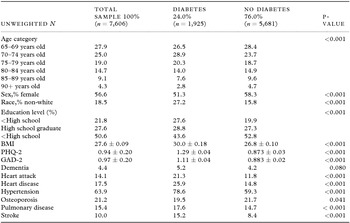
Over 80% of the participants were White, the majority of the participants were between 65 and 75 years old, and slightly more than half of the sample was female (Table 1). Nearly a quarter of the participants (24.0%) reported a diagnosis of DM. Compared with the participants without DM, those with DM were more likely to be non-White and male, to have a higher BMI, and higher self-reported depression and anxiety, and to have all medical conditions we examined, with the exception of osteoporosis.
Participant characteristics %, or mean ± standard error
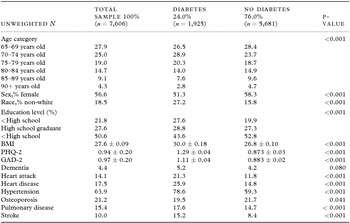
Note: Weighted data analysis: n = 7,606. BMI = body mass index (kg/m2); GAD-2 = Generalized Anxiety Disorder Scale 2 item; PHQ-2 = Patient Health Questionnaire 2 item (higher scores indicate greater depression and anxiety).
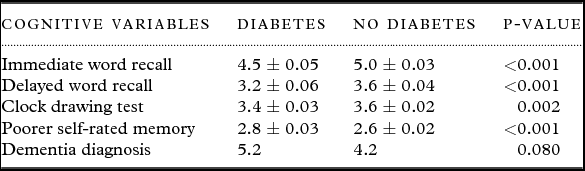
Unadjusted analyses showed that participants with reported DM performed significantly worse on the immediate word recall (4.5 words recalled vs. 5.0, p < 0.001) and delayed word recall (3.2 words recalled vs. 3.6, p < 0.001) tests, and the Clock Drawing Test (3.4 vs. 3.6, p = 0.002) than did individuals without DM (Table 2). Participants with DM also rated their memory as significantly poorer than participants without DM (2.8 vs. 2.6, p < 0.001). Those with DM also were more likely to report a dementia diagnosis (5.2% vs. 4.2%), but this association did not reach significance (p = 0.08).
Mean scores on cognitive variables by diabetes diagnosis (%, or mean ± standard error)

Note: Weighted data analysis: n = 7,061 for immediate word recall; n = 7,036 for delayed word recall; n = 6,916 for Clock Drawing Test; n = 7,019 for self-rated memory; n = 7,600 for dementia diagnosis.
After adjusting for race, age, sex, education, depression and anxiety, BMI, and multiple medical conditions, compared with participants without DM, those with self-reported DM still had significantly poorer scores on the word-list memory immediate recall (B = −0.31, 95% Confidence Interval (CI) = −0.41, −0.20) and delayed recall (B = −0.30, 95% CI = −0.43, −0.18) tests, and gave poorer self-ratings of their memory (B = 0.10, 95% CI = 0.04, 0.16) (Table 3). However, there was no longer a significant association between the DM and Clock Drawing Test scores (B = −0.07, 95% CI = −0.15, 0.005), and the association between DM and self-reported dementia diagnosis remained non-significant (odds ratio = 1.2, 95% CI = 0.92, 1.7). When we excluded participants with a history of stroke, we found that the effect size was increased. Participants with DM had even poorer scores on the word-list memory immediate recall (B = −0.33, 95% CI = −0.44, −0.21) and delayed recall (B = −0.30, 95% CI = −0.44, −0.16) as compared with the participants without DM. Further, the participants with DM also had poorer scores on the Clock Drawing Test (B = −0.10, 95% CI = −0.17, −0.02), and rated their memory as worse (B = 0.10, 95% CI = 0.04, 0.16) than participants without DM. The association between DM and self-reported dementia diagnosis remained non-significant (Odds Ratio = 1.2, 95% CI = 0.86, 1.7).
Multivariable-adjusted association between diabetes status and cognitive performance

Notes: Model 1: Adjusted for race, age, education, sex, depression and anxiety, BMI, heart attack, heart disease, hypertension, osteoporosis, pulmonary disease, and stroke. Weighted data analysis: n = 6,694 for immediate word recall; n = 6,672 for delayed word recall; n = 6,562 for Clock Drawing Test.
Model 2: Excludes participants with stroke history; adjusted for same variables as Model 1, except stroke. Weighted data analysis: n = 5,981 for immediate word recall; n = 5,964 for delayed word recall; n = 5,874 for Clock Drawing Test.
Discussion
The present study investigated the association between self-reported DM diagnosis and both cognitive performance and self-reported dementia diagnosis in a contemporary, nationally representative cohort of older Medicare beneficiaries. Results showed that, after adjustment for demographic and clinical characteristics, DM diagnosis was associated with poorer performance on tests of immediate and delayed word recall, and with poorer self-rated memory. In multivariable-adjusted sensitivity analyses that excluded stroke patients, associations between DM diagnosis and performance on tests of immediate and delayed word recall remained, and DM was associated with poorer performance on the Clock Drawing Test. There was no association in our study between DM diagnosis and self-reported dementia diagnosis. While the effect sizes for cognitive deficits were small, which is consistent with prior studies, we feel that these findings may have important clinical implications; it is important for clinicians to address risk factors for cognitive decline and dementia prior to the patient complaining of deficits, because at that point in the AD course it is likely too late to intervene successfully (Reijmer et al., Reference Reijmer, van den Berg, Ruis, Kappelle and Biessels2010; Alzheimer's Association, 2013).
Past studies, both longitudinal and cross-sectional, have also considered the association between DM and cognitive outcomes. Over a decade ago, a study done in the Framingham Heart Study cohort found that DM diagnosis and duration were associated with poorer performance on memory and visual reproduction tests; however, they did not consider dementia diagnosis as an outcome (Elias et al., Reference Elias1997). Our findings are similar to those of the Framingham Heart Study, but used a more current sample of the population. A longitudinal study in the Cardiovascular Health and Cognition Study cohort found that individuals with both DM diagnosis and an apolipoprotein E-ε4 allele had more than four times the risk for incident AD and over three times the increased risk for mixed AD, but did not report associations with performance on individual cognitive tests (Irie et al., Reference Irie2008). Similarly, in the Honolulu-Asia Aging Study cohort, a DM diagnosis and an apolipoprotein E-ε4 allele together were associated with AD and vascular dementia, as well as greater number of neuritic plaques in the hippocampus and neurofibrillary tangles in the cortex on autopsy (Peila et al., Reference Peila, Rodriguez and Launer2002). Unlike these investigations in the Cardiovascular Health and Cognition Study and the Honolulu-Asia Aging Study, we did not find an association between DM and dementia; this may be because we used a reported measure of dementia, or because we did not consider the apolipoprotein E-ε4 allele as a risk factor, as it was not available in the dataset. It may also be because, in NHATS, DM was measured by self- or proxy-reporting in later life, and evidence suggests that DM diagnosis in mid-life and longer duration of the disease is more strongly associated with dementia in later life (Roberts et al., Reference Roberts2008).
Additional findings from the Honolulu-Asia Aging Study (Peila et al., Reference Peila, Rodriguez and Launer2002) link DM and AD. AD has been linked with impaired insulin and insulin-like growth factor regulation, and DM has been associated with atrophy in areas affected early in AD and with impaired beta-amyloid clearance and tau phosphorylation that may lead to tangles and plaques characteristic of AD (Cholerton et al., Reference Cholerton, Baker and Craft2013). It has also been speculated that prolonged insulin resistance and hyperinsulinemia contribute to the development of AD pathology years or decades prior to clinical onset (Xu et al., Reference Xu, Qiu, Gatz, Pedersen, Johansson and Fratiglioni2009).
Due to the increased risk of dementia and cognitive impairment in individuals with DM seen in other studies, DM patients may be an optimal target population for AD or all-cause dementia prevention efforts. It has been found that better metabolic control among those with DM is associated with better cognitive performance (Naor et al., Reference Naor, Steingruber, Westhoff, Schottenfeld-Naor and Gries1997; Ryan et al., Reference Ryan, Freed, Rood, Cobitz, Waterhouse and Strachan2006), and greater total brain volume (Launer et al., Reference Launer2011). These findings suggest that better control over DM and early interventions for cognitive impairment and dementia in DM patients could lead to reduced burden of both diseases. This is important not only for improved healthcare but also because the cost of healthcare for those with these diseases is high. Healthcare costs associated with AD were projected at 203 billion dollars for 2013 (Alzheimer's Association, 2013), and costs for DM were at 245 billion dollars in 2012, and continue to increase; older adults and Medicare enrollees use substantially more health services than other groups (American Diabetes Association, 2013b). Further, dementia patients with DM have nearly twice the hospitalization rate as those without DM, and have nearly double the Medicare payments (Alzheimer's Association, 2013). The sample used in this study (i.e. older Medicare beneficiaries) is particularly important when considering these costs, because as the burden on our healthcare system increases, it is becoming increasingly important to reduce expenditures through effective treatment and intervention strategies in the most costly groups.
The present study's strengths include its large, nationally representative sample of older Medicare beneficiaries and inclusion of tests of memory, visuospatial ability, self-rated memory, and dementia diagnosis. Our findings, however, must be considered within the scope of several limitations. First, DM and dementia diagnosis were self-reported or reported by a proxy with a dichotomous response. Thus, it is unclear whether participants had type I or type II DM; however, impaired insulin regulation in type I DM has been associated with cognitive decline, as well (Francis et al., Reference Francis2008). Also, the study did not record diagnosis of pre-diabetes, duration of DM, use of insulin, or degree of DM control, all of which have been associated with cognitive performance (Elias et al., Reference Elias1997; Roberts et al., Reference Roberts2008; Cholerton et al., Reference Cholerton, Baker and Craft2013). In addition, DM is underdiagnosed; beyond the nearly 19 million adults with diagnosed DM, it is estimated that an additional 7 million people have undiagnosed DM (American Diabetes Association, 2013a). However, studies have shown that among Medicare beneficiaries, self-reported DM diagnosis is highly correlated (93%) with physicians’ reports of DM diagnosis (i.e. if a Medicare beneficiary says they have DM, it is nearly certain that they actually do; Day et al., Reference Day and Parker2013). Similarly, clinicians frequently fail to detect dementia; as many as half of the people living with AD are believed to be undiagnosed (Boustani et al., Reference Boustani, Peterson, Hanson, Harris and Lohr2003). Thus, even if DM and dementia diagnosis data came from physician reports, these diseases may not have been detected. In addition, the prevalence of dementia may have been lower in this study than in others due to exclusion of nursing home residents, who have high rates of dementia (Magaziner et al., Reference Magaziner2000). Further, participants with significant cognitive impairment may not remember having received a diagnosis, resulting in further misclassification. Because misclassification typically biases results toward the null, our results may underestimate the magnitude of the association between DM and cognitive outcomes in this study. The effect size of the cognitive outcomes in the study may also be attenuated because approximately 86% of the participants with a proxy-reported dementia diagnosis were unable to complete the cognitive tests. The lack of association between DM and dementia may be due to the relatively low prevalence of dementia, which in this study is based on self- or proxy report of diagnosis; therefore the absence of this finding should be interpreted with caution. Further studies with more rigorous measures of DM and dementia are needed to more precisely estimate these associations. Future studies would also benefit from including a greater range of more sensitive cognitive tasks in order to more extensively explore the relationship between DM and cognitive function. Finally, this study was cross-sectional, which prevents us from inferring directionality of the association between DM and cognitive performance. However, prior findings that DM precedes cognitive decline and dementia suggest that DM is a plausible cause of poor cognitive outcomes (Cukierman et al., Reference Cukierman, Gerstein and Williamson2005; Irie et al., Reference Irie2008).
Our findings suggest that self-reported DM diagnosis is associated with poorer cognitive performance in the general population of US older adults. This is important because of the high and increasing prevalence of DM. Middle-aged and older adults with DM represent an important target population for early intervention for prevention of progression to cognitive impairment. Prospective, nationally representative studies are needed to better understand the potential contribution of DM to cognitive impairment and decline. NHATS will provide this opportunity as data from later study waves become available.
Conflict of interest
None.
Description of authors’ roles
A. Wennberg conducted the statistical analyses and wrote the paper. R. Gottesman assisted in writing the paper. C. Kaufmann assisted with statistical analyses and in writing the paper. M. Albert, L. Chen-Edinboro, and G. Rebok assisted in writing the paper. J. Kasper is the Principal Investigator of NHATS and assisted in writing the paper. A. Spira assisted with statistical analyses and in writing the paper.
Acknowledgments
The authors would like to thank Maureen Skehan for her technical assistance navigating the NHATS data. Dr. Spira is supported by Mentored Research Scientist Development Award (1K01AG033195) from the National Institute on Aging. Christopher Kaufmann is supported by the National Institute on Aging (F31AG044052). Lenis Chen-Edinboro is supported by the National Institute of Mental Health (T32 MH014592). The content is solely the responsibility of the authors and does not necessarily represent the official views of the National Institute on Aging, National Institute of Mental Health, or the National Institutes of Health.