Introduction
The projected cost of the clinical negligence scheme for the last financial year was £2.3 billion, which represents 1.8 per cent of the National Health Service (NHS) budget in England.1 This reflects a 9.4 per cent increase in new clinical negligence claims from the 2018 and 2019 period to the 2019 and 2020 period1 and a 50 per cent increase in the number of successful claims from 2006 to 2016.2 The potential liability for known claims in the NHS exceeds £84 billion.1 Limiting the cost of litigation is crucial for the financial viability of the NHS. NHS Resolution manages clinical negligence claims for NHS organisations in England, provides indemnity cover for litigation, assists with risk mitigation and facilitates learning from claims.3
The Clinical Negligence Scheme for Trusts is a voluntary risk pooling scheme run by NHS Resolution and deals with all clinical negligence claims on behalf of the trusts. All NHS Trusts in England are members of the Clinical Negligence Scheme for Trusts. The trusts pay annual membership contributions based on their risk profile. Risk is assessed individually in view of the type and volume of clinical activity undertaken. Clinical Negligence Scheme for Trusts is responsible for meeting the legal costs and damages from clinical negligence claims on behalf of its member trusts.
England operates a fault-based compensation scheme for medical injuries.4 In the main, claims must be made within three years of the alleged negligence. In the case of children, this three-year period starts from their 18th birthday. Only a relatively small proportion of patients who have suffered harm pursue litigation.4 Compensation claims are often protracted and extremely stressful for both patients and clinicians.
The level of compensation in clinical negligence claims is directly proportional to the severity of harm.Reference Brennan, Sox and Burstin5 This is particularly pertinent for otology, a subspecialty in which most complications are objectively measurable, such as hearing loss or facial nerve palsy. In addition, the patient cohort has relatively good premorbid status. As a result, otology is potentially more susceptible to costly litigation than its subspecialty counterparts in otorhinolaryngology. The aim of this study was to review clinical negligence claims in otology in England in order to identify potential opportunities for learning, improving patient safety and decreasing litigation costs.
Materials and methods
A request for information was made to NHS Resolution regarding claims coded under ‘otolaryngology’ or ‘ENT’ between 1 April 2013 and 1 April 2018. The information received included the claim status (open or closed) and the cause of the claim with incident details and the injury related to the claim, as coded by NHS Resolution. The incident year and the year of notification to NHS Resolution were also provided. Frequently more than one cause was assigned to each claim.
Information was reviewed for all claims assigned to ‘otolaryngology’ or ‘ENT’. Using incident details, claims relating to otology were identified and categorised by diagnosis and operation where sufficient clinical information was available.
For open claims, estimated costs were calculated by NHS Resolution based on the costs already paid on the claim and the outstanding or reserve costs for each claim. For closed claims, the actual cost paid by NHS Resolution was used.
A claim dataset encompassing the prior five years of claims was used for analysis unless otherwise stated. Costs presented in this dataset were accurate as of the end of the financial year 2017 to 2018. For example, if the claim was notified to NHS Resolution in financial year 2013 to 2014, the final claim status and cost, accurate as of April 2018, was used. This allowed for a more precise analysis of actual and potential claims.
In order to compare annual changes in claim trends, an end of year claim dataset was used. This presented the claim values, for both open and closed claims, correct as of the end of the financial year in which the claim was made. For example, if the claim was made in financial year 2013 to 2014, the final claim status and costs, accurate as of April 2014, were used.
The same claim may have different values at the end of a year and in the five-year dataset, if closed after the year of notification due to differences between the reserve costs (open claims) and the costs actually paid (closed claims).
Results
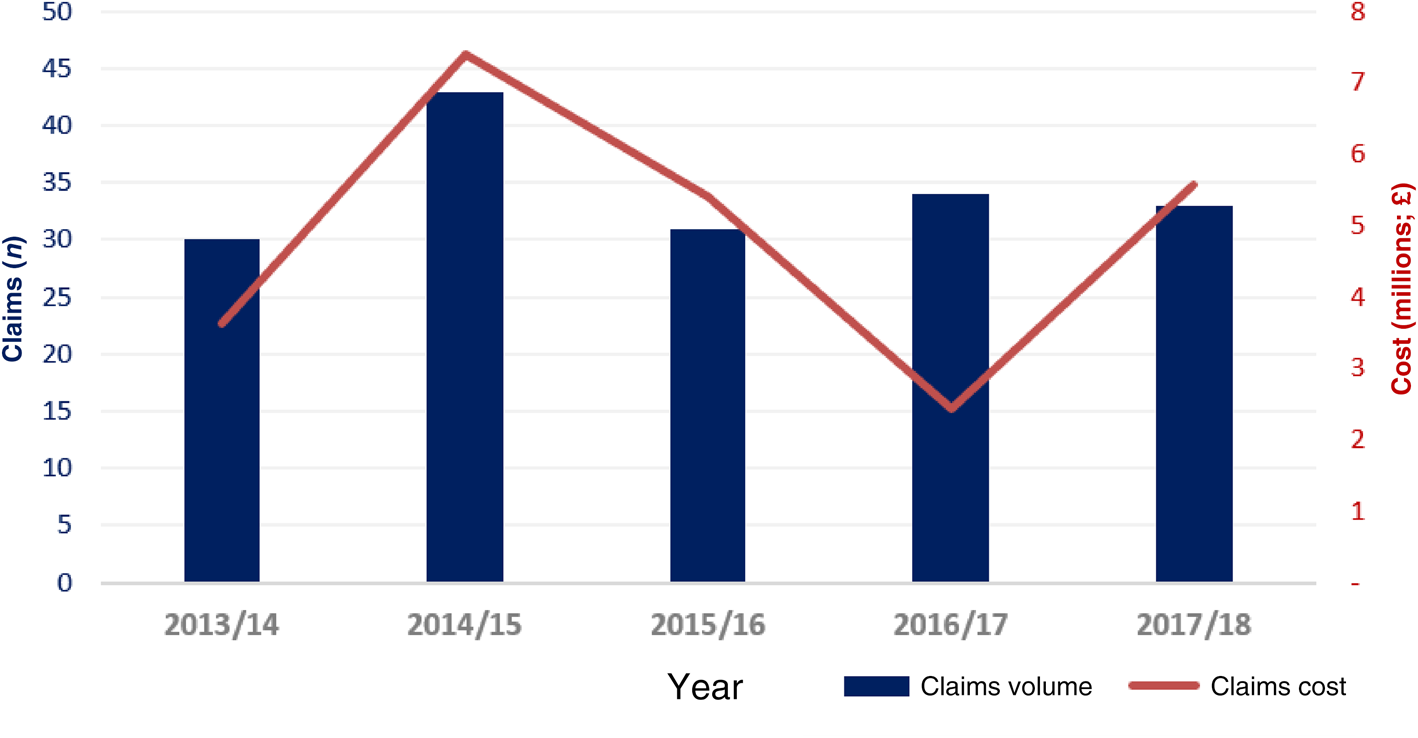
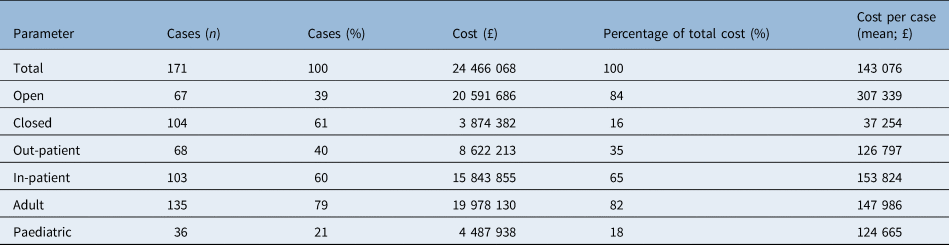
There were 750 claims from April 2013 to April 2018 notified to NHS Resolution that were categorised as otolaryngology claims. On review, 727 claims were confirmed as correctly attributed to otolaryngology. Of these, 171 claims were related to otology. Of the otology claims, the estimated total claim cost was £24.5 million, with a mean cost per case of £143 076 (Table 1). Year-on-year trends demonstrated that claim numbers varied from 30 to 45 per year, and claim costs varied between £2.4 million and £7.4 million per year (Figure 1).
Otology clinical negligence claims year on year trends from 2013 to 2018.

Cost of litigation

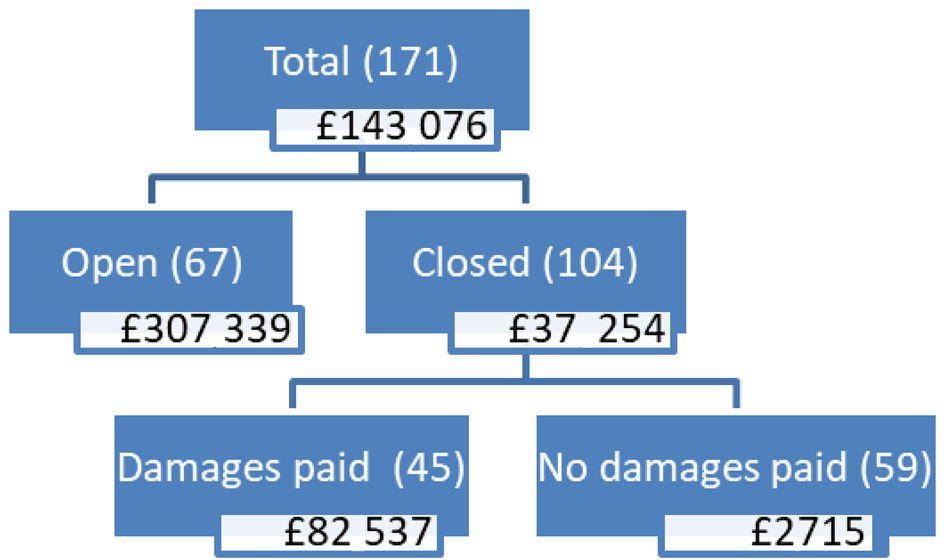
Of the otology-related claims 67 (39 per cent) were open and 104 (61 per cent) were closed at the end of the five-year period (Figure 2).
Otology clinical negligence claims. Blue box: claim number; white box: mean total claim cost.

In the closed claims group, damages were paid in 45 claims (43 per cent) with an average total claim cost of £82 537 (including legal costs). The average damages paid were £40 808. The highest amount paid was £360 831 in respect of a claim involving mastoid surgery. This was also associated with the highest legal defence cost of £62 699. The average legal defence cost for closed cases with damages paid was £7334. Fifty-nine claims in the closed claims group received no damages; however, 44 (75 per cent) of these incurred defence costs. The average defence cost was £3641. The highest defence costs from a claim in this series where damages were not paid was £73 078, in a case of partial hearing loss after failure to warn or lack of informed consent.
In the open claims group, the estimated costs were calculated by NHS Resolution based on the costs already paid and the outstanding or reserve costs for each claim. On average it was £307 339. Average estimated damages were £232 840, and the average estimated legal defence cost was £16 156. The highest estimated total claim cost in an open case was £4 162 050 in a claim related to stapedectomy surgery. This case involved the highest estimated damages of £3 462 000 and defence cost of £100 050.
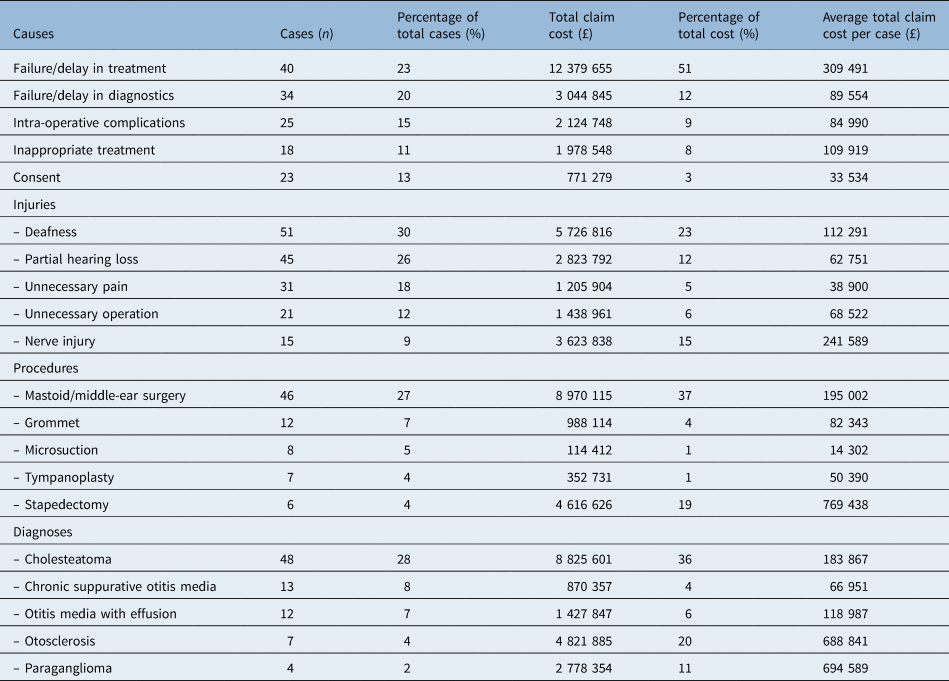
Stapedectomy was the operation with the highest average cost per claim (inclusive of damages and legal defence costs) at £769 438 (Table 2).
Cause of claim

The most common cause codes used for the 171 otology claims were ‘failure/delay in treatment’ (n = 40, 23 per cent), ‘failure/delay in diagnosis’ (n = 34, 20 per cent), ‘intra-operative complications’ (n = 25, 15 per cent) and ‘failure of consent’ (n = 23, 13 per cent). The injury codes most frequently used were deafness (n = 51, 30 per cent), partial hearing loss (n = 45, 26 per cent) and unnecessary pain (n = 31, 18 per cent). Nerve injury was cited in 15 claims (9 per cent), specifically facial nerve injury in 9 claims (5 per cent), with a mean total cost per claim (inclusive of damages and legal defence costs) of £367 395 (Table 2).
The most frequently cited diagnoses in otology claims included cholesteatoma (n = 48, 28 per cent), chronic suppurative otitis media (n = 13, 8 per cent) and otitis media with effusion (n = 12, 7 per cent). An operation was cited as a cause for litigation in 103 (60 per cent) of the otology claims. The most common operations or procedures were mastoid surgery (n = 46, 27 per cent), grommet insertion (n = 12, 7 per cent), microsuction (n = 8, 5 per cent), tympanoplasty (n = 7, 4 per cent) and stapedectomy (n = 6, 4 per cent; Table 2).
Discussion
Clinical negligence claims are a potentially rich source of learning for clinicians, enabling them to be better equipped to prevent future litigation. Several studies on litigation in otolaryngology in the UK have concluded that the review of claims by clinicians is an underutilised method for improving patient safety, advancing clinical care and limiting future litigation.Reference Patel, Harrison and Oremule6–Reference Cartwright, Baer and Atrey9 This pursuit, in the UK, is hampered by the scarce clinical information that can be ascertained. Claims are documented by legal rather than medical professionals and release of granular clinical data is exempt from disclosure under section 40(2) of the Freedom of Information Act, which protects third party personal data because of concerns regarding patient confidentiality.Reference Zorlu, Nash and Srinivasan7,Reference Cartwright, Baer and Atrey9 As a result, existing published reviews on litigation in otolaryngology are largely specialty wide, providing little information on subspecialty or operation-specific claims.Reference Patel, Harrison and Oremule6–Reference Cartwright, Baer and Atrey9
The five-year period reviewed in this study does not demonstrate a year-on-year increase in otology claims, volumes or costs. However, the 171 claims identified in the period from 2013 to 2018 far surpass the findings of Mathew et al. of 137 otology-related claims over a 15-year period (1995–2010), which is the only comparable study of otology practice in the UK.Reference Mathew, Asimacopoulos and Valentine10 This increase in litigation is mainly driven by changes in patient behaviour, claimant legal firm practice and society at large.4
Costs for clinical negligence claims varied significantly from year to year, with a sharp rise in both the volume of claims and cost in the financial year 2014 to 2015. There are no discernible trends in the data to explain this. Fluctuation in claims numbers and cost can occur in small volume specialties such as otolaryngology, especially at a subspecialty level. During this 5-year period, otology and rhinology had an equal number of clinical negligence claims (n = 171), but otology had estimated potential clinical negligence costs that were nearly 50 per cent higher than rhinology (rhinology related claims were valued at £13.6 million).Reference Navaratnam, Hariri, Ho, Machin, Briggs and Marshall11
Three otology-specific studies of clinical negligence claims are available in recent literature.Reference Mathew, Asimacopoulos and Valentine10,Reference Ruhl, Hong and Littlefield12,Reference Blake, Svider, Carniol, Mauro, Eloy and Jyung13 In the USA, the availability of databases such as Westlaw and LexisNexis, which provide detailed information on state and federal jury verdicts and settlements related to medical malpractice, allow a more detailed analysis of clinical details and cost breakdown.Reference Prabhu, Quang and Funahashi14 Ruhl et al. Reference Ruhl, Hong and Littlefield12 found that the claimant was successful in receiving compensation in 31 per cent of cases with an average of $1 131 189 (£847 266). However, Blake et al. Reference Blake, Svider, Carniol, Mauro, Eloy and Jyung13 found both lower success rates at trial of 25.5 per cent and average damages of $446 697 (£334 578).
Meaningful comparisons between costs in the USA and UK are complex because of differing legal systems and calculation methods for compensation. In the UK, the 2011 study by Mathew et al. Reference Mathew, Asimacopoulos and Valentine10 gives the only comparative data specific to otology. Eight-four per cent of closed claims over a 15-year period resulted in damages being paid, with an average amount paid of £62 700.Reference Prabhu, Quang and Funahashi14 This differs from the finding of this study which found that 43 per cent of closed claims resulted in payment of damages at an average of £40 808 per case.
Cost analysis for open claims is based on estimated total costs, inclusive of damages and legal defence, and can significantly over or underestimate costs depending on whether the claim proceeds to court and the outcome of the case. Limitations of the available dataset mean that comparison between the relative cost of pre-trial settlements and damages awarded in court is not possible.
The most common reasons cited for clinical negligence claims in otology were ‘failure/delay in treatment’ (n = 40, 23 per cent) and ‘failure/delay in diagnosis’ (n = 34, 20 per cent). These are both common cause codes for clinical negligence claims in all otolaryngology procedures.4 This is in variance to Mathew et al. Reference Mathew, Asimacopoulos and Valentine10 and Ruhl et al.,Reference Ruhl, Hong and Littlefield12 in which 50 per cent or more of claims were because of surgical error or complication, and to Blake et al. Reference Blake, Svider, Carniol, Mauro, Eloy and Jyung13 in which the need for further surgery (42.6 per cent) was the most cited cause.
Of the 48 cholesteatoma cases, 26 claims (54 per cent) cited failure to diagnose as the cause. Cholesteatoma can be easily missed and is often misdiagnosed as recurrent or chronic otitis externa.Reference Bhutta, Williamson and Sudhoff15 Ensuring that the primary care workforce and frontline junior ENT clinicians are equipped to identify ear pathology is difficult because ENT teaching in many UK undergraduate curriculums is limited.Reference Ferguson, Bacila and Swamy16 Education is also required for non-ENT specialists in primary care to provide adequate triaging and referral to specialist care.17 Telemedicine, with the incorporation of smartphone otoscopes and remote specialist review, may facilitate otology referral pathways in the future.Reference Mbao, Eikelboom, Atlas and Gallop18
Intra-operative complications and lack of informed consent were the next most frequently cited causes for clinical negligence claims in otology. Documentation in operation notes, especially inclusion of details such as use of facial nerve monitors, must be comprehensive to enable adequate legal defence against claims of negligence. If patients feel that they were not fully informed of potential risks of surgery, intra-operative complications can be cited as a cause in a negligence claim. Seventy-eight per cent (18 of 23) of consent-related claims involved patients with complications they claimed not be warned about.
The Montgomery vs Lanarkshire case in 2015 marked a seismic change in UK law on consent. Previously, assessment as to whether a clinician had provided sufficient information during the consent process was governed by the ‘Bolam test’. This asserted that the amount of information given was sufficient if deemed so by a responsible body of medical opinion. However, the Montgomery vs Lanarkshire case changed the threshold for sufficiency from the opinion of medical experts to that of a reasonable person in the patient's position.Reference Chan, Tulloch, Cooper, Smith, Wojcik and Norman19 The onus therefore now lies on the clinician to tailor the consent process to the individual patient, taking into consideration their own circumstances and interests.
This change in the law highlights the need for consent to be a process rather than a one-off event.20 Time is required for a patient to process and consider information to make an informed decision. Although preferable for both patient and surgeon, a multi-staged consent process with several appointments is difficult to achieve within the constraints of NHS practice. Operation-specific information in patient correspondence letters, use of verified information sources and patient access to a designated team member for post-appointment questions have been suggested as possible ways to enhance the consent process. In addition, the use of video consultation at a pre-consent stage has been effectively introduced during the severe acute respiratory syndrome coronavirus-2 pandemic. This has enabled clinicians to provide information and to discuss treatment in advance of surgery without the requirement for an out-patient visit.
Surgical patients in otology, unlike in many other surgical specialties, are usually medically well and undergo interventions to improve quality, rather than duration, of life. In view of the potentially devastating consequences of total hearing loss or facial nerve palsy, the inclusion of information regarding alternative treatment options is crucial to the patient's ability to give informed consent. A previous series of otology clinical negligence cases in the UK identified one claim related to stapedectomy surgery in which the patient alleged that the option of a hearing aid was not given, and thus the consent process was held to be inadequate.Reference Mathew, Asimacopoulos and Valentine10
Claim costs are proportional to the severity of the patient's disability, not the occurrence of an adverse event resulting from negligence.4 All published literature on otology claims, including this study, have found hearing loss and facial nerve damage to be the injuries most associated with successful high-damage claims.Reference Mathew, Asimacopoulos and Valentine10,Reference Ruhl, Hong and Littlefield12,Reference Blake, Svider, Carniol, Mauro, Eloy and Jyung13 The objective and testable nature of these injuries results in damages being awarded more often, as is seen in ophthalmology with claims relating to loss of vision.Reference Mathew, Ferguson and Hingorani21 Severity of injury is also a reliable predictor of size of damages awarded as seen by the difference in mean claim cost between ‘deafness’ (£112 291) and ‘partial hearing loss’ (£62 751).Reference Reilly, Horn and Sewell22 Documented evidence of a recent audiogram is important to help counsel patients regarding the necessity for surgical intervention, especially in cases of fluctuating hearing loss.Reference Ruhl, Cable and Martell23 It will also aid clinicians in the event of subsequent claims.
Of the 15 claims associated with nerve injury, 9 cited facial nerve injury specifically, of which 6 were iatrogenic. A permanent facial nerve palsy is recognised as arguably the most disastrous unintended complication of middle-ear surgery. Training in otological surgery is reliant on developing excellent understanding of middle-ear anatomy to avoid injury to the facial nerve.Reference House24 Some errors are difficult to defend from a clinical negligence viewpoint; for example, inadequate irrigation when drilling and failure to recognise key anatomical landmarks. Facial nerve intra-operative monitoring is now part of standard operating practice for ear surgery in most centres.Reference Gidley, Maw, Gantz, Kaylie, Lambert and Malekzadeh25 Failure to correctly use and document monitoring makes clinicians vulnerable to claims.Reference Lydiatt26
There were 4509 mastoid procedures (excluding cochlear implants) performed in England in the financial year 2018 to 2019.27 Considering the complex nature of this surgery, it is unsurprising that claims related to mastoid surgery (46 claims) are the highest in otology. Comparatively, grommet insertion was associated with only 12 claims despite 22 213 operations in the same period.27 Importantly, although there were only 6 claims related to stapedectomy, the mean total cost per claim was £769 438. All stapedectomy related claims cited complications (including hearing loss and facial nerve injury) as the trigger for the claim.
Claims can arise from any aspect of the patient pathway. Analysis of litigation activity trends can be used to inform clinical practice. There is a drive from the Getting it Right First Time programme in NHS England & NHS Improvement to encourage clinicians to learn from claims in a similar way to learning from patient safety incidents. Unfortunately, clinicians will be currently unaware of clinical negligence claims unless they are directly involved in the incident and, even then, they are often involved late in the process.
Conclusion
Litigation in otology is associated with high value claims because of the objective nature of complications and their potentially devastating implications. Furthermore, one of the main causes of claims is inadequate pre-operative provision of information. The law requires the clinician to tailor the consent process to each individual patient. Such a robust patient-centred process is difficult to achieve within the constraints of NHS practice.
Despite high-cost litigation in otology, information regarding clinical negligence claims remains a restricted and underutilised learning source. The open disclosure of clinical information would enable improvement in the safety and the quality of otological care. The review of current practice in response to clinical negligence is a duty to patients who have suffered harm, a necessary means of clinical improvement and a feasible method by which the NHS can seek to halt the rising tide of claims.
Acknowledgement
Lisa Paget, Getting it Right First Time, Litigation Work Stream Project Manager.
Competing interests
None declared