Introduction
Bereaved parents are at heightened risk for numerous detrimental mental and physical health outcomes, including psychiatric illness, existential suffering, marital problems, and even death (Li et al., Reference Li, Precht and Mortensen2003, Reference Li, Laursen and Precht2005; Oliver, Reference Oliver1999). They may also be at increased risk for debilitating protracted grief reactions, such as prolonged grief disorder (PGD). Symptoms of PGD include challenges to one's sense of identity and feeling that life is empty or meaningless following the loss of an attachment figure (Lichtenthal et al., Reference Lichtenthal, Currier and Neimeyer2010; Prigerson et al., Reference Prigerson, Horowitz and Jacobs2009a; Rando, Reference Rando1986). Such symptoms appear particularly prominent among parents who have lost a child, who may struggle with their sense of identity and purpose, the meaning of their child's life, and making sense of their untimely loss (Davies, Reference Davies2004; Lichtenthal & Breitbart, Reference Lichtenthal and Breitbart2015; Lichtenthal et al., Reference Lichtenthal, Currier and Neimeyer2010; Wheeler, Reference Wheeler1993). It is thus not surprising that studies have demonstrated the association between challenges with finding meaning and PGD in grieving parents (Davies, Reference Davies2004; Lichtenthal & Breitbart, Reference Lichtenthal and Breitbart2015; Lichtenthal et al., Reference Lichtenthal, Currier and Neimeyer2010; Wheeler, Reference Wheeler1993).
These central challenges to parents’ sense of meaning, purpose, and identity suggest the potential utility of a meaning-centered therapeutic approach in reducing PGD symptoms; however, although meaning-centered approaches have long been described in the bereavement literature and have been applied in clinical practice, empirical evaluations of such interventions have been limited, particularly following the death of a child (MacKinnon et al., Reference MacKinnon, Smith and Henry2015; Neimeyer, Reference Neimeyerin press). Because of the potential therapeutic value of enhancing meaning in bereaved parents (Neimeyer, Reference Neimeyer2000, Reference Neimeyer2001a, Reference Neimeyerin press; Stroebe & Schut, Reference Stroebe, Schut and Neimeyer2001), we developed a manualized intervention, Meaning-Centered Grief Therapy (MCGT), designed to enhance bereaved individuals’ sense of meaning and reduce PGD symptoms. MCGT is an adaptation of Breitbart et al.’s Meaning-Centered Psychotherapy (MCP; Breitbart et al., Reference Breitbart, Rosenfeld and Gibson2010, Reference Breitbart, Poppito and Rosenfeld2012, Reference Breitbart, Rosenfeld and Pessin2015, Reference Breitbart, Pessin and Rosenfeld2018), a brief intervention originally developed to enhance meaning in advanced cancer patients that incorporates the principles of Viktor Frankl's (Reference Frankl1959/1992) logotherapy.
Given that cancer is the leading cause of death by disease among children (American Cancer Society, 2018) and in view of the crisis in meaning that bereaved parents commonly face (Davies, Reference Davies2004; Lichtenthal & Breitbart, Reference Lichtenthal and Breitbart2015; Lichtenthal et al., Reference Lichtenthal, Currier and Neimeyer2010; Wheeler, Reference Wheeler1993, Reference Wheeler2001), our initial application of MCGT has been with parents who have lost a child to cancer. The preliminary development of MCGT followed Stage I of the Stage Model of Behavioral Therapies, including manual writing, pilot testing, and adherence measure development (Rounsaville et al., Reference Rounsaville, Carroll and Onken2001). We obtained feedback from stakeholders, including bereaved parents and grief therapists, which led to important revisions of the MCGT manual (Lichtenthal et al., Reference Lichtenthal, Lacey, Roberts and Breitbart2017). We also sought to ensure that bereaved parents would actually be able and willing to use the intervention we developed and thus to address the numerous emotional and logistical barriers to accessing support they face (Lichtenthal et al., Reference Lichtenthal, Roberts and Bohn2011b), we pilot tested delivering this intervention via videoconferencing.
The present pilot study examined the preliminary feasibility, acceptability, and efficacy of MCGT in open trials through which the intervention was delivered in person and via videoconferencing. We expected that MCGT would be feasible and acceptable, as evidenced by high treatment attendance, low attrition, and positive feedback. Furthermore, we hypothesized that MCGT would improve parents’ sense of meaning and PGD symptoms. Secondary outcomes included depression, hopelessness, anxiety, continued bonds, attachment dimensions, positive and negative affect, and health-related quality of life.
Methods
Study design and procedures
A brief open trial of MCGT was delivered in person with parents (n = 6) with elevated PGD symptoms to evaluate and refine the treatment through active participant feedback, and to identify ways to improve therapeutic alliance to maximize the impact of delivery via videoconferencing. Another brief open trial (n = 5) was then conducted, delivering MCGT via videoconferencing to iron out any logistical challenges in advance of the pilot randomized controlled trial (RCT).
Biological, adoptive, and stepparents who lost a child younger than age 25 to cancer between six months and six years ago and who were age 18 or older, English speaking, scored 34 or greater on the Prolonged Grief-13 (PG-13; Prigerson et al., Reference Prigerson, Horowitz and Jacobs2009b), and were able to provide informed consent were eligible. PG-13 scores of ≥34 were selected based on analyses from our earlier research, through which we identified 34 as 1 SD above the sample mean (Lichtenthal, Reference Lichtenthal2011). The cutoff of 34 was then used to identify struggling bereaved parents for qualitative interviews in a prior mixed methods study aimed at obtaining information to develop MCGT (Lichtenthal, Reference Lichtenthal2011). Participating parents were required to be at least six months postloss to meet criteria for PGD to avoid pathologizing of acute bereavement distress in the immediate wake of the death. The upper limit of six-year postloss was chosen because of research demonstrating that, for many parents, grief symptoms remain elevated for at least six years after their loss (Lannen et al., Reference Lannen, Wolfe and Prigerson2008). For those receiving MCGT through videoconferencing, they had to reside in the state of New York, where the interventionist was licensed. Exclusion criteria included significant cognitive impairment or psychiatric disturbance as determined by the study team.
All procedures were reviewed and approved by the Institutional Review Board at Memorial Sloan Kettering Cancer Center. Potential participants were identified by clinician referral, with approval from the deceased child's treating physician and hospital administration. Parents were initially contacted with a sensitively worded letter describing the study and stating that the research staff would be contacting parents within two weeks to discuss their interest. The mailing also provided parents with a self-addressed opt-out postcard and contact information to notify the research staff if they would not like to be contacted further. The research staff called parents within approximately two weeks of the initial letter mailing to assess interest and eligibility. Interested and eligible parents provided informed consent over the phone. For the first open trial, local participants who could likely attend in-person sessions were specifically targeted. In cases in which parents potentially were interested in participating but could not travel for in-person sessions, we arranged to contact them at the initiation of the second open trial, in which MCGT was delivered through videoconferencing. Aside from this, recruitment strategies did not differ between the two open trials.
All therapy sessions were audio-recorded and/or video-recorded with participant permission; audio-recording was required, and video-recording was optional. As is common in initial field testing of interventions (Rounsaville et al., Reference Rounsaville, Carroll and Onken2001), all MCGT sessions were delivered by the first author, who has extensive training and supervisory experience in MCP and developed the MCGT manual. Participants in the first open trial received 16 weekly sessions of MCGT, 60–90 minutes in length, delivered in person. Sessions were delivered through videoconferencing in the second open trial. Explicit instructions, training, and technical support for videoconferencing were provided, with more in-depth training for parents who had limited computer experience.
Assessments were conducted at preintervention (T1), mid-intervention (T2), postintervention (T3), and at a three-month postintervention follow-up (T4). All participants received a $50 incentive for completing the study activities. Participants in both open trials were asked to invite a support provider (e.g., spouse/partner, friend, adult child) to attend the ninth MCGT session. This session was audio- and/or video-recorded and a separate consent was obtained from the support provider.
Intervention description
Overview of MCGT
MCGT is a 16-session, manualized, one-on-one cognitive-behavioral-experiential-existential intervention that uses psychoeducation, structured discussion, and experiential exercises focusing on themes related to meaning, identity, purpose, and legacy. Sessions take between 60 and 90 minutes. Adapted from MCP for advanced cancer patients (Breitbart & Poppito, Reference Breitbart and Poppito2014), MCGT is principle driven, highlighting four core concepts throughout treatment, namely, helping parents learn to recognize that they have the ability: (1) to choose their attitude in the face of suffering; (2) to connect to sources of meaning in their lives; 3) to choose how they construct meaning about different life events, including the death; and 4) to remain connected to their child and continue their role as parent (Lichtenthal et al., Reference Lichtenthal, Lacey, Roberts and Breitbart2017).
MCGT acknowledges the grief that parents are experiencing. By highlighting the choices that they have in a situation that may feel beyond their control, MCGT helps parents learn how to coexist with their grief through meaning. Specifically, the intervention assists parents with understanding how sources of meaning in their lives can be used as resources to help give them a reason for engaging in life despite their grief. It also helps parents create a coherent narrative that incorporates the profound significance of their child's life into their own life story, facilitating preservation of their connection and bond to their child. Within the MCGT framework, cognitive schemas and techniques (Butler et al., Reference Butler, Chapman and Forman2006; Tatrow & Montgomery, Reference Tatrow and Montgomery2006) and grief psychoeducation for parents and their primary supporters are incorporated to enhance meaning-making and reframe maladaptive cognitions, facilitating discussion of how to honor the child's legacy. At the conclusion of each session, parents are presented with “steps for the week,” involving completion of questions they will discuss in the following session. It is recommended that parents will prepare their responses in writing in advance of the next session, as our research has shown that directed writing can assist with prolonged grief symptoms (Lichtenthal & Cruess, Reference Lichtenthal and Cruess2010). We understand, however, this is not realistic for many parents, and provide ample time for contemplation of the questions in each session.
Theoretical foundation
There are two levels of conceptualization that guide MCGT. First is the focus on addressing challenges to finding meaning, purpose, and identity that many grieving individuals face. As noted previously, to address such existential distress, MCGT applies the conceptual model suggested by Frankl (Reference Frankl1959/1992) and used in MCP whereby meaning and purpose can be found through connectedness with sources of meaning: those relationships, activities, roles, and experiences that an individual finds most valued and meaningful (Breitbart & Poppito, Reference Breitbart and Poppito2014). These sources of meaning can buoy individuals through times of suffering. Furthermore, connection to meaningful relationships, activities, roles, and experiences can provide opportunities to feel more “like themselves,” addressing challenges to their sense of identity. Central to this model is the principle that individuals have the freedom to choose their attitude toward their suffering, and that this attitude (i.e., the way they face the adversity before them) can be a source of meaning in and of itself (Breitbart & Poppito, Reference Breitbart and Poppito2014; Frankl, Reference Frankl1959/1992). MCGT also incorporates principles of meaning reconstruction (Neimeyer, Reference Neimeyer2001b; Neimeyer, in press), with its tandem emphasis on helping mourners (1) find meaning in the loss and in their lives in its aftermath, and (2) reconstruct a sustaining bond to the deceased to reaffirm attachment security or address unfinished business. This is largely done through experiential exercises that facilitate emotional processing, integration of the loss, and building of distress tolerance.
Over the course of 16 sessions, MCGT systematically touches on each of these different facets of meaning (e.g., sources of meaning, choosing one's attitude in the face of suffering, sense-making, benefit-finding, posttraumatic growth, legacy), highlighting specific concepts in each session while also weaving in the core principles described previously as indicated. The rationale for this approach of examining multiple meaning-related angles stems from our qualitative research with bereaved parents. This work demonstrated that, although various meaning constructs could be distinguished in parents’ narratives, they also had substantial overlap (Lichtenthal et al., Reference Lichtenthal, Lacey, Roberts and Breitbart2017). For example, the process of making sense of the loss (sense-making) and their suffering sometimes involved finding a greater positive significance of their pain (benefit-finding) and child's life (legacy), directing their own personal mission (purpose) in the world postloss. Such complexities suggest that enhancement of meaning in parents who experience existential and meaning-making challenges can be achieved through various avenues. We have termed this the “Reciprocal Pathway Theory of Meaning-Making” because of the empirical observation that enhancing one domain of meaning may positively affect another (e.g., a bereaved parent's sense of purpose may be increased through devoting herself to creating meaning in her child's life and legacy) (Lichtenthal et al., Reference Lichtenthal, Applebaum and Breitbart2011a, Reference Lichtenthal, Roberts and Shuk2011c, Reference Lichtenthal, Lacey, Roberts and Breitbart2017; Lichtenthal & Breitbart, Reference Lichtenthal and Breitbart2015). This suggests there are multiple “clinical entry points” through which a therapist can intervene to enhance meaning (Lichtenthal et al., Reference Lichtenthal, Applebaum and Breitbart2011a, Reference Lichtenthal, Roberts and Shuk2011c); thus, across the 16 sessions, the therapist is working from different vantage points, ensuring that various facets of meaning are considered and explored to the extent they may be helpful for a given parent. The concept of choice is highlighted repeatedly to empower parents and highlight freedom in the face of situations that are beyond their control, such as their profound loss. Any resulting enhancement in meaning can be viewed as an intermediary outcome (a construct to be enhanced in its own right), and a mediator, driving improvement in multiple psychosocial outcomes, including PGD symptoms. These improvements may be bidirectional, with reductions in other outcomes in turn resulting in further enhancements in meaning.
The second level of conceptualization examines more specifically MCGT's hypothesized mechanisms of change. The theoretical foundation is largely informed by the cognitive-behavioral model, which has demonstrated efficacy in improving prolonged grief, mood, and anxiety (Boelen, Reference Boelen2006; Bryant et al., Reference Bryant, Kenny and Joscelyne2017; Tolin, Reference Tolin2010). Meaning reconstruction results in cognitive shifts, including development of an adaptive, coherent perspective of one's life story as well as adaptive perspectives about specific situations associated with guilt, regret, and anger (Lichtenthal et al., Reference Lichtenthal, Lacey, Roberts and Breitbart2017). MCGT assists with reconstructing unhelpful thoughts that may have their origins in preexisting cognitive schemas (e.g., a belief that being emotional is a sign of weakness, a belief that one is incompetent). These shifts can result in a reduction in negative affect. Engagement with sources of meaning (e.g., relationships, valued activities, experiences) has overlap with behavioral activation and is thus expected to similarly result in positive experiences, cognitions, and affect (Lejuez et al., Reference Lejuez, Hopko and Hopko2001). Enhancement of such positive outcomes is in turn expected to improve depressive symptoms (Lejuez et al., Reference Lejuez, Hopko and Hopko2001) and prolonged grief (Boelen & van den Bout, Reference Boelen and van den Bout2002; Ong et al., Reference Ong, Fuller-Rowell and Bonanno2010).
MCGT also draws from attachment theory (Bowlby, Reference Bowlby1978), continuing bonds theory, and the cognitive attachment model of prolonged grief (Maccallum & Bryant, Reference Maccallum and Bryant2013). The caregiver role commonly remains active after death (Bowlby, Reference Bowlby1978), and so MCGT provides opportunities for parents to continue to engage in acts of nurturance and care for the child. As the parent is gradually transforming the relationship through consideration of new ways of connecting, the continued bond to the child offers presence as an antidote to the sense of absence (Field et al., Reference Field, GalOz and Bonanno2003). This preserves some structure of self-identity, but as suggested by the cognitive attachment model (Maccallum & Bryant, Reference Maccallum and Bryant2013), MCGT facilitates consideration of unique aspects of the griever's identity that are not “merged” with the deceased (Maccallum & Bryant, Reference Maccallum and Bryant2013). The intervention supports accessing of autobiographical memory information to develop a coherent life story that includes the deceased as part of the parent's past, supports ways of connecting in the present, and helps with envisioning a future in which the child is not physically present. In sum, through structured exercises and discussion, MCGT helps parents transform the caregiving role in a manner that preserves the relationship with their deceased child and aspects of their identity in new, adaptive, and meaningful ways (Bowlby, Reference Bowlby1978; Ronen et al., Reference Ronen, Packman and Field2009), while simultaneously supporting development of future goals and an identity that is independent of the deceased child (Maccallum & Bryant, Reference Maccallum and Bryant2013).
Measures
Demographic, medical, and mental health background information was collected at T1. All other outcomes described were assessed at T1, T2, T3, and T4. The primary outcome was PGD symptoms as measured by the widely used, validated PG-13 (Prigerson et al., Reference Prigerson, Horowitz and Jacobs2009a). The PG-13 assesses the frequency of four grief-related symptoms in the past month and the severity of seven current grief-related symptoms using a 5-point Likert-type scale. Additional items evaluate symptom duration and functional impairment. Scores range from 11 to 55, with high scores representing elevated PGD symptoms (Prigerson et al., Reference Prigerson, Horowitz and Jacobs2009a).
Sense of meaning was an intermediary outcome, assessed by the Life Attitude Profile-Revised (LAP-R), a valid multidimensional measure with 48 items rated on a 7-point Likert scale (Reker, Reference Reker1992). The LAP-R has six subscales, including Purpose, Coherence, Choice/Responsibleness, Death Acceptance, Existential Vacuum, and Goal Seeking. This study focused on the Personal Meaning Index (PMI), which is a composite of the Purpose and Coherence subscales reflecting having life goals, a sense of direction, and an integrated understanding of oneself and the world (Reker, Reference Reker1992). Scores on the PMI range from 16 to 112, with higher scores reflecting a greater sense of personal meaning in life. The LAP-R has high internal consistency, with Cronbach alpha ranging from 0.77 to 0.91 (Reker, Reference Reker1992). Meaning was also measured using a single item from the McGill Quality of Life Questionnaire (MQOL) that asks participants to complete the statement, “Over the past two days, my life has been…” using a response scale ranging from 0 (utterly meaningless and without purpose) to 10 (very purposeful and meaningful) (Cohen et al., Reference Cohen, Mount and Bruera1997). Another facet of meaning is posttraumatic growth, which reflects positive by-products of the loss experience and was assessed with the reliable, validated 21-item Posttraumatic Growth Inventory (PTGI). The PTGI has five subscales, each reflecting a different content area of growth that an individual may have experienced as a result of adversity faced: Relating to Others, New Possibilities, Personal Strength, Spiritual Change, and Appreciation of Life. Scores on these subscales as well as a total score reflect higher levels of posttraumatic growth (Tedeschi & Calhoun, Reference Tedeschi and Calhoun1996). The degree to which parents experienced a continued connection with their child was measured by the validated, reliable Continuing Bonds Scale (CBS), an 11-item measure (Field et al., Reference Field, GalOz and Bonanno2003). Responses are rated using a Likert-type scale that ranges from 1 (not at all) to 5 (very true), yielding a total score ranging from 11 to 55.
Several secondary outcomes were evaluated as well. Depressive symptoms were measured by the Center for Epidemiological Studies Depression Scale-Revised (CESD-R), a 20-item, reliable, self-rated measure (Bjelland et al., Reference Bjelland, Dahl and Haug2002; Zigmond & Snaith, Reference Zigmond and Snaith1983). Responses range from 0 (not at all or less than one day) to 4 (nearly every day for two weeks), with higher scores reflecting worse symptoms of depression. Hopelessness was assessed by the Beck Hopelessness Scale (BHS), a well-validated 20-item true–false measure of participants’ degree of pessimism and hopelessness, with scores ranging from 0 to 20 (Beck et al., Reference Beck, Weissman and Lester1974). State and trait anxiety was assessed with the 40-item, validated, and reliable State-Trait Anxiety Scale (Spielberger, Reference Spielberger1983). Twenty items assess emotional states experienced in the present moment, whereas the remaining items assess how the respondent generally feels. Responses range from 1 (almost never) to 4 (almost always), with higher scores reflecting increased anxiety (Spielberger, Reference Spielberger1983). Positive and negative affect were evaluated using the widely used, validated 20-item measure Positive and Negative Affect Schedule (PANAS), asking participants to evaluate their positive affect and negative affect on the day of completion (Watson et al., Reference Watson, Clark and Tellegen1988). Items are rated on a 5-point scale from 1 (very slightly or not at all) to 5 (extremely), with higher scores reflecting higher levels of positive or negative emotion. We evaluated health-related quality of life with the RAND 36-Item Short Form Health Survey, a reliable and valid instrument that assesses eight domains of health, including physical functioning, bodily pain, role limitations due to physical health problems, role limitations due to personal or emotional problems, emotional well-being, social functioning, energy/fatigue, and general health perceptions (Ware & Sherbourne, Reference Ware and Sherbourne1992). Higher scores on the RAND 36-Item Short Form Health Survey reflect more positive health (Ware & Sherbourne, Reference Ware and Sherbourne1992).
We evaluated therapeutic alliance with the Working Alliance Inventory-Short Form (Tracey & Kokotovic, Reference Tracey and Kokotovic1989), a 12-item multidimensional validated scale that was given to participants at T2 and T3. Acceptability was measured at T3 by a postintervention questionnaire that measured the most and least helpful treatment components and assessed satisfaction with treatment length.
Data analysis
To characterize preliminary feasibility and acceptability, descriptive statistics of postintervention questionnaire ratings, rates of recruitment, reasons for refusal, attrition, and number of sessions were calculated. To characterize preliminary treatment effects, Cohen d for change scores was calculated as a measure of effect size, relative to baseline, for pairwise-complete data at each longitudinal timepoint.
Results
Participant characteristics
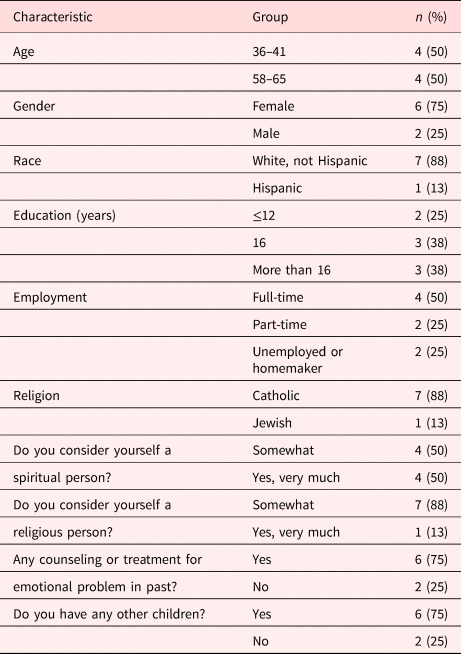
Background data were available for the eight of 11 participants who initiated MCGT sessions. Participants were primarily female (75%), white, non-Hispanic (88%), and college educated (76%). The age of participants ranged from 36 to 65, with a mean of 49.4 years (SD = 10.8). Participant characteristics are presented in Table 1. Participants who received MCGT in-person did not differ statistically from those receiving the videoconference format on baseline or longitudinal measures, including the PG-13, LAP-R PMI, or the CBS (all p values > 0.10). Longitudinal trends were also visually compared and appeared comparable between groups. Data from both open trials were therefore compiled in our presentation and discussion of the study findings.
Participant background characteristics

Descriptive statistics for the eight participants for whom baseline data were available. Mean age was 49.4 years (SD = 10.8), with a range of 36–65 years.
Feasibility, acceptability, and therapeutic alliance
We examined the proportion of patients approached who consented, the proportion approached who declined participation, reasons for refusal, and the proportion approached who were ineligible. In total, 78 parents were approached for the study. Twenty-two (28%) were unreachable and 21 (27%) were ineligible (three because they were non-English speaking, 10 because of geography, eight because PG-13 scores did not meet the threshold). Twenty (26%) parents declined, with reasons for refusal including it being too painful (n = 4), coping satisfactorily (n = 4), geographical barriers (n = 3), time barriers (n = 3), study not applicable to parent (n = 3), prior negative experience in research (n = 1), and no reason given (n = 2). Thirteen of the 56 (23%) parents reached were eligible and expressed interest, and 2 of 13 (15%) were lost to follow-up before enrolled.
Eleven participants enrolled in the open trials. Of the six participants who enrolled in the in-person open trial, four (67%) completed the treatment protocol. One participant dropped out before completing the T1 assessment, and one participant dropped following the eighth MCGT session, before completing the T2 assessment. Both participants dropped out because of difficulty traveling to the hospital for sessions. Of the five participants in the videoconferencing open trial, two (40%) completed all 16 sessions. Two parents dropped after screening, but before T1. One parent did so because of increased demands at work; the other was provided with a tablet for videoconferencing by our group, but had difficulty with Internet access and expressed it was time to “move on” from the hospital. One participant dropped out after completion of nine MCGT sessions and was lost to follow-up.
Of the eight participants who started sessions, six (75%) completed all 16 sessions. Across both open trials, 11 participants completed screening data, eight participants provided T1 data, seven participants provided T2 data, and six participants completed T3 data. Acceptability was evaluated with a postintervention questionnaire. All participants provided positive feedback about how MCGT helped them and found the length of the intervention satisfactory. Feedback about the least helpful aspects of MCGT was also provided (Table 2).
Postintervention survey responses

Six participants provided postintervention responses. Each number listed next to the two open-ended question responses corresponds to a single participant (i.e., participant 1, 2, 3, etc.).
Therapeutic alliance as measured by the WAI was also evaluated at T2 (M = 76.4, SD = 8.3; n = 7) and T3 (M = 78.0, SD = 10.8; n = 6). The WAI Total Scores were comparable (p > 0.78) for the in-person participants (T2, M = 75.75; T3, M = 77.00) and videoconferencing (T2, M = 77.33; T3, M = 80.00).
Preliminary evidence for treatment efficacy
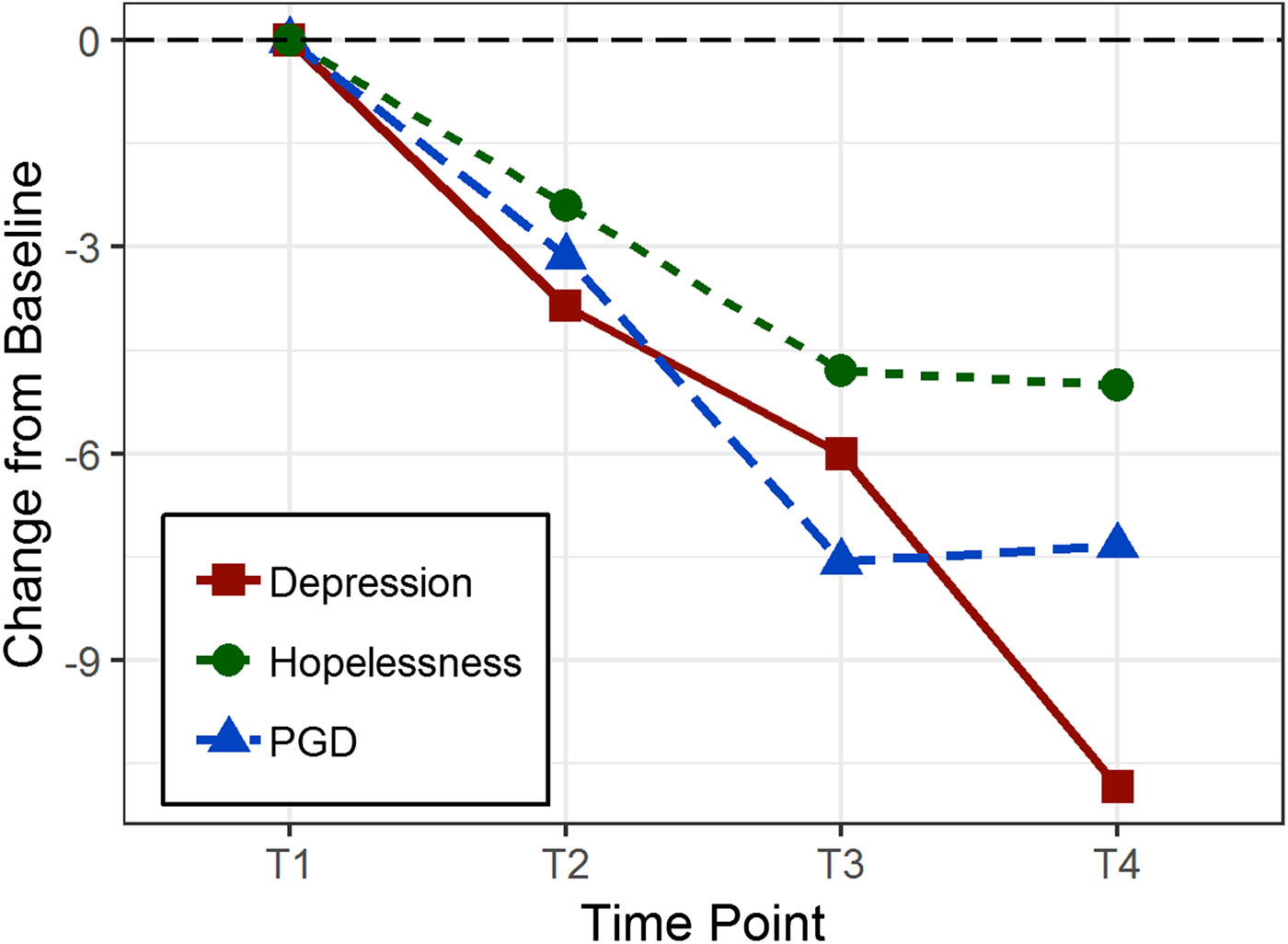
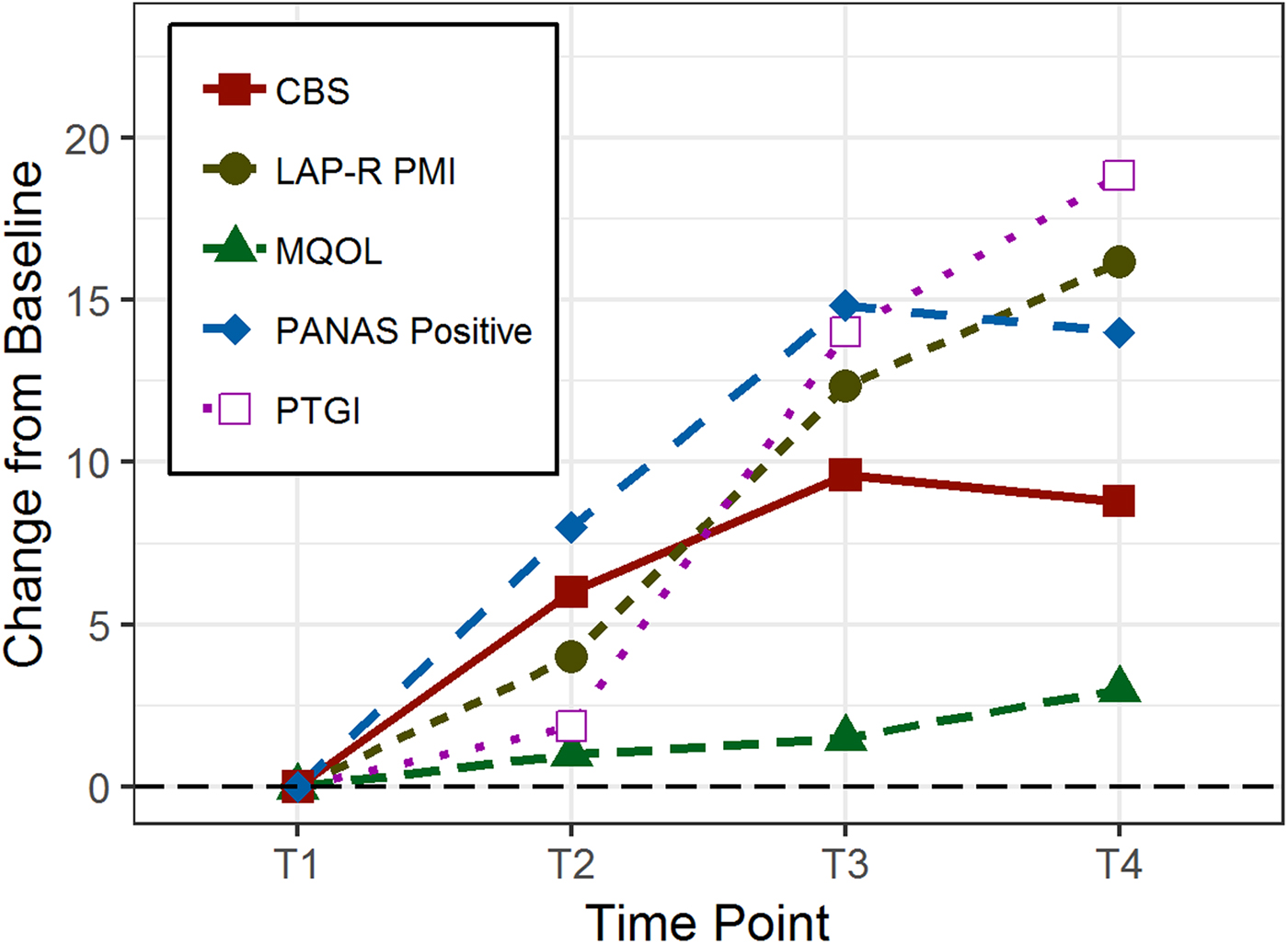
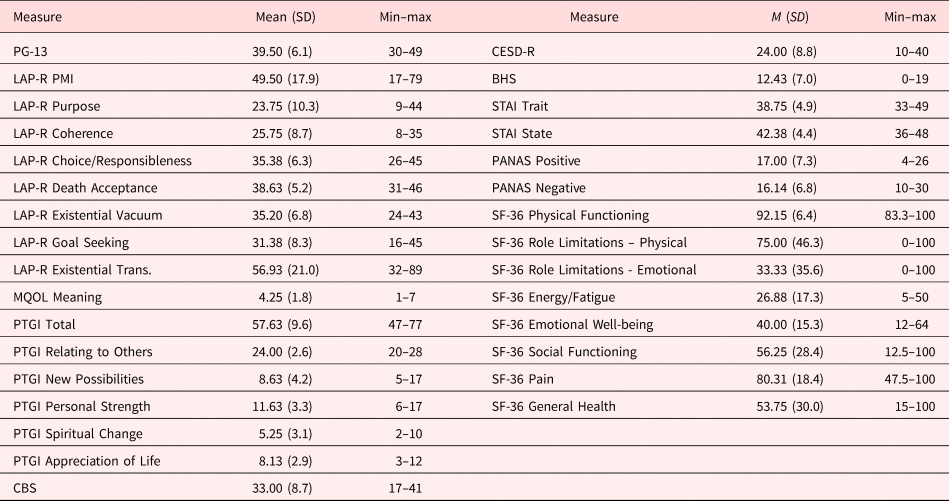
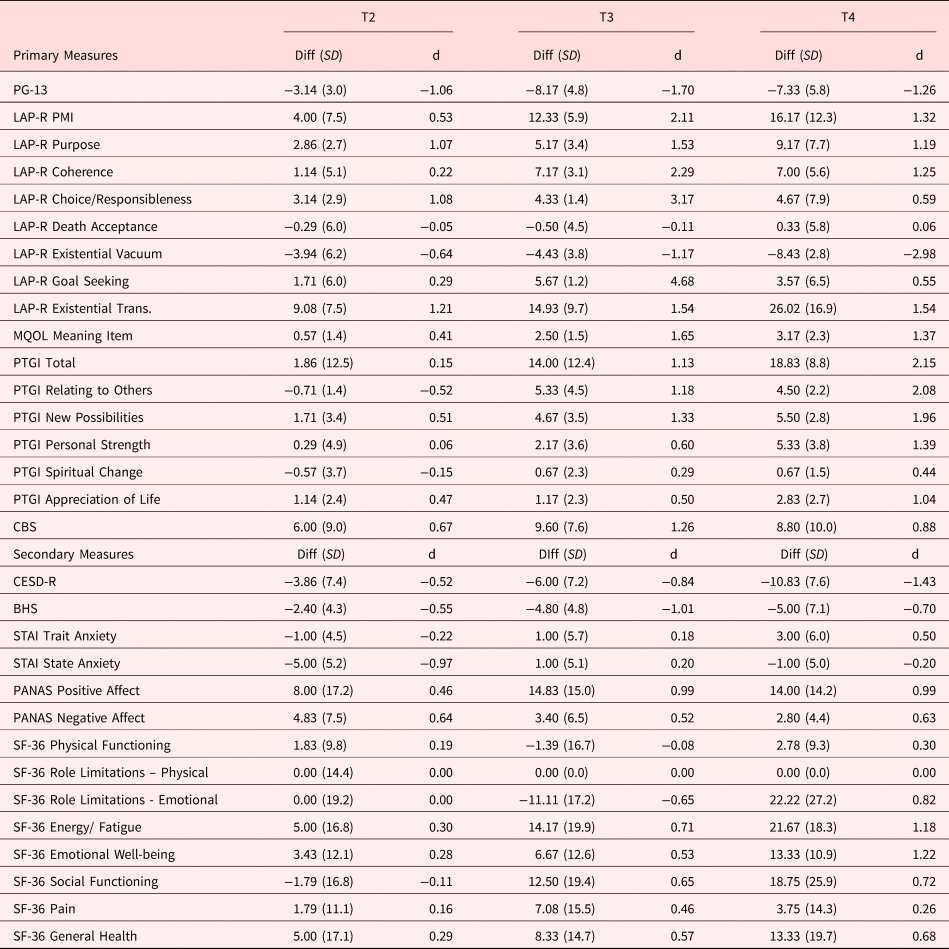
Numerous score improvements were observed from baseline to postintervention, many of which were maintained through the three-month follow-up assessment. Table 3 shows baseline descriptive statistics and Table 4 provides longitudinal change scores and effect size estimates. Large posttreatment (T3) intervention effects (Cohen d ≥ 0.80) were observed on the PG-13, LAP-R PMI, MQOL meaning item, CESD-R, BHS, CBS, PTGI total, and PANAS Positive Affect measures. Moderate posttreatment intervention effects (0.50 ≤ d < 0.80) were observed in the MOS Energy/Fatigue, Emotional Well-being, Social Functioning, Pain, and General Health subscales. At the three-month follow-up assessment, effects were generally maintained for the PG-13, LAP-R PMI, MQOL meaning item, BHS, and CBS. Effects were even stronger at three months for the CESD-R, PTGI total and subscales, and MOS Social Functioning and General Health. Efficacy results were inconsistent or conflicting for State-Trait Anxiety Inventory State and Trait, as well as MOS Physical Functioning and Role Limitations Due to Emotional Problems. Figures 1 and 2 illustrate the change over time observed in several outcomes.
The figure depicts mean change in each measure, at each timepoint, relative to baseline. Pairwise complete data are used to maximize sample size, thus not all participants included for T2 analysis were available for T3 and T4 analysis. For interpretation of size of effects, see individual measure ranges in Table 1. PGD, Prolonged grief symptoms; T1, Pre-intervention; T2, Mid-intervention; T3, Post-intervention; T4, 3 months post-intervention.

The figure depicts mean change in each measure, at each timepoint, relative to baseline. Pairwise complete data are used to maximize sample size, thus not all participants included for T2 analysis were available for T3 and T4 analysis. For interpretation of size of effects, see individual measure ranges in Table 1. LAP-R PMI, Life Attitude Profile-Revised Personal Meaning Index; MQOL, McGill Quality of Life Meaning Item; T1, Pre-intervention; T2, Mid-intervention; T3, Post-intervention; T4, 3 months post-intervention.

Participant baseline measures

BHS, Beck Hopelessness Scale; CBS, Continuing Bonds Scale; CESD-R, Center for Epidemiologic Studies Depression Scale – Revised; LAP-R, Life Attitude Profile-Revised; max, maximum; min, minimum; MQOL, McGill Quality of Life; PANAS, Positive and Negative Affect Schedule; PG-13, Prolonged Grief-13; PMI, Personal Meaning Index; PTGI, Posttraumatic Growth Inventory; SF-36, 36-Item Short Form Survey; STAI, State-Trait Anxiety Inventory; T2, mid-intervention; T3, postintervention; T4, 3 months postintervention.
Changes in prolonged grief symptoms, meaning, and continuing bonds from baseline through follow-up

Measures of change are based on the subset of participants with both a baseline value and the applicable longitudinal timepoint. Cohen d reflects the longitudinal gain, such that a positive value indicates an increase and negative value indicates a decrease; optimal direction of change is dependent on the measure.
BHS, Beck Hopelessness Scale; CBS, Continuing Bonds Scale; CESD-R, Center for Epidemiologic Studies Depression Scale – Revised; Diff, M difference; LAP-R, Life Attitude Profile-Revised; MQOL, McGill Quality of Life; PANAS, Positive and Negative Affect Schedule; PG-13, Prolonged Grief-13; PMI, Personal Meaning Index; PTGI, Posttraumatic Growth Inventory; STAI, State-Trait Anxiety Inventory; SF-36, 36-Item Short Form Survey; T2, mid-intervention; T3, postintervention; T4, three months postintervention.
Discussion
The current study offers preliminary evidence of the feasibility, acceptability, and promise of MCGT in improving psychological adjustment in parents who have lost a child to cancer. Participants provided generally positive feedback about the intervention, while also suggesting ways to strengthen the intervention, such as offering additional coping skills and reducing the emphasis on Frankl's (Reference Frankl1959/1992) work. Several participants offered video-recorded testimonials describing the benefits of MCGT that they were told would be used in recruitment of bereaved parents in future phases of this research program. The feasibility of conducting a larger trial MCGT was suggested by adequate retention rates. Seventy-five percent of parents who started MCGT completed all 16 sessions, a rate comparable to those observed in prior psychotherapy trials (Swift & Greenberg, Reference Swift and Greenberg2012). Geographical barriers to completing sessions in the in-person trial were expected, and explained why 15% of refusers declined participation and why both parents who dropped out of the in-person open trial discontinued participation.
Our prior research with parents bereaved by cancer found that, although 87% of parents with elevated PGD symptoms reported they would like assistance with their coping, only approximately one-half had actually used mental health services (Lichtenthal et al., Reference Lichtenthal, Roberts and Bohn2011b). Because bereaved parents face numerous emotional and logistical barriers to accessing support and underuse available services (Lichtenthal et al., Reference Lichtenthal, Roberts and Bohn2011b), we conducted a proof-of-concept pilot delivering MCGT using videoconferencing. Our results demonstrated that delivery of the intervention via videoconferencing was both feasible and acceptable to participants in our sample. These results contribute to the growing literature supporting the utility and effectiveness of telemental health approaches (Aboujaoude et al., Reference Aboujaoude, Salame and Naim2015; Fletcher et al., Reference Fletcher, Hogan and Keegan2018; Frueh et al., Reference Frueh, Monnier and Yim2007; Germain et al., Reference Germain, Marchand and Bouchard2010; Hilty et al., Reference Hilty, Ferrer and Parish2013; Langarizadeh et al., Reference Langarizadeh, Tabatabaei and Tavakol2017; Ruskin et al., Reference Ruskin, Silver-Aylaian and Kling2004). Telemental health interventions can also facilitate continuity of care with the treating institution in bereavement. For bereaved parents, this may be particularly important because of the common wish to remain connected to their child's treating institution, which can prevent the secondary loss of the healthcare team (D'Agostino et al., Reference D'Agostino, Berlin-Romalis and Jovcevska2008; Lichtenthal et al., Reference Lichtenthal, Sweeney and Roberts2015).
Although we found that videoconferencing was a useful way to deliver this grief intervention, the use of telemental health did not eliminate dropouts from the study. Two participants dropped out before initiating MCGT, and one participant dropped out after completing approximately one-half of the sessions. Although we tried to be very accommodating in scheduling sessions and to directly address the emotional toll of engaging in the study, additional efforts to increase retention should be made in future investigations. Investigators should remain mindful of the practical and emotional challenges of study participation, remaining highly flexible in scheduling and offering substantial support of the completion of all study activities. It was encouraging to see, though, that therapeutic alliance ratings of the in-person and videoconferencing sessions were similar on average. Symptom improvements were also similar. This suggests that videoconferencing can be an effective way of delivering MCGT and is worthy of further examination.
MCGT was designed to enhance bereaved parents’ sense of meaning and to decrease prolonged grief symptoms in parents reporting elevated levels of prolonged grief. In our sample, we observed improvements over time on both of these outcomes. The hypothesized theoretical model assumes that enhancement of meaning helps buoy bereaved parents when they feel adrift and are suffering, enhancing their ability to coexist with their enduring yearning for their child. MCGT targets maladaptive PGD symptoms, such as identity challenges, bitterness, and a sense of meaninglessness, while promoting acceptance of the loss and reducing disbelief by assisting parents to develop a coherent narrative about the loss and their lives (Lichtenthal et al., Reference Lichtenthal, Lacey, Roberts and Breitbart2017). This is consistent with research showing that bereaved parents who are able to accept the loss, maintain a connection to their child and other important relationships, and redefine their sense of identity may be better able to adapt to their loss (Barrera et al., Reference Barrera, O'Connor and D'Agostino2009). To address these feelings of absence, MCGT helps parents continue their relationship with their child as a source of meaning, which simultaneously reinforces their sense of identity as their child's parent (Lichtenthal et al., Reference Lichtenthal, Lacey, Roberts and Breitbart2017). In the current study, this was evidenced by increases in scores on the measure of continuing bonds. Participants also reported increases in posttraumatic growth, which has been associated with decreased grief intensity in bereaved parents (Engelkemeyer & Marwit, Reference Engelkemeyer and Marwit2008). Facilitating the process of benefit-finding has previously been shown to result in reductions of prolonged grief, depressive, and posttraumatic growth symptoms (Lichtenthal & Cruess, Reference Lichtenthal and Cruess2010).
Reductions in depressive symptoms and hopelessness were similarly observed in the current study. Such mood improvements may have been realized through the enhancements in meaning, growth, and positive affect that parents reported at the conclusion of MCGT. These increases may also explain the health-related quality of life benefits we found. Specifically, parents reported improved energy levels, emotional well-being, and social functioning. Improvements in bodily pain and general health were also observed. Increases in mood may have positively influenced perceptions of pain and their physical health. It may also be that decreases in grief intensity led to reductions in the physical manifestations of grief (exhaustion, identification pain, sleep and appetite disturbances), which in turn account for health benefits. We did not observe, however, improvements in physical functioning and health-related functional limitations. MCGT also did not result in consistent improvements in anxiety symptoms. Perhaps reengaging in life brought about new sources of anxiety. We found that negative affect ratings, understood to be orthogonal to positive affect (Watson et al., Reference Watson, Clark and Tellegen1988), increased on average as well. This might reflect decreases in avoidance that are characteristic of PGD or it might be an artifact of the natural, daily fluctuations of emotion that grieving individuals commonly face (Lichtenthal, Reference Lichtenthal2018a, Reference Lichtenthal2018b). This suggests the value of using multiple, real-time assessments to better understand psychological outcomes in clinical trials (Verhagen et al., Reference Verhagen, Hasmi and Drukker2016).
Limitations
As an initial evaluation of MCGT, this smaller scale study has several methodological limitations. The use of a within-group design without a comparison group limits conclusions about improvements that may be due to the effects of time. Although RCTs are regarded as the “gold standard” of intervention research, development of conceptually sound approaches commonly rely on proof-of-concept pilot trials (Rounsaville et al., Reference Rounsaville, Carroll and Onken2001). The small, relatively homogeneous sample and use of a single interventionist are also substantial limitations. Although this single interventionist design may have improved treatment fidelity, it limits the generalizability of findings. We were also limited by the inherent biases of relying on self-report data and the relatively low enrollment rate, which was due to a combination of, in almost equivalent proportions, difficulty reaching parents, ineligibility, and parents declining.
Future directions
There has been a longstanding need for interventions to address the intense, often debilitating grief that bereaved parents face. Given bereaved parents’ increased risk for a wide range of poor mental and physical health outcomes (Li et al., Reference Li, Precht and Mortensen2003, Reference Li, Laursen and Precht2005; Oliver, Reference Oliver1999), the transdiagnostic symptom improvements we observed are encouraging. Future research should compare the efficacy of MCGT in an RCT with a larger, more diverse study sample and multiple study interventionists. The use of blinded assessments would also strengthen the study design. Should MCGT demonstrate efficacy in a larger trial, further investigation of its mechanisms of change and moderators of treatment effects should be conducted.
The long-term goal of this research program is to develop and evaluate MCGT for bereaved individuals to decrease PGD symptoms, increase meaning, and facilitate postloss adjustment. If MCGT proves efficacious in improving adjustment in parents bereaved by cancer as hypothesized, adaptations for other bereaved populations, such as spouses, adult children, and siblings, can be developed.
Acknowledgments
We are deeply grateful to the bereaved parents and dedicated staff members who have contributed to this research program. Special thanks to Jacques Barber, PhD, B. Christopher Frueh, PhD, Hayley Pessin, PhD, and Janice Nadeau, PhD. The research referenced has been supported by the National Cancer Institute grants R03CA139944 (Lichtenthal), K07CA172216 (Lichtenthal), P30CA008748 (Thompson), T32CA009461 (Ostroff). This work was also supported in part by the Intramural Program of the Center for Cancer Research, National Institutes of Health (Wiener).