The Impact of Acquired Brain Injury on Children and Families
Acquired brain injury (ABI) is a leading cause of hospitalisation, disability and death worldwide (Helps, Henley, & Harrison, Reference Helps, Henley and Harrison2008) and according to the Australian Bureau of Statistics’ (ABS) 2003 Survey of Disability, Ageing and Carers, an estimated 20,000 children under 15 years of age have an ABI (Australian Bureau of Statistics, 2004). The most common cause of ABI in children is head trauma, leading to traumatic brain injury (TBI). The burden of care on both the family and the economy is substantial, with recent estimates of the lifetime financial costs amounting to AUD$2.5 million for each person with moderate TBI and AUD$4.8 million for each person with severe TBI (Access Economics, 2009).
As well as the financial costs, ABI can cause significant personality, cognitive, emotional and behavioural changes, and consequent impairment in independent functioning, education, employment and interpersonal relationships (Australian Institute of Health and Welfare, 2007). While previously it was believed that injuries at an earlier age were less detrimental due to the plasticity and reorganisational potential of the young brain, recent research has found that this is not the case. Rather, when essential skills are less developed at the time of injury, the consequences of the brain injury may be greater and more global (Anderson & Catroppa, Reference Anderson and Catroppa2006; Anderson, Catroppa, Morse, Haritou, & Rosenfeld, Reference Anderson, Catroppa, Morse, Haritou and Rosenfeld2005; Anderson et al., Reference Anderson, Spencer-Smith, Leventer, Coleman, Anderson, Williams and Jacobs2009).
Many studies have identified persistent impairments following ABI in children and adolescents, including problems with intellectual functioning, attention and hyperactivity, memory and learning, psychomotor skills, language and executive functioning, as well as higher incidences of post-injury difficulties in psychiatric, emotional, behavioural and social functioning (Anderson & Catroppa, Reference Anderson and Catroppa2006; Catroppa & Anderson, Reference Catroppa and Anderson2009; Fay et al., Reference Fay, Yeates, Wade, Drotar, Stancin and Taylor2009; Gerrard-Morris et al., Reference Gerrard-Morris, Taylor, Yeates, Walz, Stancin, Minich and Wade2010). There is some evidence that these difficulties and the associated disability can progress and worsen over time (Catroppa, Anderson, Morse, Haritou, & Rosenfeld, Reference Catroppa, Anderson, Morse, Haritou and Rosenfeld2008; Fay et al., Reference Fay, Yeates, Wade, Drotar, Stancin and Taylor2009).
Not surprisingly, paediatric ABI impacts significantly on the entire family. Parents of children with ABI commonly experience higher levels of care-giver and injury-related burden, as well as higher levels of psychological symptoms than parents of children with other kinds of injuries, and these difficulties may be persistent (Ganesalingam et al., Reference Ganesalingam, Yeates, Ginn, Taylor, Dietrich, Nuss and Wright2008; Micklewright, King, O'Toole, Henrich, & Floyd, Reference Micklewright, King, O'Toole, Henrich and Floyd2012; Stancin, Wade, Walz, Yeates, & Taylor, Reference Stancin, Wade, Walz, Yeates and Taylor2008; Verhaeghe, Defloor, & Grypdonck, Reference Verhaeghe, Defloor and Grypdonck2005; Wade, Taylor, Drotar, Stancin, & Yeates, Reference Wade, Taylor, Drotar, Stancin and Yeates1996; Wade et al., Reference Wade, Taylor, Drotar, Stancin, Yeates and Minich2002, Reference Wade, Taylor, Yeates, Drotar, Stancin, Minich and Schluchter2006d). Qualitatively, parents often report difficulty coping with the changes in their child, feelings of loss, post-traumatic stress symptoms, poor physical and mental health, trouble adjusting to new family roles, a fear of future consequences of the ABI and a negative impact on the entire family (Brown, Whittingham, Boyd, & Sofronoff, Reference Brown, Whittingham, Boyd and Sofronoff2013; Clark, Stedmon, & Margison, Reference Clark, Stedmon and Margison2008; Nalder, Fleming, Cornwell, & Foster, Reference Nalder, Fleming, Cornwell and Foster2012; Prigatano & Gray, Reference Prigatano and Gray2007). While higher levels of child dysfunction and symptomatology can lead to higher levels of parent and family distress (Aitken et al., Reference Aitken, McCarthy, Slomine, Ding, Durbin, Jaffe and MacKenzie2009; Ganesalingam et al., Reference Ganesalingam, Yeates, Ginn, Taylor, Dietrich, Nuss and Wright2008), family and parental coping can also impact on child outcomes following paediatric ABI (Anderson & Catroppa, Reference Anderson and Catroppa2006; Kinsella, Ong, Murtagh, Prior, & Sawyer, Reference Kinsella, Ong, Murtagh, Prior and Sawyer1999; Micklewright et al., Reference Micklewright, King, O'Toole, Henrich and Floyd2012; Taylor et al., Reference Taylor, Yeates, Wade, Drotar, Stancin and Burant2001; Verhaeghe et al., Reference Verhaeghe, Defloor and Grypdonck2005). In line with this, parents in a recent focus group study, emphasised the extensive impact of their emotions on their ability to parent effectively (Brown et al., Reference Brown, Whittingham, Boyd and Sofronoff2013).
A growing body of research has indicated the role of several aspects of parenting style (e.g., warm responsiveness, negativity, parental scaffolding, authoritarian and permissive characteristics) in child behavioural, cognitive and adaptive outcomes following early ABI (Gerrard-Morris et al., Reference Gerrard-Morris, Taylor, Yeates, Walz, Stancin, Minich and Wade2010; Kurowski et al., Reference Kurowski, Taylor, Yeates, Walz, Stancin and Wade2011; Micklewright et al., Reference Micklewright, King, O'Toole, Henrich and Floyd2012; Potter et al., Reference Potter, Wade, Walz, Cassedy, Stevens, Yeates and Taylor2011; Wade et al., Reference Wade, Cassedy, Walz, Taylor, Stancin and Yeates2011; Yeates, Taylor, Walz, Stancin, & Wade, Reference Yeates, Taylor, Walz, Stancin and Wade2010). Micklewright and colleagues (Reference Micklewright, King, O'Toole, Henrich and Floyd2012) found that authoritarian parenting practices mediated the relationship between parental distress and child adaptive functioning 12–36 months following paediatric ABI, such that higher levels of parental distress were related to more authoritarian parenting practices, which in turn were related to poorer child adaptive outcome. While causality of the relationships between child behaviour, parental distress and parenting practices still largely remains unknown, the chronic and potentially reciprocal nature of these parent and child difficulties (Taylor et al., Reference Taylor, Yeates, Wade, Drotar, Stancin and Burant2001) indicates the importance of family intervention that targets each of: (i) child behaviour; (ii) parenting practices; and (iii) parent adjustment and coping.
Behavioural Interventions Following Paediatric ABI
Existing reviews of the literature suggest that behavioural intervention (i.e., contingency management and positive behaviour supports) may be considered an evidence-based treatment option in this population; however, the majority of studies are uncontrolled trials or case studies with methodological shortcomings, potentially limiting their wider applicability (Gurdin, Huber, & Cochran, Reference Gurdin, Huber and Cochran2005; Laatsch et al., Reference Laatsch, Harrington, Hotz, Marcantuono, Mozzoni, Walsh and Hersey2007; Ylvisaker et al., Reference Ylvisaker, Turkstra, Coehlo, Yorkston, Kennedy, Sohlberg and Avery2007). In addition, a large number of behavioural interventions reviewed have involved the application of behavioural management techniques by therapists, teachers or residential facility staff, rather than parents (Gurdin et al., Reference Gurdin, Huber and Cochran2005; Laatsch et al., Reference Laatsch, Harrington, Hotz, Marcantuono, Mozzoni, Walsh and Hersey2007; Ylvisaker et al., Reference Ylvisaker, Turkstra, Coehlo, Yorkston, Kennedy, Sohlberg and Avery2007). An empirical study has supported the importance of parent involvement in intervention by demonstrating that family-delivered cognitive and physical rehabilitation programmes appear to be more effective than standard clinician-delivered programmes (Braga, Da Paz, & Ylvisaker, Reference Braga, Paz and Ylvisaker2005). Given the relationship between parenting practices and child outcome as described above, it seems pertinent that parents be involved in intervention.
A recent systematic review of the literature specifically on parenting interventions in the paediatric TBI population found that programmes involving training parents in behavioural management show promise in reducing child behavioural and emotional difficulties, and improving parenting skill and adjustment (Brown, Whittingham, Boyd, & Sofronoff, Reference Brown, Whittingham, Boyd and Sofronoff2012). All studies included in the review were published by the same research group, indicating the scarcity of research in the area. The majority of studies identified evaluated family problem-solving interventions for families of children or adolescents with TBI, delivered either online or face-to-face (Wade, Brown, Wolfe, & Pestian, Reference Wade, Brown, Wolfe and Pestian2005; Wade, Carey, & Wolfe, Reference Wade, Carey and Wolfe2006a, Reference Wade, Carey and Wolfe2006b; Wade, Michaud, & Brown, Reference Wade, Michaud and Brown2006c; Wade, Oberjohn, Burkhardt, & Greenberg, Reference Wade, Oberjohn, Burkhardt and Greenberg2009; Wade et al., Reference Wade, Walz, Carey, Williams, Cass, Herren and Yeates2010; Wade, Walz, Carey, & Williams, Reference Wade, Walz, Carey and Williams2008; Wade, Wolfe, Brown, & Pestian, Reference Wade, Wolfe, Brown and Pestian2005). Although behaviour management was covered in a module of these treatments, it was not the focus. Only one small pre- to post-study (Wade et al., Reference Wade, Oberjohn, Burkhardt and Greenberg2009) was identified that evaluated an online version of a traditional parenting intervention, Parent Child Interaction Therapy (PCIT; Eyberg, 1998) combined with modules such as anger management and stress. It showed statistically significant increases in positive parenting behaviours, and significant decreases in negative parenting behaviours (Wade et al., Reference Wade, Oberjohn, Burkhardt and Greenberg2009). The corresponding effect size for reduction in child problem behaviours was large (d = 1.12), but did not reach statistical significance.
While the available research indicates that parenting or family interventions involving behaviour management may be beneficial in improving child and parent outcomes, there is a pressing need for further quality trials in the area. Furthermore, each study identified to date has evaluated a treatment that was designed specifically for TBI, and had optional supplemental modules available on a range of issues to suit each individual family's needs, therefore providing treatment that was tailored and comprehensive in nature (Brown et al., Reference Brown, Whittingham, Boyd and Sofronoff2012). It is considered important for future research to also assess the applicability of standardised, mainstream parenting programmes in this population, such as Triple P (Positive Parenting Program) (Sanders, Reference Sanders2012), the Incredible Years Program (Webster-Stratton & Hammond, Reference Webster-Stratton and Hammond1990) or PCIT (Eyberg, Reference Eyberg1988), as these are likely to be more easily disseminated and widely accessible for families.
Potential Application of Stepping Stones Triple P in this Population
One established intervention that may be applicable to this population is the Triple P programme (Sanders, Reference Sanders2012). The programme is based on social learning principles and aims to improve the skills, knowledge and confidence of parents, improve communication between parents, and reduce parental stress, in order to treat and prevent child behavioural and emotional difficulties (Sanders, Reference Sanders1999; Sanders, Turner, & Markie-Dadds, Reference Sanders, Turner and Markie-Dadds2002). Triple P has a solid evidence base, including four meta-analyses demonstrating strong effects on child behaviour outcomes and parenting effectiveness (De Graaf, Speetjens, Smit, de Wolff, & Tavecchio, Reference De Graaf, Speetjens, Smit, de Wolff and Tavecchio2008a, Reference De Graaf, Speetjens, Smit, De Wolff and Tavecchio2008b; Nowak & Heinrichs, Reference Nowak and Heinrichs2008; Thomas & Zimmer-Gembeck, Reference Thomas and Zimmer-Gembeck2007).
Stepping Stones Triple P (SSTP) is a version of Triple P developed specifically for parents of children with disabilities, aged 2–12 years (Sanders, Mazzucchelli, & Studman, Reference Sanders, Mazzucchelli and Studman2010). This version has been evaluated for children with mixed disabilities such as Down syndrome and cerebral palsy (Roberts, Mazzucchelli, Studman, & Sanders, Reference Roberts, Mazzucchelli, Studman and Sanders2006) and children with autism spectrum disorders (ASD; Sofronoff, Jahnel, & Sanders, Reference Sofronoff, Jahnel and Sanders2011; Whittingham, Sofronoff, Sheffield, & Sanders, Reference Whittingham, Sofronoff, Sheffield and Sanders2009), with improvements seen on parent and child outcomes. The usefulness of SSTP has not yet been assessed for parents of children with ABI. Given the demonstrated efficacy in studies to date, it may be a promising family intervention for this population in terms of both parent and child outcomes.
Interventions to Address Caregiver Coping
Parental stress is recognised as an important factor in predicting outcomes from child-focused, or parent-training, interventions for children with intellectual disabilities, and several types of support appear promising in improving care-giver stress, including broad service delivery and respite, peer support groups and cognitive behavioural therapy (CBT; for a review, see Hastings & Beck, Reference Hastings and Beck2004). Although interventions aimed at improving child behaviour often effect change in parental stress, it has been proposed that addressing parent adjustment prior to a behavioural family intervention may be beneficial in this population (Hastings & Beck, Reference Hastings and Beck2004). An enhanced version of SSTP has been trialled with parents of children with mixed disabilities (e.g., Down syndrome, cerebral palsy), which included additional CBT sessions covering issues including: grief and loss; stress and coping strategies; personal adjustment issues; working with professionals; and strengthening couple and social support (Plant & Sanders, Reference Plant and Sanders2007). Although this programme was found to be efficacious in terms of child behaviour and parenting skill and confidence, it was not found to be superior to the standard SSTP programme, and was not found to significantly improve parental adjustment overall; however, this finding was likely attributable to many parents in the sample scoring in the non-clinical range prior to intervention (Plant & Sanders, Reference Plant and Sanders2007).
Looking specifically to the ABI population, there has been limited quality research to date addressing effective ways to support parental coping and adjustment, despite knowledge of the impact of paediatric ABI on the whole family, and the importance of parent coping in child recovery (Boschen, Gargaro, Gan, Gerber, & Brandys, Reference Boschen, Gargaro, Gan, Gerber and Brandys2007; Cole, Paulos, Cole, & Tankard, Reference Cole, Paulos, Cole and Tankard2009). Educational interventions appear to be promising in brain injury and other care-giver populations (Boschen et al., Reference Boschen, Gargaro, Gan, Gerber and Brandys2007; Cole et al., Reference Cole, Paulos, Cole and Tankard2009), though one small study has indicated the benefit of providing a more intensive CBT intervention (Singer et al., Reference Singer, Glang, Nixon, Cooley, Kerns, Williams and Powers1994). Parents in a psychoeducational stress management programme, which involved training in coping skills, experienced significantly greater reductions in symptoms of depression and anxiety when compared to an information and support only group (Singer et al., Reference Singer, Glang, Nixon, Cooley, Kerns, Williams and Powers1994). There is a clear need for more research to be conducted in this area in order to determine the best ways of supporting families in order to improve both child and family outcomes.
Potential Application of Acceptance and Commitment Therapy for Parents
Acceptance and Commitment Therapy (ACT) is one of a third-wave of cognitive therapies. Rather than attempting to improve control over internal psychological events, as is common in the more traditional cognitive therapies (CBT; Beck, Reference Beck1979), ACT considers the individual's relationship with these internal events and their function in leading a valued life (Hayes, Masuda, Bissett, Luoma, & Guerrero, Reference Hayes2004a). It incorporates mindfulness, acceptance of unwanted thoughts and feelings, cognitive defusion, a transcendent sense of self, clarification of life values, and taking action towards living in accordance with them (Hayes, Strosahl, & Wilson, Reference Hayes, Strosahl and Wilson1999). The overall aim of ACT is to increase psychological flexibility, that is, the ability to persist in a valued life direction in the presence of unwanted thoughts, feelings and memories (Hayes, Luoma, Bond, Masuda, & Lillis, Reference Hayes, Luoma, Bond, Masuda and Lillis2006). Three meta-analyses have found moderate to large average effect sizes on primary outcome measures for ACT when compared to a wait-list, placebo or treatment as usual conditions (Hayes et al., Reference Hayes, Luoma, Bond, Masuda and Lillis2006; Öst, Reference Öst2008; Powers, Zum Vorde Sive Vording, & Emmelkamp, Reference Powers, Zum Vorde Sive Vording and Emmelkamp2009). Two of these meta-analyses have found moderate effect sizes when compared with other active treatments (Hayes et al., Reference Hayes, Luoma, Bond, Masuda and Lillis2006; Öst, Reference Öst2008); however, the largest and most recent meta-analysis found no significant difference (Powers et al., Reference Powers, Zum Vorde Sive Vording and Emmelkamp2009). Although relatively novel, it is emerging as a promising method of intervention, applicable to many psychological disorders, including some that are typically considered difficult to treat (Hayes, Reference Hayes2004; Hayes et al., Reference Hayes, Strosahl, Wilson, Bissett, Pistorello, Toarmino and Bergan2004a, Reference Hayes, Luoma, Bond, Masuda and Lillis2006) .
A potential application of ACT is in addressing the ongoing practical and emotional strain experienced by many parents of children diagnosed with disabilities. Preliminary evidence for the applicability of group-based ACT workshops in reducing care-giver distress has been demonstrated through a small pre-to-post design with parents of children with ASD (Blackledge & Hayes, Reference Blackledge and Hayes2006). Although not asssessed, it is possible that such an intervention may also improve outcomes for the child through more effective parenting and family environments. Enhancing standard parenting interventions by addressing parents’ emotions through an ACT-based adjunct, may lead to additional improvements in parent distress and psychological flexibility, thereby potentially enhancing outcomes from the parenting intervention component.
Aims and Objectives
The aim of this study is to test the efficacy of parenting interventions in the paediatric ABI population. Our objective is to evaluate, through a randomised controlled trial, the efficacy of an SSTP programme plus an ACT workshop for parents of children with ABI. Specifically, the primary outcomes will be: (i) child behavioural and emotional functioning and (ii) parenting style. Secondary outcomes will be: (i) parental adjustment (stress, anxiety and depression symptoms); (ii) parental confidence; (iii) family functioning; (iv) parent relationship; and (v) parent psychological flexibility. We hypothesise that, relative to a wait-list control (treatment as usual) group, the intervention group will improve significantly more on each outcome variable. An additional hypothesis is that an improvement on measures of parent adjustment and psychological flexibility will be seen following the ACT workshop alone, prior to commencing the SSTP programme. Furthermore, it is predicted that any gains made throughout treatment will be maintained at a 6-month follow-up, as indicated by no significant change from post-intervention. A group intervention format has been selected for this project due to the perceived importance for parents of meeting other parents and gaining social support (Brown et al., Reference Brown, Whittingham, Boyd and Sofronoff2013), and the potential for improved access and reduced resources during research and later clinical implementation.
Design
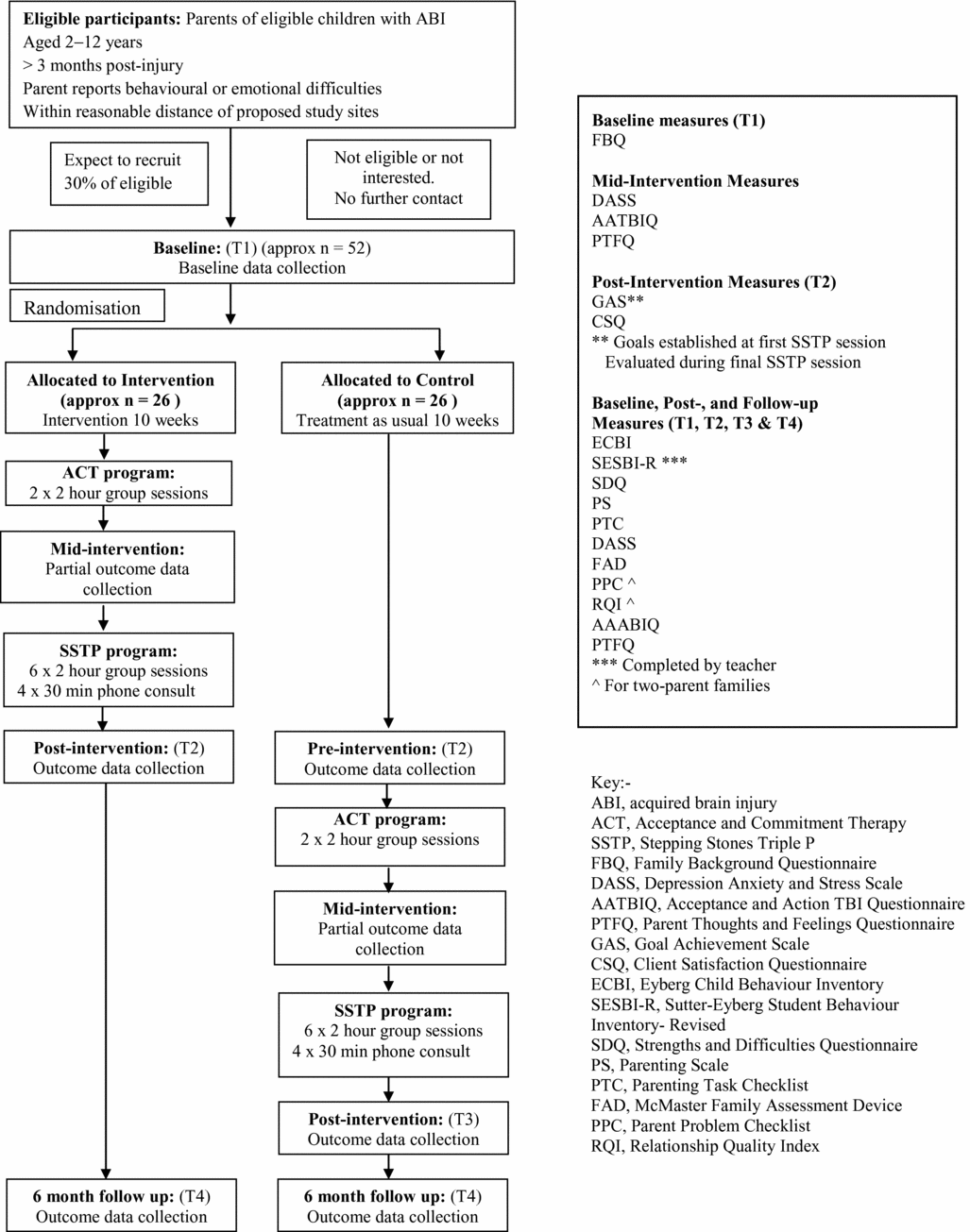
A wait-list controlled, parallel-group trial will be conducted to evaluate the efficacy of the parenting programme compared to care as usual for parents of children with ABI, aged 2–12 years. The programme will be offered to current or previous patients of two paediatric brain injury rehabilitation services in Brisbane, Australia, and groups will be held at various locations in Brisbane and surrounding regions. Assessments of outcome measures will be through parent and teacher questionnaires completed pre- and post-intervention. Further follow-up will be performed at 6 months following the intervention, to determine maintenance of effects. Measures of parental adjustment and psychological flexibility will be repeated following the ACT workshop, prior to commencement of SSTP, in order to assess whether this workshop alone influences these outcomes. The treatment group will therefore complete measures at four time points (i.e., pre-, mid- and post-intervention, and 6-month follow-up), and the wait-list control group will complete measures at five time points (i.e., pre- and post-wait-list, mid- and post-intervention, and 6-month follow-up). The study design and processes have been approved by all of the relevant hospital, university and education department ethics committees. The experimental design and outcome measures are depicted visually in Figure 1.
Flow chart of the Stepping Stones Triple P and stress management randomised controlled trial according to CONSORT guidelines.

Participants
Inclusion and Exclusion Criteria
Participants will be English-speaking, consenting parents or kinship carers of children aged between 2 and 12 years, diagnosed with ABI. The child must display chronic behavioural or emotional difficulties (i.e., more than 3 months post-injury) according to parent self-report. Such difficulties may be minor to severe in nature.
Based on operational definitions of TBI recommended by taskforces of the American Congress of Rehabilitation Medicine (1993) and the World Health Organisation (WHO; Carroll, Cassidy, Holm, Kraus, & Coronado, Reference Carroll, Cassidy, Holm, Kraus and Coronado2004), children will be required to meet at least one of the following inclusion criteria to confirm a diagnosis of TBI:
(i) any period of altered consciousness or loss of consciousness;
(ii) any loss of memory for events immediately before or after the event;
(iii) any confusion or disorientation at the time of the event;
(iv) any neurological abnormality such as focal signs (e.g., sensory impairment, ataxia, aphasia), seizure or intracranial lesion;
(v) other signs and symptoms of brain injury considered by a rehabilitation specialist to justify a diagnosis of TBI.
Parents of children who have a formal diagnosis of other forms of ABI will also be included in the study. In these cases, the injury must have arisen from a defined event, including documented injuries due to hypoxia, stroke, tumour, infection or disease. Children who have sustained their injury within the past 3 months will be excluded, as it is considered that cognitive, behavioural and emotional sequelae of the injury may not have stabilised in these individuals, and the practical and emotional strain on parents may be too great in this early stage to engage in the intervention.
Sample Size
Power analysis has indicated that to detect a large effect size for changes in child behaviour (a primary outcome measure) of .8, with alpha set to .05 and power set to .80, a sample size of 26 participants per group would be needed (Cohen, Reference Cohen1992). A large effect size is expected, based on a meta-analysis of Level 4 Triple P outcome research (De Graaf et al., Reference De Graaf, Speetjens, Smit, De Wolff and Tavecchio2008a). Allowing for a 10% attrition rate, this would require a sample size of 28 families in each of the two conditions, giving a total sample size of 56 families.
Recruitment
Participants will primarily be recruited through patient databases of paediatric rehabilitation services at the Royal Children's Hospital (Brisbane, Australia) and the Mater Children's Hospital (Brisbane, Australia). Potential participants will be invited to participate in the study via letters and follow-up phone calls. Flyers and posters will be displayed in the reception areas of clinics, and clinicians will be informed of the study, and encouraged to refer appropriate patients to the programme. External advertising will include a website, advertising on university websites and a state-wide radio promotion.
Participants will be assessed for eligibility and enrolled in the study by the study coordinator as they provide informed consent. The study will be explained to parents, and signed written consent will be obtained, acknowledging that the parents are aware of all study requirements, consent to take part, give permission for researchers to contact their child's teacher and access their child's medical records, agree to audio-visual recording of sessions and understand that they are free to withdraw from the study at any time.
Randomisation
Prior to the intervention, participants will be asked to complete baseline questionnaires. Once these are completed, participants will be randomly assigned to either the treatment group or wait-list group and informed of the dates and times of their group.
The randomisation sequence will be computer-generated and stratified by treatment site and group time with a 1:1 allocation using random block sizes of two and four. Treatment allocations will be recorded on pieces of paper, which will be folded and placed inside sealed, numbered, opaque envelopes by a staff member not involved in the study. Envelopes will be opened by the study coordinator in order as each participant returns their questionnaires. Given the nature of the study, no parties will be blinded to group assignment. Outcome measures will be parent and teacher report, thus reducing the possibility of unintended bias by clinician researchers.
Therapy Protocols and Delivery
Format
All interventions will be delivered in a group format (with between 3 and 10 families per group) and each family will receive the ACT programme, and the SSTP programme in tandem. Parents in the wait-list control will also receive the same intervention after the delay. In two-parent families, both parents will be invited to attend all sessions; however, the unit of analysis will be the family and hence only one parent will complete questionnaire measures.
Therapists
Sessions will be conducted by provisionally registered psychologists completing post-graduate training in clinical psychology, or registered psychologists, with accreditation in SSTP. Training and weekly supervision will be provided by a clinical psychologist.
Content
Acceptance and Commitment Therapy
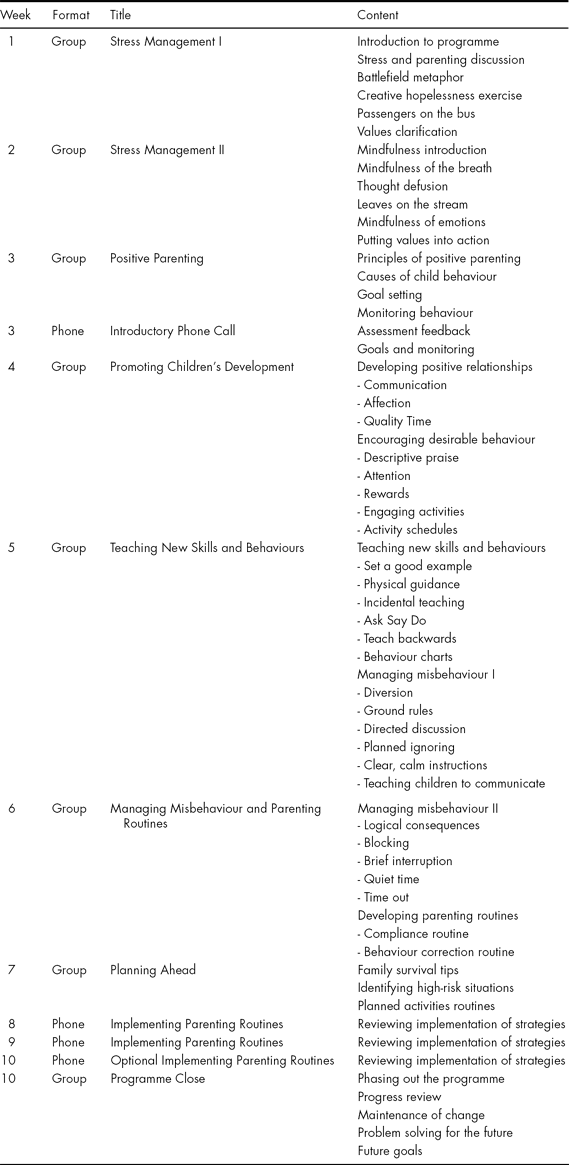
The ACT workshop is a manualised programme consisting of two group sessions of approximately 2 hours each, targeting the emotional context of parenting (Whittingham, Sheffield, & Sofronoff, Reference Whittingham, Sheffield and Sofronoff2010). The programme addresses the following ACT processes: acceptance of cognitions and emotions, cognitive defusion, mindfulness or present moment awareness, values and committed action. Content, exercises and metaphors are based on ACT as presented by Hayes (Reference Hayes2005) and Hayes, Strosahl and Wilson (Reference Hayes, Strosahl and Wilson2003), and mindfulness as presented by Segal, Mark, Williams and Teasdale (Reference Segal, Mark, Williams and Teasdale2002). The content is presented in Table 1.
Outline of Sessions for Acceptance and Commitment Therapy and Stepping Stones Triple P
Stepping Stones Triple P
The Group SSTP programme consists of six, 2-hour group sessions and three 30-minute individual sessions via telephone (Sanders, Mazzucchelli, & Studman, Reference Sanders2009). While the Group SSTP programme typically consists of five group sessions, followed by three telephone consultations, and one final group session, for this project a telephone consultation will be offered during the same week as the first of the group sessions, and an optional additional telephone consultation will be offered in the same week as the sixth and final group session if parents wish to receive further assistance. This may lead to some parents receiving an extra session than is usual in the manualised programme; however, it is considered beneficial to provide parents the opportunity to have individualised assistance early in the programme to ensure their goals and behaviour monitoring methods are suitable. Group sessions cover parenting strategies and parents are set practice tasks each week to complete at home. Individual telephone sessions are a chance to tailor strategies and refine skills learned. The content of sessions is presented in Table 1.
Locations
It is expected that groups will be conducted in various locations in Brisbane, such as hospitals and university campuses. Groups in other locations and surrounding regions (such as Ipswich, Sunshine Coast and Gold Coast) will be offered, depending on parent demand.
Other Treatments
As the majority of families will still be accessing rehabilitation services, treatment as usual will continue for both treatment and control groups for ethical reasons. Parents will be asked to report if they have received any additional support relating to parenting during the wait-list or treatment periods.
Outcome Measures and Procedures
1. Participant Characteristics
Data will be collected from medical records in order to classify the severity of the brain injury. Information collected (when available) will include: Glasgow Coma Scale (GCS) scores, length of loss of consciousness, length of post-traumatic amnesia, evidence of abnormalities on brain imaging, whether neurosurgical intervention was required, and any other relevant injuries or neurological signs.
The following measure will also be completed prior to the intervention. All parents will be offered the option of completing the questionnaires online with a secure login, or as paper versions.
Stepping Stones Triple P Family Background Questionnaire (FBQ; Sanders et al., Reference Sanders, Mazzucchelli and Studman2010)
This parent-reported demographic questionnaire collects biographical information on the child and family, information about the child's disability, health and development, and the family's use of other medical and allied health services.
2. Outcomes of the Parenting Programme
The following questionnaires were selected based on previous Triple P research and will be completed by one parent at multiple time-points: pre-intervention, post-intervention (Week 10) and at a 6-month follow-up.
(a) Child behavioural and emotional outcomes
Eyberg Child Behaviour Inventory (ECBI; Eyberg & Pincus, Reference Eyberg and Pincus1999)
The ECBI is a 36-item scale measuring child problem behaviours. It provides a measure of the number of problem behaviours (problem score; ranges from 0 to 36) and a measure of the frequency of these behaviours (intensity score; ranges from 36 to 252). Both scales have demonstrated high internal consistency (values of α = .98), with good test–retest reliability (r = .86 and .88, respectively) (Robinson, Eyberg, & Ross, Reference Robinson, Eyberg and Ross1980). The ECBI has shown good internal, discriminant and concurrent validity (Boggs, Eyberg, & Reynolds, Reference Boggs, Eyberg and Reynolds1990; Eyberg & Ross, Reference Eyberg and Ross1978; Robinson et al., Reference Robinson, Eyberg and Ross1980), and is sensitive to changes during Triple P and SSTP interventions (Sanders, Markie-Dadds, Tully, & Bor, Reference Sanders, Markie-Dadds, Tully and Bor2000; Whittingham et al., Reference Whittingham, Sofronoff, Sheffield and Sanders2009). For clinical purposes, scores of 131 or greater and 15 or greater on the intensity and problem scales, respectively, are considered to be in the clinical range (Eyberg & Pincus, Reference Eyberg and Pincus1999).
Strengths and Difficulties Questionnaire (SDQ; Goodman, Reference Goodman1997)
The SDQ consists of 25 statements about positive or negative child behaviours, which are rated for their frequency on a three-point scale, to provide scores on five scales: Emotional Symptoms, Conduct Problems, Inattention/Hyperactivity, Peer Problems and Prosocial Behaviour. Scores on each scale range from 0 to 10, and a Total Difficulties score can also be calculated which ranges from 0 to 40. An additional five questions assess the extent to which the child's difficulties impact their life, and are scored to create a Total Impact Score, ranging from 0 to 10. Clinical severity descriptors of Normal, Borderline and Abnormal can be applied to scores on each scale (Goodman, Reference Goodman1999). The questionnaire has shown good concurrent and predictive validity (Goodman, Reference Goodman1997) and has adequate reliability for children with (α = .71) or without (α = .78) intellectual disabilities (Emerson, Reference Emerson2005; Kaptein, Jansen, Vogels, & Reijneveld, Reference Kaptein, Jansen, Vogels and Reijneveld2008).
(b) Parenting outcomes
Parenting Scale (PS; Arnold, O'Leary, Wolff, & Acker, Reference Arnold, O'Leary, Wolff and Acker1993)
The PS is a 30-item questionnaire measuring three dysfunctional parenting styles: laxness (permissive, inconsistent discipline); over-reactivity (harsh, emotional, authoritarian discipline and irritability); and hostility (use of verbal or physical force) (Rhoades, Reference Rhoades2007). Respondents rate each item on a seven-point scale, and scores for each subscale are then calculated (ranging from 1 to 7). The scale has demonstrated adequate internal consistency (values of α for subscales ranging from .78 to .85), good test–retest reliability (r = .84 for the total score), an ability to discriminate parents of clinic versus non-clinic children, and correlations with observed parenting style and child behaviour (Arnold et al., Reference Arnold, O'Leary, Wolff and Acker1993; Freeman & DeCourcey, Reference Freeman and DeCourcey2007; Rhoades, Reference Rhoades2007). Established clinical cut-off scores are available for each subscale (Arnold et al., Reference Arnold, O'Leary, Wolff and Acker1993).
Parenting Tasks Checklist (PTC; Sanders & Woolley, Reference Sanders and Woolley2005)
The PTC asks parents to rate their confidence in handling difficult child behaviour in common parenting situations on a scale from 0 (Certain I cannot do it) to 100 (Certain I can do it), providing two average confidence scores (ranging from 0 to 100): behavioural self-efficacy (confidence in managing difficult behaviour) and setting self-efficacy (confidence in managing behaviour in different settings). Both scales have demonstrated excellent internal consistency (α = .97 and .91, respectively) and the measure has demonstrated the ability to discriminate between mothers from a clinic sample versus a community sample (Sanders & Woolley, Reference Sanders and Woolley2005). Parents are considered to be in the clinical range if they score less than or equal to 65.08 and 75.00 for behavioural self-efficacy and setting self-efficacy, respectively (Sanders & Woolley, Reference Sanders and Woolley2005).
(c) Family and parent adjustment
Depression Anxiety and Stress Scale (DASS; S. Lovibond & P. Lovibond, Reference Lovibond and Lovibond1995)
The DASS is a 42-item self-report questionnaire that assesses the presence of psychological symptoms in adults. Respondents rate, on a four-point scale, how much each statement has applied to them over the past week (0 = did not apply to me at all, to 3 = applied to me very much, or most of the time), to provide a score ranging from 0 to 42 on each of three scales: Depression, Anxiety and Stress. Severity descriptors (i.e., Normal, Mild, Moderate, Severe or Extremely Severe) can be applied to scores on each subscale (S. Lovibond & P. Lovibond, Reference Lovibond and Lovibond1995). The measure has shown high internal consistency for each of the Depression (α = .91), Anxiety (α = .84) and Stress (α = .90) scales, and has good discriminant and convergent validity (Brown, Chorpita, Korotitsch, & Barlow, Reference Brown, Chorpita, Korotitsch and Barlow1997; P. Lovibond & S. Lovibond, Reference Lovibond and Lovibond1995).
McMaster Family Assessment Device (FAD; Epstein, Baldwin, & Bishop, Reference Epstein, Baldwin and Bishop1983)
The General Functioning Scale of the FAD will be completed by participating parents. This scale is a broad measure of family functioning and consists of 12 items for which respondents rate their agreement on a scale of 1 to 4. An average total score is calculated, whereby lower scores reflect healthier functioning, with a determined clinical range cut-off score of 2 (Miller, Epstein, Bishop, & Keitner, Reference Miller, Epstein, Bishop and Keitner1985). It has excellent internal consistency (α = .92), adequate test–retest reliability (r = .71) and concurrent validity (Epstein et al., Reference Epstein, Baldwin and Bishop1983; Miller et al., Reference Miller, Epstein, Bishop and Keitner1985).
(d) Parent relationship (for two-parent families)
Parenting Problem Checklist (PPC; Dadds & Powell, Reference Dadds and Powell1991)
This 16-item questionnaire measures couple conflict over parenting and the ability to cooperate in parenting. Parents are asked to rate whether each item is an issue for them (problem score; ranges from 0 to 16), and the intensity of the issue (intensity score; ranges from 16 to 112). The scale has adequate internal consistency (α = .70) and test–retest reliability (r = .90), and a score of 5 or greater on the problem scale can be considered to fall in the clinical range (Dadds & Powell, Reference Dadds and Powell1991).
Relationship Quality Index (RQI; Norton, Reference Norton1983)
The RQI is a six-item measure of relationship satisfaction with high internal consistency (α = .97), concurrent validity and discriminant validity (Heyman, Sayers, & Bellack, Reference Heyman, Sayers and Bellack1994). Scores range from 6 to 45, where lower scores are associated with less stable relationships, and scores below 29 are considered to be in the clinical range (Heyman et al., Reference Heyman, Sayers and Bellack1994; Norton, Reference Norton1983).
3. Outcomes of the ACT-Adjunct
The following parent-report measures will be used to assess parent outcome in terms of psychological flexibility, as targeted by the ACT-adjunct. These questionnaires will be administered at pre-, post- and 6-months following intervention, and will also be administered at the completion of the 2-week ACT-adjunct, prior to commencing SSTP (Week 2). The DASS (as above) will also be administered at this time-point.
Acceptance and Action for ABI Questionnaire (AAABIQ)
The AAABIQ is a 19-item questionnaire developed specifically for this study. It requires parents to rate the truth of each statement as it applies to them on a seven-point Likert scale (providing a total score ranging from 19 to 133, where higher scores indicate greater psychological flexibility). The statements were adapted from the Parental Acceptance and Action Questionnaire (PAAQ; Cheron, Ehrenreich, & Pincus, Reference Cheron, Ehrenreich and Pincus2009), which is itself an adaptation of the Acceptance and Action Questionnaire (AAQ; Hayes et al., Reference Hayes, Strosahl, Wilson, Bissett, Pistorello, Toarmino and Bergan2004b), a commonly used measure of psychological flexibility. The PAAQ has demonstrated adequate internal consistency (α = .64 – .65 for individual scales), test–retest reliability (r = .68 – .74) and demonstrated predictive and concurrent validity. It has been suggested that parent-specific measures may be more sensitive to improvements obtained through parenting programmes (Blackledge & Hayes, Reference Blackledge and Hayes2006).
Parent Thoughts and Feelings Questionnaire (PTFQ; adapted from Metzler & Rusby, n.d.)
The PTFQ is a 19-item questionnaire assessing the role of parent thoughts and feelings in parenting behaviour. This questionnaire is an adaptation of the Bissett (Reference Bissett2001) Believability Scale version of the Automatic Thoughts Questionnaire (Hollon & Kendall, Reference Hollon and Kendall1980), and the ‘Action’ factor of the Parental Acceptance and Action Questionnaire (Cheron et al., Reference Cheron, Ehrenreich and Pincus2009). As yet, no psychometric data are available for this questionnaire. The first subsection of the questionnaire consists of nine items measuring the extent to which parents are able to maintain effective parenting practices in the presence of uncomfortable thoughts or feelings. Parents rate the applicability of each item from 1 (never true), to 7 (always true), to give a total score ranging from 9 to 63. In the second part of the questionnaire parents are asked to rate how often in the past week they have had a particular thought about parenting and, for those thoughts that they experienced at least once, how much it influenced the way they handled the parenting situation, from 0 (not at all) to 7 (totally). This scale provides a total score ranging from 0 to 50 for frequency of thoughts, and an average score of the influence of thoughts experienced ranging from 0 to 7.
4. Achievement of Goals
Goal Achievement Scale (GAS; Hudson, Jauernig, Wilken, & Radler, Reference Hudson, Jauernig, Wilken and Radler1995)
The GAS will be completed during sessions by parents. At the start of SSTP, parents will be asked to define behavioural goals for themselves and for their child, and to set indicators for distinct levels of success (i.e., 0%, 25%, 50%, 75% and 100%). In the final session of SSTP, parents will be asked to indicate what level of success they have achieved. This measure will provide descriptive statistics on level of goal achievement for parents completing the programme.
5. Participant Satisfaction
Client Satisfaction Questionnaire (CSQ; Sanders et al., Reference Sanders, Mazzucchelli and Studman2010)
The CSQ is a 16-item questionnaire measuring consumer satisfaction with parenting programmes and providing opportunities for feedback. It consists of 13 items rated on a seven-point scale, and 3 items posed as open-ended questions. It is an adaptation of the Therapy Attitude Inventory (Eyberg, Reference Eyberg1993), which has demonstrated high internal consistency (α = .88) and discriminant validity. For this study, two extra items specifically targeting satisfaction with the ACT-adjunct were added, therefore giving a total score for the 15 quantitative items ranging from 15 to 105. A further question was added which asked parents to nominate whether they would have preferred to have received: SSTP alone, SSTP plus ACT, or ACT alone. This questionnaire will be used to provide descriptive data on overall satisfaction with the programme. It will be completed by parents at the completion of the programme (Week 10), and will be sent to parents who did not complete the programme. Parents not completing the programme will also be asked to identify why they did not complete the programme, to gather qualitative data on barriers to completion.
6. Teacher Ratings
In order to reduce reliance on parent-report alone for assessment of improvements in child behaviour, teachers will also be asked to complete the following brief pen-and-paper measure of child behaviour in the classroom.
Sutter–Eyberg Student Behaviour Inventory-Revised (SESBI-R; Eyberg & Pincus, Reference Eyberg and Pincus1999)
The SESBI is a 38-item teacher-report of child behaviour in the classroom. Like the ECBI, it provides two scores: a measure of the number of problem behaviours (problem score; ranges from 0 to 38) and a measure of the frequency of the behaviour (intensity score; ranges from 38 to 266). Both scales have demonstrated high internal consistency (α = .96 and .98, respectively), good test–retest reliability (r = .75 for both scales), and high correlations with other teacher rating scales (Funderburk, Eyberg, Rich, & Behar, Reference Funderburk, Eyberg, Rich and Behar2003; Rayfield, Eyberg, & Foote, Reference Rayfield, Eyberg and Foote1998).
Protocol Adherence and Treatment Fidelity
Practitioner adherence to the programme protocol will be assessed through the completion of session checklists, and through independent observation of a proportion of video- or audio-recorded sessions, to ensure all components of the programme are delivered as prescribed. It is expected that weekly supervision as well as manualised protocols will also aid in ensuring adherence to the programme. Cases where substantial additional material was covered in sessions, or where substantial core content was omitted, will be defined as protocol deviations, and will be monitored and reported.
Parent attendance at group sessions and telephone consultations will be recorded. In the case of missed group sessions, parents will be offered make-up sessions via telephone or face-to-face.
Completion and Withdrawal
Parents in the treatment group will be considered to have completed the programme if they have completed pre-intervention and post-intervention assessments, and have attended at least 75% of treatment sessions. Parents in the control group will need to complete pre-wait-list and post-wait-list assessments. Parents in the treatment will be considered to have completed the study if they have also completed the 6-month follow-up assessment. It is anticipated that parents may withdraw from the study at any of these time points for various reasons, such as: recurrence of the child's medical condition, personal circumstances preventing attendance at sessions, withdrawal of consent to participate in study, the need to take part in more intensive parenting support programmes, or loss to follow-up. For parents who have attended fewer than the required number of sessions, but have completed post-intervention assessments, their data will be included in an intention-to-treat analysis. For parents who do not complete post-intervention or 6-month follow-up assessments, their data will also be included in intention-to-treat analyses. Parents who participate in other formal parenting programmes, or are discovered not to meet inclusion/exclusion criteria will be excluded from analyses as these will be considered protocol deviations. Parents who wish to withdraw from the study will be informed of other treatment options for any ongoing concerns.
Safety and Adverse Events
Adverse events will be monitored and reported to appropriate ethics committees if they occur. If parents are still experiencing significant difficulties at the conclusion of the programme, they will be informed of referral options to local services.
Planned Data Analyses
Analyses will be conducted using an SPSS statistical package. Usual data screening processes and assumption checking for statistical procedures used will be conducted. Appropriate analyses will be conducted on demographic and baseline data to determine whether there are significant differences between treatment and control groups prior to intervention. It is anticipated that groups will be similar on baseline assessments and demographic variables, due to the randomisation process used. If this is not the case, and if these variables are associated with outcomes, they will be included as predictors in analyses.
Hypotheses relating to the efficacy of the treatment in comparison to treatment as usual from pre- to post-intervention will be tested using a series of normal mixed-model repeated-measures (MMRM) linear regression analyses on the intent-to-treat sample consisting of all randomised participants (see Hedeker & Gibbons, Reference Hedeker and Gibbons2006). A restricted maximum likelihood solution will be used to fit the models, which allows participants with missing post-intervention outcome data (due to dropout) to be included. Fixed factors will be time (categorical: pre- and post-intervention), and allocation (categorical: treatment and wait-list control). Subject will be added as a random factor. Denominator degrees of freedom will be based on the Sattherthwaite approximation. Scores on measures of child emotional and behavioural functioning and parenting style will be the primary outcome measures, and the remainder of outcomes will form secondary analyses.
A further series of MMRM analyses will be used to assess treatment maintenance, comparing post-treatment scores to 6-month follow-up scores, collapsing across treatment and control groups if appropriate. An additional analysis of the specific effect of the ACT workshop will be conducted comparing pre-intervention to mid-intervention scores on parent adjustment (DASS) and psychological flexibility (AAABIQ and PTFQ), combining treatment and control group data. Effect sizes will be reported for all analyses to give a measure of the magnitude of effect.
The number of families experiencing reliable and clinically important changes will also be evaluated according to the procedures described by Jacobson and Truax (Reference Jacobson and Truax1991) and Evans, Margison and Barkham (Reference Evans, Margison and Barkham1998).
Attrition analysis will also be conducted through a series of logistic regressions using pre-intervention data and demographic variables as predictors of drop-out. Post-hoc analyses may be undertaken to investigate predictors of response to intervention and mediators of change.
Discussion
This protocol presents the background and design for a randomised controlled-trial comparing SSTP plus ACT to a wait-list control, for parents of children who have sustained an ABI. This study is the first to trial a Triple P programme in this population, and will assist in addressing the scarcity of quality research in family-interventions for paediatric ABI. A wide range of child, parent and family outcomes will be assessed, using reliable and valid measures.
The trial is registered with the Australian New Zealand Clinical Trials Registry (ACTRN12610001051033), registration date 30 November 2010.
Recruitment and enrolment to the study commenced in October 2010, with data collection beginning January 2011. The recruitment, treatment delivery and data collection of this trial have now been completed (as of 30 March 2013). A total of 59 participants were enrolled and completed baseline data. Outcome data are currently being analysed. Results will be published once available in a peer-reviewed journal.
Acknowledgements
This work was supported by a Queensland Children's Medical Research Institute Science PhD Scholarship (F.B., grant number 50002); a National Health and Medical Research Council postdoctoral fellowship (K.W., grant number 631712); a National Health and Medical Research Council Career Development Fellowship (R.B., grant number 1037220) and a Smart State Fellowship (R.B).
Ethical Clearance
Royal Children's Hospital (HREC/10/QRCH/67); University of Queensland (2010001056); Education Queensland (550/27/1046); Catholic Education Queensland (2011/146); Mater Medical Research Institute (1731C).
Declaration of Interest
None.