Introduction
Metal pollution is a global issue and is one of the most significant threats to ecosystem integrity due to its toxicity, persistence, and bioaccumulation within biological networks (Fang et al. Reference Fang, Yang, Lu, Cui, Li, Liang, Hou, Zhao and Li2019; Di Cesare et al. Reference Di Cesare, Pjevac, Eckert, Curkov, Miko Šparica, Corno and Orlić2020; Gambino et al. Reference Gambino, Chandrasekhar and Nastro2021). Its impact extends beyond aquatic organisms, potentially affecting ecosystem health.
The northern Chilean coast is a site of significant mining activity and the discharge of polymetallic minerals, predominantly copper (Cu), zinc (Zn), and lead (Pb) (Valdés et al. Reference Valdés, Román, Rivera, Ávila and Cortés2011, Reference Valdés, Román, Guiñez, Rivera, Ávila, Cortés and Castillo2015). Scientific investigations conducted in Antofagasta (23°20’S) have documented elevated Cu concentrations in invertebrate organisms, marine waters, and sediments, indicating a correlation between the presence of these metals and local industrial operations (Montenegro et al. Reference Montenegro, Valdés and González2019; Valdés et al. Reference Valdés, Román, Rivera, Ávila and Cortés2011, Reference Valdés, Román, Guiñez, Rivera, Ávila, Cortés and Castillo2015, Reference Valdés and Tapia2019). Additionally, northern Chile is considered a ‘sacrifice zone’, and fishermen have reported several spills of copper concentrate that have affected the region’s marine flora and fauna. Sacrifice zones are defined as areas constantly exposed to pollution and environmental degradation, where local communities and ecosystems are sacrificed in the name of ‘economic growth’ or ‘national prosperity’ (Valenzuela-Fuentes et al. Reference Valenzuela-Fuentes, Alarcón-Barrueto and Torres-Salinas2021).
Some metals are considered essential for life because they participate in redox processes, stabilize molecules, and regulate osmotic pressure (Jomova and Valko Reference Jomova and Valko2011; Mustafa and AlSharif Reference Mustafa and AlSharif2018). However, metals can become toxic in high concentrations (Moore and Ramamoorthy Reference Moore, Ramamoorthy, Moore and Ramamoorthy1984). This toxicity can lead to alterations in mitochondrial membrane permeability, the generation of reactive oxygen species, damage to the mitochondrial respiratory chain, uncoupling of oxidative phosphorylation, impairment of ATP synthesis, and mitochondrial apoptosis (Sun et al. Reference Sun, Li, Shi, Hussain, Mehmood, Tang and Zhang2022). Therefore, many organisms must develop strategies to survive under these stressful conditions, either by adapting to the new environment or migrating to different habitats (Doney et al. Reference Doney, Ruckelshaus, Emmett Duffy, Barry, Chan, English, Galindo, Grebmeier, Hollowed, Knowlton, Polovina, Rabalais, Sydeman and Talley2012). Consequently, many marine species, both invertebrates and vertebrates, establish complex symbiotic relationships with other species that can play a vital role in reducing physiological stress and promoting the survival of their host in response to metal pollution (Matos and Antunes Reference Matos and Antunes2021; Mori et al. Reference Mori, Iwamoto, Wakaoji, Araie, Kohara, Okamura, Shiraiwa and Takeyama2016; Romano Reference Romano2018; Selvin et al. Reference Selvin, Shanmugha Priya, Seghal Kiran, Thangavelu and Sapna Bai2009).
Host–parasite interactions are an integral part of ecosystems and can influence ecological and evolutionary processes (Marcogliese Reference Marcogliese2004; Szopieray ans Żbikowska Reference Szopieray and Żbikowska2021). Parasites play an important role in structuring their host communities (Larsen et al. Reference Larsen and Mouritsen2014; Thomas et al. Reference Thomas, Adamo and Moore2005; Wood et al. Reference Wood, Byers, Cottingham, Altman, Donahue and Blakeslee2007). Several studies show that variations in metal concentrations in parasitized organisms can influence the metabolism of their hosts, interact synergistically or antagonistically with contaminants, and induce physiological reactions in their hosts to contamination (Sures Reference Sures2006, Reference Sures2008a, Reference Sures2008b).
In polluted environments, parasites may negatively impact their hosts by increasing their sensitivity to contaminants, altering physiological condition, metabolic rate, gene expression, and immune response (Baudrimont and de Montaudouin Reference Baudrimont and De Montaudouin2007; Coors and De Meester Reference Coors and De Meester2008; Liquin et al. Reference Liquin, Hünicken, Arrighetti, Davies, Paolucci and Sylvester2021; Paul-Pont et al. Reference Paul-Pont, De Montaudouin, Gonzalez, Jude, Raymond, Paillard and Baudrimont2010a, Reference Paul-Pont, Gonzalez, Baudrimont, Jude, Raymond, Bourrasseau, Le Goïc, Haynes, Legeay, Paillard and De Montaudouinb). However, parasites could also confer an advantage to their parasitized hosts over unparasitized counterparts by reducing contaminant concentrations in host tissues (Dairain et al. Reference Dairain, Legeay, Gernigon and De Montaudouin2019; Goutte and Molbert Reference Goutte and Molbert2022; Mostafa et al. Reference Mostafa, Mossa and El Einin2014; Sures et al. Reference Sures, Siddall and Taraschewski1999; Sures et al. Reference Sures, Dezfuli and Krug2003) and/or enhancing survival in polluted environments (MacLeod and Poulin 2006). The above demonstrates the plasticity of symbiotic associations and how they can be modified in response to environmental changes, facilitating the transition from parasitism to mutualism (Fellous and Salvaudon Reference Fellous and Salvaudon2009; Goutte and Molbert Reference Goutte and Molbert2022; Leung and Poulin Reference Leung and Poulin2008). Evans et al. (Reference Evans, Irwin and Fitzpatrick2001) and Goutte and Molbert (Reference Goutte and Molbert2022) support the hypothesis that some endoparasites at low-intensity infections could be less harmful or even beneficial to hosts exposed to metals. Their findings suggest that parasites might play a buffering role in their host by helping it to survive or be less susceptible to contaminated environments.
Research on gastropod–trematode systems has provided valuable insights into understanding the dynamics of host–parasite interactions and assessing environmental stressors. Gastropods are the first intermediate hosts for numerous trematode species. They play a crucial role in the life cycle of these parasites. Furthermore, the gastropods widespread use as bioindicators for heavy metal pollution underscores their significance in environmental monitoring efforts (Meador et al. Reference Meador, Casillas, Sloan and Varanasi1995a, Reference Meador, Stein, Reichert, Varanasi and Ware1995b). Additionally, trematodes are often among the most common and abundant group of parasites (Roberts et al. Reference Roberts, Janovy, Schmidt, Schmidt and Roberts’2000). They alter the fitness of their hosts through reproductive castration, altered growth patterns, survival, and altered behavior, making them important models in several parasitological studies (Lafferty Reference Lafferty1993; Hassanine Reference Hassanine2006; Wood et al. Reference Wood, Byers, Cottingham, Altman, Donahue and Blakeslee2007).
In this study, we used the intertidal periwinkle Echinolittorina peruviana as a model organism. E. peruviana are common in the intertidal rocky pools distributed from Panama to central Chile (Guzmán et al. Reference Guzmán, Saá and Ortlieb1998). Furthermore, E. peruviana are the first intermediate hosts for at least three species of trematodes (Leiva et al. Reference Leiva, Manríquez, Aguilera and González2019). This further underscores their importance in the trophic network and in the transmission of these parasites in marine ecosystems. Thus, this study aimed to test the hypothesis of whether larval parasites Himasthla sp. play a buffering role in their hosts to chemical stressors, such as metals. This was performed by evaluating experimentally the survival of gastropods E. peruviana parasitized with the trematode Himasthla sp. and unparasitized under the distinct exposure of Cu.
Materials and methods
Snail collection, acclimatization, and experimental design
Between September and October of 2023, 1,000 individuals of E. peruviana (11.3–12.9 mm in shell length and 0.6–0.8 g total weight) were collected during the lowest daily tide from the upper rocky intertidal zone of Coloso in San Jorge Bay (23°45’S, 70°28’W). The snails were collected by hand, placed in plastic containers, and transported immediately to the laboratory CENSOR at the Universidad de Antofagasta, Chile. The snails were distributed in plastic wells and examined for the presence of parasites.
To discriminate between parasitized (with Himasthla sp.) and unparasitized snails, each snail was put into a separate well (4 cm in diameter) and kept dry for 6 h. Then 30 ml of seawater was added into each well. The emergence of cercariae was verified after 2 h of immersion by direct observation under a stereomicroscope (Leica MZ6, Leica Microsystem, Wetzlar, Germany). The identification of trematode species was made based on cercaria morphology (Martorelli 2003). Both parasitized and unparasitized snails were maintained separately for an extra period of 5 days at room temperature (approximately 18–19°C) in aerated seawater and fed with sea lettuce (Ulva spp.). Snails were taken from a pool of parasitized or unparasitized snails, and they were distributed among plastic wells (10 cm in diameter, with ten snails each), filled with 200 ml of aerated seawater and incubated at room temperature (approximately 18–19°C) for each experimental treatment (three replicates).
The seawater used in the acclimatization period and the different experiments was filtered (0.5–1 μm and activated carbon filters), sterilized with UV light (filtered seawater, FSW-UV), and then autoclaved at 120°C.
Metal preparation and analysis
Stock solutions (1000 mg/L) were prepared from analytical grade Titrisol® standard copper chloride (CuCl2; Merck Millipore, Darmstadt, Germany) in filtered seawater. The Cu solutions were diluted to the desired concentrations and added to each aquarium. The chosen Cu concentrations (3 and 6 mg/L) were based on previous range-determination experiments conducted in the laboratory (pilot studies), and on the high concentrations that have been recorded in sediments and seawater following Cu concentrate spills reported along the Chilean coast (Bustamante-Penagos and Niño, Reference Bustamante-Penagos and Niño2020; Marambio-Alfaro et al. Reference Marambio-Alfaro, Saavedra, Enciso, Marras, Serrano, Peláez, Bruna, Ávalos and Maldonado2021; Zanetta-Colombo et al. Reference Zanetta-Colombo, Fleming, Gayo, Manzano, Panagi, Valdés and Siegmund2022).
All plastic and glassware used in this study were washed in 10% nitric acid and hydrochloric acid (HCl) for 24 h and then rinsed with distilled water before use. The acid wash with HCl was carried out to remove any contamination for metals present in plastics, which could alter our results (Long et al. Reference Long and Martin1990).
Seawater parameters such as temperature, salinity, pH, and Cu concentrations were measured in each aquarium at the beginning and end of the experiments for each copper concentration (Table 1). All measurements were made using the HI98194 portable Multi-parameter Water Quality Meter (Hanna Instruments, Smithfield, USA).
Mean values ± standard deviation (±S.E.) of the seawater (SW) utilized to characterize the physic-chemical parameters

The Cu content of the seawater samples for all Cu concentrations and control were analyzed prior to toxicity tests in the chemistry laboratory (ALS Life Sciences, Antofagasta, Chile; ISO 9001 Certified) using flame atomic absorption spectrometry. Standard methods for the examination of water were used (supplied by High-Purity Standards, USA), and 0.005 mg/L for Cu detection limits were measured. Unfortunately, it was not feasible to obtain accurate tissue measurements of copper concentration due to the small snail size (11.3–12.9 mm in shell length) and body weight (0.6–0.8 g).
Survival of parasitized and unparasitized snails
The criterion to establish the death of snails followed MacLeod and Poulin (Reference MacLeod and Poulin2016), who used physical stimulation in the operculum with a blunt probe. If snails failed to respond to any stimuli, then they were classified as dead, and they were removed from the aquarium. At the end of the test, the remaining periwinkles were euthanized using an overdose of MS-222. All animal handling procedures were in accordance with the Bioethics Committee from the Universidad de Antofagasta and Ethic and Biosafety Protocols under Agencia Nacional de Investigación y Desarrollo Chile (ANID-Chile).
For the exposure experiment, different concentrations of Cu were evaluated, which were A = 3 mg/L and B = 6 mg/L and their respective controls (each treatment had three replicates). The water in the aquarium was renewed every 48 h with new water at the same metal concentrations to avoid changes of salinity and temperature in the wells. Snail mortality was checked with a stereomicroscope at intervals of 24 h until all snails were found dead (240 h = 10 days).
At the end of the experiment, the length of the snails used was recorded with a vernier caliper (within 0.5 mm accuracy). Additionally, the gonad and digestive gland of each parasitized specimen were examined after dissection. We randomly examined 10 specimens of unparasitized control snails to confirm their negative status. The small and large rediae (the within-host stages that produce cercariae) in each snail were counted under a stereomicroscope with the aim of establishing whether the abundance of rediae was related to the mortality of the snails over time.
Statistical analysis
The effects of different Cu concentrations on the survival of parasitized and unparasitized snails were analyzed using generalized linear models, using a binomial distribution for the response variable (= survival) and logit-link function (Venables and Ripley Reference Venables, Ripley, Venables and Ripley2002). The models were performed by comparing treatments and snail conditions (parasitized vs. unparasitized) nested in treatments. In this experiment, exposure time (fixed factor) was included from T0 up to T240 (240 h) nested in treatment (Cu concentrations) with three replicates for treatment. The selection of the best models was based on the Akaike criteria. An a-posteriori Dunn test was used to detect significant differences between Cu-concentrations (Dunn Reference Dunn1961). Survival analyses (Kaplan–Meier) were also performed for each copper treatment to determine the survival/mortality probabilities along the exposure time (Kaplan and Meier Reference Kaplan and Meier1958). Finally, to determine if the abundance of rediae per snail differed between experimental times, snail status (dead or alive), and Cu concentrations, a nested ANOVA was performed, with time nested within treatment (following ln- transformation and checks for homogeneity of variances and normality of the dataset), and snail length was used as a covariable.
All analyses were performed in RStudio version 4.2.3, with a significance level of p < 0.05 for all statistical analyses.
Results
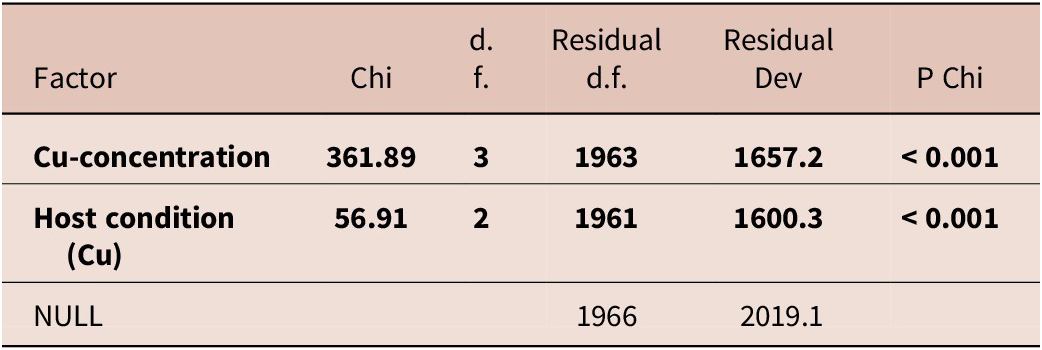
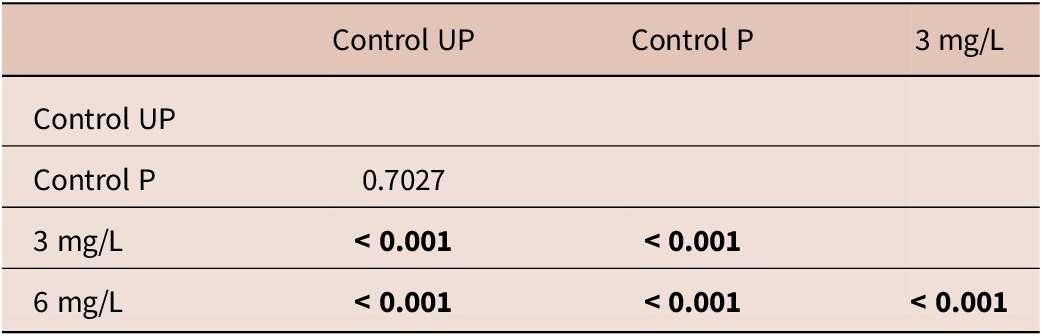
Snail survival varied significantly according to Cu concentration, and snail condition (parasitized and unparasitized) (Table 2; Figure 1). Significant differences in survival were observed between the 3 and 6 mg/L treatments compared with the control groups (parasitized and unparasitized controls), with a greater effect at the higher Cu concentration (Dunn test, p < 0.001; Table 3). In the control group, no differences in survival were observed between parasitized and unparasitized snails: for both groups, 98–100% of snails remained alive until the end of the experiment (Figure 1).
Results of Generalized Linear Models (GLMs) for the effect of different Cu-concentrations (3 and 6 mg/L) and control group, and host condition (parasitized and unparasitized) on survival of Echinolittorina peruviana. Statistically significant relationships (p < 0.05) are indicated in bold.

d.f., degrees freedom
Survival (%) of parasitized (P, red lines) and unparasitized snails (UP, blue lines) Echinolittorina peruviana exposed to 3 mg/L (thick dashed line) and 6 mg/L (dashed line) of copper, as well as the control group (solid line), over 240 hours (=10 days).

Dunn test of the effects of copper concentrations (3 and 6 mg/L, and control unparasitized (UP) and parasitized (P)) on snail survival

Significant effects are highlighted in bold (p <0.05).
At 3 mg/L of Cu concentration, the first parasitized snail death was recorded at 96 h, survival of nearly 50% (CI: 0.466–0.674) occurred at 216 h, and 15% of parasitized snails remained alive until the end of the experiment (240 h; Table S1; Figure 1). In the unparasitized snails, at a Cu concentration of 3 mg/L, the first snail death was recorded at 96 h of exposure, survival of nearly 50% (CI: 0.499–0.666) occurred at 192 h, ending with 100% mortality of snails at 240 h (Table S1; Figure 1). At higher Cu concentration (6 mg/L), the first parasitized snail death was recorded at 96 h of exposure, survival of nearly 50% (CI: 0.389–0.594) occurred at 216 h, and 15% of parasitized snails remained alive until the end of the experiment (240 h; Table S1; Figure 1). In the unparasitized snails, at a Cu concentration of 6 mg/L, the first snail death was recorded at 96 h of exposure, survival of nearly 50% (CI: 0.353–0.510) occurred at 192 h; and 100% snail mortality occurred at 240 h (Table S1; Figure 1). Thus, survival decreased at both Cu concentrations (3 and 6 mg/L), with a greater effect at the higher dose and in unparasitized snails.
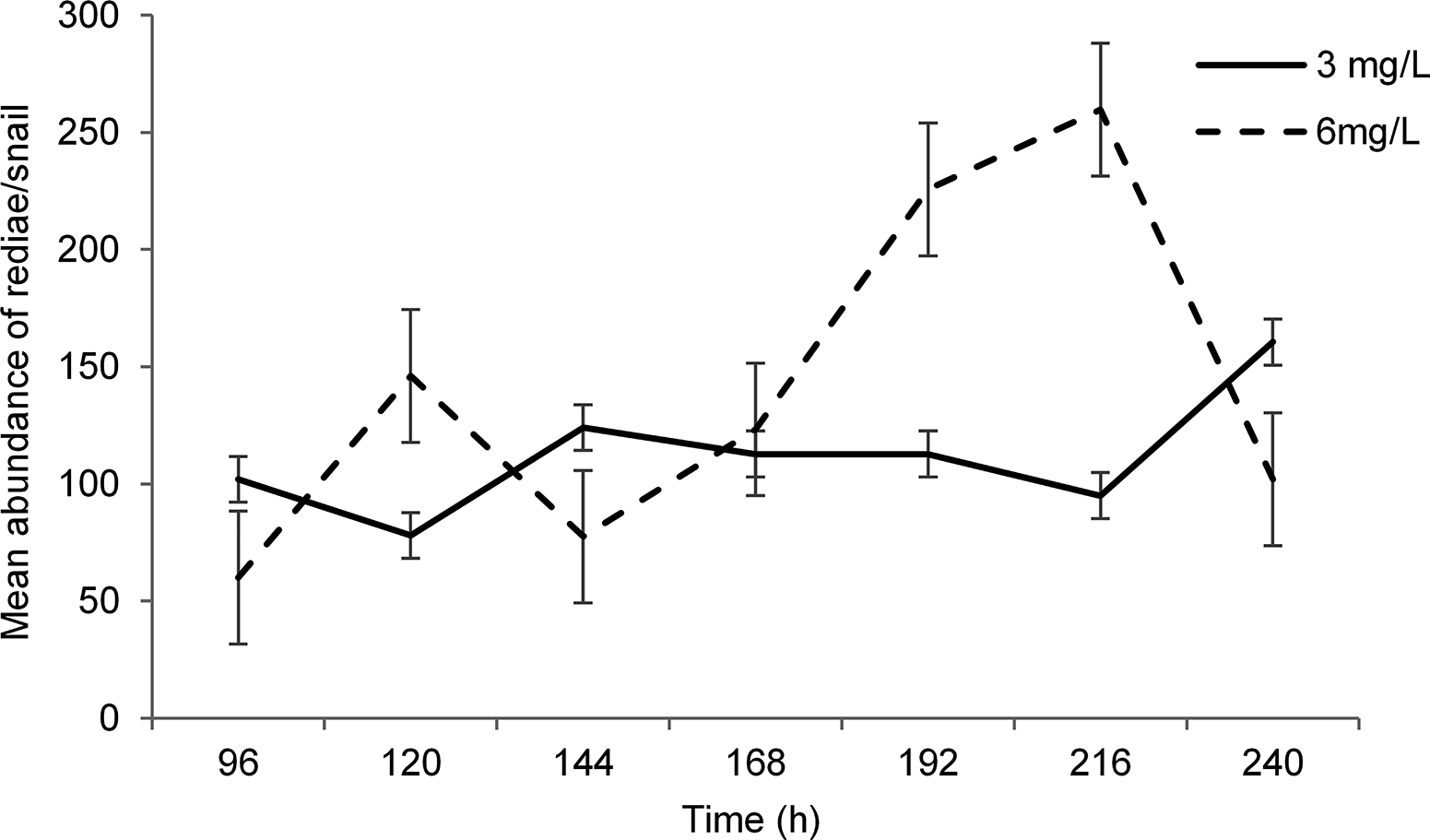
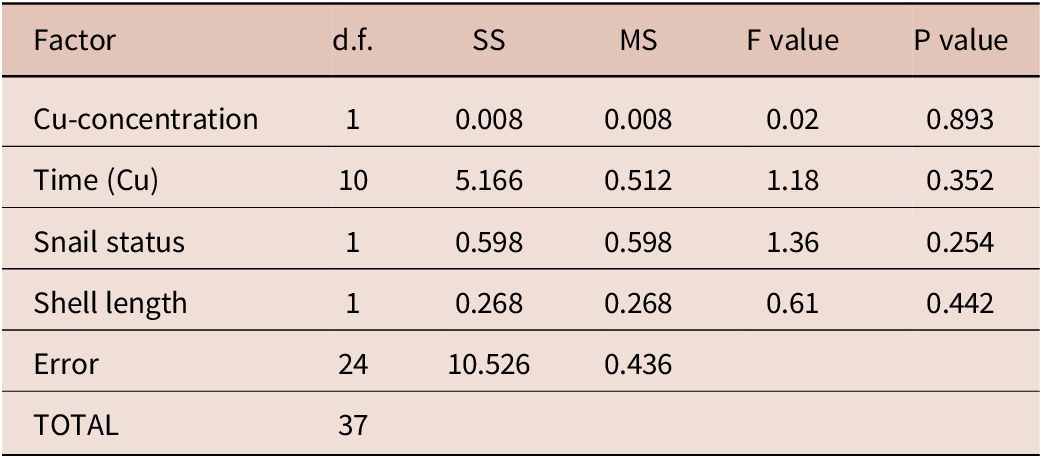
The abundance of rediae per snail varied between 44 and 398 for those snails exposed at 3 mg/L. At the higher copper concentration (6 mg/L), the number of rediae per snail varied between 22 and 351. The abundance of rediae per snail did not vary greatly during the experimental period in both treatments (Figure 2). The average number of rediae in the dead snails was 125 ± 53, while the average number of rediae per live snail was 194 ± 73 in the surviving snails. However, there were no statistically significant differences in mean abundances of rediae between treatments (F1,24 = 0.02, p = 0.893) or between parasitized snail status (dead or alive; F1,24 = 1.36, p = 0.254) or exposure times (F10,24 = 1.18, p = 0.352; Table 4).
Mean abundance ± standard error of rediae per parasitized snail exposed to the copper treatments 3 mg/L (solid line) and 6 mg/L (dashed line) during the 240 hours of exposure (=10 days).

Results of nested ANOVA for the effect of Cu, host status (dead or alive), and exposure time (hours) on abundance of rediae per parasitized snail. Statistically significant relationships (p ≤ 0.05) are indicated in bold.

Discussion
Understanding the impact of metal pollution in the field is difficult, and it is even more challenging to determine the effects of the interaction between parasites and hosts under these stressful conditions. Therefore, experimental studies are important but scarce. In this study, exposure to high concentrations of Cu (3 and 6 mg/L) affected snail survival, showing higher mortality at higher Cu concentration and in unparasitized snails compared to parasitized specimens (see Figure 1). This result suggests a possible trade-off between parasitism and host survival in polluted environments, where parasites may act as buffers, enhancing host survival or reducing susceptibility to contamination. These findings highlight the important influence of parasitism on the survival of snails in this study, especially in the population of E. peruviana inhabiting the polluted coast of northern Chile, where the prevalence of the trematode Himasthla sp. varies between 20 and 40% (authors’ data).
It has been widely documented that the asexual stage of the trematode damages the host gonads, resulting in host castration (MacLeod and Poulin Reference MacLeod and Poulin2016; Mouritsen and Poulin Reference Mouritsen and Poulin2002). This parasitism, however, can lead to greater host longevity by reducing the energetic costs associated with reproduction (Hurd Reference Hurd2001). The reduction of host fecundity is considered an evolutionary strategy where both the parasite and its host can benefit. Increased host longevity can benefit the parasite by enhancing its probability of transmission, while the parasite benefits the host by providing some protection against mortality if castration is partial (e.g., lower fecundity rate) (Hurd Reference Hurd2001) or the infection senesces and disappears over time. However, it is essential for future studies to incorporate physiological aspects to better understand how this parasite species influence the snail fecundity and to assess the consequences for snail health. Regarding this, MacLeod and Poulin (Reference MacLeod and Poulin2016) determined that the survival of the intertidal snail Zeacumantus subcarinatus exposed to different ocean acidification conditions (pH: 8.1, 7.6, and 7.4) was higher in snails parasitized with various species of larval trematodes compared to unparasitized snails after 90 days of exposure. These authors found that the differential mortality observed between parasitized and unparasitized snails could be attributed to the fact that parasitized snails, when castrated, may have more energy available to compensate for the oxidative stress caused by acidification exposure. Despite this, there are scarce numbers of works that evaluate the potential role of the host–parasite buffer relationship in polluted environments.
Environmental pollution can negatively influence the host–parasite relationship by reducing parasite transmission, altering life cycles, and affecting host and parasite survival (Lafferty and Kuris Reference Lafferty and Kuris1999; Leiva et al. Reference Leiva, Manríquez, Aguilera and González2019; Reference Leiva, Montenegro, Orrego, Vidal and González2024; Poulin and Mouritsen Reference Poulin and Mouritsen2006). Previous studies have reported that endoparasites can, in some ways, benefit their host by accumulating and sequestering high concentrations of metals from the environment, thereby reducing the metal load in host tissues compared with unparasitized snails. In this sense, Mostafa et al. (Reference Mostafa, Mossa and El Einin2014) experimentally determined that freshwater snails Biomphalaria alexandrina parasitized with cercariae of Schistosoma mansoni showed a lower concentration of metals (aluminum (Al), cadmium (Cd), Cu, iron (Fe), manganese (Mn), Pb, and Zn) in their tissues compared with unparasitized snails. However, the authors did not declare if the sizes of the snails examined were similar nor if the parasitic intensity in the snails was the same. Therefore, their results should be interpreted with caution. In another study, Evans et al. (Reference Evans, Irwin and Fitzpatrick2001), through a field study, indirectly demonstrated that parasitized marine snails Littorina littorea from contaminated sites showed a lower concentration of metals (Pb, Fe, Cu, and nickel (Ni)) in their tissues than unparasitized snails. The authors concluded that their results could be explained by the destruction of the digestive gland by cercariae, reducing the storage and retention capacity of metals in parasitized snails. Some histopathological studies on snails have evaluated the effects of infection by larval stages of digeneans, reporting destruction or alteration of the structure of the digestive gland tubules as well as histochemical changes. The extent of the damage depends on the infection intensity, abundance, and size of the rediae (Huffman et al. Reference Huffman, Klockars, Keeler and Fried2009; Liebman Reference Libman1991; Martinez et al. Reference Martinez, Gilardoni, Medina, Cremonte and Etchegoin2024; Tunholi et al. Reference Tunholi, Tunholi-Alves, Santos, Garcia, Maldonado, da-Silva, Rodrigues and Pinheiro2016; Zischke Reference Zischke1972). In our study, the digestive glands of E. peruviana snails may have been damaged by infection with Himasthla sp. However, histopathological studies are needed to confirm whether the glands were significantly affected or destroyed by the infection. In contrast to the findings of Mostafa et al. (Reference Mostafa, Mossa and El Einin2014) and Evans et al. (Reference Evans, Irwin and Fitzpatrick2001), Ong et al. (Reference Ong, Chejlava, Fried, Koehnlein, Bosavage and Sherma2004) determined that unparasitized individuals of freshwater snail Biomphalaria glabrata had lower concentrations of some elements such as Cd and Mn than parasitized individuals with digenean Schistosoma mansoni, suggesting that the host response to metals may depend on the type of metal they are exposed to and the species of parasite infecting the host. Therefore, metal pollutants will affect host metabolism, sometimes producing surprising beneficial effects for the host, such as increased longevity or survival.
Although in our study, we did not measure concentrations of metals in parasites or in host individuals, testing the survival of snails under exposure to these metals is the first approach to understanding the impact of this larval trematode in a metal pollution context. Interestingly, in our study, parasitized snails showed a higher tolerance to different concentrations of copper than unparasitized organisms, and 15% were still alive at the end of the experiment (240 h; see Figure 1). Our results show trends similar to those of previous studies, where trematodes not only play an important role in reducing contaminant concentrations in host tissues but may also confer improved survival to their hosts in polluted environments. The parasites need the host in order to complete their complex life cycle, suggesting that they may be enabling the host to overcome stressful conditions – in our case, Cu exposure. It would be interesting for future studies to use physiological and genetic indicators to evaluate the effect of contaminants on the fitness of parasitized and unparasitized hosts in order to understand the functional role of these parasites in polluted environments.
In conclusion, the present research indicates that exposure to high concentrations of Cu (3 and 6 mg/L) significantly affects host survival compared to the control group, with a greater effect at the higher dose and differing responses between parasitized and unparasitized snails. These findings underscore the importance of parasitism in influencing the survival of snails in this study. Additionally, the use of advanced molecular tools (transcriptomics, metabolomics, metagenomics) will enable us to establish the functional role (e.g., characterization of metabolic functions) of the parasite in the tolerance of its host in polluted ecosystems, as well as predict and prevent disease outbreaks.
Supplementary material
The supplementary material for this article can be found at http://doi.org/10.1017/S0022149X2500015X.
Financial support
This study was funded by the Project Semillero No. 5303, Project Puente of the Dirección de Gestión de la Investigación, and Project ANT1999, Universidad de Antofagasta, granted to MTG. NVL thank to Scholarship ANID N° 21210553 of the Chilean Government.
Competing interest
The authors declare no conflicts of interest.
Ethical standard
This study is reported in accordance with ARRIVE guidelines. The animal study was approved by the ‘Scientific Research Ethics Committee’ of Universidad de Antofagasta, Chile (N° 428/2023).