During the COVID-19 pandemic, to minimize the risk of airborne infection transmission, many frontline healthcare workers (HCWs) are required to wear N95 filtering facepiece respirators (FFRs) for long periods. Some HCWs would extend the use of their N95 FFRs, especially during the early phase of the pandemic, to preserve personal protective equipment, according to the National Institute for Occupational Safety and Health guideline. 1 As a result, there have been many reports of skin damage, especially device-related pressure injuries (DRPIs) over the face, particularly over the nasal bridge. Reference Lan, Song and Miao2
A pressure injury is localized skin injury usually over a bony prominence caused by extended pressure or shear. 3 A cornerstone of pressure injury prevention and management is removal of the pressure.
Because pressure cannot be readily removed in this circumstance, many mitigating strategies have been recommended by different organizations to prevent skin injury under N95 FFRs. 4–8 One of the strategies includes the use of prophylactic dressing over the nasal bridge to prevent pressure injury. However, there is concern about the integrity of the N95 mask seal over the skin dressing on the face. Currently, data on the impact of skin dressing on N95 respirator fit are very limited. A few small studies used qualitative fit testing to assess the respirator fit, but they have conflicting results. Reference Lansang, Orrell and Tran9–Reference Lee and Li11
Our local government, the Victoria Department of Health and Human Services (DHHS) in Australia, recommends the use of thin hydrocolloid dressing (eg, DuoDerm) or foam dressing (eg, Mepilex lite) to prevent facial injury from extended N95 respirator use. 7 However, the DHHS also cautions that uncertainty remains regarding whether this practice will increase the risk of COVID-19 infection. One study by Guschel et al Reference Guschel, Chmiel and Rosenstein12 demonstrated an effective seal (fit factor >100) of N95 respirators over hydrocolloid dressings from a quantitative fit test, which is more objective than a qualitative fit test. However, there were only 2 participants in the study.
In this study, we wanted to gather more information, through the Respiratory Protection Program (RPP) at our institution, on whether the use of thin hydrocolloid dressing over the nasal bridge compromises the N95 respirator fit and seal. A hydrocolloid dressing was chosen to test because it was already being used by some staff throughout the hospital. We compared the overall pass rates and the overall fit factors on 4 different types of N95 FFRs before and after the application of hydrocolloid dressing on each participant.
Methods
This study was conducted through the RPP, which was implemented at the Royal Melbourne Hospital in October 2020, by the Victorian government. 13 The project was approved by the local ethics committee, Melbourne Health Human Research Ethics Committee (QA 2020174).
As part of the RPP requirement, our HCWs completed a basic demographic survey, received an online education package, and also participated in mandatory quantitative fit testing on at least 3 of 4 types of N95 FFRs, according to the DHHS guideline. 13 The order of the N95 FFRs being tested was: (1) semirigid cup–type respirator (3M 1860 or 1860S, 3M, St Paul, MN); (2) flat-fold cup type (BYD N95 respirator, BYD Care, Los Angeles, CA); (3) duckbill type (BSN medical ProShield N-95 masks, BSN Medical, Mount Waverley, Victoria, Australia) or Halyard Fluidshield N95 masks (Halyard, Alpharetta, GA); and/or (4) 3-panel flat-fold type (3M Aura 9320A+). These 4 types of N95 FFRs were selected because they were readily available and were in use at our institution at the time of the study; they also encompassed a wide range in their shape design. The goal was to ensure that each HCW could achieve a successful respirator fit with at least 2 types of N95 FFRs if possible.
The quantitative fit testing was performed by fit testers who were all qualified by a certified training program, using a Portacount machine (PortaCount Pro+ 8038, TSI, St Paul, MN). The tests were conducted according to the US Occupational Safety and Health Administration (OSHA) modified ambient aerosol condensation nuclei counter quantitative fit testing protocol for filtering facepiece respirators. 14 This protocol consists of 4 exercises: (1) bending over at the hips and returning to upright repeatedly while taking 2 breaths during the bend over for 50 seconds; (2) reading a standardized text aloud for 30 seconds; (3) moving the head from side to side for 30 seconds; and (4) moving the head up and down for 30 seconds. All participants were free of facial hair and performed a user seal check before the fit test. The test was observed by a trained operator who provided consistent and constructive feedback to the individual. Any breach of the protocol was addressed by recommencing the test immediately. Participants were allowed to adjust the position of the mask and to repeat the user seal check if necessary. Participants were invited to report any discomfort or other issues with the masks they were testing.
The fit factor was calculated using the Portacount machine for each exercise by dividing the concentration of the particles in ambient air outside the mask by that inside the mask. An overall fit factor was calculated using the following equation:
 $${\rm{Overall \ FF}} = {n \over {{1 \over {FF1}} + {1 \over {FF2}} + {1 \over {FF3}} + \ldots + {1 \over {FFn}}}}$$
where FFn is the fit factor for each exercise and n is the number of exercises and overall fit factor of >100 was considered a passing assessment.
According to our RPP protocol, at the end of the quantitative fit testing, the participants were given a result sheet that listed which N95 FFRs were tested and whether they passed or failed. Participants were then immediately invited to repeat the quantitative fit testing of the N95 FFRs that they passed but reported discomfort when wearing. They were retested with a thin hydrocolloid dressing (DuoDerm Extra Thin Hydrocolloid Dressing, Australian Home Nursing Supplies, Chelsea, VIC, Australia) applied on their nasal bridge under the respirator.
The hydrocolloid dressing was cut into a rectangular piece with a dimension of about 3 cm × 15 cm, according to the Victorian DHHS guideline. 15 The participant placed it on the bridge of the nose across each cheekbone. The dressing was placed under the edges of the N95 respirator. In front of a mirror, each participant ensured that the dressing was wrinkle free and then performed a user seal check before repeating the quantitative fit test with a qualified fit tester, as described above.
The primary outcome was to investigate the overall pass rate of each type of the N95 FFR after applying the hydrocolloid dressing. The secondary outcome was to compare the overall fit factors for each type of the N95 FFR before and after the application of the dressing.
Statistical analysis
This study was conducted from the start of October until the end of December 2020. We included all the data from HCWs who participated in the repeat quantitative fit testing with the hydrocolloid dressing. Basic demographic information was collected from the RPP survey using REDCap version 10.5.2 software (Vanderbilt University, Nashville, TN). The quantitative fit-test results were recorded using a standard spreadsheet (Excel, Microsoft, Redmond, WA). Descriptive statistics were used to present the demographic data, quantitative fit factors, and pass rates. The Wilcoxon sign rank test was used to compare the overall fit factor of N95 FFR with and without hydrocolloid dressing. P < .05 was considered statistically significant.
Results
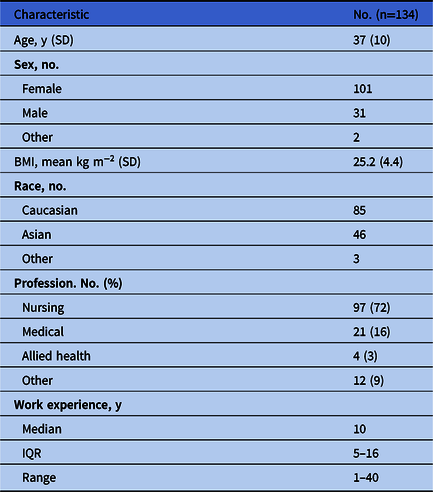
In total, 214 HCWs participated in the RPP during the study period. Among these HCWs, 134 repeated the quantitative fit testing with the application of hydrocolloid dressings under the N95 FFRs that they passed initially. Table 1 shows the demographic data for participants. Most participants were female nursing staff with normal BMI.
Participants’ Demographic Characteristics

Note. BMI, body mass index; IQR, interquartile range.
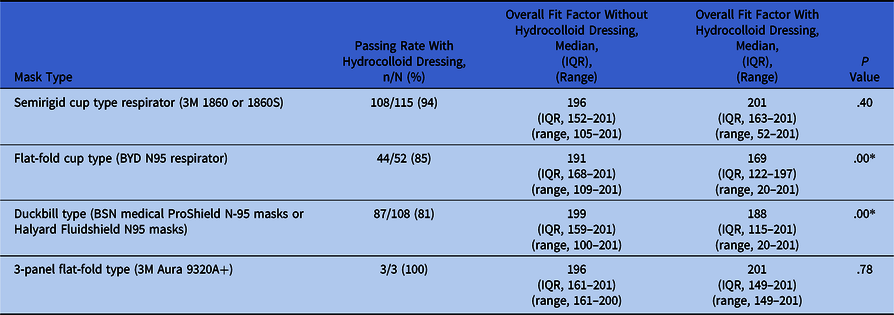
Table 2 shows the quantitative fit-test results. Overall, 115 participants passed the quantitative fit test with the semirigid cup–type respirator (3M 1860 or 1860S) initially, but only 108 of them passed when they repeated the same test with the hydrocolloid dressing on, for an overall passing rate of 94%. There was no significant change in the overall fit factor.
Overall Fit-Test Pass Rate and Fit Factor With and Without Hydrocolloid Dressing for the 4 Different Types of N95 Filtering Facepiece Respirators

Note. IQR, interquartile range.
*Statistically significant.
We detected a statistically significant reduction in the overall fit factor for both the flat-fold cup–type N95 respirator (BYD) and the duckbill type N95 respirators (BSN medical ProShield or Halyard Fluidshield), after the application of hydrocolloid dressing. The fit-test pass rates with the prophylactic dressing were 85% and 81%, respectively (Table 2). The significant decreases in the fit factors occurred during fit-test exercises 1, 2, and 4, which were bending over the hips, speaking out loud, and flexing and extending the neck, respectively.
Only 3 participants repeated the quantitative fit test with the 3-panel flat-fold type respirator (3M Aura), and all achieved an overall fit factor >100 with the hydrocolloid dressing on.
Discussion
Discomfort and pressure injury caused by N95 masks was and remains a significant issue for HCWs during the COVID-19 pandemic, affecting the ability of staff to provide care while remaining safe from infection. Reference Lan, Song and Miao2,5 Evidence in the literature shows that prophylactic hydrocolloid dressings improve comfort and reduce DRPI. Reference Gasparino, Lima and Oliveira-Kumakura16,Reference Vera, Alcalde and Carretero17 However, little evidence has demonstrated the impact of these dressings on mask performance.
Our study demonstrated a high fit-test pass rate for the semirigid cup–style respirator (3M 1860 or 1860S) when it was worn with a hydrocolloid dressing over the nasal bridge. This is reassuring data because many of our staff members find this cup-style mask uncomfortable. This finding is also useful for HCWs who are required to use this type of respirator due to supply issues or poor fit with other types of N95 respirators.
In contrast, there was a statistically significant decrease in the fit test pass rates for the nonrigid style N95 respirators, that is, the vertical flat-fold cup type and the duckbill type. For the duckbill-type N95 respirator, this decrease is likely attributable to the different physical characteristics of the mask that make it more susceptible to vertical shearing forces and therefore more likely to slide vertically over the hydrocolloid dressing, thereby disturbing the fit. A similar phenomenon was observed with the vertical flat-fold type masks, which have a limited tolerance for vertical shearing forces.
Our results suggest that all staff should have a formal quantitative fit test with hydrocolloid dressing in place if they are planning to use a hydrocolloid dressing for skin protection from vertical flat-fold masks or duckbill-type N95 respirators. Respiratory protection programs should consider mandating repeated fit testing of all types of N95 respirators when they are used with a hydrocolloid dressing because a small number of subjects did fail fit testing to even the semirigid cup when a hydrocolloid dressing was introduced.
Our study design had several limitations. First, the sample size was small, especially for the BYD and the 3M Aura N95 respirators. The initial fit-test pass rate for the BYD N95 respirators was low among our staff; therefore, not many participants could repeat the test with the hydrocolloid dressing. Most of our staff found the 3M Aura N95 respirators to be comfortable enough that they did not require prophylactic dressing. Second, there was no blinding in this study. We could not blind the fit testers due to the obvious presence of the dressing.
Additional factors to consider are whether the dressing represents a doffing risk, with the potential for contamination during doffing, although a small study showed no skin contamination from removal of the dressing. Reference Pacis, Azor-Ocampo and Burnett18 Hydrocolloid dressings are designed to remain in situ for several days. 19 Removal of hydrocolloids has been shown to cause skin stripping. Reference Waring, Bielfeldt and Mätzold20 The combination of removing the hydrocolloid dressings earlier than designed for and the repeated application and removal (ie, at the end of each shift over several days), therefore, has the potential to negatively impair the skin barrier function. This factor increases the likelihood of HCWs developing skin injuries, such as contact dermatitis. The risks versus benefits of the dressing must be carefully considered.
Importantly, discomfort and DRPIs due to N95 FFRs can cause physical and emotional stress to HCWs. Prophylactic hydrocolloid dressings represent a potentially effective strategy to relieve this problem. Our study has demonstrated that hydrocolloid dressings are more likely to disturb the mask seal for nonrigid style N95 FFRs, particularly the vertical flat-fold (BYD) and the duckbill type (BSN medical ProShield and Halyard Fluidshield), than the semirigid cup style (3M 1860) N95 FFRs. However, the dressing has the potential to disturb the seal of any type of N95 respirators. We therefore recommend that any HCW requiring use of prophylactic dressings should undergo repeat quantitative fit testing with the dressing in place prior to using the dressing and mask in combination.
Acknowledgments
Financial support
No financial support was provided relevant to this article.
Conflicts of interest
All authors report no conflicts of interest relevant to this article.