1. Background
Obsessive-compulsive disorder (OCD) is a severe mental health problem of a heterogeneous nature (e.g., Bloch, Landeros-Weisenberger, Rosario, Pittenger, & Leckman, Reference Bloch, Landeros-Weisenberger, Rosario, Pittenger and Leckman2008). The disorder is diagnosed when the patient experiences persistent and distressing obsessions that they attempt to remove through repetitive compulsions (American Psychiatric Association, 2013). The nature of obsessions and compulsions varies widely and thus clinical studies are increasingly focusing on developing ways to define coherent, homogenous subtypes of OCD that could inform more tailored treatment and diagnosis (e.g., Lochner & Stein, Reference Lochner and Stein2006). Subtypes described by clinical studies include repeated checking to prevent catastrophic events (e.g., checking electrical appliances to prevent fire), aggressive thoughts about performing harmful acts, a need for symmetry or order, performing mental rituals such as counting, and fears of contamination from germs, chemicals, or other people (see McKay and colleagues, Reference McKay, Abramowitz, Calamari, Kyrios, Radomsky, Sookman and Wilhelm2004, for an overview of OCD subtypes).
Most subtyping studies of OCD adopt quantitative approaches that ask participants to rate statements on self-report inventories. The participants’ scores are then analyzed statistically and subtypes are posited based on the clustering of various symptoms (e.g., Calamari et al., Reference Calamari, Wiegartz, Riemann, Cohen, Greer, Jacobi and Carmin2004). While these methods have shed some light on subtypes of OCD, it is also possible to investigate subtypes through qualitative approaches (e.g., Knapton, Reference Knapton2015; Van Schalkwyk, Bhalla, Griepp, Kelmendi, Davidson, & Pittenger, 2015). Collecting open-ended accounts of OCD experiences through interviews or writing samples allows participants to describe OCD in their own words without forcing their experiences to fit inflexible statements (Van Schalkwyk et al., Reference Van Schalkwyk, Bhalla, Griepp, Kelmendi, Davidson and Pittenger2015). These methods of data collection also allow real-life experiences to come to the fore and they ensure that, for participants who experience more than one subtype of OCD, this variation does not get lost amongst broad, quantitative patterns (Knapton, Reference Knapton2015).
Another qualitative approach that could be used to explore subtypes of OCD is linguistic analysis. In particular, Cognitive Linguistics (CL) argues that language use is grounded in human experiences, perceptions, and conceptualizations (Evans & Green, Reference Evans and Green2006). From this view, patterns in language reflect mental conceptualizations that organize our knowledge of, and interactions with, our environment. Thus, cognitive linguistic analysis of the language used by people with OCD allows subjective conceptualizations and experiences of the disorder to be explored. Additionally, by starting with language patterns at the individual level and working outwards in the directions that the data reveal, cognitive linguistic analysis can add to discussions on experiences of OCD at the individual, subtype, and disorder level. This provides a more individual-focused alternative to the quantitative studies that currently dominate research on OCD.
By performing a cognitive-based discourse analysis, this study aims to show how subtypes of OCD can be differentiated based on their underlying conceptualizations of threat. More specifically, through a linguistic analysis of time, space, and epistemic modality in recounted narratives of OCD episodes, this paper aims to show how participants’ perceptions of threats shift and fluctuate as OCD episodes unfold. The analysis is performed using image schema theory (Johnson, Reference Johnson1987) and cognitive approaches to deixis and perspective in discourse (Chilton, Reference Chilton2004; Lyons, Reference Lyons1977; Verschueren, Reference Verschueren1999).
2. Cognitive Linguistics and mental health
Where CL has been used to study mental health problems, researchers have generally tended to apply conceptual metaphor theory (CMT; Lakoff & Johnson, Reference Lakoff and Johnson1980), which argues that metaphor is a mapping in the human conceptual system from one domain of experience to another.
Recent work by O. Knapton (private communication) found that, in written descriptions of OCD episodes, people with OCD often externalize concepts such as OCD, THOUGHTS, THE MIND, and EMOTIONS and conceptualize them as forceful entities that are independent of the self. These concepts are structured through metaphors such as OCD IS A MONSTER (“the monster came out from me and attacked them”), THOUGHTS ARE A BATTLE (“I had to immediately come up with a mental strategy to counteract the thought”), and THE MIND IS A MACHINE (“my brain kind of freezes up”). This externalization of mental activities by people with OCD has also been found in linguistic analyses of on-line forums, where contributors liken OCD to a “shark” or other aggressive entities (Fennell & Liberato, Reference Fennell and Liberato2007, p. 322). There have also been some initial suggestions that the conceptual metaphor OCD IS A JOURNEY (e.g., “my journey through OCD”) is used more extensively in forum and blog posts by women with OCD, whereas OCD IS A BATTLE (e.g., “impossible to beat”) is used more extensively by men with OCD (Campbell & Longhurst, Reference Campbell and Longhurst2013, pp. 87–89).Footnote 1
While aggression and battles seem to be key in the organization of OCD experiences, experiences of depression have been found to be structured by conceptual metaphors such as DEPRESSION IS DESECENT (e.g., “sliding down”) (McMullen & Conway, Reference McMullen, Conway and Fussell2002, p. 172) and DEPRESSION IS A BURDEN (e.g., “I have all this personal baggage”) (Levitt, Korman, & Angus, Reference Levitt, Korman and Angus2000, p. 29). Equally, depression can be conceptualized as a CONTAINER that traps the self (e.g., “you have a sort of bubble round you”) or the self with depression can be a CONTAINER that stores negative emotions (e.g., “it was all [er] bottling up inside me”) (Charteris-Black, Reference Charteris-Black2012, p. 206). Thus, subjective experiences of depression are organized through metaphors that draw on sunken postures, heavy loads, and restricted activity. This contrasts with the metaphors that organize OCD, where the experiences seem to be characterized by movement and agency, either of the self or of externalised mental activities. It would therefore appear that different mental health problems are structured by different conceptual metaphors.
In recent years, there have been calls in CL to move away from the dominance of CMT for discourse analysis (Hart, Reference Hart2011). One problem with conceptual metaphor analysis of discourse is that studies tend to lift metaphorical expressions from the original text or speech situation. This has the effect of decontextualizing the examples, making it unclear what role the surrounding discourse (and, indeed, the broader social context) may have played in a particular expression’s interpretation (Cameron, Reference Cameron2007). Recent studies have begun to address this by exploring the emergence and co-construction of metaphor within longer stretches of discourse and within spoken interaction (e.g., Cameron, Maslen, Todd, Maule, Stratton, & Stanley, Reference Cameron, Maslen, Todd, Maule, Stratton and Stanley2009; Langlotz, Reference Langlotz2015; Tay, Reference Tay2013). Where the current study adds to research in CL is through examining the function, not of metaphors, but of image schemas (Johnson, Reference Johnson1987) and embodied, subjective positioning (e.g., Chilton, Reference Chilton2005) through extended, spoken narratives.
3. OCD and perceived threats
The leading cognitive model of OCD that attempts to explain the disorder’s aetiology is the cognitive–behavioural model (Salkovskis, Reference Salkovskis1985, Reference Salkovskis1989). Talking therapies for OCD that are recommended by health professionals (e.g., cognitive–behavioural therapy) are derived from this model. The cognitive–behavioural model of OCD posits that OCD is caused not by distressing thoughts per se but by the person’s appraisal of those thoughts. The Obsessive-Compulsive Cognitions Working Group (OCCWG; 1997) identified six belief domains that, if held strongly by a person, are likely to lead to negative appraisals of thoughts. One of these belief domains is an overestimation of the probability and severity of threats, meaning that many people who develop OCD have a strong tendency to perceive negative outcomes as highly likely and potentially catastrophic. One criticism of the cognitive–behavioural model is that these belief domains are measured as static and unchanging without allowing for any potential subjective variability between participants or over time (Riskind, Reference Riskind1997). The present study investigates the belief domain of an overestimation of threats through a more dynamic lens; that is, allowing for shifts in the perception of threats to come to the fore. To the best of the author’s knowledge, no studies have investigated the perceptions of threat in OCD through qualitative methods.
One cognitive model of anxiety that has addressed threat perception is the looming vulnerability model (Riskind, Reference Riskind1997). This model argues that people with anxiety disorders experience perceived threats as continually moving through space and time. The movement of the threat sparks fear because “the apparent physical or temporal proximity of that threat … to the self” is increased as the threat rapidly approaches and/or develops (Riskind, Reference Riskind1997, p. 688). This notion of a dynamic threat is in contrast to the static, fixed description of threat as provided by the cognitive behavioural model of OCD. The current study aligns with the looming vulnerability model by arguing that threats are not experienced as static and unchanging when in the grip of an OCD episode; rather, they are experienced as shifting and unpredictable, which heightens the person’s distress.
Although looming vulnerability is not specific to OCD (Riskind, Rector, & Cassin, Reference Riskind, Rector and Cassin2011), it has been found to be pertinent for people with fears of contamination and disease (Riskind, Abreu, Strauss, & Holt, Reference Riskind, Abreu, Strauss and Holt1997; Tolin, Worhunsky, & Maltby, Reference Tolin, Worhunsky and Maltby2004). No studies appear to have been published on dynamic threats and looming vulnerability in OCD subtypes other than contamination fears, despite the tentative suggestion by Riskind and colleagues (Reference Riskind, Abreu, Strauss and Holt1997) that dynamic threat perceptions may also operate within other subtypes of OCD. Through cognitive linguistic analysis, the current study shows that the subjective perception of threats as dynamic or static is variable across subtypes of OCD, and thus could be used to gain insights into the differences between the cognitive underpinnings of various subtypes.
4. OCD episodes, scripts, and narrative
The cognitive–behavioural model of OCD explains that an OCD episode consists of a series of components: (i) a trigger; (ii) an intrusive thought; (iii) an appraisal of character; (iv) distress and/or anxiety; (v) responses to reduce the distress; (vi) a reduction in distress; and (vii) positive reinforcement of both the appraisal and the distress-reducing behaviours (Salkovskis, Reference Salkovskis1985). Although this model has provided invaluable insights into the disorder, one criticism is that the individual components of an OCD episode (e.g., triggers, thoughts, responses) are often researched discretely via questionnaires and inventories, with interactions between the components only being examined through statistical measures (Davis, Reference Davis2008). These quantitative approaches do not easily lend themselves to an examination of how the components operate as one coherent unit. In contrast, the current study follows Knapton (Reference Knapton2015) by arguing that OCD episodes should be explored as whole units. Through a qualitative, thematic analysis of OCD episodes recounted by people with OCD, Knapton (Reference Knapton2015) found three broad subtypes of OCD episodes: (i) activity episodes, which are concerned with the negative outcomes of an activity or task that the person is performing; (ii) state episodes, which are concerned with the self and identity; and (iii) object episodes, which are concerned with the effect of external objects upon the self. Thus, by qualitatively analyzing whole OCD episodes, Knapton (Reference Knapton2015) suggests an alternative way of classifying OCD subtypes that had not previously emerged from quantitative studies that measure rigidly delineated components within OCD episodes.
The cognitive–behavioural model highlights the causal, cyclical nature of OCD episodes by stressing that the occurrence of one component of an OCD episode (e.g., unwanted thoughts) will trigger the subsequent component (e.g., an appraisal). Because of these cause-and-effect chains, it can be seen that OCD episodes follow a temporal structure. In CL, a key notion for the temporal organization of events is a ‘cognitive script’ (Schank & Abelson, Reference Schank and Abelson1977). A script is “a standard event sequence” that is stored in memory and is accessed to “interpret and participate in events we have been through many times” (pp. 37–38). As the components of certain events repeatedly occur in a specific order, a script is the underlying conceptualization of this chain of components as one connected whole. As the components of the OCD cycle seem to occur in the same order (Salkovskis, Reference Salkovskis1985), this study argues that OCD episodes are organized by a generic OCD EPISODE script. This script provides the underlying conceptual structure for the temporal sequence of the components in an OCD episode.
As scripts follow temporal sequences, their tellings in language often take the form of narratives. Therefore, it follows that the OCD EPISODE script will be realized in language through narratives of OCD episodes. Even though these OCD episode narratives follow the stable OCD EPISODE script, their linguistic tellings will show variation depending on the relationship between the interlocutors, the time and place of the telling, and so on. As Chafe (Reference Chafe1998, p. 270) argues, while the language is free to vary, “there is a level of underlying experience that is richer and more comprehensive than any particular way in which it may be verbalized” (italics in original). As the OCD EPISODE script is repeated time after time, day after day, OCD episode narratives can recount both momentous OCD episodes in the past and repetitive, routine OCD episodes that occur every day. This definition is in line with recent narrative work that encapsulates the recounting of both isolated events and repeated, everyday actions within its characterization of narrative (e.g., Georgakopoulou, Reference Georgakopoulou2007; Riessman, Reference Riessman1990).
In a key study of narrative and mental health, Capps and Ochs (Reference Capps and Ochs1995) examined the narratives of panic episodes told by one woman with agoraphobia. Capps and Ochs see these narratives as constitutive of social reality; that is, the woman’s experiences of panic are actualized through their narrative reconstructions rather than the panic episode narratives being reflective of any deeper cognitive conceptualization. This is in contrast to this study, where it is claimed that the structure of the OCD episode narratives is provided by the cognitive OCD EPISODE script that has been built up over many similar OCD episodes. Each component of the script sets up an expectation of the subsequent component and thus meanings and experiences of OCD episodes are partly created through the activation of this cognitive script. At later dates, when these OCD episodes are recounted as narratives, their discursive variations will further add to the meanings attached to the OCD episodes.
5. Perspective in discourse
Following cognitive approaches to narrative discourse, the OCD episode narratives are analyzed in this study from the stance that “the narrator’s reality is whatever is presented as the discourse world, regardless of its truth or validity outside of the discourse” (Sanders & Redeker, Reference Sanders, Redeker, Fauconnier and Sweetser1996, p. 293). Therefore, the participants’ experiences are analyzed from the viewpoints and shifting perspectives recounted within their narratives; they are not analyzed in comparison to ‘objective’ reality. For research into OCD, this approach is essential in order to capture the personal, subjective experiences of OCD that are often overlooked in quantitative studies.
In terms of speaker-oriented discourse analysis, cognitive approaches to deixis have mainly been applied in critical discourse analysis of political discourse (e.g., Chilton, Reference Chilton2004; Hart, Reference Hart, Hart and Lukeš2007). There appears to be very little application of cognitive approaches to deixis to first-person narratives of health and illness experiences. By extending the application of the theories to a new domain, this study shows how subjective, first-person perspectives of mental health problems can be explored using cognitive approaches.
5.1. deixis, lexis, and grammar
In discourse, certain linguistic forms derive their meaning from the speech situation rather than semantic values. The perspective from which a scene or event is viewed is the deictic centre, which is the meeting point of several dimensions, such as person (I), space (here) and time (now) (Bühler, Reference Bühler, Jarvella and Klein1982; Lyons, Reference Lyons1977; Verschueren, Reference Verschueren1999). The deictic centre is signalled in language through deictic expressions, for example, the adverb here has no meaning unless we already know where the speaker (i.e., the deictic centre) is located. Importantly, deictic centres can shift throughout the discourse (Segal, Reference Segal, Duchan, Bruder and Hewitt1995). For example, temporal shifts are marked by temporal adverbs (e.g., yesterday, tomorrow), locative adverbials (e.g., in 1929), and shifts in tense and aspect (e.g., Fillmore, Reference Fillmore, Jarvella and Klein1982; Steedman, Reference Steedman, Jarvella and Klein1982). Through these deictic markers, speakers position other entities in their reality in relation to themselves as the deictic centre (Bühler, Reference Bühler, Jarvella and Klein1982; Verschueren, Reference Verschueren1999).
Lexical words can also encode perspective; for example, I took the cake to the party signals movement away from the speaker, whereas I brought the cake to the party signals movement toward the speaker (Fillmore, Reference Fillmore, Jarvella and Klein1982). Similarly, grammatical constructions can encode speaker perspective and construct mental representations of events that situate the speaker as the anchored centre point (Langacker, Reference Langacker2008; Talmy, Reference Talmy2000). In terms of discourse analysis, recent work has shown how political discourse often structures events and situations through spatial concepts encoded within grammatical constructions, such as passive voice (Cap, Reference Cap2013; Chilton, Reference Chilton2004; Hart, Reference Hart2014, Reference Hart2015).
One related theory that applies deictic analysis to discourse is Deictic Space Theory (DST) (Chilton, Reference Chilton2004, Reference Chilton2005). DST argues that the self is situated not only in relation to time and space, but also in relation to modality. Thus, the self is “not only here and now, but also the origin of the epistemic true and the deontic right” (Chilton, Reference Chilton2004, p. 59, italics in original). By considering modality as existing on a scale (e.g., Sweetser, Reference Sweetser1990), it can be seen that, for epistemic modality, those propositions that are perceived as true or certain (i.e., assertions) are located close to the self, and those that are perceived as false or unlikely (i.e., negation) are located as remote from the self (Chilton, Reference Chilton2004). In the middle of the scale are propositions marked with possibility and uncertainty, such as modal verbs (e.g., might, may, could) and adverbs (e.g., possibly, perhaps). The three dimensions of time, space, and modality thus give structure to the discourse whilst remaining anchored to the speaker’s physically situated and embodied experience as the deictic centre (Chilton, Reference Chilton2005; see also Hart, Reference Hart2014). For experiences of OCD, an exploration of deixis will capture the perceptions of threats and dangerous entities in OCD episodes as they move both towards and away from the speaker in terms of physical space, temporal proximity, and certainty/possibility of occurrence. This type of analysis thus allows experiences of OCD to be considered as dynamic and changing rather than as driven by rigid belief domains.
In this study, epistemic modality is focused on over and above deontic modality as clinical research on OCD has found uncertainty and doubting to be crucial in the maintenance of the disorder (e.g., O'Connor, Reference O'Connor2002). Following some cognitive semantic approaches to modality (e.g., Declerck, Reference Declerck, Patard and Brisard2011), epistemic modality is explored as a semantic category rather than as a structural category. Therefore, epistemic modality is not restricted to closed-class items like modal auxiliary verbs and modal adverbs, but extends to lexical items and other grammatical constructions that can express degrees of certainty and possibility.
5.2. image schemas and space
Image schemas are embodied, primary units of cognition that are learned in early childhood and that organize human experiences (Johnson, Reference Johnson1987; Lakoff, Reference Lakoff1987). In terms of the structures of lived space, two image schemas are of relevance to this study: the SOURCE–PATH–GOAL image schema and the CONTAINER image schema (Johnson, Reference Johnson1987; Lakoff, Reference Lakoff1987; Lakoff & Johnson, Reference Lakoff and Johnson1999). As an outline, the SOURCE–PATH–GOAL image schema involves the trajectory of an entity from a start point (the SOURCE) to an endpoint (the GOAL); the CONTAINER image schema involves an inside and an outside separated by a boundary (Lakoff & Johnson, Reference Lakoff and Johnson1999, pp. 31–33). These image schemas are marked in language through deictic expressions (as well as lexical items). For example, the trajectory of an entity through the SOURCE–PATH–GOAL schema may be marked by lexical items and adverbial phrases such as from here, along the way, to there, and so on. The movement of an entity within or across CONTAINER boundaries may be marked, for example, by adverbs such as in to, out of, and within.
Image schemas that structure space may hold particular significance for people with OCD, as theoretical work has posited that people with contamination fears often attempt to organize the surrounding space in order to control perceived contaminants (Segrott & Doel, Reference Segrott and Doel2004). Additionally, the image schemas of CONTAINER and SOURCE–PATH–GOAL have been found to structure discourses around the spread of emerging diseases (Koteyko, Brown, & Crawford, Reference Koteyko, Brown and Crawford2008; Nerlich, Reference Nerlich, Handl and Hans-Jörg2011), which suggest that they may play a role in the conceptualizations of contamination more broadly. No studies have qualitatively examined the experiences of space within OCD subtypes that do not involve fears of contamination. Thus, this study adds to discussions about the cognitive underpinnings of OCD by suggesting that the conceptualization of space shows variation between OCD subtypes.
6. Methods
6.1. ethical approval
This study was granted ethical approval by the King’s College London Social Sciences, Humanities and Law research ethics sub-committee (Ref: SSHL/10/11-4). Pseudonyms were used at all stages from transcription to publication.
6.2. recruitment and participants
To recruit participants with OCD, two leading charities in the UK (OCD Action and OCD-UK) agreed to upload an advert onto their websites, and then potential participants contacted the researcher directly.
The eligibility criteria were that participants had to be age eighteen or over and speak English fluently. Self-identification of OCD was considered as valid as clinical diagnosis because some people with OCD choose not to be diagnosed; however, every participant did in fact have a clinical diagnosis. Particular genders, age ranges, or subtypes of OCD were not targeted. Participants were not excluded if they had diagnoses of additional mental health problems (e.g., depression) because comorbidities are common with OCD.
Fifteen participants with OCD (10 female; 5 male, age range 23–56) were recruited between July and December 2011.
6.3. data collection
Participants were informed about the aims of the study and the data-collection tasks before being asked to give written consent to be interviewed. Each participant completed an audio-recorded, semi-structured interview with the author of this paper. The interview schedule contained open-ended questions covering topics such as descriptions and experiences of OCD, the onset of OCD, and public perceptions of OCD.
After the fifteen participants had been interviewed, the researcher felt that the subtypes of OCD described in the clinical literature were equally represented in the sample. Data collection was thus concluded at this point.
6.4. data selection
The interviews were transcribed and, following the transcription methods of Chafe (Reference Chafe and Chafe1980) and Gee (Reference Gee1986), were divided into smaller chunks of discourse distinguishable by changes in intonation and content. Where participants described any component of an OCD episode (e.g., trigger, distressing thought, response), these were labelled as such. Once the individual components of recounted OCD episodes had been identified, the start and end points of whole OCD episode narratives could be ascertained.
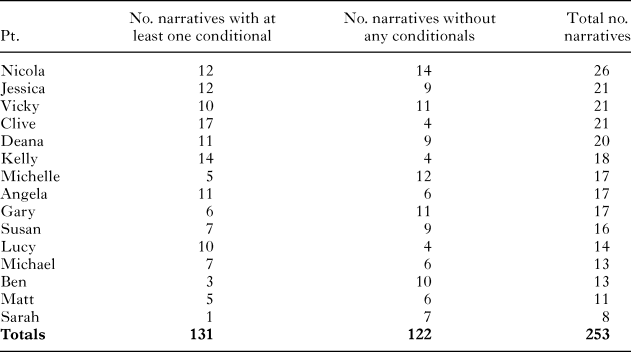
A selection of the OCD episode narratives was then made. As reasoning through conditional constructions (e.g., constructions using if, unless, as long as, and syntax inversion) has been highlighted as important for OCD (O'Connor, Reference O'Connor2002), all the OCD episode narratives were examined for conditional constructions. The narratives were then grouped for each participant according to the presence or absence of conditional constructions (Table 1, ordered by descending number of total narratives). Conditional constructions that formed part of idiomatic phrases (e.g., if the shoe fits) and reassurance seeking (e.g., if you see what I mean) were not included in the count.
Number of OCD episode narratives with and without conditional constructions

For every participant, two narratives with conditionals and two narratives without conditionals were selected (for Sarah, only one narrative with a conditional was selected). This gave a total of 59 narratives for analysis. To select the narratives, the content of all the narratives was re-examined. The narratives that were selected for each participant were those that recounted OCD episodes about their most prominent distressing thoughts. Distressing thoughts were considered ‘prominent’ if the participant had identified them as such during the interview; for example, participants often used phrases such as “the main thing these days is” (Michael) and “I have a big problem with” (Deana).
After selection, the content of the selected narratives was examined and they were re-grouped according to the three broad groups of activity episodes (n = 22), state episodes (n = 21), and object episodes (n = 16) found by Knapton (Reference Knapton2015). This re-grouping was completed after selection to ensure that the selection of narratives represented the participants’ experiences rather than being governed by predetermined categories.
6.5. data analysis
Deictic expressions of time, space, and epistemic modality were identified within the selected narratives. Lexical and grammatical constructions that represented a shift in viewpoint were also identified. The direction of movement in relation to the speaker’s self as encoded by the deictic markers, lexical items, and grammatical constructions was then examined in the unfolding narrative.
7. Results and discussion
Throughout these results, it is demonstrated that some perceived threats in OCD episodes are conceptualized as dynamic rather than static, and that the movement of the perceived threat induces fear and distress. The results therefore suggest that the fixed, blanket notion of an overestimation of the threat as posited by the cognitive–behavioural model (OCCWG, 1997) is not sensitive enough to capture these shifting perspectives. Moreover, the results also show that the dynamism of the threat is conceptualized differently for the activity, state, and object groups proposed by Knapton (Reference Knapton2015), which suggests that subtypes of OCD can be distinguished based on their conceptualizations of threat. The differences across the three groups in part stem from how the movement of the threat is structured by two interacting image schemas: the SOURCE–PATH–GOAL image schema and the CONTAINER image schema.
The analysis works through the activity group, followed by the state group and then the object group. For each group, the analysis examines the shifting perspectives throughout the narratives followed by the image schemas that structure conceptualizations of space. While the analysis was applied to all the selected OCD episode narratives, the presentation of results focuses on one narrative from each group that clearly exemplifies the patterns found for that group.
7.1. activity episodes
Activity episodes involve worries about the negative outcomes of an activity or task that the person is performing (Knapton, Reference Knapton2015). As will be shown, activity episodes are characterized by an escalation of panic as the spatial distance between the self and the threat, projection into future time, and the level of uncertainty surrounding the outcome of the situation all increase. This escalation of panic is also accompanied by a perceived lack of control over the threatening situation.
To present the findings of the activity group narratives, the following OCD episode narrative recounted by Nicola is analyzed. The analysis divides the narrative into five parts that roughly correspond to different components of the OCD EPISODE script.
(1) and then I also had an instance where I sold my double pushchair when my two got a bit bigger
(2) and erm then had this massive panic that there was something wrong with it
(3) which I think there probably was something slightly wrong with it
(4) but the thing that I thought was slightly wrong with it was dangerous
(5) even though it wasn’t dangerous
(6) but I decided in my head that it was dangerous
(7) and so I’m ringing up this guy who I sold this thing to on eBay going “oh I’m not sure
(8) I think the brake might be dodgy”
(9) and erm “can you check it before you use it with the children”
(10) and he’s like “oh it’s fine
(11) when you buy things off eBay
(12) they’re never 100% perfect”
(13) yeah but I’m like “it might be dangerous
(14) and can you check it”
(15) and then I’m going to my husband “I wanna give him the money back
(16) because then if I give him the money back
(17) then he won’t be able to sue me”
(18) and worried about being sued
(19) and ending up destitute
(20) and eventually rang this guy
(21) and said “look I want to give you your money back
(22) can you give me your address
(23) and I’ll send you a cheque”
(24) and my husband was furious with me
(25) saying “but we haven’t got the money to start giving people money back”
(26) and this guy goes to me “oh oh it’s fine
(27) we’ve sold it on now”
(28) and I was like “oh no he’s sold it on to somebody else”
(29) and at that point
(30) I thought “I can’t do anything about it because I haven’t got a clue who you’ve sold it on to”
(31) so that almost like calmed it
7.1.1. Perspective analysis
Part one (lines 1–6).
In terms of time and space, Nicola’s narrative begins by grounding the episode in a specific past time by use of the simple past tense and locative adverbials (“I also had an instance where I sold my double pushchair when my two got a bit bigger”; line 1). It is also evident that the entities in Nicola’s episode are initially experienced as in her immediate spatial proximity through the use of the possessive pronoun my in “my double pushchair” and “my two” children (line 1). However, Nicola signals a conceptualization of expanding space when she states “I sold my double pushchair”; thus presenting herself as a seller and the pushchair as moving away from her and towards the buyer.
On the dimension of epistemic modality, Nicola’s predictions about the fault with the pushchair are presented as certainties within her thoughts. She has “this massive panic that there was something wrong with it” that “was dangerous” (lines 2 and 4). Although these are Nicola’s thoughts, they are not hedged by markings of possibility; rather, they are certainties to her. Nicola juxtaposes these thoughts at the time of the episode with her thoughts at the time of the interview (“there probably was something slightly wrong with it” that “wasn’t dangerous”; lines 3 and 5), which positions the certainty she felt during the episode as perhaps misplaced. The locative adverbial “in my head” (line 6) also implies that her thoughts during her episode were specific to her and not shared by others, which strengthens the contrast between her thoughts at the time and what she now believes to be the reality of the situation.
Part two (lines 7–14).
In part two, Nicola’s perspective point begins to shift. Nicola recounts her distressing thoughts through a conversation with the buyer, in which she asks him to check the pushchair “before” he uses it (line 9), signalling that her distressing thoughts have turned to events in a future time. The switch into present tense (“I’m ringing up this guy”; line 7) also signals the dramatic nature of this part of the episode.
In terms of space, Nicola’s utterance “I’m ringing up this guy who I sold this thing to on eBay” (line 7) positions the buyer (and thus the pushchair) in a different location to Nicola. Nicola is actively reaching out from her space into his space, bypassing their previously shared space of the on-line marketplace, eBay. This compression of space is also signalled in the demonstrative “this guy”, which positions the buyer physically closer to Nicola. As the threat (i.e., the faulty pushchair) has moved further away in physical space, Nicola is endeavouring to decrease the physical distance that has been created between her and the pushchair. This can be seen as an attempt to regain control over the problematic entities that have moved out of her immediate space.
The level of threat posed by the pushchair also becomes less certain as the entities in Nicola’s thoughts move further away and further into the future. Nicola uses a modal verb to tell the buyer that she “[thinks] the brake might be dodgy” (line 8) and this uncertainty is augmented by its position within a mental process that marks a lack of assertion (“I’m not sure”; line 7). Thus, the immediate danger that Nicola was certain of has become a future possibility now that the situation is out of her control. In contrast to Nicola’s distress, the buyer is quoted as using the generic pronoun you and the simple present tense (“when you buy things off eBay”; line 11) to indicate that some level of risk is normal with eBay purchases.
Parts three (lines 15–19) and four (lines 20–25).
In part three, Nicola’s distressing thoughts have become about threats in the distant future; she is “worried about being sued / and ending up destitute” (lines 18–19). It is no longer about the immediate harm that could come to the buyer’s children but about the longer-term ramifications for herself and her family.
Part three moves the narrative back into Nicola’s personal space through the inclusion of the possessive pronoun my (“my husband”; line 15). The line “he won’t be able to sue me” (line 17) describes the scene from the buyer’s perspective and places Nicola as the person being affected. The act of “being sued” (line 18) reverses the trend of increasing spatial distance between Nicola and the problematic entities, and presents the buyer as extending out from his space and encroaching into her space. While Nicola, in part two, was attempting to reduce the distance between her and the pushchair to maintain control of the situation, here the control is with the buyer and therefore reduced distance equates to an increased threat with even greater catastrophic consequences for Nicola.
The uncertainty of the situation is also heightened by the conditional construction “if I give him the money back / then he won’t be able to sue me” (lines 16–17). Even though returning the money is an act performed by Nicola, the conditional conjunction if constructs the act as a possibility and not as something she will definitely perform. Nicola therefore appears to reduce her own agency by constructing her future actions (that are designed to rectify the situation) as possibilities.
Part five (lines 26–31).
The episode is resolved when Nicola discovers that the buyer has sold the pushchair. The fact that “he’s sold it on to somebody else” (line 28) creates even further spatial distance between Nicola and the pushchair. Rather than increasing Nicola’s worry, however, this distance “almost like calmed it” (line 31) because she thinks she can no longer “do anything about it” (line 30). Her control of the situation has, “at that point” (line 29), been completely eradicated.
Summary.
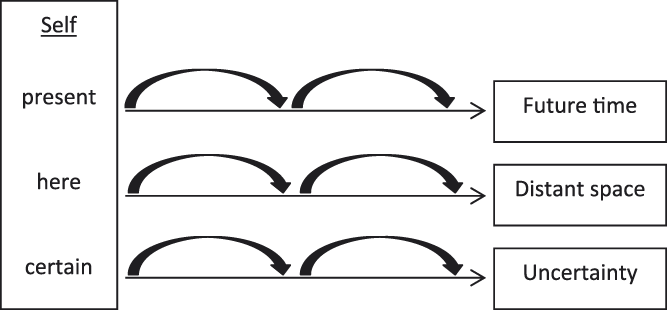
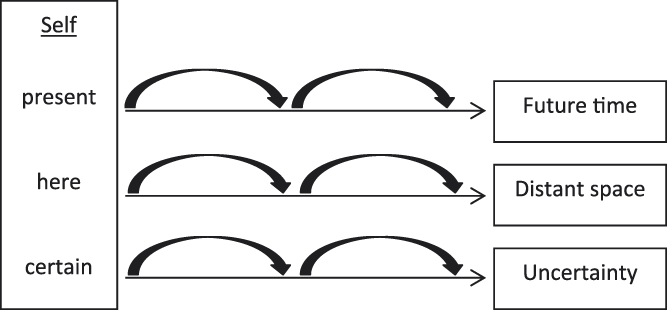
The danger and threat in Nicola’s episode is characterized by spiralling uncertainties, growing spatial distance, and projections into the more distant future. This pattern of movement away from the self was found across the majority of activity group episodes, and can be represented diagrammatically as in Figure 1.
Perspective diagram for activity group OCD episodes.
7.1.2. Image schemas
In terms of image schemas, activity episodes begin with the SOURCE–PATH–GOAL schema; as Figure 1 shows, the threat travels from a SOURCE (e.g., somewhere in Nicola’s immediate proximity) along a PATH away from the self. However, the GOAL to where it is heading is never certain. The outcome of the perceived threat is always conceptualized as uncertain or unknown, with a variety of possible negative outcomes (e.g., Nicola does not know whether the children will be harmed, whether the buyer will sue her, and so on). Thus, activity episodes cannot easily conclude due to the multitude of possible GOALS. This uncertainty has the effect that the situation continually spirals, is perceived as never-ending, and the person has to increase their agency to bring it under control.
7.1.3. Overlaps with agoraphobia
The notion that situations are more controllable when they are in one’s spatial proximity (as experienced in activity episodes) has also been investigated in experiences of agoraphobia (Capps & Ochs, Reference Capps and Ochs1995; Davidson, Reference Davidson2000). For people with agoraphobia, the movement of the self into extended spaces can spark distress. However, it is not always the emptiness of spaces that are feared but rather the unpredictable movements of others and entities that share the space (Davidson, Reference Davidson2000). There are parallels between agoraphobia and activity episodes here, as both are concerned by the uncontrollable motion of people and events within spaces that extend far away from the self as the deictic centre. This has implications for further research into OCD by highlighting that greater insights into the activity subtype could be gained by drawing on work that has been carried out into agoraphobia (e.g., Davidson, Reference Davidson2000).
7.2. state episodes
State episodes primarily involve worries about the self and identity (Knapton, Reference Knapton2015). In contrast to activity episodes, state episodes remain uncomfortably close to the person on all the deictic dimensions, primarily because it is usually the self or another ‘part’ of the self that is the perceived threat. Threatening situations are experienced as certainties that are bound to occur in the present or immediate future; equally, spatial distance between the self and the trigger is felt as dangerously close.
To show the findings of the state group narratives, an OCD episode narrative recounted by Susan is presented here. Susan’s narrative will not be divided into parts because, as will be demonstrated in the analysis, state group narratives show very little movement on the deictic dimensions. These minimal shifts create a narrative that lends itself to an analysis as one whole.
(1) it was really awful
(2) my sister had three children by then
(3) and of course I’d been involved with them and everything
(4) but it got so I couldn’t go near them because I was frightened I was gonna hurt- I was gonna hurt them
(5) do something
(6) so I couldn’t have them near me
(7) I couldn’t sit near them-
(8) like I couldn’t trust myself anymore to be anywhere-
(9) plus bear in mind I’m training as a nursery nurse
(10) so this was like the worst thing that could’ve happened really
7.2.1. Perspective analysis
Susan’s narrative begins by describing how her sister “had three children by then” and that she “[had] been involved with them” (lines 2–3). Thus, at the time of the episode, Susan and the children are regularly interacting, the spatial distance between them is minimal and there is no problematic situation. However, the children become the trigger for Susan’s distressing thoughts; Susan states “it got so I couldn’t go near them because I was frightened I was gonna hurt … them / do something” (lines 4–5). Therefore, Susan believes herself to pose a threat to her sister’s children. Susan’s distressing thoughts are about her agency in the immediate future, which is signalled by her use of the going to auxiliary (line 4). Thus, the threat that she poses to the children is perceived as imminent and certain. The use of the verb phrase “I was frightened” (line 4), however, slightly minimizes this certainty somewhat as Susan appears to be hedging the outcome of hurting the children.
In terms of spatial distance, Susan conceptualizes herself as narrowing the distance between her and the children in order to harm them. To avoid performing these actions, Susan strives to control the situation by creating greater spatial distance between her and the children, which is reflected in the clauses “I couldn’t go near them” (line 4) / “I couldn’t sit near them” (line 7). In these clauses, Susan is restraining herself from entering into the children’s space. She also reverses this perspective in line 6 with the clause “I couldn’t have them near me”. Here, Susan is not conceptualized as the agent who puts herself in the children’s proximity; rather, the children are within her space either through their own or someone else’s (e.g., their parents’) volition. This perhaps reflects the fact that Susan had “been involved with them” (line 3) and thus it is likely that her family would have expected Susan to interact with the children. Susan’s need to control the situation by creating distance between herself and her triggers (i.e., the children) contrasts with Nicola’s need (in the activity group) to control the situation by remaining close to her triggers (i.e., the pushchair).
Susan’s repetitive use of the modal verb plus negative construction couldn’t reflects an obligation for Susan to keep her distance to reduce the threat. The stative verbs in the utterances “I couldn’t have them near me” (line 6) and “I couldn’t trust myself anymore to be anywhere-” (line 8) further reflect the absence of Susan’s movement and action in this episode. Susan is endeavouring to reduce her activity as a way of controlling her agency; it is precisely her agency that is threatening and installs fear (“I was frightened I was gonna hurt … them”, line 4). Once again, Susan’s desire to control the situation through decreased agency stands in opposition to Nicola’s desire to control the situation through increased agency.
As the predicted harm to the children is caused by Susan’s actions, there is a sense of certainty about the danger she poses. Unlike the activity group, in which possible negative outcomes are uncontrollable because the harm comes to others through negligence or through reduced personal agency, the state group is characterized by a certainty that stems from one’s own direct agency. Thus, the negative outcomes never move far from the self along the dimension of epistemic modality.
Summary.
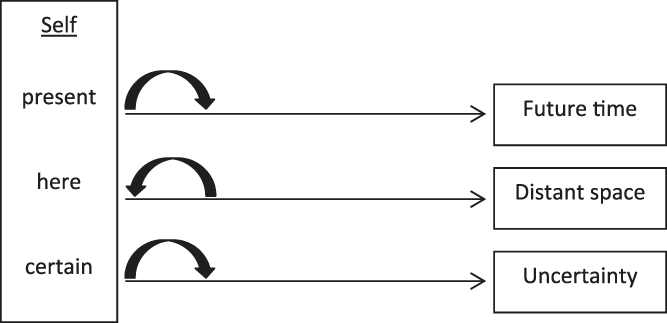
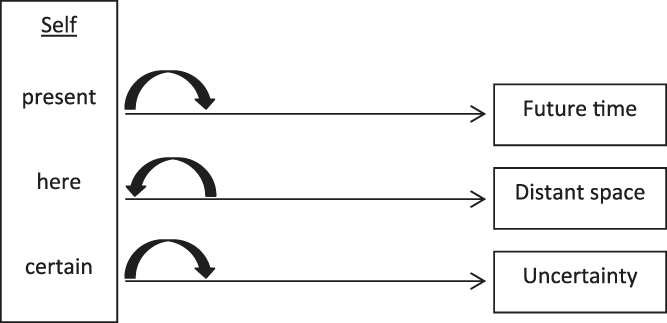
In Susan’s episode, the threat stays close to herself as the deictic centre. Time only moves into the immediate future, the space between the self and the trigger is conceptualized as getting smaller, and the negative outcome is conceptualized as highly certain. The patterns found in Susan’s narrative were also found in many other state group episodes, and can be summarized as in Figure 2.
Perspective diagram for state group OCD episodes.
7.2.2. Image schemas
As summarized in Figure 2, state episodes involve very little movement of the threat either towards or away from the self. This is because, in the vast majority of episodes, the threat is perceived as the self (e.g., as experienced by Susan), another ‘part’ of the self (e.g., the mind), or thoughts generated by the self. Thus, the threat always remains close to or within the self, and does not accelerate towards nor escalate out from the self along the SOURCE–PATH–GOAL trajectory as was seen for activity episodes. Rather, state episodes are characterized by the CONTAINER image schema, which here provides structure to the self. Therefore, the conceptual metaphor of THE SELF IS A CONTAINER appears to have significance within state episodes. In this conceptualization, the threat is intrinsically inside the self and thus trapped by the boundaries. As an example of this, Susan’s dreaded actions are perceived as certainties that are already within her bounded self; it is the predicted trajectory of the threat (i.e., herself) that she fears. Therefore, by controlling her actions, she (as the threat) does not move towards her predicted victims.
7.2.3. Overlaps with depression
The CONTAINER image schema has also been found as central to the conceptualizations of people with depression (Charteris-Black, Reference Charteris-Black2012). The fact that both depression and state episodes are structured by the SELF IS A CONTAINER conceptual metaphor supports recent work that has argued that obsessions that have implications for a sense of self are more likely to correlate with symptoms of depression (Keong, Mogan, & Kyrios, Reference Keong, Mogan and Kyrios2012). Additionally, Riskind (Reference Riskind1997, p. 687) claims that anxiety is a “‘mobilization’ response” to a developing threat whereas depression is a “‘demobilization’ response to a static or unlikely-to-vary situation”. While activity episodes fit with Riskind’s descriptions of anxiety and dynamism, state episodes fit with Riskind’s definitions of depression and perceptions of a fixed threat of which the outcome is already determined. This provides support for overlaps between the experiences of state episodes and experiences of depression. This implies that people who experience state episodes may respond positively to similar treatments that are used with people who experience depression.
7.3. object episodes
Object episodes involve a perceived change of state in the self that is caused by an object (e.g., a contaminant); therefore, the threat is an entity that is external to the self (Knapton, Reference Knapton2015). Unlike the activity and state episodes, object episodes also involve perceived certainties that have occurred in the recent past. In these past certainties, the spatial distance between the self and the threatening contaminant is closed down, which alters the present state of the self from uncontaminated to contaminated. In some but not all episodes, this change of state can then proceed to cause possible future negative outcomes. In these future possibilities, spatial distance between the self and the contaminant, and uncertainty concerning the power of the contaminant both increase.
To present the findings of the object group narratives, the following OCD episode recounted by Angela is discussed. Angela’s narrative is analyzed in five parts that correspond approximately to different components of the OCD EPISODE script.
(1) I hate air fresheners and sprays of any description-
(2) if somebody’s spraying in the street
(3) because quite often they- you- they have these weed killer people go round
(4) and a couple of times you know
(5) I’ve walked past
(6) and seen people spraying
(7) and then that’s like ruined my day
(8) because like when I get home
(9) I have to take all my clothes off
(10) and they have to be washed
(11) well I usually put them in plastic bags
(12) separate them
(13) you know shower you know
(14) because if I don’t
(15) when I go to bed
(16) then my bed clothes are just contaminated you know
…
(17) so quite often I’m always doing- the washing machine is always on
(18) sometimes I just throw clothes away
(19) I can’t wear them
(20) I’ll just- I put them in a plastic bag within a bag within a bag
(21) leave them for like several months
(22) hoping I’ll be able to sort of-
(23) maybe if I washed them three times in the washing machine
(24) and then you know put the washing machine on an empty wash at 90 degrees four times whatever
(25) I might be able to wear it again
(26) and use my washing machine again
(27) but sometimes I can’t
(28) and I just- it’s easier just to bin it
7.3.1. Perspective analysis
Part one (lines 1–7).
From Angela’s perspective within this narrative, the act of coming into contact with the chemicals has occurred in the recent past, which is signalled through the present perfective aspect in the clauses “I’ve walked past / and seen people spraying / and then that’s like ruined my day” (lines 5–7). The use of the present perfective also signals that this situation is ongoing in the narrative time; it is not a past situation that has already finished. Thus, Angela’s episode differs to those presented in the activity and state groups as the danger is perceived as having already occurred. The distress is therefore (initially) caused by recent past events rather than predicted future events.
In terms of spatial distance, the episode begins in a specific location (“in the street”; line 2) with a specific threat in the form of contaminants (chemicals from “weed killer people”; line 3). The chemicals are close to Angela (“walked past / and seen people spraying”; lines 5–6) and, although she may not have physically touched them, they are experienced by Angela as close enough to have been propelled onto her. Therefore, in this recent past event, there has been a closing down of the distance between Angela and the chemical threat. Angela thus conceptualizes herself as directly affected by the chemicals; an act of contamination has happened to her. Her distress is signalled through the clause “that’s like ruined my day” (line 7), where Angela and her plans for the day are overpowered by this contact with the chemicals. Angela does not hedge her certainty about her contamination, either by presenting it as a thought or through using epistemic modality.
Angela’s object-based episode follows a similar structure to Susan’s state-based episode, where distress is heightened through decreasing spatial distance between the self and the threat, and high levels of certainty about the negative outcome. This is in contrast to Nicola’s activity-based episode, in which distress is driven by increasing distance and escalating uncertainty.
Part two (lines 8–13).
In part two, the episode moves into the near future (“when I get home”; line 8) when Angela performs her responses to the situation. This move into a new location indicates that the chemical contaminants (and thus Angela’s feeling of contamination) have been transported with Angela across spatial boundaries. The continuing proximity of the contaminants to Angela is shown in the noun phrase “my clothes” (line 9). The threat from the contaminants is not perceived to have lessened with the passing of time or the change of location. This is similar to state episodes, in which distress is caused by states of existence and can therefore transcend location boundaries.
In order to create distance between her and the contaminants, Angela “[has] to take all [her] clothes off” (line 9) and forms barriers by putting the clothes “in plastic bags” (line 11). This attempt to increase the distance between the self and the threat is again similar to the state group and contrasting to the activity group. Angela’s responses also have the aim of eradicating the contamination completely; thus, her clothes “have to be washed” (line 10) and she has a shower.
Part three (lines 14–16).
Part three recounts Angela’s distressing thoughts about the future effects of the contamination. However, at this point, the threat has only moved to the near future (“when I go to bed”; line 15). The lack of spatial distance between Angela and the contamination is marked in the noun phrase “my bed clothes” (line 16), which couples a possessive pronoun with personal items that come into contact with the self on a daily basis.
Creating a sense of certainty is the conditional construction “if I don’t [shower] / when I go to bed / then my bed clothes are just contaminated” (lines 14–16). In this construction, the subordinate clause (i.e., “if I don’t”) and the main clause (i.e., “then my bed clothes are just contaminated”) both take the simple present tense. Dancygier (Reference Dancygier1998) names these types of constructions generic conditionals as they represent general facts about the world as perceived by the speaker. A commonly used example is if you heat water to 100°, it boils. The implication in generic conditionals is that every occurrence of the subordinate clause proposition (i.e., not washing/showering) will result in the main clause proposition (i.e., being contaminated). Thus, Angela represents this causal relationship as one with no variation; the only solution implied here is that, through the act of washing herself, Angela can ensure that her bed clothes do not become contaminated.
Parts four (lines 17–24) and five (lines 25–28).
In parts four and five, Angela recounts her actions and thoughts “several months” (line 21) after the initial situation. In the activity group, it was seen that Nicola’s distress was heightened as the threatening situation moved further into future time. In contrast, for Angela, this move into the future decreases the perceived danger and therefore her distress. She is able to consider wearing the clothes again (“I might be able to wear it again”; line 25), even though this is not always the case (“sometimes I just throw clothes away / … it’s easier just to bin it”; lines 18 and 28). Thus, an increase in future time correlates with a potential decrease in the distance between the self and the contaminated clothes. However, it is still likely that Angela will actually maximize this distance by throwing the clothes away.
It is also evident in parts four and five that the certainty of the contamination (and the corresponding level of danger) has decreased. While Angela’s clothes are conceptualized as definitely contaminated at the time of the episode, they are conceptualized as perhaps less so in the future time. This uncertainty is marked by the epistemic modality used when Angela reconsiders wearing her clothes (e.g., “I might be able to wear it again”; line 25; “maybe if I washed them three times in the washing machine”; line 23). Therefore, for Angela, the threat moves away from the self along the deictic dimensions of future time, space, and uncertainty as the situation progresses. This is the same pattern of movement as was seen for Nicola in the activity group; however, unlike Nicola, these projections serve to calm Angela’s distress.
Summary.
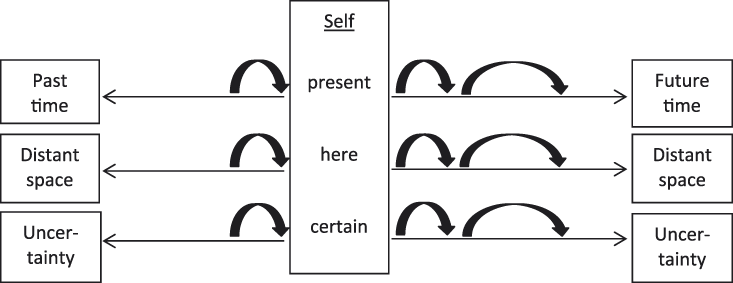
Angela’s episode begins in a recent past time, in which a chemical contaminant is perceived as coming into contact with her. This induces a feeling of contamination within Angela, which she carries forward into the present time and location of the narrative. As this sense of contamination is a state rather than a thought, it is experienced by Angela as certain. Thus, Angela’s episode begins with a closing down of time, spatial distance, and uncertainty between herself and the threat. As the episode moves further into the future, the contaminants become both further away from the self and perceived as having a less certain degree of contamination, which is less distressing for Angela. The perceived movement of the threat in Angela’s narrative was also found in many other object group narratives, which can be summarized as in Figure 3.
Perspective diagram for object group OCD episodes.
7.3.2. Image schemas
For object group episodes, the threat is structured by an interaction of the SOURCE–PATH–GOAL image schema and the CONTAINER image schema. As shown in Figure 3, the perceived trajectory of the contaminant follows the SOURCE–PATH–GOAL image schema; it is perceived as moving through space from the original site of contamination (i.e., the SOURCE, which in Angela’s case is the chemicals in the street) to a new host (i.e., the GOAL, which in the first instance is Angela). Once in contact with the contaminant, the boundaries of the new host are perceived as breached and the contamination invades the internal space of the host. Therefore, the GOAL component of the SOURCE–PATH–GOAL image schema is in fact structured by the CONTAINER image schema. As seen for Angela, this CONTAINER is often the self, whose bodily boundaries fail to protect the internal self from the external contaminants. This boundary breach can only be prevented through defensive actions designed to protect the CONTAINER, such as washing or showering. Once the self is contaminated, it becomes the SOURCE within a new SOURCE–PATH–GOAL image schema. As a SOURCE, the self is able to spread contamination to further hosts (both animate and inanimate, such as the bed clothes in Angela’s episode) that can also be conceptualized as CONTAINERS that become infiltrated by the contamination.
7.3.3. Overlaps with physical illness
The interaction of the SOURCE–PATH–GOAL schema and the CONTAINER schema has also previously been discussed in media reports of emerging diseases (Koteyko et al., Reference Koteyko, Brown and Crawford2008; Nerlich, Reference Nerlich, Handl and Hans-Jörg2011). Koteyko and colleagues (Reference Koteyko, Brown and Crawford2008, p. 251) found that media reports of avian flu in the UK developed the SOURCE–PATH–GOAL schema and the CONTAINER schema into the metaphors AVIAN FLU IS ON A JOURNEY and THE UK IS A HOUSE. The virus travels on its journey from the originating country to “the house” (i.e., the UK), where it attempts to get in through the “door” or the “gate”. The virus has to be kept out of the “house” through defence mechanisms, which are structured by metaphors of WAR. The spread of disease as represented in media discourse and the spread of contamination as experienced in object episodes in this study therefore hold undeniable similarities. Both the media discourse and the participants’ narratives show that the spread of disease and contaminants is structured by an initial SOURCE–PATH–GOAL image schema, of which the GOAL component is often structured by a CONTAINER that needs protecting through defensive actions. Although the media discourse embellishes the underlying image schemas into metaphors for rhetorical flourish, the interactions at the level of the basic image schema, rather than at the level of the metaphor, are highly comparable across the two discourse contexts. This suggests that contamination fears in OCD do not use particularly novel or striking conceptualizations with which to structure their experiences of contamination. Rather, the underlying conceptualizations are the same as those held across society; it is the level of intensity with which they are experienced that distinguishes OCD contamination fears from everyday concerns about contamination and disease.
In terms of theoretical work on dirt and contamination, it has also been suggested that the perceived threat of contaminants is derived from their ability to cross boundaries and disrupt spatial organization (Brown, Crawford, Nerlich, & Koteyko, Reference Brown, Crawford, Nerlich and Koteyko2008; Campkin, Reference Campkin, Campkin and Cox2007). The danger of contaminants is thus heightened when boundaries designed to keep them out of places in need of protection have in some way been breached. In relation to contamination subtypes of OCD, Segrott and Doel (Reference Segrott and Doel2004) argue that one important, contained space that people with contamination fears attempt to protect is that of the self. The findings of the object episodes support this notion; the self is conceptualized as highly bounded and as under threat from external forces, with bodily boundaries providing a barrier between the internal self and the feared, external contaminants. The resultant feeling of contamination is thus experienced in object episodes as an invasion of the bounded self.
7.4. relationship to cognitive models of OCD
As discussed, the cognitive–behavioural model of OCD (Salkovskis, Reference Salkovskis1985) has been criticized for investigating underlying beliefs in OCD as static, fixed values that determine the ways in which a person with OCD will think and behave (Davis, Reference Davis2008). One of these beliefs is an overestimation in the likelihood and severity of the perceived threat, which is often researched in clinical studies through quantitative methods. In contrast, the looming vulnerability model of anxiety (Riskind, Reference Riskind1997), which is a lesser-known and less widely researched model, posits that threats are perceived as dynamic and as rapidly moving through space, often advancing towards the self. In terms of OCD, looming vulnerability has only been researched in relation to contamination fears (Riskind et al., Reference Riskind, Abreu, Strauss and Holt1997; Tolin et al., Reference Tolin, Worhunsky and Maltby2004). The findings from the object episodes support this previous research by demonstrating that contamination threats are indeed conceptualized as closing in on the self. The participants who recount object episodes become highly distressed as the threat rapidly advances towards them and subsequently contaminates the self, which effectively transforms the self into a contaminant.
Where this study adds to the looming vulnerability model of anxiety is through the findings of threat perceptions in the activity and state episodes. In activity episodes, the threats are conceptualized as rapidly moving, but they are perceived as travelling an escalating distance away from the self, which correlates with a heightened sense of uncertainty. The activity episodes add weight to recent quantitative research that posits that some subtypes of OCD (such as checking) are characterized by predictions of large-scale catastrophes from relatively minor events (e.g., Giele, van den Hout, Engelhard, Dek, & Klein Hofmeijer, Reference Giele, van den Hout, Engelhard, Dek and Klein Hofmeijer2011). Moreover, the activity episodes add further insights into the perceptions of dynamic threats in OCD by showing that it is necessary to distinguish the direction in which the threat is conceptualized as travelling in relation to the self. In terms of state episodes, these differ from activity and object episodes as they show minimal movement of the threat either towards or away from the self. This finding further extends the looming vulnerability model by showing how some threats in OCD episodes are not perceived as dynamic but instead as fixed and (semi-)permanent aspects of one’s self.
The findings of this study also show how the static notion of threat perception as investigated by the cognitive–behavioural model does not capture the shifting nature of threats as they are experienced during a great number of OCD episodes, particularly those concerned with activities or external objects. Studies therefore need to move away from relying on fixed beliefs as posited by the cognitive–behavioural model of OCD and towards researching other cognitive models that may be useful in explaining the disorder’s aetiology, such as the looming vulnerability model of anxiety.
In addition, this study has demonstrated that the catch-all notion of threat perception as researched by the cognitive–behavioural model needs to be reworked so that it allows for the variation across people with OCD to come to the fore rather than be flattened out. Quantitative measurements have the effect of exploring threat perception as a blanket concept that shows little variation across participants or across different spaces, times, and contexts. The findings of the current study show how the variation in conceptualizations of threat across activity, state, and object episodes makes it possible to distinguish between these three groups. Thus, this study argues that threat perception would be a useful factor to consider in both assessments of OCD and during therapy sessions. Additionally, through highlighting the differences across the three groups, this study validates the activity, state, and object classification (Knapton, Reference Knapton2015) as a meaningful categorization system for OCD episodes.
7.5. cognitive linguistics and OCD
As discussed, qualitative studies that allow participants to provide open-ended descriptions of their experiences of OCD can provide new insights that could inform the clinical treatment and diagnosis of OCD and its subtypes. This study has demonstrated that one qualitative method that provides a fruitful approach to exploring OCD is cognitive linguistic analysis. Through the analysis of the language used by people with OCD, this study has provided evidence for underlying mental conceptualizations that structure the disorder.
In order to examine threat perception within OCD episodes, this study has argued that OCD episodes follow an underlying cognitive script that matches the OCD episode cycle advocated by the cognitive–behavioural model (e.g., triggers lead to thoughts, which lead to appraisals, and so on) (Salkovskis, Reference Salkovskis1985). However, instead of addressing each component in isolation (like many studies that follow the cognitive–behavioural model), the OCD EPISODE script is a conceptualization of OCD episodes as holistic events that operate as coherent units. This study also contends that, when people recount their OCD episodes, they follow the OCD EPISODE script to do so. As the OCD EPISODE script is sequential, the tellings of OCD episodes thus hold a narrative structure. By analyzing participants’ OCD episode narratives, this study has been able to explore the personal and variable elements of OCD experiences. In particular, the linguistic analysis of OCD episode narratives has captured the subjective, embodied experiences of threat, and has shown that perceived threats are structured through different conceptualizations for different subtypes of OCD.
7.6. practical implications for therapy
This study has aimed to show that, because language use can be reflective of mental conceptualizations, the variations in linguistic patterns across activity, state, and object episodes is driven by variations in conceptualizations. The findings would be useful for therapists as their clients may use linguistic patterns that signal the conceptualizations associated with different types of episodes. This could highlight to the therapist the conceptualizations that sustain the disorder for that particular client. For example, a client who uses a high level of uncertainty markers may have a tendency to structure their OCD episodes by the SOURCE–PATH–GOAL image schema. The therapist and the client could then work collaboratively to explore this conceptualization and to re-structure it where necessary. It may also be the case that the client’s linguistic patterns change as the conceptualizations are adjusted, which is an issue that could be explored by future studies.
7.7. limitations
The main limitation of this study is the fact that the OCD episode narratives were told in an interview context rather than being recorded in natural, everyday settings. Collecting discourse across a variety of contexts may yield different results and reduce the effects of being in a somewhat decontextualized research interview. Future studies could collect OCD episode narratives from therapy sessions or conversations with peers in order to see if the linguistic patterns presented in this study still hold.
As this is a qualitative study, the focus has been on providing specific details rather than broad, quantitative patterns. However, the data in this study come from only fifteen participants, and so future research could try to replicate the findings using a larger sample.
8. Conclusions
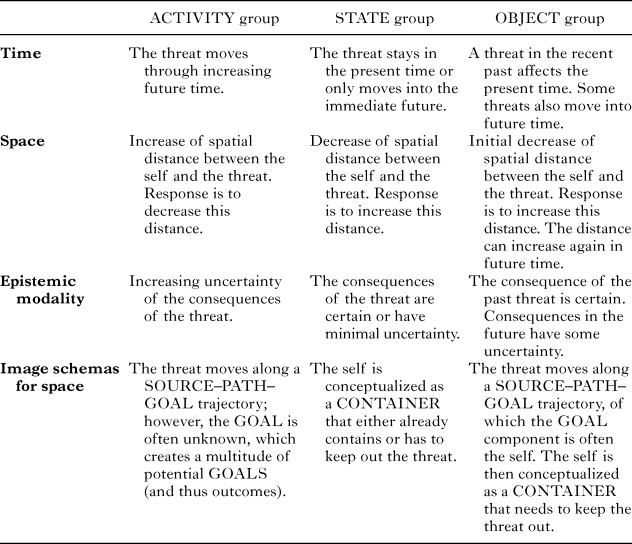
Through an application of cognitive approaches to deixis and perspective, this paper has analyzed the perceptions of threat that are recounted by people with OCD in narratives of their OCD episodes. An exploration of the deictic dimensions of time, space, and epistemic modality has shown that three types of OCD episodes (activity-, state-, and object-based episodes) involve substantial differences between their conceptualizations of threat. Table 2 summarizes the main characteristics of each of the three groups of OCD episodes.
Summary of all groups
This study has shown that the ‘catch-all’ belief of an overestimation of threat as posited by the cognitive–behavioural model of OCD (OCCWG, 1997) is not sensitive enough to pick up on shifts in threat perception as OCD episodes progress. Rather than threats being experienced by the person with OCD as static, they are often conceptualized as dynamic and in flux. These findings both support and extend the looming vulnerability model of anxiety (Riskind, Reference Riskind1997), which argues that threats are perceived as rapidly advancing towards and overwhelming the self. While threats in object episodes are perceived as advancing towards the self, threats in activity episodes are perceived as escalating away from the self, and thus it is imperative to distinguish the direction of the threat movement. Additionally, threats in state episodes are perceived as perpetually close to the self, which highlights that the dynamism of the threat is not conceptualized to the same degree across all types of OCD episodes. This study thus proposes that threat perception is a useful way to distinguish between different OCD subtypes.
While the vast majority of studies of OCD take quantitative approaches, this paper has advocated a qualitative approach that uses cognitive linguistic analysis to explore subjective conceptualizations and experiences of the disorder. This study has argued that OCD episodes follow a standardized OCD EPISODE cognitive script that both shapes OCD episodes and provides the tellings of OCD episodes with a narrative structure. By analyzing OCD episode narratives, OCD episodes can be explored as holistic units that are highly individual and open to a range of meanings depending on the context of their tellings.