Background
As North America and Europe's elderly population continues to grow (Giannakouris Reference Giannakouris2011; Raina et al. Reference Raina, Dukeshire, Lindsay and Chambers1998), caring for an ageing parent will increasingly become a likely and normative part of adult children's lives (Brody Reference Brody1985). In the United States of America and Europe, 49 and 30 per cent of all care-givers are adult children, respectively (National Alliance for Caregiving and the American Association of Retired Persons (AARP) 2015; Riedel and Kraus Reference Riedel and Kraus2011). In Canada, 62 per cent of care-givers over 45 years old are adult children (Cranswick and Dosman Reference Cranswick and Dosman2008). The literature suggests that the care-giving experience differs according to the relationship of the care-giver to the care recipient (Colvin et al. Reference Colvin, Chenoweth, Bold and Harding2004), underscoring the importance of focusing on the specific and unique experiences of adult children care-givers (ACCs). Although caring for one's parents in old age is not a new phenomenon, the trend towards longer lifespans means that ACCs are providing increasing amounts of complex care to one or both parents over a more extended period of time (Roots Reference Roots2014). These characteristics of the care situation are often at odds with ACCs' other age-normative responsibilities such as employment, social activities, and commitments to their own spouse and children (Bastawrous et al. Reference Bastawrous, Gignac, Kapral and Cameron2015). In turn, the role of caring for one's parent can act as an added stress that exacerbates health declines and the restrictions in social functioning and quality of life experienced by ACCs (Bastawrous et al. Reference Bastawrous, Gignac, Kapral and Cameron2015; McCullagh et al. Reference McCullagh, Brigstocke, Donaldson and Kalra2005).
Social support has been widely explored in the care-giving literature and found to moderate the impact of care-giving-related stress on the care-givers' health and wellbeing (Ho et al. Reference Ho, Weitzman, Cui and Levkoff2000; Wilks and Croom Reference Wilks and Croom2008). In turn, the care-giving role can cause a greater amount of stress in the absence of social support (Ostwald et al. Reference Ostwald, Bernal, Cron and Godwin2009). Care-givers' perception of social support (i.e. their appraisal that support from others is valuable and available when needed) is especially important as it has a stronger association with physical and mental health than actual support received (Bolger and Amarel Reference Bolger and Amarel2007; Uchino Reference Uchino2009).
Peers are a key source of social support for care-givers (Toseland and Rossiter Reference Toseland and Rossiter1989). The Interactional-Cognitive Model of Social Support (ICMSS) highlights the importance of individuals' perceptions of support from specific peers (Pierce Reference Pierce, Burleson, Albrecht and Sarason1994). The ICMSS considers both the social behaviours entailed in person-to-person interaction as well as the cognitive processes that underlie individuals' appraisals of the interaction (Pierce Reference Pierce, Burleson, Albrecht and Sarason1994). According to the ICMSS, there are three important domains that overlap and allow us to understand the social support process: (a) situational (e.g. care-giving situation, peer support context); (b) intrapersonal (e.g. personality, coping, mastery); and (c) interpersonal (e.g. frequency of contact with specific peers, duration of the relationship, peer similarity, perceived support) (Pierce Reference Pierce, Burleson, Albrecht and Sarason1994). Since the ICMSS does not focus on an individual's total network size or objective measures of support received, it is well suited to guide studies focused on individual peer support relationships.
Homophily theory suggests that when peers are experientially similar (e.g. share care-giving commonalities such as relationship to the care recipient or care-recipient illness), a supportive relationship ensues out of mutual understanding and empathy (Pillemer and Suitor Reference Pillemer and Suitor2002; Sabir et al. Reference Sabir, Pillemer, Suitor and Patterson2003). Peer similarity can be understood in terms of four important domains: (a) structural similarity (e.g. demographic similarity); (b) appraisal similarity (e.g. perceiving/assessing situations similarly); (c) psychological similarity (e.g. similar emotional and mental states); and (d) experiential similarity (e.g. current care-giving experience) (Sabir et al. Reference Sabir, Pillemer, Suitor and Patterson2003). Similarity across these domains has the potential to optimise the match between a care-giver's socio-emotional needs and the support they actually receive (Colvin et al. Reference Colvin, Chenoweth, Bold and Harding2004). In turn, support from similar peers can decrease isolation, buffer stress and increase care-givers' self-efficacy (Cohen and Wills Reference Cohen and Wills1985; Pinquart and Sorensen Reference Pinquart and Sorensen2007).
Although existing studies have begun to investigate the notion of peer similarity in the care-giving context, the majority of this literature has been interventional research. Interventions that match care-giving peers based on their similarities have found only modest improvements in the care-giver's health and social outcomes post-intervention (Sabir et al. Reference Sabir, Pillemer, Suitor and Patterson2003; Suitor and Pillemer Reference Suitor, Pillemer, Pescosolido and Levy2002). One study that implemented a ‘befriending’ intervention (i.e. peer mentorship and support) found that it led to minimal improvements in care-givers' quality of life and no cost-saving (Wilson et al. Reference Wilson, Thalanany, Shepstone, Charlesworth, Poland, Harvey, Price, Reynolds and Mugford2009). In their systematic review of ‘mentoring schemes' for dementia care-givers, Smith and Greenwood (Reference Smith and Greenwood2014) found that while peer-matching lacked efficacy as an intervention, the qualitative findings highlighted the value that care-givers placed on experiential similarity. In turn, they concluded that the importance of experiential similarity and the need for matching criteria required further investigation (Smith and Greenwood Reference Smith and Greenwood2014). Similarly, Pillemer and Suitor (Reference Pillemer and Suitor2002) discussed that future research needed to reconcile the lack of efficacy of their peer-matching intervention with the body of literature suggesting that peer similarity promotes wellbeing in naturally occurring networks.
To address these recommendations, this study endeavoured to explore the concept of peer similarity and its influence on care-givers' perceptions of support outside the intervention context. By focusing on non-interventional support, our study allowed care-givers to reflect on their naturally occurring interactions with peers utilising a number of modalities (i.e. in person, telephone, online, etc.). This allowed the findings to transcend the modality-specific effects reported in existing peer support interventions (Stewart et al. Reference Stewart, Barnfather, Neufeld, Warren, Letourneau and Liu2006). The complexity of relationships and the discrepancy in qualitative and quantitative findings within the existing literature suggested that a mixed-method approach was needed. As a result, we employed a mixed-method design to explore the association between peer similarity and perceived support as well as ACCs' perspectives on peer similarity and how it might influence support received from peers.
Research questions
Quantitative
• Is an ACC's perceived similarity with a peer associated with their perceptions of support from that peer?
• Does peer similarity contribute to variation in perceived support above and beyond other variables?
• Hypothesis 1: Higher perceptions of similarity to a peer will be positively associated with higher ratings of perceived support.
• Hypothesis 2: Peer similarity will contribute to the variance in perceived support above and beyond other variables (i.e. covariates).
Qualitative
• How do ACCs describe similarities/dissimilarities with their peers?
• How do they perceive similarity with peers to relate to their supportive exchanges?
Methods
Design
We employed a convergent parallel mixed-method design, characterised by the concurrent collection of quantitative and qualitative data, separate analysis of the data-sets, and integration of the findings at the level of comparison and interpretation (Creswell and Clark Reference Creswell and Clark2011). The quantitative strand of the study employed a cross-sectional survey design and the qualitative strand of the study took a qualitative descriptive approach (Sandelowski Reference Sandelowski2000b). Qualitative description is a branch of naturalistic inquiry that remains data-near, making the findings easily understood and applied by policy makers and health-care professionals (Sandelowski Reference Sandelowski2000b). Collecting both quantitative and qualitative data allowed for triangulation and complementarity (i.e. converging the data-sets to generate a more holistic understanding of care-giver relationships and peer support) (Sandelowski Reference Sandelowski2000a).
Participants
To be included in the study, participants had to be: (a) 18 years or older; (b) able to read, write and speak English; (c) assisting their parent with at least one activity of daily living (ADL; e.g. bathing, dressing) or instrumental activity of daily living (IADL; e.g. managing finances, grocery shopping) at least once per week; (d) interacting with another care-giver; and (e) providing care in Canada.
Quantitative and qualitative sample sizes
Harrell (Reference Harrell2001) has suggested that eight or nine participants per independent variable is sufficient for a regression analysis as long as the variables are well-justified by the literature. Given that our selection of variables was theoretically rooted, we felt confident that 80 participants (eight participants × ten independent variables) would give our analysis sufficient statistical power.
Participants who completed the online survey were given an opportunity to volunteer for an in-depth qualitative interview. We then purposively sampled (Thorogood and Green Reference Thorogood and Green2009) a subset of care-givers with the goal of having equal care-giver and care-recipient gender representation (i.e. daughters/sons, mothers/fathers). The analysis occurred concurrently with interviewing and we closed recruitment once ‘theme saturation’ was reached (i.e. no new ideas were uncovered in participant interviews) (Creswell Reference Creswell1998; Thorogood and Green Reference Thorogood and Green2009).
Recruitment
A multi-faceted recruitment strategy that employed online and in-person recruitment was used. Recruitment brochures with the study survey link were distributed to four community-based care-giver support groups in four major Canadian cities (Toronto, Halifax, Calgary and Vancouver) as well as two national community-care organisations. The study was also advertised through the Canadian Virtual Hospice (a national online education and support website for patients and care-givers) and two online care-giver communities. Each of these groups shared study information through their social media channels, electronic newsletters and online discussion forums. The primary investigator also used her Twitter account to ‘tweet’ the link to the survey. Prior to recruitment, the research ethics board of the University of Toronto reviewed and approved the study in 2013.
Procedure
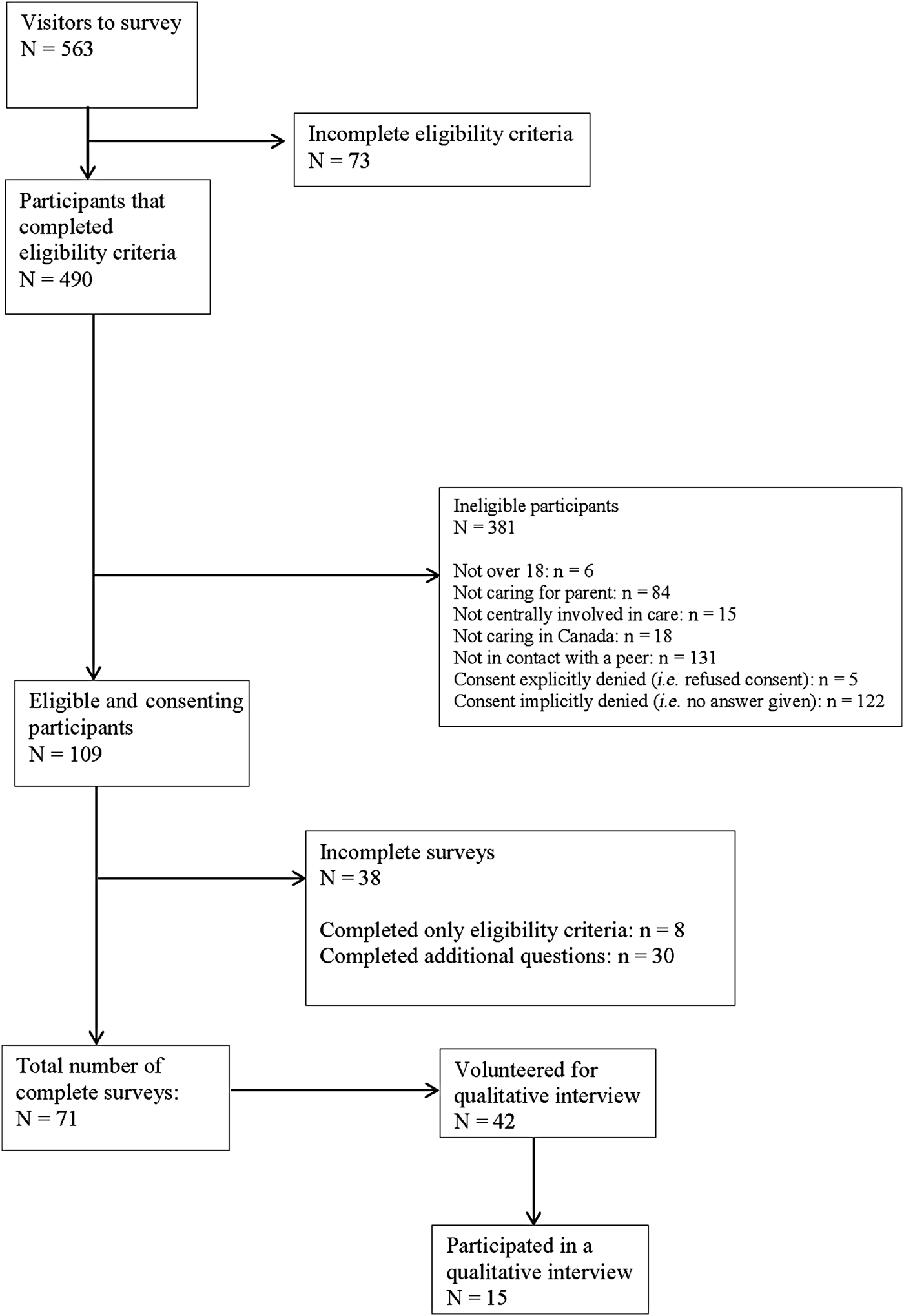
The first page of the Web survey (hosted on FluidSurveys™) asked a series of eligibility questions. Participants were then taken to the consent form if they were eligible to participate. If participants provided consent, they were taken to the full survey. Once they completed the survey, participants had the option of volunteering to be contacted for a qualitative telephone interview. Recruitment and data collection occurred simultaneously between 1 February and 1 October 2014.
Quantitative data collection
Participants were asked to complete a battery of questionnaires. The constructs that were measured and their associated measurement instruments are described below and organised according to the domains outlined by the ICMSS (Pierce Reference Pierce, Burleson, Albrecht and Sarason1994). These measures have been previously used and validated with similar populations.
Situational factors
Demographics: For descriptive purposes, a demographic questionnaire was administered (e.g. age, gender, care-giving context, etc.).
Care-giving assistance provided: The 17-item Caregiver Assistance Scale (Cameron et al. Reference Cameron, Cheung, Streiner, Coyte and Stewart2006) asked care-givers to rate the amount of aid they provide with a variety of ADLs and IADLs on a scale from 0 (none) to 6 (a lot). Scores ranged from 0 to 102, where higher scores indicated care-givers provided more assistance.
Care-recipient (parent) dependency: The ten-item modified Barthel Index (Morley, Selai and Thompson Reference Morley, Selai and Thompson2012) assessed the degree of care-recipient independence by asking whether they are independent, moderately dependent or fully dependent in completing a combination of ADLs and IADLs. Scores ranged from 0 to 20, where higher scores indicated more functional independence.
Geographic distance: Participants were first asked if they knew how far they lived from their peer. If ‘yes’, they were asked to indicate if they lived in the same country, province, city or neighbourhood. Higher scores indicated more proximity between peers.
Intrapersonal factors
Coping ability: The 28-item Brief Coping Orientations to Problems Experienced Inventory (Carver Reference Carver1997) captured various emotion- and problem-oriented coping strategies. Participants were asked to rate how often they use various coping methods on a scale of 1 (‘I haven't been doing this at all’) to 4 (‘I've been doing this a lot’). Two sub-scales captured problem-based and emotion-based coping strategies. Scores for the problem-based coping sub-scale ranged from 6 to 24 and from 22 to 88 for the emotion-based coping sub-scale, where higher scores indicated more use of that coping style.
Mastery: The seven-item Pearlin Mastery Scale (Pearlin and Schooler Reference Pearlin and Schooler1978) captured individuals' beliefs about the extent to which they are able to control or influence their life chances and outcomes. Participants were asked to indicate how much they agree with seven statements on a scale of 1 (strongly disagree) to 4 (strongly agree). Scores ranged from 7 to 28, where higher scores indicated higher levels of mastery.
Extraversion: The four-item Extraversion measure (Stefanone and Jang Reference Stefanone and Jang2008) captured the aspect of individuals' personality characterised by sociability, talkativeness, assertiveness and excitability. Participants were asked to indicate how much they agree with four statements on a scale of 1 (strongly agree) to 7 (strongly disagree). Scores ranged from 4 to 28, where higher scores indicated that individuals were more extraverted.
Self-disclosure: The three-item Self-disclosure measure captured how likely the participant is to disclose intimate details about themselves (Stefanone and Jang Reference Stefanone and Jang2008). This measure asked participants to imagine that they are talking to someone face-to-face when answering three questions. The scores ranged from 3 to 21, where higher scores indicated higher levels of self-disclosure.
Interpersonal factors
Duration of the peer support relationship: The duration of the peer support relationship was captured by asking participants to indicate the year they started interacting with their peer. This was then subtracted from 2014 (year in which participants completed the survey) to compute the duration of the relationship.
Frequency of contact between peers: The frequency of contact between peers was captured on a six-point Likert scale item that asked participants to indicate how often they interacted with their care-giving peers (0 = less than once a month, 1 = once a month, 2 = a few times a month, 3 = once a week, 4 = a few times a week, 5 = every day). Higher scores indicated greater frequency of contact between peers.
Peer similarity (independent variable of interest): The six-item Peer Similarity questionnaire asked participants to rate their similarity to a peer on a scale of 1 (similar) to 9 (dissimilar). The questions read: ‘This peer is similar to me in… (1) values; (2) personality; (3) hobbies and interests; (4) mood and emotions; (5) worries and concerns; and (6) overall’ (Lakey et al. Reference Lakey, Ross, Butler and Bentley1996). While this is one of few validated questionnaires intended to capture peer similarity, we felt that other relevant domains of similarity were not included. In turn, five questions were added to capture demographic similarity, emotional/psychological similarity, appraisal similarity and structural similarity, as recommended by Sabir et al. (Reference Sabir, Pillemer, Suitor and Patterson2003). The additional questions read: ‘This peer is similar to me… (1) demographically (e.g. age, gender, marital status); (2) in their feelings of self-worth and self-value; (3) in identifying positive aspects of care-giving (e.g. satisfaction with care-giving, benefits of care-giving); (4) in finding care-giving to be stressful; and (5) in terms of the care-giving situation (e.g. who they're caring for, amount and type of care provided, how long they've been providing care)’. Scores ranged from 11 to a maximum of 99, where higher scores indicated more similarity with the peer.
Perceived support (dependent variable): The support sub-scale of the Quality of Relationships Inventory was used (Pierce, Sarason and Sarason Reference Pierce, Sarason and Sarason1991). The Quality of Relationships Inventory is comprised of 25 items that capture support, depth and conflict in interpersonal relationships. The support sub-scale indicated the extent to which an individual perceives another person to be a source of assistance across a variety of situations. This sub-scale consisted of seven items that asked participants to rate (on a four-point Likert scale) the extent to which they could turn to/rely on their peer for some sort of support (1 = not at all, 2 = a little, 3 = quite a bit, 4 = very much). This sub-scale generated a total score that ranged from 7 to a maximum of 28, where higher scores indicated more perceived support.
Quantitative data analysis
For the quantitative data, means, frequencies and percentages were used to summarise the demographic characteristics of the sample population. In order to investigate the relationship between peer similarity and perceived support, we conducted a stepwise hierarchical multiple regression. We entered the covariates in step one and peer similarity in step two. All analyses were conducted using IBM SPSS version 22.
Qualitative data collection
Care-givers participated in one in-depth telephone interview. Each interview was guided by a set of open-ended questions that asked participants to describe: (a) their care-giving situation; (b) their engagement in peer-support activity (e.g. types of peer support provided/received; overall experiences with peer support); (c) their perceptions of similarity/dissimilarity to a specific peer; and (d) the role that similarity (or dissimilarity) plays in their interactions. Throughout the course of the interview the ‘probing’ method was used to encourage participants to discuss topics in greater detail – especially when the topics were of relevance to the research objective (Sturges and Hanrahan Reference Sturges and Hanrahan2004). All interviews were recorded, professionally transcribed and checked for accuracy.
Qualitative data analysis
For the qualitative data, we followed the six steps of thematic analysis to identify themes from the ACCs' narratives (Braun and Clarke Reference Braun and Clarke2006). This analysis began with a collaborative open coding of the transcripts that led to the development of an exhaustive coding scheme used to perform line-by-line coding of all transcripts. The constant comparative method was then used to identify distinct themes (Thorogood and Green Reference Thorogood and Green2009). The NVivo qualitative data analysis software (version 10) was used to facilitate the coding process. Several individuals were involved in each stage of the analysis process, thereby reducing bias and enhancing the credibility of the findings (Patton Reference Patton1999).
Mixed-method analysis
The ‘yield’ of a mixed-method study (i.e. the novelty of the research that goes beyond the sum of its parts) is indicated by the degree of integration between the quantitative and qualitative data-sets (O'Cathain, Murphy and Nicholl Reference O'Cathain, Murphy and Nicholl2007). To ensure high yield in the present study, ‘crystallisation’ was employed. This process entailed looking at the convergence and divergence in the data-sets through comparison and contrast in order to uncover new ideas that could not have been derived from the quantitative or qualitative data-sets alone (Caracelli and Greene Reference Caracelli and Greene1993).
Findings
Participant characteristics
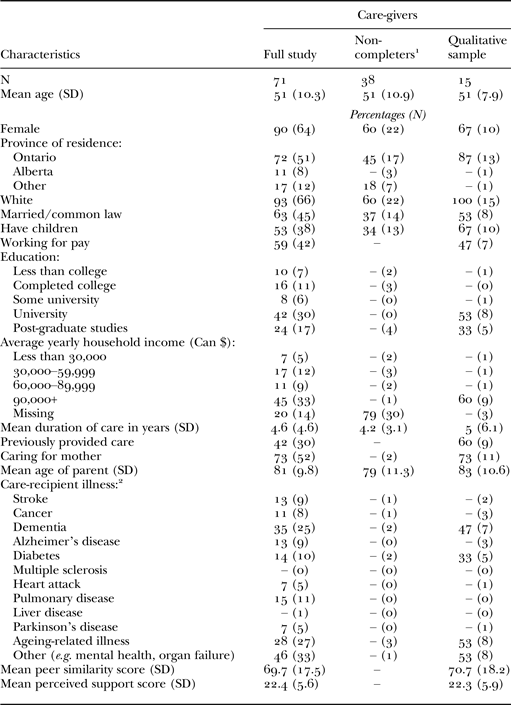
The survey was accessed 563 times with 109 visitors being eligible to participate in the study. In total, 71 (65%) ACCs completed the Web-based questionnaire, with 42 (59%) volunteering for a qualitative telephone interview (see Figure 1 for a participant flow chart). The average age of ACCs was 51 years old (range 22–65; standard deviation (SD) = 10.2), with the majority being female (90%). Since 16 per cent of care-givers did not know how far away they lived from their peer, we excluded this variable from the regression analysis as it substantially reduced the sample size. Geographic distance was instead summarised descriptively, with the mean being 3.6 (SD = 1.0), indicating that on average ACCs lived in the same province or city as their peer. Additional participant details are provided in Table 1.
Participant flow chart.

Participant characteristics

Notes: SD: standard deviation. 1. Non-completers were those who did not complete any of the outcome or covariate measures. Of the 38 non-completers, nine (23%) did not answer any questions beyond the eligibility criteria and response rates for remaining questions varied (N = 0–28). 2. Adult children care-givers could indicate that the care recipient had more than one illness and therefore the total percentage does not add up to 100.
Hierarchical multiple regression
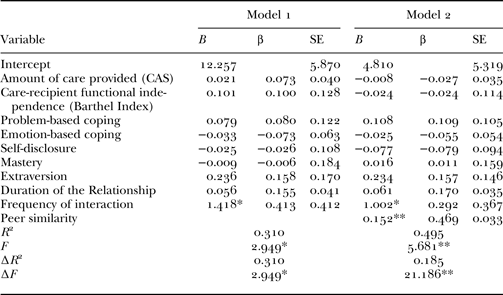
A hierarchical multiple regression was performed to predict perceived support from the covariates alone and then with the addition of peer similarity in the model (Table 2). The model including the covariates alone (Model 1) was statistically significant, R 2 = 0.310, F(9, 59) = 2.949, p = 0.006; adjusted R 2 = 0.205. The addition of peer similarity to the model (Model 2) led to a statistically significant increase in R 2 of 0.185, F(1, 58) = 5.681, p < 0.0005. This indicates that the inclusion of peer similarity in the model increased the variance explained by 18.5 per cent. Model 2 was statistically significant, R 2 = 0.495, F(10, 58) = 5.681, p < 0.0005; adjusted R 2 = 0.408.
Summary of hierarchical regression analysis for variables predicting perceived support

Notes: N = 69. B: unstandardised regression coefficient. β: standardised coefficient. SE: standard error. CAS: Caregiver Assistance Scale.
Significance levels: * p < 0.05, ** p < 0.0005.
Qualitative sample
In total, 15 ACCs participated in an interview and the themes below reflect their narratives. The telephone interviews lasted 52.2 minutes on average (range 26–77 minutes). The average age of the ACCs was 51 years old (range 41–65). Of the 15 ACCs, five were son care-givers, and the majority were providing care to their mother (N = 11). Predominantly, ACCs' peers were family members, friends or co-workers, highlighting that this population mobilises their existing network for peer support (see Table 1 for qualitative participant characteristics).
Qualitative findings
One overarching theme was identified and captured the fact that ACCs considered ‘shared care-giving experience’ to be the most important aspect of peer similarity. The relevance of ‘shared care-giving experience’ to ACCs' peer support engagement was underscored by the fact that it strengthened their relationship with peers and optimised the support they received from them.
Shared care-giving experience is of primary importance
The predominant theme in the data was that shared care-giving experience was the single most important aspect of similarity between ACCs and their peers. Although ACCs discussed other aspects of similarity/dissimilarity and how they influenced their support relationships, no aspect was described in as much depth and detail as shared care-giving experience. Shared care-giving experience included caring for an elderly parent, caring for the same illness population and being at a similar point along the care-giving trajectory. All ACCs agreed that similarities in care-giving experience were vital to a beneficial peer support relationship (e.g. valuable support, good quality relations). However, other aspects of similarity (e.g. demographics, personality) were described variably and less consistently in terms of their importance and influence on ACCs' interactions with peers.
Similarity in terms of demographics (e.g. age) and personality were not always viewed as necessary for a high-quality peer support relationship. In fact, a few ACCs commented that interacting with a peer who was different with respect to demographics or personality allowed them to get a ‘different perspective’ on things and to ‘think outside the box’. In this way, the ACCs did not feel that demographic or personality differences hindered the ability of a peer to relate to their circumstances. Few ACCs discussed similarity in values and life outlook. Shared values primarily related to a shared sense of responsibility to one's friends and family while shared life outlook captured similarity in priorities, attitude and perspective. ACCs felt that they were closer to peers with whom they shared values and life outlook and that this was often the basis for their ‘friendship’. One ACC's comment reflects how shared values – in this case, sense of responsibility – can play an important role in supportive exchanges with peers:
She has the same feeling of responsibility [and that's] definitely helpful because if I ask her to do something, she knows that I'm asking because I need her. And so in that way, it's good. (CG02, female, 55 years)
Overall, ACCs' narratives centred largely on similarities with their peers in terms of the care-giving situation (i.e. shared care-giving experience). Their comments indicated that shared care-giving experience not only influenced the support they received from their peers but also impacted the relationship they had with them.
Shared care-giving experience strengthens ACCs' relationships with their peers
Although the majority (80%) of the ACCs' peers were existing friends, family and co-workers, participants felt that shared care-giving experience was what bonded them as ‘peers’. One care-giver reflected on how similarity in care-giving experience was a key element of his ‘peer relationship’ with his wife and friends:
I find that the similarity or dissimilarity in our personalities is not really the bonding agent. The bonding agent when discussing is the care-giving aspect of it. (CG13, male, 48 years)
Another care-giver who had met her peer while seeking support online explained that without shared experience, their relationship would not exist:
I truly do think it's our experience, the fact of our life experience having been the same. Like it's a shared experience. It's not our personalities that brought us together … our shared experiences are care-giving experiences. (CG04, female, 58 years)
Shared care-giving experiences not only underlay peer support relationships but also strengthened them. The ACCs' narratives pointed to three main aspects of the peer support relationship that were positively influenced by shared care-giving experience: closeness, breadth and reciprocity. Closeness pertained to the intimacy between ACCs and their peers; breadth entailed the range and depth of topics discussed/experiences shared; and reciprocity related to the mutual exchange of support.
Many care-givers described their relationship with peers as being ‘close’. The intimacy entailed in these relationships was underscored by participants describing them as ‘friendships’. In most cases, it was implied by ACCs that shared experience allowed the relationship to extend beyond a purely support-based one into the realm of ‘friendship’. However, one ACC's experience explicitly highlights this notion. This ACC attended a peer support group where he lacked similarities in care-giving experience with the other members of the group. In turn, he felt that those individuals could not effectively relate to his circumstances. His comment reflects that if those peers had been better able to put themselves in his shoes, they could have:
…understood where I'm coming from and what kind of person I am. So it would be more of a friendship, I think. (CG01, male, 48 years)
Several care-givers agreed that the shared care-giving experiences broadened their relationship with peers. This was reflected in the wider range and detail of topics discussed. One participant that had a pre-care-giving relationship with his peer felt that care-giving added a new dimension to their relationship and allowed it to grow. Other care-givers commented on how shared care-giving experiences allowed for candidness in a relationship. As reflected in one ACC's comment, this sometimes meant being able to share even the unsavoury details of one's care-giving experience:
We tell each other the gory details of our care-giving responsibilities regularly. (CG04, female, 58 years)
In addition to the relationship being broadened through discussions of care-giving, care-givers felt more comfortable discussing a wider range of topics with peers who shared the care-giving experience. The participants' comments indicated that this was because shared care-giving experience gave way to a certain level of trust and ease with peers, leading them to feel comfortable enough to ‘talk about anything’. As one ACC explained, trusting her peer and being able to discuss any range of things made that interaction smoother and more beneficial:
I think it makes it easier to actually exchange information and to talk about things because I don't feel like I have to guard myself, my words and my feelings when I'm saying it. I can just say it. It certainly makes it easier to ask for assistance and it also makes it easier to get it all out, to have that open conversation. (CG09, female, 38 years)
Comments from a few ACCs reflected their belief that the peer support relationship was a two-way exchange where they not only received support but reciprocated it as well. Having similarities with peers in terms of the care-giving experience allowed for mutual understanding and respect for one another. This was important since the ACCs felt more guarded and less likely to exchange with a peer if a mutual sense of respect did not exist. The shared experience of care-giving was also discussed as the basis for the reciprocal sharing of advice and encouragement. This is reflected in one ACCs' comment about his interaction with people in his network who are also care-givers:
[Care-giving] is one big thing that we have in common. So we just commiserate with each other and again, offer each other free advice or some mutual respect and encouragement. (CG06, male, 52 years)
Although some differences in the care-giving experience did not restrict the reciprocity of the peer support relationships (e.g. duration or extent of care provided), a few ACCs felt that mutual support exchange was limited by their peer being at a different point along the care-giving trajectory. One ACC's comment highlights that when care-givers are not at the same stage of care-giving, the support tends to flow in one direction (i.e. either given or received but not both):
You know, I'm talking to friends who are a similar age as me but their parents are a decade younger. I offer more like advance signs and things they should look for, or things they should consider. (CG13, male, 48 years)
Shared care-giving experience optimises the support received from peers
Participants predominantly discussed shared care-giving experience as enhancing the emotional, informational and appraisal support they received from their peers. Shared care-giving experience allowed peers to relate better to the ACCs' circumstances, which led to empathy and understanding. This emotional support was described by one ACC as making her ‘feel better’ because she just needed a ‘listening ear’:
I think the support has been really good just as far as all you need really is an understanding ear or someone who can see your perspective … so it doesn't just look like a vent and you're just hating on the world … you just need to talk through it and relieve the situation and carry on. (G08, female, 41 years)
Participants also explained that shared care-giving experience made them feel like they belonged to a community, which reduced isolation. One ACC commented on this sense of community:
It's a life stage; all of my friends have elderly parents … so we're all kind of in this together. You know, a lot of us are going through similar situations. (CG10, female, 52 years)
Although care-givers did not speak extensively about how shared care-giving experience influenced the appraisal support they receive from peers (i.e. evaluative feedback), a few did comment that it was important for their peer to be caring for a parent with a similar illness. One ACC explained that each illness has its own unique set of conditions and when peers can relate to those, they are a better source of ‘validation’:
I just have a couple of girlfriends that are dealing with parents that actually have the same diagnosis of Alzheimer's and dementia [and that's important] because it validates and there's a better understanding of what you're going through. If I was talking to someone let's say who had a parent with cancer, that's a different set of circumstances that I can't relate to or that they might not be able to relate to what I'm dealing with. (CG08, female, 41 years)
Finally, participants felt that shared care-giving experience led to timely and relevant informational support from their peers. ACCs spoke about the importance of their peer caring for a parent (rather than another family member), their parents being approximately the same age and having the same illness as the parent of the ACC. These aspects were particularly important because ACCs perceived information based on care for a different illness group or a different family member as less relevant to addressing their needs. One ACC's comment about her experience with a peer support group captures this:
I was sitting in a group with two or three other people that were probably in their sixties and seventies dealing with this [care-giving] with their spouse. So that doesn't help me because I need to connect with people my own age that are dealing with parents. Because it's not just the illness that I'm dealing with … It's also kind of the administrative portion of care-giving that's fallen on my shoulders because I am an only child. (CG08, female, 41 years)
Mixed-method insights
More similarity to a peer is associated with higher perceived support
The integration of the quantitative and qualitative findings enhanced our understanding of the way that peer similarity and perceived support interact in the context of ACCs' supportive exchanges with peers. The quantitative and qualitative data both suggested that being more similar to a peer was associated with perceiving them to be a greater source of support. Care-givers felt that similar peers could relate better to their circumstances and provide timely and relevant support. This may explain why peer similarity was the most influential independent variable in the regression model (β = 0.469) and accounted for an additional 18.5 per cent of the variance in the hierarchical regression.
Not all aspects of similarity equally contribute to perceptions of support
Although peer similarity had the highest beta value and was the only independent variable (in addition to frequency of contact) to contribute significantly to the regression model, the beta value was a modest 0.469. The 18.5 per cent additional variance that peer similarity accounted for in the hierarchical regression can also be considered moderate at best. The qualitative findings may shed light on why – although significant – peer similarity did not contribute more strongly to the prediction of perceived support. The ACCs' comments suggested that while similarity with peers was important overall, not all aspects of similarity (as captured by the measurement instrument) are equally important. To ACCs, the most important aspect of similarity was shared care-giving experience because it fostered better understanding and more relevant support from peers. However, ‘experiential similarity’ was only one question on the peer similarity measure we used. The remaining questions pertained to structural, appraisal and psychological similarity – aspects not highly prioritised in ACCs' narratives. This discrepancy highlights that the peer similarity measure may not have been robust enough in capturing the intricacies of ‘experiential similarity’ and the extent to which they may influence perceived support.
Relationship quality influences the association between peer similarity and perceived support
In addition to peer similarity influencing perceived support, the qualitative data elucidated that peer similarity also impacts the nature of the peer support relationship. Specifically, more similarity with a peer helped to enhance the quality of the relationship – characterised by closeness and intimacy. The qualitative findings also suggested that these ‘high-quality relationships' may influence care-givers' perceptions of support. Namely ACCs trusted peers with whom they had good relationships and in turn placed more value on support received from them. While the quantitative analyses focused exclusively on the association between peer similarity and perceived support, the qualitative data began to elucidate that relationship quality may influence this association.
Discussion
This mixed-method study aimed to explore the influence of peer similarity on ACCs' perceptions of peer support. In total, 71 ACCs completed the Web-based questionnaire and 15 completed an in-depth qualitative interview. Peer similarity was positively and significantly associated with perceived support and explained variation in perceived support above and beyond other variables. ACCs' narratives highlighted that while overall similarity with a peer was valuable, the most important aspect of similarity with a peer was shared care-giving experience. Having care-giving similarities with peers not only optimised the support received but also strengthened their relationship.
Our findings suggest that adult children are able to mobilise existing networks for peer support. ACCs described receiving peer support from networks they built through everyday activities (e.g. socialising with friends, spending time with family, engaging with co-workers). In turn, policies that help ACCs sustain their participation in these valued activities can also enable them to obtain peer support. To help carers maintain employment, workplace policies have been suggested to include flexible work hours, virtual workspace and paid leave (Torjman Reference Torjman2015). Policies that promote social engagement have been suggested to include the provision of respite and financial aid services (Torjman Reference Torjman2015).
Given the potential wealth of peer support available to ACCs within their existing networks, future interventions should help ACCs identify peers and encourage them to mobilise these individuals for support. This capitalises on ACCs' existing resources rather than introducing artificial networks for investigative purposes (Naslund et al. Reference Naslund, Aschbrenner, Marsch and Bartels2016). Alternatively, clinicians and community care workers can identify ACCs that may be ‘at-risk’ due to having limited peer support available to them. These carers may require a different approach that entails directing them towards supportive resources (e.g. online networks or in-person support groups) in order to augment or develop peer networks.
Social comparison theory suggests that especially in times of uncertainty (e.g. illness and care-giving), individuals want to be in contact with others who are experientially similar in order to evaluate their own abilities, opinions and emotions through comparison (Buunk and Gibbons Reference Buunk and Gibbons2007; Suls and Wheeler Reference Suls, Wheeler, Suls and Wheeler2000). This may explain why during ‘personal crisis’ (e.g. non-normative life changes such as care-giving), experiential similarity overrides other aspects that are typically of importance to relationship development (Suitor and Pillemer Reference Suitor and Pillemer2000). Literature also suggests that experiential similarity is the only influence on care-givers' peer support exchanges and health outcomes (Smith and Greenwood Reference Smith and Greenwood2014). This was reflected in our finding that ‘shared care-giving experience’ was the most important aspect of peer similarity for ACCs. Some research has suggested that since ‘experiential similarity’ is the only relevant aspect of similarity, ‘extensive matching criteria’ for peer support programming are not needed (Sabir et al. Reference Sabir, Pillemer, Suitor and Patterson2003; Smith and Greenwood Reference Smith and Greenwood2014). While this may be true for demographic or personality characteristics, it is apparent from our study that ACCs naturally interact with peers with whom they share a range of care-giving similarities. This underscores that matching criteria centred on structural (e.g. demographics) and psycho-social domains (e.g. personality, values) perhaps warrants less attention than pairing peers based on specific care-giving similarities (e.g. relationship to care recipient, illness population cared for).
Despite the demonstrated importance of ‘experiential similarity’, several care-giving studies have taken a very one-dimensional approach to the concept. Aside from considerations of the illness population being cared for, research has predominantly conceptualised ‘experiential similarity’ as two people sharing the status of ‘care-giver’ (Pillemer and Suitor Reference Pillemer and Suitor1996; Sabir et al. Reference Sabir, Pillemer, Suitor and Patterson2003; Stewart et al. Reference Stewart, Doble, Hart, Langille and MacPherson1997). Findings from our study suggest that ‘experiential similarity’ is multi-faceted and extends beyond simply sharing the care-giving role. The ACCs in our study pointed towards important aspects of care-giving similarity such as being at a similar point along the care-giving trajectory, relationship to the care recipient and illness population requiring care. The peer similarity measure we used prioritised psychological similarity to a peer (e.g. personality, mood, values); and although we supplemented it with questions to capture additional domains of similarity outlined in the care-giving study of Sabir et al. (Reference Sabir, Pillemer, Suitor and Patterson2003), it was not a comprehensive assessment of shared care-giving experience. In light of the prominent role that ‘experiential similarity’ plays in care-giver peer support, peer similarity measures employed in care-giving research may need to emphasise and comprehensively capture various aspects of the care-giving situation. This can help researchers to understand the role and value of overall peer similarity compared to caregiving-specific similarity when designing and delivering support interventions.
A systematic review of peer mentor programmes for dementia care-givers concluded that more information about experiential similarity's influence on the peer support relationship is needed (Smith and Greenwood Reference Smith and Greenwood2014). Our study suggested that similarity with a care-giving peer optimises the relationship itself and that ACCs especially value support from these peers. Specifically, shared care-giving experience brought peers closer, increased the breadth and depth of their interactions and enhanced reciprocity. These aspects are echoed in the notion of ‘tie strength’ which explains that a tie between two individuals (i.e. their bond) can be classified as ‘strong’ or ‘weak’ based on: (a) time spent in the relationship (e.g. duration and frequency of contact); (b) intimacy of the relationship (e.g. breadth of topics discussed); (c) intensity of the relationship (e.g. closeness); and (d) reciprocal services (e.g. supportive exchanges) (Granovetter Reference Granovetter1973). In non-caregiving contexts, more similarity between peers has been suggested to strengthen the ties they build with one another (Mesch Reference Mesch2006). Social support from ‘strong ties’ has been linked to better mental health outcomes. Tie strength has yet to be investigated in the care-giving literature but may be an important area of research since these findings combined suggest that tie strength may moderate the effect that peer similarity has on perceived support.
Strengths and limitations
To the best of our knowledge, this is the first study to use a mixed-method approach to explore the relationship between peer similarity and perceived support amongst care-giving peers outside the intervention context. Our integration of both quantitative and qualitative data allowed us to not only report statistical relationships between the variables of interest but also to explain how and why these relationships may exist. One limitation of our study was that we were nine participants short of achieving our a priori sample size of 80. This may potentially limit the generalisability of findings. It is also possible that we did not capture other variables that may impact perceived support and confound the influence of peer similarity (e.g. total network size). Several characteristics rendered the sample of ACCs relatively homogenous. The large majority of participants were adult daughters, and although this is consistent with care-giving demographic trends, it limited our ability to draw gender-based conclusions about peer support amongst ACCs. Our use of an internet-based recruitment strategy may have limited our ability to reach those who do not have the financial means to access a computer and the internet. This may explain why our sample was largely well-educated and had relatively high household incomes. Overall, this limits the transferability of findings to ACCs with lower socio-economic status. Finally, because this research was conducted in English, it does not reflect care-giving situations where English is not the primary language. This has important implications for research conducted outside North America. Especially in Europe, the impact of care-giving on health and wellbeing can vary based on different welfare regimes, and even between countries with similar welfare states (Kaschowitz and Brandt Reference Kaschowitz and Brandt2017). In turn, our findings do not reflect the potential geographic, governmental and cultural variations in access to (and experience with) peer support that may exist.
Conclusion
This mixed-method study aimed to explore the influence of peer similarity on ACCs' perceptions of peer support. Peer similarity was positively and significantly associated with perceived support and explained variation in perceived support above and beyond other variables. ACCs' narratives highlighted that the most important aspect of similarity with a peer was shared care-giving experience. Overall, our study emphasises that peer similarity – specifically shared care-giving experience – optimises support from peers and improves the quality of their relations. In the future, studies should comprehensively capture the various aspects of care-giving similarity to inform peer-matching interventions. While the peer support relationship itself has not been the focus of much research, our study underscores that similarity with a peer may improve relationship quality and, in turn, enhance support received.