INTRODUCTION
As is now increasingly apparent, labor unrest in China has been rising steadily and especially since 2008. Newspapers increasingly report stories about strikes, especially after the strike at a Honda parts supplier in June 2010, which triggered a wave of similar strikes. The available evidence suggests that labor unrest is growing, and that the bargaining power of Chinese workers has been strengthened by positive labor market conditions (a labor shortage) and protective labor legislation (a series of laws commencing with the Labor Contract Law). Silver and Zhang (Reference Silver, Zhang and Hung2009: 174) suggest that China is ‘an emerging epicenter of world labor unrest’.
In response, the Chinese government is encouraging the institution of collective bargaining. In this sense, the state's actions are consistent with those of states elsewhere (although its motivations may be varied). In every major industrial society, an outbreak of strikes and labor unrest led to legislation establishing collective bargaining as the key methodology to deal with this issue, although the institutional landscape surrounding collective bargaining differs significantly across different countries. However, the Chinese approach to collective bargaining differs substantially from those in the West in two significant respects, i.e., while most collective bargaining regimes in most countries are based on the principle of Freedom of Association, where workers can belong to unions of their own choosing, in China all workers have to belong to one ‘official’ union federation, the All China Federation of Trade Unions (ACFTU). And in contrast to other countries, there is no positive right to strike in China. Despite these crucial differences, however, collective bargaining appears to be growing rapidly in China.
Whether collective bargaining will solve the problem of industrial conflict in China depends on the extent to which it is institutionalized, i.e., the extent to which three actors: employers, the ACFTU, and workers begin to use it effectively. The purpose of this paper is to attempt to predict the future of collective bargaining in China, based on theoretical perspectives and the limited empirical evidence we have thus far. We will address the following questions: Why is labor unrest in China increasing after 2008? Why is the Chinese state encouraging the development of collective bargaining? How is collective bargaining developing in China, and what might be its future trajectory? We draw on admittedly scant empirical evidence from our own prior and on-going research to answer these questions.
Our paper suffers from several limitations, which readers should take into account while evaluating the paper's conclusions. First, there is a problem with empirical evidence with regard to collective bargaining in China. It is a relatively recent development, having acquired the force of law only in 2008. There is no tradition of scholarship on collective bargaining within China, hence, there are very few studies. It is not a popular subject amongst Chinese management scholars (or China-based scholars in general), in part because it is a politically sensitive topic. It is not taught in the premier Chinese business schools. Hence it is no surprise that of the hundreds of papers presented at the IACMR conference (the premier Chinese management conference) on organizations and human resource management, this paper was the only one that dealt with the subject of Chinese labor relations, a key human resource issue for China's development.
Second, we rely on existing research on collective bargaining, which is based on case studies. While generalizing from case studies is fraught with problems, as Eisenhardt (Reference Eisenhardt1989) has indicated, case studies can be revealing about processes (collective bargaining is a new process in China), which is what is needed to build theory and predict future trends. We attempt to do so via our taxonomy of collective bargaining in China, but we do note that it is based on limited empirical evidence.
Third, readers must keep in mind that we are dealing with a sensitive political subject. The success of collective bargaining in solving industrial conflict depends heavily on its successful institutionalization. That, in turn, depends on the extent to which Chinese labor unions have the freedom to be legitimate representatives of employees. For them to do so, leaders of unions must be chosen by the employees, which is not the case currently. Yet, as we speculate in later sections of the paper, it is possible that the Chinese Communist Party (CCP) may find ways to increase trade union independence from the party in order to increase its own legitimacy. That is not the case currently. If anything, the CCP is tending toward greater control rather than less. Therefore, while we speculate in the paper with regard to the State's interest, we do not have a basis to make strong predictions with regard to the states’ future policies with regard to both unions and collective bargaining.
THEORETICAL PERSPECTIVES
Worker Militancy
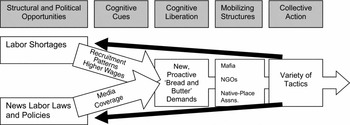
The first key question raised in this paper is with regard to why labor conflict, measured in terms of the number of strikes, is increasing in China since 2008. Prior research has suggested that strikes are limited in number (although estimates vary), and there is variation in worker militancy based on the nature of workers (whether migrants or SOE), regional differences, ownership differences, and the degree of state suppression of strikes. The literature also suggests that most strikes are ‘defensive’ in nature, trying to protect existing rights and benefits (see Lee, Reference Lee2007; Lüthje, Reference Lüthje2012; Pan Reference Pan2009; Weston, Reference Weston, Gries and Rosen2004). In this paper, we argue that strikes today are very different. In our current and ongoing work we rely on McAdam's (Reference McAdam1999) ‘political process’ model (see Figure 1) to explain the rising militancy of Chinese workers. For McAdam's framework to be applicable to the Chinese labor context, we would expect certain factors to be present. First, economic and political factors that influence workers’ bargaining power should exist. And second, workers should experience ‘cognitive cues’.
A ‘political process’ model of Chinese labor activism (based on) McAdam (Reference McAdam1999)

The key economic condition is that since early 2009, China has developed a labor shortage on its coasts and, increasingly, elsewhere (see, for example, Rapoza, Reference Rapoza2011). Gallagher (Reference Gallagher, Dong, Kuruvilla, Lee and Gallagher2011) links the increase in labor militancy and bargaining power to the shortage of workers, and argues that these shortages are a function of three issues: the decline in the working population as a consequence of the one child policy, policy changes in agriculture (sharp cuts to the taxes paid by farmers and stimulus-driven increases in rural infrastructure) that are raising the ‘opportunity costs’ of working on the coast and reducing migration to the cities, thus depriving them of workers, and finally, institutional discrimination against migrants as a result of the hukou system. Clearly, rural workers are increasingly staying at home. A poll of 200,000 migrant workers in 2011 found that more chose to work in their home provinces than chose to go elsewhere (Wang, Reference Wang2012). Capital is moving away from southeastern export processing zones like the Pearl River Delta. Chongqing, for instance, ‘for the first time employed more of its surplus rural workforce locally than it sent to other areas’ in 2011 (The Economist, 2012). Whether permanent or temporary, the shortage has served to increase labor militancy and bargaining power, reflected particularly in increasing demands for wages.
The key political factor has been the state's policy regarding worker protection and collective bargaining as well as the new media openness (at least until 2013), which serve to further increase the bargaining power of workers. In 2008, the state embarked on a ‘legislative onslaught’ enacting a range of pro-labor pieces of legislation, including the ‘Labor Contract Law’, ‘Employment Promotion Law’, and the ‘Labor Dispute Mediation and Arbitration Law’. And in 2012 new national ‘Regulations on Consultation and Mediation for Labor Disputes in Enterprises’ went into effect. These reforms essentially introduced stronger protections for workers (Friedman & Lee, Reference Friedman and Lee2010; McDermott, Reference McDermott, Townsend and Wilkinson2010). Elfstrom and Kuruvilla (Reference Elfstrom and Kuruvilla2014: 460) note that these laws, taken together, ‘amount to an official acknowledgment of the massive scale of worker unrest, as well as a new interest in containing conflict through providing it with legitimate channels, not attempting to eliminate it entirely’. Thus, it could be argued that China's ‘political opportunity structure’ for workers (Tarrow, Reference Tarrow1998) has also shifted.
In terms of ‘cognitive cues’, workers experienced these changes in many different ways. As Elfstrom and Kuruvilla (Reference Elfstrom and Kuruvilla2014: 460) note, ‘Companies’ efforts to ‘reverse-market’ themselves as “preferred employers”, by actively recruiting in working class neighborhoods (rather than waiting for workers to line up at factory doors, desperate for work), by building better dormitories, by publishing factory magazines, and by forming “task forces” of employee representatives may be received by working people as powerful “cues” that the balance of power has shifted and that they (workers) hold greater leverage over capital than a decade ago’. Rising earnings may send similar signals. Wage hikes in recent years have been dramatic. Migrants’ average monthly salaries increased by 21.2 percent in 2011 over the year before; the government has decreed that ‘the average growth of China's minimum wages should be at least 13 percent’ through 2015 and should constitute ‘40 percent of average local salaries’ (The China Post, 2012). A series of strikes at auto parts suppliers and a rash of suicides (and, subsequently, investigative reports) in a Foxconn factory in Shenzhen have led to high wage increases exceeding 20% at Honda plants. Equally importantly, media coverage of new labor laws like those noted above and greater reporting on strikes may provide ‘cues’ that more activism is tolerated by authorities. The Labor Contract Law was the subject of widespread domestic media reports focusing on individual cases of workers who successfully used the law ‘as a weapon’. Stockmann and Gallagher (Reference Stockmann and Gallagher2011) note that by telling ‘gritty’ stories of mistreatment and eventual redemption via arbitration and court, Chinese state newspapers both attract readers (serving the needs of an increasingly commercialized press) and, according to surveys conducted by Stockmann and Gallagher, increase trust in the efficacy of legal activism.
Importantly, the state has allowed more open discussion of industrial strife. The year 2008 marked the rollout of what has been dubbed China's ‘Control 2.0’ approach to media and public opinion: Communist Party Secretary Hu Jintao called for ‘releasing authoritative information at the earliest moment, raising timeliness, increasing transparency, and firmly grasping the initiative in news propaganda work’ (Bandurski, Reference Bandurski2008: 1). However, strikes and other worker ‘mass incidents’ have since received increased coverage, albeit with a Party-approved slant. This has meant that workers hear more about other workers’ activism than ever before. As Elfstrom and Kuruvilla's (Reference Elfstrom and Kuruvilla2014) qualitative interviews suggest, ‘The Honda strike, in particular, gave workers a new momentum. It awakened them’, and ‘The Honda strike had a big impact on workers' opinions, because of the media attention given to the strike. Similar strikes occurred in the past, but without the same attention’.
We would therefore expect ‘cognitive liberation’ to take place: workers should demand higher wages, more attention to the details of working life, and would strike if their demands were not met. We would expect both quantitative shift in terms of an increasing number of strikes, and we would expect pro-active strikes, for a variety of instrumental reasons. We would expect more strikes in all regions of China, in contrast to regional differences identified in prior research.
State Promotion of Collective Bargaining
The Chinese government has, since 2008, embarked on a coordinated effort to increase collective bargaining. It has done so via three separate initiatives: a change in the role of the Ministry of Human Resources and Social Security (MOHRSS), the inclusion of provisions for collective contract negotiations in the new labor laws of the 2007–2010 period (discussed above)Footnote [1] and, most importantly, the instructions of the ACFTU to increase union organizing and collective bargaining coverage across the country. The primary change in the role of the MOHRSS has been to make it more responsible for the growth of collective bargaining. The Labor Contract Law contains six articles about collective contracts, stipulating the content of collective bargaining and the right to ratify a collective bargaining agreement of the workers’ congress. And two articles focus specifically on the establishment of relatively centralized – regional and industry level – bargaining. Finally, the state and the ACFTU articulated the ‘Rainbow Plan’ (2008) to introduce collective bargaining in enterprises. Specific targets were established, i.e., collective contracts should be generally established in enterprises above a designated size,Footnote [2] in East China by 2009, in Central China by the end of 2010, and in the whole country by the end of 2012. Meanwhile, they continued to encourage (without specific targets) industry-wide or regional agreements to cover those nonunionized or small to medium-sized enterprises (Hu, Reference Hu2011). What explains the state's interests in doing so?
We do not yet have a coherent theory of the Chinese state's interests. In fact, a variety of concepts can be found in the literature to characterize the Chinese state and will not be repeated here (see Howell, Reference Howell2006 for a comprehensive review). Howell (Reference Howell2006: 274) suggests that the proliferation of terms to describe the Chinese state (development state, entrepreneurial state, the corporatist state, the dual developmental state, the market facilitating state) by authors such as Blecher (Reference Blecher and White1991), Blecher and Shue (Reference Blecher and Shue1996), and Oi (Reference Oi1995) masks a ‘deeper process of state fragmentation that fosters contradictory and complex patterns of state behavior’. Howell (Reference Howell2006: 275) suggests that to understand the Chinese state today, we must recognize that the state lies between various categories, displaying ‘elements of efficiency and inefficiency, of control and chaos, of relative autonomy and clientelism, of neoliberalism and neocorporatism’. This conception of the Chinese state allows it to be best understood as ‘polymorphous, assuming multiple complex forms and behaviours across time and space’ (Howell Reference Howell2006: 276) and provides us with a better understanding of state interests in developing collective bargaining.
One explanation for the state's action to increase collective bargaining draws primarily on the basic and long established institutional theory about industrial conflict and collective bargaining developed by the Webbs in their influential work Industrial Democracy (Reference Webb and Webb1897). The Webbs’ solution to labor conflict (consisting of ‘the device of the common rule’ [basic minimum standards legislation] on the one hand, and on the other hand, collective bargaining to equalize power between labor and management) has been the basis for most approaches states the world over have taken to reduce industrial conflict, under what Frenkel and Kuruvilla (Reference Frenkel and Kuruvilla2002) term ‘a logic of labor peace’. The Chinese government's response in encouraging collective bargaining is in many ways consistent with this explanation, in that it has enacted minimum standards legislation and is increasing collective bargaining coverage, but it is doing so in ways that do not result in the formation of free labor unions, i.e., the state here is corporatist and neoliberal at the same time.
An alternative perspective is that the state's labor policy is based on ‘decentralized legal authoritarianism’ (Friedman & Lee, Reference Friedman and Lee2010), which suggests a great emphasis on legal system building (Gallagher, Reference Gallagher2005) in order to steer the reform of the social governance system in general, and the labor relations system in particular, towards an authoritarian ‘rule by law’ system (Friedman & Lee, Reference Friedman and Lee2010). This explains the many legislations increasing labor protection during the 2007–2010 period, with the result that OECD has ranked the strictness of employment protection in Chinese labor and employment laws as among the highest in major countries (OECD, 2013; Venn, Reference Venn2009). This also explains why the state has encouraged legal mobilization and seeks to channel labor conflict into the judicial and semi-judicial system (Gallagher & Dong, Reference Gallagher, Dong, Kuruvilla, Lee and Gallagher2011; Lee, Reference Lee2007), in part to maintain political control. Given that labor peace (i.e., no strikes) can be achieved by strong protective legislation on minimum standards, as well as effective dispute resolution mechanisms, the state's encouragement of collective bargaining (an essentially democratic concept which implies some amount of independent agency on the part of workers), which might result in collective activity that might threaten the regime, remains puzzling.
Yet another explanation for the state's encouragement of collective bargaining can be found in the conception of the ‘developmental’ state. As Friedman and Kuruvilla (Reference Friedmand and Kuruvilla2015) note, at the firm level, high rates of labor turnover and severe labor shortages have come to be one of the key limits to future growth. The inability to retain a stable workforce has pushed employers in the industrial centers in coastal areas to look elsewhere. Cai (Reference Cai2007) has suggested that China may be at the ‘Lewisian turning point’, when labor scarcity begins to shift the economy away from labor intensive, input-driven growth to enhanced productivity, declining inequality, and greater domestic consumption. On the other hand, Chan (Reference Chan2010) argues that the country has not yet reached a Lewisian turning point but is instead experiencing a series of shorter-term mismatches of ages, skills and demand. However, at the national level, the state has espoused the goal of ‘economic rebalancing’, making household consumption rather than state-driven investment the key engine for economic growth, an important consideration to avoid the ‘middle income trap’ that the World Bank has predicted that China will reach in 2030. In 2010, China's household consumption as a share of GDP was only 38%, while similar figures for Brazil, Germany, India, and the USA are higher than 60%.
The state has already acted. At the 2013 plenum, the CCP outlined a plan to increase the role of markets in resource allocation by 2018, along with a range of policies that loosen various institutional interdependencies, granting more autonomy to local governments, but at the same time making the judiciary less dependent on local governments. Economic rebalancing calls for industrial policies that stimulate domestic demands and strengthen citizens’ purchasing power, and market-oriented institutions to have wages increased in tandem with industrial and economic growth. Wage growth is particularly important, and here we find an alternative explanation for the state's encouragement of collective bargaining. The CCP's 17th National Congress (2007) laid out the general target of establishing mechanisms for regular wage increases in enterprises. First in 2008 and then again in 2014 collective bargaining was written into the central government's work report to the People's Congress, where the government announced the establishment of mechanisms for regular wage increases in enterprises to deepen the reform of the income distribution system. Encouraging the ACFTU to establish collective bargaining in every establishment can be seen as one way to satisfy the state's interest to increase wages and move the economy into higher value added productivity based growth.
A different basis for the state's promotion of collective bargaining lies in its role as a regulator, enacting policies consistent with the vision of a ‘harmonious’ society, an overarching concept adopted by the CCP during the Hu Jin Tao regime. The state has a keen interest under this conception in limiting the growth in inequality. In the 30 years since economic reform began, China has gone from being the world's most equal large economy, with a gini coefficient of approximately 0.26 in 1979, to amongst the most unequal large economies (with a gini coefficient of 0.47 in 2012). The widening income inequality is seen as a potential threat to political stability (a gini coefficient of 0.40 is seen as the ‘security line’). Again, a variety of actions in the labor arena can be seen as inequality reduction mechanisms, notably the plethora of laws that promote equal pay and move workers from the informal sphere to the formal sphere. Collective bargaining, and especially industry wide collective bargaining is one way to standardize wages and benefits within industries.
Variations in Collective Bargaining
Although the central state promotes collective bargaining using uniform mechanisms at the national level, there is significant variation in the development of collective bargaining mechanisms, rules, and in institutionalization across China. What might explain this variation? In most countries, variations in collective bargaining processes can be linked to differences in bargaining structure (which in turn depends on the structure of unions and employers), as well as different regulations across states or regions (see Katz & Darbishire, Reference Katz and Darbishire2002). The state in China through its Labor Contract Law has promoted some variation, in that it supports both collective bargaining at the firm level, as well as collective bargaining at the industry level (articles 53 and 54). Friedman and Kuruvilla (Reference Friedmand and Kuruvilla2015) argue that China is taking an experimental, gradualist, and decentralized approach to the introduction of collective bargaining and to labor relations reform. They suggest that there are a number of ways in which the central state promotes or allows local experimentation. One the one hand, the ACFTU has consciously undermined the power of the nationally organized industrial unions in favor of regionally based federations, to prevent them from developing potentially an independent base of political power. Hence, much of the experimentation we see is at the enterprise level. But we must remember that provincial and local governments also have interests. And local governments play a major role in promoting collective negotiations. For instance, Friedman and Kuruvilla (Reference Friedmand and Kuruvilla2015) note that the Binhai new district in Tianjin provides firms with a subsidy equal to 15% of the total increase in wage bill that comes about through collective bargaining. Clearly, the local government has interests in raising wages and wants to incentivize firms to use collective bargaining regularly. Other local governments encourage collective bargaining because it may prevent strikes and the general instability that ensues as a result of public protests. Several provinces have enacted detailed regulations that go above and beyond the national regulations with regard to collective bargaining. Recently, Guangdong province enacted bargaining regulations, taking effect in January 2015, which not only provide for employer obligation to bargain, but even more far reaching, allow the direct election of worker representatives by workers. The point here is that we would expect to see considerable variation in collective bargaining based on the interests of different provincial and municipal governments. But these variations are tolerated, and in fact, encouraged by the central state, and as argued by Friedman and Kuruvilla (Reference Friedmand and Kuruvilla2015), consistent with the state's approaches in other arenas. For instance, the state has allowed a variety of experimentations with market reform to develop in the provinces, which has resulted in experiments with decollectivization of land (Unger, Reference Unger2002). If regions proved successful, their models could be promoted throughout the country. We argue that the state is taking a similar approach with regard to collective bargaining. In part, given the differences in employment structure, ownership, industry, workforce composition, across regions, provinces, and cities, a differentiated approach is necessary. However, the state's tolerance of diversity coexists with a key requirement, that independent forms of worker organization are banned.
In sum, we suggest that the central and local states promote collective bargaining for a variety of different interests, and that we should expect to see a variation in collective bargaining arrangements across different provinces and regions. Hence, Howell's conception of the Chinese state as a polymorphous one is best suited to the analysis of its motivations for promoting collective bargaining. In order to predict the future direction of collective bargaining, we then turn to an analysis of Chinese unions and employers.
The Future of Collective Bargaining
As noted earlier, the future of collective bargaining depends heavily on the degree to which it is institutionalized, which in turn depends on the ability and willingness of employers and trade unions to adopt the process. At the moment, we argue that it is at an incipient stage. The state has established the basic framework via its Tripartite Conference on the Coordination of Labor Relations (xietiao laodong guanxi sanfang huiyi), involving the labor ministry, the ACFTU, and the China Enterprise Confederation-China Enterprise Directors’ Association (CEC-CEDA) – a semi-official employer association in China in 2001 (Brown, Reference Brown2006). The tripartite system was strengthened in February 2005, when the ‘Circular on Further Advancing the Collective Wage Negotiation’ was published by the three parties, requiring all branches of the three parties at different levels to collaboratively work together to increase collective bargaining. The state's ‘legislative onslaught’ in 2007/8 for the first time created a legal basis for collective bargaining. And finally, the state has instructed the ACFTU to organize workplaces and establish collective bargaining in all workplaces, articulated now through the ‘rainbow’ plan.
Since the primary engine for collective bargaining growth apparently rests on the ACFTU, it is useful to theoretically examine its evolution. The key question here is whether the ACFTU can effectively represent Chinese workers in collective negotiations. There are two primary lines of debate and argument with regard to the role of the ACFTU. The first concerns the ACFTU's identity, whether it is functioning in largely path dependent ways and has not yet made the transition to a new role in a market based society. The second is that the ACFTU suffers from a crisis of legitimacy, in that most workers do not trust the union or see it as effective. We discuss each in turn below.
With regard to whether the role of the ACFTU has transformed, Chen has argued that the ACFTU remains stuck to its ‘double institutional’ identity as both an apparatus of the state (acting on behalf of the nation's collective good) and as a labor organization to protect workers’ interests (Chen, Reference Chen2003). In the old system, Chen argues that the ACFTU did not quite experience tensions between its two roles, largely because its representation function was ‘actually absorbed by the state’, given that its paternalistic labor regime under the ‘iron rice bowl’ system of employment guaranteed workers economic interests such as work, pay, health care, and social security. But under a market based system, it is increasingly experiencing these tensions, especially as industrial disputes and worker militancy increase.
Yet, the extent to which the ACFTU has evolved in a more representative direction remains contested. Chan (Chan, Reference Chan1993; Unger & Chan, Reference Unger and Chan1995) argues that the ACFTU played an effective corporatist role in the socialist period, but is likely to continue this in the market era, because the state's needs to effectively bridge the gap between the grassroots and the state in the market economy has created space for the ACFTU, among other such organizations, to incorporate worker voice into the bureaucratic system of the state. Chan (Reference Chan1993) predicted that the ACFTU would transform from its state corporatist role to that of a more societal corporatist role that features ‘a coalescing of horizontal interests from the bottom upward’.
However, Friedman (Reference Friedman2014a) does not see a promising corporatist future for the ACFTU for three reasons. First, corporatism requires that workers’ voices are successfully incorporated into the system, while the ACFTU does not incorporate workers voices. Second, corporatism requires that workers give up political demands in exchange for economic benefits and therefore implies a relatively de-commodified model of social governance, whereas in China workers clearly do not enjoy, sufficiently, such benefits. Third, however co-opted a union under corporatism is, it is a somewhat independent intermediary organization between the grassroots and the state, while the ACFTU, is clearly part of the state apparatus with no such independence.
That being said, clearly there is some transition to a more representative role of the ACFTU. Chen (Reference Chen2003) documents the increasing ways in which unions are taking up their representative function with regard to individual, if not collective, disputes. The ACFTU has carried out reforms and ‘experiments’ at both central and local levels. In the arena of organizing, unions at all levels have developed various models (i.e., the traditional ACFTU pattern, the union association patter, and the regional, industry-based pattern) to strategically organize workers (Liu, Reference Liu2010). Nevertheless, the unions’ ability to effectively represent workers is limited on the one hand by their subjective position with regard to the employer, and on the other because union leadership cadres see union organizing as a bureaucratic exercise to meet the targets suggested by the state, rather than a strategic one (Liu, Reference Liu2010; Taylor & Li, Reference Taylor and Li2010).
Chen (Reference Chen2003) suggests that there is a natural limit to the ACFTU's ability to be an independent representative agent, i.e., the state will not loosen its control over the unions, because of ‘solidarity phobia’ (e.g., the Polish experience) whereby more independent unionism is seen as subversive and threatening to the regime, as well as being threatening to the role of the state as a ‘developmental’ state. Therefore, we expect that the state will continue protecting the ACFTU monopoly on worker representation – a condition that Friedman (Reference Friedman2014a) called ‘appropriated representation’, whereby the ACFTU may be able to promote collective bargaining using its unique political position at the national level, whereas workplace unions will remain weak and illegitimate.
The crisis of legitimacy of the ACFTU has been well documented by several authors (Howell, Reference Howell2008; Taylor & Li, Reference Taylor and Li2007). The key argument here is that Chinese workers do not trust the ACFTU to adequately represent them, and in fact in many workplaces where the ACFTU is present, the workers do not even know that they have representation. The ACFTU is seen as largely apathetic, willing to allow management to exercise control (this explains the phenomena of ‘dual posting’ where the company's human resource manager is allowed by the ACFTU officials to act as ‘union leader’). Friedman (Reference Friedman2014a) suggests that official unions have been unable to win recognition from workers, and therefore wildcat strikes and other forms of representation continue to be the most effective means of addressing worker grievances. There have been recent experiments regarding direct union elections, which would arguably lead to more representative unions, and hence more legitimate ones, but there is a lack of sufficient worker involvement in these experiments (Chan, Reference Chan2009; Howell, Reference Howell2008), with a notable exception of elections initiated by workers via spontaneous strikes (Hui & Chan, Reference Hui and Chan2014).
Given that unions have an identity crisis as well as a crisis of legitimacy, the key hypotheses that we can advance is that unions will be unable to effectively represent workers in collective bargaining, and are more likely to see collective bargaining as a bureaucratic exercise, just as they view union organizing. Collective agreements then are more likely to be formalistic exercises that primarily re-state the basic conditions under the laws, and less likely to advance workers’ interests.
Like the ACFTU, the two national employer associations – the CEC-CEDA and the All China Federation of Industry and Commerce (ACFIC) – participate in the tripartite framework to promote collective bargaining, but both are also subordinated to the CCP. Our current ongoing research suggests that these employer associations are half-hearted partners in promoting collective bargaining. Local employer associations, although theoretically have to be affiliated with the two big national associations, often enjoy more autonomy from the state as well as their upper levels in decision making than their equivalents on the union side do (Friedman, Reference Friedman2014b). This allows them to ignore collective bargaining, or when it suits their interests to encourage and promote it. Given tight labor market conditions, it often suits local employers to engage in some form of regional or industry-wide coordination on wages and working conditions. In such cases, local employer associations serve as mechanisms of employers’ collective voice, while lead firms are indeed key players. But apart from these industry-wide bargaining scenarios employers tend to shy away from collective bargaining at the firm level, except after strikes.
Given the union's identity and legitimacy crises, and the employers’ relative lack of interest in promoting collective bargaining at the firm level, we have no basis to expect that the institution of collective bargaining will fulfill the state's objectives in introducing it as a means of containing labor conflict. In what follows, we discuss our methodology, and in our results section, we attempt to categorize the variation that we see in collective bargaining (based on very limited research) in China.
METHODOLOGY
In the absence of official data, we rely on alternative estimates of strikes, of which two sources are available. The first is a website run by the China Labour Bulletin, a Hong Kong based NGO that collects information on worker protests and strikes, largely from news reports in Chinese newspapers, but also from dissident blog sites and through the organization's radio call in show. The second is a website called China Strikes (Elfstrom & Kuruvilla, Reference Elfstrom and Kuruvilla2014), which also uses newspaper reports, but also individual ‘tip-offs’ through their website. While China Strikes has focused on the period of 2008–2012, the China Labour Bulletin reports strikes from 2011 onwards. For the overlapping years, i.e., 2011–2012, both websites have identified similar numbers of strikes. However, both sources of data have shortcomings. First, it is possible that both websites under-report the actual number of incidences of worker protests and strikes, since there are many incidences that do not find their way into newspapers, for a variety of reasons. Second, it is possible that only bigger strikes that disrupt life outside the factory gates (such as taxi strikes) get reported in the press. And finally, the criticism that these two websites may be measuring news stories rather than real strikes is also not entirely without substance. However, in the absence of official statistics, these are the only sources of data, even if they understate, by a significant margin, the real numbers.
With regard to collective bargaining, our goal is to use the limited research already published, and our own observations (we are currently engaged in a research project on collective bargaining that is not yet complete), to create a taxonomy of collective bargaining in China. Given that collective bargaining is a relatively new institution, but one that is expected to grow in the coming years, establishing a taxonomy today will be useful as a baseline against which future studies can make comparisons. Our taxonomy uses two concepts to classify current collective bargaining. These are the degree of centralization (or decentralization) and the degree of authenticity of collective bargaining.
Whether bargaining is centralized or decentralized depends on the bargaining structure, i.e., the level at which bargaining takes place and the employees and employers it covers (Katz, Kochan, & Colvin, Reference Katz, Kochan and Colvin2014). In Western European countries, a centralized (or multi-employer) bargaining structure is instituted at levels beyond individual firms, usually at the industry or national level, where negotiations are carried out by national or industrial level organizations of unions and employers. National level agreements are common in Austria and Sweden, whereas industry level agreements are common in Germany, Netherlands, and Belgium. Decentralized bargaining (where agreements are negotiated by company level unions and their employers are more common in the US and Japan. In China, the labor contract law permits both centralized and decentralized bargaining, although the centralized bargaining it envisages is actually at a more decentralized level than in other countries. Specifically, the law limits regional or industry level collective contracts in construction, mining, restaurant, and other industries to areas below the county level.Footnote [3] The state's rationale for this limitation is twofold, i.e. the need to resolve issues of employment instability, labor shortages, strikes, high turnover, low social security coverage, at the county level, while at the same time providing an institutional structure to extend collective bargaining coverage to workers in these difficult to organize industries – mostly small, short-lived, and non-unionized businesses. In practice, local unions often are reluctant to establish collective bargaining at above-county levels, and regional authorities do not encourage this either, while the state actively discourages industry wide bargaining structures above the country level. Thus, we will expect to see more collective bargaining agreements at the firm level rather than industry level.
Collective bargaining can also vary based on the degree to which bargaining is authentic. As we have noted earlier, there is a clear tendency towards what are called ‘template agreements’ where management and union sign a formalistic agreement that simply re-states the minimum conditions of the law and where workers are not even aware of these agreements. These would be inauthentic agreements. We define a collective bargaining agreement as authentic if it meets the following conditions: whether unions and employers actually engage in a process of negotiations, whether workers have input into crafting the demands that the union negotiates on their behalf, whether those negotiations result in concrete outcomes, and whether the process is repeated more than once (a sign of institutionalization). As we will show, the majority of collective bargaining agreements tend to be inauthentic. Authentic agreements are relatively few, and typically they occur after a strike since the strike by workers needs to be settled and it can only be settled by negotiations.
Based on our theoretical discussion with regard to strikes, we would expect to see steadily increasing numbers of strikes, offensive in nature, all across the country, along with steadily increasing conflict rates. Based on our analysis of the central and local states’ multiple interests, we would expect to see steady growth in the number of collective bargaining agreements since 2008, and significant variation. Finally, based on our analysis of the ACFTU and employers’ associations, we would expect to see many inauthentic agreements, and a preponderance of firm level bargaining.
RESULTS
Strikes
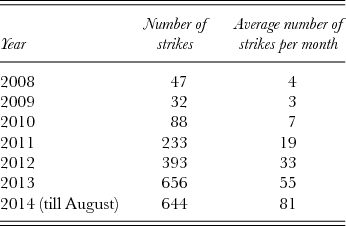
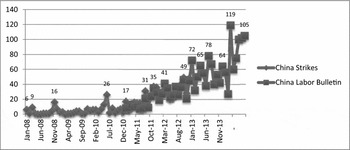
China Strikes reports a total of 793 strikes during the 2008–2012 period, while the China Labour Bulletin indicates a total of 1867 strikes between Jan 2011 and August 2014. Table 1 shows counts of strikes after integrating estimates from both websites. What is notable is that the average frequency of strikes per month has been increasing steadily. Figure 2 graphs this trend.Footnote [4] Chinese workers appear to be striking more, and longer, indicative of their bargaining power.
Strikes in China, 2008–August 2014

(Source: The 2008–2012 data about China are from China Strikes website, available from URL: https://chinastrikes.crowdmap.com/; The 2013 data about China are from China Labor Bulletin, available from URL: http://www.numble.com/PHP/mysql/clbmape.html)
Monthly strikes in China, 2008–2014 (Source: China Labor Bulletin, available from URL: http://www.numble.com/PHP/mysql/clbmape.html, and China Strikes, available from URL: https://chinastrikes.crowdmap.com/)

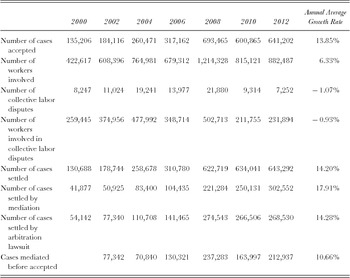
If one assumes, as we argued, that the Chinese data represents a massive undercount of reality, then clearly, China is the ‘strike capital’ of the world, with more strikes per year than most other countries. An alternative way of examining whether there is conflict in the system is to look at the number of labor disputes in China. As the data in Table 2 suggests, the number of labor disputes in China has also increased over the last few years.
Labor disputes in China (2000–2012, every alternative year)

(Source: China Labor Statistical Yearbook 2013)
In sum, and despite problems with the available data, our research suggests that Chinese workers are increasingly militant, and that the number of strikes in China seems to be steadily increasing, as are other indicators of industrial conflict, consistent with our expectations.
A taxonomy of varieties of collective bargaining in China

Collective Bargaining
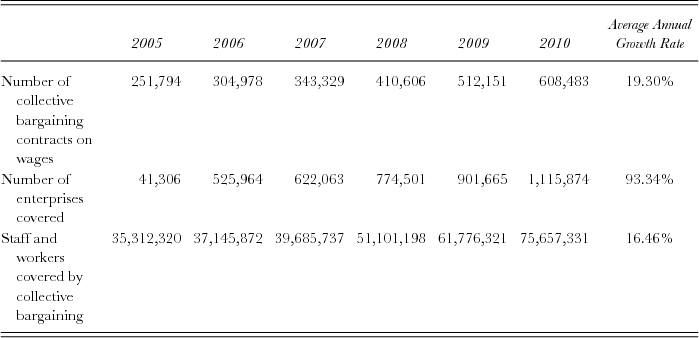
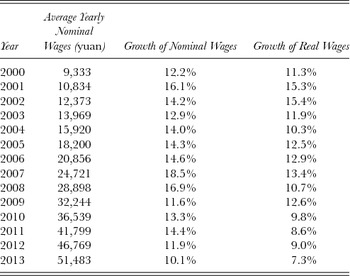
The published data show considerable growth in collective bargaining in China from 2006 onward. As is apparent from Table 3, the annual growth rates in the number of collective contracts are high, nearly 20% per year. The number of enterprises being covered by the contracts has been growing by almost 100% per year, indicating a great expansion of multi-employer – industrial and regional – contracts as well. Clearly therefore, the state's encouragement of collective bargaining has been successful in quantitative terms. Yet the growth in collective bargaining does not show an appreciable decline in industrial conflict measured by strikes or data on industrial disputes. At a preliminary level, this suggests that the state's encouragement of collective bargaining as a method of reducing conflict and strikes is not successful, or to be conservative, not successful yet. At the same time, data on wages show steady growth (see Table 4). We can draw two different conclusions from this limited data. One is that the key interest of the state was not to reduce conflict via the introduction of collective bargaining, but to increase and stabilize wages. If this conception of the state's interest is correct, then it provides support for the argument that the state is acting in ‘developmental’ ways in encouraging collective bargaining as an instrument to rebalance the economy. An alternative explanation is that the state does want to introduce collective bargaining in order to reduce conflict (as has been done in most parts of the world), but the quality of collective bargaining is not very good, and hence does not meet that goal. If this is true, then the policy prescriptions are clearer. Below, we look more closely at the nature of collective bargaining.
Growth of collective bargaining in China, 2005–2010

(Source: China Trade Union Yearbooks 2006–2011)
Wage growth in China (2000–2013)

(Source: China Statistical Yearbook 2014)
Emerging Variation: Varieties of Collective Bargaining in China
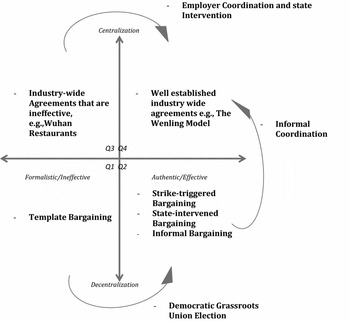
Based on the limited available research, we classify collective bargaining agreements based on how centralized or decentralized and how authentic or inauthentic they are. Recall our key caveat that there is relatively little published research, and hence, our taxonomy below (see Figure 3) is not based on a representative sample, as it should be. However, we want to highlight that this is by no means a static classification, because we also see dynamism, where there is movement from one quadrant to another. At best, this taxonomy should be seen as an initial estimate or baseline, against which future research can examine progress over the coming decade.
Quadrant 1: Decentralized inauthentic collective bargaining
Perhaps the most common form of collective bargaining is what we term ‘template bargaining’ and what other researchers have described as ‘collective contracts without collective bargaining’ or ‘paper contracts’ (Chen, Reference Chen2007; Clarke et al., Reference Clarke, Lee and Li2004; Luo, Reference Luo and Scherrer2011). Typically, the local government – often the labor administration and official union – develops a template for a collective contract that employers and the local branch of the union should sign (jiti hetong fanben). In some cases, the template agreement contains blank spaces for wage increases, which enterprises can customize to suit their needs. Usually, a template agreement leaves little room for the parties to bargain over interest-based issues (Chen, Reference Chen2007). This is the model of collective bargaining most commonly followed by the ACFTU, which provides its unions with these template agreements for various regions that employers are requested to sign, and which re-state minimum legal conditions. Often, employers prepare the contracts and unions simply sign them without engaging in any negotiation (Clarke et al., Reference Clarke, Lee and Li2004; Luo, Reference Luo and Scherrer2011; Taylor, Chang, & Li, Reference Taylor, Chang and Li2003; Wu, Reference Wu2012).
The ACFTU, which is targeted with increasing the coverage of collective bargaining within the country, appears more interested in the quantity of agreements signed (to meet its targets) with relatively little focus on the quality (Wu, Reference Wu2012). Some of these template agreements are not even enforced, due to weaknesses in the labor inspection regime (Wu, Reference Wu2012), or because the local enterprise unions also exist primarily ‘on paper’, having been set up by the ACFTU in collaboration with the employer, often without the workers’ knowledge (Liu, Reference Liu2010). Thus, though a large majority of Chinese collective bargaining agreements hew to this type, we see them as being largely inauthentic and the most decentralized, given that they are signed at the enterprise level. These have been well documented in existing studies (Clarke et al., Reference Clarke, Lee and Li2004; Luo, Reference Luo and Scherrer2011; Taylor et al., Reference Taylor, Chang and Li2003; Warner & Ng, Reference Warner and Ng1999), so we shall not expand on them here.
Quadrant 2: Decentralized authentic collective bargaining
A small but growing number of collective bargaining agreements at the firm level can be termed more authentic, although there is some variation to the extent that they truly encapsulate genuine bargaining. There are three different ways in which this type of collective bargaining is happening. One, and perhaps the most authentic form of collective bargaining, is the negotiations that take place after a strike as Elfstrom & Kuruvilla (Reference Elfstrom and Kuruvilla2014) suggest. The best known case of strike-triggered bargaining is the Honda Nanhai Transmission plant's strike in 2010 that resulted in substantial wage increases for workers, and later also triggered a strike wave in the local and national auto industry, leading to substantial wage negotiation in many of those cases as well (Hui, Reference Hui and Scherrer2011). Since a strike, when it occurs, is frequently settled by negotiations these days (Chang, Reference Chang2013), the steady growth in the number of strikes implies growth in more authentic collective bargaining. There is increasing research that suggest that strikes before and during the 2010 strike wave were settled via negotiations between provisionally elected workers’ representatives and employers (Chen, Reference Chen2010; Meng, Reference Meng2012; Meng, Lu, Lei, Wang, & Chang, Reference Meng, Lu, Lei, Wang and Chang2011). Some of these strike-based settlements have been often facilitated by the mediation of local governments and official unions, and the state, in various places, has appeared to prefer using this approach rather than suppressing striking workers (Chang, Reference Chang2013; Gallagher, Reference Gallagher2014). Chen (Reference Chen2010) refers to these dispute and strike settlement mechanisms as quadripartite bargaining, involving four actors (the state, the ACFTU, the employers, and the workers). Strikes and post-strike settlements are an important route by which collective bargaining is becoming institutionalized, suggests Meng (Reference Meng2012) in his research on Dalian.
The second way that authentic bargaining may occur without collective action by workers is through the direct intervention by the local government. Chan and Hui's (Reference Chan and Hui2014) research on Honda's (Guangzhou) Reference Gallagher, Dong, Kuruvilla, Lee and Gallagher2011 bargaining round suggests that although a union in which workers elected their representatives, and collective bargaining, were institutionalized in the firm after the 2010 strike, the local government directly intervened in the negotiations during the 2011 bargaining round, and encouraged the parties to come to agreement. Arguably, the local government was interested in avoiding a potential strike. We refer to this as authentic because it is occurring in a situation where workers choose their own representatives, and the local government apparently takes the process seriously. However, this is a more isolated case.
Although much of the prior literature has focused on formal bargaining structures to make the claim that much of Chinese collective bargaining is inauthentic, Zhang (Reference Zhang2014) makes a compelling case that we should examine informal processes, which are perhaps just as important as formal structures, and constitute the third way in which bargaining is effective. He finds, in his study of the auto industry in Tianjin, that while formal bargaining looks just as formalistic as many other cases, much of the real negotiation takes place at both enterprise and industry levels, through informal processes of coordination and negotiations that have resulted in meaningful outcomes. Although there have not been strikes or government intervention in the auto-industry bargaining cases in Tianjin that Zhang examines, his research points to the active role of the firm union in ensuring substantial negotiation. Thus, there are many different ways in which authentic bargaining is carried out.
Quadrant 3: Centralized and inauthentic collective bargaining
A major strategy of the ACFTU's Rainbow Plan can be found in its effort to carry out regional and industry-level bargaining, seen as necessary to bring employees of small and medium sized firms under collective bargaining coverage (Wu, Reference Wu2012). And as noted, the ACFTU's efforts are complemented by the state apparatus, where key state departments often take the lead in mobilizing employers. For instance, in the second author's ongoing research, he finds that, in the case of hospitals in Tianjin, the district union successfully mobilized the employers by leveraging the district Bureau of Public Health (BOPH) – a state institution in charge of examining, approving, and supervising all local public health affairs – to create an industry wide collective bargaining agreement. However, it was not clear that workers were aware of the agreement, nor was it clear that the agreement was enforced. Similar efforts are also identified in Tianjin's construction industry, as well as in other regions in Wu's (Reference Wu2012) research.
While we need more cases to draw firmer conclusions, thus far, what is clear is that many of these industry-wide agreements are either formalistic or have shown themselves to be ineffective and not institutionalized. Similar to that of decentralized and formalistic bargaining, the reasons for ineffectiveness at this level include the union's focus on formalistic terms, the absence of strict enforcement, and often, worker ignorance of the terms of the agreement, or that they were represented by a union (a frequent issue when union representatives are not directly elected) (Wu, Reference Wu2012). A classic example here is Friedman's (Reference Friedman2014b) study of sectoral bargaining in Rui'an eyeglass cluster in Zhejiang Province, where workers interviewed indeed knew nothing about the industry level contract that covered them. Probably the best-known case of failure of enforcement of collective bargaining can be found in Wuhan, where the local government, in a top-down process initiated sectoral negotiations in 2011 in the restaurant industry. Although the sectoral contract has set wage terms for over 450,000 workers from 40,000 different establishments in 2011 (Xie & Guo, Reference Xie and Guo2011), and has been renegotiated successfully over the last three years which has been well covered by mass media, recent research (Xie, Chen, Chen, & Xiao, Reference Xie, Chen, Chen and Xiao2012) shows that only 56.9% of employees surveyed were receiving the wages stipulated in the contract.
Despite these issues, the ACFTU continues to focus on building collective bargaining institutions at the industry and regional levels. In Guangzhou, for instance, the official union has organized the construction industry, although no collective bargaining has been successfully achieved (Friedman, Reference Friedman2014b). In addition, union organizing by region has also been identified in areas with clusters of small businesses, such as community unions, village union associations, market unions, office building unions, and union associations by ownership in development zones (Liu, Reference Liu2010). But we are skeptical of the prospects for institutionalization of collective bargaining at the regional level, given the heterogeneity in industries and firms in a region, and given that often workers are not aware of the agreement nor do they elect their representatives.
Quadrant 4: Centralized, authentic collective bargaining
There are a few instances of centralized sectoral bargaining that qualify as authentic. Unlike the previous examples, where it was either the local government or the ACFTU that was the primary engine behind the development of collective bargaining, in the case of Wenling, the employers were the ones who initiated the project. Wenling, a town in Zhejiang Province, contains a knitwear cluster with more than 130 firms employing about 12,000 workers in 2002. In this case, employers began spontaneous wage coordination, in an effort to deal with the rising turnover as a result of what was an acute labor shortage (Xu, Reference Xu2005). They formed an employer association in 2000, and institutionalized wage coordination amongst themselves, although not all employers came on board. By 2003, the local government stepped in, establishing an industrial union, which ultimately signed an industry-wide agreement with the employer association (Wen & Lin, Reference Wen and Lin2015). That contract has been renegotiated every year since, and is stable, although it overwhelmingly focuses on the piece-rates and not other working conditions. Moreover, it is a clear case of relatively authentic collective bargaining arrangement, in terms of how well the contract is enforced. The second author interviewed workers in the industry in 2013, and found that the piece-rates that were used to pay them was higher than or equal to those stipulated in the contract.
The Wenling model is being increasingly diffused to other areas. In all, 15 industries – including the pump sector in a town named Zeguo (Liu, Reference Liu2010) – have carried out similar bargaining by 2012, covering roughly 6,100 enterprises and 400,000 workers (Zhang & Shi, Reference Zhang and Shi2012). There are reports of cases developing in other textile and garment (Lüthje, Luo, & Zhang, Reference Lüthje, Luo and Zhang2013: 269) as well as other manufacturing clusters (Lee, Reference Lee2011). The commonalities across these ‘successful cases’ is that they are negotiating about the piece-rate at the industry level, and wage coordination was welcomed by small and medium-sized firms in order to reduce turnover in a labor shortage situation. Therefore, success seems to be in part determined by employer interest and readiness for collective bargaining as well.
DISCUSSION
Moving across Quadrants: The Future of Collective Bargaining and The Roles of Unions and Employers
While the above taxonomy presents a static picture of the varieties of collective bargaining in China, it is important to incorporate a dynamic element, specifically, what makes it possible to move from inauthentic to more authentic collective bargaining and how might decentralized bargaining connect with more centralized structures to create more worker solidarity.
How might we expect movement from inauthentic to more authentic bargaining at the firm level (i.e., from Quadrant 1 to Quadrant 2)? Certainly, as discussed earlier, strikes could trigger such a movement. But there are other ways as well. One strategy recently adopted in Guangzhou and Shenzhen is the grassroots union election (namely direct election for grassroots trade union cadres [gonghui zhixuan]). When workers are able to elect their own representatives, rather than having union leaders decided by the regional official union or the enterprise, it builds the local unions’ autonomy and independence, and is one necessary step for the growth of authentic bargaining. This focus on direct election is growing. For instance, the Shenzhen Federation of Trade Unions announced in 2012 that 163 enterprises with more than 1,000 employees would all adopt direct election (Eastmoney, 2012). The second author's interview with a key informant involved in Shenzhen's union election revealed that approximately 1,000 out of the 30,000 enterprise unions in Shenzhen had ‘carried out or reached the level of direct union election (dadao zhixuan shuiping)’ by August 2011. In Guangzhou, Peng & Du (Reference Peng and Du2010) report that several hundred of the over 50,000 firm unions had been directly elected by 2010. The case of direct union elections in Omron (Shenzhen) has been documented in Wen (Reference Wen2013) and Hui & Chan's (Reference Hui and Chan2014) work. Yet, we need more research to properly evaluate how these elections are conducted.
Although the efficacy of direct union elections has been debated (some argue that these elections were manipulated by employers or local officials, others question the degree to which these will be institutionalized in today's political climate in China, and some suggest that there is rising opposition to direct elections from both employers and the state (Chan, Reference Chan2009; Howell, Reference Howell2008; Wen, Reference Wen2013), the available evidence (Hui & Chan, Reference Hui and Chan2014; Wen, Reference Wen2013) and more recent first hand evidence from our research in Guangzhou's auto industry suggests that thus far, democratic union elections facilitates collective bargaining with real negotiation between workers and employers, including some conflictual negotiations, that result in real rather than formalistic outcomes, and hence, are more authentic.
Movement from Quadrant 3 to 4 (i.e., from less authentic to more authentic bargaining at the centralized level) appears possible when employers take the first step in coordinating through employer associations, and when the local government directly intervenes to create industry wide settlements, as suggested by the Wenling model. However, given the lack of a real connection between unions at this level and the workers they represent, and the heterogeneous workplaces that make direct election of representatives more difficult, we are not convinced that such a movement is imminent. In addition, there are a number of implementation and enforcement failures such as in the case of the restaurant industry in Wuhan that suggest the difficulty of achieving meaningful collective bargaining coverage for an entire regional industry.
There is some evidence of increased coordination between decentralized and centralized levels. Zhang (Reference Zhang2014) finds evidence of links between industry wage structures and firm level bargaining in a circumstance when lead and supplier firms belonging to the same value chain in the local labor market are involved. This indicates some degree of dynamism, distinct from the mostly static picture implied by our classification. This movement of informal coordination appears similar to those practices in the West, especially in Europe, although perhaps it is at a more incipient stage here. As Chinese employers in a cluster or industry begin to build better institutional structures to facilitate coordination, that will stimulate a similar movement amongst workers, and unions, and thereby promote industry wide bargaining as well as firm level bargaining.
CONCLUSION
In this paper we examine the growth of strikes and collective bargaining in China. Using McAdam's political process model, we argued that Chinese workers are striking more, and proactively after 2008. The Chinese state has encouraged the growth of collective bargaining, although its motivations for doing so could be attributed to different interests, such as providing a mechanism to resolve labor conflict or to increase wages in its effort to ‘rebalance’ the economy, a necessary condition to avoid the middle income trap. We argued further, that we would expect to see considerable variation in collective bargaining based on the differential interests of central and local states, who are enjoying more autonomy than they did in the past. And our analysis of the official union (ACFTU) and the crises of identity and legitimacy that it faces led us to expect that collective bargaining will be predominantly inauthentic.
The evidence largely supports our expectations. Chinese workers are clearly striking more after 2008, and the numbers of strikes from two different sets of data show steady increases. Collective bargaining has also grown sharply after 2008, but the key agent charged with the responsibility of increasing bargaining coverage (the ACFTU) tends to view it, generally, as a bureaucratic exercise. Hence our finding that much of the incipient collective bargaining in China hews to the inauthentic side of the continuum. We also find considerable variation however, in collective bargaining. This variation is attributable to the willingness of the state to allow experimentation and it would appear that different industrial relations actors, i.e. local labor bureaucracies, local employers, and local unions exercise considerable freedom to develop particular structures.
While our taxonomy presents a static picture of collective bargaining in China today, we also highlight how it may change in the future, under the present institutional structure. We have identified several conditions that are necessary for bargaining arrangements to move towards greater authenticity. Specifically, even though the Chinese state is unlikely to permit workers to affiliate with unions of their choice, reforms within the ACFTU that move it in the direction of increasing its representative function is one avenue for change. An amendment to the Guangdong Provincial Regulation on Collective Contracts for Enterprises, is, in our view, one pathway to more authentic bargaining. The regulation is detailed, covering not only the content and subject matter of collective bargaining, but includes extensive provisions regarding various aspects of collective negotiations. Most crucially, the regulation specifies clearly that, ‘negotiation representatives of the employees of the firm must either be selected by the trade union or democratically elected by the staff and workers’ – the first time that democratic elections have been specified in any provincial legislation regarding collective bargaining.
However, despite the growth and variation that we see, and despite the promise implicit in the Guangdong regulations, overall, our paper suggests that collective bargaining in China is at a very incipient stage. At this point in 2015, our initial analyses would suggest that the institution of collective bargaining in China is more effective at increasing wages, thereby meeting the state's interest in rebalancing the economy, and less effective in meeting the state's alternative interest i.e., representing workers adequately so as to reduce industrial conflict.
Under what conditions could collective bargaining meet the state's alternative interest? This requires that Chinese unions overcome their problems of identity and legitimacy. A necessary condition is that the state must be willing to provide the unions with more independence. What might bring this about? The state would be willing to do so if the legitimacy of the CCP is under threat. And that could happen if industrial conflict and labor exploitation continue to increase despite the new laws and union activity.
However, recent decisions suggest that the state has elected to follow an alternative approach of improving bargaining effectiveness with more centralization, rather than providing local union autonomy. In 2014, the ACFTU introduced a new five-year plan (2014–2018) to promote collective bargaining. Simultaneously, in order to improve collective bargaining effectiveness, the ACFTU has adopted new guidelines to its locals. These include the notion that 100% of the workers covered under CB should be aware of the bargaining, and have provided them with relatively centralized formats, that would permit aggregation of data on wages. More importantly, in May 2015, the central government and CCP released ‘Suggestions for Establishing Harmonious Labor Relations’ – the first time that harmonious labor relations were promoted at the central level in a special document. These actions suggest that the CCP has acknowledged the shortcomings of the current collective bargaining system (i.e. poor implementation, poor quality of agreements, and the ACFTUs general inability to represent workers), and the threat of continued industrial conflict to its own legitimacy, but is still leery of providing local unions and workers with more autonomy that might result in the successful institutionalization of bargaining.
How does the development of Chinese unions and collective bargaining institutions compare with other Asian nations? We might look to both Taiwan and South Korea for parallels. Japan however, is less comparable, because the post-war development of both unions and collective bargaining developed in tandem with democratization (Gould, Reference Gould1984), and was led by employers, who introduced the famous pillars of lifetime employment, seniority based wages and enterprise unions, in search of labor stability (Hashimoto, Reference Hashimoto1991). In both Korea and Taiwan, however, the export oriented industrialization regimes adopted by authoritarian governments entailed a high degree of control of labor. Rather like China today, Taiwan's policies then, required the unions to be affiliated to one central federation (the Chinese Federation of Labor), which was controlled by the Kuomintang regime (Deyo, Reference Deyo and Deyo1987). Korea adopted a similar approach with the creation of the Federation of Korean Trade Unions created by the government. However, in contrast to Taiwan (where the workforce was mostly composed of labor working in agriculture and small scale industries), Korea's labor movement, even under authoritarian governments, developed a stronger working class identity, Deyo (Reference Deyo and Deyo1987) and Chu (Reference Chu1998) argue, due to the tradition of nationalist mobilization against the Japanese occupation, large sized firms involved in heavy industries, and high industry concentration. Both countries democratized in the late 1980s. Given their historical weakness, the labor movement in Taiwan did not play a major role in the democratization processes, unlike the Korean labor movement, which was a central player in the process in Korea. Consequently, post democratization, Korean unions aggressively demonstrated their power through waves of strikes (Chu, Reference Chu1998) that resulted in the formal institutionalization of a new industrial relations regime along pluralist lines. Taiwan's labor movement, given its historical weakness, did not assert themselves as strongly after democratization, although a new labor relations regime developed thereafter. Thus, although there was broad similarity in terms of state control of labor in Korea, Taiwan and China, that similarity ended in the 1980s upon democratization in Korea and Taiwan. The Chinese labor movement still remains under state control, and the future evolution of both labor unions and collective bargaining is, as we have argued earlier in this paper, dependent on CCP's strategies.
Having developed a ‘baseline’ taxonomy of collective bargaining, how might future research advance our knowledge about collective bargaining in China? Most importantly, we need research (detailed case studies) on how collective bargaining is conducted in different parts of China. As Friedman and Kuruvilla (2014) have argued, there is much experimentation and decentralization, and more empirical evidence of these processes are clearly necessary in order to evaluate what works best, in which locations, and why? We specifically need more case studies of authentic bargaining. Second, we need analyses of collective bargaining contracts (on both a national and regional scale) in order to determine which are the key issues of contention between management and labor and how they are changing overtime. More research on the various experiments regarding union elections and the impact of these on bargaining processes and outcomes is a key need as well. Thus, there are plenty of opportunities for cutting edge research in collective bargaining in China and we hope that Chinese management scholars would answer this call for research into a crucial national human resource issue.