

INTRODUCTION
The environment represents an important evolutionary factor that interacts with the genotype, contributing to the individual's phenotypic expression (De Jong, Reference De Jong1995; Agrawal, Reference Agrawal2001). Although organisms are programmed to produce a predetermined phenotype by homeostasis in development (Lerner, Reference Lerner1954) the environmental disturbances experienced throughout their lives may alter the predetermined genotypic expression (Gorur et al., Reference Gorur, Lomônaco and Mackenzie2005; Rodrigues et al., Reference Rodrigues, Lomônaco and Christoffersen2009). Environmental heterogeneity affects, for example, the organism size or biomass, which are often linked to their survival and reproductive capacity (Schmidt-Nielsen, Reference Schmidt-Nielsen1984; Honeck, Reference Honeck1993).
Once individual size becomes altered, modulations in subsequent biological levels are expected because size is one of the most important quantitative characters (Borgia, Reference Borgia, Blum and Blum1979) and may significantly affect population and community interactions (Vaz et al., Reference Vaz, Tavares and Lomônaco2004; Gorur et al., Reference Gorur, Lomônaco and Mackenzie2005).
Polychaetes represent practical models for the study of environmental influences on the structure of their phenotypes and populations (Rossiter, Reference Rossiter1996), because they are common and abundant along tropical coastal regions. Some species may even form extensive sand aggregates subject to heterogeneous and unstable conditions influenced by the tidal regime (Santos, Reference Santos1991; Holt et al., Reference Holt, Rees, Hawkins and Seed1998; Jones et al., Reference Jones, Hiscock and Connor2000).
Among polychaetes, the Sabellariidae Johnston, 1865, commonly known as sand-manson worms or honeycomb worms, live in sand tubes cemented onto rocky substrata, mollusc shells, or seagrasses, either as solitary tubes or more often forming extensive reefs (Kirtley, Reference Kirtley1994; Hutchings, Reference Hutchings, Beesley, Ross and Glasby2000). The aggregates provide shelter for occasional invertebrate wanderers and protect from predation other marine invertebrates that become permanently established on their tubes (Porras et al., Reference Porras, Bataller, Murgui and Torregrosa1996; Dubois et al., Reference Dubois, Commito, Olivier and Retiere2006).
The aim of this paper was to verify the influence of the local hydrodynamic regime in the body dimensions of two sabellarid species, S. wilsoni and S. nanella, and in the structure of the macrofauna associated with their reefs in the intertidal zone of Cabo Branco beach, north-east Brazil.
MATERIALS AND METHODS
Species
Sabellaria wilsoni Lana & Gruet, Reference Lana and Gruet1989 (Figure 1) was originally described from the coast of Paraná, Brazil. The species has been reported only from the Atlantic Ocean, from French Guyana to Argentina, and possibly from the Gulf of Mexico (Lana & Gruet, Reference Lana and Gruet1989; Lana & Bremec, Reference Lana, Bremec, Dauvin, Laubier and Reish1994). It is known from mixohaline and polyhaline environments (estuaries and shallow bottoms of the continental shelf), living in sediments with sand and mud (sometimes with shells). This species constructs small aggregates on hard substrates, usually rocks, and may be found forming larger aggregates on reefs, associated with other sabellariids such as Phragmatopoma sp. and other families of polychaetes. It inhabits the intertidal region to 25 m deep (Lana & Bremec, Reference Lana, Bremec, Dauvin, Laubier and Reish1994).
Living female specimens of Sabellaria wilsoni Lana & Gruet Reference Lana and Gruet1989 and Sabellaria nanella Chamberlin, 1919.

Sabellaria nanella Chamberlin, 1919 (Figure 1) was originally described from the northern Indo-West Pacific Ocean, but has also been reported from the south-eastern Pacific, from Ecuador (Kirtley, Reference Kirtley1994), and along the Atlantic Ocean, on the coasts of Ceará (Kirtley, Reference Kirtley1994), Paraíba (Young, Reference Young1986), Bahia (Lana & Bremec, Reference Lana, Bremec, Dauvin, Laubier and Reish1994), Espírito Santo, Rio de Janeiro (Rullier & Amoureux, Reference Rullier and Amoureux1979; Lana & Bremec, Reference Lana, Bremec, Dauvin, Laubier and Reish1994), São Paulo, and Uruguay (Lana & Bremec, Reference Lana, Bremec, Dauvin, Laubier and Reish1994). All the occurrences of S. nanella along the Brazilian coast were associated with Phragmatopoma Moerch, 1863 aggregates. This vast distribution is suggested to result from introductions by ballast water (Kirtley, Reference Kirtley1994). This species is found in depths up to 20 m.
Study area
Sampling was carried out at Cabo Branco beach (7°8′46″S 34°47′55″W), João Pessoa, State of Paraíba, Brazil. To the south, this beach has a living cliff surrounding a rocky terrace of marine abrasion, extending from the intertidal region to hundreds of metres into the sea (Suguio & Nogueira, Reference Suguio and Nogueira1999). The climate of the region is warm (averages between 22 and 36°C) and humid (rainfall between 1500 and 1700 mm) with two distinct climatic seasons, dry (from September to February) and rainy (from March to August). Relative air humidity is around 80% (Nimer, Reference Nimer1977; Lima & Heckendorff, Reference Lima and Heckendorff1985). Water temperature varies from 29 to 33°C along the year and salinity varies from 35 to 38 (Rodrigues et al., Reference Rodrigues, Lomônaco and Christoffersen2009).
Sampling
Sampling was conducted in January and February 2008, during the lowest tides. Three areas at distinct tidal levels were chosen: area 1, in the upper mesolittoral, corresponding to the highest point in relation to the water level reached by sabellariid aggregates; area 2, in the infralittoral region, representing zones exposed only during the lowest tides; and area 3, also in the mesolittoral, representing zones unprotected by outcrops of the cliff and thus exposed to strong winds and waves. The three areas were also distinct in respect to the ground substrate, area 1 presenting large rocks spread along the beach covered with very fine sand particles, area 2 with soil substrate composed of sand, rhodoliths and average size rocks, and area 3 having soil substrate composed of larger sand particles, shells of Crassostrea gigas (Thunberg, 1793), rhodoliths and small rocks. Since the areas of collection were relatively close (not more than 25 m apart) water temperature, water salinity and solar irradiations did not differ between them.
In each of the three areas, two pieces of 8000 cm3 of reef were randomly removed from its upper exposed side. The openings of the constructed tubes over a surface of 20 cm2 were counted for each sample for an indirect estimate of the density of sabellariids in each aggregate. In the laboratory, the polychaetes were obtained after breaking the collected reef segments into pieces. Worms were extracted using forceps. After sex determination, specimens were anaesthetized with menthol and fixed for 24 hours in a 10% seawater–formalin solution before being conserved in formolin. For long-term preservation, specimens were washed using seawater and transferred to alcohol 70%. All animals associated with the aggregate samples were also identified and quantified.
From each aggregate, up to ten males and ten females of each species were taken by chance for obtaining morphometric data, totalling 171 individuals (some aggregates contained fewer than 10 adult specimens). The following measurements were taken: length and width of the ocular peduncle, width of first to third abdominal segment, and length of the outer palea. These descriptors for the morphometric analyses were taken from the anterior region of the body because the number of segments varied significantly among individuals in different stages of reproductive development.
Specimens were measured under a graduated stereomicroscope. Photographs were taken with an Olympus C-7070 digital camera and edited with Adobe Photoshop CS software.
Statistical analyses
Morphometric data were simplified in a multivariate index of size with the use of principal component analysis based in a correlation matrix among the original data (Manly, Reference Manly1994). The one sample Kolmogorov–Smirnov statistical pre-test was applied to make sure if the size distribution fits the normal curve. In order to verify if significant differences existed in the multivariate index of size associated with species, sex, and collecting areas, a three-way analysis of variance was used. Multiple comparisons of the size of individuals among sampling areas were made with the Tukey test (Zar, Reference Zar1984). The number of openings on a 20 cm2 area of the collected reef segments was correlated with size of males and females using the simple correlation test of Pearson. The regression line describing the relations between these two variables was also obtained (Zar, Reference Zar1984).
As ecological descriptors the following community indices were used: species richness (S), total abundance (N) and Shannon–Wiener (H′) diversity of animals associated with the sabellariid aggregates samples (Magurran, Reference Magurran1989). The diversity index and abundances were compared among collecting areas using, respectively, the method proposed by Hutchenson (Reference Hutchenson1970) and the Chi (χ2)-test (Zar, Reference Zar1984).
RESULTS
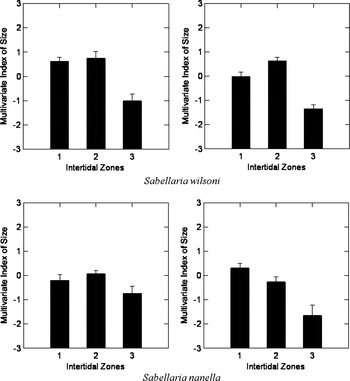
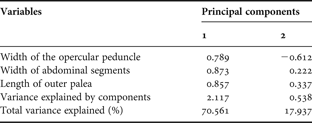
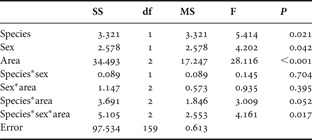
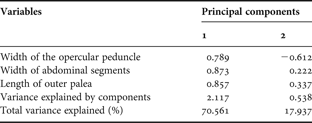
The multivariate index of size was adequately obtained, explaining 70.56% of the variance contained in the samples (Table 1). It was necessary to exclude the length of the opercular peduncle, which was not significantly correlated with the remaining variables, resulting in considerable allometric distortion. The distribution of the size index could be significantly adjusted to a normal curve (Dmax = 0.061; P = 0.537). The analysis of variance indicated a significant difference in sabellariid size between the sexes, species, and collecting areas (Table 2). Males of S. wilsoni were larger than females in all samples (Figure 2). However, the large size of females compared to males of S. nanella from area 1 generated a significant interaction of the three factors (Table 2). Sabellaria wilsoni presented a larger size than S. nanella in all aggregates. Individuals from area 3 were significantly smaller in relation to the other areas, according to the Tukey multiple comparisons (Figure 2).
Multivariate index of size (obtained by principal component analysis) of the polychaetes Sabellaria wilsoni Lana & Gruet, Reference Lana and Gruet1989 and S. nanella Chamberlin, 1919 collected in three areas along the littoral zones of Cabo Branco beach, João Pessoa, Paraíba, between January and February, 2008. Left-hand figures: females; right-hand figures: males.

First two principal components of the correlation matrix among morphological measurements of the species Sabellaria wilsoni Lana & Gruet, Reference Lana and Gruet1989 and S. nanella Chamberlin, 1919, collected at Cabo Branco beach, João Pessoa, Paraíba, during January and February, 2008. The percentage of variation explained by each component is at the base of the table.
Three-way analysis of variance of multivariate index of size of the polychaetes Sabellaria wilsoni Lana & Gruet, Reference Lana and Gruet1989 and S. nanella Chamberlin, 1919, collected in three areas along the littoral zones of Cabo Branco beach, João Pessoa, Paraíba, between January and February, 2008.

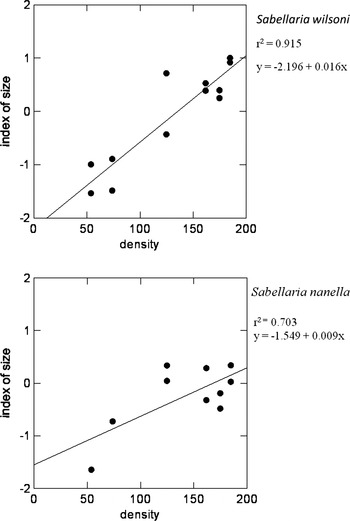
Correlations between the median size of individuals by sex in each aggregate and the density of the tubular openings of the aggregates were significant for both species (r = 0.878, P = 0.001 for S. wilsoni, and r = 0.703, P = 0.023 for S. nanella), indicating that there is a directly proportional relation between size and density of occurrence (Figure 3).
Regression between size and aggregate density of the polychaetes Sabellaria wilsoni Lana & Gruet, Reference Lana and Gruet1989 (F = 51.691 P < 0.0001) and S. nanella Chamberlin, 1919 (F = 7.826 P = 0.023) collected in three areas along the littoral zones of Cabo Branco beach, João Pessoa, Paraíba (index of size obtained by principal component analysis).

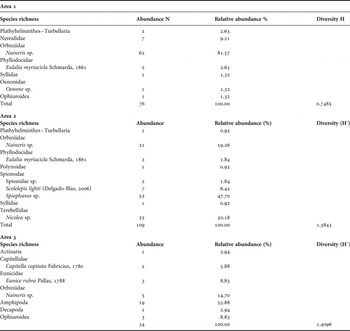
The richness and the abundance of the fauna of invertebrates associated with the aggregates in each area are described in Table 3. Differences in the indices of diversity were not found between areas 2 and 3 (t 2,3 = 0.3250, P > 0.05), but both had indices significantly higher than area 1 (t 1,2 = 3,693 P <0.001 and t 1,3 = 3.0232 P < 0.05). Five zoological groups were found in the associated fauna: polychaetes, echinoderms, crustaceans, cnidarians and flatworms. Their abundance differed significantly among the three areas, being larger in area 2 (χ21,2 = 5.8865 P < 0.025, χ21,3 = 16.0364 P < 0.001, χ22,3 = 39.3357 P < 0.001). Naineris sp. was the only species common in all areas, being more frequent in area 1 (χ2 = 58.9382, P < 0.001), in the upper mesolittoral. The polychaetes Spiophanes sp., Nicolea sp. and Scolelepis lighti (Delgado-Blas, 2006) and one species of Polynoidae Malmgren, 1867 were only found in the infralittoral area 2. The polychaetes Eunice sp. and Capitella capitata (Fabricius, 1780), one species of anemone, one decapod and one amphipod crustacean, were exclusive to area 3.
Richness (S), abundance (N) and diversity (H) of the invertebrate marine fauna associated with aggregates of the polychaetes Sabellaria wilsoni Lana & Gruet, Reference Lana and Gruet1989 and S. nanella Chamberlin, 1919 collected in three areas along the littoral zones of Cabo Branco beach, João Pessoa, Paraíba, between January and February, 2008.

DISCUSSION
It is suggested that the local variability was sufficiently intense to affect polychaete sizes. As expected, reef aggregates that received strong wave and wind impacts had smaller individuals of S. wilsoni and S. nanella than in aggregates constructed in the remaining areas. We believe that size determination in these polychaetes is being modulated by phenotypic plasticity that reflects genotypic interaction with environmental factors (Stearns, Reference Stearns1992; Scheiner, Reference Scheiner1993). Although genetic divergences may also explain the observed size variability, the great potential for dispersal and survival of larvae responsible for the construction of the aggregates (Giangrande, Reference Giangrande1997), and the proximity of the collecting sites reduce this possibility.
Survival in areas exposed to higher environmental energy and instability may demand significant additional energy both for tube construction as for the maintenance of the colonial reefs. An appropriate intensity of water flux provides the suspension of sand grains of specified sizes that will be used by the polychaetes for the construction of their aggregates (Davies et al., Reference Davies, Last, Attard and Hendrix2009). The effort and inconvenience of dealing with intense water movement and the consequent difficulty in capturing and managing sand grains results in a smaller quantity of energy available for conversion to corporeal mass.
The direct and constant wave and wind impacts also affected the number of tubular openings in the colonial reefs, considered in this paper an estimation of the population density. Density reduction in aggregates with organisms of smaller size may be a consequence of the fact that size is directly associated with fecundity or reproductive potential in both males and females (Schmidt-Nielsen, Reference Schmidt-Nielsen1984; Honeck, Reference Honeck1993). Furthermore, environmental disturbance could be directly influencing the mortality of eggs and larval forms by enhancing competition for food or by influencing the chemical composition of the water and accumulation of sediments (Vorberg, Reference Vorberg1995).
We do not know if the described differences on the sediment composition and granulometry have any influence on the reef-building characteristics (La Porta et al., Reference La Porta, La Valle and Chimenz2006). Cooper et al. (Reference Cooper, Boyd, Aldridge and Rees2007) found that the instability of sediments induced by marine currents, together with the impact of dredging activities, determined the spatial distribution of Sabellaria spinulosa Leuckhart, 1849, which preferred sites where the sediments are in abundance. Cognie et al. (Reference Cognie, Haure and Barillé2006) described the impacts of trophic competition on the native biota of the spatial expansion of the areas of culture of Crassostrea gigas (Thunberg, 1793), particularly on Sabellaria alveolata (Linnaeus, 1767).
Body size may be considered when identifying both species. Despite being morphologically very similar, S. wilsoni is significantly larger than S. nanella in all aggregates. The opercular peduncle also contributes to distinguish the two species because its length produced undesired allometric distortions in the principal component analyses. Sabellaria wilsoni usually has wider and shorter peduncules than S. nanella.
Although males were significantly larger than females, the use of body size to distinguish the sexes must be done with caution, because we found females larger than males in one aggregate from the mesolittoral zone. Perhaps these particular females were sexually mature at the moment of collecting, as suggested from their visually ‘fat’ segments. Besides, the size and shape of sabellariids may vary significantly among localities (Occhioni et al., Reference Occhioni, Brasil and Araújo2009).
The abundance and composition of the fauna of invertebrates associated with the aggregates were also affected by local environmental variability. In area 3, the fauna represented less than half of the abundances registered for the other two areas. Aggregates in area 3 also had five (of the seven) species with exclusive occurrences, which contributed to a higher differentiation of its fauna in relation to the remaining areas.
The higher uniformity in the frequencies of occurrences of species associated with aggregates from area 3 contributed to its higher diversity in relation to area 1, which is also located in the mesolittoral, but in a region less exposed to the wind and waves. The dominancy of Naineris in area 1 and of the polychaetes Spiophanes sp., Nicolea sp. and Naineris sp. in area 2 certainly contributed to decrease their diversity indices.
The biodiversity of worm reefs was previously investigated in Brazil by Fausto-Filho & Furtado (Reference Fausto-Filho and Furtado1970), in Asia by Achary (Reference Achary1974), in Europe by Porras et al. (Reference Porras, Bataller, Murgui and Torregrosa1996) and La Porta et al. (Reference La Porta, Targusi, Lattanzi, La Valle, Paganelli and Nicoletti2009), and in North America by Posey et al. (Reference Posey, Pregnal and Graham1984). Seiderer & Newell (Reference Seiderer and Newell1999) correlated community structure and population density of marine invertebrates with sediment composition and size of particles. They established the preference of Sabellaria spinulosa for environments with a large proportion of sand and gravel.
The data obtained indicate that the polychaete reefs from Cabo Branco beach have different patterns of colonial organization, which are related to local environmental conditions of the littoral zone in which they are located. The stress provoked by the action of waves and wind significantly reduced the phenotypic expression of the polychaetes size and the number of tube openings used to estimate the density of occurrence of polychaetes in the aggregates. Local environmental conditions also affected the abundance and composition of the associated fauna, which avails of the aggregate sand reefs of S. wilsoni and S. nanella as a habitat.
ACKNOWLEDGEMENTS
We acknowledge an undergraduate scholarship to A.S.S. and a productivity grant to M.L.C. (grant number 301285/2007-1), from Conselho Nacional de Desenvolvimento Científico e Tecnológico (CNPq). C.L. thanks Fundação de Amparo à Pesquisa de Minas Gerais (FAPEMIG).