Introduction
Antisocial personality disorder (ASPD) is among the most severe and treatment-resistant psychopathologies, is associated with severely detrimental outcomes, a high degree of chronicity, and delinquency. In recent years, a great deal of effort has been put forward to investigate etiological factors contributing to the development of this disorder spectrum, with several influential theories stressing the role of deficiencies in social information processing (Blair, Reference Blair1995; Dodge, Reference Dodge2006). For instance, in the violence inhibition model (VIM), correct recognition of social signals of distress (e.g. facial expressions of fear and sadness) is assumed to be the pivotal prerequisite for socialization and development of moral understanding (Blair, Reference Blair1995, Reference Blair2001, Reference Blair2003). Accordingly, deficient processing of affective stimuli has been associated with ASPD, particularly subpopulations exhibiting psychopathic traits in numerous studies (Marsh & Blair, Reference Marsh and Blair2008; Dawel et al. Reference Dawel, O'Kearney, McKone and Palermo2012; Schönenberg et al. Reference Schönenberg, Louis, Mayer and Jusyte2013, Reference Schönenberg, Christian, Gaußer, Mayer, Hautzinger and Jusyte2014). However, while the VIM assumes a specific deficit for fear and sadness, which has been backed by many earlier studies (Marsh & Blair, Reference Marsh and Blair2008), there is mounting evidence that the recognition deficit may be more general in nature, and affect a wide range of emotional expressions (Dawel et al. Reference Dawel, O'Kearney, McKone and Palermo2012). Alterations in the functioning of subcortical structures, particularly the amygdala, have been linked to deficient affective information processing in ASPD (Coccaro et al. Reference Coccaro, McCloskey, Fitzgerald and Phan2007; Blair, Reference Blair2008; Marsh et al. Reference Marsh, Finger, Mitchell, Reid, Sims, Kosson, Towbin, Leibenluft, Pine and Blair2008; DeLisi et al. Reference DeLisi, Umphress and Vaughn2009; Jones et al. Reference Jones, Laurens, Herba, Barker and Viding2009; Moul et al. Reference Moul, Killcross and Dadds2012), indicating that the emotion recognition deficit may be rooted very deeply and affect the most basic levels of information processing.
Previous theoretical accounts also postulated that certain personality characteristics may be more closely linked to the emotion-recognition deficit (Blair, Reference Blair2001; Frick & White, Reference Frick and White2008; Dadds et al. Reference Dadds, Allen, McGregor, Woolgar, Viding and Scott2013). These characteristics have been largely subsumed under the psychopathy construct, which has received increasing scientific attention over the past decades. Psychopathy is associated with specific traits on the interpersonal (e.g. manipulativeness), affective/cognitive (e.g. callous-unemotional traits, CUTs), and behavioural domain (antisocial behaviour). Increasing evidence suggests that elevated CUTs are associated with higher heritability and stability as well as more severe and detrimental developmental outcomes (Frick & White, Reference Frick and White2008). Complementing these results, an increasing number of studies report that CUTs may be the crucial component driving the emotion-recognition deficits observed in violence-prone individuals (Dadds et al. Reference Dadds, Perry, Hawes, Merz, Riddell, Haines, Solak and Abeygunawardane2006; Kimonis et al. Reference Kimonis, Frick, Fazekas and Loney2006; Marsh et al. Reference Marsh, Finger, Mitchell, Reid, Sims, Kosson, Towbin, Leibenluft, Pine and Blair2008).
Interestingly, some authors have suggested that an attention-related deficit that undermines the processing of peripheral information may underlie the affective processing deficits observed in psychopathy instead of a fundamental amygdala-driven dysfunction (Baskin-Sommers et al. Reference Baskin-Sommers, Curtin and Newman2011; Koenigs et al. Reference Koenigs, Baskin-Sommers, Zeier and Newman2011; Lake et al. Reference Lake, Baskin-Sommers, Li, Curtin and Newman2011; Newman & Baskin-Sommers, Reference Newman, Baskin-Sommers and Posner2012). This view has been challenged by Sylvers et al. (Reference Sylvers, Brennan and Lilienfeld2011), who argued that to draw such conclusions, an examination of early processing stages would be necessary. Several methods have been established in order to restrict conscious awareness of a stimulus, allowing for the investigation of early processing stages (Tamietto & de Gelder, Reference Tamietto and de Gelder2010). An extensive number of studies that employed the method of backward masking have gathered evidence that signals of social threat, e.g. facial expressions of distress, are prioritized even at early processing stages (Whalen et al. Reference Whalen, Rauch, Etcoff, McInerney, Lee and Jenike1998; Lee et al. Reference Lee, Lim, Lee and Choi2009; Sweeny et al. Reference Sweeny, Grabowecky, Suzuki and Paller2009; Jusyte & Schönenberg, Reference Jusyte and Schönenberg2013). This automatic processing advantage enables an extremely quick processing of threat-relevant stimuli and is assumed to be rooted in an amygdala-mediated evolutionary mechanism (Öhman, Reference Öhman2002, Reference Öhman2009). In view of above mentioned evidence showing amygdala dysfunction in psychopathic individuals, there are grounds to assume that the processing of emotional stimuli may be affected even at the earliest processing stages.
Only two studies to date have investigated early processing of affective stimuli in populations with elevated psychopathy scores (Sylvers et al. Reference Sylvers, Brennan and Lilienfeld2011; Viding et al. Reference Viding, Sebastian, Dadds, Lockwood, Cecil, De Brito and McCrory2012). In one recent investigation, young boys with conduct problems and healthy controls were assessed using neuroimaging during subliminal presentations of calm or fearful facial expressions (Viding et al. Reference Viding, Sebastian, Dadds, Lockwood, Cecil, De Brito and McCrory2012). The results indicated that attenuated amygdala reactivity to fearful facial expressions was evident only in the subgroup of boys with conduct disorder who also scored high on CUTs. However, the backward-masking procedure has received much criticism due to difficulties in reliably assessing whether a stimulus was in fact processed unconsciously (Pessoa, Reference Pessoa2005; Pessoa et al. Reference Pessoa, Japee, Sturman and Ungerleider2006; Kouider & Dehaene, Reference Kouider and Dehaene2007; Palermo & Rhodes, Reference Palermo and Rhodes2007).
The continuous flash suppression (CFS) paradigm is a powerful alternative procedure to suppress visible stimuli from visual awareness for extended time periods (Tsuchiya & Koch, Reference Tsuchiya and Koch2005). In CFS, one eye is presented with a high-contrast, rapidly changing image (e.g. Mondrian images), and the other eye is presented with a static stimulus (e.g. facial expressions), which typically results in a conscious percept of the dominant Mondrian-like image and a complete suppression of the weaker image from awareness for several seconds. Hence, CFS provides for one of the best current strategies to address research questions concerning the processing of unaware/unconsciously perceived stimuli. Previous research has demonstrated that emotional information, especially fearful facial expressions, tend to break this visual suppression more quickly than neutral information (Yang et al. Reference Yang, Zald and Blake2007; Almeida et al. Reference Almeida, Pajtas, Mahon, Nakayama and Caramazza2012; Anderson et al. Reference Anderson, Siegel, White and Barrett2012; Vizueta et al. Reference Vizueta, Patrick, Jiang, Thomas and He2012), which is indicative of a processing advantage for emotional stimuli. Using this novel method, Sylvers et al. (Reference Sylvers, Brennan and Lilienfeld2011) investigated early processing of affective face stimuli in a pediatric sample of boys with conduct disorder. In this study, participants viewed angry, disgusted, fearful, happy, and neutral facial expressions under CFS conditions. The results indicated that suppression durations of fearful faces were predicted by CUTs.
In summary, the investigation of deficits in early processing in aggressive and/or psychopathic samples has been scarce. Two previous studies that tackled this question have been conducted on pediatric samples (Sylvers et al. Reference Sylvers, Brennan and Lilienfeld2011; Viding et al. Reference Viding, Sebastian, Dadds, Lockwood, Cecil, De Brito and McCrory2012), whereas investigation of this issue in a clinical population with a persistent history of aggressive behaviour is still pending. Therefore, the first aim of the present study was to extend the previously reported findings on early processing deficits to a sample of young antisocial violent offenders (YAVOs) using the CFS paradigm. Most importantly, the only existing study to date that investigated early processing using CFS was conducted on a sample of children all of whom displayed conduct problems (Sylvers et al. Reference Sylvers, Brennan and Lilienfeld2011). Without the inclusion of a healthy control group that does not display antisocial behaviour tendencies, it remains unclear whether psychopathic CUTs alone underlie the early deficit or whether the effects of aggression and CUTs may be additive. Therefore, we aimed to explore the link between aggression, psychopathy, particularly CUTs, and the early processing deficits. In light of increasing evidence suggesting that the subgroup of antisocial individuals with high CUTs may represent a particularly persistent and severe form of the disorder (Frick & White, Reference Frick and White2008; Rowe et al. Reference Rowe, Maughan, Moran, Ford, Briskman and Goodman2010), and that an emotion recognition deficit may have the strongest link to the CUTs, we expected higher CUT scores to be associated with a pronounced early processing deficit in the YAVO sample.
Previous studies reported conflicting findings regarding the specificity of the emotion processing deficit, with some indicating difficulties restricted to certain facial expressions (fear and sadness), and others supporting wide-ranging deficits across all types of emotional expressions. Therefore, the second aim of the present study was to investigate the specificity of the assumed early deficit by employing all basic emotional expressions (angry, happy, fearful, disgusted, surprised, and sad) as well as neutral stimuli. A general processing deficit should be reflected in slower reaction times for all affective expressions, while a specific deficit should only be evident for fearful and sad facial expressions in the YAVO compared to the healthy control group.
Methods
Participants
The male YAVO sample was recruited from a German correctional facility (Justizvollzugsanstalt Adelsheim) through notification within the facility. Interested participants were contacted by the facility's psychological service, and experimental as well as clinical assessments were conducted in designated rooms of the facility by trained psychologists from our research group. Exclusion criteria were drug-related crimes, domestic violence or sexual assault, as well as insufficient knowledge of the German language. The final sample consisted of 26 YAVOs; none of these subjects had a history of schizophrenia, or suffered from mental retardation. Healthy male controls (CTLs) with no current psychiatric morbidity or a history thereof were recruited from a local vocational school in order to match educational status and age. Subjects were recruited by their teachers, and the assessment was carried out in the school by members of our research group. In the YAVO group, all designated individuals participated in the study. Two participants were excluded in the CTL group due to current psychopathology, resulting in a final sample of 24 CTLs. All participants provided written informed consent and received monetary compensation for participation. The study was approved by the local ethics committee and was conducted in accordance with the Declaration of Helsinki.
Demographic and clinical measures
All participants completed a questionnaire that assessed demographic information and the following German versions of the questionnaire measures: Aggressive behaviour was measured with the German version (Herzberg, Reference Herzberg2003) of the 29-item Buss–Perry Aggression Questionnaire (BPAQ; Buss & Perry, Reference Buss and Perry1992) which includes the subscales: physical and verbal aggression, anger, and hostility. The Youth Psychopathic Traits Inventory (YPI) was employed to assess self-reported psychopathic traits (Andersherd et al. Reference Andersherd, Kerr, Stattin, Levander, Blauuw and Sheridan2002). This 50-item questionnaire is constructed to assess psychopathic traits in youths. The participants judge the items on a four-point Likert scale regarding how well the given statement reflects their own behaviour/attitudes. All YPI subscales with the exception of CUTs exhibit satisfactory psychometric properties (Poythress et al. Reference Poythress, Dembo, Wareham and Greenbaum2006). The self-report Inventory of Callous-Unemotional Traits (ICU) was therefore employed in order to specifically assess CUTs (Essau et al. Reference Essau, Sasagawa and Frick2006). ICU has been employed in youths from the age of 12 years (Essau et al. Reference Essau, Sasagawa and Frick2006; Roose et al. Reference Roose, Bijttebier, Decoene, Claes and Frick2010), and consists of 24 items that make up the three subscales: Callousness (i.e. lack of empathy and remorse), Unemotional (lack of emotional response/expression), and Uncaring (indifference toward pain and suffering of others). The participants respond to the ICU items on a four-point rating scale. Current and life-time psychopathology was assessed with the Mini International Neuropsychiatric Interview (MINI; Lecrubier et al. Reference Lecrubier, Sheehan, Weiller, Amorim, Bonora, Harnett Sheehan, Janavs and Dunbar1997; Ackenheil et al. Reference Ackenheil, Stotz, Dietz-Bauer and Vossen1999). The interview was carried out by trained postgraduate psychologists who had extensive experience in conducting clinical interviews. Spatial intelligence was measured using the Wiener Matrizen Test 2 (WMT, Formann et al. Reference Formann, Waldherr and Piswanger2011), an 18-item short-version of the original 24-item WMT (Formann & Piswanger, Reference Formann and Piswanger1979). This non-verbal test is based on Raven's Progressive Matrices Test and assesses the individual's ability for deductive reasoning and problem solving. Participants are to decode different patterns of matrices and link an analogous missing matrix piece by choosing the corresponding part out of eight options.
CFS
Apparatus
Visual displays were presented on a 22-inch LCD monitor throughout the experiment with a 1.280 × 1.024 pixel resolution and a 60 Hz frame rate. Participants viewed the dichoptic CFS displays at a distance of about 30 cm, which were presented side by side on the monitor and fused with a mirror stereoscope. The optimal viewing position and mirror adjustments for the binocular alignment were determined for each participant and maintained by using a head and chin rest throughout to the experiment. Participants logged their responses via a USB keypad with four buttons, arranged to correspond to the spatial positions of the face stimuli within the CFS display. Presentation of visual stimuli was controlled by Presentation Version 16.4® (Neurobehavioral Systems, USA).
Stimuli
Frontal affective pictures (neutral, happy, angry, fearful, disgusted, surprised, and sad) of four male models (nos. 23, 25, 28, and 71) were selected from the Radboud Faces Database based on the accuracy of emotional expressions (Langner et al. Reference Langner, Dotsch, Bijlstra, Wigboldus, Hawk and van Knippenberg2010). The accuracy scores for the affective pictures was >71%, with a mean accuracy of 92.25% (s.d. = 1.96) across all emotional expressions and models. A neutral frontal expression of an additional model identity (no. 33) was employed for the practice trials. In order to match the faces for size and to avoid low-order visual confounds, the faces were cropped using an oval mask and transformed into grayscale with Adobe Photoshop CS4® (Adope Systems Inc., USA). The stimuli (2.1° × 2.6°) were standardized in terms of luminance and root mean square contrast, which was normalized to 75% in order to enhance the initial suppression of the eye and mouth region.
Coloured high-contrast Mondrian-like mask stimuli (10.6° × 10.6°) were created using the Matlab Psychophysics Toolbox (http://psychtoolbox.org); similar stimuli have been employed by several other CFS studies (Jiang et al. Reference Jiang, Costello and He2007; Stein et al. Reference Stein, Hebart and Sterzer2011). In order to promote binocular alignment, the CFS displays were presented within fusion contour frames (12.1° × 12.1°), and contained a fixation cross, visible in both CFS displays throughout the entire trial. All stimuli were presented against a uniform gray background throughout the experiment.
Procedure
After establishing binocular alignment with a test stimulus, the participants were instructed to indicate as quickly and accurately as possible which of the four possible locations the face stimulus or any part of the face had appeared (four alternative forced choice task). The participants underwent eight practice trials prior to the experiment.
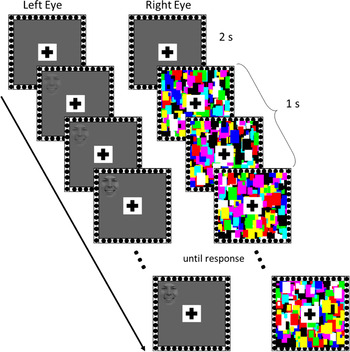
The temporal trial structure was as follows: Participants were first presented with the outline frames containing the fixation cross for 2 s (Fig. 1). Subsequently, dynamic Mondrian-like masks were flashed at full contrast into one eye, while the face stimulus was gradually introduced to the other eye, by increasing the contrast of the face stimulus in a linear fashion until it had reached full contrast after 1 s. The face stimulus’ contrast was kept stable for the remaining length of the trial, which ended once the participant had made a response.
Schematic outline of a CFS trial. Participants viewed stimuli that were projected to the left and the right eye through the mirror stereoscope. Dynamic Mondrian-like images were flashed in one eye, while a neutral or emotional (stimulus displaying one of the six basic emotions) face was gradually introduced to the other eye. Participants indicated via button press the location of the face stimulus.

Design
The experiment consisted of 224 trials in total: 2 (the side of the display containing the face stimulus: left v. right) × 4 (position of the face stimulus: top/bottom, left/right) × 4 (model identities) × 7 (emotional expression). The trials were randomized with regard to all variables for each participant.
Results
Participant characteristics
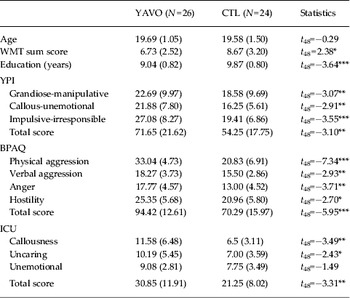
Groups did not differ in terms of age; however, CTLs tended to have completed more years of education and exhibit higher scores in the WMT (Table 1). Compared to CTLs, the YAVOs exhibited significantly higher self-reported aggression, psychopathy, as well as CUTs as indicated by the BPAQ, YPI, and ICU scores. In the YAVO sample, all individuals fulfilled the categorical criteria for an ASPD, with a total of eight individuals fulfilling diagnostic criteria for a comorbid substance and/or alcohol dependency.
Demographic diagnostic sample description

YAVO, Young antisocial violent offenders; CTL, healthy controls; WMT, Wiener Matrizen Test; YPI, Youth Psychopathic Traits Inventory; BPAQ, Buss–Perry Aggression Questionnaire; ICU, Inventory of callous and unemotional traits.
The data presented in the table refers to means and standard deviations for each measure (in parentheses).
*** p < 0.001, ** p < 0.01, * p < 0.05.
CFS analysis
Processing of neutral faces
Because neutral faces served as a reference to compute indices of processing advantage, we first examined whether there were group differences in the recognition of neutral faces (Sterzer et al. Reference Sterzer, Hilgenfeldt, Freudenberg, Bermpohl and Adli2011). To control for potential group differences, an independent samples t test was conducted for neutral facial expressions, yielding no significant group differences (YAVO: mean = 2221.76; s.d. = 464.71; CTL: mean = 2247.21; s.d. = 526.57; t 48=−0.18, p < 0.1).
Processing advantage for emotional faces
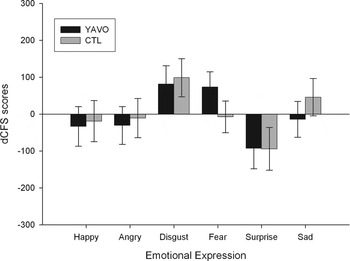
Suppression time differences reflecting processing advantage of emotional over neutral faces were computed by subtracting mean suppression times for each emotional expression from neutral expressions (Sterzer et al. Reference Sterzer, Hilgenfeldt, Freudenberg, Bermpohl and Adli2011; Sylvers et al. Reference Sylvers, Brennan and Lilienfeld2011). All further analysis steps were conducted using these difference scores (dCFS), with positive values reflecting a processing advantage and negative values a disadvantage of emotional relative to neutral stimuli. To investigate the processing advantages for each emotion and to explore potential group differences, we conducted a 7 (emotion: neutral, angry, happy, disgust, fear surprise, sad) × 2 (group: YAVOs v. CTLs) repeated-measures analysis of variance (ANOVA) with the mean difference scores (Fig. 2). The results yielded a significant main effect of emotion (F 5,240 = 5.18, p < 0.001, η 2 = 0.10), while neither the group (F 1,48 < 0.001, p > 0.1, η 2 < 0.001), nor the group × emotion interaction effect reached significance (F 5,240 = 0.73, p > 0.1, η 2 = 0.02). Bonferroni-corrected post-hoc tests revealed that the emotion effect was reflected in a processing advantage for disgusted as compared to happy and surprised facial expressions, as well as a processing advantage for fearful as compared to surprised facial expressions (all p's < 0.05).
Mean processing advantages for emotional as opposed to neutral faces. Bars indicate mean differences in suppression times obtained by subtracting emotional from neutral expressions; error bars depict s.e.m. Positive values indicate processing advantage of emotional relative to neutral faces. YAVO, Young antisocial violent offenders; CTL, healthy controls.

Influence of psychopathic traits
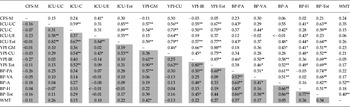
In a third step, we aimed to investigate the relationship between antisociality and psychopathic traits and their influence on early processing. For this purpose, a correlational analysis was conducted for each group in order to investigate which traits were associated with the overall suppression time in the CFS task. Results revealed that the ICU-unemotional subscale was the only measure significantly associated with the performance on the CFS task in the YAVO group; no such correlation was evident in the healthy control group (Table 2).
Correlations between CFS suppression times and diagnostic measures for YAVO and CTL participants

YAVO, Young antisocial violent offenders; CTL, control group; CFS-M, mean suppression times over all emotional expression in the Continuous Flash Suppression; ICU-C, Inventory of Callous and Unemotional Traits, Callousness subscale; ICU-UC, Inventory of Callous and Unemotional Traits, Uncaring subscale; ICU-UE, Inventory of Callous and Unemotional Traits, Unemotional subscale; YPI-GM, Youth Psychopathic Traits Inventory Grandiose-Manipulative Subscale; YPI-CU, Youth Psychopathic Traits Inventory Callous-Unemotional Subscale; YPI-IR, Youth Psychopathic Traits Inventory Impulsive-Irresponsible Subscale; YPI-Tot, Youth Psychopathic Traits Inventory total score; BP-PA, BPAQ Physical Aggression subscale; BP-VA, BPAQ Verbal Aggression subscale; BP-A, BPAQ Anger subscale; BP-H, BPAQ Hostility subscale; BP-Tot, BPAQ Total score; WMT, Sum scores obtained in the Wiener Matrizen Test.
The data represented in the table refers to bivariate correlations between the indicated measures for the YAVO (top) and the CTL (bottom, grey) group.
*** p < 0.001, ** p < 0.01, * p < 0.05.
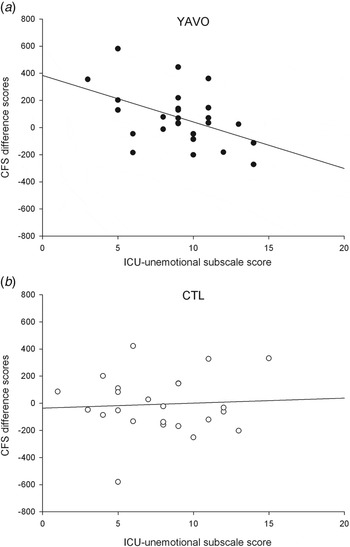
To explore the predictive value of the ICU-unemotional subscale for the processing advantage of each emotional expression, we conducted additional linear regression analyses for each group, with mean dCFS for each emotion serving as the dependent variable and the ICU unemotional subscale as predictor (see online Supplementary Table S3; please note that the analysis was repeated with the WMT sum scores as an additional predictive variable in order to control for potential influences of intelligence between groups; this did not change the outcome of the regression analyses). The results revealed a significant relationship between ICU unemotional subscale scores and dCFS for fearful facial expressions (F 2,25 = 5.27, R 2 = 0.31, β=−0.50) in the YAVO group only (Fig. 3), while no other emotional expression reached significance (all p's > 0.10). In the CTL group, there were no significant relationships between any of the dCFS scores or the ICU-unemotional subscale (all p's > 0.10).
Results of the regression analysis of the predictive value of unemotional traits for the early processing of fearful facial expressions in (a) the young antisocial violent offender (YAVO) and a (b) healthy control (CTL) group. The scatter plot represents mean difference scores obtained by subtracting mean suppression times for fearful from neutral facial expressions, with positive values indicating a relative processing advantage. The regression is indicated for both plots.

Discussion
The present study aimed to investigate deficits in early processing of emotional stimuli, their relationship to aggression as well as psychopathic traits in a group of violent offenders with ASPD and a healthy control group. The results of the present study can be summarized as follows: (1) we found some evidence for general processing advantages for certain emotional expressions, i.e. fearful and disgusted facial expressions as opposed to happy and surprised faces. (2) There were no group differences between the YAVO and CTL groups in terms of early processing advantages of the six basic emotional expressions. (3) Unemotional traits from the psychopathy spectrum were a significant predictor of deficient early processing of fearful faces in the YAVO sample. These results indicated that only aggressive individuals with higher levels of unemotional traits tended to exhibit an extensive processing disadvantage for fearful facial expressions.
General processing advantage for certain emotional faces
To the best of our knowledge, this is the first study to date to investigate early processing of all six basic emotional expressions using CFS. The present study found partial support for an early emotion processing advantage, specifically for disgusted (v. happy and surprised) and fearful (v. surprised) facial expressions. This is consistent with other studies that employed CFS and reported preferential processing for fearful facial expressions (Jiang & He, Reference Jiang and He2006; Yang et al. Reference Yang, Zald and Blake2007; Jiang et al. Reference Jiang, Shannon, Vizueta, Bernat, Patrick and He2009; Tsuchiya et al. Reference Tsuchiya, Moradi, Felsen, Yamazaki and Adolphs2009; Sylvers et al. Reference Sylvers, Brennan and Lilienfeld2011; Vizueta et al. Reference Vizueta, Patrick, Jiang, Thomas and He2012). Although only few previous studies included disgusted facial expressions, existing evidence also suggests an early processing advantage (Sylvers et al. Reference Sylvers, Brennan and Lilienfeld2011; Willenbockel et al. Reference Willenbockel, Lepore, Nguyen, Bouthillier and Gosselin2011).
Some studies have suggested that the processing advantages for emotional faces in CFS may be due to low-level perceptual features, such as systematic differences between different emotions in the distribution of luminance and spatial frequency properties (Yang & Blake, Reference Yang and Blake2012; Gray et al. Reference Gray, Adams, Hedger, Newton and Garner2013). Although this explanation cannot be entirely ruled out, we believe that it does not sufficiently explain all of the results obtained in this study. For instance, despite the employment of all six basic emotional expressions, we did not observe comparable effects for perceptually similar facial expressions, such as disgust and anger or fear and surprise, which are often confused due to similar perceptual features (Aviezer et al. Reference Aviezer, Hassin, Bentin, Trope, Ambady and Skowronski2008a , Reference Aviezer, Hassin, Ryan, Grady, Susskind, Anderson, Moscovitch and Bentin b ). Furthermore, the detection performance in the current study was correlated with a personality measure, namely CUTs, which also makes low-level features less likely to drive the observed effects. Taken together, this indicates that the result patterns in this study are more likely to be driven by emotional salience instead of low-level visual features.
Role of psychopathic traits on emotional face perception
The most important finding in this study refers to the unique association between early processing deficits, antisociality, and psychopathic traits. Among individuals exhibiting pronounced antisocial behaviour tendencies, a processing disadvantage for fearful facial expressions was associated with the degree of a facet of the psychopathy construct related to unemotional traits. These results are in accordance with the view that CUTs may be one of the most important etiological and maintaining factors in aggressive psychopathology (Blair, Reference Blair2001; Frick & White, Reference Frick and White2008; Hawes et al. Reference Hawes, Brennan and Dadds2009; Rowe et al. Reference Rowe, Maughan, Moran, Ford, Briskman and Goodman2010). The extent of emotion recognition deficits have been repeatedly linked to CUTs and an amygdala hypofunction as a possible underlying neurobiological mechanism (Dadds et al. Reference Dadds, Perry, Hawes, Merz, Riddell, Haines, Solak and Abeygunawardane2006, Reference Dadds, El Masry, Wimalaweera and Guastella2008, Reference Dadds, Allen, McGregor, Woolgar, Viding and Scott2013; Blair, Reference Blair2008; Marsh et al. Reference Marsh, Finger, Mitchell, Reid, Sims, Kosson, Towbin, Leibenluft, Pine and Blair2008; Jones et al. Reference Jones, Laurens, Herba, Barker and Viding2009; Muñoz, Reference Muñoz2009; Han et al. Reference Han, Alders, Greening, Neufeld and Mitchell2012; Sebastian et al. Reference Sebastian, McCrory, Cecil, Lockwood, De Brito, Fontaine and Viding2012; Wallace et al. Reference Wallace, White, Robustelli, Sinclair, Hwang, Martin and Blair2014).
However, the above mentioned studies used paradigms to assess emotion recognition in an explicit manner, which allows for alternative explanations related to general impairments of attentional processes (Newman et al. Reference Newman, Curtin, Bertsch and Baskin-Sommers2010; Baskin-Sommers et al. Reference Baskin-Sommers, Curtin and Newman2011) or labeling (Schulze et al. Reference Schulze, Domes, Köppen and Herpertz2012). Unfortunately, only two studies to date have investigated early processing deficits of affective stimuli in antisocial and/or psychopathic populations (Sylvers et al. Reference Sylvers, Brennan and Lilienfeld2011; Viding et al. Reference Viding, Sebastian, Dadds, Lockwood, Cecil, De Brito and McCrory2012). The study by Viding and colleagues provided evidence for reduced amygdala reactivity to masked fearful faces in boys with conduct problems who simultaneously exhibited elevated CUTs. Sylvers and colleagues examined early emotion processing in a population of conduct-disordered boys using CFS and demonstrated that deficits in the recognition of fear (strong effect) and disgust (moderate effect) were associated with the degree of CUTs. The current study replicates these previous findings, as we found strong evidence for an association between CUTs and deficits in the early processing of fear. This supports the view suggested by the VIM model of psychopathy, which proposes a processing deficit for fearful cues (Blair, Reference Blair1995, Reference Blair2001, Reference Blair2003; Blair et al. Reference Blair, Mitchell, Peschardt, Colledge, Leonard, Shine, Murray and Perrett2004, Reference Blair, Morton, Leonard and Blair2006). The present study also extends previous research in several important ways: First, this is the first study to examine early emotion processing in a sample of violent offenders formally diagnosed with ASPD. Second, the present study investigated both, the group of YAVOs as well as CTLs, allowing for the examination of specific contributions of aggressive psychopathology and psychopathic traits. Third, we used stimuli carefully adjusted for confounding low-level visual features (luminance and contrast) to limit the influence of unspecific perceptual confounds. Finally, we replicated previous findings under the employment of all basic emotional expressions instead of comparing a limited set of affective stimulus types.
Although the present study did not investigate neurobiological substrates involved in the early processing deficits, a great number of studies have found evidence for deficient amygdala functioning in psychopathy (Mitchell et al. Reference Mitchell, Fine, Richell, Newman, Lumsden, Blair and Blair2006; Marsh et al. Reference Marsh, Finger, Mitchell, Reid, Sims, Kosson, Towbin, Leibenluft, Pine and Blair2008; Jones et al. Reference Jones, Laurens, Herba, Barker and Viding2009; Yang et al. Reference Yang, Raine, Narr, Colletti and Toga2009; Viding et al. Reference Viding, Sebastian, Dadds, Lockwood, Cecil, De Brito and McCrory2012) which is assumed to be the substantial factor according to some theorists (Blair, Reference Blair2008). Challenging accounts have been suggested by other authors, who reasoned that general deficiencies in attentional processing could much better explain emotion recognition deficits in psychopathy (Newman et al. Reference Newman, Curtin, Bertsch and Baskin-Sommers2010; Baskin-Sommers et al. Reference Baskin-Sommers, Curtin and Newman2011). For instance, when children with psychopathic traits and healthy controls performed an emotion recognition task in a free-viewing condition, the psychopathic group exhibited a fear recognition deficit which was also associated with reduced attention to the salient eye region as indicated by the eye-tracking data (Dadds et al. Reference Dadds, Perry, Hawes, Merz, Riddell, Haines, Solak and Abeygunawardane2006, Reference Dadds, El Masry, Wimalaweera and Guastella2008). Interestingly, the recognition deficit disappeared when participants were instructed to attend to the eye region of the affective faces.
However, these two views may not be as controversial as they seem at first glance. Recent studies suggest that psychopathy-related emotion recognition deficits may be due to deficient attentional guidance to salient regions of a face, which is likely mediated by the amygdala (dys-)function (Adolphs et al. Reference Adolphs, Gosselin, Buchanan, Tranel, Schyns and Damasio2005; Han et al. Reference Han, Alders, Greening, Neufeld and Mitchell2012; Moul et al. Reference Moul, Killcross and Dadds2012; White et al. Reference White, Williams, Brislin, Sinclair, Blair, Fowler, Pine, Pope and Blair2012; Troiani et al. Reference Troiani, Price and Schultz2014). Perhaps the strongest evidence of this was recently provided by an imaging study in which healthy participants scoring high and low on CUTs completed an emotion recognition task (Han et al. Reference Han, Alders, Greening, Neufeld and Mitchell2012). Participants viewed affective facial stimuli which were manipulated to include or exclude the most salient facial features (i.e. eye region). High-CUT individuals exhibited attenuated activity in the amygdala and frontoparietal (attention-related) brain regions when viewing face stimuli that occluded the eye region, an effect that was absent when viewing isolated pairs of fearful eyes. Remarkably, the low-CUT group showed an inverse activation pattern for fearful and happy faces, with greater activation of the target regions in response to pictures in which relevant information was occluded (eye region), relative to the condition in which the salient region was present. The results were interpreted as evidence that enhanced activation in these regions in response to ambiguity may reflect a search for the salient stimulus components. The authors concluded that the results support the notion that the amygdala directs attention to socially salient features and that attention orienting may thus be disturbed in individuals with high CUTs. Thus, these findings show that emotional processing is associated with attention-related processing deficits in high-CUT individuals which appear to be mediated by amygdala activity, thereby supporting the role of both, attentional processing as well as amygdala involvement, in the pathophysiology of psychopathy.
Implications for therapy and future directions
With respect to these findings, several important issues remain unresolved. For one, both the present study and other preliminary findings indicate that psychopathy may be associated with disruptions in the earliest processing stages. It is therefore unclear whether such deeply rooted processing deficits can be remedied using mere attention-reallocation approaches (Dadds et al. Reference Dadds, Perry, Hawes, Merz, Riddell, Haines, Solak and Abeygunawardane2006, Reference Dadds, El Masry, Wimalaweera and Guastella2008, Reference Dadds, Allen, McGregor, Woolgar, Viding and Scott2013; Bar-Haim, Reference Bar-Haim2010; Schönenberg et al. Reference Schönenberg, Christian, Gaußer, Mayer, Hautzinger and Jusyte2014). For instance, Dadds et al. (Reference Dadds, Perry, Hawes, Merz, Riddell, Haines, Solak and Abeygunawardane2006, Reference Dadds, El Masry, Wimalaweera and Guastella2008) reported that the positive effects of explicit attention reallocation to the eye region were not lasting, despite explicit knowledge acquired by the participants that attending to the eye region is important. Furthermore, in a recent intervention study, we trained individuals with ASPD using an implicit attention-reallocation approach, as opposed to a condition in which we also gradually decreased the affective stimulus intensity (Schönenberg et al. Reference Schönenberg, Christian, Gaußer, Mayer, Hautzinger and Jusyte2014); an animated emotion recognition task served as an outcome variable. We found that the pronounced emotion recognition deficit improved only in the training condition that directed attention to salient regions of a face and gradually decreased the intensity of the emotional expression. Thus, redirecting the attentional focus to salient parts of a facial expression alone did not alleviate the emotion recognition deficits.
Against this background, the employment of CFS as an outcome measure for similar training approaches would be highly interesting and help to elucidate important questions regarding the role of these early abnormalities in the etiology and maintenance of psychopathic traits and aggressive behaviour. However, it is unclear what kind of intervention methods would be necessary to target a processing deficit on such an early level. It is possible that modification of later processing stages also have an effect on automatic processing (Suslow et al. Reference Suslow, Ohrmann, Bauer, Rauch, Schwindt, Arolt, Heindel and Kugel2006). However, in light of previously highlighted findings, it is doubtful whether mere attentional reallocation to salient regions would be an effective method to establish persisting effects. Future studies should also consider including neuroimaging techniques in order to clarify which underlying structures are subject to changes in explicit emotion recognition as well as early processing.
The results of the present study suggest that early processing deficits are more likely to emerge in a subgroup of antisocial individuals who also scored high on unemotional traits of the psychopathy construct. Therefore, it would be important to understand exactly how antisocial behaviour, CUTs and early affective processing deficits relate to each other in order to draw conclusions about the targets of new treatment approaches. It is possible that the presence of CUTs in aggressive psychopathologies may represent a particularly severe subgroup of the disorder, as indicated by some researchers (Frick & White, Reference Frick and White2008). However, it is unclear whether higher levels of CUTs would also predict similar processing deficits in other disruptive disorders, such as ADHD (Haas et al. Reference Haas, Waschbusch, Pelham, King, Andrade and Carrey2011). It also remains unresolved how CUTs relate to similar concepts, such as alexithymia, which has also been shown to be associated with emotion processing deficits in somatoform patients (Schönenberg et al. in press).
Limitations
The current study has several limitations worth mentioning. First, we only investigated a sample of male YAVOs, which leaves the question unanswered, whether the observed results could be extended to a female population. Second, based on this data, it is not clear to what extent substance and/or alcohol abuse may play a role. However, due to the fact that the observed emotion recognition deficits only affected fearful expressions, it is less likely that general neurocognitive function deficits were driving the effect. Furthermore, the current data replicates findings on emotion recognition deficits observed in different aggressive populations, including young children who are a lot less likely to have a history of substance abuse. Although a proportion of substance and alcohol related comorbidities is inherent to ASPD samples, future studies should make attempts to assess this factor more carefully in order to draw conclusions about the potential role of substance abuse in emotion recognition deficits. Finally, we cannot determine whether the early processing deficits in the CFS task reflect preattentive/unconscious processing or rather post-perceptual processes related to non-specific detection thresholds (Stein et al. Reference Stein, Hebart and Sterzer2011). Sterzer et al. (Reference Sterzer, Hilgenfeldt, Freudenberg, Bermpohl and Adli2011) have offered a methodologically elegant solution for this problem by including a control condition to control for non-specific threshold differences for detection, which allows for the isolation of the CFS-specific unconscious processing effect. Future studies addressing emotion recognition deficits should thus incorporate similar measures of control for non-specific detection thresholds in order to examine in more detail which processing stages may be affected.
Summary
In summary, the results of the present study demonstrate that specific early processing deficits are strongly related to CUTs in aggressive individuals. The present results extend previous studies with respect to the sample (violent offenders diagnosed with ASPD), the method of assessment (CFS) as well as the stimulus material (all six basic emotions). The results of the present study indicate the presence of an emotion processing deficit in antisocial individuals at the most basic levels of processing and demonstrate their close link to psychopathic traits. Furthermore, the deficit appears to be highly specific to fearful expressions, which is consistent with predictions made by the VIM model. With reference to these findings, we believe that the employment of CFS is a promising approach to investigating early processing deficits in psychopathic populations. Future studies are needed to explore the modifiability of the early processing deficit as well as its relationship to aggression, CUTs, and other psychopathologies characterized by emotionality and/or disruptive behaviour. Most importantly, the results of such studies may have significant clinical implications for the development of novel treatment strategies.
Supplementary material
For supplementary material accompanying this paper visit http://dx.doi.org/10.1017/S0033291714001287.
Acknowledgements
This research was funded by the Promotion of Junior Researchers Program at the University of Tübingen and the LEAD Graduate School (GSC1028), a project of the Excellence Initiative of the German federal and state governments. The authors would like to thank Angelika Bertsche for her support in data collection; Natalia Zaretskaya for the help with creating the stimulus material, and Ryan Dutton for language proof reading. Also, we would like to thank the staff in the youth correctional facility of Adelsheim and especially Dr Wolfgang Stelly from the psychological service for the support in conducting the study.
Declaration of Interest
None.