Introduction
The toolkit of a Maya ritualist contains crystals: rocks that can be awakened by magical interventions, and dipped or stored in liquids including the fiery alcohol known as aguardiente. If petitioned, spirits within will answer questions posed of them, resulting in an ‘illumination’ or ‘dawn’: a clarified vision of the world beyond the capacity of most humans (Hanks Reference Hanks1990: 87, 246–48, 340; Brady & Prufer Reference Brady and Prufer1999: 132). Such ‘seeing stones’ would be a valuable aid in this evaluation of Maya epigraphy, a field attending to all aspects of the most elaborate and copious system of native writing in the New World. The remarks here reflect some 60 years’ joint experience in that subject. They touch on progress in discerning the contents and contexts of Maya writing, a script in active use across the Yucatán Peninsula and nearby regions for at least 1700 years, from about 300 BC–AD 1700 (scholars add or delete centuries according to preference). In almost random motion but then launching in clear directions, Maya epigraphy passes through cycles. It languishes, bursts with energy, then slows again, in a test case of knowledge in the making.
An earlier editor of Antiquity described the decoding of Maya writing, the achievement of many, as the ‘Last of the Great Decipherments’, with apologies to Indus script, which, in our judgement, eludes any confident reading (Chippindale et al. Reference Chippindale, Hammond and Sabloff1988: 120). The tale of ‘breaking’ the ‘Maya code’ is well told by others, and includes varying rosters of heroes and villains (Coe Reference Coe2012). By any account, there was plenty of insight, folly and luck to go around. Maya archaeology before and after was not the same. Is every Maya house mound, far-flung village, economic activity or modest person illuminated by the glyphs? No. Is our understanding of the overall society and its framing concepts deepened? Undeniably.
A review needs to consider tone, as there is a temptation to register triumph. Most texts are now legible, barring a few elements or longer, more ritual phrasings within certain monuments or books. This is the Whig view of Maya epigraphy as a discipline in which figures of singular ability push the field to ever better understanding. Yet, at times, conclusions may push forward too quickly to consensus. Scholarship fails to distinguish various levels of ‘reading’, some strictly phonic, rooted in sound, with minutely recorded nuances of language; other levels give us a sense of frame and motivation that can seem little more than general inference or loose speculation.
First, always, is craft. Based on reliable images and multiple contexts, this is the marshalling of evidence for a phonic or semantic parsing of syllables and word signs—the two main constituents of Maya writing. It may sound old-fashioned to say so, but such readings are either right or wrong. They consist of a binary of proven fact and rejected alternatives, if always subject to review against new data. An ancient system of sound values, assigned to glyphs at their time of creation, means that those values are recoverable to testing. If retrieved, they can be assembled into ‘core knowledge’, a body of accepted ideas whose boundaries can vary by researcher to only a limited degree (Houston et al. Reference Houston, Chinchilla Mazariegos, Stuart, Houston, Chinchilla Mazariegos and Stuart2001: 7−10). Strong readings show a full, transparent basis: a redundancy of proof. Inevitably, there are conjectures, readings that show promise but lack the surety of interlocking contexts (for one suggested list, see Boot Reference Boot2009). Those that are faulty ultimately wither under the scrutiny of peers. What is made of these packages of sound and meaning depends on the individual epigrapher: what they perceive as their goals or activate in reference to their own background or preconceptions. No historian or participant in this period of decipherment will write the same account. Nor is any one breakthrough, by definition a large-scale shifting of understanding, correctly understood as the decipherment. This misrepresents the process. As long as one undeciphered sign dangles to torment specialists, the script is incompletely deciphered.
Apical ancestors
Maya decipherment rests on a secure armature erected long ago. First there were the temporal patterns detected by figures such as Ernst Förstemann (Reference Förstemann1887–1898), the librarian in charge of the Dresden Codex: the finest, most complex and elegantly executed Maya book. The signal advances in knowledge that followed, yielding dynastic personage, sequence and process, sound and language, mythic actors and narrative, and ultimate synthesis, all date to a time after the Second World War. At the risk of distorting a complex path to decipherment, one feature seems clear: progress often arises from someone outside the matter at hand, slightly at the margins or even greatly so, less vested in received wisdom yet attentive to evidence.
The discovery of historical personages, male and female, along with the events that enveloped them goes back to abortive observations in the early years—what is not taken up frequently seems as interesting as that which is. But, as all Mayanists know, it was Tatiana Proskouriakoff (Reference Proskouriakoff1960, Reference Proskouriakoff1993), who brought these themes back with trenchant work still worth reading and debating. The German expatriate Heinrich Berlin (Reference Berlin1958) rooted these discoveries in geography by finding a set of signs linked to places. Together, they revealed kings and queens sequenced into dynasties, with identifiable dates of birth, accession and death, also identifying subordinates, war captives and their titles. Proskouriakoff was trained as an architect, and it was unemployment in the Great Depression that brought her to archaeology where, by means of her vivid restoration illustrations, she became a specialist in Maya art and buildings. Proskouriakoff's wish to date such constructions by linked inscriptions and to seriate sculptures by style led her, by steps, to an organisation of such temporal evidence into what could only be, to collective surprise, the outlines of human biography in Maya texts. Yuri Knorosov (Reference Knorosov1952), discoverer and explorer of Maya syllables (spelling units of consonant plus vowel form), also clawed his way from the cultural and intellectual isolation of Stalin's Soviet Union. His work enabled all later studies of sound and, thereby, all probes into the nuances of ancient language.
Another nodal figure is Michael Coe. Hired by Yale to study the ‘Neolithic’ of the New World, he was an early proponent of local, ecological frameworks for understanding early settlement. But Coe relished imagery as well, enjoyed an acute eye for visual patterns and could tell a gripping story. From this student of what were then called ‘settlement patterns’ arose much of what is now known, if amplified or amended by later research, of mythic actors and narratives on Classic Maya vessels (Coe Reference Coe1973, Reference Coe and Kerr1989). The orthogonal mindset, entering the field from different or ancillary fields, along with unusual personal trajectories, characterises the last few decades. Linda Schele played a large role in bringing public attention and enthusiasm to Maya glyph studies (Schele & Miller Reference Schele and Miller1986; Schele & Freidel Reference Schele and Freidel1990; Freidel et al. Reference Freidel, Schele and Parker1993). Her original career as a studio artist led Schele to develop hands-on teaching methods at many seminars and meetings. Students equipped with scissors, photocopies and coloured markers could physically engage with rendered texts, attaining a sense of collective enterprise. What was once said of Förstemann might equally be said of Schele: both held “the desire first of all to arouse interest, if possible to call forth a reply, in order to incite [. . .] fellow-laborers to more energetic cooperation” (Tozzer Reference Tozzer1907: 155). In the final decade of her life, that outreach took her to embrace Mayan speakers wishing to learn such writing, an initiative that continues to this day under her colleague Nikolai Grube and others.
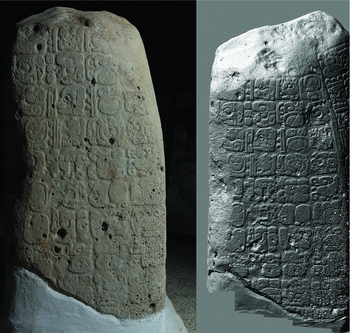
It is the rare epigrapher who shows ineptitude as a draftsperson—there is some deep connection between drawing and seeing that winnows relevant from irrelevant detail. A superb craftsman and a perceptive detector of historical patterns is Peter Mathews (Reference Mathews1997), Schele's collaborator in early studies at the site of Palenque, Mexico (e.g. Mathews & Schele Reference Mathews, Schele and Greene Robertson1974; Schele & Mathews Reference Schele and Mathews1979). The emphasis on primary documentation was brought to an initial pinnacle by Ian Graham as the first director of the Corpus of Maya Hieroglyphic Inscriptions project at the Peabody Museum, Harvard, who drew or oversaw 19 volumes of superlative line renderings of monuments. His successor Barbara Fash and her assistant Alexandre Tokovinine have since pioneered 3D imaging of texts and digital rendering, pointing to the future of such projects (Figure 1; see Tokovinine & Fash Reference Tokovinine and Fash2008).
Comparison of photograph and 3D scan of Tikal Stela 17, Guatemala, AD 557 (image: A. Tokovinine, © President and Fellows of Harvard College, courtesy Corpus of Maya Hieroglyphic Inscriptions project, Peabody Museum, Harvard University).

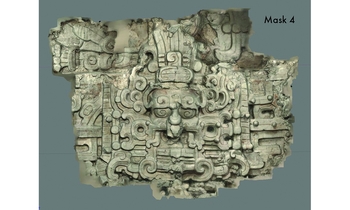
The act of synthesis, the crowning integration of approach and method, accords with David Stuart (Reference Stuart1987), the most unusual figure of all. Beginning as a child prodigy, Stuart acquired a perspective on Maya glyphs unencumbered by the quiz culture of US universities. When tallied, Stuart's contributions correspond to a disproportionate number of post-Knorosov readings of syllables and numerous word signs, along with, in recent years, explorations of systematic theology among the Classic Maya. His expansive vision has forged the current standard. In a way appropriate to the Maya, it exemplifies the indissoluble bond between texts and images (e.g. Stone & Zender Reference Stone and Zender2011). Such focused results offer the new precisions of Maya epigraphy (Figure 2).
Head of Chahk, the rain god, with nominal glyph in headdress; north cornice of the ‘Temple of the Night Sun’, Structure F8-1, El Zotz, Guatemala, c. AD 380 (image: Katie Simon and the Center for Advanced Spatial Technologies, University of Arkansas).

Epigraphic insight belongs to no one place. In past years, there have been centres of gravity focused on particular programmes, as at Harvard or Yale, which shifted to yearly festivals of learning organised by Schele at the University of Texas. Other meetings have sprung up in the wake of the latter, especially in Europe, where the vibrant Wayeb association has staged gatherings in different European cities for almost two decades. The landscape of academic discourse is increasingly virtual, however: communications are in bytes, images digitised and epigraphic communities constituted less by proximity than intellectual affinity. Blogs such as ‘Maya decipherment: ideas on ancient Maya writing and iconography’, hosted by Stuart, offer immediate dissemination and a space for comment. Even so, the ‘seeing stones’ tell us that university programmes will continue their long-term training of students, in settings that nurture more personal discussion and a sense of identity or affiliation.
New precisions
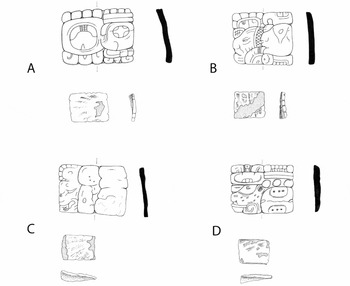
The power of ancient texts to elucidate the past depends on our technical ability, first opened by Knorosov, to assign sounds and sense to signs and to comprehend their organising grammar, but only in part. Clearly it also depends on our capacity to set those texts within social, cultural and historical processes, rendering them not simply legible but meaningful. In recent decades, we have come to understand the full scope of the texts, where the medium in question—whether monuments in stone, painted ceramic vessels or personal adornments fashioned from jade, shell or bone—determines what textual genres will be present and which audiences were to be addressed (Figure 3). The reading precision acquired in recent years allows us to draw close to the rhetorical purposes of Maya writing, appreciating the social realities that stand behind the signs.
Glyphs of Spondylus shell, burial 13, Piedras Negras, Guatemala, possibly 3 January AD 747; these may have belonged to a poorly known ruler of Yaxchilan, Mexico, during an obscure phase of its history (a: 3.7 cm wide; b: 3.9 cm wide; c: 3.8 cm wide; d: 4cm wide; excavated by H. Escobedo, drawings by S. Houston).

As mentioned before, the dominance of calendrical subject matter on the standing monuments, the feature that so transfixed the early decipherers, is real enough. How the Maya conceptualised time is still of central importance, relating as it does to the agentive role of humans within that framework and of time itself as vested with personality (e.g. Stuart Reference Stuart2012). Monumental stelae were seldom commissioned to commemorate a particular historical event, but rather celebrated major stations in the calendar. This provided an opportunity to append selected historical data in the form of royal biographies—res gestae—although even these begin by detailing the ritual or rituals occasioned by the date (Stuart Reference Stuart1996). It would nonetheless be an error to see too stark a thematic division here. By the dawn of the Classic era, if not far earlier, the concept of time had been thoroughly subsumed by royal ideology, made clear when we consider that all such stations fell on the day named Ajaw or ‘Lord’. Kings occasionally inserted their own portraits into oversized Ajaw day notations, placing further stress on their integral role in the proper ordering of the cosmos. The rock from which the monuments were hewn was considered to be as much an embodiment of time as it was its marker—in Maya thought tuun (‘stone’) was not cold and dead but possessed of an animate nature (Stuart Reference Stuart, Guernsey, Clark and Arroyo2010; Houston Reference Houston2014). Stelae thus offer a unified statement that fused image, text and material in order to present a singular expression of the immutable bond between time and kingship.
The topics covered in the historical passages are thematically restricted and formulaic in their structure and content. A major imperative was to establish personal identities—names and epithets that distinguish historical individuals and define their place in social and political structures. Onomastic studies have lately brought greater understanding of the ways that kingly nomenclature reflects godly identities, often through verbal constructions that define deities in action (Houston & Stuart Reference Houston and Stuart1996; Colas Reference Colas2004). Titles have proved to be a significant resource that points to otherwise shadowy groups and structures, with the number of known royal and non-royal epithets—frequently set in hierarchical relations through the use of grammatical possession—growing steadily in recent years. Statements of genealogical descent were a further means of asserting legitimacy and identity. For a system that was strongly patrilineal, there is a strong emphasis, at least in the final centuries of the Classic period, on naming both parents, suggesting that the titles and relationships of mothers were important to establish heritable rights.
That writing was the preserve of the powerful, and that it focuses exclusively on a narrow segment of society, is hardly exceptional in global terms. Although we would far rather hear from the whole spectrum of society, conceiving of this elite emphasis in negative terms—as somehow peripheral to the concerns of a wider community—can no longer be sustained. What the texts offer are the self-representations of the functioning heart of government, giving accounts of those agents most empowered to enact social transformations. Commoners lack their own voice, but their social participation and collective agency are implicit in the voices we do have.
Kings could be direct participants in a given event, but more often they took a supervisory role via the term uchabjiiy (literally ‘his manuring’ (field preparation)), offering a different emphasis to the bombastic images of ‘heroic kingship’ that usually accompany the texts. Such phrasing, which employs an agricultural trope of ‘tending’ or ‘manuring’ a field, distances the sovereign from the thick of the action, even where we might most expect to see them, as in records of conflict. In other contexts, the supervision of rulers (or gods) is indicated by the term yichnal, which defines bodily presence and interaction within a field of vision, elucidated by cognate survivals in descendent Mayan languages (Hanks Reference Hanks1990; Houston et al. Reference Houston, Stuart and Taube2006). The additional act of ‘witnessing’, indicated by means of ila (‘to see’), demonstrates that there were fine distinctions in elite oversight and engagement that remain to be fully determined.
An area where greater exactitude has had an impact on our model of society comes in the cultural and political geographies of the Classic Maya. The evidence for a large array of competitive kingdoms—expanding on Proskouriakoff and Berlin—has led to detailed dynastic histories and links that speak to forms of hegemonic organisation (Martin & Grube Reference Martin and Grube1995, Reference Martin and Grube2000). But this only raises further questions about the composition and the ideological underpinnings of those statelets. It has been possible to align accounts of political foundation with physical remains, charting both the construction of courtly architecture and evidence for the movement of populations across the landscape (e.g. Sharer Reference Sharer1999; Houston et al. Reference Houston, Escobedo, Child, Golden, Muñoz and Smith2003, Reference Houston, Newman, Román and Garrison2015; Stuart Reference Stuart2007). What concerns us now is the way that power was moved and instantiated in new places, a practice that probably involved the transfer of sacred artefacts and relics. The emblem glyphs identified by Berlin have been revealed not as the names of places or kingdoms per se but of dynastic houses—where some of these have local origins and are synonymous with the toponym of the central political seat, while others were transplants from elsewhere in which the name in the emblem has no local significance (Martin Reference Martin2005; Tokovinine Reference Tokovinine2013). There is emerging evidence for dynamic relocations and reformations of a kind familiar to dynastic histories across the world, features that are all the easier to observe when we have the close temporal control made possible by Maya chronology.
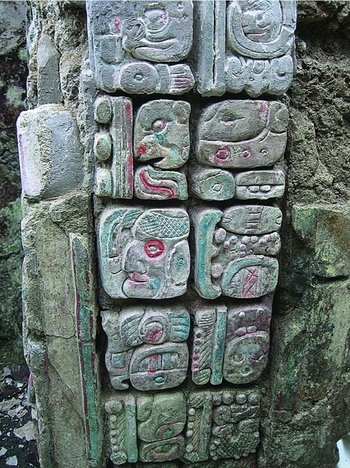
A logical precision resulting from Knorosov's breakthrough is the ability to extract sound and, as a result, language from the inscriptions. These advances have gone far indeed: the fact that scholars can now debate fine-grained subtleties of grammar, tense, aspect and the representation of vowel quality and quantity shows the advent of linguistic research in a way inconceivable to earlier researchers. Many of these data are unreservedly recondite, and the skills to evaluate particular arguments held by few. They do reveal new categories of verb, such as a particular kind of event, a mediopassive, detected independently by current author SH and Barbara MacLeod. Characterised by a distinctive suffix, which may record a particle use for verbs that have only one ‘argument’—a technical expression having to do with how predicates are completed—these form a widespread class used in many statements of building or monument dedication. They also include, as one of their examples, a key glyph for ‘rising up’ (t'abayi) with a logographic reading first suggested by Stuart (Figure 4). Phonic glyphs afford an even greater prize, sorting out the language or languages of the Mayan inscriptions. The overwhelming evidence points to a single, prestige language employed in the inscriptions, an ancestor to one living tongue, Ch'orti’. To be sure, other languages did percolate into the writing system—unusual verbs at southerly Tonina, Chiapas, Mexico, or possible Yukateko passives in the north at Chichén Itzá—but scholars must confront a surprise. Sites such as Chichén Itzá, surrounded by a region of Yucatecan speakers, display records in a language not spoken there today. The consequences of such diglossia, with multiple languages, yet one ‘high’ and elite version centred at many cities, are of intense interest sociologically, presenting a linguistic landscape in which royalty and nobles spoke a tongue across political boundaries that was incomprehensible to most of their subjects.
Painted glyphs, Tonina door jamb, Mexico, AD 708; note fungus from unprotected surfaces (photography: M. Coe, 2005).

In the first studies of Maya religion, it was logical to work back from literary sources produced under the colonial rule of the sixteenth century, more than six centuries after Classic society fell into oblivion. These divide into the ‘anthropologically’ minded accounts by clerics for a Spanish audience (such as Diego de Landa's Relación de las cosas de Yucatán) and texts written by and for indigenous Maya in Latin script (such as the Popol Wuj and Chilam Balam documents). Most of the latter were efforts to preserve native beliefs and knowledge in the face of Christian enculturation, although they are not the ‘pure’ Maya visions once imagined. The contributions of these sources have certainly been important, but it has been hard to avoid a directional fallacy that examines the Classic material for the precursors of later myths, which thereby stand as the model and arbiter of how earlier beliefs should be understood. Today the emphasis can shift to internal Classic Maya evidence, assembling a picture of ancient concepts within the extraordinarily rich interaction of words and images (Taube Reference Taube1992; Martin Reference Martin and McNeil2006). The identification of the glyph term for k'uh (Ringle Reference Ringle1988)—translated as ‘god’ in all the Colonial-period lexicons—opened a critical avenue into local representations of the divine in the inscriptions (Houston & Stuart Reference Houston and Stuart1996). By assessing the semantics of what was a ‘god’ and what was not, together with where and how the adjective k'uhul (‘sacredness’) was applied, we gain a deeper picture of religiosity in Classic times (Prager Reference Prager2014).
Anyone who hoped that the Classic inscriptions would provide mythic narratives or treatises on the essential nature of divinity has been disappointed. Although there are references to a grand scheme of pan-regional beliefs and its presiding ‘pantheon’, these are not treated in any detail. On the monuments, major deities most often appear in rites of impersonation that seem to have invoked their direct instantiation in the bodies of royal performers. Painted ceramics—the great majority of which come from the intense and deeply lamented looting of Maya sites—are the richer sources here, often depicting fragments of mythic tales or scenes from the governing palaces of the heavens and netherworld, all annotated with glyphic captions. Fixed on a transcendent plane, they can be equally understood as reciprocal models from and for human hierarchies, setting the divine order of the cosmos and thus on earth. The greater part of religious discourse in the inscriptions is in fact devoted to local observance, in which kings engage in rituals that honour or propitiate lesser gods specific to a place or dynastic house and appear nowhere else. This proves to be critical because it speaks to the source of royal claims to divine legitimacy and how it was maintained, suggesting how kings gained rights to the k'uhul (‘holy’) prefix to their royal titles. This kind of atomised religious authority is, in the Maya realm as elsewhere, the sustaining counterpart to political division and multiplicity.
The growing sophistication of the decipherment brings with it philological and epistemological issues of newfound relevance. Our increasing ability to penetrate the texts poses the question of how the information they provide maps onto other realms of knowledge. One of the dangers is that ‘textual realties’ remain locked within their own, hermetically sealed, realm of discourse that fails to connect to the material world. (That discourse can nonetheless possess an astonishing and supple sophistication; see Lacadena Reference Lacadena, Hull and Carrasco2012.) Few would question the goal of forging a collaborative and mutually enriching relationship between epigraphic and archaeological enterprises, nor can anyone doubt that such an engagement has proved problematic elsewhere (Carver Reference Carver, Cunliffe, Davies and Renfrew2002). The Maya case offers a powerful opportunity to re-examine these debates in the entirely different context of the New World (see also Andrén Reference Andrén1998).
Witz to climb
Maya hills (witz) may not be alpine in scale, but they are slippery and tangled, with jagged edges and sheer drops. Something akin to them awaits Maya epigraphers. The challenges that continue to pose real difficulties result from insufficient evidence. Certain readings have such solid support that it is a wonder they took so long to decode; others are hapax legomena—things said only once—rarities for which no amount of wishful thinking will permit a decipherment. The last 15 years have also witnessed what might be termed, with humorous overstatement, the ‘spelling wars’ (e.g. Houston et al. Reference Houston, Robertson and Stuart2000, Reference Houston, Stuart, Robertson and Wichmann2004). Sequences of signs, decisively read, can be transcribed into syllables to general acceptance. Transliterating them into Mayan language is another matter. There are remaining doubts, for some: whether there is vowel ‘complexity’ (length or accompanying glottal stops and fricatives); what the developmental state of the language of the inscriptions might be; whether there are different languages in the script; or how features such as mood or aspect might be handled (Robertson et al. Reference Robertson, Houston, Stuart and Wichmann2004). These issues do not always affect parsing of general meaning, but the details, if unresolved, make any translations into English, Spanish or another language a matter of contention. A large-scale, lavishly funded project of the Nordrhein-Westfälische Akademie der Wissenschaften und Künste at the University of Bonn may lead to some resolution by collecting and cross-referencing data. There is no equivalent of Gardiner's (Reference Gardiner1957) seminal grammar of Egyptian hieroglyphs, and we may never attain that level of comprehensiveness, but international collaboration may go some way towards achieving it for Classic Mayan.
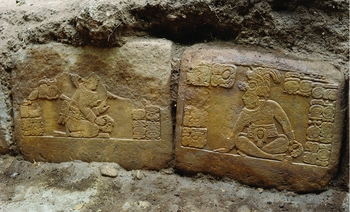
Other steep climbs include the challenge of reading early Maya glyphs, among the more opaque productions of the writing system, and understanding how they might relate to scripts that appear to be of slightly later date, such as Isthmian (Houston Reference Houston and Houston2004). There are clear links to later Maya signs, but whether syllables are fully present will need further testing. Then there is the constant concern of ethics. A paradox: to unearth a Maya text is to endanger it critically. How should such texts be documented, made accessible and, above all, preserved, or rather, their inevitable decay slowed? These crises of preservation occur everywhere, and the epigraphic heart breaks at seeing freshly exhumed, painted, poorly published texts at sites such as Tonina, Mexico, darken with fungus and crumble to the elements (see Figure 4; Stuart Reference Stuart2008). A further concern is the boundless quantity of looted inscriptions that pose important dilemmas in regard to study and dissemination. The growing ability to re-provenance monuments using textual information belies the argument that contraband materials are forever rootless and devoid of scholarly value. Recent discoveries at La Corona, Guatemala, have made it possible to fix 20 or more carved panels—currently in private and public collections worldwide—to within metres of where the Maya had set them (Figure 5; Canuto & Barrientos Reference Canuto and Barrientos2013).
Stairway blocks excavated at La Corona, Guatemala, of an athletic contest taking place at AD 635 (courtesy: Marcello Canuto, Director, Middle American Research Institute, Tulane University).

Publications, too, are difficult to balance, as scholars strive for definitive standards, rapid dissemination and to negotiate the proprietary concerns of excavators. Administrators in all US universities now flutter with excitement about ‘big data’, and these, as in the German project, are indeed the future of epigraphy. A comprehensive list of Maya dates is the first order of business, a study of formal change or variation in the Maya signary. The exalted level of orthographic and calligraphic study in places such as China represents a summit we may envy and emulate (e.g. Bai Reference Bai2003; see Zender Reference Zender2014 for a commendable shift forward). There is still—amazingly—no comprehensive, peer-reviewed, specialist volume on Maya writing as a whole.
Maya epigraphic research of recent years has combined new discoveries with a greater precision in translation that has made even long-recognised topics newly informative. Human societies consist of vastly complex interactions between the mental and material, in which language works as a crucial intermediary, while simultaneously constituting a locus of social meaning in its own right. No matter how occluded and strewn with interpretive obstacles, the ‘seeing stones’ of writing offer unique access to the world of the Maya.
Acknowledgements
Stephen Houston wishes to thank Brown University and the Center for the Advanced Study in the Visual Arts, National Gallery of Art, Washington, D.C., for the sabbatical support that enabled this article. Mary Miller and another, anonymous reviewer provided wise advice, as did Chris Scarre.