Introduction
Numerous insect fossils have been reported from the Mesozoic of Xinjiang, northwestern China (Ping, Reference Ping1935; Demoulin, Reference Demoulin1954; Hong, Reference Hong1983; Lin, Reference Lin1992; Zhou, Reference Zhou1993; Zhang, Reference Zhang1996a, Reference Zhangb, Reference Zhang1997a, Reference Zhangb; Zhang et al., Reference Zhang, Wang and Zhang2003; Deng et al., Reference Deng, Lu, Fan, Pan, Cheng, Fu, Wang, Pan, Shen, Wang, Duan, Zhang, Jia and Fang2010), but so far only two fragmentary dragonflies have been recorded from the Jurassic strata of Xinjiang (Zhou, Reference Zhou1993; Deng et al., Reference Deng, Lu, Fan, Pan, Cheng, Fu, Wang, Pan, Shen, Wang, Duan, Zhang, Jia and Fang2010). Until now, four orders (Coleoptera, Mecoptera, Orthoptera, Homoptera) have been described from the Lower Jurassic Badaowan Formation of the Tuziakeneigou outcrop of the northwestern Junggar Basin, Xinjiang (Zhang, Reference Zhang1996a, Reference Zhangb, Reference Zhang1997a, Reference Zhangb; Zhang et al., Reference Zhang, Wang and Zhang2003). Recently, several hundred insect fossils in 10 orders were unearthed from this locality including the first damsel-dragonfly described below.
The insect Order Odonata, as a subclade of the superorder Odonatoptera, comprises two main suborders Zygoptera (damselflies) and Epiproctophora, which is a clade that comprises the damsel-dragonflies and the Anisoptera (true dragonflies) (Bechly, Reference Bechly2016). The Isophlebiida (=Archithemistidae + [Campterophlebiidae + Isophlebiidae]) is one of the most diverse clades of Mesozoic damsel-dragonflies. Their oldest-known representatives are found in Late Triassic–Early Jurassic strata and the youngest in the Late Cretaceous. The family Campterophlebiidae is the largest family of this clade (Nel et al., Reference Nel, Martínez-Delclòs, Paicheler and Henrotay1993, Reference Nel, Bechly, Martínez-Delclòs and Huang2009; Fleck and Nel, Reference Fleck and Nel2002). Nine campterophlebiid genera are currently known from the Middle Jurassic–Lower Cretaceous of north China (Fleck and Nel, Reference Fleck and Nel2002; Zhang et al., Reference Zhang, Fleck, Huang, Nel, Ren, Cheng and Lin2006, Reference Zhang, Ren and Pang2008; Petrulevičius et al., Reference Petrulevičius, Huang and Nel2011; Nel et al., Reference Nel, Bechly, Martínez-Delclòs and Huang2009; Li et al., Reference Li, Nel, Ren and Pang2012, Reference Li, Nel, Ren and Pang2013; Zhang et al., Reference Zhang, Zheng, Wang, Fang and Jarzembowski2013). It should be noted that Zhou (Reference Zhou1993) also reported an anisozygopteran attributable to the family Campterophlebiidae from the Upper Jurassic of Karamay, Xinjiang.
The damsel-dragonfly Dorsettia laeta Whalley, Reference Whalley1985 was initially described from the Lower Jurassic (Lower Lias) of Dorset, England (Whalley, Reference Whalley1985) and attributed to the family Campterophlebiidae by Nel et al. (Reference Nel, Martínez-Delclòs, Paicheler and Henrotay1993). The type species is based on a basal part of a hindwing. The present study describes a well-preserved hindwing attributable to a new species of the Jurassic genus Dorsettia Whalley, Reference Whalley1985 from the Lower Jurassic Badaowan Formation of the Junggar Basin, Xinjiang, northwestern China. The new specimen provides additional morphological characters for this genus. This find expands the distribution of Dorsettia, and makes it possible to compare the Early Jurassic insect assemblages in China to the one in England. More importantly, the fossils from this locality should help to evaluate the effect of the end-Triassic extinction on the entomofauna and the insect recovery during the earliest Jurassic.
Geologic setting
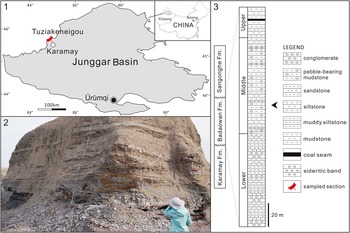
The specimens described herein were collected from the middle part of the Badaowan Formation of the Tuziakeneigou outcrop, Karamay City, Xinjiang, northwestern China (Fig. 1.1, 1.2).
(1) Geographical sketch map of the Junggar Basin, Xinjiang, China, showing the locality of the Tuziakeneigou outcrop. (2) Photograph of the insect-bearing beds of the Badaowan Formation in the Tuziakeneigou outcrop. (3) Stratigraphical column showing the lithology of the Badaowan Formation of the Tuziakeneigou outcrop and position (arrow) of the material collected in the Tuziakeneigou outcrop (based on data from Deng et al., Reference Deng, Lu, Fan, Pan, Cheng, Fu, Wang, Pan, Shen, Wang, Duan, Zhang, Jia and Fang2010).

The Badaowan Formation is in unconformity with the overlying Middle Jurassic Xishanyao Formation and the underlying Middle–Upper Triassic Karamay Formation (Fig. 1.3). It consists of gray and grayish green sandstone, siltstone and mudstone interbedded with thin conglomerate, coal, and sideritic bands, yielding bivalves, gastropods, spinicaudatans, insects, sporopollen, and plants (Deng et al., Reference Deng, Lu, Fan, Pan, Cheng, Fu, Wang, Pan, Shen, Wang, Duan, Zhang, Jia and Fang2010). The Badaowan Formation is approximately 182 m thick, and assigned to the uppermost Rhaetian–Sinemurian stages (Sha et al., Reference Sha, Olsen, Pan, Xu, Wang, Zhang, Yao and Vajda2015).
Materials and methods
The specimens were examined dry using a Nikon SMZ1000 stereomicroscope. Photographs were prepared using a Canon 5D digital camera and the line drawings were prepared from photographs using image-editing software (CorelDraw X7 and Adobe Photoshop CS6).
The nomenclature of the dragonfly wing venation used in this paper is based on the interpretations of Riek (Reference Riek1976) and Riek and Kukalová-Peck (Reference Riek and Kukalová-Peck1984), as modified by Nel et al. (Reference Nel, Martínez-Delclòs, Paicheler and Henrotay1993) and Bechly (Reference Bechly1996). Vein abbreviations are as follows: AA, anterior anal; AP, posterior anal; Arc, arculus; Ax, primary antenodal crossvein; CuAa, distal branch of anterior cubitus; CuAb, proximal branch of anterior cubitus; CuP, posterior cubitus; DC, discoidal cell; IR, intercalary radial vein; MAa, anterior branch of anterior median; MAb, posterior branch of anterior median; MP, posterior median; N, nodus; ‘O’, oblique vein; Pt, pterostigma; RA, anterior radius; RP, posterior radius; Sn, subnodal crossvein; ScP, posterior subcosta.
The higher classification of fossil and extant Odonatoptera is based on the phylogenetic system of Bechly (Reference Bechly1996, Reference Bechly2003, Reference Bechly2016). All measurements are given in mm.
Repositories and institutional abbreviations
The specimens are housed in the Nanjing Institute of Geology and Palaeontology, Chinese Academy of Sciences (NIGPAS).
Systematic paleontology
Order Odonata Fabricius, Reference Fabricius1793
Clade Isophlebioptera Bechly, Reference Bechly1996
Subclade Isophlebiida Bechly, Reference Bechly1996
Superfamily Isophlebioidea Handlirsch, Reference Handlirsch1906
Family Campterophlebiidae Handlirsch, Reference Handlirsch1920
Genus Dorsettia Whalley, Reference Whalley1985
Type species
Dorsettia laeta Whalley, Reference Whalley1985.
Other species
Dorsettia sinica n. sp.
Diagnosis
Male hindwing characters only, body unknown. AP hairy; AA with strong elbow at CuP, distally directed perpendicular to its proximal side and towards ventral edge of wing; four nearly posterior, parallel branches of AA in anal triangle between AP and AA; Ax1 and Ax2 parallel and hypertrophied and of same obliquity; subdiscoidal space posteriorly open, transverse, and divided into five smaller cells, with a length/width ratio >3:1; areas between RP2 and IR1, RP3/4 and IR2, MA and MP all with one row of cells basally, distally constricted by an opposed curvature of related veins; CuA strongly deviating from MP, and clearly divided into CuAa and CuAb far from MP; CuAa strongly bent at bifurcation of ‘gaff’ (basal part of CuA before dividing into CuAa and CuAb), zigzagged, disappearing distally, with area between MP and CuAa reduced; area between MP and CuA less than twice as wide as postdiscoidal area in basal part; Pt elongate and narrow, not braced.
Remarks
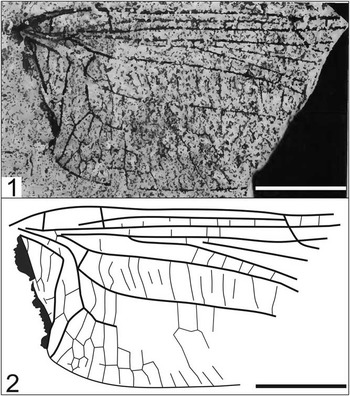
Nel et al. (Reference Nel, Martínez-Delclòs, Paicheler and Henrotay1993) suggested the following characteristics for the basally preserved type species (Fig. 2.1, 2.2): AA has a strong elbow near CuP, and is directed perpendicularly from its proximal side to the ventral edge of the wing; CuA strongly deviates from MP, and is divided into CuAa and CuAb far from MP; a very clear division of CuAa and CuAb is present, and CuAb moves proximally to the ventral edge of the wing; AA and CuAb are limited distally; the subdiscoidal cell has a length/width ratio >3:1, being transverse and partly divided into two by a transverse, incomplete, weak veinlet; the subdiscoidal cell reaches the edge of the wing; CuAa disappears distally, and the area between MP and CuAa is reduced. Our new material shares all these characteristics and thus can be attributed to this genus. However, the type species was based just on the basal portion of a hindwing. The new material provides the following further characters for the genus: the subdiscoidal space is divided into five smaller cells; the areas between RP2 and IR1, RP3/4 and IR2, MA and MP all have one row of cells basally, and are distally constricted by an opposed curvature of these associated veins; Pt is elongate and not braced. The diagnosis of Dorsettia is emended by augmenting the above characters.
Dorsettia laeta Whalley, Reference Whalley1985, holotype, hindwing (after Whalley, Reference Whalley1985); scale bar=10 mm. (1) Photograph of the hindwing. (2) Line drawing of the hindwing.

Dorsettia sinica new species
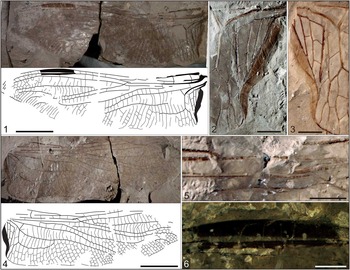
Dorsettia sinica n. sp., holotype, specimen NIGP 162227. (1) Photograph and line drawing of the hindwing, scale bar=10 mm. (2, 3) Photograph showing the detail of the anal area (part and counterpart), scale bar=2 mm. (4) Photograph and line drawing of the counterpart of hindwing, scale bar=10 mm. (5) Photograph of the compressed nodus in (4), scale bar=2 mm. (6) Photograph of the pterostigma in (1), scale bar=2 mm.

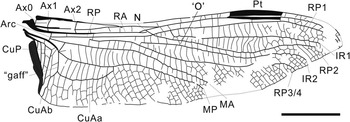
Dorsettia sinica n. sp., holotype, NIGP 162227, line drawing showing the venation of hindwing. Vein abbreviations are as follows: Arc, arculus; Ax, primary antenodal crossvein; CuAa, distal branch of anterior cubitus; CuAb, proximal branch of anterior cubitus; CuP, posterior cubitus; IR, intercalary radial vein; MA anterior median; MP, posterior median; N, nodus; ‘O’, oblique vein; Pt, pterostigma; RA, anterior radius; RP, posterior radius; scale bar=10 mm.

Diagnosis
Small species of Dorsettia with distance between wing base and nodus ca. 17 mm; Ax1 and Ax2 of distinct and parallel obliquity.
Occurrence
Tuziakeneigou outcrop, Karamay City, Xinjiang, China; Badaowan Formation, Lower Jurassic (Hettangian–Sinemurian).
Description
Hindwings hyaline, slightly compressed. Length, 53.86 mm, width at level of N, 13.79 mm; distance from wing base to Arc, 4.86 mm, from Arc to N, 14.88 mm, from N to Pt, 15.17 mm, from Pt to apex, 19.73 mm. Nodal structures strongly compressed and separated; Sn obliquely aligned with RP2 (Fig. 3.5). Wing not petiolate, anal area broad, triangular in shape, with three rows of irregular cells between AA and AP, some very small and others very large. AP hairy (Fig. 3.2, 3.3). AA with four parallel posterior branches in anal triangle, anal angle pronounced (male specimen); AA nearly parallel with MP + CuA basally; main branch of AA distally strongly bent towards posterior wing margin. Median area free of crossveins; submedian area with one crossvein; submedian and subdiscoidal areas separated by curved vein CuP. Subdiscoidal space transverse, posteriorly open, with one or two rows of cells, 8.67 mm long, maximum width 1.8 mm. DC closed basally, free of crossveins, with anterior side 3.08 mm, basal side 3.29 mm, and distal side 1.86 mm long. RP separated from MA in Arc. MA basally very strong, divided into MAa and MAb distally; MAb short, 1.86 mm long, well aligned with basal part of ‘gaff’; MAa curved, somewhat parallel with MP basally with one row of large cells in between, narrower distally, with at least two rows of cells near wing margin. CuA separating from MP 5.62 mm from wing base, distally dividing into CuAa and CuAb; CuAb long, directed towards wing base, not meeting main branch of AA, leaving subdiscoidal space posteriorly open; CuAa basally somewhat parallel to posterior wing margin with three or four rows of cells in between, distally strongly curved towards MP, short, ending on MP 9.56 mm from its base. Area between CuAa and MP with one row of large cells, smaller distally. MP curved, reaching posterior margin midway between levels of Sn and Pt, 30.23 mm from wing base, at 56.13% of total wing length. Primary antenodal crossveins very strong, Ax1 2.47 mm distal of Ax0 and Ax2 4.48 mm distal of Ax1; Ax1 and Ax2 of distinct and parallel obliquity; no secondary antenodal crossveins of first row between C and ScP, and four of second row between ScP and RA. Base of RP3/4 nearly midway between Arc and N. Base of seven postnodal crossveins present, not aligned with six preserved postsubnodal crossveins. Six preserved crossveins in space between RP, RP2, IR2 and ‘O’. Single oblique vein ‘O’ present, three cells and 4.23 mm distal of base of RP2. IR1 originating from RP1, four cells and 3.54 mm distal of base of RP2; IR1 zigzagged, more or less parallel to RP1. Pt not braced, long and narrow, 1.26 mm long, 0.23 mm wide, covering about 11 cells (Fig. 3.6). Area between MA and RP3/4 much wider distally with numerous cells along posterior wing margin. Area between RP3/4 and IR2 with one row of cells and distally with four rows along posterior wing margin. Area between IR2 and RP2 with one row of cells basally, and distally with about seven rows along wing margin. Area between RP2 and IR1 progressively widened opposite middle of Pt, but extremely narrowed near wing margin. Area between IR1 and RP1 slightly widened distally with one row of large cells in between until level of mid Pt, and distally with at least 3 rows along wing margin.
Etymology
Sinica, Latin name for China.
Remarks
The specimens can be attributed to the family Campterophlebiidae following the diagnosis provided by Nel et al. (Reference Nel, Bechly, Martínez-Delclòs and Huang2009), emended by Li et al. (Reference Li, Nel, Ren and Pang2012): the longitudinal veins of the hindwing (especially RP3/4) is more or less undulate (apomorphy) and there are no secondary antenodal crossveins present between C and ScP. Affinities with the family Isophlebiidae (see diagnosis in Nel et al., Reference Nel, Bechly, Martínez-Delclòs and Huang2009) are excluded because the distal side (MAb) of DC and the ‘gaff’ are not orientated in one transverse plane; there are no secondary antenodal crossveins between C and ScP; and the male hindwing angle is not rounded.
Few Campterophlebiidae have their hindwing subdiscoidal space posteriorly open, viz. Pritykinia Nel et al., Reference Nel, Bechly, Martínez-Delclòs and Huang2009, Pternopteron Pritykina, Reference Pritykina1970, Oreophlebia Pritykina, Reference Pritykina1985, Amnifleckia Zhang et al., Reference Zhang, Fleck, Huang, Nel, Ren, Cheng and Lin2006, Qibinlina Nel et al., Reference Nel, Bechly, Martínez-Delclòs and Huang2009, and Dorsettia Whalley, Reference Whalley1985 (Nel et al., Reference Nel, Bechly, Martínez-Delclòs and Huang2009). Our fossil (Dorsettia) differs from all these taxa except Qibinlina and Pritykinia in the absence of a hook-like anal angle in the male hindwing. Qibinlina has no clear posterior branches of AA in the anal triangle, unlike Dorsettia. Dorsettia differs from Pritykinia in the anal triangle being broader than long instead of being longer than broad.
In the Campterophlebiidae, Dorsettia can be easily distinguished from other genera by the following characters: the anal area is hairy; AA has four nearly parallel branches in the anal triangle; the anal triangle is longer than broad; the subdiscoidal space is posteriorly open; the areas between RP2 and IR1, RP3/4 and IR2, MA and MP all have one row of cells basally, and are distally constricted by an opposite curvature of these veins; the area between MP and CuAa has one row of large cells basally, and is distinctly smaller distally. The new specimens differ from the type species Dorsettia laeta in having the distance between the wing base and N about 17 mm instead of 30 mm in the latter, and Ax1 and Ax2 of distinct and parallel obliquity instead of converging obliquity in the latter. These differences are sufficient to establish a new species.
Discussion
Abundant fossils, including bivalves, gastropods, spinicaudatans, insects, sporopollen, and plants, have been recovered from the Lower Jurassic Badaowan Formation of the Tuziakeneigou outcrop of northwestern Xinjiang, China (Deng et al., Reference Deng, Lu, Fan, Pan, Cheng, Fu, Wang, Pan, Shen, Wang, Duan, Zhang, Jia and Fang2010). In the stratigraphic outcrop, the insect fauna of the Badaowan Formation can be attributed to the Ovivagina-Protorthophlebia latipennis assemblage (Deng et al., Reference Deng, Lu, Fan, Pan, Cheng, Fu, Wang, Pan, Shen, Wang, Duan, Zhang, Jia and Fang2010), among which Protorthophlebia latipennis also occurs in the Lower Lias of England (Tillyard, Reference Tillyard1933), reflecting the close relationship between these two insect assemblages. The Upper Triassic–Lower Jurassic is best developed in the Haojiagou Section of the southern Junggar Basin, Ürümqi City, Xinjiang. The Badaowan Formation in the Haojiagou Section was recently determined to be latest Rhaetian–Sinemurian in age and its middle part to be earliest Sinemurian (Sha et al., Reference Sha, Olsen, Pan, Xu, Wang, Zhang, Yao and Vajda2015). Therefore, the insect fossils in the Tuziakeneigou outcrop have an earliest Sinemurian age.
In Dorset (England), the Lower Lias has been famous for its abundant ammonites and well-preserved reptiles for at least two centuries and is now listed as a World Heritage Site. Diverse insect fossils belonging to thirteen orders have been found ranging in age from the Hettangian to the lower Sinemurian (Coram, Reference Coram2014). The specimens studied by Whalley (Reference Whalley1985) were mainly collected from layers of coarsely laminated limestone nodules (the ‘flatstones’ and ‘woodstones’) of the Black Ven Marl Member, which is considered to be early Sinemurian in age (Coram, Reference Coram2014). This suggests that the Tuziakeneigou and Dorset insect assemblages are coeval with each other.
The fossils from the earliest Jurassic strata are especially important in evaluating the effect of the end-Triassic extinction event and the recovery during the Early Jurassic. The crucial ecosystem transformations were considered to be ahead of those in the sea (Ponomarenko, Reference Ponomarenko2006), and could be supported by the different insect fauna across the T-J boundary (Shcherbakov, Reference Shcherbakov2008). After the evolution and diversification of the entomofauna during the Triassic, many Late Mesozoic dominant taxa appeared during the Late Triassic, and further developed during the Early Jurassic (Labandeira and Sepkoski, Reference Labandeira and Sepkoski1993; Ponomarenko, Reference Ponomarenko2006; Shcherbakov, Reference Shcherbakov2008). After the Late Permian extinction event, the Odonatoptera were renewed during the Middle and Late Triassic (Béthoux et al., Reference Béthoux, Papier and Nel2005), even if the faunistic replacement was progressive. The most significant event was the extinction of the large Triassic clade Triadophlebiomorpha around the end of the Triassic, as this group has no Jurassic representatives (Nel et al., Reference Nel, Béthoux, Bechly, Martínez-Delclòs and Papier2001). The damsel-dragonfly Isophlebioptera diversified at the beginning of the Jurassic and Dorsettia is one of these early damsel-dragonflies.
The latitude of the Junggar Basin during the T-J interval was considered to be around 60° N (Choulet et al., Reference Choulet, Chen, Cogné, Rabillard, Wang, Lin, Faure and Cluzel2013; Sha et al., Reference Sha, Olsen, Pan, Xu, Wang, Zhang, Yao and Vajda2015), while England was located at 30–40° N (Coram, Reference Coram2014), suggesting a long distance between the two areas. The appearance of the genus Dorsettia in two localities probably reflects a weak influence of the end-Triassic extinction on damsel-dragonflies or a quick dispersal of damsel-dragonflies during the earliest Jurassic.
Conclusions
The dragonfly Dorsettia sinica n. sp. is described and named from the Lower Jurassic of the Junggar Basin, northwestern China. The diagnosis of the genus Dorsettia is emended based on the new specimen belonging to a closely allied new species. This discovery is the earliest damsel-dragonfly in China dating from the recovery following the end-Triassic extinction, recording the rise of the isophlebioids. The find extends the distribution of Dorsettia and makes it possible to compare the Early Jurassic insect assemblages between China and England, indicating that the insect dispersed in Eurasia and exchanged between the two regions in the Early Jurassic. New discovery further indicates that the end-Triassic extinction probably had a non-dramatic influence on damsel-dragonflies (e.g., they could fly out of trouble), or that the dispersal of damsel-dragonflies was relatively quick during the earliest Jurassic.
Acknowledgements
This research was financially supported by the National Natural Science Foundation of China (Grant no. 41272013), the Chinese Academy of Sciences Presidents’ International Fellowship Initiative (Grant no. 2011T2Z04) and the HKU Seed Funding Program for Basic Research (Grant no. 201210159058).