




No CrossRef data available.
Article contents
Dissociation following traumatic medical treatment procedures in childhood: A longitudinal follow-up
Published online by Cambridge University Press: 10 February 2006
Abstract
Chronic illnesses often involve repeated hospitalization and invasive treatment procedures that can have a traumatic impact on child development. To explore possible consequences of treatment procedures, three groups of patients with congenital anomalies were examined longitudinally. At first admission, adolescents (ages 10–20, mean 15) with anorectal anomalies (n = 14), adolescents with Hirschsprung disease (n = 14), and hospitalized controls (n = 14) were assessed for treatment procedures, somatic function, mental health, and dissociative experiences. The assessment included the Adolescent Dissociative Experiences Scale (A-DES). At 10-year follow-up, the patients completed the Dissociative Experiences Scale (DES) and the Somatoform Dissociative Questionnaire (SDQ-20). Anal dilatation, an invasive medical treatment procedure performed daily by the parents the first 4 years, was correlated with the frequency and severity of persisting dissociative symptomatology. The procedure was the only significant predictor of A-DES and SDQ-20 scores, and one of two significant predictors of DES scores. This “experiment of nature” permitted a specific and unique opportunity to examine the impact of early traumatic exposure on child development in the absence of parental malevolence, and on later dissociative outcome in adolescence and adulthood. The findings might be valuable theoretically to our understanding of the development of psychopathology, and may lend itself for comparison with data on sexually abused children.
Information
- Type
- Research Article
- Information
- Copyright
- © 2006 Cambridge University Press
Despite converging evidence of deleterious effects of childhood traumatic experiences on biological, behavioral, and social functioning, the knowledge is still sparse with respect to what type of experiences that represent causal trauma in the different age groups. There also remain many questions regarding the mechanisms and processes by which severe, chronic childhood traumatic experiences exert a negative influence on development (Manly, Kim, Rogosch, & Cicchetti, 2001). The attempt to study child development and trauma is constrained by ethical considerations, making it impossible to examine the causal impact and courses of early, severe, and chronic childhood traumatic experiences; for example, sexual/physical abuse and neglect, on child development (Maclean, 2003). However, the use of “experiments of nature” allows study these effects (Cicchetti, 2003). A sample of children born with congenital anomalies in the anorectal parts of the bowel system permits a specific and unique opportunity to examine the impact of early, severe, and chronic traumatic experience on child developmental processes. Findings from longitudinal studies of anorectal anomalies (ARA) that entail traumatic medical treatment procedures the parents had to perform for years (Diseth, Egeland, & Emblem, 1998), may provide invaluable information that can inform theory and research with respect to both normal and atypical child development.
Research indicates that trauma in infancy and toddlerhood entails a special risk for insecure attachment and poor ego control. Trauma can affect emotional, behavioral, cognitive, and social development and functioning, as well as engender frank psychopathology in later childhood and adulthood (Cicchetti & Toth, 1995; Manly et al., 2001). One core issue with respect to psychopathological implications of severe chronic trauma is hypothesized to be the failure of the central nervous system to synthesize traumatic experiences into an integrated explicit memory (van der Kolk, 1994). A trauma may be so intense and complex that the child's mind is unable to process the events as a whole experience. The cognitive schemas are lacking, the level of affect is too high, and the traumatic experiences may become split off from conscious control. Dissociation (i.e., a fragmentation of the experience) occurs. According to DSM-IV (American Psychiatric Association, 1994), pathological dissociation in children refers to a developmental “disruption in the usually integrated functions of consciousness, memory, identity, or perception of the environment” with psychological dissociative symptoms such as amnesia, depersonalization, derealization, fragmentation, absorption, and identity confusion. Children with dissociative failure may also have somatic symptoms that reflect somatoform dissociative phenomena such as sensory losses, loss of motor control, general paralysis, and alterations of vision, hearing, taste, and smell (Nijenhuis, Spinhoven, Van Dyck, Van der Hart, & Vanderlinden, 1996).
Research into the link between traumatic life events and dissociative symptoms addresses the long-term effects of early traumatic experience, especially childhood sexual abuse, and reveals a strong association between a history of early, chronic abuse, and extensive dissociative experiences in adults (Chu, Frey, Ganzel, & Matthews, 1999; Lange et al., 1999), adolescents, and children (Brunner, Parzer, Schuld, & Resch, 2000; Kisiel & Lyons, 2001). This research emphasizes the importance of age of onset, severity, chronicity; that is, the number of developmental periods during which trauma was experienced, and the number of subtypes of the trauma experience. Severity and chronicity have been found to predict future levels of dissociation (Macfie, Cicchetti, & Toth, 2001; Ogawa, Sroufe, Weinfield, Carlson, & Egeland, 1997). However, some authors argue that the relative impact or causality of childhood traumatic experience has not been empirically confirmed, and other factors such as the influence of the environment and the predisposition of the patients should be taken into consideration (Grabe, Spitzer, & Freyberger, 1999). Furthermore, a traumatic experience in children should be seen in a developmental perspective; experiences representing a trauma will differ according to a child's specific age, developmental phase, and cognitive level (Cicchetti & Cohen, 1995; Putnam, 1997).
Extensive dissociative experiences have been observed in connection with dissociative disorders as well as in posttraumatic stress disorder (PTSD). The literature on dissociative disorders in children has focused primarily on children exposed to sexual abuse as well as other childhood interpersonal trauma including emotional maltreatment, neglect, emotional abuse, and physical abuse (Brunner et al., 2000; Draijer & Langeland, 1999; Mulder, Beautrais, Joyce, & Fergusson, 1998; Simeon, Guralnik, Schmeidler, Sirof, & Knutelska, 2001). Despite the traumatic nature of many medical treatment procedures, dissociative symptomatology in pediatric patients has hardly been studied. However, posttraumatic stress responses have been reported in pediatric patients with severe and life-threatening medical illnesses, for example, childhood cancer or solid organ transplantations (Stuber et al., 1997; Stuber, Shemesh, & Saxe, 2003). Data suggest that children may experience specific life-saving medical procedures and treatment, such as bone marrow transplantation and chemotherapy, as traumatic. For the child, such procedures may cast caretakers and medical personnel in the role of perpetrators.
Congenital malformations in the anorectal region represent an “experiment of nature” that are useful for testing of the hypotheses of cause and course of trauma-related dissociation. One of these malformations (ARA) involves years of posttreatment, including multiple and long-term hospitalizations, with parent–child separations and invasive medical treatment procedures so severe and chronic as to impede normal development. To avoid anal constriction by scarring, an invasive medical treatment procedure calls for the parents to insert a metallic dilator into the child's anus once or twice a day for months or years (Diseth & Emblem, 1996). The procedure thus entails repetitive painful, stressful, and traumatic invasive treatment performed by the parents daily for years during childhood, but with very benign intentions and not out of malevolence.
The use of “experiments of nature” allows to study the causal impact and courses of chronic childhood traumatic experiences on child development. Congenital malformations in the anorectal region represent such an experiment of nature, involving traumatic childhood experiences similar to sexual abuse in some ways but conducted by caregivers with very benign intentions. To further explore the impact of early, severe, and chronic traumas on child development in the absence of parental malevolence, and on later dissociative outcome commonly reported following sexual abuse, two groups of patients with congenital malformations in the anorectal region were compared with regard to traumatic and dissociative experiences of invasive anal treatment procedures and repeated hospitalizations, as reported in adolescence and again in adulthood 10 years later.
Method
Subjects and procedure
Congenital malformations in the anorectal region constitute a heterogeneous group of low-frequency disorders involving the bowel system. After primary surgery, these malformations may pose chronic difficulties such as fecal incontinence and years of posttreatment, including repeated and prolonged hospitalizations, multiple operations, and invasive after-treatment procedures during childhood. ARA involves a congenital imperforate anus, which is ordinarily evident at birth, with a termination of the anorectal part of the bowel in a blind loop at various distances from the anal sphincter muscle complex and the pelvic floor. During the first days of life, these infants usually have corrective surgery to establish free passage of stools. To avoid anal constriction by scarring, long-term postoperative treatment has traditionally included daily dilatation of the child's anal canal that is performed by the parents for months or years (Diseth & Emblem, 1996). Hirschsprung disease (HD) involves a congenital absence of innervation, that is, the absence of neural ganglion cells in the bowel wall, affecting the most distal parts of the rectum. It extends proximally into the bowel for varying distances and leads to mechanical obstruction and constipation. HD is usually diagnosed weeks to months after birth. A surgical procedure with resection of the aganglionotic bowel segment and a pull-through of the normal bowel down to the anus is performed at 6–12 months of age and involves a postoperative treatment procedure based on surgical clamps inserted through the anus and left there for an average of 5 days while the hospitalized child is restrained and tied in bed (Diseth, Bjørnland, Nøvik, & Emblem, 1997).
At first admission (Time 1 [T1]) in 1993, 17 patients with ARA (11 boys, 6 girls), 12–20 years of age (M = 15.3), 19 patients with HD (13 boys, 6 girls), 10–20 years of age (M = 15.3), and 14 hospital controls (7 boys, 7 girls), 10–20 years of age (M = 15.5), and their parents participated as part of a larger research study of anorectal malformation (Diseth & Emblem, 1996; Diseth et al., 1997).
The ARA patients comprised a subsample of 20 adolescents randomly selected from 33 consecutive ARA patients born between 1972 and 1982, and treated with the same medical procedure at the Department of Pediatric Surgery at the National Hospital. This department has a national responsibility for the treatment of such anomalies. Three (15%) of the 20 ARA patients did not fill out the questionnaire Dissociative Experience Scale and were excluded from this study. There were no significant in age, gender, bowel function, mental health, psychosocial functioning, or family functioning between the participants and nonparticipants. The HD patients comprised 22 adolescents randomly selected from 32 consecutive HD patients born between 1973 and 1983, and treated with the same medical procedure at the National Hospital. Three (14%) of the 22 patients refused to participate. There were no significant in age, gender, or bowel function between the participants and nonparticipants. The control group comprised a sample of 14 patients who were admitted to the hospital consecutively during a 4-week period in 1993 with upper urinary tract disease, asymptomatic gastrointestinal disease, or abdominal pain, and who had no reported anorectal disease or dysfunction.
At follow-up (T2) 10 years later in 2003, 78% of the original patients completed three questionnaires by mail. The participants comprised 14 (82%) patients (7 men, 7 women), 20–31 years of age (M = 25.9) from the ARA group, and 14 (74%) patients (9 men, 5 women), 20–30 years of age (M = 24.9) from the HD group. All control group subjects participated in the follow-up.
The study was approved by the Regional Ethics Committee for Medical Research, and all participants and their parents provided informed consent.
Measures
Somatic function
Anorectal continence function was assessed by clinical examination. Fecal continence function was graded according to Wingspread classification, rating four clinical states of continence ranging from 1 (clean) to 4 (constant soiling; Diseth & Emblem, 1996). Flatus continence function was assessed by asking the patients to indicate their control of flatus on a 10-cm visual analogue scale with end points at 0 (very certain) and 10 (very uncertain; Diseth & Emblem, 1996).
Traumatic experiences
Reviews of the medical records and the semistructured interviews with the parents at T1 also incorporated variables associated with severity of abuse and neglect as described in the literature (Kendall-Tackett, Williams, & Finkelhor, 1993). This included experiences of parent–child separations, the number of hospital admissions during the first 5 years of life, the type of traumatic medical treatment experiences, age at onset, frequency and duration, relationship of the executants, and the use of force. Information was also collected on physical or sexual abuse and neglect.
Dissociation and stress reactions
Measures of dissociation have played a crucial role in establishing the clinical significance of dissociative symptoms in psychiatric disorders. Adolescent and adult scales of dissociation have both proven successful for the clinical screening of dissociative disorders and have established a relationship between increased levels of dissociation and antecedent trauma (Armstrong, Putnam, Carlson, Libero, & Smith, 1997). At T1, the standardized questionnaire Adolescent Dissociative Experiences Scale (A-DES; Armstrong et al., 1997) was used to measure psychological dissociation (amnesia, absorption, and imaginative involvement, passive influence, and depersonalization and derealization) in adolescents. The A-DES is a screening instrument designed to detect psychological dissociative behavior. It is a self-administered questionnaire containing 30 items that quantify the frequency of dissociative experiences on an 11-point scale ranging from 0 (never) to 10 (always). The total A-DES score is equal to the mean of all item scores. The reliability and validity of the A-DES has been well established (Smith & Carlson, 1996), and a cutoff score of 3.0 yields good sensitivity and specificity as a screening instrument.
Time 2 included the screening questionnaire Dissociative Experiences Scale (DES; Bernstein & Putnam, 1986) for psychological dissociative symptoms in adults. The DES is a 28-item self-report that asks subjects to estimate the percentage of their daily life during which particular types of dissociative experiences occur, ranging from 0 (never) to 100% (always). The DES has proven to be reliable and valid (Carlson et al., 1993), and is used to identify patients at high risk of dissociative disorders. The results indicate that a cutoff score of 25 yields good to excellent sensitivity and specificity in screening for dissociative disorders (Carlson & Putnam, 1993).
Because patients with dissociative disorders have numerous somatic symptoms that can reflect somatoform dissociative phenomena, the surveys included the Somatoform Dissociative Questionnaire (SDQ-20; Nijenhuis et al., 1996). The SDQ-20 is a 20-item, self-reporting questionnaire that measures somatoform dissociative symptoms on a 5-point scale ranging from 1 (absent) to 5 (severe). The reliability and validity of the SDQ-20 are good and have been well documented (Nijenhuis, Spinhoven, Van Dyck, Van der Hart, & Vanderlinden, 1998).
The adult patients' posttraumatic stress symptoms were assessed using the Impact of Event Scale (IES-15; Horowitz, Wilner, & Alvarez, 1979) at T2. The IES is one of the most widely used screening instruments designed to assess psychological stress reactions after any major life event. The IES is a self-report containing 15 items related to a particular event. In the present study, the event refers to the congenital anomaly. The subject is asked to report the frequency of symptoms in the past 7 days on a 6-point scale ranging from 0 (not at all) to 5 (often). The IES has shown good psychometric properties (Joseph, 2000) in assessing psychological stress reactions after major life events. The IES produces continuous scores and a cutoff score of 19 appears to distinguish potential PTSD cases from noncases (Wohlfarth, Winkel, van den Brink, & ter Smitten, 2003).
Mental health and familial outcomes
At T1, two types of outcome measures were used for mental health: combined total behavior and emotional problem raw scores, based on the standardized questionnaires Child Behavior Checklist (CBCL; Achenbach, 1991) and the Youth Self-Report (YSR; Achenbach & Edelbrock, 1987), and a symptom score, based on the semistructured interview Child Assessment Schedule (CAS; Hodges, McKnew, Cytryn, Stern, & Kline, 1982). A global assessment of Chronic Family Difficulties (CFD; Vandvik, Høyeraal, & Fagertun, 1989) was based on a slightly modified version of the standardized semistructured parent interview entitled Parental Account of Children's Symptoms (PACS; Taylor, 1986). These mental and familial outcome measures have been presented in detail elsewhere (Diseth & Emblem, 1996; Diseth et al., 1997).
Statistical methods
Because of normal distributions, results are reported as means (standard deviations) unless otherwise stated. The results are primarily based on parametric statistics (Altman, 1991). To assess differences between independent groups, a chi-square test with Yates correction (χy2) or Fisher's exact test for small samples were used for categorical variables, and independent samples t tests were used for continuous variables. The paired t test was used to assess differences within groups from first admission (T1) to follow-up (T2). Dependencies between sets of variables are expressed by the parametric Pearson correlation coefficient (r). Multiple linear regression analyses were conducted to identify the independent treatments, somatic and family/parental predictors that contributed significantly to the explained variance in the adolescents' and adults' dissociative symptoms (A-DES, DES, SDQ-20, IES; Kleinbaum, Kupper, & Muller, 1988). The aim of the regression model selection procedure is to find a single optimal subset of independent variables (McCullagh & Nelder, 1989). The set of independent variables to be introduced in the regression analysis is based on significant bivariate correlations and developmental theoretical hypotheses. A careful check of the model assumptions, including an investigation of residual plots, did not reveal any violation of the assumptions. A two-tailed p value of less than .05 was considered statistically significant.
Results
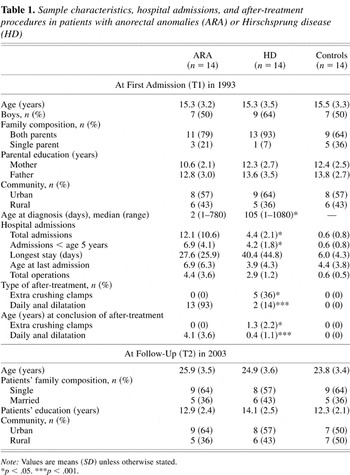
The sociodemographic characteristics, age at diagnosis, number of hospital admissions, operations, and type and duration of aftertreatment procedures of the 28 patients who participated in the follow-up are presented in Table 1. There were no significant differences in gender, age, or sociodemographic characteristics between the two patient groups at T1 or T2, or between the 28 participants at T1 and the eight patients who declined to participate at T2. According to the semistructured parental interview at T1, the family's financial, housing, and educational situation and the physical and mental health of the family members were generally good in both the ARA and the HD patient groups. There were no statistical differences between the groups.
Sample characteristics, hospital admissions, and after-treatment procedures in patients with anorectal anomalies (ARA) or Hirschsprung disease (HD)

Types of childhood traumatic experience
According to a review of medical records, the ARA and HD groups differed significantly with regard to age at diagnosis (p = .038), age at first operation (p = .02), total hospital admissions (p = .013), hospital admissions before age 5 years (p = .037), and type and duration of invasive anal treatment regimes (Table 1). Owing to the risk of postoperative anal stricture by scarring, 13 (93%) of the ARA patients and two (14%) of the HD patients (χy2 = 16.7, df = 1, p < .001) were subjected to anal dilatation once or twice daily by their parents from the age of diagnoses up to a mean age of 4 years. To treat residual septums, health professionals performed an additional procedure involving surgical clamps applied through the anus in five (37%) of the HD patients (χy2 = 5.8, df = 1, p = .015) at a mean age of 1.5 years. The procedure required that the child be restrained and tied to the bed for 5 days. All the patients treated with anal dilatation (n = 15) were closely related to the executants of the anal treatment procedure (i.e., their mothers administered the treatment). In contrast, none of those who had surgical clamps were related to the executants of the procedure, who were all health professionals. No indications of physical or sexual abuse were found in the medical records or mentioned during the parental interviews.
Sixty-four percent of the ARA families and 36% of the HD families experienced early mother–child separation when the child was transferred to the National Hospital for further treatment. The mothers often had to remain in the local hospital without adequate information about the congenital anomaly. Fifty percent of the ARA parents and 14% of the HD parents described the early mother–child separation and the hospital admissions during the first years as traumatic. When asked what they had found most difficult about having a child with a congenital intestinal malformation, 57% of the ARA parents described how badly they felt about having to inflict pain on the child by anal dilatations, and/or for having to force the child to endure the intrusive procedures of dilatations day in and day out. Thirty-six percent of the ARA parents recalled power struggles during the procedure. They stated that this had a negative influence on the parent–child relationship. For long periods during childhood, their children shied away from physical and emotional contact. In contrast, only 21% of the HD parents recalled problems related to the intrusive procedures of crushing clamps.
Somatic function
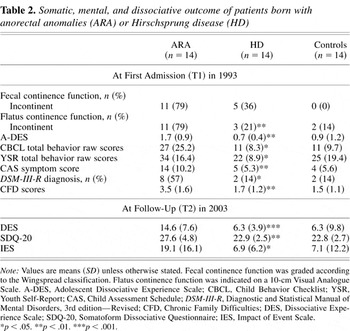
Indicators of fecal and flatus continence function in the patient groups are given in Table 2, and presented and discussed in detail elsewhere (Diseth & Emblem, 1996; Diseth et al., 1997).
Somatic, mental, and dissociative outcome of patients born with anorectal anomalies (ARA) or Hirschsprung disease (HD)

Dissociation and stress reactions
At T1, there was a significant difference between the ARA and HD patients in A-DES scores (p = .002), whereas the scores in the HD group were all comparable with the control group (Table 2). At T2, there was a persistent significant difference between the two patient groups in the DES scores (p = .001), SDQ-20 scores (p = .003), and IES scores (p = .014), whereas the HD group's scores were still comparable with the controls. Four (29%) ARA adolescents and no HD adolescents (χy2 = 4.5, df = 1, p = .034) scored beyond the cutoff point of 3.0 on the A-DES at T1, and three (21%) ARA adults and no HD adults (χy2 = 3.2, df = 1, p = .07) scored beyond the cutoff point of 25 on the DES at T2, indicating severe and persistent dissociative problems in the ARA group. There were no significant differences within the patient groups between A-DES scores at T1 and DES scores at T2 (p = .08). Three of the four ARA adolescents with A-DES scores beyond cutoff were the same three adult patients who had DES scores beyond cutoff (p = 1.0). Six (43%) of the ARA patients and one (7%) HD patient (χy2 = 5.14, df = 1, p = .023) had IES scores beyond cutoff, indicating severe and persistent posttraumatic stress symptoms. Gender, age, and sociodemographic characteristics did not correlate significantly with these dissociation and stress reaction scores.
Mental health and family outcome
The prevalence of psychiatric diagnoses, and mental health (CAS, CBCL, YSR) and family functioning (CFD) scores at T1, are given in Table 2. These findings have been presented previously and discussed elsewhere (Diseth & Emblem, 1996; Diseth et al., 1997). Significant differences were found between the ARA and HD groups in CAS symptom scores (p = .005), CBCL total scores (p = .043), YSR total scores (p = .033), and CFD scores (p = .003), whereas there were no differences between the HD and control groups, or between the continent and incontinent patient groups. Gender, age, and sociodemographic characteristics did not show a significant correlation with the mental health outcome. There were no significant differences in mental health or family function at T1 among the 28 patients who participated and the 8 patients who declined to participate in the follow-up (T2).
Associations between medical treatment procedures, somatic variables, and mental outcome
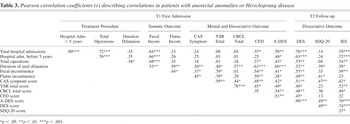
The bivariate analyses indicated significant associations between hospital admissions, invasive treatment procedures, bowel function, and mental health outcome in the ARA and HD group (n = 28) at both T1 and T2, as given in Table 3.
Pearson correlation coefficients (r) describing correlations in patients with anorectal anomalies or Hirschsprung disease

Medical treatment and dissociation
There were significant correlations between the number of hospital admissions, number of operations, duration of anal dilatation, bowel function, and family function, and the measures of psychological dissociation (A-DES at T1, DES at T2), somatoform dissociation (SDQ-20 at T2) and stress symptoms (IES at T2; Table 3). There were significant differences in A-DES scores (p = .001), DES scores (p = .005), SDQ-20 scores (p = .043), and IES scores (p = .042) between those patients who had had anal dilatations up to 2.5 years of age and those who had been dilatated for more than 2.5 years.
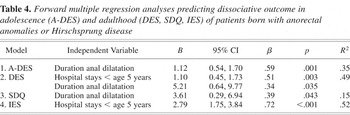
Forward multiple regression analyses were conducted to further investigate the relative importance of the independent treatment, somatic, and family variables in predicting dissociative symptoms as adolescents (A-DES) and later as adults (DES, SDQ-20, IES), as presented in Table 4. With the ARA and HD adolescents' A-DES scores at T1 as the dependent variable, the following significant explanatory variables were entered into the model: (a) treatment correlates (number of hospital admissions before age 5, number of operations, and duration of anal dilatation), (b) somatic correlates (fecal continence function and flatus continence function), and (c) family correlates (CFD). The only significant independent predictor of the adolescents' dissociative problems was the duration of anal dilatation, which explained 35% of the variance (p = .001; Table 4). The other treatment, somatic and family variables, did not contribute significantly to the explained variance of psychological dissociation in the adolescents.
Forward multiple regression analyses predicting dissociative outcome in adolescence (A-DES) and adulthood (DES, SDQ, IES) of patients born with anorectal anomalies or Hirschsprung disease

Further forward multiple regression analyses were conducted to examine the extent to which similar treatment, somatic and family variables, contributed significantly to psychological (DES) and somatoform (SDQ-20) dissociative symptoms, and posttraumatic stress symptoms (IES) in the now adult ARA and HD patients at T2. The most significant independent predictor of the dissociative symptoms in adults, as measured by the DES score, was the number of hospital admissions before 5 years of age, which explained 39% of the variance (p < .001). The duration of anal dilatation added another 10% units (p = .03; Table 4). Entering the somatic and family variables into the model did not significantly increase the explained variance of psychological dissociation in the adults. The only significant independent predictor of the SDQ-20 was the duration of anal dilatation, which explained 15% of the variance (p = .04; Table 4). The other treatment, somatic and family variables, did not contribute significantly to the explained variance of somatoform dissociation in the adults. The number of hospital admissions before age 5 was the only significant predictor of IES, explaining 52% of the variance (p < .001; Table 4).
Medical treatment and mental health and family outcomes
Several significant correlations were found between the duration of anal dilatation and mental health outcomes (CAS, YSR, CBCL) and family outcome (CFD) at T1 (Table 3). There were significant differences in CAS scores (p = .007), CBCL scores (p = .006), YSR scores (p = .050), and CFD scores (p < .001) between those patients who had had anal dilatations up to 2.5 years of age and those who had been dilatated for more than 2.5 years.
Forward multiple regression analyses were conducted to examine the extent to which treatment, somatic and family variables, contributed significantly to mental health outcomes at T1. The duration of anal dilatation was the only significant predictor of the CAS symptom scores, explaining 25% of the variance (B = 9.69, 95% confidence interval [CI] = 3.18, 16.20, p = .007), the only significant predictor of the YSR total score, explaining 34% of the variance (B = 18.69, 95% CI = 7.85, 29.53, p = .003), the best predictor of CBCL total score, accounting for 33% of the variance (B = 32.7, 95% CI = 17.01, 48.29, p = .001), together with the number of operations, which explained another 15% of the variance (B = 2.9, 95% CI = .54, 5.40, p = .03), and the only predictor of CFD score, accounting for 40% of the variance (B = 2.21, 95% CI = 1.18, 3.26, p < .001).
Dissociation and mental health outcomes
There were significant correlations between the measures of dissociation (A-DES, DES, SDQ-20, IES) and mental health outcomes (CAS, YSR, CBCL; Table 3). Forward multiple regression analysis was conducted to examine the extent to which the dissociative scores (A-DES) and the other mental health and family scores (YSR, CBCL, CFD) contributed significantly to the global mental health outcome score CAS. The most significant independent predictor of CAS was the A-DES score, which explained 49% of the variance (B = 12.64, 95% CI = 5.88, 32.04, p = .002). The YSR total score added another 10% units (B = .39, 95% CI = .03, .77, p = .04).
An examination of the relationship between dissociation as reported by adolescents (T1) and dissociative outcome as reported by adults (T2), revealed that the A-DES score at T1 was the best predictor of DES 10 years later, accounting for 79% of the variance (B = 9.96, 95% CI = 7.80, 12.12, p < .001), whereas the CAS score represented another 6% of the variance (B = .14, 95% CI = .04, .24, p = .01). Similar examination revealed that A-DES at T1 was the only significant predictor of SDQ-20 at T2 10 years later, explaining 34% of the variance (B = 3.19, 95% CI = 1.18, 5.22, p = .006).
Discussion
The experiment of nature afforded by this sample, offers a unique opportunity to study the effects of early, severe, and chronic traumatic experience on child development, and on later dissociative outcome in adolescence and adulthood. These congenital malformations involve multiple and long-lasting hospital stays and painful, stressful, and traumatic invasive medical treatment procedures so severe and chronic as to impede normal development. In contrast to sexual abuse, these children with congenital anorectal malformations could not be subjected to the traumatic medical treatment procedure randomly, and the traumatic procedures were conducted by the parents with very benign intentions and in absence of malevolence. As such, the findings might be valuable theoretically to our understanding of the development of psychopathology, and may lend itself for comparison with data on sexually abused children. The early onset, daily, repetitive, long-lasting, and invasive anal treatment procedure performed by the parents for years proved to be associated with the frequency and severity of mental health problems and dissociative symptoms. The duration of anal dilatation was the only significant predictor of both dissociative and mental health outcomes in adolescence, was still the only significant predictor of somatoform dissociative outcome in adults, and was one of two significant predictors of psychological dissociative outcome in adults. The results are similar to those indicative of a strong relationship between sexual and physical abuse and dissociation in children and adolescents (Kisiel & Lyons, 2001; Nijenhuis et al., 1996).
This long-term follow-up of two comparable groups of congenital malformations indicate an overrepresentation of mental and dissociative symptoms in the ARA group compared with the corresponding HD group, as well as with the control group of patients admitted to the hospital consecutively. The present study is the first one to report psychological and somatoform dissociative problems in children with chronic medical illnesses or congenital malformations, and the persistence of dissociative and posttraumatic stress symptoms into adulthood. The results correspond with findings that indicate a high frequency of dissociative symptoms in adolescent and adult psychiatric inpatients exposed to early, chronic childhood abuse or neglect (Brunner et al., 2000; Draijer & Langeland, 1999).
The relatively small number of patients in each group limits the general applicability of the findings. However, owing to the centralization of treatment of these low-frequency congenital anomalies, the present sample is representative of the Norwegian patient population. Soon after birth, all of them were admitted to the hospital for treatment and could not be subjected to the medical treatment procedure randomly. The repetitive invasive anal treatment procedures were for all the patients conducted by the parents under the strong recommendation and supervision of medical professionals. The two patient groups and the control group were all treated at the same hospital; were assessed using the same methods; and were comparable with regard to gender, age, and sociodemographic characteristics.
The findings suggest some risk factors that may explain the difference in dissociative outcomes for the patients with comparable anorectal malformations. Whereas dissociative symptoms in children, adolescent, and adult psychiatric inpatients were related to histories of early, chronic sexual and physical abuse, emotional and physical neglect, and stressful life events (Brunner et al., 2000; Chu et al., 1999; Draijer & Langeland, 1999; Kisiel & Lyons, 2001; Lange et al., 1999), in this study, dissociative symptoms were related to painful, stressful, and traumatic events in the medical environment. Although the literature on sexual abuse emphasizes the importance of the relationship and emotional closeness of the perpetrator (e.g., family vs. stranger), the type and severity of sexual abuse (e.g., penetration), and the chronicity (e.g., age at onset, frequency, and duration; Kendall-Tackett et al., 1993), many stressful events can occur as a result of chronic illnesses, some of which may be traumatic. Science does not yet know which events are likely to cause the symptoms of dissociative disorders, but the question has been the focus of recent research. It seems that medical procedures are cited as traumatic events more often than any other disease-related traumatic event (Stuber et al., 2003). Whereas PTSD symptoms were found to be related to life-saving medical procedures such as bone marrow and solid organ transplants, the chronic psychological and somatoform dissociative symptoms and posttraumatic stress symptoms in this study were related to repetitive, prolonged anal treatment procedures performed by the primary caregivers, and multiple, long-lasting early hospitalization.
Invasive painful medical treatment procedures and dissociative outcome
The most important predictor of dissociative outcome in adolescents and adults was the duration of the medically based, invasive, anorectal aftertreatment regime. At the median age of 7 months, children with HD were kept restrained and tied in bed for 5 days after an operation involving crushing clamps in the anorectum. In one-third of the HD children, a second procedure involving crushing clamps was performed at the average age of 1.5 years. The short-term, nonrepetitive restraint of the child was reported by parents to be unpleasant for the child and parents alike, but no significant dissociative problems were reported as adolescents or adults. In children with ARA, anal dilatations were performed once or twice daily by the parents until the children reached an average age of 4 years. The parents reported that the treatment had a traumatic effect on the children, causing power struggles and engendering parental guilt as a result of the discomfort and even pain inflicted on the child. Both the procedure itself and the children's reactions to it may have affected the attitude of the parents and the parent–child relationship.
The two medically based, invasive, anorectal, aftertreatment regimes differ in several important ways: whereas the invasive anal procedure involving surgical clamps in restrained HD patients represents a short-term trauma lasting for 5 days and usually not repeated, anal dilatation in ARA patients represents a chronic, repetitive long-term Type 2 trauma (Terr, 1991) repeated twice daily and continuing for years. Whereas the HD parents were given instruction and support about how to comfort and contain their children's stress and discomfort, spending 5 days constantly at their child's bedside, trying to distract and stimulate him or her in different ways, the ARA parents had to personally perform the anal dilatation procedure at home every day for 2–3 years. Anal dilatation became a chronic stressor for children and parents alike. Toddlers under the age of 3 often find it unpleasant to be laid down, and they may experience anal dilatation as painful because of anorectal muscle contractions as the dilatators are inserted into the anus, so the children struggle against their intrusive caregivers. The primary caregivers become the children's perpetrators, not out of malevolence but with very benign intentions because they were told by the surgeons of the medical necessity to perform this procedure.
In other words, the child's trauma is inflicted by caregivers or medical professionals, meaning it is not perceived as a disease entity that is outside human control. This view of trauma is consistent with other reports that show that traumatic experiences are reported in relation to events related to other important persons. Accordingly, they affect the template of interpersonal relationships. The trauma of anal dilatation is therefore a repeated event-type trauma (Glaser & Prior, 1997) due to a repeated unpleasant, painful, stressful, and traumatic medical treatment procedure, as well as a relationship-type trauma owing to the fact that it involves a treatment procedure “inflicted” by the primary caregivers on their child.
There is no consensus yet on the exact etiological pathway for the development of trauma-related dissociative symptomatology, but newer theoretical models stress impaired parent–child attachment patterns and trauma-based disruptions in the development of self and self-regulation. The possible consequences of daily dilatations performed for prolonged periods during early childhood by the parents may therefore be addressed from the viewpoint of attachment theory and self-development theory.
Attachment
A fundamental aspect of child development is attachment (Ainsworth, 1962; Bowlby, 1951), and it may be affected by maternal deprivation as well as emotional and physical child abuse and neglect. Newer theoretical models on development of dissociative symptomatology underline the use of an attachment framework in helping to understand both the nature of early childhood trauma's impact and its long-term sequelae (Liotti, 1999; Ogawa et al., 1997). Several studies (Brazelton & Als, 1979; Mahler, Pine, & Bergman, 1975; Stern 1985, 1995) have demonstrated that opportunities for establishing a strong, stable parent–infant relationship must be fostered during the first years of life by those who can relate to the child in a predictable, nurturing way. The child seeks to get closer to the primary caregiver on the assumption that he or she will be able to reduce discomfort, including pain and stress (Bowlby, 1969). According to the attachment theory, the primary function of early object relationships is to provide the infant with a sense of security in environments that induce fear. The child constructs internal working models of self and parent (Bowlby, 1988); models that begin to be formed in the middle of the first year of life. The quality of this attachment may be influenced by traumatic treatment procedures performed during this period, and such problems may affect parents' attitudes toward their children.
Meanwhile, the internal working models of the self and the parents can reinforce as well as modify the traumatization. A trauma does not necessarily affect a child that experiences itself as being protected, physically and psychologically, by an adequate parental relationship. However, a disrupted “protective shield” (Pynoos, 1993; Pynoos, Steinberg, & Goenjian, 1996) can alter a young child's reliance on parental efficacy and its faith in parental assurances of safety or security. In regard to the traumatic experience of surgical clamps in the HD children, the parents were still cast in the role of protectors. By way of contrast, the anal dilatation treatment procedure cast the parents in the role of perpetrators, that is, disruptors of the protective shield. In addition, when that protective shield is disrupted, the child's sense of being vulnerable and unprotected can be experienced as so frightening that he or she is not only overwhelmed by the genuine threat, but also by the very notion of a range of other potential threats and catastrophes. When the protective shield breaks, anything can happen. Traumatized children tend to confuse real traumatic experiences with the fearful flights of fantasy they can trigger. Thus, the most severe traumatic experiences are those inflicted by the persons who were expected to be protectors.
This disrupted attachment may represent a possible mechanism for the dissociative symptoms exhibited by the most affected children in this sample. In many respects the effects of attachment disruption on young children are similar to those of serious trauma. As attachment researchers investigated more high-risk samples; for example, among children with histories of physical or sexual abuse as well as neglect and family chaos, a new infant attachment category; that is, “disorganized–disoriented” attachment (Type D), was supplemented (Carlson, Cicchetti, Barnett, & Braunwald, 1989; Lyons-Ruth, Repacholi, McLeod, & Silva, 1991; Main & Hesse, 1990). For such infants, the caregiver is simultaneously a source of reassurance and a source of fear. Parental behavior is frightening or unpredictable with double messages; for example, smile and hug the child while inserting the anal dilator. A growing body of research suggests that children who have experienced trauma in their attachment relationships are especially prone to developing dissociative symptomatology. Reports hypothesize that infants classified as disorganized have had frightening or frightened experiences with their parents (Lyons-Ruth, Bronfman, & Parson, 1999; Main & Hesse, 1990). Recent data indicate that the infant Type D attachment predicts dissociative symptomatology during adolescence and early adulthood (Carlson, 1998; Liotti, 1992; Main, 1995; Ogawa et al., 1997). The daily invasive anal dilatation performed for prolonged periods by the parents may have resulted in a disorganized attachment pattern that creates a predisposition to a dissociative response.
Moreover, the age at which a chronic medical problem is diagnosed has been revealed to have a considerable impact on parental perceptions of adaptation to the medical problem (Drotar & Bush, 1985). Whereas the HD children and their parents had already established an all-important secure attachment relationship before the diagnosis was posed and the potentially traumatic and intrusive treatment procedure performed, this was not the case for the ARA patients. The diagnosis of HD was generally made weeks to months after birth. In this material, the median was 105 days. Consequently, most parents had experienced a healthy child in the neonatal period and had had time to establish that important first relationship. When hospitalized, the mother could accompany the HD child. These factors may have helped counteract other risk factors. In the ARA group, however, the anomaly was usually noted soon after birth, immediately engendering parental worries and anxieties. Discovery was often followed by a postpartum mother–child separation as the newborn was transferred to the National Hospital, underwent surgery, and was put on a course of invasive anal treatment procedures. Parental reports in the interviews indicate that early separation, the hospitalization of the newborns, and the immediate onset of potentially traumatic anal dilatation may have influenced the long-term parent–child relationship.
Last, young infants have not developed the capacity to regulate their own level of arousal and impulses. A primary attachment figure's interaction with the developing infant is normally characterized by sensitive response to the infant to regulate the affect, arousal, and behavior of the young infant. Another function of a secure attachment relationship is hypothesized to be the buffering or protecting of the developing brain from the potential deleterious effects of stress- or trauma-induced elevated cortisol on the brain during the protracted postnatal brain development (Gunnar, Brodersen, Nachmias, Buss, & Rigatuso, 1996; Sapolsky, 1996). One aspect of the risk entailed by anal dilatation may be the absence of the sensitive and protective interaction between the parents and young child. The development of these executive functions requires maturation of the frontal lobes from the end of the first year (Glaser, 2000).
Self-development
Developmental considerations are important for understanding children's reactions to this type of trauma. The toddler stage (ages 2–3) represents a “critical” age for important developmental tasks involving self-control and autonomy. According to psychodynamic theories of child development (Erikson, 1963, 1968), the anal region and its functions play a decisive role in psychosocial maturation and the development of self-control, self-confidence, and social functions associated with feelings of autonomy and pride. From the age of 18 months to 3 years (“the anal phase”), children begin to develop muscular control, including voluntary control of excretion. In regard to the risk of persistent fecal incontinence, ARA parents may tend to be overly focused on and overly sensitive about the anal region during this period (Diseth, Emblem, & Vandvik, 1995).
Furthermore, intrusive procedures in this “sensitive zone” during this developmental phase may be experienced as frightening; they evoke protests as well as painful muscular contractions. Consequently, unpleasant, often painful, anal dilatation in children with persistent problems with their continence function may influence the child's natural development of self-esteem, autonomy, and social activity, all factors of great import for mental health and psychosocial functioning. This hypothesis corresponds with previous findings of low global self-esteem, school competence, and social acceptance in ARA adolescents compared with adolescents with other chronic physical disorders (Aasland & Diseth, 1999). This hypothesis is also supported by the discovery of significant differences in A-DES, DES, SDQ-20, and IES scores in this sample between those who had anal dilatation up to 2.5 years of age and those who were treated with the procedure for more than 2.5 years.
Developmental differences also alter the type of response children have to trauma at different ages. A child's understanding of a traumatic experience, its degree of independence, and the complicated role a parent plays as the daily decision maker about painful medical treatment procedures hinge on the child's cognitive level. Depending on the child's cognitive level, it may not matter whether the perpetrator is truly helping the child or deliberately causing harm and pain.
Multiple early hospitalizations and dissociative outcome
The number of hospital admissions before age 5 was the most significant predictor of DES and IES in the patients at follow-up 10 years later. Parental reports from the ARA group indicate that multiple, long-lasting hospital stays during childhood influenced the long-term parent–child relationship. The sample was born in the late 1970s and early 1980s. At that time, rooming-in facilities and round the clock visitation for parents and siblings were not routine in Norway.
Based on attachment theory and research (Belsky & Cassidy, 1994; Bowlby, 1982; Koomen & Hoeksma, 1993; Rutter, 1995), it appears that children's actual experiences of interpersonal relationships are crucial to their psychological development, not least in terms of self-confidence, efficacy, self-worth, and intimate personal relationships. An infant's attachment to its caregiver becomes organized from the age of approximately 6 months. Studies in children of less than 5 years of age indicate an association between repeated hospitalizations and an increased risk of subsequent behavioral and emotional disturbance (Douglas, 1975; Quinton and Rutter 1976). A hospital admission of more than 1 week's duration or repeated admissions before the age of 5, particularly between the ages of 6 months and 4 years, are associated with an increased risk of behavioral disturbance in adolescence. This supports Bowlby's and Robertson's earlier studies on mother–child separations (Bowlby, 1951; Robertson & Robertson, 1971). Based on attachment theory, hospitalization can therefore be described as the decreased availability and constancy of the primary security giver at a time when the infant needs him or her most. This kind of impairment to an infant's confidence in its parent has been found to affect the parent–infant relationship, resulting in increased attachment behavior or avoidance behavior. In a study of children with cleft lip and palate, hospitalization led to avoidance behavior toward the mother (Koomen & Hoeksma, 1993). This avoidance behavior was thought to be related to recurrent stressful and painful medical experiences, combined with the decreased availability of the mother.
In this study, the specific traumatic treatment procedure was the only predictor of dissociative symptoms as adolescents, whereas the experience of hospital admissions, together with the traumatic treatment procedure, was the most significant predictor of dissociative and posttraumatic stress symptoms in the same patients as adults. One possible explanation is that at first admission, the adolescents were psychologically closer in age to the specific traumatic treatment procedure, whereas the adults' experience of the treatment of their anomaly is more nonspecific and globally connected to the hospital in general. Adult patients can better cope with their experiences of the traumatic treatment procedure, but for the adolescent, the experience is still so recent that coping is not yet possible.
Stability of the dissociative symptomatology
This study revealed a highly significant correlation between dissociative symptoms as reported first as adolescents, then as adults, and the A-DES was the best predictor of DES and SDQ-20 10 years later. Three of the four ARA adolescents with A-DES scores beyond the cutoff point were the same three patients who had DES scores beyond cutoff as adults. The only case with a high A-DES score not reflected in a high DES score as an adult, had contacted the hospital at age 17.5 for dissociative symptoms, and received combined cognitive and hypnotherapeutic trauma-specific psychotherapy (Phillips & Frederick, 1995).
A persistence or chronification of psychological and somatoform dissociative symptoms may have important clinical implications. Several studies have noted that dissociative disorders can go undetected for years or be the subject of numerous misdiagnoses (Steinberg, Rounsaville, & Cicchetti, 1991). The diagnosis and treatment of dissociative disorders can often be delayed for years because of difficulties in detecting patients at high risk. However, dissociation may be a critical mediator of mental health problems. This is in line with the previous report of the high frequency and severity of mental health problems in the ARA group (Diseth & Emblem, 1996) and the present study, which reveals that dissociative symptoms are the most significant predictor of the mental health outcome. This corresponds with the finding of dissociation as a mediator of psychopathology among sexually abused children and adolescents (Kisiel & Lyons, 2001). In dealing with children with chronic illnesses and malformations, one has to focus on, ask about, and screen for dissociative symptoms to address these aspects properly during treatment.
Studies conducted in pediatric care settings have shown that emotional trauma associated with medical illness is prevalent (Shemesh et al., 2003; Stuber et al., 1997) and is associated with a poor medical outcome. Active treatment of dissociative disorders and PTSD related to medical illness may improve the patients' outcome. One remaining question involves how to identify those who should contact the health care system for help. Screening for exposure to emotionally traumatic events and symptoms of dissociation and PTSD is not routine in pediatric care settings. One concern may be that patients who seek medical care may be reluctant to disclose or discuss emotionally traumatic events.
Conclusion
The experiment of nature afforded by this sample has permitted a specific and unique opportunity to examine the impact of early traumatic exposure on child development, and to test the hypotheses of cause and course of trauma-related dissociation. In contrast to sexual abuse, these children with congenital anorectal malformations could not be subjected to the traumatic medical treatment procedures randomly, and the traumatic intrusive procedures were conducted by the parents in absence of malevolence. As such, the findings might be valuable theoretically to our understanding of the development of psychopathology.
Research in the field of chronic childhood traumatization in a medical environment is also important for improving treatment procedures to reduce pain, stress, and trauma in hospitalized children. This study reveals that children born with ARA are at risk of traumatization. The findings suggest that the invasive, stressful, and often painful anal treatment procedures performed by parents over a period of years may represent traumatization with a long-term negative and severe impact on child development. To achieve overall optimal quality of life, the challenge is to find a compromise between physically optimal treatment procedures and procedures that are not psychological detrimental. Over the past year, new medical treatment protocols and procedures have been introduced at the two Norwegian hospitals that now treat this group of patients. In every case, the indication for anal dilatation is now carefully discussed by a multiprofessional team. Treatment involving years of anal dilatation as a routine treatment procedure has now been brought to an end. If indicated, the procedure is performed for not more than 6–9 months. Where indicated, it is performed on the basis of less painful and embarrassing procedures, for example, using anesthetics, accompanied by relaxation and distraction techniques, and by using parent substitutes to perform the procedures (nurses, outpatient clinics). Where more supportive interventions are required, psychosocial experts are included in the health care teams early in the treatment to work with the children and their families.
There is still much ignorance or, at best, discussions, about dissociative disorders in general. The criticism against today's perception of dissociative disorders has focused on these disorders as iatrogenic and epidemic. The material in this study may curb some of this discussion and lend itself for comparison with data on sexually abused children. This study eliminates any doubt about whether repeated, long-term traumatization performed by caregivers has a long-lasting impact on the children's development. In this material one cannot question the traumatic experiences; all the traumatic procedures described here have been conducted under the supervision of medical professionals and reported in hospital medical records.
References
REFERENCES
Aasland, A., &
Diseth, T. H.
(1999).
Can the Harter self-perception profile for adolescents (SPPA) be
used as an indicator of psychosocial outcome in adolescents with chronic
physical disorder?
European Child and Adolescent Psychiatry,
8,
78–85.Google Scholar
Achenbach, T. M.
(1991).
Manual for the Child Behavior Checklist and 1991 profile.
Burlington, VT:
University of Vermont, Department of Psychiatry.
Achenbach, T. M., &
Edelbrock, C. S.
(1987).
Manual for the Youth Self-Report and Profile.
Burlington, VT:
University of Vermont, Department of Psychiatry.
Ainsworth, M. D. S.
(1962).
The effects of maternal deprivation: A review of findings and
controversy in the context of research strategy. In
Deprivation of maternal care: A reassessment of its effects.
Geneva:
World Health Organization.
Altman, D. G.
(1991).
Practical statistics for medical research.
London:
Chapman & Hall.
American Psychiatric Association.
(1994).
Diagnostic and statistical manual of mental disorders
(4th ed.).
Washington, DC:
Author.
Armstrong, J. G.,
Putnam, F. W.,
Carlson, E. B.,
Libero, D. Z., &
Smith, S. R.
(1997).
Development and validation of a measure of adolescent dissociation:
The Adolescent Dissociative Experience Scale.
The Journal of Nervous and Mental Disease,
185,
491–497.Google Scholar
Belsky, J., &
Cassidy, J.
(1994).
Attachment: Theory and evidence. In
M. Rutter &
D. F. Hay (Eds.),
Development through life. A handbook for clinicians.
Oxford:
Blackwell Scientific.
Bernstein, E. M., &
Putnam, F. W.
(1986).
Development, reliability, and validity of a dissociation
scale.
The Journal of Nervous and Mental Disease,
174,
727–735.Google Scholar
Bowlby, J.
(1951).
Maternal care and mental health
(Monograph series, No. 2).
Geneva:
World Health Organization.
Bowlby, J.
(1969).
Attachment.
London:
Hogarth Press.
Bowlby, J.
(1982).
Attachment and loss: Vol. 1. Attachment
(2nd ed.).
New York:
Basic Books.
Bowlby, J.
(1988).
A secure base: Clinical applications of attachment theory.
London:
Routledge.
Brazelton, B., &
Als, H.
(1979).
Four early stages in the development of mother–infant
interaction.
The Psychoanalytic Study of the Child,
34,
349–369.Google Scholar
Brunner, R.,
Parzer, P.,
Schuld, V., &
Resch, F.
(2000).
Dissociative symptomatology and traumatogenic factors in adolescent
psychiatric patients.
The Journal of Nervous and Mental Disease,
188,
71–77.Google Scholar
Carlson, E. A.
(1998).
A prospective longitudinal study of disorganized/disoriented
attachment.
Child Development,
69,
1107–1128.Google Scholar
Carlson, E. B., &
Putnam, F. W.
(1993).
An update on the dissociative experience scale.
Dissociation,
6,
16–27.Google Scholar
Carlson, E. B.,
Putnam, F. W.,
Ross, C. A.,
Torem, M.,
Coons, P., &
Loewenstein, R. J.
(1993).
Validity of the dissociative experience scale: A multicenter
study.
The American Journal of Psychiatry,
150,
1030–1036.Google Scholar
Carlson, V.,
Cicchetti, D.,
Barnett, D., &
Braunwald, K.
(1989).
Disorganized/disoriented attachment relationships in maltreated
infants.
Developmental Psychology,
25,
525–531.Google Scholar
Chu, J. A.,
Frey, L. M.,
Ganzel, B. L., &
Matthews, J. A.
(1999).
Memories of childhood abuse: Dissociation, amnesia, and
corroboration.
The American Journal of Psychiatry,
156,
749–755.Google Scholar
Cicchetti, D.
(2003).
Experiments of nature: Contribution to developmental theory
[Editorial].
Development and Psychopathology,
15,
833–835.Google Scholar
Cicchetti, D., &
Cohen, D. J.
(1995).
Developmental psychopathology.
New York:
Wiley–Interscience.
Cicchetti, D., &
Toth, S.
(1995).
Child maltreatment and attachment organization: Implication for
intervention. In
S. Goldberg,
R. Muir, &
J. Kerr (Eds.),
Attachment theory: Social, developmental, and clinical
perspectives (pp.
279–308).
London:
Analytical Press.
Diseth, T. H.,
Bjørnland, K.,
Nøvik, T. S., &
Emblem, R.
(1997).
Bowel function, mental health and psychosocial function in
adolescents with Hirschsprung's disease.
Archives of Disease in Childhood,
76,
100–106.Google Scholar
Diseth, T. H.,
Egeland, T., &
Emblem, R.
(1998).
Effects of anal invasive treatment and incontinence on mental health
and psychosocial functioning of adolescents with Hirschsprung's
disease and low anorectal anomalies.
Journal of Pediatric Surgery,
33,
468–475.Google Scholar
Diseth, T. H., &
Emblem, R.
(1996).
Somatic function, mental health and psychosocial adjustment of
adolescents with anorectal anomalies.
Journal of Pediatric Surgery,
31,
638–643.Google Scholar
Diseth, T. H.,
Emblem, R., &
Vandvik, I. H.
(1995).
Adolescents with anorectal malformations and their families:
Examples of hidden psychosocial trauma.
Family Systems Medicine,
13,
215–231.Google Scholar
Douglas, J. W. B.
(1975).
Early hospital admission and later disturbances of behavior and
learning.
Developmental Medicine and Child Neurology,
17,
456–480.Google Scholar
Draijer, N., &
Langeland, W.
(1999).
Childhood trauma and perceived parental dysfunction in the etiology
of dissociative symptoms in psychiatric inpatients.
The American Journal of Psychiatry,
156,
379–385.Google Scholar
Drotar, D., &
Bush, M.
(1985).
Mental health issues and services. In
N. Hobbs &
J. M. Perrin (Eds.),
Issues in the care of children with chronic illness.
San Francisco, CA:
Jossey–Bass.
Erikson, E. H.
(1963).
Childhood and society.
New York:
W.W. Norton & Company.
Erikson, E. H.
(1968).
Identity youth and crisis.
New York:
W.W. Norton & Company.
Glaser, D.
(2000).
Child abuse and neglect and the brain.
Journal of Child Psychology and Psychiatry,
41,
97–116.Google Scholar
Glaser, D., &
Prior, V.
(1997).
Is the term child protection applicable to emotional abuse?
Child Abuse Review,
6,
315–329.Google Scholar
Grabe, H. J.,
Spitzer, C., &
Freyberger, H. J.
(1999).
Relationship of dissociation to temperament and character in men and
women.
The American Journal of Psychiatry,
156,
1811–1813.Google Scholar
Gunnar, M.,
Brodersen, L.,
Nachmias, M.,
Buss, K., &
Rigatuso, J.
(1996).
Stress reactivity and attachment security.
Developmental Psychobiology,
29,
191–204.Google Scholar
Hodges, K.,
McKnew, D.,
Cytryn, L.,
Stern, L., &
Kline, J.
(1982).
The Child Assessment Schedule (CAS) diagnostic interview: A report
on reliability and validity.
Journal of the American Academy of Child Psychiatry,
21,
468–473.Google Scholar
Horowitz, M.,
Wilner, N., &
Alvarez, W.
(1979).
Impact of Events Scale: A measure of subjective distress.
Psychosomatic Medicine,
41,
207–218.Google Scholar
Joseph, S.
(2000).
Psychometric evaluation of the Impact of Events Scale: A
review.
Journal of Traumatic Stress,
13,
101–113.Google Scholar
Kendall-Tackett, K. A.,
Williams, L. M., &
Finkelhor, D.
(1993).
Impact of sexual abuse on children: A review and synthesis of recent
empirical studies.
Psychological Bulletin,
113,
164–180.Google Scholar
Kisiel, C. L., &
Lyons, J. S.
(2001).
Dissociation as a mediator of psychopathology among sexually abused
children and adolescents.
The American Journal of Psychiatry,
158,
1034–1039.Google Scholar
Kleinbaum, D.,
Kupper, L., &
Muller, K.
(1988).
Applied regression analysis and other multivariable methods
(2nd ed.).
Boston:
PWS-KENT Publishing Company.
Koomen, H. M. Y., &
Hoeksma, J. B.
(1993).
Early hospitalization and disturbances of infant behavior and the
mother–infant relationship.
Journal of Child Psychology and Psychiatry,
34,
917–934.Google Scholar
Lange, A.,
de Beurs, E.,
Dolan, C.,
Lachnit, T.,
Sjollema, S., &
Hanewald, G.
(1999).
Long-term effects of childhood sexual abuse: Objective and
subjective characteristics of the abuse and psychopathology in later
life.
The Journal of Nervous and Mental Disease,
187,
150–158.Google Scholar
Liotti, G.
(1992).
Disorganized/disoriented attachment in the etiology of the
dissociative disorders.
Dissociation,
5,
196–204.Google Scholar
Liotti, G.
(1999).
Disorganization of attachment as a model of understanding
dissociative psychopathology. In
J. Solomon &
C. George (Eds.),
Attachment disorganization (pp.
291–317).
New York:
Guilford Press.
Lyons-Ruth, K.,
Bronfman, E., &
Parson, E.
(1999).
Maternal frightened, frightening, or atypical behavior and
disorganized infant attachment patterns.
Monographs of the Society for Research in Child Development,
64,
67–96.Google Scholar
Lyons-Ruth, K.,
Repacholi, B.,
McLeod, S., &
Silva, E.
(1991).
Disorganized attachment behavior in infancy: Short-term stability,
maternal and infant correlates, and risk-related subtypes.
Development and Psychopathology,
3,
377–396.Google Scholar
Macfie, J.,
Cicchetti, D., &
Toth, S. L.
(2001).
Dissociation in maltreated versus nonmaltreated preschool-aged
children.
Child Abuse and Neglect,
25,
1253–1267.Google Scholar
Maclean, K.
(2003).
The impact of institutionalization on child development.
Development and Psychopathology,
15,
853–884.Google Scholar
Mahler, M. S.,
Pine, F., &
Bergman, A.
(1975).
The psychological birth of the human infant. Symbiosis and
individuation.
London:
Hutchinson.
Main, M.
(1995).
Recent studies in attachment: Overview, with selected implications
for clinical work. In
S. Goldberg,
R. Muir, &
J. Kerr (Eds.),
Attachment theory: Social, developmental, and clinical
perspectives (pp.
407–474).
Hillsdale, NJ:
Analytic Press.
Main, M., &
Hesse, E.
(1990).
Parents' unresolved traumatic experiences are related to
infant disorganized attachment status: Is frightened and/or
frightening parental behavior the linking mechanism? In
M. T. Greenberg,
D. Cicchetti, &
E. M. Cummings (Eds.),
Attachment in the preschool years: Theory, research, and
intervention (pp.
161–182).
Chicago:
University of Chicago Press.
Manly, J. T.,
Kim, J. E.,
Rogosch, F. A., &
Cicchetti, D.
(2001).
Dimensions of child maltreatment and children's adjustment:
Contributions of developmental timing and subtype.
Development and Psychopathology,
13,
759–782.Google Scholar
McCullagh, P., &
Nelder, J. A.
(1989).
Models for continuous data with constant variance. In
P. McCullagh &
J. A. Nelder (Eds.),
Generalized linear models
(2nd ed., pp.
48–97).
London:
Chapman & Hall.
Mulder, R. T.,
Beautrais, A. L.,
Joyce, P. R., &
Fergusson, D. M.
(1998).
Relationship between dissociation, childhood sexual abuse, childhood
physical abuse, and mental illness in a general population sample.
The American Journal of Psychiatry,
155,
806–811.Google Scholar
Nijenhuis, E. R.,
Spinhoven, P.,
Van Dyck, R.,
Van der Hart, O., &
Vanderlinden, J.
(1996).
The development and the psychometric characteristics of the
Somatoform Dissociation Questionnaire (SDQ-20).
The Journal of Nervous and Mental Disease,
184,
688–694.Google Scholar
Nijenhuis, E. R.,
Spinhoven, P.,
Van Dyck, R.,
Van der Hart, O., &
Vanderlinden, J.
(1998).
Psychometric characteristics of the Somatoform Dissociation
Questionnaire: A replication study.
Psychotherapy and Psychosomatics,
67,
17–23.Google Scholar
Ogawa, J. R.,
Sroufe, L. A.,
Weinfield, N. S.,
Carlson, E. A., &
Egeland, B.
(1997).
Development and the fragmented self: Longitudinal study of
dissociative symptomatology in a nonclinical sample.
Development and Psychopathology,
9,
855–879.Google Scholar
Phillips, M., &
Frederick, C.
(1995).
Healing the divided self: Clinical and Ericksonian hypnotherapy for
post-traumatic and dissociative conditions.
New York:
W.W. Norton.
Putnam, F. W.
(1997).
Dissociation in children and adolescents. A developmental
perspective (pp.
180–198).
New York:
Guilford Press.
Pynoos, R. S.
(1993).
Traumatic stress and developmental psychopathology in children and
adolescents. In
J. Oldham,
M. Riba, &
A. Tasman (Eds.),
American Psychiatric Press review of psychiatry
(Vol. 12, pp.
205–238).
Washington, DC:
American Psychiatric Association.
Pynoos, R. S.,
Steinberg, A. M., &
Goenjian, A. K.
(1996).
Traumatic stress in childhood and adolescence. Recent developments
and current controversies. In
B. A. van der Kolk,
A. C. McFarlane, &
L. Weisaeth (Eds.),
Traumatic stress. The effects of overwhelming experience on mind,
body and society (pp.
331–358).
New York:
Guilford Press.
Quinton, D., &
Rutter, M.
(1976).
Early hospital admission and later disturbances of behavior: An
attempted replication of Douglas' findings.
Developmental Medicine and Child Neurology,
18,
447–459.Google Scholar
Robertson, J., &
Robertson, J.
(1971).
Young children in brief separation: A fresh look.
The Psychoanalytic Study of the Child,
26,
264–315.Google Scholar
Rutter, M.
(1995).
Clinical implications of attachment concepts: Retrospect and
prospect.
Journal of Child Psychology and Psychiatry,
36,
549–571.Google Scholar
Shemesh, E.,
Keshavarz, R.,
Leichtling, N. K.,
Weinberg, E.,
Mousavi, A.,
Sadow, K.,
et al.
(2003).
Pediatric emergency department assessment of psychological trauma
and posttraumatic stress.
Psychiatric Services,
54,
1277–1281.Google Scholar
Simeon, D.,
Guralnik, O.,
Schmeidler, J.,
Sirof, B., &
Knutelska, M.
(2001).
The role of childhood interpersonal trauma in depersonalization
disorder.
The American Journal of Psychiatry,
158,
1027–1033.Google Scholar
Smith, S. R., &
Carlson, E. B.
(1996).
Reliability and validity of the Adolescent Dissociative Experience
Scale.
Dissociation,
9,
125–129.Google Scholar
Steinberg, M.,
Rounsaville, B., &
Cicchetti, D.
(1991).
Detection of dissociative disorders in psychiatric patients by a
screening instrument and a structured diagnostic interview.
The American Journal of Psychiatry,
148,
1050–1054.Google Scholar
Stern, D. N.
(1985).
The interpersonal world of the infant.
New York:
Basic Books.
Stern, D. N.
(1995).
The motherhood constellation: A unified view of parent–infant
psychotherapy.
New York:
Basic Books.
Stuber, M. L.,
Kazak, A. E.,
Meeske, K.,
Barakat, L.,
Guthrie, D.,
Garnier, H.,
et al.
(1997).
Predictors of posttraumatic stress symptoms in childhood cancer
survivors.
Pediatrics,
100,
958–964.Google Scholar
Stuber, M. L.,
Shemesh, E., &
Saxe, G. N.
(2003).
Posttraumatic stress responses in children with life-threatening
illnesses.
Child and Adolescent Psychiatric Clinics of North America,
12,
195–209.Google Scholar
Taylor, E. A.
(1986).
The overactive child. In
E. A. Taylor (Ed.),
Clinics in developmental medicine
(Vol. 97).
Oxford:
Blackwell Scientific.
Terr, L. C.
(1991).
Childhood traumas: An outline and overview.
American Journal of Psychiatry,
148,
10–20.Google Scholar
van der Kolk, B. A.
(1994).
The body keeps the score: Memory and the evolving psychobiology of
posttraumatic stress.
Harvard Review of Psychiatry,
1,
253–265.Google Scholar
Vandvik, I. H.,
Høyeraal, H. M., &
Fagertun, H.
(1989).
Chronic family difficulties and stressful life events in recent
onset juvenile arthritis.
Journal of Rheumatology,
16,
1088–1092.Google Scholar
Wohlfarth, T. D.,
Winkel, F. W.,
van den Brink, W., &
ter Smitten, M.
(2003).
Screening for posttraumatic stress disorder: An evaluation of two
self-report scales among crime victims.
Psychological Assessment,
15,
101–109.Google Scholar
Sample characteristics, hospital admissions, and after-treatment procedures in patients with anorectal anomalies (ARA) or Hirschsprung disease (HD)
Somatic, mental, and dissociative outcome of patients born with anorectal anomalies (ARA) or Hirschsprung disease (HD)
Pearson correlation coefficients (r) describing correlations in patients with anorectal anomalies or Hirschsprung disease
Forward multiple regression analyses predicting dissociative outcome in adolescence (A-DES) and adulthood (DES, SDQ, IES) of patients born with anorectal anomalies or Hirschsprung disease
 You have
Access
- 82
- Cited by