








1 Introduction
1.1 Background
The Poincaré recurrence theorem (see, for example, [Reference Einsiedler and Ward5, Theorem 2.11]) is one of the most fundamental results in ergodic theory, and it asserts that for a metric measure-preserving system
$(X,{\mathrm {dist}},\mathcal {B},\mu ,T)$
 (that is,
$(X,{\mathrm {dist}})$
 is a metric space,
$\mathcal {B}$
 is a Borel
$\sigma $
 -algebra of the metric space X,
$T:X\to X$
 is a measurable function, and
$\mu $
 is a T-invariant probability measure) with countable base,
$\mu $
 -almost all points return close to themselves under the iterations of T in the sense that

(here and hereafter
${\mathrm {dist}}(\circ ,\circ )$
 denotes the usual Euclidean distance when
$X=[0,1]$
 ).
A closely related topic is the shrinking target problem, which studies the orbits accumulating near a given point. In any metric measure-preserving system
$(X,{\mathrm {dist}},\mathcal {B},\mu ,T)$
 where T is ergodic, by Birkhoff’s ergodic theorem (see, for example, [Reference Einsiedler and Ward5, Theorem 2.30]), for any fixed target
$y\in {\mathsf {Supp}}\ \mu $
 , the orbit of a
$\mu $
 -generic point accumulates around y; namely,

In particular, in [Reference Philipp12] Philipp focused on the shrinking targets in the following systems.
System I. Let
$\gamma>1$
 . We have
$T:[0,1]\to [0,1],x\mapsto \gamma x \text { mod } 1$
 .
System II. We have

with the usual distances and invariant Borel measures
$\mu $
 . The sets
$\mathfrak {A}(y)$
 of points whose orbits accumulate around a fixed point y are of interest in Diophantine number theory.
For example, it is well known (see, for example, [Reference Khinchin8, Theorem 23]) that the set of badly approximable numbers

is equal to the set of numbers whose denominators of the partial quotients in their continued fraction expansions are bounded, namely
$\mathfrak {A}(0)^{\mathsf {C}}$
 in System II; that is,

where
$(X,T)$
 is defined as in System II. The results in [Reference Philipp12] are actually stronger; they concern sets
$\overline {\mathfrak {A}}(y,\psi ):=\limsup _{n\to \infty }\{x\in X:\, {\mathrm {dist}} (T^nx,y)<\psi (n)\}$
 for a positive sequence
$\psi $
 . Analogous results for recurrence concerning the sets
$\overline {\mathfrak {R}}(\psi ):=\limsup _{n\to \infty }\{x\in X:\, {\mathrm {dist}} (T^nx,x)<\psi (n)\}$
 can be found in [Reference Hussain, Li, Simmons and Wang7] and that for twisted recurrence can be found in [Reference Kleinbock and Zheng10].
Moreover, let
$\gamma>1$
 be an integer. A real number x is called normal to base
$\gamma $
 if for any interval
$I\subset [0,1]$
 with
$\gamma $
 -adic rational endpoints and the Lebesgue measure
${\mathsf {Leb}}$
 ,

where
$(X,T)$
 is defined as in System I. Equivalently, a number x is normal to
$\gamma $
 if and only if every word of n digits from
$\{0,1,\ldots ,b-1\}$
 occurs in the
$\gamma $
 -expansion of x with asymptotic frequency of
${1}/{\gamma ^n}$
 as
$n\to \infty $
 . In System I, every number in
$\mathfrak {A}(0)^{\mathsf {C}}$
 has a uniform bound on the number of consecutive digit-
$0$
 in its base-
$\gamma $
 expansion. Clearly, such numbers are not normal, so
$\mathfrak {A}(0)^{\mathsf {C}} \subset \mathfrak {BA}$
 .
In addition, classic results (see [Reference Schmidt14]) have shown the following theorem.
Theorem 1.
-
(1) The Hausdorff dimension of $\mathfrak {A}(y)^{\mathsf {C}}$
 in System I is equal to
$1$
for all
$y\in [0,1]$
.
-
(2) The Hausdorff dimension of $\mathfrak {A}(0)^{\mathsf {C}}$
in System II is equal to
$1$
.


In particular, Theorem 1 implies that
$\mathfrak {BA}$
 and the collection of numbers not normal to a fixed integer base
$\gamma $
 have full Hausdorff dimension.
An upgrade to Theorem 1 is to consider the subset’s winning property in Schmidt’s game, which was introduced in [Reference Schmidt13]. Schmidt [Reference Schmidt13] showed the following result.
Theorem 2.
-
(1) For all integers $\gamma>1$
, the set
$\mathfrak {A}(y)^{\mathsf {C}}$
in System I is
$\alpha $
-winning for all
$y\in [0,1]$
and for all
$\alpha \in (0,\tfrac 12)$
. -
(2) The set $\mathfrak {A}(0)^{\mathsf {C}}$
in System II is
$\alpha $
-winning for all
$\alpha \in (0,\tfrac 12)$
.


We will define
$\alpha $
 -winning in §2. This property is strictly stronger than full Hausdorff dimension (see [Reference Schmidt13]), so Theorem 2 strengthens Theorem 1. Note the fact proved by Schmidt [Reference Schmidt13] that a countable intersection of
$\alpha $
 -winning sets is also
$\alpha $
 -winning, so the collection of numbers normal to no base is also
$\alpha $
 -winning for all
$0<\alpha <1/2$
 and in particular it has Hausdorff dimension
$1$
 as a consequence.
A modification of Schmidt’s game was introduced by McMullen in [Reference McMullen11] which has since been referred to as McMullen’s game.
Theorem 3.
-
(1) For all integers $\gamma>1$
, the set
$\mathfrak {A}(y)^{\mathsf {C}}$
in System I is absolute winning for all
$y\in [0,1]$
. -
(2) The set $\mathfrak {A}(0)^{\mathsf {C}}$
in System II is
$\beta $
-absolute winning for all
$\beta \in (0,\tfrac 13)$
.


We will define
$\beta $
 -absolute winning and absolute winning in §2. A set is called absolute winning if it is
$\beta $
 -absolute-winning for all
$\beta \in (0,\tfrac 13)$
 , and this property is strictly stronger than
$\alpha $
 -winning for all
$\alpha \in (0,\tfrac 12)$
 (see [Reference McMullen11]), so Theorem 3 strengthens Theorem 2.
1.2 Main results
Given a metric measure-preserving system
$(X,{\mathrm {dist}},\mathcal {B},\mu ,T)$
 , an effort to unify the settings of recurrence and shrinking targets is to consider a twist, namely a Borel measurable function
$f:X\to X$
 . For a sequence of Borel-measurable functions
$(f_n:X\to X)_n$
 , define the set of
$(f_n)_n$
 -twisted badly-approximable points for T by

The recurrence and shrinking targets settings correspond to the twists
$(f_n:X\to X)_n$
 being the identity functions and constant functions, respectively. It was shown in [Reference Kleinbock and Zheng10, Corollary 2.4] that if T is ergodic and
$\mu $
 has dense support in X, then
$\mathfrak {BA}((f_n)_n)$
 has
$\mu $
 -measure
$0$
 . However, our result will show that
$\mathfrak {BA}((f_n)_n)$
 is ‘big’ in terms of its fractal dimensions and games, despite being null in invariant measures. Here is our main result.
Theorem 4. In Systems I and II, for any equicontinuous sequence of functions
$(f_n:[0,1]\to [0,1])_n$
 , the set
$\mathfrak {BA}((f_n)_n)$
 is
$\beta $
 -absolute winning for all
$\beta \in (0,\tfrac 13)$
 .
The structure of the paper is as follows. In §2, we will introduce Schmidt’s game and McMullen’s game, and some important properties of winning sets in either game. In §3, we will prove the main result, Theorem 4, by induction: in §3.1, we will set up the notation and definitions that we will use throughout the proof, and the inductive hypotheses will be established; in §§3.2 and 3.3, we will construct the strategies for
$\beta $
 -winning in McMullen’s game for all
$\beta \in (0,\tfrac 13)$
 for System I and System II respectively, and the inductive hypothesis will be verified; in §3.4, we will finish the proof.
2 Schmidt’s game and McMullen’s absolute game
For this article to be self-contained, we define Schmidt’s game and McMullen’s game, which are used to state Theorems 2 and 3 and our main result, Theorem 4. Let
$(X,d)$
 be a complete metric space.
For any pair
$(z,\rho )\in X\times (0,\infty )$
 , define the closed ball
$B(z,\rho )$
 to be the set

Schmidt’s game was first introduced by Schmidt in [Reference Schmidt13] and since then this infinite game has been used as a notion of fractal dimensions (see, for example, [Reference Broderick, Bugeaud, Fishman, Kleinbock and Weiss1, Reference Broderick, Fishman and Kleinbock2, Reference Dani4, Reference Fishman6, Reference Kleinbock and Weiss9, Reference Tseng15]). To define Schmidt’s game, let
$\alpha ,\beta \in (0,1)$
 be constants. Consider two players
${\mathsf {Alice}}$
 and
${\mathsf {Bob}}$
 .
${\mathsf {Bob}}$
 and
${\mathsf {Alice}}$
 take turns to pick closed balls
$B_k$
 and
$A_k$
 respectively, such that

and

A subset S of X is called:
-
• $(\alpha ,\beta )$
-winning, given constants
$\alpha ,\beta \in (0,1)$
, if
${\mathsf {Alice}}$
can always set up her plays, regardless of how
${\mathsf {Bob}}$
plays, so that
$\bigcap _{k=1}^\infty B_k\cap S\neq \varnothing $
; -
• $\alpha $
-winning, given a constant
$\alpha \in (0,1)$
, if S is
$(\alpha ,\beta )$
-winning for all
$\beta \in (0,1)$
; and -
• winning if S is $\alpha $
-winning for some
$\alpha \in (0,1)$
.


It is easy to observe that the following proposition holds.
Proposition 1. If
$S\subset X$
 is winning, then S is dense in X.
$\alpha $
 -winning in Schmidt’s game is stable under taking countable intersections; specifically, we have the following result.
Proposition 2. For all
$\alpha \in (0,1)$
 , the countable intersection of
$\alpha $
 -winning sets is
$\alpha $
 -winning.
For a proof of Proposition 2, see, for example, [Reference Schmidt13, Theorem 2].
Winning properties in Schmidt’s game also imply full Hausdorff dimensions in Ahlfors regular measure spaces. For a constant
$s>0$
 , a probability measure
$\mu $
 of X is called Ahlfors s-regular if there are positive constants
$\rho _{\mathrm {max}}$
 and K such that, for all
$(z,\rho )\in X\times (0,\rho _{\mathrm {max}}),$


The space X is called Ahlfors s-regular if it is equal to the support of an Ahlfors s-regular probability measure. The following result is very well known (see, for example, [Reference Kleinbock and Weiss9, Proposition 5.1]).
Proposition 3. Let
$s>0$
 . Suppose
$(X,d)$
 is an Ahlfors s-regular metric space. If
$S\subset X$
 is winning, then the Hausdorff dimension of S is s.
McMullen introduced a variation of an infinite game like Schmidt’s game in [Reference McMullen11]. To define McMullen’s game, let
$\beta \in (0,1/3)$
 be a constant. Again, consider two players
${\mathsf {Alice}}$
 and
${\mathsf {Bob}}$
 .
${\mathsf {Bob}}$
 and
${\mathsf {Alice}}$
 take turns to pick closed balls
$B_k$
 and
$A_k$
 respectively, such that

and

A subset S of X is called
$\beta $
 -absolute-winning, given a constant
$\beta \in (0,\tfrac 13)$
 , if
${\mathsf {Alice}}$
 can always set up her plays, regardless of how
${\mathsf {Bob}}$
 plays, so that
$\bigcap _{k=1}^\infty B_k\cap S\neq \varnothing $
 .
It is very obvious that winning in McMullen’s game is stronger than winning in Schmidt’s game, as in McMullen’s game one may view
${\mathsf {Alice}}$
 ’s moves as merely blocking one of
${\mathsf {Bob}}$
 ’s possible moves, so
${\mathsf {Alice}}$
 has very little control over the states of the game. In particular, (see [Reference McMullen11]), if a set S is
$\beta $
 -absolute winning for every
$\beta \in (0,\tfrac 13)$
 , then we say S is absolute winning.
Proposition 4. If a subset S is absolute winning, then S is
$\alpha $
 -winning in Schmidt’s game for all
$\alpha \in (0,\tfrac 12)$
 .
Therefore, from Theorem 4, we immediately have the following corollary.
Corollary 1. In Systems I and II, for any equicontinuous sequence of functions
$(f_n:[0,1]\to [0,1])_n$
 , the set
$\mathfrak {BA}((f_n)_n)$
 is
$\alpha $
 -winning (in Schmidt’s game) for all
$\alpha \in (0,\tfrac 12)$
 .
Furthermore, a set S is called thick if for all non-empty open set U, the Hausdorff dimension of
$S \cap U$
 is equal to
$1$
 , see [Reference Kleinbock and Weiss9]. Consequently,
Corollary 2. In Systems I and II, for any equicontinuous sequence of functions
$(f_n:[0,1]\to [0,1])_n$
 , the set
$\mathfrak {BA}((f_n)_n)$
 has local Hausdorff dimension
$1$
 .
3 Proof of Theorem 4
3.1 Setup and inductive hypothesis
Let
$\beta \in (0,\tfrac 13]$
 . We will supply
${\mathsf {Alice}}$
 with a winning strategy for each system.
First, we define the following terms.
-
• A point $z\in [0,1]$
is called an nth-order vertex (also denoted by vertex
$^{(n)}$
) if
$z\in T^{-n}(0)$
. -
• An interval is called an nth-order cylinder (also denoted by cylinder $^{(n)}$
) if its endpoints are two consecutive (ordered by the natural order of real numbers) vertices
$^{(n)}$
.


Remark. Note that:
-
• $T^n$
is injective on any cylinder
$^{(n)}$
; and -
• given a subset of $[0,1]$
, one can count how many cylinders
$^{(n)}$
it intersects by counting how many vertices
$^{(n)}$
are contained in it; for example, if a set does not contain any vertex
$^{(n)}$
, then it is included in a cylinder
$^{(n)}$
.


Denote the balls chosen by
${\mathsf {Bob}}$
 by

and those chosen by
${\mathsf {Alice}}$
 by

where the natural number
$k_n$
 will be defined over the course of the proof. We will call the superscript ‘
$(n)$
 ’ the ‘levels’ n, and we call
$B_k^{(n)}$
 the kth round in the nth level, with this level starting from
$B_1^{(n)}$
 . The idea of levels is that for a
$\mathsf {Bob}$
 ’s ball
$B_\ell $
 ,
$\mathsf {Alice}$
 responds to
$B_\ell $
 on the nth level if
$T^{n-1}$
 is injective on
$B_\ell $
 and
$T^{n-1}B_\ell $
 is not contained in any first-order cylinder. Solely for notational purposes, we will allow zero and negative indices for these balls; for example,
$B_{0}^{(n)}$
 is the ball one round before
$B_{1}^{(n)}$
 and
$B_{-5}^{(n)}$
 is the ball six rounds before
$B_{1}^{(n)}$
 .
Remark (Levels versus rounds).
The levels introduced in this section are a bookkeeping device to keep track of the number of iterations of applying the map T, and each level is a block (possibly empty) of the rounds of McMullen’s game introduced in §2. In the notation
$B_k^{(n)}$
 , the superscript n records the level, and the subscript k records the round within that level. See an explicit example of the correspondence between levels and rounds in the remark immediately following the statement of the strategy for System I.
-
• For all $n\geq 1$
, a point
$z\in [0,1]$
is called an nth-order *-vertex (denoted by *-vertex
$^{(n)}$
) if
$z\in T^{-(n-1)}(f_{n-1}(c^{(n-1)}))$
where
$c^{(n-1)}$
is the center of
$B_1^{(n-1)}$
. -
• Denote the collection of the *-vertices of order less than or equal to n by $\mathcal {S}^{(n)}$
. -
• Denote the diameter of $B_k^{(n)}$
by
$\tau _k^{(n)}$
, denote the radius of
$B_k^{(n)}$
by
$r_k^{(n)}$
, and denote the diameter of
$T^{n-1}B_k^{(n)}$
by
$\rho _k^{(n)}$
.


In both proofs, we will verify that the following hypotheses hold for all
$n\in \mathbb {N}$
 . Let
$\rho>0$
 and
$\unicode{x3bb}>0$
 be constants that will be specified in the strategies.
Statement 1.
-
• In System I, a natural number n (which will be later referred to as the ‘nth level’) can be categorized into one of the three types.
-
– Type I: Level n is said to be of Type I if $B_1^{(n)}$
does not contain any vertex
$^{(n)}$
. -
– Type II: Level n is said to be of Type II if the interior of $B_1^{(n)}$
does not contain any vertex
$^{(n-1)}$
,
$T^{n-1}B_1^{(n)}$
contains exactly one vertex
$^{(1)}$
and
${\mathrm {diam}}(T^{n-1}B_1^{(n)})< ({\rho }/{\gamma })$
. -
– Type III: Level n is said to be of Type III if the interior of $B_1^{(n)}$
does not contain any vertex
$^{(n-1)}$
,
$T^{n-1}B_1^{(n)}$
contains at least one vertex
$^{(1)}$
and
${\mathrm {diam}}(T^{n-1}B_1^{(n)})\geq ({\rho }/{\gamma })$
.
-
-
• In System II, level n belongs to one of the three types.
-
– Type I: Level n is said to be of Type I if $B_1^{(n)}$
does not contain any vertex
$^{(n)}$
. -
– Type II: Level n is said to be of Type II if the interior of $B_1^{(n)}$
does not contain any vertex
$^{(n-1)}$
,
$T^{n-1}B_1^{(n)}$
contains exactly one vertex
$^{(1)}$
, and
${\mathrm {diam}}(T^{n-1}B_1^{(n)})<({\beta ^2}/({25(N^{(n)})^2}))$
where
${1}/{N^{(n)}}$
is the vertex
$^{(1)}$
in
$T^{n-1}B_1^{(n)}$
. -
– Type III: Level n is said to be of Type III if the interior of $B_1^{(n)}$
does not contain any vertex
$^{(n-1)}$
,
$T^{n-1}B_1^{(n)}$
contains at least one vertex
$^{(1)}$
, and
${\mathrm {diam}}(T^{n-1}B_1^{(n)})\geq ({\beta ^2}/({25(N^{(n)})^2}))$
where
${1}/{N^{(n)}}$
is the rightmost vertex
$^{(1)}$
in
$T^{n-1}B_1^{(n)}$
.
-


Denote by
$J^{(n)}$
 the last appearance of a Type III level before level n; that is,

Statement 2. We have
$\rho _1^{(n)} \geq \begin {cases} \rho & \text {if there is a Type II level after the last Type III level and before level }n; \\ \beta \rho & \text {otherwise}. \end {cases}$

Statement 3.
For all Type III levels
$n,m$
 and
$m-n\geq \unicode{x3bb} $
 , there must exist some
$n<k<m$
 such that level k is of Type III.

To prove Statement 3 holds for all
$m,n$
 , we will need the following lemma.
Lemma 2. For all natural numbers
$n,m$
 with
$1\leq n<m$
 , if levels
$n,m$
 belong to Type II, then there exists some natural number k in
$(n,m)$
 such that level k is of Type III.
We claim that under the given strategy, the following property holds.
Proposition 5. There exists some
$\delta>0$
 such that for all
$n>1$
 and for all
$x\in B_{1}^{(n+1)}$
 , one has that

3.2 Construction of strategy, I
Let
$\rho =\beta \cdot \min \{\rho _1^{(1)}, \rho _\#\}$
 , where
$\rho _\#$
 is a positive solution to

and
$\unicode{x3bb} =(({-\log \rho -\log \beta })/{\log \gamma })+1$
 .
The base case for Lemma 1 easily holds.
Let
$M\in \mathbb {N}\backslash \{0\}$
 . We make the following assumption.

Next, we state the strategy for
${\mathsf {Alice}}$
 .
Case I: If the nth level is of Type I, then
${\mathsf {Alice}}$
 relabels
$B_1^{(n)}$
 by
$B_1^{(n+1)}$
 . Note that this ‘action’ of relabeling by
${\mathsf {Alice}}$
 does not alter the state of the game.
Case II: If the nth level is of Type II, then
${\mathsf {Alice}}$
 takes
$A_1^{(n)}=B(v^{(n)},\beta \cdot \tau _1^{(n)})$
 , where
$v^{(n)}$
 is the vertex
$^{(n)}$
 in
$B_1^{(n)}$
 , and then
${\mathsf {Alice}}$
 relabels
$B_2^{(n)}$
 by
$B_1^{(n+1)}$
 .
Case III: Suppose that the nth level is of Type III. Denote the collection of the *-vertices of order less than or equal to n by
$\mathcal {S}^{(n)}$
 . We will see that by induction
$|\mathcal {S}^{(n-1)}\cap B_1^{(n)}|\leq \unicode{x3bb} $
 . For all
$k\geq 1$
 , we ask
${\mathsf {Alice}}$
 to take the center of
$A_k^{(n)}$
 to be

with the maximal allowed radii
$\beta \cdot r_k^{(n)}$
 , until the time

we denote the smallest k such that
${\mathrm {diam}}(B_k^{(n)})<({\rho }/{\gamma })$
 by
$L^{(1)}$
 . Note that it takes at most
$\lceil {\log \unicode{x3bb} }/{\log 2}\rceil $
 rounds for
$\mathsf {Alice}$
 to remove all the points in
$\mathcal {S}^{(n-1)}\cap B_1^{(n)}$
 , so

Note that all cylinders contained
$T^{n-1}B_1^{(n)}\subset [0,1]$
 have diameter
${1}/{\gamma }$
 , so
$B_{H^{(n)}}^{(n)}$
 contains at most one vertex
$^{(n)}$
 and two *-vertices
$^{(n)}$
 .
$\mathsf {Alice}$
 removes these in two turns. Then

so as a consequence, for all
$x\in B_1^{(n+1)}\subset B_{H^{(n)}+2}^{(n)}\backslash A_{H^{(n)}+2}^{(n)})$
 , one has

In addition, we have

Remark (Levels versus rounds).
We make the correspondence of levels and rounds explicit by counting the number of rounds in each type of levels in the following table. Denote by
$k_n$
 the number of moves
$\mathsf {Alice}$
 makes while the strategy is in level n (or equivalently, the number of rounds in level n). Then we have:

A Type I level n performs a pure relabeling process and does not advance the game, so
$k_n=0$
 there. In the notation of §2, we have that

For example, suppose that the strategy produces, in order, a Type I level, a Type III level with
$H^{(2)}=3$
 , a Type II level, and a Type I level. The bookkeeping unfolds as follows:

Now we verify our hypotheses hold in the progression.
Proof of Lemma 1 for System I.
For Statement 1, note that if a ball B contains two vertices
$^{(n)}$
 , then the diameter of
$T^{n-1}B$
 is at least
${1}/{\gamma }$
 , so if
$B_1^{(n)}$
 contains a vertex
$^{(n)}$
 (not of Type I), then either it contains exactly one vertex
$^{(n)}$
 (of Type II) or
$T^{n-1}B_1^{(n)}\geq ({1}/{\gamma })$
 (of Type III).
By assuming Statements 2 and 3 for
$n<M$
 , if level
$(M-1)$
 is Type III, then Statement 2 for
$n=M$
 follows immediately from (5). Recall that

We now prove Lemma 2 for this system and then use it to show Statement 3 holds.
Proof of Lemma 2 for System I.
Assume the contrary; suppose there are two consecutive Type II levels
$n,m$
 with
$n<m$
 without any intermediate Type III level. Then
$B_1^{(n)}$
 contains a vertex
$^{(n)}\, v_1$
 and a vertex
$^{(m)}\, v_2$
 , which are distinct. Then

contradicting that level m is Type II.
Then by Lemma 2, there is at most one Type II level between level
$J^{(M)}$
 and level M. Then

Since Statement 3 is assumed for all
$0<n<M$
 , by the expanding property of T, note that for all
$0<n<M$
 ,

then
$T^{\lceil \unicode{x3bb} \rceil } B_1^{(n)}=[0,1]$
 since its diameter exceeds
$1$
 , meaning that within
$\unicode{x3bb} $
 levels any Type III level
$(n)$
 , there must be another Type III level and proving Statement 3 for all n.
From (4), we finally obtain the most crucial result: Proposition 5. We will finish our proof of Theorem 4 in §3.4.
3.3 Construction of strategy, II
Before we start our statement of the strategy, we state two well-known properties of System II.
Lemma 3. (Expanding property for System II)
There exists a constant
$R>0$
 such that for all positive
$n\in \mathbb {N}$
 and for all
$x\in (0,1)$
 ,

For the remainder of the paper, we denote
$\psi :=(({1+\sqrt {5}})/{2})^2$
 .
Proof. From [Reference Khinchin8, Ch. 1, §2], in view of the notation in this book, the denominators of the convergents satisfy the recurrence relation

together with the facts that
$a_n\geq 1$
 for all n, so
$q_n$
 is greater than or equal to the nth Fibonacci number, and hence
$q_n\geq \psi ^{n/2}$
 . By the mean value theorem, the diameter of a cylinder
$^{(n)}$
 cannot be less than
${1}/{|D_xT^n|}$
 . The diameter of a cylinder
$^{(n)}$
 is
${1}/({q_n(q_n+q_{n-1})})$
 , so the lemma is proved.
Lemma 4. (Bounded distortion for System II)
For all positive
$n\in \mathbb {N}$
 and for all
$x,y$
 in an nth-order cylinder,

Lemma 4 is also well known (see, for example, [Reference Cornfeld, Fomin and Sinăi3, §7.4, Lemma 2]).
Let
$\rho _\#,\unicode{x3bb} $
 be positive solutions to the system

One can simply take
$\unicode{x3bb} $
 large enough such that

and
$\rho _\#$
 to be any number in
$(({4}/{R\beta })\cdot \psi ^{1-\unicode{x3bb} },({1}/{50})\cdot (\beta /4)^{({\log \unicode{x3bb} }/{\log 2})+6})$
 . Let
$\rho =\min \{\rho _1^{(1)},\rho _\#\}$
 .
The base case for Lemma 1 easily holds.
Let
$M\in \mathbb {N}\backslash \{0\}$
 . We make the following assumption.

Next, we state the strategy for
${\mathsf {Alice}}$
 .Case I: If the nth level is of Type I, then
${\mathsf {Alice}}$
 relabels
$B_1^{(n)}$
 by
$B_1^{(n+1)}$
 .
Case II: If the nth level is of Type II, then
${\mathsf {Alice}}$
 takes
$A_1^{(n)}=B(v^{(n)},\beta \cdot r_1^{(n)})$
 , where
$v^{(n)}$
 is the vertex
$^{(n)}$
 in
$B_1^{(n)}$
 and
$r_1^{(n)}$
 is the radius of
$B_1^{(n)}$
 , and then
${\mathsf {Alice}}$
 relabels
$B_2^{(n)}$
 by
$B_1^{(n+1)}$
 .
Case III: Suppose that the nth level is of Type III.
${\mathsf {Alice}}$
 first selects
$A_1^{(n)}$
 with radius
$\beta \cdot {\mathrm {radius}}(B_1^{(n)})$
 so that
$T^{n-1}A_1^{(n)}$
 is placed as far to the left as possible in
$T^{n-1}B_1^{(n)}$
 . Note that

in particular, we can conclude that

In Case III, we need to consider the following subcases.
-
• Subcase 1: Suppose $\underline {B_1^{(n)}\backslash A_1^{(n)}}$
contains zero or one vertex
$\underline {{}^{(n)}}$
, say
$\underline { v^{(n)}}$
. By induction,
$|\mathcal {S}^{(n-1)}\cap B_1^{(n)}|\leq \unicode{x3bb} $
. Then
$B_2^{(n)}$
contains at most
$\unicode{x3bb} $
*-vertices from
$\mathcal {S}^{(n-1)}$
, where we denote the collection of the *-vertices of order less than or equal to n by
$\mathcal {S}^{(n)}$
.
${\mathsf {Alice}}$
then selects each
$A_k^{(n)}$
in
$A_2^{(n)},\ldots ,A_{1+\lceil \log _2(\unicode{x3bb} +2)\rceil }^{(n)}$
with the maximal radii allowed and first centered at
$v^{(n)}$
and then centered at the *-vertices in
$\mathcal {S}^{(n-1)}\cap B_2^{(n)}$
if
$\mathcal {S}^{(n-1)}\cap B_k^{(n)}\neq \varnothing $
, and centered at the center of
$B_k^{(n)}$
if
$\mathcal {S}^{(n-1)}\cap B_k^{(n)}=\varnothing $
. Consequently, for all
$S^{(n)}<k<n$
where
$S^{(n)}$
is the last appeared Type III level, we have (8) $$ \begin{align} {\mathrm{dist}}&\ (T^{k-1}B_{2+\lceil\log_2(\unicode{x3bb}+2)\rceil}^{(n)},T^{-1}(f_k(c^{(k)})))\nonumber\\[6pt] & \geq \tfrac{1}{4}\cdot {\mathrm{radius}}(T^{k-1}A_{1+\lceil\log_2(\unicode{x3bb}+2)\rceil}^{(n)}) \nonumber\\[6pt] & \geq \tfrac{1}{4}\cdot \beta^{1+\lceil\log_2(\unicode{x3bb}+2)\rceil}\cdot \rho_1^{(k)} \nonumber\\[6pt] & \geq \tfrac{1}{4}\cdot \beta^{1+\lceil\log_2(\unicode{x3bb}+2)\rceil}\cdot \rho. \end{align} $$Consequently, for all $x\in B_1^{(n)}=B_{2+\lceil \log _2(\unicode{x3bb} +2)\rceil }^{(n)}$
, one has (9) $$ \begin{align} {\mathrm{dist}}\ (T^k x, f_k(c^{(k)}))\geq \tfrac{1}{4}\cdot \beta^{1+\lceil\log_2(\unicode{x3bb}+2)\rceil}\cdot \rho.\\[-22pt]\nonumber \end{align} $$Note that $B_2^{(n)}$
does not contain any vertices
$^{(n)}$
, so it contains at most one *-vertex
$^{(n)}$
;
${\mathsf {Alice}}$
centers
$A_{2+\lceil \log _2(\unicode{x3bb} +2)\rceil }$
at this *-vertex
$^{(n)}$
with maximal radius. Consequently, we obtain (10) $$ \begin{align} {\mathrm{dist}}\ (T^n x, f_n(c^{(n)}))\geq \tfrac{1}{4}\cdot \beta^{2+\lceil\log_2(\unicode{x3bb}+2)\rceil}\cdot \rho.\\[-16pt]\nonumber \end{align} $$Then ${\mathsf {Alice}}$
relabels
$B_{3+\lceil \log _2(\unicode{x3bb} +2)\rceil }^{(n)}$
by
$B_1^{(n+1)}$
. Note that (11) $$ \begin{align} {\mathrm{diam}}\ (T^{n-1}B_1^{(n+1)})&= {\mathrm{diam}}\ (T^{n-1}B_{3+\lceil\log_2(\unicode{x3bb}+2)\rceil}^{(n)})\notag \\[6pt] & \geq {\mathrm{diam}}\ (T^{n-1}B_1^{(n)})\cdot \beta^{3+\lceil\log_2(\unicode{x3bb}+2)\rceil}\notag \\[6pt] & \geq \frac{1}{4(N^{(n)})^2}\cdot \beta^{3+\lceil\log_2(\unicode{x3bb}+2)\rceil}. \end{align} $$On the other hand, since the ball $T^{n-1}B_1^{(n+1)}$
does not contain any vertices
$^{(1)}$
,
$T^{n-1}B_1^{(n+1)}$
is included in a cylinder
$J^{(n)}$
of order
$1$
. Since
$J^{(n)}$
is to the left of the cylinder
$^{(1)}\, [{1}/{N^{(n)}},{1}/({N^{(n)}-1})]$
, its diameter will not exceed that of
$[{1}/{N^{(n)}},{1}/({N^{(n)}-1})]$
; hence
${\mathrm {diam}}(J^{(n)})\leq ({1}/({N^{(n)}(N^{(n)}-1)}))\leq ({2}/{(N^{(n)})^2})$
, so together with the bounded distortion property (Lemma 4) and (11), we have that (12) $$ \begin{align} \rho_1^{(n+1)}=\frac{{\mathrm{diam}}\ (T^{n}B_1^{(n+1)})}{{\mathrm{diam}}([0,1])}& \geq \bigg[\frac{{\mathrm{diam}} (T^{n-1}B_1^{(n+1)})}{{\mathrm{diam}}(J^{(n)})}\bigg]\cdot \frac{1}{4}\notag \\[6pt]&\hspace{-1.5pt} \overset{(11)}{\geq} \bigg[\frac{1}{4(N^{(n)})^2}\cdot \beta^{3+\lceil\log_2(\unicode{x3bb}+2)\rceil} \bigg/ {\mathrm{diam}}(J^{(n)})\bigg]\cdot \frac{1}{4}\notag \\[6pt]& \geq \bigg[\frac{1}{4(N^{(n)})^2}\cdot \beta^{3+\lceil\log_2(\unicode{x3bb}+2)\rceil} \bigg/ \frac{2}{(N^{(n)})^2}\bigg]\cdot \frac{1}{4}\notag\\[6pt]&= \frac{\beta^{3+\lceil\log_2(\unicode{x3bb}+2)\rceil}}{32} \end{align} $$
(13) $$ \begin{align} &\overset{(6)}{\geq} \rho. \end{align} $$
-
• Subcase 2: Suppose ${B_1^{(n)}\backslash A_1^{(1)}}$
contains more than one vertex
${{}^{(n)}.}$
Let
${1}/{K^{(n)}}$
be the leftmost vertex
$^{(1)}$
in
$T^{n-1}(B_1^{(n)}\backslash A_1^{(n)})$
. Since
$T^{n-1}(A_1^{(n)})$
is the leftmost subinterval of
$T^{n-1}(B_1^{(n)})$
and the length of
$T^{n-1}(A_1^{(n)})$
is at least
$({\beta }/{4})\cdot \rho _1^{(n)}$
by Lemma 4, so
$({1}/{K^{(n)}})>({\beta }/{4})\cdot \rho _1^{(n)}$
. Consequently, we have $$ \begin{align*} \frac{1}{N^{(n)}}-\frac{1}{K^{(n)}}< {\mathrm{diam}}(T^{n-1}B_1^{(n)})=\rho_1^{(n)}<\frac{4}{\beta}\cdot \frac{1}{K^{(n)}}, \end{align*} $$so
(14) $$ \begin{align} \frac{1}{N^{(n)}}<\bigg(1+\frac{4}{\beta}\bigg)\cdot \frac{1}{K^{(n)}}. \end{align} $$Since $B_1^{(n)}$
does not contain any vertex
$^{(n-1)}$
, it contains at most
$\unicode{x3bb} $
*-vertices of order strictly less than n. Then
${\mathsf {Alice}}$
takes the radius of
$A_k^{(n)}$
to be
$\beta \cdot r_k^{(n)}$
(maximal allowed radius) and its center to be $$ \begin{align*} \begin{cases} \text{an element of }\mathcal{S}^{(n-1)}\cap B_k^{(n)}& \text{if }B_k^{(n)}\cap \mathcal{S}^{(n-1)}\neq\varnothing ,\\ \text{the center of }B_k^{(n)} & \text{if }B_k^{(n)}\cap \mathcal{S}^{(n-1)}=\varnothing, \end{cases} \end{align*} $$until the time (until ${\mathsf {Alice}}$
’s turn
$A_{H^{(n)}}^{(n)}$
) (15) $$ \begin{align} H^{(n)}:= \min \bigg\{k:\, k> |\mathcal{S}^{(n)}|+1 \text{ and } {\mathrm{diam}}(T^{n-1}B_k^{(n)})<\frac{\beta^2}{25(N^{(n)})^2} \bigg\}; \end{align} $$we denote the smallest k for which ${\mathrm {diam}}(T^{n-1}B_k^{(n)})<({\beta ^2}/({25(N^{(n)})^2}))$
by
$L^{(n)}$
. It is easy to observe that
$H^{(n)}\leq L^{(n)}+\lceil {\log \unicode{x3bb} }/{\log 2}\rceil $
. In addition, for all cylinders
$^{(1)}\, J$
contained in
$T^{n-1}(B_1^{(n)}\backslash A_1^{(n)})$
, the cylinder J is contained in
$[{1}/{K^{(n)}},{1}/{N^{(n)}}]$
. By (14), in particular,
$({1}/{N^{(n)}})<(1+4/\beta )\cdot ({1}/{K^{(n)}})<(5/\beta )\cdot ({1}/{K^{(n)}})$
so
$[{1}/{K^{(n)}},{1}/{N^{(n)}}]\subset [{\beta /5}/{N^{(n)}},{1}/{N^{(n)}}]$
, and hence $$ \begin{align*} \frac{\beta}{5N^{(n)}}\cdot \frac{\beta}{5N^{(n)}}<{\mathrm{diam}}(J)<\frac{1}{N^{(n)}}\cdot \frac{1}{N^{(n)}}, \end{align*} $$and hence $B_{L^{(n)}}^{(n)}$
does not contain any cylinder
$^{(n)}$
. Therefore,
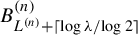
$B_{L^{(n)}+\lceil {\log \unicode{x3bb} }/{\log 2}\rceil }^{(n)}$
contains at most one vertex
$^{(n)}$
, say
$v^{(n)}$
, and at most two *-vertices
$^{(n)}$
, say
$s_1^{(n)},s_2^{(n)}$
, which
$\mathsf {Alice}$
will remove from the game as centers of
$A_{H^{(n)}+1}$
and
$A_{H^{(n)}+2}$
; that is,
$A_{H^{(n)}+1}=B(v^{(n)},\beta \rho _{H^{(n)}+1}^{(n)})$
and
$A_{H^{(n)}+2}=B(s_i^{(n)},\beta \rho _{H^{(n)}+2}^{(n)})$
where
$s_i^{(n)}\in B_{H^{(n)}+1}\backslash A_{H^{(n)}+1}$
.
Then ${\mathsf {Alice}}$
relabels
$B_{H^{(n)}+3}^{(n)}$
by
$B_1^{(n+1)}$
. We find $$ \begin{align*} {\mathrm{dist}}(T^{n-1}B_1^{(n+1)},f_n(c^{(n)}))& \geq {\mathrm{dist}}(T^{n-1}(B_{H^{(n)}+2}^{(n)}\backslash A_{H^{(n)}+2}^{(n)}),f_n(c^{(n)}))\\[6pt] & \geq \frac{1}{4}\cdot {\mathrm{radius}}(T^{n-1}A_{L^{(n)}+\lceil{\log\unicode{x3bb}}/{\log 2}\rceil+2})\\[6pt] & \geq \beta^{\lceil{\log\unicode{x3bb}}/{\log 2}\rceil+4}\cdot {\mathrm{radius}}(T^{n-1}B_{L^{(n)}-1}^{(n)})\\ & \geq \beta^{\lceil{\log\unicode{x3bb}}/{\log 2}\rceil+4}\cdot \frac{\beta^2}{50(N^{(n)})^2}\\ &\overset{(7)}{\geq} \frac{\beta^{\lceil{\log\unicode{x3bb}}/{\log 2}\rceil+6}}{50}\cdot (\rho_1^{(n)}/2)^2\\[6pt] &\overset{\text{Statement 2}}{\geq } \frac{\beta^{\lceil{\log\unicode{x3bb}}/{\log 2}\rceil+6}}{50}\cdot (\rho\beta/2)^2. \end{align*} $$In addition, for all $S^{(n)}<k< n$
, we have that $$ \begin{align*} {\mathrm{dist}}(T^{k-1}B_1^{(n+1)},f_k(c^{(k)})) & \geq {\mathrm{dist}}(T^{k-1} B_{\lceil\log\unicode{x3bb}/\log 2\rceil}^{(J^{(n)}+1)},f_k(c^{(k)}))\\[6pt] & \geq {\mathrm{radius}}(T^{k-1}A_{\lceil\log\unicode{x3bb}/\log 2\rceil+1}^{(J^{(n)}+1)})\\[6pt] & \geq \tfrac{1}{4}\cdot {\mathrm{radius}} (T^{k-1}A_1^{(J^{(n)}+1)})\cdot \beta^{\lceil\log\unicode{x3bb}/\log 2\rceil}\\[6pt] & \geq \tfrac{1}{4}\cdot {\mathrm{radius}} (T^{J^{(n)}}A_1^{(J^{(n)}+1)})\cdot \beta^{\lceil\log\unicode{x3bb}/\log 2\rceil}\\[6pt] & \geq \tfrac{1}{16}\cdot {\mathrm{radius}} (T^{(J^{(n)})}B_1^{(J^{(n)}+1)})\cdot \beta^{\lceil\log\unicode{x3bb}/\log 2\rceil+1}\\[6pt] & \overset{\text{Statement 2}}{\geq} \tfrac{1}{16}\cdot \beta\rho\cdot \beta^{\lceil\log\unicode{x3bb}/\log 2\rceil+1}. \end{align*} $$Consequently, for all $x\in B_1^{(n+1)}$
and for all
$S^{(n)}<k\leq n$
, we have (16) $$ \begin{align} {\mathrm{dist}}(T^{k-1}x,f_{k-1}(c^{(k)}))&\geq \min \bigg\{\frac{\beta^{\lceil{\log\unicode{x3bb}}/{\log 2}\rceil+6}}{50}\cdot (\rho\beta/2)^2,\frac{1}{16}\notag\\[6pt] &\qquad\qquad \cdot \beta\rho\cdot \beta^{\lceil\log\unicode{x3bb}/\log 2\rceil+1}\bigg\}.\\[-20pt]\nonumber \end{align} $$Finally, note that
$$ \begin{align*} \rho_1^{(n+1)}& = {\text{diam}}(T^nB_1^{(n+1)})\\[3pt] & \geq \dfrac{1}{4} \cdot \beta\cdot {\mathrm{diam}}(T^{n}B_{H^{(n)}+2})\\[3pt] & = \dfrac{1}{4} \cdot \beta \cdot {\mathrm{diam}} (T^{n}B_{(L^{(n)}-1)+\lceil {\log \unicode{x3bb}}/{\log 2}\rceil+3})\\ & \geq \dfrac{1}{4} \cdot \beta \cdot {\mathrm{diam}}(B_{(L^{(n)}-1)+\lceil {\log \unicode{x3bb}}/{\log 2}\rceil+3})\cdot \dfrac{1}{R}\cdot \psi^{n-1}\\ & \geq 4^{-\lceil {\log \unicode{x3bb}}/{\log 2}\rceil+3}\cdot \beta^{\lceil {\log \unicode{x3bb}}/{\log 2}\rceil+4}\cdot {\mathrm{diam}}(T^{n}B_{L^{(n)}-1}^{(n)}). \end{align*} $$Note that $T^{n-1}B_{L^{(n)}-1}^{(n)}$
is included in a cylinder
$J^{(1)}$
of order
$1$
with diameter not exceeding that of
$[{1}/{N^{(n)}},{1}/({N^{(n)}-1})]$
and
${\mathrm {diam}}(J^{(1)})=({1}/({N^{(n)}(N^{(n)}-1)}))\leq ({2}/({(N^{(n)})^2}))$
. Hence, by Lemma 4, we have (17) $$ \begin{align} \rho_1^{(n+1)} &= \frac{{\mathrm{diam}}(T^n B_1^{(n+1)})}{{\mathrm{diam}}([0,1])}\notag \\ & \geq [{\mathrm{diam}}(T^{n-1}B_1^{(n+1)})/{\mathrm{diam}}(J^{(1)})]\cdot \frac{1}{4}\notag \\ & \geq [(1/4)^{\lceil {\log \unicode{x3bb}}/{\log 2}\rceil+4}\cdot \beta^{\lceil {\log \unicode{x3bb}}/{\log 2}\rceil+4}\cdot {\mathrm{diam}}(T^{n-1}B_{L^{(n)}-1}^{(n)})/{\mathrm{diam}}(J^{(1)})]\cdot \frac{1}{4}\notag \\ & \geq \bigg[\frac{\beta^2}{25(N^{(n)})^2}\bigg/{\mathrm{diam}}(J^{(1)})\bigg]\cdot (1/4)^{\lceil {\log \unicode{x3bb}}/{\log 2}\rceil+4}\cdot \beta^{\lceil {\log \unicode{x3bb}}/{\log 2}\rceil+4}\cdot \frac{1}{4}\notag \\[6pt] & \geq \bigg[\frac{\beta^2}{25(N^{(n)})^2}\bigg/\frac{2}{(N^{(n)})^2}\bigg]\cdot (1/4)^{\lceil {\log \unicode{x3bb}}/{\log 2}\rceil+4}\cdot \beta^{\lceil {\log \unicode{x3bb}}/{\log 2}\rceil+4}\cdot \frac{1}{4} \end{align} $$
(18) $$ \begin{align} &= \frac{1}{50}\cdot 4^{-\lceil {\log \unicode{x3bb}}/{\log 2}\rceil-5}\cdot \beta^{\lceil {\log \unicode{x3bb}}/{\log 2}\rceil+6}\notag \\[6pt] & \overset{(6)}{\geq} \rho. \end{align} $$







Now we verify our hypotheses hold in the progression.
We first prove Lemma 2 for this system and then use it to show Statement 3 holds.
Proof of Lemma 1 for System II.
For Statement 1, note that if a ball B contains two vertices
$^{(n)}$
 ,
$T^{n-1}B$
 contains a cylinder of order n, so
${\mathrm {diam}}(T^{n-1}B)\geq ({1}/({N^{(n)}(N^{(n)}+1)}))$
 where
${1}/{N^{(n)}}$
 is the rightmost vertex
$^{(1)}$
 in
$T^{n-1}B$
 . Hence, if
$B_1^{(n)}$
 is not of Type I, then either it is Type II, or
${\mathrm {diam}}\ (T^{n-1}B_1^{(n)})\geq ({1}/({N^{(n)}(N^{(n)}+1)}))\geq ({\beta ^2}/({4(N^{(n)})^2}))$
 (of Type III).
By assuming Statements 2 and 3 for
$n<M$
 , if level
$(M-1)$
 is Type III, then Statement 2 for
$n=M$
 follows immediately from (13) and (18). Next, we show that Lemma 2 also holds for System II.
Proof of Lemma 2 for II.
Assume the contrary; suppose there are two consecutive Type II levels, say n and m with
$n<m$
 , without any intermediate Type III level. Since
$n,m$
 are consecutive Type II levels without any intermediate Type III level, we know that
$B_2^{(n)}=B_1^{(n+1)}=B_1^{(m)}$
 . Let
$v_1$
 be the vertex
$^{(n)}$
 in
$B_1^{(n)}$
 and let
$v_2$
 be the vertex
$^{(m)}$
 in
$B_1^{(m)}$
 ; denote
$N_1:=({1}/({T^{n-1}v_1}))$
 and
$N_2:=({1}/({T^{m-1}v_2}))$
 . Then we have two cases to consider, depending on which connected component of
$B_1^{(n)}\backslash A_1^{(n)}=B_1^{(n)}\backslash B(v_1,\beta \cdot ({\rho _1^{(n)}}/{2}))\, \mathsf {Bob}$
 picks to place
$B_2^{(n)}$
 .
-
• Case 1: Suppose that $T^{n-1}B_2^{(n)}$
contains a neighborhood of 0. Then $$ \begin{align*} {\mathrm{diam}}(T^{m-1}B_1^{(m)})& \geq {\mathrm{diam}}\bigg(\bigg(0,\frac{1}{N_2}\bigg]\bigg)\cdot \frac{\beta}{4} =\frac{1}{N_2}\cdot \frac{\beta}{4}, \end{align*} $$but this contradicts that level m is of Type II.
-
• Case 2: Suppose that $T^{n-1}B_2^{(n)}$
contains a neighborhood of 1. Then $$ \begin{align*} {\mathrm{diam}}(T^{m-1}B_1^{(m)})& \geq {\mathrm{diam}}\bigg(\bigg[\frac{1}{N_2},1\bigg)\bigg)\geq {\mathrm{diam}}\bigg(\bigg[\frac{1}{2},1\bigg)\bigg)\cdot \frac{\beta}{4} \geq \frac{1}{N_2}\cdot \frac{\beta}{4}, \end{align*} $$but this contradicts that level m is of Type II.


Therefore, we have proved the lemma by contradiction.
Then by Lemma 2 for System II, there is at most one Type II level between level
$J^{(M)}$
 and level M, so

Since Statement 3 is assumed for all
$0<n<M$
 , by the expanding property of T (Lemma 3), note that for all
$0<n<M$
 ,

meaning that
$T^{\lceil \unicode{x3bb} \rceil } B_1^{(n)}=[0,1]$
 by its diameter, so within
$\unicode{x3bb} $
 levels any Type III level
$(n)$
 , there must be another Type III level, and proving Statement 3 for all n.
From (9) and (16), again we obtain the most crucial result: Proposition 5. We will finish our proof of Theorem 4 in the concluding subsection.
3.4 Completing the proofs
We are now ready to prove Theorem 4.
Let
$\{w\}=\bigcap _{k,n} B_{k}^{(n)}$
 . Then by Proposition 5, there exists some
$\delta>0$
 such that

On the other hand, since the sequence
$(f_n)_n$
 is equicontinuous, there exists some
$\delta '>0$
 so that as long as
$|x-y|<\delta '$
 ,
$|f_n(x)-f_n(y)|< {\delta }/{2}$
 .
Since the sequence
$(c^{(n)})_n$
 converges to w, we may find N large enough such that for all
$n\geq N$
 , we have
${\mathrm {dist}}\ (c^{(n)},w)<\delta '$
 . Hence, for all
$n\geq N$
 ,



