INTRODUCTION
Tef [Eragrostis tef (Zucc.) Trotter] is a warm-season C4 annual grass, a species of lovegrass native to northeast Africa. It belongs to Poaceae, sub-family Chlorideae, tribe Chlorideae and genus Eragrostis (Gibbs-Russell et al., Reference Gibbs-Russell, Watson, Koekemoer, Smook, Barker, Anderson and Dallwitz1990). Of the entire genus Eragrostis (>350 species), tef is the only species that is grown to produce grain (2500–3000 seeds per gram) for human consumption in the Horn of Africa, Eritrea and Ethiopia. It is also grown on a limited basis for livestock feed in Australia, Kenya, South Africa, India, the Americas and Canada (Costanza et al., Reference Costanza, De Wet and Harlan1980; Purseglove, Reference Purseglove1972). Currently, the crop is grown on a large scale covering the greatest land acres in Ethiopia (Ketema, Reference Ketema1997; Zeid et al., Reference Zeid, Belay, Mulkey, Poland and Sorrells2011), feeding over one hundred million people (National Research Council, 1996). The grains are ground into flour, fermented and baked to produce a fluffy flat pancake known as Injera. Though tef is primarily grown for its grain, its straw makes high-quality hay, preferred by most livestock and fetches premium market prices (Ketema, Reference Ketema1993). Tef is generally considered as a reliable cereal crop adapted to a large variety of agro-ecological conditions (Purseglove, Reference Purseglove1972). There are a number of constraints that hamper its production which include non-genetic low grain and straw yield levels (Ketema, Reference Ketema1997, Teklu and Tefera, Reference Teklu and Tefera2005), drought (Ayele, Reference Ayele1993; Takele, Reference Takele2001) and lodging (Assefa et al., Reference Assefa, Ketema, Tefera, Nguyen, Blum, Ayele, Bai, Belay and Kefyalew1999; Ketema, Reference Ketema1997). Owing to its naturally weak stem and unbalanced top-heavy weights (especially during periods of seed production), tef tufts collapse on themselves causing an estimated average yield loss of 17% (Ketema, Reference Ketema1993). Despite the long history of tef cultivation in the specified region (>2000 years) and its importance as a source of staple food and high-priced livestock feed (D'Andrea, Reference D'Andrea2008; Ketema, Reference Ketema1997), agronomic research outputs contributing towards advancing crop yield by alleviating the genetic and agronomic constraints of the crop are limited. It is projected that tef has great potential for improvement and could produce higher yield if it receives adequate research attention (Ketema, Reference Ketema1997; Teklu and Tefera, Reference Teklu and Tefera2005).
One of the major goals in agronomy is the increased production of food, feed and fibre. This is generally intended to be achieved through efforts aimed at overcoming production constraints and improving the productivity of the land and crops using environmentally safe and renewable resources. In this context, great potential is embodied in the recent discovery of plant-derived smoke for promoting seed germination and enhancing plant growth (De Lange and Boucher, Reference De Lange and Boucher1990). Currently, plant-derived smoke-water and smoke-isolated karrikinolide1 (KAR1) play a positive role in enhancing seed germination of many hard-to-germinate and rare and threatened species (Van Staden et al., Reference Van Staden, Brown, Jäger and Johnson2000). Although the mechanisms of action still remain unknown, these smoke solutions have been also shown enhancing seedling growth of a wide range of agricultural and horticulture crops (Brown and Van Staden, Reference Brown and Van Staden1999; Kulkarni et al., Reference Kulkarni, Ascough and Staden2007; Sparg et al., Reference Sparg, Kulkarni and Van Staden2006). Smoke-aided studies conducted on various vegetables have also reported a consensual positive role of smoke solutions in promoting economically important yield components (Kulkarni et al., Reference Kulkarni, Ascough and Staden2007, Reference Kulkarni, Ascough and Van Staden2008; Van Staden et al., Reference Van Staden, Sparg, Kulkarni and Light2006). More importantly, seeds of tef (SA-Brown) treated with various smoke solutions showed higher germination percentage and produced vigorous seedlings under relatively high temperature and low osmotic potential (Ghebrehiwot et al., Reference Ghebrehiwot, Kulkarni, Kirkman and Van Staden2008). However, as yet no comprehensive greenhouse or field studies have been conducted to substantiate the net effect and possible role of plant-derived smoke treatments on grain and dry biomass (straw) yields of tef.
Thus, in an attempt to boost cereal crop production and alleviate the chronic lodging problems associated with tef, the current study assessed the effects of plant-derived smoke on certain economically important morphological, physiological and agronomic features of Eragrostis tef. The specific objectives were to examine the effects of various smoke applications (smoke-water, aerosol-smoke and KAR1) on growth, yield and general wellbeing of a common tef variety (SA-Brown). The study took a number of response variables that directly or indirectly influence grain yield, dry biomass production and resistance to lodging (Kashiwagi et al., Reference Kashiwagi, Togawa, Hirotsu and Ishimaru2008; Zuber et al., Reference Zuber, Winzeler, Messmer, Keller, Schmid and Stamp1999). The effects of the smoke-related treatments on characters, such as leaf area, chlorophyll and caroteniod concentration, were also assessed as indicators of plants’ growing conditions, photosynthetic efficiency and stress (Boardman, Reference Boardman1977). Since long, pigment quantification is being used as an indicator of plant wellbeing and greenness and thereby as an indirect measure of photosynthetic rate (Ma et al., Reference Ma, Morrison and Voldeng1995).
MATERIALS AND METHODS
Seed source
Mature, one-year-old tef [Eragrostis tef (Zucc.) Trotter] seeds (cultivar SA-Brown) were purchased from McDonald's Seeds (Pty) Ltd, Pietermaritzburg, South Africa. The seeds were stored at 5 °C until used.
Smoke-water, KAR1 and aerosol-smoke treatments
The procedure of producing smoke-water solution from different plant materials has been described by many researchers (Brown, Reference Brown1993; Van Staden et al., Reference Van Staden, Jäger, Light and Burger2004). In this study, dry Themeda triandra Forssk (Poaceae) leaf material (5 kg) was burnt in a 20-L metal drum and the smoke generated was funneled to pass through a glass column containing 500 mL of tap water for 45 min (Baxter et al., Reference Baxter, Van Staden, Granger and Brown1994). This smoke-extract was filtered through Whatman No. 1 filter paper and was used as the stock solution. The test solution was prepared by diluting 1 mL of smoke-extract with 500 mL of distilled water (1:500 v/v). A pure KAR1 (3 methyl-2H-furo[2,3-c]pyran-2-one) compound used in this experiment was isolated from plant-derived smoke-water as described by Van Staden et al. (Reference Van Staden, Jäger, Light and Burger2004). The aerosol-smoke treatment was applied on tef seeds (200 g), which were placed in sieves and exposed to cooled (~28 °C) aerosol-smoke for 10 min. This was achieved by placing the sieves inside a chimney (150-cm high) above a slowly smoking mixture of semi-dry combusting leaves of Themeda triandra Forssk (Baxter et al., Reference Baxter, Van Staden, Granger and Brown1994). From previous studies, 10 min of cool aerosol-smoke treatment provided maximum stimulatory effects on germination and vigour of test seeds with no negative effects (Sparg et al., Reference Sparg, Kulkarni and Van Staden2006). However, this is not always the case as often prolonged exposure of seeds to aerosol-smoke inhibits germination and post-germination growth processes (Light et al., Reference Light, Gardner, Jäger and Van Staden2002). Therefore, in this study following the aerosol-smoke treatment, the seeds were divided into two equal batches with one of the batches rinsed (AS-R) and the other left unrinsed (AS-UR). The AS-R seed lot was rinsed with two washes of 500 mL of distilled water and then air-dried, whereas the second batch was left unrinsed. To block the effect of rinsing, the control seeds were also divided into two batches, i.e. control-rinsed (Con-R) and control-unrinsed (Con-UR).
Greenhouse growth experiment
This pot experiment was carried out in a greenhouse maintained at 23 ± 2.5 °C, relative humidity between 25% and 52% and a mid-day photosynthetic photon flux density of 405 ± 7.5 μmol m−2 s−1. The tef plants were grown from seeds that were directly sown in terracotta pots (250 mm in diameter and 210 mm in height) filled with 25% of pure river sand (with no silt and clay) mixed with 75% of composted pine bark. All plants grew in the specified soil media and no fertilizer was applied during the entire growing season. At first, 10 seeds per pot were sown, afterwards thinned to a single plant per pot at trifoliate stage. The experiment comprised the following six treatments: AR-R, AR-U, SW (1:500 v/v), KAR1 (10−8 M) and Con-R and Con-UR, with four sub-samples and each treatment was duplicated three times giving a total of 72 pots. The smoke-water and KAR1 treatments consisted of drenching the seeded pots with test solutions (SW, 1:500 v/v and KAR1, 10−8 M) only once during germination initiation period. Before applying the smoke solutions, all the seeded pots were flushed with little, approximately 500 mL, tap water to initiate germination. Afterwards, the smoke solutions were applied into their respective pots and were allowed to reside in the soil for 48 h without further watering to avoid leaching of the smoke solutions. In the greenhouse, the pots were randomly placed on a 1-m-high greenhouse bench and were manually flushed with tap water to field capacity every third day and at times the plants showed mild signs of water stress (wilting). The watering frequency was scheduled to be low to simulate water-stress conditions in the tef growing countries of Eritrea and Ethiopia. Within the greenhouse, the pots were randomly rotated on weekly basis to minimize positional effects. The experiment was conducted from the beginning of December 2011 till 15 March 2012.
Growth measurements and observations
Determination of photosynthetic pigment content:
Determination of photosynthetic pigments and leaf area was carried out when plants were two months old, as aging causes rapid decline in pigment concentration and leaf area (Watson, Reference Watson1947). Quantification of the photosynthetic pigments, chlorophyll a, b and carotenoid, were performed following the protocols described by Lichtenthaler (Reference Lichtenthaler, Douce and Packer1987). In brief, 0.3-g fresh leaf samples (the third leaf from the shoot-tip) were destructively sampled from each of the six treatments and homogenized using a mortar and pestle in 15-mL ice-cold acetone with the addition of 5 g of fine acid-washed sand. Thereafter, the solution was filtered through Whatman No. 1 filter paper and separated using a Benchtop centrifuge (Hettich Universal, Tuttlingen, Germany) at 5000 rpm for 5 min at room temperature. The absorbance of the resultant filtrate was measured at three wavelengths (i.e. 470, 645 and 662 nm) with four technical replicates. The pigment content was estimated using Lichtenthaler's (Reference Lichtenthaler, Douce and Packer1987) following formulae; values were calculated as micrograms per gram fresh weight (FW):
Chlorophyll a (Ca) = 11.75 A662 – 2.350 A645,
Chlorophyll b (Cb) = 18.61 A645 – 3.960 A662,
Total carotenoids = 1000 A470 – 2.270 Ca – 81.4 Cb/227.
Data collection on selected morphological and agronomic performances
During the course of growth (>100 days), several measurements were recorded through destructive or non-destructive sampling methods. These parameters included leaf area, plant height, stem diameter, number of tillers, grain yield and dry biomass production. Estimating the leaf area consisted of random sampling of five matured culms (tillers) from a single potted plant of each of the six experimental treatments. Thereafter, out of the five tillers, 30 individual leaves (excluding the leaf-sheath) from similar positions along the culm were sampled. In the laboratory, leaf area was measured using a LI-3100 area meter (LI-COR, Inc., USA). Estimation of the stem-thickness consisted of non-destructively measuring stem diameters of the second internode of 20 randomly selected tillers from each of the six treatments, and the measurements were taken using a Digital 0–150 mm Vernier Caliper. Up to physiological maturity, plant height was measured using a 3-m power-tape. Plant height measurements were taken from the soil surface to the cone-shaped shoot-tip of inflorescence of each plant. Prior to harvest, the total number of tillers of all plants was recorded. Up to physiological maturity (when plants turned yellowish and dry) all plants were cut at the soil surface and the cut materials were kept in paper bags and oven-dried at 70 °C for one week and weighed. In the laboratory, seeds were collected by manual thrashing. Cleaning the seeds consisted of separating grains from chaff residues by winnowing (by means of a current of air). Thereafter, the chaff residues were returned to the biomass obtained from each respective plant and the resulting total dry biomass was weighed and recorded.
STATISTICAL ANALYSES
One-way analysis of variance (ANOVA) was conducted and means of the treatments were compared using Duncan's multiple range test at 5% level of significance. GenStat® 14th Edition statistical package release 14.1 (VSN International, Hemel Hempstead, UK) was used for statistical analysis.
RESULTS
Effects on photosynthetic pigments
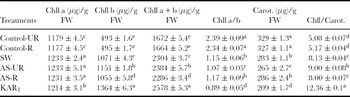
Results of the quantification of photosynthetic pigments indicated that all the smoke-related treatments, i.e. smoke-water (1:500 v/v), aerosol-smoke (both AR-R and AR-UR) and KAR1 significantly influenced the relative abundance of various photosynthetic pigments (Table 1). Compared with Con-UR, rinsing had no significant effect on all of the photosynthetic pigments studied (therefore, both Con-R and Con-UR will be hereafter referred to as control). Compared with the control, all the smoke-related treatments significantly (p < 0.001) increased the synthesis and/or accumulation of chlorophyll b relative to chlorophyll a, which in turn decreased the chlorophyll a to chlorophyll b ratio significantly. The control plants had the lowest total chlorophyll and the highest chlorophyll a to b ratio. KAR1 treatment resulted in the lowest chlorophyll a to b ratio but the highest total chlorophyll to carotenoid ratio (Table 1). In comparison with the control, the carotenoid concentration decreased by all the smoke-related treatments, with the KAR1-treated plants showing a significantly 1.6-fold lower concentration.
Effect of smoke-water, aerosol-smoke and karrikinolide1 on photosynthetic pigments of potted tef plants. Parameters analysed include chlorophyll a (Chll a), Chlorophyll b (Chll b), total chlorophyll (Chll a + b), chlorophyll a and b ratio (Chll a/b), total carotenoids (Carot.) and total chlorophyll to carotenoids ratio (Chll/Carot.).

Notes: Results are denoted as mean ± SE.
Different letters in columns indicate statistically significant treatment effect based on Duncan's Multiple Range Test at 5% probability.
Control-UR = control unrinsed; Control-R = control rinsed; SW = smoke-water; KAR1 = Karrikinolide1; AS-R = aerosol-smoke-treated and rinsed; AS-UR = aerosol-smoke-treated but unrinsed; FW = fresh weight.
Effects on morphological and agronomic performances
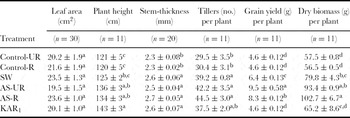
Results of the one-way ANOVA conducted to detect the effect of the smoke-related treatments on morpho-agronomic performances of tef are provided in Table 2. Compared with Con-UR, rinsing had no significant effect on all of the parameters studied. All the smoke-related treatments had no significant (p < 0.078) effect on leaf area. Compared with the control, aerosol-smoke (both AR-R and AR-UR) and KAR1 treatments significantly (p < 0.001) improved plant height. Stem-thickness showed significant increase in response to all the smoke-related treatments. In comparison with the control (29.5 ± 3.5), smoke-water (39.2 ± 0.8) and the short-term aerosol-smoke treatment of the seeds for 10 min (both AS-R = 44.5 ± 3.0 and AS-UR = 42.2 ± 3.5) resulted in significant increase in the number of tillers per plant (Table 2).
Effect of plant-derived smoke solutions and aerosol-smoke treatments on selected morpho-agronomic performances of tef [Eragrostis tef (Zucc.) Trotter].

Notes: Results are denoted as mean ± SE.
Different letters in columns indicate statistically significant treatment effect based on Duncan's Multiple Range Test at 5% probability.
Control-UR = control unrinsed; control-R = control rinsed; SW = smoke-water; KAR1 = Karrikinolide1; AS-R = Aerosol-smoke-treated and rinsed; AS-UR = Aerosol-smoke-treated but unrinsed.
Grain yield per plant showed significant (p < 0.001) variation in response to the smoke treatments applied (Table 2). In comparison with the control, seeds pretreated with aerosol-smoke for 10 min (both AS-R = 8.27 ± 0.12 and AS-UR = 9.54 ± 0.58) produced significantly 2.1-fold and 1.8-fold higher grain yield per plant respectively (Table 2). The aerosol-smoke treated but AS-UR seeds produced slightly higher grain yield compared with the AS-R seeds. Slight increase in grain and dry biomass yields was also observed in response to smoke-water treatment. However, the KAR1 (10−8 M) treatment of tef seeds had no significant effect on grain and dry biomass yields. In contrast, compared with the control, seeds pretreated with cool aerosol-smoke for 10 min (both AS-UR and AS-R) produced 1.6- to 1.8-fold higher dry biomass per plant (Table 2).
DISCUSSION
Effects on photosynthetic pigment content
Photosynthetic pigments are essential components of plant growth and development. The assessment of photosynthetic pigments, and consequently their reciprocal ratio, is an important diagnostic tool that measures the greenness, senescence and overall plant growth conditions (Torres Netto et al., Reference Torres Netto, Campostrini, De Oliveira and Bressan-Smith2005). For example, chlorophyll a/b ratio is an indicator of the functional pigment equipment and light adaptation, while the total chlorophyll to total carotenoid ratio is the best indicator of greenness/stress in plants (Lichtenthaler, Reference Lichtenthaler, Douce and Packer1987; Torres Netto et al., Reference Torres Netto, Campostrini, De Oliveira and Bressan-Smith2005). Ma et al. (Reference Ma, Morrison and Voldeng1995) also observed strong positive correlation between greenness and photosynthesis rate in soybean. A high concentration of total leaf carotenoid is a well-recognized plant response to stress (Hendry and Price, Reference Hendry, Price, Hendry and Grime1993). In the current study, all the smoke-related treatments (aerosol, SW and KAR1) significantly reduced the chlorophyll a/b ratio compared with the control (Table 1). Under normal growth conditions, the light harvesting pigment protein LHC-I of the photosynthetic pigment system (PS I) has a chlorophyll a/b ratio of about 3 (Lichtenthaler, Reference Lichtenthaler, Douce and Packer1987). In this greenhouse pot experiment only the control plants had a ratio close to 3 (2.39). The literature indicates that shade plants have lower chlorophyll a/b ratios compared with light plants due to much higher LHC-II (in PS II, LHC-II is variable) in shade plants (Boardman, Reference Boardman1977; Lichtenthaler, Reference Lichtenthaler, Douce and Packer1987). However, since the control plants had a much higher ratio (more than two-fold), the reduction in chlorophyll a/b ratio could be attributed to treatment effects rather than light/shade effects. The smoke-related treatments also affected positively the morphology and agronomic performances of tef plants (Table 2). Considering the superior performance of smoke-treated plants compared with the controls, the reduction in chlorophyll a/b ratio could be an adaptive response by the plants to counteract the effect of variation in pigment proteins of various photosystems resulted from growth conditions (Chow et al., Reference Chow, Anderson and Melis1990).
All smoke-treated plants had higher total chlorophyll to total carotenoid ratios, although figures are generally higher than those reported in the literature, i.e. ratio of 4.2–7; we recorded ratios as high as 12.36. The results, however, are in line with our visual observations, since treatments with higher ratios were much greener than those with lower ratios. This could also in part explain the superior agronomic performance of plants that germinated from smoke-treated seeds. However, a more stringent study is required to accurately gauge the role of smoke in pigment synthesis and degradation, photosystems, up/down regulation of pigment proteins as well as photosynthetic apparatus. Recently, there has been a report that these smoke treatments (SW and KAR1) at a lower concentration improved the photosynthetic apparatus of micro-propagated ‘Williams’ bananas (Aremu et al., Reference Aremu, Bairu, Finnie and Van Staden2012).
Effects on morpho-agronomic performance of tef
Our previous study on the effect of plant-derived smoke solutions on germination of tef (see Ghebrehiwot et al., Reference Ghebrehiwot, Kulkarni, Kirkman and Van Staden2008) showed that the tef cultivar used in the present study (i.e. SA-Brown) responded positively to smoke treatments. The smoke solutions tested also improved post-germination vigour indices of tef grown under relatively high temperature and low osmotic potential. However, there was no empirical information on whether plant-derived smoke treatments using various application methods could possibly influence growth and agronomic performances of tef.
One of the well-identified agronomic challenges of tef production is the non-genetic low grain yield potential of the currently available cultivars (Ketema, Reference Ketema1993, Reference Ketema1997). In addition to this, lodging and premature seed shedding cause significant losses in grain yield (Assefa et al., Reference Assefa, Ketema, Tefera, Nguyen, Blum, Ayele, Bai, Belay and Kefyalew1999; Ketema, Reference Ketema1997). Therefore, genetic improvement of tef should generate a suit of morpho-agronomic characters associated with higher yielding capacity and lodging-resistant traits, i.e. shorter plants and thicker basal culm internodes (Assefa et al., Reference Assefa, Ketema, Tefera, Nguyen, Blum, Ayele, Bai, Belay and Kefyalew1999). In other words, breeders must find a delicate balance between apparently unlinked twin traits, i.e. increasing yields and prevention of lodging (Pinthus, Reference Pinthus1973). Nevertheless, findings of this greenhouse pot experiment showed that plant-derived smoke has a great potential in improving grain and dry biomass yields of tef.
The results of the present study clearly showed that a short-term (10 min) aerosol-smoke treatment of tef seeds or treating seeds with plant-derived smoke solutions significantly promoted a number of growth and agronomic parameters directly or indirectly related to yield. Compared with the control, nearly all the smoke-related treatments improved plant height, stem-thickness, number of tillers and grain and dry biomass per plant (Table 2). These findings generally agree with previous studies done by Sparg et al. (Reference Sparg, Kulkarni and Van Staden2006) and Kulkarni et al. (Reference Kulkarni, Ascough and Staden2007, Reference Kulkarni, Ascough and Van Staden2008) in which smoke treatments of various application methods in maize (Zea mays L.), okra (Abelmoschus esculentus L. Moench.) and tomato (Lycopersicon esculentum Mill.) significantly improved seedling length, number of leaves, stem-thickness and plant dry weight. In this study, the highest grain and dry biomass yields were obtained from seeds pretreated with short-term aerosol-smoke (both AR-R and AR-UR). Compared with the rinsed seeds, not rinsing the seeds, previously treated with aerosol-smoke did not significantly affect all the parameters studied except grain yield per plant. The highest grain yield per plant was produced from aerosol-smoke pretreated unrinsed seeds. This indicates that rinsing the seeds after a short-term exposure (10 min) to aerosol-smoke may not be needed, as only prolonged exposure to aerosol-smoke negatively impacts germination and post-germination growth processes (Light et al., Reference Light, Gardner, Jäger and Van Staden2002; Sparg et al., Reference Sparg, Kulkarni and Van Staden2006).
Another interesting result is that the KAR1 treatment (10−8 M) did not significantly affect grain and dry biomass yields of tef (Table 2). KAR1 treatment of tef seeds produced the tallest plants and significantly increased stem-thickness (Table 2). However, despite its positive role on seed germination (Light et al., Reference Light, Daws and Van Staden2009), KAR1 treatment of tef seeds resulted in statistically indifferent number of tillers and grain and dry biomass yields compared with the control.
One of the most significant findings of this study is the positive role of the smoke-related treatments in promoting grain and dry biomass yields of tef. Though these yield traits of tef vary greatly with genotypes (Ketema, Reference Ketema1997), the smoke-aided increase in grain and dry biomass found in the present study compared well with other field studies. For instance, Zeid et al. (Reference Zeid, Belay, Mulkey, Poland and Sorrells2011) compared the grain yield per plant of 16 tef cultivars and stated that the average grain yield per plant was <2 g, and a yield increase of up to 3.3 g per plant was often observed under greenhouse conditions. Ketema (Reference Ketema1997) evaluated the dry biomass yield per plant of 2255 pure accessions of tef and found that the average dry biomass per plant of tef was 41 g. Compared with the averages provided by these authors, results of the present study demonstrate that aerosol-smoke treatment of tef (both AR-R and AR-UR) produced more than two-fold higher grain and dry biomass per plant.
It is also interesting that all smoke-related treatments improved stem-thickness of tef in a much similar fashion as that of the commonly used plant growth promoters such as ethephon (Berry et al., Reference Berry, Griffin, Sylvester-Bradley, Scott, Spink, Baker and Clare2000; Tripathi et al., Reference Tripathi, Sayre, Kaul and Narang2003). The positive role of smoke in promoting stem-thickness (a trait negatively associated with lodging index) implies that smoke may play a positive role in effectively reducing grain yield losses due to lodging in other cereals, such as rice, wheat and barley, provided they are responsive to smoke treatments. Furthermore, the positive role of smoke in promoting tillering capacity (a trait positively correlated to grain and dry biomass) may entail significant yield improvements and may assist in combating chronic lodging problems of tef production. It is generally expected that the smoke-induced increase in stem-thickness with simultaneous increase in the number of tillers can improve resistance to lodging (Kashiwagi et al., Reference Kashiwagi, Togawa, Hirotsu and Ishimaru2008; Tripathi et al., Reference Tripathi, Sayre, Kaul and Narang2003).
Within the context of lodging, the undesirable role of the smoke-related treatments was the associated significant increase in plant height (Table 2). Plant height is positively correlated with lodging index (Hundera et al., Reference Hundera, Nelson, Baenziger, Bechere and Tefera2000; Yu et al., Reference Yu, Graznak, Breseghello, Tefera and Sorrells2007). In other words, the more the plants grow taller the more they become vulnerable to loading. In lodging-prone cereals, such as tef (Eragrostis tef) (Assefa et al., Reference Assefa, Ketema, Tefera, Nguyen, Blum, Ayele, Bai, Belay and Kefyalew1999; Keterma, Reference Ketema1997), rice (Oryza sativa L.) (Kashiwagi et al., Reference Kashiwagi, Togawa, Hirotsu and Ishimaru2008) and spring wheat (Triticum aestivum L.) (Tripathi et al., Reference Tripathi, Sayre, Kaul and Narang2003), an increase in plant height is an undesirable trait, yet an unavoidable consequence of agronomic practices, e.g. irrigation, high fertilizer levels and heavy seeding rate (D'Andrea, Reference D'Andrea2008; Pinthus, Reference Pinthus1973; Tripathi et al., Reference Tripathi, Sayre, Kaul and Narang2003). Although field studies are further needed to substantiate the net effect and interaction of these factors (irrigation, fertilizers and seeding rate) with smoke, the smoke-induced increase in plant height may enhance lodging. However, this undesirable role of smoke on plant height can be reduced by selecting dwarf cultivars of tef (Assefa et al., Reference Assefa, Ketema, Tefera, Nguyen, Blum, Ayele, Bai, Belay and Kefyalew1999) and the use of optimal agronomic practices such as fertilization (Erkossa and Teklewold, Reference Erkossa and Teklewold2009) and seeding rate (Ketema, Reference Ketema1997).
In general, findings of this study suggest that plant-derived smoke has a great potential to improve agronomic outputs of tef. It is economically significant that plant-derived smoke may further play a positive role in lowering the cost of chemical fertilizers and thus improve economic returns (Erkossa and Teklewold, Reference Erkossa and Teklewold2009; Gezahegn and Tekalign, Reference Gezahegn and Tekalign1995). In the tef producing countries such as Eritrea and Ethiopia, costly and environment unfriendly inorganic chemical fertilizers are applied to alleviate soil fertility problems (Erkossa and Teklewold, Reference Erkossa and Teklewold2009; Ketema, Reference Ketema1997).
CONCLUSIONS
Though further field studies are obviously needed to verify the net role of plant-derived smoke treatments on tef production, findings of this greenhouse study provide a general indication that plant-derived smoke in either a gaseous or solution form can improve agronomic outputs of a cereal crop, Eragrostis tef. Of all the various methods of smoke application tested, the short-term (10 min) cool aerosol-smoke pretreatment of tef seeds before sowing produced healthier plants, which offered higher grain and dry biomass yields. Therefore, relatively simple and affordable techniques of aerosol-smoke treatment of tef seeds before sowing can be an option for the resource-limited tef growers in Eritrea and Ethiopia to improve their tef production.
Acknowledgements
We thank the University of KwaZulu-Natal for financial support. We are grateful to Simo Welcome Ngcobo for technical assistance.