


Introduction
Generalized anxiety disorder (GAD) is a common problem in the community (Wittchen and Hoyer, Reference Wittchen and Hoyer2001), has a high level of co-morbidity (Brown and Barlow, Reference Brown, Antony and Barlow1992; Yonkers, Warshaw, Massion and Keller, Reference Yonkers, Warshaw, Massion and Keller1996), and is characteristically a chronic condition (Wittchen and Hoyer, Reference Wittchen and Hoyer2001), with a low rate of spontaneous remission (Woodman, Noyes, Black, Schlosser and Yagla, Reference Woodman, Noyes, Black, Schlosser and Yagla1999; Yonkers et al., Reference Yonkers, Warshaw, Massion and Keller1996). GAD is also related to lower perceived well-being, life functioning, and quality of life (Stein and Heimberg, Reference Stein and Heimberg2004; Wittchen, Carter, Pfister, Montgomery and Kessler, Reference Wittchen, Carter, Pfister, Montgomery and Kessler2000). However, research has shown that only a minority of individuals with anxiety disorders ever receive treatment (Young, Klap, Sherbourne and Wells, Reference Young, Klap, Sherbourne and Wells2001). As has been argued before, problems associated with cost and practicality are considered important obstacles to treatment availability and accessibility (Addis, Wade and Hatgis, Reference Addis, Wade and Hatgis1999).
A number of cognitive-behavioral therapy (CBT) protocols involving single component and multi-component approaches have been shown to be efficacious treatments for GAD (Arntz, Reference Arntz2003; Borkovec and Costello, Reference Borkovec and Costello1993; Borkovec, Newman, Pincus and Lytle, Reference Borkovec, Newman, Pincus and Lytle2002; Dugas et al., Reference Dugas, Ladouceur, Leger, Freeston, Langlois, Provencher and Boisvert2003; Ladouceur et al., Reference Ladouceur, Dugas, Freeston, Leger, Gagnon and Thibodeau2000). These protocols typically involve between 12 to 16 one-hour sessions of therapy, and have achieved within group improvements at post-treatment for the key GAD symptom of pathological worry in the very large effect size range (Cohen's [Reference Cohen1988] d ranging from 1.6 to 2.6). In contrast, meta-analysis suggests single component therapies like relaxation and cognitive therapy tend to produce more modest effect sizes (Gould, Safren, Washington and Otto, 2005).
However, in terms of clinically significant change, outcomes are often only moderate. For example, a recent meta-analysis of prominent GAD treatment (predominantly individual therapy) studies by Fisher (Reference Fisher, Davey and Wells2006) found that CBT produces modest rates of recovery for the key symptom of trait pathological worry. In this analysis, an average of about 48% of patients receiving multi-component CBT recovered by post-treatment, and about 53% at one-year follow-up. Applied relaxation and cognitive therapy tended towards weaker outcomes (37% at post-treatment for both therapies, and similar rates at follow-up). Encouragingly, a recent small (N = 10) uncontrolled open-trial of metacognitive therapy by Wells and King (Reference Wells and King2006) achieved much higher rates of recovery by post-treatment (80%), although controlled replication will be necessary before drawing strong conclusions.
The exact reasons why CBT outcomes for GAD are generally modest have yet to be fully clarified. One study conducted by Borkovec et al. (Reference Borkovec, Newman, Pincus and Lytle2002) suggests that unaddressed interpersonal problems and the generally shorter therapy time involved in single component treatments may explain weaker treatment effects. On the basis of their findings, they proposed that better outcomes may require therapies to be longer in duration and to contain additional components so as to create sufficient change in the multitude of factors that can maintain GAD (e.g. cognitive, behavioral, physical, and interpersonal). Consistent with this general view, GAD research by Durham and colleagues (Durham, Allan and Hackett, Reference Durham, Allan and Hackett1999; Durham et al., Reference Durham, Fisher, Dow, Sharp, Power, Swan and Morton2004) has shown that higher clinical complexity (e.g. the presence of Axis I co-morbidity, low self-esteem, relationship stress, high symptom severity, and a number of other factors) is associated with poorer therapy outcomes. For example, Durham et al. (Reference Durham, Fisher, Dow, Sharp, Power, Swan and Morton2004) found that while less complex patients generally responded well to brief and standard forms of CBT, complex patients did not. Together, these findings suggest that better overall outcomes for GAD may require the development of more targeted, complex, and lengthy forms of treatment.
In an emerging response to the need for better GAD treatment outcomes, a number of authors have advanced the view that mindfulness training may be an important treatment modality worth considering. In particular, they have proposed that it may be well suited to alleviating dysfunctional processes maintaining GAD symptoms and pathological worry, its central feature (Borkovec and Sharpless, Reference Borkovec, Sharpless, Hayes, Follette and Linehan2004; Craske and Hazlett-Stevens, Reference Craske and Hazlett-Stevens2002; Mennin, Turk, Heimberg and Carmin, Reference Mennin, Turk, Heimberg, Carmin, Reinecke and Clark2004; Roemer and Orsillo, Reference Roemer and Orsillo2002). It has also been argued that mindfulness training is a multi-faceted approach, and may facilitate broader benefits, such as increased subjective well-being and quality of life (Baer, Reference Baer2003; Roemer and Orsillo,Reference Roemer and Orsillo2003).
Two prominent mindfulness programs that have been developed and evaluated over recent times are mindfulness-based stress reduction (MBSR; Kabat-Zinn, Reference Kabat-Zinn1990) and mindfulness-based cognitive therapy (MBCT; Segal, Williams and Teasdale, Reference Segal, Williams and Teasdale2002). Both of these programs involve 8 weekly 2-hour sessions delivered in group format. Regular meditation is a central feature of both programs, which have core aims of developing a more present focused and non-judgmental stance towards experience. According to Segal et al. (Reference Segal, Williams and Teasdale2002) these practices allow de-centering and disengagement of habitual and repetitive patterns of thinking (e.g., rumination, worry) that can maintain negative emotions and maladaptive coping responses. MBSR was originally developed to reduce stress in patients with chronic pain and health problems, and has a large supporting evidence base (for reviews see Baer, Reference Baer2003; Grossman, Niemann, Schmidt and Walach Reference Grossman, Niemann, Schmidt and Walach2004). MBCT on the other hand, while very similar in content to MBSR, contains additional depression psychoeducation and exercises aimed at preventing depression relapse.
In support of the benefits of mindfulness training for GAD, an early uncontrolled study found significant improvements in anxiety symptoms after MBSR in a mixed GAD (the minority in the sample) and panic disorder patient sample (Kabat-Zinn et al., Reference Kabat-Zinn, Maisson, Kristeller, Peterson, Fletcher, Phert, Lenderking and Santorelli1992). MBCT has also been shown to be effective at reducing the rate of depression relapse (Ma and Teasdale, Reference Ma and Teasdale2004; Teasdale et al., Reference Teasdale, Segal, Williams, Ridgeway, Soulsby and Lau2000), and to be associated with medium to large symptom improvement across a number of symptom domains in a heterogeneous group of adult psychiatric outpatients (Ree and Craigie, Reference Ree and Craigie2007). More recently, a small uncontrolled study by Evans et al. (Reference Evans, Ferrando, Findler, Stowell, Collette and Haglin2008) yielded large within group improvements in pathological worry at post-treatment in a GAD sample (d = 1.1).
From these initial findings, MBSR and MBCT may appear as attractive treatment options in terms of brevity, parsimony, and potential cost savings that group treatment may possibly afford. However, as shown, the overall GAD research base for MBSR and MBCT is only small, and methodological issues limit conclusions. For example, the Evans et al. (Reference Evans, Ferrando, Findler, Stowell, Collette and Haglin2008) study had a quite small sample size (N = 11), did not include follow-up assessments, measures of a broader range of symptoms associated with GAD, alpha level corrections, or provide a detailed description of clinical significance criteria used. Moreover, doubts have been raised as to whether brief programs like MBCT and MBSR have enough treatment elements to sufficiently alleviate processes maintaining GAD (Teasdale, Segal and Williams, Reference Teasdale, Segal and Williams2003; Wells, Reference Wells2002).
In sum, if group programs like MBSR and MBCT can be demonstrated to be clinically effective treatments for GAD, then they may be attractive treatment alternatives to individually-based interventions that are longer and more complex. However, there is a lack of substantive research evaluating the effectiveness of these programs across a range of key GAD symptoms (e.g. pathological worry, stress, fear of relaxation), in relation to the potentially broader benefits they may confer, and how outcomes compare to established treatment approaches. Given these limitations, a major of aim of this preliminary study was to more extensively evaluate symptom improvements after MBCT in an adult sample with a primary GAD diagnosis using an intent-to-treat analysis, and in relation to recovery on the key GAD symptom of pathological worry. MBCT was chosen in preference to MBSR as the cognitive rationale appears more explicit and relevant to GAD, it is a more recent and topical CBT-based approach, and a readily available session by session treatment manual aids its potential for wider dissemination and standardized delivery. Other aims of this study were to assess changes in quality of life, and examine the perceived credibility and acceptablity of MBCT. It was predicted that the MBCT program would be associated with significant improvments from pre to post-treatment in GAD related symptoms and quality of life, that would be maintained at follow-up.
Method
Participants
Twenty-three adults with a primary DSM-IV diagnosis of GAD took part in the MBCT program. The mean age was 43.4 years (SD = 13.1), with females making up 74% of the sample. All participants were Australian nationals and came from a Caucasian/European ethnic background. Eight participants were referred to the program from mental health professionals, the remainder self-referred. The majority of the sample were either married or in a defacto relationship (61%), the remainder were single. In regard to employment status, 26% of the sample were working full-time, 22% part-time employed, 13% unemployed, 17% performing home duties, 13% retired, and 9% full-time students. The current occupational type distribution of the sample could broadly be described as 8% professional, 25% managerial/technical, 8% skilled, 12% semi-skilled, and 46% unskilled/not-employed. The level of education distribution was: 52% with a tertiary/technical college qualification; 39% completing high school to at least year 10; 4% with a trade certificate; and 4% failing to complete high school. In terms of previous treatment, 78% of participants reported having previously received some form of psychotherapy (e.g. CBT, relaxation training, or counseling) for their anxiety problems, with 9% having a previous inpatient admission for anxiety/depression. Additional diagnoses in the sample were: major depressive disorder current/recurrent (n = 10), major depression in partial or full remission (n = 6), social phobia (n = 7), specific phobia (n = 3), agoraphobia without history of panic disorder (n = 2), panic disorder with agoraphobia (n = 1). Only 22% of the sample had a single Axis I GAD diagnosis, and 35% of the participants were taking anxiolytic and/or antidepressant medications at intake.
Measures
MINI-International Neuropsychiatric Interview Plus Version 5 (Sheehan et al., Reference Sheehan, Janavus, Baker, Harnett-Sheehan, Knapp and Sheehan2001) was used as the primary instrument for establishing an initial Axis I diagnoses. The MINI Plus is a structured interview based on DSM-IV (APA, 1994) Axis I criteria. Research has shown that it has good test-retest reliability and a high degree of concordance (kappa = .70) with other “gold standard” diagnostic instruments (Lecrubier et al., Reference Lecrubier, Sheehan, Weiller, Amorim, Bonora and Harnett-Sheehan1997; Sheehan et al., Reference Sheehan, Lecrubier, Harnett-Sheehan, Janavus, Weiller, Bonora, Kenskiner, Schinka, Knapp, Sheehan and Dunbar1997; Sheehan et al., Reference Sheehan, Lecrubier, Sheehan, Amorim, Janavs, Weiller, Hergueta, Baker and Dunbar1998). The MINI Plus was used because it was the mandatory assessment tool for the government out-patient clinic where one of the group interventions took place. However, parts of the Anxiety Disorders Interview Schedule for DSM-IV (ADIS-IV; Brown, DiNardo and Barlow, Reference Brown, DiNardo and Barlow1994) were also used to confirm diagnosis, establish a differential diagnosis, and fully test inclusion/exclusion criteria. It also yields a DSM-IV Axis I diagnosis with 9-point severity rating (0 to 8) and has demonstrated good inter-rater reliability (Brown, DiNardo, Lehman and Campbell, Reference Brown, DiNardo, Lehman and Campbell2001).
Outcome
GAD related symptoms and quality of life were assessed at pre-treatment, post-treatment, 6-week, and 3-month follow-up using the following measures.
Penn State Worry Questionnaire (PSWQ; Meyer, Miller, Metzger and Borkovec Reference Meyer, Miller, Metzger and Borkovec1990) is a 16-item measure that assesses the key GAD symptom of trait pathological (excessive and uncontrollable) worry. The PSWQ has been frequently used as a key GAD symptom measure in a number of treatment studies, and has been found to be a reliable and valid measure (Brown, Antony and Barlow, Reference Brown and Barlow1992; Meyer et al., Reference Meyer, Miller, Metzger and Borkovec1990).
Depression Anxiety Stress Scales – short form (DASS21; Lovibond and Lovibond, Reference Lovibond and Lovibond1996) is a 21-item version of the longer 42-item DASS, and contains 3 subscales (7 items per subscale) that measure level of depression, anxiety, and stress symptoms over the past week. Both the DASS and DASS21 have demonstrated strong psychometric properties in a range of clinical populations (Antony, Bieling, Cox, Enns and Swinson, Reference Antony, Bieling, Cox, Enns and Swinson1998; Brown et al., Reference Brown, Chorpita, Korotitsch and Barlow1997; Lovibond and Lovibond, Reference Lovibond and Lovibond1995).
Beck Depression Inventory - II (BDI-II; Beck, Steer and Brown, Reference Beck, Steer and Brown1996) contains 21 items that measure symptoms of depressed mood over the past week. The BDI-II has been shown to have high internal consistency and good test-retest reliability in an outpatient sample (Beck et al., Reference Beck, Steer and Brown1996). The BDI-II was used in this study as it is a commonly used instrument in CBT treatment studies for GAD.
Beck Anxiety Inventory (BAI; Beck, Epstein, Brown and Steer, Reference Beck, Epstein, Brown and Steer1988) is a widely used 21-item state anxiety scale that measures the cognitive, somatic, and affective symptoms of anxiety. Individuals report how much they have been bothered by a list of symptoms during the previous week. Research has shown that the BAI has sound psychometric properties (Beck and Steer, Reference Beck and Steer1993).
Quality of Life Enjoyment and Satisfaction Questionnaire (Q-LES-Q; Endicott, Nee, Harrison and Blumenthal, Reference Endicott, Nee, Harrison and Blumenthal1993) is a self-report that measures the degree of enjoyment and satisfaction experienced in various areas of daily functioning. Research has shown that the Q-LES-Q is sensitive to change in clinical samples and has sound psychometric properties (Endicott et al., Reference Endicott, Nee, Harrison and Blumenthal1993), and is not totally redundant with level of depression (Gladis, Gosch, Dishuk and Crits-Christoph, Reference Gladis, Gosch, Dishuk and Crits-Christoph1999). The 14-item (5-point Likert scale) General Activities summary subscale of the Q-LES-Q was used in the current study as a measure of overall quality of life.
Reactions to Relaxation and Arousal Questionnaire (RRAQ; Heide and Borkovec, Reference Heide and Borkovec1983) is a factor analytically derived self-report measure of fear of relaxation and arousal. The measure consists of 9 items and has been previously used in GAD intervention studies as an outcome measure (e.g. Borkovec and Costello, Reference Borkovec and Costello1993; Borkovec et al., Reference Borkovec, Newman, Pincus and Lytle2002).
Treatment credibility and expectancy
Credibility and Expectancy Questionnaire (CEQ; Borkovec and Nau, Reference Borkovec and Nau1972) was used to assess the extent to which participants perceive the intervention to be credible and whether it creates an expectancy for change. The CEQ consists of 6 items, which are averaged so as to produce a credibility score in the range 1 to 9, and expectancy for improvement score expressed as a percentage. Research by Devilly and Borkovec (Reference Devilly and Borkovec2000) has shown that the CEQ has sound psychometric properties.
Treatment acceptability
To ascertain the level of acceptability of the treatment program, participants were asked at post-treatment to rate their level of agreement on a 4-point scale (1 = not acceptable, 2 = acceptable, 3 = very acceptable, 4 = extremely acceptable) to the statement, “I have found this treatment an acceptable way to deal with the problem/s that brought me into treatment.”
Procedure
Participant recruitment and selection. Inclusion criteria for participants was age in the range 18 to 65 years, GAD was the primary DSM-IV Axis I diagnosis, and willingness to take part in a group-based program. Exclusion criteria were indication of significant suicide risk, evidence of psychotic symptoms, eating disorder, current or past schizophrenia, bipolar disorder, significant substance abuse, evidence of an organic mental disorder, or medical condition that contributed to anxiety symptoms. Participants taking part in the program were either referred by regular mental health referral agents or self-referred after reading newspaper articles briefly explaining the nature of programs available at Curtin Psychology Clinic.
All intake interviews were conducted by the principal researcher. The principal researcher had completed Masters level training in clinical assessment and CBT. Where possible, diagnostic interviews were video taped (approximately 75%). When a primary GAD diagnosis was not clear, the clinical research supervisor (senior clinical psychologist experienced in differential diagnosis) independently viewed the assessment interview and formulated a separate diagnosis. If after discussion a clear primary GAD diagnosis remained unclear or disputed, then the individual was excluded from the research program. All participants admitted to the program were assessed within 2 months of the first treatment group session, and were requested to refrain from seeking alternative treatments and maintain their medication regime over the duration of the study. Adherence to these treatment and medication requests was monitored regularly throughout the program.
Procedure and treatment protocol. The study involved an uncontrolled pre-post design, with 6-week and 3-month follow-up sessions. The treatment closely followed the Segal et al. (Reference Segal, Williams and Teasdale2002) MBCT 8 session protocol. However, an additional session was inserted after session 4 of the standard Segal et al. (Reference Segal, Williams and Teasdale2002) program to make a total of nine 2-hour group sessions, with sessions 5 to 8 of MBCT effectively moved back by one week each. This extra session was intended to allow participants to consolidate their mindfulness skills and review progress. It essentially involved a repeat of the sitting meditation of session 4, homework review, review of key mindfulness concepts from the previous sessions, and watching the first half of the MBSR video tape normally shown in session 4. The session involved no new material. Homework for this session was a repeat of the previous session. The more readily available Kabat-Zinn (Reference Kabat-Zinn1990) MBSR series 1 and series 2 practice tapes/CDs were used throughout the program, rather the Segal et al. MBCT tapes/CDs.
A total of four MBCT group interventions were conducted. Group sizes ranged from 5 to 7 participants. The principal researcher was the main group facilitator, with a clinical psychology Masters student for session support. To aid adherence to the treatment protocol, session protocol notes (including exercise notes, meditation scripts, and exercise checklists) created from the Segal et al. (Reference Segal, Williams and Teasdale2002) program were used to conduct all sessions. One week following the 9th treatment session, participants attended a post-treatment assessment group session (session duration about 60 minutes) to return post-treatment questionnaires handed out in the 9th treatment session, and be informed of how follow-up sessions would proceed. In this session participants were encouraged to continue practicing mindfulness beyond post-treatment. However, no new treatment or practice material was included in this session. Follow-up sessions occurred 6-weeks and 3-months after the last treatment session. These follow-up sessions (duration approximately 60–90 minutes each) involved collecting questionnaires mailed out in the previous week, a 30 minute sitting meditation, and review and discussion of progress with practice. No new treatment elements were introduced in these sessions.
Results
Preliminary analyses
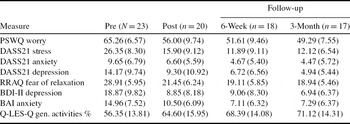
At intake the mean clinician rated severity from the 0 to 8 point ADIS-IV scale was in the moderate to severe range (M = 5.13, SD = 1.32), with a mean GAD duration of 10.2 years (SD = 11.4). The mean duration on medication for those participants taking medication was 10.9 months (SD = 11.4, range 4 to 36 months). Of the 23 participants starting the program, 3 dropped out prior to attending the third group session. For the remaining 20 participants completing to post-treatment, 2 did not provide any follow-up data, and 1 did not provide any 3-month follow-up data. The mean number of treatment sessions attended (maximum of 9) for those participants completing to post-treatment was 8.20 (SD = .95). Table 1 presents the pattern of mean scores for each symptom measure from pre-treatment to follow-up.
Means and (standard deviations) on symptom measures at pre-treatment, post-treatment, 6-week, and 3-month follow-up

Notes: PSWQ = Penn State Worry Questionnaire; DASS = Depression, Anxiety, and Stress Scales (21 item short version); RRAQ = Reactions to Relaxation and Arousal Questionnaire; BDI-II Beck Depression Inventory – II; BAI = Beck Anxiety Inventory; Q-LES-Q = Quality of Life Enjoyment and Satisfaction Questionnaire – general activities scale
Symptom improvement
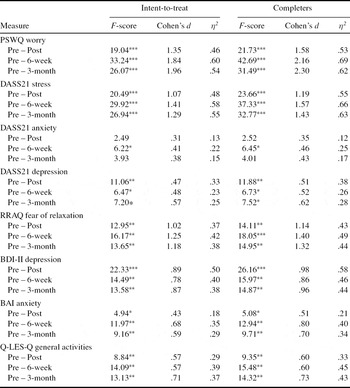
As Table 2 shows, univariate repeated measures analysis of variance (ANOVA) was conducted on each symptom measure from pre-treatment to post-treatment, and from pre-treatment to each follow-up point for both completers to post-treatment (n = 20) and intent-to-treat (N = 23). Pre to post-treatment and follow-up effect sizes were calculated using Cohen's (Reference Cohen1988) d statistic (d = .5 is medium, d = .8 is large) based on the formula: d = (M1- M2)/SD1. Like previous GAD treatment studies (e.g. Borkovec et al., Reference Borkovec, Newman, Pincus and Lytle2002; Dugas et al., Reference Dugas, Ladouceur, Leger, Freeston, Langlois, Provencher and Boisvert2003), a Simes (Reference Simes1986) modified Bonferroni alpha correction was applied to each statistic to maintain the familywise alpha level at .05. For both completers and intent-to-treat, DASS21 anxiety was the only measure to fail to show a significant post-treatment improvement at an uncorrected alpha level of .05. After alpha correction was applied, post-treatment improvement for the BAI became non-significant, whereas all other significant improvements remained significant at corrected alpha levels. Large effects were observed for PSWQ worry, DASS21 stress, RRAQ fear of relaxation, and BDI-II depression scores. Improvements on other measures were generally in the medium range, and only small for DASS21 anxiety. At 6-week follow-up, significant improvements from pre-treatment were evident on all measures for both intent-to-treat and completers after alpha correction had been applied. Effect sizes remained relatively unchanged, although the effect size for BAI anxiety for completers had increased from medium at post-treatment to large. By 3-month follow-up, apart from DASS21 anxiety, all measures for both intent-to-treat and completers showed significant improvements from pre-treatment after alpha correction. Again, effect sizes remained within similar ranges to 6-week follow-up.
Pre-treatment to post-treatment and pre to follow-up F-scores, Cohen's d, and partial eta squared for intent-to-treat (N = 23) and completers (n = 20) for each symptom measure

Notes: *p < .05, ** p < .01, *** p < .001, otherwise p > .05. Intent-to-treat df = (1, 22) and completers df = (1,19) for each measure. Cohen's (Reference Cohen1988) effect size: d = .20 is small; d = .50 is medium; d = .80 is large. η2 = partial eta squared. Missing post-treatment and follow-up scores were replaced with previous end-point scores.
Repeated measures ANOVAs were also conducted between post-treatment scores and follow-up assessment points for each symptom measure, with missing data replaced with previous end-point scores. This analysis showed that at 6-week follow-up there were significant, but small improvements on the PSWQ for both intent-to-treat F(1,22) = 15.05, p < .01, d = .35, and completers, F(1,19) = 16.66, p < .01, d = .38. However, there were no significant changes on any other measures at any follow-up point after alpha corrections had been applied.
PSWQ clinical significance
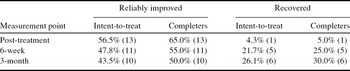
To help benchmark the clinical meaning of outcomes on the PSWQ, methods employed by Fisher (Reference Fisher, Davey and Wells2006) in his recent meta-analysis of CBT outcomes were adopted. In this analysis Fisher used Jacobson and Truax's (Reference Jacobson and Truax1991) criterion C and published normative PSWQ data to establish reliable change and recovery cut-off criteria. From pooled CBT treatment data, Fisher determined that a 7-point change or more was required to ensure a statistically reliable change on the PSWQ (Reliable Change Index of 1.96). Recovered status on the PSWQ required a reliable improvement and a post-treatment score below 47. Table 3 shows reliable improvement and recovery percentages for the PSWQ using these criteria. As can be seen, a clear majority of intent-to-treat and treatment completers had made a reliable improvement by post-treatment. However, only a very low percentage had recovered by post-treatment. By 6-week and 3-month follow-up recovery rates had improved, but were still very modest. No participants made a reliable deterioration on the PSWQ at any assessment points.
Percentages of intent-to-treat (N = 23) and completers to post-treatment (n = 20) meeting reliable improvement status and recovered status on the PSWQ at post-treatment, 6-week, and 3-month follow-up

Notes: Frequencies in parentheses. The reliably improved status and recovered status categories are mutually exclusive. That is, reliably improved patients were those patients that had an improvement of at least 7 points, but had not recovered. Recovered status was a reliable improvement and score less than 47 on the PSWQ. All missing data were replaced with previous end-point data. PSWQ worry scores for the sample at pre-treatment ranged from 55 to 79, with 87% of scores 61 or greater.
Treatment credibility, homework, and acceptability
After the first course session, CEQ mean credibility was 6.23 (SD = 1.53) on the 9-point scale, and expectancy for improvement was 54.3% (SD = 21.5). The mean percentage of the estimated total assigned homework completed for completers to post-treatment was 70.8% (SD = 23.9). At each follow-up point participants were also asked to estimate the average number of meditations they performed per week over the previous month. At 6-week and 3-month follow-up the sample reported an average of 5.06 (SD = 2.46) and 5.59 (SD = 4.00) meditations per week, respectively. In relation to rating how acceptable completing participants believed the program was for dealing with their problem (1 = not acceptable to 4 = extremely acceptable), 42.1% of completers found the program acceptable, 36.8% very acceptable, and 21.1% extremely acceptable (mean of 2.76, SD = .77).
Medication changes
One participant reported ceasing anti-depressant medication 1 week prior to the 1st session, another ceased medication after the 3rd session, and another reported commencing anti-depressant medication after the 4th session. Symptom measures for this latter participant remained in the clinical range at post-treatment, and follow-up points, with no reliable improvement in PSWQ worry or marked improvements on other measures. All remaining participants on medication reported maintaining their medication regime over the duration of the treatment phase of the program. However, three other participants reported medication changes after post-treatment. Two of these participants showed no reliable PSWQ improvements or marked improvements on other symptom measures after these changes. The third participant reported two family counseling sessions before the 6-week follow-up, and a medication change (related to a heart condition) after the 6-week follow-up. While there were some modest symptom improvements after these events, this participant had made a large and reliable improvement on the PSWQ (15 points) and on the DASS stress scale (14 points) by post-treatment and further improvements by 6-week follow-up. No other participants providing data at follow-up reported taking part in any additional therapy programs after post-treatment.
Discussion
Consistent with prediction, there were significant improvements in pathological worry and a number of GAD related symptoms at post-treatment, which were maintained at follow-up. The largest improvements occurred for the key GAD symptoms of pathological worry and stress. By post-treatment, just over 60% of the intent-to-treat sample had made at least a reliable improvement in their level of pathological worry. GAD related symptoms of fear of relaxation and depressed mood as measured by the BDI-II also showed significant improvements.
When comparing results to past research, methodological differences between studies suggest caution should be applied. Nevertheless, it seems worth highlighting that the magnitude of uncontrolled improvements in pathological worry and BDI-II depression were consistent with the recent MBCT study conducted by Evans et al. (Reference Evans, Ferrando, Findler, Stowell, Collette and Haglin2008), and were generally somewhat greater. The fact that the current pre-treatment pathological worry and BDI-II means were markedly greater than their study suggests replication of their findings had been achieved. However, the results in relation to some of the more prominent CBT studies were quite disappointing. For example, while the uncontrolled pre- to post-treatment improvement in pathological worry was in the large effect size range, it was weaker than the effect sizes observed for the most effective trials of multi-component CBT (e.g. Borkovec and Costello, Reference Borkovec and Costello1993; Borkovec et al., Reference Borkovec, Newman, Pincus and Lytle2002; Dugas et al., Reference Dugas, Ladouceur, Leger, Freeston, Langlois, Provencher and Boisvert2003; Ladouceur et al., Reference Ladouceur, Dugas, Freeston, Leger, Gagnon and Thibodeau2000). The post-treatment recovery rate on the PSWQ was also very poor in relation to Fisher's (Reference Fisher, Davey and Wells2006) meta-analysis of CBT treatment studies (e.g. multi-component CBT achieves an average of 48% at post-treatment; cognitive therapy and applied relaxation an average of 37% at post-treatment), although improved markedly by 6-week and 3-month follow-up.
In sum, while MBCT was associated with significant symptom improvements at post-treatment and a moderate level of reliable improvement in pathological worry, the rate of clinically significant improvement in pathological worry scores was very small. A number of factors in isolation and combination may possibly explain this discrepancy. For example, as outlined in the introduction, clinical complexity in terms of axis I co-morbidity and a number of other psychosocial factors are associated with poorer psychotherapy outcomes (e.g. Durham et al., Reference Durham, Allan and Hackett1999). On this basis it can be speculated that there may have been a failure of MBCT to sufficiently address maintenance processes present in the more complex and severe participants in the sample. Similarly, it is conceivable that unaddressed interpersonal problems that may have been present and a modest treatment dose may have played a role in maintaining GAD symptoms for some participants (e.g. Borkovec et al., Reference Borkovec, Newman, Pincus and Lytle2002). The latter conjecture seems particularly pertinent in relation to how recovery rates at follow-up appeared to improve in concert with patient reports of ongoing mindfulness practice. As such, while MBCT may contain multiple CBT components (Baer, Reference Baer2003), it may lack treatment dose and/or emphasis to create significant adaptive change in a sufficient number of processes that can maintain GAD (e.g. Borkovec et al., Reference Borkovec, Newman, Pincus and Lytle2002; Teasdale et al., Reference Teasdale, Segal and Williams2003; Wells, Reference Wells2002). For the majority of individuals with GAD, high end-state functioning may only be achievable after more lengthy, comprehensive, and targeted multi-component CBT. It follows that increased treatment duration and/or augmentation of MBCT with components used in more successful CBT-based approaches (e.g. Dugas et al., Reference Dugas, Ladouceur, Leger, Freeston, Langlois, Provencher and Boisvert2003; Borkovec and Costello, Reference Borkovec and Costello1993) may conceivably lead to better outcomes (e.g. elements that target avoidance, intolerance of uncertainty, poor problem orientation and solving). More research will be required to ascertain the efficacy and practicality of introducing enhancements of this nature.
Nonetheless, it seems important to note that the magnitude of effect sizes observed at post-treatment for key GAD symptoms were in the large range and were maintained at follow-up. Homework completion was also good, attrition was relatively low, and MBCT was perceived as a credible and acceptable treatment. In addition, quality of life improvements showed that MBCT was associated with changes beyond diagnosis specific symptoms. Together, these points suggest that MBCT may hold promise (especially if it can be enhanced) as a relatively brief group treatment option for clinical settings that have limited resources available for individual therapy. Perhaps MBCT might best be considered within a stepped-care model of treatment delivery. In this approach, brief group-based programs like MBCT could be offered as an initial treatment option for less complex and severe patients. In contrast, more complex patients and those failing to respond to MBCT could be offered more comprehensive and targeted CBT.
However, a number of methodological aspects limit the internal validity of the study, and therefore require comment. First, a major limitation was the lack of a comparison or control condition, thus leaving open the possibility that other factors besides MBCT may have played a role in the changes observed (e.g. non-specific factors, medication, random variation). The short follow-up period due to funding and practical constraints also limit interpretation about long term maintenance of gains. Second, the therapist was not blind to the research aims and there were no independent treatment adherence checks. Third, to reduce assessment burden and costs, only self-report questionnaires were used, and were sometimes completed in a group setting. It follows that there was a significant potential for social demand effects to have biased symptom reports. Fourth, the sample was mostly recruited by newspaper advertisements and the pre-treatment BAI mean was markedly lower than a number of clinical studies (e.g. Ost and Breitholtz, Reference Ost and Breitholtz2000; Wells and King, Reference Wells and King2006; Westbrook and Kirk, Reference Westbrook and Kirk2005). It follows that patients in the current sample may not have been particularly severe or complex compared to more routine mental health settings. However, it is noteworthy that the BAI may over-sample panic symptoms and thus may not be a particularly relevant measure of GAD severity (Cox, Cohen, Direnfeld and Swinson, Reference Cox, Cohen, Direnfeld and Swinson1996a, Reference Cox, Cohen, Direnfeld and Swinson1996b).
Despite these limitations, a number of strengths of the study help to enhance the clinical relevance of the findings. For example, there was a high level of Axis I co-morbidity and pre-treatment symptom means on the PSWQ, BDI-II, RRAQ, and DASS21 stress scale were quite comparable to past clinical studies (e.g. Borkovec et al., Reference Borkovec, Newman, Pincus and Lytle2002; Brown, Chorpita, Korotitsch and Barlow, Reference Brown, Chorpita, Korotitsch and Barlow1997; Dugas et al., Reference Dugas, Ladouceur, Leger, Freeston, Langlois, Provencher and Boisvert2003; Ladouceur et al., Reference Ladouceur, Dugas, Freeston, Leger, Gagnon and Thibodeau2000; Molina and Borkovec, Reference Molina, Borkovec, Davey and Tallis1994; Westbrook and Kirk, Reference Westbrook and Kirk2005). Together, these observations help to increase the likelihood that the sample was at least in the moderate range of severity and approximated the type of patients that might be encountered in an outpatient setting. Moreover, the magnitude of PSWQ effect sizes observed, apparent lack of relationship between symptom improvements and medication changes, and the knowledge that GAD is a chronic condition, with a low rate of spontaneous remission (e.g. Woodman et al., Reference Woodman, Noyes, Black, Schlosser and Yagla1999; Yonkers et al., Reference Yonkers, Warshaw, Massion and Keller1996), seem to improve the probability that MBCT contains active elements responsible for change. However, the results cannot comment on what treatment or group related processes were responsible for change, or whether greater mindful awareness mediated symptom improvements in the short or longer term. Rather, dismantling and experimental studies will be necessary to determine the nature of any active ingredients in MBCT, and whether they differ from other established CBT protocols.
In closing, the results suggest that MBCT is definitely worth further investigation as a treatment option for GAD. However, the low rate of recovery at post-treatment suggests enhancement will be required. It will also be crucial to establish the efficacy of MBCT relative to control conditions, and in relation to established interventions, like applied relaxation and multi-component CBT.
Acknowledgements
We wish to gratefully thank Laura Smith, Farah Feeney, Annette Brown, and Milo for their assistance in co-facilitating the MBCT groups. Finally to all the participants, special thanks for your cooperation and involvement in the study.



Comments
No Comments have been published for this article.