Background
The activities of Health Technology Assessment (HTA) bodies have evolved substantially in the past few years to accommodate the needs and demands of decision makers in changing scenarios. The scope has broadened in line with the lifecycle approach, addressing technologies from inception to obsolescence. Postlaunch Evidence Generation (PLEG) is an umbrella term for evidence generated after the launch or licensing of a health technology within its approved or intended indication (Reference Moseley, Vamvakas and Berntgen1).
When a new health technology is evaluated and marketed, it may be prone to uncertainties that have not been resolved in the clinical phase. These uncertainties commonly arise due to the narrow population or the underrepresentation of certain patient subgroups in clinical trials. The role of PLEG is not to replace but to complement evidence generation already undertaken for marketing authorization or HTA, to address remaining uncertainties and also to potentially cover wider questions of disease management, healthcare delivery, or efficiency that could be key to inform decision making. PLEG contributes to the overall and accumulating evidence about a health technology during its lifecycle.
PLEG includes all the different possible sources for obtaining the data that regulators and HTA bodies need to fill clinical and/or economic evidence gaps. PLEG can be established as clinical trials (interventional or observational), patient registries (disease or product-specific), databases (medico-administrative or from clinical daily practice), or health-related apps/mobile devices or social media focused on obtaining patient-reported outcomes (PROs) (2;Reference Marsolo, Richesson, Edward Hammond, Smerek and Curtis3). Approaches for generating quality real-world evidence (RWE) with different purposes (coverage with evidence development, managed entry agreement, clinical evaluation after launch or licensure, etc.) have been launched by many countries, including several European countries such as France (4), Italy (Reference Xoxi, Facey and Cicchetti5;6), Spain (Reference Serrano-Aguilar, Gutierrez-Ibarluzea and Díaz7;8), UK (9;10), Germany, Sweden, and The Netherlands (Reference Makady, Ham and de Boer11). Other initiatives such as the HTAi Global Policy Forum (GPF) meeting in November 2018 aimed to discuss the future availability and use of RWE in the context of HTA processes to inform decision making (12). However, little information exists regarding the operationalization of these studies.
The aim of this study is to gain a better understanding of the involvement of HTA bodies in European PLEG practices to identify cross-border cooperation opportunities on product-specific PLEG pilots arising from evidence gaps identified during HTA. This article presents the status of the PLEG practices among EUnetHTA (European Network of Health Technology Assessment) work package 5B (WP5B) partners at the end of the Joint Action (JA) 3.
Methods
Survey Description
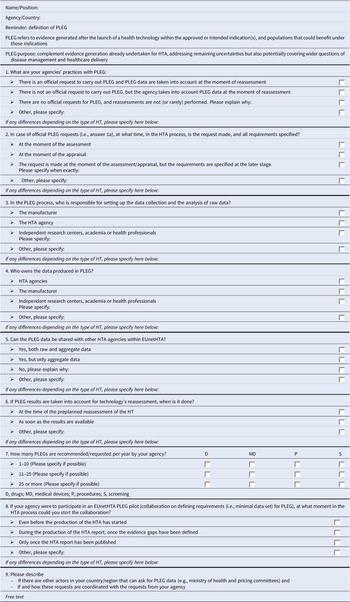
A voluntary questionnaire consisting of nine semi-closed questions was sent to all twenty-five WP5B partners (30 percent EUnetHTA partners) in December 2019 (see questionnaire in Table 1). The topics addressed were PLEG national practices, their general timelines, data ownership, and the opportunity for European collaboration of HTA bodies on a common data collection protocol and for data exchange.
Table 1.
JA3 WP5B—Questionnaire on PLEG practices
Face-to-Face Meeting
Following the survey, national PLEG practices were discussed during a face-to-face (F2F) meeting in December 2019 with HTA bodies who completed the questionnaire. The meeting provided the opportunity to collect missing information and to exchange it with other additional partners with knowledge of PLEGs not involved in the survey. During this meeting, we observed that some practices had already changed and results were updated in accordance with these findings.
Results of the PLEG survey
Half of the solicited HTA bodies (12/25) completed the survey: AIFA/Italy; Azienda-zero/Italy; Fimea/Finland; G-BA/Germany; HAS/France; Infarmed/Portugal; NICE/England; NOMA/Norway; SNHTA/Switzerland; Spanish HTA Network (RedETS); TLV/Sweden; ZIN/The Netherlands. All except NOMA attended the meeting. One of the nonresponders to the survey also participated in this meeting (HZIZ/Croatian Institute of Public Health). During the review phase in October 2021, five of the responding HTA bodies (5/12 HTA bodies: ZIN, SNHTA, AIFA, G-BA, TLV) provided additional information, which was included in the final version of the manuscript to stay as close as possible of the current situation in this highly evolving field.
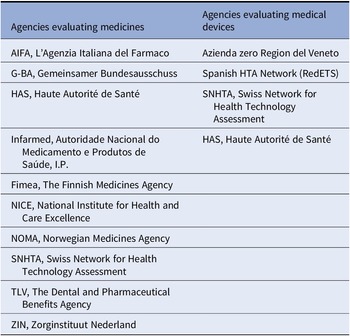
Among the twelve HTA bodies that answered the survey: ten assessed only medicines, two only medical devices (MD), and the remaining two evaluate both technologies. The scope of evaluation from the responding agencies is presented in Table 2. While NICE assesses both medicines and MD, they only completed the survey for medicines.
Table 2.
Agencies Who Participated in the Survey
The results of the survey and the main issues discussed in the F2F meeting are summarized below. For more details, the PLEG practices among HTA bodies report can be consulted (13).
Agencies Evaluating Medicines
Seven out of the ten agencies involved in evaluating medicines responded that PLEG is part of their organization’s remit. During the meeting, these agencies provided more details about the scope and objectives of PLEG in their respective countries:
-
• In France, PLEG is requested by HAS with several objectives: for reassessment of the added value of technology (i.e., evidence gap) to contribute to the monitoring of good health technology usage and the place of the product in the treatment pathway (14). HAS can request real-world data when additional evidence is deemed necessary and can exchange once or twice with the company on the PLEG protocol expectations. The guidance on PLEG has recently been updated.
-
• In Italy, AIFA is responsible for implementing monitoring registry systems. The main objective of these monitoring systems is to promote the appropriate use of drugs in the approved indication and to apply the managed entry agreements established with each company during the pricing and reimbursement (P&R) process.
-
• In Sweden, when there are remaining uncertainties, a formal request will be made to monitor drug condition of use for 18–30 months. The requests are mostly made to the manufacturer by the policy makers but TLV can also manage the development of postlaunch data itself and identify existing registries.
-
• In Germany, both G-BA and IQWiG are involved. G-BA is now responsible for making strict recommendations on PLEG study design (15). The manufacturer can discuss PLEG design with G-BA before the Statistical Analysis Plan and study protocol are created. Within this procedure, IQWiG is responsible for developing a recommendation for a valid PLEG method for a specific product. IQWiG’s General recommendations for routine practice data collection were published on 24 Jan 2020 (16).
-
• In England, the NICE assessment team works with the technical team to formulate the request to industry. NICE assessors meet with the committee where all the requirements for the PLEG process are defined. For reassessment of drugs, PLEG can be requested when the committee considers there are key uncertainties (conditional authorization).
-
• SNHTA reported that the Federal Office of Public Health reviewed the list of pharmaceutical products every 3 years. For selected drugs, this review may be informed by PLEG data and may be part of the federal government’s HTA program that aims to re-evaluate its benefits. When the presented evidence of the PLEG review is considered insufficient, the commission can decide to delist or conditionally reimburse the drug.
-
• Infarmed stated that postlaunch data are used during reassessment that occurs 2 years after the P&R negotiation, but gave no additional information on the process.
-
• While there is another scheme for PLEG from ZIN, two programs related to managed entry agreement started in 2019. For certain expensive drugs that are prescribed by medical specialists, ZIN can request disease-based registries through which these drugs can be monitored.
PLEG is not officially part of the remit for NOMA, Fimea, and HZIZ. Nevertheless, the first two explained that they did have some experience with PLEG. NOMA indicated that they participated in a EUnetHTA PLEG pilot on the Spinraza registry in collaboration with AIFA, Fimea, Infarmed, ZIN, and the Croatian Ministry of Health. Fimea commented that they identified and reported uncertainties and evidence gaps as a part of the public HTA report and were not responsible for requesting postlaunch studies but could obtain access to these on request. HZIZ stated that the Ministry of Health (MoH) is responsible for requesting the collection of any additional data.
When asked about the timing of the request, nine agencies responded that it is commonly done at the time of assessment/appraisal although four of these indicated that requirements could be specified at a later stage. SNHTA reported that they ask for complementary data to be generated without specification. Four of these HTA bodies indicated that the request could also be made at later stages during P&R negotiations or during reassessment. Infarmed reported that PLEG for oncology products could also be requested at the time of reassessment, but with usage of the National Oncology Registry (RON) data. Although they do not officially make PLEG requests, NOMA indicated that the timing of the Spinraza registry data was similar to that of the other participating agencies. Since they are not involved in PLEG requests, Fimea and HZIZ did not specify any timing.
Three respondents (G-BA, HAS, and NICE) indicated that the manufacturer or market authorization holder is responsible for data collection and raw data analysis. NICE added that the entity responsible for setting up the data collection and analysis depends on the topic (i.e., academic centers, hospitals, patient organizations, or manufacturers) and they work in partnership with NHS England. Two respondents (AIFA and SNHTA) stated that the HTA bodies is responsible for data collection and raw data analysis. The other four agencies (Infarmed, NOMA, TLV, and ZIN) have provided multiple answers with responsibility shared between manufacturers, independent research centers, health professionals, and HTA bodies depending on the technology.
Although Fimea does not have an official remit for PLEG, the market authorization holder would be responsible for setting up the data collection, submitting data requests, and so forth.
With respect to data ownership, AIFA reported being the sole owner of the postlaunch data produced. Infarmed clarified that they own the data for the two ongoing disease registries (spinal muscular atrophy and hepatitis C), but the MoH is the owner of the National Oncology postlaunch data. SNHTA did not provide information about data ownership.
The remaining nine HTA bodies explained that there are several possible data owners: manufacturer, independent research centers, academia, health professionals, hospital trusts, government agencies, or public health systems.
Five of the HTA bodies evaluating medicines (AIFA, Infarmed, NICE, SNHTA, and TLV) indicated they were able to share aggregated postlaunch data within EUnetHTA. NICE, G-BA, and HAS specified that data sharing would require explicit permission from the data owners. Three agencies responded “other” for different reasons (i.e., no formal agreements on data sharing or unclear procedure). Fimea did not respond.
Six agencies acknowledged using PLEG results at the time of the preplanned reassessment/reappraisal of the health technology. NICE added that reappraisal timelines are based on (i) alignment with ongoing clinical trial reporting timelines, (ii) time needed to address clinical uncertainties, and (iii) availability of data (also commented by TLV). In Sweden, TLV indicated that the PLEG results were used for reassessment as soon as they are available.
NOMA responded “other”: they expect Spinraza to be the first product reassessed using PLEG. Two agencies (ZIN, Fimea) did not answer.
In response to the question concerning the number of PLEG recommendations/requests per year (HTA bodies provided estimates), seven agencies elaborated less than ten requests per year, two (HAS, NICE) produced between eleven and twenty-five PLEG annually and AIFA developed more than twenty-five.
Five agencies mentioned that other actors could also request PLEG including MoH, hospital trusts, companies, regional agencies, or any other institutions or authorities involved in P&R decisions. For SNHTA and G-BA, the national regulatory agencies can request post authorization studies. Meanwhile, due to a new law, the G-BA can request routine practice data collection post authorization. Infarmed, TLV, and ZIN did not mention other actors.
Five agencies can initiate European collaboration on PLEG before beginning the production of the HTA. Fimea and NOMA can also start the collaboration during the production of the HTA reports, once the evidence gaps have been identified. AIFA and Infarmed could only participate when the HTA report has been published. SNHTA responded “other” since in JA3 they can only act as a dedicated reviewer
Agencies Evaluating MD
Three of the four agencies evaluating MD answered that they make official requests for the conduct of PLEG (HAS, RedETS, and SNHTA).
During the F2F meeting, agencies with a remit for PLEG in their national practice provided more details of its scope and process.
-
• In France, the Pricing Committee (CEPS) can force the company to provide postlaunch data as a part of the negotiation phase of the pricing decision. Accordingly, the company will submit a protocol to HAS for review. At the time of reassessment, the company will submit PLEG data to HAS.
-
• In Spain, all MS (monitoring studies) are applied under an investigational protocol, limiting the provision of the assessed technology and guiding its indication to a previously selected set of referral centers. RedETS specified that the PLEG is authorized by the CPAF (Health Ministry Commission for the National Portfolio). RedETS are responsible for defining the protocol, with clinicians and stakeholders (industry and patient representatives) are encouraged to provide feedback to the PLEG protocol.
-
• For SNHTA, PLEG request can define the goals to be addressed, type of study, responsibilities, requirements of reporting, and time frame for a planned reassessment. A yearly status report is requested for each PLEG activity in order to amend the coverage conditions or PLEG modalities if deemed necessary.
-
• Azienda Zero stated that they do not officially request PLEG but are involved in the implementation process of PLEG in Italy.
Two of the aforementioned HTA bodies (HAS and SNHTA) indicated that official PLEG requests are made at the moment of appraisal. HAS stated that the request requirements are specified in the opinion issued by the CNEDIMTS (Medical Device and Health Technology Evaluation Committee). RedETS stated that CPAF commission establishes the PLEG requirements based on specific relevant needs arising in relation to previous HTA reports. Azienda Zero stated that MD PLEG is implemented as needed for reassessment purposes with the collection of both clinical and resource use data.
Both HAS and SNHTA specified that the manufacturer is responsible for setting up the data collection and raw data analysis. At HAS the manufacturer is responsible for launching and conducting the study according to fixed timelines and HAS requirements. The other two HTA bodies (Azienda Zero, RedETS) indicated the HTA bodies has this responsibility. RedETS noted that the HTA bodies in charge of the PLEG are responsible for its implementation and the elaboration of the final report with statistical analysis of data and new evidence (Reference Serrano-Aguilar, Gutierrez-Ibarluzea and Díaz7).
SNHTA and HAS responded that the data owner (i.e., manufacturer/party applying for coverage) is responsible for the realization of the PLEG activity (i.e., clinical trial or registry). RedETS stated that the MoH, as a promotor of MS, owns the PLEG data (there is another registry of MD promoted by the Spanish regulatory agency-AEMPS). For Azienda Zero, the owners are the hospitals in which the data are collected.
All agencies participating in PLEG for MD consider PLEG for technology reassessment following a similar process. However, SNHTA and HAS use the PLEG data in the planning phase of reassessment, whereas Azienda zero and RedETS initiate the reassessment as soon as the results are available.
Regarding the annual number of PLEG requests, Azienda zero and HAS declared less than ten, whereas RedETS and SNHTA reported making fewer than five. RedETS stated that the number of PLEG requests depends on the evidence gaps identified in the assessment reports in the RedETS annual work plan.
As for medicines, most agencies (3/4) evaluating MD specified that other actors like the MoH or organizations/authorities involved during the P&R process could also request PLEG. SNHTA did not provide an answer to that question. Two, Azienda Zero and RedETS, could share both aggregated and raw data with other EU (European Union) agencies. However, for RedETS, data can be shared only after MoH authorization. HAS and SNHTA specified that they can, under some conditions, share aggregated data only. HAS, specified that aggregated data can only be shared once the CNEDIMTS’ opinion has been published and is available on the HAS Web site; sharing raw and aggregated data before the publication could be possible but implies agreeing on this matter with the owner of the data, which has not been done yet. SNHTA stated they could do it in cases where the HTA bodies itself is responsible for an updated review of the literature (HTA report).
For RedETS, HAS, and SNHTA any collaboration between HTA bodies could start during the initial assessment/production of the HTA report, once the evidence gaps have been defined. HAS specified, in case the technology is assessed solely at the national level, collaboration can only start once the HTA report has been published.
Discussion
This study provides an overview of the HTA bodies approach to PLEG and the subsequent exchanges with WP5B partners allowed updates of the practices. The results of our study show that about half of the EUnetHTA WP5B partners have procedures in place for PLEG processes with the involvement of HTA bodies, the majority concerning medicines. They also indicate that requesting PLEG is within the remit of most of the HTA bodies and, in many cases, agencies are also directly involved in producing recommendations on study design and data collection. Other actors like the MoH or authorities involved in the P&R procedure can also request PLEGs. The reasons for requesting PLEGs differ among countries, with the promotion of appropriate use and reassessment of added value the most common reasons, together with the implementation of managed entry agreements. Given the high interest in the use and generation of high-quality real-world data to support decision making, we anticipate that the use of PLEG studies will increase, thus the interest of this paper for agencies aiming to implement these processes.
In accordance with the answers provided, in more than 75 percent of the cases, the PLEG request is made at the time of the assessment/appraisal but details of the request are usually defined at a later stage. The responsibility for setting up the data collection and running the analyses mainly lies with manufacturers for medicines (60 percent) while it is more the HTA bodies’ responsibility supported by scientific societies for MD (75 percent). In most countries, HTA bodies are involved in the discussion or decision regarding the method for the development of postlaunch data either by developing the protocol or reviewing the protocol proposed by the manufacturer, research center, or MoH in order. Agencies assist the manufacturer in defining the PLEG protocol to insure it will be consistent with their evaluation standards and that all of the uncertainty requirements are included. They can also advise on the source to collect postlaunch data.
In connection with data collection responsibilities, companies are generally the data owners of PLEG, especially for medicines. In a few cases, the authorizing agency or MoH is in charge of implementing postlaunch data and is the data owner. Data ownership was viewed as an important barrier for the cross-border collaboration in PLEGs. In fact, the possibility of sharing national raw data at the European level was a controversial issue for most of the survey agencies, especially those relating to medicines since they do not own the data. As far as MD are concerned, a foreseeable barrier could be the different reimbursement/financing timelines given that the evidence requirements vary substantially for these technologies. These issues could be overcome as general timeline alignments among partners’ processes.
While most HTA bodies agreed that postaggregated data could be shared, some were unaware of the existing agreements or procedures. In general, all agreed that the earlier the PLEG request can be anticipated and formalized, the easier it will be for the agencies to exchange on their request, on the protocol under study, and on potential opportunities to share data. However, when assessments are conducted in parallel at national level, it is expected that exchange between HTA bodies can be delayed (i.e., after national appraisal) for confidential and timing reasons. Data sharing should also be anticipated because, as already discussed, only a few agencies own the data and are able to exchange them without asking permission. It should be useful to develop common strategies aimed to facilitate the data sharing, establishing agreements of collaboration between HTA bodies/regulators/decision makers and data owners. Some agencies have noted that they are still developing a formal PLEG request procedure. Their practices will be implemented soon but some of them have already expressed their willingness to participate in future EU collaborations.
The feedback received from HTA bodies is consistent and explains obstacles encountered while conducting the three product-specific PLEG pilots based on medicinal products and MD (Spinraza, Ibrance and Left ventricular Assist Devices) carried out within EUnetHTA to test the feasibility of collaborating in PLEGs among European HTA bodies; all have been successful in drawing up common evidence gaps and developing a common minimum data set. However, difficulties were encountered with respect to accessing and sharing data mainly due to legal and/or organizational barriers (13). Actually, HTA bodies had to wait for all the national assessments to be performed to agree on the evidence gap and additional evidence generation to be provided and the final step of compiling PLEG was not feasible, as data could not be shared.
The possibility of carrying out coordinated data-sharing efforts is viewed of critical importance because it can allow for resolving uncertainties that could not be answered with more limited data sets. Combining data can increase the sample size as well as the diversity of population and use conditions, allowing for the assessment of orphan drugs and more subgroup analysis to detail indications. However, from the current survey and the piloting experiences, we see that individual national cross-border collaboration can be challenging in the current scenario.
It is expected that PLEG collaborations in the future will come from Joint Collaborative Assessments (JCA), instead of national evaluations, which would facilitate the pooling of processes and the harmonization of timelines. Most participating agencies recommend EU collaboration on PLEG commence once the evidence gaps have been defined that can be easily done when finalizing a European joint assessment. This will probably be facilitated with the implementation of the HTA regulation in 2025 (17) and the Council of the EU conclusions (18); as it is mentioned that JCA can be updated when additional evidence specified in initial assessment becomes available. Joint Scientific Consultations, another joint production planned in the HTA regulation can also provide an opportunity to exchange on PLEG at an early stage. Anticipating much earlier in the development process the products and registers that could be subject to PLEG is a good way to face the challenges of EU collaboration on PLEG. Notifying the various stakeholder groups, with a focus on the industrials, but also academicians, patients, or even the regulators, earlier would be beneficial to allow discussions to begin before the launch of the PLEG project. It allows for a discussion about the quality requirements for HTA bodies. For example, the quality of a disease registry can be assessed using the EUnetHTA REQueST tool (19).
It should be acknowledged that the aim of this study was not to elaborate on the different issues and themes around PLEGs but to provide an overview of the involvement of HTA bodies in PLEG practices at the European level and to explore possible cross-border collaboration opportunities. It is also important to highlight that the practices identified during the survey had already changed between the conduct of the study and the time of manuscript review and some partners notified changes also at the time of the manuscript review. Even though the draft was circulated among all HTA bodies involved, not all provided inputs and thus the possibility exists that not all of the processes are totally updated. This underlines the challenge associated with this type of study in this continually evolving field of PLEG. However, we do not think that this undermines the study as all observed changes trend in the same direction with an increasing number of HTA bodies involved in PLEG processes.
A limitation of this study is that while WP5B was composed of HTA bodies from the network interested in PLEG topics, only half of them accepted to participate in this study. This could compromise the representatively of our work, in terms of the number of participants but also for geographical distribution, as no Eastern countries, except Croatia, were involved. Nevertheless, it is expected that those who did not participate are those less active in this field. Therefore, we can expect the ones who answered the survey will inspire the future practices of those HTA bodies without a system yet in place.
Conclusions
At the time of this work, at least twelve European HTA bodies are involved in PLEG activities and the majority have procedures in place with official requests made by the HTA bodies for PLEG. The PLEG request is primarily made at the time of the assessment/appraisal although details of the request are usually defined at later stages during P&R negotiations or even at the time of reassessment.
For pharmaceuticals, both data collection and analysis are usually the responsibility of manufacturers and companies are generally the data owners of PLEG. For MD, it is more often the responsibility of the HTA bodies, supported by scientific societies.
Some HTA bodies are still developing a formal PLEG request procedure. Most recommend collaboration starting once the evidence gaps have been defined, for instance after national appraisal. Data sharing should be anticipated as only some HTA bodies own the data and can exchange them without requesting permission.
All this information has been taken into account by the EUnetHTA JA3 activities on PLEG to prepare a more sustainable collaboration among EU HTA bodies. Although collaboration on PLEG is not mentioned in the approved Regulation on HTA in EU, it would enable cross-border collaboration between initiatives on real-world data generation from EU countries. Therefore, PLEG should be a target for the future EU HTA system.






Background
The activities of Health Technology Assessment (HTA) bodies have evolved substantially in the past few years to accommodate the needs and demands of decision makers in changing scenarios. The scope has broadened in line with the lifecycle approach, addressing technologies from inception to obsolescence. Postlaunch Evidence Generation (PLEG) is an umbrella term for evidence generated after the launch or licensing of a health technology within its approved or intended indication (Reference Moseley, Vamvakas and Berntgen1).
When a new health technology is evaluated and marketed, it may be prone to uncertainties that have not been resolved in the clinical phase. These uncertainties commonly arise due to the narrow population or the underrepresentation of certain patient subgroups in clinical trials. The role of PLEG is not to replace but to complement evidence generation already undertaken for marketing authorization or HTA, to address remaining uncertainties and also to potentially cover wider questions of disease management, healthcare delivery, or efficiency that could be key to inform decision making. PLEG contributes to the overall and accumulating evidence about a health technology during its lifecycle.
PLEG includes all the different possible sources for obtaining the data that regulators and HTA bodies need to fill clinical and/or economic evidence gaps. PLEG can be established as clinical trials (interventional or observational), patient registries (disease or product-specific), databases (medico-administrative or from clinical daily practice), or health-related apps/mobile devices or social media focused on obtaining patient-reported outcomes (PROs) (2;Reference Marsolo, Richesson, Edward Hammond, Smerek and Curtis3). Approaches for generating quality real-world evidence (RWE) with different purposes (coverage with evidence development, managed entry agreement, clinical evaluation after launch or licensure, etc.) have been launched by many countries, including several European countries such as France (4), Italy (Reference Xoxi, Facey and Cicchetti5;6), Spain (Reference Serrano-Aguilar, Gutierrez-Ibarluzea and Díaz7;8), UK (9;10), Germany, Sweden, and The Netherlands (Reference Makady, Ham and de Boer11). Other initiatives such as the HTAi Global Policy Forum (GPF) meeting in November 2018 aimed to discuss the future availability and use of RWE in the context of HTA processes to inform decision making (12). However, little information exists regarding the operationalization of these studies.
The aim of this study is to gain a better understanding of the involvement of HTA bodies in European PLEG practices to identify cross-border cooperation opportunities on product-specific PLEG pilots arising from evidence gaps identified during HTA. This article presents the status of the PLEG practices among EUnetHTA (European Network of Health Technology Assessment) work package 5B (WP5B) partners at the end of the Joint Action (JA) 3.
Methods
Survey Description
A voluntary questionnaire consisting of nine semi-closed questions was sent to all twenty-five WP5B partners (30 percent EUnetHTA partners) in December 2019 (see questionnaire in Table 1). The topics addressed were PLEG national practices, their general timelines, data ownership, and the opportunity for European collaboration of HTA bodies on a common data collection protocol and for data exchange.
JA3 WP5B—Questionnaire on PLEG practices
EUnetHTA, European Network of Health Technology Assessment; HTA, health technology assessment; PLEG, postlaunch evidence generation; WP5B, work package 5B
Face-to-Face Meeting
Following the survey, national PLEG practices were discussed during a face-to-face (F2F) meeting in December 2019 with HTA bodies who completed the questionnaire. The meeting provided the opportunity to collect missing information and to exchange it with other additional partners with knowledge of PLEGs not involved in the survey. During this meeting, we observed that some practices had already changed and results were updated in accordance with these findings.
Results of the PLEG survey
Half of the solicited HTA bodies (12/25) completed the survey: AIFA/Italy; Azienda-zero/Italy; Fimea/Finland; G-BA/Germany; HAS/France; Infarmed/Portugal; NICE/England; NOMA/Norway; SNHTA/Switzerland; Spanish HTA Network (RedETS); TLV/Sweden; ZIN/The Netherlands. All except NOMA attended the meeting. One of the nonresponders to the survey also participated in this meeting (HZIZ/Croatian Institute of Public Health). During the review phase in October 2021, five of the responding HTA bodies (5/12 HTA bodies: ZIN, SNHTA, AIFA, G-BA, TLV) provided additional information, which was included in the final version of the manuscript to stay as close as possible of the current situation in this highly evolving field.
Among the twelve HTA bodies that answered the survey: ten assessed only medicines, two only medical devices (MD), and the remaining two evaluate both technologies. The scope of evaluation from the responding agencies is presented in Table 2. While NICE assesses both medicines and MD, they only completed the survey for medicines.
Agencies Who Participated in the Survey
The results of the survey and the main issues discussed in the F2F meeting are summarized below. For more details, the PLEG practices among HTA bodies report can be consulted (13).
Agencies Evaluating Medicines
Seven out of the ten agencies involved in evaluating medicines responded that PLEG is part of their organization’s remit. During the meeting, these agencies provided more details about the scope and objectives of PLEG in their respective countries:
• In France, PLEG is requested by HAS with several objectives: for reassessment of the added value of technology (i.e., evidence gap) to contribute to the monitoring of good health technology usage and the place of the product in the treatment pathway (14). HAS can request real-world data when additional evidence is deemed necessary and can exchange once or twice with the company on the PLEG protocol expectations. The guidance on PLEG has recently been updated.
• In Italy, AIFA is responsible for implementing monitoring registry systems. The main objective of these monitoring systems is to promote the appropriate use of drugs in the approved indication and to apply the managed entry agreements established with each company during the pricing and reimbursement (P&R) process.
• In Sweden, when there are remaining uncertainties, a formal request will be made to monitor drug condition of use for 18–30 months. The requests are mostly made to the manufacturer by the policy makers but TLV can also manage the development of postlaunch data itself and identify existing registries.
• In Germany, both G-BA and IQWiG are involved. G-BA is now responsible for making strict recommendations on PLEG study design (15). The manufacturer can discuss PLEG design with G-BA before the Statistical Analysis Plan and study protocol are created. Within this procedure, IQWiG is responsible for developing a recommendation for a valid PLEG method for a specific product. IQWiG’s General recommendations for routine practice data collection were published on 24 Jan 2020 (16).
• In England, the NICE assessment team works with the technical team to formulate the request to industry. NICE assessors meet with the committee where all the requirements for the PLEG process are defined. For reassessment of drugs, PLEG can be requested when the committee considers there are key uncertainties (conditional authorization).
• SNHTA reported that the Federal Office of Public Health reviewed the list of pharmaceutical products every 3 years. For selected drugs, this review may be informed by PLEG data and may be part of the federal government’s HTA program that aims to re-evaluate its benefits. When the presented evidence of the PLEG review is considered insufficient, the commission can decide to delist or conditionally reimburse the drug.
• Infarmed stated that postlaunch data are used during reassessment that occurs 2 years after the P&R negotiation, but gave no additional information on the process.
• While there is another scheme for PLEG from ZIN, two programs related to managed entry agreement started in 2019. For certain expensive drugs that are prescribed by medical specialists, ZIN can request disease-based registries through which these drugs can be monitored.
PLEG is not officially part of the remit for NOMA, Fimea, and HZIZ. Nevertheless, the first two explained that they did have some experience with PLEG. NOMA indicated that they participated in a EUnetHTA PLEG pilot on the Spinraza registry in collaboration with AIFA, Fimea, Infarmed, ZIN, and the Croatian Ministry of Health. Fimea commented that they identified and reported uncertainties and evidence gaps as a part of the public HTA report and were not responsible for requesting postlaunch studies but could obtain access to these on request. HZIZ stated that the Ministry of Health (MoH) is responsible for requesting the collection of any additional data.
When asked about the timing of the request, nine agencies responded that it is commonly done at the time of assessment/appraisal although four of these indicated that requirements could be specified at a later stage. SNHTA reported that they ask for complementary data to be generated without specification. Four of these HTA bodies indicated that the request could also be made at later stages during P&R negotiations or during reassessment. Infarmed reported that PLEG for oncology products could also be requested at the time of reassessment, but with usage of the National Oncology Registry (RON) data. Although they do not officially make PLEG requests, NOMA indicated that the timing of the Spinraza registry data was similar to that of the other participating agencies. Since they are not involved in PLEG requests, Fimea and HZIZ did not specify any timing.
Three respondents (G-BA, HAS, and NICE) indicated that the manufacturer or market authorization holder is responsible for data collection and raw data analysis. NICE added that the entity responsible for setting up the data collection and analysis depends on the topic (i.e., academic centers, hospitals, patient organizations, or manufacturers) and they work in partnership with NHS England. Two respondents (AIFA and SNHTA) stated that the HTA bodies is responsible for data collection and raw data analysis. The other four agencies (Infarmed, NOMA, TLV, and ZIN) have provided multiple answers with responsibility shared between manufacturers, independent research centers, health professionals, and HTA bodies depending on the technology.
Although Fimea does not have an official remit for PLEG, the market authorization holder would be responsible for setting up the data collection, submitting data requests, and so forth.
With respect to data ownership, AIFA reported being the sole owner of the postlaunch data produced. Infarmed clarified that they own the data for the two ongoing disease registries (spinal muscular atrophy and hepatitis C), but the MoH is the owner of the National Oncology postlaunch data. SNHTA did not provide information about data ownership.
The remaining nine HTA bodies explained that there are several possible data owners: manufacturer, independent research centers, academia, health professionals, hospital trusts, government agencies, or public health systems.
Five of the HTA bodies evaluating medicines (AIFA, Infarmed, NICE, SNHTA, and TLV) indicated they were able to share aggregated postlaunch data within EUnetHTA. NICE, G-BA, and HAS specified that data sharing would require explicit permission from the data owners. Three agencies responded “other” for different reasons (i.e., no formal agreements on data sharing or unclear procedure). Fimea did not respond.
Six agencies acknowledged using PLEG results at the time of the preplanned reassessment/reappraisal of the health technology. NICE added that reappraisal timelines are based on (i) alignment with ongoing clinical trial reporting timelines, (ii) time needed to address clinical uncertainties, and (iii) availability of data (also commented by TLV). In Sweden, TLV indicated that the PLEG results were used for reassessment as soon as they are available.
NOMA responded “other”: they expect Spinraza to be the first product reassessed using PLEG. Two agencies (ZIN, Fimea) did not answer.
In response to the question concerning the number of PLEG recommendations/requests per year (HTA bodies provided estimates), seven agencies elaborated less than ten requests per year, two (HAS, NICE) produced between eleven and twenty-five PLEG annually and AIFA developed more than twenty-five.
Five agencies mentioned that other actors could also request PLEG including MoH, hospital trusts, companies, regional agencies, or any other institutions or authorities involved in P&R decisions. For SNHTA and G-BA, the national regulatory agencies can request post authorization studies. Meanwhile, due to a new law, the G-BA can request routine practice data collection post authorization. Infarmed, TLV, and ZIN did not mention other actors.
Five agencies can initiate European collaboration on PLEG before beginning the production of the HTA. Fimea and NOMA can also start the collaboration during the production of the HTA reports, once the evidence gaps have been identified. AIFA and Infarmed could only participate when the HTA report has been published. SNHTA responded “other” since in JA3 they can only act as a dedicated reviewer
Agencies Evaluating MD
Three of the four agencies evaluating MD answered that they make official requests for the conduct of PLEG (HAS, RedETS, and SNHTA).
During the F2F meeting, agencies with a remit for PLEG in their national practice provided more details of its scope and process.
• In France, the Pricing Committee (CEPS) can force the company to provide postlaunch data as a part of the negotiation phase of the pricing decision. Accordingly, the company will submit a protocol to HAS for review. At the time of reassessment, the company will submit PLEG data to HAS.
• In Spain, all MS (monitoring studies) are applied under an investigational protocol, limiting the provision of the assessed technology and guiding its indication to a previously selected set of referral centers. RedETS specified that the PLEG is authorized by the CPAF (Health Ministry Commission for the National Portfolio). RedETS are responsible for defining the protocol, with clinicians and stakeholders (industry and patient representatives) are encouraged to provide feedback to the PLEG protocol.
• For SNHTA, PLEG request can define the goals to be addressed, type of study, responsibilities, requirements of reporting, and time frame for a planned reassessment. A yearly status report is requested for each PLEG activity in order to amend the coverage conditions or PLEG modalities if deemed necessary.
• Azienda Zero stated that they do not officially request PLEG but are involved in the implementation process of PLEG in Italy.
Two of the aforementioned HTA bodies (HAS and SNHTA) indicated that official PLEG requests are made at the moment of appraisal. HAS stated that the request requirements are specified in the opinion issued by the CNEDIMTS (Medical Device and Health Technology Evaluation Committee). RedETS stated that CPAF commission establishes the PLEG requirements based on specific relevant needs arising in relation to previous HTA reports. Azienda Zero stated that MD PLEG is implemented as needed for reassessment purposes with the collection of both clinical and resource use data.
Both HAS and SNHTA specified that the manufacturer is responsible for setting up the data collection and raw data analysis. At HAS the manufacturer is responsible for launching and conducting the study according to fixed timelines and HAS requirements. The other two HTA bodies (Azienda Zero, RedETS) indicated the HTA bodies has this responsibility. RedETS noted that the HTA bodies in charge of the PLEG are responsible for its implementation and the elaboration of the final report with statistical analysis of data and new evidence (Reference Serrano-Aguilar, Gutierrez-Ibarluzea and Díaz7).
SNHTA and HAS responded that the data owner (i.e., manufacturer/party applying for coverage) is responsible for the realization of the PLEG activity (i.e., clinical trial or registry). RedETS stated that the MoH, as a promotor of MS, owns the PLEG data (there is another registry of MD promoted by the Spanish regulatory agency-AEMPS). For Azienda Zero, the owners are the hospitals in which the data are collected.
All agencies participating in PLEG for MD consider PLEG for technology reassessment following a similar process. However, SNHTA and HAS use the PLEG data in the planning phase of reassessment, whereas Azienda zero and RedETS initiate the reassessment as soon as the results are available.
Regarding the annual number of PLEG requests, Azienda zero and HAS declared less than ten, whereas RedETS and SNHTA reported making fewer than five. RedETS stated that the number of PLEG requests depends on the evidence gaps identified in the assessment reports in the RedETS annual work plan.
As for medicines, most agencies (3/4) evaluating MD specified that other actors like the MoH or organizations/authorities involved during the P&R process could also request PLEG. SNHTA did not provide an answer to that question. Two, Azienda Zero and RedETS, could share both aggregated and raw data with other EU (European Union) agencies. However, for RedETS, data can be shared only after MoH authorization. HAS and SNHTA specified that they can, under some conditions, share aggregated data only. HAS, specified that aggregated data can only be shared once the CNEDIMTS’ opinion has been published and is available on the HAS Web site; sharing raw and aggregated data before the publication could be possible but implies agreeing on this matter with the owner of the data, which has not been done yet. SNHTA stated they could do it in cases where the HTA bodies itself is responsible for an updated review of the literature (HTA report).
For RedETS, HAS, and SNHTA any collaboration between HTA bodies could start during the initial assessment/production of the HTA report, once the evidence gaps have been defined. HAS specified, in case the technology is assessed solely at the national level, collaboration can only start once the HTA report has been published.
Discussion
This study provides an overview of the HTA bodies approach to PLEG and the subsequent exchanges with WP5B partners allowed updates of the practices. The results of our study show that about half of the EUnetHTA WP5B partners have procedures in place for PLEG processes with the involvement of HTA bodies, the majority concerning medicines. They also indicate that requesting PLEG is within the remit of most of the HTA bodies and, in many cases, agencies are also directly involved in producing recommendations on study design and data collection. Other actors like the MoH or authorities involved in the P&R procedure can also request PLEGs. The reasons for requesting PLEGs differ among countries, with the promotion of appropriate use and reassessment of added value the most common reasons, together with the implementation of managed entry agreements. Given the high interest in the use and generation of high-quality real-world data to support decision making, we anticipate that the use of PLEG studies will increase, thus the interest of this paper for agencies aiming to implement these processes.
In accordance with the answers provided, in more than 75 percent of the cases, the PLEG request is made at the time of the assessment/appraisal but details of the request are usually defined at a later stage. The responsibility for setting up the data collection and running the analyses mainly lies with manufacturers for medicines (60 percent) while it is more the HTA bodies’ responsibility supported by scientific societies for MD (75 percent). In most countries, HTA bodies are involved in the discussion or decision regarding the method for the development of postlaunch data either by developing the protocol or reviewing the protocol proposed by the manufacturer, research center, or MoH in order. Agencies assist the manufacturer in defining the PLEG protocol to insure it will be consistent with their evaluation standards and that all of the uncertainty requirements are included. They can also advise on the source to collect postlaunch data.
In connection with data collection responsibilities, companies are generally the data owners of PLEG, especially for medicines. In a few cases, the authorizing agency or MoH is in charge of implementing postlaunch data and is the data owner. Data ownership was viewed as an important barrier for the cross-border collaboration in PLEGs. In fact, the possibility of sharing national raw data at the European level was a controversial issue for most of the survey agencies, especially those relating to medicines since they do not own the data. As far as MD are concerned, a foreseeable barrier could be the different reimbursement/financing timelines given that the evidence requirements vary substantially for these technologies. These issues could be overcome as general timeline alignments among partners’ processes.
While most HTA bodies agreed that postaggregated data could be shared, some were unaware of the existing agreements or procedures. In general, all agreed that the earlier the PLEG request can be anticipated and formalized, the easier it will be for the agencies to exchange on their request, on the protocol under study, and on potential opportunities to share data. However, when assessments are conducted in parallel at national level, it is expected that exchange between HTA bodies can be delayed (i.e., after national appraisal) for confidential and timing reasons. Data sharing should also be anticipated because, as already discussed, only a few agencies own the data and are able to exchange them without asking permission. It should be useful to develop common strategies aimed to facilitate the data sharing, establishing agreements of collaboration between HTA bodies/regulators/decision makers and data owners. Some agencies have noted that they are still developing a formal PLEG request procedure. Their practices will be implemented soon but some of them have already expressed their willingness to participate in future EU collaborations.
The feedback received from HTA bodies is consistent and explains obstacles encountered while conducting the three product-specific PLEG pilots based on medicinal products and MD (Spinraza, Ibrance and Left ventricular Assist Devices) carried out within EUnetHTA to test the feasibility of collaborating in PLEGs among European HTA bodies; all have been successful in drawing up common evidence gaps and developing a common minimum data set. However, difficulties were encountered with respect to accessing and sharing data mainly due to legal and/or organizational barriers (13). Actually, HTA bodies had to wait for all the national assessments to be performed to agree on the evidence gap and additional evidence generation to be provided and the final step of compiling PLEG was not feasible, as data could not be shared.
The possibility of carrying out coordinated data-sharing efforts is viewed of critical importance because it can allow for resolving uncertainties that could not be answered with more limited data sets. Combining data can increase the sample size as well as the diversity of population and use conditions, allowing for the assessment of orphan drugs and more subgroup analysis to detail indications. However, from the current survey and the piloting experiences, we see that individual national cross-border collaboration can be challenging in the current scenario.
It is expected that PLEG collaborations in the future will come from Joint Collaborative Assessments (JCA), instead of national evaluations, which would facilitate the pooling of processes and the harmonization of timelines. Most participating agencies recommend EU collaboration on PLEG commence once the evidence gaps have been defined that can be easily done when finalizing a European joint assessment. This will probably be facilitated with the implementation of the HTA regulation in 2025 (17) and the Council of the EU conclusions (18); as it is mentioned that JCA can be updated when additional evidence specified in initial assessment becomes available. Joint Scientific Consultations, another joint production planned in the HTA regulation can also provide an opportunity to exchange on PLEG at an early stage. Anticipating much earlier in the development process the products and registers that could be subject to PLEG is a good way to face the challenges of EU collaboration on PLEG. Notifying the various stakeholder groups, with a focus on the industrials, but also academicians, patients, or even the regulators, earlier would be beneficial to allow discussions to begin before the launch of the PLEG project. It allows for a discussion about the quality requirements for HTA bodies. For example, the quality of a disease registry can be assessed using the EUnetHTA REQueST tool (19).
It should be acknowledged that the aim of this study was not to elaborate on the different issues and themes around PLEGs but to provide an overview of the involvement of HTA bodies in PLEG practices at the European level and to explore possible cross-border collaboration opportunities. It is also important to highlight that the practices identified during the survey had already changed between the conduct of the study and the time of manuscript review and some partners notified changes also at the time of the manuscript review. Even though the draft was circulated among all HTA bodies involved, not all provided inputs and thus the possibility exists that not all of the processes are totally updated. This underlines the challenge associated with this type of study in this continually evolving field of PLEG. However, we do not think that this undermines the study as all observed changes trend in the same direction with an increasing number of HTA bodies involved in PLEG processes.
A limitation of this study is that while WP5B was composed of HTA bodies from the network interested in PLEG topics, only half of them accepted to participate in this study. This could compromise the representatively of our work, in terms of the number of participants but also for geographical distribution, as no Eastern countries, except Croatia, were involved. Nevertheless, it is expected that those who did not participate are those less active in this field. Therefore, we can expect the ones who answered the survey will inspire the future practices of those HTA bodies without a system yet in place.
Conclusions
At the time of this work, at least twelve European HTA bodies are involved in PLEG activities and the majority have procedures in place with official requests made by the HTA bodies for PLEG. The PLEG request is primarily made at the time of the assessment/appraisal although details of the request are usually defined at later stages during P&R negotiations or even at the time of reassessment.
For pharmaceuticals, both data collection and analysis are usually the responsibility of manufacturers and companies are generally the data owners of PLEG. For MD, it is more often the responsibility of the HTA bodies, supported by scientific societies.
Some HTA bodies are still developing a formal PLEG request procedure. Most recommend collaboration starting once the evidence gaps have been defined, for instance after national appraisal. Data sharing should be anticipated as only some HTA bodies own the data and can exchange them without requesting permission.
All this information has been taken into account by the EUnetHTA JA3 activities on PLEG to prepare a more sustainable collaboration among EU HTA bodies. Although collaboration on PLEG is not mentioned in the approved Regulation on HTA in EU, it would enable cross-border collaboration between initiatives on real-world data generation from EU countries. Therefore, PLEG should be a target for the future EU HTA system.
Funding Statement
This document is part of the project/joint action “724130/EUnetHTA JA3” which has received funding from the European Union’s Health Programme (2014–20).
Conflicts of Interest
The authors declare that they have no conflict of interest.