1. Introduction
Infection mechanisms such as bilinear incidence, standard incidence and saturated incidence adopted in the epidemic models play a vital role in analysing the spread of infectious diseases. The classical compartmental models such as susceptible-infected-removed (SIR) model and susceptible-infected-susceptible (SIS) model proposed by Kermack and McKendrick [Reference Kermack and McKendrick25] adopted bilinear incidence of the form $\beta SI$ assuming that the contact rate is proportional to the total population size. Standard incidence of the form $\frac {\beta SI}{S+I}$
 initiated by de Jong et al. [Reference de Jong, Diekmann and Heesterbeek11] on the condition that the contact rate is a constant. The incidence function $\frac {\beta SI}{m+S+I}$
 displays a saturation effect accounting for the fact that the number of contacts an individual can have with other individuals reaches some finite maximal value due to the spatial or social distribution of the population and/or limitation of time (Diekmann and Kretzschmar [Reference Diekmann and Kretzschmar14]). For other types of incidence functions, one can refer to Anderson and May [Reference Anderson and May4], Capasso and Serio [Reference Capasso and Serio7], Heesterbeek and Metz [Reference Heesterbeek and Metz21] and Liu et al. [Reference Liu, Levin and Iwas30]. For various epidemic models proposed to describe the spatial spread of infectious diseases, we refer to the monograph of Murray [Reference Murray31] and surveys by Fitzgibbon and Langlais [Reference Fitzgibbon and Langlais17], Ruan [Reference Ruan37], Ruan and Wu [Reference Ruan and Wu38] and the references cited therein.
Earlier models ignore the movements of individuals and the coefficients are constants. Allen et al. [Reference Allen, Bolker, Lou and Nevai2] investigated the impact of spatial heterogeneity of environment and movements of individuals on the persistence and extinction of infectious diseases modelled by an SIS reaction-diffusion model with space-dependent coefficients and standard incidence. Since then, the model proposed in [Reference Allen, Bolker, Lou and Nevai2] has attracted much attention. For example, Peng and Liu [Reference Peng and Liu33] studied global stability of the steady states, Peng [Reference Peng32] and Peng and Yi [Reference Peng and Yi35] considered the asymptotic profiles of endemic steady states. For bilinear incidence, Deng and Wu [Reference Deng and Wu12, Reference Deng and Wu13] studied the existence and global attractivity of the steady states. For the same model, Wu and Zou [Reference Wu and Zou43], Wen et al. [Reference Wen, Ji and Li42] and Castellano and Salako [Reference Castellano and Salako8] further investigated the asymptotic profiles of the endemic steady states for small and large diffusion rates. For saturated incidence of the form $\frac {\beta SI}{m+S+I}$ , Suo and Li [Reference Suo and Li41], Guo et al. [Reference Guo, Wang and Ji19] and Gao et al. [Reference Gao, Lei, Peng and Zhang18] considered the threshold dynamics and asymptotic profiles of endemic steady states. For saturated incidence of the form ${\beta SI}/({1+mI})$
 , Cui [Reference Cui10], Sun and Cui [Reference Sun and Cui40] and Huo and Cui [Reference Huo and Cui22] investigated the effects of diffusion and saturation on asymptotic profiles of the endemic steady states and concluded that the disease will be eliminated if saturated incidence rate is sufficiently large.
Nowadays, convenient transport mechanisms across many scales have changed the way we and organisms travelling with us are distributed across the globe. This causes severe consequences for the spread of epidemics that human infectious diseases rarely remain confined to small spatial regions, but instead spread rapidly across countries and continents by travel of infected individuals (Hallatscheka and Fisher [Reference Hallatscheka and Fisher20]). Long-range dispersal of species including humans can be better described by nonlocal convolution operators (Andreu-Vaillo et al. [Reference Andreu-Vaillo, Mazón, Rossi and Toledo-Melero3], Brockmann et al. [Reference Brockmann, Hufnagel and Geisel6] and Fife [Reference Fife16]). Nonlocal epidemic models have been extensively studied since the classical work of Kendall [Reference Kendall23, Reference Kendall24], in which he generalized the Kermack–McKendrick model to a space-dependent integro-differential equation and used the integral term $\beta S(x,\, t) \int ^{\infty }_{-\infty } K(x-y) I(y,\, t){\rm d}y$ to describe how infectious individuals $I(y,\,t)$
 at location $y$
 disperse to infect susceptible individuals $S(x,\,t)$
 at location $x.$
 For further results on nonlocal epidemic models, we refer to the monograph of Rass and Radcliffe [Reference Rass and Radcliffe36] and a survey by Ruan [Reference Ruan37].
Recently, Yang et al. [Reference Yang, Li and Ruan45] investigated a nonlocal dispersal SIS epidemic model with standard incidence. They showed the property of the basic reproduction number, the existence, uniqueness and stability of steady states and obtained the asymptotic profiles of endemic steady states for large diffusion rates. Feng et al. [Reference Feng, Li, Ruan and Yang15] investigated the impact of bilinear incidence, in which they found a concentration phenomenon that the infected individuals concentrate on the sites of

as the movements of infected individuals tend to zero. And limiting the movements of susceptible individuals is not always an effective strategy to eradicate the disease. Only when the total population size is relatively small, this strategy takes effect. For other nonlocal dispersal epidemic models, we refer to Kuniya and Wang [Reference Kuniya and Wang26], Yang and Li [Reference Yang and Li44] and references cited therein.
Motivated by Feng et al. [Reference Feng, Li, Ruan and Yang15] and Yang et al. [Reference Yang, Li and Ruan45], in this paper we intend to explore the influence of saturated incidence on the asymptotic profiles of endemic steady states of the following SIS epidemic model with nonlocal (convolution) dispersal

where $\Omega \subset \mathbb {R}^n$ is a smooth bounded domain; $S(x,\,t)$
 and $I(x,\,t)$
 represent the density of susceptible and infectious individuals at location $x \in \Omega$
 and time $t>0$
 , respectively; positive constants $d_S$
 and $d_I$
 are dispersal coefficients for susceptible and infectious individuals, respectively; $\beta (x)$
 and $\gamma (x)$
 are positive continuous functions on $\Omega$
 which denote the transmission rate of susceptible individuals and the recovery rate of infectious individuals at $x \in \Omega$
 , respectively; positive continuous function $m(x)$
 is incorporated to measure the inhibitory effect or model the situation that a vector or intermediate group can absorb the disease burden (Guo et al. [Reference Guo, Wang and Ji19]). The convolution integrals describe the nonlocal dispersal of individuals. More specifically, $\int _\Omega J(x-y)S(y,\,t){\rm d}y$
 and $\int _\Omega J(x-y)I(y,\,t){\rm d}y$
 represent the rates at which susceptible and infectious individuals are arriving at position $x$
 from other places, while $\int _\Omega J(x-y) S(x,\,t) {\rm d}y$
 and $\int _\Omega J(x-y) I(x,\,t) {\rm d}y$
 are the rates at which susceptible and infectious individuals are leaving location $x$
 for other locations, respectively. Throughout the whole paper, we assume that the dispersal kernel function $J$
 satisfies
(J) $J(\cdot )\in C(\mathbb {R}^n),\,~J(0)>0,\,~J(x)=J(-x)\geq 0,\,~\int _{\mathbb {R}^n}J(x)\,{\rm d}\kern0.6pt x=1$
 ,

and the initial data satisfy
(H) ${ S}_0(x)$
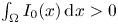
and ${ I}_0(x)$ are nonnegative continuous functions on $\bar \Omega$, and the total number of initial infectious individuals is positive; that is, $\int _\Omega {I}_0(x)\,{\rm d}\kern0.6pt x>0$.


Nonlocal eigenvalue problems may not admit principal eigenvalues in general (Coville [Reference Coville9]). So the basic reproduction number lacks variational characterization. Yang et al. [Reference Yang, Li and Ruan45] gave the limits of the basic reproduction number as the dispersal rate tends to zero or infinity under the condition that a corresponding weighted eigenvalue problem admits a principal eigenvalue and only studied the effects of large dispersal rates on the disease transmission. In the present paper, we prove the limits of the basic reproduction number removing the additional condition by a different method in Zhang and Zhao [Reference Zhang and Zhao46], which enables us to reduce the problem on the limiting profile of the basic reproduction number into that of the spectral bound of the corresponding operator, and supplement the results about small dispersal rates. It should be pointed out that the basic reproduction number of model in [Reference Allen, Bolker, Lou and Nevai2, Reference Yang, Li and Ruan45] is independent of the total population size and it depends on the total population size for (1.1) with $m\not \equiv 0$ . The nonlocal diffusion term brings the lack of regularity of the endemic steady state and Harnack inequality, which makes the limit function of the sequence of the endemic steady state hard to get when we investigate the impacts of small and large dispersal rates. Letting the dispersal rates go to infinity yields spatial homogeneity, which is a trivial conclusion. But small dispersal rates may cause interesting phenomenon. We conclude whether lowering the movements of susceptible individuals can eradicate the disease or not depends on not only the sign of $\beta -\gamma$
 but also the total population size, which is different from that of the model with standard incidence [Reference Allen, Bolker, Lou and Nevai2, Reference Yang, Li and Ruan45] or bilinear incidence [Reference Feng, Li, Ruan and Yang15, Reference Wu and Zou43]. Allen et al. [Reference Allen, Bolker, Lou and Nevai2] considered the case $m\equiv 0$
 and required that $\beta -\gamma$
 changes sign on $\Omega$
 . They concluded that limiting the movements of susceptible individuals makes the disease die out. Compared with Allen et al. [Reference Allen, Bolker, Lou and Nevai2], in this paper, we consider the following two cases:
(a) the set $\left \{x\in \Omega : \beta (x)\leq \gamma (x)\right \}$
has interior points in $\Omega$;(b) $\left \{x\in \Omega : \beta (x)>\gamma (x)\right \}=\Omega$
.



For case (a), limiting the movements of susceptible individuals makes the disease die out. For case (b), lowering the movements of susceptible individuals can eradicate the disease only when the total population size is relatively small. As for model with standard incidence [Reference Allen, Bolker, Lou and Nevai2, Reference Yang, Li and Ruan45], it does not depend on the total population size and the disease always persists with the total number of infected individuals larger than that of saturated incidence, from which we derive increasing $m$ helps to eliminate the disease or reduce the size of infected individuals. Similar comparisons can be seen when both dispersal rates approach zero and the dispersal rate of susceptible individuals is significantly lower than that of infected individuals.
This paper is organized as follows. In § 2.1, we list the main results of this paper including not only the existence, uniqueness of endemic steady state of system (1.1) but also the asymptotic profile of the endemic steady state of system (1.1) for small and large diffusion rates. In § 2.2, we compare the results of system (1.1) with that of model with standard incidence or bilinear incidence. In § 3, we present proofs of the main results stated in § 2.1.
2. Main results and discussion
2.1. Main results
In this section, we state the main results of this paper. Let $N:=\int _\Omega ({ S}_0(x)+{ I}_0(x))\,{\rm d}\kern0.6pt x$ be the total number of individuals in $\Omega$
 at $t=0$
 . Define

It is well-known that $\mathcal {M}$ can generate a uniformly continuous semigroup, denoted by $\{T(t)\}_{t \ge 0}.$
 Denote $\theta (x):=\frac {\beta (x)\frac {N}{|\Omega |}}{m(x)+\frac {N}{|\Omega |}}$
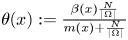 , $\mathcal {F}[\phi ](x):=\theta (x)\phi (x)$
 and

We define the basic reproduction number of system (1.1) as follows

where $r(\mathcal {L})$ represents the spectral radius of $\mathcal {L}.$
 Set $\hat R_0=r(\hat {\mathcal {L}})$
 , where $\hat {\mathcal {L}}$
 is defined by replacing $\theta (x)$
 by $\beta (x)$
 in the definition of $\mathcal {L}$
 .
First we give the results about the dependence of $R_0$ on $d_I$
 and $N$
 .
Theorem 2.1 The following statements hold.
(i) $R_0$
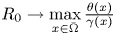
is a non-increasing function of $d_I$ with $R_0\to \max \limits _{x\in \bar \Omega } \frac {\theta (x)}{\gamma (x)}$ as $d_I\to 0$ and $R_0\to \frac {\int _\Omega \theta \,{\rm d}\kern0.6pt x}{\int _\Omega \gamma \,{\rm d}\kern0.6pt x}$ as $d_I\to +\infty$.(ii) $R_0$
is a monotone increasing function of $N$ with $R_0\to 0$ as $N\to 0$ and $R_0\to \hat R_0$ as $N\to +\infty$.




Remark 2.2 Allen et al. [Reference Allen, Bolker, Lou and Nevai2] obtained the same results as theorem 2.1 (i) for an SIS reaction-diffusion model with the aid of variational characterization for the basic reproduction number because the basic reproduction number equals the reciprocal of the principal eigenvalue of a corresponding eigenvalue problem with random diffusion. But nonlocal eigenvalue problems may not admit principal eigenvalues in general. Under the conditions that the nonlocal weighted eigenvalue problem

admits a unique positive principal eigenvalue $\mu _p$ with positive eigenfunction and there exists some positive function $\psi _{d_I}(x) \in L^2(\Omega )$
 satisfying $\mathcal {L}[\psi _{d_I}](x)=R_0 \psi _{d_I}(x),\,$
 [Reference Yang, Li and Ruan45, Theorem 2.16] gives that $R_0\to \max \limits _{x\in \bar \Omega } {\theta (x)}/{\gamma (x)}$
 as $d_I\to 0$
 and $R_0\to {\int _\Omega \theta \,{\rm d}\kern0.6pt x}/{\int _\Omega \gamma \,{\rm d}\kern0.6pt x}$
 as $d_I\to +\infty$
 . Now we remove these additional conditions and further investigate the impact of $N$
 by means of a different method in Zhang and Zhao [Reference Zhang and Zhao46], which enables us to reduce the problem on the limiting profile of the basic reproduction number into that of the spectral bound of the corresponding operator.
Next we present the existence and uniqueness of endemic steady state of (1.1).
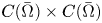
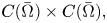
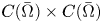
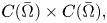
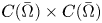
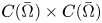
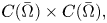
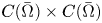
Theorem 2.3 Suppose $R_0>1.$ Then system (1.1) has an endemic steady state $(S,\, I)\in C(\bar \Omega )\times C(\bar \Omega ).$
 Furthermore, if $d_S\geq d_I$
 , the endemic steady state of (1.1) is unique.
Finally we state results on the asymptotic profile of the endemic steady state for small and large dispersal rates. Denote

Theorem 2.4 Suppose that $R_0>1$ and the set $H^-$
 has interior points in $\Omega$
 . For any fixed $d_I>0,$
 up to a subsequence of $d_{S}\to 0$
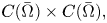
 , the corresponding endemic steady state of (1.1) satisfies $(S,\, \frac {I}{d_{S}})\to (S^*,\, V^*)$
 in $C(\bar \Omega )\times C(\bar \Omega ),$
 where $S^*$
 , $V^*>0$
 on $\bar \Omega$
 and $(S^*,\, V^*)$
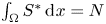
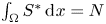
 with $\int _\Omega S^*\,{\rm d}\kern0.6pt x=N$
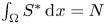 is a positive solution of

Theorem 2.5 Suppose that $R_0>1$ and $H^+=\Omega$
 . For any fixed $d_I>0,$
 up to a subsequence of $d_{S}\to 0$
 , the corresponding endemic steady state $(S,\, I)$
 of (1.1) satisfies one of the following statements:
(i) $\big(S,\, \frac {I}{d_{S}}\big)\to (S^*,\, V^*)$
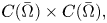
in $C(\bar \Omega )\times C(\bar \Omega ),$ where $S^*$, $V^*>0$ on $\bar \Omega$ and $(S^*,\, V^*)$ with $\int _\Omega S^*\,{\rm d}\kern0.6pt x=N$ is a positive solution of (2.1).(ii) $(S,\, I)\to \big(\frac {\gamma m}{\beta -\gamma },\, 0\big)$
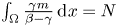
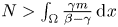
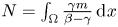
in $C(\bar \Omega )\times C(\bar \Omega )$ and $\int _\Omega \frac {\gamma m}{\beta -\gamma }\,{\rm d}\kern0.6pt x=N$.(iii) $(S,\, I)\to \big(\frac {\gamma (m+I^*)}{\beta -\gamma },\, I^*\big)$
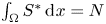
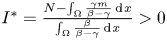
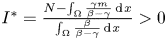
in $C(\bar \Omega )\times C(\bar \Omega ),$ where $I^*=\frac {N-\int _\Omega \frac {\gamma m}{\beta -\gamma }\,{\rm d}\kern0.6pt x} {\int _\Omega \frac {\beta }{\beta -\gamma }\,{\rm d}\kern0.6pt x}>0$.





In addition, when $N\leq \int _\Omega \frac {\gamma m}{\beta -\gamma }\,{\rm d}\kern0.6pt x$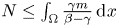 , $I\to 0$
 ; when $\beta -\gamma$
 and $m$
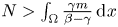
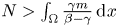
 are positive constants with $N>\int _\Omega \frac {\gamma m}{\beta -\gamma }\,{\rm d}\kern0.6pt x$
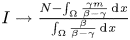
 , $I\to \frac {N-\int _\Omega \frac {\gamma m}{\beta -\gamma }\,{\rm d}\kern0.6pt x} {\int _\Omega \frac {\beta }{\beta -\gamma }\,{\rm d}\kern0.6pt x}$
 .
Remark 2.6 If the set $H^-$ has interior points in $\Omega$
 , theorem 2.4 implies that $I\to 0$
 as $d_S\to 0$
 . If $H^+=\Omega$
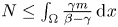
 , it follows from theorem 2.5 that $I\to 0$
 as $d_S\to 0$
 if $N\leq \int _\Omega \frac {\gamma m}{\beta -\gamma }\,{\rm d}\kern0.6pt x$
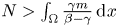
 . We conjecture that $I\to \frac {N-\int _\Omega \frac {\gamma m}{\beta -\gamma }\,{\rm d}\kern0.6pt x} {\int _\Omega \frac {\beta }{\beta -\gamma }\,{\rm d}\kern0.6pt x}$
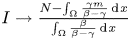 as $d_S\to 0$
 when $N>\int _\Omega \frac {\gamma m}{\beta -\gamma }\,{\rm d}\kern0.6pt x$
 . We only prove this conjecture when $\beta -\gamma$
 and $m$
 are positive constants. In figure 1, we perform some numerical simulations to support this conjecture.
Numerical simulations of the profiles of endemic steady states $(S,\, I)$ for system (1.1) as $d_S\to 0$
 , where $\Omega =(-1,\, 1),\, J(x)=\frac {1}{\sqrt {\pi }}e^{-x^2},\, N=8,\, d_S=0.0001,\, d_I=1$
 , (a) $m(x)=6,\, \beta (x)=\sin (\pi x)+10,\, \gamma (x)=\sin (\pi x)+2$
 , (b) $m(x)=\cos (\pi x)+6,\, \beta (x)=\sin (\pi x)+10,\, \gamma (x)=\cos (\pi x)+2$
 , (c) $m(x)=\cos (\pi x)+5,\, \beta (x)=\sin (\pi x)+5,\, \gamma (x)=\sin (\pi x)+2$
 .

Theorem 2.7 Suppose that $\Omega ^+$ is nonempty.
(i) Up to subsequences of $d_I\to 0$
and $\frac {d_I}{d_S}\to d\in [0,\,+\infty )$, the endemic steady state of (1.1) satisfies $(S,\, I)\to (S^*,\, I^*)$ in $C(\bar \Omega )\times C(\bar \Omega ),$ where $S^*$ is a positive function, $I^*$ is nonnegative and not identically zero on $\bar \Omega$, and $(S^*,\, I^*)$ satisfies
(2.2)\begin{align} & I^*(x)=\begin{cases} \dfrac{l(\beta(x)-\gamma(x))-\gamma(x)m(x)}{d(\beta(x)-\gamma(x)) +\gamma(x)}, & \text{ if }\ l(\beta(x)-\gamma(x))-\gamma(x)m(x)>0, ~x\in\bar\Omega,\\ 0, & \text{ if }\ l(\beta(x)-\gamma(x))-\gamma(x)m(x)\leq0, ~x\in\bar\Omega, \end{cases}\nonumber\\ & S^*=l-d I^*,\nonumber\\ & \int_\Omega (S^*+I^*)\,{\rm d}\kern0.6pt x=N, \end{align}in which $l$
is some positive constant. In particular, if $d\in [0,\, 1]$, then $l$ is uniquely determined.(ii) If the set $H^-$
has interior points in $\Omega$, then up to subsequences of $d_I\to 0$ and $\frac {d_I}{d_S}\to +\infty$, the endemic steady state of (1.1) satisfies $(S,\, I)\to (S^*,\, 0)$ in $C(\bar \Omega )\times C(\bar \Omega )$, where
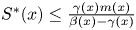
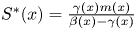
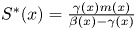
\[ S^*(x)=\begin{cases}l-\displaystyle\frac{l(\beta(x)-\gamma(x))-\gamma(x)m(x)}{\beta(x)-\gamma(x)}, & \text{ if }\ l(\beta(x)-\gamma(x))-\gamma(x)m(x)>0, ~x\in\bar\Omega,\\ l, & \text{ if }\ l(\beta(x)-\gamma(x))-\gamma(x)m(x)\leq0, ~x\in\bar\Omega, \end{cases} \]in which the positive constant $l$
is determined by $\int _\Omega S^*\,{\rm d}\kern0.6pt x=N$.(iii) If $H^+=\Omega$
, then up to subsequences of $d_I\to 0$ and $\frac {d_I}{d_S}\to +\infty$, the endemic steady state of (1.1) satisfies $(S,\, I)\to (S^*,\, I^*)$ in $C(\bar \Omega )\times C(\bar \Omega )$, where $S^*$ is a positive function and $I^*$ is a nonnegative constant. Moreover, the following conclusions hold.
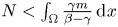
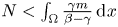
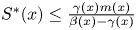
(a) If $N< \int _\Omega \frac {\gamma m}{\beta -\gamma }\,{\rm d}\kern0.6pt x$
, then $(S^*,\, I^*)=(l-\frac {[l(\beta -\gamma )-\gamma m]^+} {\beta -\gamma },\,0)$, where the positive constant $l$ is determined by $\int _\Omega S^*\,{\rm d}\kern0.6pt x=N$. In addition, there exist positive constants $0< d_0\ll 1$, $C_1$ and $C_2$ such that
\[ C_1\frac{d_S}{d_I}\leq \|I\|_{L^\infty(\Omega)}\leq C_2\frac{d_S}{d_I}\ \text{ for all }\ 0< d_I, \frac{d_S}{d_I}< d_0. \]
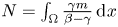
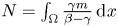
(b) If $N= \int _\Omega \frac {\gamma m}{\beta -\gamma }\,{\rm d}\kern0.6pt x$
, then $(S^*,\, I^*)=(\frac {\gamma m}{\beta -\gamma },\, 0)$.(c) If $N> \int _\Omega \frac {\gamma m}{\beta -\gamma }\,{\rm d}\kern0.6pt x$
, then $(S^*,\, I^*)=(\frac {\gamma (m+I^*)}{\beta -\gamma },\, \frac {N- \int _\Omega \frac {\gamma m}{\beta -\gamma }\,{\rm d}\kern0.6pt x}{\int _\Omega \frac {\beta }{\beta -\gamma }\,{\rm d}\kern0.6pt x})$.



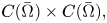



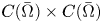












Theorem 2.8 The following statements hold.
(i) Suppose that $R_0>1.$
If $d_I$ is fixed and $d_S\to +\infty,$ then the endemic steady state of (1.1) $(S,\, I)\to (S^*,\, I^*)$ in $C(\bar \Omega )\times C(\bar \Omega ),$ where $I^*$ is the unique positive solution of
(2.3)\begin{equation} d_I\int_\Omega J(x-y)(I(y)-I(x))\,{\rm d}y+\frac{\beta(x)\frac{1}{|\Omega|}\left(N-\int_\Omega I\,{\rm d}\kern0.6pt x\right)I}{m(x)+\frac{1}{|\Omega|}\left(N-\int_\Omega I\,{\rm d}\kern0.6pt x\right)+I}-\gamma(x)I=0 \end{equation}and
\[ S^*=\frac{N-\int_\Omega I^*\,{\rm d}\kern0.6pt x}{|\Omega|}. \]
(ii) Suppose that $\int _\Omega \theta \,{\rm d}\kern0.6pt x>\int _\Omega \gamma \,{\rm d}\kern0.6pt x$
. For any fixed $d_S>0$, up to a subsequence of $d_{I}\to +\infty$, the corresponding endemic steady state of (1.1) satisfies $(S,\, I)\to (S^*,\, I^*)$ in $C(\bar \Omega )\times C(\bar \Omega )$, where $I^*$ is a positive constant and $S^*$ is the positive solution of
(2.4)\begin{equation} \begin{cases} \displaystyle d_S\int_\Omega J(x-y)(\tilde S(y)-\tilde S(x))\,{\rm d}y-\frac{\beta(x)\tilde S I^*}{m(x)+\tilde S+I^*}+\gamma(x) I^*=0,\quad x\in\Omega,\\ \int_\Omega\tilde S\,{\rm d}\kern0.6pt x=N-I^*|\Omega|. \end{cases} \end{equation}
(iii) Suppose that $\int _\Omega \theta \,{\rm d}\kern0.6pt x>\int _\Omega \gamma \,{\rm d}\kern0.6pt x$
. If $d_S\to +\infty$ and $d_I\to +\infty,$ then the endemic steady state of (1.1) satisfies
\[ (S, I)\to\left(\frac{N}{|\Omega|}\frac{\int_\Omega\gamma\,{\rm d}\kern0.6pt x}{\int_\Omega\theta\,{\rm d}\kern0.6pt x}, \frac{N}{|\Omega|}\frac{\int_\Omega(\theta-\gamma)\,{\rm d}\kern0.6pt x}{\int_\Omega\theta\,{\rm d}\kern0.6pt x}\right) ~~\text{ in }~~C(\bar\Omega)\times C(\bar\Omega). \]














Remark 2.9 If $m\equiv 0$ , system (1.1) becomes the following model with standard incidence

Yang et al. [Reference Yang, Li and Ruan45, Section 4] only proved asymptotic profiles of endemic steady states of (2.5) for large dispersal rates. But the proofs in [Reference Yang, Li and Ruan45, Section 4] contain some errors. The proof of theorem 2.8 is still correct for $m\equiv 0$ and the results of theorem 2.8 are consistent with that in [Reference Yang, Li and Ruan45, Section 4]. Since the endemic steady states of nonlocal dispersal system (2.5) lack regularity and Harnack inequality, the methods for reaction-diffusion model (Allen et al. [Reference Allen, Bolker, Lou and Nevai2] and Peng [Reference Peng32]) are not applicable to (2.5). Applying similar arguments to the proofs of theorems 2.4, 2.5 and 2.7, we supplement the following results on asymptotic profiles of endemic steady states of (2.5) for small dispersal rates.
Proposition 2.10 Suppose that $\hat R_0>1$ .
(i) Assume the set $H^-$
has interior points in $\Omega$. For any fixed $d_I>0,$ up to a subsequence of $d_{S}\to 0$, the corresponding endemic steady state of (2.5) satisfies $(S,\, \frac {I}{d_{S}})\to (S^*,\, V^*)$ in $C(\bar \Omega )\times C(\bar \Omega ),$ where $S^*\geq 0$, $V^*>0$ on $\bar \Omega$ and $\int _\Omega S^*\,{\rm d}\kern0.6pt x=N$.(ii) Assume $H^+=\Omega$
. For any fixed $d_I>0,$ if $d_{S}\to 0$, then the corresponding endemic steady state of (2.5) satisfies $(S,\, I)\to \big(\frac {N\gamma }{(\beta -\gamma )\int _\Omega \frac {\beta } {\beta -\gamma }\,{\rm d}\kern0.6pt x},\,\frac {N} {\int _\Omega \frac {\beta }{\beta -\gamma }\,{\rm d}\kern0.6pt x}\big)$ in $C(\bar \Omega )\times C(\bar \Omega )$.








Proposition 2.11 Assume $H^+$ is nonempty.
(i) If $d_I\to 0$
and $\frac {d_I}{d_S}\to d\in [0,\,+\infty )$, then the endemic steady state of (2.5) satisfies $(S,\, I)\to (S^*,\, I^*)$ in $C(\bar \Omega )\times C(\bar \Omega ),$ where
\begin{align*} & I^*(x)=\begin{cases}\displaystyle\frac{N}{|\Omega|+(1-d)\int_{H^+}\frac{\beta-\gamma} {d(\beta-\gamma)+\gamma}\,{\rm d}\kern0.6pt x}\frac{\beta-\gamma}{d(\beta-\gamma) +\gamma}, & \text{ if }\ x\in H^+,\\ 0, & \text{ if }\ x\in H^-, \end{cases}\\ & S^*=\frac{N}{|\Omega|+(1-d)\int_{H^+}\frac{\beta-\gamma} {d(\beta-\gamma)+\gamma}\,{\rm d}\kern0.6pt x}-d I^*. \end{align*}
(ii) If $d_I\to 0$
and $\frac {d_I}{d_S}\to +\infty$, then the endemic steady state of (2.5) satisfies the following statements.
(a) If the set $H^-$
has interior points in $\Omega$, then $I\to 0$ in $C(\bar \Omega )$ and $S\to S^*$ uniformly on any compact subset of $H^-$ and $H^+$, respectively, where
\[ S^*(x)=\begin{cases}0, & \text{ if }\ x\in H^+,\\ \displaystyle\frac{N}{|H^-|}, & \text{ if }\ x\in H^-. \end{cases} \]
(b) If $H^+=\Omega$
, then $(S,\, I)\to \left(\frac {N\gamma }{(\beta -\gamma )\int _\Omega \frac {\beta } {\beta -\gamma }\,{\rm d}\kern0.6pt x},\, \frac {N} {\int _\Omega \frac {\beta }{\beta -\gamma }\,{\rm d}\kern0.6pt x}\right)$ in $C(\bar \Omega )\times C(\bar \Omega )$.






2.2. Discussion
This paper is mainly concerned with the asymptotic profiles of the endemic steady states of a nonlocal (convolution) dispersal SIS epidemic model (1.1) with saturated incidence. Yang et al. [Reference Yang, Li and Ruan45] considered (2.5) with standard incidence and Feng et al. [Reference Feng, Li, Ruan and Yang15] studied the following model with bilinear incidence

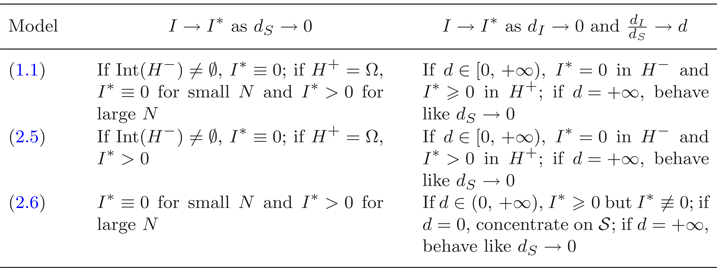
When an infectious disease breaks out in an area, people look forward to eradicating it as soon as possible for their health and normal lives. As a consequence, developing effective prevention and control strategies is especially important. For the sake of revealing the impacts of infection mechanism and dispersal rates on the elimination of infectious disease and providing possible options for disease control, we make a comparison between our main results about (1.1) and those about models (2.5) and (2.6). One can see table 1 for a quick understanding about the extinction or persistence of disease with small dispersal rates of susceptible individuals or/and infected individuals. Recall

Asymptotic behaviour of endemic steady states $(S,\, I)$ for small dispersal rates

Comparison of basic reproduction number
The basic reproduction number of (2.5) is independent of the total population size $N$ , but that of (2.6) and (1.1) depends on $N$
 and monotonically increases with respect to $N$
 by theorem 2.1. This implies that an infectious disease is more likely to be endemic in a large population. And the basic reproduction number of (1.1) is smaller than that of (2.5); that is, the transmission ability of (1.1) is weaker than that of (2.5). When the total population size is relatively large, the basic reproduction number of (2.6) is the biggest one corresponding to the strongest infection ability.
Comparison of asymptotic profiles of endemic steady states
Case I. $d_S\to 0$ . The asymptotic profiles of endemic steady states of these three models are different. For (2.5), in view of theorem 2.10, if there are low-risk sites which belong to $H^-$
 (see Allen et al. [Reference Allen, Bolker, Lou and Nevai2]), the total size of infected individuals tends to zero. But if the habitats only consist of high-risk sites which belong to $H^+$
 , the total size of infected individuals tends to $\frac {N}{\int _\Omega \frac {\beta }{\beta -\gamma }\,{\rm d}\kern0.6pt x}$
 ; that is, the disease will always persist. For (2.6), by [Reference Feng, Li, Ruan and Yang15, Theorems 2.3-2.5], if $N<\int _\Omega \frac {\gamma }{\beta }\,{\rm d}\kern0.6pt x$
 , the disease can be eradicated; if $N>\int _\Omega \frac {\gamma }{\beta }\,{\rm d}\kern0.6pt x$
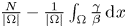
 , the total size of infected individuals tends to $\frac {N}{|\Omega |}-\frac {1}{|\Omega |}\int _\Omega \frac {\gamma }{\beta }\,{\rm d}\kern0.6pt x$
 . As to (1.1), it follows from theorem 2.4 that if $H^-$
 is nonempty, then limiting the movements of susceptible individuals yields extinction of the disease; if $H^+=\Omega$
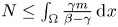
 , then the disease is either extinct or persistent by theorem 2.5. The disease can be eliminated when $N\leq \int _\Omega \frac {\gamma m}{\beta -\gamma }\,{\rm d}\kern0.6pt x$
 and we conjecture that the total size of infected individuals tends to $\frac {N-\int _\Omega \frac {\gamma m}{\beta -\gamma }\,{\rm d}\kern0.6pt x} {\int _\Omega \frac {\beta }{\beta -\gamma }\,{\rm d}\kern0.6pt x}$
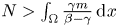
 when $N>\int _\Omega \frac {\gamma m}{\beta -\gamma }\,{\rm d}\kern0.6pt x$
 , from which we derive that increasing $m$
 helps to eliminate the disease or reduce the size of infected individuals. In figure 1, we perform some numerical simulations to support this conjecture. So systems (1.1) and (2.5) behave similarly when $H^-$
 is nonempty; model (1.1) is analogous to (2.6) when $H^+=\Omega$
 .
Case II. $d_I\to 0$ and $\frac {d_I}{d_S}\to d\in [0,\, +\infty ]$
 . If $d\in (0,\, +\infty )$
 , the infected individuals do not reside in $H^-$
 for (1.1) and (2.5). The infected individuals reside in all sites of $H^+$
 for (2.5) but do not distribute in some sites of $H^+$
 for (1.1). If $d=+\infty$
 and $H^-$
 is nonempty, then the disease is eradicated for (1.1) and (2.5). If $d=+\infty$
 and $H^+=\Omega$
 , then the disease must be persistent for (2.5) but it depends on the total population size $N$
 for (1.1) and (2.6). The disease is extinct when $N$
 is relatively small and persistent when $N$
 is large. If $d=0$
 , system (2.6) represents a particular concentration phenomenon that the infected individuals concentrate on the sites of $\mathcal {S}$
 . Systems (2.5) and (1.1) behave similarly. The infected individuals do not distribute in $H^-$
 . For (2.5), the infected individuals live exactly in $H^+$
 . But in some sites of $H^+$
 , there are not infected individuals for (1.1) implying that (1.1) tends to reduce the scale of disease. As a result, the individuals with significantly lowered dispersal rates play a dominant role.
To sum up, once a low-risk region is created or $N$ is relatively small, limiting the movements of susceptible individuals is an effective method to make the disease die out. When $N$
 is large or all sites of $\Omega$
 are high-risk, the disease cannot be totally eradicated by limiting the movements of susceptible individuals and/or that of infected individuals. But limiting the movements of susceptible individuals and that of infected individuals can prevent the disease from being extensive over the whole area.
Remark 2.12 Models (1.1), (2.5) and (2.6) do not incorporate the birth–death effect and crowding effect such as linear source $\Lambda -S$ and logistic source $S(a-bS)$
 . For random diffusion models with birth–death effect or crowding effect, appealing to the uniform persistence theory or topological degree argument yields the existence of endemic steady states. One can see Guo et al. [Reference Guo, Wang and Ji19], Li et al. [Reference Li, Peng and Wang28], Li et al. [Reference Li, Peng and Wang29], Li et al. [Reference Li, Li and Tong27], Peng et al. [Reference Peng, Wang, Zhang and Zhou34] and references cited therein for related studies. For nonlocal dispersal model, the lack of compactness of the solution semiflow makes the uniform persistence theory and topological degree argument unapplicable and a varying total population results in the difficulty that the stationary system can not be transformed into a single equation. One needs to find new methods to solve the existence, uniqueness, stability and asymptotic profiles of endemic steady states. We leave these for further study.
3. Preliminaries and proof of main results
In this section, we present the proofs of main theorems stated in § 2.1. Before that, we give some useful results.
3.1. Preliminaries
Adding up the two equations of (1.1) and integrating it on $\Omega$ yield that the total population size is constant, that is,

We investigate the existence and uniqueness of the steady state of system (1.1). That is, we consider the following stationary problem

The solutions of (3.1) also satisfy

By the same proof as [Reference Yang, Li and Ruan45, Lemma 3.3], we have the following lemma.
Lemma 3.1 System (1.1) admits a unique disease-free steady state $(\frac {N}{|\Omega |},\, 0).$
Define

The nonlocal dispersal eigenvalue problem may not admit a principal eigenvalue. See a counterexample in [Reference Coville9]. In general, $\lambda _v$ defined above may not be the principal eigenvalue.
Lemma 3.2 Yang et al. [Reference Yang, Li and Ruan45, Lemma 2.5]
Set $v(x)=-d_I \int _{\Omega } J(x-y) d y+\theta (x)-\gamma (x)$ . Suppose there is some $x_0 \in \operatorname {Int}(\Omega )$
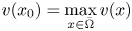
 satisfying that $v(x_0)=\max \limits _{x\in \bar {\Omega }} v(x)$
 , and the partial derivatives of $v(x)$
 up to order $n-1$
 at $x_0$
 are zero. Then $\lambda _v(d_I)$
 is the unique principal eigenvalue of

See other sufficient conditions for the existence of the principal eigenvalue in Coville [Reference Coville9] and Shen and Xie [Reference Shen and Xie39].
Remark 3.3 Although the principal eigenvalue does not always exist, we can use the principal eigenfunction of the approximation problem to construct lower or upper solution. Since $v(x)$ defined in lemma 3.2 is continuous on $\bar {\Omega }$
 , there exists some $x_0 \in \bar {\Omega }$
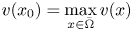
 such that $v(x_0)=\max \limits _{x \in \bar {\Omega }} v(x)$
 . Define a function sequence as follows:

where $B_{x_0}(\frac {1}{n})=\left \{x \in \Omega : |x-x_0 |<\frac {1}{n}\right \}$ , $v_{n, 1}(x)$
 satisfies $v_{n, 1} \leq v(x_0)$
 and $v_{n, 1}(x)$
 is continuous on $\Omega$
 . Indeed, $v_{n, 1}(x)$
 exists if only we take $n$
 is large enough, denoted by $n \geq n_0>0$
 . Thus, lemma 3.2 implies that the eigenvalue problem

admits a principal eigenpair, denoted by $(\lambda _v^n(d_I),\, \phi _n)$ . And $|\lambda _v^n-\lambda _v|\to 0$
 as $n\to +\infty$
 due to [Reference Yang, Li and Ruan45, Remark 2.7]. In the following arguments, we sometimes use $\phi _n$
 to construct lower or upper solution.
In view of [Reference Yang, Li and Ruan45, Corollary 2.11], we have the following relation between $\lambda _v(d_I)$ and $R_0$
 .
Lemma 3.4 $\lambda _v(d_I)$ has the same sign as $1-R_0.$

Following the same proof as [Reference Feng, Li, Ruan and Yang15, Lemma 3.12], an equivalent problem to (3.1) is obtained.
Lemma 3.5 Suppose that $d_{I}>0$ and $d_{S}>0$
 are fixed. The following conclusions hold.
(i) Let $(S,\, I)$
be a nonnegative solution of (3.1). Then the function
(3.3)\begin{equation} \kappa=d_{S} S+d_{I} I \end{equation}is a constant function. Furthermore, by letting
(3.4)\begin{equation} \tilde{S}=\frac{S}{\kappa} \quad \text{ and } \quad \tilde{I}=\frac{d_I I}{\kappa}, \end{equation}$(\kappa,\, \tilde {S},\, \tilde {I})$
satisfies
(3.5)\begin{align} & \tilde{S}=\frac{1}{d_{S}}\left(1-\tilde{I}\right), \end{align}
(3.6)\begin{align} & \frac{\kappa}{d_{S}} \int_{\Omega}\left[\left(1-\tilde{I}\right)+\frac{d_{S}}{d_I} \tilde{I}\right]\,{\rm d}\kern0.6pt x=N \end{align}and
(3.7)\begin{align} \begin{cases} \displaystyle d_{I} \int_\Omega J(x-y)(\tilde{I}(y)-\tilde{I}(x))\,{\rm d}y+\frac{\beta(x)\frac{\kappa}{d_S}(1-\tilde I)\tilde I}{m(x)+\frac{\kappa}{d_S}(1-\tilde I)+\frac{\kappa}{d_I}\tilde I} -\gamma(x)\tilde{I}=0, & x \in \Omega,\\ 0 \leq \tilde{I}<1, & x \in \Omega. \end{cases} \end{align}
(ii) If $(\kappa,\, \tilde {S},\, \tilde {I})$
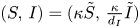
solves (3.5), (3.6) and (3.7), then $(S,\, I)=(\kappa \tilde {S},\, \frac {\kappa }{d_I} \tilde {I})$ is a nonnegative solution of (3.1).


Define

and

Recall that the spectral bound of a closed operator $A$ is defined by

in which $\sigma (A)$ and $\rho (A)$
 denote the spectrum and resolvent set of $A$
 , respectively.
Lemma 3.6 The following statements hold.
(i) If $\lambda _v^*(\infty )\geq 0$
, then $0$ is the only nonnegative solution of (3.7).(ii) If $\lambda _v^*(\infty )< 0$
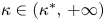
, then there exists some $\kappa ^*>0$ such that (3.7) admits a unique positive solution $\tilde I_\kappa$ when $\kappa >\kappa ^*$ and $0$ is the only nonnegative solution of (3.7) when $0\leq \kappa \leq \kappa ^*$. Moreover, the positive solution satisfies $0<\tilde I_\kappa <1$ and $\tilde I_\kappa$ is strictly increasing and continuously differentiable on $\kappa \in (\kappa ^*,\, +\infty )$.


Proof. It is easy to see that $\lambda _v^*(0)\geq \min \limits _{x\in \bar \Omega }\gamma (x)>0$ . In view of the continuity and monotonicity of $\lambda _v^*(\kappa )$
 on $\kappa$
 , if $\lambda _v^*(\infty )\geq 0$
 , then $\lambda _v^*(\kappa )\geq 0$
 for all $\kappa \geq 0$
 ; if $\lambda _v^*(\infty )< 0$
 , then there exists some $\kappa ^*>0$
 such that $\lambda _v^*(\kappa )<0$
 when $\kappa >\kappa ^*$
 and $\lambda _v^*(\kappa )\geq 0$
 when $0\leq \kappa \leq \kappa ^*$
 . By [Reference Coville9, Theorem 1.6], one can get that (3.7) admits a unique positive solution if and only if $\lambda _v^*(\kappa )<0$
 . Then we derive the conclusions of lemma 3.6 about the existence of nonnegative solutions of (3.7). By similar arguments as the proof of [Reference Yang, Li and Ruan45, Theorem 3.8], we derive that the positive solution satisfies $0<\tilde I_\kappa <1$
 . Define a mapping $G: \mathbb {R}^+\times C(\bar \Omega )\to C(\bar \Omega )$
 by

Assume $\kappa _0,\, \kappa _1\in (\kappa ^*,\, +\infty )$ and $\kappa _0<\kappa _1$
 . It is verified that $G(\kappa _1,\, \tilde I_{\kappa _0})>0$
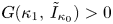 , which implies that $\tilde I_{\kappa _0}$
 is a lower solution of $G(\kappa _1,\, \tilde I)=0$
 . Clearly, $1$
 is an upper solution. By the method of upper and lower solutions and the uniqueness of a positive solution of $G(\kappa _1,\, \tilde I)=0$
 , we have $\tilde I_{\kappa _0}<\tilde I_{\kappa _1}$
 . By the positivity of $\tilde I_{\kappa _0}$
 , $0$
 is the principal eigenvalue of

The Fréchet derivative of $G$ with respect to the second variable at $(\kappa _0,\, \tilde I_{\kappa _0})$
 is

Then we have $s(G_{\tilde I}(\kappa _0,\, \tilde I_{\kappa _0}))< 0$ and $0\in \rho (G_{\tilde I}(\kappa _0,\, \tilde I_{\kappa _0}))$
 . It follows from the Implicit Function Theorem that there exists a unique $\tilde I_\kappa \in C(\bar \Omega )$
 such that $G(\kappa,\, \tilde I_\kappa )=0$
 for $\kappa \in (\kappa _0-\epsilon,\, \kappa _0+\epsilon )$
 with $\epsilon >0$
 and this $\tilde I_\kappa$
 is continuously differentiable with respect to $\kappa$
 . The proof is completed.
3.2. Proof of main results
Proof Proof of theorem 2.1
Set $\mathcal {A}_\mu =\mathcal {M}+\frac {1}{\mu }\mathcal {F}$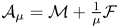 . By virtue of [Reference Yang, Li and Ruan45, Proposition 2.9], we have $\mathcal {M}$
 and $\mathcal {A}_\mu$
 are resolvent positive operators and $s(\mathcal {M})<0$
 . (i) For any $\mu >0$
 , it follows from [Reference Altenberg1, Theorem 6] that $s(\mathcal {A}_\mu )$
 is non-increasing in $d_I$
 . We derive from the proof of [Reference Yang, Li and Ruan45, Theorem 2.10] that $R_0=r(-\mathcal {F}\mathcal {M}^{-1})$
 and [Reference Zhang and Zhao46, Lemma 2.5 (ii)] gives that $r(-\mathcal {F}\mathcal {M}^{-1})$
 is the unique solution of $s(\mathcal {A}_\mu )=0$
 . As a result, $R_0$
 is non-increasing in $d_I$
 . In view of [Reference Shen and Xie39, Theorem 2.2], $\lim \limits _{d_I\to 0}s(\mathcal {A}_\mu )= \max \limits _{x\in \bar \Omega }[-\gamma (x)+\frac {1}{\mu }\theta (x)]$
 and $\lim \limits _{d_I\to +\infty }s(\mathcal {A}_\mu )= \frac {1}{|\Omega |}\int _\Omega (-\gamma +\frac {1}{\mu }\theta )\,{\rm d}\kern0.6pt x.$
 Combined with [Reference Zhang and Zhao46, Lemma 2.5 (ii)], we conclude that $R_0\to \max \limits _{x\in \bar \Omega } \frac {\theta (x)}{\gamma (x)}$
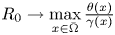 as $d_I\to 0$
 and $R_0\to \frac {\int _\Omega \theta \,{\rm d}\kern0.6pt x}{\int _\Omega \gamma \,{\rm d}\kern0.6pt x}$
 as $d_I\to +\infty$
 . (ii) Define

and

By virtue of [Reference Shen and Xie39, Proposition 3.9] and [Reference Berestycki, Coville and Vo5, Theorem 1.1], $s(\mathcal {A}_\mu )=\lambda _p(\mathcal {A}_\mu )=\lambda _p^\prime (\mathcal {A}_\mu )$ . Combined with [Reference Coville9, Proposition 1.1 (ii)], we conclude that $s(\mathcal {A}_\mu )$
 is increasing in $N$
 . Next we prove $s(\mathcal {A}_\mu )\to s(\mathcal {M})$
 as $N\to 0$
 for any $\mu >0$
 . If $s(\mathcal {M})$
 is the principal eigenvalue, that is, there exists some $\varphi \in C(\bar \Omega ),\, \varphi >0$
 such that

For any $\varepsilon >0$ , there exists $N_\varepsilon >0$
 such that $|\frac {\theta (x)}{\mu }|<\frac {\varepsilon }{2}$
 for all $N\leq N_\varepsilon$
 . Then, for $N\leq N_\varepsilon$
 , we have

By the definition of $\lambda _p^\prime (\mathcal {A}_\mu )$ , we have $s(\mathcal {A}_\mu )=\lambda _p^\prime (\mathcal {A}_\mu )\leq s(\mathcal {M})+\varepsilon$
 for $N\leq N_\varepsilon$
 . Meanwhile, it follows from [Reference Coville9, Proposition 1.1 (ii)] that $s(\mathcal {A}_\mu )=\lambda _p(\mathcal {A}_\mu )\geq s(\mathcal {M})$
 for $N\leq N_\varepsilon$
 . Hence $s(\mathcal {A}_\mu )\to s(\mathcal {M})$
 as $N\to 0$
 for any $\mu >0$
 .
If $s(\mathcal {M})$ is not the principal eigenvalue, then we can use an approximation argument. Set $h(x)=-d_I\int _\Omega J(x-y)\,{\rm d}y-\gamma (x)$
 . For each $\epsilon >0$
 , we derive from [Reference Shen and Xie39, Lemma 3.1 and Theorem 2.1 (2)] that there exists $h_\epsilon \in C(\bar \Omega )$
 such that $\|h_\epsilon -h\|_{C(\bar \Omega )}<\epsilon$
 and $s(\mathcal {M}_\epsilon )$
 is the principal eigenvalue of $\mathcal {M}_\epsilon$
 , where $\mathcal {M}_\epsilon$
 is defined by replacing $h$
 by $h_\epsilon$
 in the definition of $\mathcal {M}$
 . By the above arguments, we have $s(\mathcal {M}_\epsilon +\frac {1}{\mu }\mathcal {F})\to s(\mathcal {M}_\epsilon )$
 as $N\to 0$
 . Combined with [Reference Shen and Xie39, Theorem 2.1 (5)], we get $s(\mathcal {A}_\mu )\to s(\mathcal {M})$
 as $N\to 0$
 . It follows from [Reference Zhang and Zhao46, Theorem 2.7] that $R_0\to 0$
 as $N\to 0$
 . By similar arguments as above, we can prove $s(\mathcal {A}_\mu )\to s(\mathcal {M}+\frac {1}{\mu }\hat {\mathcal {F}})$
 as $N\to +\infty$
 , where $\hat {\mathcal {F}}$
 is defined by $\hat {\mathcal {F}}[\phi ](x):=\beta (x)\phi (x)$
 for $\phi \in C(\bar \Omega )$
 . Then we derive from [Reference Zhang and Zhao46, Theorem 2.6] that $R_0\to r(\hat {\mathcal {L}})$
 as $N\to +\infty$
 . The proof is completed.
Proof Proof of theorem 2.3
Define

where $\tilde {I}_\kappa$ is the unique nonnegative solution of (3.7). Since $R_0>1$
 , we have $\lambda _v^*(d_S\frac {N}{|\Omega |})<0$
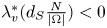 due to lemma 3.4. By virtue of the continuity and monotonicity of $\lambda _v^*(\kappa )$
 with respect to $\kappa$
 , we have $d_S\frac {N}{|\Omega |}>\kappa ^*$
 , where $\kappa ^*$
 is mentioned in lemma 3.6. Then, $N>\frac {|\Omega |}{d_S}\kappa ^*=\mathcal {N}(\kappa ^*)$
 . In view of lemma 3.6, $\mathcal {N}(\kappa )$
 is continuous on $\kappa$
 . Obviously, $\mathcal {N}(0)=0$
 and $\mathcal {N}(\kappa )\to +\infty$
 as $\kappa \to +\infty$
 . Then there exists $\kappa _N>\kappa ^*$
 such that $\mathcal {N}(\kappa _N)=N$
 . As a result, there exists a positive solution of (3.7) satisfying (3.6) for $\kappa =\kappa _N$
 , which implies that system (3.1) admits a positive solution by lemma 3.5.
Next we prove the uniqueness of the positive solution of (3.1). By lemma 3.5, it suffices to prove the uniqueness of the positive solution of (3.7) satisfying (3.6). If $d_S\geq d_I$ , in view of Lemma 3.6, $\mathcal {N}(\kappa )$
 is strictly increasing with respect to $\kappa$
 . Thus, $\kappa _N$
 is unique implying the uniqueness of the positive solution of (3.7) satisfying (3.6). The proof is completed.
Proof Proof of theorem 2.4
Since $R_0>1$ , we have $\lambda _v<0$
 and (1.1) admits an endemic steady state $(S,\, I)$
 . It follows from lemma 3.5 that the function $\kappa =d_{S} S+d_{I} I$
 is a constant function and $\tilde {I}=\frac {d_I I}{\kappa }$
 satisfies (3.7). Noting $0<\tilde I<1$
 , up to a subsequence, there exists $0\leq \hat I\leq 1$
 such that $\tilde I(x)\to \hat I(x)$
 as $d_S\to 0$
 for every $x\in \bar \Omega$
 . Suppose that there is some $x_0\in H^-$
 such that $\hat I(x_0)=1$
 . By (3.7), we have $d_I\int _\Omega J(x-y)(\tilde I(y)-\tilde I(x))\,{\rm d}y>0$
 for all $x\in H^-$
 . Letting $d_S\to 0$
 gives $d_I\int _\Omega J(x_0-y)(\hat I(y)-\hat I(x_0))\,{\rm d}y\geq 0$
 . Since $0\leq \hat I\leq 1$
 and $\hat I(x_0)=1$
 , we have $\int _\Omega J(x_0-y)(\hat I(y)-1)\,{\rm d}y=0$
 , which implies $\hat I(y)=1$
 almost everywhere in $B_\sigma (x_0)\subset H^-$
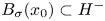 , where $B_\sigma (x_0)$
 is a ball centred at $x_0$
 with radius $\sigma$
 . If $\beta \equiv \gamma$
 on $B_\sigma (x_0)$
 , then we derive from (3.7) that

from which we derive that $\frac {\gamma (x)(m(x)+\frac {\kappa }{d_I}\tilde I(x))\tilde I(x)}{m(x)+\frac {\kappa }{d_S}(1-\tilde I(x))+\frac {\kappa }{d_I}\tilde I(x)}\to 0$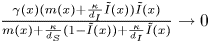 for all $x\in B_\sigma (x_0)$
 as $d_S\to 0$
 . In view of (3.3) and (3.2), we get

This implies that there is some constant $d_*>0$ such that $\kappa$
 is uniformly bounded for all $0< d_S< d_*$
 . As a result, $S(x)=\frac {\kappa }{d_S}(1-\tilde I(x))\to +\infty$
 for all $x\in B_\sigma (x_0)$
 as $d_S\to 0$
 . This contradicts (3.2).
If $\beta \not \equiv \gamma$ on $B_\sigma (x_0)$
 , integrating (3.7) over $B_\sigma (x_0)$
 yields

Sending $d_S\to 0$ gives

which implies $\int _{B_\sigma (x_0)} (\beta (x)-\gamma (x))\hat I(x)\,{\rm d}\kern0.6pt x\geq 0$ . A contradiction occurs. Thus,

By (3.6), we have

If $d_S$ is sufficiently small, then $\int _\Omega (1-\tilde {I})\,{\rm d}\kern0.6pt x\geq \frac {1}{2}\int _\Omega (1-\hat I)\,{\rm d}\kern0.6pt x\geq \frac {1}{2}\int _{H^-} (1-\hat I)\,{\rm d}\kern0.6pt x>0$
 due to (3.9). As a result,

As the right-hand side is constant, we have $\kappa \to 0$ as $d_S\to 0$
 . Then, $I=\frac {\kappa }{d_I}\tilde I\to 0$
 uniformly on $\bar \Omega$
 as $d_S\to 0$
 . By (3.6), we have

Set $v(x)=-d_I\int _\Omega J(x-y)\,{\rm d}y+\theta (x)-\gamma (x)$ . Find a sequence $\{v_n\}$
 such that

and the eigenvalue problem

admits a principal eigenpair $(\lambda _n,\, \varphi _n(x)).$ There exists $n_1>0$
 large enough such that

By (3.6), we have

Set $\underline {\tilde I}=\delta \varphi _n$ and a simple computation gives that

provided $\delta$ small enough for all $0< d_S< d_*$
 . Hence $0<\delta \varphi _n\leq \tilde I\leq 1$
 for all $0< d_S< d_*$
 . Denote $\Phi (x,\, \tilde I)=\frac {\beta (x)\frac {\kappa }{d_S}(1-\tilde I)}{m(x)+\frac {\kappa }{d_S}(1-\tilde I)+\frac {\kappa }{d_I}\tilde I} -\gamma (x)$
 and $\Theta (x,\, \tilde I)=\Phi (x,\, \tilde I)\tilde I$
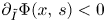
 . It is easy to check that $\partial _{\tilde I}\Phi (x,\, s)<0$
 for all $s>0$
 . For any $x_1$
 , $x_2\in \bar \Omega$
 , we find that

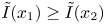
in which $0\leq \tau \leq 1$ . Without loss of generality, assume $\tilde I(x_1)\geq \tilde I(x_2)$
 . Since $\partial _{\tilde I}\Theta (x,\, s)=\Phi (x,\,s)+\partial _{\tilde I}\Phi (x,\, s)s<\Phi (x,\,s)$
 for all $s>0$
 , we have

Note that $\tilde I(x_2)$ satisfies

Since $0<\delta \varphi _n\leq \tilde I\leq 1$ for all $0< d_S< d_*$
 and $\delta \varphi _n$
 is independent of $d_S$
 , there exists $\eta >0$
 such that

We derive from (3.12) and (3.13) that

It follows from (3.11) and (3.14) that $\tilde I$ is equicontinuous with respect to $0< d_S< d_*$
 . Applying the Arzelà–Ascoli Theorem yields $\tilde I\to \hat I$
 uniformly on $\bar \Omega$
 as $d_S\to 0$
 and $0<\hat I\leq 1$
 . Then, $\frac {I}{d_S}=\frac {\tilde I}{d_I}\frac {\kappa }{d_S}\to \frac {\hat I}{d_I}\frac {N}{\int _\Omega (1-\hat I)\,{\rm d}\kern0.6pt x}:=V^*$
 and $S=\frac {\kappa }{d_S}(1-\tilde I)\to \frac {N}{\int _\Omega (1-\hat I)\,{\rm d}\kern0.6pt x}(1-\hat I):=S^*$
 uniformly on $\bar \Omega$
 as $d_S\to 0$
 . Dividing two equations of (3.1) by $d_S$
 and letting $d_S\to 0$
 yield that $(S^*,\, V^*)$
 satisfies (2.1). The proof is completed.
Proof Proof of theorem 2.5
Since $R_0>1,$ we derive from theorem 2.3 that there exists an endemic steady state $(S,\, I)$
 of (1.1) for any $d_S>0$
 with $R_0$
 independent of $d_S.$
 Note that $\int _\Omega I\,{\rm d}\kern0.6pt x\leq N.$
 Then there exists a sequence $\{d_{S_n}\}$
 with $d_{S_n}\to 0$
 as $n\to +\infty$
 such that the corresponding endemic steady state $(S_n,\, I_n)$
 satisfies $\int _\Omega I_n\,{\rm d}\kern0.6pt x\to l$
 for some $0\leq l\leq N.$
 By (3.8), we get that

and $\{\kappa _n\}$ is bounded. We derive from (3.3) that $0< I_n\leq \frac {\kappa _n}{d_I}$
 , which implies that $\{I_n\}$
 is uniformly bounded. Since $S_n$
 is continuous on $\bar \Omega,$
 there exist $x_n\in \bar \Omega$
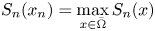
 such that $S_n(x_n)=\max \limits _{x\in \bar \Omega }S_n(x)$
 . By the first equation of (3.1), we have $-\frac {\beta (x_n)S_n(x_n)}{m(x_n)+S_n(x_n)+I_n(x_n)}+\gamma (x_n)\geq 0$
 . Then we derive that

Thus, $\{S_n\}$ is uniformly bounded. By (3.3), $I_n=\frac {\kappa _n-d_{S_n}S_n}{d_I}\to \frac {l}{|\Omega |}$
 as $n\to +\infty$
 .
If $l>0,$ the first equation of (3.1) gives

which implies that $S_n \to \frac {\gamma (m+\frac {l}{|\Omega |})}{\beta -\gamma }$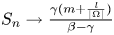 in $C(\bar \Omega )$
 as $n\to +\infty.$
 By (3.2), we have

Now, we are in a position to consider the case $l=0$ implying $\kappa _n\to 0$
 as $n\to +\infty$
 . Up to a subsequence if needed, one of the following three statements must hold:
(a) $\frac {\kappa _n}{d_{S_n}}\to 0$
as $n\to +\infty ;$(b) $\frac {\kappa _n}{d_{S_n}}\to C$
with $C$ being a positive constant as $n\to +\infty ;$(c) $\frac {\kappa _n}{d_{S_n}}\to +\infty$
as $n\to +\infty.$


In view of (3.10), (a) is impossible to occur. By similar arguments as the proof of theorem 2.4, there exists some function $0<\hat I\leq 1$ such that $\tilde I_n=\frac {d_I I_n}{\kappa _n}\to \hat I$
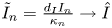 uniformly on $\bar \Omega$
 as $n\to +\infty$
 . If (b) holds, then $\frac {I_n}{d_{S_n}}=\frac {\tilde I_n}{d_I}\frac {\kappa _n}{d_{S_n}}\to \frac {\hat I}{d_I}C:=V^*$
 and $S_n=\frac {\kappa _n}{d_{S_n}}(1-\tilde I_n)\to C(1-\hat I):=S^*$
 in $C(\bar \Omega )$
 as $n\to +\infty$
 . Dividing the two equations of (3.1) by $d_S$
 and letting $n\to +\infty$
 yield $(S^*,\, V^*)$
 satisfies (2.1). If (c) holds, then $S_n=\frac {\kappa _n}{d_{S_n}}(1-\tilde I_n)$
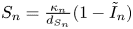 satisfies

We derive from (3.15) that

which implies that $S_n\to \frac {\gamma m}{\beta -\gamma }$ in $C(\bar \Omega )$
 as $n\to +\infty$
 . If $\int _\Omega \frac {\gamma m}{\beta -\gamma }\,{\rm d}\kern0.6pt x\neq N$
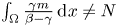 , a contradiction occurs due to $I_n\to 0$
 as $n\to +\infty$
 .
If $N\leq \int _\Omega \frac {\gamma m}{\beta -\gamma }\,{\rm d}\kern0.6pt x$ , by above arguments, it is easy to see that $I_n\to 0$
 as $n\to +\infty$
 . If $\beta -\gamma$
 and $m$
 are positive constants with $N>\int _\Omega \frac {\gamma m}{\beta -\gamma }\,{\rm d}\kern0.6pt x$
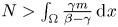 , assume on the contrary that $I_n\to 0$
 as $n\to +\infty$
 . We derive from the above arguments that $\frac {\kappa _n}{d_{S_n}}\to C$
 as $n\to +\infty$
 and $\hat I$
 satisfies

Note that $C\int _\Omega (1-\hat I)\,{\rm d}\kern0.6pt x=N$ . In view of (3.16), we have

which is a contradiction. The proof is completed.
Proof Proof of theorem 2.7
Since $\Omega ^+$ is nonempty, [Reference Yang, Li and Ruan45, Corollaries 2.12 and 2.13] implies that $R_0>1$
 for all small $d_I$
 . Then by theorem 2.3, the endemic steady state $(S,\, I)$
 exists for small $d_I.$

(i) Case I. $d\in [0,\, 1]$
. By (3.6), there exists some positive constant $d_1$ such that
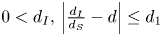
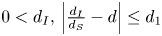
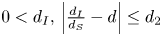
(3.17)\begin{equation} \frac{\kappa}{d_S}=\frac{N}{\int_\Omega \left[(1-\tilde I)+\frac{d_S}{d_I}\tilde I\right]\,{\rm d}\kern0.6pt x}\leq \frac{N}{|\Omega|}\ \text{ for all }\ 0< d_I, \left|\frac{d_I}{d_S}-d\right|\leq d_1. \end{equation}Up to a subsequence, we assume $\frac {\kappa }{d_S}\to l\leq \frac {N}{|\Omega |}$
as $d_I\to 0$ and $\frac {d_I}{d_S}\to d$. Note that $I=\frac {\kappa }{d_I}\tilde I$ and $\tilde I$ satisfies (3.7). One can get that $I$ satisfies
\[ d_{I} \int_\Omega J(x-y)(I(y)-I(x))\,{\rm d}y+\frac{\beta(x)\frac{\kappa}{d_S}(1-\frac{d_I}{\kappa}I)I} {m(x)+\frac{\kappa}{d_S}(1-\frac{d_I}{\kappa} I)+I} -\gamma(x)I=0, \]which implies that
(3.18)\begin{equation} I(x)=\frac{-B(x)-\sqrt{B^2(x)-4A(x)C(x)}}{2A(x)}, \end{equation}where
\begin{align*} A(x)& ={-}\frac{d_I}{d_S}\beta(x)+\frac{d_I}{d_S}\gamma(x)-\gamma(x)-\left(1-\frac{d_I}{d_S}\right) d_I\int_\Omega J(x-y)\,{\rm d}y,\\ B(x)& ={-}\left(m(x)+\frac{\kappa}{d_S}\right)d_I\int_\Omega J(x-y)\,{\rm d}y+\frac{\kappa}{d_S}\beta(x)-\gamma(x)m(x)-\frac{\kappa}{d_S}\gamma(x)\\ & \quad +\left(1-\frac{d_I}{d_S}\right)d_I\int_\Omega J(x-y)I(y)\,{\rm d}y,\\ C(x)& =\left(m(x)+\frac{\kappa}{d_S}\right)d_I\int_\Omega J(x-y)I(y)\,{\rm d}y. \end{align*}By (3.3) and (3.17), $S$
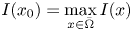
is uniformly bounded with respect to $0< d_I,\, \left |\frac {d_I}{d_S}-d\right |\leq d_1$. Let $I(x_0)=\max \limits _{x\in \bar \Omega }I(x)$. It follows from the second equation of (3.1) that
(3.19)\begin{align} I(x_0)\leq \max\limits_{x\in\bar\Omega}\frac{\beta(x)S(x)}{\gamma(x)}, \end{align}which implies that $I$
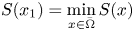
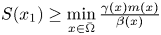
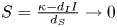
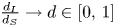
is uniformly bounded with respect to $0< d_I,\, \left |\frac {d_I}{d_S}-d\right |\leq d_1$. Let $S(x_1)=\min \limits _{x\in \bar \Omega }S(x)$. By the first equation of (3.1) that $S(x_1)\geq \min \limits _{x\in \bar \Omega }\frac {\gamma (x)m(x)}{\beta (x)}$. If $l=0$, then $I=\frac {\kappa }{d_S}\frac {d_S}{d_I}\tilde I\to 0$ uniformly on $\bar \Omega$ as $d_I\to 0$ and $\frac {d_I}{d_S}\to d\in (0,\, 1]$. Then, $S=\frac {\kappa -d_I I}{d_S}\to 0$ as $d_I\to 0$ and $\frac {d_I}{d_S}\to d\in [0,\, 1]$, which is a contradiction. Thus, $0< l\leq \frac {N}{|\Omega |}$. By (3.18), up to a subsequence, we have
\[ I\to\frac{\left(l(\beta-\gamma)-\gamma m\right)^+}{d\beta+(1-d)\gamma} :=I^*\ \text{ in }\ C(\bar\Omega) \ \text{ as }\ d_I\to0\ \text{ and }\ \frac{d_I}{d_S}\to d. \]Then, up to a subsequence, $S=\frac {\kappa -d_I I}{d_S}\to l-d I^*$
in $C(\bar \Omega )$ as $d_I\to 0$ and $\frac {d_I}{d_S}\to d$. Moreover,
(3.20)\begin{equation} \int_\Omega \left[(1-d)I^*+l\right]\,{\rm d}\kern0.6pt x=N. \end{equation}Set $g(l)=\int _\Omega [(1-d)I^*+l]\,{\rm d}\kern0.6pt x$
. Obviously, $g(0)=0$, $g(\frac {N}{|\Omega |})>N$ and $g(l)$ is strictly increasing with respect to $l\in [0,\, \frac {N}{|\Omega |}]$. Then $l$ is uniquely determined by (3.20). Hence the limits of $S$ and $I$ are independent of any chosen subsequence.
Case II. $d\in (1,\, +\infty )$
. By (3.6), there exists some positive constant $d_2$ such that
\[ \frac{\kappa}{d_S}=\frac{N}{\int_\Omega \left[(1-\tilde I)+\frac{d_S}{d_I}\tilde I\right]\,{\rm d}\kern0.6pt x}\geq \frac{N}{|\Omega|}\ \text{ for all }\ 0< d_I, \left|\frac{d_I}{d_S}-d\right|\leq d_2. \]It follows from (3.8) that
\begin{align*} \frac{\kappa}{d_S}& =\frac{1}{|\Omega|}\left[N-\left(1-\frac{d_I}{d_S}\right) \int_\Omega I\,{\rm d}\kern0.6pt x\right]\\ & \leq \frac{N}{|\Omega|}(2+d+d_2)\ \text{ for all }\ 0< d_I, \left|\frac{d_I}{d_S}-d\right|\leq d_2. \end{align*}Up to a subsequence, we assume $\frac {\kappa }{d_S}\to l\geq \frac {N}{|\Omega |}$
as $d_I\to 0$ and $\frac {d_I}{d_S}\to d$. For any given $\varepsilon >0$, set
\begin{align*} \tilde I_1^\varepsilon(x)& =\begin{cases}\displaystyle\frac{(l-\varepsilon)(\beta(x)-\gamma(x))-\gamma(x)m(x)} {l(\beta(x)-\gamma(x))+\frac{l}{d}\gamma(x)}, & \text{ if }\ (l-\varepsilon)(\beta(x)-\gamma(x))\\& \quad -\gamma(x)m(x)>0, ~x\in\bar\Omega,\\ 0, & \text{ if }\ (l-\varepsilon)(\beta(x)-\gamma(x))\\ & \quad -\,\gamma(x)m(x)\leq0, ~x\in\bar\Omega, \end{cases}\\ \tilde I_2^\varepsilon(x)& =\begin{cases}\displaystyle\frac{(l+\varepsilon)(\beta(x)-\gamma(x))-\gamma(x)m(x)} {l(\beta(x)-\gamma(x))+\frac{l}{d}\gamma(x)}, & \text{ if }\ (l+\varepsilon)(\beta(x)-\gamma(x))\\& \quad -\gamma(x)m(x)>0, ~x\in\bar\Omega,\\ \varepsilon, & \text{ if }\ (l+\varepsilon)(\beta(x)-\gamma(x))\\& \quad -\gamma(x)m(x)\leq0, ~x\in\bar\Omega. \end{cases} \end{align*}It is easy to check that $\tilde I_1^\varepsilon$
and $\tilde I_2^\varepsilon$ are respectively lower and upper solutions of (3.7) for all $0< d_I,\, \left |\frac {d_I}{d_S}-d\right |\leq d_2$. Letting $\varepsilon \to 0$ yields that $\tilde I\to \hat I$ in $C(\bar \Omega )$ as $d_I\to 0$ and $\frac {d_I}{d_S}\to d$, where
\[ \hat I(x)=\begin{cases}\displaystyle\frac{l(\beta(x)-\gamma(x))-\gamma(x)m(x)}{l(\beta(x)-\gamma(x)) +\frac{l}{d}\gamma(x)}, & \text{ if }\ l(\beta(x)-\gamma(x))-\gamma(x)m(x)>0, ~x\in\bar\Omega,\\ 0, & \text{ if }\ l(\beta(x)-\gamma(x))-\gamma(x)m(x)\leq0, ~x\in\bar\Omega. \end{cases} \]
Then, $I=\frac {\kappa }{d_S}\frac {d_S}{d_I}\tilde I\to \frac {l}{d}\hat I$
and $S=\frac {\kappa }{d_S}(1-\tilde I)\to l(1-\hat I)$ in $C(\bar \Omega )$ as $d_I\to 0$ and $\frac {d_I}{d_S}\to d$.(ii) Noting that $0<\tilde I<1$
, up to a subsequence, there exists $0\leq \hat I\leq 1$ such that $\tilde I(x)\to \hat I(x)$ as $d_I\to 0$ and $\frac {d_I}{d_S}\to +\infty$ for every $x\in \bar \Omega$. Similar to the proof of theorem 2.4, we obtain
\[ H^-{\subset} \left\{x\in\bar\Omega: 0\leq \hat I(x)< 1\right\}, \]which implies that $\int _\Omega (1-\hat I)\,{\rm d}\kern0.6pt x\geq \int _{H^-}(1-\hat I)\,{\rm d}\kern0.6pt x>0$
. Thus, there exists some constant $d_3>0$ such that $\int _\Omega (1-\tilde I)\,{\rm d}\kern0.6pt x\geq \frac {1}{2}\int _{\Omega } (1-\hat I)\,{\rm d}\kern0.6pt x>0$ and
\[ \frac{N}{|\Omega|}<\frac{\kappa}{d_S}<\frac{N}{\int_\Omega (1-\tilde I)\,{\rm d}\kern0.6pt x}\leq \frac{2N}{\int_\Omega (1-\hat I)\,{\rm d}\kern0.6pt x} \]due to (3.6) for all $0< d_I,\, \frac {d_S}{d_I}< d_3$
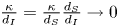
. Then, $\frac {\kappa }{d_I}=\frac {\kappa }{d_S}\frac {d_S}{d_I}\to 0$ and $I=\frac {\kappa }{d_I}\tilde I\to 0$ uniformly on $\bar \Omega$ as $d_I\to 0$ and $\frac {d_I}{d_S}\to +\infty$. Up to a subsequence, we assume $\frac {\kappa }{d_S}\to l$ as $d_I\to 0$ and $\frac {d_I}{d_S}\to +\infty$. For any given $\varepsilon >0$, set
\begin{align*} \tilde I_1^\varepsilon(x)& =\begin{cases}\displaystyle\frac{(l-\varepsilon)(\beta(x)-\gamma(x))-\gamma(x)m(x)} {l(\beta(x)-\gamma(x))}, & \text{ if }\ (l-\varepsilon)(\beta(x)-\gamma(x))\\ & \quad -\gamma(x)m(x)>0, ~x\in\bar\Omega,\\ 0, & \text{ if }\ (l-\varepsilon)(\beta(x)-\gamma(x))\\& \quad -\gamma(x)m(x)\leq0, ~x\in\bar\Omega, \end{cases}\\ \tilde I_2^\varepsilon(x)& =\begin{cases}\displaystyle\frac{(l+\varepsilon)(\beta(x)-\gamma(x))-\gamma(x)m(x)} {l(\beta(x)-\gamma(x))}, & \text{ if }\ (l+\varepsilon)(\beta(x) -\gamma(x))\\& \quad -\gamma(x)m(x)>0, ~x\in\bar\Omega,\\ \varepsilon, & \text{ if }\ (l+\varepsilon)(\beta(x)-\gamma(x))\\& \quad -\gamma(x)m(x)\leq0, ~x\in\bar\Omega. \end{cases} \end{align*}It is easy to check that $\tilde I_1^\varepsilon$
and $\tilde I_2^\varepsilon$ are respectively lower and upper solutions of (3.7) for all $0< d_I,\, \frac {d_S}{d_I}\leq d_3$. Letting $\varepsilon \to 0$ yields that $\tilde I\to \hat I$ in $C(\bar \Omega )$ as $d_I\to 0$ and $\frac {d_I}{d_S}\to +\infty$, where
\[ \hat I(x)=\begin{cases}\displaystyle\frac{l(\beta(x)-\gamma(x))-\gamma(x)m(x)}{l(\beta(x)-\gamma(x))}, & \text{ if }\ l(\beta(x)-\gamma(x))-\gamma(x)m(x)>0, ~x\in\bar\Omega,\\ 0, & \text{ if }\ l(\beta(x)-\gamma(x))-\gamma(x)m(x)\leq0, ~x\in\bar\Omega. \end{cases} \]Hence, $S=\frac {\kappa }{d_S}(1-\tilde I)\to l(1-\hat I)$
in $C(\bar \Omega )$ as $d_I\to 0$ and $\frac {d_I}{d_S}\to +\infty$. By (3.2), $l$ is determined by $\int _\Omega l(1-\hat I)\,{\rm d}\kern0.6pt x=N$.(iii) In view of (3.6), there exists $d_0>0$
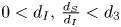
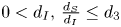
such that $\frac {\kappa }{d_S}\geq \frac {N}{|\Omega |}$ for all $0< d_I,\, \frac {d_S}{d_I}< d_0$. Up to a subsequence, we assume $\frac {\kappa }{d_S}\to l\geq \frac {N}{|\Omega |}$ as $d_I\to 0$ and $\frac {d_I}{d_S}\to +\infty$.






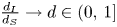




























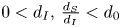


If $l<+\infty$ , then $\frac {\kappa }{d_I}=\frac {\kappa }{d_S}\frac {d_S}{d_I}\to 0$
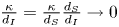 as $d_I\to 0$
 and $\frac {d_I}{d_S}\to +\infty$
 . We derive from (3.7) that

where

which implies that $\tilde I\to \frac {[l(\beta -\gamma )-\gamma m]^+}{l(\beta -\gamma )}$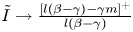 in $C(\bar \Omega )$
 as $d_I\to 0$
 and $\frac {d_I}{d_S}\to +\infty$
 . We claim that $\liminf \limits _{d_I\to 0, \frac {d_I}{d_S}\to +\infty }\|\tilde I\|_{L^\infty (\Omega )}>0.$
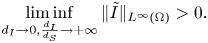 Assume on the contrary that it is false. Then there exist two sequences $\{d_{I_k}\}$
 and $\left \{\frac {d_{I_k}}{d_{S_k}}\right \}$
 with $d_{I_k}\to 0$
 and $\frac {d_{I_k}}{d_{S_k}}\to +\infty$
 as $k\to +\infty$
 such that $\tilde I_k\to 0$
 as $k\to +\infty$
 . Then, $\frac {[l(\beta -\gamma )-\gamma m]^+}{l(\beta -\gamma )}\equiv 0$
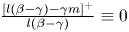 ; that is, $l(\beta -\gamma )-\gamma m\leq 0$
 . Since $l\geq \frac {N}{|\Omega |}$
 , we have $\frac {N}{|\Omega |}(\beta -\gamma )-\gamma m\leq 0$
 contradicting that $\Omega ^+$
 is nonempty. As a result, there exists some positive constant $C_1$
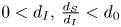
 such that $\|I\|_{L^\infty (\Omega )}=\frac {\kappa }{d_S}\frac {d_S}{d_I}\|\tilde I\|_{L^\infty (\Omega )}\geq C_1\frac {d_S}{d_I}$
 for all $0< d_I,\, \frac {d_S}{d_I}< d_0$
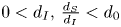
 . Note that $I=\frac {\kappa }{d_I}\tilde I=\frac {\kappa }{d_S}\frac {d_S}{d_I}\tilde I\leq C_2\frac {d_S}{d_I}$
 with $C_2$
 being some positive constant for all $0< d_I,\, \frac {d_S}{d_I}< d_0$
 . One can get that $I(x)\to 0$
 uniformly on $\bar \Omega$
 as $d_I\to 0$
 and $\frac {d_I}{d_S}\to +\infty$
 . We conclude that $S=\frac {\kappa }{d_S}(1-\tilde I)\to l[1-\frac {[l(\beta -\gamma )-\gamma m]^+}{l(\beta -\gamma )}] :=S^*$
 in $C(\bar \Omega )$
 as $d_I\to 0$
 and $\frac {d_I}{d_S}\to +\infty$
 . In addition, $l$
 is determined by $\int _\Omega S^*\,{\rm d}\kern0.6pt x=N$
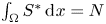 .
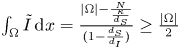
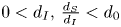
If $l=+\infty$ , then (3.6) implies that $\int _\Omega \tilde I\,{\rm d}\kern0.6pt x=\frac {|\Omega |-\frac {N}{\frac {\kappa }{d_S}}}{(1-\frac {d_S}{d_I})}\geq \frac {|\Omega |}{2}$
 for all $0< d_I,\, \frac {d_S}{d_I}< d_0$
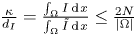
 . Then $\frac {\kappa }{d_I}=\frac {\int _\Omega I\,{\rm d}\kern0.6pt x}{\int _\Omega \tilde I\,{\rm d}\kern0.6pt x}\leq \frac {2N}{|\Omega |}$
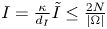
 and $I=\frac {\kappa }{d_I}\tilde I\leq \frac {2N}{|\Omega |}$
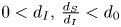
 for all $0< d_I,\, \frac {d_S}{d_I}< d_0$
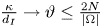
 . Up to a subsequence, we assume $\frac {\kappa }{d_I}\to \vartheta \leq \frac {2N}{|\Omega |}$
 as $d_I\to 0$
 and $\frac {d_I}{d_S}\to +\infty$
 . By (3.21), $\tilde I\to 1$
 in $C(\bar \Omega )$
 as $d_I\to 0$
 and $\frac {d_I}{d_S}\to +\infty$
 . Then, $I=\frac {\kappa }{d_I}\tilde I\to \vartheta$
 in $C(\bar \Omega )$
 as $d_I\to 0$
 and $\frac {d_I}{d_S}\to +\infty$
 . Note that $S=\frac {\kappa }{d_S}(1-\tilde I)$
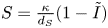 satisfies

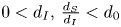
Let $\max \limits _{x\in \bar \Omega }S(x)=S(x_0)$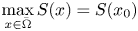 . By virtue of (3.22), we have $\frac {\beta (x_0)S(x_0)}{m(x_0)+S(x_0)+\frac {\kappa }{d_I}\tilde I(x_0)}\leq \gamma (x_0)$
 implying $S(x)\leq S(x_0)\leq \max \limits _{x\in \bar \Omega }\frac {\gamma (x)m(x)}{\beta (x)-\gamma (x)} +\frac {2N}{|\Omega |}\max \limits _{x\in \bar \Omega }\frac {\gamma (x)}{\beta (x)-\gamma (x)}$
 for all $0< d_I,\, \frac {d_S}{d_I}< d_0$
 . We derive from (3.22) that

which implies that $S\to \frac {\gamma (m+\vartheta )}{\beta -\gamma }$ in $C(\bar \Omega )$
 as $d_I\to 0$
 and $\frac {d_I}{d_S}\to +\infty$
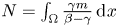
 . If $\vartheta =0$
 , then $N=\int _\Omega \frac {\gamma m}{\beta -\gamma }\,{\rm d}\kern0.6pt x$
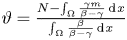
 due to (3.2). If $\vartheta >0$
 , then $\vartheta =\frac {N- \int _\Omega \frac {\gamma m}{\beta -\gamma }\,{\rm d}\kern0.6pt x}{\int _\Omega \frac {\beta }{\beta -\gamma }\,{\rm d}\kern0.6pt x}$
 due to (3.2).
To sum up, up to subsequences of $d_I\to 0$ and $\frac {d_I}{d_S}\to +\infty$
 , one of the following statements hold:
(A1) $(S,\, I)\to (S^*,\, 0)=(l-\frac {[l(\beta -\gamma )-\gamma m]^+} {\beta -\gamma },\,0)$
, where the positive constant $l$ is determined by $\int _\Omega S^*\,{\rm d}\kern0.6pt x=N$. In addition, there exists positive constants $0< d_0\ll 1$, $C_1$ and $C_2$ such that
\[ C_1\frac{d_S}{d_I}\leq \|I\|_{L^\infty(\Omega)}\leq C_2\frac{d_S}{d_I}\ \text{ for all }\ 0< d_I, \frac{d_S}{d_I}< d_0. \]
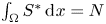
(A2) $(S,\, I)\to (\frac {\gamma m}{\beta -\gamma },\, 0)$
and $N=\int _\Omega \frac {\gamma m}{\beta -\gamma }\,{\rm d}\kern0.6pt x$.(A3) $(S,\, I)\to (\frac {\gamma (m+I^*)}{\beta -\gamma },\, I^*)$
, where $I^*=\frac {N- \int _\Omega \frac {\gamma m}{\beta -\gamma }\,{\rm d}\kern0.6pt x}{\int _\Omega \frac {\beta }{\beta -\gamma }\,{\rm d}\kern0.6pt x}>0$.






In the following, we aim to prove the conclusions item by item.
(a) If $N<\int _\Omega \frac {\gamma m}{\beta -\gamma }\,{\rm d}\kern0.6pt x$
, then (A1) must hold.(b) If $N=\int _\Omega \frac {\gamma m}{\beta -\gamma }\,{\rm d}\kern0.6pt x$
, then (A1) or (A2) holds. If (A2) holds, there is nothing to prove. Assume that (A1) holds. By the positivity of $I$, we know $0$ is the principal eigenvalue of
(3.23)\begin{align} & d_I\int_\Omega J(x-y)(\varphi(y)-\varphi(x))\,{\rm d}y+\left(\frac{\beta(x)S(x)}{m(x)+S(x)+I(x)} -\gamma(x)\right)\varphi(x)\nonumber\\ & \quad ={-}\lambda\varphi(x), \quad x\in\Omega. \end{align}In view of [Reference Shen and Xie39, Theorem 2.2], we have $\min \limits _{x\in \bar \Omega }\left \{\gamma (x)-\frac {\beta (x)S^*(x)}{m(x)+S^*(x)}\right \}=0$
implying $S^*(x)\leq \frac {\gamma (x)m(x)}{\beta (x)-\gamma (x)}$ for all $x\in \bar \Omega$. Set $x\in \Omega _l:=\{x\in \bar \Omega : l(\beta (x)-\gamma (x))-\gamma (x)m(x)\leq 0\}$. If $\Omega _l$ is empty, then $S^*(x)=\frac {\gamma (x)m(x)}{\beta (x)-\gamma (x)}$ for all $x\in \bar \Omega$. If $\Omega _l$ is nonempty, then $S^*(x)=l\leq \frac {\gamma (x)m(x)}{\beta (x)-\gamma (x)}$ for all $x\in \Omega _l$. Note that $\int _{\Omega _l}l\,{\rm d}\kern0.6pt x+ \int _{\Omega \setminus \Omega _l}\frac {\gamma m}{\beta -\gamma }\,{\rm d}\kern0.6pt x=N=\int _\Omega \frac {\gamma m}{\beta -\gamma }\,{\rm d}\kern0.6pt x$. We have $\int _{\Omega _l}(l-\frac {\gamma m}{\beta -\gamma })\,{\rm d}\kern0.6pt x=0$. Hence, $\frac {\gamma (x) m(x)}{\beta (x)-\gamma (x)}=l$ for all $x\in \Omega _l$. We derive that $S^*(x)=\frac {\gamma (x)m(x)}{\beta (x)-\gamma (x)}$ for all $x\in \bar \Omega$.(c) If $N>\int _\Omega \frac {\gamma m}{\beta -\gamma }\,{\rm d}\kern0.6pt x$
, then (A1) or (A3) holds. Assume that (A1) holds. By the proof of (b), we know $S^*(x)\leq \frac {\gamma (x)m(x)}{\beta (x)-\gamma (x)}$ for all $x\in \bar \Omega$. Then, $N=\int _{\Omega } S^*\,{\rm d}\kern0.6pt x\leq \int _\Omega \frac {\gamma m}{\beta -\gamma }\,{\rm d}\kern0.6pt x$, which is a contradiction. Hence (A3) holds. The proof is completed.
















Proof Proof of theorem 2.8
In view of [Reference Yang, Li and Ruan45, Corollaries 2.12 and 2.13] and theorem 2.3, there exists an endemic steady state $(S,\, I)$ . We first give the proof of (i). Since $\int _\Omega I\,{\rm d}\kern0.6pt x\leq N,$
 up to a subsequence, assume $\int _\Omega I\,{\rm d}\kern0.6pt x\to r$
 for some constant $r\geq 0$
 as $d_S\to +\infty.$
 In view of (3.8), we have

Then there exists some positive constant $d_S^*$ such that $\frac {\kappa }{d_S}$
 is uniformly bounded with respect to $d_S>d_S^*$
 . Note that $S=\frac {\kappa }{d_S}-\frac {d_I}{d_S}I$
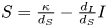 . We derive that $S$
 is uniformly bounded with respect to $d_S>d_S^*$
 . In view of (3.19), $I$
 is uniformly bounded with respect to $d_S>d_S^*$
 . Hence, $S=\frac {\kappa }{d_S}-\frac {d_I}{d_S}I\to \frac {1}{|\Omega |}(N-r):=S^*$
 as $d_S\to +\infty$
 . It follows from the second equation of (3.1) that

where

which implies that $I\to I^*$ in $C(\bar \Omega )$
 as $d_S\to +\infty$
 and $I^*$
 satisfies (2.3). We know either $I^*\equiv 0$
 or $I^*> 0$
 . Otherwise, there exists some $x_0\in \bar \Omega$
 such that $I^*(x_0)=\min \limits _{x\in \bar \Omega }I^*(x)=0$
 , then we derive from (2.3) that $\int _\Omega J(x_0-y)I^*(y)\,{\rm d}y=0$
 . Thus, $I^*(x)=0$
 for all $x\in \bar \Omega$
 , which is a contradiction. By the positivity of $I$
 , $0$
 is the principal eigenvalue of (3.23). If $r=0$
 , then $I^*\equiv 0$
 and $S^*\equiv \frac {N}{|\Omega |}$
 . Note that $w=\frac {I}{\|I\|_{L^\infty (\Omega )}}$
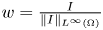 satisfies

There exists some $\hat w(x)>0$ such that $w(x)\to \hat w(x)$
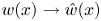 as $d_S\to +\infty$
 and $\hat w$
 satisfies

As a result, $\lambda _v(d_I)=0$ contradicting $R_0>1$
 . Hence, $r>0$
 and $I^*>0$
 .
Now prove the existence and uniqueness of positive solution of (2.3). Let $\tau \geq 0$ be a real number. Consider

It follows from [Reference Coville9, Theorem 1.6] that (3.24) admits a unique positive solution if and only if $\lambda _\tau <0$ , where $\lambda _\tau$
 is defined by

Since $R_0>1$ , we have $\lambda _0<0$
 . Noting that $\lambda _\tau$
 is increasing in $\tau$
 , there exists $\tau ^*>0$
 such that $\lambda _\tau <0$
 for all $0\leq \tau <\tau ^*$
 and $\lambda _{\tau ^*}=0$
 . As a result, (3.24) admits a unique positive solution $I_\tau$
 for all $0\leq \tau <\tau ^*$
 and $I_{\tau }\equiv 0$
 is the only nonnegative solution of (3.24) for all $\tau \geq \tau ^*$
 . And it is verified that $I_\tau$
 is decreasing with respect to $\tau \in [0,\, \tau ^*)$
 . Set $g(\tau )=\tau -\int _\Omega I_\tau \,{\rm d}\kern0.6pt x$
 . Then $g(\tau )$
 is increasing with respect to $\tau \in [0,\, \tau ^*]$
 . Since $g(0)<0$
 and $g(\tau ^*)>0$
 , there exists a unique $\tau _0>0$
 such that $g(\tau _0)=0$
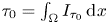
 ; that is, $\tau _0=\int _\Omega I_{\tau _0}\,{\rm d}\kern0.6pt x$
 . As a consequence, the positive solution of (2.3) uniquely exists. Hence, the limits of $S$
 and $I$
 are independent of any chosen subsequence.
Now we are devoted to the proof of (ii). Since $\int _\Omega I\,{\rm d}\kern0.6pt x\leq N,$ up to a subsequence, assume $\int _\Omega I\,{\rm d}\kern0.6pt x\to r$
 for some constant $r\geq 0$
 as $d_I\to +\infty.$
 In view of (3.8), we have

Noting that $\frac {d_S}{d_I}S+I=\frac {\kappa }{d_I}$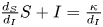 , there exists some constant $d_I^*>0$
 such that $I$
 is uniformly bounded with respect to $d_I>d_I^*$
 . Then $\frac {\beta SI}{m+S+I}-\gamma I$
 is uniformly bounded with respect to $d_I>d_I^*$
 . We derive from the second equation of (3.1) that

which implies that $I\to I^*$ in $C(\bar \Omega )$
 as $d_I\to +\infty$
 and $I^*$
 satisfies $\int _\Omega J(x-y)(I^*(y)-I^*(x))\,{\rm d}y=0$
 . Thus, $I^*$
 is a constant and $I^*=\frac {r}{|\Omega |}$
 .
Claim that $S$ is uniformly bounded with respect to $d_I>d_I^*$
 . Assume on the contrary that it is false. Then there exists a sequence $\{d_{I_n}\}$
 with $d_{I_n}\to +\infty$
 as $n\to +\infty$
 such that $\|S_n\|_{L^\infty (\Omega )}=\|\frac {\kappa _n}{d_S}(1-\tilde I_n)\|_{L^\infty (\Omega )}\to +\infty$
 as $n\to +\infty$
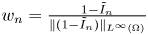
 . Set $w_n=\frac {1-\tilde I_n}{\|(1-\tilde I_n)\|_{L^\infty (\Omega )}}$
 . One can get that $w_n$
 satisfies

Noting that

we get that $w_n\to 1$ in $C(\bar \Omega )$
 as $n\to +\infty$
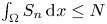
 . Then, $S_n=\frac {\kappa _n}{d_S}(1-\tilde I_n)=\frac {1}{d_S}\kappa _n\|(1-\tilde I_n)\|_{L^\infty (\Omega )}w_n\to +\infty$
 contradicting $\int _\Omega S_n\,{\rm d}\kern0.6pt x\leq N$
 . Hence, the claim must hold. It follows from the first equation of (3.1) that

where

which implies that $S\to S^*$ in $C(\bar \Omega )$
 as $d_I\to +\infty$
 and $S^*$
 satisfies (2.4). If $I^*=0$
 , we conclude from (2.4) that $S^*=\frac {N}{|\Omega |}$
 . By the positivity of $I$
 , $0$
 is the principal eigenvalue of the eigenvalue problem (3.23). By virtue of [Reference Shen and Xie39, Theorem 2.2], we have $\int _\Omega (\gamma -\theta )\,{\rm d}\kern0.6pt x=0$
 . A contradiction occurs. Thus, $I^*>0$
 .
Finally we prove (iii). We derive from (3.2) and (3.3) that

which implies that $\|S\|_{L^\infty (\Omega )}\leq \frac {N}{|\Omega |}(1+\frac {d_I}{d_S})$ . If $\frac {d_I}{d_S}\to C$
 for some nonnegative constant $C$
 , then $S$
 is uniformly bounded with respect to $d_S,\, d_I>d_*$
 with $d_*$
 some positive constant. In view of (3.19), $I$
 is uniformly bounded with respect to $d_S,\, d_I>d_*$
 . If $\frac {d_I}{d_S}\to +\infty$
 , then $I=\frac {\kappa }{d_I}\tilde I =\frac {1}{|\Omega |}[\frac {d_S}{d_I}N-(\frac {d_S}{d_I}-1) \int _\Omega I\,{\rm d}\kern0.6pt x]\tilde I$
 is uniformly bounded with respect to $d_S,\, d_I>d_*$
 . Similar to the proof of (ii), we can prove $S$
 is uniformly bounded with respect to $d_S,\, d_I>d_*$
 . The remaining proof is the same as the proof of [Reference Yang, Li and Ruan45, Theorem 4.1]. So we omit it. The proof is completed.
Proof Proof of proposition 2.10
Similar to the proof of theorem 2.4, we can prove (i). Here we only prove (ii). By the arguments in the proof of theorem 2.5, we know $I\to I^*$ in $C(\bar \Omega )$
 as $d_S\to 0$
 and $I^*$
 is a nonnegative constant. Assume $I^*=0$
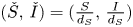
 and set $(\check {S},\, \check {I})=(\frac {S}{d_S},\, \frac {I}{d_S})$
 . Then $(\check {S},\, \check {I})$
 satisfies (3.1) with $m\equiv 0$
 . In view of the proof of theorem 2.5, there exists positive constants $\hat d$
 , $C_*$
 and $C^*$
 such that $C_*\leq \check {I}(x)\leq C^*$
 for all $x\in \bar \Omega$
 and $0< d_S<\hat d$
 . Let $\check {S}(x_0)=\min \limits _{x\in \bar \Omega }\check {S}(x)$
 and $\check {S}(y_0)=\max \limits _{x\in \bar \Omega }\check {S}(x)$
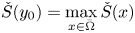 . We obtain from the first equation of (3.1) that $-\frac {\beta (x_0)\check {S}(x_0)}{\check {S}(x_0)+\check {I}(x_0)}+\gamma (x_0)\leq 0$
 and $-\frac {\beta (y_0)\check {S}(y_0)}{\check {S}(y_0)+\check {I}(y_0)}+\gamma (y_0)\geq 0$
 , which implies that $\min \limits _{x\in \bar \Omega }\frac {\gamma (x)}{\beta (x)-\gamma (x)}C_*\leq \check {S}(x)\leq \max \limits _{x\in \bar \Omega }\frac {\gamma (x)}{\beta (x)-\gamma (x)}C^*$
 . Adding up two equations of (3.1) with $m\equiv 0$
 yields

which implies that $\check {I}\to \check {I}^*$ in $C(\bar \Omega )$
 as $d_S\to 0$
 and $\check {I}^*$
 satisfies $\int _{\Omega }J(x-y)(\check {I}^*(y)-\check {I}^*(x))\,{\rm d}y=0$
 . It follows from Andreu-Vaillo et al. [Reference Andreu-Vaillo, Mazón, Rossi and Toledo-Melero3, Proposition 3.3] that $\check {I}^*$
 is a positive constant. The first equation of (3.1) with $m\equiv 0$
 gives

which implies that $\check {S}\to \frac {\gamma \check {I}^*}{\beta -\gamma }$ in $C(\bar \Omega )$
 as $d_S\to 0$
 . Then, $S=d_S\check {S}\to 0$
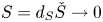 in $C(\bar \Omega )$
 as $d_S\to 0$
 . Hence, $\int _\Omega (S+I)\,{\rm d}\kern0.6pt x\to 0$
 as $d_S\to 0$
 contradicting (3.2). Now we have $I^*>0$
 . By the proof of theorem 2.5, $S\to \frac {\gamma {I}^*}{\beta -\gamma }$
 in $C(\bar \Omega )$
 as $d_S\to 0$
 and $\int _\Omega \frac {\gamma {I}^*}{\beta -\gamma }+I^*\,{\rm d}\kern0.6pt x=N$
 . Thus, $I^*=\frac {N}{\int _\Omega \frac {\beta }{\beta -\gamma }\,{\rm d}\kern0.6pt x}$
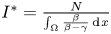 . The proof is completed.
The proof of proposition 2.11 is similar to that of theorem 2.7. So we omit it.
Acknowledgements
Research of Y.-X. Feng was partially supported by the Fundamental Research Funds for the Central Universities (lzujbky-2023-it04), research of W.-T. Li was partially supported by NSF of China (12271226), NSF of Gansu Province of China (21JR7RA537) and the Fundamental Research Funds for the Central Universities (lzujbky-2022-sp07) and research of F.-Y. Yang was partially supported by NSF of Gansu Province of China (21JR7RA535). Authors thank Dr. Ming-Zhen Xin (Lanzhou University) for drawing figures.