Introduction
Turnip is one of the most commonly grown crops from the Brassicaceae family and is consumed as leafy greens and/or roots. Turnip production in the southeastern United States is economically important for most states in this region. In North Carolina, turnips are grown on approximately 450 and 261 ha for production of leafy greens and roots, respectively (Batts et al. Reference Batts, Davis, Fernandez, Gunter, Mitchem, Monks, Schultheis and Spayd2009). Additionally, Georgia and New York produced turnip on 710 and 110 ha for leafy greens and roots, respectively, in 2012 (Anonymous 2014). Turnip roots are a good source of vitamin C, potassium, and fiber. Small-rooted turnip varieties are primarily grown for human consumption, while large-rooted varieties are generally grown for livestock feed (Batts et al. Reference Batts, Davis, Fernandez, Gunter, Mitchem, Monks, Schultheis and Spayd2009). Glucosinolates, a class of secondary metabolites present in turnip, have important properties for plant defense and human health (Justen et al. Reference Justen, Cohen, Gardner and Fritz2011; Plate and Gallaher Reference Plate and Gallaher2006).
Weeds are a major constraint in turnip root production and reduce yields by competing for nutrients, water, and light and reducing harvest efficiency (Batts et al. Reference Batts, Monks, Mitchem and Jennings2008). Very limited research has been published on herbicide tolerance of turnip. Only six herbicides are registered for weed management in turnip root production (Kemble Reference Kemble2017). Two are graminicides (clethodim and sethoxydim), and two are nonselective herbicides (glyphosate and paraquat) for stale seedbed or shielded-sprayer application (Kemble Reference Kemble2017). Clopyralid is registered to manage broadleaf weeds, especially legumes such as vetch (Vicia spp.) and clover (Trifolium spp.); however, its long plant-back restriction prevents production of other crops during a single growing season (Anonymous 2015; Batts et al. Reference Batts, Monks, Mitchem and Jennings2008). In some states, including Kentucky and Oregon, S-metolachlor is registered for use in turnip through a Federal Insecticide, Fungicide, and Rodenticide Act §24(c) special local need (Anonymous 2016a, 2016b). Controlling weeds in turnip roots is sometimes limited to DCPA applied as a shallow PPI application or a broadcast application to the soil surface at time of seeding followed by hand weeding.
Trifluralin is a soil-applied, preplant herbicide used extensively for control of annual grasses and many broadleaf weeds (Anonymous 2010; Blackshaw and Harker Reference Blackshaw and Harker1992). It inhibits root and shoot growth by interfering with cell division, primarily during the germination to emergence phase (Senseman Reference Senseman2007). In wild oat (Avena fatua L.) and Italian ryegrass [Lolium perenne L. ssp. multiflorum (Lam.) Husnot], trifluralin reduced coleoptile elongation, and showed phytotoxic effects on secondary roots and the meristems of the coleoptile node (Billet and Ashford Reference Billet and Ashford1978; Rahman and Ashford Reference Rahman and Ashford1970). Trifluralin PPI at 0.56 kg ha−1 provided 62 to 99% control of redroot pigweed (Amaranthus retroflexus L.), common lambsquarters (Chenopodium album L.), hairy nightshade (Solanum physalifolium Rusby), and green foxtail [Setaria viridis (L.) P. Beauv.] (Wilson et al. Reference Wilson, Smith and Yonts2004).
Trifluralin PPI at 0.56 to 0.84 kg ai ha−1 is registered in turnip when the crop is produced solely for greens, but it is not registered for turnip roots (Anonymous 2010). MacRae and Culpepper (Reference MacRae and Culpepper2007) reported ≤7% injury on mustard greens (Brassica juncea L.) and turnip greens from 0.28 kg ai ha−1 trifluralin. Similarly, Zandstra and Particka (Reference Zandstra and Particka2007) reported ≤2% injury on mustard and turnip greens from 0.84 kg ai ha−1 trifluralin. In both of these studies, no reduction in plant height or turnip greens yield was reported from trifluralin PPI. However, the effect of trifluralin on turnip produced for roots has not been investigated. Therefore, research was conducted to determine tolerance of turnip produced for roots to trifluralin PPI.
Materials and Methods
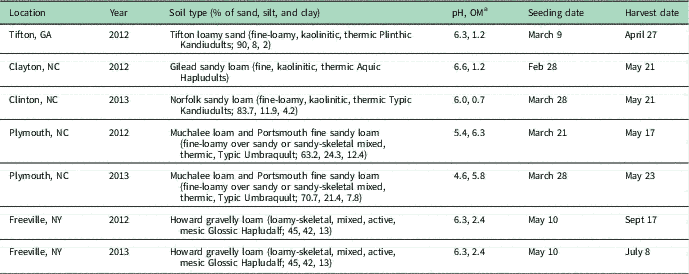
Field studies were conducted at the Tifton Vegetable Park at the Coastal Plain Experiment Station (31.47°N, 83.53°W), Tifton, GA (2012); Homer C. Thompson Vegetable Research Farm (42.51°N, 76.33°W), Freeville, NY (2012 and 2013); Tidewater Research Station (35.87°N, 76.65°W), Plymouth, NC (2012 and 2013); Central Crops Research Station (35.65°N, 78.45°W), Clayton, NC (2012); and Horticultural Crops Research Station (35.02oN, 78.28oW), Clinton, NC (2013). Information about soil, turnip planting, and harvest is given in Table 1. Studies were conducted in a randomized complete block design with either four (Tifton, Plymouth) or three (Freeville, Clayton, Clinton) replications.
Soil parameters, seeding date, and harvest date for trifluralin PPI studies in Georgia, North Carolina, and New York in 2012 and 2013.

a OM, organic matter.
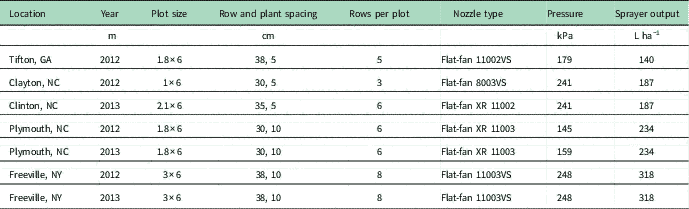
Herbicide treatments included trifluralin PPI at 0, 0.42, 0.56, 0.84, 1.12, 1.68, 2.24, and 3.36 kg ai ha−1. Plot size and date of herbicide application varied by location (Table 2). Herbicides were mixed with water and then applied using a CO2- pressurized backpack sprayer. After application, trifluralin was incorporated into the top 4 to 5 cm of soil using a tractor-mounted rototiller. On the same day, the turnip variety ‘Purple Top White Globe’ was seeded with an Earthway push planter (Earthway Products, Bristol, IN) 1- to 2-cm deep. Production, irrigation, and pest management practices other than specific treatments were standard for turnip production to optimize growth and development (Kemble Reference Kemble2017). The entire study was maintained weed-free by hand removal (hoeing, pulling) as needed.
Plot size and herbicide application information for trifluralin PPI studies in Georgia, North Carolina, and New York in 2012 and 2013.Footnote a

a Herbicide application was made using a CO2-pressurized backpack sprayer at all locations.
Visible estimates of aboveground injury to turnip were determined at either 21 or 28 to 33 d after planting (DAP) using a scale of 0 to 100, where 0=no injury and 100=plant death (Frans et al. Reference Frans, Talbert, Marx and Crowley1986). Foliar chlorosis and plant stunting were considered when making the visible estimates for injury. Turnip stand count was recorded at 13 DAP, and shoot dry biomass at 34 DAP at Tifton and Freeville during 2012. Turnip roots were dug and graded manually according to USDA standards to measure marketable root yield that includes grades 1 (diameter ≥ 4.5 cm; roots are well trimmed, firm, fairly smooth, well-shaped, clean, and not damaged from any abiotic and biotic stresses) and 2 (diameter≥4.5 cm; roots are well trimmed, firm, not excessively rough, not seriously misshapen, and not damaged from any abiotic and biotic stresses) and culls (USDA 2016). The marketable root yield included both grades 1 and 2. Ten marketable turnip roots from each plot were cut open to evaluate for internal damage at Clinton (2013) and Plymouth (2012 and 2013). Weather data were collected from regional weather stations and provided by the State Climate Office of North Carolina for all North Carolina locations, the University of Georgia weather network for Tifton, GA, and farm manager of the Homer C. Thompson Vegetable Research Station for Freeville, NY.
Data Analysis
Experiments were classified as specific combinations of year and/or location. Data were subjected to ANOVA and analyzed by SAS PROC MIXED (SAS Institute, Cary, NC). Treatment means were separated by Fisher’s protected LSD test at the 5% probability level. The nontreated check was not included in the injury analysis. Percent turnip stand count, biomass, and yield were calculated relative to nontreated check.
Result and Discussion
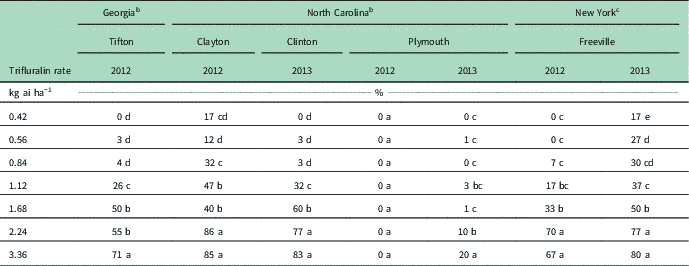
Aboveground injury to turnip varied by location (Table 3). In general, injury increased as trifluralin rate increased, except at Plymouth (2012), where no injury was observed. Trifluralin at 0.42 to 0.84 kg ha−1 caused ≤7% injury at all locations, except Freeville (2013) and Clayton, where injury ranged from 12% to 32%. Injury from trifluralin at 1.12 to 3.36 kg ha−1 ranged from 17% to 85%, except at Plymouth (2012 and 2013). The lower injury at Plymouth could be attributed to the high soil organic matter (5.8%) at this location. It has been well documented that the phytotoxicity for some soil-applied herbicides, including trifluralin, is highly dependent on soil organic matter (Mersie and Foy Reference Mersie and Foy1985; Rahman et al. Reference Rahman, Dyson and Burney1978). Thus, the registered rate of trifluralin in crops is based on soil organic matter content (Anonymous 2010).
Influence of trifluralin PPI on aboveground turnip injury at Georgia, North Carolina, and New York in 2012 and 2013.Footnote a

a Means within a column followed by the same letter are not different according to Fisher’s protected LSD (α=0.05).
b Injury ratings were taken at 28 to 33 d after planting (DAP).
c Injury ratings were taken at 21 DAP.
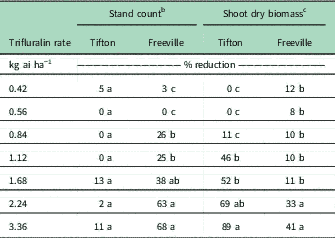
At Tifton, stand count reduction was not different between treatments and ranged from 0% to 11% (Table 4). However, at Freeville (2012), greater turnip stand reduction was observed from trifluralin at 0.84 to 3.36 kg ha−1 compared with 0.42 and 0.56 kg ha−1. At both locations shoot dry biomass reduction of turnip was greater from trifluralin at 2.24 and 3.36 kg ha−1 compared with turnip treated with trifluralin at 0.42, 0.56, and 0.84 kg ha−1.
Percent reduction of turnip stand count and shoot dry biomass as influenced by trifluralin rate in Tifton, GA, and Freeville, NY, in 2012.Footnote a

a Means within a column followed by the same letter are not different according to Fisher’s protected LSD (α=0.05).
b Plant stand count was recorded at 13 d after planning (DAP).
c Shoot biomass was measured at 34 DAP.
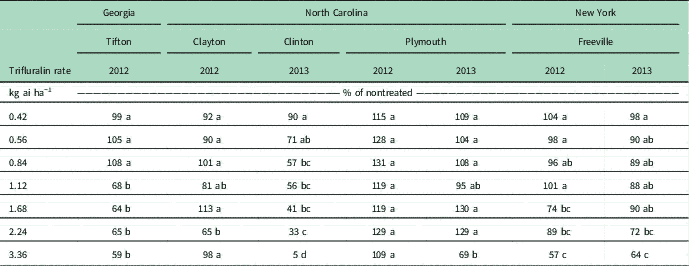
Similar to injury, turnip root yield reduction varied with location (Table 5). In general, yield reduction increased as trifluralin rate increased, except at Plymouth (2012), where no yield reduction was observed. Trifluralin rates from 0.42 to 0.84 kg ha−1 caused ≤11% turnip root yield reduction at most locations, except Clinton, where yield reduction was 29% and 43% from 0.56 and 0.84 kg ha−1, respectively. The factors that contributed to yield reduction at Clinton from trifluralin 0.56 and 0.84 kg ha−1 treatments are unclear, because yield reduction does not appear related to crop injury (<3% injury) from these rates (Table 3). Trifluralin at 1.12 to 3.36 kg ha−1 reduced turnip root yield 2% to 67%, except at Plymouth at all rates (2012) and at 1.12 to 2.24 kg ha−1 (2013). No internal injury in turnip roots was observed at Clinton and Plymouth (2012 and 2013) (unpublished data).
The effect of trifluralin PPI on marketable turnip root yield in Georgia, North Carolina, and New York in 2012 and 2013.Footnote a , Footnote b

a Means within a column followed by the same letter are not different according to Fisher’s protected LSD (α=0.05).
b Yield from nontreated treatment was 17.1, 14.7, 24.0, 19.4, 11.8, 29.4, and 34.5×10³ kg ha−1 from Tifton, Clayton, Clinton, Plymouth (2012), Plymouth (2013), Freeville (2012), and Freeville (2013), respectively.
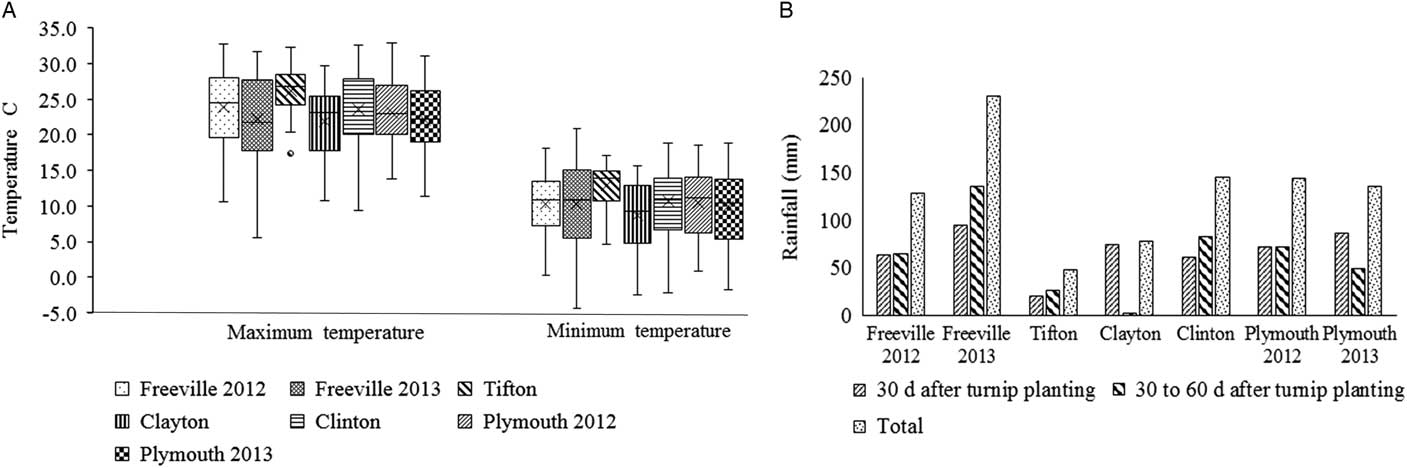
Overall, different levels of injury and yield reduction were reported based upon the study location. It is well known that bioavailability of trifluralin in field conditions is dependent upon several factors, including soil moisture, temperature, soil type, and length of time before incorporation takes place (Horowitz et al. Reference Horowitz, Hulin and Blumenfield1974; Kennedy and Talbert Reference Kennedy and Talbert1977; Savage Reference Savage1978). Trifluralin primarily dissipates by photodegradation and volatilization (Grover et al. Reference Grover, Wolt, Cessna and Schiefer1997). Thus, its herbicidal performance improves with soil incorporation immediately after application (Anonymous 2010). Trifluralin also becomes tightly bound to organic matter (Kenaga Reference Kenaga1980), and its bioavailability decreases as soil organic matter content increases (Weber Reference Weber1990). Therefore, soil organic matter is an important factor that influences application rate of trifluralin, and its application rate increases with the increase in organic matter (Anonymous 2010). Horowitz et al. (Reference Horowitz, Hulin and Blumenfield1974) reported that the phytotoxicity of soil-applied trifluralin to sorghum decreased as organic matter increased from <0.1% to 20.4%. In the present study, the injury and root yield differences between locations might be partially attributed to differences in soil organic matter content. Temperature and rainfall data varied across locations and did not appear to directly contribute to the differences in response of turnip to trifluralin (Figure 1).
Weather data, including (A) maximum and minimum temperature range and (B) rainfall from 0 to 60 d after turnip planting at each study location in 2012 and 2013. Data were collected from regional weather stations located at or near each study location.

In summary, these results indicate that turnip grown for roots is tolerant to trifluralin rates from 0.42 to 0.84 kg ha−1 for most soils and up to 1.12 kg ha−1 for high organic matter soils. Trifluralin is registered for application to turnip greens up to 0.84 kg ha−1, and the application rate depends on soil texture and soil organic matter. Based on these results and label recommendations, the same rate of trifluralin can be used in turnip production for either greens or roots. Thus, if registered, trifluralin would be a viable option for weed control in turnip root production.
Acknowledgments
The authors express appreciation to Cavell Brownie for statistical advising and staffs of the Coastal Plain Experiment Station, Tifton, GA, Homer C. Thompson Vegetable Research Farm, Freeville, NY, Tidewater Research Station, Plymouth, NC, Central Crops Research Station, Clayton, NC, and Horticultural Crops Research Station, Clinton, NC, for providing field assistance to conduct the research. This research received no specific grant from any funding agency or the commercial or not-for-profit sectors. No conflicts of interest have been declared.