Introduction
A remarkable volume of literature over the last two decades has highlighted that low birth weight (LBW) infants are prone to central distribution of fat, insulin resistance, type 2 diabetes mellitus, metabolic syndrome and cardiovascular disease later in life.Reference Nobili, Alisi, Panera and Agostoni 1 Early postnatal ‘catch-up growth’ (CUG) of such LBW infants, which erases short-term growth deficits, has traditionally been considered advantageous. However, rapid weight gain in the first 6 months of life has been reported to be associated with overweight and obesity in childhood,Reference Dubois and Girard 2 – Reference Taveras, Rifas-Shiman and Belfort 4 adolescenceReference Ekelund, Ong and Linne 5 , Reference Eriksson, Tynelius and Rasmussen 6 and adulthood.Reference Oyama, Saito and Nakamura 7 , Reference Stettler, Kumanyika, Katz, Zemel and Stallings 8 It has been suggested that accelerated CUG during the developmentally plastic period of infancy adversely programs later metabolism and body composition.Reference Singhal and Lucas 9 Early infancy, in particular being a very dynamic phase of growth, may be a sensitive window, with the potential to have greater programming effects on adiposity and metabolism than growth later in infancy.Reference Singhal, Fewtrell, Cole and Lucas 10
Although crossing of centiles in early infancy has been associated with obesity later in life,Reference Gillman 11 , Reference Chomtho, Wells and Williams 12 this period of growth has rarely been scrutinized at closely spaced time points to precisely define the influence of growth during specific time periods on later body composition. In developed countries, upward weight percentile crossing in infancy predicts fat mass (FM),Reference Ekelund, Ong and Linne 5 , Reference Ong, Emmett and Northstone 13 whereas in studies from developing countries (India,Reference Joglekar, Fall and Deshpande 14 , Reference Sachdev, Fall and Osmond 15 China,Reference Li, Stein, Barnhart, Ramakrishnan and Martorell 16 BrazilReference Wells, Hallal, Wright, Singhal and Victora 17 ) it predicts higher adult lean mass and FM. Most of the recent body composition data has been generated through studies of accelerated growth of ‘healthy’ newborns.Reference Wells 18 There is a paucity of studies separately studying the influence of CUG in term LBW infants on body composition. Therefore, inclusion of only term LBW (growth restricted) infants forms an integral core of this study. The objective of this study was to find the association between timing and magnitude of growth acceleration in early infancy, with direct measures of adiposity [fat mass percent (FM%)] measured by dual-energy absorptiometry (DEXA) at a later part of infancy (6–9 months). We hypothesized that in a cohort of term LBW infants, those with earlier and greater CUG will develop greater adiposity.
Methodology
A total of 54 healthy, singleton, term (gestational age between 37 and 42 weeks), LBW (<2500 g) neonates born between July 2010 and August 2011 were enrolled. Exclusion criteria were birth weight <1500 g, breast feeding not possible, requirement of intravenous fluids, antibiotics, oxygen or NICU stay for more than 24 h at birth, major congenital malformations, stigmata of intrauterine infections, genetic syndromes or chromosomal anomalies and residence more than 40 km from the study site. Maternal age, parity, socioeconomic status (by modified Kuppuswamy scaleReference Kumar, Shekhar, Kumar and Kundu 19 ) and mother’s education were recorded by questionnaire. Mother’s height and weight (during the first trimester), complications during antenatal or perinatal period, previous medical and obstetric history were recorded by reviewing of records. Maternal body mass index (BMI) (based on weight during first trimester) was calculated. The study was approved by the institutional Ethics committee. Written informed consent was taken from the mothers before enrollment.
Measurements
Anthropometric measurements were taken by a single investigator using standardized techniquesReference de Onis, Onyango, Van den Broeck, Chumlea and Martorell 20 within 48 h of birth. Weight of each infant (unclothed, without diaper) was determined on a calibrated electronic scale to the nearest 10 g. Length was measured to the nearest 0.1 cm using infant measuring board. Occipito-frontal head circumference was measured using a non-stretchable tape to the nearest 0.1 cm. All measurements were taken twice and average value recorded. All values were converted to z-scores adjusted for age and gender (WHO MGRS charts 2006). Weight for length z-score was calculated using WHO Anthro software (WHO 2010; version 3.1).
Follow-up
Follow-up visits were scheduled at 6 weeks, 3 and 6 months. The first two visits were scheduled with routine immunization visits to enhance compliance. Mothers were counseled to exclusively breastfeed the infants for the first 6 months. At each visit, feeding practices were recorded as duration of exclusive breast feeding, frequency of feeding, time of introduction of ‘other’ milk (animal or formula, its dilution and quantity), and time of introduction, quantity and type of solid food. On the basis of Infant and Young Child Feeding Guidelines (2010) at least three tablespoons of thick, energy-dense food given at least five times per day (in non-breast-fed infants) or three times per day (in breast-fed infants) was considered as adequate complementary feeding in infants aged 6–8 months.Reference Rajeshwari 22 Duration, type and severity of inter-current illnesses were recorded. Anthropometry was recorded at each visit.
Body composition was assessed at the last visit with a fan beam whole-body scanner with an infant platform [Discovery Hologic DEXA device QDR, Wi series with infant body composition software (version 13.1.1)]. Oral sedation (single dose of oral triclofos at 20 mg/kg) was administered 30 min before the scan for sedating the infants. Scans were carried out by a single trained radiology technician under the overall supervision of senior pediatric radiologist. Calibration of the machine was done by step phantom before each scan. FM, fat-free mass (FFM) and FM% was measured.
We also performed DEXA in eight normal birth weight (>2500 g) infants aged between 6 and 9 months of age to serve as controls. These infants were enrolled with the primary aim of acquiring body composition data; anthropometric measurements of these infants were not used in the analyses.
CUG was defined arbitrarily as difference in z-score ⩾0.67 in weight for age (∆WAZ), length for age (∆LAZ) or weight for length (∆WLZ),Reference Ong, Ahmed, Emmett, Preece and Dunger 23 indicating that growth was sufficient enough to cross a centile band on WHO growth chart. Body composition measurement was adjusted for current length (as a marker for current body size).Reference Wells 24 Fat mass index (FMI=FM/lengthReference Dubois and Girard 2 ) and fat-free mass index (FFMI=FFM/lengthReference Dubois and Girard 2 ) were calculated.
Statistical analysis
Statistical analysis was performed using Stata 11 (College Station, TX, USA). Data were summarized as mean±s.d. or number (%) as appropriate. Generalized estimating equations were used to compare changes (∆) in WAZ, LAZ and WLZ across time as these observations were correlated. The number (%) of infants showing CUG during different time intervals was estimated.
Association between FM% and magnitude of growth acceleration (∆WAZ, ∆LAZ, ∆WLZ) at various time points was assessed using linear regression analysis, and the slopes were adjusted for gender, current age and current length (as a marker for current body size).Reference Wells 24 ANOVA was used to compare difference in means of FM% among infants with early CUG (before 6 weeks), late CUG (after 6 weeks) and no CUG followed by post-hoc analysis (Bonferroni correction). P<0.05 was considered statistically significant.
Results
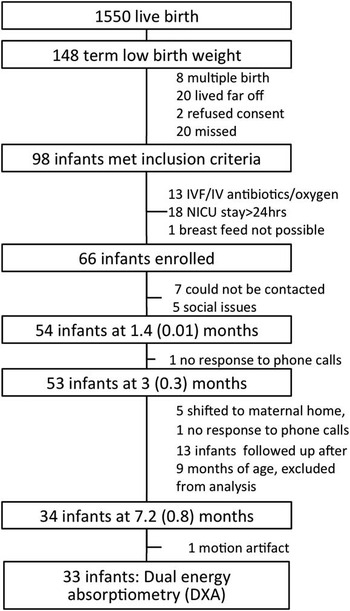
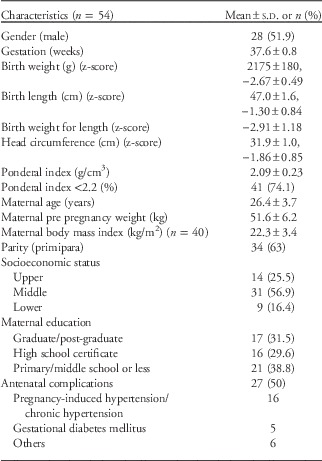
The study flow is provided in Fig. 1. A total of 54 term infants (28 boys) with mean gestation of 37.6±0.8 weeks and mean birth weight of 2175±180 g were enrolled at birth. The baseline characteristics of the cohort are depicted in Table 1. At birth, the z-score for length was greater than that for weight, indicating that this cohort was asymmetrically growth restricted in weight. The age of the infants at follow-up was 1.4±0.0, 3.0±0.3 and 7.2±0.8 months. The number of infants followed up at the respective visits was 54, 53 and 34. All baseline characteristics (listed in Table 1) except LAZ were comparable between the infants lost to follow-up at last visit (n=20) and those who were retained; the infants who were lost to follow-up were shorter at birth (LAZ 1.69±0.73 v. −1.05±0.82; P=0.004). These infants were also comparable in weight, length and WLZ at 3 months of age (P<0.05).
Study flow.

Baseline characteristics

Magnitude of growth acceleration
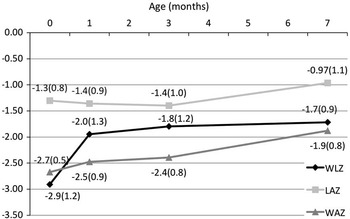
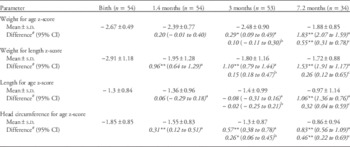
Figure 2 shows serial mean WAZ, LAZ and WLZ at birth and follow-up. The mean weight, length and WLZ of study infants was significantly lower than the WHO standards throughout the study period (P<0.001). Change in WAZ, LAZ and WLZ over time is depicted in Table 2. Significant increment in WAZ, but not in LAZ, occurred from birth to 3 months (P=0.01). Significant change in WAZ and LAZ occurred together after 3 months (P<0.001 and 0.03, respectively). Thus, WLZ (reflecting adiposity) increased significantly in the first 3 months (P<0.001) but not after 3 months. Between birth and 7.2 months, significant increment was noted in all the three parameters, WAZ, LAZ and WLZ (P<0.001). The z-score for head circumference for age increased consistently throughout the study period.
Serial mean weight for age (WAZ), length for age (LAZ) and weight for length (WLZ) at birth (n=54), and follow-up at 1.4±0.0, 3.0±0.3 and 7.2±0.8 months; n=54, 53 and 34, respectively, at follow-up.

Magnitude of growth acceleration between different time intervals in terms of weight for age, length for age, weight for length and head circumference for age (z-score)

#Values represent difference in growth parameter between two time points at follow-up.
a Change in growth from birth to respective time points.
b Change in growth parameter from 1.4 to 3 months.
c Change in growth parameter from 3 to 7.2 months.
**P<0.001, *P<0.05.
Timing of CUG
The proportion of babies who showed CUG in WAZ (∆WAZ⩾0.67) from birth to 1.4, 3 and 7.2 months was 29.6, 26.4 and 48.5%, respectively (Table 3), reflecting that nearly one-third of the infants had early CUG in WAZ (before 1.4 months). Similar data for LAZ and WLZ growth is presented in Table 3. Among all the parameters, the proportion of infants achieving CUG was maximum (72.7%) in terms of WLZ from birth to 7.2 months.
Proportion of infants catching up (⩾0.67 z-score) between different time intervals in terms of weight for age, length for age, weight for length and head circumference for age z-score

Factors influencing growth
Among 34 infants, 32 (94.1%) were exclusively breastfed till 6 months but complementary feeding (assessed at the last follow-up visit) was inadequate in 20 (58.8%) infants. ∆WAZ, ∆LAZ and ∆WLZ from birth to 7.2 months were comparable in infants who received adequate complementary feeding after 6 months of age and those who did not (data not shown). Similarly, ∆WAZ, ∆LAZ and ∆WLZ from birth to 7.2 months were similar in infants who were exclusively breastfed till 6 months and those who were not (data not shown). More than one episode of illness (predominantly respiratory and diarrheal illness) was recorded in 20 (58.8%) infants with a mean duration of illness of 6.5±9 days. ∆WAZ, ∆LAZ and ∆WLZ from birth to 7.2 months were comparable between infants with or without illness (data not shown). Gender, socioeconomic status, maternal BMI and gestation did not influence weight gain from birth to 7.2 months (P>0.05).
Body composition
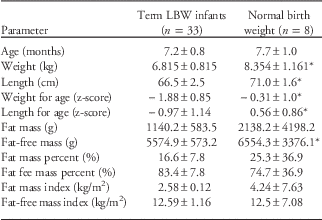
Basic and derived parameters obtained by DEXA scan are tabulated (Table 4). The control infants (n=8) were significantly heavier and taller (P<0.001) and had significantly greater FFM than LBW infants (6705.6±1101.6 v. 5574.9±573.2 g; P=0.007). Among the LBW infants (cases) boys (n=19) had significantly higher FFMI than girls (n=14; 1.29±0.09 v. 1.21±0.12 Kg/m2; P=0.04). No gender differences were found in FM%, FMI and FFM% (data not shown). FM% was not influenced by gestational age, weight and length at birth, presence of illness, adequacy of complementary feeding or mode of feeding (P>0.5). Maternal BMI did not have significant relationship with infants’ FFMI, FMI or FM% (data not shown).
Body composition and anthropometry (mean±s.d.) of term low birth weight (LBW) infants and normal birth weight infants

*P<0.05.
Relationship of body composition with magnitude of growth during different time intervals
Linear regression analysis was used to analyze the relationship between magnitude of growth (∆WAZ, ∆WLZ and ∆LAZ) during the different time intervals with FM% and FFMI in the 33 LBW infants in whom DEXA was performed. As FMI was a negatively skewed parameter and required log transformation before regression analysis, therefore this was not chosen. FFM% conversely mirrors FM% (which is mathematically explained), therefore FFMI was chosen for assessing the relationship with growth.
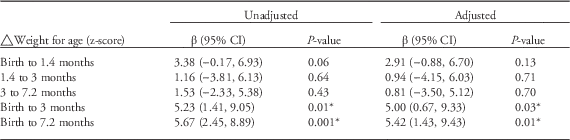
Change in WAZ from birth to 3 and 7.2 months showed a positive association with FM% at 7.2 months after adjusting for gender, current age and length (P=0.03 and P=0.01, respectively; Table 5). With respect to one z-score change in WAZ from birth to 3 and 7.2 months FM% is predicted to increase by 5.0 and 5.4%, respectively. ∆WAZ between the ages of 3 and 7.2 months was not significantly associated with FM% (P=0.70) reinforcing the impact of early growth on body composition. ∆LAZ and ∆WLZ during any time period were not associated with FM% at 7.2 months.
Association of magnitude of growth acceleration with fat mass percent (FM%, n=33)

β values are regression coefficients and represent association of FM% with weight for age z-score during different time intervals. Model is adjusted for gender, current age and length (as a marker for current size).
*P<0.05.
Change in LAZ from birth to 7.2 months was negatively associated with FFMI (P=0.02); this can be explained mathematically as FFMI includes length parameter in the denominator. ∆LAZ at any other time point, ∆WAZ or ∆WLZ was not associated with FFMI.
Comparison of body composition in infants with early, late and no CUG
In terms of CUG in WAZ, 18.2% (n=6) infants caught up before 1.4 months, 39.4% (n=13) caught up later than 1.4 months and 42.4% (n=14) did not show CUG. The mean FM% at 7.2 months in infants with early, late and no CUG were 21.4±5.3, 18.5±7.5 and 12.8±7.6%, respectively. There was a statistically significant difference among the groups in mean FM% (P=0.03), but not in mean FFMI (data not shown). Post-hoc comparison showed a trend of higher FM% in infants with early CUG when compared with infants with no CUG (P=0.06), re-emphasizing the importance of growth acceleration in early infancy.
Discussion
Understanding the influence of growth trajectory on body composition is vital in countries such as India, facing a dual burden of obesity on one hand and under nutrition or LBW on the other. In infants with intrauterine growth restraint, early CUG may play a crucial role in programming of body composition. We have therefore chosen a cohort comprising exclusively of term LBW (growth restricted) infants to study the relationship between their growth patterns and body composition.
Many previous studies, both IndianReference Bhargava, Bhargava, Kumari, Madhavan and Ghosh 25 – Reference Bavdekar, Vaidya, Bhave and Pandit 28 and western,Reference Harding and McCowan 29 – Reference Fitzhardinge and Inwood 32 reporting serial anthropometry of LBW infants, did not isolate the effects of prematurity from that of growth restriction. A few studies from developing countriesReference Khatua, Saha, Khatua and Pal 33 , Reference Srivastava, Agarwal, Gupta and Mehrotra 34 have assessed the growth of term LBW infants; however, z-scores and CUG patterns were not reported. An Indian study has reported gender-specific growth trajectory of 30 term LBW from birth to 18 yearsReference Chaudhari, Otiv and Khairnar 35 but has not reported growth over smaller time periods during the first year.
Use of z-scores based on WHO data in our study has enabled a better description of growth, comparisons within indices and international standards. We found a disparate pattern of weight and length gain, with predominant CUG in terms of WAZ and WLZ. Other studies on term LBW infants have shown a very high incidence of catch up in length/height (76% by 2 monthsReference Karlberg, Albertsson-Wikland, Kwan, Lam and Low 36 and 87.5% by 2 yearsReference Hokken-Koelega, De Ridder and Lemmen 37 ). This pattern can be explained by a large proportion of asymmetrically growth-restricted infants with relatively preserved birth length accounting for limited potential of length CUG at follow-up.
There is a paucity of studies that have used direct measures of fat and fat-free mass for body composition analysis in infants. The FM% for 6–9-month-old healthy term infants from developed countriesReference Fomon, Haschke, Ziegler and Nelson 38 – Reference Butte, Wong, Hopkinson, Smith and Ellis 40 has been observed to range from 20 to 30%, which was similar to that of normal weight control infants in our study. We could not find any data on body composition by DEXA at 6–9 months of age among term LBW infants.
We found that the magnitude of weight gain (∆WAZ) in the first 3 months had a significant direct association with FM% irrespective of current size and gender. In addition, infants with early CUG (by 1.4 months) had higher FM% than infants with no CUG, suggesting that both earlier timing and greater magnitude of catch-up weight gain led to greater accrual of fat rather than lean mass. Our study supports the previous observation by Singhal et al.,Reference Singhal, Kennedy and Lanigan 41 who noted that a nutrient-enriched formula that promoted faster weight gain in infancy increased the FM at 5–8 years of life. In a subset of exclusively breast-fed infants, in the same cohort, a direct association was noted between gain in WAZ from birth to 6 or 9 months and FM%.Reference Singhal, Kennedy and Lanigan 41 Ibanez et al.Reference Ibanez, Ong, Dunger and de Zegher 42 have reported that CUG in weight between 0 and 2 years was associated with total body adiposity at 2–4 years of age and visceral adiposity at 6 yearsReference Ibanez, Lopez-Bermejo and Suarez 43 measured by DEXA and magnetic resonance imaging, respectively. Modi et al.Reference Modi, Thomas and Harrington 44 have reported that there was no statistically significant difference in FM% by 6 weeks in eight growth-restricted and 21 healthy infants (24.7±5.3 and 28.3±4.7%, respectively). In the CASyMIR cohort (France), the period from birth to 4 months in term growth-restricted infants was highlighted as a period of rapid FM accrual assessed indirectly by skin fold thickness.Reference Beltrand, Nicolescu and Kaguelidou 45 Interestingly, FM% in this cohort at 4 and 12 months (18.6±3.6 and 17.8±3.3%) was similar to that obtained in our study group of LBW infants.
In previous studies from developing countries, there is ambiguity with regard to the effect of accelerated early growth (especially in the growth-restricted infants) on body composition. In the New Delhi cohort, BMI gain between 0 and 6 months correlated more strongly with adult lean mass (by skin fold thickness).Reference Sachdev, Fall and Osmond 15 This association was weaker in the subset of infants with birth weight <2500 g. In the Pune maternal nutrition study,Reference Joglekar, Fall and Deshpande 14 faster weight and height growth during every 6-monthly intervals from birth to 6 years was associated with both fat and lean mass (measured by DEXA) at 6 years of age. However, adjustment for current size was not done in this study. A recent pooled analysis of five birth cohorts from developing nations revealed that changes in weight trajectory relative to peers between 0 and 12 months was associated with both adult FM and FFM.Reference Kuzawa, Hallal and Adair 46 An important shortcoming in this study was the use of indirect methods to assess body composition in all but one cohort.Reference Kuzawa, Hallal and Adair 46 Our study is the first study from a developing country that shows association of infancy weight gain with FM.
The short follow-up of our study and the small sample size do not allow us to give definitive conclusions on the link between early CUG and later metabolic disease; it does, however, furnish evidence for the hypothesis that early and rapid growth acceleration in LBW infants is associated with greater fat accrual, evident as early as 6–9 months of age. Although, at this age, the FM% in LBW infants is lower compared with normal weight infants, it may be a part of the chain of events in programming of subsequent body composition.Reference Leunissen, Kerkhof, Stijnen and Hokken-Koelega 47 The effect of growth in early infancy on changes in body composition and later cardio metabolic risk in term LBW infants should be explored in a larger cohort and beyond infancy. Till the time that such studies provide us with a greater insight into the optimal growth trajectory for term LBW infants, the norm should be the promotion of exclusive breast feeding for the first 6 months and serial growth monitoring, with concern at not only growth faltering but also rapid upward crossing of centiles.Reference Jain and Singhal 48
Acknowledgment
None.
Financial Support
This research received no specific grant from any funding agency, commercial or not-for-profit sectors.
Conflicts of Interest
None.
Ethical Standards
All procedures contributing to this work comply with the Helsinki Declaration of 1975, as revised in 2008, and has been approved by the institutional committee of All India Institute of Medical Sciences, New Delhi, India. Written informed consent was taken from mothers of all infants before enrollment.