


ἔτι καὶ πϵριουσίαι καὶ κτήσϵι διὰ τὸ ποτὲ μὲν ἐπιτϵτάσθαι ποτὲ δὲ ἀνϵῖσθαι καὶ παρέχϵιν καὶ ἀποκρίνϵιν δύνασθαι.
Further correspondences of [dreams about] the penis are: to profit and loss, because it is sometimes enlarged and sometimes reduced, and it can both produce and void its product…
– Artemidorus, Oneirocritica, Book 1.45.2Footnote 1
A conspicuous number of the dream interpretations in Artemidorus’s ca. late 2nd-c. CE Oneirocritica hyperfixate on themes of business success, the unpredictable ebbs and flows of customers, and catastrophic profit loss, amplifying the very real anxieties experienced by ancient proprietors. A dream of one’s sick mother, for instance, might portend destruction of one’s products, while a dream of intercourse with one’s mother was auspicious for a business.Footnote 2 If a laborer dreamt that they possessed a multitude of hands, it could presage a rise in business, but if one dreamt of wearing white, it might signal that business will fizzle.Footnote 3 Similar anxieties abound in the Sortes Astrampsychi, a fortune-telling apparatus extant from the ca. 3rd c. CE. The proffered questions rely on an inquirer’s psychological need for external assurance: “Will I be successful?”, “Will I be harmed in the business matter?”, “Will I take part in the business affair?”, “Will I open a workshop?”, “Will I be prosperous?”Footnote 4 Some of the recommended courses of action even involve ritual intervention as a management strategy – “You won’t be harmed [in the business matter]. Don’t be distressed but offer prayers instead.”Footnote 5 It is no surprise that those invested in Roman Imperial bakeries, which relied upon an especially volatile resource – namely, fire – possessed similar if not particularly amplified concerns and mitigated them accordingly. This article investigates the riskscapes within Pompeian bakeries and the highly creative shrines and apotropaic materials deployed within them, particularly at and around the oven.Footnote 6
As reflected in the Roman textual psyche, any industrial or commercial undertaking in the Roman world was rife with risk and unknown outcomes. When a business relied on fire-based facilities, however – as was the case for potters, metalworkers, and bakers, amongst others – concerns compounded and control of an already nebulous environment became increasingly precarious (and ripe for divine intervention). Although Roman bakers who used certain forms of domed ovens likely experienced less constant exposure to active fuel than their peers, fire’s byproducts nonetheless facilitated dangerous conditions that permeated every facet of the baking process. For instance, Pompeian domed ovens largely are presumed to have functioned through accumulated heat conditions, wherein fuel was used to raise the internal temperature of the oven and was then removed in order for baking to take place via the resultant radiative and convection heat.Footnote 7 But even if fire was not continuously stoked, the necessary transfer of smoldering fuel from the oven could result in errant sparks and embers, potentially spurring a conflagration – as was perhaps the case reported in at least one ancient source.Footnote 8 The industrial mill-bakery environment only exacerbated the issue, given that both flour dust and equine waste lend themselves to combustion.Footnote 9 Separately, mismanagement of temperature and resultant baking times could impact huge swaths of batch-baked bread at once, decimating profits. Notably, one bread oven at Pompeii was excavated with 81 loaves inside.Footnote 10 On a human level, the thermal dysregulation and intermittently smoky, floury conditions inherent in a bakery posed myriad occupational hazards to workers. Such conditions would have fostered lightheadedness, lethargy, cramping, and confusion, all physiological states that made one prone to injuries and accidents, and had the capacity to disrupt the highly finnicky processes required for successfully mixing, kneading, rising, and baking loaves of bread.Footnote 11 Those laborers working closest to the oven would have been the most readily impacted pathologically, in both the short and the long term.Footnote 12 Bodily risk and risk to profit, then, intensified both in and around the oven’s opening. In a conspicuous number of archaeologically attested cases, amuletic interventions followed at the same boundary.
The habit of employing amulets and divine protectors near the mouths of industrial, fire-based facilities seems to have originated beyond the Italian peninsula – for instance, alongside Archaic Greek industrial kilns and forges, according to the textual and visual record. Later Roman literary sources from both within and beyond the Italian peninsula similarly attest to the practice, whether communities came to it independently or creatively adapted it as agents of cross-cultural contact. Regardless of the practice’s origins, I suggest that, as baking became increasingly professionalized and as ovens grew larger from the 2nd and 1st c. BCE onwards in the Italian peninsula and beyond, Roman bakers identified a new need to equip the mouths of their recently enlarged baking facilities – now sources of income and product – with their own powerful protective mechanisms. Preliminary case studies by this author suggest that industrial-scale oven protection was, in fact, adopted across the provinces over time, colored with diverse, locally influenced ritual choices: some informed by popular Eastern Mediterranean amuletic forms (e.g., standalone phalluses and frontal faces) and others highly vernacular to a particular geotemporal context.Footnote 13 Although the available archive of adequately documented and extant bakery remains at Pompeii is limited and silenced not only by taphonomic realities and 19th-c. methodological shortcomings, but also by a preservational prioritization of non-labor spaces, we can use our available archive creatively.Footnote 14 Even in the absence of substantially documented assemblages, the shrines and amuletic forms built into extant architectural features and facilities in Pompeian bakeries present a remarkable opportunity to consider risk in situ.
It is not new information that shrines are known from the shops and industries of Pompeii. As a collective material class, however, they have traditionally been woefully underinterrogated relative to domestic shrines, although recent scholarship has made strides towards shedding fresh light on the collective corpus.Footnote 15 Many archaeologists and art historians have skirted the profound creativity present within them, deferring to the term lararia to describe their presumed function – a term which obfuscates the paintings’ complexity and wrongfully assumes pride of place for the twin protector gods.Footnote 16 The industrial and commercial shrines’ diverse combinations of deities, playful variations on standard iconography, and intentional placement within spaces suggest more dynamic, creative strategies than the canonical Lar alone, a case made abundantly clear in the bakeries discussed in this contribution. The total number of commercial-scale bakeries at Pompeii is disputed, but this author’s corpus numbers 39 at the time of writing.Footnote 17
From the body of evidence at Pompeii, it will become clear that the industrial bread oven in particular was conceptualized as a locus of risk in the Campanian imagination. Swaths of niches constructed in the very surfaces of bread ovens (some even explicitly aedicula-form) have been altogether overlooked not only by excavation reports but even in shrine catalogues, despite many being visible at the time of the authors’ writing.Footnote 18 Moreover, a number of shrines were published without discussion of even immediately adjacent apotropaia (most commonly, isolated phalluses), likely due to fraught, inherited Frazerian-Durkheimian value biases of so-called “magic” versus “religion,” thus fragmenting what was a collective arsenal of protection.Footnote 19 With regard to the Pompeian bakery shrines with figural iconography, a striking number of proprietors commissioned particular, vernacular iconographies of Vesta alongside other local and protective deities in creative and varied combinations, as if crafting experiences of the divine that were more accessible and personally connected to the supplicant.
A “vernacular” ritual approach, a framework adapted from Stuart McKie, is one that operates under the assumption that all ritual is experienced through an individual’s identities and experiences in particular geotemporal contexts; it embraces variety and creativity, rather than seeking a singular “Roman” religion.Footnote 20 At Pompeii, such localisms are readily teased out. Of course, it is worth noting that a lack of published evidence for a shrine or apotropaion in a Pompeian bakery does not wholly insinuate a lack of interest in protection, nor a lack of interest in a hyper-personalized experience.Footnote 21 We cannot eliminate the possibility of wooden shrines, displaced but moveable altars, ephemeral ritual materials, undocumented and now lost apotropaia and niches, portable and interchangeable statuettes, etc.Footnote 22 Before turning to the evidence, I anchor the reading in a wider ancient Mediterranean culture of concern about conflagration, industrial amulets, and risk.
Fiery thresholds and liminality
Christopher Faraone powerfully argues that in the Greco-Roman imagination, the vulnerable body – often that of a woman or child – could function as synecdoche for a building or temple, spurring amuletic protection at its liminal thresholds (the ears and throat), amongst other places (i.e., in proximity to the targeted area). In the same multiscalar framework, we might consider that protective interventions in the form of built shrines, potent materials, and powerful iconographies could just as well be applied to the permeable orifices of risk-laden industrial equipment, including kilns, forges, and bread ovens. Amulets placed at their most porous openings were a defense against any evil which might pass inside and served as a generalized form of protection or luck in a volatile environment.Footnote 23
The use of ritual interventions and amulets at fiery industrial thresholds is a well-attested phenomenon in the Mediterranean. A fragment of a pseudo-Homeric hymn recorded in a 2nd-c. BCE text, if truly Archaic in origin, would be one of the earliest explicit, written examples of this kind of supplication. It records a prayer to Athena for protection of a potters’ kiln – and, importantly, a request for the disruption of competitors’ kilns.Footnote 24 In seeking vengeance against the laborers’ dishonest peers, the speaker entreats a cast of characters for aid, including a crew of demons poignantly named for their potential risks to the wares within the kiln, from overbaking to crushing and shattering.Footnote 25 The hymn also invokes the very real risk of unpredictable fire emanating from the kiln’s orifices, which might result in occupational injury or a mass conflagration. The author requests, “If anyone [of the disreputable businessmen] pokes their head inside [their kiln], may the whole face of that person be set alight with fire….”Footnote 26
The kiln hymn also specifically invokes Athena with her hand upraised in a blessing over the speaker’s own kiln, in order to aid the business’s fecundity (δϵῦρ, ἄγ, Ἀθηναίη καὶ ὑπέρσχϵθϵ χϵῖρα καμίνου; “Come now, Athena, and hold your hand over the kiln…”).Footnote 27 The described stance mirrors an Archaic Black Figure lekythos bearing the image of a goddess with her proper right hand aimed at the opening of a metalworker’s furnace.Footnote 28 The figure is likely Athena – her left hand holds a pair of metallurgical tongs, with two chisels or drifts for decorating metals visible behind it. The paired gestures of the goddess suggest a blessing extended to both the tools of the craft and the source of productive fire.Footnote 29 Similar depictions of craft guardianship emerge on a number of the Archaic Penteskouphia potters’ plaques, where Athena herself or her owl guard the potters’ kilns. Other Penteskouphia plaques invoke locally potent Poseidon at the kiln, speaking to the protective utility of a locally invested, more proximal deity.Footnote 30
Just as Athena was invoked amongst Archaic potters, Hephaestus had his place in Classical Athens as a patron of hearths, kilns, and forges as well. Faraone brings to our attention an important scholiast, commenting on Aristophanes’s ca. 5th-c. BCE Ὄρνιθϵς, 436–38:
ἄγϵ δὴ σὺ καὶ σὺ τὴν πανοπλίαν μὲν πάλιν / ταύτην λαβόντϵ κρϵμάσατον τύχἀγαθῇ
ἐς τὸν ἰπνὸν ϵἴσω πλησίον τοὐπιστάτου
Come, you – take up all of this panoply and suspend it, by the favor of the gods, onto the oven, close to the protector… Footnote 31
The scholiast specifically comments on the term τοὐπιστάτου, writing that it describes “the clay Hephaestus set up before the hearths as an overseer [ephoros] of the fire,” or images “depicted in relief [anaplassein] on kilns.”Footnote 32 That is, from an early period in the Mediterranean, deities were deployed in defense of fiery facilities, with supplicators selecting gods who were trade-specific and locally potent (as in the Penteskouphia plaques), with the capacity to control or mold outcomes at the kiln or forge.
Protection in the Greco-Roman world extended beyond the spheres of deities, however, into other forms of risk prevention at the fiery threshold: namely, apotropaia and functional amulets. Aristophanes remarks in a fragment on the purchasing of a βασκάνιον for the front of a coppersmith’s forge – in doing so, he unintentionally suggests a regular, known market for such evil-averting objects, if the joke is to successfully land.Footnote 33 A βασκάνιον averts envy or malintent from a vulnerable locus. The form of the apotropaion is not explicit in the fragment, but we are told in later sources, such as Plutarch’s Moralia, that such images were ἀτοπία, a word which has connotations of “paradoxical,” “absurd,” or “grotesque”:
διὸ καὶ τὸ τῶν λϵγομένων προβασκανίων γένος οἴονται πρὸς τὸν φθόνον ὠφϵλϵῖν, ἑλκομένης διὰ τὴν ἀτοπίαν τῆς ὄψϵως, ὥσθ᾽ ἧττον ἐπϵρϵίδϵιν τοῖς πάσχουσιν.
On account of this, people believe that those amulets aid against envy, through the absurdity of their magnetic appearance, so that, for the ones in possession of them, [envy] impacts them less severely. Footnote 34
Pollux attests to a shared language of risk management in the 2nd c. CE when he describes metalworkers affixing evil-averting, amusing (γϵλοῖά) materials to their furnaces’ frontages.Footnote 35 Their amusing nature could plausibly indicate absurd or grotesque appearances – aligning with the pervasive popularity of apotropaic Silen heads, theater masks, gorgons, satyrs, disembodied phalluses, and ithyphallic, bearded herms deployed at both Greek and Roman thresholds and in women’s and children’s body amulets.Footnote 36 Pliny, too, records a pervasive Roman culture of concern in fire-based workshops: “No one is unafraid of being fixed by evil prayers…”; “many believe that the works of potters are broken in this way.”Footnote 37 Anxiety persisted in the Roman consciousness about becoming the object of envy or ire, a danger which could settle on the most vulnerable, volatile member of the industrial apparatus, and that most necessary for success: the oven, forge, or kiln.
Visual depictions across the Mediterranean similarly attest to concerns at the fiery threshold being mitigated with apotropaia.Footnote 38 On the shoulder of one 6th-c. Attic hydria, a kiln frontage is adorned with a large, frontal, bearded mask.Footnote 39 Frontally oriented faces are amongst the most common amulet forms in the ancient Mediterranean, and a penchant for frontality is paralleled in contemporary contexts further east.Footnote 40 On one Penteskouphia votive tablet, a kiln is armed with an owl and a small, frontally oriented ithyphallic figure.Footnote 41 On the name-vase of the Foundry Painter, two frontal busts hang at the forge’s opening, alongside a set of horns and a series of pinakes.Footnote 42 Similarly, in a Roman context – in fact, an instance from Pompeii – Erotes are depicted working a forge wherein the entry is topped by a frontal, bearded head in a pileus (perhaps Vulcan himself, but perhaps a more generic apotropaion).Footnote 43
Intermittent archaeological evidence similarly affirms the tendency to safeguard fiery facilities with apotropaia and protective rites across the Mediterranean. A half-meter phallus was excavated in front of a Hellenistic kiln near Metapontum in Magna Graecia, for instance.Footnote 44 At Pella, a sizable phallus similarly surfaced at a kiln site.Footnote 45 In Etruria, material evidence for the phenomenon of protection at the kiln is also present, namely in vestiges of ritual action. Kiln K, one of a series of kilns excavated in Cetamura del Chianti and dated ca. 300–150 BCE, yielded a small black-gloss cup, fully intact, inserted as a likely votive into a stoking channel. The kiln also surfaced a single Campanian patera broken into sherds and scattered throughout the structure when it was built.Footnote 46 This patera likely functioned as a kind of structural deposit, imbuing the entire technology with added power and tempering its tumultuous nature. The protective practice continues to crop up across the Roman Empire in proximity to metalworking facilities: a recently re-analyzed antler-bone phallus likely emerged in the vicinity of a potter’s kiln in Lincolnshire, and in Aquincum, a 15 cm ceramic phallus surfaced amongst kilns.Footnote 47 Even at Pompeii, at least two likely textile or dye workshops’ furnaces employ phalluses or shrine niches (which themselves could have held either statuettes or apotropaia) on or above their fire-based facilities.Footnote 48
Across the Roman Empire, envy and ire cast towards the oven were, of course, not the only sources of anxiety for a proprietor of a fire-reliant business. The myriad day-to-day risks of volatile fire – whether contained or widespread property damage, burns, deaths, or otherwise – were also a locus of concern, worth warding off with apotropaia or divine protection, for both laypeople and businesses. Even the mere discussion of fire warranted anxiety: Pliny tells us that “fires mentioned during meals are averted as omens by pouring water under the table” (incendia inter epulas nominata aquis sub mensam profusis abominamur).Footnote 49 Separately, he remarks that, “at this very time, walls are scrawled with prayers warding off fire” (iam parietes incendiorum deprecationibus conscribuntur).Footnote 50 If fire within an individual’s home was already a source of dread, industries regularly engaging with furnaces and open flame, like bakeries, kilns, and forges, were surely loci of exacerbated anxiety, not to mention occasional origin points for urban fires.Footnote 51 Material manifestations of conflagration-specific anxieties are potentially recoverable in the spatial distribution of a specific class of amulet. Namely, we can track the findspots of thunderstone amulets, “stones” that were believed in the Greco-Roman imagination to have been generated by lightning strikes, with the capacity to avert lightning and resultant fire from bodies and buildings – a prime surface for inscribing an amuletic request.Footnote 52 (In actuality, the stones themselves are Neolithic axe heads, and continue to be used in modern Greek folk magic for the same purpose.) Notably, this amulet class has been found in or near at least three Roman Imperial kilns.Footnote 53 To paint with a broad brush, in the Roman period, we see and thus anticipate an adaptation of numerous popular amuletic forms with Greek and eastern precedents. Already deemed appropriate for the protection of entire structures, industrial facilities, and bodies in earlier Greek contexts, familiar amuletic shapes came to be utilized at and around the openings of fire-based facilities – including, with the advent of industrialized baking, the bread oven. At the same time, the same thresholds became sites for creative, locally informed ritual interventions.
Vernacular Vesta and the Pompeian bakery riskscape: a case study
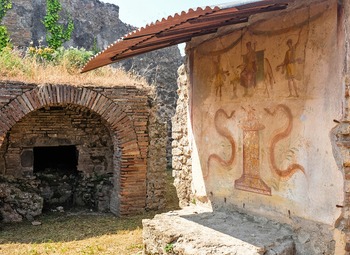
With a background established, we can now approach the phenomenon of a localized Pompeian variation of Vesta – the Roman goddess of the hearth and a patron of bakers – with renewed interest. Across Pompeian commercial and industrial contexts, Vesta appears eight times, exclusively in properties with bread ovens.Footnote 54 That is, she appears to be fully omitted from shrines in other food retailing contexts with small-scale cooking hearths and counters, suggesting that it was her oversight of baking rather than her general association with hearths or family units that was desirable.Footnote 55 Notably, her representation in the Pompeian bakeries strays from her standard Roman iconography, where she more typically stands alone or is enthroned, holding the patera, scepter, or torch.Footnote 56 In contrast, in Pompeian bakeries, the canonical Vesta is shown flanked by her sacred ass, an animal vital to milling operations: further aligning her with bakers’ motives (Fig. 1). This author has found only two examples of this explicit iconographic goddess-animal pairing outside of Pompeian wall-paintings: one a seemingly lost marble relief with an unknown provenance, and the second a marble altar showing a range of deities with their sacred animals, now in the Naples Museum.Footnote 57 The marked popularity of the variation within Pompeii and concentrated in a single industry suggests a localized, vernacular choice.
The shrine to Vesta at VII.12.11, painted in front of the industrial bread oven. (Photo by Abigail Staub-Green, 2025. Su concessione del Ministero della Cultura – Parco Archeologico di Pompei. Reproduction or distribution by any means is prohibited.)
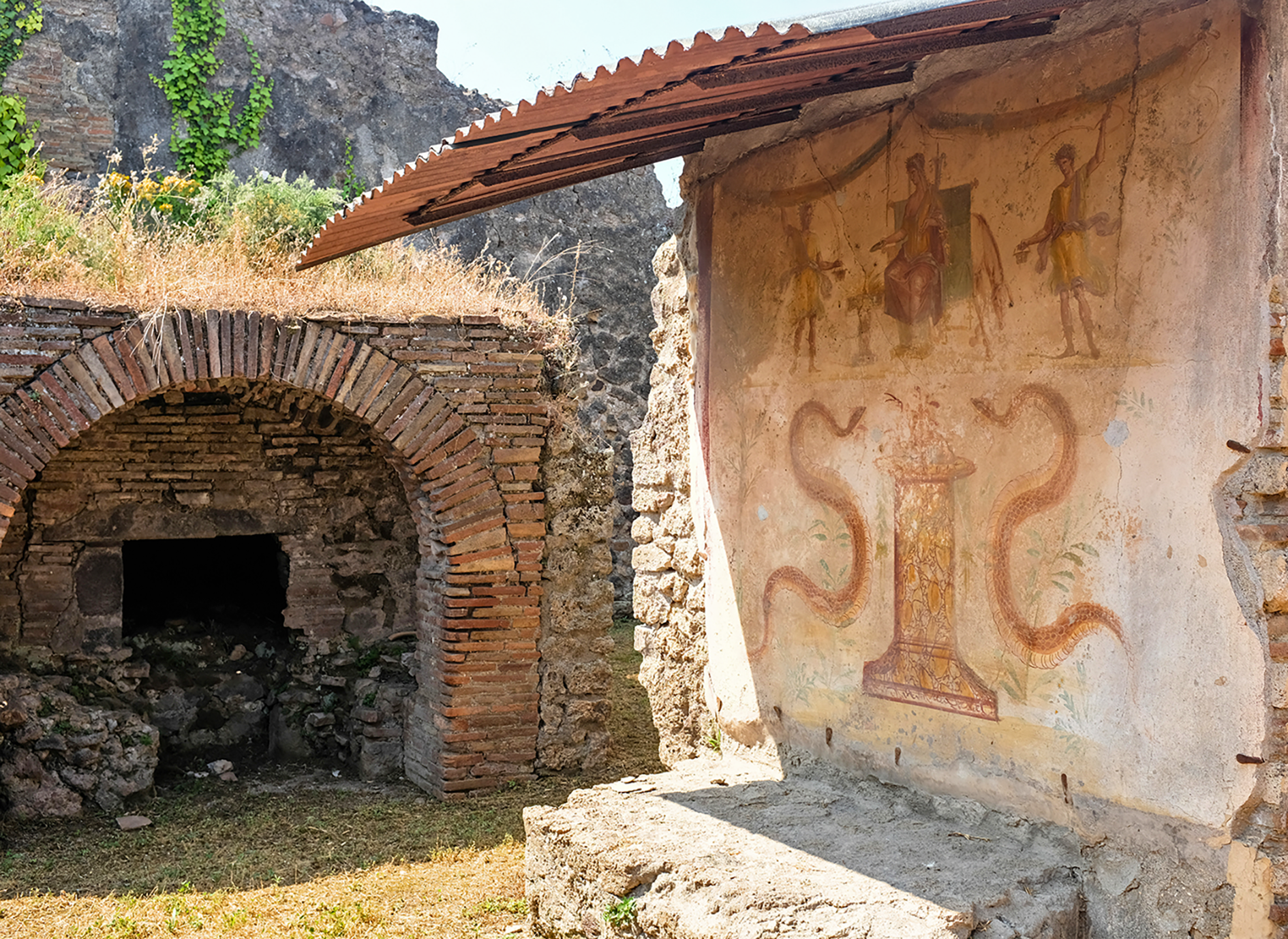
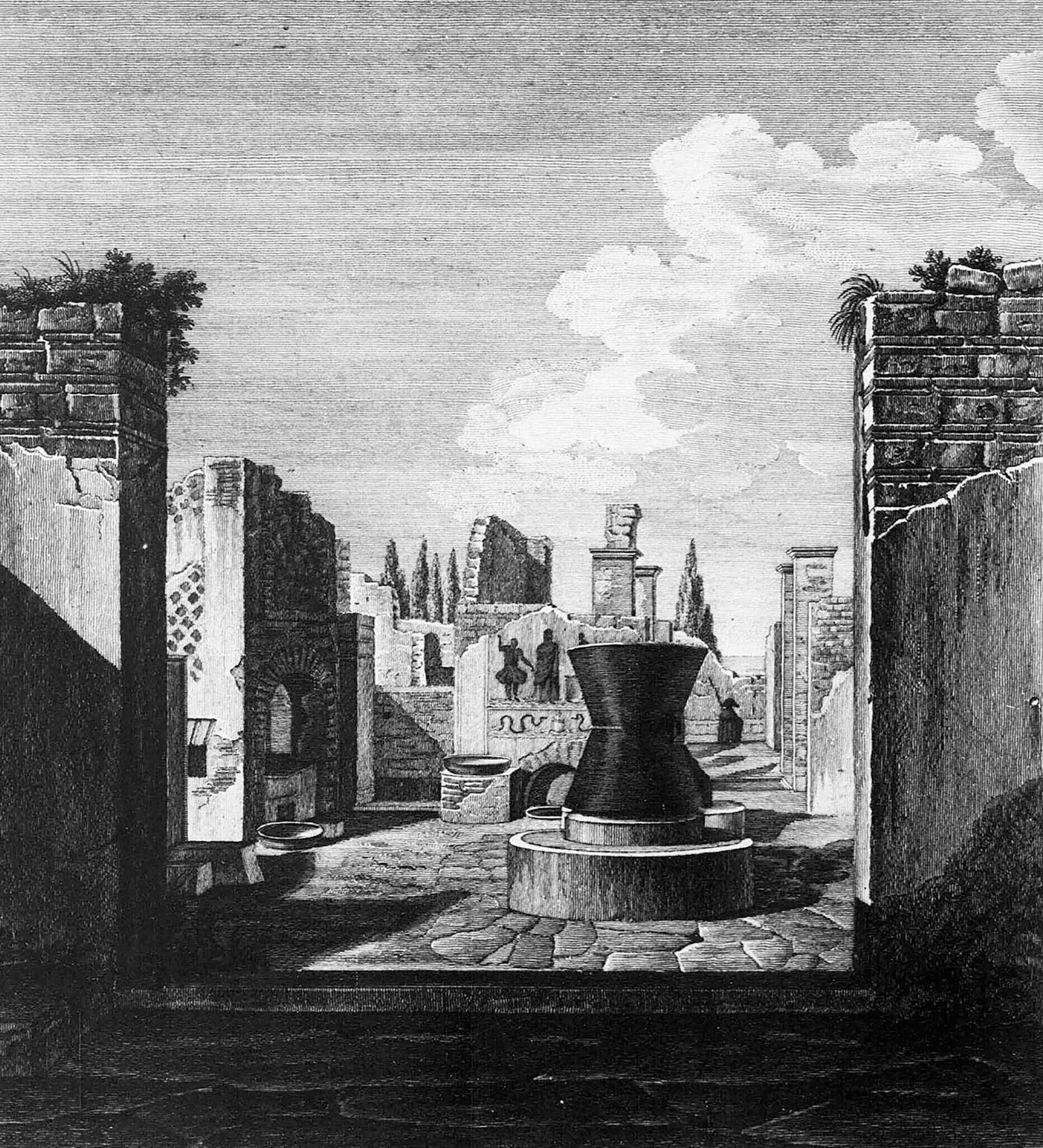
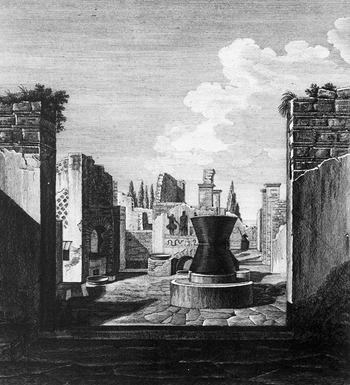
The iconographic type of the goddess and her sacred donkey is explicit in seven out of eight occurrences of the goddess in Pompeian bakeries. In the eighth (VI.3.27), it is unclear whether the ass was ever present, but one wonders if it was simply overlooked by our only firsthand source, François Mazois. Mazois, who likely saw the shrine painting in the bakery at VI.3.27 at or within a year of its excavation, rather judgmentally and succinctly writes that the upper register illustrated “a ceremony as part of the ridiculous cult practices to the goddess Fornax” (la cérémonie que l’on a indiquée ici devoir faire partie du culte ridicule que l’on pratiquait à l’égard de la déesse Fornax), without elaborating further.Footnote 58 His reasoning for identifying the scene as the cult of a baking goddess remains unclear. Perhaps he made the assumption from the image’s proximity to the oven alone, based upon a generic sacrificial scene. However, his precise choice of words suggests the presence of a female goddess. Although Vesta is otherwise never shown in bakeries without her sacred ass, the creature’s presence cannot be affirmed or denied. A print from the Mazois publication is largely unhelpful in this regard: it appears to show multiple figures, with the central figure likely veiled and female (but otherwise largely indistinguishable; Fig. 2). Curiously, discussing the same painting, Mazois argues that a pair of birds chasing insects at each side of the upper panel are a representation of the Lares. This description suggests that the twin gods themselves were not present in the composition. Yet, the print visualizes a figure in the canonical Lar position to the left of the central figure (as well as the head of a paired companion on the opposite side) and notably depicts no birds, blurring the lines of reality and making it, too, an unreliable narrator.Footnote 59 Thus, the precise details of the composition cannot be reconstructed. Breton, writing ca. 1870, merely notes that the shrine depicted a dedication to the “goddess of furnaces (la divinité protectrice des fourneaux)” and that the image had largely disappeared by the time of his writing.Footnote 60
Print of the bakery at VI.3.3/27, viewed from door VI.3.27, reproduced from Reference MazoisMazois’s (1824) Les ruines de Pompei, second partie, Pl. XIX. (Su concessione del Ministero della Cultura – Parco Archeologico di Pompei. Reproduction or distribution by any means is prohibited).
While Vesta, of course, had value for protection of any oven or hearth as a goddess of hearths, her relationship to the mill-bakery specifically went deeper, through her relationship to donkeys. Ovid describes the importance of Vesta’s sacred donkey in his Fasti VI. While the maiden goddess slept, an ill-intentioned Priapus approached. The bray of an alarmed donkey stirred her, and, in gratitude, she wreathed it in bread bits.Footnote 61 Ovid uses the story as a transition to describing the Vestalia festival of his time, during which bakers temporarily ceased activity out of respect for Vesta’s sacred animal (the same equine often used to turn their mills). That the Vestalia was well known across Pompeii’s urban fabric is suggested by its central depiction in Pompeii’s Macellum, where Erotes wreathed recumbent donkeys inside of a mill-bakery. The Macellum itself likely provided space for bread vendors, as its storerooms contained carbonized bread when excavated. Footnote 62 The association of the goddess with hearths and with donkeys, then, made her Pompeian iconography deeply intimate for the bakers commissioning her. The city’s iconographic variant was honed for their industrial pursuit.
In some instances, the Pompeian Vesta composition is also combined with other creative references or localisms, further manufacturing a Vesta who aligned with users’ vested interests and individual identities – and, suggesting a fair degree of personalization and playfulness in commissioned compositions. For instance, at VII.12.7, the lost shrine painting – positioned directly in front of the oven – apparently showed Vesta grasping a sheaf of wheat: an attribute more typical of Ceres, but one that was potent for a baker. There, the goddess was paired with Mercury holding a money pouch, a common type used to ward thresholds in Pompeian retail spaces – here, perhaps a request for oversight of the bakery’s adjoining shop, at the front of the property.Footnote 63 The inclusions thus represent the entire complex cycle of bread-baking in a single composition, from the harvesting and processing of grain (the sheaf and the milling equine) to its baking (the goddess proper) and sale (Mercury). The interplay of Vesta and Ceres may also reflect the ongoing influence and local vitality of Ceres’s cult in the city.Footnote 64
Separately, at the bakery-and-bath complex at VI.11.9–10, Vesta was paired with Pompeii’s mural-crowned tutelary deity, Venus Pompeiana, as a protector of outcomes and fates in the urban environment.Footnote 65 Below the goddesses was the reclining personification of the nearby Sarno River, creating a composition that layered place-based identities atop industrial ones (and, perhaps evoked the god’s watery oversight, although the city’s piped water source was not the Sarno).Footnote 66 In the possible restaurant-bakery of the House of Siricus (VII.1.46–48), Vesta and her donkey accompany Vulcan in a niche to the left of the oven, amplifying their fiery oversight, with depictions of cooked foods below (a common motif in kitchen shrines).Footnote 67
Vesta was not the only creative choice made in shrines, however. Two figural shrine paintings in the oven room of IX.3.10–12 opt for something else entirely, showcasing individual creativity and local identity. A pillar immediately facing the oven depicted a likely variation of Venus Pompeiana manning a vessel, while a niche facing the oven from the east wall of the milling area featured Isis (also locally potent) with the rudder and globe, alongside Harpocrates or Eros and another unidentified, horseback deity (perhaps Epona).Footnote 68 The ruddered implements with both Venus and Isis emphasize their capacities to shape outcomes and fates, an apt choice for protection at the vulnerable oven.Footnote 69 The widespread presence and political pull of Isiaci at Pompeii was impressive (perhaps speaking to the proprietor’s own social networks), and Isis’s deployment with the city’s goddess of place made the protection more targeted as well.
Of course, not all bakeries had elaborately decorated figural niches. Some niches were adorned with a plain color, border, or pattern, and others opted for the more generic Lar and serpent.Footnote 70 Any niche could be used in combination with movable figurines or an apotropaion, making them flexible and dynamic spaces for ritual and protection regardless of their decoration. It is also quite likely that many plainly decorated or undecorated niches, still plausibly with ritual use, were wholly undocumented by prior scholarship and are now lost, given the undervaluation of industrial spaces and the decay of oven faces.Footnote 71 The dynamism, vibrance, and variety employed in the extant, painted figural instances cannot be overlooked, however, and is suggestive of a great level of personalization and creativity.
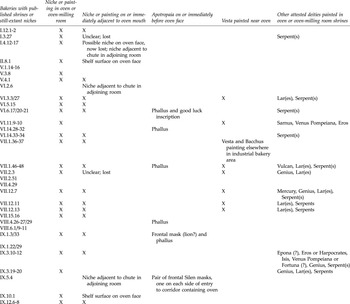
In addition to the popularity of various local and industry-specific protector deities in Pompeian bakeries’ figural shrines, the overall placement of shrines and niches across the bakeries suggests locations perceived to be vulnerable in a proprietor’s imagination (Table 1). Unsurprisingly, the oven rooms receive the most intensive protections, with many of the city’s bakeries combining milling and baking in a largely contiguous space (with kneading and other preparatory activities often undertaken in radiating rooms). Of the 39 Pompeian bakeries in the corpus, roughly 72% (28/39) of bakeries equip either the physical face of the oven or a wall within the immediate oven room with some form of traceable and plausible permanent (rather than portable) ritual intervention, whether a phallus, a grotesque visage, a niche, or otherwise.Footnote 72 A range of interventions were counted in this number, including outright, explicit amuletic or ritualistic evidence (phalluses, frontal faces, deity images, et cetera) alongside potential evidence for ritual action (i.e., plastered niches or shelves at oven mouths which could have supported the display of apotropaia, statuettes, masks or other ritual objects). Of oven-room interventions, 54% (15/28) occur directly at the oven opening (above the mouth or immediately beside it), pointing to a perceived vulnerability at the industrial threshold. Three are explicitly aedicula-form niches, six are erect phalluses (one of which is paired with a frontal head), and the remainder are undecorated niches or projecting shelves.Footnote 73
Bakeries with published or extant ritual interventions and their relationships to ovens.
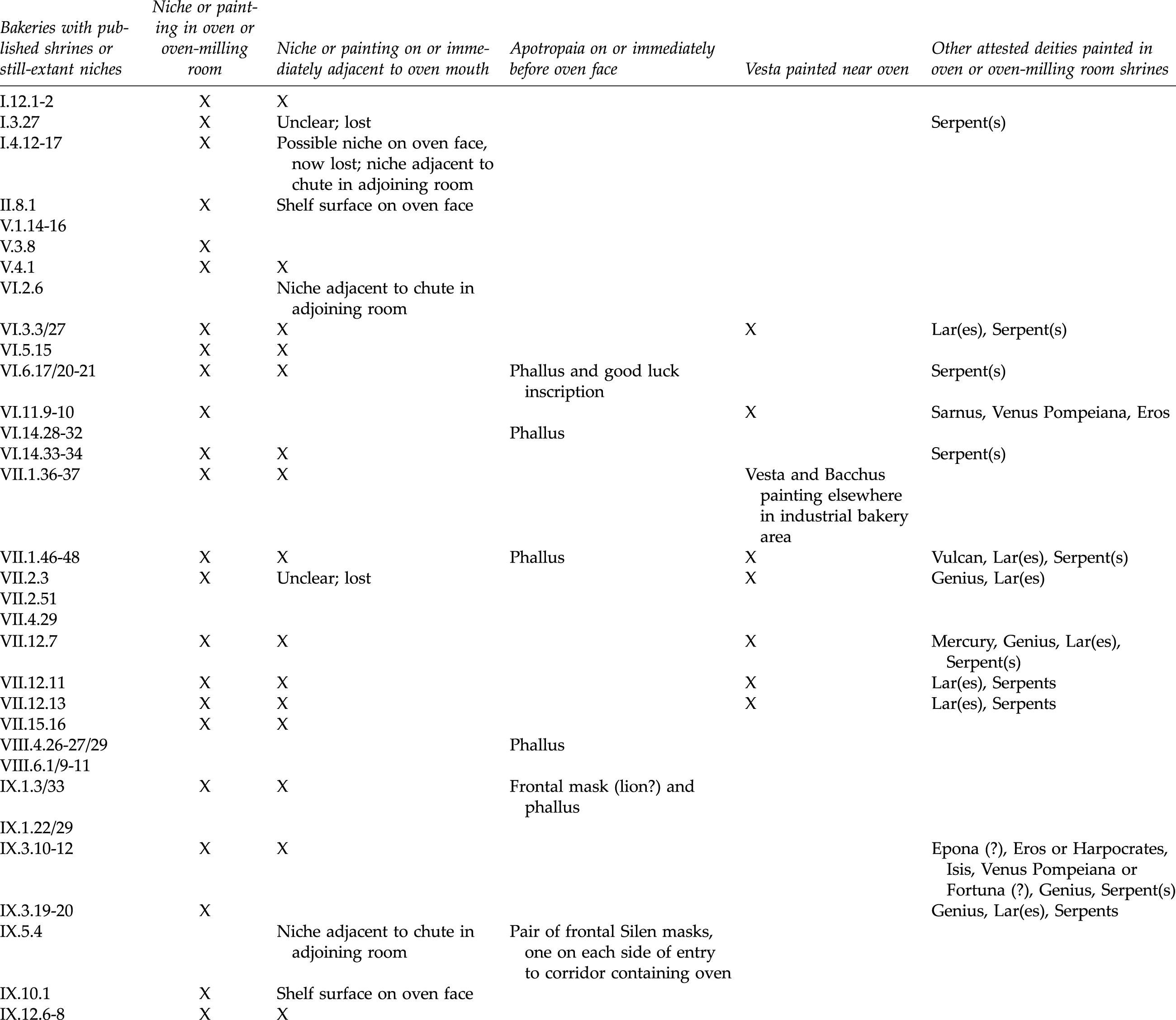
Table 1. Long description
The table presents data on ritual interventions in Pompeian bakeries, focusing on their relationship to ovens. It has 39 rows and 5 columns. The columns are labeled as follows: Bakeries with published shrines or still-extant niches, Niche or painting in oven or over-milling room, Niche or painting on or immediately adjacent to oven mouth, Apotropaia on or immediately before oven face, Vesta painted near oven, and Other attested deities painted in oven or over-milling room shrines. Each row corresponds to a specific bakery and details the presence or absence of various ritual interventions. For example, Row 1: 11.2-1-2, X, X,, , . Row 2: 13.27, X, Unclear; lost,, , Serpent(s). Row 3: 14.12-17, X, Possible niche on oven face, now lost; niche adjacent to chute in adjoining room,, . Row 4: II.8.1, X,, Shelf surface on oven face,, . Row 5: V.1.14-16, X,, , , . Row 6: V.3.8, X,, , , . Row 7: V.4.1, X,, , , . Row 8: VI.1.26,, Niche adjacent to chute in adjoining room,, , . Row 9: VI.3.3/27, X, X,, X, Lar(es), Serpent(s). Row 10: VI.5.15, X, X,, , . Row 11: VI.6.17/20-21, X,, Phallus and good luck inscription,, Serpent(s). Row 12: VI.11.9-10, X,, , X, Sarnus, Venus Pompeiana, Eros. Row 13: VI.14.28-32,, , Phallus,, . Row 14: VI.14.33-34, X, X,, , Serpent(s). Row 15: VII.1.36-37, X,, , Vesta and Bacchus painting elsewhere in industrial bakery area, . Row 16: VII.1.46-48, X, X, Phallus, X, Vulcan, Lar(es), Serpent(s). Row 17: VII.2.3, X, Unclear; lost,, X, Genius, Lar(es). Row 18: VII.2.51,, , , , . Row 19: VII.4.29, X,, , X, Mercury, Genius, Lar(es), Serpent(s). Row 20: VII.12.7, X,, , X, . Row 21: VII.12.11, X,, , X, Lar(es), Serpent(s). Row 22: VII.12.13, X, X,, X, Lar(es), Serpent(s). Row 23: VII.15.16, X, X,, X, . Row 24: VIII.4.26-27/29,, , Phallus,, . Row 25: VIII.6.1/9-11,, , , , . Row 26: IX.1.3/33, X, X, Frontal mask (lion?) and phallus,, . Row 27: IX.1.22/29, X, X,, , Epona (?), Eros or Harpocrates, Isis, Venus Pompeiana or Fortuna (?), Genius, Serpent(s). Row 28: IX.3.10-12, X, X,, , Genius, Lar(es), Serpent(s). Row 29: IX.3.19-20, X,, , , . Row 30: IX.5.4,, Niche adjacent to chute in adjoining room, Pair of frontal Silenus masks, one on each side of entry to corridor containing oven,, . Row 31: IX.10.1, X,, Shelf surface on oven face,, . Row 32: IX.12.6-8, X, X,, , .
Of the bakeries with oven-room interventions, 13 did not intervene on the oven’s physical face, but proximity to the oven was clearly a priority. At least five of the bakeries’ ovens contained figural shrine paintings immediately beside or facing them: four depicted the Lares in combination with Vesta (as at VII.12.11), and the fifth depicted a stuccoed pair of serpents, more generalized protectors of place.Footnote 74 Niches with unrecorded decorative schema also stood immediately before or beside the ovens of VI.5.15 and VII.15.16. Two additional, lost figural compositions – one a Vesta composition and another a depiction of paired serpents approaching an altar – are described in early reports as somewhere within the oven room of their respective bakeries, but their positions cannot be precisely determined, only guessed at.Footnote 75 If we add in the bakeries which had plausible shrines anywhere in the property, the percentage of bakeries with evidence of ritual concerns jumps to roughly 90%. Only three bakeries seemingly lack any permanent ritual intervention at all; one of these was bombed, making any new reading impossible.Footnote 76
Even in bakeries where shrines were recorded in major catalogues, oven-adjacent niches were overlooked. At IX.5.4, for instance, a painting of the Lares in the bakery’s milling room was published by Boyce, isolated from a separate oven room, but on-site study indicated an unpublished niche placed low in the wall next to the oven’s passthrough.Footnote 77 In addition, the 1878 issue of Notizie degli Scavi describes a pair of terracotta Silenus masks (one still extant) embedded at the threshold of IX.5.4’s oven annex. The apotropaic heads face away from the oven and look outward, as if warding off approaching threats, and at least one of them would have been hyper-visible from the bakery’s front shop room and from the street beyond, should the axis have been left unobscured.Footnote 78 At V.4.1–2, Boyce records the property’s “only” shrine in a garden.Footnote 79 However, the property has an extant, plaster-finished, square niche embedded in the oven’s praefurnium, just to the right of its mouth. Similarly, at IX.3.10–12 – the property which boasted images of Isis and Venus Pompeiana – multiple archival images capture a colored-brick, aedicula-form niche above the mouth of the oven as well.Footnote 80
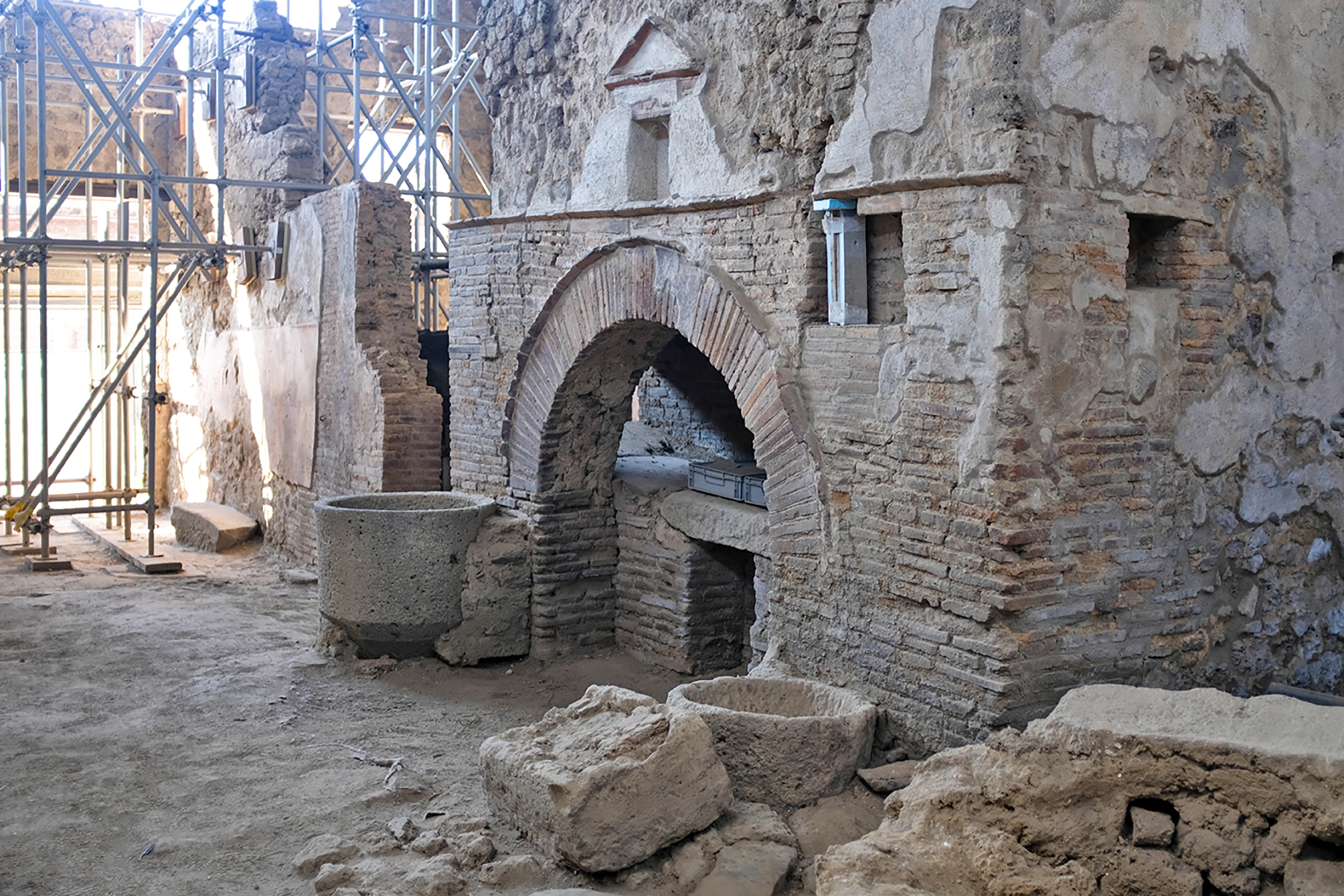
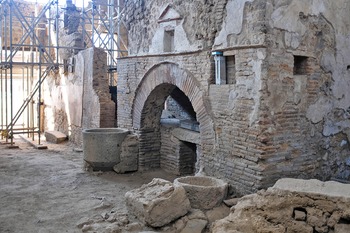
At the House of the Chaste Lovers (IX.12.6–8), although an elaborate shrine was uncovered in the internal garden west of the oven, the oven itself features a stuccoed aedicula-form niche directly over the mouth, seemingly mentioned only once, offhand, by the excavator (and, even then, only as a tympanum-shaped niche, with no true consideration for its function; Fig. 3).Footnote 81 Elsewhere in the room are the remnants of at least two more niches: one is small and arched, located in the northern wall facing the mills and oven; the other, partially preserved, is arched and plastered with a tile shelf. Both are seemingly unmentioned in publications.Footnote 82 The latter niche was set into a fragmentary, red-plastered panel on the north wall and retains an extant blue-tessera dolphin motif in the red ground (perhaps intended to reference locally potent Venus worship).Footnote 83 In addition to these features, at the threshold which provided access to the bakery from the Via dell’Abbondanza, a fresco of ithyphallic Mercury with a money pouch provided an added layer of prosperity and protection to the business within.Footnote 84
House of the Chaste Lovers (IX.12.6–8) oven and milling room, looking south towards the Via dell’Abbondanza. (Photo by Abigail Staub-Green, 2025. Su concessione del Ministero della Cultura – Parco Archeologico di Pompei. Reproduction or distribution by any means is prohibited.)
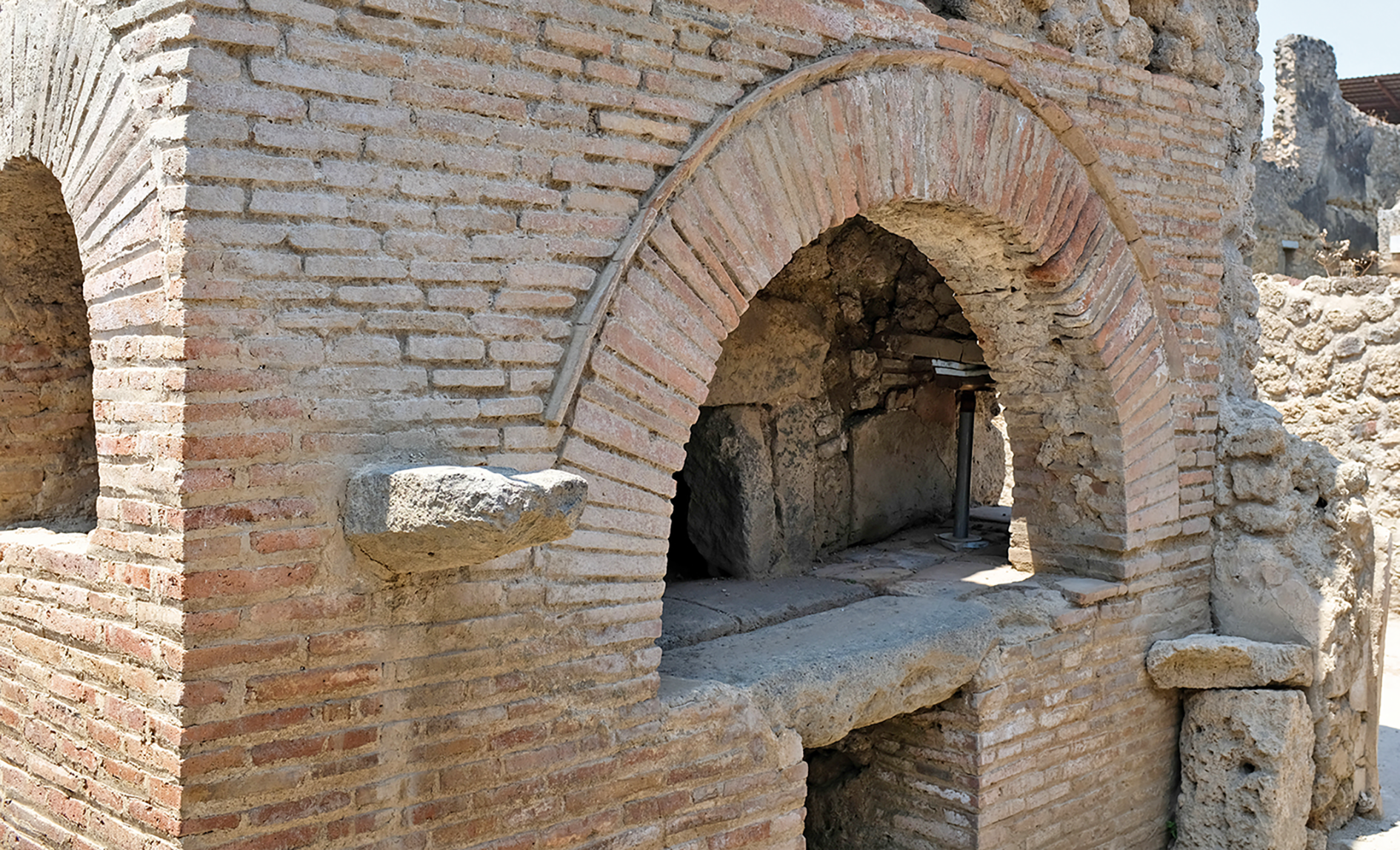
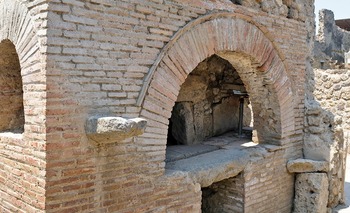
Relatedly, at the recently excavated bakery at IX.10.1, an elaborate shrine, complete with yellow stucco serpents, faced the industrial area of the bakery through a window perforation, but was not directly accessible from it.Footnote 85 However, a peculiar lava-stone shelf protrudes from the left side of the oven, at its mouth (mirroring the same shelf type found at II.8.1’s oven). Perhaps it supported something as innocuous as a lamp, or as ritually significant as a figurine or apotropaion (Fig. 4).
The oven from the mill–bakery at IX.10.1. (Photo by Abigail Staub-Green, 2025. Su concessione del Ministero della Cultura - Parco Archeologico di Pompei. Reproduction or distribution by any means is prohibited.)
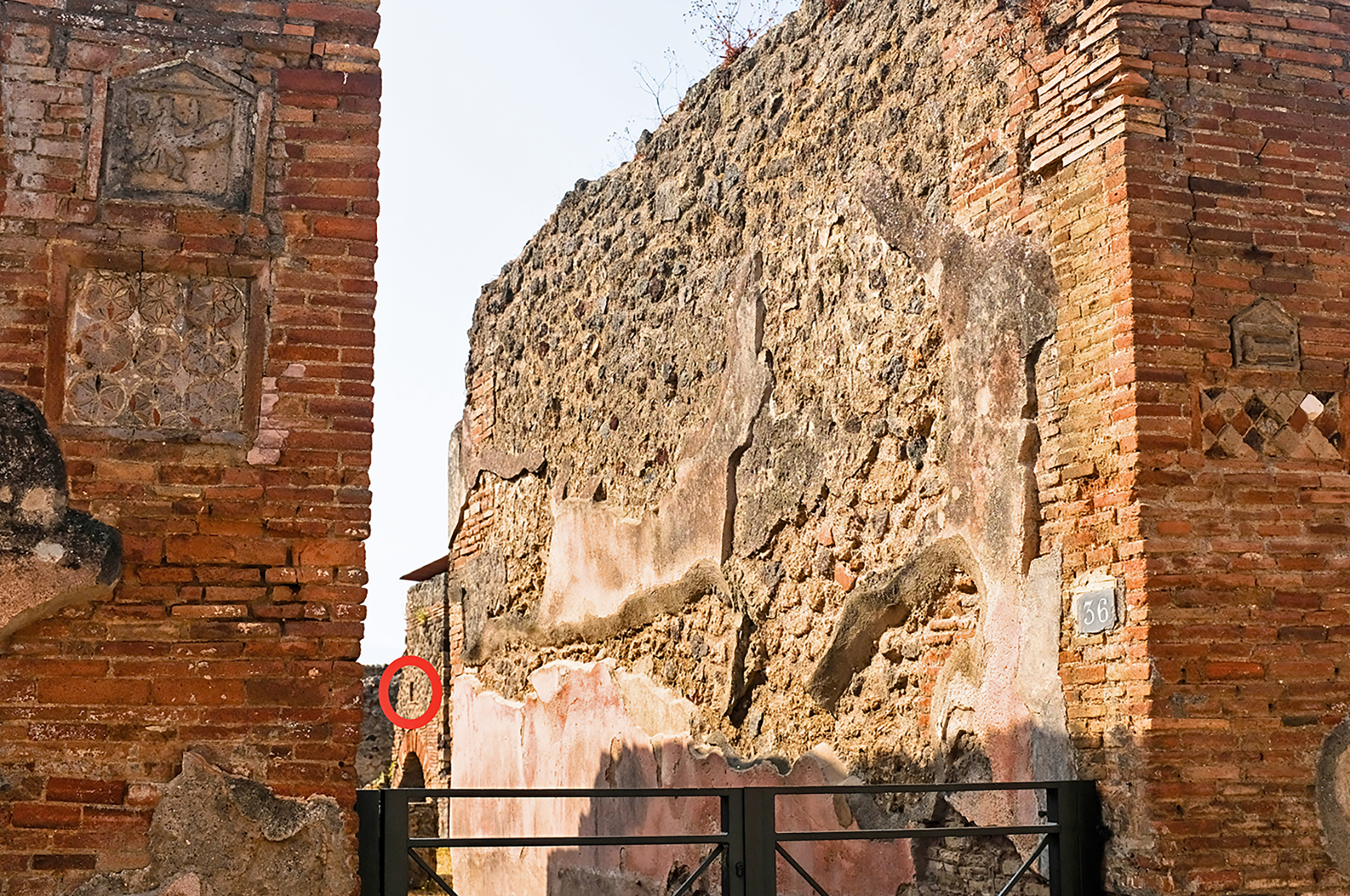
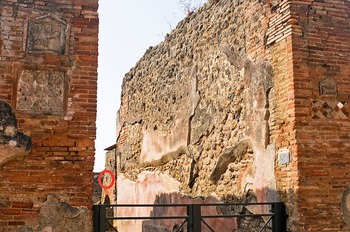
Perhaps most intriguing is VII.1.36–37, the property that houses the singular case of a Vesta depiction in a bakery outside of an immediate oven-milling room (in a likely bread-shaping room, which housed masonry table supports and a proofing bowl, just off the oven area).Footnote 86 The bakery was clearly a high-production establishment, as it was excavated with 81 loaves still sealed inside the oven.Footnote 87 Within the fabric of the oven, a colored-brick, aedicula-form niche is clearly visible to this day (partially visible at the rear of Fig. 5, marked with a circle).Footnote 88 Discussing the qualifications for shrines included in his catalogue, Boyce writes that the “aedicula façade marks the niche as a shrine of the gods, more clearly than any other feature, except the images of the gods themselves”– thus, it is hard to understand how Boyce overlooked this niche’s ritual intention.Footnote 89 However, he also argued that a shrine should be finished in plaster and possess adornment, and the deployment of colored brick may have been considered insufficient for inclusion.
Looking from the Via degli Augustali into door VII.1.36 from the street. The aedicula-form oven niche is visible inside, marked by a circle. (Photo by Abigail Staub-Green, 2025. Su concessione del Ministero della Cultura – Parco Archeologico di Pompei. Reproduction or distribution by any means is prohibited.)
In fact, users of VII.1.36–37 historically had many concerns about risk, reflected in wards at multiscalar thresholds. At one point, protective plaques were installed at the doorway to the bakery and the doorway to its shop (Fig. 5). Notably, these plaques were plastered over at the time of the eruption, requiring us to consider a range of possibilities, from shifting concerns and maintenance over time (e.g., were the current users aware of their presence?) to the inherent potency of apotropaia regardless of visibility (that is, their perceived functionality was likely not inhibited by their invisibility, if the proprietors were aware of their presence).Footnote 90 At the left, an ithyphallic figure in an aedicula stands above a geometric-patterned plaque. Although geometric plaques are attested on a number of Pompeian commercial exteriors (for instance, at the dye workshop at VIII.4.1), I suggest, perhaps optimistically, that it may reference batch-baked bread loaves, with the aedicula providing direct oversight, as mirrored inside. At the right, a phallus is placed in an aedicula, with the glans pointed directly to the vulnerable threshold of the shopfront, serving both the porous doorway and the bakery within.
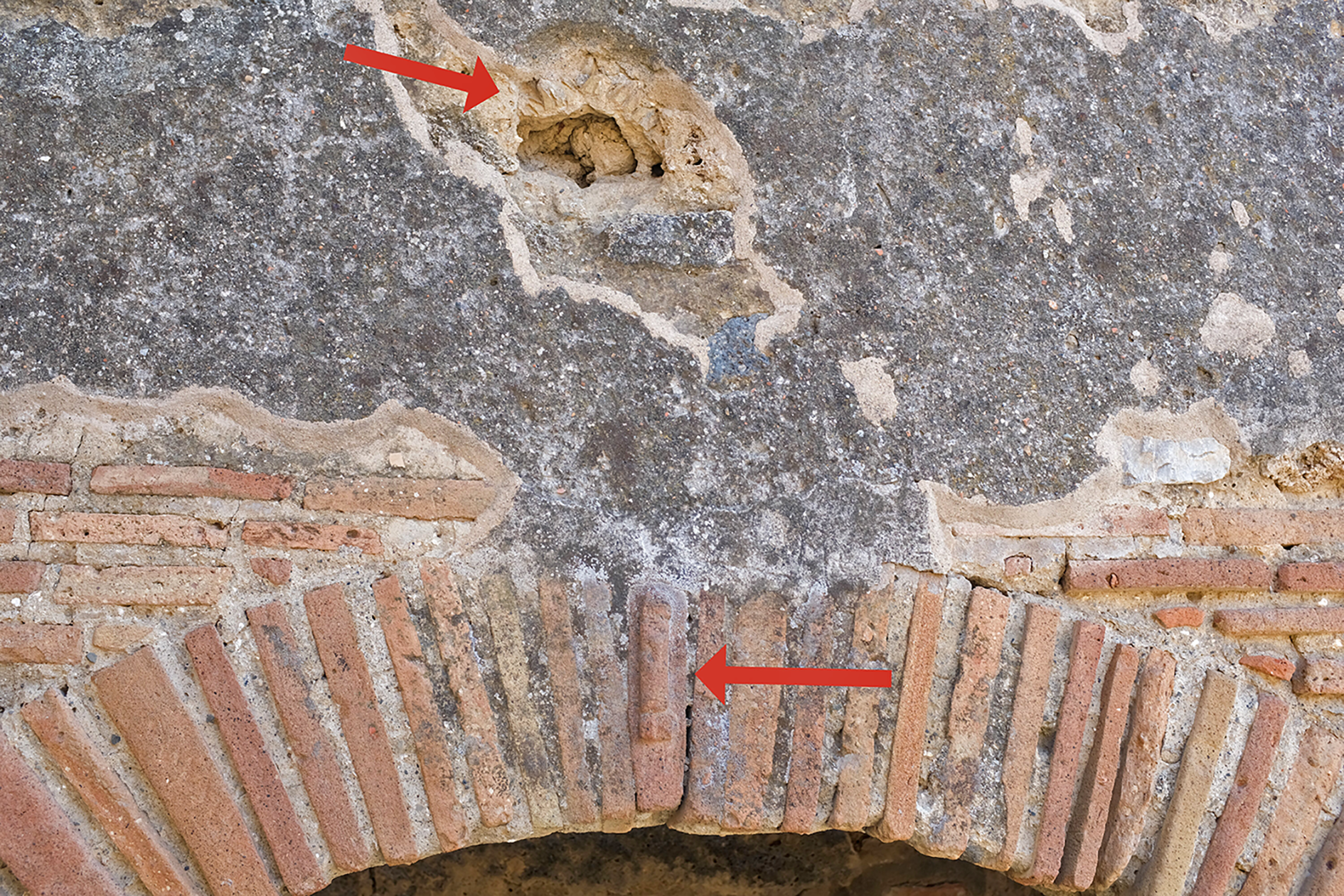
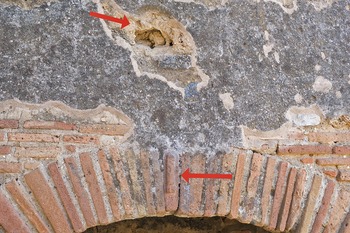
The widespread, historical obfuscation of apotropaia is especially flagrant. For instance, at the bakery complex at VI.14.28–33, where Boyce published two possible shrines in the property’s garden and none in the bakery, he actively ignored a now-lost phallus, positioned above the mouth of the oven, which had been published previously in the Notizie degli Scavi.Footnote 91 At VIII.4.26–29, although Boyce describes only the shrine niche in the property’s rear garden, a phallus is clearly visible in archival images, built into the oven surface, of which the outer frame is extant to this day.Footnote 92 Other ovens had explicit apotropaia embedded in them, alongside oven-proximal shrines. At IX.1.3/33, where Boyce recorded a twin pair of niches facing the oven, he wholly overlooked a grotesque frontal head (likely, a lion, as the edges of a mane remain) and a brickwork phallus embedded above the oven’s opening (Fig. 6).Footnote 93 Warscher was the first to document their presence at all, in the 1940s, despite the property’s excavation in 1852.Footnote 94 Similarly, the famed HIC HABITAT FELICITAS phallic plaque originated above an industrial oven, where it complemented a shrine painting of a serpent below it.Footnote 95 At the House of Siricus (VII.1.46–48), where Vulcan and Vesta joined forces beside the oven, a still-extant phallus protects the mouth directly.Footnote 96 It becomes immediately apparent that any and all protective mechanisms could be employed collectively by a Pompeian proprietor to diffuse perceived risk, with particularly emphatic intervention at the oven’s permeable orifice. Chosen mechanisms were deeply influenced by vernacular ritual practice (i.e., the prioritization of hyperlocal types and deities), alongside adaptations of familiar Greek amulet forms (masks, phalluses, etc.).
Detail from the mouth of the oven at IX.1.3/33, with the remains of an embedded, grotesque frontal head and brickwork phallus. Arrows mark the radiating hair or mane feature of the crumbling mask as well as the phallus. (Photo by Abigail Staub-Green, 2025. Su concessione del Ministero della Cultura – Parco Archeologico di Pompei. Reproduction or distribution by any means is prohibited.)
Conclusions
A Frazerian isolation of so-called “magic” from “religion,” alongside a pervasive and field-wide traditionalist desire to create a neatly packaged picture of “Roman religion,” have stunted and isolated conversations about diverse ritual interventions in the industrial sphere. Thus we have hindered our own ability to recognize local innovation and creativity. In Pompeii, I have highlighted the ways in which diverse, complex figural scenes of deities (and, especially local variations of deities, such as the pairing of Vesta and her sacred donkey within the bakery) readily blend with popular, more widespread Greek amulet forms, highly reflective of both the vernacular of southern Italy and the individual identities of Pompeian inhabitants. But even the established amulet shapes appear to follow preferential favorites amongst bakers and the larger urban fabric: namely, frontal heads and phalluses.Footnote 97 When we consider protective assemblages collectively in context, we can construct a much richer, dynamic picture: one which returns necessary creativity, agency, and social vibrancy to the Roman bakery.
Acknowledgments
I am indebted to Drs. G. Zuchtriegel and G. Scarpati of the Parco Archeologico di Pompei for granting access to many of the city’s bakeries in Summer 2025. Additionally, I warmly thank Dr. S. Hay of the Parco Archeologico di Pompei for her aid and insightful company whilst visiting IX.10.1 and IX.12.6.

 Open access

