1 Introduction
Both the generation of an epenthetic stop in two consonant clusters and stop elision in three consonant sequences are fairly common processes in the world's languages. Stop epenthesis is widely attested, among other clusters, in combinations of a nasal or a lateral followed by the lingual fricatives /s, ʃ/ or the alveolar rhotic (Yiddish gandz and haldz from German Gans ‘goose’ and Hals ‘neck’, Catalan moldre from Latin MOL(E)RE ‘to grind’; Wetzels Reference Wetzels1985: 314). The elision of a stop C2 in a three consonant cluster may apply next to consonants exhibiting the same place of articulation (Spanish cansar from Latin CAMPSARE ‘to tire out’, Catalan [diˈmars] dimarts from Latin DI(E) MART(I)S ‘Tuesday’). While many descriptive, experimental and theoretical accounts of stop epenthesis and elision processes are available in the literature (Ali, Daniloff & Hammarberg Reference Ali, Daniloff and Hammarberg1979; Ohala Reference Ohala1981, Reference Ohala and MacNeilage1983, Reference Ohala1997; Wetzels Reference Wetzels1985; Clements Reference Clements, Bosch, Need and Schiller1987; Morin Reference Morin1987; Murray Reference Murray1987; Page Reference Page, Rauch and Carr1997; Picard Reference Picard1987; Côté Reference Côté2000; Ohala & Solé Reference Ohala, Solé, Fuchs, Toda and Żygis2010), detailed information about how the articulatory and aerodynamic requirements for different consonant combinations favor or prevent the insertion and elision of a stop is lacking. To our knowledge, only Ali et al. (Reference Ali, Daniloff and Hammarberg1979) and Warner & Weber (Reference Warner and Weber2001) report experimental data for the phonetic implementation of stop epenthesis in a wide array of clusters. Another interesting research issue is the extent to which underlying and epenthetic stops remain contrastive in a given language or whether there is no such contrast.
Within this framework, the goal of the present study is to investigate the phonetic implementation of underlying and epenthetic stops and whether the former are more prominent than the latter in several word final consonant clusters starting with a nasal, a lateral or a rhotic and ending in /s/ in Valencian Catalan, i.e. /mps, nts, lts, rts/ and [ŋks] (where [ŋ] is a nasal allophone occurring exclusively before /k, g/) and /ms, ns, ls, rs, ʎs, ɲs/ where /ʎ/ and /ɲ/ are alveolopalatal consonants exhibiting phonemic status. The five former clusters have an underlying stop in C2 position, while the six latter ones do not and could thus allow stop insertion. Moreover, in all eleven clusters, /s/ is the noun plural marker, e.g. /kámp+s/ ‘fields’, /mán+s/ ‘hands’. In addition to reporting descriptive data for comparison with previous analyses for other languages, the present paper seeks to account for the articulatory and aerodynamic factors intervening in the stop insertion and elision processes.
1.1 Word final consonant clusters in Valencian Catalan: General characteristics
In Valencian Catalan, an underlying oral stop is expected to be realized phonetically after a homosyllabic nasal, /l/, /s/ or /r/ in word final position whether before a pause or a word initial vowel, e.g. /mp/ ([kamp] ‘field’, [kampesˈtɾet] ‘narrow field’), /lt/ ([alt] ‘tall’, [alti ˈpɾim] ‘tall and thin’) and /rt/ ([art] ‘art’, [artapsˈtɾakte] ‘abstract art’). Regressive place assimilation renders the two consecutive consonants homorganic in clusters with a nasal C1 at the bilabial (/mp/), dentialveolar (/nt/) and velar ([ŋk]) place of articulation, and the same applies to /lt/ where /l/ becomes dentialveolar. The production of the clusters /st/ and /rt/ involves either fronting of the tongue tip/blade from a more retracted centroalveolar or postalveolar constriction for /s/ and /r/ to a more anterior alveolar or dental closure location for /t/, or else the same place of articulation for the two consonants at the C1 constriction location (Recasens Reference Recasens1993). This scenario is in contrast with that for other Catalan dialects such as Eastern Catalan, where the word final oral stop is not realized after a homorganic nasal (except for [ŋk] in some dialectal areas) or after homorganic /l/ (except for learned words), and may be deleted after /s/ and /r/ in informal and/or fast speech. Therefore, the examples referred to above are realized [kam], [kam əsˈtɾɛt], [al], [ali ˈpɾim], [ar(t)] and [ar(t) əpsˈtɾaktə] in the Eastern Catalan dialect.
Consonants are homorganic in most of the clusters with /s/ under study in the present paper (Recasens Reference Recasens1996: 213, 349; Reference Recasens, Goldstein, Whalen and Best2006). In consonant sequences with an alveolar or alveolopalatal C1, C1 and C2 are homorganic in /ns, ls, rs/ because the two consonants are alveolar originally; as for /nts, lts, rts, ʎs, ɲs/, a high degree of articulatory constraint for the alveolar fricative causes the preceding consonant to be articulated at the alveolar zone as well. Homorganicity is also available in the Valencian Catalan realizations [ʎʃ, ɲʃ] of /ʎs, ɲs/ where /s/ has become [ʃ] through progressive palatalization. As for the remaining clusters, C1 and C2 agree in place of articulation at the labial and velar zone in the sequences /mps/ and [ŋks], and the two consonants keep their original place of articulation in the case of the cluster /ms/.
1.2 Underlying stop clusters
The issue as to whether the underlying oral stop is realized or not in three-consonant clusters with a nasal, lateral or rhotic C1 and ending in /s/ in Valencian Catalan (e.g. whether /kamps/, /alts/ and /arts/ should be realized as [kamps], [alts] and [arts] or as [kams], [als] and [ars]) is open to debate and will be of concern in the present paper. Generally speaking, the elision of the oral stop may be attributed to gestural merging between homorganic C1 and C2 causing the stop consonant to cease to be heard. Several place and manner of articulation factors may affect the degree of perceptibility of the oral stop element.
Regarding place of articulation, [ŋks] is expected to exhibit a more prominent oral stop (and thus to be more resistant to simplification) than /mps, nts, lts, rts/. This ought to be so since, in comparison to labial and dentialveolar consonants, the production of velars involves a slower and more gradual motion of the primary articulator, a larger contact area and a longer stop burst (Fischer-Jørgensen Reference Fischer-Jørgensen1954). Acoustic prominence is expected to be least for /mps/ since labials have no resonating cavity and thus the weakest burst (Ohala Reference Ohala, de Mori and Suen1985).
The manner of articulation of C1, i.e. whether a nasal, /l/ or /r/, may also play a role in the phonetic implementation of the underlying oral stop. This observation is supported by the fact that, in Eastern Catalan, the underlying stop is elided systematically after a nasal in the sequences /mp, nt/ and [ŋk] but only in specific conditions after /l, r/ in the clusters /lt, rt/ (see Section 1.1 above). Progressive nasalization causing the oral pressure level for the oral stop to lower and the stop to become less audible may account for the elision process in this case (Solé Reference Solé, Trouvain and Barry2007). Indeed, it appears that stop elision in the clusters /mp, nt/ and [ŋk] in the Eastern Catalan dialect reflects a historical process through which the plural endings /mps, nts/ and [ŋks] underwent progressive shortening of the underlying oral stop as it became increasingly nasalized followed by elision of the stop consonant (Veny Reference Veny1998). Also in American English, the underlying stop has been reported to be longer for /lts/ than for /nts/, and longer and more frequent for /ldz/ than for /ndz/ (Fourakis & Port Reference Fourakis and Port1986).
1.3 Epenthetic stop clusters
Stop insertion is associated with a transitional oral closing period resulting from the temporal overlap between the articulatory gestures for the consonants in the cluster (Browman & Goldstein Reference Browman, Goldstein, Mattingly and Studdert-Kennedy1991). The present study is concerned with whether stop insertion occurs in Valencian Catalan (and, if so, how frequently and robustly in comparison with other language scenarios), and what contextual, articulatory and aerodynamic factors are involved in stop epenthesis implementation in this Catalan dialect.
It remains unclear whether Valencian speakers may insert a homorganic oral stop in the clusters without an underlying stop /ms, ns, ls, rs, ʎs, ɲs/. According to available descriptions such as those referred to above, an audible oral stop appears to be regularly inserted in clusters with an alveolopalatal C1 ([aʎ(t)s/ʃ] ‘garlics’, [aɲ(t)s/ʃ] ‘years’). As for the remaining clusters, an audible stop transition has been reported to occur between /m, n, l/ and following /s/ in Eastern Catalan, i.e. [mps], [nts], [lts] (Brasington Reference Brasington1973, Wheeler Reference Wheeler1979: 281). Another issue is whether stop insertion occurs more or less often than in other languages. In American English, stop epenthesis has been reported to occur 100% of the time in the sequences /ls, ns/ (though 10% or less in the voiced cluster cognates /lz/ and /nz/) (Fourakis & Port Reference Fourakis and Port1986), and just about 25% in the case of /n(#)s/ (Blankenship Reference Blankenship1992). According to the first study, the process does not apply in South African English. Data for the sequences /ms, ns, ŋs/ embedded in non-words and produced by Dutch speakers show an epenthetic stop very often, i.e. 80–100% of the time (Warner & Weber Reference Warner and Weber2001). As for the Romance languages, the process operates highly frequently on the word internal heterosyllabic sequences /ns, ls, rs/ in Central and Southern Italian ([perˈ(t)sona] ‘person’, [ˈpen(t)so] ‘I think’, [ˈfal(t)so] ‘false’; Rohlfs Reference Rohlfs1968: 381).
Several factors appear to be involved in stop insertion in the consonant clusters of interest. In clusters with a nasal C1, a premature raising of the velum may cause the final portion of the nasal to become denasalized; since the articulators are still placed in the articulatory configuration for C1, the air pressure is released at the C1 place of articulation, thus giving rise to an oral stop which is homorganic with the nasal stop (Ohala Reference Ohala1997). Another source of stop insertion in nasal stop clusters appears to be the combined effect of a decrease in nasal murmur intensity towards the end of the nasal consonant, which resembles a short silent gap, and the burst-like abrupt oral release for the following fricative before velic closure is achieved (Ali et al. Reference Ali, Daniloff and Hammarberg1979 and Busà Reference Busà, Solé, Beddor and Ohala2007: 163–164). As for clusters with a lateral consonant, stop insertion is triggered by raising the sides of the tongue, thus creating complete oral closure before the central apical closure for the alveolar lateral is released (see Ohala Reference Ohala1997 regarding /ls/).
The audibility of the stop burst and thus the emergence of the oral stop is facilitated by an increase in oral pressure behind closure location for clusters with a non-nasal C1, as well as for clusters with a nasal C1 once the velum is raised (first closure formation mechanism above) or else during the nasal even more so when the velic opening is small (second closure formation mechanism). An increase in intraoral pressure level is also favored by the high aerodynamic requirements for the fricative and for C1 = /r/ mostly if realized as a trill (Black Reference Black1950, Malécot Reference Malécot1955), and by an increase in linguopalatal contact and a reduction in back cavity size associated with the presence of an alveolopalatal or velar C1 in the cluster. An increase in articulatory contact may also occur presumably when the two consonants are homorganic as opposed to when they are not, e.g. for /ns, ls/ vs. /ms/. Therefore, epenthetic stop bursts are expected to be more prominent in the sequences /ʎs, ɲs/ vs. /ms, ns, ls, rs/ and perhaps for the lingual vs. labial sequences. Also in Dutch, the stop bursts turned out to be more intense, longer and perceptually more prominent for /ŋs/ than for /ms, ns/ though no clear differences in burst frequency of occurrence and in closure duration were found to hold between the two cluster groups (Warner & Weber Reference Warner and Weber2001).
While studies on stop epenthesis have emphasized that voicing is interrupted during the formation of the oral stop closure period (Ali et al. Reference Ali, Daniloff and Hammarberg1979, Ohala Reference Ohala1997), voicing into closure may certainly occur if the intraoral pressure level is low enough to allow vocal fold vibration. Voiced stop epenthesis has been reported in experimental studies (Fourakis & Port Reference Fourakis and Port1986) and is widely attested diachronically (Catalan [səmˈbla] from unattested [səmˈla] Latin SIMILARE ‘to look like’).
1.4 Underlying vs. epenthetic stop clusters
Another research topic of the present investigation is whether the stop element is phonetically more prominent in the underlying stop clusters /mps, nts, lts, rts/ than in the non-underlying cognates /ms, ns, ls, rs/.
Since, in principle, underlying stops occur in the language's phonological representation while epenthetic stops do not, one would expect the former to be longer and to exhibit a more salient burst than the latter. Moreover, in comparison to epenthetic stops, underlying stops should occur more systematically and their phonetic implementation ought to be less variable across tokens and speakers. In partial agreement with this expectation, data for the word final sequences /l(t)s, n(t)s/ in American English reveal that, while occurring 100% of the time, underlying and epenthetic stops differ in closure duration, i.e. the closure period is shorter for inserted [t] (less than 40 ms) than for underlying /t/ (about 40 ms after /n/ to about 70 ms after /l/) (Fourakis & Port Reference Fourakis and Port1986). According to other studies dealing with the pair /nts/–/ns/, the oral stop closure does not exceed 40 ms and is longer for underlying /t/ than for epenthetic [t] (Yoo & Blankenship Reference Yoo and Blankenship2003), and both the closure period and the stop burst are more frequent for the former vs. latter stop type (Arvaniti & Kilpatrick Reference Arvaniti and Kilpatrick2007). Also, Dutch data for the sequences /m(p)s, n(t)s, ŋ(k)s/ show that 20–25 ms long epenthetic stops occur highly frequently and are identified as stops about 60–90% of the time though less so than underlying stops, presumably because they are less prominent acoustically (Warner & Weber Reference Warner and Weber2001). Not all studies report the expected differences in phonetic prominence between the two stop types. Thus, data for /n(#)s/ and /nt(#)s/ presented in Blankenship (Reference Blankenship1992) indicate that, while the alveolar oral stop segment occurs more frequently in clusters with an underlying stop than in those without it, closure duration is non–significantly longer for the former cluster class than for the latter both word medially (35 vs. 30 ms) and utterance finally (76 vs. 73 ms).
Closure voicing may also contribute to differentiating underlying from epenthetic stops. In principle, voicing could affect (shorter) epenthetic rather than (longer) underlying stops, as well as shorter than longer stop closures within each category. Voicing is expected to sit more comfortably on shorter than on longer stops due to the requirement that the intraoral pressure level does not increase above the subglottal pressure level as closure is lengthened for vocal fold vibration to occur (Ohala Reference Ohala1981). Moreover, voicing is expected to be maintained more easily whenever contextual /s/ becomes voiced (see Section 1.5 below), as well as in clusters with anterior vs. posterior consonants in line with differences in back cavity size, and in nasal clusters since air leakage for nasality allows simultaneous voicing to take place (Ohala Reference Ohala and MacNeilage1983, Solé Reference Solé, Trouvain and Barry2007).
Other segmental correlates of the underlying/epenthetic stop distinction will be subject to analysis as well, i.e. the duration of the first consonant (C1), the preceding vowel (V) and following /s/. If these phonetic segments contribute to distinguishing underlying vs. epenthetic stops, their duration should vary inversely with that of the stop closure and, therefore, C1, V and /s/ ought to be shorter in the clusters /mps, nts, lts, rts/ than in the sequences /ms, ns, ls, rs/. Moreover, the entire /VC(C)s/ string (where the second consonant occurs in clusters with an underlying stop but not in those without it) is expected to be longer in clusters with an underlying stop, or else, if intersegmental temporal compensation occurs, to exhibit about the same duration independently of whether the oral stop is underlying or epenthetic. Data for American English are by no means clear in this respect. In an early study, Ohala (Reference Ohala1981) reported a shorter V + nasal sequence duration in the word clampster (with underlying /p/) than in clam(p)ster (with or without epenthetic [p]). Fourakis & Port (Reference Fourakis and Port1986) found different trends for nasal and lateral clusters: as for nasal sequences, there was no compensatory effect of the vowel, the nasal C1 or /s/ and an increase in word duration for the underlying stop sequence in the case of the voiced cluster pair /ndz/–/nz/, and a compensatory effect of the nasal C1 but no change in vowel, /s/ or word duration for the voiceless pair /nts/–/ns/; regarding the sequences with /l/, there was a compensatory effect of vowel and fricative duration but no difference in word duration as a function of cluster type for /lts/–/ls/, and a compensatory effect of vowel duration but no change in fricative or word duration for /ldz/–/lz/.
Perceptual identification tests will also be carried out in order to ascertain whether underlying stops may be distinguished perceptually from epenthetic stops in the Valencian Catalan clusters of interest.
1.5 Utterance position and syllable and word affiliation
Another goal of this investigation is to find out the extent to which the acoustic prominence of the oral stop varies as a function of utterance position and of syllable and word affiliation.
Experimental data for American English reveal that the inserted stop is longer and more prone to occur word finally where /s/ syllabifies with /n/ than word medially where /n/ and /s/ belong to different syllables, i.e. its duration was found to range between 15 ms and 25 ms in words such as intense and science and was less than 10 ms in lexical items such as census and consent (Yoo & Blankenship Reference Yoo and Blankenship2003, Arvaniti Reference Arvaniti2006). Analogous evidence has been reported for Dutch (Warner & Weber Reference Warner and Weber2002). In a complementary fashion, impressionistic phonetic transcriptions indicate that stop epenthesis is more prone to occur word finally than across a word boundary in Catalan dialects such as Valencian, e.g. in [aɲs/ʃ] ‘year, pl.’ than in [aɲ saˈbatik] ‘sabbatical year’ (Recasens Reference Recasens1996: 274). As for the role of stress (a variable which will not be subject to analysis in the present paper), stop epenthesis in American English has been found to operate more often next to an unstressed vowel than to a stressed one (Blankenship Reference Blankenship1992), and to be favored word medially rather than word finally in postaccentual clusters, i.e. census > consent but science > intense (Yoo & Blankenship Reference Yoo and Blankenship2003).
In order to ascertain the effect of utterance position and of syllable and word affiliation on the phonetic realization of underlying and epenthetic stops, oral stop closure duration and other analysis parameters will be measured in prepausal position and in /VC(C)#sV/ and /VC(C)s#V/ sequences. Some information about syllabification and other segmental rules operating in these three positional conditions in Valencian Catalan is provided next:
(a) In prepausal position, all consonants in the eleven clusters under analysis are homosyllabic and homolexical. Both /s/ and the underlying or epenthetic stop consonants are expected to be phonetically voiceless since a devoicing rule applies to the word final fricative, and the preceding stop assimilates to it in voicing ([mans] ‘hands’, [kamps] ‘fields’).
(b) In a /VC(C)#sV/ string, the syllable boundary appears to be located at the word boundary. Therefore, the consonants in the cluster are split by a syllable and a word boundary and are thus neither homosyllabic nor homolexical. Word initial /s/ is always voiceless, and the preceding underlying or epenthetic oral stop should become phonetically voiceless after application of the regressive voicing assimilation rule referred to in (a) above ([ram ˈsɔl] ‘a single branch’, [kampsemˈbɾat] ‘a sown field’).
(c) In a /VC(C)s#V/ string, all consonants in the cluster belong to the same word but not to the same syllable since a syllable boundary occurs before /s/, as in (b) above. The fricative becomes voiced through the application of a voicing rule operating on word final fricatives and affricates before a word initial vowel, and regressive voicing assimilation ensures voicing in the preceding stop as well ([manˈzamples] ‘broad hands’, [kambˈzamples] ‘broad fields’). In the Central Valencian dialect spoken by a subset of the speakers subjected to analysis in the present study, however, the fricative and the preceding stop consonant stay voiceless in /VC(C)s#V/ sequences.
In light of the data from the literature reported above, it is predicted that the stop should be most prominent and perhaps more frequent whenever the consecutive consonants in the cluster belong to the same syllable and to the same word and occur prepausally (condition (a)), or else belong to the same word in case they do not occur prepausally and in the same syllable (condition (c)). Therefore, the stop consonant is expected to decrease in prominence in the progression (a) > (c) > (b). This prediction could, however, be counteracted by the presence of voicing in /s/ and in the stop in condition (c), which is in line with English data showing that stop insertion is less prone to apply in voiced than in voiceless contextual environments (see Section 1.3 above).
1.6 Summary
A summary of the main predictions regarding the prominence of the oral stop closure element in Valencian Catalan clusters with and without an underlying stop is presented next.
Epenthetic stops could occur more or less systematically (as in American English) or be absent (as in Southern African English). If there is a contrast between underlying and epenthetic stops, the former are expected to be longer and perhaps less variable, occur more systematically, show a more salient burst and be less extensively voiced than the latter. Consequently, underlying stops should be perceptually more prominent than their epenthetic counterparts. There could be a compensatory effect between the oral stop and the neighbouring phonetic segments; if so, the vowel, the first consonant in the cluster and /s/ ought to be longer in the case of clusters without an underlying stop than of those with it.
Place and manner of articulation and voicing may affect the phonetic integrity and the frequency of occurrence of the oral stop. Thus, the stop is predicted to be more prominent and more frequent in non-nasal than in nasal clusters, if dorsal vs. non-dorsal and if apical vs. labial, and in homorganic vs. non-homorganic sequences. Stops could be more extensively voiced in clusters with a nasal vs. non-nasal C1 and with a voiced vs. voiceless fricative. Moreover, they ought to be more salient prepausally than utterance medially, and in homolexical than in heterolexical clusters though the Catalan voicing assimilation rules may render the opposite outcome possible as well.
2 Method
2.1 Data recording
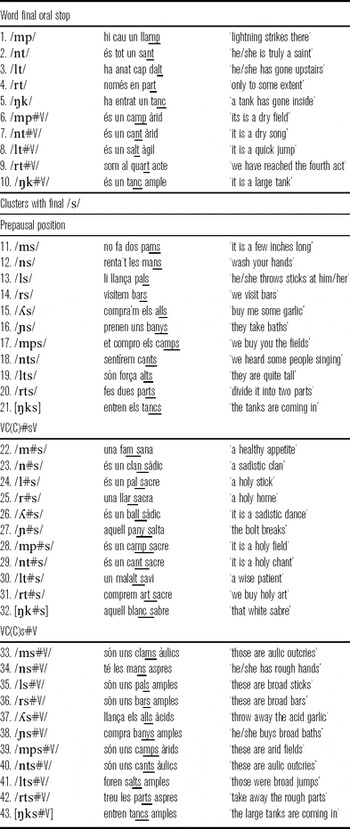
Forty-three sentences (see Table 1) were designed in order to analyze the phonetic differences between underlying and epenthetic oral stops, as well as among oral stops within each cluster class. The former research topic will be explored for the pairs /mps/–/ms/, /nts/–/ns/, /lts/–/ls/ and /rts/–/rs/ in prepausal position (see sentences 11–14 and 17–20 in Table 1), and in the sequences /VC(C)#sV/ (sentences 22–25 and 28–31) and /VC(C)s#V/ (sentences 33–36 and 39–42). The second topic will be investigated for the same clusters, and also for [ŋks] (sentences 21, 32, 43) and for /ʎs, ɲs/ (sentences 15, 16, 26, 27, 37, 38). Moreover, in order to ensure that our Valencian speakers realized the underlying stop with a well-defined closing phase and a burst in word final clusters without /s/, sentences 1–10 where the clusters /mp, nt, lt, rt/ and [ŋk] appear prepausally and prevocalically were also appended to the reading list. All sentences in Table 1 were four or five syllables long and had the stressed vowel /a/ next to the target cluster.
Recording list with sentences in Catalan orthography and English glosses. The consonant clusters under analysis appear underlined.

Eight Valencian speakers of 25–35 years of age who speak Valencian Catalan in their everyday life read all sentences seven times each at a normal speech rate. Subjects include five women (AI, IS, MA, LA, LI) and three men (EL, JO, RI), born and living in the Valencian region. Speakers differ regarding whether they produce the voicing distinction in fricatives and affricates (subjects AI, IS, MA, EL and RI, who speak Northern or Southern Valencian) or they do not (subjects JO, LA and LI, who speak the Central Valencian dialect). Recordings were carried out in a quiet room at the University of Valencia using a laptop with a 24-bit external Sound Blaster card and an AKG D70 microphone. Four sequences could not be analyzed for all speakers, namely /ʎs/ and /ʎs#V/ for MA and LI, and /ʎ#s/ for MA, LI and JO, because /ʎ/ was realized as [j] in this case, and /ɲ#s/ for LI since now the alveolopalatal nasal was pronounced as [jn].
2.2 Data analysis
2.2.1 Measurement criteria
Duration measurements were taken from spectrographic displays. Regarding the word final clusters without /s/, we checked whether or not the oral stop was present in prepausal position based on the presence or absence of a vertical spike at closure offset. The duration of the oral stop burst was measured from the burst spike until the end of the burst frication noise both prepausally and prevocalically. Whenever the burst exhibited a double spike, as for velar stops, burst onset was taken to occur at a location intermediate between the two spikes if they were close to each other or else at the second spike if they were relatively far apart.
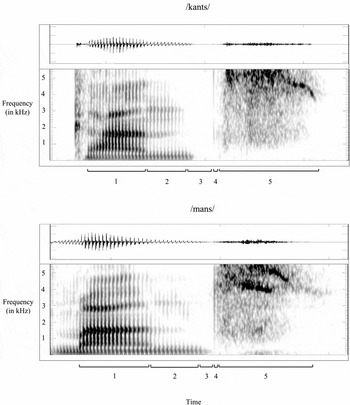
As for clusters with /s/ such as those displayed in Figure 1, the following segmentation criteria were applied visually to each of several segmental events after listening to the relevant portions of the acoustic signal by increasing the amplitude values in a range of sampled data if necessary. Events which were judged hard to identify were checked more than once, as for example the boundary between a nasal stop and the following underlying or epenthetic oral stop.
(1) V was taken to extend from the onset of a voiced period exhibiting formant excitation to the end of the vowel transitions which coincided with an intensity discontinuity before a nasal or a lateral and the onset of a short closing phase before a rhotic.
(2) A nasal C1 was measured from the beginning to the end of a wide-band first oronasal formant at about 250–350 Hz and of higher low-intensity oronasal and nasal formants (Raphael et al. Reference Raphael, Dorman, Freeman and Tobin1975). The nasal consonant was not considered to end at voicing offset since voicing could extend into the oral closing phase. The first oronasal formant was distinguishable from the voicing bar in exhibiting a wider bandwidth and a low amplitude level. A lateral C1 was defined by a voiced period exhibiting a relatively low intensity formant structure, and its onset was taken to occur at the endpoint of the preceding vowel transitions. The rhotic in the clusters /rts, rs/ was realized most often with a closing phase followed by a higher amplitude opening phase and, less often, through a closing–opening–closing–opening period. While the opening phases were always voiced, the closing ones could be voiced or voiceless depending on speaker and position (e.g. contact devoicing occurred more often prepausally than utterance medially). Speaker LI presented an approximant realization of the rhotic as a general rule.
(3) For both the underlying and inserted oral stops, the oral stop closure was characterized as a period with no acoustic energy above the voicing bar starting at C1 offset and ending at the stop burst or at /s/ frication onset whenever the burst was not visible on the spectrographic displays. In clusters with a lateral or rhotic C1, a closing period was considered to occur even if it exhibited a weak, low amplitude frication noise at about 3000–4000 Hz immediately before the high amplitude patch of noise for /s/ provided that it showed no formant structure and was followed by a burst. It was hypothesized that there could be some turbulent airflow exiting laterally at the rear of the oral cavity during the closure period of the stop in these circumstances.
(4) Whenever present, the stop burst was characterized by the presence of a weaker or stronger spike, and its duration was measured from the spike until the onset of the /s/ frication noise. No burst energy measures were taken since bursts were often less than 15 ms long and thus, too short to be confident that the energy contour would not encompass a portion of the /s/ frication noise.
(5) The fricative /s/ was taken to occur from onset to offset of a high amplitude patch of noise appearing above 4000 Hz.
Waveform and spectrogram for the sequences /kants/ ‘chants’ (top) and /mans/ ‘hand, pl.’ (bottom) produced by the Valencian speaker IS. The following segmental events have been identified on the spectrographic displays: (1) vowel; (2) C1 nasal murmur, (3) oral stop closure; (4) oral stop burst; (5) /s/ frication period.

Several other measurements relating to the oral stop segment were carried out and will be presented as percentages in the ‘Results’ section: first, whether the closing period was completely absent, or else longer or shorter than 10 ms, which is the perceptibility threshold for epenthetic stops established by Fourakis & Port (Reference Fourakis and Port1986); second, the frequency of occurrence of a burst at closure offset; third, whether the stop closure was voiced, voiceless or partly voiced as determined from visual inspection of the voicing bar on the spectrographic displays. These voicing data should be treated with caution since the presence of a weak voicing bar may reflect the presence, not of well-defined glottal pulses, but of quasi-periodic low amplitude glottal oscillations during which the folds make contact, presumably at the anterior part of the glottis (Mazaudon & Michaud Reference Mazaudon and Michaud2008). Moreover, the degree of variability in oral stop closure duration was estimated from the standard deviation values around the mean across repetitions of each cluster and as a function of position.
The presence of voicing during the alveolar fricative /s/ was also identified on the spectrographic displays, and the extent to which /r, ʎ, ɲ/ were followed by [s], [ts], [ʃ] or [tʃ] was evaluated both visually and auditorily. In agreement with previous descriptive data (see Section 1.1 above), word final /s/ was found to undergo palatalization or palatalization and affrication after /ʎ/ ([ʎʃ] in all positions, [ʎtʃ] word finally whether before a pause or a vowel) and after /ɲ/ ([ɲtʃ] in all positions though more systematically word finally than across a word boundary), and palatalization in the case of the cluster /rts/ ([rtʃ] word finally, most frequently in the case of the Central Valencian speakers JO, LA and LI). As expected, the fricative was voiceless prepausally and word initially in the /VC(C)#sV/ sequences; as for the /VC(C)s#V/ sequences, /s/ was voiceless for the three subjects speaking the Central Valencian dialect (JO, LA, LI), and voiced for the remaining speakers who, nevertheless, could exhibit a fully or partially voiceless realization of the fricative in the case of the postconsonantal endings [ts] and [tʃ].
2.2.2 Statistical analysis
Two main sets of ANOVAs were performed. On the one hand, repeated measures ANOVAs (RM ANOVAs) were carried out separately for clusters with an underlying stop and for those without it in order to elicit the effect of cluster and position on stop closure duration (see Section 3.2.2 below) and on the frequency of occurrence of the stop closure (Section 3.2.1) and of the stop burst (Section 3.2.3), but not on the frequency of occurrence of closure voicing due to the fragmentary nature of the data; data for /ʎs/ could not be included in the data set since, as pointed out in Section 2.1 above, the lateral was realized as [j] by three speakers. In order to elicit the speaker-dependent trends, parallel two-way univariate ANOVAs were performed for each speaker's data using closure duration as dependent variable with inclusion of the tokens for /ʎs/ whenever available (Section 3.2.2).
On the other hand, significant differences between underlying and epenthetic stops were ascertained statistically by means of repeated measures ANOVAs performed separately for the cluster pairs /mps/–/ms/, /nts/–/ns/, /lts/–/ls/ and /rts/–/rs/ with ‘presence’/‘absence’ of the oral stop and ‘position’ as independent variables; separate statistical tests were carried out on the duration values for the oral stop closure (Section 3.2.2), on the frequency of occurrence of the stop closure and burst (Sections 3.2.1 and 3.2.3), and on the duration of V, C1, /s/ and the /VC(C)s/ string (Section 3.2.5). Two-way univariate ANOVAs were also performed on the segmental duration data for each speaker (Sections 3.2.2 and 3.2.5).
In the repeated measures ANOVAs, each speaker contributed one averaged score per condition, and Huynh–Feldt corrected degrees of freedom were applied to the main effects in order to account for violations of the sphericity assumption. As for the univariate ANOVAs, data for all cluster repetitions were entered on the SPSS data sheet. The significant interactions were interpreted on the basis of results obtained from one-way repeated measures or univariate ANOVAs performed on each level of a significant factor. In all statistical tests, Bonferroni post-hoc tests were applied to the main effects and the degree of significance was set at p < .05.
2.3 Perception
In order to evaluate possible differences in perceptual salience between the underlying and epenthetic stops, we noted down for each cluster production whether or not the oral stop was audible after listening to it several times. Correlation analyses were performed between the stop identification percentages and stop closure duration values as a function of cluster, cluster type (i.e. clusters with underlying vs. epenthetic stops) and position.
The perceptibility level for the underlying stop in clusters with final /s/ was also verified through the administration of two perception tests. A portion of the speech signal containing the vowel and the cluster was excised from three tokens of the sequences /nts/, /ns/, /lts/ and /ls/ produced by those speakers (IS and MA) who showed significant differences in oral stop closure duration between the members of all four cluster pairs /mps/–/ms/, /nts/–/ns, /lts/–/ls/ and /rts/–/rs/. Those tokens were selected such that they exhibited the longest underlying stop closure values and the shortest epenthetic stop closure values of all tokens, and their intensity levels were evened out. The perception tests also allowed us to ascertain the extent to which Valencian Catalan epenthetic stops are perceptible or not since the closing phase for the /ns, ls/ sequences had variable durations, i.e. 0–2 ms (two stimuli), 9–12 ms (four stimuli) and 16–23 ms (six stimuli). The stop bursts for the sequences of interest were absent or short (4–7 ms). Five repetitions of all 24 signal portions (2 speakers × 4 clusters × 3 tokens) were randomized and presented for identification in a perception test for the pair /nts/–/ns/ and in a second test for /lts/–/ls/ using PowerPoint on a laptop with a high-quality sound card. Each test contained 60 stimuli grouped in six blocks of ten stimuli, and had a three-second silence between successive stimuli within each block and a six-second silence between blocks of ten stimuli.
Fifteen Eastern Catalan speakers took the two tests in a quiet classroom. Eastern Catalan rather than Valencian Catalan informants were selected for the identification task because it is easier to recruit Catalan speakers who are little influenced by the Spanish language from the Barcelona area (where Eastern Catalan is spoken) than from the Valencia area (where Valencian Catalan is spoken). Even though the underlying/epenthetic stop distinction is not contrastive in Eastern Catalan, speakers of this dialect are used to listening to Valencian Catalan and, therefore, should be sensitive to the presence or absence of an underlying oral stop in the word final clusters under analysis. The informants were told that the stimuli were part of the meaningful Catalan words cants [kants] ‘songs’, mans [mans] ‘hands’, alts [alts] ‘tall, pl.’ and pals [pals] ‘sticks’ uttered by Valencian speakers, and were asked to indicate whether they heard a dental oral stop [t] or not by writing T or Ø on an answer sheet, respectively.
3 Results
3.1 Clusters without /s/
The presence of stop bursts was checked in order to verify that a stop consonant was produced in the clusters /mp, nt, lt, rt/ and [ŋk]. Data show that the stop was indeed present in all clusters both prepausally and prevocalically, except for /mp, nt/ for speaker AI. A one-way RM ANOVA run on the burst duration values for the clusters of interest yielded a main effect of the two independent variables ‘cluster’ and ‘position’ (F(3.26, 19.61) = 11.56, p < .001; F(1,6) = 10.97, p = .016). Bursts were significantly longer prepausally than prevocalically, their durations across clusters and speakers ranging between 31.8 ms and 50.1 ms in the former position and between 13.9 ms and 26.6 ms in the latter. They turned out to be also longer for the velar cluster [ŋk] than for the labial clusters /mp/ and the dental clusters /nt, lt/ at the p = .04, p = .002 and p = .009 level of significance, respectively. In prepausal position, the stop burst was longer for [ŋk] (50.1 ms, sd = 15.68) than for the other consonant sequences /mp/ (37.2 ms, sd = 19.29), /nt/ (34.4 ms, sd = 17.77), /lt/ (33.2 ms, sd = 15.36) and /rt/ (31.8 ms, sd = 18.92).
3.2 Clusters with /s/
3.2.1 Frequency of occurrence of the oral stop closure
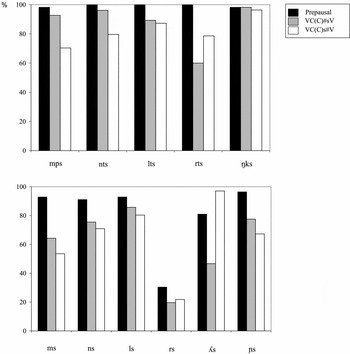
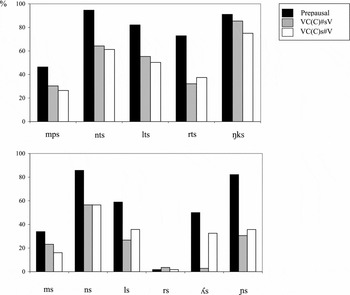
Statistical results for the frequency of occurrence of the stop closure in clusters with an underlying stop yielded a significant effect of ‘cluster’ (F(4, 28) = 2.86, p = .042) which was associated with no specific cluster pair. Figure 2 (top graph) reveals in any case lower percentages for /mps, nts, lts/ than for [ŋks] utterance medially, and above all for /rts/ than for the remaining clusters due to the fact that the stop closure for this sequence was frequently absent for three speakers in the string /Vrt#sV/ and for two other ones in the string /Vrts#V/. There was also a significant effect of ‘position’ (F(1.6, 11.64) = 4.19, p = .048), which was related to higher stop percentages prepausally than utterance medially in the sequence /VCCs#V/ (p = .05). In addition to this effect, bars in Figure 2 show a trend for the stop to occur more often in the /VCC#sV/ vs. /VCCs#V/ sequences as a general rule and the reverse for /rts/, which is in disagreement and in agreement with our initial hypothesis, respectively. Overall, percentages of occurrence are about 90–100% prepausally and 60–95% utterance internally.
Frequency of occurrence of the oral stop closure in clusters with an underlying stop (top) and in those without it (bottom) as a function of position. Closure events were only taken into consideration when 10 ms long or longer.

Data for the clusters without an underlying stop (Figure 2, bottom graph) reveal lower stop insertion percentages for /rs/ than for the other consonant sequences (F(3.5, 21.2) = 13.49, p < .001). Indeed, the closing phase for the cluster /rs/ was often absent (35–50% of the time) or measured less than 10 ms (25–45%). Consistently with an initial prediction, there also appears to be a (non-significant) trend for the stop closure to occur in the homorganic clusters /ns, ls, ɲs/ rather than in the heterorganic sequence /ms/. Stop insertions took place more frequently prepausally than utterance medially (F(1.3, 8.1) = 10.34, p = .009), and in the /VC#sV/ vs. /VCs#V/ sequences except for the cluster /ʎs/ which exhibited the opposite relationship (/VCs#V/ > /VC#sV/).
A comparison between the frequency of occurrence of the stop closure for the two members of each of the four cluster pairs /mps/–/ms/, /nts/–/ns/, /lts/–/ls/ and /rts/–/rs/ reveals that, as expected, the closing phase occurs more frequently if associated with an underlying stop than with an epenthetic stop. This difference holds in all three positions and achieved significance for the pair /rts/–/rs/ (F(1, 7) = 52.09, p < .001) but not for /mps/–/ms/, /nts/–/ns/ and /lts/–/ls/.
3.2.2 Oral stop closure duration
While ‘cluster’ and ‘position’ were included as independent variables in the same ANOVAs run on the cross-speaker and individual speakers' closure duration data, results for the two factors will be presented separately for the sake of clarity.
3.2.2.1 Cluster effect
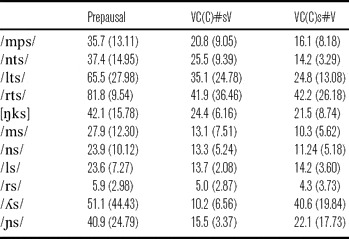
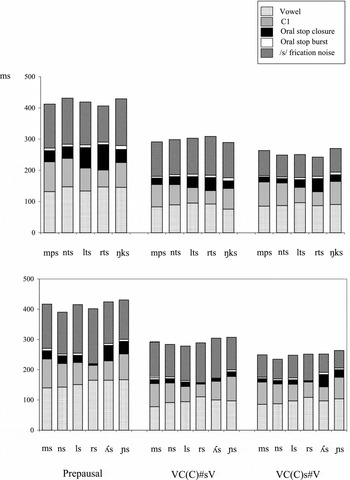
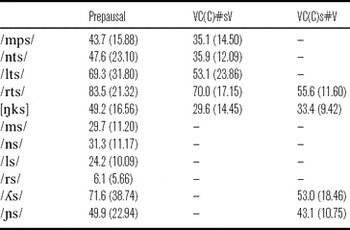
The two-way RM ANOVA carried out on the cross-speaker closure duration data for the underlying stop in the clusters /mps, nts, lts, rts/ and [ŋks] yielded a main effect of ‘cluster’ (F(2.92, 20.31) = 19.52, p < .001), which was associated with a longer closure for /rts/ than for /mps, nts/ and [ŋks] (p < .001, p = .002, p = .001). As shown in Table 2 and in Figure 3 (upper graph), closure duration values are indeed highest for /rts/ (they range between 41.9 ms and 81.8 ms), intermediate for /lts/ (24.8–65.5 ms), and lowest for /mps, nts/ and [ŋks] (16.1–35.7 ms, 14.2–37.4 ms, 21.5–42 ms), and this hierarchy holds in all three positions. All individual speakers exhibited essentially these same significant cluster-dependent differences.
Cross-speaker mean oral stop closure duration and standard deviation values (within parentheses) for all clusters as a function of position.

Cross-speaker mean duration values for the segmental elements of the /VC(C)s/ sequences under analysis. Data are plotted for the clusters with and without an underlying stop (top and bottom, respectively) as a function of position, and include events which were 0 ms long.

The cross-speaker closure duration data for the epenthetic stop in the clusters /ms, ns, ls, rs, ɲs/ also yielded a main effect of ‘cluster’ (F(1.78, 10.72) = 8.23, p = .008) which, according to the post-hoc tests, was related to a longer oral stop closure for /ms, ns, ls/ than for /rs/ (p = .021, p = .013, p = .002) and thus proceeded approximately the opposite of differences for underlying stops. Mean closure durations ranges are 10.3–27.9 ms, 11.2–23.9 ms and 13.7–23.6 ms for the three former clusters, and just 4.3–5.9 ms for the latter (see Table 2 and Figure 3, bottom graph). The oral stop closure may be longer for /ɲs/ than that for the four clusters just mentioned (15.5–40.9 ms) perhaps in line with the kinematic and contact characteristics of the articulator involved in the production of the alveolopalatal vs. the other consonants (Section 1.3), but did not differ significantly from them, presumably because its duration was more variable at least as a function of position. On the other hand, the closure duration values for the cluster /ʎs/, which could not be entered in the RM ANOVA (see Section 2.2.2 above), are comparable to those for /ɲs/ and may be even higher (10.2–51.1 ms). In agreement with the results for the cross-speaker dependent data, ANOVAs run on the individual speakers' data yielded a main ‘cluster’ effect which was associated with a maximal oral stop closure duration for clusters with an alveolopalatal C1 and a minimal closure duration for /rs/ in the case of six out of the eight subjects.
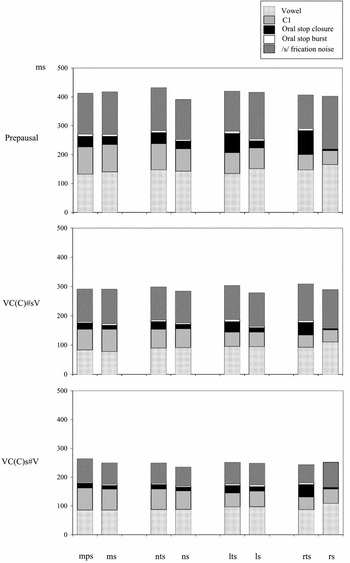
The RM ANOVAs performed on each of the cluster pairs /mps/–/ms/, /nts/–/ns/, /lts/–/ls/ and /rts/–/rs/ yielded significant cluster-dependent closure duration differences for /lts/–/ls/ and /rts/–/rs/ (F(1, 7) = 11.53, p = .011; F(1, 7) = 79.42, p < .001) but not for the two nasal cluster pairs. As revealed by Table 2 and Figure 4, even though differences in oral stop closure duration did not achieve significance for /mps/–/ms/ and /nts/–/ns/, the closure period for the underlying stop was also longer than that for the epenthetic stop for the latter pair and, to a lesser extent, for the former pair as well. All speakers exhibited a significantly longer oral stop closure for /lts/ than for /ls/ (except for speaker LA) and for /rts/ than for /rs/. As for the clusters with a nasal C1, the stop closure was significantly longer for /mps/ vs. /ms/, and for /nts/ vs. /ns/ in the case of speakers IS (F(1, 36) = 25.82, p < .001; F(1, 35) = 24.77, p < .001) and MA (F(1, 36) = 90.62, p < .001; F(1, 36) = 92.91, p < .001), and for /mps/ vs. /ms/ but not for /nts/ vs. /ns/ in the case of speakers JO and LI (F(1, 36) = 7.56, p = .009; F(1, 34) = 9.84, p = .004). Speakers AI, EL, LA and RI exhibited no closure duration differences between the underlying and epenthetic stops for any of the two cluster pairs with a nasal C1.
Cross-speaker mean duration values for the segmental elements of the /VC(C)s/ sequences under analysis. Data are plotted for pairs of clusters with and without an underlying stop as a function of position.

In disagreement with our previous expectations (see Section 1.4 above), standard deviation values in Table 2 show more variable oral stop closure durations for the underlying than for the epenthetic stops in the case of all cluster pairs /mps/–/ms/, /nts/–/ns/, /lts/–/ls/ and /rts/–/rs/. Moreover, this difference in degree of variability is largest for those pairs /lts/–/ls/ and /rts/–/rs/ exhibiting the largest closure duration difference between underlying /t/ and epenthetic [t].
3.2.2.2 Position effect
Position was significant according to results obtained from the ANOVAs run on the cross-speaker data for the clusters with an underlying stop (F(1.34, 9.41) = 26.98, p < .001), the clusters without an underlying stop (F(1.02, 6.14) = 26.91, p = .002), and each of the four clusters pairs /mps/–/ms/ (F(1.87, 13.14) = 21.98, p < .001), /nts/–/ns/ (F(1.47, 12.36) = 30.94, p < .001), /lts/–/ls/ (F(2, 14) = 16.19, p < .001) and /rts/–/rs/ (F(1.31, 9.19) = 6.13, p = .029). As revealed by Table 2 and Figures 3 and 4, this ‘position’ effect was associated with significantly longer closures prepausally than utterance medially generally at the p = .01 level of significance or less. A two-factor interaction for the pairs /lts/–/ls/ and /rts/–/rs/ (F(1.97, 13.82) = 7.51, p = .006; F(1.32, 9.29) = 5.81, p = .032) turned out to be associated with larger closure duration differences between underlying and epenthetic stops prepausally than non-prepausally. As for the statistical tests run on the data for each individual speaker, out of 64 possible cases, i.e. 2 comparisons × 4 cluster pairs × 8 speakers, closures were significantly longer prepausally than in the other two positions in 56 cases.
In contrast with our initial prediction (Section 1.5), the statistical results indicate a trend for the oral stop closure to be longer in the /VC(C)#sV/ sequences than in the /VC(C)s#V/ sequences (this duration effect reached significance for the pair /nts/–/ns/ according to the RM ANOVAs and 13 times out of 64 according to the statistical results for the individual speakers' data). This position-dependent difference did not apply to several clusters (in the case of the clusters without an underlying stop this exceptional behaviour was supported by a significant ‘cluster’ × ‘position’ interaction; F(4.36, 26.15) = 3.66, p = .015): /rs/, which was always produced with an extremely short, practically absent, oral stop element; /rts/, which exhibited similar closure durations in both /VCC#sV/ and /VCCs#V/ sequences (see Table 2); /ɲs/ (also /ʎs/ according to the individual speakers' data), which showed a longer closure in the /VCs#V/ vs. /VC#sV/ sequences.
3.2.3 Oral stop burst
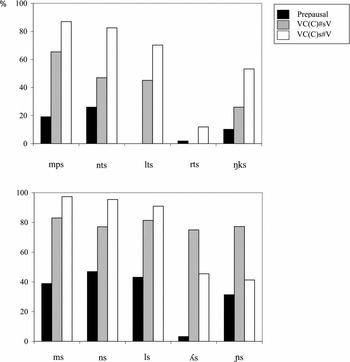
Returning to the question of how stops differ among specific consonant clusters, the consonant sequences with an underlying stop /mps, nts, lts, rts/ and [ŋks] were found to differ significantly regarding the frequency of occurrence of the oral stop burst (F(2.71, 18.97) = 8.08, p = .001). Pairwise comparisons yielded significant differences for /nts/ > /mps, rts/ (p = .044, p = .025) and for [ŋks] > /rts/ (p = .004). According to the mean values presented in Figure 5 (top graph), the stop burst does indeed occur more often for /nts/ and [ŋks] than for /mps/ and /rts/ and also /lts/. As for the clusters without an underlying stop /ms, ns, ls, rs, ɲs/, there was a significant effect of ‘cluster’ (F(4, 24) = 8.23, p < .001), which was associated with a more frequent burst for /ns/ than for /ms, rs/ (p = .044, p = .003) and for /ɲs/ than for /rs/ (p = .022). Bars in Figure 5 (bottom graph) indicate that the stop burst occurs most frequently for /ns/ in all positions and for /ɲs/ word finally, it shows up more often for clusters with a nasal than in those with a lateral of the same place of articulation (i.e. for /ns/ than for /ls/ and for /ɲs/ than for /ʎs/), shows low frequency of occurrence percentages for /ms/, and is practically absent for /rs/.
Frequency of occurrence of the stop burst in clusters with an underlying stop (top) and in those without it (bottom) as a function of position.

In parallel to the stop closure duration data, bursts occurred significantly more often in clusters with an underlying stop than in those without it for the pairs /lts/–/ls/ (F(1, 7) = 14.37, p = .007) and /rts/–/rs/ (F(1, 7) = 56.45, p < .001). No significant difference regarding the frequency of occurrence of the stop burst was found to hold for the pairs /mps/–/ms/ and /nts/–/ns/ though the mean data across speakers presented in Figure 5 (as well as the data for several individual speakers) reveal that a burst occurs more often for the underlying stop than for the epenthetic stop in this case as well.
Underlying and epenthetic stop clusters exhibited a main effect of position (F(1.62, 11.36) = 8.58, p = .007; F(1.50, 9.01) = 15.32, p = .002) which was related to a more frequent burst prepausally than in the /VCC#sV/ sequence for the underlying stops (p = .012), and prepausally than utterance internally for the epenthetic stops (p = .005, p = .001) and for the cluster pairs /nts/–/ns/ and /lts/–/ls/. Moreover, a significant two-factor interaction (F(2, 14) = 5.48, p = .017) was obtained for the pair /rts/–/rs/ according to which there were position–dependent differences in the frequency of occurrence of the stop burst for /rts/ but not /rs/ (there was practically no burst for /rs/ in any of the three position under study).
Stop bursts were relatively short, their mean duration values as a function of cluster ranging between 4 ms and 12.1 ms (see Figure 3). Moreover, the stop burst was slightly longer for [ŋks] than for the other clusters, for the underlying stops (8.9 ms, 7.3 ms, 6.2 ms in the prepausal, /VC(C)#sV/ and /VC(C)s#V/ positions, respectively) than for the epenthetic stops (6.7 ms, 5.7 ms, 5.8 ms), and prepausally than utterance medially.
3.2.4 Voicing
As shown in Figure 6, full voicing during the oral stop closure period is affected by the segmental composition of the cluster. (Data for /rs/ have not been included in the figure since the epenthetic stop is often absent in this cluster; see Section 3.2.1 above). Within each cluster type and consistently with data from the literature (see Section 1.4 above), complete closure voicing occurs more frequently in clusters with a labial or dentialveolar consonant than in those with a more retracted alveolopalatal or velar consonant, i.e. for /mps, nts, lts/ than for [ŋks] (top graph) and for /ms, ns, ls/ than for /ʎs, ɲs/ (bottom graph). Moreover, closure is practically always voiceless for /rts/ and, also in agreement with our initial predictions, there appears to be a trend for voicing to occur in clusters with a nasal C1 rather than in those with a non-nasal C1 at least in prepausal position. According to Figure 6, voicing is more prone to pervade the oral stop when epenthetic (bottom graph) than when underlying (top graph) in the case of the cluster pairs /mps/–/ms/, /nts/–/ns/ and /lts/–/ls/, which is in line with the stop being shorter in the former condition than in the latter (Section 1.4).
Frequency of occurrence of complete voicing during the oral stop closure for clusters with an underlying stop (top) and for those without it (bottom) as a function of position.

As referred to in the Introduction, previous studies have pointed out that the closing phase for the emergent stop is regularly voiceless, at least prepausally and when followed by a phonetically voiceless consonant. In order to find out whether closure duration varied with the amount of voicing during the closing phase, the duration values for the stop closure tokens showing no voicing are presented in Table 3 for all clusters under analysis (only data for clusters exhibiting a voiceless stop closure in ten or more tokens are shown). A comparison between these values and those presented in Table 2 indicate that closures are longer when voiceless than voiced for all clusters (Section 1.4), and that differences in duration between the two closure conditions may reach 20–30 ms in the case of those sequences exhibiting a considerably long stop, i.e. for /lts/ and /rts/ and for the clusters with an alveolopalatal C1 /ʎs/ and /ɲs/.
Cross-speaker mean oral stop closure duration and standard deviation values (within parentheses) for fully voiceless realizations of the clusters under study as a function of position. Data have been plotted for clusters for which at least ten tokens were available.

As for the previous measures and as shown in Figure 6, oral stop closure voicing occurs less often prepausally than phrase medially, and in the /VC(C)#sV/ sequences (where word initial /s/ always exhibits a voiceless realization) than in the /VC(C)s#V/ sequences (where /s/ is generally voiced for the subjects not speaking the Central Valencian dialect). Clusters with the alveolopalatals /ʎ/ and /ɲ/ show, however, more frequent closure voicing in the /VC(C)#sV/ vs. /VC(C)s#V/ sequences undoubtedly since, analogously to /rts/, homolexical /ʎs, ɲs/ could be realized as [ʎtʃ, ɲtʃ] and affricates may fail to exhibit voicing to a larger extent than fricatives (see Section 2.2.1 above).
3.2.5 Other segmental events
The contribution of other events, i.e. V, C1, /s/ and overall /VC(C)s/ string, to the underlying/epenthetic stop distinction is generally weak. As stated in the Introduction, the expected trend is for V, C1 and /s/, and perhaps for the /VC(C)s/ string, to compensate for oral stop duration such that those phonetic segments ought to be longer in clusters without an underlying stop than in those with it. In agreement with this hypothesis and as shown in Figure 4, the vowel and the /s/ frication noise were found to be significantly longer for /rs/ than for /rts/ across speakers (F(1, 7) = 28.58, p = .001; F(1, 7) = 27.4, p = .001) and for all individual speakers, and /s/ was also significantly longer for /ls/ than for /lts/ across speakers (F(1, 7) = 6.22, p = .041) and for two out of the eight speakers. However, contrary to the initial hypothesis, C1 and the /VC(C)s/ string turned out to be longer for /nts/ than for /ns/ across speakers (F(1, 7) = 24.57, p = .002; F(1, 7) = 11.10, p = .013) and for four out of the eight individual subjects, and data for the pair /mps/–/ms/ yielded no significant effects for either V, C1, /s/ or /VC(C)s/.
All four segmental events exhibited a significant effect of ‘position’ for all four cluster pairs at the p < .001, p = .001 and p = .002 level of significance with only one exception, namely, C1 duration for the /rts/–/rs/ pair. This effect of position was associated with a longer vowel and a longer C1 prepausally than non-prepausally, and with the duration of the /VC(C)s/ string and, to a lesser extent, of /s/ decreasing in the progression prepausally > /VC(C)#sV/ > /VC(C)s#V/. Moreover, differences in C1 and /VC(C)s/ duration between /nts/ and /ns/, and in /s/ duration between /rts/ and /rs/ and between /lts/ and /ls/, turned out to be significantly larger prepausally than non-prepausally.
3.2.6 Summary
Underlying stops turned out to occur more often and were more variable than epenthetic stops, which also occurred fairly often. The underlying/non-underlying stop distinction has been found to be cued by frequency of occurrence and duration of the stop closure and the stop burst, and to some extent by the duration of the preceding vowel and of following /s/, in the case of clusters with C1 = /l, r/. As for clusters with a nasal C1, the underlying/epenthetic stop contrast is less obvious, i.e. it is signalled at least by closure duration for a subset of speakers, and for /mps/–/ms/ rather than for /nts/–/ns/. For both nasal clusters and also for the pair /lts/–/ls/, the underlying/non–underlying stop distinction appears also to be favored by voicing which pervades the oral stop closure more often when the stop is epenthetic than when it is underlying.
Differences in stop prominence were found among clusters within each cluster group. Clusters with an underlying stop show differences mainly in oral stop closure duration for /rts/ > /lts/ > /mps, nts/, [ŋks] (though the stop may be absent for /rts/ utterance medially), in frequency of occurrence of the stop burst for /nts/, [ŋks] > /lts/ > /mps, rts/, and in burst duration for [ŋks] vs. the other consonant sequences. As for clusters with an epenthetic stop, oral closure duration decreases in the progression /ʎs, ɲs/ > /ms, ns, ls/ > /rs/ as a general rule, the closing period is frequently absent for /rs/, and the frequency of occurrence of the stop burst varies in the progression /ɲs, ns/ > /ls, ʎs/ > /ms/ > /rs/. Voicing is present during the oral stop closure most often when the stop is non-dorsal, and is preceded by a nasal consonant or /l/; moreover, the cluster /rts/ shows practically no voicing during the stop, and the closing phase is longer for voiceless stop closures than for fully or partially voiced ones.
Judging from the duration and the frequency of occurrence of the closure period and the frequency of occurrence of the burst, the oral stop element happens to be more prominent in prepausal vs. non-prepausal position with the exception of /rs/ for which the closing phase and the burst were practically absent. The stop is also more prominent in the /VC(C)#sV/ vs. /VC(C)s#V/ sequences with the exception of /rts/ which exhibits no difference in closure duration between the two sequences, and of the alveolopalatal clusters /ʎs, ɲs/ for which the epenthetic stop closure turned out to be longer in the /VCs#V/ string than in the /VC#sV/ one. On the other hand, stop closure voicing into closure was found to occur least often prepausally and most frequently in the sequence /VC(C)s#V/, except for /rts, ʎs, ɲs/ which may be realized as [rtʃ, ʎtʃ, ɲtʃ] and often exhibit a voiceless closure in this contextual condition.
3.3 Perception
3.3.1 Author's auditory impression
The duration of the oral stop closure was highly correlated with the frequency of occurrence of the stop as determined auditorily by the present author for clusters with an underlying stop but not for those without it. Correlation values for /mps, nts, lts, rts/ and for /ms, ns, ls, rs/ across speakers and positional conditions ranged between 0.67 and 0.82 for underlying stops and between 0.33 and 0.50 for epenthetic stops. Data for the author's auditory impression of the individual clusters reveal that the underlying stop is perceived less satisfactorily in the case of /mps/ (about 40%) than of /nts, lts, rts/ and [ŋks] (usually above 50%), and that the epenthetic stop is identified much more often for the sequences with an alveolopalatal /ʎs, ɲs/ (50–90%) than for /ns/ (about 20%) and /ms, ls, rs/ (essentially below 10%). Moreover, identification percentages are higher prepausally than utterance medially for clusters with an underlying stop, for the /VCC#sV/ vs. /VCCs#V/ sequence condition in the case of /nts, lts/, and for the /VC(C)s#V/ vs. /VC(C)#sV/ sequence condition in the case of /rts, ʎs, ɲs/ and [ŋks].
3.3.2 Perception tests
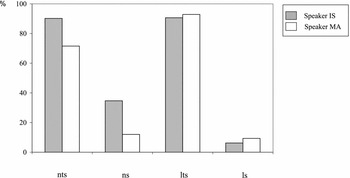
The oral stop identification percentages obtained in the perception test were clearly higher for /nts/ (80.9%) than for /ns/ (23.3%) (χ 2(1) = 143.03, p < .001), and even more so for /lts/ (91.8%) than for /ls/ (7.8%) (χ 2(1) = 318.94, p < .001) (Figure 7). These differences in stop identification were highly correlated with differences in closure duration (r = .88) but not with differences in burst duration (r = .37). A look at the identification percentages for the individual stimuli reveal that practically all cluster tokens with an underlying stop were identified about 80% of the time or higher, and that those percentages were not correlated with either stop closure or burst duration (r = .25, .15). As for the clusters without an underlying stop /ns/ and /ls/, the /ns/ stimuli produced by speaker IS yielded more stop percepts (25–47%) than the /ns/ stimuli produced by speaker MA and the /ls/ stimuli produced by the two speakers (4–20%) (see Figure 7). Percentages of stop identification in this case were unrelated to burst duration but positively correlated with closure duration for /ns/ (r = .81) and, less so, for /ls/ (r = .48). This was so since the epenthetic stop closure was clearly longer in the case of /ns/ for speaker IS (25–47 ms) than of /ns/ for speaker MA and of /ls/ for these two speakers (1–20 ms).
Percentages of oral stop identification for the cluster pairs /nts/–/ns/ and /lts/–/ls/ obtained in the perception tests.

These identification results reveal that Catalan informants are sensitive to the underlying vs. non-underlying stop distinction in the cluster productions under study, and that they may perceive the epenthetic stop successfully in some cases.
4 Discussion
One of the major findings of the present investigation is that phonetic differences between underlying and epenthetic stops hold across Valencian Catalan speakers for clusters with C1 = /l, r/, and for some speakers and much less so or not at all for others in the case of clusters with a nasal C1. Among the acoustic parameters subjected to analysis in this paper, the cues contributing to the underlying vs. epenthetic distinction appear to be frequency of occurrence and duration of stop closure and burst for /lts/–/ls/ and /rts/–/rs/, and mostly closure duration for /mps/–/ms/ and /nts/–/ns/. Another relevant difference was a higher degree of resistance to exhibit voicing during the closure period for underlying vs. epenthetic stops. Some compensatory role of the phonetic segments preceding and following the oral stop may be advocated for non-nasal clusters, i.e. our data show compensatory shortening of the preceding vowel and following /s/ for the pair /rts/–/rs/ and, less so, for /lts/–/ls/.
According to the data gathered from perception tests and the author's auditory impression, the oral stop was successfully perceived when underlying but only about 20% of the time or less when epenthetic, which is in accordance with differences in closure duration between the two stop types, i.e. closure duration was about 15–40 ms for /mps, nts/, 25–65 ms for /lts/ and 40–80 ms for /rts/, and only 10–30 ms for /ms, ns, ls/ and 5 ms for /rs/. In spite of these differences in duration, epenthetic stops occurred very frequently in prepausal position, i.e. about 81–96% except for /rs/. In utterance medial position, however, their closure duration was shorter than 10 ms about 10–30% of the time. There was one major exception, i.e. the alveolopalatal clusters /ɲs/ and /ʎs/, which turned out to show a long and highly perceptible oral stop with a closure period ranging from about 15 ms to about 40–70 ms. In the light of the data reported in the present paper, it may be ascertained that stop epenthesis in Valencian Catalan is not the outcome of a regular, cognitive process, and that the inserted stop may become audible only when especially long in favorable contextual conditions.
The prominence of epenthetic stops is clearly less in Valencian Catalan than in some Germanic languages. Data from the literature reveal that epenthetic stops were present 100% of the time for prepausal /ls, ns/ in American English, while epenthetic [t] was longer and presumably more perceptible than in Valencian Catalan (Fourakis & Port Reference Fourakis and Port1986, Blankenship Reference Blankenship1992; see Section 1 above). As for Dutch, epenthetic stops in the prepausal clusters /ms, ns/ occurred highly often and had a similar closure and burst duration than in Valencian Catalan but were perceived more frequently, i.e. about 50% in non-words (Warner & Weber Reference Warner and Weber2001). These results suggest that the degree to which epenthetic stops are produced and perceived may vary from dialect to dialect (see also data for South African English in the Introduction) and, therefore, that dialects may differ in gestural coordination in consonant sequences in terms of degrees of gestural overlap (Browman & Goldstein Reference Browman, Goldstein, Mattingly and Studdert-Kennedy1991).
The initial hypothesis that epenthetic stops ought to be more variable across tokens than underlying stops was not corroborated by the data. Instead, underlying stops turned out to be more variable than epenthetic stops, at least in clusters with C1 = /l, r/, which is in accordance with the prediction that longer articulatory events (i.e. underlying vs. epenthetic stop closures in this case) should allow for more variability than shorter ones (Ohala Reference Ohala, Fant and Tatham1975).
Differences in the phonetic implementation of an underlying stop in clusters with /s/ may be accounted for in articulatory and aerodynamic terms. Differences in degree of prominence of the oral stop element between nasal and non-nasal clusters may be sought in C1-dependent nasalization causing the oral stop to shorten and even to cease to be perceived (/t/ was also found to be much longer for /lts/ than for /nts/ in American English; Fourakis & Port Reference Fourakis and Port1986). This effect is in agreement with the Eastern Catalan phonological rule by which word final stops are deleted after a homorganic nasal consonant, and suggests that the historical process which gave rise to this rule was the elision of the oral stop in the same word final sequences /mps, nts/ and [ŋks] subjected to analysis in the present study. The extent to which other languages and dialects exhibit similar manner-dependent constraints on oral stop deletion deserves to be investigated. On the other hand, differences in the frequency of occurrence of the stop burst for /nts, ŋks/ > /lts/ > /mps, rts/ may be explained assuming that the prominence of the burst increases with linguopalatal contact area and with intraoral pressure level as back cavity size decreases. Identification data for the present author reveal that the stop is better perceived for /nts/ than for /mps/ perhaps since bursts are more prominent if the stop closure is made with the blade than with the lips and all three consonants in the cluster are homorganic. Taken together, these production and perception data suggest that stop elision in word final clusters with a nasal and /s/ in Eastern Catalan occurred first for /mps/, then for /nts/ and last for [ŋks]. Shorter and more extensively voiced closures in nasal vs. non-nasal clusters can be accounted for assuming that perseverative nasality, i.e. a delay in velar raising, renders the closing period for the oral stop shorter and more prone to acquire voicing. Moreover, in comparison to /mps, nts/, the degree of stop closure voicing was found to be similar for /lts/ and less for the dorsovelar sequence [ŋks] presumably in line with differences in back cavity size, i.e. larger for /lts/ than for [ŋks]. The reason why so little voicing occurs during /rts/ may be related to the fact that voicing is already present during the final opening period of the rhotic, the stop-like nature of the rhotic, and/or the realization of /rts/ as [rtʃ] before a pause or a vowel by the three subjects speaking Central Valencian and, to a lesser extent, by two other speakers as well.
The phonetic implementation of clusters without an underlying stop conforms to similar constraints. A longer oral stop closure for clusters with a laminopredorsal C1 (/ʎs, ɲs/) than for those with a labial or an apicolaminal C1 (/ms, ns, ls, rs/) appears to be related to differences in tongue contact size. A similar rationale could account for why the stop burst occurs more often in sequences with a laminopredorsal or laminal consonant than in those with an apical or a labial one (/ɲs, ns/ > /ls, ʎs/ > /ms/ > /rs/), and a trend for homorganicity favoring the presence of the stop burst in all nasal clusters other than /ms/ could also play a role. According to the author's auditory impressions, perceptual data were consistent with those production data in yielding higher identification percentages for sequences with alveolopalatals and for /ns/ than for /ms, ls, rs/. In parallel to clusters with underlying stops, differences in intraoral pressure may account for why closure voicing is more prone to occur in the clusters /ms, ns, ls/ than in the clusters with a more retracted alveolopalatal /ʎs, ɲs/. Finally, the failure for /rs/ to undergo stop insertion and to exhibit a well–defined burst may be attributed to a weak closure resulting from the antagonistic manner requirements involved in the performance of the tongue tip vibration for a syllable final trill and the generation of audible turbulence for the lingual fricative (Ohala & Solé Reference Ohala, Solé, Fuchs, Toda and Żygis2010, Solé Reference Solé2009). The rise of a transitional stop in words like course, harsh and cars is unlikely in English as well (Mowrey & Pagliuca Reference Mowrey and Pagliuca1995: 96) though possible in Central and Southern Italian (Section 1.3). It is unclear whether the fact that the preconsonantal rhotic is often produced with only a single contact in Valencian may be responsible for the practical absence of stop insertions in the sequence /rs/; judging from the speakers' data referred to in Section 2.1 above, an increase in the number of contacts from one to two and devoicing during the rhotic did not result in a longer closure for the underlying stop in the cluster /rts/ or for the epenthetic stop in the cluster /rs/.
All segmental events subjected to investigation, i.e. the vowel, C1, the oral stop and /s/, turned out to be longer prepausally than phrase internally. As for the two phrase-internal positions, the stop closure could be shorter in the /VC(C)s#V/ vs. /VC(C)#sV/ sequences for most clusters due to the presence of voicing in /s/ and in the preceding stop consonant in the former vs. latter sequence and in disagreement with the alternative prediction that the oral stop closure ought to be more robust when all consonants in the cluster occur word internally than when they do not. The opposite trend was found to hold for clusters with an alveolopalatal C1 in line with the fact that in this case /ts/ was realized as [tʃ] much more often word finally than across a word boundary.
It is hard to ascertain whether the failure for the majority of our speakers to produce a difference between underlying and epenthetic stops in nasal clusters is indicative of a sound change process involving the deletion of the underlying stop at work in present-day Valencian Catalan. This scenario could just correspond to a state of synchronic variation, as suggested by the fact that speakers showing closure duration differences between underlying and epenthetic stops in nasal and non-nasal clusters with /s/ were also the ones exhibiting the longest oral stop burst in clusters without /s/ (IS, LI, MA), and also that two of the three Central Valencian speakers who acted as subjects in our experiment showed a significantly longer stop closure for /mps/ than for /ms/ (JO, LI). There could be then a trend for subjects speaking the Central Valencian dialect, as well as for those producing salient bursts prepausally in clusters without /s/, to keep the underlying stop distinction most faithfully in nasal clusters with /s/.
The production and perception results reported in this paper are interesting in many respects. First, they confirm previous reports that dialects may differ in the frequency of occurrence and prominence of stop epenthesis in consonant clusters. Secondly, they contribute to our knowledge of the phonetic causes of stop elision and insertion in clusters by exploring the place, manner and voicing characteristics involved in the presence or absence of the stop realization. Finally, data show that stop insertion and elision may be conditioned by utterance position and contextual factors.
Further research should deal with those articulatory and aerodynamic factors engendering epenthetic stops and favoring underlying stop elision in consonant clusters. The interpretation of some of the results reported in the present investigation needs to be verified and refined with new aerodynamic and articulatory data, namely, why stop epenthesis is more common in clusters with an alveolopalatal than with a more anterior C1 and is not prone to occur in the sequence /rs/; why stop elision may occur after a nasal rather than after a lateral or a rhotic; how homorganicity between the consonants in the cluster affects the probability that a stop be inserted or deleted, and what are the contextual and positional factors causing the presence or absence of phonetic voicing during the inserted stop.
Acknowledgements
This research was funded by projects FFI2009–09339 of the Ministry of Innovation and Science of Spain and FEDER, and 2009SGR003 of the Generalitat de Catalunya. I would like to thank three anonymous reviewers for their comments, Manel Pérez Saldanya for providing recording space, and the Valencian Catalan speakers for the production experiment.