


In many established democracies, a majority of the population is in favour of more direct democracy, i.e. institutional arrangements that allow citizens to vote on political issues (Bowler et al. Reference Bowler, Donovan and Karp2007; Rose and Weßels Reference Rose and Weßels2021). The institutionalisation and use of direct democracy, however, usually lags behind popular demand (Gherghina et al. Reference Gherghina, Geissel and Henger2024b). While preferences for direct democracy among the population are well-researched, less is known about political elites. Although some studies examine the attitudes of individual politicians (e.g. Bowler et al. Reference Bowler, Donovan and Karp2002, Reference Bowler, Donovan and Karp2006), few focus on political parties, and most concentrate on populist parties (Gherghina and Pilet Reference Gherghina and Pilet2021; but see Engler et al. Reference Engler, Leemann and Schaffner2024). However, parties are crucial, as institutional reform typically requires the commitment of an entire party and, in multiparty systems, the cooperation of several. More fundamentally, direct democracy concerns the allocation of decision-making authority itself and thus directly affects parties’ role as key intermediaries in representative systems. As contemporary democracies increasingly combine representative and direct elements (Gherghina et al. Reference Gherghina, Pilet and Suiter2026), this raises the question of how parties position themselves vis-à-vis reforms that may complement or challenge their role.
This article addresses a key question in the literature on direct democracy – why parties would loosen their monopoly on decision-making by sharing power with citizens (Altman Reference Altman2019; Bowler and Donovan Reference Bowler and Donovan2000) – thereby contributing to a growing literature on party positions on direct democracy, which has so far focused mainly on populist parties. To do so, I theorise and analyse parties’ positions on direct democracy by considering both ideological and instrumental motivations for supporting its expansion. On the one hand, parties should be more or less amenable to increasing popular participation in political decision-making depending on their general ideological outlook – specifically, whether they are on the left or right and whether they are populist. On the other hand, a party’s status in the party system – specifically, whether it is a challenger party and in government or opposition – may lead it to favour or oppose referendums for instrumental reasons.
Empirically, I analyse all election manifestos of German parties represented in the national parliament for national and state parliamentary elections between 1975 and 2017, based on a comprehensive dataset covering multiple parties across sixteen federal states over a period of forty years. Using a custom dictionary, I identified over two thousand sentences containing statements on direct democracy, which I then coded as either supporting, opposing or neutral vis-à-vis an expansion of direct democracy using a large language model (LLM). I find that parties’ statements on direct democracy are predominantly favourable, with most other statements being neutral. Parties that do not support expanding direct democracy avoid addressing the topic, consistent with salience theory (Budge Reference Budge, Robertson, Hearl and Budge1987). Regression analyses of the data provide evidence for both ideological and instrumental motives.
The greatest approval of direct democracy is found in the election manifestos of left-of-centre parties – Die Linke/PDS and the Greens – but also the right-wing populist Alternative for Germany (AfD). These findings align with the left’s emphasis on political equality and broadening participation and populist parties’ focus on popular sovereignty, mirroring findings on popular preferences for direct democracy. Extending these findings, I show that among the underlying dimensions of political conflict, the cultural dimension is more strongly associated with direct democracy than the economic dimension. Moreover, instrumental considerations predict parties’ stances. Challenger parties support direct democracy more than mainstream parties, but do not moderate their positions when going mainstream. Governing parties are less likely to support direct democracy than opposition parties. In particular, Germany’s catch-all parties, the Christian Democratic Union (CDU) and the Social Democratic Party of Germany (SPD), emphasise direct democracy more in opposition than in government.
Although these findings derive from a single case, the theoretical arguments linking parties’ ideologies, challenger versus mainstream status and government versus opposition status to their position on direct democracy are not dependent on a specific political system or culture. Nevertheless, the extent to which these findings travel to other countries may depend on the context of a given country. The empirical analysis suggests that a greater frequency of referendums is associated with greater support from parties. Hence, the importance of ideology and governing status may be reduced in cases of frequent usage, such as in Switzerland. Moreover, the topic of a referendum may also matter. For example, referendums on regional independence, such as in Catalonia, become highly politicised. In such cases, parties’ positions on these issues may be more relevant for explaining their stance on direct democracy than their general ideological outlook. Furthermore, Germany’s parliamentary democracy does not permit testing, all potential determinants. In presidential systems, common in Latin America, referendums are frequently initiated by the president. In such cases, whether a party holds the presidency may be a more reliable predictor of a party’s position on direct democracy than its inclusion in a parliamentary majority.
Nevertheless, this article significantly deepens our understanding of elite preferences for direct democracy by theorising and empirically testing both ideological and instrumental reasons why parties, rather than individual politicians, support it. Whereas prior work has primarily relied on pooled analyses over shorter periods, this article marshals greater causal leverage by exploiting within-party variation over forty years. This approach adds nuance to existing findings, showing that challenger parties continue to emphasise the issue rather than downplaying it after mainstreaming, and that government participation causally affects party positions primarily among centrist catch-all parties. These new empirical insights – not obtainable through studies focused on citizens, individual elites or pooled party-level data – also inform our understanding of party support for democratic reform more broadly, contributing to a literature that moves beyond electoral reform to examine how politicians (Lucas et al. Reference Lucas, Sheffer and Loewen2024) and parties (Engler et al. Reference Engler, Gessler, Abou-chadi and Leemann2023) relate to democratic norms and principles.
Theorising parties’ positions on direct democracy
While there is a considerable body of research on citizens’ preferences regarding direct democracy, less is known about the preferences of political elites.Footnote 1 While Shaun Bowler et al. (Reference Bowler, Donovan and Karp2002) find that right-leaning legislators and candidates in Canada, New Zealand and the US are more supportive of citizen-initiated referendums, a similar survey of MPs and candidates in Australia, Germany, the Netherlands and New Zealand indicates that left-leaning politicians are more favourable to referendums and citizens' initiatives (Bowler et al. Reference Bowler, Donovan and Karp2006). However, Ninio Junius et al. (Reference Junius, Matthieu, Caluwaerts and Erzeel2020) find no linear link between left-right ideology and support for referendums among parliamentarians in fifteen European democracies. Instead, they, as do Sergiu Gherghina et al. (Reference Gherghina, Close and Carman2023), see stronger support for referendums among MPs of both left- and right-wing parties than among centrists.
Existing findings on the instrumental motives of political elites appear more consistent. Members of governing parties and MPs who have been in parliament longer are more sceptical about the expansion of direct democracy than opposition or challenger party MPs (Junius et al. Reference Junius, Matthieu, Caluwaerts and Erzeel2020; Bowler et al. Reference Bowler, Donovan and Karp2002). Sitting MPs are also more sceptical than candidates (Bowler et al. Reference Bowler, Donovan and Karp2006). Candidates who have won elections see less reason to reform the political system.
While these studies provide insights into legislators’ and candidates’ attitudes, individual politicians cannot bring about institutional change. Such reforms require consensus within a ruling party and, in multiparty systems, across parties. Despite the central importance of parties for institutional reforms, few studies have investigated the position of parties on direct democracy. Sarah Engler et al. (Reference Engler, Leemann and Schaffner2024) find that parties’ positions on direct democratic institutions are informed by their ideological stance, with parties on the left of the GAL-TAN dimension being particularly supportive. Taking a narrower focus, Sergiu Gherghina and Jean-Benoit Pilet (Reference Gherghina and Pilet2021) challenge the assumption that populism equates to strong support for referendums, as only half of the populist parties are in favour of referendums. Finally, analysing party press releases from Germany, Austria and Switzerland, Engler et al. (Reference Engler, Gessler, Abou-chadi and Leemann2023) find that parties differ in the democratic principles they emphasise. Left-libertarian parties highlight individual autonomy, while populist radical-right parties demand more popular participation and fewer elements of liberal democracy.
Building on these studies, I formulate a theoretical account of how ideological and instrumental motivations explain variation in parties’ support for direct democracy. As with citizens, a political party’s ideological orientation is key to understanding its stance on direct democracy. The extension of rights, such as voting rights for women historically (Rubio-Marín Reference Rubio-Marín2014) and for underage citizens contemporarily (Leininger and Faas Reference Leininger, Faas, Eichhorn and Bergh2020), is traditionally associated with left-wing parties (Bobbio Reference Bobbio1997). In contrast, conservative parties generally appear more reluctant to support changes of any kind, including institutional reform towards greater citizen participation (see also Bowler et al. Reference Bowler, Donovan and Karp2006). Parties’ stances may also be informed by whether they expect referendums to deliver more left- or right-wing policies. Bowler et al. (Reference Bowler, Donovan and Karp2002) hypothesised that, given that recent referendums in the countries under study furthered conservative policies, right-of-centre politicians would be more favourable. In Germany, however, most state-level referendums have been about traditional left-wing issues, such as the remunicipalisation of energy networks in Hamburg and Berlin. As far as citizens are concerned, those who identify as left-wing show higher approval of direct democracy (e.g. Bengtsson and Mattila Reference Bengtsson and Mattila2009; Donovan and Karp Reference Donovan and Karp2006). However, existing results for individual politicians are inconsistent (Junius et al. Reference Junius, Matthieu, Caluwaerts and Erzeel2020; Bowler et al. Reference Bowler, Donovan and Karp2002, Reference Bowler, Donovan and Karp2006). Against this background, I test the first hypothesis:
Hypothesis 1: Left-of-centre parties are more supportive of direct democracy than right-of-centre parties.
However, direct democracy is commensurate with various differing philosophical traditions (Qvortrup Reference Qvortrup and Qvortrup2013), indicating openness to different political ideologies. It is not surprising then that surveys of citizens (Rose and Weßels Reference Rose and Weßels2021) and politicians (Gherghina et al. Reference Gherghina, Close and Carman2023; Junius et al. Reference Junius, Matthieu, Caluwaerts and Erzeel2020) in several countries show that support for direct democracy is higher at both ends of the political spectrum than in the centre, which provides the second hypothesis:
Hypothesis 2: Given that parties at both ends tend to oppose the establishment, they may therefore view direct democracy as a means of limiting elite power.
These parties are likely aware that their full manifestos do not resonate with the general public, but that individual issues may. Hence, direct democracy offers the potential to put these issues on the agenda. Consistent with these considerations, David Altman (Reference Altman2019: ch. 5) finds that political actors at both ends of the ideological spectrum were more likely to trigger referendums and plebiscites than centrists. Centrist parties, and catch-all parties in particular, participate in government more frequently and in leading roles, and hence have less interest in direct democratic reform. Therefore, I formulate the third hypothesis as follows:
Hypothesis 3: Both left-of-centre and right-of-centre parties approve of direct democracy more than centrist catch-all parties.
Beyond left-right ideology, populism is a thin-centred ideology that combines with both left- and right-wing host ideologies (Mudde Reference Mudde2004). Populist parties of all stripes criticise established political institutions, accusing them of ignoring the will of ‘the people’. By advocating for more direct democracy, populist parties can claim to empower citizens and transfer decision-making from elites to the public. Hence, there appears to be a natural link between populist ideology and direct democracy, leading Cas Mudde (Reference Mudde2007: 152) to claim that ‘virtually all radical right-wing populist parties call for the introduction or increased use of referendums’. As populist parties develop more coherent policy profiles, they can be seen as ‘policy-purposeful parties’ (Charalambous et al. Reference Charalambous, Conti and Pedrazzani2025), which may view referendums as a strategic tool for policy enactment, especially since these parties rarely participate in government.
Prior research shows that MPs and candidates of populist parties are particularly supportive of direct democracy (Bowler et al. Reference Bowler, Denemark, Donovan and McDonnell2017), but parties are less so (Gherghina and Pilet Reference Gherghina and Pilet2021; but see Gherghina et al. Reference Gherghina, Geissel and Henger2024b). While populist parties support direct democracy in principle, they remain vague on details in their manifestos (Gherghina et al. Reference Gherghina, Pilet and Mitru2024c). Also, evidence on populist-party supporters is mixed, with some studies finding stronger support for direct democracy among populist citizens (Jacobs et al. Reference Jacobs, Akkerman and Zaslove2018; Mohrenberg et al. Reference Mohrenberg, Huber and Freyburg2021; Zaslove et al. Reference Zaslove, Geurkink, Jacobs and Akkerman2021) and others finding no difference or even less support among populists (Bowler et al. Reference Bowler, Denemark, Donovan and McDonnell2017; Fölsch et al. Reference Fölsch, Dolezal, Heinisch, Wegscheider and Werner2024; Rose and Weßels Reference Rose and Weßels2021). Given clear theoretical priors but mixed evidence, I test the following expectation:
Hypothesis 4: Populist parties are more likely to support direct democracy than non-populist parties.
Regardless of ideology, parties may support direct democracy for instrumental reasons. Indeed, the conception of parties as self-interested, strategic actors is central to the literature on electoral reform (Benoit Reference Benoit2007). It is helpful to distinguish – following Steven Reed and Michael Thies (Reference Reed, Thies, Shugart and Wattenberg2001) – outcome-contingent from act-contingent motivations for party support of institutional reforms. Outcome-contingent motivations refer to parties’ expectations that institutional reforms – here, towards more direct democracy – will enhance their influence over policy outcomes. This logic helps explain why challenger and opposition parties tend to support referendums, as I explain further below. Act-contingent motivations, on the other hand, imply that parties endorse reforms because the mere act of supporting direct democracy resonates with public opinion, and they expect this to improve their popularity. Similarly, Shaun Bowler and Todd Donovan (Reference Bowler and Donovan2013: ch. 2) emphasise that any electoral reform brought about by political elites represents a combination of self-interest and popular support as motives. However, as I lack the necessary public opinion data to test this latter mechanism empirically, I do not pursue it further in this study.
Among parties that may have instrumental reasons for supporting direct democracy, so-called challenger parties that have not yet participated in government stand out. These parties may support direct democracy as a means to politicise and potentially even enact individual policies they care about and which they believe have majority support, because they lack influence on policy through representative channels. As Catherine De Vries and Sara Hobolt (Reference De Vries and Hobolt2020) argue, challenger parties engage in issue entrepreneurship by introducing and politicising new issues to challenge mainstream parties. These issues must not be tied to existing political cleavages but must be novel to have the potential to split the electoral base of mainstream parties. Consistent with this perspective, Engler et al. (Reference Engler, Gessler, Abou-chadi and Leemann2023) find that Green and populist radical right parties in Germany, Austria and Switzerland emphasise popular participation more than mainstream parties in press releases. Gherghina et al. (Reference Gherghina, Close and Carman2023) find that parliamentarians who have never been part of a governing coalition are most supportive of direct democracy. This gives the fifth hypothesis:
Hypothesis 5: Challenger parties are more supportive of direct democracy than mainstream parties.
Finally, the antagonism between government and opposition is a crucial consideration in explaining why parties may support direct democracy. When a party enters government, it assumes responsibility for implementing and realising policies. However, direct democracy is a lengthy process that requires time and resources to turn a popular initiative into a referendum. Ruling parties may perceive direct democratic institutions, which effectively turn the population into another veto player (Hug and Tsebelis Reference Hug and Tsebelis2002), as limiting their room to manoeuvre. Opposition parties, on the other hand, can use popular legislation to push through their key issues outside parliament against a government majority, or, as they often do, to politicise them. On the latter point, Mihail Chiru et al. (Reference Chiru, Giugăl, Guţoiu and Secăreanu2025) provide credible causal evidence that this strategy can benefit parties electorally. Accordingly, politicians of governing parties are more sceptical of direct democratic reforms than politicians of opposition parties (Gherghina et al. Reference Gherghina, Close and Carman2023; Junius et al. Reference Junius, Matthieu, Caluwaerts and Erzeel2020; Bowler et al. Reference Bowler, Donovan and Karp2002). This gives me my final hypothesis:
Hypothesis 6: Parties in government are less supportive of direct democracy than those in opposition.
Direct democracy in Germany
Germany is a valuable case for testing the above expectations because it allows me to observe the same parties in different constellations within a stable institutional context over a long period, including three challenger parties, two of which became mainstream during the observation period. Mainstream parties regularly alternate in government with other minor parties, often forming different coalitions. Germany’s party system encompasses the full ideological spectrum, including populist parties on both the far left and far right. Germany’s federal states hold elections for state parliaments every four to five years, with each parliament having sole responsibility for setting state laws. State parties operate independently of their national counterparts, leading to variance in policy within the same party across different states, and political conflict is salient across both economic and cultural dimensions.
In terms of direct democracy, Germany allows citizens to launch citizen initiatives and to vote in referendums at the state and local levels, but not at the national level. The population in all 16 federal states can launch popular initiatives. After reunification, the new federal states in eastern Germany included provisions for popular legislation in their state constitutions. Many other federal states also reformed their procedural rules in the 1990s and 2000s to make direct democratic institutions more accessible. However, signature requirements and approval quorums continue to differ from state to state.
Some state constitutions – in Baden-Württemberg, Bremen and Saxony – also allow state parliaments to initiate referendums. Additionally, state parliaments and governments in these three states and in North Rhine-Westphalia can call a referendum if a proposed constitutional amendment fails to secure a parliamentary supermajority. Moreover, Bavaria’s and Hesse’s state constitutions mandate referendums to ratify any constitutional changes. In sum, Germany knows both bottom-up and top-down forms of direct democracy. For simplicity, henceforth, I refer to any popular vote as a referendum.
With twelve referendums, Bavaria is the federal state with the most referendums, followed by Hesse and Hamburg with four referendums. Further referendums were held in Schleswig-Holstein, Saxony, Saxony-Anhalt, Mecklenburg-Western Pomerania, Baden-Württemberg and Berlin. None of the other federal states have seen a single referendum yet.Footnote 2 In the national parliament (Bundestag), the debate on direct democratic elements at the national level only occasionally flares up. Since 2002, all parties in the Bundestag except for CDU/CSU and AfD have introduced bills on direct democracy at some point. None of these initiatives received the two-thirds majority required to amend the constitution.
Germany represents a case of limited institutionalisation and moderate use of direct democracy. While Switzerland is at the high-intensity end of the spectrum, with frequent referendums at all levels of government and broad elite and popular support for direct democracy, Germany is in the middle, with direct democracy confined to subnational levels. Moreover, Germany also contrasts with presidential systems, particularly in Latin America, where referendums are often introduced and initiated by presidents (Ruth-Lovell and Welp Reference Ruth-Lovell and Welp2024) to strengthen their mandates or pursue constitutional change. Its comparatively low usage of referendums makes it helpful for examining explanatory factors that may be obscured in contexts of frequent usage. However, patterns observed in Germany’s parliamentary democracy cannot necessarily be generalised to presidential systems or democracies with more entrenched direct democratic traditions.
Research design
I analyse the positions that political parties in Germany take towards direct democracy by examining the election manifestos of the CDU/CSU, SPD, Greens, Free Democratic Party (FDP), Die Linke/PDS and AfD for national and state elections between 1975 and 2017.Footnote 3 The CDU and the Christian Social Union (CSU) are Christian-democratic sister parties – the latter only competes in Bavaria – and together represent Germany’s conservative catch-all party. The SPD is Germany’s social-democratic catch-all party. The Greens and the liberal FDP are smaller parties that regularly form coalitions with one of the two catch-all parties. Notably, the Greens emerged as a progressive challenger party in the 1980s and have since gone mainstream, having participated in several state governments and in national government. Die Linke/PDS and the AfD are challenger parties on the left and right, respectively. The PDS, formed in 1990 as the successor party to the GDR’s former ruling party SED, merged with the western German WASG in 2007 to become Die Linke (The Left); hence, I employ the label Die Linke/PDS. The party has participated in some state governments in eastern Germany. The AfD first contested the 2013 national elections as a Eurosceptic challenger party, and then moved further to the right to emerge as the widely successful populist radical-right party it is today. It has not yet participated in any government at the state or national level.
Election manifestos are the central medium through which parties define their positions for election campaigns and coalition negotiations. Accordingly, party manifestos receive considerable attention in political science research and are frequently used to determine parties’ political positions (see e.g. Braun Reference Braun, Carter, Keith, Sindre and Vasilopolou2023). For this study, I rely on the manifestos of the above parties as provided in the Political Documents Archive (Benoit et al. Reference Benoit, Bräuninger and Debus2009; Gross and Debus Reference Gross and Debus2018; Pappi and Seher Reference Pappi and Seher2009).Footnote 4 This database contains manifestos for German national and state elections that have been converted into a pure text form to enable text analysis.
Based on a manual review of randomly selected manifestos, I developed a dictionary to identify relevant sentences.Footnote 5 This dictionary relies on a definition of direct democracy encompassing citizen-initiated referendums, obligatory referendums and top-down referendums, excluding recall votes.Footnote 6 My approach aligns with all three categories of Altman’s (Reference Altman2010) widely-used typology of direct democracy mechanisms: ‘required by constitution’, ‘top-down’ and ‘citizen-initiated’. Hence, my dictionary covers the word direct democracy as well as the following procedural terms: local citizens’ initiative, local citizens’ petition and local referendum, which apply at the local level; and state citizens’ initiative, state citizens’ petition, state referendum and plebiscite, which apply at the state level.Footnote 7 When searching for these terms in the election manifestos, I considered both the plural forms and the various declensions of the terms through stemming. This search returned 2,209 sentences spread across 476 manifestos containing at least one keyword. I kept the sentences intact, including punctuation, to supply full natural-language sentences to an LLM for further analysis.
An example of such a typical statement can be found in Die Linke’s manifesto for the 2017 Bundestag election: ‘We need more direct democracy and referendums at the federal level, too.’Footnote 8
I do not consider the following terms or pairs of terms because they do not imply any specific reference to direct democracy but rather to citizen participation more generally: citizen-centred decision-making, democratic participation, living democracy or citizen involvement.Footnote 9 On their own, these terms do not indicate a demand for direct democracy, as the following example from the manifesto of the Berlin CDU for the 2016 parliamentary elections illustrates:
Smaller tasks without cross-district significance often cannot be decided from a centralised perspective in a citizen-oriented manner. We want to return these responsibilities to the city districts.Footnote 10
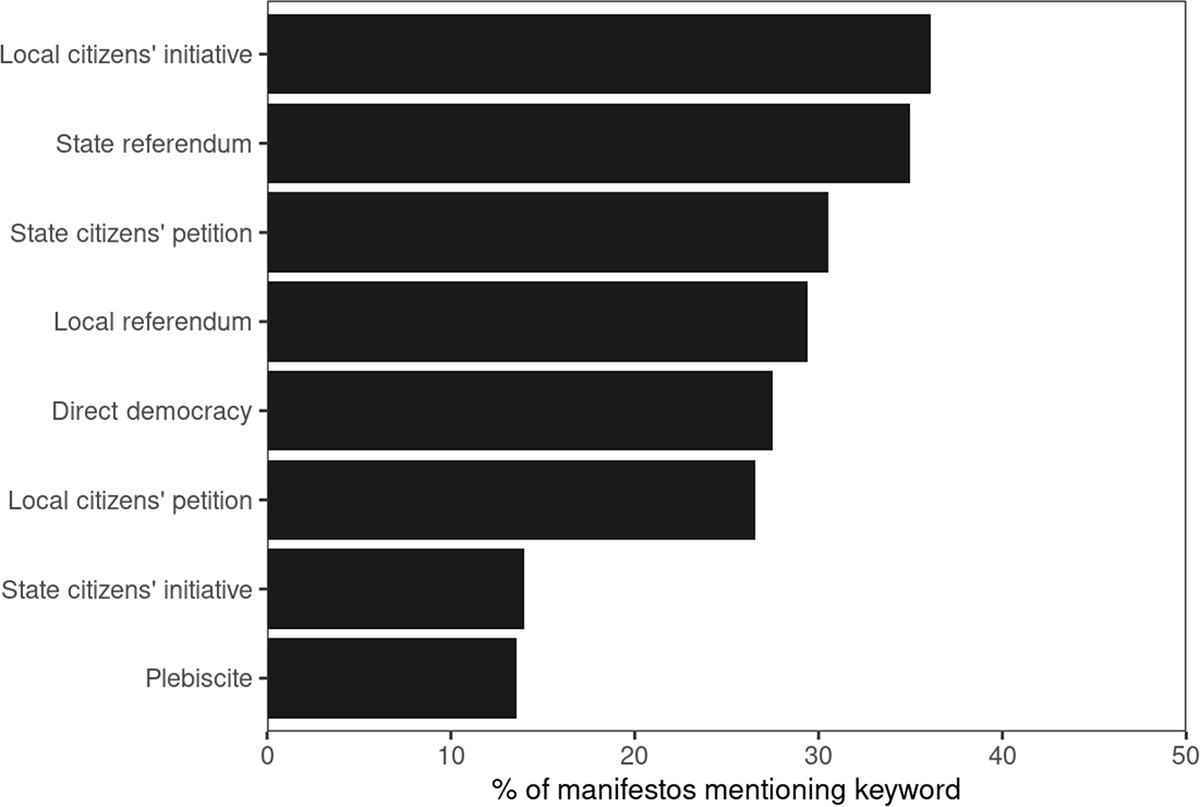
I created a corpus of election manifestos using the R package Quanteda (Benoit et al. Reference Benoit, Watanabe, Wang, Nulty, Obeng, Müller and Matsuo2018). Figure 1 shows the frequency of the individual words in the corpus. About a quarter of these manifestos mention the term direct democracy. Almost every third manifesto contains the term referendum (Volksentscheid), making it the most frequently occurring search term. Other procedural terms are also often used, with terms referring to the state level mentioned slightly more often than terms referring to the local level.
Frequency of Search Terms in Parties’ Election Manifestos

Given the large number of relevant sentences, I coded all statements as supporting, opposing or neutral towards (more) direct democracy using the LLM. In applying this LLM, I am mindful that its use is a debated topic in the social sciences (Ollion et al. Reference Ollion, Shen, Macanovic and Chatelain2024) and adhere to the current best practices (Törnberg Reference Törnberg2024) in the field: I document all aspects of the coding process and validate the AI-generated coding against human coders based on a subset of the material. Specifically, I used OpenAI’s model gpt-4o-mini, accessed via the Application Programming Interface (API). I instructed the model to approach the sentences as a potential voter seeking to inform themselves about the party’s positions and to code statements as either supporting, opposing or neutral on (more) direct democracy. Three human coders received the same instructions and corroborated the automated coding.Footnote 11 In a random sample of 100 sentences containing one of the keywords, all three coders achieved an acceptable intercoder reliability of 0.63 (Krippendorff’s alpha) among themselves and 0.62 with the LLM codings. Disagreements among the human coders and between them and the AI centred around statements coded as neutral and either positive or negative by the coders, documenting how the complex language of manifestos (see, for instance, Bischof and Senninger Reference Bischof and Senninger2018) creates ambiguity, whether intentionally or not.
The automated coding reveals, and the manual coding confirms, that mentioning direct democracy almost always implies a favourable position.Footnote 12 About 75% of sentences were positive, with less than 5% negative. The remaining statements were neutral. These findings mirror results by Engler et al. (Reference Engler, Leemann and Schaffner2024), who, using a machine learning classification approach,Footnote 13 find that of all sentences in the MARPOR corpus of national party manifestos that mention direct democracy, only 2.7% indicate opposition to direct democracy. Apparently, parties do not openly express scepticism about expanding direct democracy. Instead, they prefer not to discuss the issue.Footnote 14 This finding aligns with the theory of salience formulated by Ian Budge (Reference Budge, Robertson, Hearl and Budge1987), which underpins the MARPOR project’s coding scheme (Werner et al. Reference Werner, Lacewell, Volkens, Matthieß, Zehnter and Van Rinsum2021). According to the theory, parties emphasise issues important to them and avoid the core issues of their opponents. As a result, there is little negative positioning in party manifestos (Budge and Farlie Reference Budge and Farlie1983).
The dependent variable for all analyses is the number of sentences per manifesto coded as supporting (more) direct democracy, which I analyse using linear regression to facilitate interpretation of coefficients. I estimate four sets of models. The first set of models is estimated on the entire sample of all national and state election manifestos and tests expectations about parties’ ideological outlook. The second set of models is estimated on a reduced sample of national and state manifestos from 1990 to 2017, for which estimates of parties’ ideological outlook on a continuous scale are available. The third set of models, estimated again on all available national and state manifestos, tests for expectations regarding challenger parties. The fourth and final set of models tests expectations regarding government status.
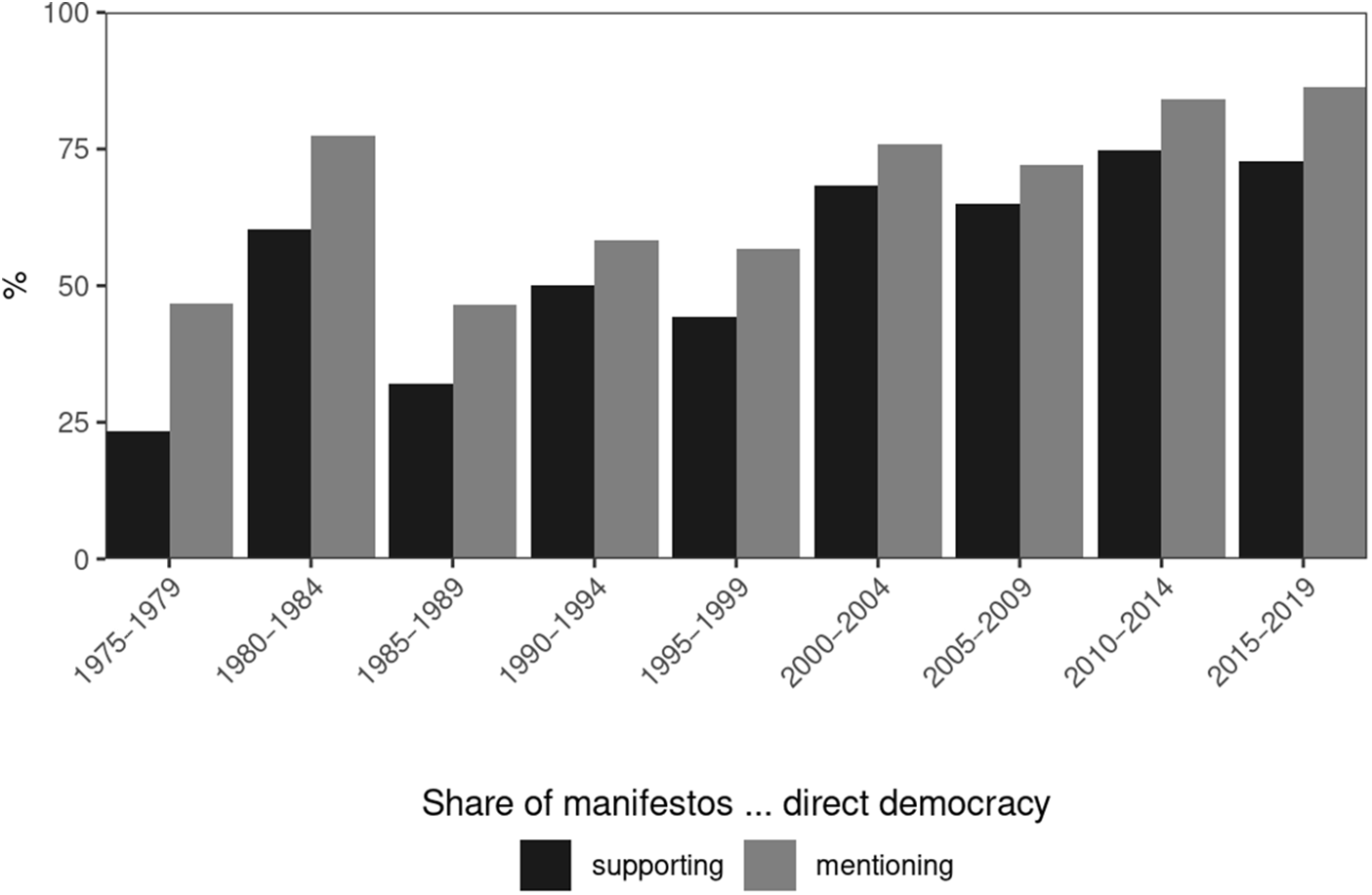
Given that the dependent variable is not strictly continuous nor normally distributed but represents counts, I also present results using negative binomial regression in the Supplementary Material. Since the modal number of supporting sentences per manifesto among those that mention it at least once is one, I also use logistic regression to model support for direct democracy as a binary indicator. Specifically, I code whether a manifesto contains more supporting than opposing statements, ignoring neutral statements. Figure 2 illustrates the binary coding by plotting the share of manifestos within a five-year interval that contains at least one supporting statement. The figure shows that the share of manifestos mentioning direct democracy has increased over time, with a particularly strong increase from the late 1990s to the early 2000s, a period when significant institutional reforms towards more direct democracy occurred in the German states.
Share of Manifestos Containing a Supporting or Any Statement on Direct Democracy

The main independent variables capture a party’s ideological position and status in the party system. To measure left-right ideology, I rely on both categorical and continuous measures. For the categorical measure, I categorise parties as left, centre or right. For the continuous measure, I rely on data from Thomas Bräuninger et al. (Reference Bräuninger, Debus, Müller and Stecker2020), who estimated parties’ positions on a general left-right dimension, as well as their positions on economic and cultural dimensions, based on party manifestos from 1990 to 2017. These latter measures allow for variation within party brands and over time. They allow me to distinguish between an economic and a cultural left-right dimension. I measure populism using a binary indicator for Germany’s two populist parties, the Die Linke/PDS and the AfD. The AfD represents an archetypal case of a populist radical-right party grounded in a nativist conception of ‘the people’, while the PDS is frequently recognised as a paradigmatic example of left-wing populism, combining democratic socialism with a populist conception of itself as the ‘vox populi’ beyond representing working-class interests (March Reference March2007; Mudde Reference Mudde2004). This populist orientation appears to have persisted in its successor, Die Linke, as reflected in its inclusion in the widely used PopuList (Rooduijn et al. Reference Rooduijn, Van Kessel, Froio, Pirro, De Lange, Halikiopoulou, Lewis, Mudde and Taggart2019). Moreover, Jan Philipp Thomeczek (Reference Thomeczek2023) shows that the party regularly employs populist rhetoric, albeit to a lesser extent when participating in state governments.
The coding of challenger and governing parties, although simple binary indicators, merits further explanation. First of all, I consider only the Greens, Die Linke/PDS and the AfD as challenger parties, as they formed decades after the founding of the Federal Republic of Germany. These parties are no longer coded as being challenger parties once they formally join a government coalition for the first time. Given the significant autonomy state parties enjoy from the national party, I code a party’s status state-by-state. With another binary indicator, I code whether a party participated in government when it issued its manifesto, again coding state-by-state.
All models control for the number of sentences in a manifesto to account for the possibility that longer manifestos mention more topics.Footnote 15 I also control for a secular time trend and practical experience with direct democracy; the latter operationalised as the total number of referendums in a jurisdiction before an election. Given that the total number of sentences can be interpreted as issue emphasis – that is, the extent to which parties want or feel they need to emphasise the issue of direct democracy – I also replicate all models using the count of all statements on direct democracy as the dependent variable and present the results in the Supplementary Material.
Results
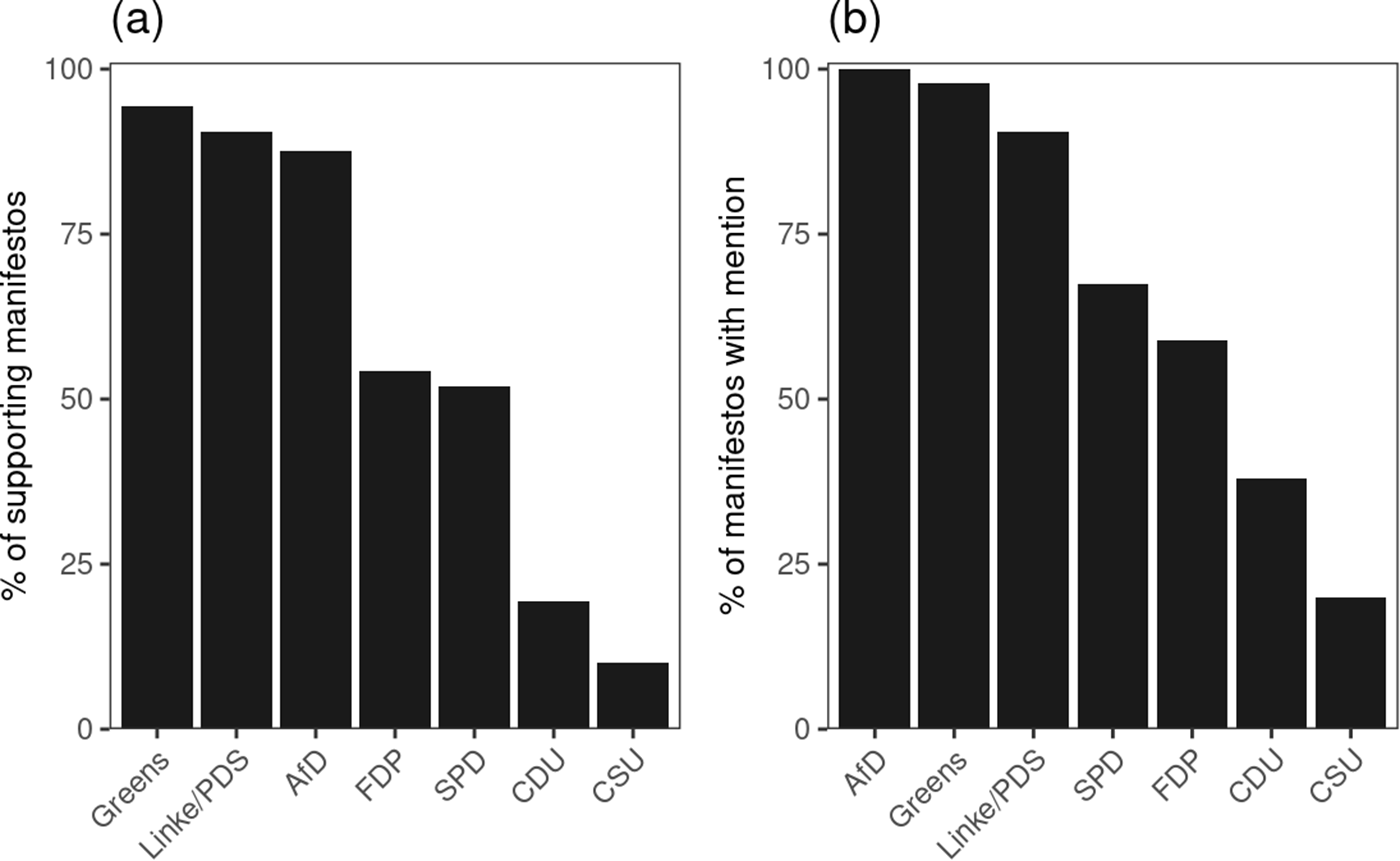
Of the 701 party manifestos examined, 476 (67.9%) mention the topic of direct democracy and 408 (58.2%) do so approvingly. As can be seen in Figure 3, the parties that were most supportive of direct democracy also mentioned the topic more frequently, although the AfD addressed the topic most frequently but not most favourably.Footnote 16 As expected, the manifestos of the left-progressive parties, the Greens and Die Linke/PDS, offer the strongest support for direct democracy. Among Germany’s two centrist catch-all parties, the SPD’s manifestos feature significantly more (positive) mentions of direct democracy than those of the CDU or CSU. Last but not least, populist parties, both on the left and the right, emphasise direct democracy in their manifestos. The AfD and Die Linke address the issue in 92.2% of their manifestos, while the other parties only do so in 64.3% of their manifestos.
Share of Manifestos with (a) More Supporting than Opposing Statements or (b) at Least One Sentence on Direct Democracy

The models in Tables 1 and 2 test the theoretical expectations regarding parties’ ideology. All specifications control for differences between states through state-fixed effects and include a linear time trend (accounting for dynamics such as the appearance of the AfD in the last third of the observation period) as well as government status (which may correlate with ideological orientation). I operationalise time as the number of years that have passed since the beginning of the observation period – i.e. 1975 or, in some analyses, 1990 – and standardise the manifesto length variable so that the intercept value indicates the average number of mentions in a manifesto of average length issued by an oppositional centrist party in the respective base year.
OLS Regressions of the Count of Supporting Statements on Direct Democracy per Manifesto on Dummy Variables Indicating Party Ideology

Table 1 Long description
Three OLS regression models, columns 1 to 3, report coefficients with standard errors in parentheses for the count of supporting statements on direct democracy per manifesto. Column 1 includes left-of-centre at 2.70 with standard error 0.24 and three stars, right-of-centre at 0.81 with 0.24 and three stars, governing party at minus 0.73 with 0.21 and three stars, years since 1975 at 0.03 with 0.01 and three stars, cumulative number of referendums at 0.27 with 0.09 and two stars, sentences standardised at 0.75 with 0.11 and three stars, and intercept at 1.91 with 0.44 and three stars. Column 2 includes populist at 3.00 with 0.31 and three stars, governing party at minus 1.07 with 0.20 and three stars, years since 1975 at 0.01 with 0.01 and no stars, cumulative number of referendums at 0.26 with 0.10 and two stars, sentences standardised at 1.29 with 0.11 and three stars, and intercept at 3.27 with 0.44 and three stars. Column 3 includes left-of-centre at 2.09 with 0.26 and three stars, right-of-centre at 0.73 with 0.23 and two stars, populist at 1.86 with 0.33 and three stars, governing party at minus 0.60 with 0.20 and two stars, years since 1975 at 0.02 with 0.01 and no stars, cumulative number of referendums at 0.27 with 0.09 and two stars, sentences standardised at 0.98 with 0.11 and three stars, and intercept at 2.29 with 0.44 and three stars. State fixed effects are marked with a check in all three columns. R2 values are 0.43, 0.41, and 0.46 for columns 1 to 3, and N is 677 in each column.
Notes: Binary variables code left-of-centre (Greens and Die Linke), right-of-centre (FDP and AfD) and populist parties (Die Linke and AfD), with the omitted base category being centrist parties (CDU, CSU and SPD). Results based on the full sample of national and state election manifestos, 1975–2017.
* p < 0.05, ** p < 0.01, *** p < 0.001 (standard errors in parentheses).
OLS Regressions of the Count of Supporting Statements on Direct Democracy per Manifesto on Continuous Variables Indicating a Party’s Position on a General, Economic or Cultural Left-Right Dimension

Table 2 Long description
OLS regressions report coefficients and standard errors in parentheses for the count of supporting statements on direct democracy per manifesto, with three model columns labeled, (1), (2), and (3). Each model includes one left right measure: in (1) Left Right is minus 0.13 with standard error 0.04 and three stars; in (2) Left Right (Econ.) is minus 0.13 with standard error 0.04 and three stars; in (3) Left Right (Cult.) is minus 0.19 with standard error 0.04 and three stars. Populist is 2.26 with standard error 0.39 and three stars in (1), 2.10 with standard error 0.41 and three stars in (2), and 2.31 with standard error 0.36 and three stars in (3). Governing party is minus 1.13 with standard error 0.25 and three stars in (1), minus 1.12 with standard error 0.25 and three stars in (2), and minus 0.80 with standard error 0.26 and two stars in (3). Years since 1990 is 0.07 with standard error 0.02 and three stars in (1), 0.06 with standard error 0.02 and three stars in (2), and 0.07 with standard error 0.02 and three stars in (3). Cum. num. of referendums is 0.16 with standard error 0.13 in (1), 0.17 with standard error 0.13 in (2), and 0.17 with standard error 0.13 in (3). Sentences (standardised) is 1.26 with standard error 0.15 and three stars in (1), 1.25 with standard error 0.15 and three stars in (2), and 1.12 with standard error 0.15 and three stars in (3). Intercept is 4.45 with standard error 0.70 and three stars in (1), 4.62 with standard error 0.72 and three stars in (2), and 4.25 with standard error 0.60 and three stars in (3). State fixed effects are marked with a check in all three models; R2 is 0.43 in (1), 0.43 in (2), and 0.45 in (3), and N is 479 for each model.
Notes: Models estimated on a reduced sample of national and state election manifestos, 1990–2017.
* p < 0.05, ** p < 0.01, *** p < 0.001 (standard errors in parentheses).
Model (1) in Table 1 confirms the expectation that left parties position themselves most strongly in favour of direct democracy. On average, the manifestos of the Greens and Die Linke/PDS contain about three more supporting sentences than those of Germany’s centrist parties.Footnote 17 These results confirm the initial theoretical expectation regarding stronger preferences for direct democracy on the left (Hypothesis 1). Moreover, model (1) confirms the expectation that direct democracy is more popular at both ends of the political spectrum than in the centre, although support among parties on the right is not as strong as on the left. These results align with and extend findings by Gherghina et al. (Reference Gherghina, Geissel and Henger2024b) for national manifestos between 2010 and 2024. This finding holds even when controlling for the fact that parties on the fringes of the German political spectrum also tend to be populist in their ideological orientation – see model (3).
The results in Table 1 further confirm that populist parties are more positive towards direct democracy. On average, a populist party manifesto contains about three more supporting sentences on direct democracy than a non-populist party manifesto. However, as shown in model (3), when taking into account that Germany’s two populist parties are positioned at the right and left ends of the ideological spectrum, populist parties appear less distinctive in their emphasis on direct democracy, as the coefficient almost halves. Given ambiguity about classifying Die Linke as populist and whether the AfD adopted populism before 2017 (Arzheimer Reference Arzheimer2015), I estimate models coding each party as populist in turn. In both models, the populism coefficient remains positive and significant, indicating that populist parties emphasise direct democracy more than their host ideology alone would predict.Footnote 18 These results, thus, confirm and extend initial findings on the AfD and Die Linke/PDS for the period 2010–2024 (Gherghina et al. Reference Gherghina, Geissel and Henger2024b) to a longer time frame.
Thus far, I have used a categorical coding of ideology to provide results for the entire period of study. However, parties’ positions on the left-right spectrum may shift over time, and state-level branches of the same party brand may adopt different stances. This approach also overlooks the rise of a cultural dimension in political competition, which does not always align with economic left-right positions. Therefore, I use the estimates of party ideology from Bräuninger et al. (Reference Bräuninger, Debus, Müller and Stecker2020), derived from the same set of manifestos analysed here but limited to the period 1990–2017. Table 2 presents the results of regression models predicting the frequency of supporting statements on direct democracy in manifestos based on a party’s general, economic and cultural left-right orientation measured on continuous scales, where higher values indicate more conservative positions.
The results are broadly consistent with those obtained with a categorical coding of ideology: left-leaning parties are more likely to make positive statements about direct democracy, while right-leaning parties have fewer supporting mentions, as indicated by the negative coefficients on the ideology variables. The populism indicator remains significant in all models when continuous measures of left-right ideology are used. The coefficient magnitudes and model fit in models (2) and (3) – which assess economic and cultural left-right dimensions – are similar. If two parties were one standard deviation apart from each other in the ideology estimate, this would correspond to a difference of roughly half a supporting statement on direct democracy in their manifestos.Footnote 19 This similarity is not surprising given that German parties generally align along a diagonal in a two-dimensional policy space, with economically left-wing parties also tending to adopt more progressive cultural positions (Bräuninger et al. Reference Bräuninger, Debus, Müller and Stecker2020: 73).
Allowing for a curvilinear relationship between manifesto emphasis and ideology, this relationship weakens for a general and economic left-right dimension, while the cultural dimension retains its explanatory relevance. As can be seen in Figure 4, the second hypothesis regarding the popularity of direct democracy on the ideological fringes can be confirmed for the cultural but not for the economic dimension.Footnote 20 In these specifications, populism remains a significant predictor net of ideology, operationalised on a continuum, thereby lending further support to the third hypothesis.
Predicted Number of Supporting Statements on Direct Democracy as a Function of a Party’s Left-Right Position

Beyond ideology, parties’ instrumental motives for endorsing direct democracy also depend on their position within the party system. In Table 3, I regress the frequency of supporting statements on direct democracy in party manifestos on a binary indicator of their status as challenger parties. As shown in model (1), challenger parties support direct democracy significantly more than mainstream parties. However, this result raises the question of whether challenger parties reduce their emphasis on direct democracy after losing this status by joining a national or state government. Models (2)–(4), which focus on the three challenger parties and changes within parties over time, show that challenger parties do not appear to moderate their demands for direct democracy when going mainstream by joining a government for the first time, at least not in their manifestos. These results, therefore, only partially confirm the fourth hypothesis. Challenger parties apparently emphasise institutional reform to distinguish themselves; and they may have little incentive to deemphasise the issue once they go mainstream so as not to alienate their voter base.
OLS Regressions of the Count of Supporting Statements on Direct Democracy per Manifesto on a Dummy Variable Indicating whether a Party Is a Challenger Party or Not When Issuing Its Manifesto

Table 3 Long description
Ordinary least squares results report coefficients for the count of supporting statements on direct democracy per manifesto across four models: Full sample, Greens Die Linke PDS, Greens, and Die Linke PDS. For Challenger party, coefficients are 2.58 with standard error 0.34 and three stars in Full sample, 0.87 with 0.79 in Greens Die Linke PDS, 0.95 with 0.88 in Greens, and minus 0.04 with 1.30 in Die Linke PDS. For Years since 1975, coefficients are 0.03 with 0.01 and two stars in Full sample, 0.05 with 0.04 in Greens Die Linke PDS, 0.06 with 0.05 in Greens, and 0.02 with 0.07 in Die Linke PDS. For Cum. num. of referendums, coefficients are 0.28 with 0.15 in Full sample, 0.69 with 0.40 in Greens Die Linke PDS, 0.46 with 0.32 in Greens, and 1.74 with 1.06 in Die Linke PDS. For Sentences standardised, coefficients are 1.01 with 0.17 and three stars in Full sample, 1.23 with 0.24 and three stars in Greens Die Linke PDS, 1.02 with 0.24 and three stars in Greens, and 2.07 with 0.30 and three stars in Die Linke PDS. State fixed effects are marked present for Full sample, Greens, and Die Linke PDS, and absent for Greens Die Linke PDS; state party fixed effects are marked present only for Greens Die Linke PDS. Model fit and sample sizes are: R2 0.38 with N 701 and N clusters 101 for Full sample; R2 0.49 with N 214 and clusters 34 for Greens Die Linke PDS; R2 0.40 with N 140 and clusters 17 for Greens; and R2 0.69 with N 74 and clusters 17 for Die Linke PDS.
Notes: All specifications include party dummies and state fixed effects and are estimated on all available national and state election manifestos.
* p < 0.05, ** p < 0.01, *** p < 0.001 (clustered standard errors in parentheses).
Finally, the regression models presented in Table 4 regress the frequency of supporting statements on an indicator of their government or opposition status, while including state-party fixed effects to isolate changes within parties as they transition from opposition to government status and vice versa. Model (1) shows a negative and statistically significant relationship between participation in government and support for direct democracy, in line with the sixth hypothesis.Footnote 21 While the AfD and Die Linke have never or rarely been in government, and the FDP and the Greens slightly more often, the SPD and the CDU show the greatest variance in government participation. For the SPD, 86 of 160 manifestos were written during participation in government, and for the CDU, 80 of 150 manifestos were written during participation in government at the national or state level.
OLS Regressions of the Count of Supporting Statements on Direct Democracy per Manifesto on a Dummy Variable Indicating whether a Party Participated in Government or Not When Issuing Its Manifesto

Table 4 Long description
Ordinary least squares regression results report coefficients with clustered standard errors in parentheses for three columns: Full sample, CDU, CSU and SPD, and Other parties. For Governing party, coefficients are minus 0.38 with standard error 0.18 and one star in Full sample, minus 0.24 with standard error 0.14 in CDU, CSU and SPD, and minus 0.55 with standard error 0.34 in Other parties. Years since 1975 is 0.01 with standard error 0.01 in Full sample, 0.01 with standard error 0.01 in CDU, CSU and SPD, and 0.01 with standard error 0.02 in Other parties. Cum. num. of referendums is 0.30 with standard error 0.13 and one star in Full sample, 0.15 with standard error 0.12 in CDU, CSU and SPD, and 0.46 with standard error 0.24 in Other parties. Sentences standardised is 0.99 with standard error 0.14 and three stars in Full sample, 0.56 with standard error 0.18 and two stars in CDU, CSU and SPD, and 1.13 with standard error 0.18 and three stars in Other parties. State party fixed effects are marked with a check in all three columns. R2 is 0.63 for Full sample, 0.38 for CDU, CSU and SPD, and 0.60 for Other parties. N is 677, 311, and 366 respectively, and N clusters is 101, 35, and 66 respectively.
Notes: All specifications include state-party fixed effects and are estimated on all available national and state election manifestos.
* p < 0.05, ** p < 0.01, *** p < 0.001 (clustered standard errors in parentheses).
Therefore, in model (2) I focus only on the CDU, CSU and SPD, and in model (3) on all other parties. OLS results are suggestive but not conclusive, as coefficient estimates for both subsamples are negative but statistically insignificant. In negative binomial and logistic regression models, the government-party coefficient in the mainstream parties sample is statistically significant. In contrast, the coefficient is only once significant and substantially smaller in the subsample of the other parties. These results, reported in Tables D.20 and D.21 in the Supplementary Material, suggest that the effect of government participation by and large accrues to mainstream and to a lesser extent, smaller parties, supporting the fifth hypothesis.Footnote 22
All results replicate when using the count of all statements on direct democracy – supportive, opposing or neutral – as both measures are highly correlated. This reflects a key insight from salience theory (cf. Budge Reference Budge, Robertson, Hearl and Budge1987) that parties are more likely to mention issues they support than those they oppose. Substantively, these additional results (presented in Tables D.6–D.8, D.12, D.14, D.17–D.19 and D.23–D.26 in the Supplementary Material) suggest that left-of-centre, populist and challenger parties, as well as opposition parties more broadly, devote greater attention to the topic of direct democracy. All results also replicate when using negative binomial regression to model counts or binary logistic regression of a binary indicator of support (see Tables D.4, D.5, D.10, D.11, D.15, D.16, D.20 and D.21 in the Supplementary Material).
I also examine whether highly salient referendums abroad are associated with changes in German parties’ positions on direct democracy, drawing on recent research showing that events such as the 2016 Brexit referendum can influence public opinion and, at least temporarily, reduce support for referendums (Steiner and Landwehr Reference Steiner and Landwehr2023). However, I find no systematic evidence of such effects: analyses of pre- and post-referendum party manifestos yield no significant changes, and exploratory tests for structural breaks to identify similar events remain inconclusive.Footnote 23
Conclusion
The implementation and use of direct democratic institutions lags behind citizens’ enthusiasm, yet explanations for this gap remain limited because research has focused mainly on citizens’ and individual politicians’ preferences rather than political parties, whose agreement is crucial for democratic reforms. This study therefore examines what shapes parties’ positions on direct democracy, considering both ideological and instrumental motivations. Using election manifestos from German parties in national and state elections between 1975 and 2017, the analysis finds broad support for both ideological and instrumental motives: ideologically, left-of-centre parties express stronger support for direct democracy than centre- or right-of-centre parties, while populist parties show particularly high support beyond what their host ideologies would predict. Instrumental factors also matter: challenger parties are generally more supportive than mainstream parties, parties emphasise direct democracy more in opposition than in government, and Germany’s catch-all parties (CDU and SPD) in particular highlight direct democracy when in opposition but deemphasise it once in government.
More broadly, these findings imply that the gap between mass support for direct democracy and its limited institutionalisation is rooted in the strategic logic of party competition as much as in normative disagreement. Parties tend to endorse direct democracy most strongly when it helps them challenge established elites or signal responsiveness, but governing responsibility dampens that commitment. This insight is relevant well beyond Germany, as the core mechanisms identified here – ideology, challenger status and government participation – are not unique to one country. Still, their empirical force is likely to vary across contexts. In democracies with more entrenched referendum traditions, in highly polarised territorial conflicts, or in presidential systems where executives can more directly deploy referendums, the German pattern may be attenuated or take a different form.
While parties’ positions broadly reflect their constituents’ preferences and follow ideological patterns, they often fail to implement their reform proposals. Institutional reforms require support from other parties to form parliamentary majorities, and even supermajorities for constitutional amendments. Here, reforms are mainly hindered by centrist catch-all parties, typically senior coalition partners, which are central to governing and, as my analysis has shown, more sceptical of such changes. However, as challenger parties assume government responsibility, they appear to influence their coalition partners, reflected in increasing support for direct democracy across all party manifestos over time. Such a shift may help explain the wave of direct democracy reforms in German states during the late 1990s and 2000s, which, however, have stalled since then. Any future reforms are hindered by parties reducing their commitment to direct democracy once in government, to the extent of openly communicating reduced enthusiasm in their manifestos. Future research should investigate the conditions under which governing coalitions choose to expand citizen participation.
Future research could also address some shortcomings that this article, as one of the first studies of its kind, naturally has. First, Germany’s parties, by and large, align on a diagonal between an economic left-right dimension and a GAL-TAN dimension of political conflict (Bräuninger et al. Reference Bräuninger, Debus, Müller and Stecker2019), limiting my ability to disentangle the two. Studies focusing on countries that offer more variance or on a larger number of parties in multiple countries would be better able to assess the relative importance of economic and cultural left-right ideology. Second, due to a lack of public opinion data – surveys rarely include items on direct democracy, and subnational surveys are scarce – I was unable to investigate whether parties’ stances on democratic reform change in response to shifts in citizens’ procedural preferences. This leaves act-contingent motives (cf. Reed and Thies Reference Reed, Thies, Shugart and Wattenberg2001) for party support for democratic reform as an important question for future research. Third, future research should also analyse which types of direct democracy parties propose and how this varies by government–opposition status and context. While opposition parties may favour bottom-up instruments such as initiatives (see Chiru et al. Reference Chiru, Giugăl, Guţoiu and Secăreanu2025), governing parties may prefer top-down mechanisms to legitimise policies. Referendums can either broaden participation or be instrumentalised to bolster support during periods of democratic stress (cf. Gherghina et al. Reference Gherghina, Farcas and Oross2024a). Therefore, future studies should measure the type of direct democracy being proposed (e.g. Engler et al. Reference Engler, Gessler, Abou-chadi and Leemann2023) across a broader set of regimes.
Supplementary material
The supplementary material for this article can be found at https://doi.org/10.1017/gov.2026.10060.
Data availability
The data and code supporting this study’s findings are openly available on Zenodo: https://doi.org/10.5281/zenodo.21159000. The corpus of manifestos analysed is available at http://www.polidoc.net.
Acknowledgements
Previous drafts of this article were presented at the Jahrestagung 2024 des AK Parteienforschung in Chemnitz, 10–11 October 2024, and the Direct Democracy Workshop in Zurich, 17–19 June 2024. I am thankful to the audiences there, in particular Davide Morisi, Lucas Leemann, Klaudia Wegschaider, Eva-Maria Trüdinger, Florian Schaffner, Nanuli Silagadze, Adrien Petitpas, Felix Grünewald, Alice El-Wakil, Michael Minkenberg, Manés Weißkircher, Eric Linhart, Benjamin Höhne and Volker Best for their very helpful questions and constructive comments. Tom Anderer, Anne Markstein, Luka Schönhöfer and Marcel Schneider provided excellent research assistance. The author used ChatGPT to code the dependent variable for this study. The procedure is described in detail in the article and Supplementary Material. Moreover, during the preparation of this work, the author used Grammarly, DeepL and ChatGPT to improve the language of the manuscript and ChatGPT and GitHub Copilot to support statistical programming. After using these tools, the author reviewed and edited the content as needed and takes full responsibility for the content of the publication.
Financial support
The author acknowledges funding from the German Research Foundation (DFG) – project number 491988424.
Ethics statement
The author reports that there are no competing interests to declare.


 Open access

