Decision makers in healthcare systems are challenged by the need to maintain sustainability whereas ensuring access to valuable innovations. The definition of “value” is based on economic and clinical considerations and should account for uncertainty in estimates (Reference Towse and Barnsley1). A recent review showed that decision makers are inclined to consider very broad and different definitions of value, entailing various combinations of clinical, economic, political, social, and ethical considerations (Reference Vermeulen and Krabbe2).
In the case of vaccination, clinicians, public health researchers, and health economists have shown the relevance of a broader definition of value for the capture of multiple facets of benefits generated by such public health interventions (Reference Bloom, Brenzel, Cadarette and Sullivan3). Most of the health economics literature shows agreement that decision makers assessing the economic value of a vaccine should adopt a full societal perspective that entails considerations beyond direct healthcare costs (e.g., treatments, visits, and hospitalizations), including loss of productivity and informal care costs related to the working days lost (Reference Bloom, Fan and Sevilla4). Numerous reviews of the literature (Reference Brouwer, Koopmanschap and Rutten5–Reference Koopmanschap and Rutten8) have shown that loss of productivity and informal care costs are rarely taken into consideration. The main reasons are likely related to the difficulty in collecting data on productivity losses, which differ among occupational categories. Furthermore, most of the literature fails to provide relevant evidence, and the estimation of productivity loss often must incorporate jurisdiction-specific information. Guidelines on economic assessment, including the approach taken to include productivity loss, vary substantially among countries (Reference Drummond9).
The scientific literature provides a standardized set of methods for the estimation of social costs due to productivity losses. The human capital approach is among the most commonly used methods. Its basic hypothesis is that the individual “produces” in fair proportion to the income received, and that the salary reflects the actual contribution of the worker to the productive activity (Reference Drummond9, Reference Johannesson10). This approach assumes that the labor market is characterized by full employment, and thus that investment in the health of potential workers will increase the amount of work available in the market. As the focus is on the loss of productivity due to the temporary absence of an ill worker, the reference period extends from the occurrence of a pathological event to the retirement. To obtain a measure of income, one can refer to a sample estimate of patient incomes or a classification of wages by sector and activity category, obtained from national surveys (11, 12).
The human capital approach also can be used to extend the societal perspective beyond consideration of the effects of the productivity loss on individuals, social insurance, and employers. To our knowledge, however, no report describes the use of this approach to estimate the fiscal impacts of infectious diseases. We define the fiscal impact of a disease as the decrease in income tax revenues resulting from the reduction in individual incomes due to illness. Tax revenues are typically derived from individual incomes, which increase with productivity, and productivity depends strongly on individuals' health status. Thus, the sustainability of national health services could be argued to depend on their ability to ensure high levels of productivity through health maintenance or improvement. The aim of this paper was to test an analytical framework developed for the estimation of the fiscal impacts of three vaccination programs for influenza (FLU), pneumococcus (PC), and herpes zoster (HZ), with consideration of postherpetic neuralgia (PHN), the main complication of the latter, in Italy.
Methods
Theoretical Framework
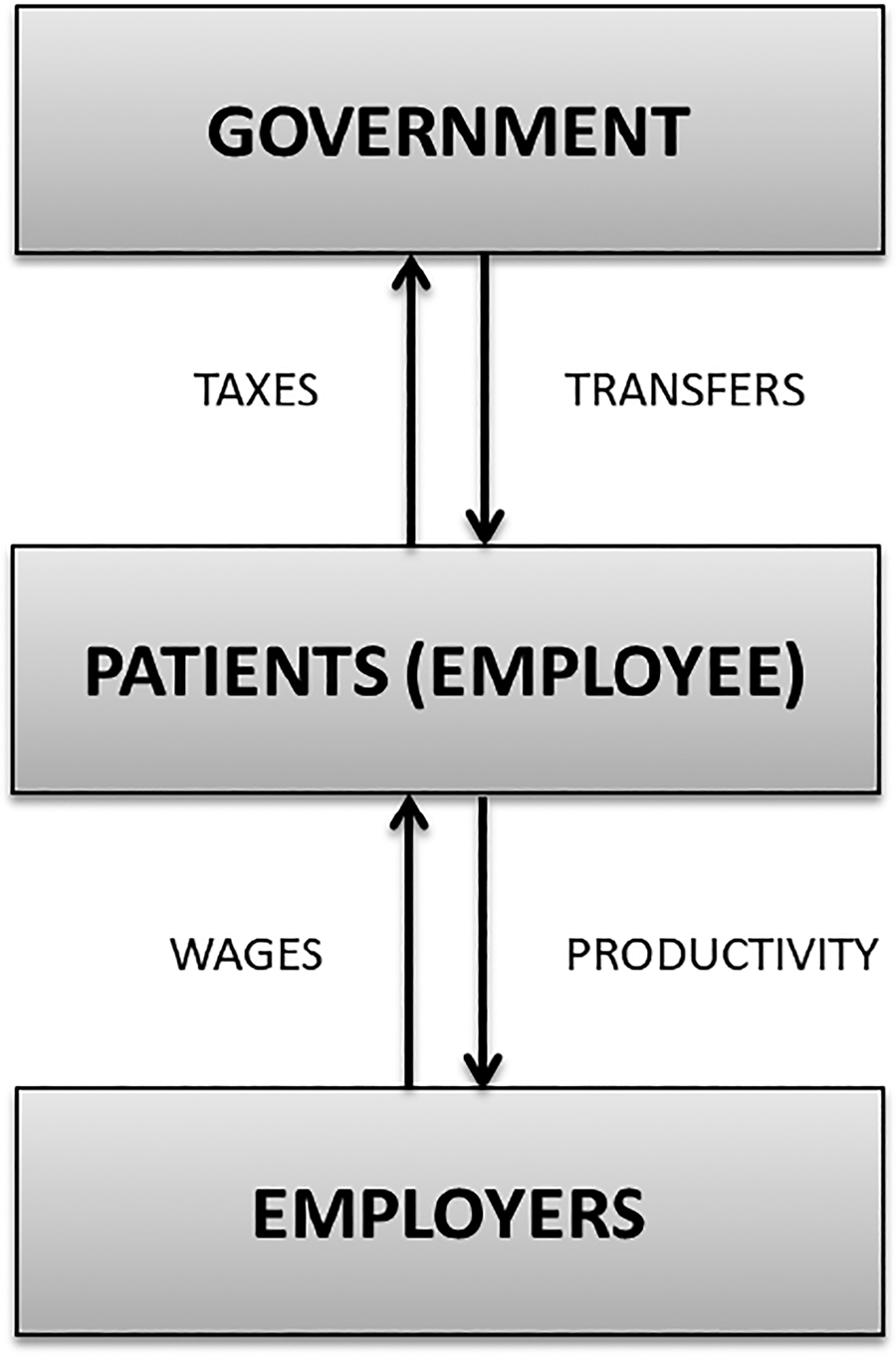
Our framework is consistent with the theoretical background holding that the accumulation of human capital and increase in populational health are the key drivers of economic growth and the results of an endogenous process. Thus, according to this perspective, governments should invest in new medical technologies to increase populational health, thereby enhancing productivity growth. Increases in productivity increase incomes, and thus consumption and tax revenues, which in turn can be used to increase investment in health (Reference Solow13). This process can be simplified to the following cause–effect formalization:
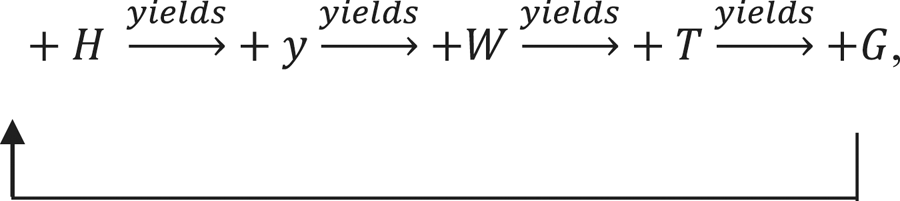 where H represents the number of healthy individuals, y represents employers' productivity, W represents employee income, T represents total fiscal revenues, and G represents public expenditure for health.
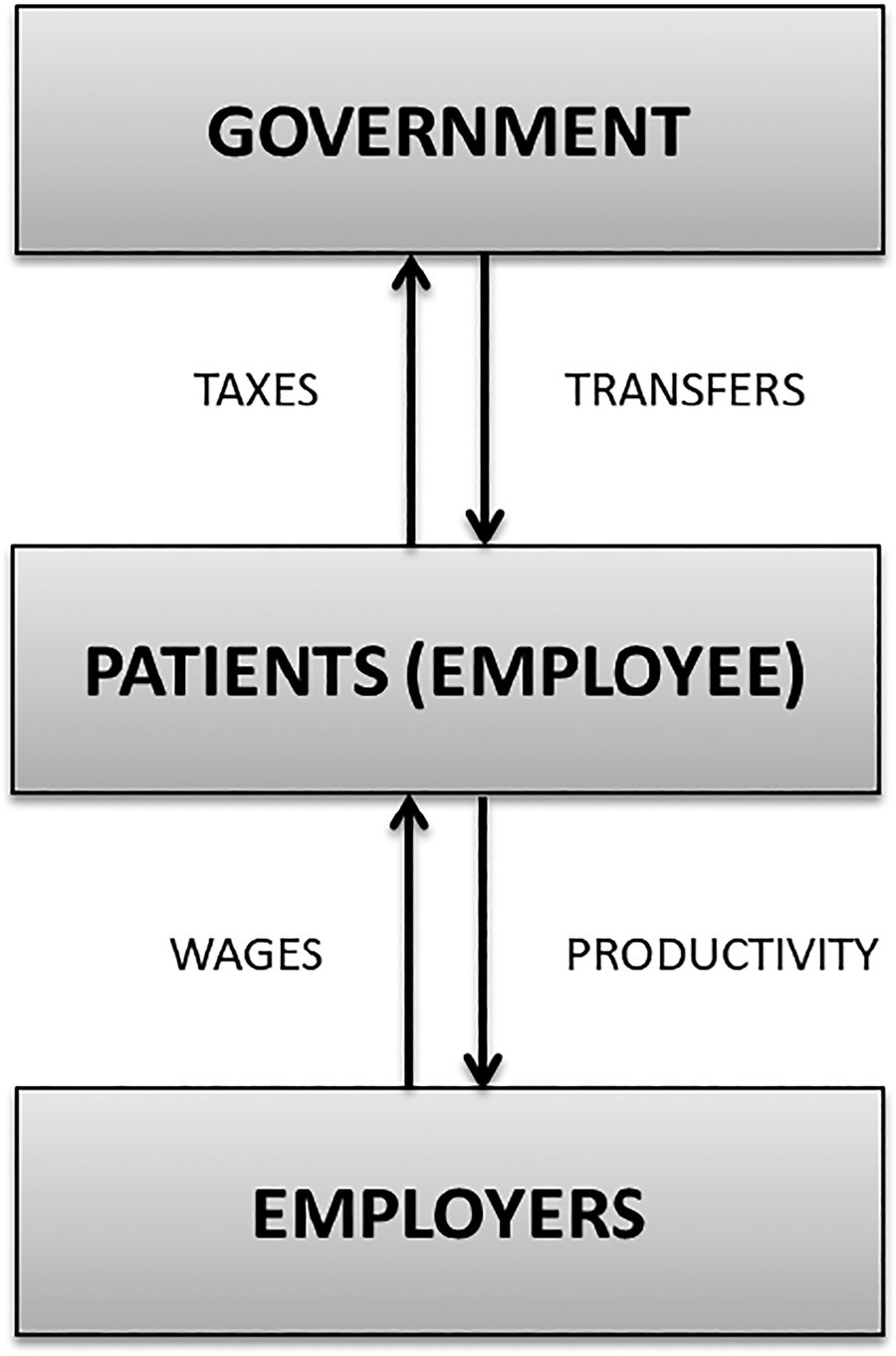
We considered in our analysis only permanent employees enrolled in Italy's public social insurance scheme. In this case, individual productivity losses due to disease experience reduce the total amount of income subject to taxation. Consequently, a medical technology that restores individuals' health or prevents the onset of disease entails an increase in tax revenues. Payments and benefits in addition to wages (i.e., allowances of duty, fringe benefits, and achievement awards) were not included in the calculation. According to the Italian National Statistics Institute (ISTAT), these extra payments account for an average of 33 percent of the total income from work in Italy (14). Figure 1 illustrates the fiscal impact analytical framework.
The fiscal impact analytical framework.
Study Design
We tested the framework in a two-stage analysis. First, we estimated the fiscal impact of the disease and second, we performed a cost–benefit analysis of the individual benefits of vaccination against the cost of the vaccine.
We constructed three scenarios for FLU, PC, and HZ, respectively. First, using the incidence rates and numbers of working days lost, estimated from the literature, we estimated the fiscal impact and the impact on the social security level. Second, we simulated increases in income revenues derived from decreases in the number of working days lost resulting from extensions of vaccination coverage. Simulation results were presented for a 1-year time horizon. In addition, 10-year projections of the base case results were performed for PC and HZ (and related PHN), being the vaccination coverage duration higher than 1 year as in the case of FLU.
Because our model aimed to quantify fiscal impacts, we did not consider at this stage any existing causal effect between vaccination coverage and epidemiology (i.e., reduction in the basic reproduction number). We considered the decrease in the number of people infected as a consequence of coverage extension, which results in the reduction of the number of working days lost by the total population.
Fiscal Impact Estimation
To estimate the fiscal impact, we first estimated the social security cost burden using data from the Italian Social Security Institute (INPS) (15). We used the human capital approach, which enabled us to quantify the days of absence from work, used as cost drivers in the estimation of final individual incomes. We considered, as empirical evidence shows (14), that social insurance does not fully cover workers' wages. Once individuals' final incomes were estimated, a taxation process was simulated. We separately considered (i) the losses to the government associated with social insurance transfers and (ii) the decrease in fiscal revenues due to losses in workers' incomes. For (ii), we used the Italian income taxation scheme (EUR 0–15,000, 23 percent; EUR 15,001–28,000, 27 percent + EUR 3,450; EUR 28,001–55,000, 38 percent + EUR 6,960; EUR 55,001–75,000, 41 percent + EUR 17,220; EUR > 75,001, 43 percent + EUR 25,420) (12).
Cost Estimation
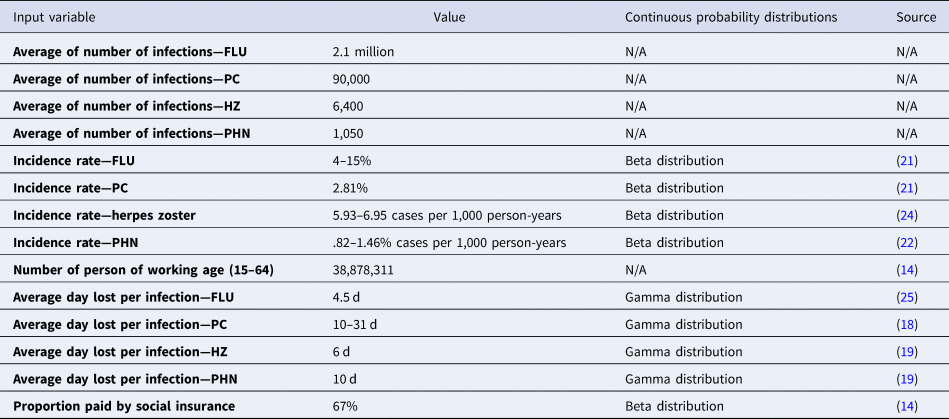
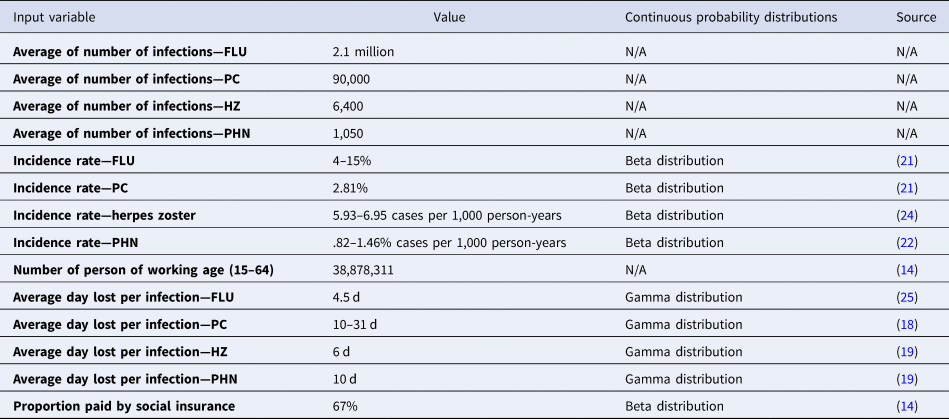
For the economic analysis, we used the input variables listed in Table 1, including the distributions used for the probabilistic sensitivity analysis. The numbers of working days lost for the three diseases were estimated from the literature (Reference Bauer, Welte and Ernen16–Reference McLaughlin, McGinnis, Tan, Mercatante and Fortuna20). The days of absence from work were valorized using the gross hourly wage, based on the ISTAT average of eighteen euros (14). Then, we assumed that 33 percent of the gross hourly wage paid during absences was borne by the INPS. The total cost of the productivity loss was estimated according to the Italian cost-sharing rule, which charges reimbursement for the first 3 days of missed work to employers and the remainder to the INPS.
Input variables for the economic analysis
Furthermore, we considered an average of 36 hours of work per week and a total of 48 working weeks per year (considering 4 wk of vacation). Cost–benefit ratios were calculated for the three diseases to valorize the investment in the extension of vaccination among working adults. The analysis did not explicitly examine the effectiveness of the vaccination programs; we considered only the linear reduction in the number of people infected as a result of the combined effect of effectiveness and coverage rate.
Reference Population
The reference population for the scenarios consisted of subjects aged 30 to 65 years. The three diseases were selected to enable observation of the combined effects of incidence and severity, expressed in terms of the number of days of illness in a working population. In particular, FLU was selected to enable observation for a disease with a high incidence, but which caused few days of illness. PC has a low incidence, but potentially causes a large number of sick days. HZ was selected to enable the assessment of the fiscal impact of its complication PHN, which potentially causes a large number of sick days. For FLU, data were extrapolated from the databases of the Istituto Superiore di Sanità (National Institute of Health), which sums the epidemiological trends of FLU seasons in the InfluNet monitoring report (21). From these data, we estimated that about 8 percent of the working-age population was affected by FLU each year. For HZ, we used data from Gialloreti et al. (Reference Gialloreti, Merito and Pezzotti22), who estimated that 216,391 cases occurred in Italy each year. The annual incidence of PC was derived using data from a study reporting a number of 290 cases per 100,000 individuals (21). The reference population was also adjusted for the unemployment rate in Italy in 2017 (14).
Sensitivity Analysis
To investigate the impact of the extension of adult vaccination on the increase in tax revenues in Italy, a multivariate sensitivity analysis was performed with the variables of epidemiology, number of days of absence from work, hourly wages, and vaccination coverage included in the models. This analysis was performed with Monte Carlo simulation, allowing 1,000 iterations. Disease incidences were fitted using a beta random variable, and the number of days of absence from work and hourly wages were associated with a gamma random variable. Parameter values in the 25th and 75th percentiles were reported.
Results
Scenario Modeling
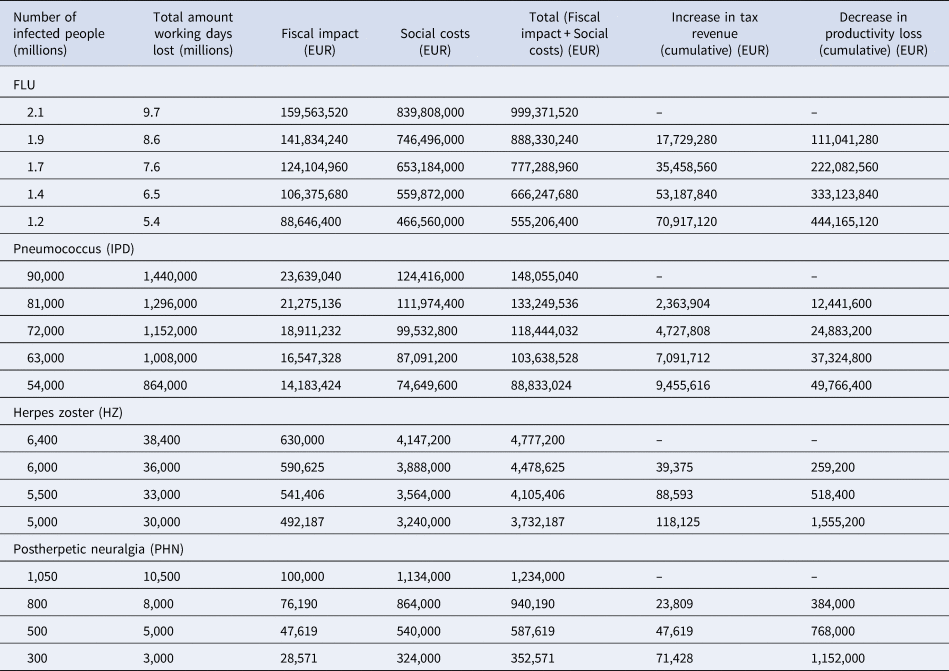
Our model estimates that, based on 2.1 million infected people per year, the current fiscal impact and social costs associated with FLU are EUR 160 million and EUR 840 million, respectively. A vaccination strategy resulting in a reduction of the number of infected people by 200,000 would result in a decrease in productivity loss of EUR 111 million and an increase in tax revenue of nearly EUR 18 million annually. For PC, based on 90,000 infected people each year (Reference Sterrantino, Trifirò and Lapi23), the current fiscal impact and social costs are EUR 24 million and EUR 124 million, respectively, and a vaccination strategy reducing the number of infected people by 9,000 would reduce productivity loss by EUR 12 million and increase tax revenue by nearly EUR 2 million annually. For HZ, based on 6,400 infected people annually, the current fiscal impact and social costs are EUR 630,000 and EUR 4 million, respectively, and a vaccination strategy reducing the number of infected people by 400 would reduce productivity loss by EUR 260,000 and increase tax revenue by nearly EUR 39,000 annually. Based on 1,050 infected people each year, the current fiscal impact and social costs associated with PHN are EUR 100,000 and EUR 1 million, respectively, and a vaccination strategy reducing the number of infected people by 300 would reduce productivity loss by EUR 384,000 and increase tax revenue by nearly EUR 24,000 annually. For all models, strategies resulting in greater reductions of the number of infected people had proportionally larger increases in tax revenue (Table 2).
Baseline scenario results
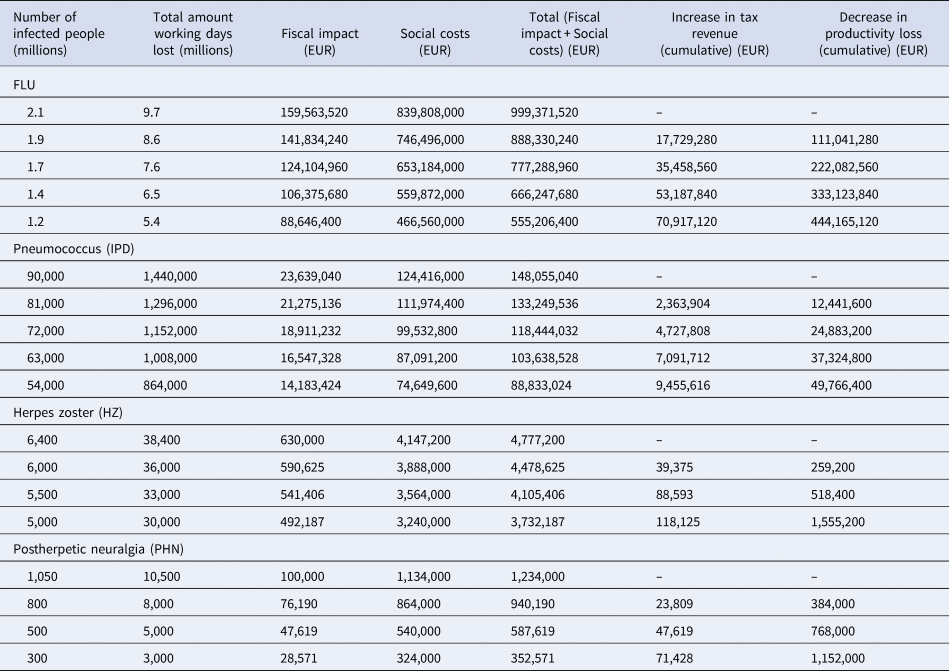
The results of the 10-year projections for PC and HZ/PHN are presented in Supplementary Tables 1 and 2. We estimated fiscal revenue gains of EUR 32 million (discounted at 3 percent) for PC and EUR 700,000 for HZ/PHN for reductions in number of infected people from 90,000 to 54,000 and from 6,400/1,050 to 5,000/300, respectively.
Probabilistic Analysis Results
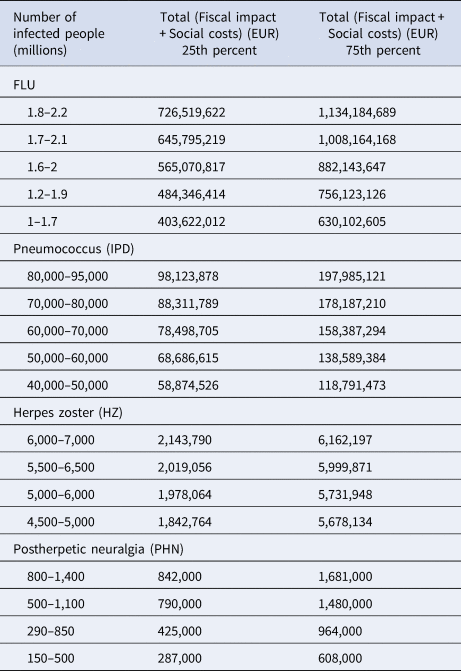
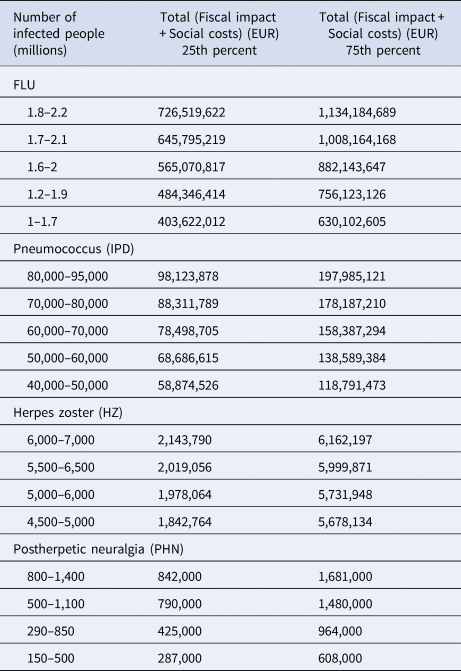
The results (fiscal impact + social cost) of the three scenarios and of Monte Carlo simulation, with the 75th and 25th percentiles representing the worst and best possible scenarios, respectively, are presented in Table 3. Coverage extensions involved the reduction of social costs due to productivity loss and increases in tax revenues, independent of variability of the parameters included in the models.
Probabilistic analysis results
Cost–Benefit Analysis Results
We estimated the per-capita impacts of vaccinations from the baseline scenario results (Table 1). The per-capita impacts of vaccination are shown in Supplementary Table 3. The analysis revealed that investment in vaccination yielded average per capita benefits up to twice the value of the investment in terms of tax impact and up to sixteen times the value in terms of productivity loss.
Discussion
In this study, we estimated the returns (in terms of social savings) derived from the extension of FLU, PC, and HZ vaccination coverage in Italy. We included as social savings the fiscal revenues derived from the reductions in the numbers of working days lost due to illness; such loss is assumed to have negative impacts on individual incomes and savings for social security expenditures.
Although this work generated data about the impacts of vaccination in the Italian context, our primary aim was to develop an analytical framework that provides additional information about the impact on tax revenues, which is typically not considered in traditional health economics and cost-of-illness studies. We tested the framework using scenarios for three infectious diseases with different epidemiological scales, and thus requiring different platforms for the estimation of cost profiles. FLU has little impact on per-capita income due to the small number of working days lost, but important effects on social expenditure and overall fiscal revenues due to the large number of individuals involved. PC has an average burden in terms of prevalence, but a relevant impact in terms of the number of working days lost. HZ has a smaller epidemiological burden and impact on absenteeism. The estimation of social costs due to absence from work indicated that the extension of vaccination coverage is cost saving, depending on the epidemiological burden and cost of the vaccination strategy; the fiscal impact of coverage extension, being proportional to the individual income, is always positive, regardless of the epidemiological burden or number of working days lost. In all three case studies, social savings and fiscal revenues were likely to be positive in 100 percent of cases.
The framework developed in this study can be an asset for policy makers, as in this era in which economic constraints pose challenges for publicly financed health care, valorization of the impacts of measures such as vaccination expansion on fiscal revenues, used to fund public health care, is a capability enabling health systems to provide themselves with some of the resources needed to finance innovation and prevention. Moreover, assessment of the value of vaccination strategies should take into account potential welfare cost savings due the effects on social security expenditures derived from the reduction in the number of working days lost.
We used the human capital approach in this study because it is among the most commonly used methods (Reference Johannesson10) and because information that could be collected from the literature and national databases fit the requirements of the approach well. Moreover, this approach accurately represents social insurance expenditure in the Italian context. The use of an alternative approach (i.e., the friction cost method) would have shifted the focus to private actors with no direct connection to fiscal revenues (i.e., employers). Nevertheless, further studies could investigate the combined application of the human capital and friction cost approaches to capture the fiscal impact derived from employers' income loss due to employees' illness.
Our work has some limitations that need to be addressed. First, we used data extrapolated from the literature and existing databases for the simulations. In particular, the baseline simulation employed the average hourly wage taken from Italian statistics. More detailed analyses should be performed to consider particular categories of workers, with specific focus on those most likely to be exposed to infectious diseases (e.g., health professionals and police officers). However, hourly wages in these occupational categories are close to the average value used in our analysis. Furthermore, workers with more infectious disease exposure are more likely to experience significant gaps between the basic salary reimbursed by social insurance for illness and the salary including other work-related allowances (i.e., productivity or shift allowances). In further analyses, we will use cross-sectional surveys to populate our framework with real data from a representative sample.
Another limitation of our work is that we assumed linearity in the reduction of the number of working days lost consequent to an increase in the vaccination coverage. Access to epidemiological panel databases could aid the exploration of this assumption.
In addition, our analysis employed a 1-year time horizon, consistent with yearly tax payment and the financing of public expenditures on the basis of yearly tax revenues. However, the effectiveness of at least two of the vaccination programs considered (for PC and HZ/PHN) manifests over multiple years; thus, fiscal impacts may have been underestimated in these two cases. For this reason, we also performed 10-year simulations for these diseases. However, due to the difficulty of predicting the capability of a national health service to ensure high levels of coverage over years, the results of these simulations should be interpreted with caution. The main strengths of the fiscal impact assessment are the potentiality of powering the information and the capability of influencing decision makers.
Finally, we estimated the fiscal impact of disease as the loss in government tax revenue. Instead, patients could be considered also as indirect sources for fiscal revenue estimates. For example, we should consider the fiscal impact of potential substitution effects in the consumption behavior of patients with infectious disease. Other indirect sources of reductions in tax revenues are employers' friction costs and productivity losses due to employees' illness. Discrete choice experiments and cross-sectional surveys would aid the investigation of these additional effects.
In conclusion, our work shows how traditional methods aimed at estimating the cost of illness from a social perspective can be improved by additionally considering the fiscal impact, which accounts for the decrease in fiscal revenues due to illness. On the other hand, the potential reduction of the fiscal impact should be included in the assessment of the effects of new medical technologies, adding a new dimension to this valorization. Infectious diseases are important fields of application due to their high prevalence and/or the potential for “partial eradication” through the implementation of vaccination programs.
Supplementary material
The supplementary material for this article can be found at https://doi.org/10.1017/S0266462320000069.
Acknowledgments
We thank the Advisor Board Members: Boccalini S., Conversano M., D'Ancona Paolo, Iannazzo S., Icardi G., Maio T., Mennini F.S., Migliorini R., Signorelli C., and Scotti S.
Financial support
This work was supported by an unrestricted educational grant from MSD, Pfizer, and Sanofi.
Conflict of interest
None.