The handshake is a common social custom that is a potential health hazard.Reference Sklansky, Nadkarni and Ramirez-Avila1,Reference Mermel2 The hands of healthcare personnel and patients are often contaminated with pathogenic bacteria, viruses, or fungi.Reference Sklansky, Nadkarni and Ramirez-Avila1–Reference Boyce and Pittet3 These organisms can be efficiently transferred from person to person via hand contact.Reference Mermel2–Reference Gwaltney, Moskalski and Hendley4 Hand hygiene reduces but does not eliminate the risk for transfer.Reference Boyce and Pittet3,Reference Sunkesula, Kundrapu, Macinga and Donskey5,Reference Sunkesula, Kundrapu, Knighton, Cadnum and Donskey6 For example, alcohol hand sanitizer reduced methicillin-resistant Staphylococcus aureus (MRSA) on the hands of colonized patients, but incomplete removal was common, particularly in those with a high baseline level of recovery.Reference Sunkesula, Kundrapu, Macinga and Donskey5
Banning the handshake has been proposed as a strategy to reduce pathogen transmission in healthcare settings.Reference Sklansky, Nadkarni and Ramirez-Avila1,Reference Mermel2,Reference Parga, Valadez, Chang, Sarin-Gulian, Holdbrooks and Sklansky7 Alternative greetings that eliminate or reduce hand contact have also been proposed.Reference Sklansky, Nadkarni and Ramirez-Avila1,Reference Mermel2,Reference Mela and Whitworth8,Reference Ghareeb, Bourlai, Dutton and McClellan9 One example is the fist bump, which involves less surface area and time of contact than the handshake.Reference Mela and Whitworth8,Reference Ghareeb, Bourlai, Dutton and McClellan9 In an experimental model, the fist bump transferred less Escherichia coli than a handshake,Reference Mela and Whitworth8 but whether the fist bump is less likely to transfer pathogens in clinical settings remains unknown. Therefore, we conducted a study with MRSA-colonized patients to test the hypothesis that the fist bump transfers MRSA less frequently than the handshake. In addition to the traditional fist bump, we tested a modified fist bump called the cruise tap that further reduces the surface area of contact by allowing contact only between 1 knuckle of each hand.Reference Dahl10
Methods
We conducted a cohort study of a convenience sample of 50 MRSA-colonized patients at the Cleveland VA Medical Center to compare the frequency of transfer of MRSA from hands with different types of greetings involving hand contact. Supplemental Figure 1 (online) provides a video showing the 3 hand contact greetings. Potential participants were excluded if they had limited ability to perform the greetings or to apply hand sanitizer due to inability to use their hands. The facility’s institutional review board approved the study protocol.
Each participant served as an internal control and performed 4 greetings with their dominant hand in sequence from least to greatest contact: (1) cruise tap (the dorsal surface of one knuckle touches the dorsal surface of another knuckle),Reference Dahl10 (2) fist bump (one fist meets another with the dorsal side of all 4 ulnar proximal phalanges touching), (3) handshake, and (4) handshake after patient hand hygiene using 2 mL of alcohol gel. The participants were coached to ensure appropriate hand hygiene as previously described.Reference Sunkesula, Kundrapu, Macinga and Donskey5 The recipient for the greetings was a research staff member wearing a sterile glove. After the greeting, the contacted portions of the sterile glove were imprinted directly onto BBL CHROMagar containing cefoxitin 6 μg/mL. Plates were processed for recovery of MRSA as previously described.Reference Sunkesula, Kundrapu, Macinga and Donskey5 The number of MRSA colony-forming units (CFUs) recovered were counted.
The primary outcome was the frequency of transfer of MRSA. A 2-sample, 2-sided power calculation indicated that 50 participants would provide 90% power to detect a difference in transfer of 50% versus 20%. A conditional logistic model was used to compare the frequency of transfer for handshake versus the other greetings. A Kruskal-Wallis test was used to compare the number of MRSA colonies transferred. The Student t test was used to compare the number of MRSA colonies recovered from the dorsum versus palmar hand surfaces. Data were analyzed using R version 3.5.0 software (The R Foundation for Statistical Computing, Vienna, Austria).
Results
For the 50 MRSA-colonized patients, the mean age was 67 years (range, 29–97); 47 patients (94%) were men; 20 patients (40%) were long-term care facility (LTCF) residents; 31 patients (62%) had limited mobility; and 25 patients (50%) had intravenous or urinary catheters. Only 3 patients (6%) reported regular use of alcohol hand sanitizer while in the hospital or LTCF. MRSA was recovered from the palmar and dorsal hand surfaces of 10 patients; 2 patients had MRSA only on the dorsal hand surface. There was no significant difference in the burden of MRSA on the palm versus dorsum of the hands (mean +SE CFU recovered, 32.7+12.3 vs 27.3+12.7; P = .78).
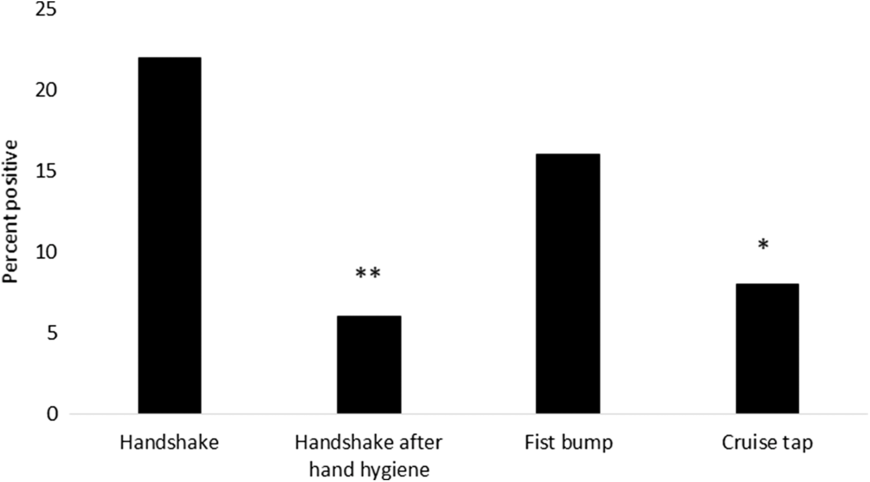
As shown in Figure 1, there was a significant reduction in the frequency of MRSA transfer for the cruise tap versus the handshake (8% vs 22%; P = .023) but not for the traditional fist bump (16% vs 22%; P = .61). Use of alcohol hand sanitizer by carriers significantly reduced transfer of MRSA by handshake (6% vs 22%; P = .009).
Frequency of transfer of methicillin-resistant Staphylococcus aureus (MRSA) from hands of MRSA-colonized patients by different greeting methods. * P< .05; **P < .01.

Discussion
The fist bump is frequently discussed as a potential alternative to the handshake that might reduce the risk for pathogen transfer between patients and personnel or among patients.Reference Mermel2,Reference Ghareeb, Bourlai, Dutton and McClellan9,Reference Dahl10 However, we found that the burden of MRSA was similar on the palmar and dorsal surfaces of the hands of MRSA-colonized patients and fist bump and handshake greetings resulted in similar frequencies of MRSA transfer (16% vs 22% transfer, respectively). Transfer was significantly reduced with a modified fist bump that reduced the area of contact to a single knuckle and when patient hand hygiene was performed before a handshake.
Our findings suggest that modified greetings such as the cruise tap could potentially reduce the risk for transfer of healthcare-associated pathogens. However, it is notable that transfer occurred 8% of the time even with the minimal skin surface contact of the cruise tap. In addition, the acceptability and feasibility of the cruise tap or other greetings that involve minimal contact requires further investigation. Patients with reduced coordination or vision sometimes had difficulty performing the cruise tap. Greetings (eg, the Namaste gesture) that involve no contact have also been proposed as an alternative to the handshake, but such greetings are not commonly used in the United States.Reference Sklansky, Nadkarni and Ramirez-Avila1,Reference Mermel2
Given that the handshake is so strongly established as a social custom, encouraging hand hygiene by patients as well as personnel might provide a more practical approach to reduce hand-to-hand transfer of pathogens. Simple educational interventions can be effective in increasing patient hand hygiene and reducing but not eliminating hand contamination.12 Personnel should be aware of the need for hand hygiene after shaking the hands of patients and visitors. Because alcohol does not reduce Clostridioides difficile spores on hands, gloves should be worn when shaking hands of patients with C. difficile infection.Reference Sunkesula, Kundrapu, Knighton, Cadnum and Donskey6
Our study has some limitations. We studied only 1 pathogen in a single healthcare facility with predominantly male patients and only a minority had hand contamination. Additional studies are needed in other settings and with other pathogens. The recipient of the greetings in this study wore gloves to avoid risk of MRSA acquisition. Whether MRSA transfer to bare hands might be greater than transfer to gloves remains unknown. Finally, it is likely that our findings overestimate the potential for hand hygiene to reduce transfer because patients were coached to ensure thorough application to all hand surfaces.
In summary, a traditional fist bump greeting was not associated with a significant reduction in MRSA transfer from colonized patients in comparison to a handshake, but transfer was reduced with a modified fist bump and after patient hand hygiene. Additional studies are needed to identify effective strategies to reduce transfer of healthcare-associated pathogens by hands.
Supplementary material
To view supplementary material for this article, please visit https://doi.org/10.1017/ice.2020.192
Acknowledgments
We thank the patients at the Cleveland VA Medical Center for their participation in the study.
Financial support
This work was supported by a Merit Review grant (grant no. 1 I01 BX002944-01A1) from the Department of Veterans’ Affairs to C.J.D.
Conflicts of interest
C.J.D. has received research grants from Clorox, Pfizer, PDI, and Boehringer Laboratories. All other authors report no conflicts of interest relevant to this article.