Implications
Long duration transportation has been reported to cause poor poultry welfare and substantial economic losses to the poultry industry owing to the increases in injuries, mortality, live weight loss and poor meat quality. The present study found that addition of 1200 mg/kg creatine monohydrate for 14 days during the finishing period decreased broiler live weight loss during transportation, and alleviated transport-induced negative changes in breast meat quality by reducing muscle glycolysis. These findings provide a basis for further work on the use of creatine monohydrate to reduce meat quality problems in transported broilers.
Introduction
In modern poultry industry, market-age broiler chickens are inevitably transported to slaughterhouses. Long duration transportation has been reported to result in physiological and metabolic changes (Yue et al., 2010; Zhang et al., Reference Zhang, Yue, Zhang, Xu, Wu, Yan, Gong and Qi2009) and that can affect animal welfare, processing yield and meat quality (Owens and Sams, Reference Owens and Sams2000; Dadgar et al., Reference Dadgar, Lee, Leer, Burlinguette, Classen, Crowe and Shand2010; Petracci et al., Reference Petracci, Bianchi and Cavani2010). More importantly, transport stress also causes higher chicken mortality, live weight loss and poor meat quality, which results in substantial economic losses to the poultry industry (Bianchi et al., Reference Bianchi, Petracci and Cavani2005; Karaman, Reference Karaman2009; Chauvin et al., Reference Chauvin, Hillion, Balaine, Michel, Peraste, Petetin, Lupo and Le Bouquin2011). Thus, the importance of reducing transport stress and improving meat quality is becoming widely recognized. Dietary supplementation with some additives, such as oregano, ascorbic acid or chromium, has been proposed as effective ways to reduce stress responses or improve meat quality in transported broilers (Young et al., Reference Young, Stagsted, Jensen, Karlsson and Henckel2003; Perai et al., Reference Perai, Kermanshahi, Nassiri Moghaddam and Zarban2014).
Muscle creatine is a naturally occurring compound found mainly in the form of phosphocreatine, which is the main source of energy for contracting muscle fibers during intense bouts of physical activity or anaerobic effort (Fitch and Shields, Reference Fitch and Shields1966; Casey and Greenhaff, Reference Casey and Greenhaff2000). Creatine monohydrate (CMH) is one of the primary additive forms of creatine, and its loading has been widely studied due to its potential ergogenic effect in sports performance (Harris et al., Reference Harris, Soderlund and Hultman1992; Vandenberghe et al., Reference Vandenberghe, Goris, Van Hecke, Van Leemputte, Vangerven and Hespel1997). Oral consumption of CMH by humans can elevate both muscle creatine and creatine phosphate contents by 32% and 20%, respectively (Harris et al., Reference Harris, Soderlund and Hultman1992). The effects of CMH on domestic animals have also been evaluated. They found that CMH can not only increase growth of pigs (James et al., Reference James, Goodband, Unruh, Tokach, Nelssen, Dritz, O’Quinn and Andrews2002), but also help to improve the quality of chicken meat (Young et al., Reference Young, Karlsson and Henckel2004). In addition, some studies also reported a new function of creatine to attenuate acute stress responses by effectively quenching superoxide anions and other aqueous radicals (Lawler et al., Reference Lawler, Barnes, Wu, Song and Demaree2002; Deminice and Jordao, Reference Deminice and Jordao2012). However, there is limited information concerning the effects of CHM on muscle energy metabolism and meat quality of broiler chickens when experiencing transport stress. Thus, the aim of the present study was to explore the effects of dietary supplementation with CMH during the finishing period on growth performance, plasma variables, carcass traits, meat quality and muscle glycolytic potential (GP) of broilers subjected to transport stress.
Material and methods
All experimental procedures followed the ethical guidelines for animal and were approved by the Institutional Animal Care and Use Committee of Nanjing Agricultural University.
Birds, diets and housing
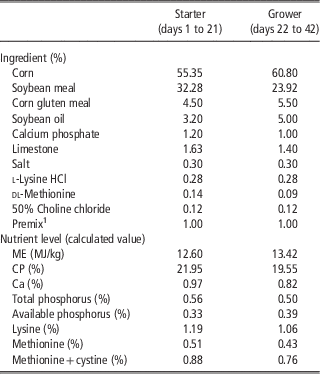
A total of 400 1-day-old Arbor Acres male broiler chickens were purchased from a commercial hatchery (Hewei Agricultural Development Co. Ltd, Anhui, China). All chickens were fed the same starter and grower diets from the 1st day to 28 days of age. On 28 day, 320 healthy birds were selected by weight and randomly allotted to three experimental diets supplemented with 0 (160 birds), 600 (80 birds) or 1200 mg/kg (80 birds) CMH in the basic grower diets. CMH was provided by Tianjin Tiancheng Pharmaceutical Co. Ltd, Tianjin, China. Each treatment was composed of 8 replicates with 10 birds each except the control with 20 birds in each replicate (10 birds/cage). The birds were kept in wired three-level battery cages (0.90×1.00×0.45 m) from 28 to 42 days of age and housed in an environmentally controlled room. Diets were fed in mash form and birds were allowed ad libitum access to feed and water. The ingredient composition and nutrient levels of the basal diets are shown in Table 1. On 42 day, BW and feed consumption were recorded for each replicate. Feed conversion ratio (FCR, feed : gain, g : g) were also calculated from 28 to 42 days.
Ingredient composition and calculated nutrient levels of the basal diets

ME=metabolizable energy.
1 Premix provided per kg of diet: phytase, 1200 U; xylanase, 2000 U; cellulose, 2000 U; vitamin A, 12 000 IU; vitamin D3, 2500 IU; vitamin E, 20 mg; menadione, 1.3 mg; thiamine, 2.2 mg; riboflavin, 8 mg; nicotinamide, 40 mg; calcium pantothenate, 10 mg; pyidoxine·HCl, 4 mg; biotin, 0.04 mg; folic acid, 1 mg; vitamin B12, 0.02 mg; iron, 80 mg; copper, 8 mg; manganese, 100 mg; zinc, 65 mg; iodine, 1.1 mg; selenium, 0.3 mg.
Experimental design and transportation
On the morning of 42 day, after an 8-h fast, the birds of CMH-free group were divided into two equal groups, but the birds in the other two groups maintained their original states. Each group was composed of 8 replicates with 10 birds each. All birds of these four groups were weighted and transported in the same truck from the rearing house to the laboratory according to the designed protocol as follows:
-
∙ Control: the broilers fed the basic grower diet and experienced 0.75-h transport, as a lower stress group (Zhang et al., Reference Zhang, Yue, Zhang, Xu, Wu, Yan, Gong and Qi2009; Yue et al., Reference Yue, Zhang, Wu, Xu, Zhang and Qi2010);
-
∙ T: the broilers fed the basic grower diet and experienced 3-h transport;
-
∙ T+CMH600: the broilers fed the basic grower diet supplementation with 600 mg/kg CMH from 28 to 42 days of age and experienced 3-h transport;
-
∙ T+CMH1200: the broilers fed the basic grower diet supplementation with 1200 mg/kg CMH from 28 to 42 days of age and experienced 3-h transport.
The transport conditions were set as follows: 10 birds from each replicate were held in one crate (1.2 ×0.7 ×0.25 m). All 32 crates undergoing different treatments were randomly distributed in the truck. The birds of the control group were transported from 0700 to 0745 h, and other three 3-h transport groups were transported from 0700 to 1000 h on 8 July 2013. The average temperatures and relative humidity inside of the truck were 28.7±4.1°C and 80.3% during the transport period, respectively. Transportation was carried out on a ring road between Jiangning and Xuanwu districts, Nanjing, China. The average speed was 60 km/h. No feed or water was supplied during the transport.
Sample collection
After transported to the laboratory, the birds were weighed in replicate again to calculate live weight loss. All 3-h transportation broilers were allowed to rest 0.75 h before slaughter. The control birds (0.75-h transport) were allowed to rest 3 h to ensure that all birds have same fast time (a total fast time of 11.75 h including the 8-h fast before transport) before slaughter. Immediately after rest, one bird with a BW close to the replicate (crate) average BW was selected (8 birds/treatment), weighed and then stunned by an electrical stunning water bath system (1% NaCl (wt/vol) in water; 50 V, 67 mA of alternating current, 400 Hz for 15 s each one) and then blood sample was collected via exsanguination of the left jugular vein with bistouries. For each bird, about 6 ml of blood was collected in a heparinized tube, shaken slightly and then centrifuged for 10 min at 2700×g at 4°C to get plasma. The plasma was stored at −20°C until analysis. The carcasses were then defeathered to determine carcass weight. The abdominal adipose tissue (from the proventriculus surrounding the gizzard down to the cloaca), breast muscle and thigh muscle from each bird were collected and weighed. Carcass dressing percentage, abdominal fat, breast muscle and thigh muscle were expressed as a percentage of BW.
Meanwhile, samples (~5.0 g each) from the left pectoralis major (breast) and tibialis anterior (thigh) muscle were quickly frozen in liquid nitrogen and stored at −80°C until analysis of muscle lactate, glycogen and GP. These two kinds of muscles were selected because they have different muscle fiber distribution pattern (Dubowitz, 1985; Zhang et al., Reference Zhang, Yue, Zhang, Xu, Wu, Yan, Gong and Qi2009). The right side breast and thigh muscle were taken to measure meat quality traits.
Plasma analysis
Plasma glucose concentration was determined using a commercial glucose oxidase kit (Shanghai Rongsheng Biotech Co. Ltd, Shanghai, China). Plasma corticosterone concentration was assessed with a commercial enzyme immunoassay kit (Cusabio Biotech. Co. Ltd, Wuhan, Hubei, China). All plasma parameters were measured according to the manufacturers’ instructions.
Meat quality measurement
Muscle pH at 45 min (pH45 min) and 24 h postmortem (ultimate pH, pHu) was measured triply using an HI9125 portable waterproof pH/ORP meter (Hanna Instruments, Cluj-Napoca, Romania). The pH probe was inserted at an angle of 45° into the breast and thigh muscle directly. Each sample was measured three times and their average value was taken as the final result. The pH decline within 24 h postmortem (ΔpH) was calculated as ΔpH=pHu−pH45 min (Zhang et al., Reference Zhang, Yue, Zhang, Xu, Wu, Yan, Gong and Qi2009).
Meat color was measured in duplicate at two different locations at 24 h postmortem using a Minolta CR-400 Chroma Meter (Konica Minolta Sensing Inc., Osaka, Japan) and the average values were reported. The CIE Lab system values of lightness (L*), redness (a*), and yellowness (b*) were recorded.
Drip loss was measured as described by Young et al. (Reference Young, Karlsson and Henckel2004). Briefly, ~30 g of regular-shaped muscle, cut from the same location in the right breast and thigh muscles, was weighed and placed in a nitrogen filled container to avoid evaporation and oxidation. After 24 h at 4°C, the muscle was cleaned of surface moisture using filter paper and reweighed. The drip loss was calculated as a percentage: ((initial weight−final weight)/initial weight)×100.
After testing the drip loss at 24 h postmortem, the meat samples were weighed and placed in individual new zip-sealed plastic bags and cooked in a water bath at 75°C for 15 min to reach an internal temperature of 70°C. Then, the meat was cooled in running water to ambient temperature, wiped with paper towels to remove excess moisture and reweighed. The cooking loss was calculated as (%): ((initial weight−cooked weight)/initial weight)×100. Then, the cooked samples were used for shear force value test using a TMS-Pro Texture Analyzer (Food Technology Corporation Co., Sterling, VA, USA) with a load cell of 100 N and a crosshead speed of 150 mm/min. The meat strips (3.0 cm long, 1.0 cm wide and 0.5 cm thick) were cut from the medial portion of the muscle, parallel to the longitudinal axis of the myofibers and sheared according to the procedure described by Honikel (Reference Honikel1998). Shear force was measured perpendicular to the axis of the muscle fibers in triplicate.
Muscle GP analysis
Muscle lactate and glycogen content were determined, modified from the methods of Hambrecht et al. (Reference Hambrecht, Eissen, Newman, Smits, Verstegen and den Hartog2005) and Zhang et al. (Reference Zhang, Yue, Zhang, Xu, Wu, Yan, Gong and Qi2009). The frozen muscle (0.5 g) was homogenized for 1 min in 4.5 ml ice cold saline and then centrifuged for 10 min at 2700×g at 4°C. The supernatant fraction was used to determine lactate content with a commercial lactic acid kit (Nanjing Jiancheng Bioengineering Institute, Nanjing, China). Another 0.5 g muscle was homogenized for 1 min in 4.5 ml ice cold perchloric acid solution (0.85 M HClO4) to inhibit glycolytic changes. The supernatant fraction was neutralized with 10 M KOH and stored at −80°C for analysis. Glycogen in supernatant fraction was hydrolyzed to glucose by incubation with amyloglucosidase (A7420; Sigma-Aldrich Inc., St. Louis, MO, USA) in acetate buffer (pH 4.8) at 55°C for 2 h. In this method, glycogen were hydrolyzed to glucose by incubation with amyloglucosidase and glucose-6-phosphate was catalyzed to glucose by incubation with glucose-6-phosphatase (Nanjing Jiancheng Bioengineering Institute), and then the glucose was determined with a commercial glucose oxidase kit. The GP was calculated as the sum of 2×(glycogen)+(lactate) and expressed as μmol of lactic acid equivalent per g of fresh muscle (Monin and Sellier, Reference Monin and Sellier1985).
Statistical analyses
The statistical analysis of the data was performed with the SAS program (version 8.02; SAS Institute Inc., Cary, NC, USA). The distribution of the data was checked for normality by the Shapiro−Wilks test. All data were normally distributed and were analysed using ANOVA, followed by a post hoc test (Tukey) for parametric data.
Results
Growth performance
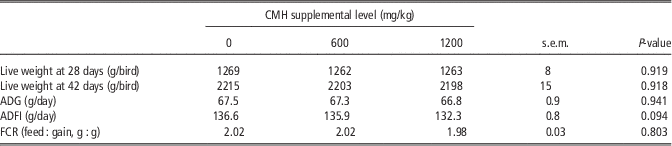
The growth performance of broiler chickens fed with CMH from 28 to 42 days of age was present in Table 2. Dietary supplementation with different CMH levels had no significant effect on average daily gain, average daily feed intake and FCR compared with the control group (P>0.05).
Effects of dietary supplementation with creatine monohydrate (CMH) during the finishing period on growth performance of male broilers from 28 to 42 days of age
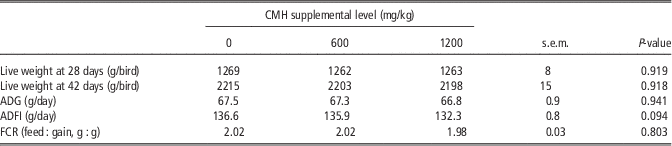
ADG=average daily gain; ADFI=average daily feed intake; FCR=feed conversion ratio.
The results are presented by mean values and the s.e.m.
Live weight loss and plasma variables
As shown in Table 3, a 3-h transport increased bird live weight loss and plasma corticosterone concentration and decreased plasma glucose concentration compared with the birds in the control group (P<0.05). Compared with the T group, supplementation of both 600 and 1200 mg/kg CMH did not affect the concentrations of plasma corticosterone and glucose. In addition, birds in T+CMH1200 group showed a lower live weight loss compared with birds in the T group (2.31% v. 2.92%, P<0.05).
Effects of dietary supplementation with creatine monohydrate (CMH) during the finishing period on live weight loss and concentrations of plasma variables of 3-h transported broilers

The results are presented by mean values and the s.e.m.
Means in the same row with different superscripts differ significantly (P<0.05).
1 Control=broilers fed on a basal grower diet and experienced 0.75-h transport; T=broilers fed on a basal grower diet and suffered from 3-h transport; T+CMH600=broilers fed on a basal grower diet supplementation with 600 mg/kg CMH from 28 to 42 days of age and suffered from 3-h transport; T+CMH1200=broilers fed on a basal grower diet supplementation with 1200 mg/kg CMH from 28 to 42 days of age and suffered from 3-h transport.
Carcass traits and meat quality
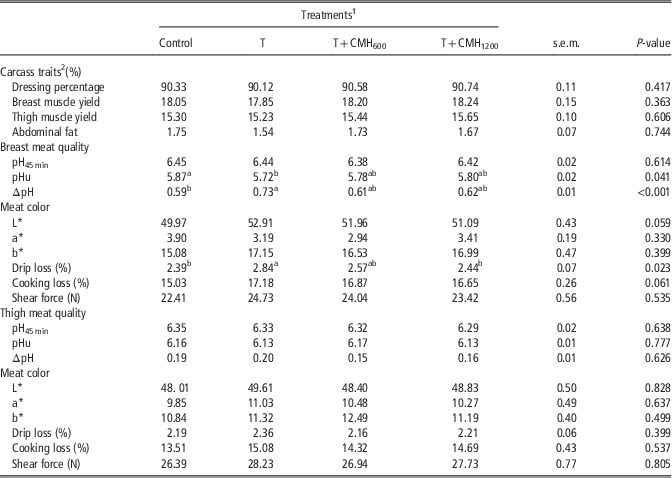
In the present study, a 3-h transport had no effect on dressing percentage, breast and thigh muscle yield, and abdominal fat yield, and meat quality of thigh muscle compared with the 0.75-h transport group (P>0.05, Table 4). Compared with the control group, a 3-h transport significantly decreased pHu, and increased pH decline within 24 h postmortem (ΔpH) and drip loss of breast meat (P<0.05). In T+CMH1200 group, the drip loss of breast muscle was significantly lower compared with the T group (P<0.05).
Effects of dietary supplementation with creatine monohydrate (CMH) during the finishing period on carcass traits and meat quality of 3-h transported broilers
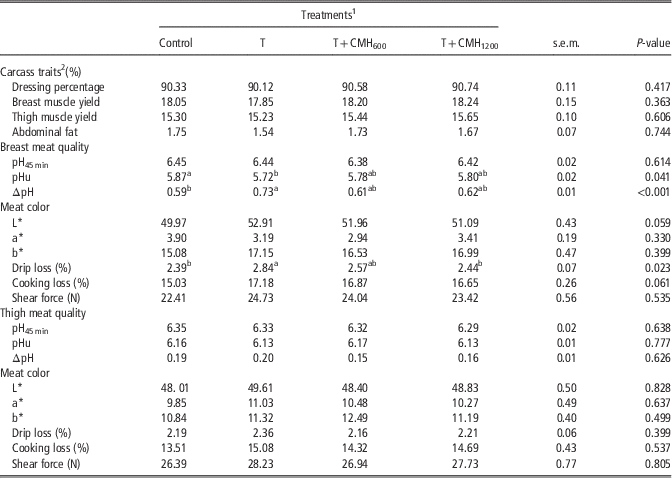
pH45 min=pH at 45 min postmortem; pHu=ultimate pH, the pH at 24 h postmortem; ΔpH=pHu−pH45 min; L*=lightness; a*=redness; b*=yellowness.
The results are presented by mean values and the s.e.m.
Means in the same row with different superscripts differ significantly (P<0.05).
1 Control=broilers fed on a basal grower diet and experienced 0.75-h transport; T=broilers fed on a basal grower diet and suffered from 3-h transport; T+CMH600=broilers fed on a basal grower diet supplementation with 600 mg/kg CMH from 28 to 42 days of age and suffered from 3-h transport; T+CMH1200=broilers fed on a basal grower diet supplementation with 1200 mg/kg CMH from 28 to 42 days of age and suffered from 3-h transport.
2 Percentages of BW at slaughter.
Muscle lactate, glycogen and GP
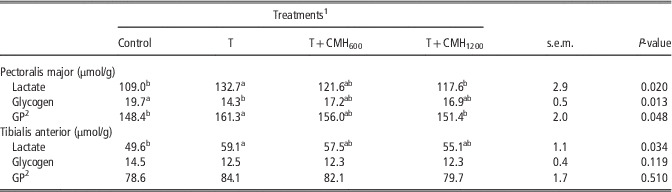
Compared with the control group, 3-h transport increased the content of lactate and GP (P<0.05, Table 5), as well as decreased the glycogen content in pectoralis major muscle (P<0.05), whereas dietary addition with 1200 mg/kg CMH decreased the contents of lactate and GP in pectoralis major muscle (P<0.05). Furthermore, 3-h transport also increased the lactate content in tibialis anterior muscle (P<0.05), although no significant effect on contents of glycogen and GP in tibialis anterior muscle was observed (P>0.05). Moreover, dietary CMH supplementation had no significant effect on content of lactate, glycogen and GP in tibialis anterior muscle compared with the T group (P>0.05).
Effects of dietary supplementation with creatine monohydrate (CMH) during the finishing period on muscle glycolytic potential at 45 min postmortem of 3-h transported broilers
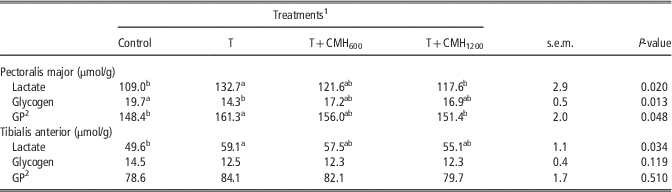
GP=Glycolytic potential.
The results are presented by mean values and the s.e.m.
Means in the same row with different superscripts differ significantly (P<0.05).
1 Control=broilers fed on a basal grower diet and experienced 0.75-h transport; T=broilers fed on a basal grower diet and suffered from 3-h transport; T+CMH600=broilers fed on a basal grower diet supplementation with 600 mg/kg CMH from 28 to 42 days of age and suffered from 3-h transport; T+CMH1200=broilers fed on a basal grower diet supplementation with 1200 mg/kg CMH from 28 to 42 days of age and suffered from 3-h transport.
2 GP=2×(glycogen)+(lactate) (Monin and Sellier, Reference Monin and Sellier1985). GP, lactate and glycogen are on a fresh-tissue basis.
Discussion
The present study showed that dietary supplementation with different levels of CMH for 14 days before slaughter had no effect on the overall growth performance of broilers, which is consistent with observation of Xia et al. (Reference Xia, Abdullahi, Zuo, Chen and Feng2012). In addition, addition of CMH (15 g/l) together with glucose (50 g/l) in the water at 18 or 48 h before slaughter also did not affect BW gain of broilers (Young et al., Reference Young, Karlsson and Henckel2004; Nissen and Young, Reference Nissen and Young2006).
The live weight loss of broilers during transportation is closely related to the transport distance and time. Sowinska et al. (Reference Sowinska, Wojcik, Pomianowski, Chorazy, Mituniewicz, Witkowska, Piotrowska, Kwiatkowska-Stenzel, Czaplinska and Kuczynska2013) reported that elongation of transport length for a distance of 200 and 300 km significantly increased broiler weight loss. In this study, a 3-h transport increased broiler weight loss, which agrees with findings of Karaman (Reference Karaman2009) and Sowinska et al. (Reference Sowinska, Wojcik, Pomianowski, Chorazy, Mituniewicz, Witkowska, Piotrowska, Kwiatkowska-Stenzel, Czaplinska and Kuczynska2013). Surprisingly, broilers in T+CMH1200 group showed a lower weight loss than that in the T group in the present study, indicating that CMH had a potential to maintain BW of chickens subjected to transport stress.
Plasma corticosterone concentration is a sensitive parameter that reflects the stress levels of transported broilers (Zhang et al., Reference Zhang, Yue, Zhang, Xu, Wu, Yan, Gong and Qi2009). In our study, the chickens in T group showed higher concentration of plasma corticosterone, indicating that these broilers experienced more stress during 3-h transportation than those transported for 0.75 h. A 0.75-h transport has been reported to cause an elevation in plasma glucose concentration in both fast-growing and slow-growing broilers, which may partially be due to glycogen breakdown in the liver (Zhang et al., Reference Zhang, Yue, Zhang, Xu, Wu, Yan, Gong and Qi2009; Yue et al., Reference Yue, Zhang, Wu, Xu, Zhang and Qi2010). Our present result indicated that 3-h transportation accelerated the reduction of bird plasma glucose, regardless of dietary addition of CMH or not.
The present study showed that transportation or CMH supplementation had no effect on dressing percentage, breast and thigh muscle yield, and abdominal fat of broilers, which is in accordance with some previous studies (Bianchi et al., Reference Bianchi, Petracci and Cavani2005; Doctor and Poltowicz, Reference Doctor and Poltowicz2009; Chen et al., Reference Chen, Wang, Kong, Ma and Zou2011).
Dadgar et al. (Reference Dadgar, Lee, Leer, Burlinguette, Classen, Crowe and Shand2010) found that birdsexperienced a 3- to 4-h transport under higher temperature (20<T⩽30°C) showed a lower pHu and higher cooking loss in breast muscle than those transported under lower temperature (T⩽20°C). In this experiment, 3-h transport also decreased pHu, and increased ΔpH and drip loss of breast meat. These results are contrary to the reports from Zhang et al. (Reference Zhang, Yue, Zhang, Xu, Wu, Yan, Gong and Qi2009) and Yue et al. (Reference Yue, Zhang, Wu, Xu, Zhang and Qi2010), primarily because the broilers suffered from more stress in our present study owing to an 8-h fast before transport compared with Zhang et al. (Reference Zhang, Yue, Zhang, Xu, Wu, Yan, Gong and Qi2009) and Yue et al. (Reference Yue, Zhang, Wu, Xu, Zhang and Qi2010) who did not remove feed and water from the broilers until transport. In addition, no influence on overall thigh meat quality characteristics suggested that breast muscle are more vulnerable to meat quality deterioration when birds are subjected to transport stress.
Previous studies showed that CMH supplementation in drinking water enhanced breast muscle water-holding capacity (WHC) of chickens (Young et al., Reference Young, Karlsson and Henckel2004; Nissen and Young, Reference Nissen and Young2006). Therefore, they concluded that the CMH could increase the intracellular volume by elevating water uptake in the muscle, resulting in an increase of water content and WHC. The present study showed that 3-h transport significantly increased drip loss of breast muscle, while 1200 mg/kg CMH supplementation significantly reduced the breast drip loss, which helps maintain breast meat quality of transported broilers.
Glycogen is the major energy reserve in skeletal muscle. It is well known that aerobic glycolysis generates a maximum of 38 molecules of ATP per molecule of glucose, whereas anaerobic glycolysis produces only 2 net ATPs per molecule of glucose or glycogen along with lactate fermentation (David and Michael, Reference David and Michael2008). Some previous studies demonstrated that anaerobic glycolysis of muscle glycogen is enhanced when broilers experienced transport stress (Savenije et al., Reference Savenije, Lambooij, Gerritzen, Venema and Korf2002; Zhang et al., Reference Zhang, Yue, Zhang, Xu, Wu, Yan, Gong and Qi2009), resulting in lactate accumulation and further muscle pHu reduction (Khan and Nakamura, Reference Khan and Nakamura1970). These previous results indicated that lactate accumulation caused by rapid anaerobic glycolysis is the main reason for muscle pH decline of transported chickens. Warriss et al. (Reference Wariss, Kestin, Brown, Knowles, Wilkins, Edwards, Austin and Nicol1993) reported that the glycogen content of biceps femoris muscle decreased with the increase in transport time, while that of the breast muscle did not change, probably because the thigh muscle is involved in maintaining balance in the moving vehicle during transportation. In this study, 3-h transport decreased glycogen content with an increase in lactate content in both breast muscle and thigh muscles, which is in agreement with some previous reports (Savenije et al., Reference Savenije, Lambooij, Gerritzen, Venema and Korf2002; Zhang et al., Reference Zhang, Yue, Zhang, Xu, Wu, Yan, Gong and Qi2009). Muscle glycogen reservation at the moment of death is also reflected in the GP (Monin and Sellier, Reference Monin and Sellier1985). In the present study, higher lactate content and GP in breast muscle was accompanied with a faster pH decline (ΔpH), lower pHu and higher drip loss in 3-h transported broilers, suggesting that transport-induced negative changes of breast meat quality was mainly because of the enhancement of glycolytic metabolism and the accumulation of muscle lactate.
It is well known that the thigh muscle (tibialis anterior) consists of type I (slow-twitch oxidative), type IIa (fast-twitch oxidative glycolytic) and type IIb (fast-twitch glycolytic) fibers, which produces energy relying primarily on aerobic glycolysis of type I fibers; however, the pectoralis major muscle of market-age broilers mainly consists of type IIb fibers with higher glycogen content, which produces energy primarily by anaerobic glycolysis of the glycogen (Choi et al., Reference Choi, Ryu and Kim2006; Zhang et al., Reference Zhang, Yue, Zhang, Xu, Wu, Yan, Gong and Qi2009). Therefore, the percentage of type IIb fibers is negatively related to the muscle pHu and positively related to drip loss and lightness (Ryu and Kim, Reference Ryu and Kim2005). In the current study, the more negative changes in meat quality observed in the breast muscle of 3-h transported broilers is likely because of the faster glycolytic rate compared with that of the thigh muscle.
The primary effect of CMH is to increase the creatine phosphate load in the muscle, which is the main source of energy for contracting muscle fibers during intense bouts of physical activity or anaerobic effort (Harris et al., Reference Harris, Soderlund and Hultman1992; Casey and Greenhaff, Reference Casey and Greenhaff2000). Consequently, a higher glycogen content accompanied with lower lactate content was observed in pectoralis major muscle of T+CMH1200 group compared with those in the T group. CMH supplementation with a dose of 1200 mg/kg significantly decreased the contents of lactate and GP in pectoralis major muscle, indicating that the reduction muscle glycolysis by CMH supplementation is probably the reason for maintain meat quality of transported broilers. In addition, it has been demonstrated that creatine can attenuate acute stress responses via direct antioxidant activity (Lawler et al., Reference Lawler, Barnes, Wu, Song and Demaree2002; Deminice and Jordao, Reference Deminice and Jordao2012). We thus recommended that further studies are needed to investigate whether the protective effect of CMH supplementation for maintaining meat quality in transported broilers is also closely related to its antioxidant activity.
In summary, dietary supplementation with different levels of CMH for 14 days before slaughter did not affect the overall growth performance and carcass traits of broilers. A 3-h transport decreased plasma glucose concentration, elevated plasma corticosterone concentration, increased weight loss, enhanced the muscle glycolysis and subsequently induced some detrimental changes to breast meat quality (lower pHu and higher drip loss). Nevertheless, supplementation of 1200 mg/kg CMH reduced chicken weight loss, drip loss, as well as decreased the contents of lactate and GP in pectoralis major of 3-h transported broilers. These findings suggest that the reduction of muscle glycolysis is probably the reason for maintain meat quality by supplementation of CMH in transported broilers.
Acknowledgments
This work was supported by the Science and Technology Innovation Fund for the Youth of Nanjing Agricultural University (Y0201300225), the National Natural Science Foundation of China (3140130455), the National Science & Technology Pillar Program during the 12th five-year plan period of China (2012BAD28B03), the Three Agricultural Projects of Jiangsu province of China (SX(Reference Chen, Wang, Kong, Ma and Zou2011)146) and Scientific Research Fund for the Youth of College of Animal Science and Technology of Nanjing Agricultural University.