INTRODUCTION
In infectious disease epidemiology, the basic reproduction number, R0, is defined as the average number of secondary cases caused by one infected individual entering a population consisting solely of susceptible individuals (Anderson and May, Reference Anderson and May1990; Diekmann et al. Reference Diekmann, Heesterbeek and Metz1990; Hartemink et al. Reference Hartemink, Randolph, Davis and Heesterbeek2008). R0 has a number of important applications. It has a threshold value such that if R0>1, a pathogen will persist should it be introduced, whilst R0<1 suggests it will die out. R0 is also a measure of the risk that an outbreak may occur and, when an outbreak does occur, it gives a measure of the initial rate of exponential increase of infected individuals. The proportion of a population that requires vaccination in order to prevent an outbreak is also determined using R0 (Anderson and May, Reference Anderson and May1990; Diekmann et al. Reference Diekmann, Heesterbeek and Metz1990; Hartemink et al. Reference Hartemink, Randolph, Davis and Heesterbeek2008). R0, however, is difficult to define in natural systems due to indeterminate variability in susceptibility, infectivity and contact rates among individuals. This problem is often compounded by the presence of multiple host species and transmission routes (Hartemink et al. Reference Hartemink, Randolph, Davis and Heesterbeek2008). Given the importance of R0 in the epidemiology of infectious diseases there have been many attempts to define R0 for tick-borne infections (Randolph, Reference Randolph1998; Norman et al. Reference Norman, Bowers, Begon and Hudson1999; Randolph et al. Reference Randolph, Miklisova, Lysy, Rogers and Labuda1999; Caraco et al. Reference Caraco, Glavanakov, Chen, Flaherty, Ohsumi and Szymanski2002; Rosa et al. Reference Rosą, Pugliese, Norman and Hudson2003; Ghosh and Pugliese, Reference Ghosh and Pugliese2004; Rosa and Pugliese, Reference Rosą and Pugliese2007). More recently, next generation matrix methods have been employed to address the complexities of infections in natural systems (Hartemink et al. Reference Hartemink, Randolph, Davis and Heesterbeek2008) which has resulted in the most comprehensive and biologically correct estimation of R0 for tick- borne infections.
Tick species of the genus Ixodes are important vectors of numerous pathogens worldwide (Parola and Raoult, Reference Parola and Raoult2001). Throughout Europe, I. ricinus is the vector of Babesia microti, Anaplasma phagocytophilum and Borrelia burgdorferi sensu lato, the agents of human babesiosis, human granulocytic anaplasmosis and Lyme borreliosis respectively (Duh et al. Reference Duh, Petrovec and Avsic-Zupanc2001; Parola, Reference Parola2004; Stanzak et al. Reference Stanzak, Gabre, Kruminis-Lozowska, Racewicz and Kubica-Biernat2004). To be a competent vector, more than 1 developmental stage of I. ricinus must acquire a bloodmeal from a given host species. For trans-stadial transmission, larvae and nymphs that feed on an infected host, develop to the next instar, and infect a new host during their subsequent feed as nymphs or adults, thereby maintaining a cycle of infection. (Randolph and Storey, Reference Randolph and Storey1999). In some cases, ticks can also acquire an infection by feeding alongside infected ticks, without the need for systemic infection of the host (Jones et al. Reference Jones, Davies, Steele and Nuttall1987; Randolph et al. Reference Randolph, Gern and Nuttall1996). In Europe, rodents host both larvae and nymphs of I. ricinus (Milne, Reference Milne1949; Gern et al. Reference Gern, Estrada-Pena, Frandsen, Gray, Jaenson, Jongejan, Kahl, Korenberg, Mehl and Nuttall1998; Liz et al. Reference Liz, Anderes, Sumner, Massung, Gern, Rutti and Brossard2000; Karbowiak, Reference Karbowiak2004) and are competent transmission hosts of B. microti, A. phagocytophilum and B. burgdorferi s.l. B. microti is a small mammal specific pathogen whilst A. phagocytophilum infects both small mammals and large mammals such as deer, although it is thought that separate A. phagocytophilum strains exist in discrete small mammal and large mammal cycles (Bown et al. Reference Bown, Lambin, Ogden, Begon, Telford, Woldehiwet and Birtles2009). Members of the B. burgdorferi s.l. complex utilize a range of vertebrate transmission hosts, for example, the B. valaisiana genospecies is associated with birds and B. afzelii with rodents (Kurtenbach et al. Reference Kurtenbach, De Michelis, Etti, Schäfer, Sewell, Brade and Kraiczy2002). Deer are not considered competent transmission hosts of B. burgdorferi s.l. (Telford et al. Reference Telford, Mather, Moore, Wilson and Spielman2006). In some locations, as in Ireland, nymphs of I. ricinus may be found in extremely low numbers or be completely absent from small mammals (Gray et al. Reference Gray, Kirstein, Robertson, Stein and Kahl1999, Reference Gray, Robertson and Key2000; Harrison et al. Reference Harrison, Scantlebury and Montgomery2010). This has led to the suggestion that small mammals may not always be important transmission hosts of tick-borne infections (Gray et al. Reference Gray, Kirstein, Robertson, Stein and Kahl1999, Reference Gray, Robertson and Key2000).
We used empirical data from Ireland, where the incidence of nymphs of I. ricinus on small mammals is low, and previously published tick, and pathogen-specific, data to parameterize the R0 model of Hartemink et al. (Reference Hartemink, Randolph, Davis and Heesterbeek2008). This model was then used to predict whether infections of B. microti, A. phagocytophilum, and B. burgdorferi s.l. were likely to persist in small mammal populations. The model was also used to investigate how changes in the proportion of transmission-competent hosts on which I. ricinus had fed, the transmission efficiency of pathogens to and from ticks and hosts, and the abundance of larvae and nymphs on hosts, affects pathogen persistence in small mammals. Predictions of the model were validated by screening small mammals and ticks for pathogens by PCR.
MATERIALS AND METHODS
Calculation of R0
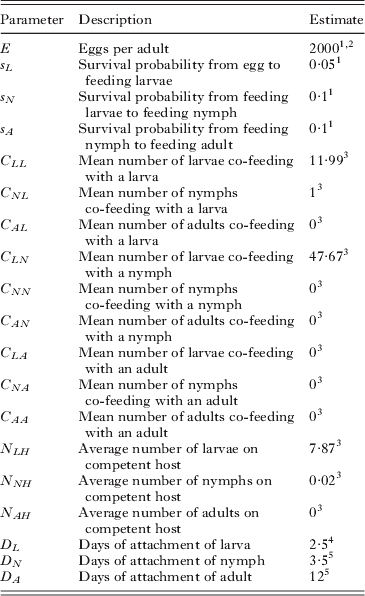
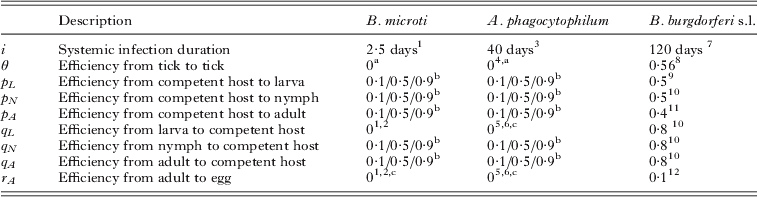
In the current study, R0 was calculated as a function of h c, the proportion of competent hosts on which I. ricinus is feeding, for B. microti, A. phagocytophilum and B. burgdorferi s.l. using the next-generation matrix method of Hartemink et al. (Reference Hartemink, Randolph, Davis and Heesterbeek2008). Each element in the matrix was calculated using previously published tick-related and pathogen-specific parameters and tick-related parameters describing the distribution of life stages of I. ricinus on A. sylvaticus specific to the current study (Tables 1 and 2). As there is a paucity of literature regarding the transmission efficiency of B. microti and A. phagocytophilum from I. ricinus to small mammal hosts (β T−V) and from small mammal hosts to I. ricinus (β V−T), R0 was calculated using low, medium and high transmission efficiency scenarios for these pathogens using transmission coefficients of 0·1, 0·5, and 0·9 respectively. In the case of B. burgdorferi s.l. previously published transmission coefficients were used.
Ecological parameters for Ixodes ricinus derived from the literature and the current study (adapted from Hartemink et al. (Reference Hartemink, Randolph, Davis and Heesterbeek2008).)

Ecological parameters for B. microti, A. phagocytophilum and B. burgdorferi s.l. (adapted from Hartemink et al. (Reference Hartemink, Randolph, Davis and Heesterbeek2008).)

To investigate what impact the abundance of larval and nymphal stages on hosts may have on the ability of these tick-borne pathogens to become established, or persist, in the current study, R0 was calculated using a fixed value of h c (corresponding to the value obtained for A. sylvaticus from bloodmeal analysis) across a range of mean loads of larval and nymphal ticks using a medium level transmission coefficient of 0·5 for B. microti and A. phagocytophilum and previously published transmission coefficients for B. burgdorferi s.l.
R0 was calculated via the spectral decomposition of the parameterized next-generation matrix that yields a set of eigenvalues, the largest of which is R0. The matrix was decomposed using the eigen (matrix) function in package base of the R software package available under GNU licence from www.r-project.org.
Study sites
Five sites supporting mixed broadleaf and coniferous woodland sites in Northern Ireland were sampled over 8 weeks from May until July 2007. Sites were selected on the basis that they had resident populations of red deer, Cervus elaphus, (2 sites) or fallow deer, Dama dama, (3 sites) and were therefore likely to have ticks present.
Small mammal samples
In total, 180 Self-set snap traps were deployed in pairs at 15 m intervals in vegetation adjacent to forest tracks. Traps were set after 6 pm in the evening and collected before 8 am the following morning. Each mouse was stored separately in a sealed sample bag that was also searched for unattached ticks. Ticks were removed from each mouse using fine forceps and a stiff bristle brush paying particular attention to the margins of the pinna. The total number of ticks was recorded per mouse and identified to species using standard keys (Snow, Reference Snow1978; Arthur, Reference Arthur1963). Their developmental stage was recorded as larvae, nymph or adult. Blood of mice was sampled by cardiac puncture using a sterile 5 ml, 21-gauge syringe and needle, blood was stored in individual 1·5 ml microcentrifuge tubes at −20°C prior to DNA extraction.
Sampling of questing ticks
The abundance of questing ticks was assessed using a standardized drag sampling technique. A 1 m×1 m square piece of towelled material, weighted and spread out with bars at the leading and rear edge was dragged along a 15 m transect of trackside grass at 1 ms−1 with a total of 20 transects per forest site. Ticks were removed from the drag after each transect using fine forceps and stored in 70% ethanol. Ticks were identified to species level using standard keys, counted, and the developmental stage recorded. In addition to ticks collected from standardized drag sample transects, additional drag samples were conducted to increase the sample size of ticks available for screening for tick-borne pathogens. All sites were sampled for questing ticks at the same time as small mammal trapping (May, June and July, 2007).
DNA extraction
DNA was extracted from blood by alkaline digestion (Bown et al. Reference Bown, Begon, Bennett, Woldehiwet and Ogden2003). First, 0·5 ml of 1·25% ammonia solution was added to 50 μl of blood in a Sure-Lock microcentrifuge tube (Fisher Scientific, Loughborough, UK) and heated to 100°C for 20 min. Tubes were centrifuged, opened and heated until half the initial volume remained. The solution was diluted 1 in 10 with sterile, deionized distilled water. The same method was used to extract DNA from ticks that had first been macerated using a pipette tip. DNA extracts of ticks were not diluted. Only nymphal and adult ticks were tested for the presence of pathogens.
Detection of pathogens via polymerase chain reaction (PCR)
An Apicomplexa-specific PCR targeting the 18S rRNA gene was used to test for the presence of Babesia microti (Simpson et al. Reference Simpson, Panciera, Hargreaves, McGarry, Scholes, Bown and Birtles2005). A. phagocytophilum and B. burgdorferi s.l. infections were detected using a real-time PCR assay as previously described by Courtney et al. (Reference Courtney, Kostelnik, Zeidner and Massung2004). Samples positive for A. phagocytophilum were subjected to a second, nested PCR assay targeting the msp4 gene for sequence determination (De La Fuente et al. Reference De La Fuente, Massung, Wong, Chu, Lutz, Meli, Von Loewenich, Grzeszczuk, Torina and Caracappa2005; Bown et al. Reference Bown, Lambin, Ogden, Petrovec, Shaw, Woldehiwet and Birtles2007). Samples positive for B. burgdorferi s.l. were subjected to a second, nested PCR targeting the 5S-23S intergenic spacer region (Rijpkema et al. Reference Rijpkema, Molkenboer, Schouls, Jongejan and Schellekens1995). All PCRs included negative controls in a ratio of 1:5 and positive controls. Amplification products were purified using a Qiaquick PCR purification kit (Qiagen) and sequences determined using a commercial sequencing service (Macrogen, Korea). Sequence data from successfully sequenced amplification products were used to search for other closely related sequences using the NCBI nucleotide BLAST database. Sequences were aligned and compared using BioEdit v7.0.9© (Ibis Biosciences, California, USA).
Bloodmeal analysis
Bloodmeal analysis, to identify hosts that questing I. ricinus nymphs had fed on as larvae, was conducted using a published reverse line blot (RLB) protocol (Humair et al. Reference Humair, Douet, Cadenas, Schouls, Van De Pol and Gern2007). Five probes were used (‘Apodemus’, ‘bird’, ‘Capreolus’, ‘Sciurus’ and ‘Sorex’) as they represent the most likely vertebrate hosts present at study sites, targeting Apodemus sylvaticus, birds, deer, squirrel spp. and Sorex minutus respectively.
RESULTS
The basic reproduction number, R0
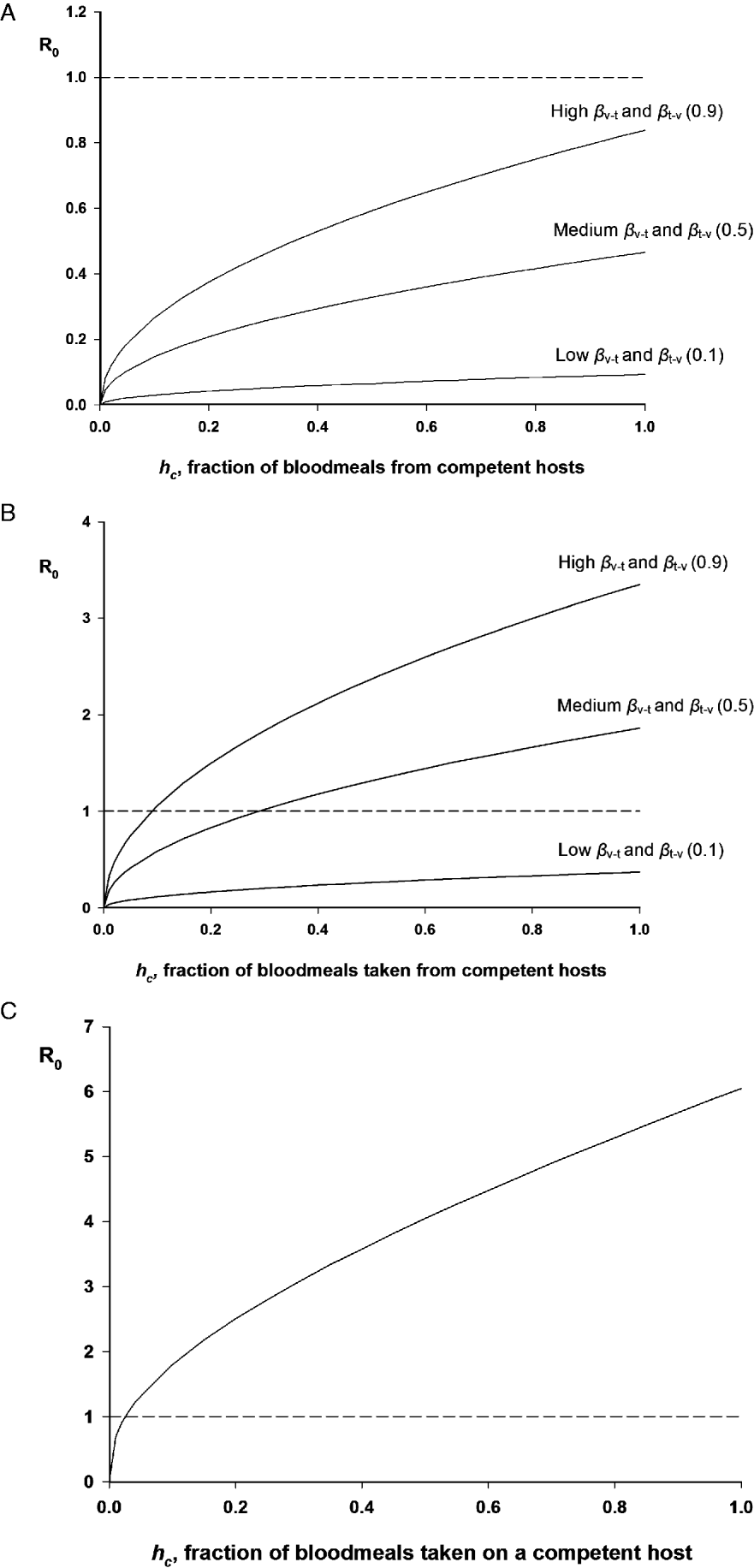
Values of R0 plotted as a function of h c (the proportion of competent hosts on which I. ricinus is feeding), for B. microti, A. phagocytophilum and B. burgdorferi, s.l. are presented in Fig. 1.
R0 plotted as a function of h c, the fraction of bloodmeals taken on a competent host, for (a) Babesia microti, (b) Anaplasma phagocytophilum (both under low, medium and high transmission efficiency scenarios) and (c) Borrelia burgdorferi s.l. using previously published transmission coefficients (cited by Hartemink et al. Reference Hartemink, Randolph, Davis and Heesterbeek2008).

In the case of B. microti, the threshold value for R0 was never reached regardless of the proportion of competent hosts on which I. ricinus had fed or the transmission efficiency scenario employed. This was also the case for A. phagocytophilum under low transmission efficiency. However, for medium and high transmission scenarios the proportion of competent hosts on which I. ricinus was required to feed upon in order for the threshold value to be reached were 30% and 9% respectively. When h c was fixed at 11·45% (representing 11 out of 96 positive reactions obtained for A. sylvaticus during bloodmeal analysis) the transmission coefficient required to produce a value of R0>1 for A. phagocytophilum was 0·795. In contrast, the threshold value of R0 was rapidly achieved for B. burgdorferi s.l. with only 2·55% of competent hosts required to be feeding I. ricinus for the threshold to be reached.
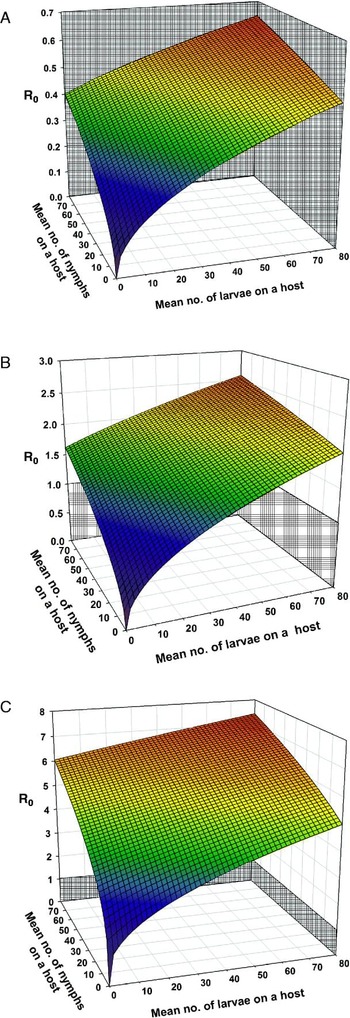
A plot of the interaction between mean number of larvae and nymphs on a competent host and R0 for each pathogen is presented in Fig. 2. In the case of B. microti, increasing the mean number of larvae and nymphs on the host slowly increased the value of R0, but even at unrealistically high tick burdens (80 larvae and 80 nymphs) the threshold value of R0 was not reached. In the case of A. phagocytophilum, however, the threshold value was achieved much more rapidly, requiring, only a single larvae and 30 nymphs or 20 larvae and a single nymph for the threshold value to be achieved. Similarly, in the case of B. burgdorferi s.l. the value of R0 increased rapidly with increasing tick load, requiring only a single larvae and a single nymph for the threshold value of R0 to be reached.
Interaction of mean larval and nymphal abundance of Ixodes ricinus on Apodemus sylvaticus and R0 for (a) Babesia microti, (b) Anaplasma phagocytophilum and (c) Borrelia burgdorferi s.l. assuming a medium level transmission efficiency of 0·5 for (a, b), previously published transmission coefficients (cited by Hartemink et al. 1998) for (c) and h c=11·45% for all 3 pathogens. Hatching indicates areas of the plot where R0<1.

Tick distribution
A total of 233 questing ticks consisting of 100 larvae, 129 nymphs and 4 adults were collected from standardized drag samples. The only tick species identified was I. ricinus. Densities were generally low with a mean abundances per m2±s.e. for larvae, nymphs and adults of 0·086±0·019, 0·067±0·014, and 0·003±0·001 respectively. A total of 1168 ticks consisting of 1165 larvae, 3 nymphs and 0 adults were collected from wood mice, giving an overall nymph:larvae ratio of 1:388. Again, the only tick species recovered was I. ricinus. Mean tick burdens per mouse±s.e. for larvae, nymphs and adults were 7·871±1·087, 0·020±0·011 and 0 respectively. The distribution of ticks on wood mice was overdispersed, with a small proportion of the host population (20%) feeding the majority of larvae (72%) and all nymphs.
Pathogen detection
In addition to the 100 nymphs and 4 adult ticks collected by standardized drag samples, a further 167 nymphs and 6 adults were collected by non-standardized drags. In total, 137 wood mice and 277 ticks (267 nymphs and 10 adults) were tested for the presence of B. microti and A. phagocytophilum whilst the 277 ticks were also tested for B. burgdorferi s.l. Three I. ricinus nymphs tested positive for the presence of A. phagocytophilum but no wood mice or adult ticks were positive. Of the 277 ticks screened for the presence of B. burgdorferi s.l. 20 nymphs were positive. No samples were positive for the presence Babesia microti.
Sequence analyses
(a) A. phagocytophilum
Of the 3 tick samples that tested positive for A. phagocytophilum, 2 (R14 and R49) were sequenced successfully. R14 and R49 were not identical but shared 96·3% similarity. R14 was identical to a strain found in a dog in Slovenia (GenBank Accession no. EF442004), whilst R49 was most closely related to strains recovered from red and roe deer in Slovakia and a lamb from Norway sharing 98·0% sequence similarity (EU180065, EF442003 and EU240474, respectively). All percentage similarities are across 301 base pairs.
(b) B. burgdorferi s.l
Of the 20 ticks that tested positive for B. burgdorferi s.l. 13 were sequenced successfully. R6, R17, R21, R57, T5, T61 and TC64 were most closely related to the B. garinii genospecies (AB178361) sharing 96·4%–98·2% sequence similarity. TC33 and TC19 were most closely related to the B. afzelii-type strain (GQ369937) with 93·2% and 98·6% sequence similarity and L1, TC16, R64 and T1 were most closely related to the B. valaisiana genospecies (L30134) with 93·5%–97·3% similarity. Therefore, 85% of B. burgdorferi-positive samples successfully sequenced were bird-associated genospecies whilst 15% were associated with rodents. All percentage similarities are across 225 base pairs.
Bloodmeal analysis
A total of 170 questing I. ricinus nymphs collected from 4 sites were included in bloodmeal analysis, 83 of which yielded positive reactions. DNA from more than 1 host was found in 13/83 positive reactions resulting in 96 host identifications made from 83 positive reactions. Birds were the most important hosts for I. ricinus nymphs feeding as larvae and were present in 51 out of 96 host identifications. Deer were the second most important hosts (18/96) followed by wood mice and pygmy shrews (both 11/96). Squirrels were the least important hosts for larval ticks, present in only 5 out of 96 host identifications. None of the ticks that tested positive for A. phagocytophilum yielded reactions in the bloodmeal analysis. Sixteen of the 20 nymphs that tested positive for B. burgdorferi s.l. were included in bloodmeal analysis. Of the 8 B. burgdorferi s.l. positive samples identified as the B. valaisiana genotype by sequence analysis, 4 gave positive reactions all of which indicated that the ticks had previously fed on birds. Of the 3 B. burgdorferi s.l. positive samples identified as B. garinii, 1 gave a positive host identification indicating that this tick had also fed on a bird. Neither of the samples identified as B. afzelii by sequence analysis gave positive host identifications. Two samples which gave positive host identifications were of mixed origin, both of which included a deer and shrew signal.
DISCUSSION
The basic reproduction number, R0, responded differently for each pathogen in response to the proportion of competent hosts on which I. ricinus fed and the mean abundance of larval and nymphal ticks on hosts. Values of R0 suggested that B. microti could not persist given the distribution of life-history stages of ticks on wood mice, even if the transmission coefficients were high, if ticks fed solely on competent reservoir hosts, or if tick larval and nymphal tick burdens were unrealistically high. This was supported by the absence of B. microti in wood mice and questing ticks when screened by PCR. The inability of B. microti to become established or persist in this system is likely to be a product of the short period of infectivity that this pathogen has for ticks of 1–4 days (Randolph, Reference Randolph1995).
In the case of A. phagocytophilum, the threshold value of R0 was achieved, but only when the proportion of competent hosts on which I. ricinus had fed was greater than that of the current study or when the transmission coefficient was unrealistically high. A. phagocytophilum was not detected in small mammals but A. phagocytophilum was found in questing ticks. However, sequence analysis revealed that the strains were most closely related to those recovered from large mammals across Europe suggesting that other, large mammal, hosts of I. ricinus present at the study site were responsible for these infections. Moreover, Bown et al. (Reference Bown, Lambin, Ogden, Begon, Telford, Woldehiwet and Birtles2009) observed that different A. phagocytophilum strains exist in discrete enzootic small mammal and large mammal cycles. The prevalence of infection of I. ricinus nymphs was low (1·12%) and the probability of a mouse feeding a nymph was also low (2·02%). Even if different strains of A. phagocytophilum were capable of utilizing both large and small mammals the probability of a nymph infected with A. phagocytophilum feeding on a mouse was extremely low (0·02% or 1 in 5000) making the spillover of A. phagocytophilum from larger to small mammals highly unlikely. Therefore, it is highly probable that the A. phagocytophilum strains present in the current study were involved in an ungulate-tick cycle and that no A. phagocytophilum cycles were present in wood mice.
In contrast to B. microti and A. phagocytophilum, the threshold value of R0 for B. burgdorferi s.l. was achieved rapidly, requiring I. ricinus to feed on a much smaller proportion of competent hosts than encountered in the current study (2·55%). This threshold value was reached using realistic transmission coefficients and required fewer larval and nymphal tick abundances to feed on mice than that recorded in the current study. Values of R0 indicated that small mammals alone could maintain cycles of infection of B. burgdorferi s.l. without the need for alternative transmission hosts. s.l. This suggestion was at least partially supported by the identification of B. afzelii, a rodent-associated Borrelia genospecies (Kurtenbach et al. Reference Kurtenbach, De Michelis, Etti, Schäfer, Sewell, Brade and Kraiczy2002), in questing ticks. However, the origin of the B. afzelii infections could not be determined by bloodmeal analysis. Squirrels are also competent reservoirs of this Borrelia genospecies (Craine et al. Reference Craine, Nuttall, Marriott and Randolph1997) and it is possible that they were the origin of the infection.
Differences in the response of R0 between B. microti and A. phagocytophilum most likely lie in differences in the systemic infection duration. Clinical infections of B. microti have been detected for up to 31 days post-infection by PCR in the USA (Vannier et al. Reference Vannier, Borggraefe, Telford, Menon, Brauns, Spielman, Gelfand and Wortis2004). As previously mentioned, Randolph (Reference Randolph1995) observed that in the actual period of infectivity for ticks feeding on an infected host is 1–4 days using British strains. A. phagocytophilum infections have been detected by PCR for up to 40 days post-infection (Telford et al. Reference Telford, Dawson, Katavolos, Warner, Kolbert and Persing1996) but the actual period of infectivity is unknown. If, like B. microti, the period of infectivity is much less than the period where the infection can be detected by PCR then the threshold value of R0 would be more difficult to achieve and infection cycles of A. phagocytophilum less likely to develop.
The ability of B. burgdorferi s.l. to become established more readily in the wood mouse-tick system than other pathogens is a product of its relatively long systemic infection duration and the secondary route of infection available via efficient co-feeding transmission (Randolph et al. Reference Randolph, Gern and Nuttall1996).
As expected, wood mice were infected almost exclusively with larvae and only 3 nymphs were recovered. The resultant small nymph to larvae ratio (1:388) is comparable to those found elsewhere in Ireland (1:∞ and 1:650 (Gray et al. Reference Gray, Kahl, Janetzki and Stein1992) and 1:105 (Gray et al. Reference Gray, Kirstein, Robertson, Stein and Kahl1999) but is generally much smaller than those recorded across the rest of Europe (min=1:7, max=1:185, mean=1:44, n=19) (Matuschka et al. Reference Matuschka, Fischer, Musgrave, Richter and Spielman1991; Humair et al. Reference Humair, Turrian, Aeschilimann and Gern1993; Talleklint and Jaenson, Reference Talleklint and Jaenson1994; Kurtenbach et al. Reference Kurtenbach, Kampen, Dizij, Arndt, Seitz, Schaible and Simon1995; Humair et al. Reference Humair, Rais and Gern1999; Randolph and Storey, Reference Randolph and Storey1999; Randolph et al. Reference Randolph, Miklisova, Lysy, Rogers and Labuda1999)). It has been suggested that climatic conditions, such as humidity and temperature, can determine the distribution of tick life stages on hosts (Randolph and Storey, Reference Randolph and Storey1999). Ticks are prone to desiccation and immature stages are more susceptible than adults due to their smaller surface area to volume ratio, higher metabolic rate and limited fat reserves (Randolph and Storey, Reference Randolph and Storey1999). As a result, different life stages quest at different heights in vegetation, with larvae questing close to the moist litter layer and nymphs and adults questing progressively higher (Gigon, Reference Gigon1985). Experimental data have shown that nymphs, when confronted by increasingly dry conditions, quest lower in vegetation and feed more frequently on small mammals (Randolph and Storey, Reference Randolph and Storey1999). Ireland has a temperate maritime climate and generally has higher levels of precipitation and lower temperatures than other locations across Europe (BIOCLIM variables; BIO12-annual precipitation and BIO1-annual mean temperature, www.worldclim.org/bioclim). Therefore, it is likely that nymphs in Ireland quest higher in vegetation than individuals in drier locations and, as a result, do not encounter small mammals as frequently. Low nymph to larvae ratios may limit the development of enzootic tick-borne pathogen cycles in small mammals. However, the distribution of I. ricinus on small mammals is often over-dispersed and this must be taken into account when assessing if tick-borne pathogen cycles are likely to be present, or develop, in a given area (Nilsson and Lundqvist, Reference Nilsson and Lundqvist1978; Craine et al. Reference Craine, Randolph and Nuttall1995; Randolph et al. Reference Randolph, Miklisova, Lysy, Rogers and Labuda1999). For example, Randolph et al. (Reference Randolph, Miklisova, Lysy, Rogers and Labuda1999) found that the same 20% of small mammal hosts fed 61% of larvae and 72% of nymphs whilst a similar observation was made in the current study (20% of hosts fed 72% of larvae and all nymphs). This coincident aggregated distribution has important implications for the transmission of tick-borne pathogens as it allows small numbers of nymphs to feed alongside, and potentially infect, large numbers of larvae (Randolph et al. Reference Randolph, Miklisova, Lysy, Rogers and Labuda1999). Therefore, even small nymph to larvae ratios, such as those found in Ireland may be epidemiologically significant.
Sequence analysis indicated that 2 bird-associated genospecies of B. burgdorferi s.l. were also present in I. ricinus nymphs, B. valaisiana and B. garinii (Kurtenbach et al. Reference Kurtenbach, De Michelis, Etti, Schäfer, Sewell, Brade and Kraiczy2002). Bloodmeal analysis revealed that birds were the most important hosts of larval I. ricinus and that ticks infected with B. valaisiana and B. garinii had previously fed on birds. Therefore, it is not surprising that bird-associated Borrelia genospecies were the most common infections present. Present data suggest that birds are important hosts of larval I. ricinus and have a more important role in the epidemiology of B. burgdorferi s.l. in Ireland than small mammals. This suggestion is supported by previous studies in Ireland that also found bird-associated Borrelia genospecies to be the most common Borrelia infections present in questing ticks and that wood mice were rarely infected with B. burgdorferi s.l. (Kirstein et al. Reference Kirstein, Rijpkema, Molkenboer and Gray1997; Gray et al. Reference Gray, Kirstein, Robertson, Stein and Kahl1999, Reference Gray, Robertson and Key2000).
The current study highlights how individual variation in the ecological parameters of tick-borne pathogens and their vectors can greatly affect the probability of establishment and persistence of pathogens within a system. We believe the R0 model of Hartemink et al. (Reference Hartemink, Randolph, Davis and Heesterbeek2008) and the methods currently presented provide a potentially valuable tool in the control of tick-borne pathogens, allowing the identification of factors responsible for tick-borne pathogen persistence which could be utilized in management decisions. The view that small mammals have a more limited role in the epidemiology of tick-borne infections where nymphs of I. ricinus are rare on small mammals is supported.
ACKNOWLEDGEMENTS
A. Harrison was supported by a Ph.D. studentship from the Department of Agriculture and Rural Development (DARD), and access to field sites was kindly provided by the Forest Service of Northern Ireland. We thank Richard Birtles for access to facilities and Mathieu Lundy and Neil Reid for constructive discussion on the manuscript. This study was conducted in compliance with the ethical procedures of the Queen's University of Belfast.
APPENDIX
Structure of the next generation matrix (a), a schematic version of the matrix indicating the location of the various transmission routes used by pathogens (b) and a list of equations used to calculate each element within the matrix (c) (taken from Hartemink et al. Reference Hartemink, Randolph, Davis and Heesterbeek2008). Equations utilize tick- and pathogen-specific parameters derived from the literature and the current study (Tables 1 and 2).
(a)

(b)
(c) k 11=s Ls Ns AEr A,
k 12=s Ns AEr A,
k 13=s AEr A,
k 14=Er A,
k 15=0,
k 21=(s Lø LLCLL+s Ls Nø NLCLN+s Ls N s AøALCLA) h c,
k 22=(s Nø NLCLN+s Ns Aø ALCLA) h c,
k 23=(s Aø ALCLA) h c,
k 24=0,
k 31=(s Lø LNCNL+s Ls Nø NNCNN+s Ls N s AøANCNA) h c,
k 32=(s Nø NNCNN+s Ns Aø ANCNA) h c,
k 33=(s Aø ANCNA) h c,
k 34=0,
k 41=(s Lø LACAL+s Ls Nø NACAN+s Ls N s AøAACAA) h c,
k 42=(s Nø NACAN+s Ns Aø AACAA) h c,
k 43=(s Aø AACAA) h c,
k 44=0,
k 51=(s Lq L+s Ls Nq N+s Ls N s Aq A) h c,
k 52=(s Nq N+s Ns Aq A) h c,
k 53=s Aq Ah c,
k 54=0,
k 55=0.