Introduction
Juvenile nasopharyngeal angiofibroma is an uncommon, highly vascular, nonencapsulated tumour which typically occurs in adolescent males. Patients complain of painless, persistent nasal obstruction and recurrent epistaxis. Juvenile nasopharyngeal angiofibroma accounts for 0.05 to 0.5 per cent of all head and neck tumours.
Surgical extirpation is the treatment of choice in most cases, since there is no established pharmacological or radiological treatment. The goal of surgery is complete resection of the tumour with minimal complications; this requires adequate surgical exposure and appropriate patient selection. Recently, many studies have reported successful use of endoscopic techniques in cases of juvenile nasopharyngeal angiofibroma.Reference Onerci, Yucel and Ogretmenoglu1–Reference Mair, Battiata and Casler3
Coblation was introduced in 1997. It is a patented but still relatively new technique used in soft tissue surgery. We could find no previous reports of the use of coblation for resection of juvenile nasopharyngeal angiofibroma. Therefore, the present study aimed to document 11 cases of juvenile nasopharyngeal angiofibroma with limited extension to the nasopharynx and nasal cavities, which were completely resected using endoscopic coblation, and to compare results with those of traditional endoscopic methods.
Materials and methods
We conducted a retrospective review of 23 patients with juvenile nasopharyngeal angiofibroma who had undergone endonasal endoscopic surgery between June 2000 and May 2009 in the otolaryngology department of Zhongnan Hospital of Wuhan University. Eleven of these patients had undergone endonasal endoscopic surgery using coblation technology.
The study protocol was approval by the institutional review board of Zhongnan Hospital of Wuhan University. All patients provided written consent to inclusion in the study.
All patients were young men (mean age, 18.9 years) who presented with persistent nasal obstruction and recurrent epistaxis.
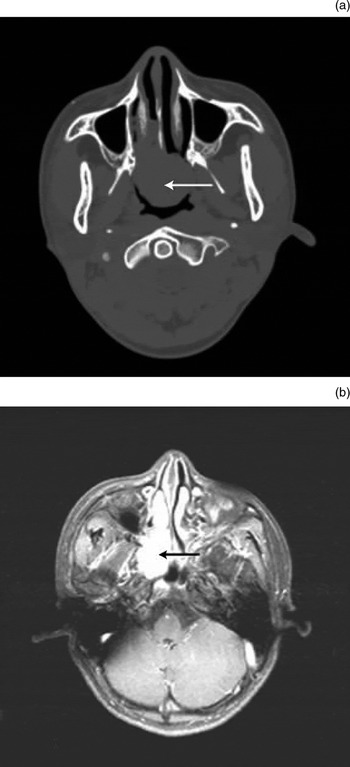
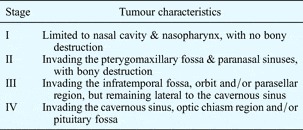
All underwent complete pre-operative evaluation, including nasal endoscopy (Figure 1), computed tomography (Figure 2a) and magnetic resonance imaging (Figure 2b). Using Andrews and colleagues’ classification, all tumours were categorised as stage I (Table I).Reference Andrews, Fisch, Valavanis, Aeppli and Makek4
Pre-operative endoscopic views showing the pink tumour (arrow) inside the right nasopharynx and extending into the left nasal cavity.

Pre-operative axial (a) computed tomography and (b) magnetic resonance imaging scans showed a soft tissue mass (arrow) in the nasopharynx and nasal cavity.

Fisch classificationReference Andrews, Fisch, Valavanis, Aeppli and Makek4

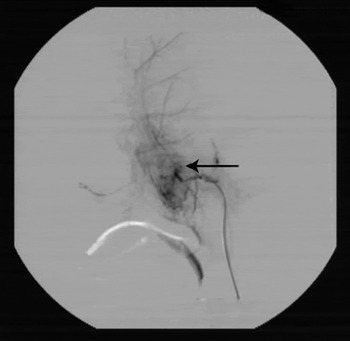
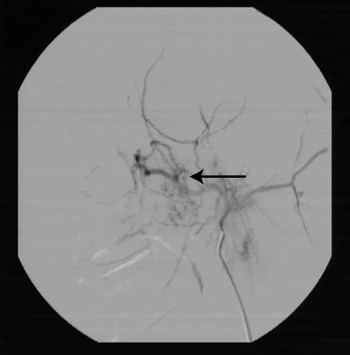
Twenty-four hours before surgery, all patients underwent hyper-selective embolisation of arterial branches depending on the internal maxillary artery, performed using polyvinyl alcohol (cannula diameter 300–350 µm; Beijing KELINAS New Material TECH Co., Ltd, Beijing) (Figures 3 and 4).
Lateral view of external carotid angiography, showing the well vascularised tumour (arrow).

Lateral view of external carotid angiography after embolisation of feeder vessels. The tumour is no longer visible (arrow).

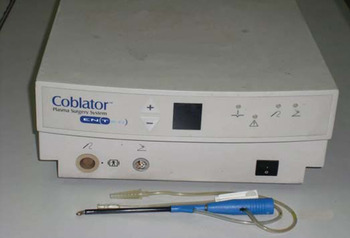
Based on previously published reports, we used the Evac 70 plasma wand for coblation (Arthrocare, Sunnyvale, California, USA) (Figure 5).Reference Windfuhr, Deck and Remmert5 A flow control roller valve was attached to a suspended Giving set containing 500 ml of 0.9 per cent saline solution. The flow rate was adjusted to allow saline to pass continuously over the tip of the coblation wand, prior to removal via the suction channel of the wand (connected to the operating theatre suction system). The roller valve was clamped to halt saline flow during pauses in the procedure. Standard coblation power settings were used for the ablation mode (six) and coagulation mode (three). Each mode was activated by one of two foot pedals.
The coblation system. A hook is used to resect the tumour.

A clamp was used to grasp the superior pole of the tumour and to identify its lateral border. The active electrodes were always directed toward the surface of the tumour. We usually noted less bleeding during coblation surgery than during surgery with traditional methods.
If required, haemostasis was achieved by activating the coagulation mode. The electrodes were placed onto the bleeding vessel and the coagulation mode activated using the second foot pedal.
Surgical technique
After induction of general hypotensive anaesthesia, the nasal fossae were typically plugged with neurosurgical cotton pledgets soaked in 1 per cent xylocaine plus 1/10 000 adrenaline, which were left in place for 15 minutes prior to surgery.
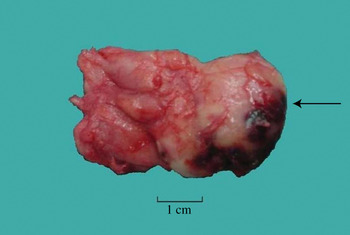
Surgery was performed endoscopically via the right or left nasal cavity. The inferior half of the middle turbinate was resected to facilitate visualisation of the tumour. The tumour was then resected from the nasal septum and the upper nasopharyngeal cavity using coblation (Figure 6). Frozen section analysis was performed on intra-operative biopsies from the resection boundary, to enable histological evaluation of surgical margins.
Surgical specimen, showing complete resection of the tumour (arrow).

On completion of the procedure, the nasal cavity was tamped with a polyvinyl fluoride (PVF) series medical sponge (Beijing Yingjia Medical Material Co., Ltd, Beijing), which was removed three days later.
Follow up
Computed tomography of the surgical field was performed six months post-operatively and then yearly. Nasal endoscopy was performed every six months for the first year and then yearly. First post-operative endoscopy took place one month after surgery.
Statistical analysis
Statistical analysis was performed using SigmaStat version 2.03 software (SPSS Inc, Chicago, Illinois, USA). T-tests were performed when appropriate. A p value of less than 0.05 was considered significant.
Results
No vascular, ophthalmological or neurological complications were reported, either intra- or post-operatively.
Post-operative histopathological examination confirmed the diagnosis of juvenile nasopharyngeal angiofibroma in all cases.
Operative time
Removing the tumour took a mean time ± standard deviation (SD) of 87.45 ± 12.58 minutes using coblation and 136.67 ± 11.11 minutes using traditional endoscopic instruments (Table II). Thus, coblation took almost 50 minutes less; this difference was statistically significant (t = 9.962, p < 0.001, t-test).
Outcome measures, by resection method

*Traditional endoscopic resection; †coblation-assisted endonasal endoscopic resection. Pts = patients; intra-op = intra-operative; SD = standard deviation
Intra-operative blood loss
Each surgeon visually estimated the amount of blood loss that occurred during tumour removal (Table II). There was a statistically significant difference between blood loss due to coblation-assisted endonasal endoscopic resection, compared with traditional endoscopic resection (t = 28.944, p < 0.001, t-test).
Follow up
Endoscopic nasal examination one month after surgery showed complete disappearance of the tumour in all cases. Our patients’ mean duration of post-operative follow up (after primary surgery) was 58 months (range, 17–125 months). Subsequent endoscopic nasal examinations confirmed the absence of any residual or recurrent mass.
Discussion
Surgical resection of juvenile nasopharyngeal angiofibroma has traditionally used a transoral, transfacial or combined craniofacial approach. All of these open procedures require oral or external facial incisions, the removal or division of bone, and the sacrifice of important facial structures (e.g. turbinates and inter-nasosinus wall), in order to gain access to the tumour. Given that most midfacial growth occurs in early adolescence, the extensive tissue damage associated with these surgical approaches could result in secondary disturbances of facial growth.
More recently, a marked shift towards less invasive surgery has occurred. Advances in endonasal endoscopic surgery, coupled with the success of pre-operative arterial embolisation, have allowed selected cases of juvenile nasopharyngeal angiofibroma to be managed endoscopically. The success of such procedures has depended on the surgeon's skill and experience, as well as on strict patient selection. Mann et al. reviewed this field, and concluded that properly selected patients with Fisch class I tumours may be successfully treated with endoscopic resection, thus avoiding the increased morbidity associated with open procedures.Reference Mann, Jecker and Amedee6 Appropriate patient selection for this procedure is essential, and the tumour must be a Fisch class I lesion appropriate for endoscopic resection.Reference Wormald and Van Hasselt2
Bleeding is without doubt the most significant complication of juvenile nasopharyngeal angiofibroma resection. In our study, intra-operative blood loss was significantly less in the coblation group, compared with the traditional endoscopic technique group. Moreover, the coblation procedure took almost 50 minutes less than the traditional endoscopic procedure, a statistically significant difference.
In the current study, a combination of pre-operative embolisation, intranasal endoscopy approach and coblation resection enabled successful excision of juvenile nasopharyngeal angiofibroma, without complications.
• Endoscopic resection of Fisch class I juvenile nasopharyngeal angiofibroma can be achieved using conventional endoscopic instruments either alone or with coblation assistance
• In this study of 23 patients, blood loss and operative time were significantly less in the coblation group
• No recurrence was found in either group
The use of coblation to achieve safe tumour resection and effective coagulation has been previously described.Reference Madgy, Belenky, Dunkley and Shinhar7, Reference Glade, Pearson, Zalzal and Choi8 The dissection technique involves passing a bipolar, radiofrequency electric current through a medium of normal saline, resulting in the production of a plasma field of highly ionised particles. These ions are able to break down intercellular bonds, resulting in tissue ‘melting’ at a temperature of approximately 70°C.Reference Noordzij and Affleck9 Coblation produces tissue destruction with minimal energy scatter, at a low temperature (approximately 60 to 70°C), causing less damage to adjacent tissues. In contrast, conventional diathermy produces temperatures of over 400°C.Reference Parsons, Cordes and Comer10 Despite the low temperatures generated by coblation, small blood vessels are still sealed during the process, minimising haemorrhage and morbidity. Coblation induces thermal injury using electromagnetic energy.
The goal of successful coblation tumour resection is to ablate all viable tumour tissue while still ensuring a tumour-free margin. This goal was achieved in the present study. Furthermore, no post-operative recurrences were observed during the follow-up period.
Conclusion
Endoscopic, transnasal resection of JNA (Fisch Class I) tumors with good surgical margins and minimal blood loss can be achieved with Coblation technology.