INTRODUCTION
Word segmentation and vowel harmony
One of the first tasks for a child in the process of language acquisition is to learn which sound sequences correspond to words in natural speech. Speech that children hear is usually composed of long strings of words and does not necessarily provide cues regarding word boundaries (Cole & Jakimik, Reference Cole, Jakimik and Cole1980). Despite that, children are universally successful at word learning, and they rarely produce word boundary errors. Thus the question how children learn which sound sequences correspond to words in a particular language naturally arises.
Previous research has shown that infants rely heavily on prosodic cues when they are segmenting words in a string of speech (Curtin, Mintz & Christiansen, Reference Curtin, Mintz and Christiansen2005; Cutler & Norris, Reference Cutler and Norris1988; Jusczyk, Reference Jusczyk1997; Reference Jusczyk1999; Jusczyk, Houston & Newsome, Reference Jusczyk, Houston and Newsome1999; Morgan, Reference Morgan1996; Thiessen & Saffran, Reference Thiessen and Saffran2003; among others). Statistical probabilities and phonotactic constraints, i.e., constraints in the order of phones, are also observed to be helpful in word segmentation (Aslin, Saffran & Newport, Reference Aslin, Saffran and Newport1998; Brent & Cartwright, Reference Brent and Cartwright1996; Saffran, Newport & Aslin, Reference Saffran, Newport and Aslin1996; among others, though see also Cairns, Shillcock, Chater & Levy, Reference Cairns, Shillcock, Chater and Levy1997; Mattys, Jusczyk, Luce & Morgan, Reference Mattys, Jusczyk, Luce and Morgan1999; Yang, Reference Yang2004). It seems natural to assume that other phonological regularities, for instance, vowel harmony, may contribute to word segmentation as well. In harmonic languages, words tend to have either all front or all back vowels. Assuming that a great majority of the words are harmonic in a language, vowel harmony may be relevant to word boundaries because shifts from one vowel type to the other (shifts from back to front or the other way around) may signal word boundaries. Indeed, studies based on Finnish show that adults can recognize words on the basis of harmony cues (Suomi, McQueen & Cutler, Reference Suomi, McQueen and Cutler1997; Vroomen, Tuomainen & Gelder, Reference Vroomen, Tuomainen and Gelder1998). In these studies, pseudo-words were created based on Finnish vowel harmony rules where word boundaries and harmony shifts overlapped and adults were observed to be sensitive to such shifts. A similar study based on Turkish vowel harmony rules was conducted on Turkish and French speakers and the role of vowel harmony vs. word stress on word segmentation was tested. The results suggested that Turkish speakers showed sensitivity to vowel sequences in word segmentation and used them together with word stress regularities, while French speakers relied only on stress cues in word recognition (Kabak, Maniwa & Kazanina, Reference Kabak, Maniwa and Kazanina2010). These promising results reported in the literature based on adult data raise the question of whether or not children use vowel harmony cues in a similar way in learning words. To investigate this question, Mintz and Walker (Reference Mintz and Walker2006) conducted a head-turn experiment in which infants aged 0;7 listened to nonsense sequences such as detipobubeditopu and observed that infants were sensitive to vowel shifts in such sequences and recognized harmonic sequences such as deti or pobu as words. These findings suggested that when harmonic information was available, children could use it to assign word boundaries. Similar results were reported by van Kampen, Parmaksiz, van de Vijver and Höhle (Reference van Kampen, Parmaksiz, van de Vijver, Höhle, Gavarró and Freitas2008) based on a study where children acquiring Turkish and German were tested using artificially created words. These studies showed that children were capable of segmenting words following vowel cues, but they did not show whether they could use vowel harmony as a segmentation mechanism in word learning in real life.
It is important to note that languages created and tested in the literature are all artificial languages where harmonic cues reliably point to word boundaries. In other words, when word segmentations coincide with non-harmonic vowel shifts, they are attributed to the role of vowel harmony (or disharmony) in segmentation. The question that still remains to be answered is whether natural speech has such cues and thus whether it is reasonable to assume that children acquiring harmonic languages have access to reliable harmonic cues.
In a learning mechanism where vowel harmony is used, words are expected to be consistently harmonic, as a non-harmonic word would give an erroneous cue or a false alarm for a word boundary. Such false alarms are difficult to undo in a mechanism that operates on vowel harmony cues. Similarly, a mechanism that assigns word boundaries only at vowel shifts will have many ‘misses’ due to utterances that are composed of words that have only the same type of vowel. In such instances, a learner would treat the whole utterance as one single word unless s/he can rely on some other cues. Unlike the artificial languages that are used in experiments, natural languages have many false alarm contexts as well as misses, which make it challenging to segment words with vowel harmony cues. Therefore a learning mechanism should assume additional cues, and such cues are available in natural languages in the form of the phonotactic regularities of phonemes, stress patterns, the distributional properties of words, or some other regularities. Earlier studies have already shown that stress patterns were acknowledged as more reliable cues by speakers of Finnish, Turkish, and French, for example, and were preferred over vowel cues (Kabak et al., Reference Kabak, Maniwa and Kazanina2010; Vroomen et al., Reference Vroomen, Tuomainen and Gelder1998). In this study we investigate the nature and the amount of vowel harmony cues that could be used with other cues to segment words in natural speech by contrasting the vowel distributions within and across words.
Because we investigate the relevance of vowel harmony to word segmentation, we need to examine the harmony patterns both within words, and across word boundaries. The motivation for this study lies in the idea that, although harmonic languages are not fully harmonic, and word boundaries are not necessarily non-harmonic, there may still be some contrastive regularity in ‘within word’ vs. ‘across words’ contexts that could potentially complement other segmentation cues. For example, although a harmonic sequence such as /aa/ or /au/ is observed both at word boundaries and within words, it may be more frequent within words. An opposite trend may be recorded for non-harmonic sequences such as /ai/ or /ae/, i.e., they may appear across word boundaries more often. If we can document such a complementary distribution pattern, it may enable us to recognize vowel harmony as a possible segmentation tool. To this end, we look at vowel distributions in two harmonic languages, Turkish and Hungarian. We further contrast the patterns in harmonic languages with the patterns in two non-harmonic languages, Farsi and Polish, through parallel analyses run on the four languages individually. We can assume a mechanism that can rely on vowel harmony only if within- and across-word distributions are reliably different, especially in harmonic languages.
Vowel harmony in Turkish and Hungarian
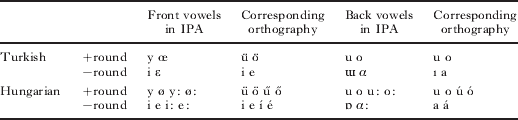
In both Turkish and Hungarian, words tend to have either all front or all back vowels. Turkish has eight vowels (four front and four back), as seen in Table 1. According to the rules of the front/back or palatal vowel harmony, a word can have either all front or all back vowels (Clements & Sezer, Reference Clements, Sezer, van der Hulst and Smith1982; Demircan, Reference Demircan1996; among others). Turkish word formation is mainly realized through suffixation, and suffixes undergo vowel harmony in such a way that the harmonic status of the words is maintained. In the word at-lar-ımız-dan ‘horse-plu-poss-abl’,‘from our horses’ the word at has a back vowel and all the suffixes that are attached to this word are back (i.e., -lar,-ımız, -dan). In contrast, a word such as ev has a front vowel, and takes the front variety of the suffixes (i.e., -ler, -imiz, -den): ev-ler-imiz-den ‘house-plu-poss-abl’. The language has many non-harmonic words as well due to borrowings and compounding. Some of these non-harmonic words, including the word anne ‘mother’ are very common in child-directed and child speech. Despite these non-harmonic words, a great majority (90%) of words are reported to be harmonic, based on a Turkish corpus study of 601 words (Rodd, Reference Rodd and Ellison1997). In the case of the non-harmonic words, suffixes harmonize in accordance with the last vowel of the word. Some inflections, such as the progressive marker -Iyor, harmonize only partially (it appears as -üyor, -uyor, -iyor, and -ıyor, with the change of the first vowel only; the last vowel remains as /o/). Besides the palatal vowel harmony, Turkish has rounding harmony that applies to high vowels as well, but it will be beyond the scope of this study.
Turkish and Hungarian vowels in IPA symbols and orthography
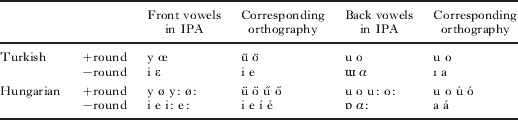
Hungarian has seven short vowels and seven long vowels, which are longer versions of the short counterparts, with two exceptions (see Table 1). The sound represented by é is the long version of /e/, not /ε/ and the sound represented by á is /α:/ not /ɒ:/. In addition to these fourteen vowels, nearly half of Hungarian speakers distinguish an eighth vowel, a short vowel, ë /ε/ as in the word szëg ‘carpenter's nail’ (Abondolo, Reference Abondolo and Comrie1987), but it was not found in the corpus, so it was not covered in the analyses. Just as is the case in Turkish, Hungarian has an internal vowel harmony that concerns the vowel sequences within word stems, and an external vowel harmony through which suffixes harmonize in word formation (e.g., szűr-tök ‘you-plu strain’ vs. szúr-tok ‘you-plu pierce’). An important exception to this generalization is the words that have i and í, so-called ‘neutral’ vowels, which take suffixes with back vowels although they are front (e.g., ír-tok ‘you-plu write’). Just like Turkish, Hungarian has rounding harmony as well (e.g.,-tok/-tök, as exemplified above vs. -tëk after non-round vowels), but it will be beyond the scope of this study.
In general, the terms ‘harmonic’ and ‘non-harmonic’ are used to refer to relations between vowels within words. In the present study it is important to analyze harmony relationships both within words and across word boundaries. For the sake of simplicity, we use these same terms to refer to relations of vowels across word boundaries as well. Those word boundaries that have only back or only front vowels on both sides of the boundary are categorized as harmonic. In an utterance such as Erel-cim bu ne ‘Erel-dim this what’ ‘Erel-dear, what's this?’ from the CHILDES Turkish corpus (File 1aa), the last vowel of the word erelcim is a front vowel. The vowel in the following word is back. The one in the last word is front, resulting in the sequence front–front–front # back # front, where # stands for a word boundary. So a shift from front to back and then back to front vowel corresponds to a word boundary in this particular example. In contrast, in an utterance such as kimin teybi ‘who-gen-3s (tape)recorder-poss-3s’ ‘Whose (tape) recorder?’ from the same corpus, all the vowels are front; therefore there is no word boundary cue provided by vowel shifts.
Farsi and Polish as control languages
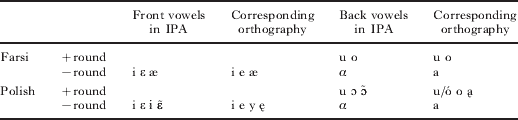
In order to test whether the regularities that are observed are due to the harmonic nature of Hungarian and Turkish and are not just accidental, results from harmonic languages are compared to non-harmonic languages. Farsi, an Indo-European language spoken in Iran, is selected as a non-harmonic language because its vowel system is symmetrical – it has three front and three back vowels, as seen in Table 2. In regular orthographic spelling, vowels are not represented, but a corpus with phonologically transcribed utterances (including vowels) is available in CHILDES. In the table, the vowels are shown just as they are represented in the orthography of the corpus.
Farsi and Polish vowels in IPA symbols and orthography
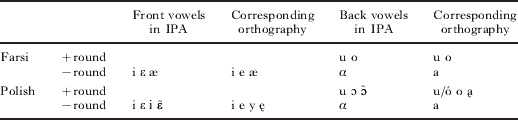
Polish is a West Slavonic language of central Europe. It is written in the Latin alphabet with a few additions. Its transcription is transparent in terms of the pronunciation of vowels, which are listed in Table 2 (Jassem, Reference Jassem2003). In addition to three front and three back vowels, it has two nasal vowels, which are marked clearly in orthography. The vowel /u/ has two different representations, u and ó. When i appears before vowels, it is not pronounced as /i/, it rather palatalizes the preceding consonant, so in such sequences it is not treated as a vowel. The alphabet character y represents a variant of /i/ rather than a consonant and is treated as such. It is not included in the vowel chart as a distinct phoneme in some sources (e.g., Stone, Reference Stone and Comrie1987). An important difference between Polish/Farsi and Hungarian/Turkish is that in non-harmonic languages, unlike the harmonic ones, suffixes do not undergo vowel harmony to fit the properties of the vowels in the stems.
Method
The corpora
All the analyses were conducted on child-directed speech from the corpora available at CHILDES. Details of the corpora are reported in Table 3. The Turkish analysis was conducted on the entire Aksu corpus of thirty-five children (Slobin, Reference Slobin, Wanner and Gleitman1982). The data were collected at the children's homes by an experimenter. Family members were present during the sessions and were involved in the conversations, but the majority of the child-directed speech comes from the experimenters. All the utterances produced by all the adults were included in the analysis. A parallel analysis was conducted on the Hungarian corpus (MacWhinney, 1974). Three children were included in the analysis because the number of utterances and word tokens they provided were similar to the amount of data that was available for Turkish. The sessions were recorded at a children's kindergarten. In addition to the experimenter, teachers and other children contributed to the conversations. All child-directed utterances were included in the analysis.
Corpus details

The Farsi and Polish data are from CHILDES as well (Farsi: Family, Reference Family2009; Polish: Weist & Witkowska-Stadnik, Reference Weist and Witkowska-Stadnik1986; Weist, Wysocka, Witkowska-Stadnik, Buczowska & Konieczna, Reference Weist, Wysocka, Witkowska-Stadnik, Buczowska and Konieczna1984). For Farsi, data from one child (Lilia) was sufficient to provide a comparable amount of data. Lilia's recordings were made at home by her parents. A nanny, a brother and other family members were also present in some sessions and contributed to the recordings. All the child-directed speech was included in the analysis. The Polish analysis was conducted on the Weist corpus of four children that provided a similar number of utterances. Parents, investigators and in some sessions other family members participated in the recordings and all child-directed speech was included in the analysis.
Procedure
The first analysis presents the proportion of harmonic versus non-harmonic words in the language and shows how harmonic a language is. The 200 most frequent multisyllabic words (frequency range: 20–453 in Turkish, 16–402 in Hungarian, and 23–687 in Farsi, 18–400 in Polish) were selected and coded as harmonic or non-harmonic according to the frontness–backness features of the vowels. The 200 most frequent words were selected in order to exclude words with very low frequency. In the case of Hungarian, for example, this restriction excluded words that occurred less than sixteen times in the whole corpus of over 40,000 word tokens. All multisyllabic words that have the same frequency as the 200th word were included in the analysis as well. So in Turkish, Farsi and Polish 203, and in Hungarian 212, multisyllabic words were included.
The second analysis compared the occurrence frequencies of vowel pairs within words and across word boundaries. The goal of this analysis was to see whether harmonic sequences (e.g., /aa/, /au/, /ee/) were more likely to occur within words rather than across word boundaries, and whether it was the other way around for the non-harmonic sequences (e.g., /ae/, /ai/, /uœ/). For this analysis, the same corpus was used, but in their entirety rather than limiting the analysis to the 200 most frequent multisyllabic word types. A list of all possible vowel pairs was created, categorized as harmonic or non-harmonic, and the frequency of each vowel sequence within and across word boundaries was calculated and compared. These lists of vowel pairs that were created individually for each language can be seen in the ‘Appendix’.
The reason why we look at vowel pairs composed of two vowels rather than longer sequences of vowels is that word boundaries are immediately surrounded by two vowels (the last vowel of the first word and the first vowel of the second word), and we would like to compare the same vowel pairs occurring within and across word boundaries.
It is important to note that how we look at harmony within words in the second analysis is different from what we do in the first analysis, where whole words were coded as harmonic and non-harmonic regardless of the individual (co-)occurrences of vowels within a word. In the second analysis, we look at vowel pairs that occur adjacent to each other (when consonants are left out). For example, in the first analysis, a word such as masaya ‘table-dat’ is counted as one harmonic word. In the second analysis, it is counted as two /aa/ sequences. We need the first analysis to see how harmonic a language is. We need to look at vowel pairs rather than entire words as well because it is the only way we can compare within-word contexts to across-word boundary contexts.
Results
Harmonic words
In this analysis, we look at the proportion of harmonic words in harmonic and non-harmonic languages to see how harmonic a language is. The results of this analysis will provide us with a clearer idea of the vowel distribution patterns in word-size units. The analysis is restricted to the most frequent 200 multisyllabic words in each language.
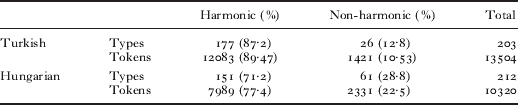
The results show that, despite the presence of non-harmonic words in both Turkish and Hungarian, a majority of words are harmonic in both these harmonic languages. Table 4 displays the number of word types and tokens in frequencies in the two languages.
Harmonic and non-harmonic words in types and tokens in Turkish and Hungarian
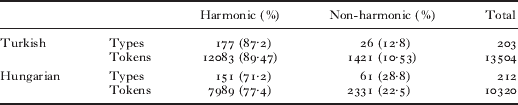
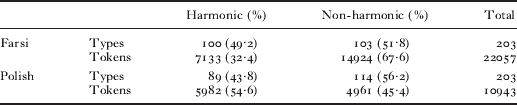
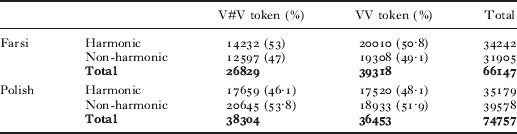
Table 5 reports the frequencies of harmonic and non-harmonic words in two non-harmonic languages, Farsi and Polish. As predicted for a non-harmonic language, in Farsi, harmonic and non-harmonic word types have equal proportions. Interestingly, non-harmonic words are even more frequent if we look at the frequency of words in terms of tokens. Polish presents a similar pattern, where harmonic and non-harmonic words have almost the same proportion, in both the token and the type analysis, as seen in the table.
Harmonic and non-harmonic words in types and tokens in Farsi and Polish
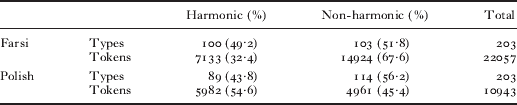
Overall results from the four languages showed that the great majority of words in child-directed speech were harmonic in harmonic languages. In non-harmonic languages, such a trend was not observed. Moreover, an opposite trend was recorded in the case of the word tokens in Farsi.
Harmony within versus across word boundaries
In this part of the study, token occurrences of harmonic and non-harmonic sequences of vowels within and across word boundaries (VV vs. V#V) were contrasted. The goal of this analysis is to see whether there is a contrastive pattern of occurrence of harmonic and non-harmonic vowel pairs. If we can show that harmonic and non-harmonic pairs are likely to occur with different distributional properties, the former appearing more within words, and the latter more across word boundaries, we could use this to support our hypothesis that vowel distributions can provide a learner with helpful cues for word segmentation.
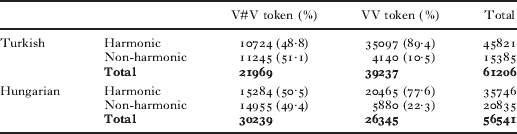
Table 6 displays the total counts of Turkish and Hungarian analyses. Harmonic and non-harmonic vowel sequences that occur across (V#V) and within word boundaries (VV) are shown in the first and the second columns of the table. The within-words counts show that a great majority of harmonic vowel pairs appear within words in Turkish and Hungarian. This result is similar to the result of the first analysis (Table 4), where we saw that a great majority of words are harmonic in harmonic languages. The word boundary counts (V#V) show that about half of the word boundaries are harmonic in Turkish and Hungarian. What is interesting and more relevant for the purpose of this study, however, is the contrast between within- and across-words contexts. Although only half of the word boundaries are non-harmonic, the contrast between within-words and across-words contexts clearly shows that vowel distributions within and across word boundaries are different. Harmonic sequences mostly occur within words, while non-harmonic sequences are found at word boundaries.
Harmony within (VV) versus across (V#V) word boundaries in Turkish and Hungarian
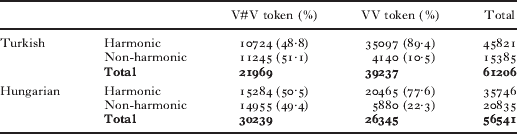
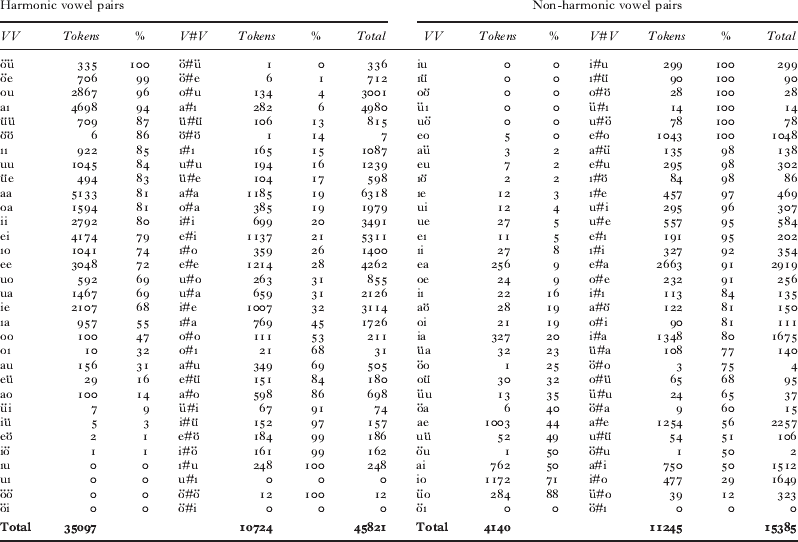
In the case of Turkish, although harmonic sequences can be found both across and within words, they are more likely to appear within words, while non-harmonic sequences appear mostly at word boundaries. Examination of individual vowel pairs that are reported in the ‘Appendix’ provides further evidence for the contrastive distribution pattern of the vowels. For example, although a harmonic sequence such as /aa/ can be found both within words and at the two sides of a word boundary, it is more likely to be found within words. In all, 6,318 occurrences of /aa/ were recorded in the corpus and 5,133 (81·2%) of such occurrences were within word boundaries. Similarly, the /œε/ sequence is recorded 712 times, and 706 of them (99%) are within words, although it may appear at word boundaries as well. Not all harmonic pairs appear mostly within words though. In all, 11 out of 32 vowel pairs are found more than 50% of the time across word boundaries. However, as seen in Table A in the ‘Appendix’, the token frequencies of such unexpected occurrences are not very high. Therefore, they do not affect the overall tendencies.
An opposite trend is observed in the non-harmonic sequences, i.e, they are more likely to be observed at word boundaries. The sequence /ea/, for example, is recorded 2,919 times in the sessions, and 2,663 (91%) of them occur across word boundaries, although it is a possible sequence within words as well. Only 2 out of 32 non-harmonic pairs are observed within word boundaries in more than 50% of the cases, and both of them have the vowel /o/ as the second member of the VV pair and a high vowel as the first member. What contributes to this unexpected distribution is the non-harmonizing and frequent progressive marker -Iyor.
The overall Turkish results suggest that, although harmonic word boundaries are frequent, it is more likely for a harmonic sequence to be found within a word boundary than across word boundaries (χ2 (1, N = 61,206) = 12,357·419, p <.0001). This picture suggests that when occurrences of individual sequences within and across word boundaries are contrasted, a promising picture appears in Turkish.
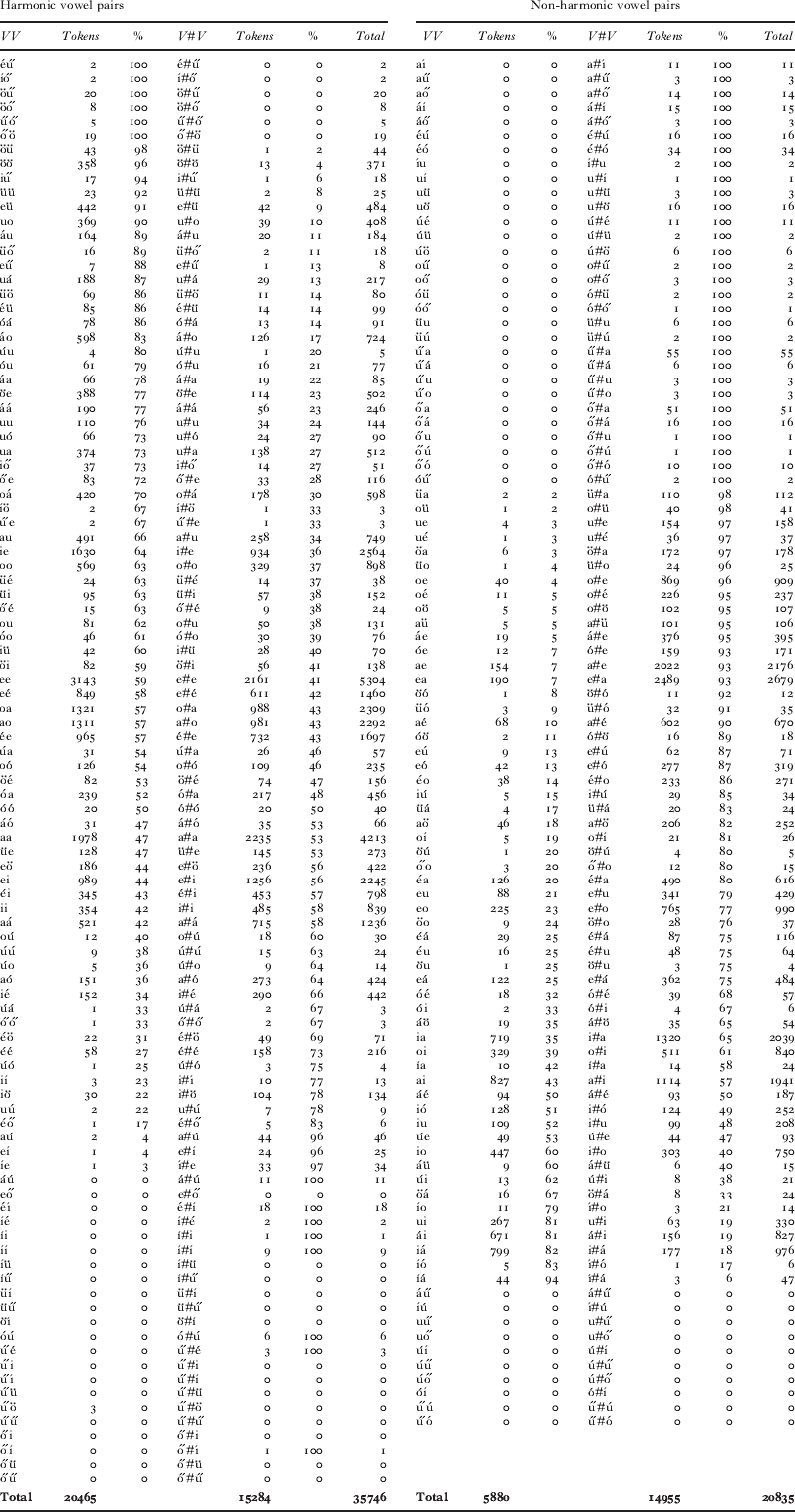
A similar, but not exactly the same, distributional regularity is observed in Hungarian. In the case of the non-harmonic sequences, the Turkish results are replicated, i.e., a majority of non-harmonic sequences appear across word boundaries. The Hungarian results are even stronger, because about half of the non-harmonic vowel pairs are not observed within words at all, while in Turkish those non-harmonic pairs that only occur across word boundaries are about 20% of the total pairs. The sequence /ae/, for example, is recorded 2,176 times, and 2,022 (92·9%) of them appear across word boundaries. Although there are non-harmonic vowel pairs that are more frequent within words, they are not that many in terms of token frequencies, as seen in Table B in the ‘Appendix’. What is also important is that a majority of non-harmonic sequences that are exceptionally more frequent within words contain the ‘neutral’ vowels that behave like both a back vowel and a front vowel.
In the case of the harmonic sequences, the distribution of vowels within and across word boundaries is not always as expected. In the case of Turkish, almost all individual harmonic sequences are more frequent within words, while in Hungarian, the occurrence of harmonic sequences are not necessarily associated with within-word contexts. The sequence /aa/ is found across a word boundary in 54% of the instances, for example. Despite that, the proportion of non-harmonic sequences that occur across word boundaries is high, and the overall results suggest that in Hungarian, just as is the case in Turkish, harmonic sequences tend to occur within words, and non-harmonic sequences across words (χ2 (1, N = 56,541) = 4,424,498, p < .0001).
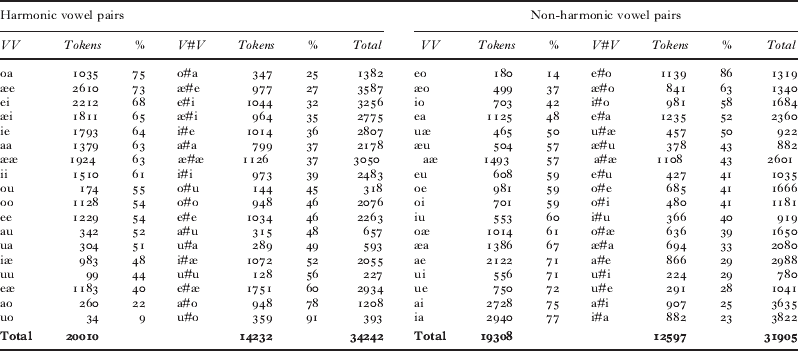
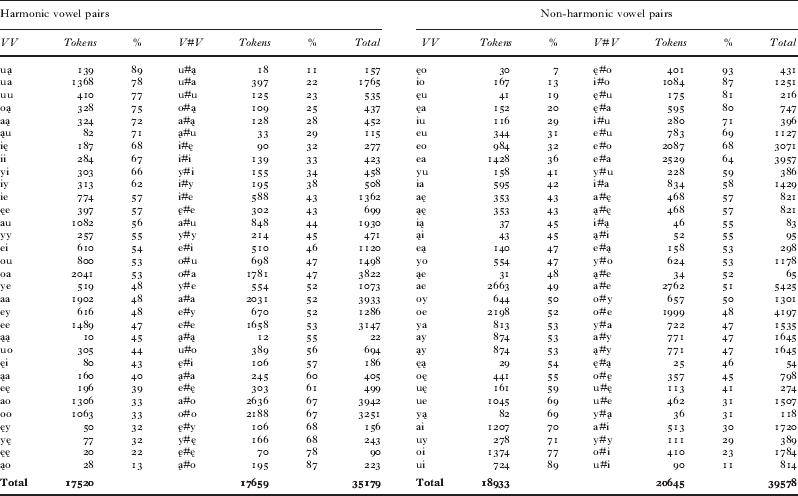
The similarity of Hungarian to Turkish becomes apparent when these two harmonic languages are compared to Farsi and Polish, two non-harmonic languages. In Farsi (Table 7), within-word and across-words contexts have equal proportions of harmonic and non-harmonic sequences. Although the proportion of harmonic sequences found within words may provide potentially useful cues for word recognition, despite the fact that Farsi is not a harmonic language, the distribution of non-harmonic sequences with an exact same pattern blurs the results because harmonic and non-harmonic sequences do not display a contrastive distribution. The Farsi results, especially when all the analyses are considered together, provide a clear contrast to Turkish and Hungarian, where harmonic sequences are more likely to occur within words, and non-harmonic sequences across word boundaries. Another contrast can be seen between Polish and the harmonic languages. Unlike the pattern in Turkish and Hungarian, in Polish both harmonic and non-harmonic sequences are equally likely to appear across word boundaries and within words (Table 7).
Harmony within (VV) versus across (V#V) word boundaries in Farsi and Polish
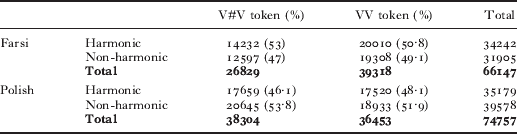
A closer look at the individual pairs reported in the ‘Appendix’, Tables C (Farsi) and D (Polish) provides a clearer contrastive pattern. Unlike harmonic languages, in neither Farsi nor Polish are there vowel pairs that exclusively appear within words or across word boundaries. A majority of vowel sequences can be found in both contexts with equal frequency, regardless of their harmony status.
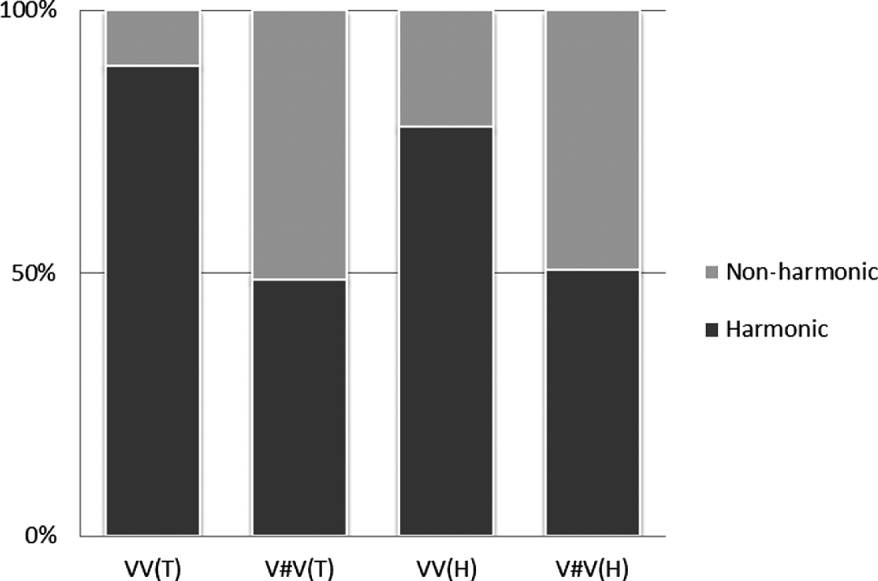
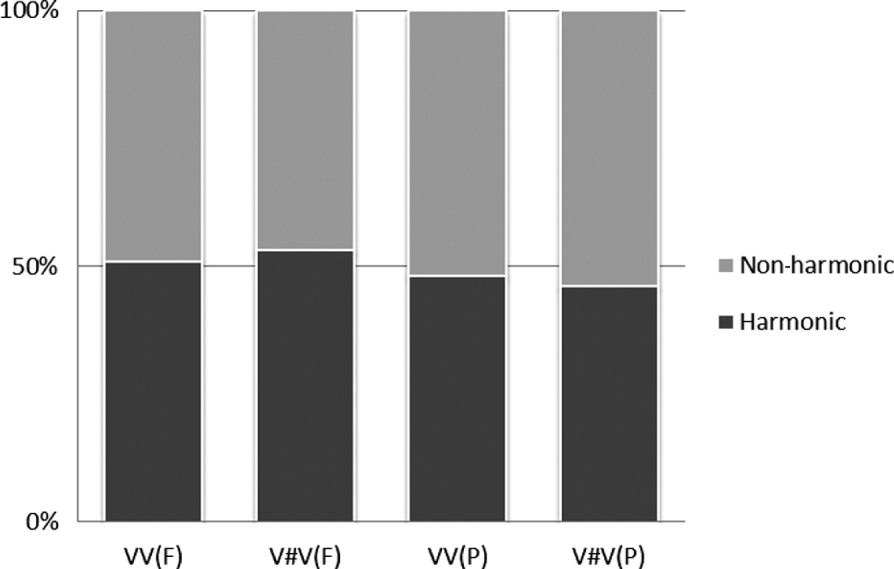
The contrast between harmonic and non-harmonic languages can be clearly observed in Figures 1 and 2 as well. VV(T), VV(H), VV(F) and VV(P) bars represent the harmonic (dark) and non-harmonic sequences within word boundaries in Turkish, Hungarian, Farsi, and Polish, respectively. The numbers are the number of sequence (/aa/, /ae/, etc.) tokens. What is important to note for the purpose of this study is the similarity of the VV(T) and VV(H) bars, and their dissimilarity to VV(F) and VV(P).
Harmony within (VV) versus across (V#V) word boundaries in Turkish (T) and Hungarian (H).

Harmony within (VV) versus across (V#V) word boundaries in Farsi (F) and Polish (P).
As seen in Figures 1 and 2, in both Hungarian and Turkish, harmonic sequences are clearly more frequent within words (VV) than across word boundaries (V#V), and non-harmonic sequences are more frequent across word boundaries (V#V). In Farsi and Polish, such a contrastive pattern is not observed. Harmonic and non-harmonic sequences show the same pattern within words as across word boundaries, failing to provide any potential cues for word recognition.
Discussion and conclusion
In this study, we investigated whether harmonic languages provide a learner with harmonic cues that could be used in word segmentation together with other cues. We looked at the proportion of harmonic vs. non-harmonic words in harmonic and non-harmonic languages to see whether harmonic languages really are as harmonic as one expects. We further looked at the distributional properties of vowel pairs to see whether harmonic and non-harmonic vowel pairs appear in distinct contexts (within words and across word boundaries), providing potential cues for segmentation.
The results suggested that a great majority of words are harmonic in Turkish and Hungarian child-directed speech. It was also observed that, although some harmonic sequences may occur across word boundaries as frequently as non-harmonic sequences do, they are more likely to occur within words in harmonic languages. Therefore there is some vowel harmony information embedded in the natural data, although it is not as easily accessible as it has been assumed in the literature, and it may be useful in word boundary recognition, especially when it is used together with some other cues. Newport and Aslin (Reference Newport and Aslin2004) show that learners are capable of acquiring patterned relations among non-adjacent segments. It is likely that vowel harmony is one such non-adjacent relationship that can be learned and used in word learning together with some other cues. A comparison of vowel sequences occurring within and across word boundaries may provide a learner with helpful statistical cues to rely on in speech segmentation.
Analyses conducted on two non-harmonic languages, Farsi and Polish, further showed that the regular pattern observed in harmonic languages is not an accidental one. Rather, it is peculiar to harmonic languages, and learners of harmonic languages most probably use the language-specific regularities available to them, while speakers of non-harmonic languages learn to rely on other cues. These results find support in experimental settings. They correctly predict the findings reported by van Kampen et al. (Reference van Kampen, Parmaksiz, van de Vijver, Höhle, Gavarró and Freitas2008), who show that Turkish infants aged 0;6 (but not the German infants of the same age) prefer listening to harmonic over non-harmonic pseudo-words. Moreover, Turkish infants aged 0;9 can segment words using vowel-harmony cues. The results in the present study are in line with the results of Kabak et al. (Reference Kabak, Maniwa and Kazanina2010), as well, who report that adult Turkish speakers, but not the speakers of a non-harmonic language, follow harmony cues in word segmentation together with other cues. These results are not surprising considering the vowel harmony and word boundary patterns reported in this study.
The goal of this study was to examine whether there is any regularity based on vowel harmony that could potentially be used in word segmentation in the acquisition of harmonic languages. Although we examined only the sequences of vowels, without taking into consideration any other potential cue (for example, co-occurrence regularities of consonants, word stress, distributional properties of word-size units) that can be used together with harmony cues, we do not have the intention of assuming a learning mechanism that operates exclusively on vowel harmony cues. The results suggested that there is some regularity due to vowel harmony that could potentially be helpful in word segmentation, but it is also important to acknowledge that there is a need to rely on additional cues, especially in contexts where harmonic cues result in the wrong segmentation. For example, harmony across word boundaries is not problematic only if the child has access to additional cues to segment words (when one of the words is a very frequent word that the child hears in non-harmonic contexts, for example). Similarly, the difficulty due to non-harmony within words can be overcome by considering, for example, transitional probabilities. Frequent use of some suffixes in unambiguous contexts may also be helpful. For example, in the case of non-harmony within words in Turkish, one single suffix, the progressive marker -Iyor, has a special place, because it appears to be the reason for the only two non-harmonic pairs that appear more frequently within words. -Iyor is one of the earliest acquisitions in Turkish, due to its semantic salience, obligatory contexts and frequent production in child-directed speech (Aksu-Koç & Ketrez Reference Aksu-Koç, Ketrez, Bittner, Dressler and Kilani-Schoch2003). Once the learner figures out that -Iyor is part of the word, s/he may rely on this information for further segmentation. With multiple cues considered simultaneously, a learner can gather information that could work against erroneous harmony-based segmentation. Further research on cue weighting and cue integration, where multiple potential cues can be examined simultaneously, will reveal how much of the harmony information reported in this study can be beneficial in word segmentation.
APPENDIX: TOKEN FREQUENCIES OF HARMONIC AND NON-HARMONIC VOWEL PAIRS WITHIN WORDS (VV) AND ACROSS WORD BOUNDARIES (V#V)
Harmonic and non-harmonic vowel pairs in Turkish child-directed speech
Harmonic and non-harmonic vowel pairs in Hungarian child-directed speech
Harmonic and non-harmonic vowel pairs in Farsi child-directed speech
Harmonic and non-harmonic vowel pairs in Polish child-directed speech. The character u represents both u and ó