“Nobody thought that this would make a very good picture.” In a 2001 documentary on the making of Richard Donner's Superman (1978), creative consultant Tom Mankiewicz recalled one of the central difficulties filmmakers faced when they adapted the adventures of the comic book superhero. “Everybody, I guess, had the memory of the Batman television series, and they thought, ‘it's just going to be campy, and we can't have, you know, two and a half hours of camp’” (2:45).Footnote 1 Batman may have lasted a mere three seasons, but this 1960s pop camp extravaganza still cast a shadow over the production and reception of Superman a decade later. Like Mankiewicz, Donner, the director, wanted their adaptation to deflect the camp bullet.Footnote 2 To remind his team to aim for realism, he even reportedly went so far as to post signs that said “Verisimilitude” in each production office.Footnote 3
His efforts paid off in critical and commercial success. Judith Martin of the Washington Post applauded the filmmakers for “avoiding the obvious temptations to sneer at the naivete or to camp it up.”Footnote 4 Superman's “verisimilitude” record was not entirely unblemished, however. Critics suggested the film's trio of comic, scheming villains led by business tycoon Lex Luthor (Gene Hackman) channeled the Batman pop camp tradition. Charles Champlin of the Los Angeles Times, for example, indulged in powerfully phallic imagery by describing Luthor as “a kind of campy arch-fiend in the throbbing vein of the crooks Batman and Robin contended with on television.”Footnote 5 Yet the consensus was that Superman avoided or at least downplayed camp. Audiences flocked to theaters to see a serious take on the man of steel, netting the film about $134 million at the domestic box office.Footnote 6
The franchise's success was short-lived, and a revivified camp, one no longer confined to the portrayal of the villains, would take the blame for its failure. Superman's warm reception extended to Superman II (Richard Lester, 1980), but the slapstick comedy of Superman III (Richard Lester, 1983) left audiences and critics cold, and the box office failure and critical derision of Superman IV: The Quest for Peace (Sidney J. Furie, 1987) forced filmmakers to leave the series on ice for two decades.Footnote 7 The franchise's commercial nadir, however, was Jeannot Szwarc's Supergirl (1984), a spinoff featuring Superman's cousin that earned a meager $14 million domestically.Footnote 8 Supergirl's fatal flaw, according to the critics, was its return to the campiness that Superman had once so successfully repressed. Critics, again, zeroed in on the characterization of the villain, the witch Selena. Sheila Johnston of Monthly Film Bulletin blamed actor Faye Dunaway prematurely for the demise of the series, predicting it would “decline into cynical camp.”Footnote 9 The specter of Batman had returned to haunt the Superman films, as Jimmy Summers recognized in his BoxOffice review: “Hokey, jokey and campy, it's like the old ‘Batman’ TV series with a bigger budget.”Footnote 10 Camp, then, fuels this declension narrative: Superman had his kryptonite, and the Superman franchise had its camp.
Or so the story goes. But let us rewind to the start, to the supposedly non-campy Superman. At least one person involved in the production process articulated a very different agenda, one that turns this declension narrative on its head. Film composer John Williams, interviewed in another 2001 documentary, described how the performances of Christopher Reeve and Margot Kidder, the actors playing Superman and Lois Lane, inspired his compositional process:
One of the essential things about the film to me was the fact that it was fun and didn't take itself too seriously. And the way Richard had directed it, and particularly the way Chris and Margot had played the parts, that it had an almost kind of theatrical camp, if you like, to it. . . . And that if one could strike a level of theater and sleight of hand and tongue in cheek in the creation of the themes, that it might be the right idea (20:12).Footnote 11
Williams's words clearly run contrary to Donner's documented desire to avoid camp in Superman. All of these expressed intentions, of course, must be taken with a grain of salt for obvious reasons: they may not necessarily indicate actual artistic goals but rather attempts to frame the reception of the film (sometimes years later), and, in our world of dead authors, intent has no monopoly on determining meaning. What these comments reveal, however, is a striking disconnect in the discourse on camp in Superman, a gap between Donner's stated interest in making a serious film and Williams's delight in its “theatrical camp.”Footnote 12 To make matters even more complicated, there is a third possible reading: Champlin's suggestion that the pop camp legacy of Batman lived on in Luthor's portrayal. These conflicting testimonies leave us with a number of questions. What did camp mean to these individuals? What is its place in the Superman series, and why is it so controversial? And finally, what role could Williams's score play in creating camp?
Drawing on the work of camp theorists Susan Sontag, Moe Meyer, and Andrew Ross, I argue these competing descriptions of Superman register the existence of two different yet overlapping forms of camp operating within the franchise. By narrowly focusing on pop camp and ignoring the film scores, critics misunderstood and misrepresented camp's place in the Superman series. The series’ reception history outlines a backlash against the franchise's growing investment in pop camp—a highly legible form of camp, popularized by Batman, with overblown performances as its hallmark feature. In this sense, Superman is indeed the least campy of the films and Supergirl the most, suggesting there is a negative correlation between camp and critical acclaim. There is, however, a subtler camp aesthetic present from the very start of the series that critics have overlooked, one that resonates strongly with Williams's words: a playful mismatching of gender signifiers and an undercutting of heteronormative romantic relationships that I refer to as “queer camp.”
Because much of this queer camping takes place in the series’ leitmotivic film scores, a dimension of filmmaking that the critics neglected, the franchise's hidden queer message eluded them.Footnote 13 Using camp as an oppositional reading strategy, I offer score-based queer readings of Superman and Supergirl. Approaching these films through their scores makes audible a consistent queer camp aesthetic that suggests we listen more critically to the implicit assumption of the reception history's declension narrative: that camp is a symptom of aesthetic decline. My rereading thus brings into focus the overlooked political work the series accomplishes: the queer camp aesthetic subverts the heteronormativity of the main characters, portraying Superman and Supergirl as queers of steel.
Broadly, I aim to contribute to the robust and growing literature on musical constructions of camp by drawing the leitmotivic score more closely into its orbit. Although genres like the musical and opera as well as the star personas of popular music artists have attracted a lot of attention from music scholars invested in camp, the leitmotivic score has received comparatively little.Footnote 14 Music scholars have eloquently described how a leitmotif or love theme can shape how we interpret a character's gender or sexuality, but they have not fully explored how these themes can destabilize preferred heteronormative readings through camp.Footnote 15 I offer here a case study demonstrating the leitmotivic score's ability to serve as, to borrow an apt pun from David Bergman's anthology, a “camp ground.”Footnote 16
I begin by situating my approach within both the fraught domain of camp theory and the ongoing conversation about gender in film music studies. In the second section, I position the franchise within the longer history of camp and queerness in superhero comics to demonstrate why camp was such a charged issue. I turn next to John Williams's score for the original Superman, arguing that Superman's themes mock his masculine heroic persona and that the love theme, in deviant fashion, makes him the object of Lois's gaze. In this reading, Superman emerges as a queer character in the broader sense of the term: queer as a marked alternative to the strict performance of heteronormativity. In the fourth section, I analyze Jerry Goldsmith's score for Supergirl, arguing similarly that the character's themes work against her performance of heterofemininity. I then trace the drifting associations of the leitmotif that becomes the love theme. In a departure from Superman, this thematic development so thoroughly undermines the film's central heterosexual relationship that it constructs the protagonist as queer in a more colloquial sense: as gay.
Queer Camp, Pop Camp, and the Camped Leitmotivic Score
I turn first to camp, a longstanding yet slippery term that has incited rancorous debates over its definition. My analytical framework rests on Moe Meyer's definition of “Camp,” which I, for reasons explained below, refer to as queer camp, and Andrew Ross's theorization of pop camp.Footnote 17 Both authors are indebted to Susan Sontag, whose groundbreaking “Notes on ‘Camp’” (1964) essay introduced camp, a term used in gay male circles since the beginning of the twentieth century, to a wider audience.Footnote 18 At its heart is performativity and the circulation of hidden codes. “To camp is a mode of seduction,” Sontag writes, “one which employs flamboyant mannerisms susceptible of a double interpretation; gestures full of duplicity, with a witty meaning for cognoscenti and another, more impersonal, for outsiders.”Footnote 19 One way to interpret this definition is to restate it using terms familiar from reception theory: camp serves as an oppositional reading strategy, one that identifies a certain unconvincing quality in the preferred, “impersonal” reading—something excessive, theatrical, incongruous—and draws out the “witty,” less obvious, coded message.Footnote 20
To analyze queer camp in the Superman franchise, I combine pillars of Sontag's definition with Moe Meyer's queer theory scaffolding. Meyer is one of several camp theorists who pinpointed some central insensitivities in Sontag's landmark essay: she downplays camp's queer origins and, dismissing its subversive potential, describes it as “apolitical.”Footnote 21 For Meyer, “Camp is political; Camp is solely a queer (and/or sometimes gay and lesbian) discourse; and Camp embodies a specifically queer cultural critique.”Footnote 22 By “queer,” Meyer means something broader than a descriptor for members of the LGBTQ+ community: “What ‘queer’ signals is an ontological challenge that displaces bourgeois notions of the Self as unique, abiding, and continuous while substituting instead a concept of the Self as performative, improvisational, discontinuous, and processually constituted by repetitive and stylized acts.”Footnote 23 Queerness, in other words, is a performed identity that flouts the established codes of heteronormativity, one whose internal incoherence only enhances its critique. It is here that camp theory intersects with queer theory: Meyer's notion of queer identity draws on Judith Butler's well-known description of gender as “an identity instituted through a stylized repetition of acts.”Footnote 24
Meyer differentiates the uppercase “Camp” from the lowercase “Pop camp” or “the camp trace,” the mainstream appropriation of camp he blames Sontag's essay for inspiring.Footnote 25 Andrew Ross has described how the rise of the pop art movement coincided with and contributed to the birth of pop camp in the 1960s. Intellectuals, taken aback by the celebration of the mass-produced art they considered tasteless, used camp as a way to engage, at least ironically, with pop.Footnote 26 Ross contrasts this version of camp—camp as a distancing mechanism—with the oppositional reading strategy of the original “gay camp subculture,” in which “glamorous images culled from straight Hollywoodiana were appropriated and used to express a different relation to the experience of alienation and exclusion in a world socially polarized by fixed sexual labels.”Footnote 27 The mainstreaming of camp taste led to the development of entertainment designed to invite camp readings. What had been an aesthetic associated with a marginalized community became commodified as pop camp, its double meanings and innuendoes now exaggerated to communicate to the broadest possible audience. It was, significantly, a superhero show that solidified pop camp's wide appeal: the Batman television series, which irreverently gestured at a romantic relationship between Batman and Robin. “Everyone ‘knew’ about Batman and Robin,” Ross writes, “a fact that spoilt the jokes for the few.”Footnote 28
Unlike Meyer and other authors, I will not attempt to make a firm, clean distinction between pop camp and other forms of camp because doing so, as several camp theorists have argued, is both impractical and unproductive.Footnote 29 I use the terms “queer camp” and “pop camp” instead of Meyer's “Camp” and “camp trace” to draw attention to their shared subversive power because I do not hold with Meyer's belief that pop camp is inferior to camp. “Queer camp” is, of course, an imperfect term that risks implying pop camp is somehow not queer, and I use it purely out of the need for some term to refer to a particular mode of camp operating within the Superman films that queers the main characters. I understand pop camp in these films not as ontologically distinct from queer camp but rather as a historical, discursive phenomenon. As the franchise's reception history demonstrates, filmmakers and critics tended to equate all camp with the enjoyably blunt approach of the Batman show, a show that remains the textbook example of pop camp for camp theorists. Contemporary critics read as campy those qualities within the Superman franchise that resembled this approach: the hammy performances of the actors playing the villains. To focus on pop camp is to tell only part of the story and to obscure the political work the franchise accomplishes through its characterizations of the heroes. In Superman and Supergirl, the superheroes’ performances of heteronormativity do not persuade, and my oppositional queer camp reading sees these failures as critiques of the superhero genre that draw attention to its repressed queer legacy.
These performances are not just constructed through acting and lines of dialogue. Laura Mulvey has influentially argued that the camerawork tends to align the audience member's perspective with that of the male character, making the female character the passive recipient of the male gaze. Films cast female characters as spectacles for male consumption: “women are simultaneously looked at and displayed, with their appearance coded for strong visual and erotic impact so that they can be said to connote to-be-looked-at-ness.”Footnote 30 The leitmotivic score often functions as the aural equivalent of the system Mulvey described, pairing the male character with a heroic theme coded as active—often a theme in a military topic scored with brass instruments—and the female character with a lyrical love theme coded as passive.
This is not to suggest, of course, that there is anything inherently gendered about marches or love themes. Indeed, these conventions are not innate but rather associations mapped onto music that have solidified over time. Film music scholars have analyzed such representations extensively, tracing their roots to a host of late-Romantic repertoires both “high” and “low,” including symphonies, tone poems, operas, and melodramas.Footnote 31 Hollywood audiences, however, did not need to be familiar with these nineteenth-century repertoires to recognize and understand their gendered conventions because film composers had used them in their leitmotivic scores since the days of silent films. Moreover, the popularity and commercial success of Williams's score for Star Wars: Episode IV—A New Hope (George Lucas, 1977) brought the leitmotivic score and its well-worn gender connotations back into fashion in the 1970s and 1980s.Footnote 32
Studying depictions of gender within and beyond the domain of the leitmotivic score has long been a main artery of film music studies, with important contributions by Claudia Gorbman, Caryl Flinn, Kathryn Kalinak, Heather Laing, and Peter Franklin variously identifying the types of gendered music composers employ and investigating broader connections between music and femininity within film music discourse.Footnote 33 In her study of classical Hollywood film music, Rebecca Fülöp has more specifically mobilized Butler's theorization of gender, arguing that music is a key component of a character's gender performance.Footnote 34 It is through Butler's work that film music studies of gender and camp theory productively intersect. Taking Fülöp's model as a starting point, I argue that a character's theme contributes to their performance of gender, and, following Meyer, that such a performance may in fact express a queer identity through camp. Before exploring how camp functions within Williams's and Goldsmith's scores, I contextualize the franchise within comic book history to illustrate why the filmmakers expressed such concern over the issue of camp and why it was so important for them to avoid the Batman model.
Camp in the Comics, or, the Problem with Batman
The Batman television show was always going to affect the reception of Superman because the fortunes of the superheroes were tied together from their earliest appearances in the comics. Superman, created by Jerry Siegel and Joe Shuster, debuted in Action Comics #1 in 1938, published by a company that would eventually become DC Comics.Footnote 35 Batman, created by Bob Kane and Bill Finger for the same publisher, was not far behind, appearing in Detective Comics #27 in 1939 and pairing up with Robin one year later.Footnote 36 Superman's instantly impressive sales were a boon to the nascent comic book industry, and he earned his own comic book and newspaper strip (1939), a radio show (1940–51), a series of animated shorts (1941–43), and two film serials (1948, 1950).Footnote 37 Batman followed suit, receiving his own comic book (1940), a newspaper strip (1943), a recurring role on Superman's radio show (1945), and two film serials (1943, 1949).Footnote 38 Superman made the transition to full-length film and television first. Superman and the Mole Men (Lee Sholem, 1951), starring George Reeves, was released in theaters to promote Reeves's upcoming Adventures of Superman (1952–58) television show.Footnote 39
The escapades of Superman and Batman, like those of nearly every other superhero, were campy from the start. Andy Medhurst's analysis of Batman's camp elements easily applies to the larger superhero genre: “Batman in its comic book form had, unwittingly, always been camp—it was serious (the tone, the moral homilies) about the frivolous (a man in a stupid suit).”Footnote 40 Their adventures also had gay subtextual meanings from the beginning, a separate but related phenomenon. Superhero stories often read like allegories of the closet: male superheroes lead double lives, donning flamboyant outfits to wrestle with other men while keeping such activities secret from the women they love.Footnote 41 This subtext is quite close to the surface in Batman's case: as Will Brooker has explored, the closeness of Batman's supposedly homosocial relationship with Robin has provided ample fodder for queer readings.Footnote 42 It was this combination of camp aesthetic and gay subtext that the Batman television show would later make legible to a broader range of readers. Superman's gay subtext, however, is not much harder to find, given that he has his own queer-coded younger male sidekick, “cub reporter” Jimmy Olsen, who repeatedly goes undercover as a woman.Footnote 43 But despite these parallels, it was not Superman's legacy of camp and queerness that would prove challenging for his 1978 adaptation but rather Batman's, in part because it was Batman, and not Superman, who was outed during the campaign to censor comics in the 1950s.
Psychiatrist Fredric Wertham led the charge in his 1954 book Seduction of the Innocent, pulling Batman's gay subtext to the surface for all to see.Footnote 44 Although his primary targets were crime and horror comics, Wertham offered a brief yet impactful reading of Batman and Robin's relationship that drew on the interpretations of his gay male patients: “They live in sumptuous quarters, with beautiful flowers in large vases, and have a butler, Alfred. Batman is sometimes shown in a dressing gown. As they sit by the fireplace the young boy sometimes worries about his partner. . . . It is like a wish dream of two homosexuals living together.”Footnote 45 Such allegations could not be taken lightly during the 1950s, when homosexuality was seen as a mental disorder and government employees lost their jobs over their sexual preferences.Footnote 46 Yet, as Brooker has pointed out, Wertham actually bolstered the circulation of Batman's gay subtext, a subtext his subsequent depictions have grappled with ever since.Footnote 47
Wertham's critiques led to congressional hearings in 1954, and in an attempt to avoid government censorship, the comic book industry began to regulate itself that same year. Publishers organized the Comics Magazine Association of America, established a comics code to control content, and created a censorship agency, the Comics Code Authority, to enforce it. Modelled after the Hays Code that Hollywood had adopted decades earlier, the comics code essentially limited displays of violence and sex, including “sex perversion,” a term encompassing homosexuality.Footnote 48 Many comic book publishers went out of business in the wake of the code, and those that survived adapted their content to be more suitable for children.Footnote 49
These censorship efforts heralded the dawn of the kid-friendly Silver Age of comic books. Facing stiff competition from television, comics doubled down on what they could offer their young audience that the limited special effects of the day could not: an immersive science-fiction universe featuring aliens, alternate dimensions, and robots.Footnote 50 Although it would be an oversimplification to link all these changes to the dustup over Batman, some alterations to the comics do seem like direct responses. Writers tried to make the bachelor superhero more convincingly heteronormative by positioning him as the patriarch of the “superhero family,” which was, as Mark Best defines it, “an expansion of the cast of the primary superhero comics … to include new superheroes and other characters or foreground supporting characters.”Footnote 51 Batwoman (1956) and Bat-Girl (1961) joined Batman's superhero family to serve as heterosexual love interests for Batman and Robin.Footnote 52 There was a corresponding expansion of Superman's superhero family: Jimmy Olsen and Lois Lane headlined their own comic book series in 1954 and 1958, respectively, and Supergirl, Superman's cousin, arrived in 1959.Footnote 53
The whimsical storytelling of the Silver Age only enhanced the genre's essential camp qualities. The expansion of the superhero family was so ridiculously excessive, for example, that it extended to pets: Superman's Krypto the Super-Dog (1955), Batman's Ace the Bat-Hound (1955), and Supergirl's Streaky the Super-Cat (1960) and Comet the Super-Horse (1962).Footnote 54 This delightful zaniness made the stoic pronouncements of Superman and Batman seem even more incongruous in comparison. The superhero family's camp potential did not end with super-pets. The new love interests for the Dynamic Duo opened up further queer possibilities, as Will Brooker's work on Batman suggests: Batman and Robin constantly rebuff the advances of Batwoman and Bat-Girl, and sometimes the four heroes divide more readily into two gay couples.Footnote 55 The dialogue, too, provided a fertile ground for camp meanings to blossom. As Glen Weldon and Brooker have written, characters in the Superman and Batman comics tend to wear their emotions on their sleeves, letting out gulps, gasps, and sighs in melodramatic fashion.Footnote 56 They deliver, in other words, the type of over-the-top performances that attract camp followings in film.
Enter the Batman television show, a point of convergence for homosexuality, pop, and camp that would loom over future superhero adaptations. Pop artists like Andy Warhol and Roy Lichtenstein—who reveled in mass-produced, colorful “low” art—had made comics a fashionable medium, and ABC was eager to profit from the trend with their adaptation of the Batman comics.Footnote 57 As contemporary critics recognized, the show targeted both children and adults, presenting as a fun adventure for the former and as a sophisticated pop extravaganza for the latter.Footnote 58 William Dozier, the show's executive producer, enabled both readings by conveying the show's cartoonish exploits with deadly seriousness, saying that each actor needed “to act as if he's deciding whether to drop a bomb on Hanoi.”Footnote 59
Of course, many of these characteristics made the show not just pop but also pop camp. The exact relationship between pop and camp is difficult to parse—both were decidedly “in” during the 1960s in the wake of the pop art movement and Sontag's essay, both center on mass culture, and critics used both terms to describe the show.Footnote 60 Tipping the scales toward a pop camp and not simply pop reading is the ironic distance the show creates, which conflicts with pop's generally more sincere celebration of its products.Footnote 61 The scenery-chewing performances of aging queer icons like Cesar Romero and Tallulah Bankhead, who played the villains, only piled more logs onto the camp fire.Footnote 62 Adding the final spark was the pesky, perennial problem of Batman's sexuality. In an interview with Judy Stone of the New York Times, Dozier dropped a homophobic slur to distance the show from camp's homosexual associations: “I hate the word ‘Camp.’ It sounds so faggy and funsies.”Footnote 63 When she asked about Wertham's allegations, he declared, “There will be no doubt on TV that Batman and Robin like girls.”Footnote 64 Although the comics had recently eliminated Batwoman and Bat-Girl, Dozier demanded they create a new love interest for Batman—Batgirl sans hyphen—for the show to incorporate in its third season.Footnote 65 All these efforts came to naught as the series became emblematic of pop camp and, relatedly, a gay Batman. As Medhurst aptly puts it: “The Batman/Robin relationship is never referred to directly; more fun can be had by presenting it ‘straight,’ in other words, screamingly camp.”Footnote 66
Batman, then, sits at the intersection between longstanding homophobic anxieties over gay subtexts in comics and a wider awareness of the queer potential of camp. Everything Batman represented was outmoded by the time Superman was produced, an era dominated by what Andrew Britton has described as “Reaganite entertainment”: blockbuster films featuring elements consonant with the contemporaneous Republican imaginary, such as a nostalgia for an imagined, uncomplicatedly patriarchal past, an emphasis on cartoonish conflicts between pure good and evil, and a fear that nuclear weapons might fall into enemy hands.Footnote 67 The tradition of the pop camp villain seemed to survive as a method of containment, a way to restrict the interrelated associations of queerness and camp to the villains to make the costumed superheroes seem heteronormative in comparison. That filmmakers and critics went to such great lengths to distance Superman from Batman, a television show featuring a different superhero that ended a decade earlier, speaks to the staying power and undesirability of Batman's associations. Against this backdrop, it is frankly shocking that John Williams identified aspects of “theatrical camp” and, more importantly, that his score would foreground the repressed queer legacy of the comic books.
John Williams's Superman Score, 1978
“Can you read my mind? Do you know what it is that you do to me? I don't know who you are. Just a friend from another star?” In one of the most audiovisually spectacular sequences from Superman, we watch Lois Lane (Margot Kidder) and Superman (Christopher Reeve) soar over Metropolis as we hear the words of her internal monologue loosely coordinated with the sweeping phrases of Williams's “Love” theme (1:29:56).Footnote 68 The flying date amplifies the erotic tension building between the two characters since Superman rescued Lois, a reporter for the Daily Planet, from a helicopter accident, a tension that had already nearly bubbled over during their innuendo-laden interview on Lois's rooftop patio. She agreed to go flying with him, having swiftly forgotten a prior commitment with her bumbling colleague Clark Kent, whom she failed to recognize as Superman's alter ego. In this comic book film of epic proportions, one that outlines Superman's alien origins and his conflict with Luthor, it was the subtle interactions between Superman and Lois that dazzled the critics.Footnote 69
Although critics closely monitored the dynamic between Superman and Lois, a crucial aspect of Superman in general and this scene in particular flew, so to speak, under their radar: queer camp. Camp did not escape the notice of John Williams, however, who cited the critically acclaimed performances of the romantic leads, and not the antics of the pop camp villains, as instances of “theatrical camp” in his 2001 interview.Footnote 70 And yet, camp has gone almost unmentioned in the existing insightful analyses of Williams's score.Footnote 71 One significant exception is the invaluable liner notes to the Film Score Monthly (FSM) soundtrack collection, credited to soundtrack restorer Mike Matessino, FSM editor Lukas Kendall, and Williams specialist Jeff Eldridge, which contain the most extensive discussion of the franchise's music. Their contextualization of Williams's comments speaks to camp's low repute and betrays a concern that listeners might associate the term with bad films:
Fans may bristle at the word “camp” being used to describe a superhero—typically, the worst comic-book films have used that approach—but it is important to understand that Williams uses the word to differentiate Superman from a film like Schindler's List or Saving Private Ryan. Certainly, no one could imagine Superman-style music playing in those dramas, or their more dramatically subdued themes playing for Superman's heroic feats. Williams, like Donner, embraces a tone of “verisimilitude” that encompasses myth, heart and humor—but never cynicism.Footnote 72
This passage suggests that Williams was making a distinction between Superman and some of his later collaborations with Steven Spielberg, but nothing about his original quote indicates he was speaking comparatively. Indeed, Williams's fond description of Superman's camp elements would seem wholly incompatible with the claim that he followed Donner's “verisimilitude” directive. This ambivalence about “camp” perhaps stems from a warranted fear that readers may misunderstand a concept that is notoriously hard to grasp. But it is worth saying that, at its core, camp is warm and big-hearted, not cold and cynical, and that it is affection, not contempt, that drives its gentle mockery of its objects. Indeed, we might rewrite this final sentence to better reflect the aesthetic of Superman and its score: “Williams, like Donner, embraces a tone of ‘camp’ that encompasses myth, heart and humor—but never cynicism.” And we need not take Williams's word for it. A closer analysis of the film illuminates a queer camp aesthetic surfacing in the characterization of Superman and his relationship with Lois, one that lovingly lampoons his heroic persona and positions him as an erotic spectacle.
Superman begins in the solemn world of the space opera, established by Williams's noble brass fanfares, where Jor-El (Marlon Brando) and Lara (Susannah York) make grim pronouncements as they send their son to Earth to save him from the destruction of Krypton. On Earth, Jonathan Kent (Glenn Ford) and Martha Kent (Phyllis Thaxter) adopt Superman and raise him in rural Kansas in scenes that Williams paints with a pastoral, Copland-esque brush.Footnote 73 It is when the adult Superman finally arrives in Metropolis that camp of any kind comes to the fore. Creative consultant Tom Mankiewicz described the abrupt tone change leading into this third section in his 2001 comments: “Bang! It became a comic strip” (13:00).Footnote 74 We meet pop camp Luthor in his lavish, underground lair, and we detect an amusing incongruity between Superman and his more grounded surroundings.
Drawing on Superman's comic book persona and even on some of Adam West's Batman characterization, the script and Reeve's performance portray Superman as a sincere do-gooder swimming upstream against the cynical undercurrents of Metropolis. For example, when Superman rescues Lois from the helicopter, he deadpans, “Well, I certainly hope this little incident hasn't put you off flying, miss. Statistically speaking, of course, it's still the safest way to travel” (1:10:04). Here, Superman's line and Reeve's delivery balance a naïve concern about Lois's future travel plans with a knowing misrepresentation of her emotional state—obviously her astonishment that a man flew her to safety would trump any vague worries about the dangers of flying. The film also affectionately ribs the character for his earnestness. When Superman tells Lois he plans “to fight for truth and justice and the American way,” she laughs and retorts, “You're gonna end up fighting every elected official in this country!” (1:25:16).
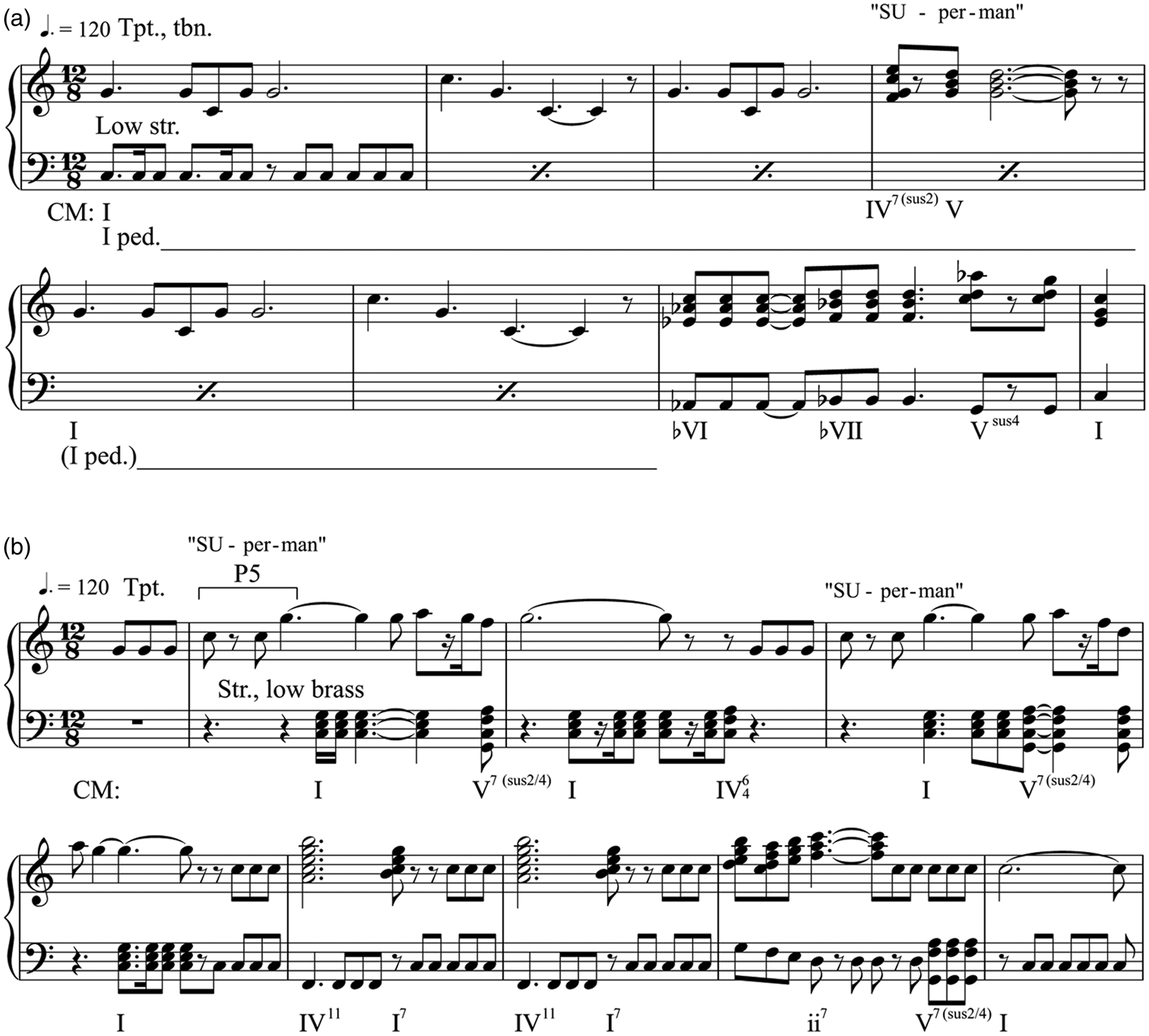
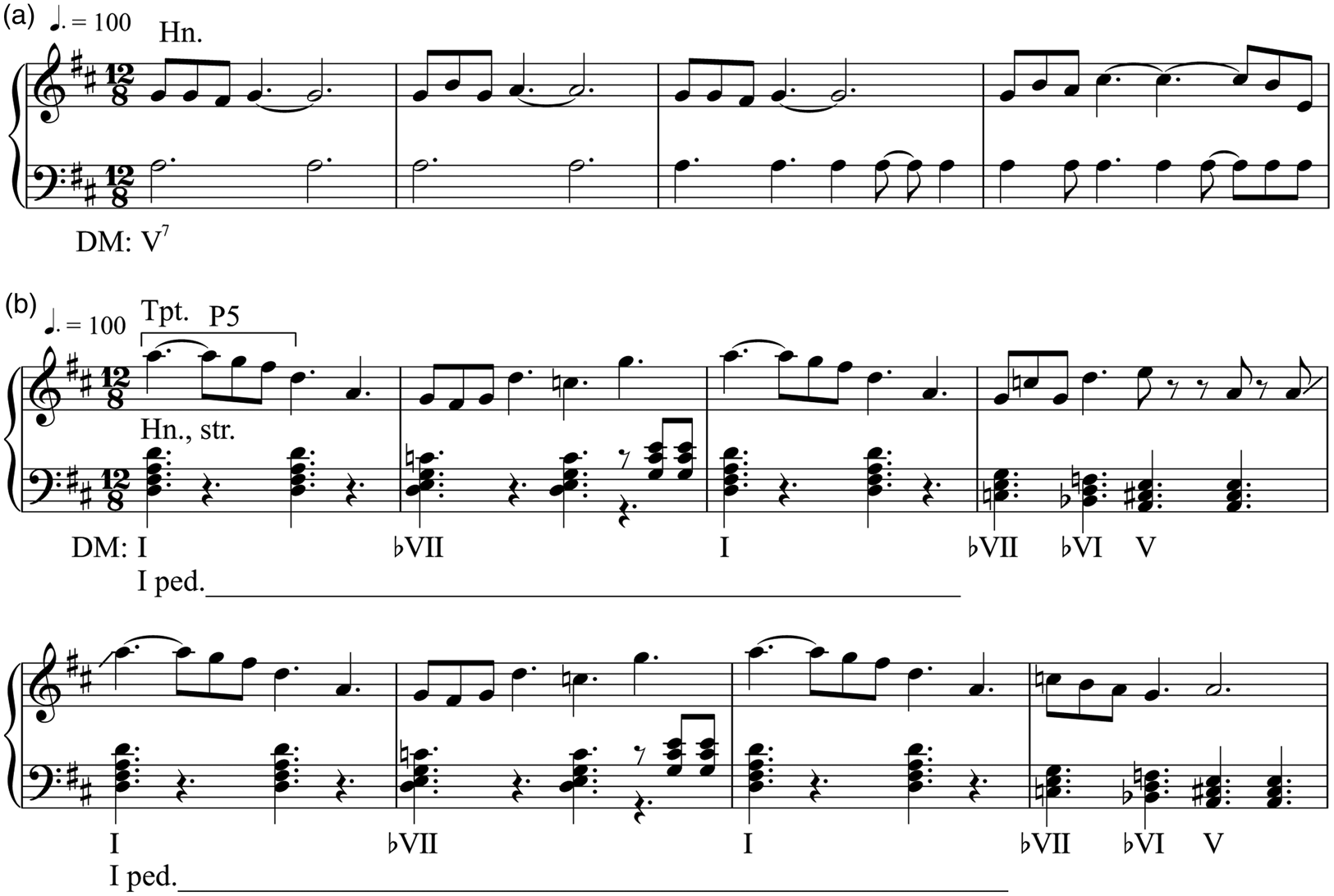
Superman's musical themes enhance the character's out-of-placeness, making similar slight jabs at his wholesomeness. There is a knowing, good-natured, over-the-top quality to his leitmotifs that portrays him as both fittingly heroic and also too heroic to be taken entirely at face value. Example 1 presents his leitmotifs as they appear in the overture.Footnote 75 The jagged and muscular “Superman fanfare” represents Superman's heroic identity and his superpowers (Example 1a, 3:16).Footnote 76 Williams reserves the famous “Superman” theme, with its exuberant leaping fifth, for his especially impressive feats like saving Lois from the helicopter (Example 1b, 1:58; 1:09:25).Footnote 77 Both themes communicate Superman's courageous masculinity through conventionalized scoring practices—they evoke a military topic, and they are generally played by male-coded brass instruments. At first blush, they are exactly what we would expect in a leitmotivic score of this era, particularly one by Williams. Indeed, analyses by Janet K. Halfyard, Victoria Hancock, and Neil Lerner have discussed Williams's similarly masculine-coded leitmotifs for the male heroes of the Indiana Jones and Star Wars series.Footnote 78
Superman, Superman's leitmotifs as they appear in the overture.
Example 1a. “Superman fanfare.”
Example 1b. “Superman.”
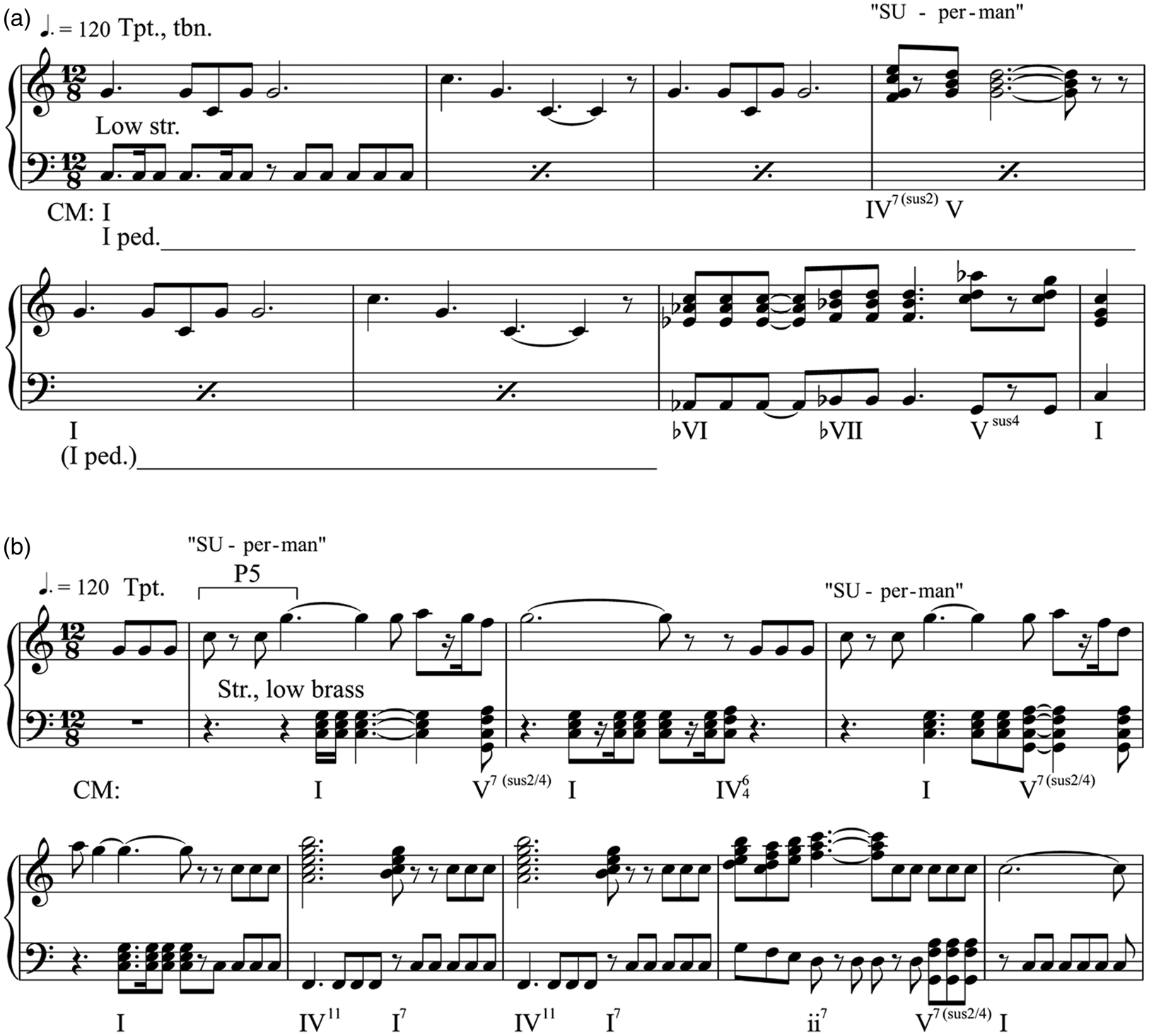
And yet, to return to Sontag's influential words, underneath this “impersonal” meaning there is a “witty meaning for cognoscenti.”Footnote 79 On the cold hard page, these themes may resemble Luke's theme, and, indeed, Superman's opening credits and the Krypton section evoke the space-operatic, mythical tone of Star Wars. The similarity ends, however, in the Metropolis section, when Superman joins a screwball comedy set in a quasi-realistic 1970s city, and a queer camp aesthetic emerges in the score. Much like Superman himself, the gentle humor of his themes stems from a mismatch between their earnest quality and the ridiculousness of the dramatic context. To give but one example, we hear a deadpan “Superman fanfare” as a burglar, using suction cups to scale a building, sees Superman standing perpendicular on the wall, quipping, “Hi there! Something wrong with the elevator?” (1:11:38).
In addition to the incongruity between the heroism of Superman's leitmotifs and the prankishness of their surroundings, there is an archness to the themes themselves. Matessino, Kendall, and Eldridge's liner notes provide an excellent example of this quality, although the authors do not read it as campy. Some of the rhythms in “Superman fanfare” and “Superman” “seemed to tempt the listener to sing the word ‘SU-per-man’ as if it were a lyric” (see the annotations in Examples 1a and 1b).Footnote 80 We also hear Superman's name hammered out in the ostinato leading up to “Superman” (1:30, not shown in Example 1b) that also accompanies “Superman fanfare” and “Love” (see Examples 1a and 3). Leaning into one of the biggest criticisms of the leitmotivic score—that it serves as a redundant signifying system by providing aural calling cards for characters—Williams carves the rhythms of Superman's name into his themes.Footnote 81 What could be more excessive, more over the top, more camp?
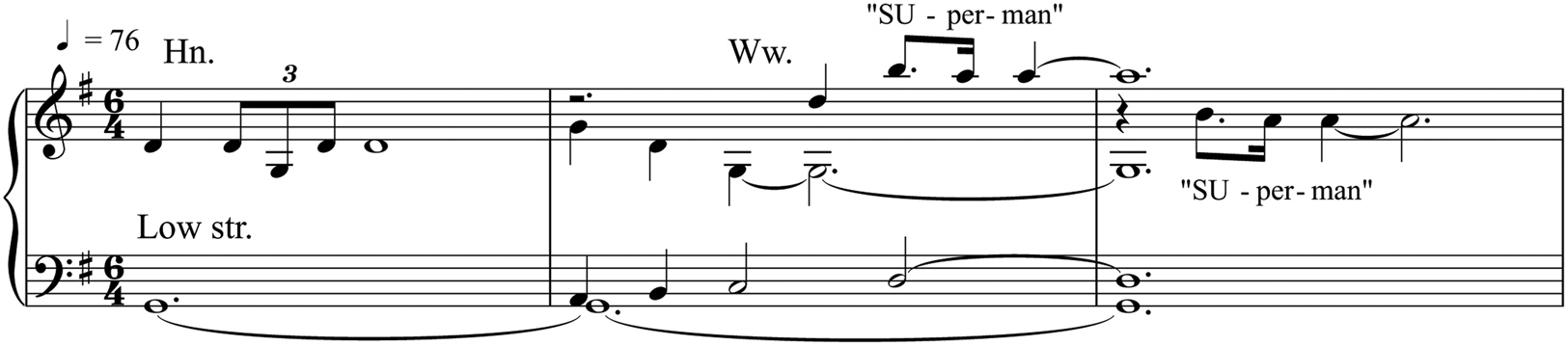
This tongue-in-cheek aspect is especially pronounced in certain appearances of “Superman fanfare” that highlight the “SU-per-man” fragment with a change of orchestration. These lighthearted variants occur in the film's more comical moments, such as when Lois almost makes the connection that Clark is really Superman in one of the last scenes (2:13:46). The first example, however, is when Jonathan and Martha discover Superman in his crashed spaceship, the child emerging unscathed from the wreckage.Footnote 82 The score, rather than reinforcing the portentousness of this moment, introduces a wry humor instead (Example 2, 24:22). After the horns somberly play “Superman fanfare” over a G in the low strings, the woodwinds add the “SU-per-man” fragment in a higher register, almost winking at the gravity of the situation (see the annotations in Example 2).
Superman, “SU-per-man” in “Superman fanfare” (cue: “Growing Up”).

Superman's themes, then, amplify the queer camp aesthetic of his characterization. They seem, at first, to reinforce the preferred reading in their loving representation of his masculine bravery, but they also coyly undercut it with their earnest appearances in ridiculous situations and arch appearances in serious situations, calling to mind another of Sontag's aphoristic camp definitions: “One can be serious about the frivolous, frivolous about the serious.”Footnote 83 These incongruities, the ways the themes seem almost to chafe against their dramatic contexts, open an ironic distance from the events, providing a space for Sontag's “witty meaning for cognoscenti”: an affectionate mockery of Superman.Footnote 84 There is more to this reading, but to access it fully we must first consider Superman's relationship with Lois and its musical accompaniment.
In an article for the Los Angeles Times, Patricia Goldstone identified one of the unique features of their dynamic: “in spite of the hero's powers, the sex roles . . . are reversed: It is he, in a sense, who is being the tease, and she who has trouble disguising her lust for him.”Footnote 85 Lois is captivated by Superman, and although he seems aware of her affections, he pretends not to notice them. Superman's reversal of the typical action film gender roles throws its queer camp aesthetic into harsh relief. Lois, the sharp-tongued, smoking workaholic, gawks at the soft-spoken Superman in his skintight, colorful outfit, and he becomes an erotic figure for her consumption. Their relationship, in other words, is queer in the expansive sense of deviating from bourgeois heteronormativity.
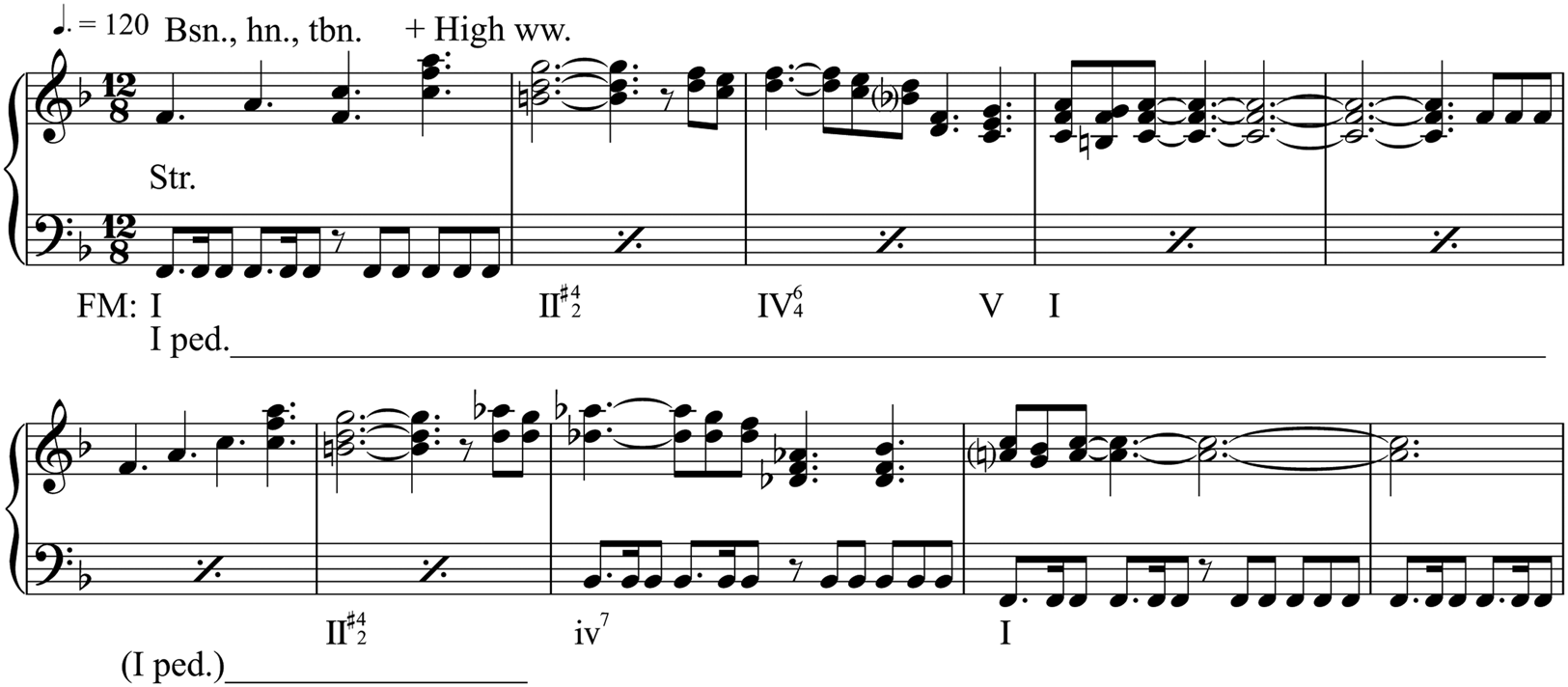
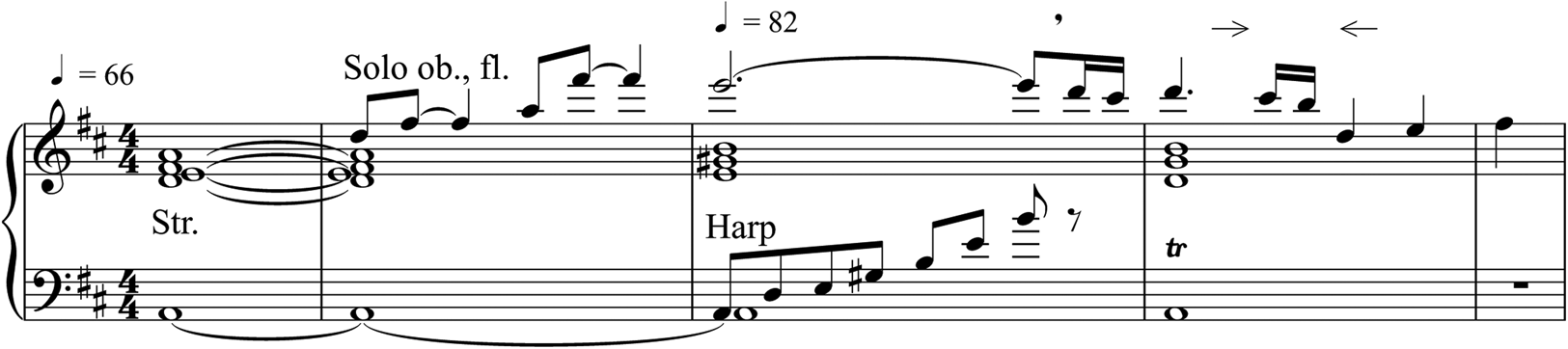
The score plays a large role in creating this aesthetic. Following leitmotivic conventions, Williams pairs Lois with a lyrical love theme, originally heard in F major in the overture (Example 3, 3:33). But there is an intriguing difference between “Love” and the typical love theme, which is usually more closely tied to the feelings male characters harbor for female characters—the aural equivalent to Mulvey's male gaze. This holds true even for some of Williams's most memorable love themes, including those for Raiders of the Lost Ark (Steven Spielberg, 1981) and Star Wars: Episode II—Attack of the Clones (George Lucas, 2002).Footnote 86 But “Love” in Superman departs from these conventions by representing Lois's affection for Superman as well as his for her. During the queer campy Metropolis section of the film, most of the appearances are tied to Lois's perception of Superman.
Superman, “Love” as it appears in the overture.

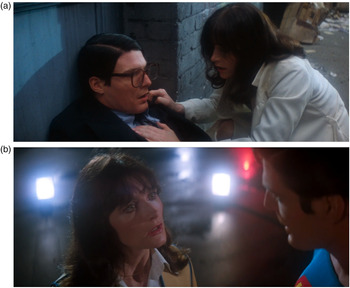
“Love” becomes associated with their role reversal in its very next appearance, when a mugger pulls a gun on Lois and Clark. When Lois kicks their assailant, he fires at her, and Clark secretly catches the bullet and pretends to faint (Figure 1a). We hear “Love” as Lois, adopting a historically masculinized role, checks to see if the effeminate Clark is hurt (54:28). “Love” becomes more specifically romantic after Superman saves Lois from the helicopter accident, and her desire for her rescuer is plainly visible on her face (Figure 1b). The gaze here certainly belongs to Lois, as does the love theme (1:10:08).
Superman, Gender-swapped roles.
Figure 1a. Clark (Christopher Reeve) “faints” after the mugging.
Figure 1b. Lois (Margot Kidder) ogles Superman.

The connection between “Love” and Lois's feelings for Superman deepens throughout the night of their flying date, which begins when Lois interviews Superman. Lois's tongue-tied infatuation with her subject is obvious, as she trips over her words and accidentally makes a sexual innuendo: “How big are you? How tall are you?” (1:22:40). “Love” takes on a flirtatious guise in this scene, the first appearance of which is shown in Example 4 (1:21:13). Although Superman remains controlled throughout their encounter, Lois is caught off balance by her attraction to him, which is paralleled by the halting presentation of “Love,” with coy syncopations in the melody and an elastic tempo (compare Example 4 to Example 3). As the annotations indicate, the music shifts to a faster tempo in the third measure, pauses at the end of the harp arpeggio, rushes forward again in the fourth measure before slowing down once more, almost emulating Lois's breathlessness and verbal stumbling.
Superman, Flirtatious “Love” during Lois's interview (cue: “The Penthouse”).

The link between “Love” and Lois's subjectivity becomes all but inescapable in the flying sequence that so captivated the critics. One of the striking qualities of this scene is surely Lois's internal monologue, recited over “Love” (1:29:56).
Leslie Bricusse wrote these words as lyrics for the theme, and Kidder recorded a version of the song, but Donner eventually decided the lyrics sounded better recited.Footnote 87 Their infantilizing language is at odds with Lois's generally brusque persona. She refers to herself as “a kid” and as “a little girl,” and she seems to relish Superman's ability to “see right through [her].” This sexist characterization would seem to neutralize any threat Lois, a career woman, might pose to heteronormative relationships by reassuring the viewer that underneath her icy professionalism, she secretly longs for a man to sweep her literally off her feet.
And yet there is something incongruous, excessive, and theatrical about this sequence that undermines this interpretation. The plot grinds to a halt as we are treated to a sumptuously overblown romantic sequence that is too long, too indulgent, and too ham-fisted. The inclusion of spoken lyrics—and cheesy ones at that—contributes to the excessiveness of the romantic depiction, recalling the literalness of the “SU-per-man” rhythms in Superman's leitmotifs. The mismatch between Lois's otherwise gruff personality and her insipid thoughts foregrounds the element of theatricality: she is playing the role of the typical love interest, and the performance is unpersuasive. At the same time, the lyrics tie the entire sequence to her perspective. As we hear her thoughts, we are invited not to objectify her but rather to step into her shoes, to gaze longingly at Superman's body as the two fly over Metropolis.
Superman offers us a preferred reading: Superman is a paragon of male heroism, and Lois would gladly sacrifice her independence to be with him. Yet this performance of heteronormativity is ultimately unconvincing because the film and the film score are rife with Sontag's “flamboyant mannerisms susceptible of a double interpretation.”Footnote 88 Superman's themes, too heroic to be taken entirely seriously, compromise his performance of masculinity, and the tight link between Lois's subjectivity and the love theme make him an erotic spectacle and object of sexual desire. Hidden beneath Superman's failed performance of heteronormativity, then, is his performance of a queer identity that foregrounds the suppressed camp tradition of the comics. Critics, distracted by the more legible pop camp performances of Luthor and his cronies, noticed this queer camp aesthetic but failed to recognize it as camp, leading to the misbegotten idea that Superman broke away from the superhero's camp legacy and the franchise died when it subsequently reembraced its past. But, as we shall see with Goldsmith's score for the critically derided Supergirl, the queer camp aesthetic unites the franchise, and rather than catalyzing its downfall, camp has always been one of its defining features.
Jerry Goldsmith's Supergirl Score, 1984
Supergirl begins in the floating space station of Argo City, populated by Kryptonians who escaped the explosion of their home world. Kara Zor-El (Helen Slater) inadvertently loses the Omegahedron, one of the city's power sources, and when she travels to Earth to recover it, she gains superpowers in her new environment and becomes Supergirl. The Omegahedron falls into the hands of the witch Selena (Faye Dunaway), who promptly begins abusing its power. Dressed in gaudy costumes and bellowing inane spells, she is even more of a pop camp figure than Luthor, and, much like the villains of the Batman show, she is coded as queer, this time through her close relationship with her live-in, wisecracking sidekick Bianca (Brenda Vaccaro). To establish a home base, Supergirl enrolls at an all-girls boarding school and moves into a dorm room with Lois's sister, Lucy (Maureen Teefy). For the rest of the film, Supergirl and Selena battle for the Omegahedron and the affections of Ethan (Hart Bochner), a brawny landscaper. In an ending that Paula Graham has recognized as antifeminist and homophobic, the world is set right again when Supergirl defeats Selena and banishes her to the Phantom Zone.Footnote 89
Supergirl's campiness, unlike Superman's, definitely pinged the critical radar, and it is indeed hard to miss the way the film leans further into pop camp, propelled by Dunaway's mannered performance. Yet, by focusing so much on one type of camp, critics then and now have missed the continuation of another: the queer camp aesthetic of Supergirl's portrayal. The score again plays a large role in creating this aesthetic through the gendered connotations of Supergirl's leitmotifs and the development of the love theme. First, much like Superman's leitmotifs, Supergirl's cast doubt upon her performance of heteronormativity, this time more directly because the masculine gender-coding of her music conflicts with her overwhelmingly hyperfeminine gender presentation. Second, the theme that sounds destined to become a love theme in the overture undergoes a process I term associational drift: its extramusical meaning evolves over the course of the film, and although the theme eventually represents Supergirl's relationship with Ethan, the broadness of its significations effectually deemphasizes their love story. Taken together, the failure of Supergirl's performance of heteronormativity makes available a queer reading that pairs her instead with her roommate, Lucy.
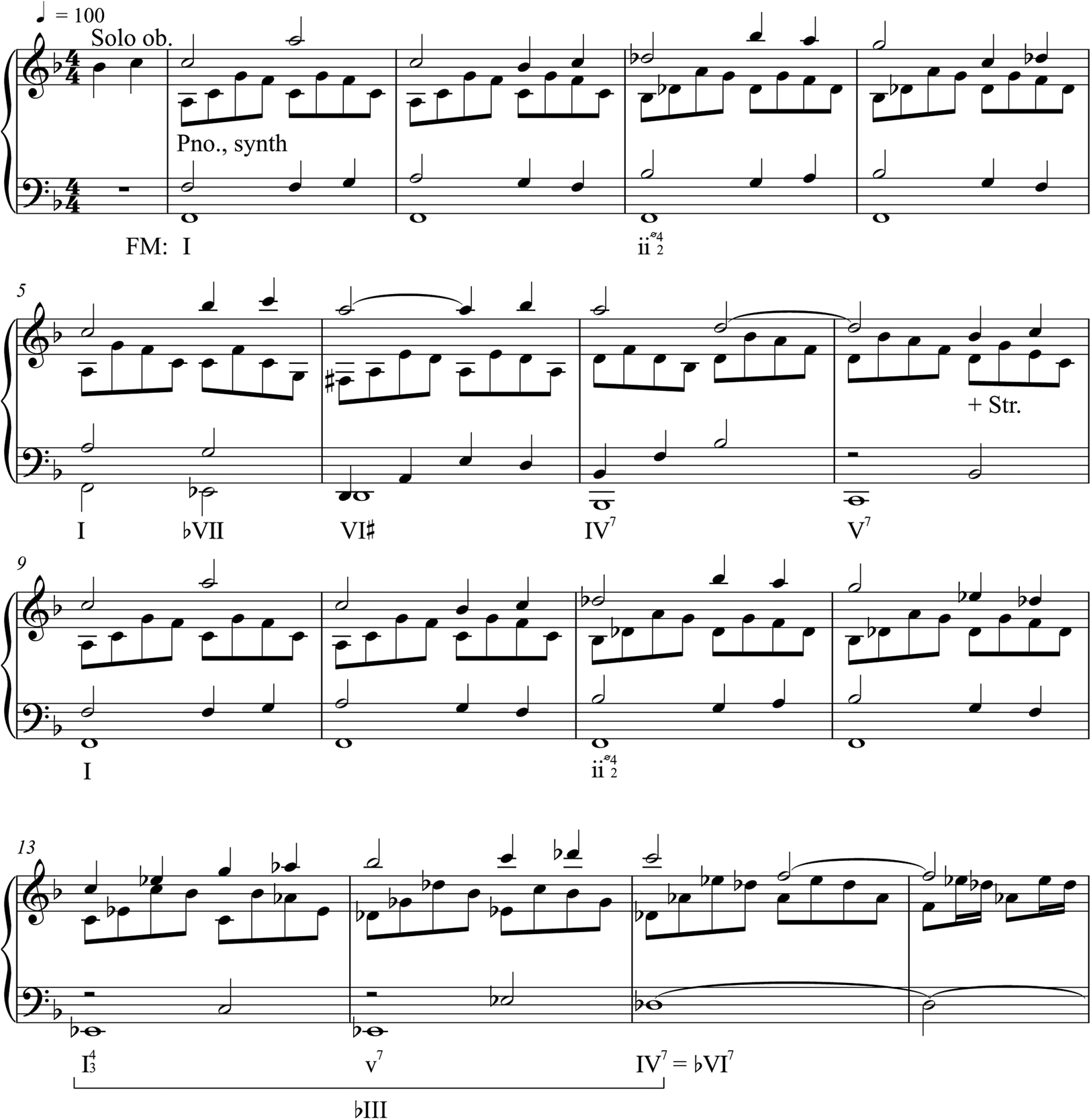
Goldsmith faced an unusual dilemma: he had to compose leitmotifs to represent a female action hero, a task made difficult by the longstanding associations between levels of narrative agency and gender roles.Footnote 90 Leitmotifs for women usually cast them as passive objects of affection for men, and there is no corresponding ironclad convention for depicting women who are heroes in their own right. Goldsmith elected to write male-coded leitmotifs for Supergirl that evoke Williams's work for Superman, a decision that essentially queered Williams's already queer model. Supergirl, like Superman, has two leitmotifs, shown as they appear in the overture in Example 5. “Supergirl fanfare” and “Supergirl” have the same jaunty compound meter and brass-heavy orchestration as “Superman fanfare” and “Superman” (compare Example 5a, 0:21 and 5b, 0:31 to Example 1a and 1b).Footnote 91 “Supergirl” is similar to “Superman” in its march-like character and its emphasis on the heroic interval of the perfect fifth (see brackets in Example 1b and 5b), and the ♭VII and ♭VI chords of “Supergirl” recall the harmonic idiom of “Superman fanfare” (compare Example 5b and 1a).Footnote 92 These similarities open a dialogue between the scores and facilitate a queer reading of Supergirl.
Supergirl, Supergirl's leitmotifs as they appear in the overture.
Example 5a. “Supergirl fanfare.”
Example 5b. “Supergirl.”

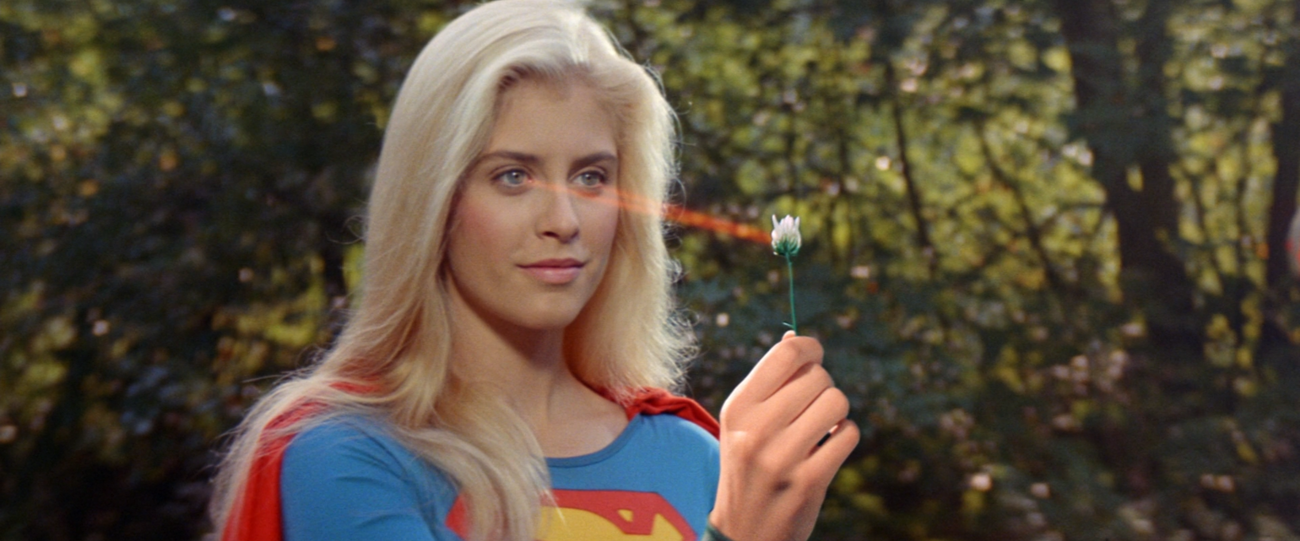
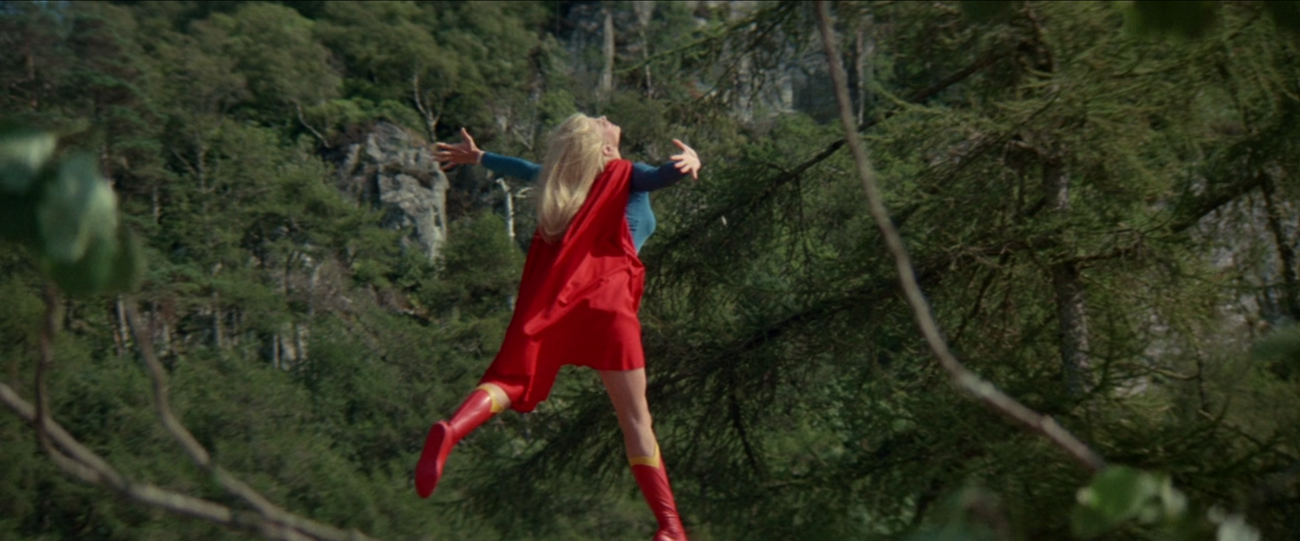
Linking male-coded leitmotifs to a female character is not necessarily campy, but in this case their male connotations contradict the way the rest of the film portrays her gender identity. Visually, she is almost excessively feminized: she wears skirts nearly the entire film, even as a superhero. In addition, the film carefully presents her abilities as feminine versions of Superman's. For example, when she arrives on Earth, she explores her newfound superpowers by gently using her heat vision to open the petals of a flower (Figure 2). Unlike Superman, who flies in a no-nonsense manner, Supergirl gracefully spins and flips through the air like a ballerina. Supergirl's exaggerated femininity, then, clashes with the pointed masculinity of her leitmotifs, creating the type of gender incongruity that is the harbinger of camp.Footnote 93
Supergirl, Supergirl (Helen Slater) uses heat vision to open a flower.

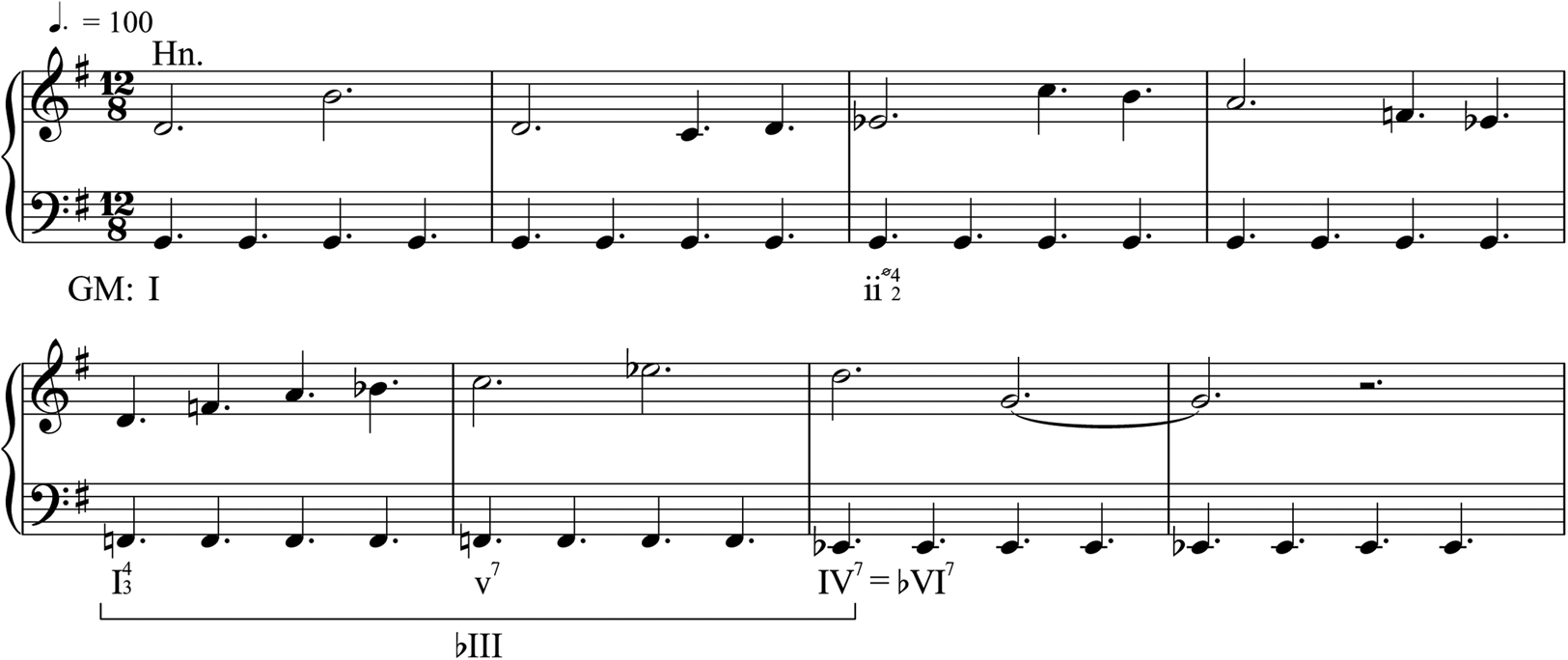
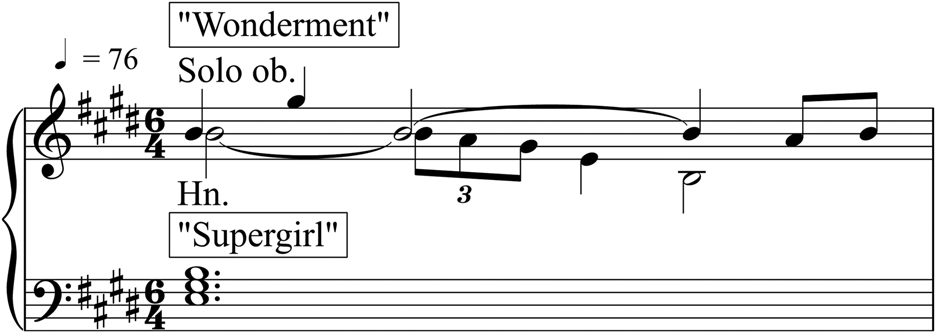
Supergirl's queerness comes even more into focus through the development of the film's would-be love theme, introduced in the overture and labeled “Wonderment” in Example 6 (1:31). At first blush, the similarities between Goldsmith's overture and Williams's, upon which Goldsmith's is clearly modeled, suggest the theme is a love theme, the parallel of “Love” in Superman (compare Example 6 to 3). For one, the overtures’ thematic distribution and tonal relationships are strikingly alike. Both begin with two heroic leitmotifs, and both modulate to the subdominant to introduce a lyrical leitmotif. Admittedly, “Love” and “Wonderment” have less in common than the heroic leitmotifs do: Williams uses a late-Romantic idiom for “Love,” but Goldsmith evokes jazz and popular music in “Wonderment” by including major seventh chords and, occasionally, a now-dated-sounding synthesizer. Yet there is still an intertextual connection between this theme and the Williams approach: the supertonic half-diminished seventh chord in the third and fourth measures, a chord Williams often uses for love themes.Footnote 94 Goldsmith's inclusion of the same chord seems like a reference to Williams's harmonic vocabulary.
Supergirl, “Wonderment” as it appears in the overture.

And yet, the theme's associational drift challenges this assumption. Indeed, the theme's early appearances within the film have little to do with romance—we hear it instead whenever Supergirl is enthralled by her surroundings or contemplating beauty. Because this theme's associations are far broader than those of a love theme, I label it “Wonderment.” We first hear a fragment as she gazes out her ship's window on her journey to Earth (11:28). Goldsmith presents the full version for the first time when Supergirl explores her ability to fly through dance in a cue appropriately titled “Flying Ballet” (Figure 3 and Example 7, 16:22).Footnote 95 Goldsmith also turns to “Wonderment” for when Supergirl soars over a herd of horses (18:11), flies over the city (20:53), and, amusingly, when she sees a rabbit in the forest (28:02).
Supergirl, Supergirl learns to fly through dance.

Supergirl, “Wonderment” in “Flying Ballet.”

After these early scenes, “Wonderment” undergoes associational drift, narrowing its once wide scope to signify romance specifically, albeit not permanently. This process begins when Supergirl rescues Ethan after Selena drugged him with a love potion to make him fall in love with the first person he sees. As Ethan looks at Supergirl, Goldsmith presents “Wonderment” with a fragment of “Supergirl,” a technique he repeats for many of Supergirl's interactions with him (Example 8, 1:02:43). The inclusion of her leitmotif suggests—erroneously, as we later learn—that her emotional response to Ethan will come to define her as a character.
Supergirl, “Wonderment” at Ethan (cue: “The Monster Tractor”).

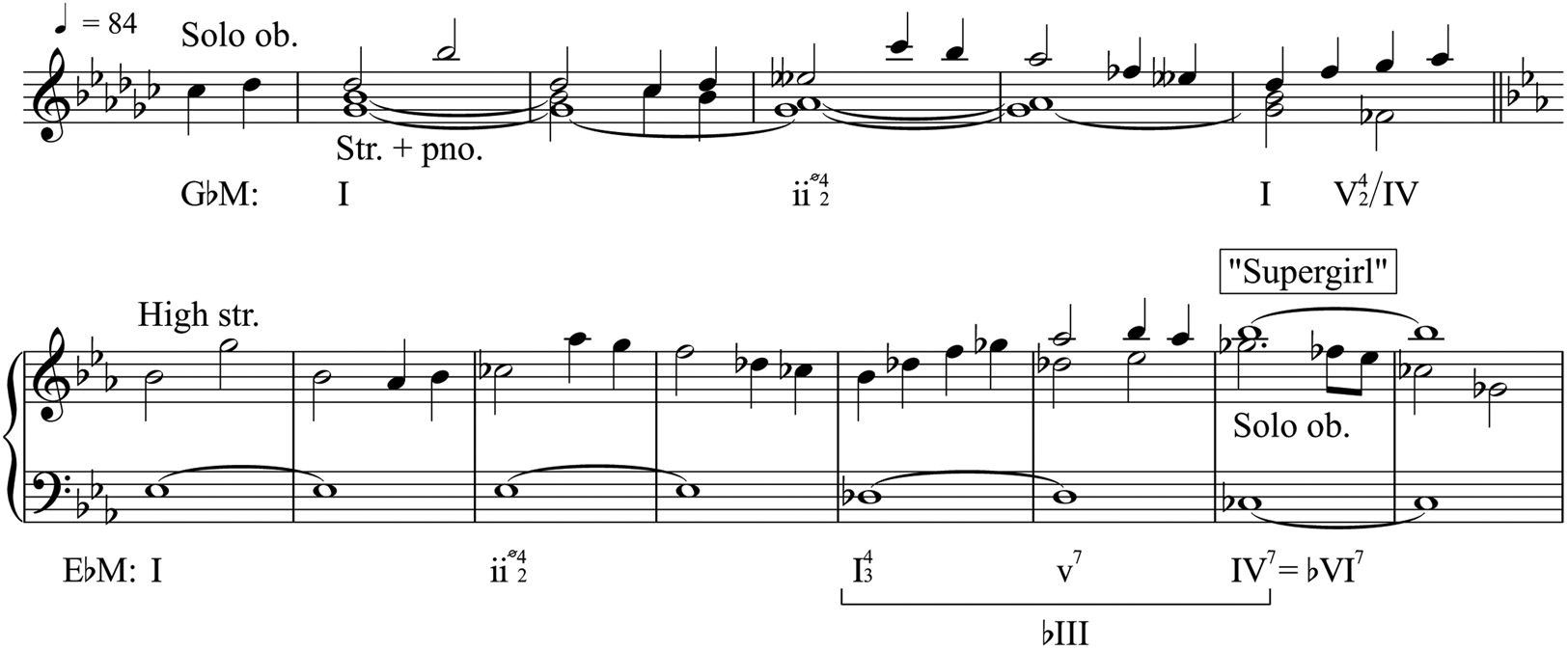
In a farcical depiction of heterosexual attraction, Ethan instantly announces that he loves Supergirl and quotes lines from Byron's poetry: “A bird of free and careless wing was I through many a smiling spring. The cold repulse, the look askance, the lightning of love's angry glance—stay! Let me behold you.”Footnote 96 “Wonderment” in the solo oboe in G-flat major underscores Ethan's declaration and Supergirl's puzzled expression (Example 9, 1:03:22). Ethan then kisses her, which inspires a modulation to E-flat major. Goldsmith again layers a “Supergirl” fragment over the final measure, as she leaves in confusion. Earlier, the film established Supergirl's naiveté when she failed to understand Lucy's insinuations about the romantic nature of Clark's relationship with Lois. It seems likely that this is her first kiss. And yet the appearance of the same leitmotif that accompanied her earlier encounter with a rabbit diminishes its importance, suggesting Ethan makes an impression on her not because she is attracted to him but rather because romance is a new experience.
Supergirl, “Wonderment” at romantic love (cue: “The Monster Tractor”).

In fact, before Ethan's drug-fueled confession of love, the film had hinted at a different sexual orientation for Supergirl. In the first comic book series, she lives at an orphanage, but, in a significant departure, the film trades the domesticity of the original setting for the lesbian possibilities of an all‐girl's boarding school, opportunities it exploits by placing her in homoerotic contexts like a softball game and a locker room shower scene. Fittingly, Supergirl is decidedly uninterested in Ethan at first, focusing instead on her friendship with Lucy. The development of “Wonderment” contributes to this queer reading. “Wonderment” may have evolved into a love theme, but it is not exclusive to Supergirl's feelings for Ethan. When she returns to her dorm after kissing him, she relives the experience by kissing herself in the mirror, accompanied by “Wonderment” in G-flat major, the same key as in the earlier kiss scene with Ethan (1:07:26). Supergirl's affections are redirected toward the female image in the space she shares with Lucy, suggesting she would rather kiss her roommate.
Ethan's unimportance becomes even more conspicuous at the end of the film. After Supergirl defeats Selena, Ethan hands her the Omegahedron, which immediately captures her attention, and she turns away from him (1:56:15). Here “Wonderment” engages in further associational drift, detaching from Supergirl's romantic feelings to represent her relief that she recovered her city's lost power source. Supergirl nearly forgets to say goodbye to Ethan, but when she belatedly remembers, we hear two final romantic “Wonderment” phrases (1:56:41). Then she races back home to save her family, accompanied by a “Wonderment” now completely shorn of its romantic connotations (1:57:45). No longer featuring material from “Supergirl,” “Wonderment” reverts to an earlier state—it is nearly the same as the first appearance in the overture. Supergirl, too, circles back to her initial priorities, leaving Ethan behind to complete her mission.
Out of the Super-Closet
Like Superman's performance of heteromasculinity, Supergirl's performance of heterofemininity is unpersuasive. These performances of queer identities are what Moe Meyer would call the “queer cultural critique” that emerges from all this queer camping.Footnote 97 In Superman, Williams's score constructs Superman as a queer figure, one whose dated boy-scout goodness and eroticization compromise his heteromasculinity. In Supergirl, the critique of the superhero is more on the nose. Supergirl's male-coded leitmotifs foil her heterofeminine gender presentation, and the associational drift of “Wonderment” calls her attraction to Ethan into question, making room for a queer reading that links her to Lucy. Although leitmotivic analysis has hardly been a mainstay of camp studies, the film scores’ roles in creating the queer camp aesthetic in the Superman franchise demonstrate that the leitmotivic score has remarkable potential as a camp site.
The series’ queer cultural critique is powerful because it excavates the buried queer legacy of the superhero story. Part of the fun of superhero comic books is the interplay between the heteronormative text and the scarcely concealed queer subtext: supposedly straight main characters struggle to hide their secret identities, sometimes risking “coming out” to friends and family members. Despite Wertham's homophobic fearmongering about homoeroticism in the Batman comic books, the Batman show broadcast this subtext and packaged it with another crucial component of the superhero comic book: camp. The popularity and potency of this combination was so strong that ten years later, the filmmakers behind Superman went to great lengths to escape Batman's shadow. And yet Superman engages with the camp tradition on a number of levels. Critics recognized Luthor's shenanigans as part of the pop camp tradition, but even though they enjoyed the gender role reversal between the romantic leads, they overlooked the camp reading such gender play invites. When the series drew closer to Batman by amplifying the pop camp elements of films like Supergirl, critics cast camp as the meta-villain of the saga, perpetuating the belief that camp is aesthetically bad.
In much of the discourse surrounding the franchise, it is not hard to pull apart the equation between camp and worthlessness to recognize homophobia as a hidden operator. Camp is bad because it is queer, and attempts to purge camp from the superhero adaptation can read like efforts to exorcise the queer. And this is what makes the campiness of the Superman films so delicious: the heteronormative mask slips, giving us a glimpse of the superhero's true face, one that has always been queer.