Introduction
The genus Paurodontella was erected by Husain & Khan (Reference Husain and Khan1968) and currently contains 15 nominal species (Handoo et al., Reference Handoo, Iqbal, Kazi and Fayyaz2010; Esmaeili et al., Reference Esmaeili, Heydari and Ye2016a, Reference Esmaeili, Heydari and Yeb, Reference Esmaeili, Heydari, Kheiri and Ye2019; Golhasan et al., Reference Golhasan, Heydari and Miraeiz2016; Yaghoubi et al., Reference Yaghoubi, Pourjam and Pedram2018) including Paurodontell aberrans (Nandakumar & Khera, Reference Nandakumar and Khera1969) Sumenkova, Reference Sumenkova1975; Paurodontell apitica (Thorne, Reference Thorne1941) Husain & Khan, Reference Husain and Khan1968; Paurodontell asymmetricus (Tikyani & Khera, Reference Tikyani and Khera1968) Sumenkova, Reference Sumenkova1975; Paurodontell densa (Thorne, Reference Thorne1941) Husain & Khan, Reference Husain and Khan1968; Paurodontell minuta Husain & Khan, Reference Husain and Khan1968; Paurodontell niger (Thorne, Reference Thorne1941) Husain & Khan, Reference Husain and Khan1968; Paurodontell sohaili Maqbool, Reference Maqbool1982; Paurodontell auriculata Anderson, Reference Anderson1985; Paurodontell balochistanica Handoo et al., Reference Handoo, Iqbal, Kazi and Fayyaz2010; Paurodontell myceliophaga Handoo et al., Reference Handoo, Iqbal, Kazi and Fayyaz2010; Paurodontell iranica Golhasan et al., Reference Golhasan, Heydari and Miraeiz2016; Paurodontell persica Esmaeili, Heydari & Ye, 2016; Paurodontell parapitica Esmaeili, Heydari & Ye, 2016; Paurodontell gilanica Yaghoubi et al., Reference Yaghoubi, Pourjam and Pedram2018; and Paurodontell composticolla Esmaeili et al., Reference Esmaeili, Heydari, Kheiri and Ye2019.
Within Paurodontidae Thorne, Reference Thorne1941, the genus is mainly characterized by the presence of basal stylet knobs, excretory pore located near the nerve ring, basal bulb with a stem-like extension, absence of post-uterine sac (PUS) or present only in rudimentary form, simple vulval lips and bursa not enclosing tail tip (Siddiqi, Reference Siddiqi2000).
According to the classification by Siddiqi (Reference Siddiqi2000), Paurodontella belongs to the subfamily Paurodontinae Thorne, Reference Thorne1941, family Paurodontidae Thorne, Reference Thorne1941, superfamily Sphaerularioidea Lubbock, 1861, suborder Hexatylina Siddiqi, 1980 in the order of Tylenchida Thorne, 1949. The status of the family Paurodontidae had many changes (Siddiqi, Reference Siddiqi2000; Andrássy, Reference Andrássy2007), the family distinguished two subfamilies, Paurodontinae and Sphaerulariinae Lubbock, 1861, under the family Sphaerulariidae and its placement under superfamily Sphaerularioidea were mostly accepted. Most disagreements have been related to the family level classification, and the genera within the family, which were predicted by Sumenkova (Reference Sumenkova1975), when he synonymized Paurodontoides Jairajpuri & Siddiqi, Reference Jairajpuri and Siddiqi1969 and Bealius Massey & Hinds, Reference Massey and Hinds1970 with Stictylus Thorne, Reference Thorne1941, partly due to the fact that many species have morphologically different entomophagous and non-entomophagous forms (Geraert et al., Reference Geraert, Raski and Choi1985; Fortuner & Raski, Reference Fortuner and Raski1987; Siddiqi, Reference Siddiqi2000; Andrássy, Reference Andrássy2007).
During a nematode survey, an unknown nematode population belonging to the genus Paurodontella was recovered from soil samples in the rhizosphere of a peach tree in Nazar Abad region of Alborz Province, Iran. Detailed observations using light microscopy and molecular assays indicated that this population differed from all previously described members of the genus and should be assigned to a new species. This publication includes a description of Paurodontella minora n. sp. through morphological observation and molecular characterization by the D2–D3 expansion region of the 28S rRNA gene sequence.
Materials and methods
Sampling, extraction, mounting and drawing
Specimens of P. minora n. sp. were obtained from a soil sample collected in Nazar Abad City, Alborz Province, Iran in May 2019. To obtain a cleaner suspension of nematodes, the tray method (Whitehead & Hemming, Reference Whitehead and Hemming1965) was employed. Specimens for light microscopy were killed by gentle heat, fixed in a solution of 4% formaldehyde + 2% glycerol and transferred to anhydrous glycerin according to De Grisse (Reference De Grisse1969) and mounted on permanent slides. Specimens were examined using an Olympus BH-2 (Japan) compound microscope. Measurements were carried out using a drawing tube attached to a Nikon E200 light microscope (Japan). All measurements were expressed in micrometres (μm). Photographs of nematodes were taken by a digital camera attached to the same microscope.
DNA extraction, PCR and sequencing
Nematode DNA was extracted from single live individuals. Single nematode specimen was transferred to an Eppendorf tube containing 16 μl ddH2O, 2 μl 10× polymerase chain reaction (PCR) buffer and 2 μl proteinase K (600 μg/ml) (Promega, Benelux, The Netherlands) and crushed for 2 min with a micro-homogenizer, Vibro Mixer (Zürich, Switzerland). The tubes were incubated at 65 °C for 1 h, then at 95 °C for 10 min. One μl of extracted DNA was transferred to an Eppendorf tube containing: 2.5 μl 10X ammonium reaction buffer, 0.75 μl magnesium chloride (50 mm), 0.25 μl dNTPs mixture (10 mm each), 0.75 μl of each primer (10 mm), 0.2 μl BIOTAQ DNA Polymerase (BIOLINE, UK) and double-distilled water to a final volume of 25 μl. The 28S D2–D3 was amplified using forward primer D2A (5′-ACA AGT ACC GTG AGG GAA AGT TG-3′) and reverse primer D3B (5′-TCG GAA GGA ACC AGC TAC TA-3′) (Nunn, Reference Nunn1992).
The PCR cycle conditions were: one cycle of 94 °C for 2 min, followed by 35 cycles of denaturation at 94 °C for 30 s, annealing temperature of 55 °C for 45 s, extension at 72 °C for 3 min, and finally one cycle of 72 °C for 10 min. PCR products were purified after amplification using ExoSAP-IT (Affmetrix, USB products), quantified using a Nanodrop spectrophotometer (Nanodrop Technologies, Wilmington, DE, USA) and used for direct sequencing in both directions using the same PCR primers. The resulting products were purified and run on a DNA multicapillary sequencer (Model 3130XL genetic analyser; Applied Biosystems, Foster City, CA, USA), using the BigDye Terminator Sequencing Kit v.3.1 (Applied Biosystems, Foster City, CA, USA), at the Stab Vida sequencing facilities (Caparica, Portugal). The newly obtained sequence was submitted to the GenBank database under accession number MK517638 for partial 28S D2–D3 rDNA.
Phylogenetic analyses
The molecular sequence of P. minora n. sp. was compared with those of other nematode species available in GenBank using the Basic Local Alignment Search Tool (BLAST) homology search program. Our newly obtained DNA sequence, together with the GenBank sequences used for phylogenetic analyses, were edited with ChromasPro1.5 2003-2009 (Technelysium Pty Ltd, Helensvale, Australia) and aligned using ClustalW (http://workbench.sdsc.edu; Bioinformatics and Computational Biology group, Department of Bioengineering, UC San Diego, CA). All available species of Paurodontella and some other Hexatylina species from GenBank were also selected for phylogenetic analysis. The outgroup taxon was chosen according to previously published data (Esmaeili et al., Reference Esmaeili, Heydari and Ye2016b). The model of base substitution in the sequences data were evaluated using MODELTEST version 3.06 (Posada & Criandall, Reference Posada and Criandall1998) based on the Akaike-supported model (Arnold, Reference Arnold2010). Bayesian analysis was performed to confirm the tree topology using MrBayes 3.1.0 (Huelsenbeck & Ronquist, Reference Huelsenbeck and Ronquist2001) running the chain for 1,000,000 generations and setting the ‘burn-in’ at 1000. The Markov chain Monte Carlo method was used within a Bayesian framework to estimate the posterior probabilities (pps) of the phylogenetic tree (Larget & Simon, Reference Larget and Simon1999) using the 50% majority-rule. The λ2 test for homogeneity of base frequencies and phylogenetic tree was performed using PAUP* version 4.0 (Sinauer Associates, Inc. Publishers, Sunderland, MA).
Results
Paurodontella minoraFootnote * n. sp.
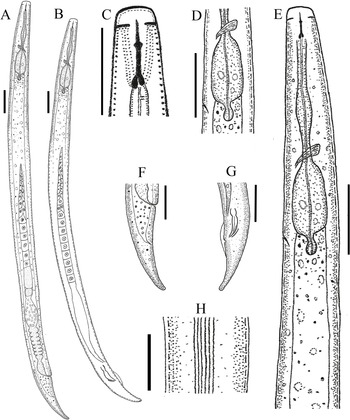
Line drawing of Paurodontella minora n. sp.: (A) female entire body; (B) male entire body; (C): stylet; (D) second (posterior) bulb region of female; (E) female pharyngeal region; (F) female posterior region; (G) male posterior region; and (H) lateral field of female. All scale bars 20 μm, except for c = 10 μm.

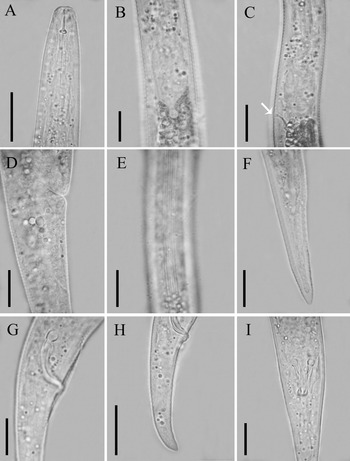
Paurodontella minora n. sp: (A) female anterior region; (B, C) female basal bulb region, showing excretory pore (arrowhead in C); (D) vulva to anus region; (E) lateral field; (F) female posterior region; (G) spicule and bursa in lateral view; (H) male posterior region; and (I) spicule and bursa in ventral view (scale bars = 10 μm.).

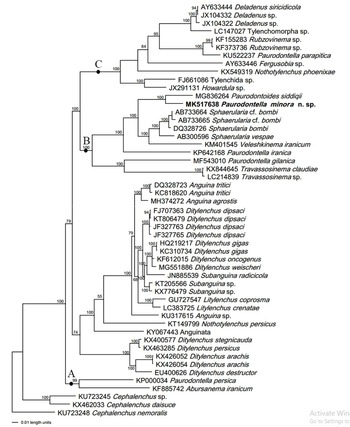
Bayesian consensus tree inferred from 28S under GTR + I + G model (−ln L = 14,037.9111; AIC = 28,095.8223; freqA = 0.1668; freqC = 0.1995; freqG = 0.3424; freqT = 0.2913; R(a) = 1.2152; R(b) = 4.6046; R(c) = 2.0815; R(d) = 0.9524; R(e) = 5.3779; R(f) = 1; pinva = 0.1483; shape = 0.822). Posterior probability values exceeding 50% are given on appropriate clades.

Measurements
See table 1.
Morphometrics of Paurodontella minora n. sp. All measurements in μm and in the form: mean ± standard deviation (range).

Description
Free-living mycetophagous female
Body short, slender, becoming almost straight on death or sometimes arcuate ventrally after heat relaxation. Cuticle with transverse striate throughout body, ca. 1.0–1.6 μm apart. Lateral field marked by 6–7 incisures, outer and inner incisures are weakly crenate. Lip region wide, rounded contour, annulated and continuous with body contour. Lip region 2.5 (2.0–3.0) μm high, 6.4 (6.0–7.0) μm broad. Amphidial aperture slit-like, located on lateral lips. Stylet weak, short, 6.1 (5.5–7.0) μm long, conus ca. 0.4–0.5 times the stylet length, with minute and asymmetrical basal knobs. Dorsal gland orifice 1.5–2.0 μm posterior to stylet knobs. Pharyngeal corpus a cylindrical tube with long and fusiform median bulb, without valvular apparatus, isthmus cylindrical and slender, encircled by nerve ring. Position of excretory pore at the level of the basal bulb region, located at 70 (65–76) μm from anterior end. Basal bulb large, with small stem-like extension projecting into lumen of intestine. Hemizonoids just anterior to excretory pore. Vulva near anus as a transverse slit, well posterior, located at 87 (86–88)% of body length. Reproductive tract prodelphic, gonad outstretched. Crustaformeria composed of 8–10 rows. Oviduct not branching to form a uterine diverticulum. Spermatheca spherical with round sperms ca. 2.2–3.0 μm in diameter, in young female without sperm. Oocytes in a single file, but arranged in two files at proximal end. Ovary reflexed at tip in some individuals, in young female outstretched. Vagina extending into body for slightly less than 50% body diameter. Post uterine sac absent. Post-vulval region tapering gradually, anus distinct or vestigial, tail conoid ending in a finely rounded terminus.
Free-living mycetophagous male
Rare (ratio of 1:8 females). Very similar to female in general morphology except for reproductive system. Cuticle with fine annulation, about 1.5–1.8 μm apart. Tail conical with rounded tail tip without mucron. Testis single, outstretched. Spermatocytes arranged in double rows. Spicule cephalate, and arcuate ventrally. Gubernaculum simple. Bursa annulated, adanal.
Infective female
Not found.
Type host and locality
Females and male were recovered from soil samples from the rhizosphere of a peach tree (Prunus persica L.) in Nazar Abad City, Alborz Province, Iran, during May 2019 (Global Positioning System coordinates: 35°48N, 51°00E, 1380 m above sea level).
Type material
Holotype female, two paratype females and paratype male (slides PMS001 and PCSM002) deposited at the Nematode Collection of the Department of Plant Protection, College of Agricultural and Natural Resources, University of Tehran, Karaj, Iran. Two female paratypes deposited at the National Nematode Collection of the Department of Nematology, Iranian Research Institute of Plant protection, Tehran, Iran. Two paratype females deposited in the United States Department of Agriculture Nematode Collection, Beltsville, MD, USA.
Diagnosis and relationships
Paurodontella minora n. sp. is an amphimictic species and is characterized by a combination of the following characters: relatively short body length of 393 (350–438) μm (females) and 380 μm (male); lateral fields marked by 6–7 incisures; 6.1 (5.5–7.0) μm long stylet with minute and asymmetrical basal knobs; a short stem-like extension projecting into lumen of intestine; excretory pore located at the level of basal bulb region ca. 70 (65–76) μm from anterior end in females; absence of a uterine diverticulum branch; V = 87 (86.4–88.2), absence of PUS; tail conoid with finely rounded tip; and rare male with 15 μm long spicules and adanal bursa.
The new species belongs to the genus Paurodontella based on the commonly shared characters, that is, stylet knobs’ characters (asymmetrical in the case of the new species), an elongate fusiform, non-muscular, non-valvate median pharyngeal bulb, basal bulb with a stem-like extension projecting into the lumen of intestine and male bursa not reaching tail tip (adanal bursa).
According to Handoo et al. (Reference Handoo, Iqbal, Kazi and Fayyaz2010) species of Paurodontella can be divided to those with/without a uterine diverticulum. Due to the presence of a relatively short body, absence of PUS, shape of posterior body and an oviduct not branching to form a uterine diverticulum, the new species comes close to four known species in the genus, namely P. asymmetrica, P. balochistanica, P. densa and P. niger.
It differs from P. asymmetrica by having asymmetrical stylet knobs vs. symmetrical and posteriorly directed, shorter stylet (5.5–7.0 vs. 13–14 μm), lateral field with 6–7 vs. 4 lines, tail tip rounded vs. pointed and presence vs. absence of male; from P. balochistanica by shorter stylet (6.1 (5.5–7.0) vs. 10.5 (10–11) μm), asymmetrical stylet knobs vs. symmetrical and posteriorly directed, lateral field with 6–7 vs. 4 lines, absence of PUS vs. presence and presence of male vs. absence; from P. densa by having short stem-like extension projecting into the lumen of intestine vs. long, absence of PUS vs. presence and presence of male vs. absence; and from P. niger by having short vs. long stem-like extension projecting into the lumen of intestine, absence of PUS vs. presence and tail tip rounded vs. pointed.
Molecular phylogenetic relationships
Amplification of the partial 28S D2–D3 rDNA gene sequence from P. minora n. sp. specimens yielded a single fragment of approximately 800 base pairs based on gel size.
To determine the phylogenetic relationships of P. minora n. sp. with other nematode species, a newly obtained 700 nt long partial sequence of 28S rDNA with accession number MK517638 was used. The BLAST search using this fragment revealed that it is unique; with no highly matched sequence deposited in GenBank only 94% identity was achieved for an isolate of Sphaerularia Dufour, Reference Dufour1837 with accession number of MH243752. When the newly obtained sequence was compared for the 28S D2–D3 region of Sphaerularia sp., they shared 677 identical nucleotides (95%), 25 insertions/deletions (3%) and 1 indel over 700 total characters. The phylogenetic tree generated from 28S D2–D3 alignment by Bayesian inference analysis under the GTR + I + G model is presented in fig. 3, which contained 48 in-groups and three out-groups’ taxon. This tree rooted with three isolates of the genus Cephalenchus spp. (KU723245, KX462033 and KU723248) Pereira & Baldwin, Reference Pereira and Baldwin2016 revealed that all species of the genera in Sphaerulariidae are in a 79% supported polyphyletic clade.
In the phylogenetic 28S tree, the new species clustered a clad with a species of the genus Paurodontoides, Paurodontoides siddiqii Esmaeili, Golhasan, Ye and Heydari, 2018 (MG836264), both of which forming a clade with two species of the genus Sphaerularia (AB733664, AB733665, AB300596, DQ328726) (Tylenchida: Hexatylina: Sphaerularioidea: Sphaerulariidae; Sphaerulariinae) and Veleshkinema Yaghoubi et al., Reference Yaghoubi, Pourjam and Pedram2018 (KM401545) (Tylenchida: Hexatylina: Sphaerularioidea: Sphaerulariidae; Paurodontinae) occupied with Paurodontella iranica (KP642168) in a basal position with a PP support of 100% (fig. 3). This clade is in highly supported sister relation with Paurodontel gilanica (MF543010) and phylogenetically close to members of the family Neotylenchidae (Thorne, Reference Thorne1941).
Two other species of the genus (Paurodontella persica and Paurodontella parapitica) (KP000034 and KU522237) are placed in distantly separated clades with the new species; concerning the uncertainty of its generic position and the non-monophyletic nature of most hexatylenchid taxa, this placement could neither confirm nor reject the placement of the species P. persica under the genus Paurodontella. The monophyletic nature is not seen for most families and subfamilies of Hexatylina in the 28S tree; however, genomic sequences are not available for most representatives of the suborder.
Discussion
The suborder Hexatylina (sensu Siddiqi, Reference Siddiqi2000) comprises a diverse group of taxa which are separated from each other based on their morphological and/or biological characters. The useful morphological characters for species delimitation within Paurodontella are the position of stylet knobs, length of a stem-like extension projecting into the lumen of intestine, form of oviduct branching and PUS. Paurodontella minora n. sp. could be separated from species of the genus Paurodontus by lacking a chamber-like structure surrounding the pharyngeal bulb and PUS.
The Paurodontella species may be divided into two assemblages; one ‘diverticulum-species’ group and other ‘none-diverticulum species’ group. The new species belonging to a group of none-diverticulum species group in the genus are further characterized by lacking a structure in their reproductive system that is referred to as the diverticulum; a prominent, small, anterior projection attached to oviduct forming a uterine diverticulum of variable size which may function as spermatheca (Handoo et al., Reference Handoo, Iqbal, Kazi and Fayyaz2010). The classification of these groups is based on morphological features. Paurodontella minora n. sp. is unique within the genus by having a small body size, short stylet with minute and asymmetrical basal knobs, 6–7 incisures in lateral field and a short stem-like extension projecting into the lumen of intestine.
Currently, molecular data are only available for a limited number of identified Paurodontella spp. mainly described from Iran (Esmaeili et al., Reference Esmaeili, Heydari and Ye2016a, Reference Esmaeili, Heydari and Yeb, Reference Esmaeili, Heydari, Kheiri and Ye2019; Golhasan et al., Reference Golhasan, Heydari and Miraeiz2016;Yaghoubi et al., Reference Yaghoubi, Pourjam and Pedram2018), and not available to old species under the genus. In our present large subunit rDNA (LSU tree), members of Sphaerularioidea have occupied separate clades within the phylogenetic tree. For example, the subfamilies of Sphaerulariidae are in separate clades, distantly related to each other. The non-monophyletic nature is also seen for several genera such as Paurodontella, Deladenus and Nothotylenchus. In the genus Paurodontella, P. persica clustered with Abursanema iranicum and formed a separate clade (A), three species (P. minora n. sp., P. iranica and P. gilanica) formed clade B with species of Paurodontoides, Sphaerolaria, Veleshkinema and Travassosinema, and P. parapitica was placed in a clade of Deladenus, Rubzovinema and Fergusobia species (clade C). Similar to the former phylogenetic analysis by Koshel et al. (Reference Koshel, Aleshin, Eroshenko and Kutyrev2014) using small subunit–internal transcribed spacer–5.8S–LSU rDNA sequences, the non-monophyletic nature of families such as Sphaerulariidae, Neotylenchidae, Allantonematidae Pereira, 1931 and Anguinidae Nicoll, 1935, is documented. Although access to find old reported species in the genus is difficult, further research should elucidate to attempt an integrated revision of the genus.
Siddiqi (Reference Siddiqi2000) pointed out that the family Sphaerulariidae has ‘two types of generations, one free-living, fungus- or plant-feeding, another involving a heterosexual female parasitic in the insect haemocoel’. Most species of the family Sphaerulariidae are insect associates (Siddiqi, Reference Siddiqi2000) with the exception of the genera under Paurodontinae. Thus, with regard to the absence of parasitic/or infective female, free-living mycetophagous of Paurodontinae and placement of the new species, P. minora n. sp. share fungal feeding or probably, the plant feeding habits.
Acknowledgements
The authors thank Mr Mohammad-Housein Esmaeili for his help with sampling and Dr Weimin Ye (North Carolina Department of Agriculture and Consumer Services, Raleigh, USA) for his valuable and helpful comments.
Financial support
The authors thank the University of Tehran for financial support.
Conflicts of interest
None.
Ethical standards
This article does not contain any studies with human participants or animals performed by any of the authors.