


Effective, legitimate police forces are widely viewed as necessary for sustained peace, economic growth, and the rule of law. Because citizens are more likely to interact with police officers than with most other civil servants (Mazerolle et al. Reference Mazerolle, Antrobus, Bennett and Tyler2013), building trust in the police may also help build trust in the state more generally. These intuitions have catalyzed millions of dollars of investments in state security institutions by donors, aid agencies, and the UN—a trend that has accelerated in recent years with the proliferation of organizations and initiatives dedicated to rule of law promotion and security sector reform (Carothers Reference Carothers2009).
Establishing police effectiveness and legitimacy is especially challenging in the world’s weakest and most war-torn states—arguably the settings in which effective and legitimate police forces are most urgently needed. Citizens of these countries often do not know how to contact the police, and many assume that seeking redress through state security institutions will be prohibitively expensive. Many also (rightly) fear police corruption and abuse. As a result, victims and witnesses often refuse to report to the police, relying instead on customary mechanisms of dispute resolution. These can be efficient, effective, and easily accessible (Isser Reference Isser2011), but are often biased against historically marginalized groups, entrenching inequities in areas beyond the state’s purview (Aldashev et al. Reference Aldashev, Chaara, Platteau and Wahhaj2012). Some also rely on modes of adjudication that are illegal under state law, and that violate norms of due process (e.g., trial by ordeal).
The literature on fostering citizens’ trust and compliance with state security institutions is surprisingly thin, especially in political science, and especially in the developing world. Despite influential early contributions by political scientists (e.g., Wilson Reference Wilson1978), for many years the study of policing was dominated by criminologists, psychologists, and, to a lesser extent, economists. As informative as these studies have been, the vast majority focus on the USA, UK, and Australia, and may not generalize to developing countries, much less to weak and war-torn states (Braga et al. Reference Braga, Welsh, Papachristos, Schnell and Grossman2014; Sahin et al. Reference Sahin, Braga, Apel and Brunson2017). While a number of scholars have explored “best practices” in post-conflict security sector reform (e.g., Bryden, N’Diaye, and Olonisakin Reference Bryden, N’Diaye and Olonisakin2008), few have addressed whether or how these reforms affect the relationship between civilians and state institutions. Moreover, these latter studies are almost all observational, and many rely on anecdotal evidence alone. As such, they are susceptible to selection and other biases.
This situation is beginning to change, with several recent randomized controlled trials exploring particular approaches to policing in the developing world.Footnote 1 We advance this literature by experimentally evaluating the effects of recurring “Confidence Patrols” by elite police officers on crime, property rights, and police/community relations in Liberia. Importantly, and unlike most other studies of policing (experimental or otherwise), our evaluation occurs in a context of ongoing state penetration into communities governed first and foremost by customary authorities—in particular, chiefs, elders, and sodalities known as “secret societies.”
State penetration can sometimes result in mutually advantageous arrangements between statutory and customary providers of security and other public goods (Baldwin Reference Baldwin2015). Often, however, the projection of state power sparks conflict between competing authorities, each angling to make “their rules, whether state law or some other implicit code, become the routine basis upon which people act” (Migdal and Schlichte Reference Migdal, Schlichte and Schlichte2005, 15, emphasis ours). These cases are characterized not by the “mutual empowerment” of statutory and customary institutions, but rather by contestation over “mutually exclusive goals” (Migdal Reference Migdal, Migdal, Kohli and Shue1994, 24). Our aim in this paper is not only to contribute to the academic literature on policing, statebuilding, and security sector reform, but also to inform policymaking in Liberia at an especially delicate moment, as UN peacekeepers withdraw and the government extends its presence into rural areas long accustomed to state absence or abuse.
Our evaluation leverages a combination of original survey and behavioral data, Liberian National Police (LNP) crime records, and qualitative field reports compiled by a Liberian research assistant hired to shadow the LNP for the duration of the experiment. Together, these data yield six sets of results. First, we find that the Confidence Patrols program improved security in treatment communities, strengthening property rights and reducing the incidence of some types of crime as measured in our survey, notably simple assault and domestic violence. Second, we find that the program reduced the costs of crime reporting by increasing citizens’ knowledge of Liberian law and improving their understanding of the mechanisms available to them for accessing the LNP. Third and relatedly, we find that residents of treatment communities were approximately 50% more likely to report felony offenses to the police and courts relative to the control group. This difference was not accompanied by a corresponding change in reporting of misdemeanors—an important finding in itself, given the severe capacity constraints under which the Liberian police and courts continue to operate.
Fourth and more surprisingly, we find no evidence that the program improved citizens’ (generally negative) perceptions of the police, courts, or Liberian government. These null effects are inconsistent with our expectations, and with studies suggesting that citizens’ willingness to cooperate with the state in general (Levi, Sacks, and Tyler Reference Levi, Sacks and Tyler2009) and the police in particular (Tyler Reference Tyler2004; Tyler and Huo Reference Tyler and Huo2002) depends on their belief that state institutions are competent and procedurally fair. A potential solution to this puzzle lies in our fifth result: We find that the shift from under-reporting to reliance on the police and courts was concentrated almost entirely among residents who were not members of Liberia’s powerful secret societies. Society membership is an important source of privilege in rural Liberia, and nonmembers are at a distinct disadvantage when crimes are committed or disputes occur (Lubkemann, Isser, and Banks, III Reference Lubkemann, Isser, Banks and Isser2011). Our results suggest that the Confidence Patrols program provided an “exit option” for these individuals.
Finally and also relatedly, we find some evidence that the program provoked backlash from the customary sector, with residents of treatment communities reporting more frequent appearances of the “bush devil”—a controversial ceremonial figure that secret societies use to maintain social order, often at the expense of nonmembers (Isser, Lubkemann, and N’Tow Reference Isser, Lubkemann and N’Tow2009)—and more stringent social norms against cooperation with the LNP. Taken together, our results suggest that expanding police presence into rural communities can improve security and help equalize access to justice, even where distrust of state security institutions is pervasive, but that state penetration is contentious, and is liable to provoke backlash from those who benefit from customary law.
Our study is not without limitations. First, because our sample size is modest, it is possible that we failed to detect small effects, particularly for outcomes that are relatively rare (e.g., armed robbery). Second, some of our dependent variables are difficult to measure in a survey, and our proxies may be susceptible to social desirability bias and other forms of measurement error. This problem afflicts all studies that use surveys to measure outcomes, and ours is no exception. We attempt to overcome these limitations by complementing our survey with administrative, qualitative, and behavioral data, and by showing that our findings are inconsistent with social desirability bias. Nonetheless, our results should be interpreted with these caveats in mind.
Third, the Confidence Patrols program featured multiple components—town hall meetings, Q&A sessions, foot patrols, distribution of pamphlets, and soccer games with local youths—and we are unable to disentangle their relative effectiveness. We view this limitation as minor, both conceptually and practically, since all components of the program were designed with the same purpose in mind—providing information and creating opportunities for positive contact between police officers and civilians—and since the marginal cost of each additional component was low.Footnote 2 Finally, as with any study focused on a single case, we cannot be sure whether our results generalize. The dynamics of state penetration in Liberia are similar to those in other African countries, and problems of police corruption and abuse are endemic to the continent, and to much of the developing (and, indeed, developed) world. We believe a similar program would have similar effects in other rural African contexts, and possibly beyond. Nonetheless, we can only speculate about generalizability and leave this question for future research to explore.
THEORY
Pathologies of Policing after Civil War
The challenges of creating effective, legitimate police forces are especially daunting in countries recovering from civil conflict. Police effectiveness depends in part on citizens’ cooperation, and on their willingness to report to the police when crimes are committed or violence occurs (Braga Reference Braga2008; Tyler and Fagan Reference Tyler and Fagan2006; Tyler and Huo Reference Tyler and Huo2002). This, in turn, depends on citizens’ belief that the benefits of cooperation will exceed the costs. In countries overcoming legacies of civil war, citizens may hold strong priors that state security institutions are biased, predatory, or incompetent, and may therefore expect the benefits of cooperation to be low. Previous studies have shown that negative police/citizen interactions are more powerful in damaging citizen views of the police than positive interactions are in improving them (Li, Ren, and Luo Reference Li, Ren and Luo2016)—an especially salient concern in post-conflict settings.
These problems are compounded by the often-prohibitive costs of reporting to the police or cooperating in criminal investigations, especially where civil war is accompanied by state collapse. Citizens may not know how to contact the police in the first place and may have to incur search costs to find someone who does. They may be uncertain about whether certain behaviors (e.g., domestic violence or corporal punishment) are or are not illegal under state law, further increasing search costs and diminishing expected benefits if victims fear their cases will be dismissed out of hand. Post-conflict police forces also tend to operate under severe resource constraints and often have limited physical presence, forcing victims to pay the additional financial cost of traveling to the nearest police station, or of transporting the nearest police officer to them. And in communities long resistant to state rule, citizens may incur social costs for engaging with the police at all.
The result is an equilibrium in which uncooperative citizens undermine police effectiveness, and ineffective police forces undermine citizen cooperation. Under these circumstances, victims may opt to seek redress through customary (informal) institutions instead,Footnote 3 which many view as quicker, less expensive, more accessible, and more legitimate than their statutory (formal) counterparts (Blair Reference Blair2018b). If the former are perfect substitutes for the latter, then this may not be a problem; indeed, in some settings informal institutions facilitate the provision of security and other public goods by compensating for the lack of state capacity at the local level (Baldwin Reference Baldwin2015).
Yet, customary institutions are often beset by biases of their own, favoring a “conservative social order” characterized by “patriarchal hierarchy and social inequalities” (Isser Reference Isser2011, 334). In Ghana, for example, Goldstein and Udry (Reference Goldstein and Udry2008) find that property rights tend to be stronger among those who occupy a privileged position within the “traditional” power structure. Conversely, in Liberia, Sandefur and Siddiqi (Reference Sandefur and Siddiqi2013, 4) find that plaintiffs who are disadvantaged under customary regimes (e.g., women suing men) tend to prefer, and to be more satisfied by, the treatment they receive in the formal sector and that the poor in particular tend to benefit from access to the “progressive features” of formal law. Customary institutions may also use extrajudicial mechanisms for resolving disputes, or may refuse to abide by legal limits on their authority, encouraging forum shopping and exacerbating uncertainty among complainants who “cannot be sure in advance which legal regime will be applied to their situation” (Tamanaha Reference Tamanaha2008, 375).
Resolving the Pathologies
If police forces could properly train, equip, and monitor the behavior of their own personnel, they could potentially improve performance and increase citizen cooperation, initiating a “virtuous circle” of legitimacy and effectiveness. Yet, weak and war-torn states seldom enjoy the resources to achieve a transformation of this sort. In this paper, we evaluate an alternative approach that involves concentrating resources in a small number of (relatively) well-trained, well-equipped police units, which are then deployed to respond to the most serious incidents of crime and violence, and, equally important, to engage with civilians on a face-to-face, day-to-day basis through community-oriented policing tactics borrowed from the USA and Europe (Gill et al. Reference Gill, Weisburd, Telep, Vitter and Bennett2014). This approach is increasingly popular in post-conflict countries, several of which are implementing or considering similar strategies.Footnote 4 Despite their inadequacies, rank-and-file units remain responsible for less serious incidents.
In theory, this approach can decrease the costs of cooperation, increase the benefits, or both. In their interactions with citizens, elite units can reduce search costs by providing information about how to contact the police, and by clarifying what is and is not illegal under state law. They can lower financial costs by increasing police presence and delineating the often-misunderstood boundaries between statutory and customary jurisdictions, thereby curtailing forum shopping. And they can mitigate social costs by persuading citizens to rely on formal rather than informal mechanisms of adjudication, potentially shifting social norms that discourage cooperation with the police.
As citizens interact with elite units, they may update their priors about the competence and professionalism of the police force as a whole. Some criminologists have found that citizens’ attitudes toward the police are malleable and that mutually respectful, “procedurally just” contact with individual officers can depolarize relations, even where distrust is deeply entrenched (Nix et al. Reference Nix, Wolfe, Rojek and Kaminski2015; Sunshine and Tyler Reference Sunshine and Tyler2003; Tyler Reference Tyler2004; Tyler and Huo Reference Tyler and Huo2002; Wolfe et al. Reference Wolfe, Nix, Kaminski and Rojek2016). Some have argued that even a single encounter during a routine traffic stop can have this effect, provided officers abide by norms of procedural fairness (Mazerolle et al. Reference Mazerolle, Antrobus, Bennett and Tyler2013). If citizens care as much about police intentions as performance, as some criminologists suggest (Tyler and Huo Reference Tyler and Huo2002), then concentrating resources in elite units may promote cooperation even before broader security sector reforms are enacted, as the police demonstrate their intention to break with a troubled past.
But the strategy is not without risks. Concentrating resources may not deter crime if elite units are too few or far removed to respond in a timely manner. Whether community-oriented policing can (or should even be expected to) reduce crime remains something of an open question (Gill et al. Reference Gill, Weisburd, Telep, Vitter and Bennett2014); whether positive but brief encounters with individual officers can improve citizens’ attitudes remains unsettled as well.Footnote 5 Even the notion that procedural justice can improve citizens’ trust and cooperation—one of the most influential findings from criminology in recent decades—is increasingly contested (Nagin and Telep Reference Nagin and Telep2017). Conversely, exposure to elite units may backfire by raising citizens’ expectations beyond the capacity of rank-and-file officers to meet them. And even if contact with elite units increases reliance on the police, this may exacerbate insecurity if statutory institutions prove imperfect substitutes for customary ones (Isser Reference Isser2011).
State penetration into areas long accustomed to autonomy may also provoke backlash from those who occupy privileged positions under the status quo (Migdal Reference Migdal, Migdal, Kohli and Shue1994). Civil war often entrenches informal mechanisms of dispute resolution, and individuals who benefit from these mechanisms may have no reason to support “increased administrative intrusiveness by central authorities, even if it is justified in terms of an external threat” (Leander Reference Leander, Guzzini and Jung2002, 9). Customary institutions can pursue a variety of strategies to prevent the penetration of statutory ones (Aldashev et al. Reference Aldashev, Chaara, Platteau and Wahhaj2012), reasserting their influence in ways that undermine police effectiveness and discourage citizen cooperation—dynamics about which the existing literature on police/community relations in the West is largely silent.
SETTING
Policing after Civil War in Liberia
Liberia has struggled with these challenges since the end of the civil wars that devastated the country from 1989 to 2003. Today, despite over a decade of reform under the auspices of the UN Mission in Liberia (UNMIL), many citizens still perceive the LNP as ill-equipped, inaccessible, and ineffective. Relations between civilians and the LNP were further strained by the 2014–15 Ebola epidemic, which exacerbated, and was exacerbated by, Liberians’ distrust of state institutions (Blair, Morse, and Tsai Reference Blair, Morse and Tsai2017). Liberia, in this sense, is an especially “least likely” case for generating trust and cooperation with the police, and our evaluation occurred at an especially “least likely” moment.
During the civil war, Liberians took recourse in customary institutions, which either survived the conflict or were quickly restored thereafter (Sawyer Reference Sawyer2005). A variety of customary institutions exist in Liberia, some of which (e.g., chiefs) are legally authorized to resolve petty crimes and nonviolent domestic disputes. Others are not recognized under Liberian law, and are entirely unregulated by the state. Of these, the most powerful are sodalities known as “secret societies” (or “Poro” and “Sande” in our study regions).Footnote 6 Secret societies have existed in Liberia since before the seventeenth century, and for most of Liberian history, they served as the “most important political institution” (Ellis Reference Ellis1995, 188) and the “dominant social force” in rural communities (Little Reference Little1965, 349).
Secret societies are generally considered the peak of the customary hierarchy, with chiefs and elders operating as “purely civic authorities” subject to the “real control” of the societies (Ellis Reference Ellis1995, 188). While their influence waned over the twentieth century, they enjoyed a “distinct revival” during the civil war (Ellis Reference Ellis2006, 270), and continue to play a central role in conflict resolution in many communities today, where they are expected to be the first and in some cases ultimate arbiters of disputes—an expectation that can extend even to “significant crimes that technically should be referred to the formal court system” (Lubkemann, Isser, and Banks III Reference Lubkemann, Isser, Banks and Isser2011, 213).
While many Liberians perceive informal institutions as viable alternatives to the police and courts, others—especially those without connections to local political power—view the customary sector as “inherently biased against them” (Lubkemann, Isser, and Banks III Reference Lubkemann, Isser, Banks and Isser2011, 219). Moreover, while customary institutions may be effective at resolving petty disputes, they often struggle to address more serious crimes. Some also rely on trial by ordeal, an illegal but still commonly practiced method for investigating and adjudicating criminal cases.Footnote 7
Aware that biases pervade both the formal and informal sectors, most crime victims opt not to report to either. According to a 2009 survey, out of a total of 3,181 civil cases, only 3% were reported to the formal sector, compared to 38% reported to the informal sector. More striking, 59% were not reported at all. Similarly, of 1,877 criminal cases, only 2% were reported to a formal venue, 45% to an informal one, and 53% to neither (Isser, Lubkemann, and N’Tow Reference Isser, Lubkemann and N’Tow2009). Under-reporting is especially pronounced for sexual violence and domestic abuse—crimes for which state law often conflicts with local norms—and citizens who report these crimes may face social sanctions in their communities (Lubkemann, Isser, and Banks III Reference Lubkemann, Isser, Banks and Isser2011). Previous studies have also found that crimes are much more likely to be resolved informally, and much less likely to be reported to the police, when a “powerful” person is involved (Siddiqi and Sandefur Reference Siddiqi and Sandefur2009, 97).
Regional Justice and Security Hubs and the Confidence Patrols Program
The Liberian government recently introduced two related policy innovations in an attempt to mitigate these problems. The first is the construction of five Regional Justice and Security Hubs at strategic locations around the country. Each Hub hosts joint deployments from the courts, the Bureau of Immigration and Naturalization, and—most important for our purposes—the Police Support Unit (PSU), an elite unit of the LNP whose members are better trained and equipped than their rank-and-file counterparts.Footnote 8 The Hubs are the cornerstone of the government’s strategy for decentralizing security and justice provision into rural areas, and for consolidating state authority before UNMIL’s withdrawal (Cheng-Hopkins and Tah Reference Cheng-Hopkins and Tah2013).
Second and related is the “Confidence Patrols” program, which deploys teams of 10–12 PSU officers on recurring visits to towns and villages throughout rural Liberia. During each visit, patrolling officers hold town hall meetings, distribute informational posters about the Hubs and other reforms, and conduct foot patrols to interact with citizens—forms of engagement often associated with community policing (Gill et al. Reference Gill, Weisburd, Telep, Vitter and Bennett2014). Each patrol typically lasts several hours; in more distant communities, officers sometimes spend the night. During the Ebola epidemic the visits also included lessons in Ebola prevention, jointly delivered by government health workers and PSU officers themselves. (We describe the program in further detail below.)
Officers participating in the Confidence Patrols program received a day-long training on community policing from the LNP’s community services division, supervised and supported by the UN. The training covered topics such as the role of “proactive policing” in identifying potential drivers of crime, the importance of citizen trust and cooperation for police effectiveness, and the roles and responsibilities of police officers, local leaders, civil society organizations, and citizens. In Liberia, the notion that police officers would be willing to proactively visit communities to meet civilians and address their concerns constitutes a radical departure from the status quo, in which officers wait passively in depots for criminal complaints to arrive.
RESEARCH DESIGN
Study Sites
The Confidence Patrols program began shortly after the inauguration of the Regional Justice and Security Hub in Gbarnga, Bong County in 2013, but implementation was sporadic. Our evaluation began in June of the following year. We focused on three counties in particular—Bong, Lofa, and Nimba—which together comprise the jurisdiction of the Gbarnga Hub. (The Gbarnga Hub was the only one of the five to be considered fully operational at the time of our evaluation.) These three counties were especially hard hit during the Liberian civil war (Ellis Reference Ellis2006) and have become focal points for peacebuilding and state consolidation in the post-conflict period.
Sample & Randomization
Eligibility was limited to communities (1) with at least 500 residents, (2) near a usable road, and (3) with limited prior exposure to the program. These criteria yielded a sample of 74 communities, ranging in population from approximately 500 to 4,000 residents, and located between 1/2 hour and three hours from the Gbarnga Hub. Communities were then grouped into nine geographic blocks, each consisting of seven to 10 communities that could be patrolled in a one-to-two day period.Footnote 9 Within each block, four communities were randomly assigned to treatment and the remainder to control. The resulting sample consists of 38 control communities and 36 treatment communities.
Implementation
Most treatment communities were visited four or five times over the 14 months of the evaluation. In some cases, patrols were delayed or canceled due to impassable roads; as a result, one community was never visited, and another was visited only twice. (Both of these communities were surveyed at endline and are included as treatment communities in our analysis).Footnote 10 All patrols originated from the Gbarnga Hub. Typically, the patrolling officers would visit two to three proximate communities per day, sometimes spending the night. The program was suspended between September 2014 and February 2015 due to the Ebola epidemic, and continued thereafter until September 2015.
While four or five visits over 14 months may seem like a rather weak treatment, field reports from our Liberian research assistant suggest the intervention was much stronger than it may appear. The program aimed to affect communities not just through increased police presence, but also through the provision of information that would persist and diffuse in the officers’ absence. Moreover, most of the communities in the sample had little exposure to the police before the start of the evaluation. A field report from the community of Kpayaquelleh is typical: “the participants said that it is unusual to see PSU officers visiting them and educating them about what they need to know about their rights.”Footnote 11
PSU presence was sufficiently unusual that in some places residents expressed fear of the patrolling officers, at least initially. As one town chief explained, “he was first afraid when he was informed that the PSU was in the town. He and some of the town elders panicked…. Now that they have known the purpose of the visit, they welcome the PSU and will not be afraid.”Footnote 12 Similar sentiments were expressed in other communities, and are reflected in our endline survey: Roughly half of all treatment group respondents reported feeling scared of the PSU on the first patrol, compared to just 4% who reported feeling scared by endline. The program was also much more intensive than others that have been subjected to experimental evaluation, many of which involved a single short, scripted interaction between police officers and citizens (see Nagin and Telep Reference Nagin and Telep2017 for a review).
Town hall meetings were usually held in a public place at the center of the community (e.g., a market or school). Attendance ranged from a low of 15 residents to a high of 125. Representatives from the local leadership were always present at the meetings, including the town chief, a youth group leader, a women’s group leader, and/or elders. The PSU began each meeting by acknowledging all local leaders and then gave two short presentations, the content of which remained more or less constant across communities. The first presentation focused on the Hub and its role in decentralizing access to justice and security, and described how residents could use the Hub to report crimes, file court cases, and register complaints of police misconduct. The second focused on the roles, responsibilities, and capacities of the various units of the LNP.
Officers often made direct, personal appeals during these presentations, urging citizens to trust them, and stressing the difference between the “old” LNP and its newly reformed counterpart. (We provide illustrative excerpts in the appendix.) While the program was not designed in terms of procedural justice per se, officers did follow some of its basic tenets during these interactions—e.g., treating citizens with respect and giving them voice to ask questions and lodge complaints (Tyler Reference Tyler2004; Tyler and Huo Reference Tyler and Huo2002). Presentations were followed by Q&A, which led to lively and sometimes lengthy discussions about a range of topics, including domestic violence, crime reporting, police misconduct, and the appropriate role of Community Watch Forums—youth groups organized with help from the police to facilitate crime reporting.Footnote 13 At the end of each meeting, officers provided attendees with contact information for the Hub and the PSU commander, then walked the community in smaller groups to speak with residents in private and solicit questions or concerns. In many cases, officers concluded the visit by organizing an informal soccer match with local youths. Each visit lasted two to three hours on average in the early stages of the evaluation, tapering off to an hour and a half in later stages as residents became familiar with the themes of the visits.
There was inevitably some variation in the way treatment was administered across communities and over time. This is true of virtually all field experiments involving human implementers, and ours is no exception. Based on field reports by our Liberian research assistant, however, implementation was much more homogeneous than one might expect from a program of this sort. The format of the visits remained constant throughout—town hall meetings followed by Q&A followed by foot patrols and distribution of pamphlets—and the progression of topics during the town hall meetings always followed the same standardized template. We do observe some variation in the nature of the questions asked during Q&A; whether or not officers played soccer with local youths (for example, during the rainy season); whether or not officers spent the night in the community; and whether or not officers discussed Ebola (a topic that was eliminated as the epidemic waned). Otherwise, our field reports indicate the intervention was generally homogeneous. This homogeneity was also observed by two of the authors who accompanied the PSU on patrols in non-study communities. While there was some turnover in police personnel over the course of the project, officers rotated relatively infrequently (every six months), and all received the same pre-deployment training in community policing.
EMPIRICAL STRATEGY
Hypotheses
We pre-registered 11 hypotheses, nine of which we test here.Footnote 14 We hypothesized that the Confidence Patrols program would reduce the cost of cooperating with the police by increasing citizens’ knowledge of the LNP (H1) and Liberian law (H2), and would heighten the benefits of cooperation by improving citizens’ perceptions of the LNP (H3). As citizens became more familiar with their legal rights and obligations and more confident in the LNP, we expected crime reporting to increase (H4), reliance on extrajudicial punishment (especially trial by ordeal) to decline (H5), and support for Community Watch Forums to increase (H6). We also hypothesized that the program would reduce crime (H7) and enhance security of property rights (H8). To the extent that citizens attributed improvements in the quality of security provision to the Liberian government, we hypothesized that the program would improve perceptions of the state more generally (H9) and potentially boost tax morale (H10). Because the patrolling officers disseminated information about Ebola prevention and treatment, we expected that the program might reduce the incidence of Ebola as well (H11).
We exclude H10 from our analysis here because tax compliance proved to be quite unrelated to the themes of the program, and we exclude H11 because only three patrols were actually conducted before or during the Ebola epidemic. (As we show in the appendix, the program’s effects on these latter two outcomes were not statistically significant, though treatment communities did report fewer cases of Ebola on average.) We also test one hypothesis that was not pre-specified, namely that the program would improve perceptions of the courts. This hypothesis is motivated by field reports from our Liberian research assistant, which revealed that patrolling officers repeatedly emphasized disputants’ rights to a fair and impartial trial in a court of law.
Data
We leverage four sources of data. First, we conducted a survey of all communities in November and December 2015. The survey was implemented by Parley Liberia, a local NGO, and consisted of two instruments, one administered to a sample of 18 randomly-selected adult residentsFootnote 15 and the other administered to five purposively-selected local leaders—typically the town chief, two elders, a women’s group leader, and a youth group leader. Outcomes from the survey are organized into clusters of three to eight dependent variables, each corresponding to one of our 11 hypotheses. At the end of the survey, we also offered respondents a small “sitting fee” (70 Liberian dollars, roughly $1 USD, equivalent to a little under a day’s wage for the average citizen of these three counties). We then gave them the option of donating a portion of their sitting fee to support an existing or potential Watch Forum in their community. Since officers repeatedly emphasized the importance of Community Watch Forums during patrols, we interpret these donations as a measure of citizens’ willingness to incur a personal cost to improve coordination between their community and the police. Summary statistics and further details on measurement are provided in the appendix.
We further complement our survey with administrative data on all crimes reported to the LNP by any community in our sample between June 2014 and June 2016. Because most of the LNP’s files are not digitized, collecting these data involved visiting each LNP depot in the area to copy and transcribe their records. While these records are informative, they are also limited in several ways. Incidents are generally only documented if the complainant or responding officer anticipates that the resulting case will merit court action; the data thus capture only a fraction of the crimes reported to the police. This, in turn, captures only a fraction of the crimes that occur, most of which are never reported at all. We therefore interpret LNP crime records as proxies for crime reporting, rather than crime per se, though ultimately we cannot disentangle the two. Because survey-based measures allow us to distinguish between these two outcomes, we focus on them here, and report results using LNP data in the appendix.
Finally, we hired a Liberian research assistant to shadow the PSU for the duration of the experiment, accompanying the officers on all patrols and keeping a written log of the proceedings, including topics discussed by the officers and questions asked by residents, as well as more general observations about each visit. The research assistant’s presence was unobtrusive: His goal was to produce a record of each patrol with as much detail as possible, but without interfering in the interactions between officers and residents.Footnote 16 We use these qualitative field reports to contextualize and inform our quantitative results.
Estimation
Apart from support for Community Watch Forums, which we operationalize using a single behavioral measure, each of our outcomes comprises a cluster of three to eight dependent variables. To mitigate the possibility of both Type I and Type II errors, and in accordance with our pre-analysis plan, we estimate the Average Effect Size (AES) across all dependent variables within each cluster using the estimator in Clingingsmith, Khwaja, and Kremer (Reference Clingingsmith, Khwaja and Kremer2009).Footnote 17 AES coefficients are interpreted in terms of standard deviations from the control group mean.Footnote 18
All specifications include block fixed effects and individual- and community-level controls. At the individual level, we control for gender, age, household size, tribe, religion, education, and literacy.Footnote 19 At the community level, we also control for population, mobile phone coverage, an indicator for whether or not there is an LNP depot in the community, and an index of social services available in the community (clinics, schools, wells, latrines, and guesthouses). Community-level controls are gleaned from the 2008 census and from our endline survey of local leaders. Since the latter was conducted after the intervention, we use it only to control for variables that were unlikely to be affected by treatment. Standard errors are clustered at the community level throughout. In addition, because the probability of treatment assignment varied slightly across blocks, we weight each observation by the inverse probability of being assigned to treatment (for treated units) or control (for control units) within each block, following Gerber and Green (Reference Gerber and Green2012, 117).Footnote 20
When estimating differences in crime reporting between treatment and control communities, we fit a crime-level regression given by
 $${y_{civs}} = \alpha + \beta {T_{vs}} + {\gamma _s} + {{\bi{X}}_{ivs}}\theta + \myMatrix{Z}_{vs}\delta + {e_{civs}},$$
where y civs indicates whether crime c reported by individual i in community v of block s was referred to a statutory forum, customary forum, both, or neither,Footnote 21 T vs denotes community-level treatment assignment, Xivs and  $\myMatrix{Z}_{vs}$ denote the individual- and community-level controls listed above, respectively, and γs denotes block fixed effects. Standard errors are again clustered at the community level.
Spillover, Measurement Error, and Social Desirability Bias
Three caveats are warranted, one related to spillover, one to measurement error, and one to social desirability bias. First, our empirical strategy assumes the absence of spillover between treatment and control communities. Criminologists distinguish between two types of spillover: displacement (whereby increased police presence displaces crime from one location to another nearby) and diffusion (whereby increased police presence in one location reduces crime in nearby locations as well). The literature on these possibilities is extensive; while results are mixed, the most recent research (including several meta-analyses) suggests that displacement tends to be minimal and is usually offset by the effects of treatment itself. Diffusion is more common (Bowers et al. Reference Bowers, Johnson, Guerette, Summers and Poynton2011; Guerette and Bowers Reference Guerette and Bowers2009; Telep et al. Reference Telep, Weisburd, Gill, Vitter and Teichman2014).
We believe the risk of spillover of either kind is minor in our case, as our communities are rural, and most are located far from one another. (Most criminological studies of displacement and diffusion focus on hot spots policing in cities.) While we did not apply buffers between units, with just one exception, all treatment and control communities are separated by at least one additional village that was not included in the study. Moreover, the average distance between each treatment community and the nearest control is 6.8 km. This is a long way in rural Liberia, where roads are rough and often impassable, and where few citizens have access to a vehicle. (These distances are also measured “as the crow flies”—the driving or walking distance is longer.)
Our qualitative data further suggest that most crimes in our sample originate from within rather than outside communities. As we will see, this is especially true of the types of incidents on which we observe the strongest negative treatment effects: land disputes (which almost always involve neighbors) and domestic violence (which almost always involves members of the same household). Diffusion is more likely than displacement in our context, as residents of control communities may have learned some of the information provided to treatment communities secondhand. This, however, would bias our estimates toward the null, causing us to underestimate the effects of the program.
Second, it is possible that the program affected the definition or perceived severity of certain types of crime, thereby complicating interpretation of any differences we observe between treatment and control communities. While this is possible, we do not believe it is a cause for concern. For one, the wording of our questions was clear and specific, leaving little room for misinterpretation or ambiguity. Moreover, insofar as the program changed respondents’ definitions of particular crimes, it likely expanded them (e.g., in the case of rape or domestic violence), making any reductions we observe relative to the control group all the more notable.
Third and related, it is possible that the program simply taught respondents to give socially desirable answers to survey questions and that the treatment effects we observe are an artifact of this bias. While we cannot eliminate this possibility, we believe it is unlikely to explain our results. We find that the program affected a number of outcomes for which there is no socially desirable response (e.g., knowledge of the Gbarnga Hub), or for which the socially desirable response is unclear, and/or was never addressed by the officers (e.g., the decision to fallow one’s farmland). Moreover, the program appears not to have affected outcomes that we would expect to be most susceptible to social desirability bias. In particular, the program did not improve perceptions of the police, and respondents in both treatment and control communities expressed generally negative views of the LNP and the Liberian government. These nulls suggest that respondents were not simply parroting back messages they heard during the program, and provide some reassurance that the positive effects we observe on other outcomes (e.g., crime reporting) are not merely artifacts of social desirability bias.
RESULTS
Increased Knowledge of the Police and Liberian Law, Reduced Crime, and Improved Security of Property of Rights
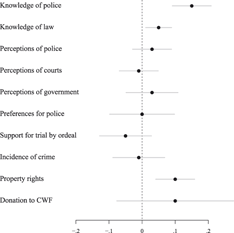
Figure 1 plots the AES for each of our outcome clusters. The program had small and not statistically significant effects on several key outcomes. Most notably, it did not improve Liberians’ perceptions of the police, courts, or government, and did not increase preferences for the police in hypothetical scenarios of crime and violence. It had a substantively large but not statistically significant negative effect on self-reported reliance on trial by ordeal, and an even larger but imprecisely estimated positive effect on donations to Community Watch Forums. The program did not reduce the overall incidence of crime as measured in the survey, though as we discuss below, this null AES masks variation in the average treatment effect on particular categories of crime.
Average Effect Size by Outcome Cluster
Notes: Average Effect Sizes (AES) for each cluster of outcomes. AES coefficients are interpreted in terms of standard deviations from the control group mean.

The program did, however, increase knowledge of the police, largely by increasing awareness of the Gbarnga Hub and the services it provides, and by improving citizens’ understanding of how to contact the LNP. The program also modestly but statistically significantly improved knowledge of Liberian law. Most notably, residents of treatment communities were four percentage points more likely to know that detainees must be released after 48 hours if no criminal complaint is filed, and four percentage points more likely to know that trial by ordeal is illegal. These amount to increases of 5% and 6%, respectively, relative to their control group means.
More striking, the program significantly improved security of property rights. Residents of treatment communities were five percentage points more likely to feel secure about their farmlands (an increase of 7% relative to the control group mean); five percentage points (6%) less likely to be involved in an ongoing dispute over their farmlands; six percentage points (29%) more likely to report making costly improvements to their homes in the past year; and four percentage points (5%) more likely to report plans to fallow their farmland in the next year—an important proxy for security of property rights in Africa, where many farmers neglect to fallow out of fear that others will appropriate their land (Goldstein and Udry Reference Goldstein and Udry2008). We view these effects as especially promising given the continued prevalence of land disputes in rural Liberia, and the persistent threat of violence they pose (Blattman, Hartman, and Blair Reference Blattman, Hartman and Blair2014; Hartman, Blair, and Blattman Reference Hartman, Blair and Blattman2018). Because patrolling officers never mentioned outcomes such as fallowing or household improvements in their presentations, it is unlikely that these results are artifacts of social desirability bias.
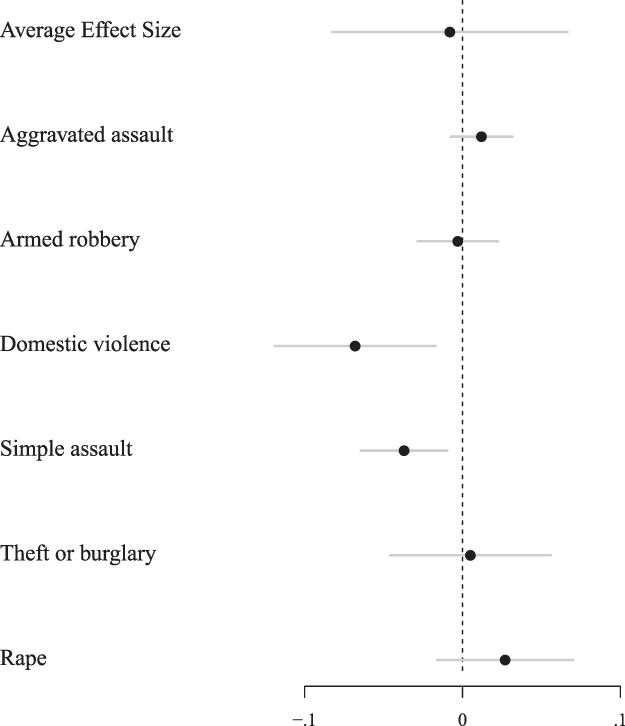
The null AES on crime in general also masks important variation across specific categories of crime. Figure 2 reports average treatment effects on the incidence of armed robbery, theft and burglary, aggravated assault, simple assault,Footnote 22 domestic violence, and rape. While the program did not reduce the incidence of aggravated assault, armed robbery, rape, or theft and burglary, it did reduce the incidence of simple assault by four percentage points, and domestic violence by seven percentage points. Relative to the control group, these amount to substantively large reductions of 37% and 16%, respectively. We view these effects as especially important given the pervasiveness of domestic violence in particular in rural Liberia and given that community policing-style interventions like the one we evaluate often fail (and may not be expected) to reduce crime at all, especially in the short term (Gill et al. Reference Gill, Weisburd, Telep, Vitter and Bennett2014). The null effects on aggravated assault, armed robbery, and rape may reflect the low (reported) incidence of these crimes in control communities, raising the possibility of floor effects.
Effects on Crime Disaggregated by Category
Notes: Average Effect Size (AES) on all categories of crime and average treatment effects (ATE) on crime disaggregated by category. AES coefficients are interpreted in terms of standard deviations from the control group mean.

Increased Crime Reporting
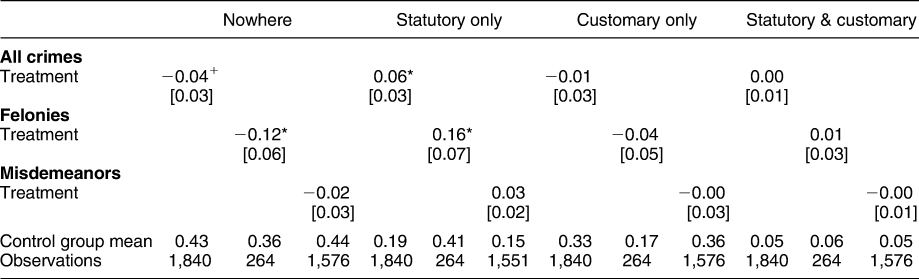
For crimes that did occur, Table 1 displays differences in reporting to the formal sector, informal sector, both, or neither between treatment and control communities. The likelihood that a crime would go unreported was five percentage points lower in treatment communities relative to control, and the likelihood of reporting to the police or courts was a corresponding six percentage points higher. Both of these differences are driven by felonies rather than misdemeanors:Footnote 23 felonies in treatment communities were 12 percentage points less likely to go unreported, and 16 percentage points more likely to be reported to the police or courts. There is no difference in reporting to the informal sector for either category of crime.
Heterogeneity in Crime Reporting

Notes: Standard errors, clustered by community, in brackets. +p < 0.1; *p < 0.05; **p < 0.01; and ***p < 0.001.
These are substantively large and practically meaningful results. Calculations based on the average population of our sample communities (about 1,000) suggest that these changes equate to roughly 11 fewer unreported felonies per community per year.Footnote 24 Notably, this decline was not accompanied by an increase in reporting of misdemeanors to the statutory sector—an important finding in and of itself, given that the police and courts are already severely over-burdened and under-resourced, and must therefore prioritize the most serious criminal cases.
Heterogeneity by Secret Society Membership
Improving access to state security and justice institutions should be especially beneficial to those who are disadvantaged under customary regimes (Aldashev et al. Reference Aldashev, Chaara, Platteau and Wahhaj2012; Sandefur and Siddiqi Reference Sandefur and Siddiqi2013). We explore this possibility by testing for heterogeneous treatment effects along four indicators of status within Liberia’s customary sector: gender, age, ethnicity, and membership in a secret society.Footnote 25 Of these four, we interpret society membership as the most direct proxy for disadvantage, since society members tend to be favored over nonmembers regardless of their other demographic characteristics (Isser, Lubkemann, and N’Tow Reference Isser, Lubkemann and N’Tow2009).
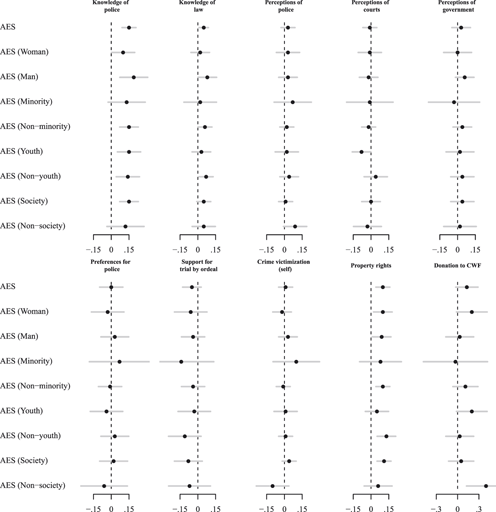
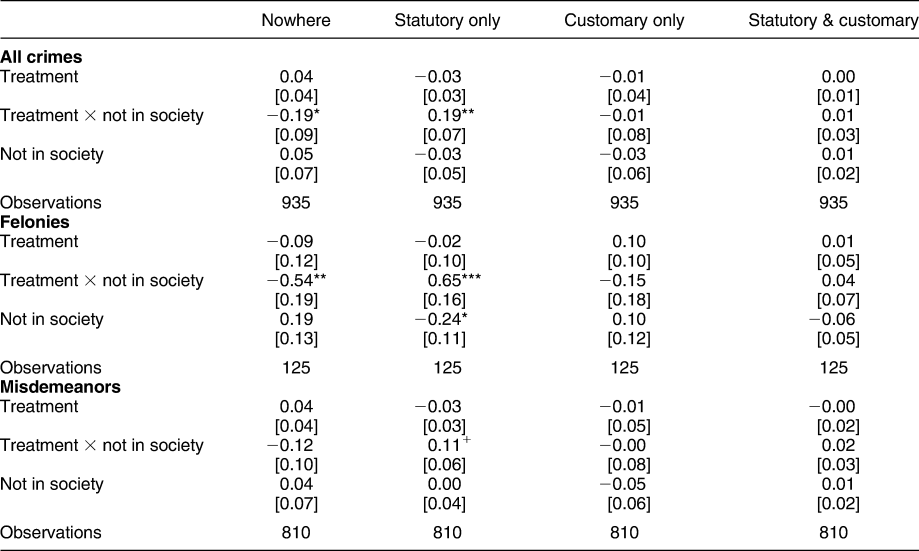
Figure 3 displays heterogeneous treatment effects for each of our outcome clusters; Table 2 replicates this analysis for crime reporting, focusing on secret society membership alone. (Analogous crime reporting results for other subgroups are in the appendix and are uniformly null.) In general, we find little evidence of treatment effect heterogeneity, with one important exception. Non-society members are the only subgroup for which we find a large and significant increase in donations to Community Watch Forums; they are also the only subgroup for which we observe a significant improvement in perceptions of the police (though this effect is not statistically different from the null among society members).
Heterogeneous Treatment Effects
Notes: Average Effect Sizes (AES) for each cluster of outcomes disaggregated by subgroup. Each pair of coefficients is derived from a separate regression. AES coefficients are interpreted in terms of standard deviations from the control group mean.

Heterogeneity in Crime Reporting by Secret Society Membership

Notes: Standard errors, clustered by community, in brackets. This analysis includes only crimes against the respondent or the respondent’s immediate family, and excludes those that occurred in the community at large. +p < 0.1; *p < 0.05; **p < 0.01; and ***p < 0.001.
More importantly, and perhaps not coincidentally, we find that the difference in crime reporting between treatment and control communities is concentrated almost entirely among non-society members. Substantively, the likelihood that a non-society crime victim would report to the police or courts was 16 percentage points higher in treatment communities relative to control. This difference is especially pronounced for felonies—non-society victims of felonies were a full 63 percentage points more likely to report to the police or courts—and is driven by a corresponding reduction in the likelihood of refusing to report at all. There is no difference in the likelihood of reporting between society members in treatment and control communities, regardless of the severity of the crime.
DISCUSSION
Our quantitative results suggest that the Confidence Patrols program improved knowledge of the police and Liberian law, reduced the incidence of some types of crime, and enhanced the security of property rights. Felony offenses were also significantly more likely to be reported to the police and courts in treatment communities relative to control. The program did not, however, improve citizens’ rather bleak perceptions of the police, courts, or government more generally. In this section, we use our qualitative data to inform and substantiate our interpretation of the quantitative results, focusing on five outcomes in particular: (1) crime reporting; (2) domestic violence and security of property rights; (3) perceptions of the police; (4) access to statutory institutions for those disadvantaged under customary regimes; and (5) backlash by the customary sector. We explore additional themes from the qualitative data in the appendix.
Decreased Expected Costs of Reporting
Our theory characterizes the decision to cooperate with the police as a function of expected costs and benefits. We interpret our results as suggesting that the Confidence Patrols program lowered the expected costs of reporting (e.g., by improving knowledge of Liberian law), but that it did not necessarily increase the expected benefits (e.g., by improving perceptions of the LNP). Our qualitative data corroborate this interpretation. Patrolling officers repeatedly urged citizens to report crimes to the police and provided contact and logistical information that should have mitigated the obstacles to doing so. Officers also answered basic factual questions about Liberian law, such as whether the police are legally required to detain witnesses as suspects (they are not);Footnote 26 whether members of Community Watch Forums are legally authorized to “tie criminals with rope” (they are not)Footnote 27 or “judge cases and charge people to pay money” (they are not);Footnote 28 or whether sexual and gender-based violence (SGBV) can legally be “compromised” outside of court (it cannot).Footnote 29 Our quantitative results suggest that residents absorbed these lessons and that increased knowledge of the police and Liberian law helped lower the perceived barriers to reporting.
Decreased Crime and Increased Security of Property Rights
Lower costs of reporting may also help explain the reduction we observe in the incidence of some types of crime, as well as the improvement in security of property rights. Greater knowledge of the police and courts may have provided residents with a sense of safety, while the recognition that other residents also have this knowledge may have deterred potential criminals from committing crimes in the first place (particularly crimes for which the perpetrator can be readily identified, such as domestic violence).
Our qualitative data provide further insight into these results. Property disputes were a recurring concern in treatment communities. Citizens requested guidance on resolving land disputesFootnote 30 and preventing them from escalating into violence or property destruction.Footnote 31 Citizens also asked about theft of livestock—a common crime in rural Liberia.Footnote 32 The officers provided often-detailed guidance in these cases, advising against vigilantism, directing disputants to the Land Commission or Land Coordination Center, and reassuring them that the police would intervene in the case of escalation.
Questions about domestic abuse and SGBV were even more common. Town hall meetings almost always included some discussion of these topics, typically led by one of the female officers, who emphasized that domestic violence is an offense for which perpetrators can expect to be prosecuted. The officers also discouraged husbands from abusing their wivesFootnote 33 and alerted past or potential victims to the existence of a dedicated SGBV office at the Gbarnga Hub and of a Women and Children Protection Section at most police stations. While the LNP’s capacity to respond to these incidents is limited, domestic violence and land disputes are cases in which the perpetrator can usually be identified, making them easier to solve, even for the severely resource-constrained LNP.
Null Effect on Perceptions
Contrary to our expectations, we find that the Confidence Patrols program had no effect on citizens’ perceptions of the police, courts, or Liberian government more generally. There are a number of potential explanations for these null results. Perhaps the program changed perceptions of the PSU but not the LNP as a whole. (Unfortunately, we only measure the latter and so cannot test this possibility.) Or perhaps it improved perceptions of the LNP’s capacity to address particular types of (violent) crime, without changing assessments of the force overall. (We cannot test this possibility either, though we find no evidence that the program strengthened citizens’ preferences for the LNP in hypothetical scenarios of violent crime.) As we discuss in the appendix, patrolling officers repeatedly emphasized the severe capacity constraints under which the LNP operates;Footnote 34 perhaps civilians simply internalized this message. Or perhaps perceptions are just sticky and hard to change.
Alternatively, perhaps exposure to an elite subunit raised citizens’ expectations beyond the capacity of the rank-and-file LNP to meet them, such that perceptions improved after treatment, but regressed to the mean by the time of endline data collection. While we cannot test this interpretation directly, we do observe some patterns that are consistent with it: Only about half (56%) of crime victims who reported to the LNP in the past year described themselves as satisfied with the LNP’s response, and crime victims in the treatment group were about 10 percentage points less likely to be satisfied than those in the control group (though this difference is not statistically significant). But these results are only suggestive: We do not know whether the decision to report was preceded or followed by a change in perceptions of the LNP nor whether dissatisfaction deterred future reporting.
Access to the Statutory Sector for Non-society Members
One of our most intriguing findings is that the difference in crime reporting between treatment and control communities is driven by those who do not belong to one of Liberia’s powerful secret societies. In our view, the most likely explanation for this result lies in the tendency of secret societies (and other customary institutions) to discriminate against nonmembers. While membership in secret societies is widespread—over 75% in our sample—women, youths, and minority groups (especially Muslims and Pentecostal Christians) tend to be excluded, as do “strangers” who migrate from other communities as adults.
Historically, those who did not belong to secret societies were considered “ceremonially unclean,” and members could “ride roughshod” over them (Little Reference Little1965, 358). Similar dynamics persist today, and many nonmembers believe that customary institutions are biased and thus “incapable of providing justice;” as one individual cited in Isser, Lubkemann, and N’Tow (Reference Isser, Lubkemann and N’Tow2009, 36) categorically explains, “anyone who is not a member of the Poro [secret] society will never be right.” Perhaps as a result, nonmembers in our control group were eleven percentage points less likely to report felonies to customary authorities, and sixteen percentage points more likely not to report them at all.
Our results suggest that the Confidence Patrols program provided an “exit option” for these individuals.Footnote 35 This interpretation is consistent with our qualitative data. In many communities, disputants complained of customary authorities “playing” with their cases;Footnote 36 in response, patrolling officers encouraged them to report to the police, courts, or magistrates instead. They also admonished communities not to rely on customary practices that are known to cause tension between secret society members and nonmembers.Footnote 37 Our interpretation is also consistent with anthropological studies showing that where the police and courts are present, disputants who are not members of secret societies often seek “additional review and recourse from a more neutral, and usually higher, authority” (Isser, Lubkemann, and N’Tow Reference Isser, Lubkemann and N’Tow2009, 45).
A remaining puzzle is why we observe increased reporting among non-society members, but not among women, youths, and ethnic or religious minorities—groups that are also believed to be disadvantaged under customary law. In our sample, however, youths and minorities are no more or less likely to report crimes to customary authorities, suggesting that whatever discrimination they face is not sufficient to deter them from relying on the customary sector. (Women are less likely to report to either sector—a pattern that the program seems not to have changed.) Moreover, heterogeneity by society membership holds even after we control for these other demographic characteristics (and for their interaction with treatment assignment). Our finding that women in the treatment group were no more likely to report may suggest that the program failed to provide them with a satisfactory exit option or that women are simply less willing to report crimes in general, even with increased police presence. Regardless, society membership appears to be an important driver of the differences we observe between treatment and control communities, even controlling for other potential sources of status.
Backlash from the Customary Sector
Attempts to project state power into communities governed first and foremost by customary institutions can provoke backlash from those most invested in the status quo (Migdal Reference Migdal1988, Reference Migdal, Migdal, Kohli and Shue1994). Though we did not anticipate testing for this possibility, our survey did include several questions that allow us to do so.Footnote 38 First, we asked respondents whether they believed their neighbors would “get vexed” if (hypothetical) burglaries or incidents of domestic violence were reported to the police. We interpret these as proxies for the strength of social norms against reporting.
Second, we asked residents whether the “bush devil” had appeared in their community in the past year. The bush devil is a ceremonial figure associated with secret societies who emerges to restore social order in times of unrest; when he appears, non-society members are required to retreat indoors, and if they refuse (as some do), conflict is often the result (Isser, Lubkemann, and N’Tow Reference Isser, Lubkemann and N’Tow2009, 33). Patrolling officers explicitly discouraged this practice,Footnote 39 and we interpret its persistence as a proxy for social tension, and for attempts by secret societies to reassert their authority.
Table 3 reports average treatment effects on these outcomes. Residents of treatment communities were seven percentage points more likely to expect social sanctions for reporting to the police in cases of burglary, and eight percentage points more likely to expect social sanctions in cases of domestic violence (increases of 13% and 18%, respectively, relative to the control group). Notably, we do not find evidence of heterogeneous treatment effects on these outcomes by secret society membership, suggesting that the program heightened perceptions of social sanctions among members and nonmembers alike. Concerns about social sanctions appear repeatedly in our qualitative data as well, especially around cases of domestic violence and sexual assault.Footnote 40 Residents of treatment communities were also five percentage points more likely to report appearances of the bush devil in the past year (a 50% increase relative to the control group, though only weakly statistically significant). Indeed, in one community, the bush devil appeared to protest the presence of patrolling officers themselves—an incident that required several hours of mediation to defuse.Footnote 41
Effects on Social Sanctions & Appearances of Bush Devil

Notes: Control group means are covariate-adjusted. Standard errors, clustered by community, in brackets. +p < 0.1; *p < 0.05; **p < 0.01; ***p < 0.001.
CONCLUSION
Weak and war-torn states often struggle to restore citizens’ willingness to rely on the police and courts when crimes are committed or disputes arise. Resistance to police presence is often especially marked in rural areas long accustomed to state absence or abuse. Fearing that the costs of reporting will be high and the benefits low, many victims and witnesses opt not to report at all, or to rely on customary authorities instead. These authorities can be effective, accessible, and inexpensive, but they also tend to discriminate against historically marginalized groups. Customary authorities may also attempt to actively undermine the police, heightening the risk of conflict as the state projects power nationwide (Aldashev et al. Reference Aldashev, Chaara, Platteau and Wahhaj2012).
We experimentally evaluate a central component of the Liberian government’s ongoing efforts to expand the presence of state security and justice institutions in rural areas. We find that recurring “Confidence Patrols” by elite police officers improved knowledge of the police and Liberian law, enhanced security of property rights, and reduced the incidence of some types of crime. We also find that felonies were more likely to be reported to the statutory sector in treatment communities relative to control and that this difference was especially marked among residents who were disadvantaged under customary regimes. These results are particularly striking given the initial skepticism with which patrolling officers were often greeted; given that many community policing-style interventions fail to deter crime (Gill et al. Reference Gill, Weisburd, Telep, Vitter and Bennett2014); and given that most patrols were conducted shortly after the end of the Ebola epidemic, when relations between citizens and the state were especially strained (Blair, Morse, and Tsai Reference Blair, Morse and Tsai2017).
We also find, however, that the program did not mitigate citizens’ distrust of the police, courts, or government more generally. This is inconsistent with much of the literature on procedural justice, which suggests that citizen cooperation depends on prior trust and perceptions of fairness (Tyler Reference Tyler2004; Tyler and Huo Reference Tyler and Huo2002). It is, however, consistent with research showing that citizens are unlikely to update their perceptions of the police (much less the government as a whole) in response to a limited number of encounters over a relatively short amount of time (Nagin and Telep Reference Nagin and Telep2017; Sahin et al. Reference Sahin, Braga, Apel and Brunson2017; Skogan Reference Skogan2006). Our results suggest that citizens may be willing to change their behavior without a corresponding change in perceptions (on this point, see also Blair Reference Blair2018a). The program also appears to have provoked some backlash from the customary sector and to have aggravated social norms against cooperation with the police.
Whether the change in crime reporting that we observe will persist over time remains an open question, though we expect much will depend on the performance of rank-and-file officers and court officials. If the police and courts prove capable of resolving crimes effectively and equitably, then greater reporting now may lead to even greater reporting in the future. Conversely, if these institutions prove corrupt or ineffective, then increased reporting may be short-lived. Assessing these and other potential long-run dynamics is beyond the scope of our evaluation. In the short term, however, we view the program as a qualified success.
From a policy perspective, our results suggest that better-trained, better-equipped police officers can effectively deter (some types of) crime and improve security of property rights, even when elite units are based several hours away, and even when rank-and-file officers continue to languish under severe resource constraints. Increased police presence may also help mitigate inequities under prevailing customary regimes. But our findings also suggest that post-conflict police forces should anticipate resistance to their presence, especially initially. Projecting state authority into communities long accustomed to autonomy is often a contentious process, which may disrupt existing power dynamics and provoke backlash from those whose interests are threatened by an encroaching state. Whether and how these dynamics will resolve as the Liberian government continues to expand remains to be seen. We leave this question for future research to address.
SUPPLEMENTARY MATERIAL
To view supplementary material for this article, please visit https://doi.org/10.1017/S0003055419000121.
Replication materials can be found on Dataverse at: https://doi.org/10.7910/DVN/ZIXH95.






Comments
No Comments have been published for this article.