Introduction
Research on intergenerational solidarity in families is a flourishing field. The impetus lies in the structural and cultural developments affecting families. The extension of life and the fall in birth rates have resulted in so-called ‘bean pole’ families with a relatively large number of vertical ties and comparatively few horizontal ties, while an increase in divorce and re-partnering has resulted in increased complexity of family ties (Bengtson Reference Bengtson2001; Hagestad Reference Hagestad1998; Matthews and Sun Reference Matthews and Sun2006; Seltzer et al. Reference Seltzer, Bachrach, Bianchi, Bledsoe, Casper, Chase-Lansdale, DiPrete, Hotz, Morgan, Sanders and Thomas2005). In Europe, the expansion of welfare state provision has decreased the economic and practical need for family support (Esping-Andersen Reference Esping-Andersen1999), while women's higher labour-force participation has introduced new challenges for family caring (Blossfeld Reference Blossfeld1995; Blossfeld and Huinink Reference Blossfeld and Huinink1991; Hakim Reference Hakim2000). Processes of individualisation, secularisation and emancipation have brought about a shift from economic and instrumental interdependencies to a more affective orientation in families, with a greater emphasis on individual needs and personal happiness (Hareven Reference Hareven, Blieszner and Bedford1995; Lewis Reference Lewis2001).
It has been common, particularly in public debates but also in a number of scholarly scenarios (e.g. Popenoe Reference Popenoe1988, Reference Popenoe1993; Waite and Gallagher Reference Waite and Gallagher2000; Wolfe Reference Wolfe1989), to suggest that the structural and cultural changes of the past decades have had negative repercussions for intergenerational family solidarity. Nevertheless, little evidence has been found for the presumed ‘decline of the family’. The majority of Europeans express strong commitments to maintain their function of providing support to family members (e.g. Daatland and Herlofson Reference Daatland and Herlofson2003). High proportions of elderly parents in Europe see a child at least once a week (Hank Reference Hank2007; Tomassini et al. Reference Tomassini, Kalogirou, Grundy, Fokkema, Martikainen, Broese van Groenou and Karisto2004b), and the majority of family members are involved in transfers up and down generational lines (Albertini, Kohli and Vogel Reference Albertini, Kohli and Vogel2007; Attias-Donfut, Ogg and Wolff Reference Attias-Donfut, Ogg and Wolff2005). Formal services have not eroded informal support: studies have repeatedly shown that generous welfare state services complement rather than substitute or crowd out family care (Chappell and Blandford Reference Chappell and Blandford1991; Daatland and Lowenstein Reference Daatland and Lowenstein2005; Künemund and Rein Reference Künemund and Rein1999; Litwin and Attias-Donfut Reference Litwin and Attias-Donfut2009; Motel-Klingebiel, Tesch-Römer and Von Kondratowitz Reference Motel-Klingebiel, Tesch-Römer and Von Kondratowitz2005). Older adults often turn to institutional providers for long-term intensive support tasks such as personal and nursing care, while their family provides sporadic, less strenuous services such as practical help with housekeeping (Bonsang Reference Bonsang2009; Brandt, Haberkern and Szydlik Reference Brandt, Haberkern and Szydlik2009).
Our aim is to portray western European families amid structural and cultural change. We consider differences in intergenerational family solidarity across 11 European countries. The data stem from the first wave of the Survey of Health, Ageing and Retirement in Europe (SHARE). Our approach is novel in two respects. First, we adopt a multi-dimensional perspective on intergenerational solidarity rather than focus on isolated aspects as is commonly done in comparative research on western European families. Second, we address variability in intergenerational solidarity within countries rather than assume that a country has one typical pattern of family relationships.
A multi-dimensional view of intergenerational family solidarity
The intergenerational solidarity model developed by Bengtson and his colleagues (e.g. Bengtson and Roberts Reference Bengtson and Roberts1991; Roberts, Richards and Bengtson Reference Bengtson and Roberts1991) has inspired many family researchers. The model distinguishes six solidarity dimensions: affectual (warmth, closeness), associational (frequency of contact, types of shared activities), consensual (agreement on values and beliefs), functional (exchange of resources), normative (familial obligations), and structural (opportunities for interaction). Unfortunately, researchers have rarely considered multiple dimensions of intergenerational family solidarity simultaneously, and when they have, their data have been from single-country studies (e.g. Hogan, Eggebeen and Clogg Reference Hogan, Eggebeen and Clogg1993; Silverstein and Bengtson Reference Silverstein and Bengtson1997 for the United States of America; Van Gaalen and Dykstra 2006 for The Netherlands; but seeLowenstein Reference Lowenstein2007 for an exception). Comparative studies of western European countries have largely focused on one dimension of intergenerational solidarity, such as parent–child contact frequency (Tomassini et al. Reference Tomassini, Kalogirou, Grundy, Fokkema, Martikainen, Broese van Groenou and Karisto2004b), intergenerational co-residence (Tomassini et al. Reference Tomassini, Glaser, Wolf, Broese van Groenou and Grundy2004a), norms of family obligation (Daatland and Herlofson Reference Daatland and Herlofson2003) or resource transfers (Albertini, Kohli and Vogel Reference Albertini, Kohli and Vogel2007; Attias-Donfut, Ogg and Wolff Reference Attias-Donfut, Ogg and Wolff2005; Höllinger and Haller Reference Höllinger and Haller1990). Hank's (Reference Hank2007) work on proximity and parent–child contact frequency, and Daatland and Lowenstein's (Reference Daatland and Lowenstein2005) work on care preferences, proximity and help from family are examples of studies involving data from several European countries in which sets of dimensions of intergenerational family solidarity have been examined.
In our view, the consideration of multiple dimensions of intergenerational solidarity helps to form a nuanced view of intergenerational family relationships. To that end, we address the question of whether different types of late-life families can be empirically distinguished, and if so, what their incidence is and whether their distribution varies within and across European countries. We not only consider multiple domains of intergenerational solidarity, but also make a provision for varying combinations of solidarity dimensions and levels. We explicitly allow for the possibility that high levels on one solidarity dimension do not co-vary with high levels on another dimension. For example, parents and adult children might interact frequently but not exchange instrumental support because they wish to be self-sufficient (Gans and Silverstein Reference Gans and Silverstein2006).
Variability within countries
Reher's (Reference Reher1998) seminal paper on family ties in western Europe has served as a framework for many comparative studies. ‘In bold strokes’ (1998: 204), Reher characterised the centre and north of Europe by weak family links, and the Mediterranean by strong family ties. In countries with weak family ties, young adults set up households of their own at a relatively young age, and provision of care to vulnerable family members is largely accomplished through public and private institutions. In countries with strong family ties, young adults remain in the parental home until they marry, and much of the aid given to the needy and the poor comes from the family. In weak family areas, individualistic values tend to dominate, whereas collectivistic values predominate in strong family contexts. Reher traced the emphasis on the individual and self-reliance in northern Europe to the Reformation, and attributed the overriding importance of kin ties in southern Europe to Catholic and Islamic influences.
Following Reher's work, differences in intergenerational family solidarity patterns in western Europe tend to be described in terms of a north–south gradient. Daatland and Herlofson (Reference Daatland and Herlofson2003) reported greater support for filial norms in Spain and Israel than in Norway, England and Germany. In ranking of countries from most individualistic to most familialistic on the basis of family obligation norms, Kalmijn and Saraceno reported a ‘North–South element’ (2008: 492) but also pointed to the relatively familialistic position of Germany and Austria. Höllinger and Haller (Reference Höllinger and Haller1990) summarised their findings in terms of close kin relations in southern and eastern Europe, and loosened kin ties in northwestern Europe. Hank (Reference Hank2007) showed that the prevalence of co-residence of older parents with their children is lowest in the Scandinavian countries and The Netherlands, highest in the Mediterranean countries, while intermediate levels were reported for the central region of Europe. The frequency of parent–child contacts exhibited ‘a similar north–south pattern’ (2007: 162). Albertini, Kohli and Vogel (Reference Albertini, Kohli and Vogel2007) reported more frequent but less intense transfers of time and money from parents to children in Nordic than in southern European countries, with the continental European countries being somewhere in the middle. Hank and Buber (Reference Hank and Buber2009) report a similar pattern for grandparenting support. Haberkern and Szydlik speak of ‘a clear north–south contrast’ (2010: 309) with lower proportions of frail elderly being cared for by their children in the Scandinavian countries, The Netherlands and Switzerland, and higher proportions receiving care in the southern European countries. In their analyses of help from adult children to parents, Ogg and Renaut (Reference Ogg and Renaut2006) showed a north–south gradient in the proportions providing some kind of support, but the reverse for regular and daily help. Attias-Donfut, Ogg and Wolff found ‘some evidence of the expected north–south European gradient’ (2005: 171), but interestingly, they also stated that the pattern of intergenerational transfers did not neatly follow European regional differences.
Though Reher acknowledged that his ‘portrayal simplifie[d] a heterogeneous European experience’ (1998: 212), few researchers have considered within-country variability in family solidarity patterns. As noted earlier, our aim is to identify different types of late-life families. Rather than assume that a specific pattern best characterises intergenerational family solidarity in a particular country, we focus on variability. We argue that different family types are present in varying proportions in all countries (cf. Douglas Reference Douglas1999; Grendstad Reference Grendstad1999).
Distinguishing family types
We focus on geographic distance, frequency of contact, norms of family obligation, and support exchange – representing the structural, associational, normative and functional solidarity dimensions in Bengtson's model. With regard to support exchange, we consider help in kind both up and down family lines, but financial support only down family lines. Previous studies have shown that financial support flows predominantly from parents to children (Albertini, Kohli and Vogel Reference Albertini, Kohli and Vogel2007; Attias-Donfut, Ogg and Wolff Reference Attias-Donfut, Ogg and Wolff2005; Kohli Reference Kohli1999). The literature provides clues as to ways in which the solidarity dimensions might serve to distinguish types of families. Note that we cannot state in advance precisely how many family types will emerge, and what their dominant features will be. Nevertheless, we can draw upon previous work to outline patterns of family support.
Geographic proximity facilitates face-to-face contact (De Jong Gierveld and Fokkema Reference De Jong Gierveld and Fokkema1998; Grundy and Shelton Reference Grundy and Shelton2001; Hank Reference Hank2007; Joseph and Hallman Reference Joseph and Hallman1998; Lawton, Silverstein and Bengtson Reference Lawton, Silverstein and Bengtson1994; Lin and Rogerson Reference Lin and Rogerson1995; Litwak and Kulis Reference Litwak and Kulis1987). Face-to-face contact, in turn, increases the likelihood of exchanges of help in kind (Soldo and Hill Reference Soldo, Hill, Maddox and Powell Lawton1993).Footnote 1 Frequent face-to-face contact not only reduces the costs of giving, but also helps to make support providers aware of the recipient's needs. Exchanges of financial support are less affected by distance because they do not require interaction in person (Litwak and Kulis Reference Litwak and Kulis1987). Following these considerations, we predict that geographic distance discriminates high-support-in-kind from low-support-in-kind families, but does not differentiate families by level of financial support.
SHARE measures overall parent–child contact frequency, but face-to-face contact is not distinguished from other forms of contact. To the extent that contact frequency pertains to face-to-face contacts (which we cannot ascertain), we expect the clustering pattern for contact frequency to be similar to that for geographic distance. Thus we expect to find families with high levels of support in kind which are furthermore characterised by geographic proximity of parents and children and frequent contact, versus those with low levels of support in kind where the distance separating parents and children is greater and contact levels are lower. As noted earlier, financial transfers do not require face-to-face contact (and geographic proximity). We predict that high levels of contact go together with a greater intensity of monetary transfers, and vice versa. By maintaining contact, family members have information about financial needs. Moreover, keeping in touch is a means to reciprocate the receipt of financial support (Rossi and Rossi Reference Rossi and Rossi1990).
Previous research has shown that a sense of family obligation predisposes support behaviour. Elderly parents, for example, who feel strongly that family members should help one another, give their children more practical and financial help than parents who had weaker feelings of obligation (Lee, Netzer and Coward Reference Lee, Netzer and Coward1994). Among adult children, family obligation norms positively associate with parental care-giving (Gans and Silverstein Reference Gans and Silverstein2006; Klein Ikkink, Van Tilburg and Knipscheer Reference Klein Ikkink, van Tilburg and Knipscheer1999; Stein et al. Reference Stein, Wemmerus, Ward, Gaines, Freeberg and Jewell1998). Of course, actual support exchange might also have an impact on norms of obligation. Drawing on cognitive dissonance theory (Festinger Reference Festinger1957; Münch Reference Münch1972), we argue that discrepancies between support behaviour and perceived norms of obligation create psychological discomfort, which is to be avoided. Thus intensive supportive exchanges are likely to be attributed to a strong sense of duty, whereas not providing support despite strong family norms is likely to result in a downward adjustment of beliefs about the desirability and feasibility of family help in times of need. Whereas there are good reasons to assume strong links between norms of family obligation and support exchanges, there is less reason to expect strong links between norms of family obligation and contact frequency. Family obligation norms are only one of the motives underlying intergenerational interactions. According to exchange theory (Ekeh Reference Ekeh1974; Emerson Reference Emerson1976), parents and children keep in touch either as a repayment for previous services or in expectation of future rewards (e.g. an inheritance). According to attachment theory (e.g. Cicirelli Reference Cicirelli, Pillemer and McCartney1991), intergenerational contact is motivated by feelings of affection and closeness. On the basis of the previous considerations, we predict that norms of family obligation discriminate families by level of support regardless of type of support, but not by level of contact frequency.
So far, we have considered links between support exchange and the other solidarity dimensions. Now we focus only on support exchange, and more specifically on the direction of intergenerational transfers. In principle, four types of support flows can be distinguished: primarily downward, primarily upward, mutual transfers, and no transfers. The first two types are consistent with an altruism model (Batson Reference Batson, Gilbert, Fiske and Lindzey1998), which postulates that people give without expecting anything in return because they care about the other's wellbeing. Interestingly, they are also consistent with an exchange model (Ekeh Reference Ekeh1974; Emerson Reference Emerson1976), which posits that people transfer their resources in return for having received favours in the past or because they expect to gain in the future from providing help. Mutual transfers are a form of immediate reciprocity: there is little delay between giving and receiving. Note that the exchanges might pertain to different forms of support as, for example, when adult children provide help in kind in exchange for financial support. A situation of no transfers is likely when there are no resources to be exchanged, no needs requiring responses, or when the parent–child relationship is not close enough to warrant exchanges of support (Soldo and Hill Reference Soldo, Hill, Maddox and Powell Lawton1993).
Data and methods
Data source
The data stem from the second release file of the first wave of the Survey of Health, Ageing and Retirement in Europe (SHARE). This survey took place in 2004 among 27,500 non-institutionalised individuals aged 50 years and over in 11 European countries: Sweden, Denmark, The Netherlands, Belgium, Germany, France, Austria, Switzerland, Italy, Spain and Greece.Footnote 2 Computer-assisted personal interviews were conducted. Self-completion questionnaires supplemented these interviews. Although probability samples were drawn in all participating countries, the survey did not have a uniform sampling design, and varied from a simple random selection of households (in the Danish case, for example, from the country's central population register) to rather complicated multi-stage designs (as, for example, in Greece, where the telephone directory was used as a sampling frame). The weighted average household response rate ranges from 39 per cent in Switzerland to 81 per cent in France (for a thorough description of methodological issues, seeBörsch-Supan, Hank and Jürges Reference Börsch-Supan, Hank and Jürges2005; Börsch-Supan and Jürges Reference Börsch-Supan and Jürges2005). The sample sizes also vary. Belgium has the largest sample (3,600) and Switzerland the smallest (960).
We use data from the so-called ‘family respondent’, who was randomly selected from all individuals in a household aged 50 or more years. The analyses are restricted to those who had at least one living child (16,968 cases). We further restricted the analyses to the 11,906 parents who had no children living at home, to avoid having patterns of contact frequency and support exchange confounded with co-residence. The pooled multi-national sample is further reduced to 11,181 because of missing values on the solidarity measures.
Measures of solidarity dimensions
Latent class analysis (LCA) was applied to construct the typology of late-life families (detailed in the next section). The input for LCA is a cross-classification table of the scores for each variable in the analysis. It is customary to use dichotomous variables (Hogan, Eggebeen and Clogg Reference Hogan, Eggebeen and Clogg1993; Silverstein and Bengtson Reference Silverstein and Bengtson1997; Van Gaalen and Dykstra Reference Van Gaalen and Dykstra2006). Though dichotomisation implies a loss of information, it ensures having a manageable number of cells in the data matrix. An analysis on the basis of eight dichotomous measures, for example, results in 28 or 256 cells. Using all answer categories would produce unacceptably sparse data.
The following solidarity measures were used. Geographic proximity was whether the parent had at least one child living within five kilometres (0=no, 1=yes).Footnote 3 The frequency of contact pertained to whether the parent had more than weekly contact with one or more children either in person, by telephone or mail (0=no, 1=yes). The family obligation norms variable was based on items assessing opinions on state versus family responsibility for elder care in combination with items assessing opinions on the duty to care for children and grandchildren.Footnote 4 Those with sum scores in the bottom 20 per cent (and thus strongly refuting family responsibility) were assigned a score of ‘1’ (weak family obligation norms), the others received a score of ‘0’ (strong family obligation norms). We used a lower cut-off to take the family-positive bias into account that measures of family obligation norms tend to have (cf. Daatland and Herlofson Reference Daatland and Herlofson2003). With regard to support exchange, we constructed the following three dichotomous variables (0=no, 1=yes): (a) downward help in kind: whether the parent had provided personal care, practical household help, or help with paperwork to one or more adult children from outside the household or had looked after the grandchildren from outside the household ‘almost every month’ in the past year,Footnote 5 (b) upward help in kind: whether one or more of the adult children from outside the household had provided personal care, household help, or help with paperwork ‘almost every month’ to the parent, and (c) downward financial transfers: whether the parent had given any financial or material support amounting to €250 or more to any of the adult children from outside the household during the last 12 months.Footnote 6
Latent class analysis
In LCA one assumes probabilistic rather than deterministic relationships between the latent construct (the concept of interest, in this case solidarity between parents and their adult children) and manifest indicators (the measures actually used) (Hagenaars and Halman Reference Hagenaars and Halman1989; Yamaguchi Reference Yamaguchi2000). A basic assumption of LCA is conditional independence, which means that associations between manifest indicators exist only insofar as they measure the same latent construct. LCA has the advantage that the classes of the latent construct are discrete and need not be ordered along a continuum (Clogg Reference Clogg, Arminger, Clogg and Sobel1995). In this study, the classes are typical scoring patterns for the solidarity measures.
We started by computing a latent class model with only a single latent class (no relation between manifest indicators) and added one class after the other, checking for model fit and significance. We used the program Latent GOLD 4.0, developed by Vermunt and Magidson (Reference Vermunt and Magidson2005). In addition, we determined the robustness of the latent class model for the various countries included in SHARE by estimating separate latent class models for the three geographic regions: northern Europe (Sweden, Denmark, The Netherlands and Belgium), central Europe (Germany, France, Austria and Switzerland), and southern Europe (Italy, Spain and Greece).Footnote 7
Measures of socio-demographic characteristics of parents and children
To assess the validity of the typology of families, we examined whether socio-demographic characteristics of parents and adult children, which are known correlates of family solidarity, differentiated family types in theoretically meaningful ways. We looked at indicators of the need for support (e.g. health problems), the availability to provide help (e.g. number of adult children), and the readiness to receive and provide help (e.g. religiosity). Indicators for the 11 countries participating in SHARE were also included. For ease of interpretation, effect instead of dummy coding was used, highlighting each country's deviation from the grand mean of all observations.
Socio-demographic characteristics of the parents included gender (coded 0=male, and 1=female), age (50–59, 60–69 and 70 or more years), marital history (three categories: living with a partner, single after widowhood, single after divorce), health problems (1=yes if: reports difficulties performing one or more activities of daily living, reports severe limitations in performing usual activities for the past six months at least because of a health problem, or rates general health as poor), household income (quartile measure: ⩽€13,154 for bottom 25 per cent, ⩾€51,257 for top 25 per cent), educational attainment [highest educational degree obtained, coded into 1997 International Standard Classification of Education (ISCED-97) with three levels: low (pre-primary education, primary education or first stage of basic education, and lower secondary or second stage of basic education), intermediate (upper secondary education, and post-secondary non-tertiary education), and high (first stage of tertiary education, and second stage of tertiary education)], and religiosity (based on the question, ‘Thinking about the present, about how often do you pray?’, with four categories: prays daily, prays weekly, prays less than weekly, never prays).
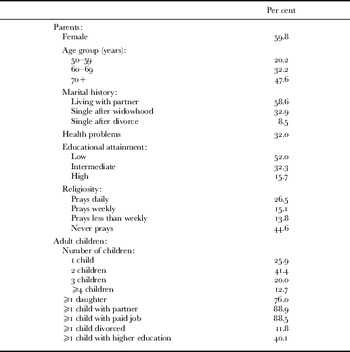
The measures of the socio-demographic characteristics of adult children are aggregate indicators. They include the number of children (coded as 1, 2, 3 and ⩾4), having one or more daughters (1=yes), one or more children living with a partner (1=yes), one or more children with a paid job (1=yes), one or more divorced children (1=yes), and one or more children with high educational attainment (1=yes). Table 1 presents the descriptive information for the analysis sample.
Descriptive characteristics of parents and adult children in the analysis sample, 11 European countries, 2004

Notes: Weighted percentages. Sample size 10,447.
Source: Survey of Health, Ageing and Retirement in Europe (SHARE) – release 2 (for details, see text).
Multinomial regression analysis
We applied multinomial logit regression analysis (Liao Reference Liao1994), which is an extension of the binary logit model, to determine the associations between family type and socio-demographic characteristics of parents and their offspring. The multinomial logit model (MNLM) is appropriate because the categories of the dependent variable (i.e. types of late-life families) are discrete, nominal and unordered. With n categories, the MNLM is roughly equivalent to performing 2×(n – 1) binary logistic regressions. In the MNLM all the logits are estimated simultaneously, which enforces the logical associations among the parameters and makes a more efficient use of the data (Long Reference Long1997). To interpret the MNLM results, we estimated marginal effects (Liao Reference Liao1994). The marginal effect gives the change in probability by one unit change in an explanatory variable when all other variables are held constant at sample mean values. For example, the marginal effect for a dummy variable is the difference between being in Category 1 and being in Category 0. For each variable, the marginal effects sum to zero.
Results
Four types of late-life families
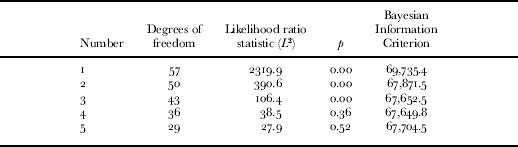
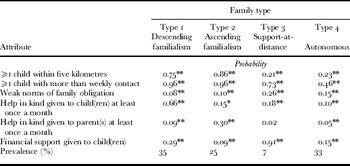
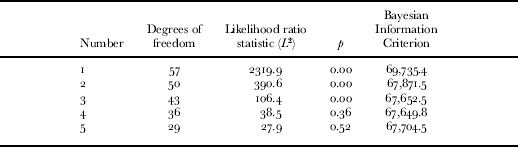
Table 2 provides details on the optimal number of types in the LCA, which turned out to be four. The right-hand column shows successive decreases in the size of the Bayesian Information Criterion (BIC) as the number of types progresses from one to four, and an increase if a fifth type is distinguished. Table 3 provides information on the distinguished family types. When separate latent class models for respondents in northern Europe, central Europe and southern Europe were estimated, the same general family typology emerged, indicating that it is highly robust across the distinguished geographic regions.
Model fit for the optimal number of classes in the latent class analysis
Note: Sample size 11,181.
Source: Survey of Health, Ageing and Retirement in Europe (SHARE) – release 2 (for details, see text).
Latent class analysis of solidarity between parents aged 50 or more years and their non-coresident children

Note: Sample size 11,181.
Source: Survey of Health, Ageing and Retirement in Europe (SHARE) – release 2 (for details, see text).
Significance levels: *p<0.01, **p<0.001.
As can be seen in the top row of Table 3, 35 per cent of families were of the first type, 25 per cent of the second, 7 per cent of the third, and 33 per cent of the fourth. These percentages are the cumulative probabilities for all families of belonging to the respective types. The coefficients in the columns of types 1 to 4 indicate the probability that a family was characterised by specific dimensions of solidarity, under the condition that the family was of that type. For example, there was a 75 per cent probability that at least one child lived within a radius of five kilometres in Type 1 families, and a 29 per cent probability that parents provided financial support to their children.
A high probability of having a child living within five kilometres characterised Types 1 and 2, but not Types 3 and 4. The likelihood of more than weekly contact broadly distinguishes the first three family types from the last: it was high for Types 1, 2 and 3, and low for Type 4. A low probability of endorsing weak family obligation norms was characteristic of Types 1 and 2, but not of 3 and 4. With its high probability that help in kind is provided by parents to their children, Type 1 distinguished itself from Types 2, 3 and 4. We assign the label ‘descending familialism’ to Type 1 families. ‘Familialism’ in the label emphasises the endorsement of family obligation norms. The likelihood that adult children provided help in kind to their parents was higher for Type 2 than for any other type, and for that reason we assign the label ‘ascending familialism’ to Type 2 families. The moderate probability that parents had weak family obligation norms and the high probability that they provided financial support to their children makes Type 3 stand out from the others, and we assign them the label ‘supportive-at-distance’. Type 4 families were characterised by low probabilities of having a child living nearby, more than weekly contact with at least one child, and support exchange, and a moderate probability of weak family obligation norms. We assign the label ‘autonomous’ to these families.
In sum, the four late-life family types, which were robust across northern, central and southern European regions, were (a) descending familialism: living nearby, frequent contact, endorsement of family obligation norms, and primarily help in kind from parents to children, (b) ascending familialism: living nearby, frequent contact, endorsement of family obligation norms, and primarily help in kind from children to parents, (c) supportive-at-distance: not living nearby, frequent contact, refutation of family obligation norms, and primarily financial transfers from parents to adult children, (d) autonomous: not living nearby, little contact, refutation of family obligation norms, and few support exchanges. Note that we did not find a late-life family type characterised by concurrent reciprocal transfers between parents and adult children, i.e. high probabilities of both downward and upward support. Note also that the results represent a snapshot in 2004. The likelihood of belonging to a particular family type can shift over time.
Distribution of family types across western Europe
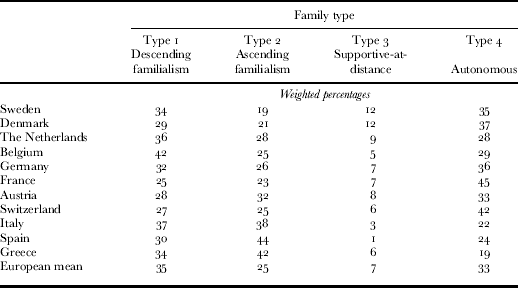
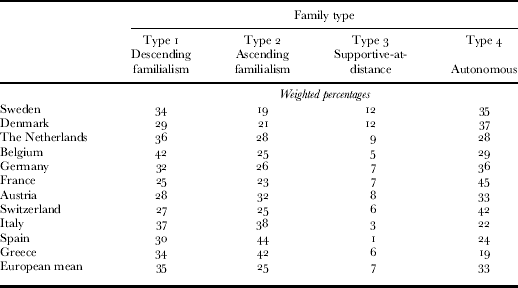
Table 4 shows the distribution of these four late-life family types by country. Each family type is present in each country, but the distributions vary. The descending familialism type was strongly represented in Belgium, while the ascending familialism type was most strongly represented in Italy, Spain and Greece. In Austria, there was a high representation of the ascending familialism type. The proportions in a particular country of descending and ascending familialism types should not be viewed as if alternatives summing to a consistent share. Rather, the two types appear to go together. Countries with a high proportion of the descending familialism type also tend to be those with a high proportion of the ascending familialism or supportive-at-distance type. The pattern appears to be one of a high or a low likelihood of intensive intergenerational transfers, regardless of their direction. This intensive-transfer pattern is mirrored by the autonomous type. In France and Switzerland, for example, the proportion of descending and ascending familialism types is comparatively low (48 and 52%, respectively), but the proportion of the autonomous type is higher than elsewhere in Europe (45% in France and 42% in Switzerland). Relatively low proportions of descending and ascending familialism types were also observed in Sweden and Denmark; in the last, the proportion of families in the supportive-at-distance type was the highest (12%). Conversely, the proportion of descending and ascending familialism types was high in Italy (73%), Spain (74%) and Greece (76%), and to a lesser extent in Belgium (67%), but the proportion of the autonomous type was low in these countries (22% in Italy, 24% in Spain, 19% in Greece and 29% in Belgium).
Distribution of late-life family types by country
Note: Based on the 11 European countries in the Survey of Health, Ageing and Retirement in Europe (SHARE). Sample size 11,181.
Source: SHARE – release 2 (for details, see text).
Socio-demographic differentials in family type
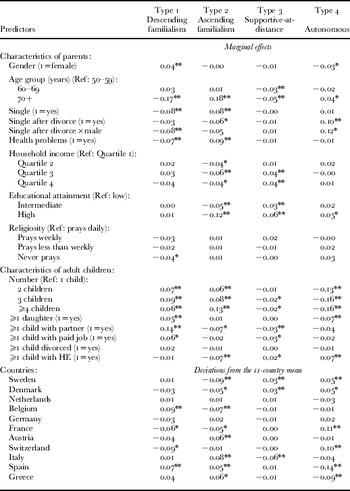
Previous research has shown that parents who are no longer partnered receive more practical support from their adult children than those who are still together, and that this is more strongly so for women than men and for the widowed compared to the divorced (Kalmijn Reference Kalmijn2007; Silverstein, Parrott and Bengtson Reference Silverstein, Parrott and Bengtson1995). For that reason we included the interaction term ‘single after divorce×male’ in the multinomial logit regression analyses. To assess whether the distribution of late-life family types varied by parental gender, one should not only consider the gender main effect but also the interaction effect of divorce and gender. These predictors taken together (see Table 5) show that mothers were more likely to be in the descending familialism type of late-life families than fathers, particularly so for widowed mothers and for those in intact marriages. They also show that mothers, particularly if they were widowed or in intact marriages, were less likely to be in autonomous families than fathers. Table 5 shows furthermore that parents aged 70+ were less likely to be in the descending familialism type and more likely to be in the ascending familialism type than 50–59-year-olds. Contrary to expectations, they also had a relatively greater likelihood of being part of autonomous families. The aged 60 or more years were less likely to be in supportive-at-a-distance families than the youngest age group.
Predictors of the four types of late-life families: marginal effects of multinomial logit regression

Notes: Sample size 9,940. Ref: reference category. HE: higher education.
Source: Survey of Health, Ageing and Retirement in Europe (SHARE) – release 2 (for details, see text).
Significance levels: * p<0.01, **p<0.001.
To assess differences by marital history, the effects of singlehood, divorce, and the interaction of divorce and gender should be considered together. The findings show that parents living without a partner were less likely to be involved in the descending familialism type, and more strongly so (a) if they are divorced than if they are widowed, and (b) for fathers than for mothers. The opposite held for the likelihood of being part of autonomous late-life families: it was greater for single older adults than for those living with a partner, and greatest for divorced fathers. The likelihood of being part of the ascending familialism type differed between the divorced and the widowed: the divorced were less likely, but the widowed more likely than are those living with a partner to be part of a family involving ascending familialism. Older parents experiencing health problems were less likely to be in the descending familialism type but more likely to be in the ascending familialism type than older parents in good health. Parental health status was not associated with the likelihood of being in either supportive-at-distance or autonomous families.
The likelihood of being part of the descending familialism type did not vary by the household income of the parent. Families involving ascending familialism were less likely, but families involving supportive-at-distance more likely among those with higher household incomes than among those with lower incomes. The likelihood of being in families with autonomous parent–child relationships did not vary by household income. The pattern of findings for parents' educational attainment is quite similar to that for parental income, with one exception. The highly educated were more likely to be in the autonomous family type than the lower educated. The findings show virtually no differences by parental religiosity. The only significant coefficient is for the families of parents who reported never praying: their families were least likely to involve descending familialism.
The middle part of Table 5 shows the associations between family type and the socio-demographic characteristics of adult children. Differences by family size involve a contrast between one-child families, and families with two or more children. The likelihood of being part of the descending and ascending familialism types was greater, but the likelihood of being part of supportive-at-distance families or autonomous families was smaller for parents with two or more children compared to parents of a single child.
Parents of daughters had a greater likelihood of being part of descending familialism families, and a smaller likelihood of being part of autonomous families. The gender composition of the children's network did not associate with the likelihood of being in the ascending familialism type or the supportive-at-distance type. Parents with children-in-law had a greater likelihood of being part of the descending familialism type, and a smaller likelihood of being part of the ascending familialism or supportive-at-distance types. Having partnered children showed no association with the likelihood of being part of autonomous families. The pattern of findings for parents of children with paid jobs was quite similar, albeit that the association between having employed children and the likelihood of being part of ascending familialism was not significant. Divorce in the younger generation made no difference to the distribution of family types. Parents of highly-educated children were less likely to be part of the ascending familialism type, but more likely to be part of supportive-at-distance families. They also had a greater likelihood of being part of autonomous families.
As the bottom part of Table 5 shows, the distribution of late-life family types differed significantly between European countries. Compared to the average European parent aged 50 and over,Footnote 8 (a) those in Belgium and Greece were more likely to be part of the descending familialism type, while those in France and Switzerland were less likely to be part of this late-family type; (b) parents aged 50+ in Austria and the Mediterranean countries had a greater likelihood of being part of ascending familialism type, while the likelihood was smaller for their counterparts in Sweden, Denmark, Belgium and France; (c) the likelihood of families of the supportive-at-distance type was greater in Sweden and Denmark, but smaller in Spain; and (d) the likelihood of families of the autonomous type was greater in Sweden, Denmark, France and Switzerland, but smaller in Greece and Italy.
Discussion and conclusions
The first aim of our study was to contribute to a more nuanced view of intergenerational family relationships by considering simultaneously multiple domains of family solidarity. The analyses revealed four types of late-life families which were robust across northern, central and southern European regions. The descending and ascending familialism types are characterised by high probabilities of exchanging help in kind from parents to children and from children to parents, respectively, in addition to a high probability of having a child nearby, being in contact more than once a week with at least one of the children, and having strong norms of family obligation. Comparing the characteristics of the descending and ascending familialism types, on the one hand, and those of the supportive-at-distance type, on the other, it seems that geographic proximity and strong norms of family obligation are important conditions for the exchange of help in kind, but not for the exchange of financial support. The autonomous type is characterised by high probabilities of not living nearby, having little contact, refutation of family obligation norms, and few support exchanges. It is interesting that no late-life family type had a high probability of help in kind both upward and downward. Apparently, an immediate reciprocity pattern of support exchange is not characteristic of relationships between parents and their adult children. The exchange of support among parents and adult children more closely resembles a pattern of reciprocity in the long run, akin to Antonucci and Jackson's (Reference Antonucci, Jackson and Warnes1989) social support bank.
The second aim of our study was to promote a more nuanced view of cross-national differences in family solidarity by considering the distribution of family types across countries. Findings showed that each type is prevalent in each country, suggesting that scholars need to move beyond the idea that a particular country can be characterised by a single dominant type of late-life family. The degree of representation varied across countries. The descending and ascending family types, taken together, were most strongly represented in The Netherlands, Belgium, Italy, Spain and Greece, and least strongly represented in Sweden, Denmark and Switzerland. The supportive-at-distance type was most common in Sweden, Denmark and The Netherlands, and least common in Belgium, Italy and Spain. The proportion of the autonomous family type was low in The Netherlands, Belgium, Italy, Spain and Greece, and high in France and Switzerland. Interestingly, the proportion of the autonomous type was not the highest in the countries which are generally viewed as the most de-familialised (Esping-Andersen Reference Esping-Andersen1999; Reher Reference Reher1998), namely Sweden, Denmark and The Netherlands. The distribution of family types across countries clearly does not fit the north–south divide that has commonly been suggested. Glaser, Tomassini and Grundy (Reference Glaser, Tomassini and Grundy2004) made a similar observation in their study of formal and informal support for older people in Europe. They showed, for example, that Portugal and Greece behaved differently from Italy and Spain, and that The Netherlands was more similar to the Nordic countries than to its western European neighbours.
Socio-demographic differentials in family type follow predictable patterns, underscoring the validity of the developed typology. It is important to note that family types are not fixed, but change in response to changes in the lives of parents and children, reflecting different needs, availability and readiness for family solidarity. A first shift might be from supportive-at-distance to descending familialism when children move from young adulthood (being in school, living as a single) to middle-age, entering their family-building phase (living with a partner, having children and a paid job). The next shift is from descending familialism (parents being the providers of help in kind) to ascending familialism (parents being the recipients of help in kind) when parents reach the last phase of their life, characterised by increasing health problems and widowhood. Finally, the socio-demographic profile of the autonomous families reveals that parental divorce and high socio-economic status especially increase the likelihood of individualism in late-life families. Future data collection that follows family members over time should examine changes in family type in connection with lifecourse dynamics.
Data on co-resident adult children were excluded from the analyses to avoid confounding patterns of contact frequency and support exchange with sharing in the same household. The implication is of course that family types based on co-residence fall by the side. Rates of co-residence are higher in the Mediterranean countries than elsewhere in Europe (Hank Reference Hank2007; Tomassini et al. Reference Tomassini, Glaser, Wolf, Broese van Groenou and Grundy2004a). When interpreting the results, it is important to keep in mind that the identified family types represent a larger portion of families in the Scandinavian and continental countries than in the Mediterranean countries.
By necessity, our analyses were limited to aggregate measures of adult children. We were unable to use the parent–child dyad as the analytical unit given the lack of information in SHARE on exchanges of support with each individual child. As a result, variation among adult children could not be considered. Previous work has shown that parents do not interact with all their children equally (Kalmijn and Dykstra Reference Kalmijn, Dykstra, Dykstra, Kalmijn, Knijn, Komter, Liefbroer and Mulder2006). Differences between children in terms of the frequency of contact with their parents are greater in large families, divorced families, and when parents have reached an advanced age. Previous work has also shown that adult children make their behaviour contingent on their siblings' interactions with their parents (Van Gaalen, Dykstra and Flap Reference Van Gaalen, Dykstra and Flap2008). For example, children visit their parents less often if they have siblings who are geographically or emotionally closer to their parents than they are themselves. An interesting question for cross-nationally comparative work is whether intra-family variability is greater in individualistic than in familialistic countries.
Only western European countries participated in the first wave of SHARE. The second wave of data collection has two new countries: the Czech Republic and Poland.Footnote 9 The Generation and Gender Surveys (GGS), a system of nationally comparative surveys carried out under the auspices of the Population Activities Unit of the United Nations Economic Commission for Europe, include several central and eastern countries.Footnote 10 The new data sets make it possible to expand analyses eastwards. Future work should examine whether the typology of late-life families is also robust in former communist countries, and if so, how and why the distribution of family types varies across these countries.
Acknowledgements
The research presented here is based on Wave 1 data from the early Release 2 of the Survey of Health, Ageing, and Retirement in Europe (SHARE). SHARE data collection in 2004–2007 was primarily funded by the European Commission through its 5th and 6th framework programs (project numbers QLK6-CT-2001-00360; RII-CT-2006-062193; CIT5-CT-2005-028857). Additional funding by the US National Institute on Aging (grant numbers U01 AG09740-13S2; P01 AG005842; P01 AG08291; P30 AG12815; Y1-AG-4553-01; OGHA 04-064; R21 AG025169) as well as by various national sources is gratefully acknowledged (see http://www.share-project.org for a full list of funding institutions). This paper was written in the context of MAGGIE (Major Ageing and Gender Issues in Europe), a program of research funded through the sixth framework program of the European Commission (grant number 028571), and in the context of MULTILINKS (How Demographic Changes Shape Intergenerational Solidarity, Well-being, and Social Integration), a program of research funded through the seventh framework program of the European Commission (grant number 217523). The authors thank Niels Schenk and the two anonymous reviewers of the journal for their helpful comments. Work on the paper was carried out while the first author was a fellow at the Netherlands Institute for Advanced Studies in the Humanities and Social Sciences (NIAS) in Wassenaar.