INTRODUCTION
Since the advent of antiretroviral therapy (ART), persons diagnosed with HIV infection have faced a dramatic turnabout in their prospects for a normal lifespan. Having heretofore faced the prospect of near term disability and/or death, they now can reasonably expect to achieve and maintain stable health, although ongoing medical care and medications that have significant side effects may be essential to its maintenance (Rabkin & Ferrando, 1997). This change in outlook has created opportunities and challenges, with many HIV+ people now considering the possibility of returning to work, often after years of unemployment and/or disability. Additionally, with the change in survival rate and duration of wellness, public policies regarding entitlements are being re-examined. Some of these benefits are needs-based with a very low cap on permissible earned income. Many of the job opportunities accessible to HIV+ patients do not include health insurance, which is important to their continued health. Thus, the decision to relinquish government or private benefits and health insurance upon return to work may be fraught with uncertainty and anxiety and is certainly a high stakes decision for many affected persons and their families.
Despite personal and financial barriers, return to work (RTW) brings clear-cut benefits even apart from increased income. These include a sense of accomplishment, social engagement, structure to the day, and normalization in the sense of “rejoining society” and regaining an identity other than “HIV+ patient.” (McElhiney et al., 2000). Whereas limited, the available evidence suggests that returning to work by people with HIV/AIDS is often desired but rather seldom achieved. Several longitudinal studies of HIV+ adults have found that those who were working at study entry continued to work, but only a small minority (13% to 16%) successfully returned to permanent paid employment (Ferrier & Lavis, 2003; Goldman & Bao, 2004; Lem et al., 2005; Rabkin et al. 2004).
Returning to work (RTW) has been conceptualized as a process with several stages (Young et al., 2005). In this study, we focus on re-entry and maintenance of employment, where functional abilities are likely to be of greatest relevance. In this context, one must consider the neurocognitive, psychiatric, and medical complications often associated with HIV infection.
A significant percent of persons with symptomatic HIV infection evidence some form of cognitive impairment, usually mild (White et al., 1995) and a distinct minority of persons with asymptomatic HIV infection evidence some form of cognitive slowing (Martin et al., 1992). An increasing body of literature has demonstrated that even mild levels of cognitive impairment can reduce the type of work for which the person may be qualified (that is, persons with mild cognitive impairment qualify for lower level jobs than premorbidly; Heaton et al., 1994) as well as affecting employment status itself (e.g. unemployed vs. employed) with poor performance on tasks of memory and executive functioning posing particular barriers to employment for HIV+ persons (van Gorp et al., 1999). These observations must be tempered, however, by the fact that the studies described earlier were cross-sectional in nature and most were completed before the advent of ART. The latter is particularly relevant because highly active antiretroviral therapy (HAART) has been shown to improve cognitive test performance once patients are so treated (Ferrando et al., 2003).
Psychiatric and psychosocial factors also complicate employment issues for persons with HIV infection. Prevalence rates for lifetime major depression are generally elevated in comparison to HIV− individuals of similar demographic backgrounds (Ciesla & Roberts, 2001). Depressive disorders have been found to interfere with re-employment in medically healthy patients (Heaton et al. 1978) who stopped working, and their treatment has been shown to promote improved work performance (Mintz et al. 1992), although work restoration took longer than symptom remission.
Medical conditions also influence considerations of work. For example, Blalock et al. (2002) found that, in a cross-sectional study of 200 men and women with HIV/AIDS who attended a clinic for the medically indigent, 60% was unemployed and had lower average CD4 cell count and higher viral load than those who worked, although other studies did not find such a relationship (e.g. Vitry-Henry et al., 1999). Whereas most people with HIV/AIDS are now spared acute illness with opportunistic infections, milder but nevertheless distressing physical symptoms such as neuropathy, fatigue or diarrhea often occur and recur, whether due to HIV, the antiretroviral medications used to manage HIV, or concurrent illnesses. Both the physical symptoms and accompanying distress can restrict the type of work that is possible, and also the probability of returning to work at all. This study was designed to assess the contributions of neurocognitive, medical and psychiatric measures as predictors of success in finding and maintaining employment in a longitudinal cohort of HIV+ persons.
METHODS
Research Participants
Participants were 118 community dwelling HIV+ men and women who had stopped working after learning their HIV+ status and who were now actively seeking employment (e.g. sending out resumes, attending agency programs designed to promote return to work) and who agreed to enroll in this longitudinal, two-year study. Other enrollment criteria were ages 18 to 55, documented HIV seropositivity, and history of at least 12 months full time paid employment. Exclusion criteria included moderate or severe HIV related dementia, current active substance abuse or dependence, plans to move out of the area within two years, lack of fluency in English, or severe mental illness (schizophrenia, other psychosis).
Participants were recruited through several sources: persons newly enrolled in a government-funded program designed to assist HIV+ persons in finding employment (60% of our referrals); responses to advertisements placed in newspapers or community magazines (16%); and flyers including a mailing to several hundred subscribers to POZ (a magazine targeted to HIV+ persons), and word of mouth (24%).
Measures
Sociodemographic measures
These included age, gender, education, ethnicity, work history, and type of prior employment, using the Hollingshead and Redlich classification (Hollingshead & Redlich, 1958).
Financial measures
Current income, including government and private disability income were recorded at every visit. Government benefits include Supplemental Security Income (SSI) and Social Security Disability Insurance (SSD). Those with SSI who return to work stop receiving payments when their income exceeds a modest monthly sum, and lose Medicaid when they return to work, whereas those returning to work with SSD continue to receive payments for six months, and their case remains open for as long as 45 months. We also recorded other entitlements, which participants received, including public assistance, rent supplement and food stamps. These were obtained by self-report.
Medical measures
CD4 cell count and HIV plasma RNA viral load determined by polymerase chain reaction were measured after every study visit at a local commercial laboratory (Quest). For the HIV RNA assay, the lower limit of detection was 400 copies per milliliter of serum (the standard at the time the study was initiated in 1999). Undetectable test results were conservatively scored as 399 (2.69 log) copies. All medications including antiretrovirals, medication side effects and incident opportunistic infections and cancers were recorded at each visit. Because restricted mobility often characterizes symptomatic HIV illness, we administered the Physical Limitations Scale from the RAND Medical Outcomes Study (Brook et al., 1979), which lists 10 activities in descending order of difficulty. Items are summed to obtain a total score, with higher scores indicating more physical limitations. The 7-item physical fatigue subscale of the Chalder Fatigue Scale (Chalder et al., 1993) was used to assess current symptoms such as feeling tired or needing to rest during the day. Participants also received a urine toxicology screen and breathalyzer test to assess for acute or recent use of drugs or alcohol.
Neuropsychological measures
A battery of neuropsychological (NP) tests was administered to assess intelligence, academic ability, attention, memory, spatial abilities, language function, executive functions, and motor/psychomotor speed. The following tests were administered at all visits (IQ and academic achievement testing were administered only once): Wechsler Adult Intelligence Scale-III (WAIS-III; Wechsler, 1997a); Wide Range Achievement Test-3 (WRAT-3; Wilkinson, 1993), Trail Making Test A and B (Reitan, 1958) California Verbal Learning Test (CVLT; Delis et al., 1987), Faces I and IIl (immediate and delayed) from the Wechsler Memory Scale-III (Faces) (Wechsler, 1997b), Stroop Color Interference Test (Golden et al., 1978), California Computerized Assessment Package (CalCAP; Miller, 1990), Wisconsin Card Sorting Test (WCST; Grant & Berg, 1948). For the WAIS-III, the four aggregate index scores were used in the analyses (Verbal Comprehension [VCI]; Perceptual Organization [POI], Working Memory [WMI], Processing Speed [PSI]), though traditional IQ scores are also reported for descriptive purposes.
Psychiatric/psychosocial measures
The SCID (Spitzer et al., 1995) psychotic screen was used to determine eligibility criteria. The Patient Health Questionnaire (PHQ) (Spitzer et al., 1999) was used for provisional diagnoses of current major depression and minor depression. This questionnaire has 9 items corresponding to the 9 criteria for diagnosis of major depression. The presence of 5 or more (including depressed mood and/or loss of interest) is consistent with a diagnosis of major depression, whereas the presence of 3 or 4 (including mood and/or interest) constitutes a diagnosis of minor depression. The 21-item Beck Depression Inventory (Beck et al., 1961) was also administered. Additional measures administered at every visit include the Endicott Quality of Life Enjoyment and Satisfaction Questionnaire, referred to here as “QOL” (Endicott et al., 1993), the Wortman Social Support Scale (O'Brien et al., 1993), an instrument we constructed to assess “work advantages and disadvantages” (McElhiney et al., 2000) and a self-efficacy scale regarding prospects for returning to work that the authors also designed.
Outcome measures
The primary dependent measure was time to first job measured in days post baseline and this was the primary dependent variable for the study, which was used for our survival analyses reported in Table 2 (see later). Employment status was assessed at each six-month visit and at three-month intervals between visits, based on a telephone interview and for classification and descriptive purposes; we report mean data for those who obtained employment during the study versus those who did not. We used Hollingshead-Redlich scoring to record level of occupational attainment. Number of hours per week was recorded for those who found paid employment during the study. Included in this definition is stipend work for community-based organizations, usually in the form of outreach and peer education. Participants were considered employed if they worked more than 4 hours per week for more than a week, and they were considered employed full time if they were employed more than 20 hours per week (this was our operational definition for data classification purposes). Employment both “on and off the books” was recorded and these were considered equivalent for purposes of data analyses. Persistent employment was defined as maintenance of employment, once begun, for the duration of participation in the study.
Procedures
Interviewers/psychometrists had a master's degree in mental health or were neuropsychology post-doctoral fellows with at least 2 years of training and received biweekly supervision by a psychiatrist who was an expert in psychiatric diagnosis (SJF), by a psychologist with expertise in psychosocial and health issues (JGR), and by a senior board certified neuropsychologist (WVG). The study was approved by the Institutional Review Boards of Weill Medical College of Cornell University and then by the New York State Psychiatric Institute, when the program relocated to this institution. Data were collected between September 1999 and June 2003.
After a complete description of the study was given to the participants, written informed consent was obtained. Participants were then scheduled for their first visit, and were scheduled for return visits at six-month intervals for a total of 5 visits. Participants received $40.00 plus lunch money for participation in the study at the first visit, which increased by $10.00 at each subsequent visit. One hundred eighteen participants seen at least once after study baseline comprise the study sample. Of these, 86 participants (72%) were seen at Visit 5.
Statistical Analyses
Descriptive statistics (mean, SD, percent) were used to describe the sample. Subjects obtaining “noncompetitive” work (e.g., per diem positions for persons with HIV/AIDS in which there is no competition for the position) and those obtaining “competitive” (traditionally defined) employment were pooled in the analyses presented here because preliminary analyses indicated that predictive results were essentially identical, and pooling simplified the presentation and increased power. The primary analysis of predictors of return to work was done using proportional hazard survival regression (Cox model, SAS PHREG) with days to first job as the dependent variable. The Wald chi-square test was used to determine statistical significance, using the unadjusted p < .05 level as the criterion.
Initially, each of the variables collected was tested in a separate predictive model using the baseline value for those variables that were measured repeatedly. Then a “best fit” model was determined by including all of the variables that were statistically significant univariate predictors in a multiple survival regression model, again using the proportional hazard method with stepwise selection. We then repeated this sequence of steps, in each case using updated versions of the predictive variables at each assessment as time-varying covariates to see if the repeated assessments resulted in improved prediction of return to work over and above the baseline assessment.
Mixed effects linear growth models were performed for all variables that were assessed at the six month follow-up intervals to compare the overall (average) level and linear trends over time in the group of participants who worked with those who did not work during follow-up. We estimated a fixed linear trend effect, as well as a repeated measures factor to account for non-independence within subjects, specifying an unstructured covariance matrix for the repeated measures. These analyses were performed separately for each variable on which repeated measures were available. The between-group main effect tested differences in overall (average) level after baseline (adjusting for baseline by including that variable as a covariate), and the group by time interaction tested for differences in trends over time.
Detailed exploratory proportional hazard survival regression analyses and mixed effect repeated measures analyses were done to examine possible causal directionality in the case of depression. In the survival model, we included both baseline, prior (time-dependent), and concurrent measures of depression to try to tease apart cause and effect. Similarly, in mixed effect repeated measures analyses we coded time points as being before, during, or after employment in the analysis models.
The reader should be cautioned regarding the number of analyses performed in this initial, exploratory study, which of course creates the potential for an inflated alpha. However, requiring all analyses to meet the stringent requirements of a Bonferroni correction also creates the likelihood for a Type II error. Therefore, in this study, we require an alpha of .05 with the recognition that future studies will be required to confirm these suggestive observations.
RESULTS
Participants
Table 1 presents the demographic and baseline assessment data of our 118 participants at enrollment (Visit 1). As can be seen in the table, the majority was male and African-American, consistent with the demographic distribution of HIV infection in greater New York City. Mean age was 42; among the participants, 64 (54%) were self-identified as gay or bisexual. Most lived alone and 87% had Medicaid and/or Medicare, with the rest covered by VA or private insurance. Twenty-one percent were receiving SSI (needs-based benefit), and 48% received SSD (disability-based benefit). “Other assistance,” received by 70% of the participants, consists of government assistance with rent and food stamps. Mean IQ for the sample was in the Average range, with 20% of the participants scoring below 80 for WAIS-III Full Scale IQ score.
Baseline assessment: Descriptive statistics for dependent variables

Baseline psychiatric status
At study entry, 12% were identified as having a current major depressive disorder, but 52% had a lifetime (including current) history of depression. Seventy-four percent of the sample had some history of a substance abuse/dependence disorder (where current diagnosis was a study exclusion criterion); approximately 7% had a lifetime history of alcohol abuse/dependence, 19% had substance abuse/dependence excluding alcohol, or both (48%). Of those with a substance abuse history (other than alcohol), 15% had a history of IV drug abuse. Participants reported occasional intermittent recreational use of substances (mostly marijuana and cocaine) though no participant was acutely intoxicated at the time of testing based on a urine toxicology screen and breathalyzer test.
Baseline medical status
Mean CD4 cell count at entry was 392 cells/cu.mm, with approximately one third of our sample having less than 250 cells/mm. About half had undetectable viral copies (<400 copies) at enrollment. Most had an AIDS diagnosis based either on historical CD4 nadir or history of opportunistic infections, but none had current acute opportunistic illnesses at study entry. Mean interval since learning HIV+ status was 8 years (SD = 4 years).
Returning to work
Approximately half (52%) of the sample found employment as broadly defined above during the two-year study period. Of these, 16 (14%) obtained noncompetitive short-term work such as handing our flyers for a community program 6 hours/week, and 47 (40%) obtained paid employment of at least 5 hours/week for at least 1 week. Eighteen participants (15%) worked persistently once employed, with the rest finding intermittent employment.
Table 1 also presents mean Hollingshead-Redlich (HR) ratings for the participants at study entry. As can be seen, the mean HR rating was 4.37 for the study participants overall, with little change in HR level for those finding work from their mean score before study entry to post-employment job rating. Thus, participants who found work generally found a similar level of work post-study entry compared to history of occupational attainment.
Predictors of employment
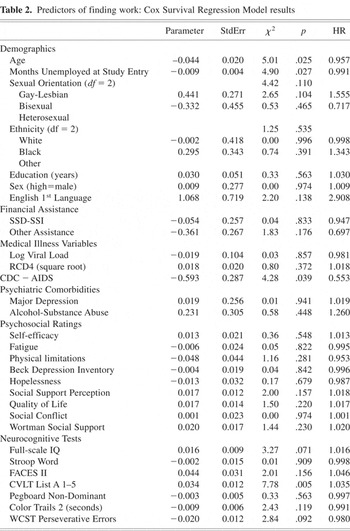
Compared to those who never worked during the two-year study, those who found employment were, on average, younger, reported a higher quality of life satisfaction and enjoyment, and performed significantly better on a timed motor measure with their dominant hand and evidenced better learning and recall on recognition and learning memory mea-sures (Faces I and CVLT total). Table 2 presents the results of the univariate and multiple survival regression analyses (Cox models).
Predictors of finding work: Cox Survival Regression Model results

Older participants, those who had been unemployed longer, and those with AIDS diagnoses were significantly less likely to find work during the two-year observation period. As Table 2 indicates, the most significant predictor of finding work was the total number of words learned on the CVLT at the first study visit.
A Cox survival regression composite model that included the four significant predictors (i.e., age, duration of unemployment prior to study entry, CDC classification and CVLT total score) was highly significant (χ2 = 19.7, df = 4, p < .001), but of the four predictors, only the total score on the CVLT was uniquely significant (χ2 = 5.20, df = 1, p = .023). Follow-up analyses suggested that months unemployed prior to study entry was redundant with the other predictors, and a forward stepwise selection model yielded significant parameters for age (younger participants were more likely to work, χ2 = 5.64, df = 1, p = .018), CDC-AIDS (i.e., having an AIDS diagnosis was a negative predictor, χ2 = 5.08, df = 1, p = .024), and total score on the CVLT at baseline in which more words learned predicted a greater probability of finding employment (χ2 = 5.09, df = 1, p = .024).
In the time-dependent survival regression models that added updated post-baseline updated assessments to the baseline measurement, none of the updated, time-dependent effects remained as significant predictors. Thus, the repeated measures data that were obtained over the ensuing study visits did not meaningfully improve prediction of job outcomes after the baseline values were considered.
Figure 1 depicts the significant association between baseline CVLT total score and the probability of finding employment at some time during follow-up. As can be seen, the likelihood of finding work roughly doubled from the lowest to the highest baseline CVLT score, going from just over 30% among the lowest scorers to just over 70% at the high end of CVLT performance. Using quartiles, the positive predictive value (PPV) of a CVLT-Total score above 52 (being in the top quartile) is 66%. The negative predictive value (NPV) of a score in the lowest quartile is 69%, indicating that for those in the lowest quartile who would be predicted not to find work, 69% actually did not.

CVLT baseline predicts finding employment.
We performed a similar analysis (results not reported) using total number of days worked after entering the study with similar results; the CVLT was again the most robust predictor of total days worked for these participants.
Duration of Employment
We correlated the 32 predictive variables listed in Table 2 with duration of employment after entry into the study in order to determine if any were significantly associated with longevity of employment after returning to work. Only one was statistically significant, and the direction was counter-intuitive (CDC-AIDS status, a negative predictor of getting a job at all, was positively associated with job duration for those who did find work (r = .30, df = 59, p = .019)) suggesting a likely spurious finding related to the number of statistical analyses performed.
Trajectories of Change Over Time
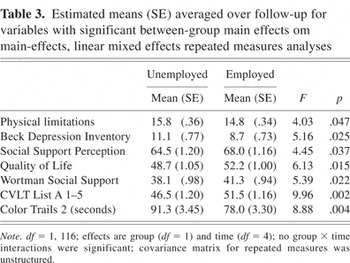
In the mixed effects analyses of level and trends over time, none of the variables had significant work × time interactions though as might be expected, all of the neuropsychological variables demonstrated practice effects over the testing occasions but these were similar for those who found work and those who did not. As such, the interaction was dropped and the models were re-estimated as main effect, repeated measures models including time and work outcome status (ever worked versus never worked). Several variables had significant main effects over time, meaning differences averaged across the entire follow-up period. These are listed in Table 3, which reveals that participants who found work at some point in the study reported fewer physical limitations, were less depressed (see below), perceived greater social support, reported higher quality of life and, as emphasized above, had higher scores on the total number of words on the CVLT and performed better on the Color Trails 2 than those who did not find employment.
Estimated means (SE) averaged over follow-up for variables with significant between-group main effects om main-effects, linear mixed effects repeated measures analyses

Depression, Quality of Life, and Work
A proportional hazard survival regression analysis using the prior (before finding work) and current (after finding work) BDI scores as independent variables was performed with time to finding work as the dependent variable. BDI score prior to finding employment was not a significant predictor of finding employment (χ2 = 1.99, df = 1, p = .16, hazard ratio = 1.0). However, BDI score after finding work was significantly associated with employment status (χ2 = 4.54, df = 1, p = .033, hazard ratio = .94). The hazard ratio indicates that at any assessment point, an individual one standard deviation above the BDI mean (about 7 points) would be 36% less likely to have found a job during the preceding interval. In other words, depressive symptoms were fewer after but not before finding work.
We also classified each assessment using a four-category system based on work status: never worked, before finding work, currently employed, and between jobs or after losing work. The first category differentiated those participants who had never worked during follow-up from those who ever did. The other three differentiated among assessments of those who had worked as a function of whether they were looking for the first job, employed, or experiencing the loss of a job. This classification system combines between-subjects information (worker, non-worker) and within-subject (before, during after work) information. Mean BDI in these four categories was compared using a mixed effects ANCOVA, controlling for baseline BDI. In addition to testing differences between categories, we also tested the significance of change from baseline within each category using the t-test on change from baseline.
The analyses indicated significant differences in mean BDI depression levels during follow-up as a function of these job categories (F = 3.13, df = 3, 116, p = .028). Mean BDI change from baseline was significantly different from zero only in the “While employed” time category (t = 2.37, df = 116, p = .020), and the only significant pairwise contrast between categories was between those who never worked and those who were currently employed (t =3.01, df = 116, p = .003). As would be expected, BDI ratings obtained while subjects were working were lower than those from individuals who never worked at all.
The analysis of quality of life had similar but less significant results. As was the case with the BDI, an overall contrast between those who never worked and those who did (averaging across pre, during and post work ratings) was significant (t = 5.02, df = 111, p = .027). Overall quality of life, averaged across the follow-up period, was generally poorer for subjects who never found work, but none of the pairwise contrasts between time periods within the worker category on the QOL were significant. Thus, among those who worked at some point during follow-up, quality of life while working was not significantly better when employed than when unemployed.
DISCUSSION
Of the myriad of predictors in our study, one—an index of learning and memory (CVLT) stood out as a robust predictor of finding employment. In fact, this study found that the likelihood of finding employment doubled from the lowest to the highest score on the CVLT obtained at baseline, with those attaining the highest score on the CVLT having a greater than 70% chance of finding work. Thus effortful learning and memory ability seems a key variable in predicting success in returning to work—even over IQ, health measures and other variables including entitlements, perhaps because the CVLT involves many components including it being an effortful task, utilizing clustering as an effective strategy, and utilizing working memory as well. The unique combination of cognitive processes embodied in the CVLT seems to tap a construct that seems uniquely tied to success in returning to work, at least in this cohort. Motor speed was also a significant, but less consistent, predictor of those who found work during the study period. These variables, therefore, are obviously key to examine in any formal assessment of HIV+ persons.
Barriers to work include (not surprisingly) being older, having an AIDS diagnosis), and duration of unemployment. Though clinicians cannot do much to alter the first two variables, they can perhaps encourage those who stop work in the context of illness to seek to return as soon as it is feasible to reduce as much as possible this duration of unemployment. The longer the individual is out of work, the lower the odds he or she will successfully find employment later.
In addition, primary care providers may be too quick to recommend going on disability when their patients express concerns about working. They need to be aware that workplace re-entry after a period of unemployment is not easily accomplished. Seeking workplace accommodations for health reasons while maintaining some level of employment may be one option with fewer long-term costs.
People who do return to work report less depression following their employment. Although some depressive symptoms do not seem to pose a significant barrier to returning to work (at least in the absence of significant clinical depression), success in finding work does appear to significantly improve mood. Not surprisingly, HIV+ individuals who do return to work report improved mood and quality of life.
Variables that did not significantly predict returning to work—these include IQ, basic academic abilities of reading, spelling and arithmetic, and maintenance or loss of entitlements. In our earlier study of gay men who were diagnosed with AIDS before the advent of antiretroviral therapy, predictors of working included financial (disability benefits), psychiatric (past or current diagnoses of depressive disorders), medical (physical limitations), and cognitive (executive function) (Rabkin et al., 2004). None of these variables were found to be significant in the current study, perhaps because participants had benefited from the availability of effective HIV treatment, and represented a more heterogeneous group in terms of education and work placement. On the other hand, in our current cohort, a much larger proportion found at least some work.
Those who returned to work did so at an occupational level similar to their historic work level (i.e. before stopping work), which probably explains the lack of predictive power of IQ or academic abilities. It is also surprising that the longitudinal trajectories of cognitive, psychiatric and medical functioning did not add to our predictive model. This is an interesting finding that warrants further exploration in future studies. It could be that a longer follow-up period beyond two years would have yielded greater predictive accuracy. It is also possible that antiretroviral therapy and active medical care helped maintain participants' health and cognitive function so that the longitudinal trajectories added no more to the predictive model than the baseline assessments. It is also possible that these findings related to the relatively low levels of employment attained by the group, and raises the question as to how well these results generalize to groups at higher levels of employment. Future studies must address this issue.
Targeted efforts to lessen duration of unemployment, and other approaches (e.g. cognitive rehabilitation) to improve learning and motor function may optimize chances of successful re-entry to the workforce for those seeking to return to work in the context of HIV infection.
Only a small percent of our participants obtained persistent employment during the period of follow up. The reason for this is unclear—it might have to do with the demographic characteristics of our sample—persons with some longstanding socioeconomic challenges, or intermittent physical illness. Regardless of the reasons, these findings suggest the importance of vocational counseling and support, such as assistance in making the transition from time-limited stipend jobs such as handing out flyers to recruit new clients for agency services, to competitive and permanent jobs. Future research might expand upon this and examine what services and policy changes are needed to enable those people who wish to find stable employment to succeed in doing so.
This study represents one of a handful of longitudinal, prospective studies to examine predictors of return to work within the context of HIV. Though this condition has provided us with a unique opportunity to study return to work for persons whose prospects for survival and return to health are changed from just a few years ago, the question of how applicable these findings are to other conditions is of course important. The extent to which these variables predict success in returning to work after such conditions as mild or moderate traumatic brain injury, physical illness such as multiple sclerosis that has improved, etc. is unclear. Future research should investigate the extent to which similar factors predict success in returning to work in other conditions. Future studies might also focus on the relationship between total duration of employment prior to the onset of an illness and ability to return to work post-stopping work.
ACKNOWLEDGMENTS
This project was supported by NIMH grant #5 RO1 MH060560 to the authors. The information in this manuscript and the manuscript itself is new and original and is not currently under review by any other publication, and has never been published either electronically or in print. There are no financial relationships between the authors and others regarding the methods or findings of this study.