In the past decade, multiple models have implicated emotion regulation as a mediating mechanism between parent–child relationship quality and adolescent internalizing symptoms (Bögels & Phares, Reference Bögels and Phares2008; Morris, Silk, Steinberg, Myers, & Robinson, Reference Morris, Silk, Steinberg, Myers and Robinson2007; Yap, Allen, & Sheeber, Reference Yap, Allen and Sheeber2007). In this paper, we will present research supporting these models, emphasizing the role of attachment relationships as indicators of parent–child relationship quality. Although the longitudinal effects of infant–mother attachment security for child and adolescent emotion regulation and adjustment are well documented (Berlin & Cassidy, Reference Berlin and Cassidy2003; Gilliom, Shaw, Beck, Schonberg, & Lukon, Reference Gilliom, Shaw, Beck, Schonberg and Lukon2002; Kobak & Sceery, Reference Kobak and Sceery1988; Vondra, Shaw, Swearingen, Cohen, & Owens, Reference Vondra, Shaw, Swearingen, Cohen and Owens2001), gaps remain in our understanding of father–child relationship effects.
Recently, it has been proposed that fathers’ involvement in exploration and play with their children may have a stronger association with later child outcomes than secure base behavior or safe haven-seeking with fathers (e.g., Dumont & Paquette, Reference Dumont and Paquette2013; Flanders et al., Reference Flanders, Simard, Paquette, Parent, Vitaro, Pihl and Séguin2010). Parent–child play presents a unique opportunity for engaging in reciprocal, cooperative interactions (Russell, Petit, & Mize, Reference Russell, Pettit and Mize1998), which are also noted as important factors in the development of secure attachment relationships (Ainsworth, Blehar, Waters, & Wall, 1979; de Wolff & van Ijzendoorn, Reference de Wolff and van IJzendoorn1997). However, there is only minimal longitudinal evidence supporting specific links between father–child play, child emotion regulation, and internalizing symptoms. The purpose of the present investigation is to better understand the role of father–child play quality, specifically with respect to fathers’ sensitivity and challenge, and dyadic affective mutuality, in shaping future emotional dysregulation and internalizing symptoms. Given the overwhelming evidence regarding the influence of both attachment security with mothers and early environmental risk for children's development, the present study will examine questions of father–child play in the context of infant–mother attachment organization and demographic risk factors for emotional dysregulation and internalizing.Footnote 1
Models of Emotion Regulation as Mediator
Morris et al. (Reference Morris, Silk, Steinberg, Myers and Robinson2007) suggest that the family context influences the development of emotion regulation in three important ways: (a) children learn about emotion regulation through observing caregivers and significant others in their lives, (b) children experience specific parenting practices and behaviors related to emotion socialization, and (c) children's experience of the emotional climate of the family influences emotion regulation, as reflected by attachment quality, parenting styles, family expressiveness, and the quality of the parental marital relationship. Moreover, the authors propose that while there are direct effects of family context on children's adjustment, much of these effects occur through the impact of the family on children's emotion regulation. Similarly, Yap et al. (Reference Yap, Allen and Sheeber2007) proposed a framework in which adolescents’ ability to regulate emotions is influenced by innate individual characteristics, such as temperament, as well as parenting processes, both of which have been implicated in vulnerability for internalizing symptoms. In each of these models, emotion regulation serves as a mechanism through which family processes and temperament interact to increase adolescents’ vulnerability toward internalizing symptoms. Furthermore, roles for mothers and fathers are viewed in a holistic manner, rather than for their unique contributions.
Empirical Support for Mediation Models
Multiple studies support components of these models, although there is little consistency in terms of age at which assessments are given. Generally, findings are contained either within early to middle childhood (e.g., birth to first grade) or within pre-, early, or later adolescence (e.g., ages 10–18).
Support in early childhood
A vast field of research supports the utility and reliability of assessing mother–child attachment relationships via the Strange Situation during infancy and toddlerhood, and story-stem techniques with preschool-aged children (see Solomon & George, Reference Solomon, George, Cassidy and Shaver1999, for a review), as well as observations and parent-reports of parent–child relationship functioning (Grossmann et al., Reference Grossmann, Grossmann, Fremmer-bombik, Kindler, Scheuerer-Englisch and Zimmermann2002; Grossmann, Grossmann, Kindler, & Zimmermann, Reference Grossmann, Grossmann, Kindler, Zimmermann, Cassidy and Shaver2008; Kerns, Tomich, Aspelmeier, & Contreras, Reference Kerns, Tomich, Aspelmeier and Contreras2000). However, there is no agreed-upon standardized measure or age for assessing children's emotion regulation. As a slow-developing capacity (Thompson, Reference Thompson1994), good emotion regulation should vary significantly throughout early childhood, and is likely an indicator of concurrent and future adjustment across development. Despite differences in measures of emotion regulation across studies, mother–infant Strange Situation classification predicted emotion regulation abilities in toddlers (Vondra et al., Reference Vondra, Shaw, Swearingen, Cohen and Owens2001), preschoolers (Berlin & Cassidy, Reference Berlin and Cassidy2003; Gilliom et al., Reference Gilliom, Shaw, Beck, Schonberg and Lukon2002), and first graders (Brumariu & Kerns, Reference Brumariu and Kerns2013). Early insecure attachment with mothers also predicted internalizing symptoms in preschoolers (Vondra et al., Reference Vondra, Shaw, Swearingen, Cohen and Owens2001) and first graders (NICHD Early Child Care Research Network, 2006).
Support in preadolescence and adolescence
At the other end of the youth developmental spectrum, there are several studies linking parent–child relationships, emotion regulation, and internalizing symptoms within the pre- to early adolescent period (e.g., Brody & Ge, Reference Brody and Ge2001; Brumariu, Kerns, & Siebert, Reference Brumariu, Kerns and Seibert2012; Suveg & Zeman, Reference Suveg and Zeman2004; Yap, Schwartz, Byrne, Simmons, & Allen, Reference Yap, Schwartz, Byrne, Simmons and Allen2010) and middle to later adolescence (e.g., Allen, Moore, Kuperminc, & Bell, Reference Allen, Moore, Kuperminc and Bell1998; Kobak & Sceery, Reference Kobak and Sceery1988; Rosenstein & Horowitz, Reference Rosenstein and Horowitz1996). Within these studies there was also significant variability in the measurement of parent–child relationships (e.g., observed interaction, parent reports, story stems, Adult Attachment Interview), emotion regulation (e.g., child or adolescent self-report, parent-report, interview, Q-sort procedures), and internalizing symptoms (e.g., various self- and parent-report measures). Of particular interest to the present research was an observational study of parents discussing positive and negative emotions with their children (ages 7–12), in which fathers’, but not mothers’, positive emotional reciprocity during the discussion was associated with significantly fewer child emotional and behavioral problems, and this effect was fully mediated by the child's emotion regulation (Thomassin & Suveg, Reference Thomassin and Suveg2014).
Developmental considerations in mediation models
Flanders et al. (Reference Flanders, Simard, Paquette, Parent, Vitaro, Pihl and Séguin2010) proposed that the effects of father–child play on the development of children's emotion regulation may only emerge over time as the child consolidates the learning that takes place within these interactions. Thus, it is crucial to have a longitudinal perspective of the influence of father–child play on children's later emotion regulation abilities. From infancy to age 15, children and adolescents develop skills, abilities, and vulnerabilities through gradual as well as abrupt change. We contend that the assessment of internalizing symptoms during adolescence, as an outcome of early parent–child relationships and childhood emotional dysregulation, is especially necessary. With the exception of some phobias (Merikangas et al., Reference Merikangas, He, Burstein, Swanson, Avenevoli, Cui and Swendsen2010), the majority of internalizing symptoms show significant increases around age 15, including clinically significant depressive symptoms (Center for Behavioral Health Statistics and Quality, Reference Carlson, Sroufe, Cicchetti and Cohen2016; Hankin et al., Reference Hankin, Abramson, Moffitt, Silva, McGee and Angell1998). Lifetime prevalence of social phobia, panic disorder, and posttraumatic stress disorder increase from earlier to middle adolescence (Merikangas et al., Reference Merikangas, He, Burstein, Swanson, Avenevoli, Cui and Swendsen2010), and lifetime prevalence of generalized anxiety disorder more than doubles between these age groups (Merikangas et al., Reference Merikangas, He, Burstein, Swanson, Avenevoli, Cui and Swendsen2010). Accordingly, middle adolescence is an ideal moment to assess for internalizing symptomology, as multiple clinically significant symptoms may emerge at this time. Understanding the many developmental processes that contribute to the emergence of adolescent internalizing symptoms may help improve accuracy in early detection and treatment of clinical-level symptoms.
However, of the literature reviewed, only two known studies extended these findings from infancy through childhood into preadolescence or later. First, the ability to manage intense emotions in first and third grade mediated associations between mother–infant/toddler attachment security and preadolescent anxiety symptoms (Brumariu & Kerns, Reference Brumariu and Kerns2013). A second study delineated complex pathways from early mother–child attachment and temperament through emotion regulation, anxiety, and peer relationships during childhood to predict middle and late adolescent anxiety symptoms (Bosquet & Egeland, Reference Bosquet and Egeland2006). Aside from these two studies, middle childhood as a developmental conduit for emotion regulation and emotional adjustment has received little empirical study.
During middle childhood, there is tremendous enhancement and refinement of skills and abilities, including motor coordination (Haubenstricker & Seefeldt, Reference Haubenstricker, Seefeldt and Seefeldt1986), cognitive ability (Piaget, Reference Piaget and Cook1954), social skills (Apperly & Robinson, Reference Apperly and Robinson2002), self-control (Mischel, Shoda, & Rodriguez, Reference Mischel, Shoda and Rodriguez1989), and desire to demonstrate independence and competence (Erikson, Reference Erikson1963). Furthermore, during later childhood and preadolescence, there is notable growth in the skills and abilities relevant to emotion regulation. Specifically, executive functioning improves as attention spans increase (Anderson, Reference Anderson2002), planning becomes more elaborate (Anderson, Anderson, & Garth, Reference Anderson, Anderson and Garth2001), perspective-taking advances (Flavell, Reference Flavell1968), and children are better able to talk through different kinds of problems, including self-control (Mischel et al., Reference Mischel, Shoda and Rodriguez1989) and social problems (Dodge et al., Reference Dodge, Lansford, Burks, Bates, Pettit, Fontaine and Price2003). Related to these executive functioning developments, older children and preadolescents show increases in their ability to regulate emotions compared to earlier middle childhood (Raffaelli, Crockett, & Shen, Reference Raffaelli, Crockett and Shen2005). Eight- to 9-year-olds’ emotion regulation abilities may be more similar to adolescents’ than those of younger children (Raffaelli et al., Reference Raffaelli, Crockett and Shen2005; Simonds, Kieras, Rueda, & Rothbart, Reference Simonds, Kieras, Rueda and Rothbart2007). As such, assessing older children/preadolescents’ response to intense emotional experiences may provide an important bridge between infancy and later adolescence.
Of note, both of the studies reviewed above that included pathways from infancy, through childhood, to preadolescence (Brumariu & Kerns, Reference Brumariu and Kerns2013) or adolescence (Bosquet & Egeland, Reference Bosquet and Egeland2006) were focused on anxiety symptoms in youth, without extending findings to internalizing symptoms more broadly. Furthermore, the emphasis across the studies reviewed above was on either mother–child relationships (e.g., maternal Strange Situation, mother–child interaction tasks) or general attachment to parents (e.g., Adult Attachment Interview). There were no known studies specifically examining emotion regulation mediating the quality of father–child interactions and adolescent symptomology. This constitutes a significant gap in the literature.
Father–Child Relationships: Links to Child and Adolescent Outcomes
Conceptualization of father–child relationships
Existing research suggests that, across cultures, fathers prefer playing with their children to the more “typical” mother–child caregiving interactions, such as feeding and soothing (Grossmann et al., Reference Grossmann, Grossmann, Kindler, Zimmermann, Cassidy and Shaver2008). In addition, playful interactions are one of the only activities in which fathers are more involved than mothers (Dumont & Paquette, Reference Dumont and Paquette2013). Because the nature of father–child play is often more exciting and stimulating, fathers also tend to be children's preferred play partners (Clarke-Stewart, Reference Clarke-Stewart1978; Dumont & Paquette, Reference Dumont and Paquette2013).
When it comes to measuring the early caregiving environment, the Strange Situation is the most frequently used assessment of mother–child attachment relationships (Shaffer, Reference Shaffer2009), though it has been a less accurate measure of father–child relationships (Dumont & Paquette, Reference Dumont and Paquette2013). Emerging research suggests fathers may provide sensitivity in a different manner than mothers, such as through positive engagement in playful interactions with the child (Grossmann et al., Reference Grossmann, Grossmann, Fremmer-bombik, Kindler, Scheuerer-Englisch and Zimmermann2002, Reference Grossmann, Grossmann, Kindler, Zimmermann, Cassidy and Shaver2008). For example, Grossmann et al. (Reference Grossmann, Grossmann, Fremmer-bombik, Kindler, Scheuerer-Englisch and Zimmermann2002) proposed that fathers “provide security to their children through sensitive and challenging support as a companion when the child's exploratory system is aroused” (p. 311). Using observations of joint playful interactions, Grossmann et al. (Reference Grossmann, Grossmann, Fremmer-bombik, Kindler, Scheuerer-Englisch and Zimmermann2002) rated the quality of the father–child relationship based on the degree of father sensitivity (i.e., patience, cooperation, level of interest, and providing age-appropriate explanations) and challenge (i.e., challenging the child to play in a more mature manner and motivating the child in exploratory play). They found that father–child play sensitivity was significantly associated with children's later attachment representations.
A model is emerging within the literature that describes a complementary process in which mothers primarily function as a secure base and safe haven for care and protection, while fathers function more as a source of secure exploration through play and challenge (Bögels & Phares, Reference Bögels and Phares2008; Paquette, Reference Paquette2004). Paquette (Reference Paquette2004) suggested that fathers’ provision of more exciting and challenging experiences with children facilitates their exploration and engagement with the environment outside of the safety provided by the mother–child attachment relationship. That is, it may be the quality of the relationship and the degree of sensitivity with the father during father–child play, combined with a secure base with the mother, which marks father–child attachment security (Paquette, Reference Paquette2004). Early father–child interaction studies found that children whose fathers were more sensitive during physical play were more confident explorers in solitary play (Belsky, Garduque, & Hrncir, Reference Belsky, Garduque and Hrncir1984; Easterbrooks & Goldberg, Reference Easterbrooks and Goldberg1984). A burgeoning literature indicates that fathers contribute to child development in unique, yet complementary ways to mothers (Bretherton, Reference Bretherton2010; Freeman, Newland, & Coyl, Reference Freeman, Newland and Coyl2010; Goodsell & Meldrum, Reference Goodsell and Meldrum2010; Newland & Coyl, Reference Newland and Coyl2010). Here we are careful about making distinctions between play and caregiving activities. Although play often involves caregiving (e.g., soothing boo-boos), and caregiving often involves play (e.g., bath time, and dressing infants and toddlers), we conceptualize play here as a time set aside for parent–child interaction around child-focused, enjoyable activities. This type of parent–child play presents a unique opportunity for engaging in cocreated reciprocal interactions (Russell et al., Reference Russell, Pettit and Mize1998). Moreover, Russell et al. (Reference Russell, Pettit and Mize1998) posit that the ability of parents and children to move from a more “vertical” power structure to mutual and reciprocal, more “horizontal” relationships during play has significant benefits for child development.
Father–child play relationships, emotion regulation, and internalizing
In an attempt to clarify the mechanisms by which father–child bonds influence child emotion regulation, several researchers have proposed that father–child play is both a source of attachment bonds and a unique arena in which to practice emotion regulation. Specifically, high excitement and arousal associated with father–child play allows fathers to both demonstrate emotional sensitivity and challenge young children's emerging emotional resources (Clarke-Stewart, Reference Clarke-Stewart1978; Diener, Mangelsdorf, Mchale, & Frosch, Reference Diener, Mangelsdorf, Mchale and Frosch2002; Dumont & Paquette, Reference Dumont and Paquette2013; Freeman et al., Reference Freeman, Newland and Coyl2010; Grossmann et al., Reference Grossmann, Grossmann, Fremmer-bombik, Kindler, Scheuerer-Englisch and Zimmermann2002, Reference Grossmann, Grossmann, Kindler, Zimmermann, Cassidy and Shaver2008). As a result, children learn to modulate their own emotions and behavior to have an enjoyable, exciting experience, and do not become under- or overstimulated (Flanders et al., Reference Flanders, Simard, Paquette, Parent, Vitaro, Pihl and Séguin2010). For example, fathers’ modeling of effective self-control and limit setting during observations of play interactions at ages 2 to 6 was related to fewer father-reported aggressive behaviors and greater emotion regulation over time, and this relationship was moderated by the quality of the father–child relationship during play (Flanders et al., Reference Flanders, Simard, Paquette, Parent, Vitaro, Pihl and Séguin2010). A father–child activation relationship has been proposed that suggests that the stimulating, exciting, and nonpunitive experiences during father–child play teaches children to follow rules, self-regulate, and promotes the encoding of one's own and decoding of others emotional signals (Paquette, Reference Paquette2004). Furthermore, research has suggested that the ability to avoid overstimulating the child requires a unique sensitivity on the part of the father to the child's emotional cues (Parke, Reference Parke1994; Volling et al., Reference Volling, McElwain, Notaro and Herrera2002).
Given initial support for the positive effect of father–child play on emotion regulation, we expect that father–child relationships might similarly impact the development of internalizing symptoms in adolescence, if considered within the context of existing support for the impact of general parent–child attachment and the mother–child relationship on children's development of emotion regulation and internalizing. There are many studies of father–child positive reciprocity and mutuality during play and their relation with fewer externalizing problems in children and adolescents (e.g., Criss, Shaw, & Ingoldsby, Reference Criss, Shaw and Ingoldsby2003; Deater-Deckard, Atzaba-Poria, & Pike, Reference Deater-Deckard, Atzaba-Poria and Pike2004), as well as links between reciprocal influence between parents and children on the development of externalizing behaviors (e.g., Larsson, Viding, Rijsdijk, & Plomin, Reference Larsson, Viding, Rijsdijk and Plomin2008; Pardini, Fite, & Burke, Reference Pardini, Fite and Burke2008). However, less is known about links to internalizing symptoms. In one exception, higher father involvement in play with their preschool-aged child predicted fewer internalizing symptoms 1 year later, but only in the context of greater positive coparenting behavior between mothers and fathers (Jia, Kotila, & Schoppe-Sullivan, Reference Jia, Kotila and Schoppe-Sullivan2012). One limitation of Jia et al.’s (Reference Jia, Kotila and Schoppe-Sullivan2012) study was the use of fathers’ self-reports of play involvement, which does not speak to the quality, reciprocity, or mutuality of play interactions. However, these findings speak to the importance of understanding the role of father–child play in the context of how the broader family system is functioning. Other research has found that mutually responsive father–child play facilitates children's self-regulation, which can reduce the risk for later internalizing behaviors (Bögels & Phares, Reference Bögels and Phares2008). Finally, Mattanah (Reference Mattanah2001) found that fathers’ effective limit setting during father–child interactions was associated with fewer signs of depression and anxiety. However, this finding does not speak to the overall mutuality, sensitivity, or engagement between fathers and children during play.
Rationale for the Current Study
Methodological gaps
Longitudinal studies on the association between sensitive and challenging father–child play interactions, emotion regulation, and the development of internalizing symptoms are limited in the existing literature. Like studies that include early attachment, most focus on middle and late childhood outcomes, or externalizing behaviors (Bögels & Phares, Reference Bögels and Phares2008; Flanders et al., Reference Flanders, Simard, Paquette, Parent, Vitaro, Pihl and Séguin2010; Jia et al., Reference Jia, Kotila and Schoppe-Sullivan2012; Mattanah, Reference Mattanah2001). The lack of research extending into adolescence is important due to the increased risk for some internalizing symptoms noted above. Thus, there is a great opportunity to increase the evidence base for fathers’ roles in current conceptualizations of developmental psychopathology broadly, and adolescent internalizing specifically. Grossman et al. (Reference Grossmann, Grossmann, Fremmer-bombik, Kindler, Scheuerer-Englisch and Zimmermann2002) reported some of the only known data linking early father–child play to adolescent outcomes. However, this study was limited in the outcomes that were assessed and by a small and homogeneous sample. Finally, methods with which father–child data are gathered have been relatively limited. Fathers’ reports of children's behaviors are often absent in studies of child development, despite wide support for the idea that fathers provide differing attachment functions and information about their children's emotions and behaviors (Grossmann et al., Reference Grossmann, Grossmann, Fremmer-bombik, Kindler, Scheuerer-Englisch and Zimmermann2002, Reference Grossmann, Grossmann, Kindler, Zimmermann, Cassidy and Shaver2008). In addition, most of the existing research on father–child playful interactions emphasizes the “rough and tumble,” or physical, nature of father–child play. Less is known about the long-term outcomes of a broader spectrum of sensitive, challenging play between fathers and children. Whether the overall quality of father–child play allows children to practice self-regulation, regardless of the level of physicality, is an open question.
Important covariates
As noted throughout this literature review, mothers and fathers are proposed to operate in complementary ways to influence children's adjustment. Specifically, mothers are proposed as facilitating secure base/safe haven behavior in children, whereas fathers are conceptualized as facilitators of secure exploration. Each of these roles helps the child to feel secure at each stage of a circle arcing out from the secure base, through exploration, and back to a safe haven when exploration becomes too much (Cooper, Hoffman, Powell, & Marvin, Reference Cooper, Hoffman, Powell, Marvin and Berlin2007). Therefore, any assessment of father–child play would tell a more complete story if mother–child security on the Strange Situation was also included. Temperament is also important to acknowledge in the present study. Developmental models and existing empirical studies emphasize the role of the child's individual temperament as an important factor in the development of emotion regulation and internalizing symptoms. For example, temperament strongly predicts children's and adolescents’ emotion regulation (Wills, Gibbons, Gerrard, & Brody, Reference Wills, Gibbons, Gerrard and Brody2000), and temperamental negativity is associated with difficulty regulating emotions as early as infancy, using observational and biological methods (see Calkins & Hill, Reference Calkins, Hill and Gross2007; Fox & Calkins, Reference Fox and Calkins2003, for reviews). Child gender has important implications for several of the constructs present in the model. In a meta-analytic review of emotion expression, girls tended to express more positive emotions as well as more internalizing, whereas boys tended to express more externalizing emotions (Chaplin & Aldao, Reference Chaplin and Aldao2013). Girls in middle childhood showed greater skill at modulating some negative emotions than boys (Davis, Reference Davis1995), and adolescent girls reported significantly higher scores on subscales of a self-report measure of emotion regulation that indicated more confusion, goal interference, and lack of agency when experiencing strong negative emotions (Weinberg & Klonsky, Reference Weinberg and Klonsky2009). Girls are also at higher risk of developing internalizing symptoms in adolescence, particularly depression (Hankin & Abramson, Reference Hankin and Abramson2001; Hankin et al., Reference Hankin, Abramson, Moffitt, Silva, McGee and Angell1998; Nolen-Hoeksema & Girgus, Reference Nolen-Hoeksema and Girgus1994). Finally, family risk and stability factors are important to consider, such as sufficiency of family income and stability of the family unit, as some research suggests that at higher levels of situational risk, fathers’ involvement may be especially important for children's emotional development (Eisenberg, Cumberland, & Spinrad, Reference Eisenberg, Cumberland and Spinrad1998; Garside, Reference Garside2004; Klimes-Dugan et al., Reference Klimes-Dougan, Brand, Zahn-Waxler, Usher, Hastings, Kendziora and Garside2007).
Summary and hypotheses
In summary, support is emerging for emotion regulation as a mediator between father–child relationships and internalizing symptoms, but additional research is needed. No known study examines the relationship between all three of these constructs using a longitudinal design extending into adolescence. In an attempt to clarify these relationships, we utilized data from a longitudinal study of child development with multiple reporters including an observational measure of father–child play interactions at first grade, mother and father emotion regulation ratings at third grade, and youth reported internalizing symptoms at age 15. The goals of this study were to provide a better understanding of the influence of father–child play relationships on children's development of emotion regulation in childhood and internalizing symptoms in adolescence. We hypothesized that, after accounting for infant–mother attachment security, temperament, and demographic risk/protective factors, more sensitive, stimulating, and affectively mutual father–child play in first grade would indirectly predict adolescent internalizing symptoms at age 15 through parent ratings of emotional dysregulation in third grade. There were no a priori hypotheses about whether these indirect effects will fully or partially mediate the association between father–child play and adolescent internalizing. Full mediation would indicate that the effect is completely explained by the model tested, whereas partial mediation would suggest room for model improvement or additional mediating mechanisms (Rucker, Preacher, Tormala, & Petty, Reference Rucker, Preacher, Tormala and Petty2011).
Method
Participants and procedures
Participants were 476 families drawn from the National Institute of Child Health and Human Development's Study of Early Child Care and Youth Development (NICHD SECCYD), a large longitudinal study of children from birth to age 15 years (NICHD Early Child Care Research Network, 2006). Participants were recruited from 10 hospital sites across the United States when infants were 1 month of age. The 476 families in the current sample were included based on availability of complete data at all time points, and represent 34.9% of the original sample N of 1,364. Of the 476 participants included, 47.9% were male, 91.8% identified as Caucasian, and 93.9% of mothers identified as being married, with 98.5% of fathers living with mothers. In addition, 51.6% of mothers and 53.1% of fathers had a bachelor's degree or higher, and median family income after the child's birth was $37,500.
Compared to the original sample, the present subsample included slightly more female children, (original = 48.3% female subsample = 52.1% female), χ2 = 4.20, df = 1, p < .05, ϕ = .06; fewer non-Caucasian children (original = 19.6% non-Caucasian, subsample = 8.2% non-Caucasian), χ2 = 60.16, df = 1, p < .001, ϕ = .21; more married mothers at child age 1 month (original = 70.9% married, subsample = 89.5% married), χ2 = 122.61, df = 1, p < .001, ϕ = .30; more parents living together at child age 1 month (original = 85.5% living together, subsample = 98.5% living together), χ2 = 100.28, df = 1, p < .001, ϕ = .27; had greater financial resources, with original income-to-needs ratio M = 2.55 (2.73), subsample income-to-needs ratio M = 3.39 (2.31), t (1, 271) = –5.68, p < .001; had more highly educated parents: original sample median maternal education of some college, subsample median maternal education of college degree, t (1, 361) = –9.37, p < .001; and original sample median paternal education of some college, subsample median paternal education of college degree, t (1, 248) = –8.42, p < .001. Among nondemographic target variables, the present subsample included a greater number of securely attached children (original = 69.1% secure, subsample = 72.7% secure), χ2 = 4.78, df = 1, p < .05, ϕ = .06; higher quality father–child play, with original M = –0.66 (2.90), subsample M = 0.25 (2.55), t (658) = –3.96, p < .001; and adolescents that reported fewer internalizing symptoms, original M = 48.18 (9.95), subsample M = 46.39 (10.32), t (954) = –2.73, p < .01. There were no significant differences between the original sample and subsample on either parent's report of child's emotion regulation.
Only biological fathers’ data were included for father-figure reports of child behavior and father–child interactions. Informed consent and parent permission were obtained for all research activities. Demographic data were gathered from all individuals participating in this study during the initial home visit when children were 1 month old and at the final visit at age 15. Procedures were approved by the institutional review boards for participating institutions.
Measures
Attachment security
Infant–mother attachment security was assessed at 15 months with the Strange Situation (Ainsworth et al., Reference Ainsworth, Blehar, Waters and Wall1978). The Strange Situation is a laboratory procedure used to assess infant attachment styles via observations of infants’ responses to their mothers after a series of separations and reunions. Strange Situations were video recorded and coded to yield the standard classifications of secure (B), insecure-avoidant (A), insecure-resistant (C), disorganized (D), and unclassifiable (U). Across all coder pairs, agreement with the aforementioned classification system was 83% (κ = .69), and disagreements were reviewed and a code was assigned based on consensus. In the present study, only cases classified as A, B, and C were included. Due to the relatively small proportions of insecure-avoidant (A) and insecure-resistant (C), participants rated as insecure were grouped together, resulting in a single categorical variable: secure versus insecure attachment.
Father–child play quality
The quality of father–child interactions was assessed through observations of a 15-min semistructured teaching and play situation during a home visit when children were in first grade. The interaction task included three activities. The first task was intended to be a fun yet challenging activity, where the adult and child had to develop a plan and coordinate their actions during the joint use of an Etch-A-Sketch in order to simultaneously draw diagonal lines. The second task required the child to use colored cubes to build three block designs pictured on cards. The activity was expected to be difficult for first graders to complete independently. The final task was the card game “Slap Jack.” This activity allowed for observation of expressions of affect from the adult and child, as well as the child's emotional regulation in a potentially exciting and/or frustrating game with the father.
The Parent–Child Interaction task rating scale was adapted from Egeland and Heister (Reference Egeland and Heister1993) and Pianta (Reference Pianta1994) to be task and age appropriate. Qualities of parenting and child behavior in the Parent–Child Interaction task were rated from the videotaped interactions by trained coders using 7-point global rating scales from 1 (very low) to 7 (very high). Interrater reliability estimates, via calculation of the intraclass correlation coefficient, ranged from .71 to .88. For the purposes of the current study, a composite father–child play interaction variable was created including the following ratings: child felt security/affective mutuality, adult sensitivity (composite of: supportive presence, respect for autonomy, and reversed hostility), and adult stimulation (composite of: cognitive stimulation and quality of assistance). Because adult sensitivity and stimulation scores were already composite variables created for the larger study and were measured on a different scale than felt security, each of these variables was first converted into a z score in order to combine them into a composite variable for this study. The larger composite variable was created by taking the sum of each of the z scores. These variables were chosen based on the existing literature linking these characteristics to infant–father relationship quality in playful interactions (Grossmann et al., Reference Grossmann, Grossmann, Kindler, Zimmermann, Cassidy and Shaver2008). Scale reliability for this composite father–child play interaction variable was Cronbach's α = 0.87.
Emotional dysregulation
Mothers and fathers completed the Parent Report of Children's Reactions questionnaire when children were in third grade. The 10-item questionnaire was developed for the larger study from which these data were drawn, and was designed to measure parents’ perceptions of how their child expresses emotions in response to positive and negative events. Parents rated the frequency of children's display of emotions on a 5-point scale from 1 (never) to 5 (always). Sample items included “when my child feels an emotion, either positive or negative, my child feels it strongly” and “when angry, it is easy for my child to still be rational and not overreact” (reverse scored). The child's emotion regulation score was computed as the sum of responses to 10 items after reverse scoring 5 items. Possible scores ranged from 10 to 50, with higher values indicating a stronger, less adaptive emotional reaction. Due to initial concerns about the internal consistency from the father report, 1 item was dropped from the scale (“After finishing a difficult task, my child feels delighted or elated”) for this study. The resulting reliability was Cronbach's α = 0.71. Reliability for mothers’ reports of the emotion regulation score was Cronbach's α = 0.76.
Youth internalizing
Adolescents completed the Youth Self-Report (YSR) during a visit to the laboratory at age 15 (Achenbach & Rescorla, Reference Achenbach and Rescorla2001). Youth rated the extent to which they experience each of 112 behavioral and emotional symptoms currently or within the last 6 months. Items were rated on a 3-point scale from 0 (not true) to 2 (very true or often true), with higher scores reflecting higher problem levels. Only the internalizing symptoms scale was utilized in the current study, which is based upon the withdrawn, somatic complaints, and anxious/depressed syndrome scales. The internalizing scale is calculated as a T score, with borderline problems ranging from T = 65 to T = 69, and clinical-level scores at T = 70 and above. The YSR has been extensively normed on a nationally representative sample of adolescents (Achenbach & Rescorla, Reference Achenbach and Rescorla2001). For the internalizing symptoms scale of the YSR, Achenbach and Rescorla (Reference Achenbach and Rescorla2001) reported acceptable internal consistency (r = .80).
Demographic information
For the current study, parents provided data on child sex at birth, income-to-needs ratio at 1 month, and traditional family status at age 15. Sex of the child was included as a covariate, given the higher rates of some internalizing symptoms among adolescent girls (e.g., Kessler et al., Reference Kessler, Avenevoli, Costello, Green, Gruber, McLaughlin and Merikangas2012; Nolen-Hoeksema & Girgus, Reference Nolen-Hoeksema and Girgus1994). The income-to-needs ratio at age 1 month was included as a covariate due to the potential risks of living in a low-income household during infancy (Sedlak et al., Reference Sedlak, Mettenburg, Basena, Petta, McPherson, Greene and Li2010). Income-to-needs ratios of 1.00 or greater indicated that the family's income met or exceeded their reported needs. Traditional family status was defined as biological parents currently married and living together. Traditional family status at age 15 was coded 1(yes) or 0 (no), and included as a covariate to account for variance in emotion regulation and internalizing that might be explained by the relative stability in the child's nuclear family across the entire study period.
Infant temperament
Mothers completed the Early Infant Temperament Questionnaire (EITQ; Medoff-Cooper, Carey, & McDevitt, Reference Medoff-Cooper, Carey and McDevitt1993) at 1 month. Infant temperament was included as a covariate given its well-documented association with emotion regulation (Rothbart & Sheese, Reference Rothbart, Sheese and Gross2007), depression (e.g., Kiff, Lengua, & Bush, Reference Kiff, Lengua and Bush2011; Krueger, Reference Krueger1999; Sugimura & Rudolph, Reference Sugimura and Rudolph2012), and anxiety (e.g., Vervoort et al., Reference Vervoort, Wolters, Hogendoorn, de Haan, Boer and Prins2010), as well as its potential to promote emotion regulation and resilience (e.g., Gartstein & Bateman, Reference Gartstein and Bateman2008). The measure was initially shortened to include 38 items measuring infant activity, approach, adaptability, mood, and intensity, rated on a 6-point Likert-type scale from 1 (almost never) to 6 (almost always), with the option of CA (cannot answer). For a large number of items, mothers rated CA, which led to a large amount of missing data and an inability to calculate subscales. In response, an aggregate score was created using the 14 items in which 2% or less of the responses were CA. Example items include “My baby's hunger cry is a scream rather than a wimper” and “My baby resists (squirms, fusses) during routine dressing or undressing.” Higher scores indicated more difficult temperament. The internal consistency for this aggregate scale in the current sample was Cronbach's α = 0.70. Regarding validity of the modified measure, mothers who rated their infants highly on this modified scale also tended to rate their infants as “more difficult than average” on a global measure of infant temperament given at 1 month of age. Specifically, mothers who chose the “more difficult than average” category for their infants had scores on the EITQ that were, on average, about 1 SD above those who rated their baby as “about average.” Further, the modified scale given at 1 month was significantly positively correlated with mothers’ ratings on a more expanded version of the EITQ given at age 6 months.
Results
Analysis plan
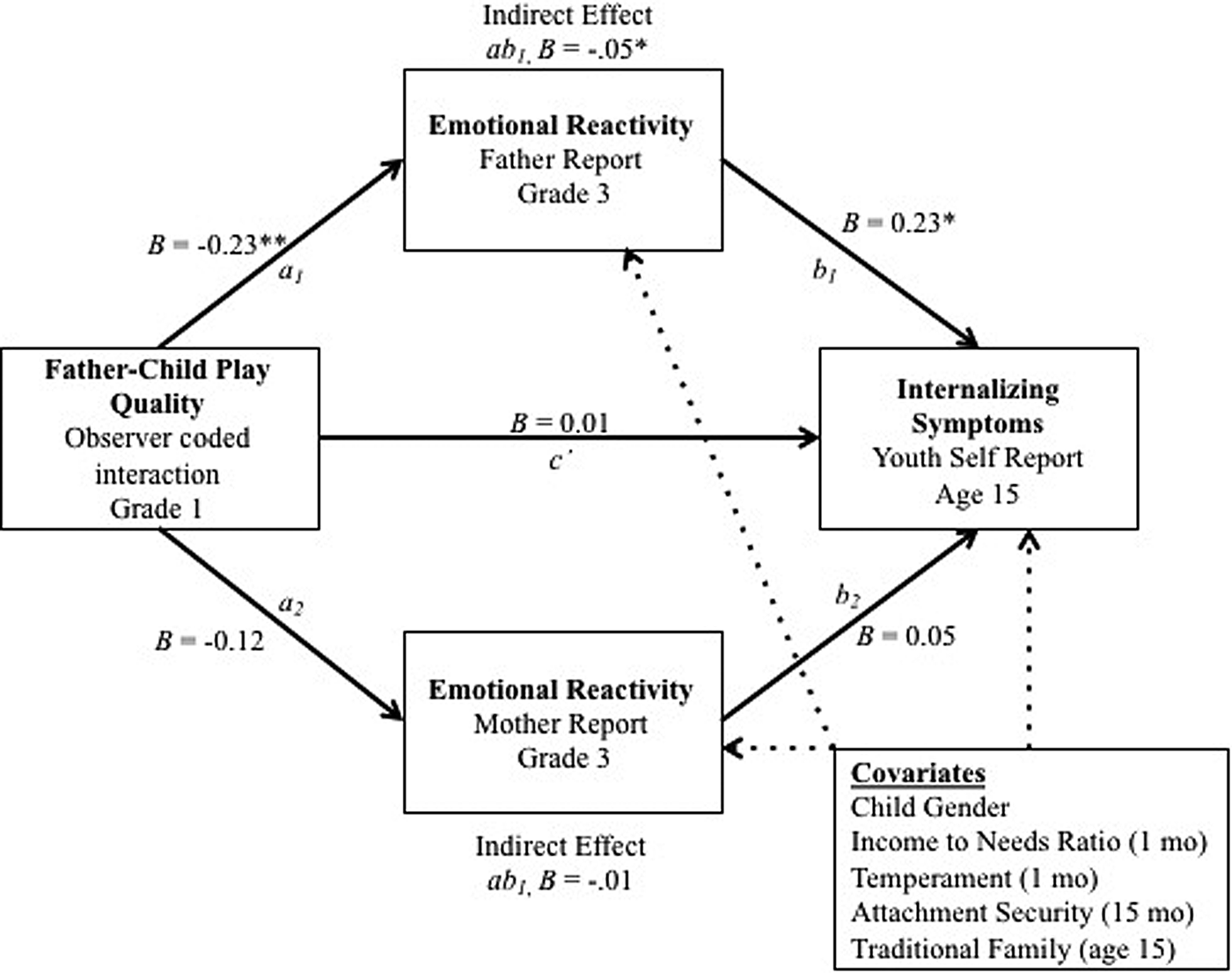
First, a descriptive analysis was performed to indicate sample characteristics regarding demographic and target variables. Second, in order to test the hypothesis that the relationship between early father–child play quality and adolescent internalizing is mediated by mother and father reports of children's emotional regulation, a multiple mediation model was analyzed using ordinary least squares path analysis (Hayes, Reference Hayes2013). This analysis estimates path coefficients in a parallel mediator model and generates bootstrap confidence intervals for the total and specific indirect effects of the predictor variable on the outcome variable through one or more mediators (Hayes, Reference Hayes2013). All paths were adjusted for the potential influence of covariates in the model (see Figure 1). We present results for each indirect effect and direct effect, and significant covariates. Mediation effects through mother and father reports of emotional dysregulation were conducted simultaneously.
Mediation Model for Father-Child Play, Emotion Regulation, and Internalizing Symptoms. Note: * p < .05, ** p < .01.

Descriptive statistics
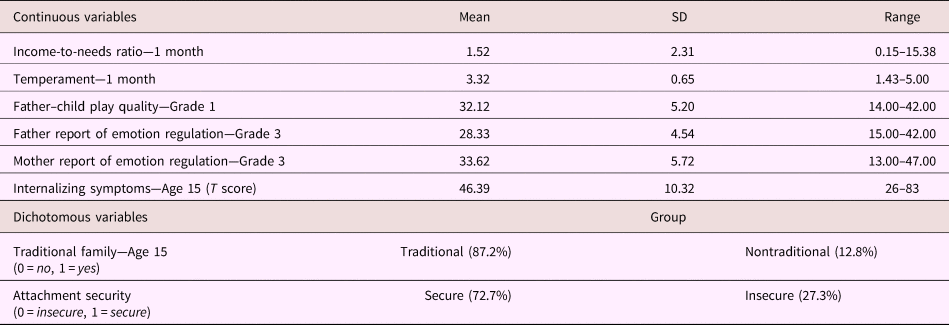
Descriptive data for study variables are presented in Table 1. On average, families in the sample had an income-to-needs ratio suggesting that their income exceeded their needs. Mothers’ temperament ratings indicated that they rated their infants as occasionally difficult on average, and rarely extremely difficult or easy. When totals for ratings of father–child play quality were compared to the original rating scale (by dividing by the number of subscales in the total score), on average dyads scored in the “moderately high” range of composite felt security/mutuality and father sensitivity/stimulation. Fathers rated their children as struggling with emotional dysregulation slightly below “about half the time” on average; mothers tended to rate their children as struggling with emotional dysregulation between “about half the time” and “usually.” Mothers’ average ratings of emotional dysregulation difficulties were significantly higher than fathers’ ratings, t (475) = 19.75, p < .001.
Descriptive data for study variables

On average, teens’ self-reports of internalizing symptoms were well below the borderline and clinical cutoffs for symptom distress. Further inspection of the data revealed that 4% of teens in this sample met the borderline clinical cutoff for internalizing symptoms (T > 65), which is consistent with population estimates for adolescents across anxiety, depression, and/or somatic disorders (e.g., American Psychiatric Association, 2013; Merikangas, Nakamura, & Kessler, Reference Merikangas, Nakamura and Kessler2009). Approximately 73% of children were rated as securely attached, which is consistent with previous studies in nonclinical samples (Ainsworth et al., Reference Ainsworth, Blehar, Waters and Wall1978; van IJzendoorn & Kroonenberg, Reference van IJzendoorn and Kroonenberg1988; van IJzendoorn, Schuengel, & Kranenburg, 1999). About 87% of the study child's biological parents in the current sample were still married to one another when the child was 15, which is higher than the 20-year marriage survival rate for first marriages in the United States (52%–56%) during the time these data were gathered (Copen, Daniels, Vespa, & Mosher, Reference Copen, Daniels, Vespa and Mosher2012).
Correlations between covariates and target variables
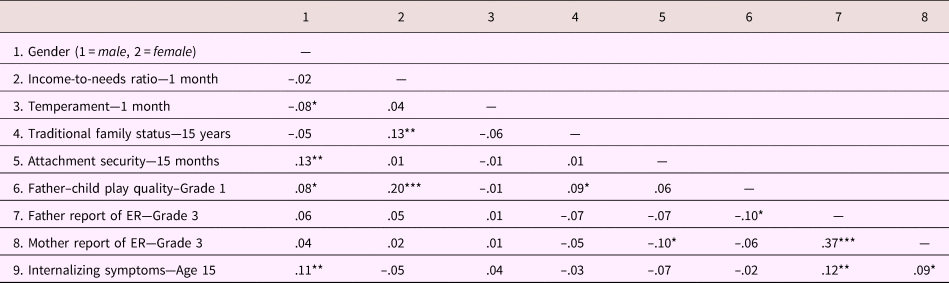
Table 2 shows the zero-order correlations among all covariates and target variables. Overall, effect sizes were small to medium (r = –.11 to .37). Demographic covariates were significantly correlated with target variables, such that girls tended to have easier temperaments, better play quality with fathers, and greater internalizing symptoms (see Table 2). Girls were more often rated as securely attached, Pearson χ2 = 8.00, df = 1, p < .01. Having a higher income-to-needs ratio was significantly positively correlated with father–child play quality, and traditional family status at age 15. Traditional family status at age 15 was also positively associated with ratings of father–child play quality in first grade.
Correlations among study variables

Note: ER, emotion regulation. *p < .05. **p < .01. ***p < .001.
Infants rated as securely attached in the infant–mother Strange Situation at 15 months were rated by mothers as having fewer problems with emotional dysregulation; with fathers’ ratings showing a similar marginally significant pattern (see Table 2). Of note, attachment security at 15 months was unrelated to father–child play quality at Grade 1. However, infant attachment security was marginally associated with internalizing symptoms at age 15, such that secure attachment was correlated with fewer internalizing symptoms. Children whose mothers rated them as having more difficult temperament at 1 month were also rated by mothers as having significantly greater emotional dysregulation at Grade 3, but temperament was unrelated to fathers’ ratings of child emotional dysregulation. Mother and father ratings of child emotional dysregulation difficulties were moderately correlated with each other, and both were positively correlated with internalizing symptoms at age 15. Overall, these findings support the inclusion of sex, income-to-needs ratio, traditional family status, infant–mother attachment, and infant temperament as covariates in the primary mediation analyses. These preliminary analyses also support the inclusion of fathers’ perspectives and relationships with children as unique predictors of adolescent adjustment.
Mediation analysis
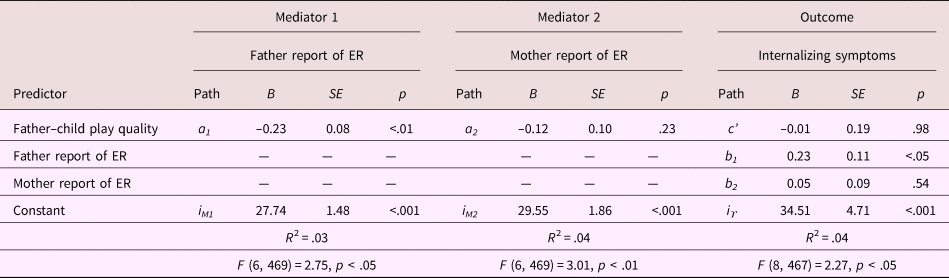
Tests of the indirect effect of father–child play quality at Grade 1 on internalizing symptoms at age 15 through its effect on fathers’ ratings of children's emotional dysregulation at Grade 3 are presented in Figure 1 and Table 3. Dyads with higher observer ratings on the father–child play quality composite scale at Grade 1 had lower father ratings of emotional dysregulation difficulties at Grade 3, 95% CI [–.39, –.06], and children whose fathers rated them lower on emotional dysregulation at Grade 3 reported fewer internalizing problems at age 15, 95% CI [.01, .45]. A bias-corrected bootstrap confidence interval for the indirect effect, path ab 1, B = –.05, based on 10,000 bootstrap samples was entirely below zero, 95% CI [–.14, –.01], suggesting that criteria for mediation were met (Preacher & Hayes, Reference Preacher and Hayes2004).
Regression coefficients, standard errors, and model summary information for the parallel multiple mediator model (depicted in Figure 1)

Note: ER, emotion regulation.
There was no significant indirect effect of father–child play quality on internalizing symptoms through mother reports of child emotional dysregulation difficulties, path ab 2, B = –.01. A bias-corrected bootstrap confidence interval for the indirect effect based on 10,000 bootstrap samples included zero, 95% CI [–.06 to .01]. Third, there was no evidence that father–child play quality influenced adolescent internalizing symptoms independently of its effect through father-reported emotional dysregulation. Thus, in the current study, father reports of child emotional dysregulation difficulties fully mediated the effect of father–child play on adolescent internalizing symptoms. The overall effect of the mediation model was small, explaining 4% of the variance in adolescent self-reported internalizing symptoms at age 15.
The results presented above were calculated above and beyond the effects of the sex of the study child, family income-to-needs ratio during infancy, infant–mother attachment, infant temperament, and traditional family status on both the mediators and outcome. However, some covariates did show significant relationships with mediators and final outcomes in the model. Specifically, infants rated by mothers as having easier temperament at 1 month and classified as securely attached with mothers at 15 months also tended to be rated by mothers as having fewer emotional dysregulation problems at Grade 3, B = 1.22, 95% CI [0.43, 2.02], SE = 0.40, p < .01, and B = –1.31, 95% CI [–2.47, –0.16], SE = 0.59, p < .05, respectively. Being female remained a significant predictor of higher internalizing symptoms relative to males in the total overall model, B = 2.40, 95% CI [0.51, 4.27], SE= 0.96, p < .05. Infant–mother attachment security was marginally associated with internalizing symptoms, such that children classified as secure during infancy tended to report fewer internalizing symptoms as adolescents, B = –1.83, 95% CI [–3.93, 0.26], SE = 1.07, p < .10.
Discussion
The aim of this study was to add to the literature examining father–child play as a unique contributor to later childhood emotion regulation and adolescent internalizing symptoms, in the context of mother–child attachment and individual and demographic risk factors. We hypothesized that father–child play quality in first grade would predict both parents’ ratings of emotional dysregulation in third grade, which would in turn predict adolescent self-reported internalizing symptoms at age 15, above and beyond the effects of infant–mother attachment, temperament, sex of the study child, family income-to-needs ratio during infancy, and traditional family status during adolescence. Findings partially supported our hypothesis: father–child interactions at first grade characterized by high child felt security/affective mutuality, and greater father sensitivity and stimulation, predicted lower levels of internalizing symptoms in adolescence through fewer problems with emotional dysregulation in third grade. However, only fathers’ reports of emotional dysregulation in third grade significantly mediated the relationship between father–child play quality and internalizing symptoms, suggesting that fathers’ reports contributed uniquely to the prediction of adolescent internalizing, even after accounting for mothers’ ratings of emotional dysregulation, infant–mother attachment security, temperament, and demographic factors. In contrast, mothers’ ratings were not a significant mediator, an unexpected finding that will be discussed below.
We started with the assumption that both mothers and fathers make important and unique contributions to child emotional dysregulation and internalizing symptoms. Previous theoretical models suggested that mothers made a primary contribution to protect against emotional dysregulation through providing protection, a safe haven, and a secure base from which to explore the world, whereas fathers made a primary contribution during the exploration phase, sensitively engaging the child in enjoyable and challenging play without over- or understimulating (Bögels & Phares, Reference Bögels and Phares2008; Grossmann et al., Reference Grossmann, Grossmann, Fremmer-bombik, Kindler, Scheuerer-Englisch and Zimmermann2002, Reference Grossmann, Grossmann, Kindler, Zimmermann, Cassidy and Shaver2008; Paquette, Reference Paquette2004). A second assumption was based in theory and research supporting a model of adolescent psychopathology in which emotion regulation/dysregulation is a mechanism through which earlier parenting and child factors may contribute to adolescent internalizing symptoms (Morris et al., Reference Morris, Silk, Steinberg, Myers and Robinson2007; Yap et al., Reference Yap, Allen and Sheeber2007). Whereas there was support for components of each of these models with respect to fathers, the present study was unique in that it empirically tested both models simultaneously.
Supportive, sensitive, challenging, and affectively mutual father–child play and child emotional dysregulation
In the present sample, father supportive/challenging behaviors during play were defined as providing a supportive presence, respecting the child's autonomy, limiting hostile emotions, providing cognitive stimulation, and assisting the child appropriately, which were combined with observers’ dyadic ratings of the child's felt security and affective mutuality while playing with the father. These components were included to capture attachment secure base functions of supporting exploration in new or challenging circumstances, delighting in the child as a person, participating in shared enjoyment, and providing structure and help when necessary, as well as the safe haven functions of organizing the child's feelings as needed (Cooper et al., Reference Cooper, Hoffman, Powell, Marvin and Berlin2007). These behaviors also incorporate the “horizontal” qualities of parent–child play that is cooperative, coconstructed, and affectively mutual that are important for the development and maintenance of attachment bonds, peer relationships, and positive overall adjustment (e.g., Criss et al., Reference Criss, Shaw and Ingoldsby2003; Deater-Deckard et al., Reference Deater-Deckard, Atzaba-Poria and Pike2004; Russell et al., Reference Russell, Pettit and Mize1998).
Theoretically, children who are played with in this manner learn to explore a range of emotional experiences with an invested adult present to provide support as needed (Axline, Reference Axline1969; Van Fleet, Sywulak, & Sniscak, Reference Van Fleet, Sywulak and Sniscak2010). At the same time, for the adult involved, playing with children in such a child-centered manner requires the modeling of a high level of attentiveness, emotional attunement, self-awareness, and self-regulation (Axline, Reference Axline1969; Van Fleet et al., Reference Van Fleet, Sywulak and Sniscak2010). This combination of fathers’ sensitively supporting, challenging without overstimulating, respecting autonomy, engaging in affective mutuality, and self-regulating during child play is a key component of the transfer of child emotion regulation abilities from parent directed to child directed (Carlson & Sroufe, Reference Carlson, Sroufe, Cicchetti and Cohen1995; Grossmann et al., Reference Grossmann, Grossmann, Fremmer-bombik, Kindler, Scheuerer-Englisch and Zimmermann2002; Morris et al., Reference Morris, Silk, Steinberg, Myers and Robinson2007; Parke, Reference Parke1994; Volling, McElwain, Notaro, & Herrera, Reference Volling, McElwain, Notaro and Herrera2002). Much previous research has focused on father–child “rough and tumble” physical play, in which aggression is simulated but titrated to acceptable limits to create optimal arousal for enjoyable play, without becoming actually hostile or intentionally dangerous (Flanders et al., Reference Flanders, Simard, Paquette, Parent, Vitaro, Pihl and Séguin2010). As such, the present study complements existing findings by including goal- or toy-directed play, without the emphasis on rough and tumble play.
Emotional dysregulation as a mediator of father–child play and internalizing symptoms
Our findings provide evidence of emotional dysregulation as a full mediator of the relationship between parent–child relationships and internalizing symptoms. Practically, the present findings connect existing research indicating that sensitive and challenging father–child play protects from the development of later emotional dysregulation and internalizing symptoms (Bögels & Phares, Reference Bögels and Phares2008; Jia et al., Reference Jia, Kotila and Schoppe-Sullivan2012; Mattanah, Reference Mattanah2001) to studies in which emotion regulation difficulties predict internalizing problems (Bosquet & Egeland, Reference Bosquet and Egeland2006; Brumariu & Kerns, Reference Brumariu and Kerns2010, Reference Brumariu and Kerns2013; Brumariu et al., Reference Brumariu, Kerns and Seibert2012; Cummings & Cicchetti, Reference Cummings, Cicchetti, Greenberg, Cicchetti and Cummings1990). The emotion regulation abilities that children develop as a result of the above-described father–child play interactions are likely generalized to improved coping and self-regulation during adolescence, which may buffer them from internalizing reactions (Allen, Reference Allen, Cassidy and Shaver2008; Allen & Miga, Reference Allen and Miga2010); however, we cannot infer specific skill development based on the present findings.
Additional contributions of the present study
In the present study, the primary focus was on father–child play and father reports of child emotional dysregulation. In addition to the proposed mediation effects, we found a marginal direct effect between secure mother–child attachment during infancy and lower levels of adolescent internalizing. This finding was not as strong as one might expect based on the existing literature regarding links between secure mother–child attachment and internalizing (Bosquet & Egeland, Reference Bosquet and Egeland2006; Brumariu & Kerns, Reference Brumariu and Kerns2010, Reference Brumariu and Kerns2013). Of note as well, mothers’ reports of child emotional dysregulation did not mediate the relationship between father–child play and internalizing in adolescence, as would be expected based the existing literature and initial correlations. Theoretically, this suggests that links between father–child play at first grade and adolescent internalizing were completely explained by fathers’ reports of children's emotional dysregulation at third grade (Rucker et al., Reference Rucker, Preacher, Tormala and Petty2011). Consistent with this interpretation, the present study was based on theory and research suggesting that mothers and fathers develop attachment bonds with their children through different channels: mothers more through caregiving and fathers more through play (Flanders et al., Reference Flanders, Simard, Paquette, Parent, Vitaro, Pihl and Séguin2010; Paquette, Reference Paquette2004). According to theory, it may be that fathers’ context for viewing their young children's emotion regulation and dysregulation is more likely to occur in the context of play experiences, thus increasing the likelihood of positive interactions. Alternatively, mothers’ experiences may be broader and include more opportunities for negative, dysregulated behavior. In the present sample, mothers tended to perceive children as significantly more dysregulated than fathers. Hence, this may be why father reports of children's emotional dysregulation fully mediated the relationship between father–child play and adolescent internalizing. Alternatively, it is also possible that after accounting for other variables in the model and across such a lengthy time span, mothers’ report of child behavior was simply no longer a significant predictor of teen self-reported internalizing symptoms.
Strengths of the present study
The use of multiple methods and multiple reporters, including observational data with both parents, mother and father reports of children's behaviors, and youth self-reports of their own symptomatology, allows for a multidimensional understanding of the impact of father–child dynamics on child and adolescent development and reduces error due to measurement bias. This study is unique in that it incorporates observations of father–child play, which has been cited as being an important indicator of the father–child relationship (Flanders et al., Reference Flanders, Simard, Paquette, Parent, Vitaro, Pihl and Séguin2010; Grossmann et al., Reference Grossmann, Grossmann, Fremmer-bombik, Kindler, Scheuerer-Englisch and Zimmermann2002, Reference Grossmann, Grossmann, Kindler, Zimmermann, Cassidy and Shaver2008), as well as father reports of children's emotional reactivity, both of which are not often utilized in child developmental research. The present study also used a more expansive definition of play, including task- and game-based play, without a sole focus on physical play. The data used in this study were also longitudinal, spanning from early infancy to middle adolescence, and accounted for several important covariates with known links to emotional dysregulation and internalizing (e.g., sex of child and temperament). The longitudinal design allowed for the testing of emotional dysregulation as a mediating mechanism during middle childhood, prior to adolescence. This is significant, as developmental changes associated with puberty and adolescent development create a special set of challenges for emotion regulation (Rudolph, Troop-Gordon, Lambert, & Natsuki, Reference Rudolph, Troop-Gordon, Lambert and Natsuaki2014; Spear, Reference Spear2002; Weir, Reference Weir2016). Furthermore, having a follow-up during adolescence allowed us to extend longitudinal findings into a high-risk age group for developing internalizing symptoms (American Psychiatric Association, 2013), potentially informing early detection and intervention techniques. Finally, the substantial sample size made it possible to account for important risk factors for emotional dysregulation during childhood and internalizing during adolescence.
Limitations and future directions
Despite the additions to the existing literature and strengths of this study, there remain potential limitations to the findings in terms of sample characteristics and measurement. First, there are limits to generalizability, given that our sample was primarily Caucasian, affluent, and had a high proportion of stable marriages. The stability and affluence are partly an artifact of including only biological fathers’ play observations at Grade 1, as well as including data across 15 years, as more stable and affluent families are also more likely to continue participation in longitudinal studies in general (see Cotter, Burke, Stouthamer-Loeber, & Loeber, Reference Cotter, Burke, Stouthamer-Loeber and Loeber2005). However, including only biological fathers’ play observations reduced potential error introduced by including other types of father figures that may have different lengths of relationship and levels of involvement in the child's life. In order to address the unusually stable marriages and affluence in the sample, family stability and income-to-needs ratio were included as covariates. Future research should replicate these findings for families who have more diversity in father figures (e.g., biological, stepfathers, or same-sex parents), as well as greater socioeconomic, racial, and ethnic diversity. Second, although levels of internalizing symptoms in the present study were consistent with population-level averages, the relatively low level of internalizing limits our ability to extrapolate findings to more severely distressed adolescents. This is an especially important area for future research, as fathers’ involvement in childhood emotion socialization may be particularly important under conditions of higher risk (see Klimes-Dugan et al., Reference Klimes-Dougan, Brand, Zahn-Waxler, Usher, Hastings, Kendziora and Garside2007).
Third, emotion regulation is a multifaceted construct, and may be conceptualized as part of a developmental process occurring between the child and his or her caregiving and social environment (Calkins & Hill, Reference Calkins, Hill and Gross2007; Carlson & Sroufe, Reference Carlson, Sroufe, Cicchetti and Cohen1995; Morris et al., Reference Morris, Silk, Steinberg, Myers and Robinson2007), a traitlike quality that encompasses how a child experiences and expresses his or her emotions within a developmental period (see Gross & Thompson, Reference Gross, Thompson and Gross2007, for review), and the ability to access a set of adaptive or maladaptive skills in a moment of heightened emotionality (e.g., Gross, Reference Gross2015; John & Gross, Reference John and Gross2004; Sheppes & Gross, Reference Sheppes and Gross2011). Given its complexity, particularly during child development, it has been recommended that researchers employ multiple measures of assessing emotion regulation (Cole, Martin, & Dennis, Reference Cole, Martin and Dennis2004). In the present study, a major limitation was the use of a measure that has been described more specifically by previous researchers as assessing children's difficulties in managing intense emotions (Brumariu & Kerns, Reference Brumariu and Kerns2013). Based on previous theory and research, we argue that this is significantly similar to Zeman, Cassano, Perrt, and Stegall's (Reference Zeman, Cassano, Perrt-Parrish and Stegall2006) definition of emotional dysregulation, which is the extent to which the child's typical emotional expression is out of sync with his or her social context (e.g., too easily triggered or overly intense). As such, for the sake of parsimony and based on the existing theoretical models, we conceptualized this measure is indicative of emotional dysregulation. It is possible that the inverse is true, that lower scores on this measure capture underlying positive emotion regulations skills; however, we are not able to draw this conclusion from the present study. As worded, there are no indicators from the measure of what positive emotion regulation strategies and skills children possess. Yet, we argue that even the strictest interpretation of the measure is especially apt for the age at which it was administered, given the advances made by 8- to 9-year-olds in executive functioning (Anderson, Reference Anderson2002; Anderson et al., Reference Anderson, Anderson and Garth2001), solving novel problems (Dodge et al., Reference Dodge, Lansford, Burks, Bates, Pettit, Fontaine and Price2003; Mischel et al., Reference Mischel, Shoda and Rodriguez1989), and awareness of the impact of emotion expression on social context (Simonds et al., Reference Simonds, Kieras, Rueda and Rothbart2007), and thus chose to include it in the present study.
Finally, based on the present findings, it is tempting to suggest that fathers’ influence emerges not only complementary to mothers’ but also later in development. However, further research is needed to investigate the possibility of timing effects for mothers’ and fathers’ influence. Previous research suggests that the effects of father–child play on the development of children's emotion regulation may emerge over time as the child consolidates the learning that takes place within these interactions (Flanders et al., Reference Flanders, Simard, Paquette, Parent, Vitaro, Pihl and Séguin2010; Zeman, Penza, Shipman, & Young, Reference Zeman, Penza, Shipman and Young1997). However, it is likely that the quality of father–child play at Grade 1 was significantly influenced by earlier play and attachment-building experiences with both mothers and fathers prior to this assessment (e.g., Belsky et al., Reference Belsky, Garduque and Hrncir1984; Grossmann et al., Reference Grossmann, Grossmann, Fremmer-bombik, Kindler, Scheuerer-Englisch and Zimmermann2002; Kazura, Reference Kazura2000). Thus, it would be useful in future research to assess father–child play and child emotion regulation at various time points, and using multiple methods, during early and middle childhood in order to better understand the developmental process of play and its influence on developing emotion regulation.
Application and conclusions
The current study adds to the growing literature indicating that fathers’ supportive, sensitive, and affectively mutual participation in play with their young children is key for healthy child development. There are numerous existing attachment- and play-oriented interventions designed to address these components of parent–child relationships, although not fathers specifically. The present findings suggest that engaging fathers in play-oriented parent–child interventions may be particularly meaningful and effective, especially given that playful interactions have been cited as being one of the only activities in which fathers are more involved than mothers (Dumont & Paquette, Reference Dumont and Paquette2013). Finally, given the importance of fathers’ contributions to child development, the present findings highlight the need to address barriers preventing fathers from diverse backgrounds and families from participating in developmental and clinical research.
Acknowledgments
This study was conducted by the NICHD Early Child Care Research Network supported by NICHD through a cooperative agreement that calls for scientific collaboration between the grantees and the NICHD staff. We would like to thank the children, families, and other individuals who participated in this study.