Introduction
Neurocysticercosis (NCC) is induced by the larval stage of the tapeworm Taenia solium, and such infection has become a major cause of neurological diseases in several countries in Latin America, Asia and Africa where NCC is endemic (White et al., Reference White, Robinson and Kuhn1997; Del Brutto, Reference Del Brutto2014). Due to immigration of infected people from the endemic areas, NCC is now also emerging in developed countries (Roman et al., Reference Roman, Sotelo, Del Brutto, Flisser, Dumas, Wadia, Botero, Cruz, Garcia, de Bittencourt, Trelles, Arriagada, Lorenzana, Nash and Spina-Franca2000).
Routine clinical diagnosis of NCC is difficult, because the manifestations of this parasitic infection are not specific. However, introduction of sensitive and non-invasive methods such as computerized neuroimaging, computed tomography (CT) and magnetic resonance imaging have made it possible to perform ante-mortem examination (Garcia et al., Reference Garcia and Del Brutto2005a). Recently, new techniques offering high specificity and sensitivity have been developed in the field of immunodiagnostics. One such method is Western blot analysis using glycoprotein antigens prepared by lectin affinity purification from intact T. solium cysts (Brand & Tsang, Reference Brand and Tsang1989). Enzyme-linked immunosorbent assay (ELISA) and immunodot blot techniques using low molecular mass antigens have also been developed and are reported to have high specificity (Tsang et al., Reference Tsang, Brand and Boyer1989).
The mentioned methods are specific and sensitive, but they also have the disadvantage of being expensive due to high costs of antigen production and/or specialized equipment that must be run by skilled technicians (Tsang et al., Reference Tsang, Brand and Boyer1989; Deckers & Dorny, Reference Deckers and Dorny2010). Thus there is a need for diagnostic tests that are cheaper to produce and easy to use, and also reduce the amount of crude worm material required (Deckers & Dorny, Reference Deckers and Dorny2010; Lundstrom et al., Reference Lundstrom, Salazar-Anton, Sherwood, Andersson and Lindh2010; Salazar-Anton et al., Reference Salazar-Anton, Tellez and Lindh2012). Recombinant DNA technology can be used to generate antigenic proteins that can serve as simplified, low-cost substitutes for native antigens. An example of this is the previously described antigen Tsol-p27, and studies conducted in Central America and sub-Saharan Africa have shown potential usefulness of the recombinant form of the Tsol-p27 protein (Salazar-Anton & Lindh, Reference Salazar-Anton and Lindh2011; Salazar-Anton et al., Reference Salazar-Anton, Tellez and Lindh2012; Nhancupe et al., Reference Nhancupe, Salazar-Anton, Noormahomed, Afonso and Lindh2013). In this paper, we describe the performance of Western blot analysis of the Tsol-p27 recombinant antigen for possible use as a diagnostic test for NCC, comparing that method with an in-house ELISA used at the Eduardo Mondlane Faculty of Medicine, Maputo, Mozambique. These methods were compared with a reference method, enzyme-linked immunoelectrotransfer blot (EITB) assay.
Materials and methods
Collection of serum samples
In this study, we used a panel of human serum samples collected in Mozambique from the following subjects: 103 patients in the Angonia District, an area endemic for cysticercosis; 58 HIV-positive patients treated at the Ponta Gea Health Centre in the city of Beira; and four NCC patients, positive by CT scan and described previously (Nhancupe et al., Reference Nhancupe, Salazar-Anton, Noormahomed, Afonso and Lindh2013). Demographic and clinical data of patients positive by EITB, including gender, age and epilepsy that might be related to CNS infection, are presented.
Immunological protocols
The expression and purification of recombinant Tsol-p27 protein together with Western blot analysis were performed as described previously (Salazar-Anton et al., Reference Salazar-Anton, Tellez and Lindh2012). The purified Tsol-p27 was compared using two different ELISA systems: either the in-house ELISA that uses T. solium larva extract from pigs as the antigen source and is normally used within Maputo Central hospital, Medical Faculty, Parasitology Laboratory, or a commercial ELISA from Cypress® (Langdorp, Belgium). The commercial ELISA was used according to manufacturer's instructions. Tsol-p27 was also compared with a reference test, EITB, that was used according to the procedure recommended by the manufacturer (LDBIO Diagnostic, Lyon, France). Furthermore, the EITB reference test was also used as described by the manufacturer to establish whether antibodes towards Echinococcus were present.
Results
Among the individuals who provided the investigated samples, 12.4% (20/161) were epileptic, 34.2% (55/161) were male and the mean age was 38 years. Four previously described positive sera using conventional ELISA, Tsol-p27 Western blot, EITB and CT scans (Nhancupe et al., Reference Nhancupe, Salazar-Anton, Noormahomed, Afonso and Lindh2013) were included in the present study.
The results of Tsol-p27 Western blot assay from this study were compared with those obtained using an in-house ELISA for NCC. Positive EITB results were regarded as confirmatory of human cysticercosis, and hence this technique was used as a reference test to assess the performance of the other diagnostic methods (Salazar-Anton et al., Reference Salazar-Anton, Tellez and Lindh2012).
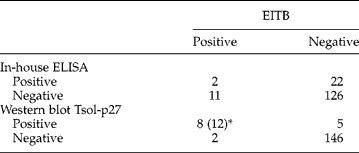
Of the 161 investigated serum samples from the two regions in Mozambique, 14 were positive and 147 negative by EITB. None of the positive samples were derived from patients with epilepsy. The positive samples were recognized by antigens ranging between 23–26 and 55 kDa. The 23–26 kDa antigens were most common, followed by the 39 kDa antigen. The Tsol-p27 Western blot analysis showed both higher sensitivity and higher specificity compared to the in-house ELISA (table 1). The sensitivity and specificity values were determined based on the positive and negative results for Tsol-p27 antigen obtained using the commercial EITB assay as reference method.
Detection of antibodies against T. solium cysticerci in serum samples from sections of the human population in Angonia and Beira using two different immunodiagnostic tests compared with a reference method, EITB.
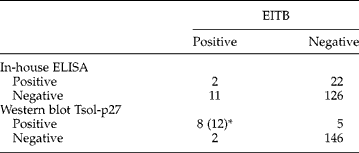
* The number of positive samples when samples from a previous study (Nhancupe et al., Reference Nhancupe, Salazar-Anton, Noormahomed, Afonso and Lindh2013) are added.
The Tsol-p27 Western blot analysis was found to offer 80.00% (95% confidence interval (CI): 44.43–96.89%) sensitivity and 96.69% (95% CI: 92.44–98.90%) specificity, with a positive predictive value (PPV) of 61.54% (95% CI: 31.64–86.00%) and a negative predictive value (NPV) of 98.65% (95% CI: 95.19–99.80%). If the four positive samples from the previous study are added, the sensitivity increases to 85.71% (95% CI: 57.19–98.22%) while the specificity remains the same. PPV increases to 70.59% (95% CI: 44.04%–89.69%) and NPV remains at 98.65% (95% CI: 95.20%–99.84%).
Corresponding values for the ELISA were 15.38% (95% CI: 2.37–45.46%) sensitivity and 85.14% (95% CI: 78.36–90.44%) specificity; PPV, 8.33% (95% CI: 1.27–27.04%) and NPV, 91.97% (95% CI: 86.08–95.92%).
Discussion
Immunodiagnosis of human cysticercosis has been performed using a variety of methods, such as ELISA, indirect fluorescent antibody tests, radioimmunoassay, complement fixation assays, immunoelectrophoresis, dot blot and EITB (Garcia et al., Reference Garcia, Del Brutto, Nash, White, Tsang and Gilman2005b; Simac et al., Reference Simac, Michel, Andriantsimahavandy, Esterre and Michault1995; Deckers & Dorny, Reference Deckers and Dorny2010). Of the techniques developed so far, EITB offers the greatest specificity and sensitivity of 100% and 98%, respectively, although the sensitivity of this test is considerably lower in cases involving single or few cysts (Singh et al., Reference Singh, Kaushal, Ram, Kaushal, Dhanuka and Khurana1999). EITB uses an enriched fraction of glycoproteins prepared by lectin affinity purification of an extract from intact cysticerci (Tsang et al., Reference Tsang, Brand and Boyer1989; Deckers & Dorny, Reference Deckers and Dorny2010). One of the drawbacks of EITB is that production of the test is expensive and therefore not feasible in many countries. Furthermore, trained personnel are required to perform the test and to evaluate the results, particularly in countries where the overall worm burden is high and thus cross-reactivity can occur between sera from patients infected with other flatworms and from NCC patients (Dorny et al., Reference Dorny, Brandt, Zoli and Geerts2003; Deckers & Dorny, Reference Deckers and Dorny2010). Consequently, research projects have focused on developing new serological diagnostic tools that offer high sensitivity and specificity, and are cheap to produce. The aim of the present study was to further evaluate the recombinant Tsol-p27 protein as a target molecule in immunoassays. The protein was previously identified in Central America as a possible antigen for use in a dot blot method, which showed sensitivity of 97.8% and specificity of 86.7%, levels that are equal to or higher than those noted for other commercial methods (Salazar-Anton et al., Reference Salazar-Anton, Tellez and Lindh2012).
An earlier investigation conducted in the sub-Saharan African country of Mozambique revealed that similar properties were exhibited by Tsol-p27 (Nhancupe et al., Reference Nhancupe, Salazar-Anton, Noormahomed, Afonso and Lindh2013). In the current study, Western blot analysis of Tsol-p27 resulted in increased specificity and sensitivity compared to the in-house ELISA for NCC, although the values were lower than those reported from Central America: sensitivity 85.71% versus 86.7% and specificity 96.69% versus 97.8% (Salazar-Anton et al., Reference Salazar-Anton, Tellez and Lindh2012). These discrepancies might be explained by the disparity in burden of worms in the different geographical areas. It is known that flatworms such as Schistosoma and Echinococcus species are widespread in Mozambique but are fairly rare in Central America. Another plausible explanation is the sensitivity of the reference method, EITB, especially when analysing sera from patients infected with a low number of cysts. Three of the five samples that were false positive by recombinant Tsol-p27 Western blot analyses came from epileptic patients, and it is known that NCC can give rise to epilepsy. However, no definitive conclusions can be drawn from this single observation and more investigations are needed.
It has been reported that using ELISA or other immune diagnostic methods to detect specific antibodies against T. solium cysticerci in serum from patients with suspected cysticercosis constitutes a useful tool for identifying such infection in humans (Simac et al., Reference Simac, Michel, Andriantsimahavandy, Esterre and Michault1995). However, the different immune diagnostic methods should not replace neuroimaging techniques but instead be an aid to give the correct diagnosis (Del Brutto, Reference Del Brutto2012a). The in-house ELISA we used provided very poor results, detecting only two of 14 patients who were positive for NCC by EITB assay. This low sensitivity might be explained by serum samples coming from patients with very few cysts, or even by the fact that the ELISA used proteins from pigs infected with T. solium. Such material can vary in quality, and in our study might have represented a batch of less immune reactive proteins, or proteins that were partially degraded during the production process (Del Brutto, Reference Del Brutto2012b).
At present, T. solium antigens for diagnosis of human cysticercosis are derived from parasites extracted from infected pork (Deckers & Dorny, Reference Deckers and Dorny2010). Perhaps recombinant antigens can serve as a simplified, low-cost substitute for the native antigens, and also provide a reproducible, field-applicable diagnostic assay (Scheel et al., Reference Scheel, Khan, Hancock, Garcia, Gonzalez, Gilman and Tsang2005). The format of the test has to be developed to fit into field conditions. Methods described earlier include both a dot blot method and the use of latex agglutination as possible and promising formats (Salazar-Anton et al., Reference Salazar-Anton, Tellez and Lindh2012; Biswas & Parija, Reference Biswas and Parija2013).
Acknowledgements
The authors would like to thank Fernando Salazar for providing the Tsol-p27 expression vector.
Financial support
We are very grateful to the Swedish International Development Cooperation Agency for financial support provided via Program 51140011, Impact of Zoonotic Diseases on Public Health and Animal Production.
Conflict of interest
None.
Ethical standards
The authors assert that all procedures contributing to this work comply with the ethical standards of the relevant national and institutional committees on human experimentation and with the Helsinki Declaration of 1975, as revised in 2008. The use of human samples was approved by the Ethics Committee of the Faculty of Medicine of Eduardo Mondlane University in Mozambique and Committee on Biomedical Research Ethics, Mozambique. The authors also assert that all procedures contributing to this work comply with the ethical standards of the Committee on Biomedical Research Ethics, Mozambique.