Introduction
In Tunisia, the study of biodiversity of aquatic organisms and, in particular, fish has aroused the interest of several researchers, leading to the investigation of some commercial species that are susceptible to exploitation in aquaculture. Recently, research was focused on fish of great ecological but little commercial importance, such as gobiids (Menif, Reference Menif2000), blenniids (Gharred, Reference Gharred1999), silversides (Trabelsi, Reference Trabelsi2002) and labrids (Ouannes Ghorbel et al., Reference Ouannes Ghorbel, Bradai and Bouain2002; Ouannes Ghorbel, Reference Ouannes Ghorbel2003; Ben Slama et al., Reference Ben Slama, Menif and Ben Hassine2007). The labrids form an essential link in the food chain of fish of high economic value. The investigations of these fish were carried out essentially on the ecobiology of the most common species in the Gulf of Gabes (Ouannes Ghorbel, Reference Ouannes Ghorbel2003), examining some features such as the reproductive period and sexual maturity of peacock wrasse Symphodus tinca (Linneaus, 1758) collected from the southern coasts of Tunisia (Ouannes Ghorbel et al., Reference Ouannes Ghorbel, Bradai and Bouain2002) and the diet of brown wrasse Labrus merula (Lineaus, 1758) coming from the northern coasts (Ben Slama et al., Reference Ben Slama, Menif and Ben Hassine2007). Parasitological research on these fish is rare and limited to copepods (Benmansour & Ben Hassine, Reference Benmansour and Ben Hassine1997, Reference Benmansour and Ben Hassine1998; Benmansour, Reference Benmansour2001), microsporidia (Mansour et al., Reference Mansour, Prensier, Ben Jemaa, Ben Hassine, Metenier, Vivares and Cornillot2005) and myxozoans (Bahri & Marques, Reference Bahri and Marques2008). Concerning the trematodes, hitherto no study has been conducted on the labrids of the Tunisian coast. We intended, therefore, to study the diversity of digeneans of these fish collected from the Bay of Bizerte, to evaluate the changes in infection parameters with respect to seasons and to compare our data with those available in some western Mediterranean localities.
Materials and methods
During the sampling period (July 2006–July 2007), 371 labrid fish belonging to nine species (273 Symphodus tinca (Linnaeus, 1758), 33 Labrus merula (Linnaeus, 1758), 30 Labrus viridis (Linnaeus 1758), 4 Labrus bergylta (Ascanius, 1767), 7 Symphodus roissali (Risso, 1810), 5 Symphodus cinereus (Bohnaterre, 1788), 5 Symphodus mediterraneus (Linnaeus, 1758), 9 Coris julis (Linnaeus, 1758) and 5 Thalassoma pavo (Linnaeus, 1758)) were collected from the Bay of Bizerte situated in the north-east of Tunisia. These species are sedentary, gregarious or solitary, and usually inhabit rocky areas covered with algae. They generally live at depths varying from 1 to 8 m. Sexual maturity is reached during the second year of life, exceptionally during the first year for S. roissali. The lifespan is variable (3–18 years). The prey of labrids consists of benthic invertebrates (molluscs, crustaceans, annelids and echinoderms) (Fischer et al., Reference Fischer, Seneider and Bauchaut1987).
Fish were examined 2–10 h after capture. Sex, total length and weight of each fish were recorded. These fish were opened by a longitudinal incision along the belly. The intestine was removed and divided into three parts (anterior intestine, mid-intestine and rectum) and carefully examined for digenean parasites under the binocular microscope. To describe parasite communities in each single fish, the number of digenean species and the total number and the niche of individuals were recorded. The parasites were studied in vivo under the stereomicroscope or conserved for later observation. These parasites were fixed in Bouin's fluid, coloured with boric carmine. After differentiation, the specimens were dehydrated by passage in three successive baths of alcohol (70%–95%–100%), cleared in Gaulteria oil and then mounted in Canada balsam. The drawings were made with the aid of a camera lucida. The terms prevalence, abundance and mean intensity of infection follow the definitions of Margolis et al. (Reference Margolis, Esch, Homles, Kuris and Schad1982) and Bush et al. (Reference Bush, Lafferty, Lotz and Shostak1997).
Results and discussion
Among the labrid fish studied, only three species, S. tinca, L. merula and L. viridis, were parasitized. The other studied fish were digenea-free, maybe because of their small sample size (being small, they can escape from the net).
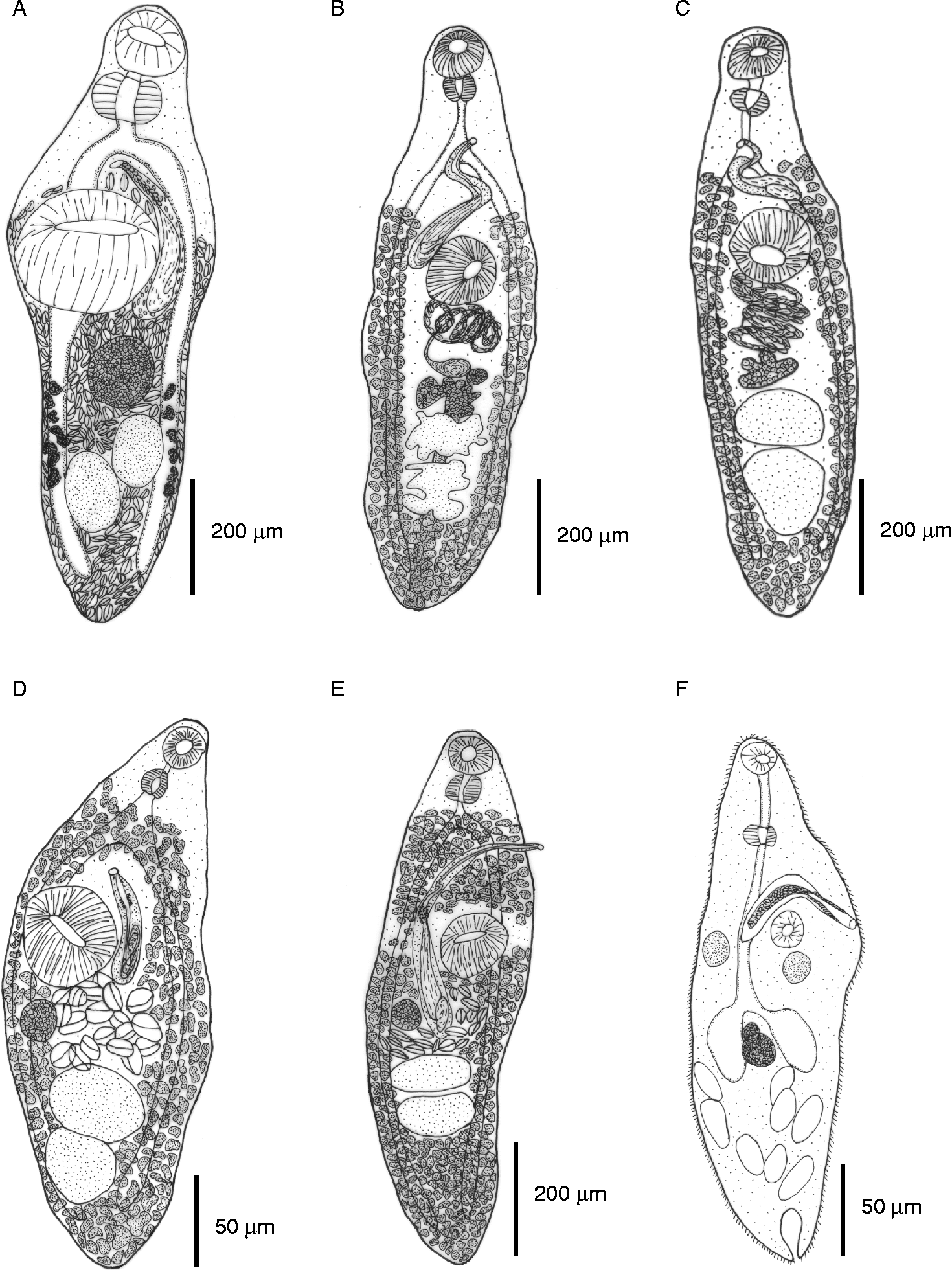
Six digenean species were found in the digestive tract of labrid fish; they belonged to three families: Fellodistomidae (Proctoeces maculatus (Looss, 1901) Odhner, 1911 (fig. 1A)), Opecoelidae (Helicometra fasciata (Rud, 1819) Odhner, 1902 (fig. 1B); Helicometra pulchella (Rud, 1819) Odhner, 1902 (fig. 1C); Macvicaria alacris (Looss, 1901) (fig. 1D); Peracreadium genu Nicoll, 1909 (fig. 1E)) and Zoogonidae (Zoogonus rubellus (Olson, 1868) Odhner, 1902) (fig. 1F). The two species of Helicometra closely resemble each other, but can be distinguished, according to Stossich (Reference Stossich1904) and Palombi (Reference Palombi1929a, Reference Palombib), by the form of the testes, being lobed in H. fasciata and smooth in H. pulchella. Sekerak & Arai (Reference Sekerak and Arai1974) considered these two species synonymous and gave a key to the species where the location or shape of the gonads appears to have little value. This key is based, in particular, on the position of the oral sucker and acetabulum, the sucker ratio, the anterior extent of the vitellarium, the posterior extent of the cirrus sac and the egg size. On the basis of the specificity of these species to the molluscan first intermediate host (Reversat & Silan, Reference Reversat and Silan1993), and by the use of enzyme electrophoresis (Reversat et al., Reference Reversat, Renaud and Maillard1989, Reference Reversat, Maillard and Silan1991), the presence on the south coast of France of a complex of cryptic species indistinguishable on morphological grounds has been demonstrated. Malate dehydrogenase (locus Mdh-1) was the only isoenzyme allowing the discrimination between species. Korniychuk (Reference Korniychuk2000) also did not mention any conspicuous difference between H. fasciata and H. pulchella, these species showing great morphological variability according to the host (Korniychuk, Reference Korniychuk1999). However, H. pulchella is characterized by a higher reproductive activity (larger size of uterus) and the position of the ventral sucker. This sucker occupies an inner position in the body of H. pulchella compared to acetabulum of H. fasciata. The ratio of forebody to the total length of the body is 34.46% in H. pulchella and 38.30% in H. fasciata. Similar results were noted in the species from our coasts. We have also recorded that these two species are distinguished by the vitellarium extent. These glands, which reach to about the intestinal bifurcation in H. pulchella, arrive just before the ventral sucker in H. fasciata.
(A) Proctoeces maculatus, (B) Helicometra fasciata, (C) Helicometra pulchella, (D) Macvicaria alacris, (E) Peracreadium genu, (F) Zoogonus rubellus.
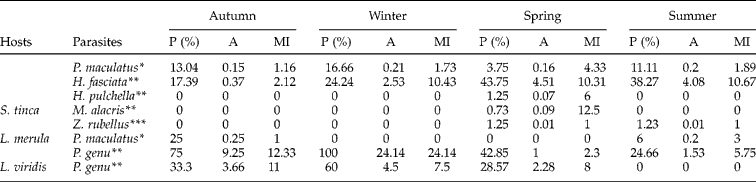
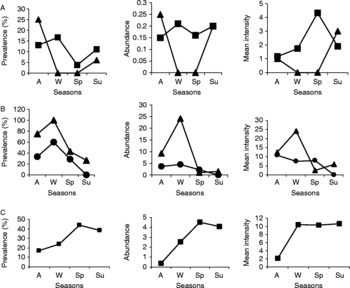
Our results (table 1) show that H. pulchella, M. alacris and Z. rubellus, found only in S. tinca, are uncommon parasites and their presence is limited to spring in H. pulchella and M. alacris, and to spring and summer for Z. rubellus. This can be explained by the scarcity of the intermediate hosts or by the restricted longevity of the adult parasite. Proctoeces maculatus, present throughout the year in S. tinca, has been detected in summer and autumn in L. merula. Infection by P. maculatus reached its highest level in winter in S. tinca and in autumn in L. merula (fig. 2A). Helicometra fasciata and P. genu were present during all four seasons in S. tinca and L. merula, respectively. Peracreadium genu infected L. viridis in three seasons (autumn, winter and spring). For this parasite, the highest prevalence was recorded in winter in both hosts (L. viridis and L. merula) (fig. 2B). For H. fasciata this value was higher during spring in its single host (S. tinca) (fig. 2C). The highest level of infection, recorded for the various species, was usually in winter and spring. This result is probably related to trophic activity of fish, which increases gradually during the pre-laying period (September–February) to reach its maximum in April (Fischer et al., Reference Fischer, Seneider and Bauchaut1987).
The seasonal variation in the prevalence (P), abundance (A) and mean intensity (MI) of digeneans from labrid fish (*Fellodistomidae, **Opecoelidae, *** Zoogonidae).

Prevalence, abundance and mean intensity of (A) Proctoeces maculatus in Symphodus tinca (■) and Labrus merula (▲); (B) Peracreadium genu in Labrus merula (▲) and Labrus viridis (●); (C) Helicometra fasciata in Symphodus tinca. A, autumn; W, winter; Sp, spring; Su, summer.

The spatial distribution of digenean species within the digestive tract of the host showed that, except for Z. rubellus and P. maculatus, which were restricted to the rectum, other parasites did not seem to have restricted requirements and colonized different parts of the intestine.
The most diverse digenean fauna was found in S. tinca (five species). The fauna of this species was dominated by H. fasciata and secondly by P. maculatus. Labrus viridis and L. merula showed a lower diversity, not exceeding 1 and 2 species, respectively (table 1). The variation in parasite species richness in labrid fish from the Tunisian coasts may be related to the sampling effort. Many more specimens of S. tinca (273 individuals) were examined, compared to L. merula (33 individuals) and L. viridis (30 specimens). Moreover, in the western Mediterranean (Campos & Carbonell, Reference Campos and Carbonell1994; Bartoli et al., Reference Bartoli, Gibson and Bray2005) the species richness of digeneans in L. merula is greater than that of S. tinca. This is undoubtedly connected with the diet of the host, which is slightly more diverse in L. merula. The diet of S. tinca includes molluscs, shellfish and annelids, whereas L. merula consumes these organisms in addition to echinoderms. Labrus viridis feeds on shellfish, molluscs and fish (Fischer et al., Reference Fischer, Seneider and Bauchaut1987). The consumption of the latter prey reduces the chances of passage of the digenean stages, since they are not generally carried by fish. Host behaviour can also have an influence on the specific richness. Indeed, S. tinca, which often lives in groups, competes for food, which reduces the chances of the passage of infective stages of parasites, whereas L. merula, as a solitary species (Fischer et al., Reference Fischer, Seneider and Bauchaut1987), is saved from this competition.
The analysis of parasite infracommunities shows that the majority of host species (97.02%) harbour only one species of parasite and the occurrence of two (2.38%) or three (0.6%) is much less frequent. However, we have twice noted the presence of three species of parasites (H. fasciata, M. alacris and P. maculatus) on the same microbiotope, the rectum of S. tinca. This result supports the hypothesis of Kennedy (Reference Kennedy, Esch, Bush and Aho1990) which suggests that the poverty of infracommunities can be explained by the low rate of transmission and not by competition for food resources.
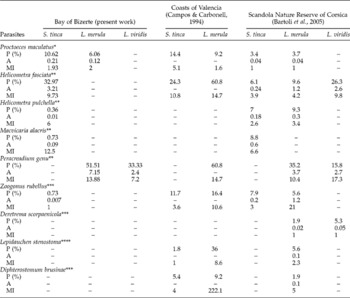
The digenean fauna of labrid fish has been the subject of research in the western Mediterranean (Campos et al., Reference Campos, Carbonell and Pellicer1990; Bartoli & Riutort, Reference Bartoli and Riutort1994; Campos & Carbonell, Reference Campos and Carbonell1994; Bartoli et al., Reference Bartoli, Gibson and Riutort1994, Reference Bartoli, Morand, Riutort and Combes2000, Reference Bartoli, Gibson and Bray2005; Bartoli & Bray, Reference Bartoli and Bray1996; Bartoli & Boudouresque, 1997; Sasal et al., Reference Sasal, Niquil and Bartoli1999). In the eastern Mediterranean no comparative analysis has been conducted. The comparison of the digenean fauna of Labridae from the Tunisian and Valencian coasts (Campos & Carbonell, Reference Campos and Carbonell1994), shows the same diversity (five species) for S. tinca, three of them (P. maculatus, H. fasciata, P. genu) are common to both localities but H. pulchella and M. alacris, present in the S. tinca from our coasts, are replaced by Diphterostomum brusinae (Stossich, 1899) and Lepidauchen stenostoma Nicoll, 1913 on the coast of Valencia. Moreover, the digenean fauna in L. merula from the Valencian coasts is more diverse than that recorded off our coasts (table 2). The digenean fauna of Labridae from the Tunisian coasts compared to that of the Scandola Natural Reserve of Corsica (Bartoli et al., Reference Bartoli, Gibson and Bray2005), shows that our coasts have the lowest diversity. Deretrema scorpaenicola Bartoli & Bray, 1990, Lecithochirium musculus (Looss, 1907) and Lepidauchen stenostoma, collected from Labridae of Corsica, have not been reported, so far, from Tunisian coasts (table 2). Concerning the levels of infection, the studies of Bartoli et al. (Reference Bartoli, Gibson and Bray2005) and Campos & Carbonell (Reference Campos and Carbonell1994) have shown that they are usually higher in labrid fish from the western coasts of the Mediterranean than in those from Tunisian coasts (table 2). The origin of this differential distribution of digenean frequencies between the different Mediterranean environments may be related to the frequency of the intermediate hosts and the variation in physical and chemical parameters of the biotope that can influence the host as well as the free-living larval stages of parasites. Although an increase in temperature generally causes an increase in the emergence of cercariae from the first intermediate host, it can indirectly reduce their number (Thieltges et al., Reference Thieltges, Jensen and Poulin2008). Indeed, the increase in temperature undoubtedly causes an increase in trophic activity of predators of cercariae (e.g. anemones) (Mouritsen & Poulin, 2003). The invasion of the Mediterranean by the alga Caulerpa taxifolia has caused a qualitative and quantitative change in the structure of benthic invertebrate populations, and therefore a modification in the frequency of parasitic fauna. In addition to the physical barrier that C. taxifolia constitutes, this alga also synthesizes and then releases some toxic substances, such as caulerpenyne and terpene, into the environment; these metabolites can affect the behaviour, the survival and the transmission of free larval infective stages (miracidia, cercariae) to the first mollusc host and to the invertebrate second intermediate host (Bartoli & Boudouresque, 1997). These authors also believe that the consumption of this alga by invertebrates may cause the accumulation of caulerpenyne and terpene in their own tissues. Consequently, the settlement of rediae or sporocysts in the first intermediate host and metacercariae in the second might become impossible. The consumption of these intermediate hosts by the final hosts leads to the accumulation of metabolites in their digestive tract, thus limiting the recruitment and development of these larvae into adults. According to these hypotheses, Bartoli & Boudouresque (1997) have explained the low diversity and frequency of the digenean fauna of Symphodus ocellatus inhabiting an environment colonized by C. taxifolia, relative to those in environments not invaded by this alga.
The prevalence (P), abundance (A) and mean intensity (MI) of digeneans from labrid fish off Tunisian coasts, the coasts of Valencia (Campos & Carbonell, Reference Campos and Carbonell1994) and Scandola Nature Reserve (Bartoli et al., Reference Bartoli, Gibson and Bray2005). *Fellodistomidae; **Opecoelidae; ***Zoogonidae; ****Acanthocolpidae. Lecithochirium musculus (Hemiuridae) only recorded in S. tinca from Corsica with low levels of infection.

If biotic factors can have a major impact on the variation of the digenean frequency, abiotic factors, such as pollution, certainly contribute to these variations. Bartoli (Reference Bartoli1987, Reference Bartoli1990) has mentioned that in the Scandola Nature Reserve of Corsica (western Mediterranean) where anthropogenic action is much reduced (absence of major pollutants), the digenetic fauna of fish shows a high diversity and frequency. However, in polluted environments, increasing concentrations of pollutants bring about a reduction of cercarial viability and reduce their success in infecting the second host (Evans, Reference Evans1982; Cross et al., Reference Cross, Irwin and Fitzpatrick2001; Morley et al., Reference Morley, Crane and Lewis2001). Similarly, Cross et al. (Reference Cross, Irwin and Fitzpatrick2005), when examining the swimming behaviour of Cryptocotyle lingua (Creplin, 1825) cercariae living in a polluted environment, found that they displayed a slower horizontal swimming rate and reduced longevity compared to cercariae released in a cleaner environment. Another similar finding was recorded by Morley et al. (Reference Morley, Crane and Lewis2003) on the cercariae of Echinoparyphium recurvatum (Digenea: Echinostomatidae) living within rediae parasitizing molluscs having accumulated toxic substances (cadmium and zinc). The free-living stages of Digenea have been highlighted as potentially good biological indicators of pollution with heavy metals (Lafferty, Reference Lafferty1997).