Introduction
The productivity of crops is directly related to their capture of resources such as water and nutrients and the efficiency with which they convert them into biological products (Yi et al., Reference Yi, Shenjiao, Shiqing, Xinping and Fang2010). In efforts to reduce resource inputs and create more sustainable soil use, assessing the performance of crop systems is increasingly important to retain agricultural productivity (Levidow et al., Reference Levidow, Pimbert and Vanloqueren2014). Crop yields are mainly co-limited by availability of both water and nitrogen (N), which are the most essential resources for crop production. Mueller et al. (Reference Mueller, Gerber, Johnston, Ray, Ramankutty and Foley2012) estimated that global crop production may be increased by 45 to 70% for most crops by improving water and N availability and exploitation simultaneously. Achieving such increases requires a quantitative understanding of how soil constrains water and N uptake by crops, including often overlooked physical processes that may constrain root growth, N cycling and water availability.
In tropical regions, available water capacity and nitrogen availability in most soils are limited. The quality of these soils is further limited by generally low contents of free-iron and organic carbon, combined with high fine sand and silt proportions, that cause these soils to harden during drying cycles (Daniells, Reference Daniells2012). This process harms soil rootability, reduces the soil volume accessed by roots, impairs water and nitrogen uptake and decreases nitrogen and water use efficiency (Moura et al., Reference Moura, Serpa, Santos, Costa Sobrinho and Aguiar2010). Under tropical meteorological conditions, the high atmospheric evaporative demand can produce an actual transpiration rate that may be less than the potential transpiration rate, even though the soil moisture supply might be considered sufficient. Crops may have a loss of turgidity, decreased carbon uptake, cessation of growth and lower productivity (Denmead and Shaw, Reference Denmead and Shaw1962). According to Becher et al. (Reference Becher, Breuer and Klingler1997), in soil that hardens, diminished root growth can be observed when the water potential approaches −100 kPa, which according to Moura et al. (Reference Moura, Macedo, Sena, Campos and Aguiar2017) may occur in the fourth day after rain or irrigation in tropical conditions.
In these circumstances, water and nutrient uptake rely heavily on the volume of soil explored by the plant roots. Therefore, enhancing soil rootability is crucial to increase crop growth, and water and nutrient use efficiency and to become more productive the crop systems.
In these soils the mechanical constraints from hardening need to be overcome, which is feasible through the use of mulching, gypsum application and increased humified organic matter (Mulumba and Lal, Reference Mulumba and Lal2008; Sumner, Reference Sumner2009; Carrizo et al., Reference Carrizo, Alesso, Cosentino and Imhoff2015). Unfortunately, in tropical regions, achieving the required amount of humified organic matter is limited by conditions that favour the rapid decay of applied biomass (Christensen, Reference Christensen2000).
Mulching with surface residues provides soil cover and decreases the water evaporation rate, so that soil moisture loss and the hard-setting process are diminished (Moura et al., Reference Moura, Marques, Silva, Piedade and Aguiar2014). In addition, in soil enriched with polyvalent cations the new organic matter derived from mulch interacts with calcium and magnesium, enhancing soil structure in the root zone further (Wuddivira and Camps-Roach, Reference Wuddivira and Camps-Roach2007). However, the relation between the improved soil rootability possibly caused by mulching and by interactions between organic matter and polyvalent cations on plant physiological factors that sustain plant growth has yet to be confirmed. Such understanding would support efforts to avoid wasting water and nutrients in tropical agricultural systems.
The hypotheses of this paper are that the addition of leguminous mulch to a cohesive tropical soil with gypsum may improve maize performance by enhanced rootability as hardening by wetting and drying cycles will diminish. This was measured in controlled field experiments over two seasons, with a further treatment of different irrigation intensity. Through this combined understanding of plant physiological response to potential decreases in the hardening of tropical soils, the benefits of using mulch and gypsum simultaneously will be better understood. This will provide reliable data to guide agronomic practice to improve nitrogen and water use efficiency. Therefore, the aim of this study was to evaluate how the use of the mulch can affect soil-rootability, reducing penetration resistance (PR) of structurally fragile tropical soil enriched with calcium. The crop properties of nutrient uptake, growth, productivity and water use efficiency in maize were also compared to soil physical measurements of strength and water content.
Materials and methods
Experimental site
The experiment was conducted at Maranhão State University, Brazil (2°30′S, 44°18′W), which has a hot, semi-humid, equatorial climate with a mean precipitation of 2100 mm/year and two well-defined seasons, a rainy season that extends from January to June and a dry season with a pronounced water deficit that extends from July to December. The average temperature is ~27°C, the maximum temperature is 37°C and the minimum temperature is 23°C. The average potential evapotranspiration rate of the experimental period is 6.5 mm/day.
The local soils display hardsetting characteristics (determined by the relationship between PR and volumetric water content) and are classified as Arenic Hapludults (Moura et al., Reference Moura, Oliveira, Coutinho, Pinheiro and Aguiar2012; Soil Survey Staff, 2014). A (0–20 cm layer) horizon has the properties as given in Table 1. These soil characteristics were obtained according to the standard methods of Carter and Gregorich (Reference Carter and Gregorich2008). The area was limed in September 2014, with 1 t/ha of surface-applied lime, corresponding to 390 and 130 kg/ha of Ca and Mg, respectively. In this same period, natural gypsum was applied at a rate of 6 Mg/ha, which corresponds to 1020 kg/ha of Ca. The gypsum grain size was such that 95% by weight passed through a 0.25-mm screen mesh.
Characteristics of soil of the experimental area before the beginning the experiment

Soil organic matter SOM, sum of base SB, percentage base saturation PBS.
Experimental trial
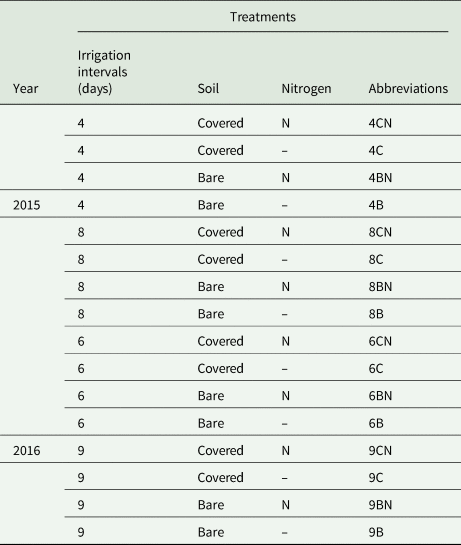
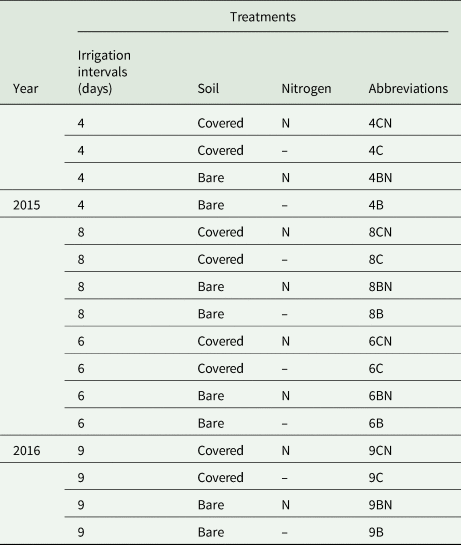
The experiment was conducted during two dry seasons of the years 2015 and 2016. However, the plots with mulch received 10 t/ha of leaves and branches of Acacia mangium legume in 2013 and 2014. The experimental layout was established with mulching or bare soil, with or without nitrogen and with 4 and 8-day irrigation intervals in 2015. In 2016, the irrigation intervals were extended to 6 and 9-day in the attempt to achieve greater differences, as for tested variables, between treatments. Four replicates were distributed in a completely randomized block design, including the treatments described in Table 2. The plot size was 8 × 5 m and maize (cultivar AG 1055) was sown at the beginning of October 2015 and 2016 in a 1.0 × 0.25-m spacing resulting in four plants per m2. The soil was manually fertilized with 120 kg/ha P2O5, 100 kg/ha K2O and 5 kg/ha Zn, according to Tropical Soil Fertilizer Manual. In addition, the following treatment was applied: 100 kg/ha of nitrogen as urea divided into two applications and 10 t/ha of leaves and branches of A. mangium legume, 5 days after germination of the maize, which was also applied in 2013 and 2014. Water was supplied by drip tape irrigation, using one tape by row with emitters spaced 25 cm apart, each delivering 1.25 L/h over 4 h to deliver a total of 20 mm of water per irrigation.
Treatments used in the study: irrigation intervals (days), covered (C) and bare (B) soil with nitrogen (N)
Soil and plant measurements
All the field measurements of soil and plants were done at V-18 stage of the maize, immediately before irrigation of each treatment. The PR was measured in 2016 with 10-cm gradations, at layers of 0–10 cm and 10–20 cm, using a digital penetrometer (Falker, Porto Alegre, Brazil) with three replicates per plot.
In December 2016, when irrigation experiment had been finished, soil samples were collected using a heavy-duty auger to evaluate interactions between organic matter and base cations. The samples consisted of five sub-samples collected at two depth increments (0–10 and 10–20 cm) and were used for chemical analyses. Samples were taken after the 2016 harvest and therefore, the treatments were: CN = soil covered by mulch and with nitrogen; C = soil covered by mulch; BN = bare soil and with nitrogen and B = bare soil. Each sample was air-drier, homogenized and immediately analysed for exchangeable K, Ca and Mg (using an ‘exchangeable ion resin’) and potential acidity (H + Al using a Shoemaker, McLean and Platt buffer solution at pH 7.0). All analyses were made according to van Raij et al., (Reference van Raij, Andrade, Cantarella and Quaggio2001). The cation exchange capacity (CEC) was calculated as K + Ca + Mg + (H + Al), and the sum of bases (SB) was calculated as K + Ca + Mg. The base saturation percentage was calculated as SB/CEC × 100. Furthermore, Ca, Mg and K measurements were obtained using a Varian 720-ES ICP Optical Emission matter analysis Spectrometer.
For the soil organic matter (SOM) physical fractionation, a granulometric method was used as described by Cambardella and Elliott (Reference Cambardella and Elliott1992). Air-dried soil samples of 20 g were sieved through 2-mm mesh and weighed in 250 ml polyethylene cups, in which 80 ml of 5 g/l sodium hexametaphosphate was added. The samples were stirred for 15 h on a horizontal stirrer, sieved through 53 μm mesh, and rinsed until the clay was completely removed. The particulate material remaining on the sieve was transferred to aluminium pots and dried to a constant mass in a forced-air oven at 50°C. After drying, the material was weighed, ground in a porcelain mortar, homogenized with the aid of a glass rod and C was determined using an elemental analyser. Then, the soil particulate organic carbon (POC) was calculated. The soil mineral organic carbon (MOC) was obtained by the difference between soil total organic carbon and POC.
Evaluation of gas exchange
The following gas exchange parameters were evaluated in 2015: the photosynthetic CO2 assimilation (Pn), stomatal conductance (g S) and transpiration rate (E). This used a Portable Measurement System for Gaseous Exchanges (IRGA), LI-6400® model, LI-COR, Lincoln, NE, USA. In the evaluation phase of the plants, an artificial light (system coupled with IRGA with blue and red LEDs) was used with an intensity of 1500 μmol/m2/s. During the evaluations, the initial concentration of CO2 in the chamber was maintained at around 380 μmol/mol. These physiological parameters were measured on two new fully expanded leaves, for three plants chosen at random in each plot, in the upper part of the canopy exposed to full sunlight, between 8:00 and 10:00 am in the morning. Three measurements were recorded automatically every 2 min for each leaf to ensure a steady-state condition for the gas exchange flow. The light units (the diode array contained blue and red LEDs), with the upper jaw enclosing the leaf, were used to ensure constant irradiance that replicated the sunlight (1600 μmol/m2/s). The measurements were carried out 4 days after the irrigation.
In 2015 and 2016, at physiological maturity, harvest was manually made, and the grain yield (GY) components were separately assessed in a 10 m2 area. The GYs were determined, and all of the values were adjusted according to a moisture level of 145 g/kg. The water efficiency indices were calculated using the following formulae: (1) biological water use efficiency (BWUE) and (2) agronomic water use efficiency (AWUE).


Statistical analyses
The data were analysed via analysis of variance (ANOVA), and the means were compared using Tukey's post hoc test at a P = 0.05 significance level. The data were analysed using InfoStat software (InfoStat Group, College of Agricultural Sciences, National University of Córdoba, Argentina). Correlations between the calcium and SOM fractions were investigated through canonical redundancy analysis (RDA). These analyses were performed using the R software (R Development Core Team, 2009). According to Legendre and Gallagher (Reference Legendre and Gallagher2001), after a meaningful transformation of the data, RDA is the best suited method to study the relations between environmental variables.
Results
Changes in soil attributes
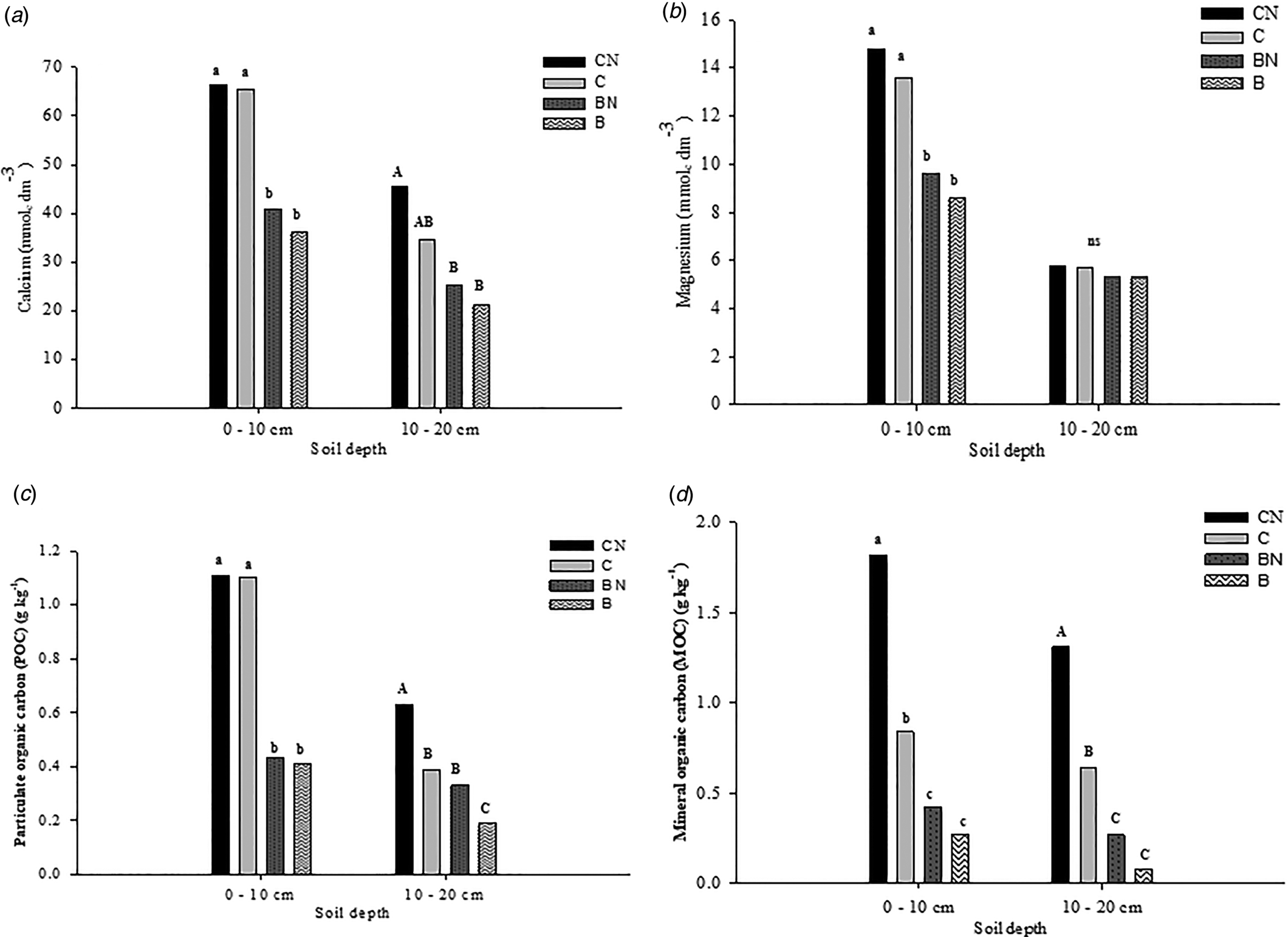
Mulching with nitrogen increased significantly contents of Ca at the 0–20 cm layer (P < 0.05), but without nitrogen, calcium only increased in the 0–10 cm layer. Meanwhile, Mg content was also significantly increased by mulching in the 10 cm layer (P < 0.05) (Figs 1(a) and (b)). In the same way, the fraction of POC was increased by the mulch in the 0–10 cm layer (Fig. 1(c)). In the 10–20 cm layer, the organic matter fraction was increased by nitrogen with and without mulching (P < 0.05). Meanwhile MOC was more than twice as greater in the 0–20 cm layer in the plots with mulch (Fig. 1(d)), but MOC was increased by nitrogen only in treatments with mulch (P < 0.05).
Calcium, magnesium, POC and MOC contents in the soil. CN = soil covered by mulch and with nitrogen; C = soil covered by mulch; BN = bare soil and with nitrogen and B = bare soil. Different letters (lowercase for 0–10 cm layer and uppercase for 10–20 cm layer) indicate a significant difference at the 5% level by the Tukey's test. ns = no significant.

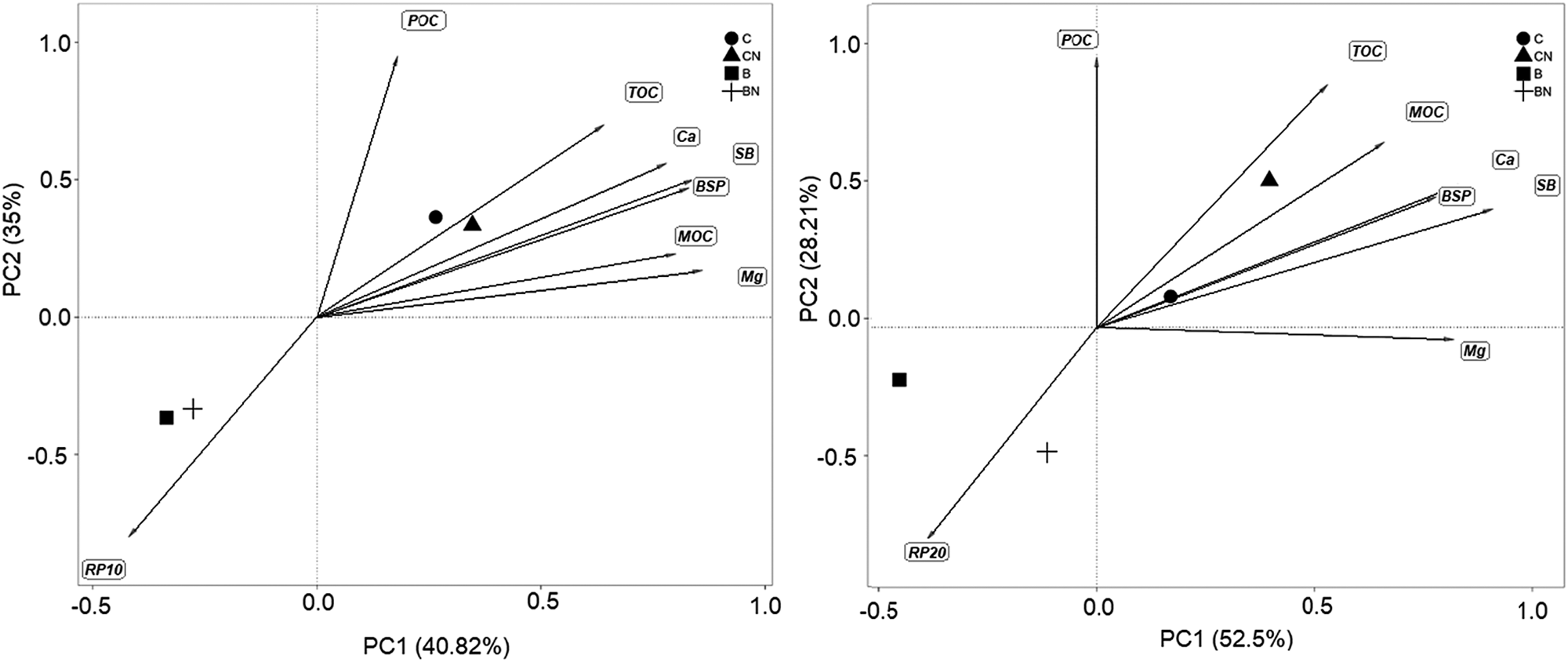
The canonical redundancy analyses showed strong association between Ca, Mg and MOC fractions and weak association with POC, in the plots with mulch, in the 0–10 cm layer (Fig. 2). However, in the 10–20 cm layer only MOC was associated with Ca and Mg. In contrast, plots without mulch were only associated with soil PR in the 0–20 cm layer.
Principal components analyses of calcium, magnesium, organic carbon fractions and soil penetration strength. POC, particulate organic carbon; MOC, mineral organic carbon; TOC, total organic carbon; Ca, calcium; Mg, magnesium; SB, sum of bases; BSP, base saturation percentage.

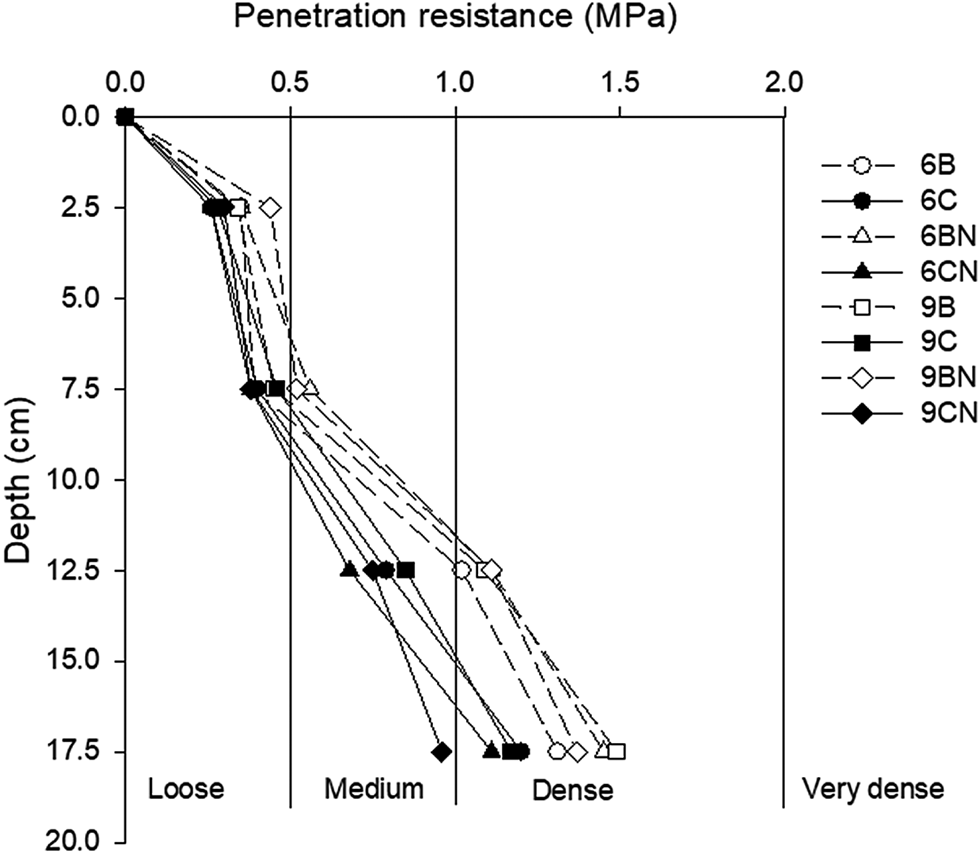
Results in 2016 showed that mulch decreased significantly soil PR directly measured at the 0–20 cm layer always when nitrogen was used (P < 0.05) (Fig. 3). However, in plots without nitrogen, the mulch effect did not decrease PR when it was not significantly different in the treatments 6 and 6C, in the 5–10 cm layer and 9 and 9C in the 0–10 cm layer. In contrast, from 10 cm depth, all plots with mulch showed PR more than 70% lower those without mulch. From an agronomic point of view, these results suggest that for the 10–20 cm layer, all treatments without mulch could be considered as having dense soil, which will harm nutrient and water uptake.
PR in 2016, at the 0–20 cm layer. Six and 9-days irrigation intervals; CN: soil covered by mulch and with nitrogen; BN: bare soil and with nitrogen; C: soil covered by mulch; B: bare soil.

Water physiological parameters and nitrogen uptake
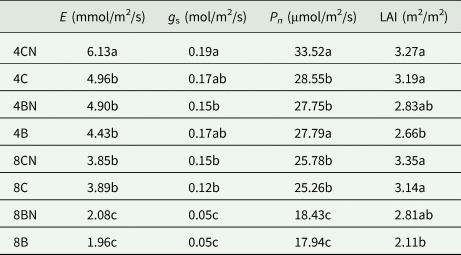
The mulch combined with nitrogen and the narrower interval between irrigation affected the transpiration rate (E) (Table 3), such that the 4CN treatment was greater than all other treatments and three times higher than in 8B and 8BN. There were no significant differences among the other treatments. In the same way, the stomatal conductance (g s) was more than two times lower in the treatments 8BN and 8B (0.05 mol/m2/s), higher in 4CN (0.19 mol/m2/s) and intermediate in the other treatments. The interval between irrigation affected photosynthetic CO2 assimilation, which was greater in the 4-day interval treatments. However, for 8CN and 8C it was around three times greater than in the 8BN and 8B treatments. In the treatments without nitrogen, the mulch significantly increased the leaf area index in all intervals between irrigation. Thus, 4C > 4B and 8C > 8B. In contrast, the application of nitrogen and the irrigation intervals had no effect on the leaf size and for the treatments without mulch and nitrogen, 4B and 8B produced the foliar index without significant differences between them and narrower than 8CN, 8C, 4CN and 4C.
Transpiration rate (E), stomatal conductance (g s), photosynthetic CO2 assimilation (P) and leaf area index (LAI) in the treatments

CN, soil covered by mulch and with nitrogen; BN, bare soil and with nitrogen; C, soil covered by mulch; B, bare soil.
Different letters in the column indicate significant differences (P < 0.05).
Four and 8-days irrigation intervals.
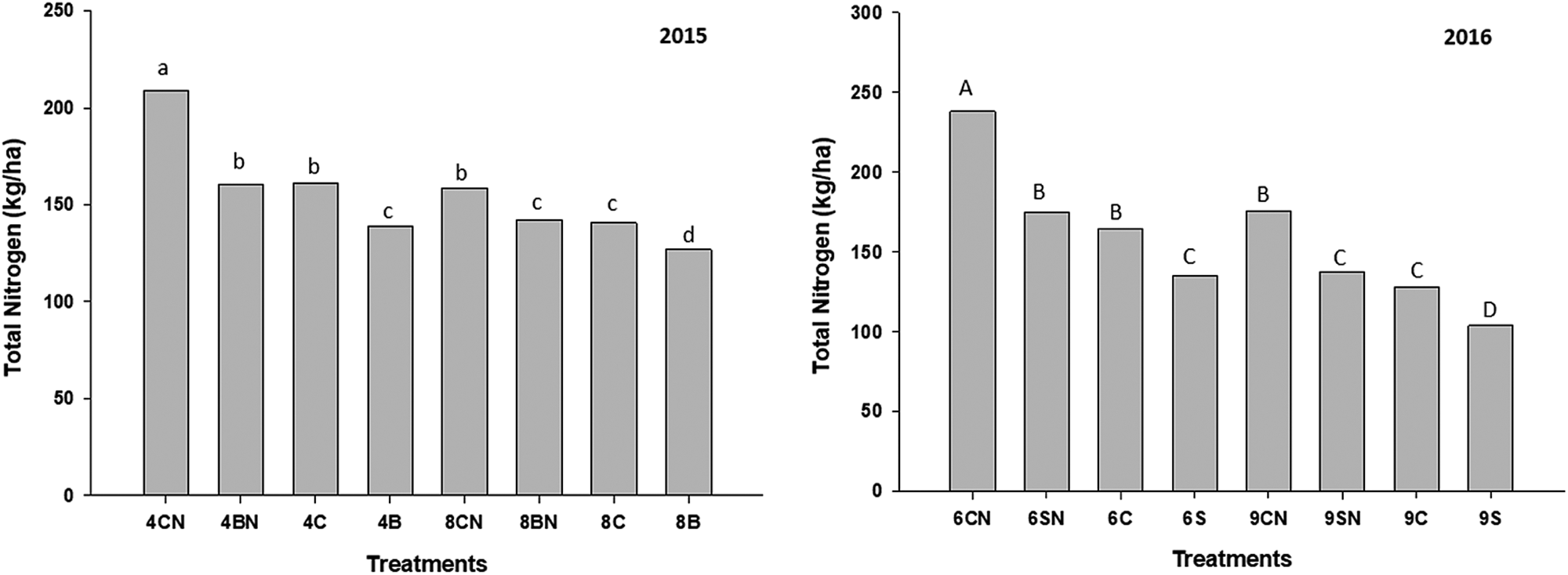
The mulch significantly increased N accumulation by maize (Fig. 4), in 2015 and in 2016 in the two-irrigation intervals, with and without urea (P < 0.05). The positive effect of mulch on N accumulation can be seen between the different irrigation intervals, 8CN = 4BN, 9CN = 6BN and 8C = 4B, 9C = 6B. The use of urea without mulch was equivalent to the use of mulch alone in terms of N accumulation in maize. The irrigation interval also increased N accumulation, therefore the higher quantities of N accumulated were in 4CN and 6CN.
Nitrogen maize accumulation in 2015 and 2016 in the treatments. Different letters (lowercase for 2015 and uppercase for 2016) indicate a significant difference at the 5% level by the Tukey's test. ns = no significant. Four, 6, 8 and 9-days irrigation intervals; CN: soil covered by mulch and with nitrogen; BN: bare soil and with nitrogen; C: soil covered by mulch; B: bare soil.

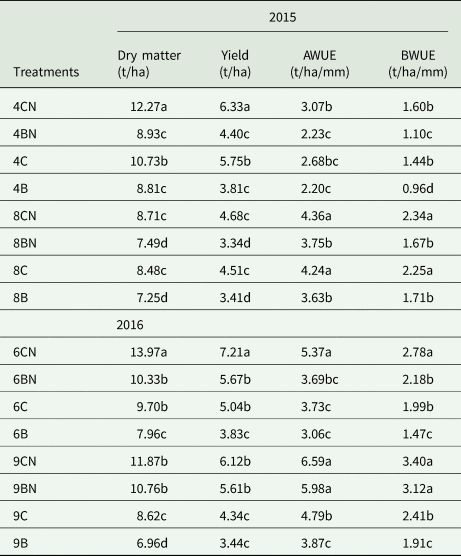
In 2015, dry matter production and yield were increased by mulch in such a way that all mulch treatments had greater biomass than in its comparable uncovered treatment (4CN > 4BN, 4C > 4B, 8CN > 8BN, 8C > 8B) (Table 4). In the same way, in 2016, dry matter and yield were greater in treatments with mulch for most treatments, apart from some treatments with a 9-day irrigation interval. In addition, when comparing treatments with and without mulch but with smaller and larger irrigation intervals, can be realized that mulch addition increases BWUE in 2 years: 4CN = 8BN and 8C = 4B, and 9CN = 6CN, 9C = 6B (Table 4).
Dry matter, yield, AWUE and BWUE in the treatments

CN, soil covered by mulch and with nitrogen; BN, bare soil and with nitrogen; C, soil covered by mulch; B, bare soil.
Different letters in the column indicate significant differences (P < 0.05).
Four, 6, 8 and 9-days irrigation intervals.
BWUE refers to produced biomass per water applied, while AWUE is maize GY per water applied. BWUE was increased by mulch in almost all treatments in 2015 and 2016, except to those with narrower irrigation intervals without N (4B = 4C and 6B = 6C). In addition, the treatments with 9-day of irrigation interval with N was not significantly different: 9CN = 9BN (Table 4). The use of N and the increase of irrigation interval in the plots with mulch almost doubled BWUE, which can be seen comparing 4BN to 8CN (2.23 to 4.36) or 6BN to 9CN (3.69 to 6.59). The use of N in 2016 increased the BWUE when mulch was used, but also for 9 days irrigation interval 9BN > 9B even without mulch. AWUE was also increased by mulch in the 2 years, in almost all treatments, except for 9CN and 9BN for which there was no significant difference. AWUE was increased by N only in 2016, in all treatments.
Discussion
Mulch decreased the onset of soil hardening, resulting in improved crop performance. These effects may have been accentuated by the pre-treatment of the soil with gypsum and lime, which is a common practice to improve structural stability and increase pH. Calcium and magnesium added during this pre-treatment interacting with organic carbon provided by the mulch can form bridges between soil particles that cause aggregation (Whittinghill et al., Reference Whittinghill and Sarah2012). With the high levels of rainfall levels found at the study site (1960 mm/year) and the high water infiltration rate of the sandy loam soil (70 mm/h) (Moura et al., Reference Moura, Oliveira, Coutinho, Pinheiro and Aguiar2012), cations may move quickly through the soil profile, although mulch may retard the rate of leaching, as observed in the greater Ca concentrations observed in the mulch amended plots. In the same way, variation in exchangeable cation concentrations can affect the fluxes of dissolved organic matter by stabilizing negatively charged organic matter through sorption to positively charged cations (Moore and Turunen, Reference Moore and Turunen2004). The bond between polyvalent cations and negatively charged organic matter functional groups is not easily reversible and surfaces of organic materials will be less accessible for microbial activity. This explains the greater POC and MOC contents in plots with mulch, although accumulation of organic matter could be impaired by conditions that favour fast decay of incorporated biomass in humid tropical regions (Christensen, Reference Christensen2000). The increase in SOC in plots with N may be attributed to increased C sequestered in plant biomass, returned to the soil as crop residue (Aula et al., Reference Aula, Macnack, Omara, Mullock and Raun2016). Furthermore, the strong association between cations and the organic matter fraction in the principal component analysis confirms the effects of the interactions between organic carbon with calcium and magnesium, which can have a positive effect on soil rootability (Fig. 2). This is reflected in the smaller PR and greater biomass measured in mulch plots compared to bare plots.
Provided that the differences in PR cannot be explained by small and non-significant variations in soil moisture (data not shown), biomass and gypsum combined were able to improve the soil root environment by decreasing PR in the 0–20 cm layer in the treatments with biomass (Fig. 3). Increased porosity and in sand loamy soil can be promoted by biomass application according to Shepherd et al. (Reference Shepherd, Harrison and Webb2002), by decreasing PR and enhancing aggregation. In addition, the structural improvements caused by Ca2+ applied via gypsum will accentuate soil particle aggregation, thereby creating even better soil conditions for root growth (Anikwe et al., Reference Anikwe, Eze and Ibudialo2016). Wuddivira and Camps-Roach (Reference Wuddivira and Camps-Roach2007) studied the interaction between calcium and organic matter in a sandy-kaolinitic soil similar to the soil we examined. This study supports our finding of improved rootability, which they attributed to increased aggregate stability from the formation of strong bonds involving Ca2+ bridges.
Greater water uptake due to physiological processes and stomatal conductance is directly mediated by the water transpiration rate. As stomatal conductance controls CO2 flux in leaves, the similarities of the photosynthetic CO2 assimilation that we observed in plots 4BN, 4B, 8CN and 8C, may be explained by similar variations in the transpiration rate (Table 3). However, a reduction in gas exchange by a reduction in stomatal conductance depends on the extent to which vegetation is coupled with its surrounding atmosphere; therefore, stomatal conductance is less responsive to water deficits than tissue expansion (Graça et al., Reference Graça, Rodrigues, Farias, Oliveira, Hoffmann-Campo and Zingaretti2010). Indeed, the differences in the leaf area index showed that in comparison with nitrogen or the irrigation interval, mulch had a greater impact on increased leaf expansion, which is one of the most sensitive processes to water stress. According to Sadras and Milroy (Reference Sadras and Milroy1996), the reduced leaf area is probably the most obvious mechanism crops use to restrict water loss in response to soil-stress. The mulch increased the accumulation of nitrogen in treatments with urea compared to bare soil treatments. Therefore, the increased leaf area index in the covered plots may be explained by modification in the water and nitrogen extraction pattern by plants. Indeed, in this cohesive soil, enhancement in root growth is associated with a reduction in cohesion due to increased OC derived from the application of gypsum and biomass in previous years (Moura et al., Reference Moura, Portela, Macedo, Sena, Sousa and Aguiar2018).
One of the most significant findings of this study is the capacity of mulch to delay the onset of water stress. With increased irrigation intervals of 4 to 8 days (2015) or 6 to 9 days (2016), plots amended with mulch at the longer interval had a similar crop physiological response, water use efficiency and yield of maize to plots not amended with mulch at the shorter interval. These results suggested that mulch, used with urea, can delay the water supply for 3 or 4 days due to improvements in soil rootability caused by calcium and organic matter interactions. This may be crucial to a region where small intervals without rain are increasingly common due to a global climate change.
Conclusions
Using 2 years research in the attempt to achieve greater differences, as for tested variables between treatments, we concluded that the use of the mulch on structurally fragile tropical soil enriched with calcium can delay the cohesion process associated with hardsetting, thus reducing the maximum soil PR. The improved soil rootability led to an enhanced leaf area index, greater nitrogen uptake and increased CO2 assimilation, which had important physiological consequences including increased dry matter production and maize yield. Therefore, due to improved water use efficiency, this strategy may be a simple, profitable way to increase crop productivity in tropical conditions rather than seeking to increase water and nutrient applications alone.
Acknowledgements
The Brazilian authors thank the Coordination for the Improvement of Higher Level Personnel (CAPES) and the National Council for Scientific and Technological Development (CNPq) for their support.
Financial support
The current work was undertaken as part of NUCLEUS, a virtual joint centre to deliver enhanced N-use efficiency via an integrated soil–plant systems approach for the United Kingdom and Brazil. Funded in Brazil by FAPESP – São Paulo Research Foundation [grant number 2015/50305-8]; FAPEG – Goiás Research Foundation [grant number 2015-10267001479] and FAPEMA – Maranhão Research Foundation [grant number RCUK-02771/16]; and in the United Kingdom by the Biotechnology and Biological Sciences Research Council [grant number BB/N013201/1] under the Newton Fund scheme.
Conflict of interest
The authors declare there are no conflicts of interest.
Ethical standards
Not applicable.