‘The English churchyard is a doomed institution’.Footnote 1
‘Across the streamlet and the graveyard wall … stood the grey church tower … One creates the world, as it were. How many thousand vanished worlds lay buried under the uneven turf of the old churchyard? At last, it seemed, the long controversy over the burial ground was ended. It had gone on for nearly five years, from Church Council to Parish Council, and back again to the Church Council.’Footnote 2
A major change affecting English village life has been proceeding over the past century and a half, but it is one that has been little noticed or commented upon by historians. Churchyard burial grounds that had in countless cases been used from early medieval times have been closing in large numbers.Footnote 3 The age-old custom of burial around the church, usually centrally placed in the local community, has been giving way to cremation or burial in new rural or other cemeteries often sited well away from the centre of the village. The period has of course been one of financial, organisational and doctrinal crisis for the Church of England, most notably since about 1960, and other issues may have precluded discussion of churchyard closure and change in burial cultures. Little is known about the underlying causes, chronology, extent and effects of the closures. There are many consequences, as yet not investigated, for the role of the Church, for secularisation, for the local community, for the meaning of commemoration and mourning. This article sheds light upon these changes via a study of all burial sites in Leicestershire and Rutland, with the prime emphasis on rural areas.
When historians think of Victorian cemeteries, they have in mind the great cemeteries such as Highgate, Kensal Green, Undercliffe (Bradford) or the Glasgow Necropolis.Footnote 4 Such cemeteries developed from the 1830s in response to problems of urban industrialism, demographic growth, public health, churchyard overcrowding and the desire to express new forms of class status. They were also a response to religious controversies of the early nineteenth century, in which rivalry between the established Church and many Nonconformists was rampant and divisive, a rivalry that was often focused upon burial, funeral liturgy and ritual, and which sought to express values of denominational pride and identity.Footnote 5 Tensions arose because burial provision had traditionally been through the local parish, an Anglican unit of administration. The parish developed because of the economic and administrative needs of the medieval Church, and had been adapted by the Tudors for many secular functions. With the subsequent burgeoning of religious dissent the status and representativeness of parish churchyard authority was open to challenge. Disputes in both town and countryside escalated with the continued growth of religious dissent, and with industrialisation and major shifts in the distribution of population. The fastest demographic growth was in regions which came to have weak Anglican control and source coverage, where Nonconformity often intervened with greatest ease and local need.Footnote 6 Thus in the great industrial towns and cities, well away from the Anglican heartlands, cemetery provision assumed its most striking artistic and spatial manifestations, because it was here that there was the greatest religious, sanitary and demographic need for it. The literature on the evolution of the cemetery has many explanatory emphases – religion, public health, garden and monumental design, amenity values, changes in social structure and related demand – yet it is unsurprising that such a history has been written as fundamentally urban.
However, there is an unexplored paradox here. When site numbers are considered, the cemetery is clearly much more of a rural phenomenon than an urban one. There are many more cemeteries in the countryside than in the towns. In Leicestershire and Rutland, for example, thirty-six cemeteries can reasonably be classed as ‘urban’; but (excluding churchyard extensions), there are seventy-nine rural cemeteries.Footnote 7 And the history of such rural cemeteries remains unwritten. The reasons for their development are unstudied, and their meanings in relation to the local community and to cultures of death are veiled. In many cases they replaced older parish churchyards, even for cremated remains, yet that very significant historical transition has attracted little scholarly attention. The chronology of both churchyard closure and new cemetery formation in the countryside is vaguely understood. There is a clear need for regional case studies that analyse issues of rural burial provision and their links to village community life, and which redress the urban emphases of cemetery historiography.
The growth of ‘New Dissent’ after about 1740 brought much controversy over burial, and this contributed to the cemetery movement that commenced with the Rosary Cemetery at Norwich (1819), and which expanded markedly from the 1830s. That period saw the growth of joint-stock cemetery companies, notably in some of the larger cities, and many towns and cities constructed civic burial grounds from then. These developments were augmented by Edwin Chadwick's campaign to promote improved public health, epitomised by his Sanitary Report of 1842,Footnote 8 and his influential Interment Report of 1843,Footnote 9 with their concerns over sanitation, water supply, drainage, sewerage, cholera (notably in 1831–2) and dire urban death rates.Footnote 10 Prevailing fears and pythogenic or miasmic theories about the spread of infections heightened these priorities.Footnote 11 Many of these concerns, and what were essentially engineering solutions, over-arched the role of the traditional parish, a supposedly incompetent administrative unit for which Chadwick had scant respect. He wished to see large ‘sanitary’ cemeteries built outside towns, and these were, he thought, likely to appeal to Nonconformists. Chadwick failed to stop interments within cities, but his influence was still impressive. Such concerns also influenced the prohibition of intra-mural church burial by the Public Health Act (1848), while the Metropolitan Interments Act (1850) improved control over burial in the metropolis. There was considerable opposition to central government enactments on burials. Yet from 1852Footnote 12 an array of so-called ‘Burial Acts’ facilitated processes of cemetery formation and churchyard closure, initially in London, but from 1853 in the country at large, with Lord Palmerston as Home Secretary agreeing to many closures.
Under the Burial Acts parish vestries were allowed to establish burial boards, comprising between three and nine ratepayers of the parish.Footnote 13 Such boards could borrow money, on the security of the poor rates, or raise sums by special rates as though they were poor rates,Footnote 14 and could use these funds to establish separate burial grounds, normally away from the parish church. These grounds were usually consecrated, in whole or in part, by the Anglican bishop in whose diocese they were situated. Chapels could be built and consecrated on the burial grounds, and this could involve an Anglican chapel and another for Nonconformists.Footnote 15 The latter were thus to some degree united by separate architectural provision. The parish clergyman was eligible to be appointed to a burial board, but was not ex officio a member.Footnote 16 Because of the differences between consecrated and unconsecrated areas, and the possibilities of two chapels, it is clear that these cemeteries were often intended to serve distinct parts of the communities that established them. Their subdivisions represented real denominational divisions and politics within the fractured community, what one might term parochial necropolitics.
Burial boards and new cemeteries represented a new departure from – and a weakening of – the historical parish controls of the Anglican Church. This was as true in Leicestershire and Rutland as it was in many other counties. New cemeteries enabled the closure of many traditional or extended churchyards, or followed rapidly upon them. A vestry could (if there was unanimity) decide to use a new burial ground in exactly the same way as an existing one or a churchyard, but this was not usual. In some cases settlements united to provide a joint burial board and ground,Footnote 17 agreeing proportional expenses according to the value of parish property. A Leicestershire example was the Billesdon and Rolleston burial ground. This was not common practice, but where it did occur there was further weakening of the parochial powers of the Anglican clergyman.
In addition to these developments, parochial subdivision and extra church-building were promoted by the 1818 Church Building Act and subsequent legislation.Footnote 18 There were as many as twenty-one church-building acts between 1818 and 1856. The so-called ‘Million Act’ of 1818 reflected apprehension over irreligion and the dangers of popular unrest. The act allowed £1,000,000 of government money to be spent on new urban churches, the Church Building Commission managing the fund. St George's and Holy Trinity churches in Leicester and their associated parishes were created using funds under this act. An extra £500,000 was granted by a further act in 1824. From 1836 the Ecclesiastical Commission under Bishop Charles Blomfield played an important role in diocesan reform and organisational change, having far-reaching responsibilities that included churchyards. The 1843 New Parishes Act, which enabled major increases of new parishes in the most expansive areas,Footnote 19 also had implications for enlarged burial provision. These acts and reforms amounted to a watershed for the Church of England, and laid foundations for many later changes. While there has been considerable discussion by historians of the origins of churches in this legislation, and their architectural (de)merits, they have been much less interested in the implications for parochial structures or churchyard burial.Footnote 20
In the nineteenth century the hostile attitudes of some clergy towards the burial of persons from other denominations achieved notoriety. The best-known controversies were the Akenham (Suffolk) burial case of 1878, and the Llanfrothen (Merioneth) case of 1888–9.Footnote 21 In some areas, notably in the Baptist strongholds of southern Leicestershire, Northamptonshire and Warwickshire, large chapel burial grounds were established.Footnote 22 The Baptist denominations believed in adult baptism, thus creating problems of burial eligibility for unbaptised persons in consecrated Anglican churchyards. Many other denominations also used the curtilages around chapels in such a way, notably the Independents and the Unitarians in Leicestershire. Methodist congregations (numerous in the north of Leicestershire) often used the Anglican churchyards; this stemmed from Wesley's origins in the Anglican Church and his disinclination to split from it. Nine Methodist chapels in Leicestershire (none in Rutland) had separate burial grounds. While comparative data is lacking, their Methodist counterparts in, for example, Norfolk, or the Calvinistic Methodists in Wales, seem more commonly to have had their own burial grounds. Tensions over burial persisted between Methodism and the Anglican Church.Footnote 23
A further factor affecting churchyards and burial has been the rise in cremation as a way of disposing of the dead.Footnote 24 It became legal from 1884, and spread through the example of Bonar Law, Henry Irving, Holman Hunt and others.Footnote 25 It was advocated as more hygienic and environmentally safer than burial, and this argument, and the expansion of crematoria, guaranteed its rapid growth from 1945. The cremation rate reached 50 per cent in 1967, and 63 per cent by 1976.Footnote 26 It is now the most common procedure, covering over 72 per cent of deaths.Footnote 27 Costs of cremation in Leicestershire are said to be ‘just a little bit lower’ than churchyard burial, the local authorities preferring cremation.Footnote 28 Cremation seems nationally to be more prevalent in urban than rural areas.Footnote 29 Ashes can be disposed of in much smaller spaces in established burial grounds, whether these be churchyards or cemeteries.
Reform of often heavily overgrown Victorian cemeteries, with their large memorials and legal issues of freehold and memorial ownership, had been a frequent concern in the twentieth century. Such reform produced changes in the design and layout of cemeteries, memorial clearance or re-siting, and the appearance of more modern cemetery forms such as the ‘lawn cemetery’.Footnote 30 In such developments, a number of inter-linked factors were apparent: a rejection of many ‘Victorian values’ and their material relics, a rejection in which the Anglican Church played an important role;Footnote 31 the rise of apparently scientific and secular beliefs; the ‘sanitising’ of death and burial and a narrowing of its community impact to the immediate family and friends;Footnote 32 the handing over of death to ‘professionals’ to deal with; and changes in the ways in which the undertaking and cemetery management professions chose to present themselves to the public and markets. These have all been implicated in shifts of cultural and theological attitudes influencing the disposal of the dead.
Churchyard closures and the rise of rural cemeteries need to be seen in such contexts. Clearly, when the long medieval and post-medieval history of churchyard burial is considered – the traditions by which so many thousands of people were usually buried in each village churchyardFootnote 33 – there can be no doubt that there has been fundamental historical change. There are considerable implications here for senses of ‘community’, belonging, and for ideas about the on-going centrality of ‘the church dead’. Over recent decades Anglican churches have been closing nationally at the rate of about seventy every year. The rate of Nonconformist chapel closures is even greater. Yet it is not known how many churchyards have closed, what the overall chronology of closure has been, or what regional or chronological variations there are.Footnote 34 Nationally aggregated or regionalised data on closures by Orders in Council are not available, and would need considerable research to ascertain. Indeed, it seems that some dioceses have no data on the present status of their own Anglican churchyards, and are unable to provide any current or historical statistics on this issue.Footnote 35 Nor is it known how many burial-board cemeteries were established. At present it is simply clear that the vast majority of cemeteries in England must have been created by burial boards in the decades after 1850, via the post-1850 legislation, that many of these sites are still in use, that (contrary to overwhelmingly urban historiographical emphases) most of them are rural, and that very large numbers of churchyards have been closed, particularly over recent decades.
Leicestershire and Rutland burial sites
The Anglican Church was predominant in Leicestershire and Rutland. Leicestershire was also a stronghold of the Independents and Baptists, and had many Methodists, especially in areas bordering on Lincolnshire, Nottinghamshire and Derbyshire.Footnote 36 Nonconformity was not well established in Rutland. Dissenting chapels could be located even in small rural communities, and some of these had their own burial grounds. Catholics, Independents, Baptists, Unitarians and Quakers had traditions that inclined them towards separate burial grounds, while Methodists often used Anglican churchyards. These denominations were all found in Leicestershire and, to a lesser degree, in Rutland.
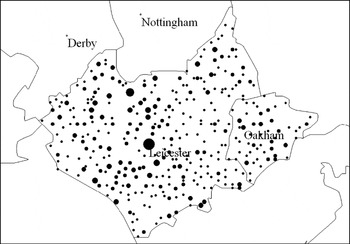
This research covers all burial sites in Leicestershire and Rutland that were used at some point between 1850 and the present day (see Figure 1). Churchyard closures began to feature from 1850 (leaving aside a few urban burial grounds). The greatest density of burial sites per settlement was found to the west, north and south of Leicester, in areas where industries such as hosiery, boot and shoe, mining, quarrying and engineering were located. These were almost always linked to significant religious Nonconformity, as for example in Leicester, Loughborough, Hinckley, Coalville, Shepshed, Mountsorrel, Whitwick or Wigston Magna. Population growth was rapid in such places. East Leicestershire and parts of Rutland, by comparison, had slighter populations and indeed many deserted medieval settlements. This area is largely one of the independent uncontested survival of ancient Anglican churchyards. Parliamentary enclosure in east Leicestershire usually turned arable land over to pasture with resulting reductions in employment on the land. Industry was comparatively rare in these areas, so that there was less pressure for new or extended burial sites.
Leicestershire and Rutland: density of burial sites.

Many methods and sources were used in this research to establish sites, chronologies of use and closure, and associated issues bearing upon usage and expectations.Footnote 37 Questionnaires were sent to parish clerks, chairmen of parish councils and clergy, ensuring coverage of all historic parishes. Response rates were very high. Ordnance Survey maps of different periods were examined. Among the archival documentation was the minutes of vestries, boards of guardians and burial boards, records relating to cemetery maintenance, minutes of parish councils, rural district councils, county councils, parochial church councils, and correspondence with the secretary of state. Most churchyard closures were through Orders in Council and these are documented in the London Gazette.Footnote 38 Further use was made of local and county histories, churchyard and cemetery plans, aerial photographyFootnote 39 and dated gravestone evidence. In addition, interviews were conducted with many people on rural churchyard closures, cemetery provision and community identity in these settlements.Footnote 40
The research has covered a total of 556 rural and urban burial sites in the two counties. These sites are in (or adjoin) 352 differently named settlements. About 15 per cent now have populations under 100, two-thirds of them are villages with populations of between 100 and 1,500 people, and about 20 per cent of them have larger populations. The great majority of the settlements are nucleated villages: that is, they comprise a central core of housing, historically a church and churchyard sited within the village (often central to it), with the parish fields surrounding the settlement. This characteristic Leicestershire and Rutland village structure, which differs markedly from areas of scattered settlement as found in upland zones like Wales, the Lake Counties, Northumberland and such counties, has particular implications for historical burial provision, community structures and cultures of burial.
Churchyard extensions
For very many communities, the desire to augment burial provision was met initially by the extension of the existing Anglican churchyard, usually into adjacent land. In this period, churchyard extensions usually came under the Church Building Acts (especially of 1818–19) and the Consecration of Churchyards Act of 1867, which did not cover cemeteries (and their extensions) formed under the Burial Acts.Footnote 41 Earlier measures were repealed and consolidated by the New Parishes Measure of 1943. Faculties issued by the bishop were usually necessary for altering churchyards.Footnote 42 In the two midland counties 38 per cent of the churchyards have been extended.Footnote 43 Some churchyards were extended more than once, such as Frisby on the Wreake, Langham, Nether Broughton, Packington or Sheepy Magna. No doubt there had been many extensions before 1850, notably in towns.Footnote 44 The freehold of extensions continued to be the same as for the ancient churchyard.Footnote 45 The church had to acquire such land for extension, whether by donation or purchase, and normally had to arrange for drainage and/or clearance of old drains, levelling of land, creating pathways, fencing or other boundaries. Some extensions were accompanied or shortly preceded by memorial clearance, levelling and other work on the main churchyard. In the twentieth century that might also involve the creation of a war memorial.Footnote 46 In some cases extension land was donated by the clergyman from glebe land.Footnote 47 There even seems to have been an expectation of this in some cases.Footnote 48 The co-operation of local landowners was often crucial, and they could insist upon conditions, for example reserving grave space for their own families, or laying down stipulations about design and boundaries.
Churchyard extension was usually carefully planned, as for example in William Keay's beautiful plan of 1938 for Ilston churchyard, with its hawthorn, holly and yew hedges, gravel path, stile, post-and-rail fence, retaining wall, provision for planted trees, and recommendations for compatible types of memorial in ‘English oak, or of some stone or slate quarried in Great Britain’.Footnote 49 The aim in this case was ‘to reduce as far as possible the labour and expense of the upkeep of the Churchyard, and to enhance its beauty’, as well as to encourage English trade. The costs of extension could vary considerably, depending especially upon whether land was purchased or donated. Earl Shilton's churchyard extension cost more than £253 in 1906.Footnote 50 North Kilworth's extension cost £41 in 1922, a small sum at that time.Footnote 51 Peatling Parva's extension of 1930–1 took place because the lord of the manor granted a portion of adjoining land, but cost £27 for the railings, with undisclosed but much higher further costs for lawyers’ fees, gates, painting fences, paths, ditches, levelling and the like.Footnote 52 To judge from current fund-raising for an envisaged churchyard extension at Braunston, the sum now required would often be about £5,000, even with donated land.Footnote 53 Churchyard extension funds could be raised in a number of ways. These included parish subscriptions, entertainments, dances, whist drives,Footnote 54 lotteries, bazaars, visits of the Church Army, the holding of ‘missions’, formation of a Communicants’ Guild and the use of parish charities. All these had implications for ‘community’ life – in a real way they augmented senses of Anglican community, centred as they were on a mutual endeavour. And these larger churchyards raised further issues, as soon became clear to parochial church councils like that of North Kilworth, for with increased mowing costs and the like they were now more costly to maintain.Footnote 55
Where an extension to the churchyard took place, but the location of the ‘extension’ was in another part of the settlement, away from the older churchyard, there was often confusion about continuity, definition and purpose. In some instances, sites marked as ‘cemy’ on Ordnance Survey maps belong to the Anglican Church. In some cases ‘extensions’ are across a road from the historic churchyard. Local residents can themselves be uncertain as to the ownership of such a site, and the matter can become further muddied if the parish council assumes maintenance responsibilities. Physical distance from the church can have an effect on opinions about the ‘sacredness’ of land and issues of consecration, and may reduce the influence of the clergy.
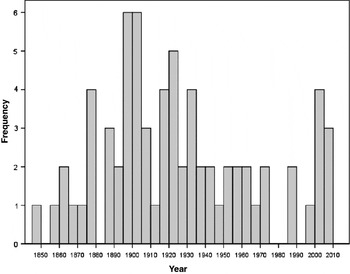
For Leicestershire and Rutland there has been a fairly continuous experience of churchyard extension right up the present day, but with peaks in the period between about 1875 and 1930 (see Figure 2). The years from 1895 to 1905, in particular, saw considerable extension of this kind, with the implication that these dates witnessed considerable pressure upon churchyard space, and/or the reaching of memorial satiety for many churchyards.
Leicestershire and Rutland: dates of churchyard extensions.

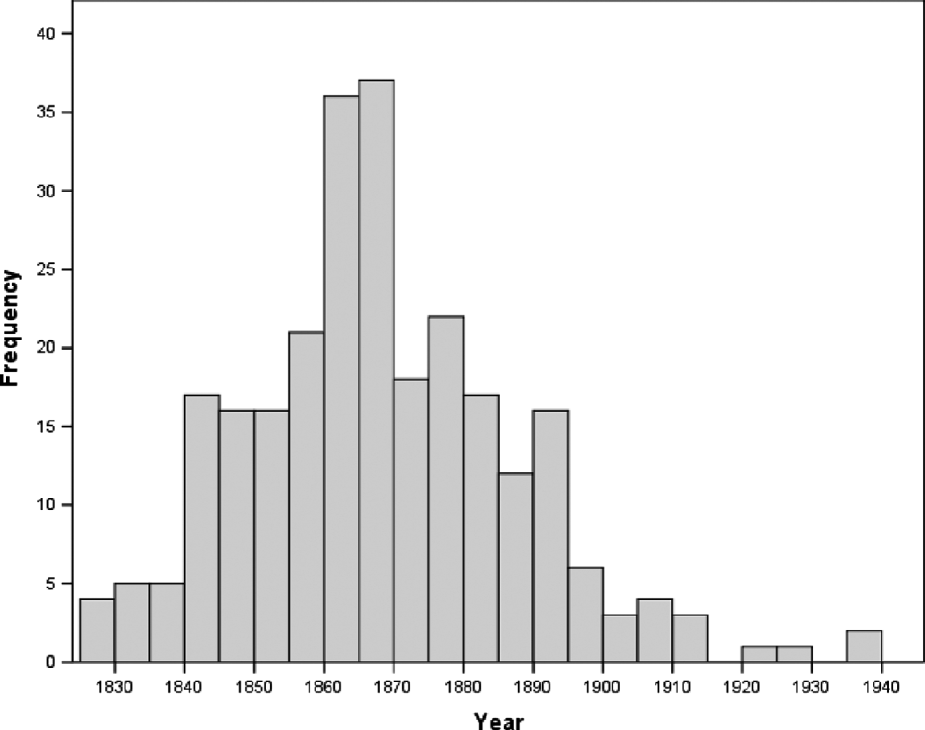
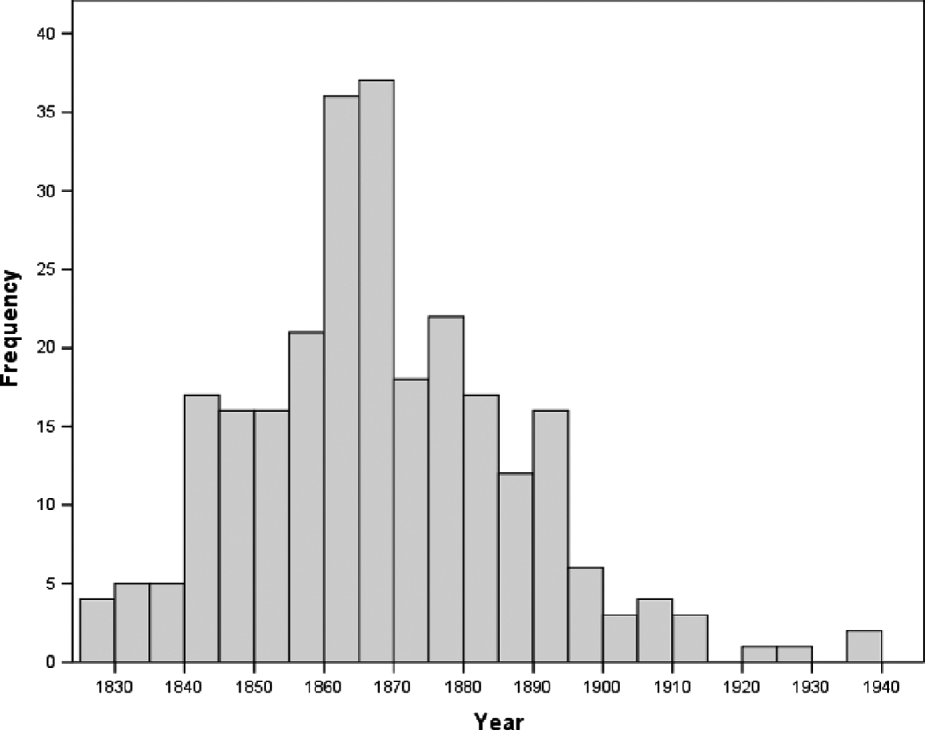
Was this trend related to investment in church restoration, specifically did it occur alongside the renovation of church buildings themselves? The question here is whether church restoration, a major investment, was accompanied by a simultaneous outlay of funds to pay for churchyard extension. In fact the dating of each church's main restoration in these two counties (see Figure 3)Footnote 56 was much more a phenomenon of earlier decades, notably of the 1860s, and predates any major investment in churchyards. In fact, the two seem quite distinct. Investment in one tended to predate and exclude investment in the other, and it was only after the Victorian church restoration programme was largely over that significant extension of churchyards is to be seen. In a relatively few cases there were two or more phases of major church restoration and it is difficult to decide which was the more important. In such cases, the first phase is indicated in Figure 3. For the large majority of churches, however, the main period of rebuilding is easily ascertained. The chronology of second major restorations also peaks in the 1860s, and to a diminishing extent in the next two decades, so the distribution of the double restorations of some churches is taken into account.
Leicestershire and Rutland: dates of first major church restoration.
Churchyard closure
Churchyard extensions gave a new lease of life to churchyards. In such cases churchyard closures occurred later, normally when the extension itself was full and little scope remained for further expansion. Churchyards could be closed under the 1853 Burial Act on the grounds of overcrowding, and this would bring consideration of a new and differently sited cemetery, the responsibility for which would devolve upon the local authority.Footnote 57 Exactly what the grounds are for churchyard closure – when is a churchyard ‘full’? – has never been legally clarified, despite statements about plenitude from the occasional geophysical survey. Yet being ‘full’ was the usual reason for churchyard closure, and was a judgement often reached in view of an abundance of large Georgian and Victorian memorials. Those memorials are rich in historical detail and design, a treasure for historians. Yet in another sense they represent the valediction of the selfish dead: they block a churchyard and force later generations to look elsewhere for burial places. In previous centuries, earlier burials had rarely hindered on-going burial, and graves had frequently been reused.Footnote 58 The Victorians applied a new moral code in this regard, with their greater reluctance to disturb the dead. This inevitably hastened churchyard closure. Other reasons for closure have been that continued use threatened public health, or might contravene decency, or that terminating burials would reduce ‘nuisances’. For example, the churchyard at Wistow, Leicestershire (where much space remains), was closed in 1873 for fears that it would flood. The duty to maintain closed churchyards stayed in the hands of churchwardens under the Victorian Acts,Footnote 59 but could be transferred to a parish council, a parochial church council or thence to another local authority,Footnote 60 even though ownership remained with the rector. The churchyard extension of Blaston St Giles (Leicestershire), for example, considered as part of the main churchyard, is now owned by Harborough District Council which is legally liable to maintain it.Footnote 61 Some churches, faced with considerable financial problems and markedly diminishing congregations, with contentious claims upon scarce burial space, or with problematic drains, have reportedly been keen to close churchyards and to off-load their care and insurance to other authorities.Footnote 62 This may have been a motive in some closures, even though it can result in situations, as at Old Dalby (Leicestershire), where legal responsibilities become ambiguous and fraught.
Churchyard closure has rarely been straightforward. It normally took place under the 1852–3 and 1900 Burial Acts, though much other legislation was relevant. Churchyards were not closed by a bishop, but through the influence of local authorities concerned with health, the local medical officer of health, and a central authority such as the Ministry of Health or the Ministry of Housing and Local Government.Footnote 63 The directive was by Order in Council or act of parliament. An Order in Council was most common, under the 1853 Act, and this often stated that the closure was ‘for the protection of the public health’.Footnote 64 It could make a number of stipulations about the closure. For example, it could postpone closure, or state exceptions, allowing burials to continue in ‘properly cemented’ walled graves, especially for relatives of those interred already.Footnote 65 It might even occasionally allow this in church vaults as well. In Whitwick in 1855 it was allowed that ‘Mrs Sarah Bonnett may, at her decease, be buried in the family vault belonging to Mr Bonnett, in Whitwick Church, on condition that the body be enclosed in an air-tight metallic coffin, and that the coffin be embedded in brickwork, well cemented’.Footnote 66 Some people lobbied hard for exceptional permission to be buried in the old churchyard, as at Barwell in 1899: ‘for me and my family’; or for ‘John Needham, aged 87 years, who has been Parish Clerk 50 years’; or for ‘Jane Brown aged 73 whose family have for generations been buried in the churchyard’.Footnote 67 These pleas underscore the attachments at stake, and the unease at change. Walled-in graves, with a coffin even ‘embedded in a layer of powdered charcoal four inches thick, and … separately entombed in brick or stone work, properly cemented’,Footnote 68 or other such regulations, applied in the exceptional permissions for churchyard burial of people like these, or for those whose husbands or wives were already buried. Such wording emphasises the health concerns. There has over the past century been no provision for reopening churchyards following an Order in Council.Footnote 69 This does not apply to cremated remains, as has been stressed by the Cremation Society of England. This might have allowed cathedrals and churches to reassume their earlier significance for burial, but such hopes seem to have been largely misjudged.Footnote 70
The closure of churchyards through an Order in Council was frequent in Leicestershire and Rutland. Closures were very noticeable in the larger settlements where new cemeteries were established, but could affect small villages too. The median population today of settlements where the churchyard remains ‘fully open’ in Leicestershire and Rutland is 289; but for churchyards that are completely closed the median population is 1,015.Footnote 71 That difference established – with its obvious inference that settlement size has been a crucial factor affecting closure – it is still the case that many small villages have had their churchyards closed. Leaving aside deserted medieval villages, and some towns or cities, this occurred almost entirely after 1850.
In some cases the effect of an Order in Council could be deferred. This might be because of family interests in continued burial in an ancestral plot. There could be unresolved issues or local opposition involving the church, as when incumbents tried to safeguard their burial fees, which was a major issue.Footnote 72 ‘Defence of private property’ (for example, burial fees and prerogatives, or advowson values) was an argument used by the Anglican Church against burial reform both locally and nationally. Opponents of the Established Church often asserted that the Church had no right to levy burial fees, and that these were illegal.Footnote 73 Every inhabitant dying in the parish had the right to burial in the parish churchyard, it was argued, and the minister therefore had a responsibility to bury such a person – he could be suspended if he declined to do so. The complex legal manuals on clerical and burial-board fees show how intricate and conflictual these issues could be.Footnote 74
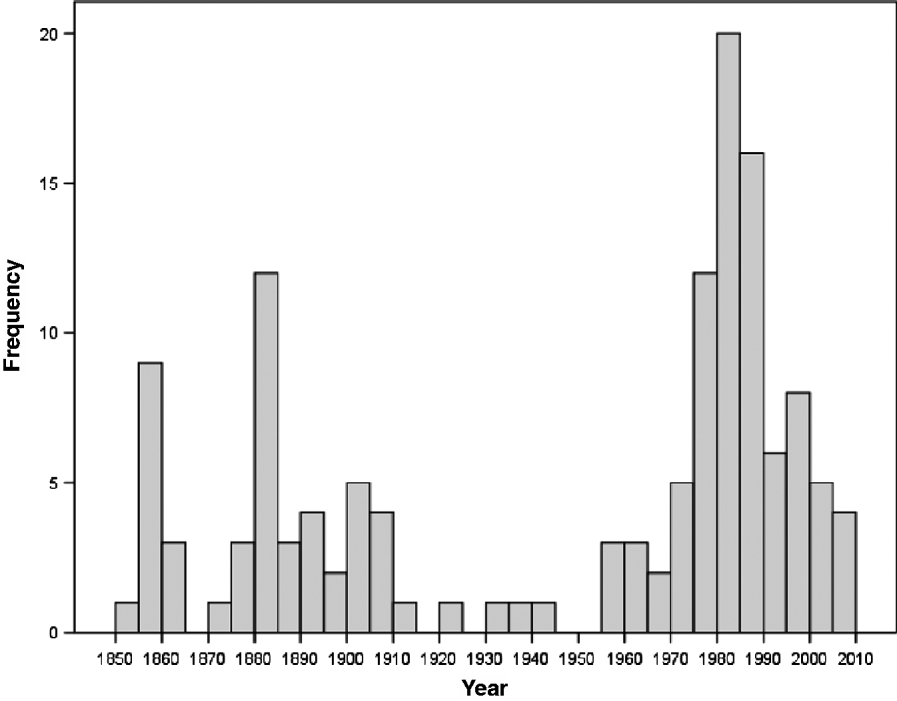
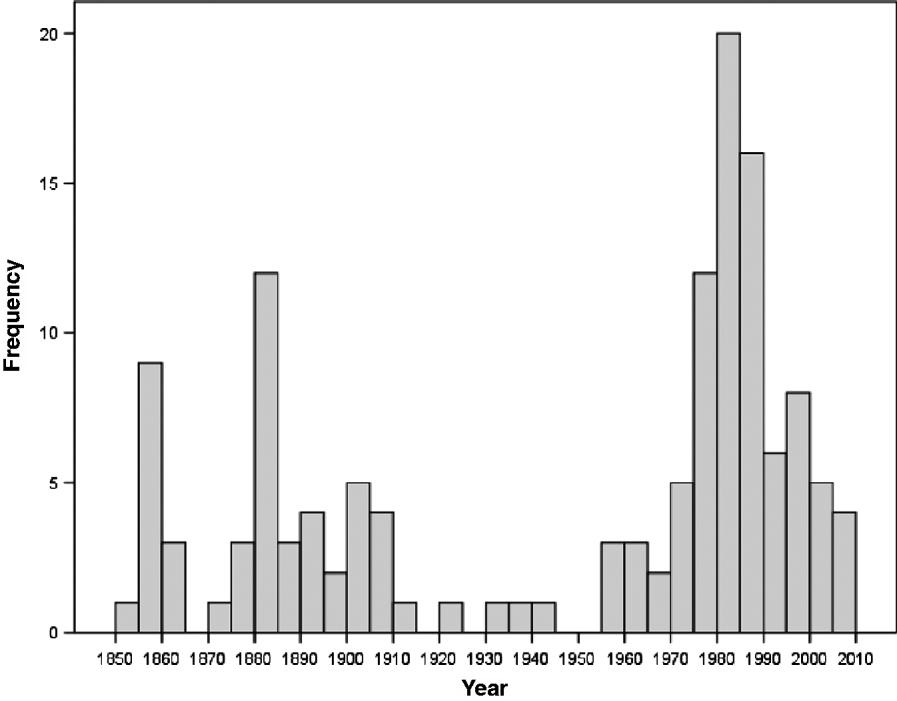
Given these issues, it is surprising that so little is known about the chronology of churchyard closures. For Leicestershire and Rutland (see Figure 4), the main phases of closure were from 1855 to 1910, and then more dramatically from 1970 to the turn of the century, although rates of churchyard closure are still historically quite high. In Leicestershire and Rutland it assumed its greatest significance during the 1980s. Thus a tradition of churchyard burial stretching back into medieval times has, for these midland churches, come to an end over the past four decades.
Leicesteshire and Rutland: chronology of churchyard closures.
The emergence of village cemeteries
Under the 1850–1906 Burial Acts, or under the 1879 Public Health (Interments) Act, land could be purchased for a new parish cemetery or burial ground. Such land was vested in a burial authority or board which had control over it, and any ratepayer was eligible for membership of the burial board.Footnote 75 The board could buy or sell land, or take and use land in the parish vested in guardians, overseers, churchwardens or other trustees for the general benefit of the parish. It could build one or two chapels. The site could be wholly or partly consecrated by the bishop. A burial board could contract with any company entitled to bury people. It might borrow money on the security of the poor rate, and any costs incurred by the burial board, including for any chapel, were paid from the rates.Footnote 76 Fees could be charged for burial and putting up a memorial. Parishioners had the same rights to burial in the new site as hitherto in the churchyard.
Yet rural cemeteries were usually sited away from the village. Chadwick's influence is apparent here, the thinking being fundamentally about public health, water supply and sanitation, coupled with concerns about cheapness and availability of land.Footnote 77 The new burial ground had to be over 200 yards from the nearest house (a distance that was changed to over 100 yards in 1854).Footnote 78 In countless parishes across England such cemeteries are to be seen outside the edges of villages, at 100 yards or more, sometimes much more, from Victorian housing. In Leicestershire and Rutland the examples are very numerous indeed.Footnote 79 National legislation had decreed this distancing of the cemetery from the village as a public health concern, and parish authorities had been persuaded that they were better off not risking ‘essence of corpse’ in their village wells.Footnote 80 Whether such fears were justified or not (and many have doubted it), this new aspect of burial markedly contrasted with the usual communal centrality of the old Anglican churchyard. The dead had once been central to the village, tied spatially to their descendants. Now they were outside it, often very well outside it, indeed in many cases buried away in a rather remote field, as at Burley or Belton in Rutland.
Very large numbers of rural cemeteries displaced churchyards and were set up in this way, and they are among the most neglected of local historical subjects. They raise important issues of interpretation, and they certainly question the urban emphases in cemetery historiography. Most people have ‘city’ conceptions of what a cemetery is: a major quasi-garden site, carefully laid out by civic authorities, having chapels, ornate entries, perhaps a lodge, elaborate gates, costly to maintain, replete with large monuments. Such is to be found at Loughborough, Oakham, or Leicester's Welford Road or Gilroes cemeteries.Footnote 81 Yet there are very many more small rural cemeteries. In Leicestershire and Rutland, 120 cemeteries opened after 1810 and the large majority of these are little rural cemeteries. Some are very small, like that at Burley. While they have often been carefully planned and dignified, even with chapels and other facilities, visually they can amount to little more than a very small field with a handful of humble monuments. They do not approach the scale and stature of the large urban cemeteries. Yet these rural sites far outnumber the urban ones, and they are much more ‘typical’ than the other end of the spectrum, epitomised by Highgate, Kensal Green or the Glasgow Necropolis.
When considering the chronology of cemetery opening in Leicestershire and Rutland the date of first interment is taken as the indicator of the point at which the cemetery became operative (see Figure 5). (The establishment of burial boards is similar to and very slightly predates the trend shown here.) The highest point is for the later 1850s, after the initial enabling legislation. Numbers continue high thereafter, albeit with a tendency to decline from the peak, until the twenty-first century when the numbers again rise. ‘Green’ cemeteries, such as those at Prestwold (1998), Ketton Park (2000) or Scraptoft (2003) also begin to figure. Of these more than 200 exist nationally, and they are the ultimate (and secular) rejection of Victorian monumentalism, normally shunning any kind of memorials except tree planting.
Leicestershire and Rutland: date of first interment in cemetery.

Belton in Rutland, or Burley, both among the more humble cemeteries, may be taken as examples of small rural cemeteries. They are very small hedged enclosures, well away from the villages, containing 20–55 usually small monuments, and in Burley a bench that has clearly been more welcoming to birds than humans. In Belton, a small square of land donated by a Mrs Turner in the 1950s is divided by a concrete path, with Anglican burials on one side, ‘chapel’ on the other, although nothing makes this visually explicit.Footnote 82 Ignored by most people, such cemeteries are beloved by some. For all their isolated humility, as tokens of village life they are curiously moving sites. A slightly larger example is the village cemetery at Great Bowden (see Figure 6). Its earliest interment was in 1880, and in chronology, size and site location (outside the village) it is fairly typical of rural cemeteries. Most of the Leicestershire and Rutland rural cemeteries share its absence of buildings.
Great Bowden cemetery © author.

In a few parishes, such as Eastwell or Husbands Bosworth, Catholic landowners were in a situation to influence the formation of burial grounds, as with the Turville-Petres at Husbands Bosworth.Footnote 83 Such influence was rare in Leicestershire and Rutland, where anti-Catholic fears could be pronounced.Footnote 84 However, Protestant Nonconformity raised many issues for Anglican control over burials. In parishes where tensions were pronounced, there were likely to be strong pressures to remove Anglican controls. Arguments could be focused upon burial, or burial could become an issue that crystallised wider disputes over church rates, control of charities, tithe, the role of the clergyman on the vestry and so on. Where Nonconformity was strongly present, burial-boards cemeteries were often set up at a relatively early stage to supplement or replace churchyards. After all, these parishes tended to be populous or industrial (and so were already experiencing pressure on burial space, or public hygiene issues), and in them acrimony could occur over the conduct of services, which might be resolved by a cemetery. In a parish such as Mountsorrel, featuring hosiery and a heritage of quarrying, workers in both sectors were well known for dissenting sentiments. The village has major Methodist and Baptist chapels, with a Temperance Hall, and its Nonconformist history also encompasses Independency, Quakerism and Unitarianism.Footnote 85 It is therefore hardly surprising to find, well beyond the perimeter of the settlement, an extensive parish council-controlled cemetery, one that has symmetrical dual Gothic Revival chapels of the mid-nineteenth century, constructed from Mountsorrel granite, the Church of England and Nonconformity having equal visual presence (see Figure 7). Flanking chapels like this usually bear witness to Nonconformist assertiveness, while the extra cost of building them reflected and accentuated discord between the Established Church and Nonconformity.Footnote 86
The dual chapels at Mountsorrel © author.

The cost of the new cemeteries could, as Steer put it, be ‘extremely oppressive’.Footnote 87 Although far below the cost of a more urban midland cemetery – £8,000 for Belgrave (1880), a treasury loan of £3,500 for Oakham (1885–6), £28,000 for Enderby (1992), £156,000 for Leicester Road, Uppingham (2008) – they were very expensive for a rural parish to bear.Footnote 88 There was the buying of land, surveying the site and making trial holes, drainage, legal fees, architects’ and building costs for chapels, fencing, planting, a caretaker's or gardener's house and other possible buildings, and so on. Claybrooke's new burial ground cost over £560 in 1860.Footnote 89 Bitteswell paid over £130 in 1903 for a plan, making drains, cleaning ditches, planting hawthorn quicks, making paths and a roadway, entrance gates, iron fencing with bow tops in nine foot hurdles, and other such items.Footnote 90 The burial ground at Willoughby Waterless cost £263 in 1903–4.Footnote 91 Barrow on Soar in 1894 estimated its total cost to be in the region of £1,500, six tenders having been between £1,430 and £1,750.Footnote 92 Beyond the use of the poor and special rates, funds were raised in comparable ways to churchyard extensions. Land for rural cemeteries was sometimes donated, even by clergymen, who may have been anxious in some cases to ensure their role in subsequent management. The parish of Croft was unable to find land for a burial ground, and wanted the county council to make an order allowing the parish council to purchase land compulsorily, until the rector generously offered part of his garden and a field from his glebe land.Footnote 93 Willoughby Waterless purchased an area for a cemetery from glebe land,Footnote 94 as did Claybrooke.Footnote 95 Appleby Magna was gifted land for a burial board in 1876.Footnote 96 Empingham's new cemetery (1919) required close negotiation with Lord Ancaster and his agent, who wished to avoid any site near the village in case the Local Government Board objected.Footnote 97 Sheepy Magna and Sheepy Parva's joint cemetery was laid out in 1925 on land conveyed to the Ecclesiastical Commissioners by its rector, the Revd William Southwell, from part of his glebe land.Footnote 98 The two Sheepys raised £154 for this joint burial ground and its fencing, for ‘socket pipes’ and for forms dealing with the consecration service, by means of an appeal with 200 printed leaflets, voluntary subscriptions, a fête and other such methods.Footnote 99
Consecration of a new rural cemetery could involve problems, as the author Henry Williamson was aware.Footnote 100 It might highlight village tensions and hierarchies. Sheepy Magna and Parva, in the mid-1920s, seems to have been a case of problems averted. Having raised the required sums, the Sheepy Magna parochial church council discussed how the new cemetery should be consecrated. An important issue was the consecration ‘Order of procession’ to the new burial ground, which lay 200 yards outside the village – there were village rivalries at stake here. Priorities were displayed in the marching order: ‘namely The Churchwardens; the Registrar; The Lord Bishop; The Rector; the Choir; The Church Council and Sidesmen; the general Body of Parishioners; The Sunday Scholars attended by their Teachers. The Procession was about 80 yards in length’. The bishop of Peterborough arrived on time and accepted his tertiary marching position. He performed from an awning, and it was gladly noted that he reserved his concerns about ‘matrimonial causes’ (‘matters … of a very delicate nature’), for a letter shortly afterwards. ‘The services in Church, and on the Ground were most impressive. That day was indeed a memorable one.’Footnote 101 Consecrations of burial grounds often used Psalm xvi, with reference ‘to the saints that are in the earth, and to the excellent … The lines are fallen unto me in pleasant places; yea, I have a goodly heritage … Therefore my heart is glad’. In the Sheepy case, the event seems to have had a gladly unifying effect.
This was not always the case. Consecration involved the bishop agreeing to the plan and condition of the new cemetery,Footnote 102 even though he could be locally disliked by Nonconformists, and it often brought argument about the prerogatives of the Anglican clergyman, Nonconformist interests and the burial board. In this it epitomised all the religious issues of burial ground control. In some cases public notices about the dedication or consecration of the site were vandalised.Footnote 103 Parish after parish solemnly wrote to the Home Secretary to inform him as to their stance on the various consecration issues. Barrow on Soar, for example, had a burial board rancorously divided into ‘the Non-Consecrationists’ and ‘the Consecrationists’. After much dispute, it became the view in 1894 of this burial board ‘That the Board object to the legal consecration as such, but have no objection to consecration, providing that the signing of the sentence of consecration is omitted.’Footnote 104 The Home Secretary wrote back saying that he had ‘no power to dispense with the requirements of the law, or to accept dedication in lieu of consecration’.Footnote 105 One famous lawyer denounced the whole business of new cemetery consecration, pointing out that no such service or ceremony existed in the Book of Common Prayer, that it was not authorised in any act, nor in the ‘Articles of Religion’ – that it was a ‘superstition’, and probably illegal, ‘a striking additional example of modern ecclesiastical usurpation’ and an attempt to extort fees.Footnote 106
However, the practice was pervasive. The proportions of the burial ground that were to be consecrated or unconsecrated were to be ‘sanctioned by a Secretary of State’,Footnote 107 and could be seen on the ground spatially to symbolise the relative local strengths of Nonconformists and the Church of England. So inevitably they warranted a methodical argument. A new burial ground could be used in exactly the same way as the churchyard if rate-payers in vestry unanimously wanted that – but if within ten years the vestry wanted an unconsecrated burial ground that also had to be supplied.Footnote 108 This could result in a burial board running two cemeteries in a parish.Footnote 109 In an era of rising Nonconformist strength, it is easy to see how these issues of consecration affected vestry politics. Many arguments took place about rights pertaining to consecrated and unconsecrated land. Then there were disputes over consecration fees: about mixing them up with incumbents’ fees;Footnote 110 or whether they ought to be paid at all, and if so whether to the vicar-general, chancellor, archdeacon or official, registrar or other officer, secretary of the archbishop or bishop, or apparitor.Footnote 111 Evidently, none of this kind of debate about the appurtenances of Anglican office-holding appealed to Nonconformists, most of whom would gladly ditch the bishop and all he stood for. So it could be all the more galling to find that the bishop's deed of consecration determined to some extent how the cemetery was run thereafter. For example, there was the issue of whether the rent for any part of the ground, as yet unused for burials and suitable for grazing, went to the vicar, or was for general upkeep of the facility.Footnote 112
A more general point about rural cemeteries needs to be made. Unlike a large urban cemetery, where the catchment area was wide and traversed parishes, most rural cemeteries were parochial. They did not in principle depart from earlier understandings about local belonging and connected burial rights. Non-parishioners could sometimes be buried in them, but almost always with higher fees payable,Footnote 113 a situation widely applying today. Rural market towns had cemeteries where such direct links between community and burial were obviated to a degree, as was true where parishes (like the two Sheepys) combined to form joint burial boards,Footnote 114 although the latter were fairly rare. Over time, such direct links from community to burial could become uncertain because ownership and responsibility might shift from parish to district council, or from district to parish council. The passing of responsibility between authorities is a feature of twentieth-century village cemetery history. There is little doubt that early rural cemeteries manifested much local pride, despite the fractious disputes over some of them. Indeed, such dispute was itself a fight over the soul of the rural parish and what it ought to take pride in. These are significant rural themes. By contrast, the desire to express civic importance, to use the cemetery to assert class standing and conspicuous wealth (consider the merchant memorials of the Glasgow Necropolis), to see new cemeteries as pioneering exercises in post-Loudon landscape aesthetics and designFootnote 115 – all key meanings that have been ascribed to cemeteries – are clearly less applicable to rural locations.
Cremation
To some degree cremation has allowed earlier traditions of churchyard use to continue where full burial has ended. Leicestershire is served by the crematoria and chapels at Gilroes and Loughborough, while the inhabitants of Rutland sometimes use Grantham or Peterborough crematoria. The interment of cremated remains has been a significant shift in many parishes. Churchyard space near to the church walls has often been used for this. Yet in many people's views this seems a lesser option than full burial. As one interviewee at Wanlip (Leicestershire) said:
Cremation? Well it's not the same, is it, being buried after that. It's just some carbon. No, there's nothing left then of you, is there? It's not like having yourself buried. But then you need money to be buried, don't you? It's like everything else. Or you got to leave a donation or something to the church, like a new clock or something [points to the tower]. Yes, I'd like to be buried here, in this churchyard, but whether I manage that I don't know. My wife thinks the same. They say there isn't much space. They could extend over there, look that's church land. Don't know why they don't do that.Footnote 116
So often in such discussions it is a language of ‘they’– rather than of ‘we’, ‘us’, ‘our’. The absence of a sense of possession, control or influence is characteristic, as in so many other areas of modern community life. Even so, in some cases cremated remains have been deposited in designated places near churches and chapels where no recent burial has occurred. A desire to be buried, in whatever form, in the churchyard seems to persist among many people, and the possibilities locally available influence decisions on whether to opt for cremation. In cemeteries, space for cremated remains is almost always available, usually in special garden and remembrance areas.
Catholic and Nonconformist rural burial grounds
Leicestershire and Rutland also have some burial grounds linked to rural Catholicism, which survived in large part because of local gentry support. There is, for example, the Catholic church built in 1873–4 at Husbands Bosworth, with its small burial ground, or the Cistercians at Mount Saint Bernard's Abbey (established after 1835, near Whitwick in west Leicestershire, with the Catholic influence of the de Lisle family and the earl of Shrewsbury). Monks here have their own burial ground within the abbey precincts. In addition, there are burial grounds owned by Nonconformist communities, notably some Baptists and Congregational chapel curtilages and grounds. There are also those of the Unitarians, Methodists, the United Reformed Church and others.Footnote 117 The continuing Nonconformist burial grounds in rural Leicestershire include Baptist chapel grounds at Sutton in the Elms, at the famous chapel of Arnesby (where the great pulpit orator Robert Hall was born and is buried), and at Quorn, or there is the Congregational chapel at Theddingworth. Almost all Nonconformist burial grounds in rural Leicestershire and Rutland have been closed.
It is clear that the issues concerning burial for those of the Anglican faith, and the questions of how burial is linked to ideas of community, senses of place and local attachment, are as relevant for historic English Nonconformity as they are for the Anglican Church. These issues also have much relevance to secularised persons. The history of Nonconformist burial in this midland countryside foretells in some ways what has happened to the Anglican Church. Insofar as this impinges upon cemetery history, it also stands apart from a generalised history of urban cemeteries. There are different chronologies and customs for English historic Nonconformity compared to the Anglican Church, and small chapel burial grounds were often closed before many churchyards. Dissenters could experience difficulty in buying land for a chapel, let alone for a burial ground, given opposition to them and shortages of funds within poorer denominations.Footnote 118 This explains the small size of some of their burial grounds, which occasionally have almost a token quality about them: a mere handful of memorials in a very constrained area. Furthermore, many denominations or faiths (for example, Unitarians, Quakers, Methodists, Jews, Sikhs, Hindus) have much wider senses of place than the salient Anglican parish.Footnote 119 This is apparent, for example, in the place attachments (often other British cities) recorded on memorials in the burial ground of the Unitarian Great Meeting House in Leicester.Footnote 120 Interviews with people from different faiths in these two counties make such wider affiliations as connected to religion very clear. The significance of local burial or cremation within a strongly defined spatial community, as in the case of Anglicans and their parishes, usually has different and much weaker meanings for non-Anglicans, whose affiliations often pertain to a traversing or cosmopolitan faith, rather than to any parochialised or local religious community.Footnote 121 The Anglican parish has been and remains a great strength in many ways, notably in pastoral work, and with processes of rationalisation it has mutated into combined (and sometimes internally confusing) benefices. It does seem, however, that many Anglican interviewees and respondents to questionnaires about burial provision are unclear about whether they are affiliated to the traditional parish/village/church, or to a wider combined benefice (‘parish’) of between three and nine ancient parishes; nor do they always communicate this ambiguity clearly; nor do they seem keen on it. ‘They call it a parish, but it's not really’ – this and other such comment are frequently heard.Footnote 122 In this regard, ‘We have all sorts of little quirks that we tried to put right.’Footnote 123 Caught within these administrative issues, affiliated for purposes of possible burial within a vague ‘parish’ that historically has different spatial meanings, but which is still undeniably continuous in the local history of Anglicanism, the Church of England appears unusual by comparison with the out-reach and globalised affiliations of many other faiths, especially when issues of death and memorialisation are addressed in relation to belonging and community.
Themes and interpretation in rural burial
In Leicestershire and Rutland, which share many characteristics with midland England generally, there has been very significant displacement of churchyards by rural cemeteries, even in small villages. Conservation area status protects many churchyards, as does scheduling as an ancient monument, or as an area of archaeological importance.Footnote 124 The Anglican Church still exercises much control where its churchyards remain valid, and where few burial alternatives exist. It may be that Leicestershire, and to a lesser degree Rutland, show relatively high levels of change. Leicestershire has experienced population pressures and industrialisation in its central, northern and western areas (hosiery, mining and quarrying, boot- and shoe-making, engineering), which for a time brought significant sanitation problems, especially in Leicester.Footnote 125 These problems accentuated concerns over burial. In the nineteenth century there were also good reasons for Leicester to be named ‘the metropolis of Dissent’,Footnote 126 given its pronounced Nonconformist diversity and local governance.
Such industrial, religious and pluralistic influences spread out from Leicester into the countryside, much like the ‘putting-out’ industries. Change also came from pressures within nucleated patterns of midland settlement, which seem to have intensified moves away from churchyard provision. In the midlands replacement cemeteries abound. In Leicestershire and Rutland, about 53 per cent of Anglican churchyards are closed, as are 88 per cent of other religious burial grounds.Footnote 127 Many of these churchyards and burial grounds have been displaced by 120 cemeteries. Furthermore, clergy and parish clerks attest that significant numbers of still-used churchyards are virtually redundant. These churches are largely medieval in origin. Some of them are themselves officially redundant, often placed under the Churches Conservation Trust, for example Allexton, Beeby, Brentingby, Burley, Edmondthorpe, Garthorpe, Great Stretton, Leicester All Saints, Stapleford, Stretton-en-le-Field, Wardley or Withcote Chapel.Footnote 128 Given the high costs of maintenance and often pitiful church attendance, this church and churchyard redundancy will surely become even more pronounced in the decades ahead, although the extent of church redundancy in these midland counties is unlikely to rival Lincolnshire or Norfolk, where scarcity of rural population is often apparent. A slightly different feature, apparent in the midlands and in some of the officially redundant churches elsewhere, is some continued use of a churchyard despite the church itself being redundant, badly decaying or even demolished. This was the case in a small number of parishes. There has, for example, been the reopening of two graves in the early twenty-first century for further burials at Great Stretton, which is an otherwise disused churchyard – indeed, it is a churchyard where notices advise people not to be tripped up by rabbit burrows, and not to stand within four metres of the tower because of falling masonry. Issues are thus raised about the meaning of such burial provision, where no services are performed in an abandoned, dilapidated and badly vandalised church.
Discussion of rural Leicestershire and Rutland calls for comparisons with other regions. In some English regions there was limited demand for burial space and so a relatively high survival of traditional church provision. In the North Riding, for example, there are very few rural cemeteries because of its thinly spread population and settlements. In Devon too, there are rural cemeteries in villages like South Molton, Bishop's Nympton, Mortehoe, Willand, Sidbury or Colyton, or in small towns like Ilfracombe or Bideford – but they are few and far between. Churchyard burial provision in such areas can seem relatively continuous. Such regions may seem atypical. Even in geographically out-lying areas like west Cumbria,Footnote 129 or north Lincolnshire and across the mouth of the Humber,Footnote 130 areas that are not densely settled, there are many village and rural market-town cemeteries. In Norfolk (where the problem is often said to be poorly attended or redundant churches rather than overcrowded churchyards) village and rural market-town cemeteries are nevertheless quite widely found.Footnote 131 This is despite the fact that many Norfolk churchyards remain fit for purpose, especially in those villages that have experienced declining populations. There are over a hundred cemeteries in Essex, most of them small rural ones. In the villages around Cambridge, Newmarket, Saffron Walden and Haverhill, rural cemeteries abound in very significant numbers.Footnote 132 Much the same is true in DorsetFootnote 133 or Gloucestershire east of the River Severn.Footnote 134 And in more populous regions, whether urban or rural, they are even more conspicuous. Were small proximate places sometimes involved in mutual rivalry over cemetery provision, as when medieval villages competed over the heights of their church spires? The geography of British cemetery location in the countryside remains to be firmly established, but the influencing factors seem to have been nucleation of settlements, population size and density, small-to-medium parish acreages, rural industries, the extent of the rural exodus after 1850 and Nonconformist presence, which was itself affected in complex ways by the prior regional strengths of the Anglican Church.Footnote 135
Edwin Chadwick's arguments, and the sanitation movement of which he was a part, gave authorities many motives to intervene in church grounds. Local pride showed itself in cemetery designs, and class status was clearly visible in memorials. By the 1830s urban churchyards were receiving a very bad press indeed, and this made alternatives necessary for reasons of social respectability as well as public health. Many clergy, influenced by ecclesiology and medievalism, were redefining their roles away from Georgian clerical practices and, like other professions, they were becoming more specialised. In the countryside class position found expression in church seating, communion order and clustered positioning of expensive monuments in churchyards. There were problems of church attendance for deferential reasons, denominational rivalries, conflicts stemming from the attitudes of the Anglican clergy towards Nonconformity, and questions about who should officiate at dissenters’ funerals. There were even arguments over the use of the parish bier and church bell(s).Footnote 136 On burial issues there were good reasons for the rector of Sheepy Magna to plead in St Paul's words: ‘Let us not be desirous of vain glory, provoking one another, envying one another.’Footnote 137 The Akenham case, though the most famous in England, had many counterparts outside Suffolk. Religious, recreational and social control over the churchyard had been an issue for centuries, as David Dymond has admirably explained, and by the mid-nineteenth century some clergy felt that they had finally achieved this control.Footnote 138 Furthermore, in some ‘traditional’ areas little affected by industrialisation, any religious gain for Nonconformity in by-passing the Anglican churchyard via a new cemetery was counterbalanced by the economic and social costs of such cemeteries. There was the problem of purchasing land from estate owners; deference and traditional employment relations often remained strong; and token acquiescence in the established Church's stance on burial issues could occur. The spiritual and emotional links of some communities with the churchyard were too deeply grounded to be worth sustained challenge.Footnote 139
In other words, it sometimes took considerable will and purpose to insist on a village cemetery. Where such a cemetery was founded, it constituted a major break in the history of the community: a divorce from the Church, its rituals, its clergyman and from the Anglican-attempted definition of the village. In 1810 William Wordsworth saw the churchyard as enhancing ‘the community of the living and the dead’.Footnote 140 Others have seen it as ‘the place that demonstrates the immortality of the dead’, a phrase open to various meanings.Footnote 141 Whatever one's perspective or belief, it is clear that a break with churchyard traditions fractures continuity from the past. It marked a departure from any attempt spatially to see the dead as a village collective, having a symbolic meaning through their presence together in the churchyard, as the ancestral basis of the community, almost as that community venerating itself. Increasingly, thereafter, the churchyard represented vestiges of the long dead to whom the community felt less and less blood ties, as newcomers moved in and many of the poor moved out. The churchyard and its contents became of antiquarian interest, like its often immovable Georgian and Victorian monuments, even with surviving iron railings and chain fences around them looking like a model of parliamentary enclosed fields, a point missed by Karl Marx.Footnote 142 Of course, under canon law from medieval times the churchyard itself had to have a solid boundary, to avoid defilement by grazing animals as well as unsuitable human uses. But were the much later railings around monuments erected as protection against sacrilege, or as an assertion of social distinctions, or to affirm private property – or do these concepts merge so much as to make such distinctions meaningless? These large stone memorials were erected on behalf of the unprecedentedly selfish dead of those periods, who were now heavenly happy to glut the churchyard with their own self-expression, rather than adopting the temporary wooden grave boards or modest gravestones of earlier generations. Their family names, in countless cases, would nevertheless soon become alien to the shifting community, the relics of unremembered people, an emotional irrelevance in terms of most villagers’ family history.
By contrast, the rural cemetery marked the more recent dead, and those dead no longer had the close shadow of the church upon them to endow some sacred quality to their memory. ‘Sacred to the memory of’ became almost redundant phraseology, especially in a small field 200 yards or more outside the village in a cemetery featuring a rotting wooden seat covered by bird droppings. Memory is managed in different and distanced ways in such contexts. Nor would the presence of the recent dead any more endow the Established Church with familiar connotations by beloved or immediate ancestral association. And a cemetery is entirely dedicated to the dead. By comparison, a churchyard and its church have more on-going relevance for the living: baptisms and marriages, for example, continue to occur there. The role of the community in co-operating in the funeral, once a feature of church-focused and nucleated villages, has diminished. Family and remoter friends became paramount. Linked to this, religion became less important in funerals, which were seen to have less consequence for an after-life. Clearly then, where these spatial changes occurred they were very significant for processes of ‘de-Christianisation’, for fading ideas of village collectivisation, for the ways in which ‘the community’ could venerate itself or regard its ancestors as sacred, as well as being a fulcrum for Anglican-Nonconformist hostilities. And clearly too, the numerical significance of the English rural cemetery, whatever the undoubted regional contrasts, is such as to challenge any centrality given to the large urban cemetery as the focal point for cemetery history. When the history of the cemetery is rewritten so as to incorporate rural cemeteries, it will be a very different history, raising other questions, and the sun will then throw into relief rather different messages from the sites and monuments.