Implications
Enteric methane production from dairy cows is a significant source of greenhouse gases emissions. A meta-analysis on calorimeter data describing methane emissions from Holstein-Friesian dairy cows was undertaken to examine if selecting for cow genetic merit (production efficiency) could be used as a mitigation tool for reduced enteric methane emissions. The results demonstrated that while high yielding cows produced more methane (g/day), cow genetic merit had no significant effect on methane emission as a proportion of feed intake (g/kg dry matter). Thus, feed intake appears to be the main driver of enteric methane emissions from dairy cattle.
Introduction
Atmospheric methane (CH4) is one of the most potent and influential greenhouse gases. Globally, ruminant supply chains are estimated to produce 5.7 GT CO2-eq to the atmosphere per annum, accounting for 80% of the livestock sector emissions (Opio et al., Reference Opio, Gerber, Mottet, Falcucci, Tempio, MacLeod, Vellinga, Henderson and Steinfeld2013). Consequently, there is increasing pressure to develop effective mitigation strategies to reduce CH4 emissions from the livestock sector, especially enteric CH4 emissions from ruminant livestock. During the last two decades, calorimeter data from research institutes has been used to develop a range of prediction models to facilitate an improved understanding of the effects of diet and animal factors on enteric CH4 emissions (Mills et al., Reference Mills, Kebreab, Yates, Crompton, Cammell, Dhanoa, Agnew and France2003; Yan et al., Reference Yan, Mayne, Gordon, Porter, Agnew, Patterson, Ferris and Kilpatrick2010; Ellis et al., Reference Ellis, Dijkstra, France, Parsons, Edwards, Rasmussen, Kebreab and Banninkll2012). In addition, many nutritional strategies designed to reduce CH4 emissions at an individual animal basis have been evaluated, including the use of dietary manipulation (e.g., improving forage quality, inclusion of concentrates, feed processing) and dietary additives (e.g., inhibitors, electron receptors, ionophores, plant bioactive compounds) (Hulshof et al., Reference Hulshof, Berndt, Gerrits, Dijkstra, van Zijderveld, Newbold and Perdok2012; Hristov et al., Reference Hristov, Oh, Firkins, Dijkstra, Kebreab, Waghorn, Makkar, Adesogan, Yang, Lee, Gerber, Henderson and Tricarico2013; Ramin and Huhtanen, Reference Ramin and Huhtanen2013). Although some of these ‘additive’ and ‘biotechnological’ approaches are promising, their long-term effects have not yet been extensively established.
Genetic improvement may offer an additional approach by which to reduce CH4 emissions. For example, a number of recent studies have demonstrated that selection of cows with high genetic merit for milk yield normally results in an increase in feed intake and milk production, and a decrease in enteric CH4 emissions per kg feed intake or milk yield, in comparison with cows of a relatively low genetic merit for milk yield (Chagunda et al., Reference Chagunda, Römer and Roberts2009; Bell et al., Reference Bell, Wall, Russell and Simm2010; Yan et al., Reference Yan, Mayne, Gordon, Porter, Agnew, Patterson, Ferris and Kilpatrick2010). This reduction in CH4 emissions is likely to reflect a reduction in the proportion of consumed energy used for maintenance, the ability of higher genetic merit cows to mobilise body tissue for milk production (without an associated intake) combined with their ability to partition a greater proportion of consumed energy into milk rather than into body tissue (Veerkamp and Emmans, Reference Veerkamp and Emmans1995; Yan et al., Reference Yan, Mayne, Keady and Agnew2006). In the development of CH4 emission inventory for a whole lactation, the effect of mobilisation of body tissue in early lactation would be offset by an additional intake in late lactation and the dry period for restoration of body condition. Similarly, beef cattle breeding programmes have been used to select cattle with a lower residual feed intake (RFI), which require a lower nutrient intake than expected for a given growth rate. There is evidence that cattle with lower RFI can have a 16% to 25% lower enteric CH4 output per unit live weight gain (Herd et al., Reference Herd, Arthur, Hegarty and Archer2002; Hegarty et al., Reference Hegarty, Goopy, Herd and McCorkell2007). Therefore, the selection of cattle with high production efficiency is increasingly considered as a promising and cost-effective strategy to mitigate against enteric CH4 emissions per unit of product. Nevertheless, it is unclear if selection for higher genetic merit for milk production and other functional traits has also led to the selection of cows with an inherent genetic capacity towards lower levels of methanogenesis, and if this could also be contributing to the lower CH4 emission rate. There is, however, little information available within the literature on the relationship between cow genetic merit and enteric CH4 emission rate.
At the Agri-Food and Biosciences Institute, over 1000 lactating dairy cows have been subject to respiration calorimeter measurements during the last 20 years to evaluate the effects of animal and dietary factors on energetic efficiencies and enteric CH4 emission rate. The objectives of the present study were to use these data to develop a range of statistical models to investigate the relationship between cow genetic merit (for milk production and profitability) and the potential for enteric CH4 emission rate.
Material and methods
Animals and cow genetic merit
The data set (n=736) used in the present study was collated from 32 studies involving lactating Holstein-Friesian cows and undertaken at this Institute between 1992 and 2010 (see Supplementary Material S1). Animals were either in their first (n=250), second (n=187) or subsequent (n=299) lactations, while the stage of lactation when CH4 emissions were measured in the respiration calorimeter chambers ranged from early to late lactation (20 to 261 days post calving).
During the last two decades many countries have developed economic indexes that bring together a number of traits into a single value to assist farmers to make appropriate breeding decisions (in the case of sire value). Within the United Kingdom the two economic indexes that are currently used are the profit index (PIN) and profitable lifetime index (PLI). For a dairy cow, these are defined as the expected difference in net margin (pound sterling, £) that an animal is expected to deliver per lactation (PIN) and during the animal’s lifetime (PLI), compared with the population average. At present PIN and PLI of Holstein cows in the United Kingdom are expressed using 2010 as the ‘base year’. While PIN includes milk yield and milk fat and protein content (relative weightings of 24.1%, 27.5% and 48.5%, respectively), PLI includes all the components within PIN (relative weighting of 45%) as well as the following functional traits: lifespan, fertility, somatic cell count, udder and locomotion (relative weightings of 21.1%, 18.5%, 5.5%, 5.6% and 4.1%, respectively) (Holstein UK, 2013).
The PIN and PLI values used in the present study were based on the April 2013 proof run (Holstein UK, 2013). Thus, PIN and PLI values for all cows used in the analysis within this paper were updated and presented on a common basis at a single point in time. The method for this conversion is described on the website of Holstein UK (2013) and DairyCo Breeding (2013).
Feeds
Dairy cows were offered either forage only diets (n=66) or a mixture of forage and concentrates (n=670). Forages used in individual diets included grass silage (n=454), mixtures of grass silage and maize silage (n=142), mixtures of grass silage and whole crop wheat silage (n=6), straw (n=36), fresh grass (n=46), dried grass (n=20) and lucerne (n=32). The grass silages were produced from primary growth and first and second regrowth herbages, with herbage either unwilted or wilted before ensiling, and ensiled with or without application of silage additives. The concentrates used included some of the following ingredients: cereal grains (barley, wheat or maize), by-products (maize gluten meal, molassed or unmolassed sugar-beet pulp, citrus pulp or molasses) and protein supplements (soybean meal or rapeseed meal). The concentrate component of the diets was offered either mixed with the forage in a complete diet, or separate from the forage. All animals were offered their diets (either straight forages or a complete diet) ad libitum.
Digestibility and calorimeter measurements
Nutrient digestibility, energy intake and output, and enteric CH4 emissions used in the present study were measured in digestibility trials and by indirect open-circuit respiration calorimeter chambers. Before the commencement of nutrient utilisation measurements, all dairy cows were offered their experimental diets for at least 3 weeks in group-housed cubicle accommodation with free access to water. Afterwards, animals were restrained in individual stalls using a neck chain for between 5 to 8 days, with measurement of total feed intake and total collection of faeces and urine undertaken during the final 3 to 6 days. Animals were then housed in calorimeter chambers for 3 to 5 days with measurement of total gaseous exchange (CH4, CO2 and O2) taking place during the final 2 to 4 days. All equipment, sampling procedures, analytical methods and calculations used in the calorimetric studies were described by Gordon et al. (Reference Gordon, Porter, Mayne, Unsworth and Kilpatrick1995) and calibration of the chambers by Yan et al. (Reference Yan, Agnew, Gordon and Porter2000). Energy corrected milk yield (ECMY) was calculated from measured milk energy output (El, MJ/day) divided by the calculated energy concentration (MJ/kg) of 1 kg of standard milk (concentrations of fat, protein and lactose=40, 32 and 48 g/kg, respectively). The energy content of 1 kg of standard milk was calculated using the equation given by Tyrrell and Reid (Reference Tyrrell and Reid1965; Equation (1)):
 $$\eqalignno{{\rm Energy}\ {\rm content}\ {\rm of}\ {\rm standard}\ {\rm milk}=\,&0.0{\rm 384}\,{\rm fat}{\plus}0.0{\rm 223}\,{\rm protein}\cr &{\plus}0.0{\rm 199}\,{\rm lactose }-{\rm }0.{\rm 1}0{\rm 8}\cr $$
where unit for energy content of standard milk is MJ/kg and for fat, protein and lactose is g/kg.
Statistical analysis
The effect of cow genetic merit (PIN or PLI) on enteric methane emission rate was evaluated using two analytical packages: ANOVA and linear mixed modelling technique. All analyses were conducted in GenStat version 16.2 (Payne et al., Reference Payne, Harding, Murray, Soutar, Baird, Glaser, Channing, Welham, Gilmour, Thompson and Webster2013).
ANOVA
The ANOVA was undertaken by dividing the whole PIN (n=736) and PLI (n=548) data sets into three sub-groups, categorised as low, medium and high genetic merit, respectively; namely, PIN<£3 (n=252); £3 to £15 (n=269) and >£15 (n=215); and PLI<£23 (n=378), £23 to £67 (n=127) and >£67 (n=43). The three sub-groups in each PIN and PLI data set were grouped according to their genetic rankings, representing cows within the bottom 50%, between the top 20 and bottom 50%, and the top 20% of the UK population at the time of the proof run. The effect of cow genetic merit on enteric CH4 emission rate was examined using the linear mixed modelling methodology to test if there was a significant difference among the three sub-groups within the PIN or PLI data sets. The CH4 emission rate evaluated in the present study included enteric CH4 emission as a proportion of dry matter (DM) intake, organic matter (OM) intake, digestible DM intake, digestible OM intake and ECMY; and CH4 energy output (CH4-E) as a proportion of gross energy (GE) intake, digestible energy (DE) intake and metabolisable energy (ME) intake. Experiment and animal within the experiment were fitted as random effects in all models and cow genetic merit (PIN or PLI) was fitted as a fixed effect. Additional combinations of the covariates were also fitted as supplementary fixed effects for evaluation of CH4 emissions, which included parity, days in milk, days of pregnancy, dietary forage proportion and dietary contents of NDF, CP and ME. The significance or otherwise of the fixed effects was assessed by comparing a Wald statistic against the appropriate F-distribution. If any of the additional fixed effects was not significant (P>0.05) it was removed from the analyses and the model refitted.
Linear mixed modelling
The effect of cow genetic merit on enteric CH4 emission rate was also examined using the whole PIN and PLI data set. The relationship between each response variable (CH4/DM intake, CH4/OM intake, CH4/digestible DM intake, CH4/digestible OM intake, CH4/ECMY, CH4-E/GE intake, CH4-E/DE intake or CH4-E/ME intake) and each explanatory variable (PIN or PLI) was fitted as a linear mixed modelling with the REML commands. Experiment and animal within the experiment were fitted as random effects in all models and the explanatory variable as a fixed effect. Additional combinations of the covariates, when appropriate, were also fitted as supplementary fixed effects for evaluation of CH4 emissions. These were parity, days in milk, days of pregnancy, dietary forage proportion and dietary contents of NDF, CP and ME. The significance or otherwise of the fixed effects was assessed by comparing a Wald statistic against the appropriate F-distribution. If any of the additional fixed effects was not significant (P>0.05) it was removed from the analyses and the model refitted.
Results
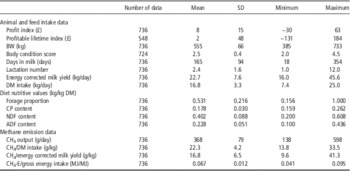
The animal, diet and CH4 emission data used in the present study are presented in Table 1. The dairy cows used in the present study were different in genetic merit with PIN ranging from −£30 to £63 and PLI from −£131 to £184. Reflecting the range in DM intake (7.4 to 25.0 kg/day) and ECMY (16.0 to 45.6 kg/day), there was a wide range in total enteric CH4 emissions (138 to 598 g/day), CH4 output per kg DM intake (13.8 to 33.5 g/kg) or ECMY (9.6 to 41.3 g/kg), and CH4-E as a proportion of GE intake (0.041 to 0.095 MJ/MJ).
Animal, diet and methane (CH4) emission data used in the present study

DM=dry matter.
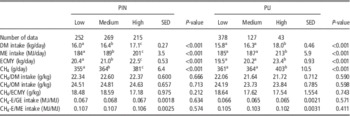
Within the PIN data set, there was a significant increase in DM intake, ME intake and ECMY with increasing PIN (P<0.001). Consequently, CH4 emissions (g/day) also increased significantly with increasing PIN (P<0.001) (Table 2). However, there was no significant difference among the three sub-groups (P>0.05) in terms of CH4 output as a proportion of DM intake, OM intake or ECMY, or CH4-E as a proportion of GE intake or ME intake. Similarly, there was no significant difference (P>0.05) between PIN and CH4 emission as a proportion of digestible DM intake or digestible OM intake, or CH4-E as a proportion of DE intake (results not presented). Effects within the PLI subgroups were similar to those within PIN, except that the increases in DM intake, ME intake, ECMY and CH4 emissions (g/day) between the low and medium PLI groups did not reach significance (P>0.05).
Effect of cow genetic merit (profit index and profitable lifetime index: low, medium or high) on methane outputs of lactating Holstein-Friesian dairy cows

CH4=methane emission; PIN=profit index; PLI=profitable lifetime index; CH4-E=methane energy output; DM=dry matter; OM=organic matter; GE=gross energy; ME=metabolisable energy; ECMY=energy corrected milk yield.
a,b,cWithin a row, means without a common superscript letter differ significantly (P<0.05).
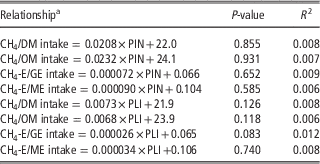
Further evaluations of the effect of cow genetic merit were undertaken on the whole data set of PIN and PLI using linear mixed modelling technique. The results are presented in Table 3. No significant relationships were identified between PIN or PLI, and CH4 emissions as a proportion of DM intake, OM intake or CH4-E output as a proportion of GE intake or ME intake. The P values ranged from 0.585 to 0.931 for the PIN data set and 0.083 to 0.740 for the PLI data set. The corresponding R 2 values were from 0.006 to 0.009 (PIN data set), and from 0.006 to 0.012 (PLI data set).
Linear regressions between enteric methane emission rate and cow genetic merit –PIN PLI

CH4=methane emission; PIN=profit index; PLI=profitable lifetime index; CH4-E=methane energy output; DM=dry matter; OM=organic matter; GE=gross energy; ME=metabolisable energy.
a Unit=g/kg for CH4/DM intake and CH4/OM intake; MJ/MJ for CH4-E/GE intake and CH4-E/ME intake.
Discussion
A number of experiments have been conducted within the United Kingdom to evaluate the effect of increasing cow genetic merit on energetic efficiency and enteric CH4 emissions (Ferris et al., Reference Ferris, Gordon, Patterson, Mayne and Kilpatrick1999; Yan et al., Reference Yan, Mayne, Keady and Agnew2006; Bell et al., Reference Bell, Wall, Russell and Simm2010). These results demonstrated that in comparison with low genetic merit cows, high genetic merit cows had a lower enteric CH4 emission per kg of DM intake and milk yield, and lower CH4-E outputs as a proportion of GE intake. Similar results have also been reported with beef cattle, namely that increasing production efficiency reduces daily enteric CH4 (L/kg0.75) production rate (Nkrumah et al., Reference Nkrumah, Okine, Mathison, Schmid, Li, Basarab, Price, Wang and Moore2006) or CH4 emissions (g/day) (Hegarty et al., Reference Hegarty, Goopy, Herd and McCorkell2007; Fitzsimons et al., Reference Fitzsimons, Kenny, Deighton, Fahey and McGee2013). In these two beef cattle experiments, the ‘high production efficiency’ animals were selected through a breeding programme designed to identify cattle with a low RFI value. Cattle with low RFI require less food than expected to achieve the same level of production. Therefore, the selection of dairy and beef cattle with high production efficiencies provides an effective tool to reduce enteric CH4 emissions per unit of product (milk or meat).
Although a range of diet and animal factors (e.g., feeding level, animal productivity and forage proportion) have been observed to influence enteric CH4 production, it is also possible that there is a physiological mechanism for lower CH4 emissions with high genetic merit cattle. However, little information is available in the literature as to whether decreasing CH4 emission rate with increasing genetic merit is as a result of higher feed intakes and improved quality of diets offered, or an inherent lower rumen methanogenesis potential, or both. The present study was designed to address this issue by applying a range of techniques, including linear mixed modelling and ANOVA, to a large data set of CH4 emission and energy metabolism data measured in calorimeter chambers.
Within the present study the linear mixed modelling analysis found no significant relationship between cow genetic merit (PIN or PLI) and CH4 emission as a proportion of feed intake or energy intake. The ANOVA also revealed that there was no significant difference in CH4 emission as a proportion of feed intake or energy intake among the low, medium and high genetic merit (PIN or PLI) sub-groups. Bell et al. (Reference Bell, Wall, Simm and Russell2011) in a study involving 139 individual dairy cows compared lifetime CH4 emissions as a proportion of ECMY and found that the lifetime values for CH4/ECMY decreased from 55.4 to 31.4 g/kg when DM intake increased from 13.8 to 18.4 kg/day. Chagunda et al. (Reference Chagunda, Römer and Roberts2009) examined enteric CH4 emissions from lactating dairy cows and found a significant difference in CH4 emissions as a proportion of milk yield in high genetic merit dairy cows offered either low or high forage diets (11.8 v. 15.7 g/kg, respectively). Similarly, the low genetic merit cows offered a low forage diet had a significantly lower CH4 emission per kg milk yield than when offered a high forage diet (12.9 v. 17.3 g/kg, respectively). Thus, these results indicate that the lower proportional CH4 emission rate observed in previous production studies with high yielding cows, compared with low/medium yielding cows, are most likely due to their higher feed intakes and better quality diets offered.
A number of recent studies have assessed the potential association between enteric CH4 emissions and microbial ecology of ruminal methanogens. Using the culture-independent methods, Zhou et al. (Reference Zhou, Hernandez-Sanabria and Guan2009, Reference Zhou, Hernandez-Sanabria and Guan2010) reported that while there was no significant difference in the total population of methanogens between cattle with different feed efficiencies, their rumen methanogenesis capacity was highly related to changes in feed intake and dietary composition. Jones et al. (Reference Jones, Phillips, Naylor and Mercer2011) found that changes in methanogenic communities in relation to RFI were dependent on feeding type and diet quality. Zhou et al. (Reference Zhou, Hernandez-Sanabria and Guan2010) reported predominant methanogenic species obtained from the low energy density diet shifted to a community containing more diverse predominant species with the high energy density diet. Therefore, the results obtained in the present study and in previous publications indicated that enteric CH4 emission rate in cattle is mainly driven by feed intake and dietary nutrient compositions within the different studies.
The present data set was collated from 32 respiration calorimeter experiments undertaken at this Institute over an 18-year period. These studies required experimental animals to be housed in individual chambers, while CH4 emissions, feed intake and milk yields were measured over a very short period (<1 week) at various stages of the lactation. Thus, the feed intake and milk yield data obtained in this type of study may not fully represent the milk production potential of cows over a full lactation. There is evidence indicating that daily CH4 emission rates (g/day) of dairy cows varied considerably during lactation, but followed the variation curves of feed intake and milk production (Garnsworthy et al., Reference Garnsworthy, Craigon, Hernandez-Medrano and Saunders2012). Daily CH4 emission rates also vary among cows on commercial farms (Bell et al., Reference Bell, Potterton, Craigon, Saunders, Wilcox, Hunter, Goodman and Garnsworthy2014). Therefore, further studies designed specially to compare the production capacity, rumen ecology and methanogenesis in dairy cows with different genetic merits (PIN or PLI) may be required to validate the results obtained in the present study.
Conclusions
The present meta-analysis study demonstrated that when using calorimetric data from Holstein-Friesian dairy cows at different stages of lactation cow genetic merit (PI and PLI) had no significant effect on enteric CH4 emissions per kg feed intake or per MJ energy intake. The enteric CH4 emission of dairy cattle appears to be related to feed intake and dietary nutrient composition. Breeding programmes that select dairy cows with high production efficiencies can reduce feed intake per kg milk yield, and thus reduce enteric CH4 emissions per unit of feed intake or energy intake.
Acknowledgements
Mr Dong was in receipt of a PhD studentship sponsored by the China Scholarship Council. The authors wish to thank the staff of the Dairy and Energy Metabolism Units for collection of data and care of animals. This work was funded by the European FP7 – Project No. 266367 Sustainable Organic and Low Input Dairying (SOLID).
Supplementary Material
For supplementary material/s referred to in this article, please visithttp://dx.doi.org/10.1017/S1751731115001445