1. Introduction
The present study focuses on the phonological behavior of affricates in a regional German dialect spoken in Northern Italy (Cimbrian German; Bacher 1905, Tyroller 2003). It is shown that the context for various allomorphs in the nominal and verbal inflexion of Cimbrian German requires the analysis of affricates in that dialect as [+continuant]. This claim is significant because it conflicts with the representation of affricates proposed by linguists such as La Charité (1993), Rubach (1994), Clements (1999), Kim (2001), and Kehrein (2002) (on the basis of Jakobson et al. 1952), which sees affricates as strident stops without a [+continuant] component.
In section 2, I summarize some of the competing models for affricates that have been proposed in the crosslinguistic literature on theoretical phonology. In section 3, I present the relevant data from Cimbrian German, and in section 4, I discuss several open research questions.
2. The Structure of Affricates
In recent years, a number of competing featural models have been proposed for the representation of affricates (see Lin 2011 for a recent survey). In this section, I discuss briefly the Contour Segment Representation, the Complex Segment Representation, and the Strident Stop Representation, focusing on two of the predictions made by the latter model.
According to the first model, affricates are (monosegmental) contour segments in the sense that they consist of a single root node (with the major class features [–son(orant)] and [−cons(onantal)]) that dominates [−cont(inuant)] and [+cont(inuant)] in that linear order. Given this structure, affricates as represented in 1a are distinct from stops in 1b and fricatives in 1c because the latter two segment types only have one specification each for [±cont].
(1)


First proposed by Sagey (1986), the Contour Segment Representation has been argued to capture edge effects: Phonologically, affricates pattern with the stops on their left edge and with fricatives on their right edge. For example, the English regular plural requires an epenthetic vowel between an affricate or a coronal fricative and /z/, as in churches, bridges, bushes. Since there is no epenthesis if the stem ends in a coronal stop (as in cats), Sagey (1986) concludes that epenthesis depends on a representation like the one in 1a, in which affricates are fricatives on their right side.
The Contour Segment Representation in 1a has been challenged by a number of researchers (see, among others, Hualde 1988, Lombardi 1990). According to Lombardi 1990, the [−cont] and [+cont] autosegments (which are sometimes interpreted as the corresponding privative features [stop] and [fricative], respectively) are situated on different autosegmental tiers. In the representation in 2a, affricates are complex segments in the sense that they are both [stop] and [cont]. In 2b,c, stops and fricatives are represented in that model with the features [stop] and [cont], respectively.
(2)
Within this model, the representation in 2a predicts that affricates behave phonologically as stops or fricatives on either side. The argument for 2a and against 1a is said to derive support from the existence of antiedge effects. For example, in Turkish, both stops and affricates (but not fricatives) are devoiced at the right edge of a syllable, i.e., [−cont]→ [−voice]/__]σ. This type of rule is problematic for 1a because this representation incorrectly predicts that syllable-final affricates should not devoice. This prediction follows from the representation of affricates in 1a as [−cont] is not situated at the right edge of a syllable. Lombardi (1990) concludes that the representation in 2a is correct because it predicts that affricates can behave like stops or fricatives on either side.Footnote 1
Both the Contour Segment Representation and the Complex Segment Representation have been rejected by proponents of the Strident Stop Representation (see, among others, La Charité 1993, Rubach 1994, Clements 1999, Kim 2001, Kehrein 2002, and Hall 2004 for Modern Standard German, who base their models on the earlier one proposed by Jakobson et al. 1952). According to the representation in 3a, affricates are [−cont], but there is no [+cont] component. Instead, affricates are distinguished from the corresponding stops with the feature [±stri(dent)]: Affricates are [+stri] and stops are either not marked for the feature [stri] at all, as in 3b, or they are [–stri].
(3)
Strident fricatives such as /s z/ require that the representation in 3c be augmented with the feature [+stri]. There is general—although not unanimous—agreement among the linguists cited above that [+stri] only describes sibilant sounds. Thus, sibilant affricates are segments such as /ts dz  /, sibilant fricatives include sounds such as /s z
 /, and [−stri] are the fricatives /θ f ç x/. The status of nonstrident affricates such as [pf] under 3a is discussed below.
The three models presented above make a number of falsifiable claims, two of which are presented in 4.
(4) Two predictions made by the Strident Stop Representation
a. Strident affricates can contrast with stops at the same place of articulation, but nonstrident affricates cannot.
b. Affricates and fricatives do not constitute a natural class.
Prediction 4a says that it is possible to have a language that contrasts [t] and [ts], for example, in which both sounds are either dental or alveolar. By contrast, nonstrident affricates such as /pf/ (in Modern Standard German; henceforth MSG), /tθ/ (in the Nilotic language Shilluk spoken in Sudan), and /kx/ (in Swiss German) never occur together in the same language with stops at the same place (Kehrein 2002). Put differently, in languages with /t/ and /tθ/ or /p/ and /pf/, there is always a minor place contrast that distinguishes the two sounds. For example, in MSG /p/ is bilabial and /pf/ is labio-dental; in Shilluk, /t/ is lamino-alveolar and /tθ/ is apico-dental (Kehrein 2002:27). This means that in a language such as Shilluk, /t/ and /tθ/ are both [–son, –cont, –stri], and an independent feature (for instance, [±distr(ibuted)]) distinguishes the stop from the affricate. I do not commit myself here to the feature(s) required to distin-guish /p/ from /pf/ and /k/ from /kx/, but I assume that it is a (minor) place feature.Footnote 2
In this paper, I focus on the prediction in 4b. The reason 4b follows from the Strident Stop Representation is that in this model, the natural class of affricates and fricatives can only be captured if they share [+cont], but the representation in 3a has no [+cont] component. Neither 1a nor 2a makes the same prediction. In fact, both models claim that affricates and fricatives should form a natural class because both sets of sounds are [+cont].Footnote 3
The correctness of 4b is far from obvious; in fact, some superficial evidence suggests that it is wrong. For example, even many proponents of the Strident Stop Representation recognize the fact that sounds such as /s z  / (fricatives) and /ts dz
 / (affricates) can pattern together in many languages (for example, LaCharité 1993, Clements 1999, Kehrein 2002). LaCharité (1993) demonstrates that with respect to Chumash Sibilant Harmony, Modern Yucatec Maya Morpheme Structure Constraints, Basque Stop Voicing, and Basque Stop Palatalization, fricatives such as /s/ and affricates such as /ts/ constitute a natural class. However, LaCharité (1993:7) correctly observes that in all these cases, affricates pattern only with sibilant fricatives: “Notably absent are rules that show affricates patterning with a full range of fricatives, including those that are not sibilant.” It is for this reason that she refers to the patterning of affricates together with fricatives as a “pseudoproperty” of affricates. A similar assessment of prediction 4b is provided by Clements (1999) and Kehrein (2002:46–57).
In the present article, I argue that the patterning of affricates in Cimbrian German requires reference to the natural class of affricates and fricatives, contrary to prediction 4b. In contrast to the evidence discussed by La Charité (1993), Clements (1999), and Kehrein (2002), the data to be discussed below involve both strident and nonstrident affricates patterning together with strident and nonstrident fricatives. Hence, the patterning together of affricates and fricatives in Cimbrian German cannot be analyzed as the natural class of [+stri] sounds.
3. Affricates in Cimbrian German
3.1 Overview of the Dialect
Cimbrian (German Zimbrisch) is an Upper German dialect spoken in northeastern Italy and derived historically from a Southern Bavarian dialect. According to the Ethnologue, there are approximately 2,300 native speakers of Cimbrian. The data to be discussed below have been drawn primarily from Tyroller 2003, which is a detailed description of the variety of Cimbrian spoken in the municipality of Lusern, in the province of Trento. I refer henceforth to this dialect as CLG (Cimbrian-Lusern German). Three additional sources for Cimbrian phonology are Bacher 1905, Kranzmayer 1981, and an unpublished handout by Alber 2011. A useful Internet reference for Cimbrian German dialects (including CLG), with a brief grammatical description and recordings, is available at http://titus.uni-frankfurt.de/didact/zimbr/cimbrian.htm.
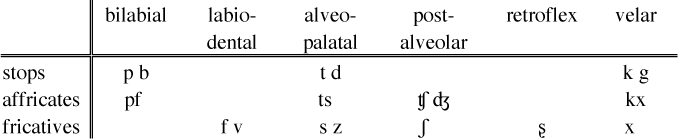
Table 1 contains all CLG affricate, stop, and fricative phonemes. Tyroller (2003:62–71) provides numerous minimal or near minimal pairs demonstrating that the eighteen obstruents in table 1 are phonemes of CLG. Bacher (1905:161–165) provides some discussion of the phonetics of these sounds.
Obstruent phonemes in CLG.
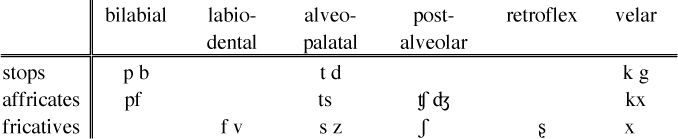
There are several significant differences between the inventories of obstruents in CLG and MSG. First, CLG has the velar affricate /kx/; second, CLG has no fricative  ; third, CLG has a voiceless sibilant Tyroller transcribes as
 which he describes as a “retracted voiceless
 ” (zurückgezogenes stimmloses
 ; p. 42). Tyroller (2003:49) later refers to the sound as retroflex, which is the term I adopt here. On the basis of Tyroller's examples it appears that CLG
 corresponds to West Germanic +/s/ and CLG /s/—to West Germanic +/t/.Footnote 4 The historical development of those sounds in Cimbrian dialects is discussed in Bacher 1905 and Kranzmayer 1981.
In the following sections, I consider the structure of affricates in CLG in light of the models discussed in section 2. Since all analyses agree that affricates are [−cont] (or the equivalent privative feature [stop]), I do not discuss evidence that the affricates in table 1 bear that feature. Instead, in sections 3.2 and 3.3 I concentrate solely on prediction 4b.Footnote 5 Following the studies cited in section 2, I assume that affricates in CLG, as in all languages, are, by definition, monosegmental.
3.2 The Verbal Allomorphs
According to Tyroller's (2003:90ff.) detailed description of the verbal morphology of CLG, there are five realizations of the infinitive morpheme:  The same allomorphs also occur in the first and third person singular indicative verb forms. Bacher's (2005:193–197) material on verb conjugations in Cimbrian refers to these realizations as well. It is clear from both of these sources that the contexts for the verbal allomorphs are—for the most part—phonological because the same contexts account for the allomorphs of all other inflectional suffixes that end in a nasal (see section 3.3). In the following paragraphs, I describe the relevant data on CLG verbs and posit an analysis with (linear) rules. An alternative treatment in a different theoretical framework (for example, Optimality Theory) is possible, although I contend that any such alternative would need to capture formally the fact that affricates and fricatives pattern together.
The data in 5a–d illustrate that the [−әn] allomorph occurs after a verbal stem ending in a nasal, that is, [m n ŋ] or [g], respectively. It is shown in 6 below that [−ŋ] (and not [−әn]) occurs after a monosyllabic stem that ends in [g]. I, therefore, assume that [−әn] occurs in 5d only after [g] in a disyllabic verbal stem. Unless otherwise noted, the phonetic transcriptions in 5 and below have been taken directly from Tyroller 2003. Here and elsewhere, I present the MSG orthography in the first column and the CLG pronunciation in the second column.
(5)
The examples in 6 show the distribution of −n [−n], −m [−m] and −ng [−ŋ]. The [n] suffix occurs after a vowel, as in 6a, or a liquid, as in 6b,c. In 6d–i, I show that the nasal suffix is homorganic with a stem-final voiceless or voiced stop. A process I refer to below as Nasal Place Assimilation (see 7a) ensures that the nasal suffix surfaces as [m] after /p/, as [n] after /t/, and as [ŋ] after /k/. The first member of each pair in 6g–i, that is, the infinitive form, has no voiced stop in the surface representation, but the second member of each pair illustrates that the voiced stop occurs in other members of the verbal paradigms. On the basis of these alternations, I hold that the underlying forms of the verb stems in 6g–i end in /b d g/. The −n (that is, /−n/) in those examples subsequently undergoes Nasal Place Assimilation, and the voiced stop then deletes by a process I refer to as Voiced Stop Deletion (see 7b).Footnote 6
(6)
(7)
The examples in 8 illustrate that the allomorph −an (that is,  ) occurs after a fricative, as in 8a–g, or after an affricate, as in 8h–k. There is a wealth of data presented in Tyroller 2003 and Bacher 1905 for verbs with stems ending in all of the fricatives and affricates in 8. From Bacher 1905:172 it is also clear that
 only occurs after affricates and fricatives. The only gap is [dӡ].
(8)
Note that the fricatives in 8a–g include both strident, that is,  , as well as nonstrident sounds, that is, [f v x]. The same point holds for the affricates in 8h–k:
 surfaces after the strident affricates
 and after the nonstrident affricates [pf kx]. Italian loanwords with
 occurring after a fricative or affricate abound, for example, ankommen
 ‘arrive', compare Trentino rivàr.Footnote 7
As in Standard German (Wiese 1996), I hold that the infinitive ending of CLG is underlyingly /-n/ and that schwa is epenthesized before that consonant if it cannot be syllabified (C').Footnote 8 Schwa Epenthesis has been stated linearly in 9. A rule I posit below in 10 converts the epenthetic schwa to  after an affricate or a fricative.
(9)
A comment is in order concerning the context for Schwa Epenthesis. The disjunction in the left context ensures that schwa is inserted either after a nasal, as in 5a–c, or after an affricate or a fricative, as in 8. Note that the latter context is captured with the two features [−son, +cont]—a grouping that is only possible given the Contour Segment Representation in 1a or the Complex Segment Representation in 1b, but not the Strident Stop Representation in 3a. An analysis which collapses the nasal context and the affricate-fricative contexts into one is not possible under any approach to distinctive features known to me. One might suspect that if nasals are [+cont] (see Mielke 2002), then the two features [+cons, +cont] would do the job, but this is not the case because those features also describe /r/, which is a [+cont] sound.Footnote 9
The examples in 8 tell us that the allomorph  surfaces after an affricate or a fricative and before a nasal. I capture the fact that the surface vowel is
 and not ә with the following process, which is implied in Tyroller's (2003:126) comment that there is a change from [әn] to [
 n] after an affricate or a fricative:Footnote 10
(10)
The rule in 10 is important for the present analysis because it refers to affricates and fricatives together as [−son, +cont], contrary to the prediction made by 4b. Significantly, the natural class of affricates and fricatives also subsumes nonstrident sounds, that is, [pf f x]. Note that the left context for Vowel Lowering is compatible with both the Contour Segment Representation in 1a and the Complex Segment Representation in 2a.Footnote 11 Five representative examples from the data sets provided above are illustrated in the following derivation:
(11)
The derivations in 11 account for the distribution of the −an allomorphs in verbs as described in the original sources for CLG. As I demonstrate in the following section, the same analysis also holds for all nonverbal suffixes ending in a nasal.
3.3 Other Allomorphs
According to the description of CLG noun declensions in Tyroller 2003:126–127, there are five realizations of the plural morpheme for masculine and feminine nouns that are identical in shape to the realizations of the infinitive morpheme discussed in the previous section, that is, −en [−әn], −n [−n], −m [−m], −ng [−ŋ], and −an  (see also Bacher 1905). The distribution of these nominal allomorphs is identical to the distribution of the homophonous verbal allomorphs discussed in section 3.2. Similar generalizations hold for surface allomorphs in adjective endings with a suffix-final nasal, demonstrative pronouns, and suffixes involved in deriving verbs from adjectives or nouns. As in section 3.2, we see below that it is the distribution of
 that provides evidence against the prediction in 4b because
 only occurs after fricatives and affricates.
The realization −en [−әn] of the plural allomorph surfaces after a noun stem ending in a nasal according to Tyroller (2003:126), although the only examples provided in that work are ones in which the nasal is [n]. The CLG noun [lαm] is a loan word (< Italian lama ‘blade’).
(12)
In 13, one can observe that [−n] surfaces after liquids, as in 13a,b, while [−n], [−m], and [−ŋ] surface after homorganic stops, as in 13c–h. In the latter data set, /−n/ takes on the place features of a preceding voiceless stops [p t k] by Nasal Place Assimilation. In 13f–h, the nasal suffix surfaces as [m], [n], or [ŋ] after an underlying /b/, /d/, or /g/, respectively. In examples like these, Nasal Place Assimilation and Voiced Stop Deletion apply. I do not present the entire phonetic transcription for 13a,b because it is not given in Tyroller 2003.
(13)
The most important set of data is presented in 14. Here −an  surfaces after fricatives, that is,
 in 14a–f, or after affricates, that is,
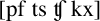 in 14g–j. (Examples 14a, d–g, and i–j are all from Bacher 1905). I have not found a masculine or feminine plural after a stem ending in [z]. I assume that this gap is accidental because the infinitive morpheme discussed in section 3.2 consistently surfaces as
 after fricatives and affricates, including [z].
(14)
The data in 12–14 show that the plural allomorphs [−әn], [−n], [−m], [−ŋ], and  have the same distribution as the homophonous verbal allomorphs discussed in section 3.2.
An identical alternation can be observed for adjectival suffixes. Tyroller (2003:143) states clearly that  occurs after fricatives and affricates, [−әn] after nasals, [−n] after vowels, liquids, and (alveolar) stops. In 15, I provide representative examples for these realizations in the dative/accusative singular of the weak declension (Tyroller 2003: 144–145). (Although Tyroller does not provide examples of adjective stems ending in an affricate, it is clear from that source that the
 allomorph occurs in that context in 15, as well as 16 and 17).
(15)
As shown in 16, the same generalization that governs the distribution of [−әn], [−n], and  holds for the various realizations of the weak plural declension and for the dative/accusative singular of the strong declension.
(16)
The dative singular endings for the demonstrative suffix reveal the same pattern of allomorphy.
(17)
The final data set (Tyroller 2003:190–192) illustrates that suffixes ending in a nasal can convert nouns into adjectives, as in 18a,b, or they can convert nouns and adjectives into verbs, as in 18c. Observe that [−әn] occurs after a nasal in 18a, while  occurs after fricatives or affricates in 18b,c.
(18)
In sum, the distribution of  regardless of the lexical category of the base word, is determined entirely by the phonology: [−әn] occurs if the final segment of the stem is an affricate or fricative, [−әn] after a nasal, [−n] after a vowel or liquid, and [−n]/[−m]/[−ŋ] after a homorganic stop. The analysis proposed in the preceding section for verbs can easily be extended to the data in 12–18.
4. Conclusion and Open Questions
In the present article, I have argued that affricates and fricatives in the Cimbrian dialect of German (CLG) pattern together in the context of two phonological rules. This finding is important because it contradicts the claim made in previous studies that affricates and fricatives do not constitute a natural class (recall 4b). The conclusion is that affricates in CLG must have a [+cont] component and that the natural class of affricates and fricatives is therefore characterized as [−son, +cont]. I remain agnostic concerning the complete featural representation for affricates in CLG. My conclusion is that either the Contour Segment Representation in 1a or the Complex Segment Representation in 2a is compatible with the material presented above. In the future, one might want to investigate additional data from CLG—or other varieties of Cimbrian German—involving affricates in order to determine which of the two representations does the most justice to the facts.
Several fundamental questions remain open for further study. First, it would be a worthwhile endeavor to search for additional evidence from CLG that would confirm the findings of the present study. This dialect could conceivably have additional rules that treat affricates and fricatives as a unit, for example, if only affricates and fricatives (but not stops) undergo a certain process. It is also possible that fricatives and affricates function as a natural class in CLG if these and only these sounds are subject to certain phonological rules or phonotactic constraints.
Other open questions have a wider scope. For example, a very obvious question to consider in future work is whether or not there are other languages (or dialects of German), in which affricates and fricatives pattern together. One of the reasons why further research on German dialects like CLG is important is that they have nonstrident affricates such as /pf/ and /kx/, as pointed out above. Some of the studies referred to in section 2 have argued that affricates cannot and should not be treated as [+cont], but it remains to be seen if all of these case studies have been successfully reanalyzed from the perspective of the Strident Stop Representation.
Several unrelated issues clearly worthy of future study were mentioned in the course of my analysis. For example, one could investigate the phonology and phonetics of the CLG vowel  (and [ә]) as well as the nature of the proposed process in 10 as a lowering or a retraction. Finally, there needs to be a thorough investigation of the (place) features distinguishing the sibilants of CLG, especially
 and
 .
 ‘saw’ versus
 ‘scythe’ (Tyroller 2003:67). The confusion around the phonemic status of sounds such as [z] is not important for the present analysis as it only addresses the behavior of sibilants in stem-final position (see sections 3.2 and 3.3). In stem-final position, labiodentals and alveolar fricatives are predictably voiceless after short vowels, and voiced after long vowels and sonorant consonants. Other fricatives, that is,
 , are invariably voiceless in stem-final position (and in all other contexts). Tyroller (2003) interprets
 as an allophone of /s/ and
 , but it is difficult to see how this is possible given the many examples in his descriptive grammar in which
 contrasts with [s] and
 , for example, miss
 ‘Mass’ versus misch
 ‘mix’ (Tyroller 2003:69).
 after the dorsal affricate [kx] (see 8k), Tyroller is inconsistent concerning how this and similar suffixes (see section 3.3) are realized in that context. On the one hand, we have evidence that
 surfaces after [kx], but on the other hand, Tyroller notes that the [−ŋ] allomorph is possible in some words (see, for example, pp. 46, 93). For example, he transcribes the verb grab as
 In the 200-page dictionary of Cimbrian in Bacher 1905:211–432, it is very easy to find nouns whose stem ends in [kx] followed by
 after [kx] in addition to the ones listed in 8k, but I have not found any examples in that source with
 in the same context. One could speculate that Tyroller's speakers showed free variation, that is, both
 and
 are possible, while Bacher's speakers were much more consistent. This is clearly an issue that needs to be left open for further study.
 , and [−әn]. (In a suppletive treatment of CLG, the natural class of affricates and fricatives is expressed in the subcategorization frame for
 ). The argument against treating the verbal allomorphs of CLG as suppletive is that the same type of subcategorization would be required for all other CLG suffixes that end in a nasal (see section 3.3).
 is not an allophone of /r/. It is not difficult to find examples in Tyroller 2003 in which [ә] contrasts with
 and other vowels, for example, dann
 ‘then ’, Honig
 ‘honey’, schön
 ‘beautiful’, Boden [po:n] ‘floor’. I refer to the rule in 10 as a lowering because I am assuming that [ә] is central and
 is (upper) low, although it needs to be clarified what type of vowel
 is from the phonological perspective. One possibility is that
 is back (that is, [+back]) and /ә/ is central (that is, [−back]), in which case it would make more sense to refer to 10 as a rule of “retraction.” Some independent evidence for the latter interpretation is that CLG appears to have a process that retracts the only other central vowel phoneme, that is, /a/, before a nasal. See the discussion in Tyroller 2003:30, in which central [a] and back [α] are allophones, whereby the latter only occurs before a nasal or before a historical nasal that was later deleted. The interpretation of 10 as lowering or retraction is immaterial for the present analysis.
 (recall section 2) could describe the sounds after which
 occurs, that is,
 . An obvious problem with this approach is that
 (recall 8e) is usually considered to be [+distr], and yet
 occurs after
 as well. By contrast, my treatment, which treats
 and
 as [+cont], has no such drawback. I argue that the burden of proof now lies on the shoulders of linguists who want to argue in favor of [distr] or some other feature.