Over the past 30 years, employer-sponsored defined contribution (DC) savings plans have displaced defined benefit (DB) pensions in the private sector. There were 2.4 active DB participants for each active DC participant in the private sector in 1975, but these proportions had more than flipped by 2007, when there were 3.4 active DC participants for each active DB participant (U.S. Department of Labor, Employee Benefit Security Administration, 2008, 2010). Several factors have been implicated in this shift, including increased regulatory costs for DB providers following the passage of the Employee Retirement Income Security Act (ERISA) in 1974, the legislated creation of an attractive (to employers) alternative to the DB pension through section 401(k) of the Internal Revenue Code in 1978, and workers’ interest in portable pension benefits as the labor force has become more mobile.
The picture in the public sector is very different. In most jurisdictions, a DB pension is still the primary retirement income benefit offered to employees. However, some jurisdictions have followed the private sector and shifted towards a DC system. Going forward, fiscal pressures are likely to generate more movement in this direction. Even jurisdictions with a primary DB plan currently offer supplemental DC plans.
The distinction between DB and DC plans is an important one. In a DB plan, participants have little impact on the income that they will receive in retirement other than through their choice of when to leave their job. Plan sponsors dictate the formula that determines the payments to retired participants. Sponsors also decide with the help of highly trained financial professionals how much money to save today to fund these future payments and where these savings are invested.
In a DC plan, participants usually must choose how much to spend out of their assets during retirement, how much to contribute to the plan before retirement, and how to invest plan assets with limited guidance from their employer or plan sponsor. The consequences of having individuals with low levels of financial sophistication make complicated financial decisions has been well documented in the literature: individuals procrastinate, their savings outcomes are heavily influenced by plan design features such as employer-selected defaults, they place too much weight on information that is not relevant (e.g. past asset returns), and they place too little weight on information that is relevant (e.g. mutual fund fees).
We begin this paper by surveying the retirement plans offered in the public sector, evaluating the generosity of the DB plans and describing the types of DC plans that are available. We find that public sector DB plans generally provide high-income replacement rates during retirement for employees who retire from the public sector with long tenures, but even within this set of employees, there is a large amount of heterogeneity in the replacement rate across plans. In contrast, employees who leave the public sector with shorter tenures are not covered as generously. In public DC plans, mandatory employee contributions and employer contributions that are not contingent on employee choices are much more common than in private DC plans, and these combined contributions are often a large fraction of employee salary. We conclude by summarizing previous research findings on employee savings behavior in private DC plans and discussing how this research points to areas where the design of public sector pension plans could be improved.
1. The public sector pension landscape
1.1 DB and DC plans in the public sector
In the USA, there are over 2,500 different public employee retirement systems providing benefits to the over 20 million individuals employed in the public sector.Footnote 1 For most of these employees, the primary retirement income benefit is a DB pension plan. According to Snell (Reference Snell2010a), ‘91 percent of full-time state and local government employees are covered by a traditional, defined benefit retirement plan.’ Although DC plans are making some inroads in the public sector, quantifying their importance is difficult because the data collected on public sector retirement plans have largely focused on DB plans.
Pensions & Investments has compiled data on the 1,000 largest retirement plan sponsors (public and private) in the U.S., as measured by assets under management (Pensions & Investments, 2010a, b). Of the 1,000 largest plans in 2009, 222 are classified as public plans.Footnote 2 Among these public plans, DB plans predominate: only 6% of total assets under management are in DC plans. But 94 of the 222 largest public pension plan sponsors have a DC component, and 38 of these plans have over $1 billion in DC assets.Footnote 3
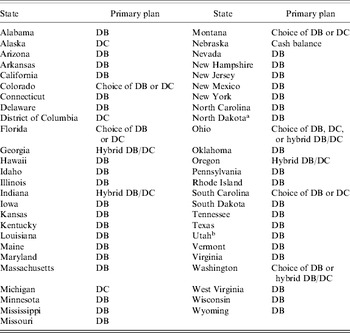
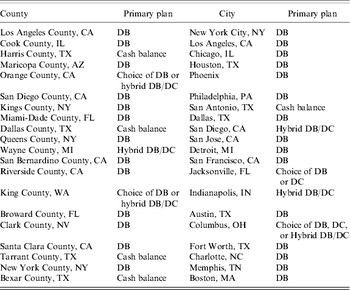
To get a more complete picture of the role of DC plans in the public sector, we compiled information on the retirement plans offered to new hires in 2010 in all 50 states, the District of Columbia, the 20 largest cities, and the 20 largest counties in the U.S. (as measured by population).Footnote 4 Some jurisdictions have a single plan for most or all public sector employees, whereas others have separate plans for different employee categories, such as teachers, public safety workers, and elected officials.Footnote 5 In Tables 1 (states plus Washington D.C.) and 2 (counties and cities), we list the plans available to a general public sector employee. Some plans appear in Tables 1 and 2 multiple times; for example, a plan that covers workers employed by all levels of government within a state that contains a top-20 city and a top-20 county would show up three times as a plan covering state, county, and city employees.
Primary retirement and savings plans available to newly hired general state employees

a North Dakota gives a small group of state employees (<10%) a choice between a DB and a DC plan.
b Starting in 2011, Utah state employees will have a choice between a hybrid DB/DC plan and a DC plan.
Primary retirement and savings plans available to newly hired general county and city employees

Tables 1 and 2 show that DB plans are the predominant primaryFootnote 6 retirement plan at all levels of state and local government. But 11 states and Washington D.C. have some sort of DC component in their primary retirement plan, either a DC only plan, a hybrid DB/DC plan (which combines a DB component with a DC component that is distinct from the state's supplemental DC plans), or a plan that allows employees to choose a DC or a hybrid DB/DC plan instead of a DB plan. These DC and hybrid DB/DC offerings are largely recent with all but one being incorporated in the past 15 years.Footnote 7 Fewer large cities and counties have a primary plan with a DC component: only 7 of the 40 jurisdictions in Table 2.
Regardless of the nature of their primary retirement plan, all of the jurisdictions in Tables 1 and 2 have an optional supplemental DC plan available to employees, and a non-trivial fraction have multiple supplemental options. The need for these supplemental DC plans depends on how well the primary plan is meeting employees’ retirement income needs.
1.2 The adequacy of state-DB pensions
Public sector DB pensions are often perceived by the public as being quite generous. To see how accurate this perception is, we calculate the extent to which employment automatically generates an annuity stream of income for a stylized public sector employee,Footnote 8 Joe the Bachelor, in each state, assuming Joe retires on 1 January 2010. The metric we use is Joe's replacement rate after taxes and retirement plan contributions: (after-tax automatic retirement annuity income in first retirement year)÷(after-tax salary in final work year−mandatory retirement plan contributions in final work year). We include state DB plan payments (or payments from the DB component of a state hybrid plan) and Social Security payments in Joe's automatic annuity income. Even though Joe is retiring on 1 January 2010, we assume that he worked his entire career under the pension rules being offered to new hires in 2010.
Befitting his name, Joe has never married and has no dependents. The absence of spousal labor and pension income means that the automatic replacement rate we calculate for Joe approximates the ratio of his retirement consumption to his pre-retirement consumption if he does no saving outside the DB pension both before and after retirement. Of course, the before-tax generosity of Joe's state pension benefits does not depend on his marital status or number of dependents, at least as long as he is alive.
We assume that Joe has a final pre-retirement salary of either $50,000 or $100,000, and has experienced 1% annual real wage growth up until age 60 and 0% nominal wage growth until his retirement at age 65. We consider six different work histories for Joe:
(A) Joe retires having worked for 40 years, all of it in the public sector.
(B) Joe retires having worked for 35 years, all of it in the public sector.
(C) Joe retires having worked for 35 years, the first 5 in the private sector and the last 30 in the public sector.
(D) Joe retires having worked for 35 years, the first 30 in the private sector and the last 5 in the public sector.
(E) Joe retires having worked for 35 years, the first 15 in the private sector and the last 20 in the public sector.
(F) Joe retires having worked for 35 years, the first 20 in the public sector and the last 15 in the private sector.
Note that in every scenario, the replacement rate Joe would get later in retirement could be different than our calculations here due to cost-of-living adjustments (COLAs). Appendix A (available online) includes more details on the assumptions and methodology we use to calculate Joe's automatic replacement rate, the values of the automatic replacement rate we calculate for Joe in each state, each state's tax treatment of labor income and pension income, and whether each state's employees participate in Social Security.
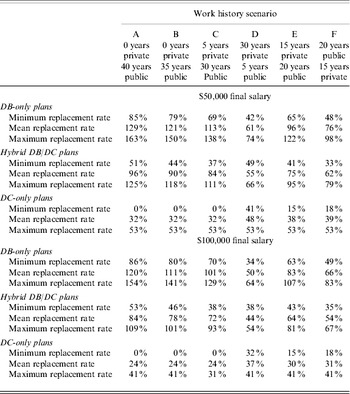
Table 3 shows summary statistics of the automatic replacement rates, broken out by Joe's final salary, work history, and the type of plan offered by the state. A state that offers employees a choice of plans appears in multiple plan categories – once in each category it offers.
Joe the bachelor's automatic retirement income replacement rates: summary statistics

Source: Authors’ calculations.
Under most of the scenarios we consider where Joe's final income is $50,000, the average automatic replacement rate in plans with at least some DB component is close to or exceeds the 70–75% replacement rate that is often considered adequate. As a point of comparison, Munnell and Soto (Reference Munnell and Soto2005) calculate that the median U.S. single individual who retired with an employer-sponsored pension between 1999 and 2003 receives Social Security plus pension annuity income (assuming all DC assets are annuitized) equal to 56% of his average income in the highest 5 out of the last 10 years prior to retirement.Footnote 9 Nonetheless, a need for additional savings remains – even for many public sector employees covered by a DB plan – for several reasons.
First, because the Social Security system is progressive, Joe's average replacement rate is decreasing in his final salary.Footnote 10 For example, when Joe has a 35-year career entirely spent in the public sector, his replacement rate in DB-only plans is 10% points lower on average with a $100,000 final income than with a $50,000 final income.
Second, in the DB-only plans and the hybrid DB/DC plans, Joe's automatic replacement rate falls if he has spent less time working in the public sector. This is because the typical DB pension formula increases benefits with years of service.Footnote 11 If Joe's last job is in the public sector with a final income of $50,000, his average replacement rate in a DB-only plan decreases by 8% points as his years of public sector work decrease from 40 to 35, by another 8% points as his tenure decreases from 35 to 30, and by another 17% points as his tenure decreases from 30 to 20. If Joe works only 5 years in the public sector, there are many states whose DB systems do not give Joe any automatic annuity because he does not satisfy the plan vesting requirements. Thus, Joe's automatic annuity income would come solely from Social Security. In most of these states, Joe would receive a refund of his contributions to the state pension system if the system requires employee contributions.Footnote 12
Third, conditional on working partly in the public sector and partly in the private sector, Joe has a lower replacement rate if he ends his career in the private sector than if he ends his career in the public sector. This is because the DB pension formulas are a function of Joe's nominal final average salary in the public sector. For example, if Joe retires with a final average salary of $50,000 and works 20 years in the public sector and 15 years in the private sector, his average DB-only replacement rate is 20% points higher if he retires from the public sector than if he retires from the private sector (96% versus 76%).
Fourth, even holding fixed Joe's final income and work history, there is substantial heterogeneity in his automatic replacement rate across states. For example, with a final average salary of $50,000 and a 35-year career spent entirely in the public sector, the average replacement rate across all DB-only plans is 121%. If Joe worked in Pennsylvania, his replacement rate would be a much higher 150%. But if Joe worked in Maine, his replacement rate would be only 79%. Joe's average automatic replacement rate in states with hybrid DB/DC plans is lower on average than in the states with DB-only plans – 90% versus 121% – as would be expected, since it is intended that Joe fund some of his retirement with assets in the DC component of these plans. There is also substantial variation in Joe's automatic replacement rate within the small number of hybrid DB/DC plans, ranging from a low of 44% in Ohio to a high of 118% in Oregon. In DC-only plans, Joe's replacement rate is either 0% (in states whose newly hired employees do not participate in Social SecurityFootnote 13) or around 50% (the replacement rate that he gets from Social Security alone after taxes).
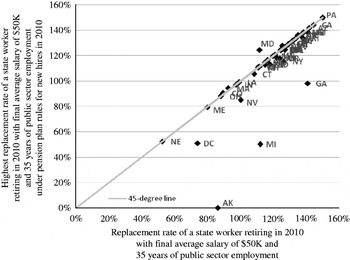
The automatic replacement rates in Table 3 are derived assuming that Joe accumulates benefits for his entire career under the rules in place for employees newly hired today. How has this automatic replacement rate changed over time? Figure 1 plots one measure of this change for Joe if he works his entire 35-year career in the public sector (work history B above) and has a $50,000 final salary. The vertical axis is the highest automatic replacement rate Joe could get in his state if he spent his entire career under the rules for today's new hires. The horizontal axis is the most generous automatic replacement rate Joe could get if he spent his career under the rules actually experienced by employees who started working in 1975 and retired at the beginning of 2010.
State retirement plan replacement rates over time.

Most states are fairly close to the 45-degree line, indicating that the automatic replacement rate has not changed much over time, at least for employees who spend their entire careers in the public sector. The few substantial changes have mostly lowered the automatic replacement rate; conditional upon changing, the average change is a 10% point decrease.
Several states have decreased the generosity of their DB pension in ways that do not show up in Figure 1. For example, an increase in the years of service at which employees vest would reduce the automatic replacement ratio of employees who leave the public sector with years of service between the old and the new vesting thresholds. Many states have adopted ‘anti-spiking provisions’ to combat the practice of artificially inflating pay in the final year or two before retirement by taking extremely high amounts of overtime or getting short-term ‘promotions’ into higher-paying positions. Since pension formulas depend on some measure of final average pay, spiking increases pension payouts in retirement.Footnote 14 We have assumed that Joe's pay is flat during his last 5 years before retirement, and so the automatic replacement rates that we calculate are not influenced by spiking. States are also reducing the generosity of their retiree health insurance, a valuable benefit that we do not incorporate into our replacement rate calculation. The current fiscal situation facing many jurisdictions will likely precipitate many more such changes. To the extent that pensions are becoming less generous in some of the less visible ways discussed above, this may increase the need for supplemental DC savings.
1.3 The adequacy of state-DC pensions
The adequacy of DC savings plans is more difficult to assess than that of DB plans because their adequacy often depends significantly on participant behavior: Are employees participating, how much are they contributing, and what type of asset allocation do they choose? In most private sector 401(k) plans, there are many ways employees can fall short (Munnell and Sundén, Reference Munnell and Sundén2004): they can delay enrolling in the plan, choose a contribution rate that is too low to generate the necessary resources to maintain consumption in retirement, or choose an inappropriate asset allocation (e.g. investing heavily in employer stock, investing in high-fee funds, or investing in a manner that does not match their risk tolerance).
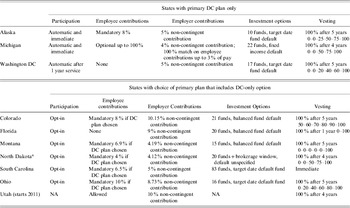
Table 4 lists some characteristics of states’ primary DC plans. Optional supplementary DC plans and the DC component of hybrid DB/DC plans are not included in the table. In contrast to most private sector DC plans, plan contributions are mandatory for most state employees whose primary plan is the DC plan.Footnote 15 Thus, in the three states whose only primary plan is the DC plan, contributions to the DC plan are automatic and employees cannot opt out. In the states that allow employees to choose a DC plan as their primary plan, the default primary plan is the DB plan (or the hybrid DB/DC plan in the State of Washington), and so mandatory DC plan contributions do not commence unless the employee actively enrolls in the DC plan.
Characteristics of state primary DC retirement savings plans

a North Dakota gives a small group of state employees (<10%) a choice between a DB and a DC plan.
In the private sector, most DC plans are funded by elective employee contributions and an employer contribution that depends on the employee's contribution (e.g. the employer will match 50% of employee contributions up to 3% of pay). The contribution rules in state DC plans are usually very different. Only Michigan allows variable employee contributions that are matched by the employer, as is the norm in the private sector. Instead, state DC plans usually offer an employer contribution that is not contingent on employee contributions, ranging from 4% of salary in Michigan to 10.15% of salary in Colorado. Most also fix the employee contribution at a level between 4% and 10% of salary, although two jurisdictions (Washington DC and Florida) do not allow employee contributions at all.
One area where public and private sector DC plans are similar is the investment options offered. The number of investment options ranges from 10 to the low 20s with only one exception, South Carolina, which has four different investment fund managers and a total of 85 funds. All of the fund menus have investment options that span the risk-expected return spectrum, and most include target date funds. The default fund is either an age-appropriate target date fund or a balanced fund with the exception of Michigan, where the default is a fixed income fund. This is in line with the private sector, which has also moved toward target date and balanced fund defaults that satisfy the Qualified Default Investment Alternative (QDIA) guidelines of the Pension Protection Act of 2006.
Employees’ own contributions are always immediately vested in state DC plans. The vesting of employer contributions varies across jurisdictions, from immediate vesting in South Carolina to cliff vesting after 5 years in Montana. Employees in most states become incrementally vested in their employer contributions over time, until they are fully vested after 4 or 5 years. The range of state vesting schedules mirrors what we observe in private sector plans.
Participants in state DC plans are less likely than participants in private sector DC plans to end up with extremely low retirement savings, since most states impose high minimum contribution rates. Colorado and Ohio require combined employer plus employee contribution rates in excess of 18%. Four other states mandate combined contribution rates greater than or equal to 10%. But some states have rather low mandatory combined contribution rates. Washington DC contributes only 5% of salary and allows no employee contributions, and North Dakota's combined mandatory contribution is 8.12% of salary, with no possibility for employees to contribute more. Michigan's minimum mandatory contribution rate is 4%, but employees can accumulate more by making additional optional employee contributions and earning the accompanying employer match.
2. Behavioral economics and retirement savings
We now turn to a brief summary of the behavioral economics literature on retirement savings. In Section 3, we will apply these research findings to the public sector retirement plans that we have described in Section 1.
Several recent papers document a pervasive lack of financial literacy in the U.S. population (e.g. Lusardi and Mitchell, Reference Lusardi and Mitchell2006, Reference Lusardi and Mitchell2007; Applied Research and Consulting, 2009; Lusardi and Tufano, Reference Lusardi and Tufano2009; Lusardi et al., Reference Lusardi, Mitchell and Curto2010). This low level of financial literacy carries over to the specific domain of employer-sponsored retirement plans. Gustman et al. (Reference Gustman, Steinmeier and Tabatabai2007) and Chan and Stevens (Reference Chan and Stevens2008) show that many Health and Retirement Survey respondents do not understand important features of their retirement plan, including whether the plan is a DB or a DC plan, the age at which they qualify for full benefits, and the relationship between continued work and future benefits. Choi et al. (forthcoming) similarly show that many employees in one DC savings plan do not know their employer match. Finally, Brown and Weisbenner (Reference Brown, Weisbenner, Brown, Liebman and Wise2009) document that individuals participating in the State Universities Retirement System of Illinois are confused about which plan option best meets their needs.
Complicated financial decisions can be overwhelming for many individuals, especially those with little financial expertise and experience. Saving and investing for retirement can be especially daunting, as it involves making large long-term commitments in a domain in which many individuals will never develop significant expertise. Learning is hindered by the fact that each individual goes through the lifecycle savings problem only once, outcomes are realized with substantial delay and noise, and the rapid pace of financial innovation renders previously acquired knowledge obsolete.
The consequences for savings plan outcomes have been well documented. Several broad patterns of behavior emerge from the literature. First, individuals procrastinate when faced with complicated choices. In the context of retirement saving, this often implies not saving at all. Carroll et al. (Reference Carroll, Choi, Laibson, Madrian and Metrick2009) document substantial procrastination in 401(k) savings plan enrollment in a large private sector savings plan, even though the costs of delay can be substantial (Choi et al., forthcoming). Conversely, Choi et al. (Reference Choi, Laibson, Madrian and Wise2009a) and Beshears et al. (Reference Beshears, Choi, Laibson and Madrian2010a) show that simplifying the savings plan enrollment process leads to sizeable increases in participation.
Second, savings and investment outcomes are heavily influenced by plan design features that matter little in standard economic models. The best evidence on this front is the sensitivity of outcomes to the plan defaults. Savings plan participation increases greatly following employer adoption of automatic enrollment, which changes the plan default from non-participation to participation, and contribution rates and asset allocations shift toward the automatic enrollment defaults (Madrian and Shea, Reference Madrian and Shea2001; Choi et al., Reference Choi, Laibson and Madrian2004b, Reference Choi, Laibson, Madrian, Metrick, McCaffrey and Slemrod2006; Beshears et al., Reference Beshears, Choi, Laibson, Madrian, Kay and Sinha2008). Allowing employees to choose automatic future contribution rates increases leads to sizeable future increases in savings (Thaler and Benartzi, Reference Thaler and Benartzi2004). Portfolios are more heavily invested in employer stock when the employer match is invested by default in employer stock (Benartzi, Reference Benartzi2001; Choi et al., Reference Choi, Laibson and Madrian2009b). The fraction of pension beneficiaries choosing a joint and survivor annuity increased substantially when this option became the legal default for married individuals (Holden and Nicholson, Reference Holden and Nicholson1998; Saku, Reference Saku2005).
Defaults are not the only plan design feature that significantly influences savings and investment outcomes. In plans without an employer match, discretionary employee contribution rates are influenced by whether mandatory contributions are labeled as employee or employer contributions (Card and Ransom, Reference Card and Ransom2011). Several authors have found that asset allocation choices are sensitive to the structure of the investment menu (Benartzi and Thaler, Reference Benartzi and Thaler2001; Brown et al., Reference Brown, Liang and Weisbenner2007; Karlsson et al., Reference Karlsson, Massa, Simonov, Mitchell, Soldo and Madrian2007) and the form on which individuals must indicate their choices (Benartzi and Thaler, Reference Benartzi and Thaler2007).
Third, individuals pay too much attention to irrelevant information and too little attention to relevant information. For example, individuals chase past returns in both their asset allocation choices (Benartzi, Reference Benartzi2001; Choi et al., Reference Choi, Laibson and Madrian2004b, Reference Choi, Laibson and Madrian2010; Calvet et al., Reference Calvet, Campbell and Sodini2009) and contribution rate choices (Choi et al., Reference Choi, Laibson, Madrian and Metrick2009) while paying too little attention to mutual fund fees (Choi et al., Reference Choi, Laibson and Madrian2010).
A fourth pattern is a reliance on heuristics and rules of thumb in decision making. For example, Benartzi and Thaler (Reference Benartzi2001) document what they call ‘naïve diversification’: individuals diversify by investing in several different mutual funds, but they fail to account for the underlying correlations in returns across the funds when making their choices.Footnote 16Choi et al. (Reference Choi, Laibson, Madrian, Metrick, McCaffrey and Slemrod2006) show that employees disproportionately choose 401(k) contribution rates that are divisible by 5.
Finally, individuals do a poor job of integrating various aspects of their financial lives; rather, they appear to engage in mental accounting, making decisions in each subset of their portfolio without considering their choices in other subsets (Choi et al., Reference Choi, Laibson and Madrian2009b; Card and Ransom, Reference Card and Ransom2011).
This long list of biases has complex implications for the overall adequacy of retirement savings. Depending on the institutional environment, some behavioral biases will generate excessive accumulation of retirement wealth, whereas other biases will generate inadequate accumulation of retirement wealth.
To illustrate the case of excess accumulation, consider an individual who has a large DB pension claim, but fails to fully account for that claim when making retirement savings decisions. For example, the individual might mentally segregate their DB claim and follow a simple heuristic in choosing an active savings rate in his DC account, for instance, save up to the match threshold, which is 6% of income in a typical private sector DC plan. Assuming that the employee's contributions are partially matched, the total implicit saving rate could far exceed 20% once the DB accumulation and Social Security are also taken into account. In this scenario, the individual might save far too much, particularly if he has a low level of labor income and a correspondingly high Social Security replacement rate. Likewise, consider a completely passive individual who works for an employer with a DB plan and also a DC plan that has automatic enrollment, an employer match, and automatic contribution escalation. In this setting, such a household might also end up saving far too much.
On the other hand, the passive behavior noted above could lead to insufficient retirement wealth accumulation in other contexts. For example, a largely passive individual who works for an employer with neither a DB nor a DC savings plan could save far too little.
Behavioral biases therefore predict a mixed picture of heterogeneous savings outcomes, with this heterogeneity driven by the interaction between behavioral biases (like passivity or mental accounting) and the individual's institutional environment. Researchers who study savings adequacy have reached differing conclusions about the extent to which individuals are financially prepared for retirement. Some argue that individuals are largely well positioned (e.g. Engen et al., Reference Engen, Gale and Uccello1999; Scholz et al., Reference Scholz, Seshadri and Khitatrakun2006), while others conclude that most individuals are falling short of where they need to be (Munnell et al., Reference Munnell, Webb and Golub-Sass2007).
3. Implications for public sector retirement plans
What are the implications of these behavioral patterns for thinking about how well public sector retirement plans meet the retirement income needs of public sector employees?
We start by considering the situation of employees who have a primary DB plan. DB plans have been characterized as being less complicated than DC plans for their participants. Indeed, DC plans demand – or at least allow – a substantial amount of individual autonomy, whereas DB plans require almost no choices by participants before retirement. But there are many complicated features of DB plans that have implications for how employees use the supplemental DC savings plans they are offered.
The formulas determining DB pension payouts seem relatively straightforward on the surface: final average salary multiplied by years of service multiplied by a retirement factor. But these formulas often have complicated wrinkles, such as limits on the growth in final wages that will count in the formula, future COLAs that are hard to value, and rules about the combination of age and years of service that must be attained to receive a full benefit. Many individuals have misconceptions about their retirement benefits, which may affect their choices about how much to save in their supplemental DC plans.
DB plans reward tenure, since most payout formulas depend directly on years of service and some measure of final average pay, which is itself often related to tenure. Individuals who leave the public sector with relatively low levels of tenure will be entitled to very little or nothing at all. Although the common perception is that public sector workers are generally long-term employees, a recent Maine task force report claims that over half of public sector workers in Maine leave the public sector before reaching the 5 years of service necessary to vest (Maine URP Task Force, 2010). If this is true in other states as well, then more attention probably needs to be paid to supplemental DC plans in the public sector.
Finally, the Windfall Elimination Provision (WEP) greatly complicates estimating the level of Social Security income that employees of six states (Colorado, Louisiana, Maine, Massachusetts, Nevada, and Ohio) will receive. While employed by these states, employees make no contributions to Social Security, and neither does their employer. Consequently, earnings from employment in these states are not counted towards determining Social Security benefits. But some employees have long enough careers to qualify for Social Security benefits in addition to their state pension. The WEP reduces Social Security payments to these employees. As explained on the Social Security web site:
‘Before 1983, people who worked mainly in a job not covered by Social Security had their Social Security benefits calculated as if they were long-term, low-wage workers. They had the advantage of receiving a Social Security benefit representing a higher percentage of their earnings, plus a pension from a job where they did not pay Social Security taxes. Congress passed the Windfall Elimination Provision to remove that advantage’.
(Source: http://www.ssa.gov/pubs/10045.html, accessed 7 August 2010.)The annual statements that Social Security sends to participants projecting their future benefits do not account for the effects of the WEP, and so affected state employees may mistakenly believe that they are entitled to higher Social Security benefits than they will in fact receive, altering their savings and retirement decisions.
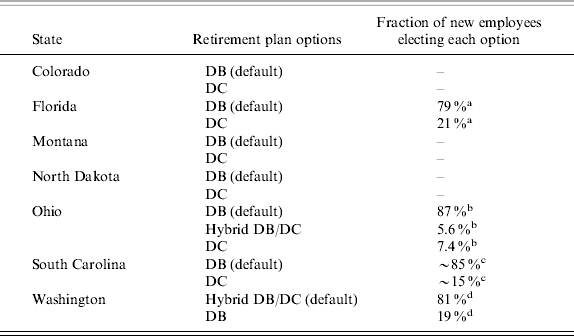
In some states, employees have a choice of plans in which to participate, which adds yet another layer of complexity. Employees do not typically have the option of procrastinating indefinitely, because there is a deadline by which a decision must be made.Footnote 17 But in fact, the decision does not need to be explicitly made, since the employer specifies a default plan for individuals who do not state a preference. Table 5 lists the states that offer a choice of primary plan, which plan is their default option, and the fraction of new employees who end up in each option in the states from which we were able to get that information. The default is the DB plan in all of the choice states except for Washington, where the default is a hybrid DB/DC plan. Consistent with previous research, the large majority of employees – 79% to 87% – end up in whichever plan is the default.
Plan defaults in states that offer a choice of primary plan
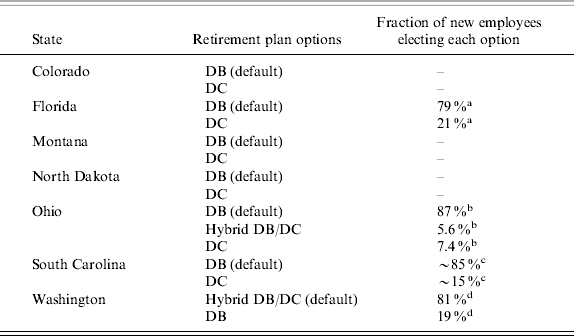
We calculate the fraction of new employees electing each option from the annual reports of the states that report active members by year for each plan.
a Florida: the fraction of new employees hired between 2000 and 2009.
b Ohio: the fraction of new employees hired between 2003 and 2008.
c South Carolina: rough estimate from a state employee in the South Carolina pension office (personal communication).
d Washington: the fraction of new employees hired between 2002 and 2008.
Beshears et al. (Reference Beshears, Choi, Laibson, Madrian, Kay and Sinha2008) discuss several reasons why defaults are powerful. One may be particularly relevant here: the perception that the default is the employer-endorsed option. Most workers probably lack the knowledge necessary to map each retirement plan to their preferences, and so the default may be particularly likely to be perceived as the correct course of action. Yang (Reference Yang2005), Brown and Weisbenner (Reference Brown, Weisbenner, Brown, Liebman and Wise2009), and Goda and Manchester (Reference Goda and Manchester2010) all document strong default effects among employees who have a choice between a DB and a DC plan (the employees studied by Brown and Weisbenner had a choice among three different plans). In the organization studied by Goda and Manchester, the default differed by age: employees older than 45 had a DB plan default, while employees younger than 45 had a DC plan default. Employees who are just above the age-45 cutoff are 60% points more likely to be in the DB plan than employees who are just below the age-45 cutoff. Goda and Manchester's analysis suggests that following the age-based default rule was close to optimal ex ante for employees. However, even if the age-based default rule was optimal on average, there could be many employees who are swept up into a plan that is not optimal for them. The organizations studied by Yang (Reference Yang2005) and Brown and Weisbenner (Reference Brown, Weisbenner, Brown, Liebman and Wise2009) designated the DB plan as the default for all employees. Like Goda and Manchester, Yang finds that the default is very influential, especially for employees younger than 30, whom she calculates are least likely to benefit from being in the DB plan.Footnote 18 Brown and Weisbenner also find that the default is powerful, and employees who opt out of the default tend to choose a dominated non-default plan.
Instead of having a default, employees could be required to actively choose their primary plan before a deadline. Carroll et al. (Reference Carroll, Choi, Laibson, Madrian and Metrick2009) study such a regime in a private 401(k) plan that required employees to actively choose a (possibly zero) contribution rate within 30 days of hire. This approach prevents employees from finding themselves in an inappropriate plan through passivity, but also places a heavy burden on employees to gather enough information to make a wise decision. Thus, active decision regimes are best accompanied by mechanisms that help employees quickly and easily understand their options.
An interesting design choice is whether to make the plan choice reversible. In some states, the plan choice is irreversible, whereas in other states, employees have one or more opportunities to switch between plans. Reversibility may complicate the decision-making task even further, and could cause employees to make their initial choice less thoughtfully. On the other hand, flexibility is valuable if employees make a mistake in their initial choice, or if their circumstances change.
All states with a DC-only plan remove at least one layer of complexity by automatically enrolling employees in the DC plan with an employer contribution that is not contingent on employee choices. Most go a step further by also requiring a fixed contribution on the part of employees, some at relatively high rates. The default investment fund in these plans is typically a target date fund. Although target date funds are not perfect, they are diversified across multiple asset classes and automatically become less risky as the participant ages.Footnote 19
The complexity in public DC plans comes from the optional supplemental savings plans, in which employees must determine their appropriate contribution rates and asset allocations. As noted in Section 1, not all DB and primary DC plans generate high-retirement-income replacement rates for all public sector workers, resulting in the need to utilize these supplemental plans. Some aspects of the supplemental plans’ complexity seem unnecessary. For example, a state may have one provider administering its primary DC plan with one set of investment options, another provider with a completely different set of investment options managing its first supplemental plan, and yet another provider with a third set of investment options for its second supplemental plan. If there are multiple supplemental plans, employees who want to augment their primary benefits would have to choose which supplemental plan to use first. Like the choice between a DB and a DC plan discussed above, this is not necessarily a straightforward decision.
Another source of complexity in both DB and DC plans is the process of transforming accumulated benefits into retirement income. Most private sector DC plans do not have an annuitization option within the plan, and so accumulated balances are not automatically converted into a payment stream upon retirement. Rather, retirees must take some action to convert their plan balances into an annuity, or they must self-manage spending down their wealth in retirement. In the private sector DC plans that do offer an annuity option, the take-up rate of this option is quite low. The low rate of annuitization both within and outside of DC plans is often referred to as the ‘annuity puzzle’ because it goes against theoretical predictions that individuals should have a strong demand for annuities to insure against longevity risk (Yaari, Reference Yaari1965; Brown, Reference Brown2007).Footnote 20 Within-plan annuitization options are somewhat more prevalent in the public sector than in the private sector. Of the 12 states that have a DC-only or a hybrid DB/DC plan, half have an option within the plan for employees to annuitize their wealth upon retirement.Footnote 21
In contrast, both private and public sector DB plans have traditionally paid out accrued benefits as either a single or as a joint and survivor life annuity. But many DB plans have started to offer a lump sum payout option. Mitchell (Reference Mitchell1999) reports that in 1991, when aggregate data on lump sum payout options were first collected, only 14% of private sector DB plan participants had the option of a lump sum payout. By 2005, more than half (52%) of private sector DB plan participants had a lump sum option available (U.S. Department of Labor, Bureau of Labor Statistics, 2007). Anecdotal discussions with those in the pension and retirement savings industry suggest that when a lump sum option is available, the majority of participants elect the lump sum. So the trend in private sector DB plans is towards decreased levels of annuitization. Public sector DB plans are still more aggressive in promoting annuitization. Only a third of states allow employees the option of taking a lump sum withdrawal, and in most of these, the lump sum payout is limited to the equivalent of a few years of annuitized benefits.Footnote 22
4. Conclusions
In this paper, we have provided an overview of the public sector pension landscape in the U.S. Although DB plans remain the predominant primary plan, some jurisdictions – particularly at the state level – have opted to offer only a DC plan or have given employees a choice among a DB, DC, and hybrid DB/DC plans. All jurisdictions have one or more supplemental DC plans available to employees.
We document substantial heterogeneity across jurisdictions in the extent to which their DB, DC, or hybrid DB/DC plans automatically set employees up for high-retirement-income replacement rates. Employees in plans that will provide them with less automatic savings probably need to engage in some supplemental savings in order to maintain their standard of living in retirement. The need for supplemental savings is particularly high for low-tenured workers who may not vest in a DB plan or who may only partially vest in a DC plan.
We conclude by discussing how recent behavioral economics research on savings and investing behavior applies to the institutions and choices that employees face in public sector retirement plans. Most public sector DC plans do not allow employees any choice in how much gets contributed to the plan, and employees’ assets are directed by default into target date retirement funds. By limiting the amount of choice employees have in the primary DC plan, public sector retirement plan designers are likely to have eliminated most of the left tail of savings outcomes that arise in private sector DC plans due to financial illiteracy, procrastination, and time-inconsistent tastes for immediate consumption gratification; although it is unknown how large of a welfare cost reducing choice exacts due to rational employees’ reduced ability to smooth marginal utility intertemporally. Public sector supplemental DC plans are typically more complicated and confusing than those found in the private sector, since there are often multiple supplemental plans offered, and since each supplemental plan may be operated by a different financial services company. More research is needed to determine why the supplemental plans are structured as they are and how variation in their structure affects how well public sector employees do when faced with these types of choices.