


1. Introduction
It is clear that the West Germanic definite article is derived from a demonstrative pronoun or adjective, but when it came to be used as an article has remained in dispute. Harbert (Reference Harbert2007:142) summarizes the dis-agreement:
The point at which this transition is complete is hard to pin down. Behaghel (Reference Behaghel1923–32) asserts that they had already lost the deictic force of demonstratives by the time of OHG. On the other hand, Abraham (Reference Abraham1997) claims that in MHG neither the definite nor the indefinite article had yet developed its modern meaning, and speaks of OHG and MHG as belonging to a ‘pre-article’ phase. Philippi (Reference Philippi1997) claims they were still demonstratives … and that they only became true definite articles in late medieval times.
The source of the difficulty lies in the misconception that there is a specific point in time when the demonstrative becomes a definite article akin to the article used in Present Day German (PDG). Leiss (Reference Leiss2000, Reference Leiss, Stark, Leiss and Abraham2007) and Abraham (Reference Abraham1997) see the loss of aspect as the key evolutionary development for the advent of the definite article in OHG.
This paper is a functional analysis of the article in German that allows the identification of articles by their use in OHG and later periods of German. Section 2 discusses the pre-OHG situation in terms of a definiteness cycle. It also discusses recent research by Leiss (Reference Leiss, Stark, Leiss and Abraham2007, Reference Leiss2000), Hawkins (Reference Hawkins2004), and Lyons (1991) on the evolution of articles that helps identify stages in the development from deictic to definite article within the context of use and can be applied to OHG. Section 3 gives a brief overview of the texts used for the study and analyzes evi-dence from those texts in light of the research discussed in section 2. The last section concludes that there was a definite article in OHG, but that its use differed in earlier stages of German compared to later stages.
Before proceeding, it is useful to discuss some of the terminology employed throughout the paper. Lyons (Reference Lyons1999) and Mathews (Reference Mathews2005) provide the following definitions. Lyons (Reference Lyons1999:1–20, 157–198) provides more extensive discussion of the terminology. A determiner is a gram-matical unit that limits the referent of a noun phrase and refers to both demonstratives and definite articles. Demonstratives are distin-guished from definite articles in that they show deixis. Deixis is derived from a Greek term meaning “to point out” and is traditionally used with demonstratives such as English this or that to point out to the listener the referent that the speaker has in mind.
The definite article (such as the in English) marks a noun phrase as definite but does not indicate deixis. Discourse deixis points out something named either in the preceding discourse, that is, anaphora or in the following discourse, that is, cataphora. Visibility can refer to physical visibility to speaker and listener or to textual visibility in the sense of anaphora and cataphora. A determiner can be distal if it refers to something far away either physically or within the discourse, or proximal if it refers to something close either physically or within the discourse. The terms distal and proximal are generally used to refer to demonstratives but, as I show below, can also refer to definite articles.
2. Definiteness Cycle and the Genesis of the German Definite Article
Greenberg (Reference Greenberg1978:61) posited a “cycle of the definite article” consisting of three stages: definite article, nongeneric article, and noun marker. Van Gelderen (Reference Gelderen2007:286, Reference Gelderen2011:17) bases the cycle on the Principle of Feature Economy:
(1) Principle of Feature Economy:
Minimize the semantic/interpretable features in the derivation.


Van Gelderen expands the formulation to account for the syntactic position (the top row in 2) and the semantic/feature role (the bottom row in 2), and to include two earlier stages of Adjunct and Specifier. I propose that the Adjunct in the German DP/Definite cycle is a noun.
(2) DP / Definiteness Cycle
Van Gelderen (Reference Gelderen2007:286) compares this diachronic process to a pro-cess by which a light verb such as go becomes a future auxiliary. This verb contains the semantic features [motion], [future], and [location]. When used in combination with a verb that contains the features [motion] and [location] such as bring as in I'm gonna bring that, only the feature [future] of go is activated allowing it to be grammaticalized to a future auxiliary. A demonstrative noun might be considered a light noun. It has the features [deixis] and [definiteness] (and possibly others). When used with another noun, it might retain only the feature [definiteness]. Demonstratives could begin as adjuncts to nouns or adjectives but be reanalyzed as DP Specifiers and later grammaticalize as an article Head of DP.Footnote 1 The Head Preference Principle (HPP) triggers grammaticalization:
(3) Head Preference Principle: Be a head, rather than a phrase.
HPP is another principle of feature economy. It is easier for the language learner to analyze given linguistic input as a phrasal head than as a full phrase. In case of an ambiguous structure, the language learner would analyze it in the way that is closest to the surface structure, that is, as a head. “This change is slow, however, since a child learning the language will continue to have input, for instance, of a pronoun as both a phrase and a head” (van Gelderen Reference Gelderen2007:283). The German definite article (a head) can, in fact, still be used as a demonstrative (a phrase).
The stem of the Germanic noun would be a noun class marker at the end of the definite cycle. The cycle could then begin anew.
Once the functional element has lost its semantic and interpretable features, it becomes a probe looking for an element to value its uninter-pretable features. I assume it can value these with elements that are themselves inactive; otherwise renewal would not take place. Some elements are straightforward renewers: demonstratives have phi features and adverbs temporal or spatial ones. (van Gelderen Reference Gelderen2011:20)
A demonstrative retains interpretable features. The demonstrative may be grammaticalized to a definite article that no longer has interpretable features and only indicates definiteness. The modern Germanic languages all show this third stage of the cycle.
The DP-hypothesis states that the referential interpretation of NP is determined in Head, D. In languages that do not have articles (and may not have DP in their grammars), if referentiality is to be marked, it must be marked some other way. Philippi (Reference Philippi1997) argues that case can act as a functional head and saturate a referential argument position for NP. Using examples from Turkish, Finnish, and Russian, she shows that gen-itive or partitive case can be used to mark an NP as weak (indefinite) and accusative case can be used to mark an NP as strong (definite).
Philippi (following Abraham Reference Abraham1997) and Leiss (Reference Leiss2000, Reference Leiss, Stark, Leiss and Abraham2007) also claim that the older Germanic languages use a system of accusative/ genitive case alteration similar to Russian to mark NPs as definite or indefinite. In this system, only perfective verbs can govern direct objects in both accusative and genitive case. The accusative marks the object as definite and the genitive marks the object as indefinite. Imperfective verbs can only govern objects in the accusative case but use accusative to mark the object as indefinite. Imperfective verbs, therefore, cannot mark an NP as definite. Russian can compensate for this deficiency by using a perfective verb prefix when it is necessary to mark an NP as definite.
(4)
Abraham (Reference Abraham1997) finds that OHG could do the same with perfective prefixes, but that it was different in that the object in the accusative governed by an imperfective verb was ambiguous with respect to defi-niteness. He postulates a later stage in OHG when durative verbs lost their status as morphologically marked imperfectives. Eventually aspect was lost entirely and replaced by a tense system. Abraham admits that “the basis for this generalization for OHG is as yet limited and is in need of more statistical support” (p. 46).
At some point German ceases to use case to mark definiteness and develops a definite article. Philippi (Reference Philippi1997) sees a causal connection be-tween the weakening of case morphology and the rise of the definite article: the former results in determiners being reanalyzed as the functional head of the NP. Leiss (Reference Leiss1994, Reference Leiss, Stark, Leiss and Abraham2007) holds a similar view and describes the loss of the aspect system and rise of an article system as a “parametric change” or “grammatical revolution” (Leiss Reference Leiss1994:319). Yet the two systems could exist side-by-side, at least for some time. Leiss Reference Leiss, Stark, Leiss and Abraham2007 identifies three phases of development. The first phase proceeds as follows:
… a demonstrative pronoun referred anaphorically to indefinite objects (in a SVO-serialization) as well as to definite objects (in a SOV-seriali-zation). This process of anaphoric reference turns indefinite rhematic material into given information. Thus indefinite objects become defi-nite “one clause later”. (p. 97)
In the second phase, demonstrative pronouns are used in rhematic positions to mark definite objects. They do not refer anaphorically to preceding information but to knowledge shared by speaker and listener. This is called hypodetermination.
The third phase according to Leiss is hyperdetermination. In this phase, definite articles are used with any definite argument including in-herently definite subjects, which gives rise to the anaphoric function of the definite article (this function, however, should not be confused with the anaphoric function of the demonstrative pronoun, which emerges in the first phase). Leiss does not define definiteness or elaborate on the different ways definite articles can be used. However, once the definite article has emerged, its domain of use continues to expand.
Hawkins (Reference Hawkins2004:84–86) identifies four stages of semantic/pragmatic evolution of articles derived from demonstrative pronouns. I include the deictic pronoun as stage 0. Hawkins’ stage 2 picks up where Leiss (Reference Leiss1994) left off.
- (5)
0. Use as deictic only
1. Abandonment of deictic restriction and adoption of anaphoric function for visible or recently mentioned nouns
2. Expansion of the range of use from visible to nonvisible nouns
3. Universal or generic use with little or no pragmatic delineation
4. Extension to specific indefinite reference and purely syntactic purposes, for example, as a noun class marker
Lyons (Reference Lyons1999) discusses how the proximal/distal dichotomy of demonstratives can be found in article use as well. The difference between a proximal demonstrative such as English this and a distal demonstrative such as English that is usually quite obvious. Most lan-guages with a definite article, however, use the same word as both proximal and distal article. In its proximal function, such a word would be used to refer either to an object that is physically close or to some-thing recently mentioned. The anaphoric use is derived from the article use when deictic concepts are transferred to the temporal dimension of discourse.
The distal uses of an article are those that “require some inferencing to interpret; the hearer must calculate, using background knowledge and experience, what the referent is” (Lyons Reference Lyons1999:161). Lyons uses the example of the North Frisian dialect Fering described by Ebert (Reference Ebert1971a, Reference Ebert and Wunderlich1971b) that does have distinct proximal and distal articles:
Fering has two definite articles, the ‘A-article’ and the ‘D-article’. The D-article is used anaphorically as in (1), cataphorically, where the referent is identified in a following relative clause as in (2), and where the referent is visible in the physical context as in (3):
1 Oki hee an hingst keeft. Di hingst haaltet.
‘Oki bought a horse. The horse is lame.’
2 Det buk, wat hi tuiast skrewen hee, dochts niks.
‘The book that he wrote first is worthless.’
3 Dön kaater kleesi.
‘The/those cats are scratching.’
The A-article is used with uniques as in (4), generics as in (5), referents unique or identifiable in the wider situation as in (6), referents iden-tified by a prenominal adjective as in (7), in associative occurrences as in (8), and (rather than a possessive) with inalienable properties as in (9):
4 a san
‘the sun’
5 A kaater kleesi.
‘Cats scratch.’
6 Ik skal deel tu a kuupmaan.
‘I must go (down) to the grocer.’
7 A fering spriik as det spriik, wat a feringen snaaki.
‘The Fering language is the language that the Föhrer speak.’
8 Jister wul wi deel an Sina bischük, an üüs wi diar uunkem, do as a dör feest.
‘Yesterday we wanted to go (down) and visit Sina, and when we got there the door is locked.’
9 Hi ded ham a hun.
‘He gave him his hand.’ Lyons (Reference Lyons1999:62)
The proximal uses of the Fering D-article type overlap with the uses of the distal demonstrative, which is why a distal demonstrative can come to be used as a definite article, as is the case in Fering and German, but which also make it difficult to identify articles in a written text. When an article is used with nouns that have more abstract referents, such as in Lyons’ examples above, the usage identifies it as a definite article even if the article is derived from a demonstrative. To this day, in German, what looks like an article can be interpreted as a distal demon-strative, for example, der da meaning ‘that one there’; or, any time the determiner is stressed, it is interpreted as a demonstrative, for example, dasBuch is interpreted as ‘that book’ as opposed to unstressed das Buch that has the neutral meaning ‘the book’. (German dies- ‘this’ and jen- ‘that’ are not necessarily stressed, but they cannot be confused with an article.) The evidence from Fering suggests an innovative way of analyzing data from any language, but it may be especially useful for other Germanic languages such as OHG.
3. Article Usage in the Texts
This section examines evidence for the types of article use discussed above. Both translations often contain ther, thie, thaz where the Latin original contains a demonstrative or a bare noun. This is an indication that ther, thie, thaz could be used as a distal demonstrative or as an ar-ticle.
For this study, I examined the major texts in Old Franconian dialects: The Isidor translation, the Tatian translation, and Otfrid's Evangelien-buch. The OHG Isidor translation is dated to the last decade of the eighth century. It has been argued that it is composed in an otherwise unknown West Franconian dialect by an author who was fluent in Latin and Old French (see Bostock Reference Bostock1976:118–125). The OHG translation of Tatian's Gospel harmony was written in East Franconian about AD 830. The Evangelienbuch is a poetic Gospel harmony, not a translation, and is considered to have been composed between 863 and 871. Otfrid's dialect was yet another variant of Franconian known as South Rhenish Fran-conian. For my study, I used the entire Isidor translation and selections from Tatian translation, as well as the Evangelienbuch of length roughly equal to the entire Isidor. The passages from Tatian and the Evangelien-buch were selected at random, but all of them appear at the beginning of chapters since that is where new objects and ideas tend to be introduced. For the Isidor, I used Eggers Reference Eggers1964, for Tatian, Sievers Reference Sievers1892, and for the Evangelienbuch, Erdmann & Wolf Reference Erdmann and Wolf1957. References to line numbers are from these editions.
3.1. Use of the Article for Genitives
There is one use of a determiner, which quite clearly cannot be demon-strative, namely, a determiner used in a partitive genitive construction. The Isidor translation contains the phrase in zeihne dhero liudeo, which translates the Latin phrase in signum populorum ‘in (a) sign of the people’. The people are not mentioned in the text immediately preceding this passage, so dhero has no anaphoric or deictic function. The same Latin phrase appears again later in the paragraph without a determiner.
Within the older system, where (in)definiteness is indicated by inter-action between aspect and case, genitive objects are indefinite regardless of whether they appear with perfective or imperfective verbs. When the genitive object is, in fact, definite, the determiner (now an article) is needed to show that. The selections from the Tatian translation contain many such genitives. Some examples are given in 6.
- (6)
a.
b.
In 6a, the noun in the genitive case appears for the first time in the cor-responding narrative. More examples of this type appear in Appendix. It is very unlikely that a demonstrative could be used in this way, as there is no deixis shown. The function of the determiner is purely grammatical, that is, the semantics has been lost and the demonstrative has been gram-maticalized to an article.
In the Evangelienbuch, determiners in the genitive case appear everywhere where they are not part of a possessive construction. In some cases, the determiner could be intended simply as a demonstrative in the genitive case, as shown in 7.
- (7)
a.
b.
In 7a, thero gomono is in a cataphoric relationship to the relative pro-noun ther. More examples can be found in Appendix.
In all the examples in 8, the nouns in question have been previously mentioned in the text. The determiners could therefore be demonstratives intended to convey the anaphoric relationship. Yet there are other nouns that have not been previously mentioned.
- (8)
a.
b.
c.
Although these objects have not been recently mentioned by name they are known to the reader. The holy flower and the exalted as well as the bride of God are metaphors for Mary. The table is identifiable as the Lord's table, or the table of the last supper. Identifiability combined with definiteness seems to require the article for these partitive genitives.
3.2. Proximal Use of the Article
The Isidor translator uses determiners 440 times. The overwhelming majority of these determiners are of the type used as articles in PDG, and they are often used where no determiner is present in the Latin original. Such usage suggests that at least some of these determiners were con-strued as articles.
The OHG of the Isidor sometimes makes anaphoric use of a determiner. A referent can be first introduced without a determiner, for example, I.6 daz er fona fater ist gaboran ‘that he from father is born’ and then referred back to with a determiner, for example, I.6 fona demo selbo fater ‘from the/that same father’ to show an anaphoric relationship. Jäger (Reference Jäger1917) finds 32 examples in the Isidor where the determiner has a clearly anaphoric function. Jäger sees this as article usage but notes that possessive pronouns can also be used in place of articles to convey ana-phora. Jäger's analysis, however, does not acknowledge the fact that demonstratives can also be used anaphorically, and, therefore, these demonstratives cannot be said to be articles for this reason alone. Such frequent use of determiners where none are present in the Latin text is, however, consistent with anaphoric article use.
The Tatian translation also contains numerous examples of nouns that appear for the first time without a determiner and later on, when the object or person is referred back to, with a determiner. In these cases, the Latin original never uses determiners for the second mention. Leiss (Reference Leiss, Stark, Leiss and Abraham2007:92) cites one such example from the beginning of the Tatian translation that contains a rhema without an article and thema with an article:
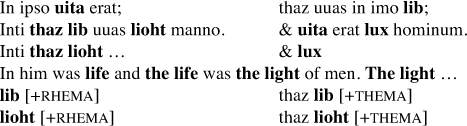
There are many other examples. In 9, an OHG line is followed by the corresponding Latin text: 9a shows the first mention of the noun boat, while example 9b shows the second mention of this noun.
- (9)
a. 52.1 Imo stigantemo in skef folgetun imo sine iungiron.
Et adscendente eo in navicula secuti sunt eum discipuli eius.
‘With him climbing into (the/a) boat, his disciples followed him.’
b. 52.2 … thaz skef uuard bithekit mit then undon.
… navicula operiretur flucyibus.
‘the/that ship was covered with waves.’
Example 10 offers especially compelling evidence for article use: Since thiu scaf and thio zigun refer to hypothetical sheep and lambs, it is very unlikely that thiu/thio is a demonstrative. For more examples of this type see Appendix.
(10) 152.2 so hirti zisceidit scaf fon zigon, inti sezzit thiu scaf fon sineru zesavvun inti thio zigun fon sineru uuinistrun.
Sicut pastor segregate oves ab hedis, et statuet oves quidam a dextris suis, hedos autem a sinistris.
‘Thus (a) shepherd separates sheep from lambs and sets the sheep at his right and the lambs at his left side.’
The Evangelienbuch also contains many determiners that appear to be proximal articles. It is more difficult to determine whether they are ar-ticles or demonstratives though, since the Evangelienbuch is an original composition, with no Latin text for comparison. However, there is one clear example:
(11) I.3.9-12 Ni was Noe, ih sagen thir ein,
not was Noah, I tell you once,
in then thaz minnista deil,
among them the least part
‘I tell you now, Noah was not the least of them.’
The determiner in this example is almost certainly an article, not a demonstrative, since the author is not pointing out and comparing specific parts (deil). The Evangelienbuch also contains many clear examples of distal articles.
3.3. Distal Use of the Article
All of the works examined show that distal articles can be used for at least some of the purposes identified above. However, none of them contain examples of a distal article used with referents with inalienable properties. In this section, various distal uses of the article are discussed.
First, an article can be used to express the uniqueness of an object. In PDG, nouns that denote unique objects such as sun, moon, earth, devil, heaven, hell, life, death, sin, and night require an article. In contrast, in the OHG translation of the Isidor or Tatian uniqueness does not seem to play a role in article use. The Isidor translation has words for sun, earth, heaven, and devil that never appear with a determiner of any kind. Similarly, the selection from the Tatian translation contains words for earth, life, and sin that are never used with an article to express unique-ness.
In the Evangelienbuch, however, an article is used with unique objects. The first mention of night (naht) and foundation (of the earth) (fundament) contains an article:
- (12)
a. II.1.13 Er mano rihti thia naht,
before moon steered the night
joh wurti ouh sunna so glat,
and became also sun so smooth
‘before the moon steered the night and before the sun
became so smooth’
b. II.1.22 thaz fundament zi houfe, thar thiu erda ligit ufe:
the foundation to ground where the earth lies on:
‘the foundation was laid where the earth now lies’
This usage is common in PDG and other Germanic languages, but it is applied to somewhat different sets of nouns in different languages and dialects. Otfrid mentions heaven (himil), earth (erda), moon (mano), and sun (sunna) for the first time without an article. The use of the article to encode uniqueness tends to expand over time. Examples 16 show the early stages of such use.
Second, an article can be used with nouns whose referents are iden-tified by a prenominal adjective. The older Germanic languages use the so-called strong and weak declensions to indicate indefiniteness and definiteness, respectively. In OHG, the following adjective forms were uninflected: in the nominative case, masculine/feminine/neuter forms, both singular and plural, and in the accusative case, the neuter singular form. The uninflected forms arose through loss of unstressed syllables. Then new adjectival inflection was created by adding to these uninflected forms either nominal endings inherited from Proto-Indo-European or recently introduced pronominal endings. Thus, a strong declension came into being, which in the modern Germanic languages indicates indefinite-ness.
Interestingly, pronominal inflections are not used for masculine or neuter nouns in the Isidor translation, and of 20 feminine examples, only five show pronominal inflection (Braune/Eggers Reference Braune and Eggers1975:216, Anm. 2). These uninflected adjectives, in fact, do not seem to indicate indefinite-ness of the noun they modify; on the contrary, the nouns appear to be definite by identifiability:
(13)
A good test for the use of a determiner solely as a definiteness marker is its compatibility with superlatives. “It is a general fact that languages which have definiteness marking use it with superlatives: the cleverest boy, *a cleverest boy. And it is clear that what is involved here is definiteness in the narrow, grammatical sense” (Lyons Reference Lyons1999:246). In the Isidor translation, there are only 3 examples of superlatives modifying nouns. Two of them contain a determiner:
- (14)
a. IV.2 in dhemu eristen deile
‘in the first part’
b. V. 9 mit dhem hohistom salidhom
‘with the highest holiness’
These determiners can hardly be considered demonstratives in this context. There is one example of a postposed adjective with weak declension:
(15) V.1 frido herost-o
peace highest-def
‘the highest peace’
There are many examples of superlatives used as adjectival nouns. Some of them appear with determiners:
- (16)
a. IV.4 in dhemu eristen
‘in the first’
b. V.4 dher hohist-o
the highest-def
‘the highest one’
c. IX.9 dhea herost-un
the highest-def
‘the highest ones’
However, other such adjectival nouns show either weak declension alone, as in 17, or null declension, as in 18.
(17)
(18)
In all of the above examples, there is some kind of definite marking. The occasional use of an article, even though definiteness could be marked by adjective declension alone, indicates that there is a grammatical tran-sition underway.
In the language of the Tatian translation, it is also possible to mark definiteness on an adjective by using the weak declension, as shown in the first line of example 19 (the -e ending).
(19)
When the weak declension is used in conjunction with a determiner, it continues to be used as an agreement feature marking definiteness along-side the determiner. This may explain why unstressed adjectival endings did not disappear: They were repurposed as agreement.
It is likewise possible to mark indefiniteness with the strong adjective declension alone.
(20)
Here, again, the declension functions as agreement when used within a semantically indefinite context, for instance, with the weak quantifier many:Footnote 2
(21)
The strong declension is also used with collectives and abstract nouns:
(22)
In contrast to the Isidor translation, the selections from the Tatian translation do not contain definite objects with an adjective and a deter-miner. Adjective declension in the Evangelienbuch appears the same as in the Isidor in the sense that the use of an article with definite objects modified by adjectives appears to be optional:
(23)
The word wine in each example can be said to be definite based on the adjective declension and/or the context. In 23a, the speaker is referring to a specific type wine, the better one of two, and an article is used. In 23b, (the) very best wine is definite wine but not specific or identifiable wine, and therefore, an article apparently is not required.
Third, an article can be used with nouns that name generic objects. In the Isidor translation and in the selections from the Tatian translation, an article is not found with generic objects. In the Evangelienbuch, how-ever, determiners are used in cases of what could be called a generic reference:
(24)
In these examples, the nouns in question all refer to people in general. The use of the article may also have to do with the fact that they are all in the genitive case (see section 3.1 above).
There is another type of generic reference to something other than people that requires the use of the article in cases other than genitive:
(25)
Here Otfrid is referring to literature and the books of the bible in general. The Isidor and Tatian translators may not have had any opportunity to use articles for such references.
Fourth, an article can appear with nouns whose referents are iden-tifiable. In the Isidor translation, determiners and possessive adjectives appear with certain referents at all times including the first mentioning, regardless of how they appear in the Latin source. In the Isidor, these referents are primarily well-known biblical characters and things. For example, burc when it refers to Jerusalem, tempil when it refers to the temple in Jerusalem, and samanunge in the sense of synagogue, always appear with a determiner. Dhazs heilege chiscribe ‘the Holy Scripture’ always appears with a determiner and an adjective (see Jäger Reference Jäger1917:37–42). This kind of determiner use appears to be motivated by identifiablity alone. It conveys no proximal or distal sense and should therefore be considered an article.
The Tatian translation also provides evidence of identifiability being encoded by determiners used as articles. The word for savior appears as ther heilant 13 times in the text selections. It appears without a determiner only when used to address Christ.
In all cases, heilant/ther heilant is a translation of the Latin Ihesus. It would not make sense for the translator to use it in the distal (or proximal) sense of that/this savior so many times throughout the text when it is clear to the audience to whom he is referring. This must be an example of an article. There are other examples of this type:
(26)
The gastihus is the inn where Mary and Joseph wish to stay the night of Jesus’ birth, and it is only mentioned this one time in the text. The sea (that is, the Sea of Galilee) is not mentioned previously. These deter-miners therefore do not contain a deictic element and are better described as articles.
The selection from the Evangelienbuch also contains examples of an article used with nouns whose referents are identifiable to the reader:
(27)
All of these nouns are mentioned for the first time in the passages above. They all refer to the structure of poetry. Since they denote entities known to the reader or listener, the article encodes their identifiability.
Finally, an article can be used in cases of associate occurrence. In the Tatian translation, there is another example of determiners that for simi-lar reasons are not likely to be demonstratives:
- (28)
a. 5.1 Iesse gibar Dauiden then cuning.
Jesse begat David.accthe.acc king.acc
‘Jesse begat David the King.’
b. 5.2 Dauid ther cuning gibar Salomonen.
David the king begat Salomon.acc
‘David the King begat Salomon.’
King David is not mentioned previously in the text. The determiner therefore cannot be a demonstrative or express an anaphoric relationship. It is used in an associative occurrence and as such is a distal definite article. The Isidor and the selections from the Evangelienbuch do not contain examples of this use of the definite article.
3.4. Cliticized Articles
Finally, certain determiners appear as clitics. Since a stressed word such as a demonstrative would not cliticize, this clearly shows that these words are articles.
(29) Ein scaf er stantan gisah, thaz was zem opphere gimah;
a sheep he standing saw that was to-the sacrifice suited
‘He saw a sheep standing there that was suitable for sacrifice.’
This preposition-determiner contraction occurs throughout the Evan-gelienbuch with the preposition zu and the determiners them (zem) and ther (zer). The fact that this contraction exists shows that them and ther cannot be demonstratives in those instances, as only an unstressed function word, such as an article, could cliticize. In 33, them is used as a distal article with a noun (sacrifice) whose referent is identifiable in the wider context and that has not been previously mentioned. Although the contraction never occurs with other prepositions in the Evangelienbuch, new grammatical constructions often begin with a narrow scope of applicability. Then they either expand their scope over time or die out. The zum contraction probably represents the initial stage, following which, during Middle High German and PDG, the scope of the construction expands to include other prepositions and articles. This process, known as extension, is beyond the scope of the present article. For a similar development involving the extension of the -st verb ending in OHG, see Somers Reference Somers2011. As an affix, the article is in stage 4 of the DP cycle, as defined by van Gelderen.
4. Summary and Conclusions
I can now construct a more nuanced explanation of article use in the major OHG texts. All three works employ a definite article. The differ-ence between them and the PDG texts is in how the use of the article is restricted. I have shown that the development of articles in OHG did not happen quickly and in all contexts simultaneously.
The OHG works all contain an article used for partitive genitives and a proximal article. The proximal article developed from the demon-strative, and the partitive genitive use of the article was probably the first use of the new article. The development of the definite article in the works examined here cannot be viewed as a purely teleological develop-ment though; the works examined are snapshots of different dialects that do not necessarily represent stages in a singular development. All of the works contain a distal article used with nouns whose referents are identi-fiable to the reader. Distal article use with other types of nouns varies widely. The distal article was found with prenominal adjectives in the Isidor translation and in the Evangelienbuch selections. The absence of a distal article in the selections from the Tatian translation may be coincidental. It may be present in other parts of the work, which were not selected.
Both works that contain the distal article also contain prenominal adjectives that alone convey (in)definiteness: Strong and weak declension conveys indefiniteness and definiteness, respectively. This indicates that the article was still in the process of developing this function. Associative use of the distal article was found only in the selections from the Tatian translation. Use of the article for generic and unique objects was found only in the Evangelienbuch selections. Use for generics and uniques is the most abstract use of the distal article. This usage may therefore be a late development, but comparative work is necessary to confirm this hypothesis. The Evangelienbuch also contains examples of the earliest article clitics, restricted to the preposition zu used with singular, masculine, and neuter nouns. These preposition/determiner con-junctions are the most compelling evidence for the definite article, since cliticization only occurs with unstressed grammatical items, that is, articles, not demonstratives.
The evolution of article use appears to progress from less abstract to more abstract. Once the article acquires more abstract functions, its phonological form starts to become reducible, which allows cliticization, and the next stage of the DP/definiteness cycle (stage 4: affixation) is realized.
APPENDIX
The selections from the Tatian translation contain many such genitives (see example 6 in the main text). In all instances except 53.9, the noun in the genitive case appears for the first time in the corresponding narrative:
Examples from the Evangelienbuch of determiners in the genitive case that appear everywhere where they are not part of a possessive construction (see example 7 in the main text):
Examples of nouns from the Tatian translation that appear for the first time without a determiner and when the object or person is referred back to, with a determiner (see examples 9 and 10 in the main text):
52.3 Her tho uuas in themo skefe ubar houbitphuliuui slafenti.
Ipse vero erat in puppi super cervical dormiens.
‘At that time he was sleeping on pillows in the/that ship.’
52.3 Ein habeta in imo diuuala …
Unus enim habebat demonia …
‘One had demons in him …’
52.4 Noh mit ketinun giu mohta in einig man gibintan, uuanta her of to mit fuozthruhin inti mit ketinun gibuntan zibrah thie ketinun inti thio fuozthruhi…
Et neque catenis iam quisquam eum poterat ligare; quoniam Sepe compedibus et catenis vinctus disrupisset catenuas et compedes comminuisset …
‘No-one could keep him bound with chains anymore because often when he was bound with foot shackles and chains he broke the/those chains and smashed the/those foot shackles …’
53.9 Uuas thar nalles fer fon in cutti suino managero ezenti. Thie diuuala batun in sus quedante: oba thu unsih uzuuerphes, senti unsih in thaz cutti thero suino.
Erat autem non longe ab illis grex porcorum multorum pascens. Demones autem rogabant eum dicentes: si eicis nos, mitte nos in gregem porcorum.
‘Not far from him there was (a) herd of pigs feeding. The demons bade him thus saying: if you throw us out, send us into the/that herd of pigs.’
53.10 Sie tho uzgangante fuorun in thiu suin, inti mit mihhilu ungirehhu thaz cutti uuas biskrenkit in then seo …
At illi exeuntes abierunt in porcos, et mango impetus grex precipitatus est in mare …
‘Then going out they went into the/those pigs and with (a) great commotion the/that herd was drowned in the sea …’
53.11 Thie sie fuotiritun fluhun inti sagetun in burgi inti accarun allu.
Qui autem pascebant eos fugerunt et nuntiaverunt in civitate et in agros omnia.
‘Those who cared for them fled and told everyone in (the) town and fields.’
53.12 Senu tho al thiu burg gieng ingegin themo heilante, inti gisehanemo imo inti then man sizzentan fon themo thie diuuala uzgiengun …
Et ecce tota civitas exit obviam Ihesu et viso eo et hominem sedentem a quo demonia exierant …
‘So then all the/that town went toward the Savior and seeing him and the/that man from whom the/those demons had left …’
53.13 Mit thiu her tho arsteig in skef, bat in ther man fon themo thie diuuala uzgiengun …
Cumque ascenderet navem rogabat eum vir a quo demonia exierant …
‘As he stepped into (the) boat, the/that man whom the demons had left begged him …’


