1. INTRODUCTION
Language planning institutions in France and Québec have traditionally exerted strong top-down influence on the French lexicon and continue to intervene in the usage of the language whenever they deem it necessary (Candel, Reference Candel and Lebreton2015, Reference Candel, van Ostade and Percy2017). In France, government-issued decrees since 1972 outline legal support for the work of so-called terminological commissions, aimed at replacing incoming foreign terms and expressions with French terminology. In Québec, the Charter of the French Language (1977) grants similar powers to the Office québécois de la langue française. While the long consultations and complex decision-making processes underlying the work of these professional lexical innovators remain mostly unknown to the public, the successes and pitfalls of some of their widely used lexical creations often elicit considerable public interest. New terms that made it into the mainstream, or seem likely to catch on eventually, such as ordinateur for ‘computer’, courriel for ‘email’, and not long ago infox for ‘fake news’, are recognized as successful acts of enrichment of the French language. Others are derided as failures that call into question the efficacy of the very same top-down terminological creation process; after all, accès sans fil (and its proposed abbreviation ASFI) and terminal de poche or ordiphone fell into oblivion in French linguistic history shortly after their official release as recommended alternatives for ‘wireless internet access (wifi)’ and ‘smartphone’ (Kim, Reference Kim2015, Reference Kim2018). However, rather than conducting ‘a discussion of change in the lexicon [that] soon descends the citation of individual examples’ (Posner, Reference Posner1997: 143), it seems much more appropriate to search for general processes and criteria that might propel some lexical innovations to thrive where others tend to fail.
While studies of historical, especially semantic, change in the lexicon have been abundant, previous scholarship on the systematic longitudinal effects of terminology creation in French is nonexistent. The few quantitative and attitudinal studies of the effects of prescriptivism seem to agree on one point: there are broad discrepancies between prescription and practice. Attempts at regulating the variable use of complex grammatical structures, such as the subjunctive mood and future tenses in formal written registers, for instance, have been blatantly ineffective due to the fact that prescriptivism tries to impose a strict form-function symmetry on an inherently variable linguistic system and, predictably, fails to influence vernacular usage at all (Poplack et al., Reference Poplack, Lealess and Dion2013; Poplack and Dion, Reference Poplack and Dion2009). It has also been shown that the French and the Québécois tend to demonstrate purist attitudes towards the influence of English, but speakers in Québec tend to be more inclined to use prescribed terminology than those in France (Walsh, Reference Walsh2016). With the increasing use, control and consumption of social media, official and spontaneous word creations can be expected to become more frequent and widely diffused (Blackwood, Reference Blackwood2013), which makes it particularly relevant to find out what could make some newly created terms thrive and others fall quickly into disuse.
In French today, English is perceived as the most productive donor language, making borrowings from English the most relevant source to test the efficacy of terminological prescription. The type of corpus selected for such a study also has to control for media and topic, since the probability of the entrenchment of English loanwords in French depends greatly on their frequency and dispersion across written registers (Chesley and Baayen, Reference Chesley and Baayen2010), and borrowings are more numerous in topics associated with the prestige of English in domains such as sport (Bernard-Béziade and Attali, Reference Bernard-Béziade and Attali2012; Martin, Reference Martin2007), music, entertainment, media (Ostyn et al., Reference Ostyn, Lienart and Klein1997), computer science and politics (Varga et al., Reference Varga, Orešković Dvorski and Bjelobaba2011), especially American politics (Chaput, Reference Chaput and Burger2010). While spoken language could provide abundant lexical borrowings, only their recurrence in widely diffused written media, among them newspapers, can be taken as indication of their use and entrenchment in the language (Saugera, Reference Saugera2017). Newspapers also provide a good test case for the longitudinal effects of prescription in written registers thanks to their frequency of publication and the strict editorial constraints to comply with standard language norms. Although newspapers are expected to comply with the rules of standard French, lexical borrowings have been shown to occur even in widely distributed, international journalistic writing.
This article proposes to measure the efficacy of top-down intervention on the lexicon from a single source: the publications of the Commission d’enrichissement de la langue française (CELF, ‘Commission for the Enrichment of the French Language’) in Journal officiel. Previous studies investigated terminology implantation drawing on manuals by multinational IT companies (Saint, Reference Saint2015), specialized communications in the domain of nanotechnology (Quirion, Reference Quirion2011), or newspaper articles from French-speaking territories (Kim, Reference Kim2015, Reference Kim2018) and they confirmed striking variation pertaining to the relative frequency of official recommendations: publications in Québec are more likely to reject Anglicisms when French terms are at their disposal. Rather than following previous studies that focused on a variety of prescriptive inputs during a given time period, this study applies precise data-analytical methods to a single, large and publicly available newspaper corpus to examine the variable use of English lexical borrowings and their prescribed French equivalents before and after the official date of publication of the new French term in Journal officiel, the legal source of laws, decrees and other official information published by the French Parliament and the national government. Using a single source as input leads to less contextual variation than in previous studies, which examined a wide variety of prescriptive literature or sources of opinion. It has the advantage of controlling for the type of innovation (single lexical items) and the onset and timeline of prescription (three years prior and after the official date of recommendation). Although prescription has had little effect on the use of complex grammatical structures, such as the subjunctive, it is expected to affect the lexicon more easily, since lexical change precedes grammatical change in contact situations (Poplack, Reference Poplack2018; Thomason and Kaufman, Reference Thomason and Kaufman1991). Target words examined in this study come from technology and entertainment industries, as they are among the most productive sources of lexical creation in contemporary French. Section 2 describes the sources of prescriptive terminology and English borrowings used in this study and explains the methods of data collection and analysis. Section 3 reports on the results of a generalized additive model and reveals that prescription does affect the probability of the use of some terms. The analysis will shed light on the proportion of successful terminological innovations and offer some insights into the possible role of the scope and readership of the French newspapers included in the corpus.
2. TERMINOLOGICAL COMMISSIONS IN FRANCE
Motivated by prescriptivism and purism (Thomas, Reference Thomas1991), the CELF in France puts in place extensive procedures to find the most suitable terms for objects, tools and concepts in the fields of science, technology, media and culture. In order to achieve this goal, the CELF coordinates the work of multiple universities, industry partners, ministry commissions and other language institutions such as the Académie française (‘French Academy’). The process of accepting and prescribing a new French term to replace a foreign expression also involves multiple steps of revisions. First, the new term is created by a group of experts including linguists and scientists, but also members of the community where the term is intended to be used. When the group of experts proposes a neologism, they are instructed to examine if creating that neologism is necessary, if the term is transparent (i.e. it is directly associated with the notion it covers), and if it complies with the morphological and syntactic rules of French. They can consult other francophone partner institutions, the Association française de normalisation (Afnor, ‘French Standardization Association’) and academic linguistic laboratories. Afterwards, the Académie française evaluates the proposal and decides whether to approve or to return it for further revisions. When a term is finalized, the proposal is submitted for ministerial approval. At the end, the term and its definition are published in the Journal officiel, as well as on FranceTerme, a website dedicated to the work of terminological commissions (Rapport annuel 2017 de la Commission d’enrichissement de la langue française, 2019).
The prescription procedure is informed and motivated by purism. The essence of purism lies in the attempt to rid the language of foreign elements by using two processes: saying not only what linguistic features ought to be included, but also what features are to be excluded (Langer and Nesse, Reference Langer, Nesse, Hernández Campoy and Conde Silvestre2012). Purism is directed primarily at the lexicon, but it affects the codification, cultivation and planning of all aspects of standard languages. It is often associated with the notions of ‘decadence’ and ‘corruption’ of a language and its lexical stock, and the responsibility to remedy this situation (Chansou, Reference Chansou2003). While purism is considered an abstract ideology motivating negative attitudes towards foreign elements in the language, prescriptivism is very much concrete: it is the materialization of purism. The quintessential trait that differentiates prescriptivism from purism lies in authority: while every speaker has the power to show purist attitudes towards a presumably ideal form of language, only a limited number of speakers with authority have the power to act by prescribing the use of that, purportedly ideal, form. Language laws are only one of the many forms of prescriptivism. Dictionary editors, grammar book authors and language instructors all have the means to demonstrate prescriptive tendencies. Thus, contrary to purism, prescriptivism is not inherently conservative; its norms can change (Walsh, Reference Walsh2014).
The goal of prescriptivism is to achieve a desired form, while language planning outlines how it can be done (Calvet, Reference Calvet2017). The French government’s decree of 7 January 1972 calls for terminological commissions to propose new terms to denominate new realities, or to replace lexical borrowings, and to publish them in the government gazette Journal officiel de la République française. The Bas-Lauriol Law of 31 December 1975 prohibits all foreign expressions in administrative publications, if a localized terminology is available. The Toubon Law of 4 August 1994 establishes that all public information should be accessible in French, including advertisements, contracts and communications. Even though the Toubon Law applies solely to the government, and it does not concern private entities, it has caused a controversy in France. In an attempt to harmonize the work of multiple terminological commissions, the decree of 3 July 1996 brought to life the Commission générale de terminologie et de néologie (‘General Commission of Terminology and Neology’), which was subsequently renamed Commission d’enrichissement de la langue française in the decree of 25 March 2015, while also altering the functions of the terminological commissions. The new decree specified that official terminology mandatorily replaced equivalent foreign expressions in state-issued publications, correspondences and documents. Additionally, its use is also obligatory in trade contracts dealing with public missions and services in France. And yet, to what extent mandatory terminology becomes mainstream remains an open question. Official language laws, including words produced by the CELF and published in Journal officiel, are merely recommendations for the public; they are not mandatory. Therefore, it is crucial to examine under what circumstances prescriptive efforts succeed, if at all, and when and how they are able to replace foreign borrowings with French-only terminology. The present article uses quantitative methodology borrowed from corpus linguistics to try to arrive at such generalizations.
3. METHODOLOGY
3.1. Corpus
The effect of prescription was examined using a combined variationist and corpus linguistic approach. The lexical items selected for this study were considered variables with two variants: the original English lexical borrowings and the French terms prescribed by the CELF. Occasionally, a third variant was also available, which was either a colloquial term or a prescribed term in Québec, but not in France. This third term was not included in the study. Measuring the use of both lexical items allows us to observe the recommended term’s relative frequency as opposed to its absolute frequency, which produces the implantation coefficient (Quirion, Reference Quirion2003). These lexical variables all belonged to the semantic fields of computer science, information technology, audiovisuals or entertainment industry, which have been shown to be productive domains in the late twentieth and early twenty-first century in previous scholarship. A total of 54 terms were selected as target variables in this study from the official list of more than 7,600 recommended terms published on FranceTerme. The selected terms were distributed among the following domains: 12 from audiovisuals, 2 from electronics, 26 from computer science and 14 from telecommunication. In the domain of audiovisuals, the lexical items denoted concepts related to television and cinema (e.g. blockbuster, prequel, trash television, trailer) as well as video games (e.g. gameplay, game designer). Computer science was represented by words related to computers (e.g. freeware, toner), the Internet (e.g. pop-up window, webcam, cloud computing), services offered on the web (e.g. triple play, bundle), and electronic devices and their contents (e.g. e-reader, e-book). The domain of telecommunication included terms that belong to traditional telephone (e.g. call center, SIM card, femtocell) and online communication (e.g. email, chat). Two items came from the domain of electronics: OLED (screen technology) and multitask. There was considerable overlap between the domains of these terms on FranceTerme. For instance, smartphone was listed under computer science, but it could just as well have been part of telecommunication. Similarly, tablet figured among audiovisuals, but it could have also been grouped within computer science. This overlap was due to the prescription procedure: officially recommended translations can be requested by different terminological commissions at the same time, which means that the definition of a term and its grouping into a given domain might very well depend on the commission that reviews it first. For this reason, these domains should be considered informative rather than deterministic groupings. They were not designated as factors in subsequent analyses.
To translate e-book, two terms were recommended by the CELF at two different times. On 18 January 2005, livre électronique was proposed, but on 4 April 2012 two additional recommendations were announced to make semantic nuances more explicit: livre numérique to designate the electronic version of a book and liseuse to refer to ‘e-reader’. Previously, these two meanings were both expressed by livre électronique; consequently, the 4 April 2012 decision rescinded the 18 January 2005 recommendation. Both terms were part of the present corpus, distinguished by the times of their recommendation. Such modifications underscore the flexibility of prescriptivism: in cases such as these, the terminological commissions decided to annul a previously prescribed term and recommend two new ones that they found better suited for multiple contexts of use.
Two types of newspaper sources were used based on their audiences: La Croix, Le Figaro, Le Monde, Le Parisien, Les Echos as newspapers with general audience and 01net and Journal du Net as newspapers targeting audiences specialized in new Internet technologies. The first category comprised five daily national newspapers from France of wide distribution, all covering a variety of topics. All five titles are published in France, but most of them are also accessible internationally, which means that a significant portion of the French-speaking population around the world can read them. As mentioned previously, lexical borrowings can occur even in widely distributed, international journalistic writing. The newspapers 01net and Journal du Net are published for specialized audiences, well-versed in new media and technologies, thus in these texts more English lexical borrowings were expected to occur. While all general audience newspapers are originally printed, it is essential to note that the specialized ones are primarily online publications. At the same time, being published primarily online would not affect the results as specialized professionals are assumed to regularly use the Internet.
The data were collected from Nexis Uni, an online database storing primarily journal articles, web-based publications and legal documents. Nexis Uni has limited access to certain selected newspaper titles in this corpus, which helped narrow the number of variables. Since the goal of this study was to observe the effect of top-down intervention on the probability of use of the prescribed terms, time was treated with a new approach, hitherto unattested in quantitative sociolinguistic studies. The frequencies of each term in the corpus (henceforth, term frequencies) were examined three years before and three years after the time of prescription to see whether a term had been attested before its official recommendation, and also whether prescription did or did not affect its probability of use after prescription. Thus, time was treated as a dynamic component: for each variable, time 0 marked the month of prescription and observation points expanded up to three years before and after time 0. For instance, tutoriel was prescribed for ‘tutorial’ in April 2007, thus the observed time period for this term stretched from April 2004 to April 2010.
3.2. Method
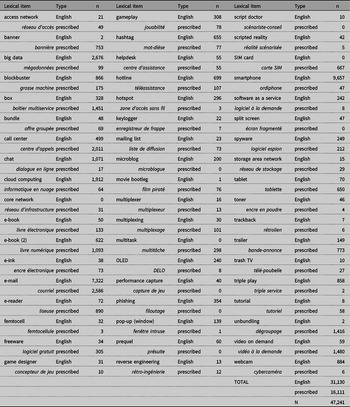
In the corpus, frequency equals the number of articles, even if the target term itself was repeated multiple times in the article. This approach allowed to control for articles that repeated a term and thus could have caused distortions in frequency counts: it might have looked like a given variant is abundantly used, when in reality, it was only used in one publication. This counting method aligns well with measurements of dispersion intended in this study. A total of 47,241 articles were collected for the 54 variables (Table 1, Appendix). Prescribed variants occurred in 16,111 articles (34%), while non-prescribed variants figured in 31,130 articles (66%). The five most frequent variants were English terms smartphone, email, big data, and prescribed terms courriel ‘email’, centre d’appels ‘call center’. There were six more variants used in more than 1,000 articles: English terms cloud computing and chat and prescribed terms vidéo à la demande ‘video on demand’, boîtier multiservice ‘box’, dégroupage ‘unbundling’, and livre numérique ‘e-book’. Nine variants had zero frequency: English terms core network, multitask, SIM card and prescribed terms microblogue ‘microblog’, capture de jeu ‘performance capture’, filoutage ‘phishing’, présuite ‘prequel’, scénariste-conseil ‘script doctor’ and écran fragmenté ‘split screen’. Even though these nine terms did not occur in the corpus, their English or prescribed equivalents did – they were thus included in the model.
Furthermore, in order to examine the effect of prescriptivism over time, generalized additive models (GAM) were implemented, using GAM in the mgcv (Mixed GAM Computation Vehicle) package in R (Wood, Reference Wood2017). Unlike traditional linear models that are fit to explore linear relationships between dependent and continuous independent variables, GAMs are preferred when linear relationships between variables cannot be assumed, for instance, due to nonlinear change over time and nested dependencies between variables (Winter and Wieling, Reference Winter and Wieling2016). In such cases, including the present corpus, rather than yielding ‘inferences’ based on raw frequency counts, GAMs provide ‘estimates’ about the ‘probability of use’ of dependent variables, and express those estimates as logistic values between 0 and 1. Thus GAM are considerably more flexible in uncovering hidden patterns in the data (Larsen, Reference Larsen2015). In this study, GAMs model the probability of use of each lexical item or variant, with the application value as the frequency count of the prescribed variant, measured against all other variants combined. The output of relative frequencies therefore corresponds to a six-year-long estimate of implantation coefficients. If prescriptivism does indeed have an effect on the probability of use of a prescribed variant after its prescription time, one would expect to see an increasing S-curve after prescription at time 0. As we shall see in the next section, some of the lexical variants examined in this study show such trajectories.
Several GAMs were tested by adding so-called ‘interactions’ and ‘smooths’ to the model. In the GAM evaluated as the best fit for the data, the logit probability of the frequency count of the prescribed variant is measured against the frequency counts of the other variants, with time added as a non-linear smooth term multiplied by the lexical items, while also adding lexical items and the newspaper source as main effects. Lexical items were included as by variables with the time smooth term in order to display individual patterns for the effect of prescription for each lexical item. This would not have been possible if lexical items had been used as a main effect. This method allowed a better understanding of how prescription affects each term over time to be gained. At the same time, since GAM can only take one by variable, newspapers were included as main effect, using mean estimates for each of them.
4. RESULTS
4.1. Summary tables
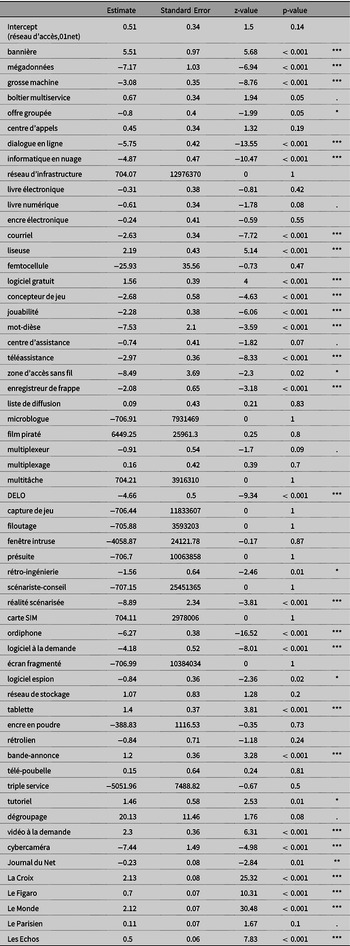
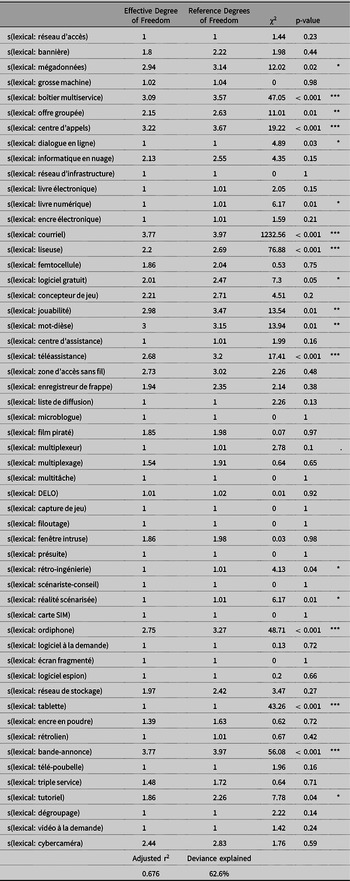
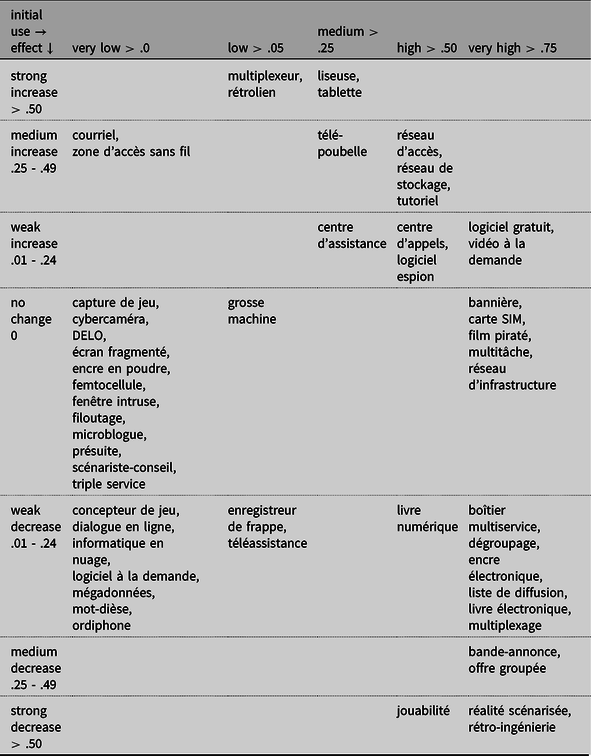
Summaries of parametric coefficients and approximate significance of smooth terms of the generalized additive models (GAM) for all 54 lexical variables and seven newspaper titles are shown in Tables 2 and 3 (Appendix). Parametric coefficients represent the main effects in the model for all lexical items and the estimated degrees of freedom in the summaries of the approximate significance of smooth terms indicate whether the smooth term is linear (close to 1), or non-linear (farther from 1). The measures ‘deviance explained’ (Table 3) is 62.7% and the adjusted r2 is 0.67, which suggests that the GAM used in this analysis represents a good model for the data. Although these summary tables contain p-values that traditionally indicate significance, in this study they are approximate and neglect smoothing parameter uncertainty. For this reason, a better interpretation of the results through the visualizations of probabilities of use patterns over time will be displayed in Figures 2 to 5 in the next sections, using the visreg (Breheny and Burchett, Reference Breheny and Burchett2017) and the ggplot2 packages in R (Wickham, Reference Wickham2009). The effects of initial use and of prescription from very low (> .0) to very high (>.75) for each term are summarized in Table 4 (Appendix).
4.2. Variation among newspapers
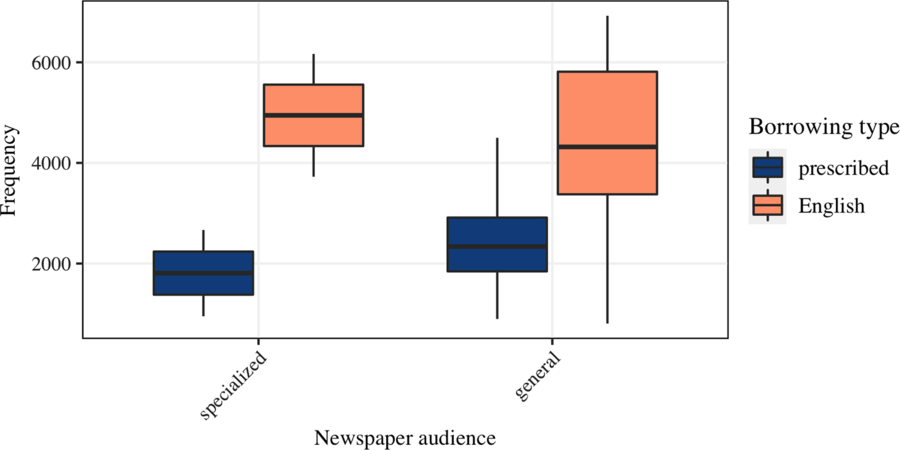
The newspaper sources show considerable variation in the use of the prescribed terms and their English equivalents (Figure 1). In the corpus of 47,241 articles, 33,732 are from general newspapers and 13,509 articles are from specialized newspapers. Prescribed variants occurred less frequently in the newspapers specialized in new Internet technologies, which thus confirms the hypothesis that these sources would be likely to choose the original lexical borrowing because their audience is exposed to the new realities of the tech industry earlier than the audience of the general newspapers. Figure 1 also suggests that prescription has little effect on terminology implantation in Journal du Net and 01net. In the case of the general newspapers, prescribed terminology also figures less frequently, although with increased variability among general newspaper titles. The distribution of the variables in these publications indicates that the conservative leaning Christian newspaper La Croix is particularly apt to use official terminology, surpassing slightly the use of English terms. Le Monde is also close to an even distribution, which is particularly interesting because it has the highest international readership among French national newspapers (BOOK Presse Grand Public 2016, 2017). One would assume that international expectations to comply with the standard written norms affects the use of prescribed terminology in a newspaper such as Le Monde, but this is not the case. Other national newspaper titles clearly prefer English variants in over two-thirds of all cases, with Le Parisien using the least prescribed terminology.
Distribution of prescribed vs. English lexical variants in general and specialized newspapers.

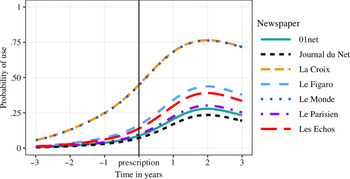
Figure 2 depicts the results of GAMs applied to all prescribed terminology combined over time in each newspaper. In this and all subsequent GAM visualizations, estimated probability values are shown on the vertical axis and time (in years) before and after the time of prescription appears on the horizontal axis. Since in the GAMs, newspaper sources were included as main effect and not a by variable of the smooth term, curves represent probabilities of use rather than frequency counts. The initial and the final probabilities of use across the observed time period correspond to the starting points and endpoints of each line shown in different colour lines. They allow us to evaluate whether a prescribed term had been used or not before its official prescription by the CELF (high or low values on the bottom left) and whether its probability of use increased or decreased over time (high or low values on the top right).
Estimated probabilities of use of prescribed terminology three years before and three years after prescription in each newspaper.

In Figure 2, the first observation to make is the distinct patterns of La Croix and Le Monde from the other newspapers, overlapping yellow and blue curves in the top of the figure, indicating that the estimated probabilities of use of prescribed terminology in both newspapers reach 0.72 by the end of the third year after prescription. Furthermore, even though prescribed terms are more or less frequent before prescription, official recommendation does boost their probability of use for at least a few years afterwards. The result, in each case, is a S-curve-like diffusion that is slow at first, but accelerated after the time of prescription and throughout most of the observed time period. There is a stable increase in the estimated probability of use reaching 0.38 in Le Figaro, 0.33 in Les Echos and 0.25 in Le Parisien. Le Figaro has a comparable size of readership to Le Monde, but it is considered more conservative, which might explain its tendencies to adopt prescribed terminology at a higher probability than other news sources, such as Les Echos.
The lowest increase among national newspapers with a general audience in Figure 2 is shown by Le Parisien. This could be due to its more colloquial news profile that would entail that lexical choices in Le Parisien tend to mirror everyday speech more closely, including the recurring use of newly adopted foreign borrowings for certain concepts. Although their estimated probabilities of use are on comparable paths to the general newspapers, the two specialized newspapers, 01net and 0.19 in Journal du Net, show more moderate uptakes over time. By the end of the third year after prescription, the model estimates a probability of use of officially recommended variants at 0.23 in 01net and 0.19 in Journal du Net. This suggests that these sources also employ prescribed variants, but less frequently than the other sources.
4.3. Positive effects of prescription
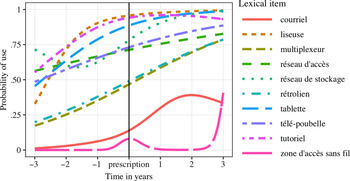
Figure 3 comprises terms that had the strongest increase in probability of use at one point after prescription. The term zone d’accès sans fil, recommended in 2005 for hotspot, shows one of the lowest estimated initial and final probabilities of use. Interestingly, its use in newspapers increased slightly at the time of prescription, but real uptake happened only at the end of the observed time period. Courriel¸ another term with low initial probability of use, on the other hand, shows a classic S-curve like diffusion, with just a slight decline at the end of the observed time period. The uptake of this term might have been boosted by its official recommendation for ‘email’ in Québec prior to its prescription in France. Among lowest initial uses on this figure belong to rétrolien and multiplexeur. The former, recommended for trackback and denoting a linking system between websites, is a loan creation based on rétro- and lien from 2010, while the latter, prescribed in 2003, is an assimilated loanword echoing the verb multiplexer, where the suffix -er was adapted as -eur. Both terms show a nearly identical and almost linear increase from low to very high probabilities of use in six years.
The estimated probability of use for terms showing strong and medium effects of prescription.

Among the terms that show strong effects of prescription, i.e. a boost of more than 0.50 in probability of use over time (Table 4, Appendix), liseuse and tablette had medium initial usage. Liseuse was prescribed in 2012 when the CELF revised its recommendation for e-book. Originally, in 2005, livre électronique was recommended as both the device and the digital copy of the book, which was annulled by the 2012 decision specifying that e-reader is ought to be translated as liseuse, a semantic loan that borrows the meaning of electronic reader to the already existing word liseuse. Tablette is a semantic loan from 2011 that contributes new meaning to the existing French word for ‘tablet’ (as in ‘a shelf’, ‘pharmaceutical tablet’ or ‘clay tablet’), and now it also refers to ‘tablet computer’ as in English. Similarities in form and word length observed for tablette ‘tablet’ might also have contributed to the strong increase in the probability of use of the prescribed term tutorial, recommended in 2007. Denoting to the training section of a game or a software, the term is based on the English tutorial, which derives from the English verb to tutor. Borrowing the adjectival suffix –el to transform the English borrowing into a quasi-cognate in French, tutoriel attests to the creative use of morpho-phonology in new terminology creation.
Six prescribed terms demonstrated medium effect of prescription, indicating an at least 0.25 increase by the end of the observed time period: courriel, réseau d’accès, réseau de stockage, télé-poubelle, tutoriel and zone d’accès sans fil. The highest initial and final usage is associated with réseau de stockage, prescribed for storage area network in 2010. This loan rendition does not include every element of the original English compound word because it omits area. Additionally, even though both réseau and stockage correspond to network and storage, respectively, stockage itself is an assimilated loanword from the English stock. Thus, it seems that stockage has already been so entrenched in French, that the CELF did not object to the use of this assimilated loan hence calquing a new term. Réseau d’accès and télé-poubelle, two other terms with high estimated initial and final probabilities of use, are a loan translation for access network from 2003 and a loan creation for trash TV from 2010. The latter is not considered a loan translation because télé- is truncated from télévision, making it more of a neologism than a translation, as the prefix itself means far in English. Similar to other terms with high probabilities of use, réseau d’accès and télé-poubelle also show a steady linear increase over time.
4.4. Weak to no effects of prescription
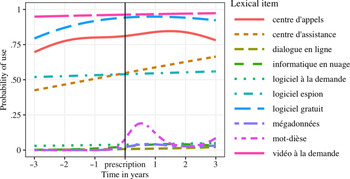
Prescribed terms for which prescription had only a weak effect, i.e., an increase of <0.25 in the probability of use over time (Table 4, Appendix), are shown in Figure 4. Centre d’appels, centre d’assistance, logiciel espion, logiciel gratuit and vidéo à la demande, all with >0.4 initial probabilities of use, the display medium to high initial usage. Centre d’appels is a loan translation prescribed in 2003 to replace call center. Perhaps the relative success of the prescribed variant lies in its form: it clearly refers to the same concept as the English borrowing, with the added advantage of being short as well. While the loan rendition centre d’assistance, prescribed in 2007, differs semantically from its English equivalent, help desk, it can help users link its referential meaning to a family of prescribed terms denoting locations rather than means of assistance. The jury is still out on logiciel espion, a compound loan translation from 2007, that is relatively unlikely to replace spyware based on its probability of use over the six-year period.
The estimated probability of use of the prescribed terminology three years before and three years after prescription with weak effects of prescription.

Semantic similarities with the already entrenched logiciel might be the reason for the high probability of use of logiciel espion, recommended for spyware. The same type of similarity might be at play for logiciel gratuit that appears to render well its English variant freeware, a portmanteau composed of free and software. The last term of this group is the prescribed variant vidéo à la demande, a loan translation of video on demand. This term, recommended in 2006, mirrors the original English compound, very likely contributing to its success in probability of use.
Among the terms with the weakest effects of prescription and very low initial use (see Table 4, Appendix), mot-dièse, is emblematic on social media. It is the prescribed term for hashtag, the pound symbol, used mainly on Twitter to tag words or expressions with a searchable link to express belonging to a topic. The word hashtag is never explicitly written out when the term is used: only the symbol #. However, when the discourse is about hashtag, the word is spelled out. Mot-dièse was recommended in 2013 to replace the original English word, but based on Figure 4, its probability of use did not have a remarkable uptake. The official term is a neologism, a loan rendition of hash by dièse (as in the musical symbol for ‘sharp’) and tag by mot. Even though it clearly refers to the symbol #, and it is as short as hashtag, its only uptake in France seems to have been due to the initial discussions that it sparked for a short time after its prescription. Its probability of use at year 3 of the observed period was among the lowest.
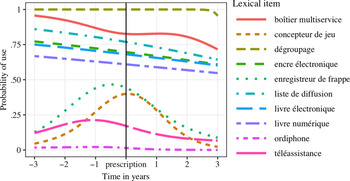
Terms for which final usage displayed no change or ended up even lower than their initial estimated probability of use are shown in Figure 5. One prescribed term in this group that has had virtually no attested initial usage and prescription did not affect this outcome either is ordiphone for ‘smartphone’. Other recommended variants, such as concepteur de jeu ‘game designer’, téléassistance ‘hotline’, and enregistreur de frappe ‘keylogger’ show medium to high estimated probability of use before prescription followed by decrease after prescription. Thus, even though the CELF adopted an already attested term as official terminology, prescription did not seem to help sustain the use of these promising terms. It is possible that newspapers reacted to the newly available terminology, but as time went by, they reverted to the English variants. Although the French concepteur de jeu, officially recommended by the CELF in 2011 for game designer, is a semantically transparent loan translation, game and designer, are well-attested Anglicisms in French, which might have contributed to the apparent success of their English compound over the officially preferred French term. Smartphone represents a particular case because the word is composed of the suffix -phone, which is natively used in French just as much as in English to denote ideas related to the telephone. The recommended term from 2009 itself, ordiphone, contains the same suffix. The prefix smart-, which refers to the ‘intelligence’ of the device compared to its predecessors, is quite productive in similar expressions, such as smart TV, smart fridge, smart home, etc. It is replaced by the prefix ordi-, which originates from the well-established prescribed term: ordinateur. And yet, despite the identical length and the similarity with other nativized expressions, ordiphone was clearly not preferred over smartphone.
The estimated probability of use of the prescribed terminology three years before and three years after prescription with weak negative effects of prescription.

Boîtier multiservice ‘box’, dégroupage ‘unbundling’, encre électronique ‘e-ink’, liste de diffusion ‘mailing list’, livre électronique ‘e-book’ and livre numérique ‘liseuse’ is among prescribed terminology with high (>.5) to very high (>.75) initial usage, whose probability of use either has not changed decreased over time. Yet again, as suggested in the visualization in Figure 5, the CELF adopted terms that were attested in previous usage, but prescription had no effect on their estimated probability of use over time. The term dégroupage, referring to the opening-up of a local telephone network to competition and widely used prior to its prescription as preferred to ‘unbundling’, was the only widely adopted variant in the corpus whose 100% probability of use was sustained at such levels for the observed period.
Boîtier multiservice was recommended in 2007 to replace ‘box’. This term attributes new meaning to boîtier, referring to a device through which multiple telecommunication services (e.g. telephone line, internet, television) can be accessed rather than to a particular service in the cloud. The recommendation by the CELF explicitly adds to the definition of boîtier multiservice the prohibition of using the English word box, which appears frequently in brand names. The English variant ‘mailing list’ differs somewhat from its prescribed counterpart liste de diffusion, which was created through loan rendition: while liste is equivalent to list in English, diffusion diverges from mailing. Nonetheless, recommended in 2007, liste de diffusion is successfully implanted probably thanks to its semantic similarities shared with ‘mailing list’.
The last term in this group unsuccessful terms, livre numérique, is a particular case because it represents only one of the official terms replacing ‘e-book’. In 2005, the CELF recommended livre électronique, a loan translation of electronic book subsequently shortened to ‘e-book’, as replacements for both the electronic device and the digital edition of a book. However, to further clarify the distinction between e-book and the device e-reader, the CELF decided to change its recommendation in 2012 and propose livre numérique for the book, and liseuse for the device. This proves the flexibility of prescriptivism, as opposed to purism: while the latter aims at preserving a state of the language perceived as prestigious, prescriptivism endorses change in order to provide language users with forms based on established consensus.
5. CONCLUSION
Table 4. (Appendix) presents the summary of initial use and effect of prescription for all 54 prescribed terms examined in this study. The diffusion of words with medium or low initial usage shows the largest effects of official recommendation, which suggests that top-down lexical change is the most successful when prescription follows usage. However, this general tendency has to be nuanced. Recommended terms with high probability of use throughout the observed period revealed that whenever the CELF endorsed a variant already well attested in usage, prescription did nothing more than endorsing a fait accompli: lexical change through the replacement of the English borrowing had already taken place and its statement by an official act seemed superfluous. However, when prescription followed the incipient uptake of a recommended term, i.e., it took place during the initial phases of diffusion, official recommendation could have boosted the probability of use of the new term. Such strong increases (that is, a high probable effect of prescription) characterized variants with previously attested medium initial usage. These variables included tablette ‘tablet’, liseuse ‘e-reader’, rétrolien ‘trackback’ and multiplexeur ‘multiplexer’, and with a moderate effect courriel ‘email’, réseau d’accès ‘access network’, télé-poubelle ‘trash tv’, tutoriel ‘tutorial’. What do these variants have in common? The answer seems straightforward: their length compares favorably to that of their English equivalents, the two share obvious semantic similarities or the recommended terms are direct translations of the English borrowings, with a clear reference to meaning. And yet, there are many prescribed terms characterized by the same similarities that do not enjoy a comparable increase in probability of use. Among the examples was ordiphone that could have indeed replaced ‘smartphone’, as well as microblogue ‘microblog’, femtocellule ‘femtocell’, and so on.
Other terms with weak effect of prescription display merely noticeable increase, yet they constitute change compared to initial usage. These included dialogue en ligne, informatique en nuage, logiciel à la demande, mégadonnées and mot-dièse. Big data is a relatively recent buzzword to characterize a great amount of available information, and it was meant to be replaced by mégadonnées in 2014. Even though the official term possesses the same elements of the compound word with the prefix méga- equaling big, big data seems to be too well entrenched in journalistic texts. Cloud computing has also gained popularity thanks to cloud services such as Dropbox or iCloud. While nuage is a semantic loan prescribed in 2010 and providing an already existing word with new meaning based on its English borrowing, it does not compare with the use of cloud. In spite of the slight uptake of logiciel à la demande after its official recommendation in 2013 for ‘software as a service’, its probability did not significantly increase. In fact, ‘software as a service’ was affected by word formation processes that seem to have propelled its abbreviated form SaS to greater use, becoming brand-like attributes to its respective service. The prescribed variant was not able to achieve the same level of recognition.
Certain lexical terms seemed to have been utterly unaffected by prescription, following their own trajectory, no matter how popular they were before they were officially recommended. Among them were prescribed variants used with high initial probability in specialized contexts, such as dégroupage ‘unbundling’ and encre électroniqe ‘e-ink’ and enregistreur de frappe ‘keylogger’ that did not demonstrate an uptake soon after the prescription time.
As far as the actual frequency counts of the two lexical variants were concerned, overall all journalistic publications demonstrated some uptake in probability of use of prescribed terms over time, but in varying degrees. Generally speaking, specialized newspapers presented the lowest probability of use of prescribed terminology: their lexical preferences, even if initially affected by prescription, remained favorable to English. General newspapers, on the other hand, gladly complied, in particular La Croix and Le Monde that displayed the strongest compliance with the new prescriptive lexical norms. There was no overwhelming evidence from this corpus that political preferences could influence the use of prescribed terminology. Future studies of more extensive newspaper sources could focus on the publication and editorial processes rather than generalizations based on political affiliation.
Although this study has identified several promising general tendencies, it still remains unclear what led to increase in probability of use. In earlier versions of the generalized additive model the type of borrowings (e.g. calque, loan translation, loan rendition) was used as a main effect, but it did not yield any significant effect. Additionally, the time period based on the year of prescription was also included to investigate why terms such as ordinateur for ‘computer’ and écran for ‘screen’ were successful, and ordiphone for ‘smartphone’ and écran fragmenté for ‘split screen’ were not. However, the model’s estimates were not improved by the time period, which means that post-2000 official recommendations behaved in a similar fashion than earlier recommendations.
In conclusion, targeted frequency counts and generalized additive models revealed that there is considerable variation among the prescribed variants with regards to the uptake of previously more or less well-entrenched terminology after prescription time. At this point, the question is whether we can accept that each prescribed variant has a unique story to tell, and there is no recipe for their successful implantation in use. If that were the case, one would not have advanced any more in our discoveries of ‘general processes of change in the lexicon’ (see Posner’s comment in the Introduction). However, it seems that the results of this study are encouraging enough to make three general observations. The first is that prescription is most effective when it endorses the incipient change of a previously attested term. The second is that for lexical variants that already enjoy high probability of use, prescription is largely superfluous, although it can conceivably provide legitimacy for continued use. For lexical variants with low or medium probability of use, success is not foreseeable; their individual histories could be preferable, indeed.
APPENDIX
Summary of article counts by lexical item and type used for the newspaper analysis

Summary of the parametric coefficients in the GAM for the newspaper corpus
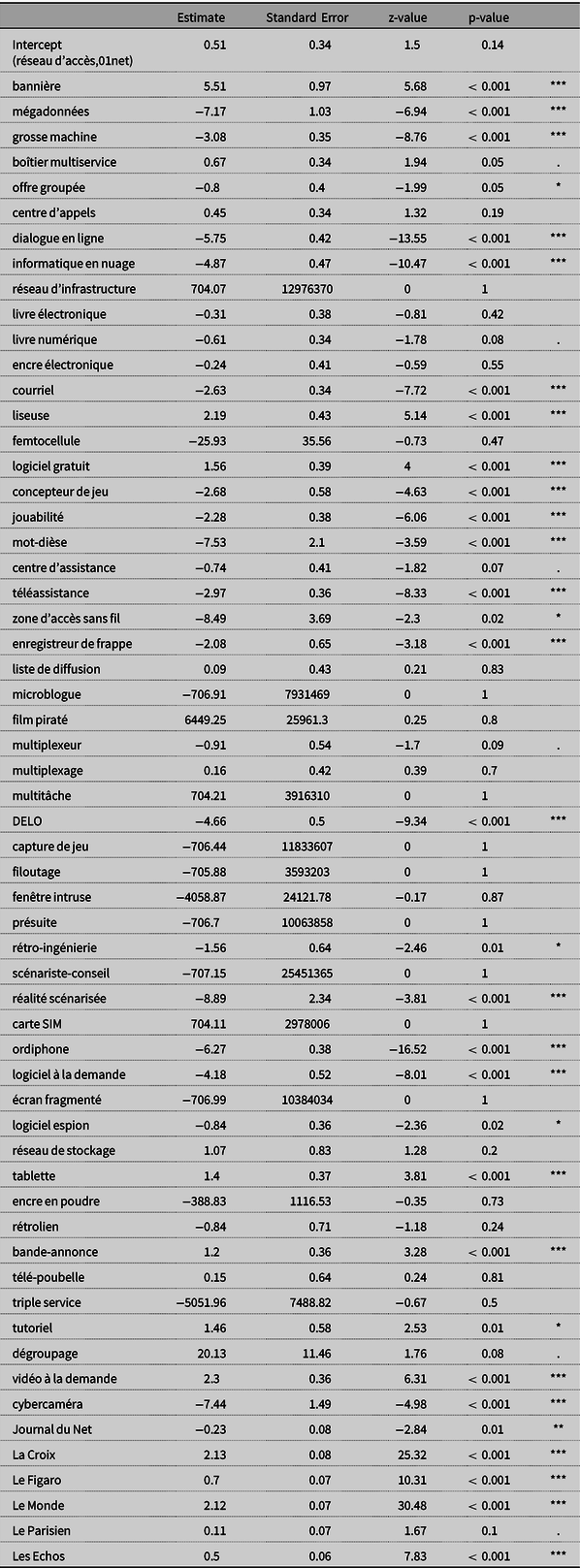
Significance codes: 0 ‘***’ 0.001 ‘**’ 0.01 ‘*’ 0.05 ‘.’ 0.1 ‘ ‘ 1
Approximate significance of smooth terms in the GAM for the newspaper
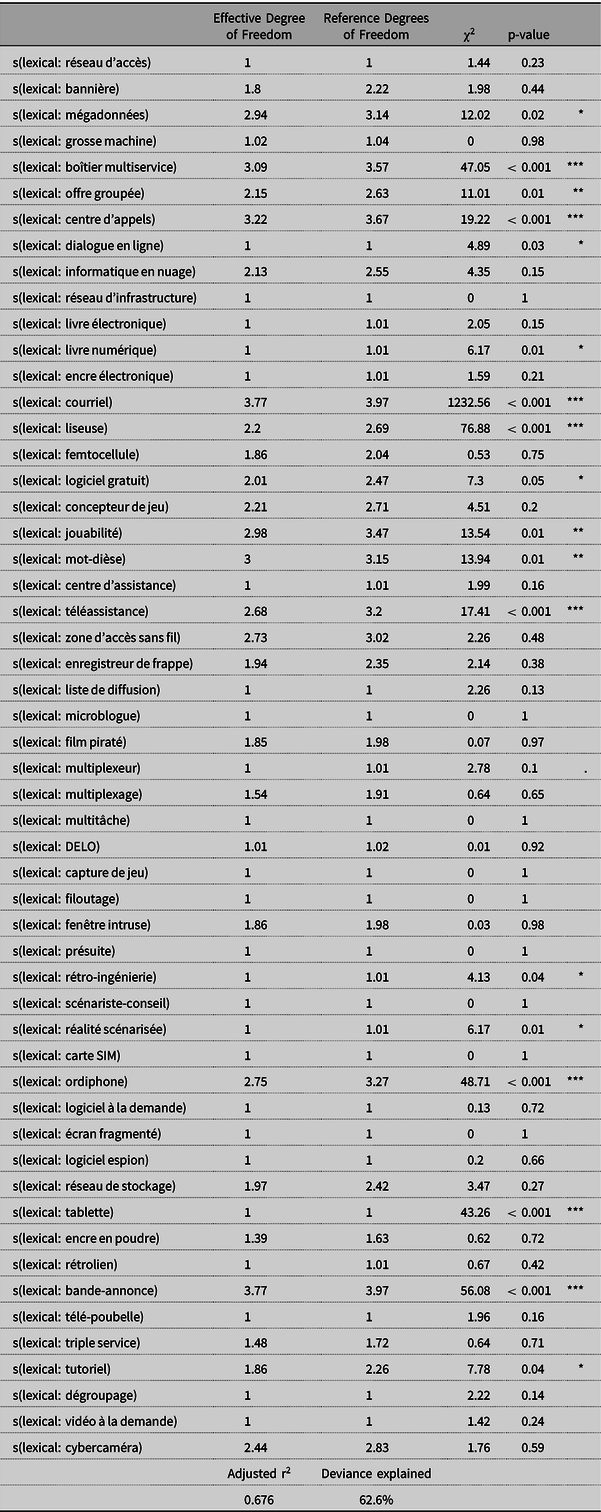
Significance codes: 0 ‘***’ 0.001 ‘**’ 0.01 ‘*’ 0.05 ‘.’ 0.1 ‘ ‘ 1
The effect of prescription for the 54 prescribed terms in light of the initial usage. The strongest increase (i.e. the highest effect) is found for terms with medium and low initial usage