Nomenclature
- RBF
radial basis function
- LOS
line of sight
- PNGL
proportional navigation guidance law
- TPNGL
true proportional navigation guidance law
- GTPNGL
generalized true proportional navigation guidance law
- PPNGL
pure proportional navigation guidance law
- IPNGL
ideal proportional navigation guidance law
- MPC
model predictive control
- SMDO
sliding mode disturbance observer
- ISS
input to state
- NTSMGL
nonlinear terminal sliding mode guidance law
1.0 Introduction
In the past few decades, proportional navigation guidance law (PNGL) has been the widely used homing missile interception strategy, because of its advantages such as simple calculation, robustness and practicability [Reference Ben-Asger, Farber and Levinson1]. References [Reference Gao, Li, Feng and Jing2–Reference Cho and Kim6] also proposed some variation forms of proportional navigation guidance law (PNGL), such as adaptive motion camouflage proportional guidance law, true proportional navigation guidance law (TPNGL), generalized true proportional navigation guidance law (GTPNGL), pure proportional navigation guidance law (PPNGL) and ideal proportional navigation guidance law (IPNGL), and discussed their advantages and disadvantages. In the terms of different requirements and constraints, especially for manoeuvering targets and impact angle constraints, scholars have put forward many improved PNGL forms, while PNGL is more suitable for interception of non-manoeuvering targets. When intercepting targets with strong manoeuverability, the performance of the PNGL algorithm will be reduced. This defect promotes the research of advanced control method and its application in the design of the missile guidance system.
In recent years, some progress has been made in the research of three-dimensional guidance law design. In Ref. [Reference Cho, Kim and Park7], a three-dimensional nonlinear trajectory tracking guidance law, on the back of differential geometry of space curves, got into the public scene. The guidance law makes the aircraft converge to the ideal path of a given general shape and move along it without restrictions on the initial position and velocity. In Ref. [Reference Fu, Liu, Zhang and Xia8], an adaptive three-dimensional PNGL based on convex optimisation is proposed to for the problem of LOS angle and acceleration constraints. By solving the optimisation problem, the proportional guidance gain is obtained. In Ref. [Reference He, Wang and Wang9], based on multivariable control design method, a suboptimal three-dimensional guidance law with end-angle constraint is proposed for intercepting unknown manoeuvering targets. The guidance law is essentially a compound control method, which is a combination of standard continuous model predictive control (MPC) and adaptive multivariable sliding mode disturbance observer (SMDO). They are used to track the optimal LOS angle of non-manoeuverable targets and to estimate the unknown manoeuvering information of compensated targets online. In Ref. [Reference Li and Ji10], based on the finite time input-to-state (ISS) theory, a three-dimensional nonlinear guidance law with finite time convergence is proposed in the absence of linearisation hypothesis and target acceleration estimation. The line-of-sight angular rates can be stabilised within a small convergence range in a finite time. In Ref. [Reference Man, Liu and Li11], a nonlinear suboptimal guidance law, which minimises an integrated quadratic performance index, appears. To simplify the guidance algorithm, theta-D method is used to replace solving Hamilton-Jacobi-Bellman equation of the nonlinear system. In Ref. [Reference Weiss and Rusnak12], a three-dimensional guidance law was designed based on the feedback linearisation method for the problem of missile intercepting manoeuvering targets at any initial heading. In Ref. [Reference Yan, Zhu, Kuang and Yuan13], a guidance law based on computational geometry of three-dimensional collision time and angle constraints is introduced. The guidance law allows the missile to move to the target along a specific trajectory. The collision line forms a direction consistent with the expected collision angle, so as to meet the collision angle constraint, and the impact time is controlled by adjusting the length of the trajectory. In Ref. [Reference Ji, Lin, Wang, Hu and Pei14], based on sliding mode control theory and backstepping design technology, a robust guidance law for three-dimensional manoeuvering target interception considering autopilot dynamics and terminal angle constraints is raised. A second-order adaptive sliding mode observer is used to estimate target manoeuver, so that the missile can accurately intercept the target in a limited time. In Ref. [Reference Shafiei and Vazirpour15], based on the approach of discrete-time partial stabilisation, a robust guidance law for intercepting manoeuvering targets in a three-dimensional environment is presented.
For the past few years, sliding mode variable structure control theory has been widely used in guidance law design because of its good robustness to external disturbances and parameter perturbations [Reference Guo, Li and Zhou16]. However, most of the developed sliding mode guidance laws are only exponentially or asymptotically stable, and usually only when the time is close to infinity, will the designed sliding surface tend to zero or its very small neighborhood [Reference Li, Shin and Tsourdos17]. Generally speaking, the flight time of missile terminal guidance is very short, so the design of guidance law should consider the finite time convergence control method. In recent years, novel sliding-mode guidance law with finite time convergence has been proposed, which includes second-order sliding mode guidance law [Reference Zhang, Xia and Li18, Reference He, Lin and Wang19], fast terminal sliding-mode guidance law [Reference Sun, Wang, Yi and Xiong20], nonsingular terminal sliding-mode guidance law [Reference Song, Song and Zhou21–Reference Wu, Cai, Zhao and Wang23], output feedback continuous terminal sliding mode guidance law [Reference Zhao, Li, Yang and Li24], adaptive second-order nonsingular terminal sliding mode guidance law [Reference Xu, Gao, Fang, Wang and Li25], integral sliding mode guidance law [Reference Zhang, Fu, Li and Xia26, Reference Song and Song27] and super-twisting integral sliding mode guidance law [Reference Meng and Zhou28].
However, chattering of sliding mode control is a tricky problem, which will cause serious harm to guidance system. This undesirable phenomenon is caused by the discontinuous switching function in the guidance law. To solve this problem, it is common to approximate discontinuous sign functions with continuous sigmoid functions [Reference Kumar and Ghose29]. However, there are still the following disadvantages. (1) The sigmoid function cannot guarantee the finite time convergence of the sliding mode variables in the presence of external perturbations. (2) The sigmoid function cannot make the sliding variable drive to zero. (3) The sigmoid function is not directly considered in stability analysis.
So far, the techniques of disturbance and uncertainty estimation such as nonlinear disturbance observer [Reference Zhang, Gai, Zhong and Zhang30], nonhomogeneous disturbance observer with finite time convergence [Reference Zhao and You31], fixed-time convergence disturbance observer [Reference Yang and Xia32], extended high gain observer [Reference Ma, Khalil and Yao33], robust nonlinear disturbance observer [Reference Chwa34], extended state observer [Reference Lin, Hsieh and Lin35, Reference Zhao, Chao, Wang and Yang36, Reference Duan, Zhou and Cheng37] and nonlinear robust H-infinity observers [Reference Liao, Luo, Ji and Gai38], have made important contributions to the treatment of many uncertain disturbances in guidance systems.
At present, although there are a large number of research results for the design of three-dimensional guidance law, the following problems still need to be solved: (a) Under the condition that the overload capability of the missile does not take an obvious advantage, it can intercept the large manoeuvering target accurately; (b) accurately estimate the disturbance of the guidance system caused by the target manoeuver; (c) line-of-sight angle and line-of-sight angle rate converge in finite time.
If the above problems are solved, the high manoeuvering target will be intercepted more accurately in three-dimensional space. The main contributions and innovations of the guidance law proposed in this paper are summarised as follows:
(1) In the guidance law proposed in this paper, non-singular terminal sliding surface is designed and a fast power reaching law is selected. This allows the line-of-sight angle and line-of-sight angle rate to converge in finite time. At the same time, the chattering phenomenon of sliding mode control is eliminated.
(2) A new global RBF neural network is proposed to accurately estimate the perturbation of the guidance system caused by target manoeuvering. Compared with Refs [Reference Ji, Lin, Wang, Hu and Pei14, Reference Si and Song39, Reference Si and Song40], this method can realise the estimation and compensation of target manoeuvering without knowing the upper bound of target manoeuvering. In order to improve the estimation accuracy and accelerate the convergence characteristics of RBF neural network, the parameters of RBF neural network are adjusted online in real time.
(3) An adaptive law is designed to compensate the estimation error of RBF neural network and improve the convergence speed of the guidance system. This allows the missile without a significant advantage in overload capability to successfully intercept more than 20g large manoeuvering targets with higher accuracy.
Moreover, literature [Reference Jiang, Wang and Dong41] also uses the RBF neural network disturbance observer and non-singular terminal sliding mode control to design a guidance law. However, it differs from the guidance law proposed in this article in the following aspects:
(a) The non-singular terminal sliding mode surface is different. The non-singular terminal sliding mode surface proposed in this paper adopts a segmented design idea and has higher convergence accuracy.
(b) RBF neural network adaptive parameter design methods are different, this paper can make RBF neural network parameters adaptive adjustment to the optimal, and use the adaptive law to further eliminate the neural network disturbance estimation error. Therefore, the disturbance estimation accuracy is higher than that of the method in Ref. [Reference Jiang, Wang and Dong41].
(c) The guidance law proposed in this paper is based on three-dimensional space, while that of in Ref. [Reference Jiang, Wang and Dong41] only considers the two-dimensional plane.
The remainder of this article is organised as follows. In Section 2, equations of guidance system for the missile intercepting the target is presented in three-dimensional space. In Section 3, a new three-dimensional finite-time guidance law based on sliding mode adaptive RBF neural network is proposed for highly manoeuvering targets, and the finite-time convergence and stability are proved. In Section 4, the numerical simulation results are carried out under different kinds of scenarios of missile intercepting highly manoeuvering targets to demonstrate and evaluate the effectiveness and superiority of the proposed guidance law. In Section 5, the crucial conclusion of the whole paper is presented.
2.0 Formulation of guidance mode
This article only models the navigation system. In the establishment of guidance model, we regard the missile as a mass point, without considering its aerodynamic characteristics, mass characteristics, inertia characteristics as well as propulsion characteristics, and without limiting its flight envelope. It assumes that the available overload of the missile flight control system is 40g.
This section demonstrates equations of guidance system for the missile intercepting the target. In order to be more practical and reduce the influence of coupling between channels, the three-dimensional guidance model is considered. Figure 1 shows the three-dimensional relative motion of a missile to a target. In the guidance model, the missile and the target are treated as particles. The missile is denoted by M and the target is denoted by T. Mxyz is an inertial coordinate system.
 $ Mx_{4}y_{4}z_{4} $
is a line-of-sight coordinate system. The relative distance between the missile and the target is denoted by R. The elevation and azimuth angles of the line-of-sight are denoted by
 $ {q_\varepsilon } $
and
 $ q_{\beta} $
, respectively. The vectors of the missile’s acceleration and target’s acceleration are denoted by
 ${a_M} = {[\begin{array}{*{20}{c}}{{a_{MR}}}&{{a_{M\varepsilon }}}&{{a_{M\beta }}}\end{array}]^T}$
and
 ${a_T} = {[\begin{array}{*{20}{c}}{{a_{TR}}}&{{a_{T\varepsilon }}}&{{a_{T\beta }}}\end{array}]^T}$
in the line-of-sight coordinate system separately.
Three-dimensional relative motion of a missile to a target.

The relative motion equation of a missile to a target can be obtained from Fig. 1. Let the rotational angular velocity of the line-of-sight coordinate system relative to the ground inertial coordinate system be
 $ \omega $
. The relative velocity vector is expressed in Equation (1).
 \begin{equation} {{V}}(R,{q_\varepsilon },{q_\beta }) = \left[ {\begin{array}{*{20}{c}} {\dot R}\\ {R{{\dot q}_\varepsilon }}\\ { - R{{\dot q}_\beta }\cos {q_\varepsilon }} \end{array}} \right]\end{equation}
According to the solution method of vector derivative, Equation (2) can be obtained.
 \begin{equation} \frac{{d{{V}}}}{{dt}} = {\bf{\omega }} \times {{V}} + \frac{{\partial {{V}}}}{{\partial t}} = {a_T} - {a_M}\end{equation}
In Equation (2),
 $ dV/dt $
is the derivative of the relative velocity with respecting to time in inertial coordinates.
 $ \partial V / \partial t $
is the derivative of the relative velocity with respecting to time in the line-of-sight coordinate system.
 $ \omega\times $
is given by Equation (3).
 \begin{equation}\omega \times = \left[ {\begin{array}{*{20}{c@{\quad}c@{\quad}c}} 0&{ - {{\dot q}_\varepsilon }}&{{{\dot q}_\beta }\cos {q_\varepsilon }}\\ {{{\dot q}_\varepsilon }}&0&{ - {{\dot q}_\beta }\sin {q_\varepsilon }}\\ { - {{\dot q}_\beta }\cos {q_\varepsilon }}&{{{\dot q}_\beta }\sin {q_\varepsilon }}&0\end{array}} \right] \end{equation}
Substituting Equations (1) and (3) into Equation (2), we can get Equation (4).
 \begin{equation} \begin{split} \left[ {\begin{array}{*{20}{c@{\quad}c@{\quad}c}} 0&{ - {{\dot q}_\varepsilon }}&{{{\dot q}_\beta }\cos {q_\varepsilon }}\\ {{{\dot q}_\varepsilon }}&0&{ - {{\dot q}_\beta }\sin {q_\varepsilon }}\\ { - {{\dot q}_\beta }\cos {q_\varepsilon }}&{{{\dot q}_\beta }\sin {q_\varepsilon }}&0 \end{array}} \right]\left[ {\begin{array}{*{20}{c}} {\dot R}\\ {R{{\dot q}_\varepsilon }}\\ { - R{{\dot q}_\beta }\cos {q_\varepsilon }} \end{array}} \right] + \\ \left[ {\begin{array}{*{20}{c}} {\ddot R}\\ {R{{\ddot q}_\varepsilon } + \dot R{{\dot q}_\varepsilon }}\\ { - R{{\ddot q}_\beta }\cos {q_\varepsilon } - \dot R{{\dot q}_\beta }\cos {q_\varepsilon } + R{{\dot q}_\varepsilon }{{\dot q}_\beta }\sin {q_\varepsilon }} \end{array}} \right] = {a_T} - {a_M} \end{split}\end{equation}
Expanding Equation (4) produces Equation (5).
 \begin{equation}\left\{ \begin{array}{l} \ddot R - R\dot q_\varepsilon ^2 - R\dot q_\beta ^2{\cos ^2}{q_\varepsilon } = {a_{TR}} - {a_{MR}}\\[5pt] R{{\ddot q}_\varepsilon } + 2\dot R{{\dot q}_\varepsilon } + R\dot q_\beta ^2\sin {q_\varepsilon }\cos {q_\varepsilon } = {a_{T\varepsilon }} - {a_{M\varepsilon }}\\[5pt] - R{{\ddot q}_\beta }\cos {q_\varepsilon } - 2\dot R{{\dot q}_\beta }\cos {q_\varepsilon } + 2R{{\dot q}_\varepsilon }{{\dot q}_\beta }\sin {q_\varepsilon } = {a_{T\beta }} - {a_{M\beta }}\end{array} \right.\end{equation}
From Equation (5), we can solve for
 $ {\ddot q_\varepsilon } $
and
 $ {\ddot q_\beta } $
, given by Equation (6).
 \begin{equation} \left\{ \begin{array}{l} {{\ddot q}_\varepsilon } = - \dfrac{{2\dot R}}{R}{{\dot q}_\varepsilon } - \dot q_\beta ^2\sin {q_\varepsilon }\cos {q_\varepsilon } - \dfrac{{{a_{M\varepsilon }}}}{R} + \dfrac{{{a_{T\varepsilon }}}}{R}\\[4pt] {{\ddot q}_\beta } = - \dfrac{{2\dot R}}{R}{{\dot q}_\beta } + 2{{\dot q}_\varepsilon }{{\dot q}_\beta }\tan {q_\varepsilon } + \dfrac{{{a_{M\beta }}}}{{R\cos {q_\varepsilon }}} - \dfrac{{{a_{T\beta }}}}{{R\cos {q_\varepsilon }}} \end{array} \right.\end{equation}
According to Ref. [Reference Sun, Wang, Yi and Xiong20], the problem of missile collision angle constraint is equivalent to that of line-of-sight angle tracking. The desired terminal line-of-sight angles are defined as
 $ {q_{\varepsilon d}} $
and
 $ {q_{\beta d}} $
. let
 $ {x_1} = {q_\varepsilon } - {q_{\varepsilon d}} $
,
 $ {x_2} = {q_\beta } - {q_{\beta d}} $
,
 $ {x_3} = {\dot q_\varepsilon } $
,
 $ {x_4} = {\dot q_\beta } $
. The guidance system state equation in three-dimensional space can be demonstrated by Equation (7).
 \begin{equation}\left\{ \begin{array}{l} {{\dot x}_1} = {x_3}\\[4pt] {{\dot x}_2} = {x_4}\\[4pt] {{\dot x}_3} = - \dfrac{{2\dot R}}{R}{x_3} - {x_4}^2\sin {q_\varepsilon }\cos {q_\varepsilon } - \dfrac{{{a_{M\varepsilon }}}}{R} + {d_\varepsilon }\\[7pt] {{\dot x}_4} = - \dfrac{{2\dot R}}{R}{x_4} + 2{x_3}{x_4}\tan {q_\varepsilon } + \dfrac{{{a_{M\beta }}}}{{R\cos {q_\varepsilon }}}{\rm{ + }}{d_\beta }\end{array} \right.\end{equation}
In Equation (7),
 $ {d_\varepsilon } $
and
 $ {d_\beta } $
are the disturbance caused by the manoeuvering information of the target. The expressions of
 $ {d_\varepsilon } $
and
 $ {d_\beta } $
are respectively demonstrated by Equation (8).
 \begin{equation}\left\{ \begin{array}{l} {d_\varepsilon }{\rm{ \;=\; }}\dfrac{{{a_{T\varepsilon }}}}{R}\\ {d_\beta } = - \dfrac{{{a_{T\beta }}}}{{R\!\cos {q_\varepsilon }}}\end{array} \right.\end{equation}
Equation (7) can be further simplified into Equation (9). The expressions of
 $ {{{f}}_1} $
,
 $ {{{f}}_2} $
and
 $ {b_1} $
,
 $ {b_2} $
are respectively demonstrated by Equations (10) and (11).
 \begin{equation}\left\{ \begin{array}{l} {{\dot x}_1} = {x_3}\\[4pt] {{\dot x}_2} = {x_4}\\[4pt] {{\dot x}_3} = {{{f}}_1}{{ + }}{b_1}{a_{M\varepsilon }} + {d_\varepsilon }\\[4pt] {{\dot x}_4} = {{{f}}_2} + {b_2}{a_{M\beta }} + {d_\beta }\end{array} \right.\end{equation}
 \begin{equation}\left\{ \begin{array}{l} {{{f}}_1} = - \dfrac{{2\dot R}}{R}{x_3} - {x_4}^2\sin {q_\varepsilon }\cos {q_\varepsilon }\\[7pt] {{{f}}_2} = - \dfrac{{2\dot R}}{R}{x_4} + 2{x_3}{x_4}\tan {q_\varepsilon }\end{array} \right.\end{equation}
 \begin{equation}\left\{ \begin{array}{l} {b_1} = - \dfrac{1}{R}\\[6pt] {b_2} = \dfrac{1}{{R\cos {q_\varepsilon }}}\end{array} \right.\end{equation}
3.0 The design of guidance law
In this section, a new three-dimensional finite-time convergence guidance law is developed, based on sliding mode adaptive RBF neural network against highly manoeuvering targets. By using the Lyapunov stability theory, the finite-time convergence and stability are analysed, and the optimal adaptive parameters are designed.
The guidance system Equation (9) can be rewritten as Equation (12)–(14).
 \begin{equation}x{\rm{ \;=\; }}\left[ \begin{array}{l} {x_1}\\ {x_2}\end{array} \right] = \left[ \begin{array}{l} {q_\varepsilon } - {q_{\varepsilon d}}\\ {q_\beta } - {q_{\beta d}}\end{array} \right]\end{equation}
 \begin{equation}\dot x{\rm{ \;=\; }}\left[ \begin{array}{l} {{\dot x}_1}\\ {{\dot x}_2}\end{array} \right]{\rm{ \;=\; }}\left[ \begin{array}{l} {x_3}\\ {x_4}\end{array} \right] = \left[ \begin{array}{l} {{\dot q}_\varepsilon }\\ {{\dot q}_\beta }\end{array} \right]\end{equation}
 \begin{equation}\ddot x{\rm{ \;=\; }}\left[ \begin{array}{l} {{\dot x}_3}\\ {{\dot x}_4}\end{array} \right] = {{f + Bu}} + d\end{equation}
where
 \begin{equation}{{f = }}\left[ \begin{array}{l} {{{f}}_1}\\ {{{f}}_2}\end{array} \right]{\rm{ \;=\; }}\left[ \begin{array}{l} - \dfrac{{2\dot R}}{R}{x_3} - {x_4}^2\sin {q_\varepsilon }\cos {q_\varepsilon }\\[7pt] - \dfrac{{2\dot R}}{R}{x_4} + 2{x_3}{x_4}\tan {q_\varepsilon }\end{array} \right]\end{equation}
 \begin{equation}{\rm{B = }}\left[ {\begin{array}{*{20}{c@{\quad}c}} {{b_1}}&0\\ 0&{{b_2}}\end{array}} \right]{\rm{ \;=\; }}\left[ {\begin{array}{*{20}{c@{\quad}c}} { - \dfrac{1}{R}}&0\\[9pt] 0&{\dfrac{1}{{R\cos {q_\varepsilon }}}}\end{array}} \right]\end{equation}
 \begin{equation}{{d = }}\left[ \begin{array}{l} {d_1}\\ {d_2}\end{array} \right]{\rm{ \;=\; }}\left[ \begin{array}{l} {d_\varepsilon }\\ {d_\beta }\end{array} \right] = \left[ \begin{array}{l} \dfrac{{{a_{T\varepsilon }}}}{R}\\ - \dfrac{{{a_{T\beta }}}}{{R\cos {q_\varepsilon }}}\end{array} \right]\end{equation}
 \begin{equation}{{u = }}\left[ \begin{array}{l} {{{u}}_1}\\ {{{u}}_2}\end{array} \right]{\rm{ \;=\; }}\left[ \begin{array}{l} {{{u}}_\varepsilon }\\ {{{u}}_\beta }\end{array} \right]{\rm{ \;=\; }}\left[ \begin{array}{l} {a_{M\varepsilon }}\\ {a_{M\beta }}\end{array} \right]\end{equation}
3.1 Guidance law design and its stability analysis
In order to cancel the line-of-sight angle error and allow the line-of-sight angle rate to converge quickly to zero, an appropriate non-singular terminal sliding surface is designed. The specific form is as follows:
 \begin{equation}s{\rm{ \;=\; }}\left[ \begin{array}{l} {s_1}\\ {s_2}\end{array} \right] = \left[ \begin{array}{l} {{\dot x}_1} + {\alpha _1}{x_1} + {\alpha _2}g({x_1})\\ {{\dot x}_2} + {\alpha _1}{x_2} + {\alpha _2}g({x_2})\end{array} \right] = \dot x + {\alpha _1}x + {\alpha _2}g(x)\end{equation}
where
 $ {\alpha _1} > 0,{\alpha _2} > 0 $
and
 $ g(x) \in R $
is defined as follows:
 \begin{equation}g(x){\rm{ \;=\; }}\left[ \begin{array}{l} g({x_1})\\ g({x_2})\end{array} \right]\end{equation}
 \begin{equation}g({x_{\rm{i}}}){\rm{ \;=\; }}\left\{ \begin{array}{l} {\rm{sig}}{({x_i})^\lambda },\\[4pt] {\gamma _1}{x_i} + {\gamma _2}sign({x_i}){x_i}^2\end{array} \right.\begin{array}{*{20}{c}} {}\\[4pt] ,\end{array}\begin{array}{*{20}{c}} {}\\[4pt] {}\end{array}\begin{array}{*{20}{c}} {\left| {{x_i}} \right| > \eta }\\[4pt] {\left| {{x_i}} \right| \le \eta }\end{array}\begin{array}{*{20}{c}} {}&{i = 1,2}\end{array}\end{equation}
 \begin{equation}{\gamma _1}{\rm{ \;=\; }}(2 - \gamma ){\eta ^{\lambda - 1}}\end{equation}
 \begin{equation}{\gamma _2}{\rm{ \;=\; }}(\gamma - 1){\eta ^{\lambda - 2}}\end{equation}
where
 $ 0 < \lambda < 1 $
,
 $ 0 < \gamma < 1 $
and
 $ \eta $
is a small positive constant.
 $sig{({x_i})^\lambda } = {\left| {{x_i}} \right|^\lambda }{\mathop{\rm sgn}} ({x_i})$
.
Remark 1. The sliding surface proposed in this paper can ensure that the sliding manifolds converge to a small area instead of zero within a finite time, avoiding the system chattering phenomenon caused by crossing the sliding surface, and at the same time, ensure that the system state converges to a small area in a finite time. The following Theorem 1 reveals a detailed explanation.
The derivative of s is expressed as follows.
 \begin{equation}\dot s{\rm{ \;=\; }}\left[ \begin{array}{l} {{\dot s}_1}\\ {{\dot s}_2}\end{array} \right] \;=\; \ddot x + {\alpha _1}\dot x + {\alpha _2}\dot g(x){{ = f + Bu}} + d{{ + l}}\end{equation}
where
 \begin{equation} {{l = }}{\alpha _1}\dot x + {\alpha _2}\dot g(x)\end{equation}
 \begin{equation}\dot g(x){\rm{ \;=\; }}\left[ \begin{array}{l} \dot g({x_1})\\ \dot g({x_2})\end{array} \right]\end{equation}
 \begin{equation}\dot g({x_{\rm{i}}}){\rm{ \;=\; }}\left\{ \begin{array}{l} \lambda {\left| {{x_i}} \right|^{\lambda {\rm{ - }}1}}{{\dot x}_i},\\[4pt] {\gamma _1}{{\dot x}_i} + 2{\gamma _2}{x_i}{{\dot x}_i}sign({x_i})\end{array} \right.\begin{array}{*{20}{c}} {}\\[4pt] ,\end{array}\begin{array}{*{20}{c}} {}\\[4pt] {}\end{array}\begin{array}{*{20}{c}} {\left| {{x_i}} \right| > \eta }\\[4pt] {\left| {{x_i}} \right| \le \eta }\end{array}\begin{array}{*{20}{c}} {}&{i = 1,2}\end{array}\end{equation}
In order to make the system state trajectory converge rapidly from the initial state to the designed sliding mode surfaces, a fast power reaching law is selected as follows:
 \begin{equation}\dot s{\rm{ \;=\; }}\left[ \begin{array}{l} {{\dot s}_1}\\[4pt] {{\dot s}_2}\end{array} \right] = - {{{k}}_2}s - {k_1}{\rm{sig}}{(s)^\gamma }{\rm{ \;=\; }}\left[ \begin{array}{l} - {{{k}}_2}{s_1} - {k_1}{\rm{sig}}{({s_1})^\gamma }\\[4pt] - {{{k}}_2}{s_2} - {k_1}{\rm{sig}}{({s_2})^\gamma }\end{array} \right]\end{equation}
where
 $ {k_1} > 0,{k_2} > 0 $
.
Then design the guidance law as follows:
 \begin{equation}{{u = }} - {{{B}}^{ - 1}}({{f}} + \hat d + {{ad + l + }}{{{k}}_2}s{{ + }}{k_1}{\rm{sig}}{(s)^\gamma })\end{equation}
where
 $ \hat d $
shown as Equation (30) is the estimation term of the system disturbance d caused by the target manoeuvering. ad is an adaptive term in order to eliminate the influence of system disturbance estimation error on the guidance system and improve the convergence speed of the guidance system. The expression of the adaptive term ad is designed as Equation (31). In this equation, the first term is used to accelerate the convergence rate of the guidance system and the second term is used to reduce the impact of the system disturbance estimation error.
 \begin{equation}\hat d{{ = }}\left[ \begin{array}{l} {{{{\hat d}}}_1}\\[4pt] {{\hat d}_2}\end{array} \right]\end{equation}
 \begin{equation}{{ad = }}\left[ \begin{array}{l} {{a}}{{{d}}_1}\\[9pt] a{d_2}\end{array} \right]{{ = }}\left[ \begin{array}{l} \dfrac{{{s_1}}}{{\left| {{s_1}} \right| + \mu }}{{\hat \chi }_1} + {{\hat \delta }_1}\\[9pt] \dfrac{{{s_2}}}{{\left| {{s_2}} \right| + \mu }}{{\hat \chi }_2} + {{\hat \delta }_2}\end{array} \right]\end{equation}
where
 \begin{equation}\dot {\hat{\delta _i}} = {\eta _1}{{{s}}_i},i = 1,2\end{equation}
 \begin{equation}{\dot {\hat{\chi_i}}}=\dfrac{{{s_i}^2}}{{\left| {{s_i}} \right| + \mu }},i = 1,2\end{equation}
 \begin{equation}{\tilde \chi _{{i}}}{\rm{ \;=\; }}{\hat \chi _i}{\rm{ - }}{\chi _i},i = 1,2\end{equation}
Next, the stability and finite time convergence of the guidance system will be analysed and proved. Before that, the following lemma is introduced.
Lemma 1. [Reference Si and Song39] For the nonlinear system
 $ {{\dot x = }}f(x,t),x \in {R^n} $
, it can assume that there exists a positive definite and continuous function V(x).The derivative of V(x) satisfies inequality (35)
 \begin{equation}{{\dot V}}(x) \le - \mu {{V}}(x) - \lambda {{{V}}^\alpha }(x)\end{equation}
where
 $ \mu > 0,\lambda > 0 $
and
 $ 0 < \alpha < 1 $
, if the initial time is
 $ {{{t}}_0} $
and
 $ {{x}}({{{t}}_0}) = {{{x}}_0} $
, the time from the initial state to the equilibrium point of the system satisfies the following inequality:
 \begin{equation}{\rm{T}} \le \frac{1}{{\mu (1 - \alpha )}}\ln \frac{{\mu {{{V}}^{1 - \alpha }}({x_0}) + \lambda }}{\lambda }\end{equation}
This inequality indicates that the system states converge in a finite-time.
Theorem 1. For the guidance system (14), the sliding mode surface is given as Equation (19), the reaching law is given as Equation (28) and the guidance law is given as Equation (29). We can achieve the following conclusions.
-
(a) In a finite-time, the sliding manifold s is converged to the small region
 $ \left| {\rm{s}} \right| \le {\varepsilon _1} $
, where
$ {\varepsilon _1} $
is a very small positive constant.
-
(b) In a finite-time, the line-of-sight angle errors
$ {q_\varepsilon } - {q_{\varepsilon d}} $
and
$ {q_\beta } - {q_{\beta d}} $
are converged to the small regions
$ \left| {{q_\varepsilon } - {q_{\varepsilon d}}} \right| < \eta $
and
$ \left| {{q_\beta } - {q_{\beta d}}} \right| < \eta $
, where
$\eta $
is a very small positive constant. -
(c) In a finite-time, the line-of-sight angle rate
$ {\dot q_\varepsilon } $
and
$ {\dot q_\beta } $
are converged to the small regions
$ \left| {{{\dot q}_\varepsilon }} \right| < \eta \eta $
and
$ \left| {{{\dot q}_\beta }} \right| < \eta \eta $
, where


 \begin{equation}\eta \eta {\rm{ \;=\; }}{\alpha _1}\eta {\rm{ + }}{\alpha _2}{\eta ^\lambda }{\rm{ + }}{\varepsilon _1}\end{equation}
Proof. A Lyapunov function
 $ {{{V}}_1} $
is selected as Equation (38).
 \begin{equation}{{{V}}_1}{\rm{ \;=\; }}\frac{1}{2}{s^{{T}}}s\end{equation}
The residual estimation error of the guidance system disturbance is expressed as follows:
 \begin{equation}\left| {d - \hat d - {{ad}}} \right| \le \varepsilon\end{equation}
The derivative of
 $ {{{V}}_1} $
is expressed as follows.
 \begin{equation}\begin{array}{l} {{{{\dot V}}}_1}{\rm{ \;=\; }}{s^{{T}}}\dot s\\[4pt] {\rm{ = }}{s^{{T}}}({{f + Bu}} + d{{ + l}})\\[4pt] {\rm{ = }}{s^{{T}}}(d - \hat d - {{ad}} - {{{k}}_2}s - {k_1}{\rm{sig}}{(s)^\gamma })\\[4pt] \le - {{{k}}_2}{\left| {{s}} \right|^2} - {k_1}{\left| {{s}} \right|^{\gamma {\rm{ + }}1}}{\rm{ + }}\varepsilon \left| {{s}} \right|\end{array}\end{equation}
Rewrite the formula (40) into the following two forms:
 \begin{equation}{{{\dot V}}_1} \le - {{{k}}_2}{\left| {{s}} \right|^2} - ({k_1}{\left| {{s}} \right|^\gamma } - \varepsilon )\left| {{s}} \right|\end{equation}
 \begin{equation}{{{\dot V}}_1} \le - ({{{k}}_2}\left| {{s}} \right| - \varepsilon )\left| {{s}} \right| - {k_1}{\left| {{s}} \right|^{\gamma {\rm{ + }}1}}\end{equation}
When
 $ {k_1}{\left| {{s}} \right|^\gamma } - \varepsilon \ge 0 $
,
 $ \left| {\rm{s}} \right| \ge {(\varepsilon /{k_1})^{1/\gamma }} $
,
 \begin{equation} {{{\dot V}}_1} \le - {{{k}}_2}{\left| {{s}} \right|^2} = - 2{{{k}}_2}{{{V}}_1}\end{equation}
When
 $ {{\rm{k}}_2}\left| {\rm{s}} \right| - \varepsilon \ge 0 $
,
 $ \left| {\rm{s}} \right| \ge (\varepsilon /{k_2}) $
,
 \begin{equation} {{{\dot V}}_1} \le - {k_1}{\left| {{s}} \right|^{\gamma {\rm{ + }}1}} = - {2^{\frac{{\gamma {\rm{ + }}1}}{2}}}{{{k}}_1}{{{V}}_1}^{\frac{{\gamma {\rm{ + }}1}}{2}}\end{equation}
It can be known from Lemma 1 and the inequality (43) and (44) that the sliding manifold s is converged to the small region
 $ \left| {{s}} \right| \le \min \left\{ {{{(\varepsilon /{k_1})}^{1/\gamma }},} \right.\left. {(\varepsilon /{k_2})} \right\}{\rm{ \;=\; }}{\varepsilon _1} $
within a finite-time. where
 $ {\varepsilon _1} $
is a very small positive constant. Therefore, conclusion (a) is proved.
Case 1.
 $ If \left| {{{{x}}_i}} \right| \ge \eta ,i = 1,2 $
, A Lyapunov function
 $ {{{V}}_2} $
is selected as Equation (45).
 \begin{equation} {{{V}}_2}{{ = }}\frac{1}{2}{{{x}}_i}{{{x}}_i} ,{{ i}} = 1,2\end{equation}
When
 $ \left| {{s}} \right| \le \min \left\{ {{{(\varepsilon /{k_1})}^{1/\gamma }},} \right.\left. {(\varepsilon /{k_2})} \right\}{\rm{ \;=\; }}{\varepsilon _1} $
, according to Equation (19), the inequality (46) can be obtained.
 \begin{equation}{{{\dot x}}_i} \le - {\alpha _1}{{{x}}_i} - {\alpha _2}{\rm{sig}}{({x_i})^\lambda }{\rm{ + }}{\varepsilon _1}\end{equation}
The derivation of
 $ {{V}_2} $
is expressed as the inequality (47).
 \begin{equation}\begin{array}{l} {{{{\dot V}}}_2}{\rm{ \;=\; }}{{{x}}_i}{{{{\dot x}}}_i}\\[4pt] {\rm{ }} \le - {{{x}}_i}({\alpha _1}{{{x}}_i} + {\alpha _2}{\rm{sig}}{({x_i})^\lambda } - {\varepsilon _1})\\[4pt] {\rm{ }} \le - {\alpha _1}{\left| {{{{x}}_{{i}}}} \right|^2} - {\alpha _2}{\left| {{{{x}}_{{i}}}} \right|^{\lambda + 1}} + {\varepsilon _1}\left| {{{{x}}_{{i}}}} \right|\end{array}\end{equation}
Rewrite the inequality (47) in the following two forms:
 \begin{equation}{{{\dot V}}_2} \le - {\alpha _1}{\left| {{{{x}}_{{i}}}} \right|^2} - ({\alpha _2}{\left| {{{{x}}_{{i}}}} \right|^\lambda } - {\varepsilon _1})\left| {{{{x}}_{{i}}}} \right|\end{equation}
 \begin{equation}{{{\dot V}}_2} \le - ({\alpha _1}\left| {{{{x}}_{{i}}}} \right| - {\varepsilon _1})\left| {{{{x}}_{{i}}}} \right| - {\alpha _2}{\left| {{{{x}}_{{i}}}} \right|^{\lambda {{ + }}1}}\end{equation}
When
 $ {\alpha _2}{\left| {{{{x}}_{{i}}}} \right|^\lambda } - {\varepsilon _1} \ge 0 $
,
 $ \left| {{{{x}}_{{i}}}} \right| \ge {({\varepsilon _1}/{\alpha _2})^{1/\lambda }} $
,
 \begin{equation}{{{\dot{\textrm{V}}}}_2} \le - {\alpha _1}{\left| {{{{x}}_{{i}}}} \right|^2}{\rm{ \;=\; }} - 2{\alpha _1}{{\rm{V}}_2}\end{equation}
When
 $ {\alpha _1}\left| {{{{x}}_{{i}}}} \right| - {\varepsilon _1} \ge 0 $
,
 $ \left| {{{{x}}_{{i}}}} \right| \ge ({\varepsilon _1}/{\alpha _1}) $
,
 \begin{equation}{{{\dot V}}_2} \le - {\alpha _2}{\left| {{{{x}}_{{i}}}} \right|^{\lambda {\rm{ + }}1}}{\rm{ \;=\; }} - {2^{\frac{{\lambda {\rm{ + }}1}}{2}}}{\alpha _2}{{V}}_2^{\frac{{\lambda {\rm{ + }}1}}{2}}\end{equation}
Supposed that
 $ \min \left\{ {{{({\varepsilon _1}/{\alpha _2})}^{1/\lambda }},} \right.\left. {({\varepsilon _1}/{\alpha _1})} \right\} \le \eta $
, it can be known from Lemma 1 and the inequality (50) and (51) that
 $ {{{x}}_i} $
is converged to the very small region
 $ \left| {{{{x}}_i}} \right| < \eta ,i = 1,2 $
within a finite-time. So the line-of-sight angle errors
 $ {q_\varepsilon } - {q_{\varepsilon d}} $
and
 $ {q_\beta } - {q_{\beta d}} $
are converged to the small regions
 $ \left| {{q_\varepsilon } - {q_{\varepsilon d}}} \right| < \eta $
and
 $ \left| {{q_\beta } - {q_{\beta d}}} \right| < \eta $
within a finite-time. Conclusion (b) is proved.
Case 2. If
 $ \left| {{{\rm{x}}_i}} \right| < \eta ,i = 1,2 $
, when
 $ \left| {{s}} \right| \le \min \left\{ {{{(\varepsilon /{k_1})}^{1/\gamma }},} \right.\left. {(\varepsilon /{k_2})} \right\}{\rm{ \;=\; }}{\varepsilon _1} $
, according to Equation (19), the inequality (52) and (53) can be easily obtained.
 \begin{equation}{{{\dot x}}_i} \le - {\alpha _1}{{{x}}_i} - {\alpha _2}({\gamma _1}{x_i} + {\gamma _2}sign({x_i}){x_i}^2){\rm{ + }}{\varepsilon _1}\end{equation}
 \begin{equation}\begin{array}{l} \left| {{{{{\dot x}}}_i}} \right| \le \left| {{\alpha _1}{{{x}}_i}{\rm{ + }}{\alpha _2}({\gamma _1}{x_i} + {\gamma _2}sign({x_i}){x_i}^2)} \right|{\rm{ + }}{\varepsilon _1}\\[4pt] {\rm{ }} \le \left| {{\alpha _1}{{{x}}_i}} \right|{\rm{ + }}\left| {{\alpha _2}({\gamma _1}{x_i} + {\gamma _2}sign({x_i}){x_i}^2)} \right|{\rm{ + }}{\varepsilon _1}\\[4pt] {\rm{ }} \le {\alpha _1}\eta {\rm{ + }}{\alpha _2}{\eta ^\lambda }{\rm{ + }}{\varepsilon _1}{\rm{ \;=\; }}\eta \eta\end{array}\end{equation}
Then,
 $ {{{\dot x}}_i} $
is converged to the very small region
 $ \left| {{{{\dot{\rm x}}}_i}} \right| < \eta \eta ,i = 1,2 $
within a finite-time. So the line-of-sight angle rate
 $ {\dot q_\varepsilon } $
and
 $ {\dot q_\beta } $
are converged to the small regions
 $ \left| {{{\dot q}_\varepsilon }} \right| < \eta \eta $
and
 $ \left| {{{\dot q}_\beta }} \right| < \eta \eta $
within a finite-time. Conclusion (c) is proved.
3.2 RBF neural network disturbance observer design
In order to intercept large manoeuvering targets accurately, it is necessary to estimate the disturbance of the guidance system caused by target manoeuvering. In this paper, a new global RBF neural network is proposed to estimate the disturbance. The disturbance
 $ d{\rm{ \;=\; }}{\left[ {\begin{array}{*{20}{c}}{{{{d}}_1}}&{{{{d}}_2}} \end{array}} \right]^{{T}}} $
can be estimated using the RBF neural network as Equation (54).
 \begin{equation}{{{d}}_i}{\text{ = }}\sum\limits_{j = 1}^{{m}} {w_{{{ij}}}^*} {{h}}_{{{ij}}}^* + {\varepsilon _{i0}} = {W_i}{^{*T}}{{{h}}_i}^* + {\varepsilon _{i0}}{\text{ = }}{{{d}}_i}^{\text{*}} + {\varepsilon _{i0}},i = 1,2\end{equation}
Where
 $ {{{W}}_{{i}}}^{{*}}{\rm{ \;=\; }}{\left[ {w_{i1}^{{*}}\begin{array}{*{20}{c}} {w_{i2}^{\rm{*}}}&{...}&{w_{{{im}}}^{\rm{*}}} \end{array}} \right]^T},i = 1,2 $
are optimal output weight vectors of the output layer of the RBF neural network.
 $ {\varepsilon _{i0}},i = 1,2 $
are the optimal estimation error.
 $ {{{d}}_i}^{{*}},i = 1,2 $
are the optimal approximation of the disturbance
 $ {{\rm{d}}_i},i = 1,2 $
.
 $ {{{h}}_{{i}}}^{\rm{*}}{\rm{ \;=\; }}{\left[ {h_{i1}^*\begin{array}{*{20}{c}} {h_{i2}^*}&{...}&{h_{{{im}}}^*}\end{array}} \right]^T},i = 1,2 $
are optimal vectors whose elements are given by Equation (55) which represents the Gaussian activation function of RBF neural network hidden layer neurons.
 \begin{equation}{{h}}_{{{ij}}}^*{\rm{ \;=\; }}\exp \left(\frac{{ - {{\left\| {x - c_{{{ij}}}^*} \right\|}^2}}}{{2\sigma _{ij}^{*2}}}\right),i = 1,2\end{equation}
Where
 $c_{{ij}}^{*}$
is the optimal centre and
 $\sigma _{ij}^{*}$
is the optimal width for the
 ${{{j}}_{{th}}}$
Gaussian function.
The RBF neural network disturbance estimator is chosen as Equation (56).
 \begin{equation}{{{\hat d}}_i}{\rm{ \;=\; }}\sum\limits_{j = 1}^{{m}} {{{\hat w}_{{{ij}}}}} {{{\hat h}}_{ij}} = {\hat W_i}^T{{{\hat h}}_i},i = 1,2,{{j}} = 1,2,3 \cdot \cdot \cdot m\end{equation}
Where
 $\hat{W}_{\rm{i}}{\rm{ \;=\; }}{\left[ {{{\hat w}_{i1}}\begin{array}{*{20}{c}} {{{\hat w}_{i2}}}&{...}&{{{\hat w}_{{{im}}}}} \end{array}} \right]^T},i = 1,2$
that adaptively adjust online are output weight vector of the RBF neural network linear output layer.
 ${{\hat{\rm h}}_{\rm{i}}}{\rm{ \;=\; }}{\left[ {{{\hat h}_{{\rm{i}}1}}\begin{array}{*{20}{c}} {{{\hat h}_{i2}}}&{...}&{{{\hat h}_{{\rm{im}}}}}\end{array}} \right]^T}$
 $,i = 1,2$
that also adaptively adjusts online are the activation function vectors of the hidden layer neurons of the RBF neural network. The elements of
 ${{{\hat h}}_{{i}}}$
are given by Equation (57).
 \begin{equation}{{{\hat h}}_{{{ij}}}}{\rm{ \;=\; }}\exp \left(\frac{{ - {{\left\| {x - {{\hat c}_{ij}}} \right\|}^2}}}{{2\hat \sigma _{ij}^2}}\right),i = 1,2,{{j}} = 1,2,3 \cdot \cdot \cdot m\end{equation}
Let the optimal approximation of the disturbance
 ${{{d}}_i}^{\rm{*}},i = 1,2$
subtract the adaptive approximation of the disturbance
 ${\hat d_i},i = 1,2$
. Then we use linearisation techniques to expand it into a partially linear form of Taylor expansion series. Equation (58) is obtained.
 \begin{equation}{{{d}}_i}^* - {\hat d_i}{\rm{ \;=\; }}{W_i}{^{*T}}{{{h}}_i}^* - {\hat W_i}^T{{{\hat h}}_i}{\rm{ \;=\; }} - {\tilde W_i}^T{{{\hat h}}_i} - {\hat W_i}\frac{{\partial {{{h}}_i}}}{{\partial {c_i}}}{\tilde c_i} - {\hat W_i}\frac{{\partial {{\rm{h}}_i}}}{{\partial {\sigma _i}}}{\tilde \sigma _i} + {\varepsilon _{i1}},i = 1,2\end{equation}
Where
 ${{{\tilde W}}_{{i}}}{{ = }}{{{\hat W}}_i} - {{{W}}_i}^{\rm{*}},i = 1,2$
are the deviation of weight vectors between the adaptive weight vectors
 ${{{\hat W}}_i}$
and the optimal weight vectors
 ${{{W}}_i}^{\rm{*}}$
for the linear output layer of RBF neural network.
 ${{{\tilde c}}_{{i}}}{\rm{ \;=\; }}{\hat c_i} - {{{c}}_i}^{\rm{*}},i = 1,2$
are the deviation centre vectors of the Gaussian function between the adaptive centre vectors
 ${\hat c_i}$
and the optimal centre vectors
 ${{{c}}_i}^{\rm{*}}$
.
 ${\tilde \sigma _{{i}}}{\rm{ \;=\; }}{\hat \sigma _i} - {\sigma _i}^{\rm{*}},i = 1,2$
are the deviation of the width vectors between the adaptive width vectors
 ${\hat \sigma _i}$
and the optimal width vectors
 ${\sigma _i}^{\rm{*}}$
.
 ${\varepsilon _{i1}},i = 1,2$
are the error for the Taylor series.
 $\frac{{\partial {{{h}}_i}}}{{\partial {c_i}}},i = 1,2$
are given by Equation (59) and
 $\frac{{\partial {{{h}}_i}}}{{\partial {\sigma _i}}},i = 1,2$
are given by Equation (60), respectively.
 \begin{equation}\frac{{\partial {{{h}}_{{i}}}}}{{\partial {c_i}}}{\rm{ \;=\; }}{{{h'_{ci}}}} = \left[ {\begin{array}{*{20}{c@{\quad}c@{\quad}c@{\quad}c}} {\frac{{\partial {{{h}}_{i1}}}}{{\partial {c_{i1}}}}}&0&0&0\\ 0&{\frac{{\partial {{\rm{h}}_{i2}}}}{{\partial {c_{i2}}}}}&0&0\\ \cdots & \cdots & \cdots & \cdots \\ \cdots & \cdots & \cdots &{\frac{{\partial {{{h}}_{im}}}}{{\partial {c_{im}}}}}\end{array}} \right] \in {R^{m \times m}},i = 1,2\end{equation}
 \begin{equation}\frac{{\partial {{{h}}_{{i}}}}}{{\partial {\sigma _i}}}{\rm{ \;=\; }}{{{h'_{\sigma i}}}} = \left[ {\begin{array}{*{20}{c@{\quad}c@{\quad}c@{\quad}c}} {\frac{{\partial {{\rm{h}}_{i1}}}}{{\partial {\sigma _{i1}}}}}&0&0&0\\ 0&{\frac{{\partial {{\rm{h}}_{i2}}}}{{\partial {\sigma _{i2}}}}}&0&0\\ \cdots & \cdots & \cdots & \cdots \\ \cdots & \cdots & \cdots &{\frac{{\partial {{{h}}_{im}}}}{{\partial {\sigma _{im}}}}}\end{array}} \right] \in {R^{m \times m}},i = 1,2\end{equation}
Substituting Equation (29) into Equation (24), Equation (61) can be obtained.
 \begin{equation}{\dot s_{{i}}}{\rm{ \;=\; }}{{{d}}_i} - {\hat d_i} - a{d_i} - {{{k}}_2}{s_i} - {k_1}{\rm{sig}}{({s_i})^\gamma },i = 1,2\end{equation}
Substituting Equations (31) and (58) into Equation (61), Equation (62) can be obtained.
 \begin{equation}\begin{array}{l} {{\dot s}_{{i}}}{\rm{ \;=\; }} - {{\tilde W}_i}^T{{{{\hat h}}}_i} - {{\hat W}_i}{{{{h_{\sigma i}}}} }{{\tilde c}_i} - {{\hat W}_i}{{{{h'_{\sigma i}}}}}{{\tilde \sigma }_i} + {\delta _{{i}}}\\[3pt] - \frac{{{s_i}}}{{\left| {{s_i}} \right| + \mu }}{{\hat \chi }_i} - {{\hat \delta }_i} - {{{k}}_2}{s_i} - {k_1}{\rm{sig}}{({s_i})^\gamma },i = 1,2\end{array}\end{equation}
Where
 ${\delta _{{i}}}{\rm{ \;=\; }}{\varepsilon _{0i}} + {\varepsilon _{1i}},i = 1,2$
are total RBF neural network estimation error for the system disturbance. It is the sum of the optimal estimation error (
 ${\varepsilon _{i0}},i = 1,2$
) and the error for the Taylor series (
 ${\varepsilon _{i1}},i = 1,2$
).
Define
 ${\tilde \delta _{{i}}},i = 1,2$
to be the deviation of the total RBF neural network estimation error for the system disturbance between the adaptive estimation error
 ${\hat \delta _i}$
and the actual estimation error
 ${\delta _i}$
, which is expressed by Equation (63).
 \begin{equation}{\tilde \delta _{{i}}}{\rm{ \;=\; }}{\hat \delta _i} - {\delta _i},i = 1,2\end{equation}
Substituting Equation (63) into Equation (62), Equation (64) can be obtained.
 \begin{equation}{\dot s_{{i}}}{\rm{ \;=\; }} - {\tilde W_i}^T{{{\hat h}}_i} - {\hat W_i}{{{h'_{\!\!ci}}}}{\tilde c_i} - {\hat W_i}{{{h'_{\!\!\sigma i}}}}{\tilde \sigma _i} - {\tilde \delta _{{i}}} - \frac{{{s_i}}}{{\left| {{s_i}} \right| + \mu }}{\hat \chi _i} - {{{k}}_2}{s_i} - {k_1}{\rm{sig}}{({s_i})^\gamma },i = 1,2\end{equation}
In order to prove the stability of the guidance system expressed in Equation (14) under the guidance law expressed in Equation (29), the Lyapunov function is selected in Equation (65).
 \begin{equation}{{{V}}_{0{{i}}}}{\rm{ \;=\; }}\frac{1}{2}{s_i}^2{\rm{ + }}\frac{1}{2}{\tilde \chi _i}^2{\rm{ + }}\frac{1}{{2{\eta _1}}}{\tilde \delta _i}^2{\rm{ + }}\frac{1}{{2{\eta _2}}}{\tilde W_i}^T{\tilde W_i}{\rm{ + }}\frac{1}{{2{\eta _3}}}{\tilde c_i}^T{\tilde c_i} + \frac{1}{{2{\eta _4}}}{\tilde \sigma _i}^T{\tilde \sigma _i},i = 1,2\end{equation}
Where
 ${\eta _1}$
,
 ${\eta _2}$
,
 ${\eta _3}$
and
 ${\eta _4}$
are designed parameters,
 ${\tilde \chi _{{i}}}{\rm{ \;=\; }}{\hat \chi _i}{\rm{ - }}{\chi _i},i = 1,2$
are the error between the adaptive gain
 ${\hat \chi _i}$
and the fixed gain
 ${\chi _i}$
.
Take the derivative of the Lyapunov function and get Equation (66).
 \begin{equation}{{{\dot V}}_{0{{i}}}}{\rm{ \;=\; }}{{{s}}_i}{{{\dot s}}_i}{\rm{ + }}{\tilde \chi _i}{\dot {\tilde \chi} _i}{\rm{ + }}\frac{1}{{{\eta _1}}}{\tilde \delta _i}{\dot {\tilde \delta} _i}{\rm{ + }}\frac{1}{{{\eta _2}}}{\tilde W_i}^T{\dot {\tilde {W_i}}}{\rm{ + }}\frac{1}{{{\eta _3}}}{\tilde c_i}^T{\dot {\tilde {c_i}}} + \frac{1}{{{\eta _4}}}{\tilde \sigma _i}^T{\dot {\tilde \sigma} _i},i = 1,2\end{equation}
Substituting in Equation (64) into Equation (66), Equation (67) can be obtained.
 \begin{align} {{{{\dot V}}}_{0{{i}}}} & = {{{s}}_i}\left( - {{\tilde W}_i}^T{{{{\hat h}}}_i} - {{\hat W}_i}{{{{h'_{\!\!ci}}}}}{{\tilde c}_i} - {{\hat W}_i}{{{{h'_{\!\!\sigma i}}}}}{{\tilde \sigma }_i} - {{\tilde \delta }_{{i}}} - \frac{{{s_i}}}{{\left| {{s_i}} \right| + \mu }}{{\hat \chi }_i} - {{{k}}_2}{s_i} - {k_1}{\rm{sig}}{({s_i})^\gamma }\right)\nonumber\\ & \quad + {{\tilde \chi }_i}{{\dot {\tilde \chi }}_i}{\rm{ + }}\frac{1}{{{\eta _1}}}{{\tilde \delta }_i}{{\dot {\tilde \delta} }_i}{\rm{ + }}\frac{1}{{{\eta _2}}}{{\tilde W}_i}^T{{\dot {\tilde W}}_i}{\rm{ + }}\frac{1}{{{\eta _3}}}{{\tilde c}_i}^T{{\dot {\tilde c}}_i} + \frac{1}{{{\eta _4}}}{{\tilde \sigma }_i}^T{{\dot {\tilde \sigma} }_i},i = 1,2\end{align}
Substituting
 ${\dot {\tilde {\delta _{{i}}}}}{\rm{ \;=\; }}{\dot {\hat {\delta _i}}}$
,
 ${\dot {\tilde {\chi _{{i}}}}}{\rm{ \;=\; }}{\dot {\hat {\chi _{{i}}}}}$
,
 ${\dot {\tilde {W_{{i}}}}}{\rm{ \;=\; }}{\dot {\hat {W_{{i}}}}}$
,
 ${{{\dot {\tilde {c_{{i}}}}}}}{\rm{ \;=\; }}{{{\dot {\hat {c_i}}}}}$
and
 ${\dot {\tilde {\sigma _{{i}}}}}{\rm{ \;=\; }}{\dot {\hat {\sigma _i}}}$
into Equation (67), Equation (68) can be obtained.
 \begin{align} {{{{\dot V}}}_{0{{i}}}} &= {{{s}}_i}\left( - {{\tilde W}_i}^T{{{{\hat h}}}_i} - {{\hat W}_i}{{{{h'}}}_{ci}}{{\tilde c}_i} - {{\hat W}_i}{{{{h'}}}_{\sigma i}}{{\tilde \sigma }_i} - {{\tilde \delta }_{{i}}} - \frac{{{s_i}}}{{\left| {{s_i}} \right| + \mu }}{{\hat \chi }_i} - {{{k}}_2}{s_i} - {k_1}{\rm{sig}}{({s_i})^\gamma }\right) \nonumber\\ & \quad + {{\tilde \chi }_i}{{\dot {\hat {\chi_i}} }}{\rm{ + }}\frac{1}{{{\eta _1}}}{{\tilde \delta }_i}{{\dot {\hat {\delta_i}} }}{\rm{ + }}\frac{1}{{{\eta _2}}}{{\tilde W}_i}^T{{\dot {\hat {W_i}}}}{\rm{ + }}\frac{1}{{{\eta _3}}}{{\tilde c}_i}^T{{\dot {\hat {c_i}}}} + \frac{1}{{{\eta _4}}}{{\tilde \sigma }_i}^T{{\dot {\hat {\sigma_i}} }},i = 1,2 \end{align}
By rearranging and combining Equation (68), Equation (69) can be obtained.
 \begin{align} {{{{\dot V}}}_{0{{i}}}} &= {{{s}}_i}( - {{{k}}_2}{s_i} - {k_1}{\rm{sig}}{({s_i})^\gamma }) - \frac{{{s_i}^2}}{{\left| {{s_i}} \right| + \mu }}({{\hat \chi }_i}{\rm{ - }}{{\tilde \chi }_i}){\rm{ + }}{{\tilde \delta }_i}\left(\frac{1}{{{\eta _1}}}{{\dot {\hat {\delta _i}} }} - {{{s}}_i}\right){\rm{ + }}{{\tilde W}_i}^T \left(\frac{1}{{{\eta _2}}}{{\dot {\hat {W_i}}}} - {{{{\hat h}}}_i}{s_i}\right) \nonumber\\[1pt] & \quad + {{\tilde c}_i}^T \left(\frac{1}{{{\eta _3}}}{{\dot {\hat {c_i}}}} - {{{{h'_{\!\!ci}}}}}{{{s}}_i}{{\hat W}_i}\right) + {{\tilde \sigma }_i}^T\left(\frac{1}{{{\eta _4}}}{{\dot {\hat {\sigma_i}} }} - {{{{h'_{\!\!\sigma i}}}}}{{{s}}_i}{{\hat W}_i}\right),i = 1,2\end{align}
To guarantee that the guidance system expressed in Equation (14) under the guidance law expressed in Equation (29) is globally stable and the first derivative of the Lyapunov function
 ${{{\dot V}}_{0{{i}}}} < 0$
is satisfied, the time evolution of the adaptive estimation error
 ${\hat \delta _i}$
, the adaptive weight vectors
 ${{{\hat W}}_i}$
, the adaptive centre vectors
 ${\hat c_i}$
and the adaptive width vectors
 ${\hat \sigma _i}$
are chosen as Equation (70).
 \begin{equation}{\dot {\hat {\delta_{{i}}}}}{\rm{ \;=\; }}{\eta _1}{{{s}}_{{i}}}, {\dot{\hat {W_i}}}{\rm{ \;=\; }}{\eta _2}{{{\hat h}}_i}{s_i}{{ , }} {\dot {\hat {c_{{i}}}}}{\rm{ \;=\; }}{\eta _3}{{{h'_{\!\!ci}}}}{{{s}}_i}{\hat W_i}, {\dot {\hat {\sigma _i}}}{\rm{ \;=\; }}{\eta _4}{{{h'_{\!\!\sigma i}}}}{{{s}}_i}{\hat W_i}, i = 1,2\end{equation}
Substituting Equations (34) and (70) into Equation (69), Equation (71) can be obtained.
 \begin{equation}{{{\dot V}}_{0{{i}}}}{\rm{ \;=\; }}{{{s}}_i}(\!- {{{k}}_2}{s_i} - {k_1}{\rm{sig}}{({s_i})^\gamma }) - \frac{{{s_i}^2}}{{\left| {{s_i}} \right| + \mu }}{\chi _i},i = 1,2\end{equation}
According to Equation (71), the stability of the guidance system is guaranteed since the first derivative of the Lyapunov function
 ${{{\dot V}}_{0{{i}}}} < 0$
with the gain
 ${\chi _i},i = 1,2$
as a positive value.
The summary of the presented three-dimensional finite-time guidance law schemeis based on sliding mode adaptive RBF neural network against highly manoeuvering targets is as follows:
 \begin{equation}\begin{array}{l} {{u = }} - {{{B}}^{ - 1}}{{(f}} + \hat d + {{ad + l + }}{{{k}}_2}s{\rm{ + }}{k_1}{\rm{sig}}{(s)^\gamma })\\[5pt] {\rm{ = }}\left[ \begin{array}{l} {{{u}}_1}\\[5pt] {{{u}}_2} \end{array} \right]{\rm{ \;=\; }}\left[ \begin{array}{l} - \frac{1}{{{b_1}}}{\rm{(}}{{{f}}_1}{\rm{ + }}{{{{\hat d}}}_1}{{ + a}}{{{d}}_1}{\rm{ + }}{\alpha _1}{{\dot x}_1} + {\alpha _2}\dot g({x_1}){\rm{ + }}{{{k}}_2}{s_1}{\rm{ + }}{k_1}{\rm{sig}}{({s_1})^\gamma })\\[5pt] - \frac{1}{{{b_2}}}{\rm{(}}{{{f}}_2}{\rm{ + }}{{\hat d}_2}{\rm{ + }}a{d_2}{\rm{ + }}{\alpha _1}{{\dot x}_2} + {\alpha _2}\dot g({x_2}){\rm{ + }}{{{k}}_2}{s_2}{\rm{ + }}{k_1}{\rm{sig}}{({s_2})^\gamma }) \end{array} \right]\\[5pt] {\rm{ = }}\left[ \begin{array}{l} - \frac{1}{{{b_1}}}( - \frac{{2\dot R}}{R}{x_3} - {x_4}^2\sin {q_\varepsilon }\cos {q_\varepsilon }{\rm{ + }}{{\hat W}_1}^T{{{{\hat h}}}_1}{\rm{ + }}\\[5pt] \frac{{{s_1}}}{{\left| {{s_1}} \right| + \mu }}{{\hat \chi }_1} + {{\hat \delta }_1}{\rm{ + }}{\alpha _1}{{\dot x}_1} + {\alpha _2}\dot g({x_1}){\rm{ + }}{{{k}}_2}{s_1}{\rm{ + }}{k_1}{\rm{sig}}{({s_1})^\gamma })\\[5pt] - \frac{1}{{{b_2}}}( - \frac{{2\dot R}}{R}{x_4} + 2{x_3}{x_4}\tan {q_\varepsilon }{\rm{ + }}{{\hat W}_2}^T{{{{\hat h}}}_2}{\rm{ + }}\\[5pt] \frac{{{s_2}}}{{\left| {{s_2}} \right| + \mu }}{{\hat \chi }_2} + {{\hat \delta }_2}{\rm{ + }}{\alpha _1}{{\dot x}_2} + {\alpha _2}\dot g({x_2}){\rm{ + }}{{{k}}_2}{s_2}{\rm{ + }}{k_1}{\rm{sig}}{({s_2})^\gamma }) \end{array} \right]\end{array}\end{equation}
4.0 Simulation results
In this section, in order to demonstrate and evaluate the effectiveness and superiority of the proposed guidance law in Equation (72), the numerical simulation results are carried out under different kinds of scenarios of missile intercepting highly manoeuvering target. The simulation is divided into two parts. The first part, aiming at two different target manoeuver scenarios, verifies the effectiveness of the proposed guidance law at target interception accuracy and line-of-sight angle control accuracy. In the second part, in order to illustrate the superiority of the proposed guidance law, we compare it with other guidance laws in different manoeuver situations of the target.
Initial condition of the missile and the target for the simulation

Expected terminal line-of-sight angle

Simulation results of four expected line-of-sight angles attack targets with Case 1.

In the following simulation, the guidance parameters of the guidance law designed in this paper are as follows:
 ${\alpha _1}{\rm{ = 10}}$
,
 ${\alpha _2}{\rm{ = 10}}$
,
 $\lambda {\rm{ = 0}}{\rm{.6}}$
,
 $\eta {\rm{ = 0}}{\rm{.01}}$
,
 $\gamma {\rm{ = 0}}{\rm{.9}}$
,
 ${k_1}{\rm{ = 6}}$
,
 ${k_2}{\rm{ = 2}}$
,
 ${\eta _1}{\rm{ = 1}}$
,
 ${\eta _2}{\rm{ = 15}}$
,
 ${\eta _3}{\rm{ = 15}}$
,
 ${\eta _4}{\rm{ = 1}}$
,
 $\mu {\rm{ = 1}}$
The initial values of the integral variable parameters in the guidance law are as follows:
 ${\hat \chi _{{i}}}(0){\rm{ = }}10$
,
 ${\hat \delta _{{i}}}(0){\rm{ = 0}}{\rm{.001}}$
,
 ${\hat W_i}(0){\rm{ = [\!- 60, - 30, 0, 30, 60]}}$
,
 ${\hat c_i}(0){\rm{ = [\!- 0.1, - 0.05, 0, 0.05, 0.1]}}$
,
 ${\hat \sigma _i}(0){\rm{ = [3, 3, 3, 3, 3]}}$
,
 $i = 1,2$
It assume that the maximum available overload of the missile is 40g. Therefore, the guidance command is artificially limited to 40g in the simulation.
4.1 Effectiveness verification
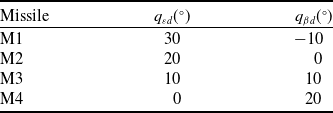
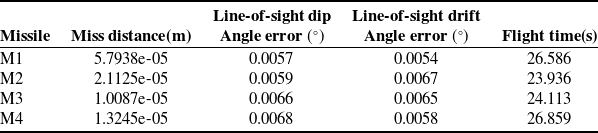
To verify the effectiveness of the proposed guidance law, four missiles in the same initial position and state are considered to attack targets in two manoeuvering situations at their desired terminal line-of-sight angles. Initial conditions of the missile and the target for the simulation are shown as Table 1. The expected terminal line-of-sight angles of the four missiles attacking the target are shown in Table 2. Two different cases for target manoeuvers are as follows Case 1 and Case 2.
Case 1:
 ${a_{T\varepsilon }}{\rm{ \;=\; }}200\sin (0.5t){\rm{m}}/{{\rm {\rm s}}^2}$
,
 ${a_{T\beta }}{\rm{ \;=\; }}200\cos (0.5t){\rm{m}}/{{\rm s}^2}$
.
Case 2:
 ${a_{T\varepsilon }}{\rm{ \;=\; }} -\!200{\rm{m}}/{{\rm s}^2}$
,
 ${a_{T\beta }}{\rm{ \;=\; }}200{\rm{m}}/{{\rm s}^2}$
.
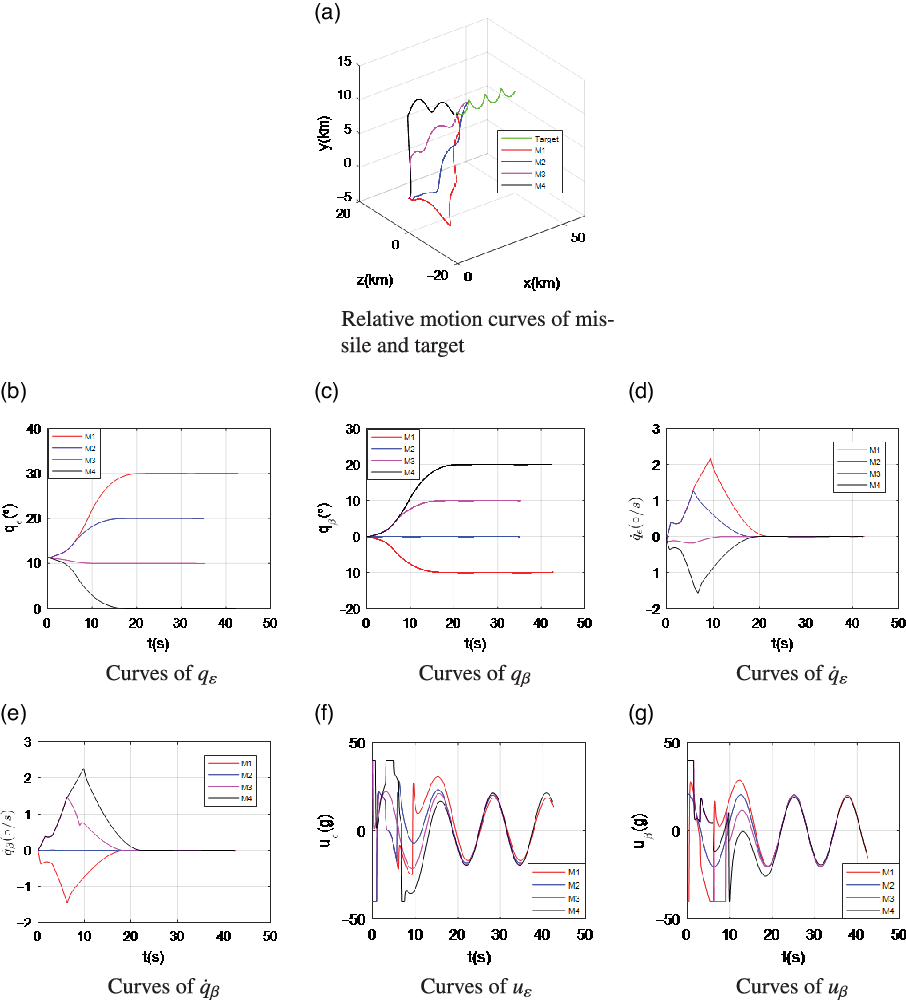
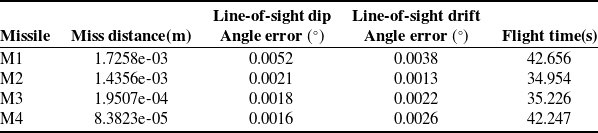
For Case 1, Fig. 2 and Table 3 show the simulation results of the proposed guidance law. The relative motion curves of the missile and the target are elaborated in Fig. 2(a). It can be known that four missiles with different expected terminal line-of-sight angles were all able to successfully intercept the target. The curves of
 ${q_\varepsilon }$
and
 ${q_\beta }$
for the four missiles are demonstrated in Fig. 2(b) and (c). It can be obtained that
 ${q_\varepsilon }$
and
 ${q_\beta }$
converge to different expected terminal line-of-sight angles precisely in a finite-time. The curves of
 ${\dot q_\varepsilon }$
and
 ${\dot q_\beta }$
for the four missiles are shown in Fig. 2(d) and (e). It is clearly revealed that the guidance system has the best convergence performance under the proposed guidance law in this paper. Figure 2(f) and (g) indicate the curves of
 ${{{u}}_\varepsilon }$
and
 ${{{u}}_\beta }$
, which are within reasonable bounds. From Table 3, it can be known that all four missiles in the same initial state and at the same initial position under the proposed guidance law in this paper are able to accurately hit a manoeuvering target with the specified terminal line-of-sight angle. The maximum miss distance for the four missiles with different expected terminal sight angles is less than 0.002m, and the errors of the terminal line-of-sight angles are all controlled within
 $0.006^{\circ}$
. The excellent control ability of the proposed guidance law in this paper to miss distance and expected terminal line-of-sight angle error is verified.
Simulation results of four expected line-of-sight angles attack targets with Case 1

Simulation results of four expected line-of-sight angles attack targets with Case 2.

For Case 2, when
 ${a_{T\varepsilon }}{\rm{ \;=\; }} -\!200{\rm{m}}/{{\rm s}^2}$
,
 ${a_{T\beta }}{\rm{ \;=\; }}200{\rm{m}}/{{\rm s}^2}$
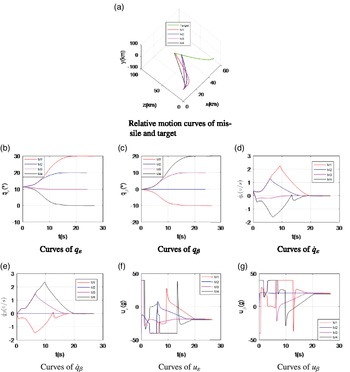
, Fig. 3 and Table 4 display the simulation results of the proposed guidance law. The relative motion curves of the missile and the target are revealed in Fig. 3(a). The curves of
 ${q_\varepsilon }$
and
 ${q_\beta }$
for the four missiles are manifested in Fig. 3(b) and (c). The curves of
 ${\dot q_\varepsilon }$
and
 ${\dot q_\beta }$
for the four missiles are shown in Fig. 3(d) and (e). The curves of
 ${{{u}}_\varepsilon }$
and
 ${{{u}}_\beta }$
for the four missiles are displayed in Fig. 3(f) and (g). Figure 3 shows the same situation as Fig. 2, so it will not be repeated here. From Table 4, it can be known that all four missiles in the same initial state and at the same initial position under the proposed guidance law in this paper are able to accurately hit a manoeuvering target with the specified terminal line-of-sight angle. The maximum miss distance for the four missiles with different expected terminal sight angles is less than 0.0001m, and the errors of the terminal line-of-sight angles are all controlled within
 $0.007^{\circ}$
. The excellent control ability of the proposed guidance law in this paper to miss distance and expected terminal line-of-sight angle error is verified.
4.2 Superiority verification
To further verify the superiority of the proposed guidance law, the conventional proportional navigation guidance law and nonlinear terminal sliding mode guidance law [Reference Kumar and Ghose29] are selected for comparison. Initial conditions of the missile and the target for the simulation are shown as Table 1. Select the expected terminal line-of-sight angles
 ${q_{\varepsilon d}}{\rm{ \;=\; }}30^\circ $
,
 ${q_{\beta d}}{\rm{ \;=\; }}10^\circ $
. Two different cases for target manoeuvers are as follows Case 1 and Case 2.
Case 1:
 ${a_{T\varepsilon }}{\rm{ \;=\; }}200\sin (0.5t){\rm{m}}/{{\rm s}^2}$
,
 ${a_{T\beta }}{\rm{ \;=\; }}200\cos (0.5t){\rm{m}}/{{\rm s}^2}$
.
Case 2:
 ${a_{T\varepsilon }}{\rm{ \;=\; }} -\!200{\rm{m}}/{{\rm s}^2}$
,
 ${a_{T\beta }}{\rm{ \;=\; }}200{\rm{m}}/{{\rm s}^2}$
.
The traditional proportional guidance law is shown as Equation (73).
 \begin{equation}{u_{PN{{GL}}}} = \left[ \begin{array}{l} {{{n}}_1}\left| {\dot R} \right|{{\dot q}_\varepsilon }\\[5pt] {n_2}\left| {\dot R} \right|{{\dot q}_\beta }\end{array} \right]\end{equation}
Where
 ${{{n}}_1}$
and
 ${{{n}}_2}$
are guidance parameters of the
 ${u_{PNGL}}$
.
Simulation results of four expected line-of-sight angles attack targets with Case 2

Simulation results of three different guidance laws with Case 1.

After a lot of simulations, the control effect of
 ${u_{PNGL}}$
is optimised by adjusting the parameters. The final guidance parameters
 ${{{n}}_1}{\rm{ \;=\; }}4$
and
 ${{{n}}_2}{\rm{ \;=\; }}4$
are chosen.
The sliding surface of nonlinear terminal sliding mode guidance law (NTSMGL) is chosen as Equation (74).
 \begin{equation} {{s}} = \left[ \begin{array}{l} {s_1}\\[5pt] {s_2} \end{array} \right] = x + \frac{1}{\beta }{\dot x^{p/q}}\end{equation}
Where
 $\beta > 0$
, p and q are positive odd numbers, and they satisfy
 $p > {{q}}$
,
 $1 < p/q < 2$
.
The NTSMGL is chosen as Equation (75).
 \begin{equation}{u_{NTSMGL}} = - {{{B}}^{ - 1}}\left({{f}} + \frac{{\beta {{q}}}}{p}{\dot x^{2 - p/q}} + ks + H{\mathop{\rm sgn}} (s)\right)\end{equation}
NTSMGL can make the guidance system state converge in finite time and is robust to system disturbance. It can intercept manoeuvering targets.
After a lot of simulations, the control effect of
 ${u_{NTSMGL}}$
is optimised by adjusting the parameters. Finally Select the guidance parameter of
 ${u_{NTSMGL}}$
as
 $\beta {{ \;=\; 10}}$
,
 $p{{ \;=\; }}9$
,
 ${{q \;=\; 7}}$
,
 ${{k}} \;=\; 5.5$
,
 $H{\rm{ \;=\; }}\left[ {\begin{array}{*{20}{c}} {0.01}&0\\[5pt] 0&{0.01}\end{array}} \right]$
.
For Case 1, when
 ${a_{T\varepsilon }}{\rm{ \;=\; }}200\sin (0.5t){\rm{m}}/{{\rm s}^2}$
,
 ${a_{T\beta }}{\rm{ \;=\; }}200\cos (0.5t){\rm{m}}/{{\rm s}^2}$
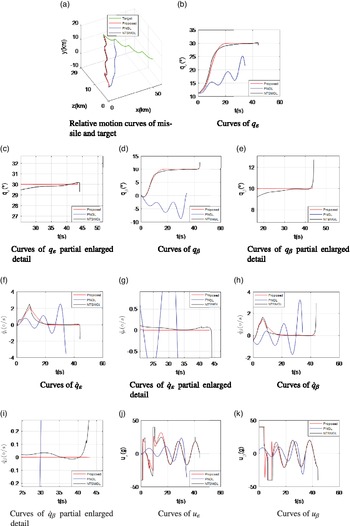
. Figure 4 and Table 5 reveal the simulation results of sinusoidal wave manoeuvering target interception under three different guidance laws, which are the proposed guidance law in this paper, the PNGL and the NTSMGL. The relative motion curves of the missile and the target under three different guidance laws are shown in Fig. 4(a). All three different guidance laws allow the missile to successfully intercept sinusoidal manoeuverable targets, even if the missiles’ flight paths are different. Figure 4(b)–(e) shows the curves of
 ${q_\varepsilon }$
, the curves of
 ${q_\varepsilon }$
partial enlarged detail, the curves of
 ${q_\beta }$
and the curves of
 ${q_\beta }$
partial enlarged detail, respectively. It can be clearly seen from Fig. 4(b)–(e) that both the proposed guidance law in this paper and NTSMGL guarantee the convergence of
 ${q_\varepsilon }$
and
 ${q_\beta }$
. However, PNGL cannot ensure the convergence of
 ${q_\varepsilon }$
and
 ${q_\beta }$
. In addition,
 ${q_\varepsilon }$
and
 ${q_\beta }$
under the proposed guidance law in this paper obviously has faster convergence speed and higher accuracy than those under NTSMGL. Figure 4(f)–(i) shows the curves of
 ${\dot q_\varepsilon }$
, the curves of
 ${\dot q_\varepsilon }$
partial enlarged detail, the curves of
 ${\dot q_\beta }$
and the curves of
 ${\dot q_\beta }$
partial enlarged detail, respectively. It can be clearly seen from Fig. 4(f)–(i) that the guidance law proposed in this paper makes
 ${\dot q_\varepsilon }$
and
 ${\dot q_\beta }$
converge to near zero with high accuracy. Although NTSMGL also makes
 ${\dot q_\varepsilon }$
and
 ${\dot q_\beta }$
converge to near zero, divergence phenomenon appears at the moment when the missile and the target are about to encounter. And PNGL does not makes
 ${\dot q_\varepsilon }$
and
 ${\dot q_\beta }$
converge to near zero. Figure 4(j)–(k) shows the curves of
 ${{{u}}_\varepsilon }$
and
 ${{{u}}_\beta }$
. The elevation and azimuth acceleration commands of the missile
 ${{{u}}_\varepsilon }$
and
 ${{{u}}_\beta }$
are in a reasonable range under three different guidance laws. From Table 5 it can be known that under the guidance law proposed in this paper, the missile’s miss distance to the target is much smaller than the other two guidance laws. At the same time, the line-of-sight dip angle error and line-of-sight drift angle error are far less than the other two guidance laws. Compared with NTSMGL, the flight time of the missile under action of the guidance law proposed in this paper is shorter, which makes the interception probability of the missile with shorter flight time increase in the terminal guidance phase. Although the flight time of the missile under action of PNGL is the shortest, it cannot control the line-of-sight angle, and the miss distance is large. In conclusion, by comparing the simulation results of the three guidance laws, the guidance law proposed in this paper has better control performance.
Simulation results of three different guidance laws with Case 1

Simulation results of three different guidance laws with Case 2.

For Case 2, when
 ${a_{T\varepsilon }}{\rm{ \;=\; }} -\!200{\rm{m}}/{{\rm s}^2}$
,
 ${a_{T\beta }}{\rm{ \;=\; }}200{\rm{m}}/{{\rm s}^2}$
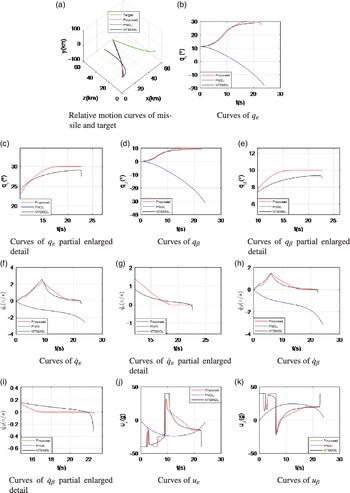
. Figure 5 and Table 6 reveal the simulation results of constant manoeuvering target interception under three different guidance laws, which are the proposed guidance law in this paper, the conventional PNGL and the NTSMGL. The relative motion curves of the missile and the target under three different guidance laws are shown in Fig. 5(a). PNGL failed to intercept the constant manoeuvering target, while the other two guidance laws succeeded. Figure 5(b)–(e) indicates the curves of
 ${q_\varepsilon }$
, the curves of
 ${q_\varepsilon }$
partial enlarged detail, the curves of
 ${q_\beta }$
and the curves of
 ${q_\beta }$
partial enlarged detail, respectively. Figure 5(f)–(i) displays the curves of
 ${\dot q_\varepsilon }$
, the curves of
 ${\dot q_\varepsilon }$
partial enlarged detail, the curves of
 ${\dot q_\beta }$
and the curves of
 ${\dot q_\beta }$
partial enlarged detail, respectively. Figure 5(j)–(k) shows the curves of
 ${{{u}}_\varepsilon }$
and
 ${{{u}}_\beta }$
. Figure 5(b)–(k) shows the same situation as Fig. 4(b)–(k), so it will not be repeated here. It can be seen from Table 6 that, under the guidance law proposed in this paper, the miss distance of the missile to the target is much less than NTSMGL, while PNGL cannot intercept the constant manoeuver target with the acceleration of 20g. At the same time, the line-of-sight dip angle error and line-of-sight drift angle error under action of the guidance law proposed in this paper are far less than NTSMGL, while PNGL has no ability to control the line-of-sight angle. In conclusion, by comparing the simulation results of the three guidance laws, the guidance law proposed in this paper has better control performance.
Simulation results of three different guidance laws with Case 2

5.0 Conclusions
In this paper, a new sliding mode adaptive neural network guidance law is proposed to intercept highly manoeuvering targets with ideal impact angles. The guidance law, based on fast nonsingular terminal sliding mode, ensures that the line-of-sight angle and the line-of-sight angle rate converge in finite-time rather than asymptotically. A fast-power-reaching law is adopted to ensure the fast convergence of the sliding mode surface and overcome the chattering phenomenon of the sliding mode control. Aiming at the external disturbance caused by the target manoeuvering, the RBF neural network without the target prior information is proposed to estimate. At the same time, adopt the adaptive law to eliminate estimation errors of RBF neural network. According to Lyapunov stability theory, the proposed guidance law can ensure the guidance system stability. In order to verify the effectiveness of the proposed guidance law in this paper, the numerical simulation is carried out for four missiles with the same initial state intercepting 20g sine wave and constant two big manoeuvering target situation at different expected terminal line-of-sight angles. The numerical simulation results demonstrate that the proposed guidance law has small miss distance and line-of-sight angle error, so it has excellent control performance. In order to verify the superiority of the proposed guidance law in this paper, it is compared with the conventional PNGL and the NTSMGL. The numerical simulation is carried out for three different guidance laws that are used to intercept 20g sine wave and constant big manoeuvering target situation at desired terminal line-of-sight angles. The numerical simulation results demonstrate that the proposed guidance law is superior to the other two guidance laws in both miss distance and line-of-sight angles error control.