Introduction
The provision of emergency medical care in Pakistan has not been a focus of medical education and training. Because of an overriding need to address limited primary health care, resources and trained personnel are scarce, and cultural barriers often supersede the urgency of medical conditions. Despite these challenges, the value of emergency care is gaining attention.Reference Razzak, Hyder, Akhtar, Khan and Khan1
According to a 2005 survey of the 39 medical colleges in Pakistan, 85% of medical colleges were not satisfied with the care provided in the Emergency Department (ED) of their primary teaching hospital. Ninety-six percent believed that Pakistan should have a separate residency training program in Emergency Medicine.Reference Razzak, Ahmed, Saleem and Nasrullah2
In 1985, the Aga Khan University Hospital (AKUH), a private, fee-for-service, nonprofit teaching hospital, was established in Karachi, Pakistan. The AKUH offers a broad range of secondary and tertiary medical care.3 In 2000, the AKUH became the first teaching hospital in Pakistan to be ISO 9002 certified by the International Organization for Standardization (ISO); at the time of the study, the AKUH was ISO 9001 certified as well. In September 2006, it became the first hospital in Pakistan to be awarded Joint Commission International accreditation for “achieving and maintaining international quality standards in health care.”3
Also in 2000, AKUH initiated an Emergency Medicine (EM) residency program. This program, led by American-trained physicians, laid the foundation for emergency medicine care in the country.
The objective of this study was to explore the breadth of Emergency Medicine training in Pakistan through an analysis of the Aga Khan University Hospital's program and facilities.
Methods
Data collection consisted of three components: (1) a survey of the Emergency Department and hospital services; (2) a survey of the Emergency Medicine training curriculum; and (3) a retrospective chart review of patients seen in the Aga Khan Emergency Department from December 1-14, 2008.
The survey of the AKUH Emergency Department and hospital services was conducted using a tool to examine both the facility and available resources, including personnel. A copy of the nine-page document is included as an Appendix (online only). The survey consisted of sections that covered patient demographics, Emergency Department and hospital staff, specialty services provided, configuration and capabilities of the Emergency Department, as well as laboratory, pharmaceutical, and procedural capabilities. The survey tool was completed by University of Illinois at Chicago research personnel. Information was obtained via direct observation of facilities, interviews of hospital personnel, and data extracted from the survey tool. Members of the AKU faculty were asked to comment on three strengths and three weaknesses of AKUH's Emergency Department.
The retrospective chart review was conducted for every tenth chart of patients seen in the ED from 00:00 am on December 1 through 23:59 pm on December 14, 2008. Data obtained included: date of visit, age, gender, system complaint, diagnosis, and disposition. Data collected were entered into an Excel spreadsheet Version 97-2004 (Microsoft Corporation, Redmond, Washington USA) for data processing. System complaints were condensed into 15 categories: (1) cardiac; (2) dermatological; (3) endocrine; (4) otolaryngology; (5) gastrointestinal; (6) urological; (7) hematology/oncology; (8) infectious disease; (9) miscellaneous/non-emergent; (10) neurology/neurosurgery; (11) obstetrics/gynecology; (12) ophthalmology; (13) orthopedics; (14) psychiatry; and (15) pulmonary. Dispositions consisted of one of three categories: admitted, discharged, or left against medical advice.
The survey of the Emergency Medicine training curriculum was conducted using a tool created to obtain basic information about the residency program. The curriculum portion of the survey was created based on the “model curriculum for Emergency Medicine residency training” developed by the Society for Academic Emergency Medicine (SAEM) and the Council of Emergency Medicine Residency Directors (CORD).4 Information was obtained through interviews with the chairman of the Emergency Department, the faculty and current Emergency Medicine residents. Information also was obtained through the program's website and a review of the written curriculum that details each rotation and its objectives.
Analysis for data entered into the electronic data spreadsheet was conducted using Excel. Analysis of the Emergency Department and hospital services survey and the Emergency Medicine training curriculum survey was conducted through manual review of data.
The study was conducted over a four-week period in January of 2009. University of Illinois at Chicago Institutional Review Board approval was obtained.
Results
Emergency Department
The AKUH is a 543-bed tertiary care center offering a broad range of medical services. The Emergency Department (ED) is fully equipped with modern facilities and consists of 33 beds with an organized triage, separate pediatric and adult EDs, a resuscitation bay, and a fast-track area. The resuscitation bay contains only two ventilators. Although the ED is in the immediate vicinity of the Radiology Department, it is not located near the operating rooms or the intensive care unit (ICU).
The ED services comprise all the hospital procedures that other tertiary care centers offer. The following emergency procedures are not performed: suprapubic catheterization, burr hole craniostomy, intraosseous access, peritoneal lavage, and bedside ultrasound. The hospital laboratory performs all common and specialized laboratory tests. While the AKUH has access to virtually all medications, none are stored in the ED, except for the emergency resuscitation medications kept in four crash carts.
Faculty
The ED is staffed by 11 attending physicians with board certifications in various specialties. Four physicians hold certifications in Pediatrics; four in Internal Medicine; one in Family Medicine; one in Emergency Medicine; and one in General Surgery. Five of the 11 physicians attended a foreign medical school. All faculty physicians reported having certifications in Basic Life Support, Advanced Cardiac Life Support, Advanced Pediatric Life Support, and Advanced Trauma Life Support. In addition, one general trauma surgeon is on the faculty.
The ED staff also includes 26 nurses, all of whom are locally educated. The ED nurses are required to hold certifications in Advanced Cardiac Life Support.
Faculty members identified the three most common strengths of the ED as: (1) the ED is well equipped; (2) the ED has an organized structure and patient flow; and (3) the protocols are followed appropriately. Three weaknesses identified by the faculty included: (1) a lack of an ancillary nursing staff; (2) long ED stays with reluctant admitting services; and (3) a lack of sufficient teaching in obstetrics and gynecology and trauma.
Chart Review
The charts of 152 patients who visited the ED from December 1-14, 2008 were reviewed. Sixty-nine (approximately 46%) patients were female, and 83 (54%) male.
Thirty-seven percent of patients were pediatric (n = 56) and 63% (n = 96) were adult. Forty-six percent of children were from 1-5 years of age (n = 26), 19.6% were less than one year old, (n = 11) and 32% (n = 18) were from 6-18 years of age. The majority of adult patients were 36-65 years of age (53%, n = 51), 33% (n = 32) were 19 to 35 years old, and only 14.6% (n = 14) were greater than 65 years of age.
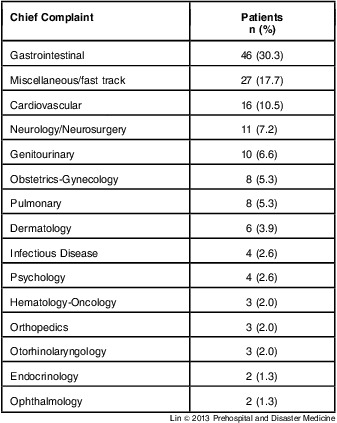
The majority of patients (30.3%, n = 46), presented with gastrointestinal (GI) complaints. This category included patients with surgical conditions. Patients in the fast-track category (17.7%, n = 27), included those with simple lacerations, wound checks, medication refills, simple musculoskeletal complaints and follow-up visits. Additionally, 10.5% (n = 16) of patients presented with cardiovascular issues, 7.2% (n = 11) presented with neurological or neurosurgical problems, 6.6%(n = 10) had genitourinary problems, 5.3% (n = 8) had pulmonary issues, 5.3% (n = 8) had obstetrics-gynecological issues, 3.9% (n = 6) dermatological, 2.6% (n = 4) with infectious disease, 2.6% (n = 4) psychological, 2.0% (n = 3) hematological-oncological, 2.0% (n = 3) with orthopedic injuries, 2.0% (n = 3) otolaryngological, 1.3% (n = 2) ophthalmological, and 1.3% (n = 2) with endocrine related complaints (Table 1).
Chief Complaint Based on System

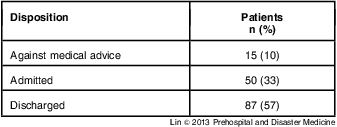
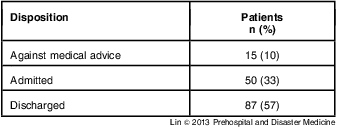
In the two-week period examined, there was a 33% admission rate (n = 50) from the ED; 57% of the patients (n = 87) were discharged; and 10% (n = 15) left against medical advice (Table 2).
Patient Outcome
Emergency Medicine Curriculum Analysis
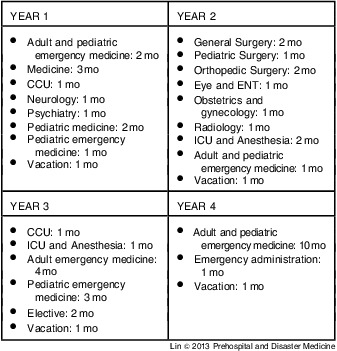
A review of the curriculum and clinical duties of Emergency Medicine physicians revealed that the residency program comprises four years with two residents accepted per year. The curriculum is modeled after EM programs in the United States and offers a variety of clinical rotations, all at the AKUH.5 Each rotation lasts approximately one month. Each EM resident spends 21 rotations in Emergency Medicine, three in General Medicine, two in General Pediatrics, one in Neurology, one in Psychiatry, two in General Surgery, one in Pediatric Surgery, two in Orthopedics, one in Obstetrics/Gynecology, two in the Intensive Care Unit (ICU) and Anesthesia, two in the Cardiac Care Unit, one in Radiology, one in Ophthamology and Otolaryngology, two as an elective, and one in administration. Table 3 lists the clinical rotations required of each EM resident by year. In addition, each resident has one month of vacation per year.
Breakdown of Medical Curriculum by Year

Abbreviations: CCU, Cardiac Care Unit; ENT, Ear, nose, and throat; ICU, Intensive Care Unit
The didactic portion of the program includes monthly Morbidity and Mortality conferences, a journal club, and lectures. With EM being a new specialty in Pakistan, there is no official board certification examination. However, many residents take European equivalents.
Discussion
The survey of the Emergency Department revealed modern facilities and organization on a par with established Emergency Medicine standards.
Aga Khan University Hospital does not have a ramp to accommodate ambulances. However, ambulances in Pakistan are scarce, poorly equipped, and usually are used to transport deceased patients. The faculty members hold board certifications in their respective specialties but are relatively experienced in EM. Despite the number of poisonings and overdoses that are encountered in EDs across the nation, Aga Khan University Hospital does not have a toxicology department. This is changing, as faculty members have sought toxicological research experience in the United States. Nevertheless, AKUH has one of the few EDs in the country that utilizes organization and efficiency strategies of established EDs in the US. The chart review data suggest that the patients have access to procedures and well-trained physicians who offer a broad range of services.
Within the patient population, there is a mix of pediatrics and adults with a fairly high admission rate. While the proportions of admissions and discharges are on a par with many established emergency departments, the rate of patients who left against medical advice is high. Although some patients left because of poor prognosis, a large proportion of patients left as a result of financial constraints.
During the review period, the AKUH cared for a relatively high proportion of patients who presented with GI diseases. The majority of these patients presented with abdominal pain, vomiting and/or diarrhea; all but one were nonsurgical. According to the World Health Organization, only 58% of the population of Pakistan had access to sanitation systems in 2006.6 Thus, the presentation of enteritis-related diseases is not unexpected in a developing nation where sanitation and hygiene are limited. The AKUH staff was well equipped to handle these complaints.
Additionally, a high percentage of patients were admitted with cardiovascular issues. Various studies have shown that people from the Indian sub-continent, including Pakistan, have dyslipidemia with elevated levels of triglycerides and low levels of high-density lipoprotein.Reference Kumar7 These factors may lead to coronary heart disease, and could explain the incidence of cardiovascular issues in this patient population.Reference Kumar7 Again, from review of the hospital services and the EM training program, the physicians and nurses of the ED appear to be trained to handle such cardiovascular problems.
Analysis of the EM residency curriculum revealed that the program provided well-rounded clinical rotations. Internal reviews incorporated into the program help to ensure that residents are obtaining a broad and relevant experience. However, by comparing the AKUH curriculum with that of the Society for Academic Emergency Medicine, and through interviews of various faculty and residents, four weaknesses have been identified.
First, limited “hands-on” learning is provided for male physicians in the obstetrics and gynecology rotation. The reasons for this are likely multi-factorial and include cultural traditions, religion, and a generally conservative mindset. In addition, all of the current faculty physicians in the Emergency Department are male. A study conducted in the United Kingdom concluded that female patients, when given a choice, prefer female physicians to male physicians.Reference O'Flynn and Rymer8 In addition, the variation of Islam most prevalent in Pakistan restricts interactions between the sexes. This poses problems for the training of male physicians.Reference Aqeel Subhani9
Second, trauma experience available to the EM residents at the AKUH is limited. The hospital does not have an ambulance bay to receive victims of trauma, and most trauma cases are diverted to government hospitals. However, this may be less of an issue given that ambulances are not always equipped to transport such victims. As the AKUH is a fee-for-service private hospital, trauma exposure is limited.
The prehospital services offered also are limited because of the scarcity of ambulances and the lack of a developed infrastructure to accommodate them. Pakistan's lack of an organized out-of-hospital Emergency Medical Services (EMS) system also may be a limiting factor in training physicians to work in mass-casualty situations. Recent events and experiences in Pakistan highlight the vulnerability of the region to natural and manmade disasters (ie, earthquakes and political instability).
Third, while the hospital provides a wide range of care, certain services are not available. As noted, the hospital provides no formal toxicology service. Poisonings, overdoses, and toxic chemical exposures are common occurrences in developing and developed countries alike. They often are not well understood, and may be overlooked, misdiagnosed, or inadequately treated. Specific training in toxicology and related subject matter is important in equipping physicians with the training to identify potentially lethal exposures.
Lastly, the hospital provides training under modern facilities, and it has specialty services that often are not available in hospitals in most areas of the country. Extensive resources are available for medical care at the AKUH. While graduating residents are well trained in this setting, they may not be trained or accustomed to working in another, less well-equipped facility. As the majority of Pakistan's public hospitals have minimal resources, a period of adjustment would be anticipated for trained physicians who work outside of the AKUH.
While the hospital's Emergency Department offers quality tertiary care that mimics that which exists in US-based emergency departments, resident training is constrained by cultural norms and the lack of an adequate EMS infrastructure. The AKUH can mature as an Emergency Medicine training program by attempting to narrow the gaps in its curriculum.
The lack of obstetrics and gynecology experience for male physicians is difficult to resolve because of existing religious and Pakistani customs. However, the AKUH can draw on published strategies for improving the obstetrics and gynecology experience for male residents in other Muslim countries.Reference Rizk, Al-Shebah, El-Zubeir, Thomas, Hassan and Ezimokhai10
Rather than trying to bring more trauma patients to the AKUH, which could require a practice and culture change, collaboration with government hospitals could provide a more complete trauma experience for its residents. The addition of a rotation in a government hospital would not only provide residents with necessary trauma experience, but also would provide them the experience of working in a setting with limited resources.
While the existence of toxicology services and a prehospital infrastructure are identified gaps in experience for training physicians, these segments of Emergency Medicine service are challenging to establish and likely will require long-term and more intensive efforts. The first step in addressing these gaps is to increase awareness among the Pakistani health care community.
Conclusion
Health care in Pakistan faces some of the same challenges as those faced by many other developing nations. Resources are scarce, and the sophisticated infrastructure required in a western model of emergency care is almost nonexistent. Despite these challenges, the Aga Khan University Hospital is a pioneer in establishing Emergency Medicine as a recognized discipline in the region. While significant challenges lie ahead for Emergency Medicine in Pakistan, emergency medical care is gaining significance in developing nations.
Supplementary material
To view supplementary material for this article, please visit http://dx.doi.org/10.1017/S1049023X12001859