Introduction
Avian influenza virus (AIV) is an important disease worldwide that causes huge economic problems in animal production and may also threaten human health. Apart from domestic avian species, wild birds are a huge reservoir for AIV. Sixteen hemagglutinin (HA) and nine neuraminidase (NA) subtypes have been detected in avian species, which may exist in multiple combinations and are not evenly distributed amongst species and locations (Webster et al. Reference Webster, Bean, Gorman, Chambers and Kawaoka1992, Olsen et al. Reference Olsen, Munster, Wallensten, Waldenström, Osterhaus and Fouchier2006). Understanding the biology of this virus in the wild reservoir systems may help with predicting and controlling the infection in the future (Webster et al. Reference Webster, Bean, Gorman, Chambers and Kawaoka1992).
The natural hosts of AIV are believed to be Anseriformes (waterfowl) and Charadriiformes (gulls, terns, skuas and shorebirds) (Webster et al. Reference Webster, Bean, Gorman, Chambers and Kawaoka1992). In these birds, low-pathogenic AIVs (LPAIVs), with no or mild effects on host health, seems to be ubiquitous (Webster et al. Reference Webster, Bean, Gorman, Chambers and Kawaoka1992). High-pathogenic AIVs (HPAIVs) are believed to have no wild reservoir systems, but it is generally accepted that these emerge from LPAIVs after infecting poultry. The ecology of waterfowl and shorebirds therefore impacts the global distribution and diversity of AIVs directly (Olsen et al. Reference Olsen, Munster, Wallensten, Waldenström, Osterhaus and Fouchier2006). Some of these birds migrate along intercontinental flyways and are considered to be responsible for transmitting HPAIV strains into Europe and Africa from Asia (Kilpatrick et al. Reference Kilpatrick, Chmura, Gibbons, Fleischer, Marra and Daszak2006). This movement may also allow for the long-term transmission and introduction of high-pathogenic strains into remote places, such as the Antarctic region (Hurt et al. Reference Hurt, Vijaykrishna, Butler, Baas, Maurer-Stroh and Silva-de-la-Fuente2014). Over 100 million birds flock to the Antarctic coastline and surrounding islands every spring to breed (Shirihai Reference Shirihai2008). Moreover, some birds, such as Arctic terns (Sterna paradisaea) or south polar skuas (Catharacta maccormicki), fly to Antarctica after sharing grounds with other shorebirds and seabirds in the northern hemisphere (Egevang et al. Reference Egevang, Stenhouse, Phillips, Petersen, Fox and Silk2010, Weimerskirch et al. Reference Weimerskirch, Tarroux, Chastel, Delord, Cherel and Descamps2015). These movements may therefore promote the spread of AIV into Antarctic ecosystems from elsewhere, which is of particular concern due to the vulnerability of the fauna, as they have limited immune capabilities to combat newly introduced diseases (McMahon Reference McMahon2010, Abad et al. Reference Abad, Busquets, Sanchez, Ryan, Majó and Gonzalez-Solís2013). Indeed, it has been suggested that these ecosystems may act as evolutionary sinks where newly introduced strains could become endemic in the Antarctic populations and diverge to a large degree (Hurt et al. Reference Hurt, Vijaykrishna, Butler, Baas, Maurer-Stroh and Silva-de-la-Fuente2014, Reference Hurt, Su, Aban, Peck, Lau and Baas2016).
While there are abundant data available on LPAIV in Northern Hemisphere wildlife, those of the Southern Hemisphere and particularly Antarctica are still very limited (Olsen et al. Reference Olsen, Munster, Wallensten, Waldenström, Osterhaus and Fouchier2006, Brown et al. Reference Brown, Luttrell, Uhart, Ferreyra, Romano, Rago and Stallknecht2010, Abad et al. Reference Abad, Busquets, Sanchez, Ryan, Majó and Gonzalez-Solís2013). AIV shedding has recently been detected by real-time reverse transcription polymerase chain reaction (RRT-PCR) in an Antarctic southern giant petrel (Macronectes giganteus) (Petersen et al. Reference Souza Petersen, Araujo, Krüger, Seixas, Ometto and Thomazelli2017). These authors suggested that the migratory behaviour of seabirds is the main source of transmission for AIVs within the Antarctic region. Many Antarctic seabirds move out of the Antarctic region in winter to adjacent areas, where numerous strains of AIV have been detected in birds. In a recent review, Afanador-Villamizar et al. (Reference Afanador-Villamizar, Gomez-Romero, Diaz and Ruiz-Saenz2017) showed evidence that Chile and Argentina are among the Latin American countries with the largest numbers of reported cases of AIV infection, even though the percentage of positive samples recovered during routine surveillance programmes suggested low infection rates. Of these cases, 43.7% belonged to migratory birds (mainly orders Anseriformes and Charadriiformes), 28.1% to local wild birds and 28.1% to poultry. Another review by Renata & Thijl (Reference Renata and Thijl2016) supports the notion that the prevalence of AIV is low in South American wild Charadriiformes, with a 3.8% prevalence rate in Chile being the highest, and all other countries falling below 1%. This review article, however, acknowledges that the available data regarding the occurrence of AIV in South America are still limited. Avian influenza virus is also present in southern Africa, with the H5N8 HPAIV epidemic being the latest episode (FAO 2018). In South Africa, H5N8 has been detected in several wild birds, with marine birds being the largest group of reported species mortalities. Terns, particularly greater crested terns, comprised the worst-affected group, followed by African penguins and cormorants (FAO 2018). In addition, in Australia, a recent study showed that 1.9 ± 0.1% of Australian wild birds were positive for AIV on PCR over a 5 year period, with evidence of widespread exposure to many LPAIV subtypes (Grillo et al. Reference Grillo, Arzey, Hansbro, Hurt, Warner and Bergfeld2015). Therefore, the likelihood of Antarctic birds interacting with other bird species from areas where AIV has been previously detected and introducing it into the Antarctic ecosystems seems to be high.
This study provides further insights into the role of seabirds in the global epidemiology of the AIVs in the Southern Ocean. We assessed the prevalence of AIV in 14 seabird species from the orders Procellariiformes and Charadriiformes at three Antarctic and sub-Antarctic localities: Livingston, Marion and Gough Iislands. Given the previous descriptions of AIV circulation within birds in the Antarctic and sub-Antarctic regions (Barbosa & Palacios Reference Barbosa and Palacios2009), we hypothesized that AIVs may also be found in the birds of these orders from these three islands, from which AIVs have not been previously reported.
Materials and methods
Collection of samples
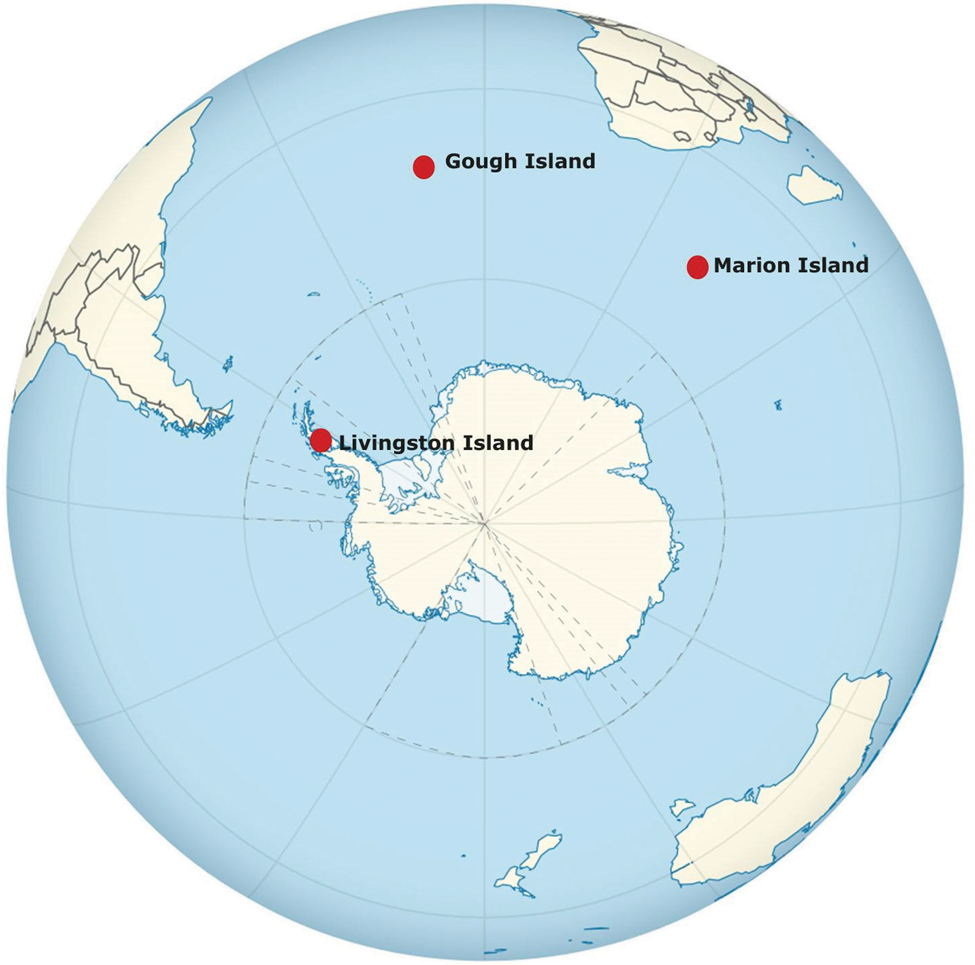
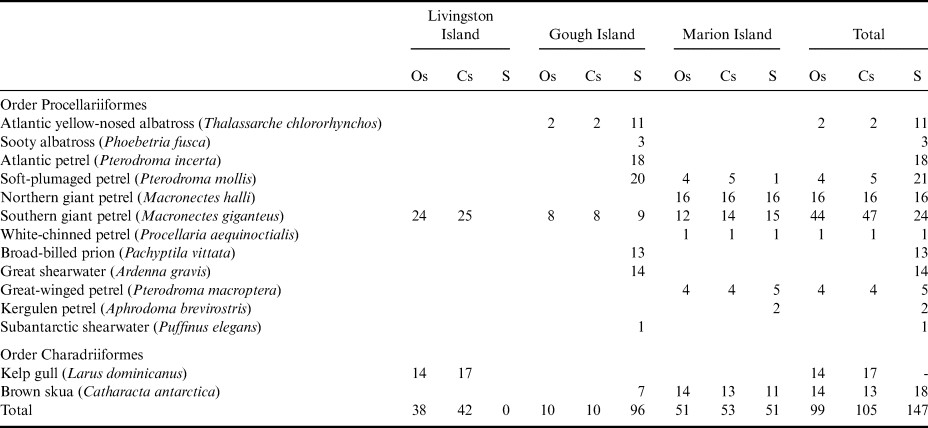
The samples used in this study were collected at one of three locations (Fig. 1): Byers Peninsula (62°38‘S, 61°50‘W, Antarctic) on Livingston Island, one of the South Shetland Islands; Marion Island (46°54‘S, 37°44‘E, sub-Antarctic), which is the largest of the two Prince Edward Islands; and Gough Island (40°20‘S, 9°55‘W, south Atlantic), which forms part of the Tristan da Cunha archipelago and is the most northern breeding site of giant petrels (Roscales et al. Reference Roscales, González-Solís, Zango, Ryan and Jiménez2016). Samples at Livingston Island were collected in January 2009, those at Marion Island in April–May 2011 and those at Gough Island in September–October 2009 (Table I). Samples were taken in the field by hand from live un-anaesthetized animals, which were released immediately after sampling (see further details of collection in Roscales et al. Reference Roscales, González-Solís, Zango, Ryan and Jiménez2016). Blood was taken from the brachial vein, centrifuged for 10 min at 10 000 rpm and serum was frozen until analysis. Oropharyngeal and cloacal swabs were collected by inserting a sterile metal cotton wool swab into the oral cavity and cloaca, respectively, then placed in phosphate-buffered saline and stored for 1–8 hours before being frozen at -20°C in the field laboratory and during transit. Within 2–5 weeks after collection, the swabs were transferred to the laboratory in Barcelona where they were stored at -75°C until analysis.
South Pole world map showing the locations of the three islands used as sampling sites in this study with red dots: Marion Island, Gough Island and Livingston Island.

Numbers and types of samples used in the study, showing the species and island from which each sample was taken.

Cs = cloacal swab, Os = oropharyngeal swab, S = serum.
Serological assay
A total of 147 serum samples from 13 different bird species (Table I) were analysed with an avian influenza commercial competitive enzyme-linked immunosorbent assay (cELISA) (ID Screen Influenza A Antibody Competition Multi-Species, ID Vet, Montpellier, France) according to the manufacturer's instructions. This cELISA kit detects antibodies against the influenza A nucleoprotein, which is present in all AIV subtypes (Ely et al. Reference Ely, Hall, Schmutz, Pearce, Terenzi, Sedinger and Ip2013). Following the manufacturer's instructions, four wells of the cELISA plate were controls, two negative and two positive, and each well of the same type was identical. The negative control was considered negative if the average optical density (OD) of the two wells was > 0.7, while the positive control was considered positive if the average OD of the two wells was < 0.3. The percentage inhibition (PI) of each sample was calculated by dividing the sample OD by the OD of the negative control, then multiplying by 100. A PI of < 45% was considered positive and a PI > 50% was considered negative. A PI of between 45% and 50% was considered doubtful and therefore the sample analysis was repeated.
RNA extraction and RRT-PCR
A total of 99 oropharyngeal and 105 cloacal swabs were analysed following RRT-PCR to detect AIV genomes (Table II). First, viral RNA was extracted using a NucleoSpin RNA Virus (Macherey-Nagel) kit following the manufacturer's instructions. RNase-free water was used as a negative control, while the viral strain A/swine/Spain/01/2010 (H1N1) from the laboratory's stores was used as a positive control.
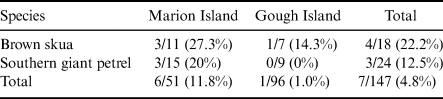
Numbers and percentages of avian influenza competitive enzyme-linked immunosorbent assay-positive samples. The species for which only negative results were obtained have been omitted.

The oropharyngeal and cloacal swabs were analysed by a TaqMan RRT-PCR to detect AIV using an influenza virus matrix gene-specific PCR primer set and hydrolysis probe, designed by Spackman et al. (Reference Spackman, Senne, Myers, Bulaga, Garber and Perdue2002) for a region conserved in all type A influenza virus matrix genes. The amplification conditions previously described by Busquets et al. (Reference Busquets, Alba, Napp, Sánchez, Serrano and Rivas2010) were used in a Fast7500 analyser (Applied Biosystems, Foster City, CA, USA). An internal positive control (IPC) was used to avoid false negatives due to PCR inhibitors (Busquets et al. Reference Busquets, Alba, Napp, Sánchez, Serrano and Rivas2010). The probe used was labelled at the 5‘ end with VIC™ reporter dye and at the 3‘ end with TAMRA™ quencher dye. The IPC amplification result was considered positive if the fluorescence of VIC™ was > 0.05 ΔRn. If ΔRn < 0.05, the RRT-PCR was considered non-valid and was repeated. Negative and positive controls were included in each RRT-PCR. The results were recorded as cycle threshold (Ct) values, corresponding to the PCR cycle in which the fluorescence level of VIC™ increased above the threshold value of 0.2 and 0.5, respectively.
Statistical analyses
The Fisher exact test was used to compare the proportion of positive and negative serological results for both location and animal species variables. Statistical analyses were performed using EpiInfo™ (version 7, CDC). P < 0.05 was considered significant for all analyses. Risk ratios (RRs) were also calculated; a RR of > 1 and < 1 meant that seropositivity was more and less probable, respectively, to occur in one group (island or animal species) compared to the other. Where RR = 1, there was no difference in risk between groups.
Results
Results from the cELISA are detailed in Table II. Seven of 147 (4.8%; 95% confidence interval (CI): 2.3–9.5%) serum samples from Marion and Gough islands were positive for antibodies against AIV, with 6 from Marion Island (11.8%; 95% CI: 5.5–23.4%) and 1 from Gough Island (1.0%; 95% CI: 0.2–5.7%). No birds from Livingston Island were seropositive. Three of 15 (20%; 95% CI: 7.1–45.2%) southern giant petrels from Marion Island, 3 of 11 (27%; 95% CI: 9.7–56.6%) brown skuas (Catharacta antarctica) from Marion Island and 1 of 7 (14%; 95% CI: 2.7–51.3%) brown skuas from Gough Island tested positive for antibodies against AIV. This resulted in overall prevalence rates of 3 of 24 in southern giant petrels (12.5%; 95% CI: 4.3–31.0%) and 4 of 18 in brown skuas (22.2%; 95% CI: 9.0–45.2%). All other species analysed were seronegative against AIV.
Overall seroprevalence was statistically greater in birds from Marion Island than Gough Island (P = 0.014). The RR between birds from the two islands was 11.29 (95% CI: 1.40–91.28), indicating a significantly greater likelihood of a positive sample occurring in birds from Marion Island than from Gough Island. There were no statistical differences in the proportion of positive samples between southern giant petrels and brown skuas (P = 0.67), nor was there a difference in risk between the two species (RR = 0.56; 95% CI: 0.14–2.21).
The PI (inversely proportional to antibody titre) for each positive sample ranged from 4.2% to 30.0%. Brown skuas had a PI of 6.5 ± 2.5% (mean ± standard deviation (SD)), while that for southern giant petrels was 14.5 ± 10.1%. By locality, positive results from Marion Island showed a PI of 10.6 ± 7.9%, while the only individual from Gough Island with a positive result had a PI of 30.0%. Oropharyngeal or cloacal shedding of AIV was not detected by RRT-PCR in any bird.
Discussion
This study revealed the occurrence of antibodies against AIV in two sub-Antarctic seabird species: southern giant petrels and brown skuas. Both species are moderately migratory and have similar non-breeding areas. They breed throughout the Southern Ocean (~40–60°S) during the summer and spend the non-breeding periods farther north, reaching the coasts of Chile, Argentina, Uruguay, Brazil, South Africa, Namibia, Australia and New Zealand (Conroy Reference Conroy1972, Petersen et al. Reference Souza Petersen, Araujo, Krüger, Seixas, Ometto and Thomazelli2017, Birdlife International 2018). As stated previously, numerous strains of AIV have been detected in wild birds and poultry from these geographical areas (Grillo et al. Reference Grillo, Arzey, Hansbro, Hurt, Warner and Bergfeld2015, Afanador-Villamizar et al. Reference Afanador-Villamizar, Gomez-Romero, Diaz and Ruiz-Saenz2017, FAO 2018); therefore, it would be plausible to hypothesize that some of the studied birds might have contracted infection by interacting with other bird species or with their prey from areas in which AIV has been detected before.
Overall, when including our results, AIV seroprevalence rates have been repeatedly reported in giant petrels and skuas from several Antarctic (Barbosa & Palacios Reference Barbosa and Palacios2009) and sub-Antarctic localities. In southern giant petrels, we found a 20% seroprevalence rate at Marion Island, compared to 46–100% at the South Shetland Islands in 2001–2002 (Baumeister et al. Reference Baumeister, Leotta, Pontoriero, Campos, Montalti, Vigo, Pecoraro and Savy2004). Ours is the first definite record of seropositivity against AIV antibodies in brown skuas, although Baumeister et al. (Reference Baumeister, Leotta, Pontoriero, Campos, Montalti, Vigo, Pecoraro and Savy2004) had already reported seroprevalence rates ranging from 9% to 29% in skuas at Nelson Island in the South Shetland Islands between 1998 and 2002, where brown and south polar skuas co-occur but the former are more abundant (Silva et al. Reference Silva, Favero, Casaux and Baroni1998). Austin and Webster (Reference Austin and Webster1993) found seroprevalence rates in south polar skuas on Ross Island to be 7% in 1978 and 11% in 1986, and Miller et al. (Reference Miller, Watts and Shellam2008) found a 1% seroprevalence rate in this species near Davis Station, Antarctica, in November–December 1999.
Giant petrels and skuas are both predators that scavenge large quantities of penguin and seal carrion (Stonehouse Reference Stonehouse1956, Conroy Reference Conroy1972, Hunter Reference Hunter1983). The seroprevalence rates found in these two taxa at several localities, coupled with the fact that giant petrels, being Procellariiformes, are not natural hosts for AIV, suggest a possible link between scavenging behaviour and AIV seroprevalence. Even though penguins are not natural hosts for AIV, they are still susceptible to it (Barbosa & Palacios Reference Barbosa and Palacios2009, Abad et al. Reference Abad, Busquets, Sanchez, Ryan, Majó and Gonzalez-Solís2013), and therefore this scavenging behaviour may allow for the possible transmission of AIV from avian prey to their predators. Nevertheless, further studies of both penguins and scavenging seabirds are needed in order to confirm or reject this hypothesis.
Our results show a significantly higher risk of AIV in birds from Marion Island compared to those from Gough or Livingston islands, as well as some differences in seroprevalence rates when compared with previous studies. However, differences in seroprevalence rates among localities may simply result from seasonal differences. Our samples from Marion Island were collected in April–May, whereas those from Gough Island were collected in September–October. April is the end of the chick-rearing period for southern giant petrels (Roscales et al. Reference Roscales, González-Solís, Zango, Ryan and Jiménez2016). Therefore, a greater density of birds is expected in that period, including many immunologically naïve juveniles, who probably have a greater risk of infection, leading to a greater infectious pressure. In contrast to this, sampling on Gough Island (September–October) occurred during the incubation period when few young birds are likely to be present, decreasing the risk of infection as well as the AIV infectious pressure. The Antarctic Livingston Island was also sampled relatively early in the breeding season (December), and no positive birds were found. This may again partly result from a relatively low risk of infection at that stage of the season, but it may also indicate a greater circulation of the virus in the sub-Antarctic environment than the Antarctic environment. This has been suggested before by Barbosa & Palacios (Reference Barbosa and Palacios2009), since AIV, amongst various other disease-causing viruses, has never been isolated in Antarctica and has only been reported in serological studies. Interestingly, this study found no positive results even for serology against AIV from Antarctic samples, whereas other studies in the past have done so (Barbosa & Palacios Reference Barbosa and Palacios2009). This may be due to the differences in Antarctic regions, the timing of the sampling or the species sampled; for example, no skuas nor giant petrels were sampled for serology on Livingston Island, even though these species had higher seroprevalence rates on the other islands. Had we taken these samples, it would have been interesting to see whether these species also showed any seroprevalence in the Antarctic regions. These factors combined reduce the strength of the conclusion that AIV is uncommon in the Antarctic region, and hence further studies will be needed to strengthen this conclusion.
All oropharyngeal and cloacal swabs assessed by RRT-PCR gave negative results. The antibody persistence time and the shedding times for the bird species included in this study are currently unknown. Having said this, a study by Garcia et al. (Reference Ramos i Garcia, Garnier, González-Solís and Boulinier2014) suggested that antibodies can persist for long periods of time in some procellariforms, at least those against Newcastle disease virus, as maternal antibodies were able to be transferred up to 5 years after vaccination. This interesting point suggests that the serological studies performed may have given us the AIV infectious history for the past couple of years, at least in the procellariforms. Further studies would be needed, however, to assess the specific antibody persistence times for AIV and in other orders of birds in order to be able to interpret the serology results with less speculation. Moreover, it has been reported that some Charadriiformes may only shed AIV for very short periods of up to 10 days (Brown et al. Reference Brown, Stallknecht, Beck, Suarez and Swayne2006). The latter, together with the relatively low AIV seroprevalence detected in this study, may explain the lack of detection of AIV by RRT-PCR.
In conclusion, our results indicate that AIV strains could be uncommon in Antarctic and sub-Antarctic predatory seabirds, but they probably circulate at low levels within scavenging seabirds. These results may suggest that scavenging seabirds act as an avian reservoir and as spreaders of the virus in the Southern Ocean; they may become infected with AIV from their prey in their more northern wintering quarters. Further studies are necessary in order to determine the role these species play in AIV epidemiology and whether this circulation is species specific.
Acknowledgements
As Byers Peninsula is protected, researchers applied for permits to the Spanish Polar Committee (the polar authority in the country) and the permits were granted to the project's principal investigator. We thank Antje Steinfurth, Rob Ronconi, Jose Antonio Gil Delgado and Antonio Quesada for logistical and fieldwork support. Logistical support at Marion and Gough Islands was provided by the South African National Antarctic Programme, Department of Environmental Affairs. This study was funded by the Ministerio de Ciencia e Innovación from the Spanish Government (POL2006-06635, CGL2009-11278/BOS and CTM2011-12973-E). We thank the reviewers for their comments.
Author contributions
JG-S, PGR, FXA and NM conceived and designed the sampling and experiments. OG, MN and RV performed the experimental procedures and analysis. OG, LGR, FXA, MN, PGR, JG-S and NM discussed the results and contributed to the publication.