Introduction
Terrestrial ecosystems in Antarctica essentially consist of islands of snow- and ice-free ground surrounded by areas unsuitable for habitation (Bergstrom & Chown Reference Bergstrom and Chown1999, Beyer & Boelter Reference Beyer and Boelter2002, Bargagli Reference Bargagli2005, Bergstrom et al. Reference Bergstrom, Hodgson and Convey2006). On a continental scale, such fragmented habitats can be characterized by a variety of ecological and climatic factors which increase the level of differentiation among Antarctic regions. In a geographical context, the continent is divided in two main and well-defined areas: continental Antarctica, including the whole East Antarctica landmass and the base and eastern side of the Antarctic Peninsula, and maritime Antarctica, corresponding to the west coast of the Antarctic Peninsula (Convey Reference Convey2001) and the Scotia Arc archipelagos. Chown & Convey (Reference Chown and Convey2007) defined the “Gressitt line” as indicating a major and ancient biological barrier between the two Antarctic regions. Across this boundary few or no species are shared in the major terrestrial faunal groups of mites (Acari), springtails (Collembola) and Nematoda (Greenslade Reference Greenslade1995, Andrássy Reference Andrássy1998, Pugh & Convey Reference Pugh and Convey2008). More probably the communities of the two regions have evolved in isolation in situ over multi-million year timescales since the final stages of Gondwana break-up, surviving repeated glacial cycles in ice-free refugia and with only limited capability to further expand their distribution during post-glacial periods.
At a regional scale (such as along the coasts of Victoria Land or the Antarctic Peninsula), faunal composition may be further influenced by landscape features (such as large glacier tongues flowing from inland), which have apparently formed insurmountable barriers for many species (including soil arthropods) (Frati et al. Reference Frati, Fanciulli, Carapelli and Dallai1997, Adams et al. Reference Adams, Bardgett, Ayres, Wall, Aislabie, Bamforth, Bargagli, Cary, Cavacini, Connell, Convey, Fell, Frati, Hogg, Newsham, O’Donnell, Russell, Seppelt and Stevens2006), increasing the levels of regional and sub-regional endemism. At a finer (local) scale, the distribution of each soil species is very fragmented, reflecting the availability of suitable habitat and resources (Caruso et al. Reference Caruso, Hogg and Bargagli2010). Among the number of abiotic features driving Antarctic terrestrial ecosystems (Hogg et al. Reference Hogg, Cary, Convey, Newsham, O’Donnell, Adams, Aislabie, Frati, Stevens and Wall2006), the availability of liquid water is the major factor influencing the presence of soil fauna (Block Reference Block1994, Bargagli Reference Bargagli2005), as it necessary to support the establishment of soil communities (including lichens, mosses, algae and soil invertebrates). Therefore, with limited dispersal capabilities (Marshall & Coetzee Reference Marshall and Coetzee2000) and of desiccation tolerance (Convey Reference Convey1996), single species have populations which are effectively isolated one from another even on geographic scales as small as metres. Population genetic data largely confirm these levels of fragmentation (e.g. Fanciulli et al. Reference Fanciulli, Summa, Dallai and Frati2001, Stevens & Hogg Reference Stevens and Hogg2006a, Stevens et al. Reference Stevens, Frati, McGaughran, Spinsanti and Hogg2007).
Because of its extreme environmental conditions and long-term geographical isolation, the Antarctic terrestrial invertebrate fauna is particularly impoverished in terms of species diversity (Convey Reference Convey2001), mainly comprising springtails and mites (Greenslade Reference Greenslade1995, Pugh Reference Pugh1997, Stevens & Hogg Reference Stevens and Hogg2003, Reference Stevens and Hogg2006a), nematodes (Andrássy Reference Andrássy1998, Courtright et al. Reference Courtright, Wall, Virginia, Frisse, Vida and Thomas2000, Wharton Reference Wharton2003), tardigrades (McInnes & Pugh Reference McInnes and Pugh1998), and rotifers. High levels of endemism have been shown in both regions (and at smaller geographical scales), further supporting suggestions of ancient origins for much of the Antarctic terrestrial biota (Pugh & Convey Reference Pugh and Convey2008). Recent studies have demonstrated that many Antarctic species are part of a relict fauna that has been present in the continent since the Miocene or earlier (Stevens et al. Reference Stevens, Greenslade, Hogg and Sunnucks2006a, Convey & Stevens Reference Convey and Stevens2007, Convey et al. Reference Convey, Gibson, Hillebrand, Hodgson, Pugh, Smellie and Stevens2008, Reference Convey, Stevens, Hodgson, Smellie, Hillenbrand, Barnes, Clarke, Pugh, Linse and Cary2009, Pugh & Convey Reference Pugh and Convey2008). For instance, Stevens et al. (Reference Stevens, Greenslade, Hogg and Sunnucks2006a) suggested that diversification in five Antarctic Collembola and related sub-Antarctic taxa occurred 11–21 m.y.a., well before the Pleistocene (2 m.y.a.). Species distribution and faunal composition have therefore been shaped by both historical (see Rogers Reference Rogers2007) and environmental factors (Hogg et al. Reference Hogg, Cary, Convey, Newsham, O’Donnell, Adams, Aislabie, Frati, Stevens and Wall2006, Caruso et al. Reference Caruso, Hogg, Carapelli, Frati and Bargagli2009).
Springtails (Collembola) are the dominant hexapod taxa inhabiting Antarctic soils, and, with two flies (Diptera) limited to the Antarctic Peninsula and mites, the only true Antarctic arthropods (Convey Reference Convey2001). More than 20 species of Collembola have been described during the past century of faunistic surveys in Antarctica (Greenslade Reference Greenslade1995), representing only four families. Faunal composition is distinct between continental and maritime Antarctica, with Friesea grisea (Schaeffer) (Neanuridae) being the only species currently described as inhabiting both regions of the continent.
In the last decade, molecular markers have been exploited in the study of population structure in Antarctic soil invertebrates, allowing inferences to be drawn on their evolutionary history. With the exception of Stevens et al. (Reference Stevens, Greenslade, Hogg and Sunnucks2006), where multiple species of Cryptopygus were compared, most studies have focused on the phylogeographic patterns of the most widespread and easy-to-collect species, such as the mite Stereotydeus mollis Womerley and Strandtmann (Stevens & Hogg Reference Stevens and Hogg2006a, McGaughran et al. Reference McGaughran, Hogg and Stevens2008) and the springtails Gressittacantha terranova Wise (Fanciulli et al. Reference Fanciulli, Summa, Dallai and Frati2001), Desoria klovstadi (Carpenter) (Stevens et al. Reference Stevens, Frati, McGaughran, Spinsanti and Hogg2007), Gomphiocephalus hodgsoni Carpenter (Stevens & Hogg Reference Stevens and Hogg2003, Reference Stevens and Hogg2006a, Nolan et al. Reference Nolan, Hogg, Stevens and Haase2006, McGaughran et al. Reference McGaughran, Hogg and Stevens2008, Reference McGaughran, Torricelli, Carapelli, Frati, Stevens, Convey and Hogg2010) from Victoria Land, and the springtail Cryptopygus antarcticus antarcticus Willem (McGaughran et al. Reference McGaughran, Torricelli, Carapelli, Frati, Stevens, Convey and Hogg2010) from the Antarctic Peninsula. Most of these studies were focused on the mitochondrial genes COX1 and COX2, providing a wealth of comparative data. The use of the mitochondrial genome in the study of Antarctic phylogeography is now further supported by the sequencing of complete mitochondrial genomes in three Antarctic endemic springtails (Nardi et al. Reference Nardi, Spinsanti, Boore, Carapelli, Dallai and Frati2003, Carapelli et al. Reference Carapelli, Comandi, Convey, Nardi and Frati2008, Torricelli et al. Reference Torricelli, Carapelli, Convey, Nardi, Boore and Frati2010). The general pattern emerging from all these studies is that of high levels of genetic variation characterized by a small number of frequent (and potentially ancestral) haplotypes and a large number of derived haplotypes, with little haplotype sharing among populations. This pattern, with low levels of current gene flow, is consistent with the long persistence of taxa on pre-Pleistocene timescales, and subsequent expansion from glacial refugia after the Pleistocene (reviewed in Stevens & Hogg Reference Stevens and Hogg2006b). The influence of other factors, such as local environmental parameters or life-history traits, as well as sporadic events, such as bottlenecks and passive dispersal, has also certainly contributed to the present distribution and phylogeographic structure.
No studies of Antarctic phylogeography have yet suggested a latitudinal influence on the distribution of genetic variability in Antarctica. In addition to the previously mentioned historical and local environmental factors, Caruso et al. (Reference Caruso, Hogg, Carapelli, Frati and Bargagli2009) found other factors (distance from the sea, altitude) to influence the distribution of some species. However, a clear geographical pattern, coinciding with latitude, is present in invertebrate species distribution along the Victoria Land coastline (Frati et al. Reference Frati, Fanciulli, Carapelli and Dallai1997), although this may more likely be indicative of long-term historical barriers rather than the direct influence of environmental proxies for latitude (Adams et al. Reference Adams, Bardgett, Ayres, Wall, Aislabie, Bamforth, Bargagli, Cary, Cavacini, Connell, Convey, Fell, Frati, Hogg, Newsham, O’Donnell, Russell, Seppelt and Stevens2006).
Recently, Torricelli et al. (Reference Torricelli, Carapelli, Convey, Nardi, Boore and Frati2010) found extraordinary levels of genetic divergence in whole mitochondrial genome sequences of Friesea grisea, such as to suggest the occurrence of cryptic species in Western and Eastern Antarctica. The availability of extensive population samples from both Victoria Land and the Antarctic Peninsula has permitted the current comparative study of phylogeographic patterns of this species. Furthermore, for the first time in Antarctic molecular phylogeographic studies, a novel mitochondrial gene, ATP6, is used in conjunction with the more widely used COX1.
Material and methods
Specimens of Friesea grisea from the Antarctic Peninsula (maritime Antarctica: AP) were sampled from nine collection sites during 2002–03 by the British Antarctic Survey (BAS) in collaboration with the Italian National Antarctic Program (PNRA). Samples from Victoria Land (continental Antarctica: VL) were collected from eight sites during the 2005–06 PNRA expedition. All specimens were rapidly frozen and stored at -80°C after collection.
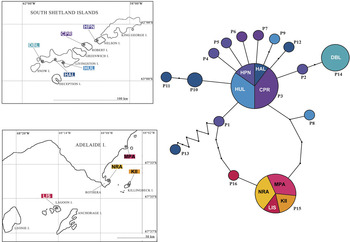
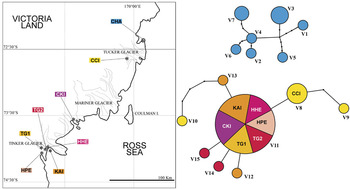
The sampled populations from the Antarctic Peninsula can be divided into two clearly separated geographic groups (Fig. 1): a northern group (HPN, CPR, HUL, HAL and DBL), from the South Shetland Islands, and a southern group (KII, MPA, NRA, LIS), collected from Adelaide Island and neighbouring islands. The distribution of collection sites in Victoria Land was more uniform, with the eight sites encompassing a transect between 72°25′S and 74°04′S (Fig. 2). Nevertheless, these collection sites are geographically isolated by major glacier tongues, such as the Tucker Glacier (between Cape Hallett and Crater Cirque), the Mariner Glacier (between Crater Cirque and Cape King), the Aviator Glacier (separating Cape King from Kay Island, Hayes Head and Tinker Glacier 2), and the Tinker Glacier (separating Kay Island, Hayes Head and Tinker Glacier 2 from Tinker Glacier 1 and Harrow Peaks).
Map of collection sites (asterisks) in the Antarctic Peninsula and the corresponding network of haplotypes. In the network, each circle represents a distinct haplotype; the size of the circles is proportional to the abundance of the relative haplotype; each colour represents a distinct population. Abbreviations of haplotypes as in Table I.

Map of collection sites (asterisks) in Victoria Land and the corresponding network of haplotypes. Each circle represents a distinct haplotype; the size of the circles is proportional to the abundance of the relative haplotype; each colour represents a distinct population. Abbreviations of haplotypes as in Table I.

A total of 135 specimens were genotyped, 80 from the maritime and 55 from continental Antarctica (Table I). For each individual, the mitochondrial genes encoding for subunit I of the cytochrome c oxidase (COX1), and subunit 6 of the ATPase (ATP6) were amplified with a standard PCR protocol on a GeneAmp PCR System (Applied Biosystems) and sequenced.
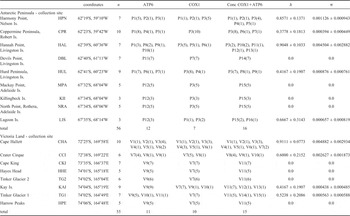
Haplotype distribution and population genetic parameters in the populations studied. Numbers in parentheses indicate the number of individuals possessing an haplotype. h = haplotype diversity, π = nucleotide diversity.

Primers were manually designed on the alignment of the two target genes from two specimens of F. grisea whose mitochondrial genome was completely sequenced and described in Torricelli et al. (Reference Torricelli, Carapelli, Convey, Nardi, Boore and Frati2010). For the amplification of the ATP6 and COX1 fragments the following primer pairs were used: A6.3936J (GCATTCTTTTATCCCTCAAATATCACC) and A6.4859N (GCAGAGATTGGTCAAGGGCTTTGGTC); COX1.1507J (TCAACAAATCATAARGATATYGG) and COX1.2161N (CAAATGTTGGTATAAAATAGGATC). Primer numbers correspond to the position of the 5′-nucleotide on the sequenced mitochondrial genome of F. grisea from the Antarctic Peninsula (Torricelli et al. Reference Torricelli, Carapelli, Convey, Nardi, Boore and Frati2010). In order to use the same primer in all specimens, ambiguous bases were included in the COX1.1570J primer to account for sequence variation between individuals.
Total DNA was extracted from frozen specimens using the commercial kit Wizard SV Genomic Purification System (Promega) and eluted in a final volume of 50 μl of Nuclease Free Water. All PCR amplifications were performed in a volume of 25 μl containing 2.5 μl of genomic DNA (whose concentration ranged from 2.3 to 17 ng μl-1), 0.5 μM of each primer, 0.2 mM of each dinucleotide, 2.5 mM of MgCl2, 5 μl of Green GoTaq Flexi buffer and 0.625 u of GoTaq Flexi DNA Polymerase. PCR conditions for both genes were: 35 cycles at 94°C for 1 min, 50°C for 1 min, and 72°C for 90 sec, followed by a final extension step at 72°C for 5 min.
All PCR products were purified with the commercial kit “Wizard® SV Gel and PCR Clean–Up System” (Promega) and the resulted amplicons quantified with a Nanodrop ND1000 UV vis (NanoDrop Technologies). Direct sequencing of purified PCR products was performed on a Beckman Coulter CEQ 8000XL Automated Sequencer. All amplified fragments were sequenced in both directions using both amplification primers. Sequences were deposited in GenBank under Accession numbers HQ315646–HQ315685.
Sequences were manually aligned with McClade 4.08 (Maddison & Maddison Reference Maddison and Maddison2000) and analysed with PAUP* 4.0b10 (Swofford Reference Swofford2001). Haplotype frequencies and their distribution on the network were obtained using the software Collapse 1.2 (available at: http://darwin.uvigo.es/software/collapse.html) and TCS 1.21 (Clement et al. Reference Clement, Posada and Crandall2000), respectively, using the default setting of 95% connection limit. Calculations of nucleotide and haplotype diversity indexes were performed using the program Arlequin 3.11 (Excoffier et al. Reference Excoffier, Laval and Schneider2005). ModelTest (Posada & Crandall Reference Posada and Crandall1998) was used to assess the model of evolution that best fits the data, and estimates of genetic distance between haplotypes were calculated either as uncorrected percentage of nucleotide substitutions and as GTR+G-corrected genetic distance values (with the parameters estimated by ModelTest). Genetic distances between populations have been calculated by averaging uncorrected and GTR+G-corrected genetic distances for all individuals of each population under comparison (Table II).
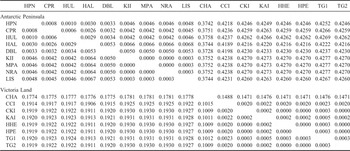
Matrix of genetic divergence between populations. Uncorrected p-distances (below the diagonal) and GTR+G-corrected distances are reported. See Table I for the abbreviations of populations.

Results
A 537 bp fragment for ATP6 and a 478 bp fragment for COX1 were sequenced in a total of 135 individuals (80 from nine populations along the Antarctic Peninsula, and 55 from eight populations in Victoria Land; Figs 1 & 2, Table I). The sequenced fragments encompass positions 4131–4667 for ATP6 and positions 1614–2212 for COX1 in the sequence of the complete mitochondrial genome of a specimen of F. grisea from the Antarctic Peninsula (Torricelli et al. Reference Torricelli, Carapelli, Convey, Nardi, Boore and Frati2010; GenBank accession Number: EU016196). Scrutiny of COX1 sequences revealed nine sites (all in third codon positions and all in individuals from the Peninsula) with uncertain nucleotide identification. This was evident from the presence of double peaks on the electropherograms, which could not be resolved by sequencing in both directions and could be possibly attributed to heteroplasmy. Double peaks were found in the COX1 sequences of 24 individuals, all from AP, and some of them even exhibited double peaks at more than one site. Eight of the nine sites with double peaks were variable in the remaining individuals. Because of the impossibility of unambiguously assigning the haplotypes at the putative heteroplasmic individuals, these were removed from the analysis, which was therefore based on 111 individuals, 56 from the Antarctic Peninsula and 55 from the Victoria Land. There were no insertions or deletions and sequences were aligned and concatenated into a unique 1015 bp dataset.
No common haplotype was found between AP and VL samples. Sequences of COX1 were found to be more conserved across individuals (17 haplotypes) than those of ATP6, showing only seven different haplotypes (P1–7) in the Antarctic Peninsula, and 10 haplotypes (V1–10) in Victoria Land (Table I). Percentage of variable sites in COX1 was 2.7% in AP, 10.9% in VL, and 21.3% in the pooled set of haplotypes. Most substitutions occurred in 3rd codon positions, and only four variable positions were found in the amino acid sequences. Only one amino acid replacement was diagnostic between AP and VL. Divergence among haplotypes ranged from 14.4 to 17.2% in comparisons involving samples from AP vs VL, and generally < 2.3% between individuals from the same region (see supplementary Table – www.journals.cambridge.org/jid_ANS). The population from Cape Hallett (CHA) represents an exception to this generalization, as its six haplotypes (all of them unique for this site) show divergence values of 9.0–9.8% with respect to the remaining haplotypes found in the Victoria Land (see supplementary Table – www.journals.cambridge.org/jid_ANS).
Sequences of ATP6 were more variable across individuals (23 haplotypes), with 12 different haplotypes (P1–12) in the Antarctic Peninsula, and 11 haplotypes (V1–11) in Victoria Land (Table I). Percentage of variable sites was 2.6% in AP, 12.7% in VL and 27.7% in the pooled set of haplotypes. A higher number of amino acid replacements was inferred, with a total of 26 variable positions in the amino acid sequences. Seventeen amino acid replacements were diagnostic between AP and VL. Divergence among haplotypes was 19.9–21.6% in comparisons involving samples from AP vs VL, while it did not exceed 1.3% in comparisons between samples from the same region (see supplementary Table – www.journals.cambridge.org/jid_ANS). Again, haplotypes from CHA represent an exception, showing higher values of genetic divergence (10.8–11.5%), and six amino acid replacements against other VL haplotypes. Two of these replacements were shared with AP haplotypes. Nevertheless, in one of the sites the AP haplotype is shared with CHA, while in the other site the AP haplotype is shared with all other populations of VL (and not CHA). This prevents us from unequivocally assessing the ancestral haplotype(s).
The dataset of concatenated haplotypes is composed of 16 haplotypes in AP and 15 haplotypes in VL (Table I). In the Antarctic Peninsula, two haplotypes (P3 and P15) are shared by more than one population. All northern populations (HPN, CPR, HUL, HAL), with the exception of DBL, share P3, along with a set of additional haplotypes (P1–13), each of which are found in only one population. P15 is shared by all southern populations (KII, MPA, NRA, LIS), each of which also possesses another “private” haplotype. The population of Devils Point (Livingston Island) had one single haplotype (P14), not shared by any other population. In Victoria Land, only one haplotype (V11) is shared by more than one population. V11 is found in all populations except Cape Hallett and Crater Cirque, which both have their own set of peculiar haplotypes. Cape Hallett has the highest number of haplotypes detected in this study for a single population (seven out of ten individuals sampled), which are also well differentiated from the remaining haplotypes in terms of genetic divergence (10.0–10.5%; see Supplementary Table – www.journals.cambridge.org/jid_ANS). In contrast, four of the southernmost populations in Victoria Land (CKI, HHE, TG2, HPE) were fixed for the shared haplotype V11. This pattern is reflected by the estimate of haplotype diversity (Table I), which is higher for Cape Hallett and Crater Cirque than for the remaining populations.
Two haplotype networks were constructed for both regions (Figs 1 & 2, right sides). In the Antarctic Peninsula, the two most common haplotypes dominate the network, with all rare haplotypes of each of the two groups of populations (northern and southern) deriving (1–4 mutations) from each of the dominant haplotypes (P3 and P15, respectively). In Victoria Land, the number of substitutions (101–107) between Cape Hallett haplotypes and those from the remaining populations prevents the clustering of all haplotypes in the same network. The network representing haplotypes V8–15 shows that all haplotypes derive (1–5 substitutions) from the most common haplotype, V11. Among these haplotypes derived from V11 are also those found at Crater Cirque (V8, V9, V10).
Discussion
Previous molecular phylogenetic studies on Antarctic Collembola have failed to find evidence of a latitudinal gradient in genetic diversity, and genetic structuring has often been related to the pattern of post-glacial recolonization from glacial refugia (Stevens et al. Reference Stevens, Greenslade, Hogg and Sunnucks2006, Convey & Stevens Reference Convey and Stevens2007, McGaughran et al. Reference McGaughran, Hogg and Stevens2008). Our data on Friesea grisea do not show unequivocal signs of a latitudinal gradient in genetic variability, although in the Antarctic Peninsula, the northern populations from the South Shetland Islands show more haplotype diversity (12 different haplotypes) than that found in the southern populations (those located in or near Adelaide Island), which only shows two haplotypes (Table I). Many factors, related to latitude, may influence the pattern of genetic diversity, for instance including the fact that more extreme temperatures may select for tolerant genotypes, ultimately leading to a decrease of genetic variability. On the other hand, the most remarkable aspect of these data is the evidence for local differentiation between groups of populations. In fact, in both regions, populations can be divided into northern and southern groups which share no haplotypes. In the Antarctic Peninsula, the northern group is composed of populations from the South Shetland Islands (haplotypes P1–14), while the southern group is represented by Adelaide Island (and nearby locations) (haplotypes V15–16). In Victoria Land, Cape Hallett and Crater Cirque each possess their own unique set of haplotypes, with no sharing with the remaining southern populations. In addition, the levels of genetic divergence between the haplotypes found at Cape Hallett and the remaining haplotypes of F. grisea suggest a more ancient (pre-Pleistocene) divergence between these two groups of haplotypes. In the context of post-glacial dispersal from refugia (Convey & Stevens Reference Convey and Stevens2007), this species may have had several distinct Pleistocene refugia to start from (Stevens et al. Reference Stevens, Greenslade, Hogg and Sunnucks2006), one in the Cape Hallett area and another for the populations south of Crater Cirque. In addition, the network (Fig. 2) shows that Crater Cirque haplotypes might be derived from the same ancestral haplotype as the remaining southern populations (V11), suggesting a south-to-north route of colonization across the Mariner Glacier. The area of Victoria Land sampled in the current study overlaps that sampled in a study of Desoria klovstadi (Stevens et al. Reference Stevens, Greenslade, Hogg and Sunnucks2006). Interestingly, a similar pattern is observed for both species, with the Cape Hallett area characterized by a unique set of genetically related haplotypes, not shared with Crater Cirque and other southern populations.
McGaughran et al. (Reference McGaughran, Torricelli, Carapelli, Frati, Stevens, Convey and Hogg2010) assessed the genetic structure of the hypogastrurid collembolan Gomphiocephalus hodgsoni collected from 28 sites in the southern section of the Victoria Land (76°07′S to 78°19′S). The distribution of populations in their study covers a latitudinal transect of similar extent to that of the present study, but most of the populations of G. hodgsoni were collected in the Dry Valleys, which are thought to have had available deglaciated soils much earlier than other sites in the Victoria Land (Lawver & Gahagan Reference Lawver and Gahagan2003, Sugden et al. Reference Sugden, Bentley and Cofaigh2006). Two contrasting patterns emerge when comparing F. grisea and G. hodgsoni. First, G. hodgsoni shows a much higher number of haplotypes (45) for COX1, although this is probably due to the much greater number of individuals screened (289). Second, COX1 haplotypes in F. grisea show much higher divergence values (up to 9%) compared with those of G. hodgsoni (up to 2.5%). This essentially indicates the influence of the haplotypes from Cape Hallett, and might reflect a much older (pre-Pleistocene) divergence.
A clear geographical distinction was evident also in the Antarctic Peninsula between the groups of northern (from the South Shetland Islands) and southern (from Adelaide Island and the surroundings) populations. This suggests the presence of multiple refugia, each represented by the two clusters of haplotypes shown by the haplotype network. In this scenario, the two most frequent haplotypes (P3 and P15) are likely to be the most ancient ones, from which the remaining haplotypes have been derived by virtue of single (or a few) mutations.
A similar dataset was assembled by McGaughran et al. (Reference McGaughran, Torricelli, Carapelli, Frati, Stevens, Convey and Hogg2010) who studied a number of populations of the isotomid collembolan C. antarcticus antarcticus collected from some of the same sites along the Antarctic Peninsula as the populations of F. grisea in the present work, and encompassing exactly the same geographic area. As observed before in the comparison with G. hodgsoni, F. grisea shows fewer haplotypes (7) than those found in C. a. antarcticus, and a lower genetic divergence between them. Again this difference could be attributed to a more recent expansion for F. grisea. Interestingly, no sharing of haplotypes between the South Shetland Islands and the region around Adelaide Island was found for C. a. antarcticus either.
These data also allow comparison to be made between the two main regions (AP and VL). Although the overall taxonomic status of the two sets of populations may be validly questioned (Torricelli et al. Reference Torricelli, Carapelli, Convey, Nardi, Boore and Frati2010), this may be considered irrelevant for the purposes of the comparison. With a similar number of individuals sampled in the two regions, the number of haplotypes is also similar. This is somewhat dependent on the overall sample size and increasing the number of individuals sampled will eventually lead to the discovery of additional haplotypes. Most of AP haplotypes (14/16) were found in one or two individuals. A similarly high rate of occurrence for rare haplotypes was reported in Cryptopygus antarcticus antarcticus (McGaughran et al. Reference McGaughran, Torricelli, Carapelli, Frati, Stevens, Convey and Hogg2010). A possible explanation for these findings is the occurrence of population bottlenecks during the Pleistocene (McGaughran et al. Reference McGaughran, Torricelli, Carapelli, Frati, Stevens, Convey and Hogg2010).
We found considerable sharing of haplotypes among several different populations. This was evident for haplotypes P3 and P15 (each shared by four populations in the Antarctic Peninsula), and V11 (shared by six populations in Victoria Land). These “dominant” haplotypes account, respectively, for 21/56 and 15/56 (in the Antarctic Peninsula), and 35/55 (in Victoria Land) of the total individuals sampled in each region. Besides indicating the presence of multiple glacial refugia (as discussed above), a “dominant” haplotype occurring in many sites also suggests higher levels of recent gene flow among populations.
In conclusion, our data confirm the likelihood of a pre-Pleistocene origin for Antarctic springtails, which must have survived the glacial periods in multiple refugia in each of the major regions where they are currently found. The ancient origin, coupled with the multiple refugia hypothesis and the harsh environmental conditions (limiting current gene flow), account for the observed local differentiation among northern and southern groups of populations in both Antarctic Peninsula and the Victoria Land.
Acknowledgements
We wish to thank two anonymous reviewers for their constructive comments on an earlier version of the manuscript. This work was funded by the Italian Program of Research in Antarctica (PNRA) and the British Antarctic Survey (BAS). The logistic support of PNRA and BAS during the collection of the material is acknowledged. Partial support was also provided by the University of Siena. This paper also contributes to the BAS Ecosystems, Antarctica New Zealand’s Latitudinal Gradient Project (LGP, Key Question 2 - role of large-scale ice structures) and SCAR Evolution and Biodiversity in the Antarctic (EBA) research programmes.