

In Canada, as in many countries around the world, people aged 65 years and over are the fastest-growing segment of the population; over four million Canadian adults are older than 65, making up 13 per cent of the total population (Statistics Canada, 2005). This number will increase to roughly 25 per cent of the total population before the year 2031, a trend similar to that in the United States. Gender alone appears to be one of the most important variables in health for older adults in North America (Huyck, Reference Huyck, Birren and Schaie1990). There are, for example, over half a million more women older than 65 than there are men (Statistics Canada, 2005). Women also live longer, with an average life expectancy of 83.6 years, compared to 76.7 years for men. Conversely, as women get older they tend to experience more chronic health problems than their male counterparts. These gender differences in health functioning have been attributed to various factors, including hormonal, genetic, and behavioural differences (Huyck, Reference Huyck, Birren and Schaie1990).
Just as there appear to be different trends in the chronic health conditions experienced by men and women, research in the area of self-reported health also shows different trends for each gender. Specifically, it seems that women may provide more accurate, albeit more negative, reports of their physical health throughout their lifespan and into older adulthood. This may be because women know more about health in general, and their own health specifically, than do men (Idler, Reference Idler2003). It follows that women may provide more accurate self-reports of health than their male counterparts.
Importantly, the health problems of older adults are often both physical and psychological. It is theoretically necessary to examine the health of older adults within a bio-psychosocial framework, which conceptualizes health as a state of physical, psychological, and social well-being (Cavanaugh, Blanchard-Fields, & Norris, Reference Cavanaugh, Blanchard-Fields and Norris2008). From within this framework, we must examine psychological and social factors in addition to physical health. Two such factors include general wellness and life satisfaction, both of which are found to be significantly associated with physical health, predictions of mortality, and measures of morbidity (Berg, Hassing, McClearn, & Johansson, Reference Berg, Hassing, McClearn and Johansson2006).
Research suggests that certain personality traits are associated with better health, both physical and psychological (e.g., Shifren & Bauserman, Reference Shifren and Bauserman1996). For example, as noted by Shifren and Bauserman, relatively high instrumentality (defined as a set of personality traits associated with personal agency and accomplishment) has often been associated with better health and psychological adjustment than expressivity (defined as a set of personality traits associated with the maintenance of social relationships, and a focus on other’s needs). Both males and females can be relatively high in both instrumentality and expressivity, predominantly instrumental or expressive, or relatively low in both. Both instrumentality and expressivity were originally conceptualized as gender-linked traits; instrumental traits such as dominance and competitiveness were commonly associated with stereotypical masculinity, while expressive personality traits such as dependence and sensitivity were commonly associated with stereotypical femininity (Bem, Reference Bem1974).
Whereas sex is often understood to mean the biological differences between males and females of any particular species, gender has come to indicate social and psychological patterns of behaviour (Woodhill & Samuels, Reference Woodhill and Samuels2003). In other words, gender is something we do (Bem, Reference Bem1993). Most contemporary psychologists now agree that gender is learned through social situations in childhood, adolescence, and adulthood, and cognitive processes must also be taken into account to explain how the environment shapes gender development (Banerjee, Reference Banerjee, Ding and Littleon2005). Social cognitive theory stresses the influence of children’s social experiences on their behaviour and also highlights their active role in observational learning. According to this theory, individuals attend to other people’s behaviour, test that behaviour themselves, and then evaluate the outcomes of the behaviour. In the same way, we play an active role in the development of our health behaviours and beliefs, which, in turn, may be related to our gender role(s) (Banerjee, Reference Banerjee, Ding and Littleon2005).
Another explanation of the observable behaviour differences between men and women is that these differences are due to an intrinsic, inherent difference between the sexes. Acceptance of this approach suggests that because men naturally show higher levels of instrumentality, while women naturally show greater expressivity, psychological health for both men and women would depend on the correspondence of their actual personality traits to those most appropriate for their sex (Bem, Reference Bem1974). According to this paradigm, women who endorse predominantly expressive traits and men who endorse predominantly instrumental traits will demonstrate optimal psychological and physical adjustment. In contrast, Sandra Bem’s androgyny model holds that high levels of both stereotypic masculine and stereotypic feminine traits are essential for optimal adjustment of both men and women at any age. According to this model, an androgynous orientation leads to maximized psychological wellness and “defines a [better] standard of mental health” (Bem, Reference Bem1974, p.162).
To test her model, Bem developed the Bem Sex Role Inventory (BSRI) to measure self-rated instrumental and expressive personality traits (Bem, Reference Bem1974). The BSRI assesses a person’s gender role in terms of the respondent’s self-reported possession of socially desirable instrumental and expressive traits. A basic assumption of the measure is that no one is absolutely masculine or feminine. Respondents are classified as belonging to one of four groups: (a) Instrumental (high on instrumentality and low on expressivity), (b) Expressive (high on expressivity and low on instrumentality), (c) Undifferentiated (low on both expressivity and instrumentality), and (d) Androgynous (high on both expressivity and instrumentality).
Providing support for Bem’s androgyny model, Shifren and Bauserman (Reference Shifren and Bauserman1996) found that, of the 336 men and women they surveyed, participants high in both instrumentality and expressivity reported significantly better health practices (less smoking, reduced alcohol and drug use, and more safety precautions taken [i.e., condoms]) than their peers. These results replicated earlier studies showing that individuals who score high on both instrumental and expressive traits report better health practices and outcomes (e.g., Baffi, Redican, Sefchick, & Impara, Reference Baffi, Redican, Sefchick and Impara1991).
Bem’s model has not received unambiguous empirical support. Rather, as mentioned earlier, some researchers have found support for instrumentality as the healthier gender role (e.g., Whitley, Reference Whitley1983), especially when adopted by women (Kleinman, Reference Kleinman2001). Various meta-analyses of the literature on instrumentality and expressivity have supported this position. Whitley (Reference Whitley1983) found that instrumental but not expressive traits were strongly related to the absence of depression, general adjustment, and general health, findings consistent with the earlier results of Bassoff and Glass (Reference Bassoff and Glass1982) and Taylor and Hall (Reference Taylor and Hall1982). Antill and Cunningham (Reference Antill and Cunningham1979) showed that instrumental traits in both males and females were positively correlated with self-esteem, while expressive traits were either negatively correlated or not correlated. Instrumental traits are also positively correlated with greater psychological adjustment in both males and females (Adams & Sherer, Reference Adams and Sherer1985). In one study, individuals who scored higher on instrumental traits showed significantly higher levels of general self-efficacy and assertiveness, and scored significantly lower on the depression and social introversion scales of the MMPI than their expressive and androgynous peers.
While it is important to note that these results are derived almost entirely from college-aged samples, they seem to support the notion of androcentrism, defined by Bem as “the privileging of males, male experience, and the male perspective” (Bem, Reference Bem1993, p. 15). If one uses androcentric reasoning, then, as the male experience is privileged over that of women, or because instrumentality is more highly valued than expressivity, perhaps it is more adaptive for women to endorse traditionally masculine characteristics. Social cognitive theory can be used to explain this: if stereotypically instrumental personality traits are most highly valued, then it would be valuable for any person to exhibit them. In androcentric societies, these personality traits would be strongly reinforced. This valuation of stereotypically masculine traits may be especially visible in the current cohort of older women, who have spent their entire lives subject to androcentric values. A logical consequence would be that older women may show high levels of instrumentality, and further that women who are more highly “masculine” may also be more likely to indicate higher self-reported health functioning.
In support of this possibility, some researchers have indeed found that women endorse more instrumental traits as they age than they did in their youth (Huyck, Reference Huyck and Bengston1996). In fact, some empirical research suggests that gender identity becomes less fixed as we get older (see Cavanaugh et al., Reference Cavanaugh, Blanchard-Fields and Norris2008, for a review), resulting in a more androgynous trait set for older adults. It may be most accurate to say that individual scores on stereotypically gender-linked personality traits become less fixed and more fluid as a person ages (e.g., Sinnott & Shifren, Reference Sinnott, Shifren, Birren and Schaie2001). Others have even said that older adults may experience a gender ‘crossover’ (Gutmann, as cited in Huyck, Reference Huyck and Bengston1996). Gutmann has observed that older men become more passive as they get older, and women become more willing to meet their own needs for achievement and control (Gutmann, Reference Gutmann1987). This view is supported by psychometric studies showing that older adults tend to score high on both instrumental and expressive traits (Sinnott & Shifren, Reference Sinnott, Shifren, Birren and Schaie2001). In other words, as we get older we show diminished correspondence between stereotypically gender-linked traits and our gender, and we exhibit increased levels of androgyny. That is not to say that all older adults reach a point where they equally endorse instrumental and expressive personality traits. Rather, across the lifespan, men continue to endorse significantly more instrumental traits than women; it is just that women increasingly endorse more instrumental traits as they age (e.g., Huyck, Reference Huyck and Bengston1996). The opposite likely holds true for men and expressivity.
In addition to these personality traits, there are also other factors related to the self-reported health functioning of older adults (e.g., social support, economic status, chronic health conditions; Quirouette & Pushkar, Reference Quirouette and Pushkar1999). For example, the availability of friends, family, and other acquaintances who offer information, emotional relief, and even material aid is associated with reduced levels of loneliness (Homen & Furukawa, Reference Homen and Furukawa2002), higher quality of life (Gabriel & Bowling, Reference Gabriel and Bowling2004), and is a significant predictor of long-term maintenance of physical activity (McAuley, Jerome, Elavksy, Marquez, & Ramsey, Reference McAuley, Jerome, Elavsky, Marquez and Ramsey2003) in older adults. Economic status is also strongly associated with the health of older adults (House, Herd, & Lantz, Reference House, Herd and Lantz2005; Prus, Reference Prus2004), given that it may shape an older adult’s “exposure to and experience of almost all risk factors for health” (House et al., Reference House, Herd and Lantz2005, p.17). Canadians of higher economic status have lower mortality and chronic illness rates than those of lower economic status (Prus, Reference Prus2004).
Not surprisingly, more objective indicators of an individual’s physical health are also associated with the self-reported health functioning of older adults (Schulz, Mittelmark, Kronmal, Polak, Hirsch, German, et al., Reference Schulz, Mittelmark, Kronmal, Polak, Hirsch, German and Bookwala1994); specifically, higher rates of chronic illness and medical co-morbidity are associated with lower levels of self-reported health function in a given population of older adults. Among individual older adults, changes in levels of self-reported health functioning over time systematically reflect their level of medical co-morbidities and chronic illnesses (Leinonen, Heikkinen, & Jylha, Reference Leinonen, Heikkinen and Jylha2002). However, these factors do not invalidate the role of personality and gender role identity in health.
In the present study, our model of health function included self-rated physical health, life satisfaction, and wellness. It is noted that the three facets of our model likely are not equally related to each other or to the overarching concept of health function. For example, wellness and life satisfaction, both more psychologically oriented aspects of health function, are closer to each other conceptually than either is to self-rated physical health.
Further, it is acknowledged that this study addresses only those aspects of health function perceived by the individual. Medical conditions that are undiagnosed or that are not perceived by the respondent as impacting health function certainly play a part in the individual’s health function, but the role of these conditions was not assessed in the present study. Undiagnosed or unappreciated hypertension is an example of such a condition.
The purpose of this study was to investigate Bem’s androgyny model further, and, specifically, to apply it to the assessment of self-reported physical health, life satisfaction, and general wellness in older adults. First, it was hypothesized that more men would be classified as instrumental rather than as expressive, androgynous, or undifferentiated, and that, likewise, more women would fall into the expressive classification than either the instrumental, androgynous, or undifferentiated classifications.
Second, based on the present literature review, it was hypothesized that both older women and men whose scores on the BSRI led to an instrumental classification would show higher levels of self-reported health function (physical health functioning, general wellness, and life satisfaction) than those classified as expressive, androgynous, or undifferentiated, even when controlling for chronic health conditions, economic status, and social support.
Third, it was hypothesized that given past research on gender differences in the accuracy of self-reports of health, women would show higher correlations than men between a relatively more objective measure of chronic health conditions and measures of self-rated physical health function and wellness.
Method
Recruitment and Sampling
The sample consisted of 102 participants (47 males and 55 females), living in southwestern Ontario, Canada. The study was approved by the Research Ethics Board at the University of Windsor.
Participants were recruited from two local seniors’ organizations. The first author attended meetings of these organizations and asked for volunteers from the members in attendance. Older adults at these meetings were told that the study would require approximately one hour of their time. The first author encouraged participation by saying that the psychological community needed more information on aging well, instead of “just aging.” Following the meetings’ completion, the first author collected data from participants. If individuals were interested in taking part in the study but unable to stay after the meeting, the first author made arrangements to come to their home or to another location convenient to them in order to complete the measures.
To reach the targeted number of participants (100), snowball sampling was also used. After completing the measures, and following debriefing, participants were asked if they knew of anyone who might be interested in taking part in the study. Participants were asked if they would provide the name and telephone number so that the first author could contact the third party directly. If they were uncomfortable sharing this information, participants were also encouraged to give the first author’s name and contact information to anyone they thought might want to take part in the study. In this way, the friend or family member could contact the first author directly by telephone or e-mail. In all, 34 participants were recruited using snowball sampling.
Prior to enrollment in the study, potential participants were informed that the study was based on written questionnaires that required an English reading level of grade 8 or above, and that having a history of stroke or brain injury might make it more difficult for them to participate. Based on this information, an unknown number of individuals may have decided not to continue with the study.
Participants
Participants ranged in age from 65 to 93, with a mean age of 77.37 (SD = 6.45). The samples of men and women did not differ significantly on mean age, t (99) = 1.1, ns. The men in our sample ranged in age from 65 to 91, while the women in the sample ranged from 65 to 93. To compare the age distributions of men and women, participants were sorted into one of five groups: those aged 65–70, 71–75, 76–80, 81–85, and 86–93. A chi-square analysis was run to compare the number of men and women in each age group. No significant differences emerged, χ2[4, n = 101] = 2.81, ns. Given that no significant age differences were observed between the men and women in our sample, age was not included as a covariate in the analyses.
Measures
Demographic information was collected from each participant, including (a) date of birth, (b) gender, (c) years of formal education, (d) marital status, (e) first language, and (f) country of birth.
Three covariates were used in the study. Two items from the Joseph M. Foley Elderhealth Centre Self-Assessment Form (Ebersole & Hess, Reference Ebersole and Hess1998) assessed economic status and social support, the first two covariates. The third was a relatively objective self-report index of chronic health conditions, the Katz adaptation of the Charlson Chronic Health Conditions Index (the C-K Index; Katz, Chang, Sangha, Fossel, & Bates, Reference Katz, Chang, Sangha, Fossel and Bates1996). Participants indicated whether they had received a physician’s diagnosis of each chronic health condition on the C-K Index (e.g., participants were asked if they had ever experienced a heart attack). Items on the C-K Index are weighted in terms of seriousness. The total score therefore reflects co-morbid medical burden based both on number and seriousness of health problems: the higher the score, the more severe the burden of illness. The total score is an indicator of the cumulative increased likelihood of one-year mortality based on chronic health conditions. Levels of item-specific agreement between the original Charlson Chronic Health Conditions Index and the C-K Index range between 83 and 100 per cent (Katz et al., Reference Katz, Chang, Sangha, Fossel and Bates1996). The C-K Index has been used with community-dwelling older adults in the past to measure their chronic health and medically co-morbid conditions and to control for these conditions in various statistical analyses (Blalock, Byrd, Hanson, Yamanis, McMullin, Devellis et al., Reference Blalock, Byrd, Hanson, Yamanis, McMullin, Devellis, Robert, Panter, Kawata, Watson and Jordon2005).
The Bem Sex Role Inventory (BSRI; Bem, Reference Bem1974) was used to measure participants’ instrumental and expressive traits. The BSRI is made up of two subscales, the BSRI Masculinity and Femininity subscales, and consists of 60 adjectives. The Masculinity subscale consists of 20 instrumental traits, stereotypically associated with masculinity; the Femininity subscale includes 20 expressive traits, stereotypically associated with femininity. The remaining 20 adjectives are neutral items not incorporated in either subscale. Participants rated how well each adjective accurately described them using a seven-point Likert scale.
The median split method (Lenney, Reference Lenney, Robinson and Shaver1991) was used to classify each participant into one of four categories: (a) instrumental (high instrumental and low expressive), (b) expressive (high expressive and low instrumental), (c) androgynous (high instrumental and high expressive), or (d) low on both (undifferentiated). The median scores on the Masculinity and Femininity scores were calculated for the total sample (both men and women). Each participant then was identified as belonging to one of the four gender role categories based on that person’s score relative to the median on both BSRI subscales. Thus, if a participant’s scores fell above the median on the Masculinity subscale, but below the median for the Femininity subscale, that individual was classified as instrumental. If scores fell above the median for the Femininity subscale but below the median for the Masculinity subscale, that person was classified as expressive. If scores were below the median for both Masculinity and Femininity subscales, that person was classified as undifferentiated. Finally, if a participant’s scores were above the median for both Masculinity and Femininity subscales, the individual was classified as androgynous.
Slivinske, Fitch, and Morawski’s (Reference Slivinske, Fitch and Morawski1996) Wellness Index Scale was used to assess the general wellness of participants. This index comprises six subscales, four of which (Morale, ADL-IADL, Religiosity, and Social Resources) were used, totalling 57 items. Participants rated each question on a five-point Likert scale, from strongly agree (1) to strongly disagree (5), with lower scores indicating greater wellness. The Physical Health subscale was excluded because the information it provided would have been similar to that provided by the RAND SF-36 (see below). The Economic Resources subscale was excluded because it does not contribute to the composite measure of overall functioning provided by the other subscales (see Slivinske et al. for a discussion).
The Satisfaction with Life Scale (Diener, Emmons, Larsen, & Griffin, Reference Diener, Emmons, Larsen and Griffin1985) was used to measure participants’ life satisfaction. This measure consists of five items, which participants rated on seven-point Likert scales, with higher scores indicating increased satisfaction with life.
Twenty questions from the RAND 36-Item Medical Outcomes Study Short Form Health Survey (RAND SF-36; RAND, 1995) were used to assess the self-reported physical health function of participants. We applied four subscales for this purpose: Physical Functioning (10 questions); Limitations in Physical Activities because of Physical Health Problems (4 questions); Bodily Pain (2 questions); and Vitality (4 questions). Participants indicated ratings on a six-point Likert scale from none/not at all (1) to very severely/extremely (6). Higher scores on the RAND SF-36 indicate better self-reported physical health functioning.
These data were analyzed using SPSS 16.0 for Macintosh.
Procedure
Participants met with the experimenter both individually and in groups, either following their seniors’ organization meeting, or at another location convenient to the participant (i.e., the individual’s home). To begin the testing session, the experimenter led participant(s) through two examples of how to answer the questionnaires, beginning with items from the BSRI (1974). The questionnaires required participants to indicate their own responses by circling the appropriate answer on paper. Once the participant(s) had completed the survey, they were debriefed in-person and given a letter summarizing the debriefing information. All participants were offered the chance to enter into a draw for one of four gift certificates valued at $50.00.
Results
Initial Analyses
Economic status
Three quarters of the participants identified their economic status as “Comfortably able to afford the necessities” (n = 77), and the remaining participants were “Able to afford the necessities with careful budgeting” (n = 24; see Ebersole & Hess, Reference Ebersole and Hess1998). Men and women did not show significantly different response patterns for economic status, χ2[4, n = 101] = 2.21, ns.
Social support
To assess levels of social support, participants were asked about their marital status and living arrangements. In response, 61 participants (60.8%) indicated that they were married, 31 (30.4%) indicated that they were widowed, and four each indicated that they were either separated or divorced (3.9%) or single (3.9%). One participant did not indicate his marital status. A total of 33 participants reported that they lived alone (32.4%), and the rest of the sample indicated that they lived with a spouse, child, or someone else (77.6%). More men than women were married, and significantly more women than men were widowed, χ2 (4, n = 102) = 11.18, p < 0.01. Not surprisingly, men were significantly more likely to live with a spouse, while women were significantly more likely to live alone, χ2 (5, n = 102) = 10.92, p = 0.05.
Chronic health conditions
Co-morbid health conditions (e.g., angina, diabetes, lymphoma) were weighted on the C-K Index as described earlier (Katz et al., Reference Katz, Chang, Sangha, Fossel and Bates1996). Men reported a mean of 1.7 on the weighted index, while women reported a mean of 1.2, results similar to those reported in published studies of older community-dwelling participants (Leinonen et al., Reference Leinonen, Heikkinen and Jylha2002; Sarkisian, Hays, Berry, & Mangione, Reference Sarkisian, Hays, Berry and Mangione2002). These two means were not significantly different (t (102) = 1.5, p = ns, n = 100), indicating that men and women had a similarly mild mortality risk for the year after testing (Charlson, Pompei, Ales, & Mackenzie, Reference Charlson, Pompei, Ales and Mackenzie1987).
BSRI subscales
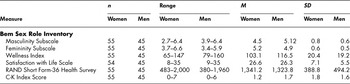
Although the hypotheses concerned the four-way classification of participants as instrumental, expressive, androgynous, or undifferentiated, the Masculinity and Femininity subscales also can be treated as continuous measures of instrumentality and expressivity, respectively. Independent samples t-tests were run to compare men’s and women’s means on the BSRI subscales. Men had higher scores on the Masculinity subscale, M = 5.11, SD = 0.6, n = 45, than women did, M = 4.51, SD = 0. 8, n = 55, t(100) = 3.7, p < 0.01. Women rated themselves significantly more highly on the Femininity subscale, M = 5.22, SD = 0.8, n = 55, than did men: M = 4.89, SD = 0.6, n = 44, t(97) = –3.2, p < 0.01. A restricted range of scores on both BSRI subscales and relatively high mean values were noted for both genders, particularly for men.
Table 1 gives descriptive statistics for the sample on the BSRI subscales and indices of wellness, life satisfaction, physical health function, and chronic health conditions.
Descriptive data by sex on BSRI subscales, wellness index, life satisfaction, physical health function, and an index of chronic health conditions (n = 100)

Sample sizes differ by measure because some participants did not answer all of the items of each subscale. Cases were deleted on a scale-by-scale basis. The BSRI Masculinity and Femininity subscale scores provide continuous indices of instrumentality and expressivity, respectively.
Assumptions for analyses of covariance
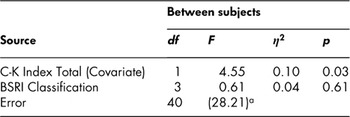
The assumption that the covariates of economic status, social support, and chronic health conditions were linearly related to the dependent variables (Wellness Index, Satisfaction with Life Scale, and RAND SF-36) was only partially met. For women, the chronic health conditions index (C-K Index) was the only covariate significantly correlated with any of the dependent variables, and this measure was only related to the measure of self-reported physical health functioning (RAND SF-36), r = –0.34, p < 0.01. Specifically, as number and severity of chronic health conditions increased, self-reported physical health functioning decreased. Similarly for men, only the C-K Index was significantly correlated with any of the dependent variables, correlating significantly with both life satisfaction (r = –0.36, p < 0.01) and the RAND SF-36 (r = –0.49, p < 0.01). Again, as chronic health conditions increased, self-reported physical health functioning, as well as life satisfaction, decreased. Therefore, in further analyses addressing the hypotheses, the C-K Index was the only covariate used and only in analyses involving the RAND SF-36, for men and women, and the Satisfaction with Life Scale, for men only.
BSRI Classification and Gender
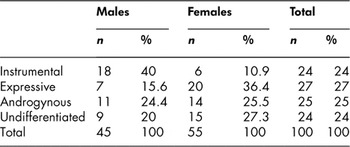
We hypothesized that more men would fall in the instrumental category on the BSRI than the expressive, androgynous, or undifferentiated category, and we anticipated that more women would fall in the expressive category than in the other three. As shown in Table 2, the categorization resulting from the median-split method showed that a greater number of women were classified as expressive (n = 20) than either undifferentiated (n = 15), androgynous (n = 14), or instrumental (n = 6). However, the variation in the number of women across categories was not statistically significant, χ2(3, n = 55) = 7.32, ns. Similarly, although more men were classified as instrumental (n = 18) than expressive (n = 7), undifferentiated (n = 9), or androgynous (n = 11, respectively), there was no statistically significant relationship among category membership and the relative number of men falling into the four classifications, χ2(3, n = 43) = 6.11, ns.
Bem Sex Role Inventory Classification: Median split analysis (n = 100)

The median split method classifies participants according to their BSRI Masculinity and Femininity scores in relationship to the median of the whole sample (both men and women). See Methods section for more information on the median split method.
BSRI Classification and Health Function
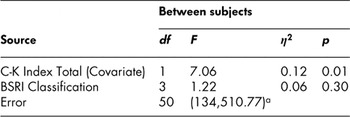
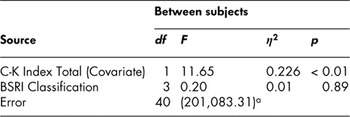
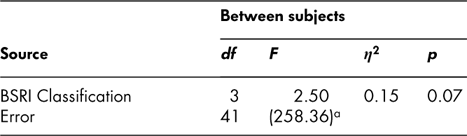
We predicted that men in the instrumental category would rate their health function higher in terms of physical health, life satisfaction, and wellness than men in the other three categories; similarly, we hypothesized that women classified as instrumental would give higher self-ratings of health function than women in the expressive, undifferentiated, or androgynous categories. We conducted an ANCOVA for women to compare means of instrumental, expressive, androgynous, and undifferentiated participants on self-reported physical health, controlling for chronic health conditions (see Table 3). Two ANCOVAs were conducted for men for both self-reported physical health (Table 4) and life satisfaction (Table 5). Neither men nor women showed a significant effect of BSRI classification on self-reported physical health after controlling for chronic health conditions. Results were similar for men’s scores on life satisfaction.
Analysis of covariance for women’s scores on the RAND SF-36 (n = 55)

a Value enclosed in parentheses represents mean square error.
Analysis of covariance for men’s scores on the RAND SF-36 (n = 45)

a Value enclosed in parentheses represents mean square error.
Analysis of covariance for men’s scores on the Satisfaction With Life Scale (n = 45)

a Value enclosed in parentheses represents mean square error.
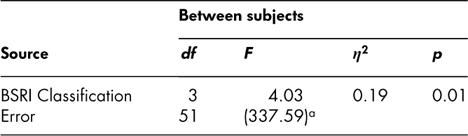
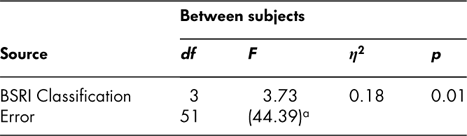
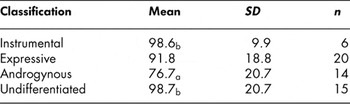
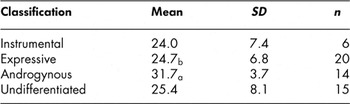
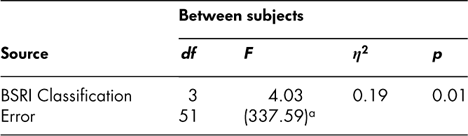
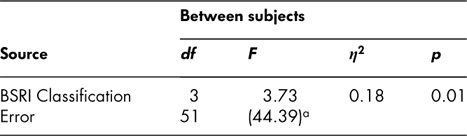
We conducted three one-way ANOVAs to compare the means of instrumental, expressive, androgynous, and undifferentiated participants on general wellness (for men and women) and life satisfaction (for women). Men showed no significant effects of BSRI classification on general wellness (see Table 6), while for women, the effect of BSRI classification was statistically significant for both the Wellness Index (Table 7) and the Satisfaction with Life Scale (Table 8). Mean scores for women on the Wellness Index and Satisfaction with Life Scale are presented in Tables 9 and 10, respectively.
Analysis of variance for men’s scores on the Wellness Index (n = 44)
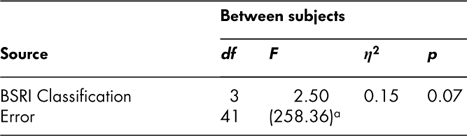
a Value enclosed in parentheses represents mean square error.
Analysis of variance for women’s scores on the Wellness Index (n = 55)
a Value enclosed in parentheses represents mean square error.
Analysis of variance for women’s scores on the Satisfaction With Life Scale (n = 54)
a Value enclosed in parentheses represents mean square error.
Wellness Index scores for women according to Bem Sex Role Inventory Classification (n = 55)

Lower scores indicate greater wellness. Means with different subscripts differ significantly at p < 0.05 by Games-Howell test. All other means are not significantly different.
Satisfaction With Life scores for women according to Bem Sex Role Inventory Classification (n = 55)

Means with different subscripts differ significantly at p < 0.05 by Games-Howell test. All other means are not significantly different.
As there were unequal numbers of women in the different BSRI classifications, we conducted a Games-Howell post hoc test. Contrary to our hypothesis, women classified as instrumental did not report significantly higher levels of wellness or life satisfaction than women in the other three groups. Rather, as predicted by the androgyny model, women classified as androgynous reported higher levels of general wellness than participants classified as instrumental or undifferentiated (see Table 9). Women classified as androgynous also reported higher levels of life satisfaction than women classified as expressive (see Table 10).
Gender and Self-Reported Health Function
It was also hypothesized that women would show higher correlations than men between a more objective self-report index of chronic health conditions and more subjective self-rated physical health and wellness. Two-tailed Pearson correlations were run to explore the relations among the C-K Index, the Wellness Index, and the RAND SF-36. For women, the negative correlation between the C-K Index and the RAND SF-36 (r = –0.34, p < 0.05) indicated that as the number and severity of medical diagnoses increased, self-ratings of physical health functioning decreased. For men, the correlation between these two measures, however, was also statistically significant (r = –0.49, p < 0.01). Correlations between the C-K Index and the Wellness Index were not significant for either gender.
Discussion
This study explored Bem’s androgyny model in relation to self-reported health function in older adults in a community in southwestern Ontario. First, based on the literature and a bio-psychosocial model of health, we hypothesized that among the older women in our sample a higher percentage would fall into Bem’s expressive classification than into any of the other three (instrumental, androgynous, or undifferentiated), and we expected that among older men, a higher number would fit the instrumental category than the other three. Second, it was anticipated that older women and men in the instrumental classification would report more favourable health function than peers of the same sex in the other three BSRI categories. Third, we anticipated that women would show higher correlations than men between an index of number and severity of reported chronic health conditions and two of the three facets of our model of self-described health function (physical health function and wellness). None of our hypotheses was supported by statistically significant results. However, our results suggest directions for future study and provide a new view of the relationship among personality traits, gender, and health function in older adults.
With regard to the first hypothesis, among women there were no statistically significant differences in the number in each of the four BSRI categories, and among men there were no statistically significant discrepancies in the number classified in the four categories. Nonetheless, consistent with the first hypothesis, on an absolute basis a higher percentage of women fell in the expressive category than the other three, and a higher number of men fell in the instrumental classification than in the others.
Contrary to the second hypothesis, older men and women who were classified as instrumental did not rate their health function (physical health function, wellness, or life satisfaction) more positively than did their expressive, undifferentiated, or androgynous counterparts. In fact, a different trend emerged for the women in the sample, such that androgynous women had significantly more positive ratings of wellness than their instrumental and undifferentiated peers and higher life satisfaction ratings than their expressive peers. No clear relation was found between BSRI classification and any aspect of self-reported health functioning for the men in the sample.
Consistent with Bem’s model of androgyny (Bem, Reference Bem1974), these results suggest that for older adult women high levels of both instrumental and expressive traits may be most adaptive. Notably, when instrumentality and expressivity were examined as continuous interval-level variables as measured by the BSRI subscales of Masculinity and Femininity, older men endorsed higher levels of instrumentality than expressivity and older women showed the opposite pattern. Nonetheless, the mean values of both instrumentality and expressivity were relatively high for both genders (see Table 1).
Even in the absence of the expected relationship between high instrumentality and self-reported health in older adults, the present results do not mean that stereotypically masculine traits are not culturally valued for both men and women. Indeed, androgyny necessarily involves having high levels of instrumental traits. These findings imply that high amounts of expressivity, or stereotypically feminine traits, in addition to high levels of instrumental traits, and the interplay between these two trait groups, may also be important for older women. While instrumental traits have been shown to be related to health functioning in previous research (e.g., Bassoff & Glass, Reference Bassoff and Glass1982; Shifren & Bauserman, Reference Shifren and Bauserman1996; Whitley, Reference Whitley1983), a strong relationship between expressive traits and health functioning has not been widely found.
A possible explanation for these results is that instrumental BSRI classification, and instrumental traits in general, may not be as strongly related to the types of physical and psychological problems faced by older adults as they are to the types faced by younger adults. Past research clearly establishes a link between high levels of instrumentality (in the absence of high levels of expressivity) and health, but primarily in samples of young, college-aged adults. It is possible that the type of health issues salient to that demographic group (e.g., condom use; Shifren & Bauserman, Reference Shifren and Bauserman1996) are not the same health issues salient for older adults (e.g., chronic illnesses; Quirouette & Pushkar, Reference Quirouette and Pushkar1999). A link between high instrumentality and health might have emerged if we had used different measures to assess these constructs. It is also possible that specific subgroups of instrumental or expressive traits, such as those that are more socially desirable, are associated with better health overall (Woodhill & Samuels, Reference Woodhill and Samuels2003).
It is also important to consider gender and its relation to coping style. It is said that growing old is not for “sissies,” and the health problems associated with aging are certainly associated with increased stress for older adults. Bio-behavioural research suggests that, consistent with stereotypical masculinity, men tend to rely on problem-focused coping strategies: two familiar reactions are aggression (fight) or avoidance (flight). Conversely, women may use equally active, affiliation-seeking coping styles (the “tend and befriend” paradigm; Monnier, Stone, Hobfoll, & Johnson, Reference Monnier, Stone, Hobfoll and Johnson1998; Taylor, Reference Taylor2006). It may be that older adults who adopt both coping styles may exhibit a facet of androgyny that is not measured by the BSRI and thus is not captured in the present data, which document a positive association between androgyny and wellness and life satisfaction for women but not men. This is an area requiring further investigation.
Additionally, as we have mentioned, some have argued that gender role becomes less salient, and less clearly defined, for older adults. If this is the case, it may be that the relationships among stereotypically masculine and feminine gender roles, associated personality traits, and self-reported health functioning are stronger than the results of this study suggest.
Present results may also reflect participants’ relatively restricted range of scores on the two BSRI subscales, which were the basis of assigning participants to instrumental, expressive, androgynous, and undifferentiated categories using the median-split method. This limited range and resulting diminished variance may have obscured relationships between instrumentality and health functioning. Restricted range of scores on the BSRI subscales also might explain why no significant relationships at all were found between the BSRI categories and self-reported health function for the older male participants, whose range of scores was especially restricted. Ideally, measures should be constructed so that the majority of participants score in the mid-range of possible responses, where a measure may be most sensitive. In the current study, men’s and women’s responses on the both the BSRI subscales were in the upper range of possible scores.
It was not immediately clear why the androgynous classification, as opposed to an instrumental classification, might be more psychologically adaptive for women while there was no overall relationship between the BSRI classification and either wellness or life satisfaction for men. Notably, being highly instrumental did not prove to be especially adaptive for older men either. Perhaps gender-linked patterns of behaviour do not influence older men’s health functioning in the same way they do for women. Androgynous women may benefit from behaviours associated with having high levels of both instrumentality and expressivity. In this way, women who are highly instrumental may reap the benefits associated with stereotypically masculine traits such as independence and decisiveness, while simultaneously benefiting from the social support and communal networks associated with expressive traits. It is possible that the interplay between these traits may be more relevant for women’s general health functioning than it is for men. This requires further exploration.
Consideration of cultural androcentrism (Bem, Reference Bem1993) may help clarify why women showed an effect for androgyny while men did not. Specifically, androgyny adds instrumental personality traits to the expressive traits consistently endorsed by young women, while for men, expressive traits are added to instrumental traits. Previous research has shown the positive effect of instrumentality on health, but no such effects have been found for expressivity and health. It may be that an addition of expressive personality traits for older adult men does not necessarily add what is culturally valued and therefore would not be related to greater wellness and life satisfaction.
Previous research has suggested that women may provide more accurate reports of their own health than do men (Idler, Reference Idler2003). Our third hypothesis was that, compared to men, women would show higher correlations between self-reported physical health function (RAND SF-36) and wellness (Wellness Index) and a relatively objective self-report measure of chronic health conditions (the C-K Index). In the current study, significant correlations between physical health function and the chronic illness index were present for both sexes, while there was no significant correlation between chronic illness and wellness for either gender. On an absolute basis the correlation between self-reported physical health and chronic illness was greater in men. This finding, contrary to many previous studies of self-rated health (Idler, Reference Idler2003), may be explained by differences in study design. For example, other studies of self-reported health have used more objective means of assessing chronic illness independent of self-report measures, including physician’s reports and medical records. This body of research has often examined longitudinal data, and as such has been able to speak to the relationship between self-rated health and objective health conditions over time. Unfortunately, these techniques were outside the purview of the present study.
It is necessary to consider the many limitations of the present study. One major limitation is the size of our sample. A more definitive link between androgyny and health in older adults requires replication in a substantially larger and more demographically and geographically diverse sample. Unfortunately, community-dwelling and independent older adults are often difficult to recruit, and ongoing efforts are required to increase social science research with this demographic group.
Based on the findings of the current study, several directions for future research are suggested. First, it may be useful to explore the relationship between gender roles as assessed by the BSRI and locus of control in older adults (Windle & Sinnott, Reference Windle and Sinnott1985). In a factor analysis, Windle and Sinnott (Reference Windle and Sinnott1985) explored the two-factor (masculinity and femininity) model of BSRI items with a sample of older adults. The authors found that, rather than the two-factor masculinity and femininity model that emerged for younger men and women, multiple-factor models emerged for both older men and women. It is important to note that androgyny, as identified by the median-split method of analysis for the BSRI, may not reflect the same dimensions for older adults as it does for younger adults. For example, it may be that for older adults, the adjectives on the BSRI Masculinity subscale are more a reflection of an internal locus of control rather than any particular gender-role-related personality traits or behaviours. Examination of the behaviours associated with gender role classification in older adults would provide a way to explore this possibility. For example, it may be helpful to study what, if any, behavioural differences emerge among instrumental, androgynous, and expressive older adults (e.g., activity level or self-advocacy in health care environments).
The relationship between personality traits and health functioning in older adults requires further investigation. The link between androgyny and health functioning in an older adult population should be explored further, particularly for older women. While it may be appropriate to continue to examine whether a relationship exists between instrumentality and expressivity and health in older adults (using, perhaps, a more sensitive measure of those constructs), it would also be worthwhile to investigate other personality traits, such as neuroticism and conscientiousness, two groups of personality traits that have been also found to be related to the health of older adults (Shifren & Bauserman, Reference Shifren and Bauserman1996).